Do elephants make deliberate gestures to ask for things? Our study says yes

Source: The Conversation – Africa (2) – By Vesta Eleuteri, PhD candidate, Universität Wien

Elephants are known for their intelligence, strong social bonds, and good memories. But do they communicate to show real intention? A new study suggests they do. The research showed that elephants gestured to ask for food when a person was around and that they kept gesturing when they didn’t receive all the food. These are signs that the elephants are trying to communicate with intention.

We spoke to lead author Vesta Eleuteri, a PhD candidate, to learn more about what this means and why it matters.


Why did you study how elephants use gestures to communicate?

Most of the research on elephant communication is on their calls and chemical signals, likely because of their extraordinary hearing and smell. How elephants communicate with gestures is comparatively less studied. But there are descriptions of elephants using many different body movements and displays in different contexts, which suggests a key role of gestures in elephant communication.

But whether elephants gesture intentionally to others to communicate goals in mind has not been systematically explored before. My colleagues and I study the cognition and communication of animals to understand how complex cognitive skills evolved, which is what this article is based on.

In our study led by the University of Vienna and in collaboration with the University of St Andrews, the University of Portsmouth and City University of New York, we show that semi-captive elephants use many different gestures intentionally to ask a human to give them apples (their goal).

We found that the elephants used 38 different gesture types intentionally. The elephants kept gesturing when they only got half the apples (only partially reached their goal), while they changed gestures when they got no apples (did not reach their goal), both key behaviours to establish intentional use.

Why is it important to know whether their communication is intentional?

The ability to intentionally communicate goals in mind using a variety of gestures might help elephants navigate their complex social lives. By showing that semi-captive elephants gesture intentionally to humans using many different gesture types, our study builds on the evidence that this ability is not unique to primates, but that it has repeatedly emerged during evolution.

Here we consider intentionality as “goal-directed intentionality”, which is the ability to communicate goals we have in mind to others. This was in the past considered to be a unique human skill. Today we know that all the other apes and even some other primates (although in a less flexible way) communicate intentionally using over 70 different gesture types to communicate many different goals in mind. Some examples include gesturing for things like “come here”; “give me that”; “groom me”.


Read more:
Whose turn is it? The question is at the heart of language and chimpanzees ask it too


In non-primates, this intentionality was shown only in a few animals, from guppy fish to Arabian babblers. But typically this was done with one or two gestures and for specific goals, like “follow me”.

Elephants are distantly related to humans in evolution. We last shared a common ancestor with them over 100 million years ago. But, like apes, they are highly intelligent and live in complex societies where they have many different types of relationships (from kin to allies, friends and strangers). Also, there are descriptions of elephants using many different body movements and displays during many different contexts. These include when they greet, affiliate, play with each other or even when they travel together.


Read more:
Female elephants rumble to say ‘let’s go!’ New study in Namibia shows males do too, a sign of unexpected social bonds


What gestures did the elephants use, and how do you know they were on purpose?

The elephants in semi-captivity often reached their trunks or swung them back and forth towards the human or the tray with apples. This made it clear they were communicating that they wanted the apples.

Elephant gestures.

To know whether the elephants were using their gestures intentionally, we applied the behavioural criteria first created to study the development of intentional communication in human infants. These are: audience directedness, persistence and elaboration.

Signallers should use gestures when there is a recipient and appropriately according to whether he/she is looking or not (audience directedness). For example, if the recipient is not looking at them, they should use tactile gestures instead of visual gestures that the recipient would not see.

After gesturing, signallers should wait for the recipient to react and, if the recipient does not react as they wanted, they should keep gesturing (persistence) or change gestures (elaboration) to clarify what they wanted.

I can make an example. If I want to ask you to pass me the salt (my goal), I first should consider whether you are looking at me and, if you are, I may reach my hand towards the salt (audience directedness). If you don’t react or pass me the wrong thing, like the pepper, I should keep gesturing (persistence) or should change gesture by, for example, pointing towards the salt to clarify I wanted the salt from you (elaboration).

You worked with semi-captive elephants; do wild elephants act the same?

We and many other elephant experts have observed wild elephants gesturing apparently intentionally to each other (and even to us!) many times in the field. Nonetheless, we cannot confirm their ability to gesture intentionally merely from our observations. Science is there to systematically test with data the intuitions or feelings we get from observations.

Whether wild elephants use the same gestures we observed in this semi-captive group is an interesting question that needs to be explored. The same goes for assessing if different elephant groups or populations use different gestures. Based on previous descriptions, wild elephants should use, intentionally, a few of the gestures we found (trunk reaches or swings) but maybe they don’t use some of the “more creative” ones like the “blow leaf in the air” our elephant Pfumo had fun using.


Read more:
Spotted hyenas all sound different when they call – they can tell friend from foe


What’s next for your research?

We want to systematically test whether wild elephants gesture intentionally to each other, describe the repertoire of their intentional gestures and the goals (meanings) they use these gestures for (they may say to each other: “travel with me”, “move away”, “stop that”). We have thousands of videos collected in two elephant populations in South Africa that I am video coding for gestures and their intentional use.

It will take time to define the repertoire and meanings of elephant intentional gestures. But we hope to someday do this and to compare the gestures of different populations to understand if elephants may have different “gestural languages”.


Read more:
When a hippo honks, here’s what it could mean – to another hippo at least


Studying animal communication offers “a window” into our own language, into our minds, because it allows us to understand what, if anything, makes language unique. Showing that animals have so much in common with us makes people empathise more with them and care more about them, which is important for their conservation.


Read more:
Bottlenose dolphins smile at each other when they play — new study reveals how and why


Most importantly, studying animal communication is crucial because we can understand animals better and, if we know them better, we can take better measures to safeguard them.

The Conversation

Vesta Eleuteri is affiliated to the University of Vienna and receives funding from the Austrian Science Fund (FWF) under the grant “DK Cognition and Communication 2”: W1262-B29 (10.55776/W1262).

ref. Do elephants make deliberate gestures to ask for things? Our study says yes – https://theconversation.com/do-elephants-make-deliberate-gestures-to-ask-for-things-our-study-says-yes-261782


Sudan’s rebel force has declared a parallel government: what this means for the war

Source: The Conversation – Africa (2) – By Samir Ramzy, Researcher, Helwan University

Sudan’s south-western city of Nyala in Darfur recently became the centre of a significant political development.

After more than two years of fighting Sudan’s army, an alliance of armed and political groups backed by the paramilitary Rapid Support Forces announced the formation of a parallel government on 20 July 2025.

The new administration, dubbed the Government of Peace and Unity, is a coalition of armed movements from Darfur in Sudan’s western region, and Kordofan in the central region. Together, these regions account for about 46% of Sudan’s total land area.

The coalition has made Nyala its base. The city is a transit hub, with an airport and railway terminus. It is also a trading centre for gum arabic, one of Sudan’s largest exports and a key ingredient in making food, drinks and medicines.

The coalition’s stated aim is to establish a more representative governing structure for Sudan’s peripheral regions. It has 24 member groups.

In my view, however, the creation of a parallel government reflects the reality that neither the Rapid Support Forces nor its rival Sudanese army is close to victory. This view is informed by my research on Sudan’s political developments and its conflict dynamics for close to a decade.

The creation of a parallel government appears to be about entrenching the paramilitary group’s control in its western strongholds as the conflict continues. It risks cementing a permanent division of the country.

Why form a parallel government?

The Rapid Support Forces emerged from the Janjaweed militias that fought in Darfur, western Sudan, in the 2000s. Once allied with the state, the group grew into a powerful governmental paramilitary force, competing with the Sudanese Armed Forces for control of Sudan’s politics and economy.

When full-scale war broke out in April 2023, the Rapid Support Forces quickly seized much of western Sudan, particularly the Darfur region. It is country’s largest region, home to around 10 million people and spanning 500,000 square kilometres.

Darfur shares borders with Libya, Chad and the Central African Republic. It is also the Rapid Support Forces’ leadership’s home territory. It contains vast reserves of gold, fertile farmland and major production zones for gum arabic.

With little chance of outright military victory and its image in tatters, the paramilitary group has sought to reinvent itself politically. The group’s reputation has been devastated by reports of ethnic cleansing, sexual violence and atrocities against civilians.

The new Government of Peace and Unity is its attempt to gain favour. By forging alliances with other armed movements and community groups, the group is trying to position itself as the voice of Sudan’s marginalised peripheries.

Coalition partners include the Sudan People’s Liberation Movement-North (SPLM-N), the largest non-state armed group in Sudan. The group controls territory in Kordofan and advocates for the establishment of a secular state.

The new coalition’s founding charter calls for:

  • a decentralised political system

  • granting Sudan’s regions significant autonomy over local governance and resources.

This resonates with communities such as the Fur who have suffered decades of exclusion by Sudan’s political elite. Most of these leaders come from the country’s northern and central regions.


Read more:
Sudan’s civil war is rooted in its historical favouritism of Arab and Islamic identity


The timing of the announcement reflects both political and military calculations.

The Rapid Support Forces and its allies control large areas in western Sudan but have faced challenges expanding further east, where the Sudanese army remains entrenched.

Establishing a formal administration allows the coalition to strengthen its influence in the territories it already holds, and build alliances with local communities. It also helps create political structures that can engage with external actors.

Broadening the political base

Key figures from influential political groups have taken senior positions within the parallel government.

The Rapid Support Forces commander Mohamed Hamdan Dagalo (also known as Hemedti) has assumed the role of president of the presidential council. Abdelaziz al-Hilu, the leader of SPLM-N, was appointed as vice-president.

Fadlallah Burma, head of a faction of the Umma Party, the former ruling party, took the position of speaker of the legislative council. Mohamed al-Ta’ayshi, a politician from the Arab Ta’aisha tribe, was appointed prime minister.

Leaders from African-origin communities such as the Fur have also taken positions within the administration. Many of these groups have faced Sudanese army airstrikes and have historical grievances against the central state.

However, legitimacy at home is not enough. The Rapid Support Forces also hopes to use foreign alliances to force international recognition.

Kenya hosted the coalition’s launch conference. The group has also cultivated ties with actors in Chad, the Central African Republic, South Sudan and eastern Libya. These relationships have already helped the group consolidate control over key border areas, particularly in Libya, which spans a 382km border.

Serious challenges remain

The Rapid Support Forces-led project faces major obstacles.

Internal rivalries over power sharing have delayed the announcement of a full cabinet. Key ministries, including defence, foreign affairs and finance, remain unassigned.

Militarily, the Rapid Support Forces cannot claim uncontested authority even in its western strongholds. Sudanese army-allied forces still control El-Fasher, the capital of North Darfur. The army also maintains an overwhelming advantage in the air, making it impossible for the parallel government to project control beyond its core zones.

Internationally, the initiative has been widely condemned by the African Union and the Arab League.

The risks ahead

The failure of international mediation has left Sudan’s conflict at an impasse.

Tensions between Egypt and the United Arab Emirates – both key players in an international mediation effort that also includes the US and Saudi Arabia – have further complicated the search for a political solution.

Their tensions led to the postponement of a peace meeting in Washington in July 2025. The meeting was called off after Egypt, which supports the army, rejected the UAE’s proposal to exclude the two major warring parties from Sudan’s transitional government.

In this context, the Rapid Support Forces’ bid for legitimacy may fuel a more intense struggle with the army rather than a push towards compromise.

Three battlegrounds are likely to escalate.

  • The battle for El Fasher: Military confrontations are likely to escalate in El Fasher, the capital of North Darfur, as it remains the only major area in the region not under the control of the Rapid Support Forces.

  • The air war: The paramilitary group may try to procure advanced weapons to counter the army’s air dominance.

  • The humanitarian front: The parallel government could use aid routes to gain recognition. The UN has shown flexibility in engaging with de facto authorities in Sudan, prompting the army to block such efforts by controlling border crossings and routes as much as possible.

The longer the stalemate lasts, the greater the risk that Sudan will fragment beyond repair, which is unlikely to benefit any party involved.

What needs to happen next

One immediate step the international community could take is to expand and strictly enforce the arms embargo on Sudan. This could reduce the flow of weapons to both sides and create pressure for a return to negotiations.

In addition, a new political process is urgently needed, one less vulnerable to regional rivalries than the four-nation initiative.

International actors must also find ways to deliver humanitarian aid directly, even if that means air drops into hard-to-reach areas. This will help reduce civilian suffering and prevent both sides from weaponising aid access.

Without such interventions, Sudan’s future could be defined by a protracted war that leaves the state hollowed out and communities further devastated.

The Conversation

Samir Ramzy does not work for, consult, own shares in or receive funding from any company or organisation that would benefit from this article, and has disclosed no relevant affiliations beyond their academic appointment.

ref. Sudan’s rebel force has declared a parallel government: what this means for the war – https://theconversation.com/sudans-rebel-force-has-declared-a-parallel-government-what-this-means-for-the-war-262363

Why on Earth is the planet’s day getting shorter?

Source: The Conversation – UK – By James O’Donoghue, Research Associate Professor in Planetary Astronomy, Meteorology, University of Reading

Quality Stock Arts/Shutterstock

Earth will complete a rotation 1.33 milliseconds earlier than usual on Tuesday, August 5. That makes it one of the shortest days of 2025 at 86,399.99867 seconds long. How that happens, and how we can even measure it with such precision, might make your head spin faster too.

On average, Earth physically rotates in 23 hours, 56 minutes, 4 seconds and 90.5 milliseconds – this is called a sidereal day. It is Earth’s “true” rotation relative to distant objects in deep space, like stars.

However, the kind of day most people go by is 24 hours long and that is called a solar day – it’s the time between two sunrises, or consecutive noons. The extra 4 minutes comes from the fact that Earth has to rotate 1 more degree, to 361 degrees, for the Sun to appear in the same place again.

Both kinds of day are slightly shorter on August 5 2025, largely due to what is happening with winds in Earth’s atmosphere, fluid circulation in the ocean and magma – and even the Moon’s gravitational pull.

Deviations from 24 hours have been accurately measured since the 1970s using atomic clocks and astronomy. Over the course of a year, these changes build up: in 1973, for example, the sum of deviations added up to +1,106 milliseconds, meaning that the Earth lagged behind in its rotation by just over a second. Leap seconds were introduced in the same year to correct for this, with one second added to the clock at the end of the day – 23:59:60.

Absurd levels of accuracy are needed in time-keeping. Global positioning systems (more commonly called GPS) can pinpoint where you are in space, that’s no problem. But if the planetary surface you are on has physically spun slightly faster or slower than expected that day, an uncorrected GPS won’t know that, and your position won’t match with your map.

A 1.33 millisecond deviation translates to a position error of about 62 cm at the equator, so 1973’s cumulative drift would have caused GPS errors of around half a kilometre if left uncorrected over the year.

Why doesn’t the Earth stay still?

To find out how fast the Earth is spinning at all, you need to find a reference frame in which, ideally, nothing is moving. Everything in space moves relative to everything else, but the farther we look, the more still things seem; just as distant hills appear to move slower while you’re on a train, and nearby farms rush by.

Luckily, there are objects so magnificently bright that they outshine entire galaxies. These are quasars, and they are visible across the universe from billions of light years away.

Quasars are supermassive blackholes up to billions of times the mass of our Sun, which emit between 100 and 10,000 times more light than our entire galaxy, the Milky Way. Quasars are detectable from billions of light years across the universe, where things are essentially stationary, so they act as cosmic beacons.

Radio telescopes measure our position relative to these, yielding values of Earth’s true rotation period to sub-millisecond accuracy.

Those ultra‑precise observations are also the starting point for computer models which include movements of the atmosphere, oceans, celestial motions and more to predict the length of day. This is how we know, in advance, when a day is shorter, and how to correct GPS as a result.

Winds in Earth’s atmosphere are the biggest influence on the length of each day as a result of their collisions with the land surface, particularly when they hit mountain ranges. Incredible as it may sound, wind actually slows the spin of the Earth this way.

Earth’s prevailing winds are fastest in the northern hemisphere winter, but slowest from June to August, so the summer months always bring the shortest days of the year (even though we tend to say these are the “longest” days in the northern hemisphere, because of their greater daylight duration).

These daily and seasonal changes are just short‑lived blips atop broader slowdowns. Over decades, the melting of the polar ice caps has been slowing the Earth’s rotation. To understand why, consider a spinning ballerina retracting their outstretched arms – they begin to spin much faster. A spinning ball, like Earth, is no different.

Earth is oblate, meaning the surface at the equator is 21.5 km farther from the centre of the planet than the surface at the poles. As climate change melts the polar ice caps, meltwater moves from the poles to the equator via the ocean. Rising sea levels mean water is farther from the surface, and just like the ballerina moving their arms back out, it aids Earth’s slowdown. Redistribution of Earth’s mass changes our rotation in similar ways, including by earthquakes.

A graph showing how day length has changed.
Historical deviation of day length from the 24-hour day (86,400 seconds).
Ⅱ Ⅶ Ⅻ/International Earth Rotation and Reference Systems Service

The Moon, while beautiful, can be a huge drag over billions of years. Earth’s oceans are raised by the Moon’s gravity, but as the Earth rotates, the raised oceans are carried slightly ahead of the Moon in its orbit. But the Moon continues pulling on those oceans, dragging them backwards against the Earth’s anticlockwise rotation, which slows us down.

Earth’s rotational energy isn’t lost, it’s transferred to the Moon, which gains orbital speed and causes it to escape Earth’s gravity a little better – this is why it’s moving away from us at 3.8 cm a year. Our length of day has increased from 17 hours 2.5 billion years ago largely due to the Moon sapping Earth’s angular momentum over the eons.

Earth’s rotation has slowed every year from 1973 to 2020 (where precise measurements exist), with each year accumulating hundreds of milliseconds of lag, which has already been accounted for by adding 27 leap seconds. Things changed from 2020 – the Earth started spinning faster instead of slower every year, probably the result of angular momentum exchange between the Earth’s core and mantle, but modulated by the numerous other motions we’ve explored.

July 5, July 22 and August 5 were singled out as some of this year’s fastest days far in advance, because on top of the Earth’s internal motions and seasonal quirks in atmospheric winds, the Moon’s position in orbit also slows the Earth twice per orbit (every two weeks). This is because when the Moon is directly above the equator, all of its tidal drag acts east to west, but on these dates, it is positioned farthest north and south, weakening that effect.

You won’t notice the sunrise arrive 1.33 milliseconds sooner, but to precision atomic clocks, quasar‐referenced astronomical measurements, it will be obvious.

The Conversation

James O’Donoghue receives funding from the UK Science and Technology Facilities Council (STFC).

ref. Why on Earth is the planet’s day getting shorter? – https://theconversation.com/why-on-earth-is-the-planets-day-getting-shorter-260946

Feeling unstimulated and apathetic at work? You might be experiencing rustout

Source: The Conversation – UK – By Sabrina Fitzsimons, Co-Director of DCU CREATE (Centre for Collaborative Research Across Teacher Education), Lecturer in Education, Dublin City University

Cast Of Thousands/Shutterstock

Tense, overworked employees everywhere will recognise the features of burnout: exhaustion, depersonalisation (feeling detached from others or yourself in the workplace) and a reduced sense of personal accomplishment. It happens when chronic workplace stress isn’t managed appropriately.

At the other end of the stress spectrum is rustout. You may well have experienced it. This is when employees become bored, apathetic and unmotivated, often doing the minimum necessary work. This can result in them procrastinating, browsing social media or looking for something more stimulating elsewhere.

Rustout is mental and emotional decline caused by repetitive, mundane tasks and ongoing professional stagnation. Unlike burnout, which results from work overload, rustout arises from underutilisation and a lack of stimulating work.

It can be amplified when a workplace values efficiency and meeting specific outcomes over professional engagement, leaving people feeling invisible or replaceable. In other words, it occurs when people are not challenged enough.

It may sound like a strange complaint to those who would love to think about work a little bit less. But in the long run, it has the potential to lead to career dissatisfaction and may have an impact on mental health.

Yet, within many occupations, rustout remains an unspoken issue. Perhaps this is due to an unofficial expectation that work is supposed to be boring.

Our research explored rustout in a particular profession: teacher educators. These are university lecturers who teach trainee teachers. We surveyed 154 teacher educators and carried out follow-up interviews with 14 of them.

While most described enjoying their work and its variety, we found an undercurrent of symptoms and experiences indicative of rustout. We believe our findings may have resonance with other occupational settings.

Rustout may sound a bit like the social media trend of quiet quitting. However, the teacher educators we spoke to were not deliberately stepping back from their duties or plotting their exit. In fact, they remained highly committed to their students – making their situation even more frustrating.

They often saw it as a vocation and took pride in guiding new teachers into the profession. Many spoke of the joy it was possible to find in their work and the many brilliant, inspiring young people they had helped to nurture. However, some had lost this enthusiasm.

Ever-growing piles of paperwork forced their focus away from what they enjoyed. Crucially, there was a sense that it was no longer the job they had signed up for.

Focus on teacher educators

Teacher educators in higher education balance multiple responsibilities: teaching, supervising their students’ teaching placements, mentoring, and extensive administrative work. These demands leave little space for engagement with research, which is increasingly valued in metrics-driven universities.

We found that the bureaucratisation of higher education in Ireland and the UK has led to excessive paperwork, compliance tasks, and constant system changes. One teacher educator told us: “A good 70% of my workload now is almost just admin, which is very depressing.”

Combined, these can leave little time for the more creative or professionally enriching aspects of the role, such as curriculum design, teaching or research. “I often feel I have produced nothing at the end of the week, and there is no sense of development,” one said.

Woman at laptop surrounded by papers
Teacher educators spoke of spending a lot of their time on admin.
Nattakorn_Maneerat/Shutterstock

Rustout can also occur when there is a misalignment between professional aspirations and job demands. For example, in our study, some highly qualified teacher educators with significant experience in research, leadership and teaching felt dragged down by repetitive, low-value tasks rather than work that aligned with their expertise.

As one said: “People can be pigeon-holed into a role, and they are left in that comfort zone rather than being challenged or invited to try something that might stimulate or get the creative juices flowing.” Some may be happy to sit with rustout for some time, but being stuck in this situation can lead to professional dissatisfaction.

Restricted professional growth can lead to feelings of rustout. This includes limited opportunities for career mobility, rigid structures, and a lack of workplace career support.

If employees are seen as a “safe pair of hands” who can keep the operation moving, their professional satisfaction is not addressed. “The conversation doesn’t happen; it’s just ‘Did you get the job done’,” one teacher educator said. “It’s not about work satisfaction; you are lucky to have your job.”

Hidden costs of rustout

Rustout has both personal and institutional consequences. On an individual level, it leads to disengagement, apathy and reduced motivation. One said they were “functioning without thriving,” with repetitive tasks eroding their sense of purpose.

Many teacher educators said they were unable to discuss dissatisfaction due to workplace culture and performance expectations. “Rustout exists in teacher education. Absolutely. However, I have no experience of ever having a conversation with anyone around it,” one said.

This may be because it suits everyone not to talk about it. Nothing is being rocked when staff are working and doing their jobs. This silence benefits institutions in the short term, since it maintains stability and delays difficult conversations. However, in the long term, it can contribute to retention issues, a negative workplace culture and possibly reduced innovation.

We believe rustout should be put on the mental health agenda in workplaces, just as burnout is. Employers must acknowledge that the wellbeing of their employees is integral to overall success.

The Conversation

The authors do not work for, consult, own shares in or receive funding from any company or organisation that would benefit from this article, and have disclosed no relevant affiliations beyond their academic appointment.

ref. Feeling unstimulated and apathetic at work? You might be experiencing rustout – https://theconversation.com/feeling-unstimulated-and-apathetic-at-work-you-might-be-experiencing-rustout-260837

I write James Bond novels – here’s why Peaky Blinders creator Steven Knight will bring a crackling new intensity to 007

Source: The Conversation – UK – By Kim Sherwood, Lecturer in Creative Writing, University of Edinburgh

Our hero is on his way to confront danger, feign love and give away a little of his soul. As he takes a long plane journey over Europe into enemy territory, he reflects on what his younger self would make of him now: “Would he recognise himself beneath the surface of this man who was tarnished with years of treachery and ruthlessness and fear?”

You would be forgiven for imagining these as the thoughts of Thomas Shelby, screenwriter Steven Knight’s war hero-turned-Peaky Blinders gang leader. Or the meditations of Viggo Mortensen’s Russian mobster with a heart of gold in Knight’s 2007 film, Eastern Promises.

In fact, this is a passage from Ian Fleming’s fifth James Bond novel, From Russia With Love (1957) – a favourite read of another conflicted, powerful man, John F. Kennedy.

Like Bond, Knight’s protagonists are intelligent, charming, witty, courageous, withdrawn and ruthless – scarred by violence with a seam of cold anger. It is this crosscurrent that makes Knight such a strong pick as the scribe for Bond’s next cinematic incarnation, expected to be released in 2028.

Knight talks about his appointment.

If you’ve not read Fleming before, you might be surprised by Bond’s self-reflection and melancholy here – a strand throughout the books which we saw manifest most significantly on screen during Daniel Craig’s tenure. It’s something I am confident Knight will bring to the screen with crackling intensity, and which I have explored in my own Double O trilogy.

As a lifelong Bond fan, it was a dream come true when the Ian Fleming Estate commissioned me to write a trilogy of novels expanding the world of 007. My mission was to introduce new “Double O” agents.

In Double or Nothing (2022), Bond has gone missing and Moneypenny – now chief of the Double O Section, in the world’s most overdue promotion – doesn’t know if he’s been captured or even killed. In the sequel A Spy Like Me (2024), a rogue Johanna Harwood (003) infiltrates the lion’s den to rescue 007. In the final novel, Hurricane Room, out in May 2026, Bond returns as the Double O agents make their last stand.

The Hurricane Room title comes from the same chapter of From Russia With Love, as Bond’s plane experiences turbulence. As “lighting flung its hands across the windows”, Bond draws on the image of the hurricane room:

In the centre of Bond was a hurricane room, the kind of citadel found in old-fashioned houses in the tropics … To this cell the owner and his family retire if the storm threatens to destroy the house, and they stay there until the danger is past. Bond went to his hurricane room only when the situation was beyond his control, and no other possible action could be taken.

I read From Russia With Love aged 12. It was my first Bond novel and I fell in love with this hero whose inner resources keep him from ever giving up. This is also a quality that Knight unpacks beautifully with the dangerous but soulful Tommy Shelby – probably the only gangster to get a Rambert dance treatment (the series has been adapted into a ballet by the British dance company).

Creating icons

An icon is recognisable by eye. We know Bond by a series of images – the tuxedo, the martini, his Walther PPK pistol – just as we know Shelby by his extreme fade, club collar and peak lapels.

But if a character is as flat as a religious icon, they can’t grow or evolve. That’s not the case with Shelby, who we’ve seen grow with Cillian Murphy over a decade, or Bond, who has evolved with us for seven decades and as many actors. Knight can give us a Bond who is both iconic and human.

Another shared strand between Fleming and Knight is the deliberate use of national myth. Fleming set Bond up as a symbol of Britain. When the villains of From Russia With Love want a scandal that will destroy Britain, they look for a symbol: “Of course, most of their strength lies in myth – in the myth of Scotland Yard, of Sherlock Holmes, of the Secret Service… Myths are built on heroic deeds and heroic people. Have they no such men?” And the reply: “There is a man called Bond.”

With Tommy Shelby, Knight created a recognisable icon.

Fleming then spends the book destroying him. But Bond’s power as a symbol has endured, exemplified in the 2012 Olympic opening ceremony as Daniel Craig, using all the magic of the movies, parachuted in with the Queen.

In Peaky Blinders, Knight takes totemic images from our national consciousness, such as the trenches in the first world war, the Houses of Parliament and Birmingham’s industrial past. But he also gives us the wider picture, from working-class veterans with PTSD to Italian, Jewish and Black families, and women struggling for independence. It’s this refreshing look at our identity that promises Knight’s take on Bond as a symbol will be just as fascinating as Fleming’s.

When Fleming first sat down to write Bond, he told a friend: “I am going to write the spy story to end all spy stories.” He certainly revolutionised the genre, but it wasn’t the end, only the beginning.

It’s been my honour to write in this universe, and I can’t wait to see where Knight takes it next. James Bond Will Return.


This article features references to books that have been included for editorial reasons, and may contain links to bookshop.org. If you click on one of the links and go on to buy something from bookshop.org The Conversation UK may earn a commission.


Looking for something good? Cut through the noise with a carefully curated selection of the latest releases, live events and exhibitions, straight to your inbox every fortnight, on Fridays. Sign up here.


The Conversation

Kim Sherwood does not work for, consult, own shares in or receive funding from any company or organisation that would benefit from this article, and has disclosed no relevant affiliations beyond their academic appointment.

ref. I write James Bond novels – here’s why Peaky Blinders creator Steven Knight will bring a crackling new intensity to 007 – https://theconversation.com/i-write-james-bond-novels-heres-why-peaky-blinders-creator-steven-knight-will-bring-a-crackling-new-intensity-to-007-262547

How much protein do you really need? Too much or too little can be harmful

Source: The Conversation – UK – By Dan Baumgardt, Senior Lecturer, School of Physiology, Pharmacology and Neuroscience, University of Bristol

Prostock-studio/Shutterstock

Does anyone else think we’ve all become a bit too protein-obsessed? Once upon a time, we got our protein from meat, fish, dairy and pulses. Now it seems like every consumable product comes loaded with it — from energy bars to protein-packed cereals and baked goods.

I’m surprised no one’s thought of stirring it into their tea for a boost. Oh wait, they have.

That’s not to say I’m anti-protein. Far from it. Protein plays an essential role in body functions such as growth, immunity and digestion. It’s important that we get enough of it each day.

But the million-dollar questions we should be asking are: how much do we actually need? When is it too much, or too little? And where should we be getting it from?

Protein is one of the three macronutrients we need in the largest amounts – the others being carbohydrates and fats. Micronutrients such as vitamins and minerals are important too, but they’re needed in much smaller quantities — typically milligrams, or even micrograms.

Protein is involved in a huge range of physiological processes. It’s of course crucial for muscle growth and repair. Bodybuilders looking for an Adonis (or Amazonian) physique often consume large amounts alongside strength training. But protein isn’t just about muscles – it’s a core structural material for bone, skin, hair and nails too.

It also plays vital roles inside the body. It allows muscles to contract, makes up digestive and metabolic enzymes, and is a key component of haemoglobin (which carries oxygen), ferritin (which stores iron) and antibodies (which fight infection).

But remember: protein doesn’t work in isolation. Our bodies also rely on carbohydrates and fats — providing short and long-term energy sources that are just as important.

Carbohydrates provide four calories of energy per gram, and fats proide nine calories per gram. While protein can also be used as an energy source – also producing four calories per gram – carbs are more accessible for tissues to use rapidly. And crucially, building muscle also requires fuel. So, if your diet is too low in carbohydrates, your muscle gains may stall and you may find yourself depleted of energy.

In general, protein is filling and can help reduce snacking. And too little protein can be harmful. Protein deficiency can occur due to inadequate diet, eating disorders, or conditions such as cancer, Crohn’s, or liver disease. Symptoms include fatigue, muscle wasting and a weakened immune system.

Because protein also helps regulate fluid balance in the body, a deficiency can lead to swelling or oedema. In severe cases, as seen in some developing countries, the condition kwashiorkor — marked by a swollen belly — can result from inadequate protein intake.

How much?

It can sometimes be difficult to work out how much protein you should be eating each day, especially when different sources give variable advice.

A good starting point is to consider your overall energy requirements. Government recommendations suggest that up to 35% of your daily calories should come from fat, and up to 50% from carbohydrates. That leaves a minimum of 15% for protein — which for someone on a 2,500-calorie diet works out to about 95g of protein per day.

Another calculation accounts for your body size too, giving a value more specific to the individual. Around 0.8g protein per kilogram of body weight for a sedentary adult is advised.

For athletes and bodybuilders – who often aim for around 2g per kilogram — this can mean as much as 200g of protein a day. And that’s hard to achieve through regular food alone. For context, 30 eggs contain 200g of protein, as does 2.5kg of cooked beans. Certain foods have more protein (like the go-to chicken breast), though the overall volume of food required can still be high.

That’s where protein powder often comes in — usually offering 20g–30g of protein per scoop – as supplementation. It’s absolutely fine to incorporate some powder or shakes into a healthy diet alongside wholefoods, which are the best protein sources. But it’s important to set limits – and avoid the temptation to go overboard.

Too much

Is it possible to be taking on too much protein? The answer is yes, if you’re regularly consuming more than your body needs.

Excess protein is broken down and excreted through the kidneys, which may cause dehydration and place additional strain on renal function. Unused protein can also be converted into fat, potentially leading to weight gain. High-protein diets are sometimes associated with gastrointestinal side effects such as bloating, diarrhoea and bad breath.

And while many high-protein foods are healthier, others (such as red or processed meats) may also be high in saturated fat, which can increase the risk of serious conditions like heart disease.

So yes — protein is essential, but balance is key. Your daily needs depend on your body size, activity levels and general health. Consider your goals: are you aiming to maintain a certain weight, or looking to lose fat or gain muscle? Some starting points are:

  • aim for at least 0.8g protein per kilogram of body mass daily
  • balance it with adequate carbs and fats
  • prioritise wholefood sources over protein supplements where possible
  • increase your intake responsibly if you’re training hard or trying to gain muscle
  • but be cautious with too high, sustained intakes — these may do more harm than good.

As someone who could do with a wee bit more in his own diet, I’m off to try that protein-in-my-tea trick. Wish me luck.


Get your news from actual experts, straight to your inbox. Sign up to our daily newsletter to receive all The Conversation UK’s latest coverage of news and research, from politics and business to the arts and sciences.

The Conversation

Dan Baumgardt does not work for, consult, own shares in or receive funding from any company or organisation that would benefit from this article, and has disclosed no relevant affiliations beyond their academic appointment.

ref. How much protein do you really need? Too much or too little can be harmful – https://theconversation.com/how-much-protein-do-you-really-need-too-much-or-too-little-can-be-harmful-261211

A red meat allergy from tick bites is spreading – and the lone star tick isn’t the only alpha-gal carrier to worry about

Source: The Conversation – USA (3) – By Lee Rafuse Haines, Associate Research Professor of Molecular Parasitology and Medical Entomology, University of Notre Dame

Steak and other red meats can trigger an allergic reaction in people with alpha-gal syndrome. Vicushka/Moment via Getty Images

Hours after savoring that perfectly grilled steak on a beautiful summer evening, your body turns traitor, declaring war on the very meal you just enjoyed. You begin to feel excruciating itchiness, pain or even swelling that can escalate to the point of requiring emergency care.

The culprit isn’t food poisoning – it’s the fallout from a tick bite you may have gotten months earlier and didn’t even notice.

This delayed allergic reaction is called alpha-gal syndrome. While it’s commonly called the “red meat allergy,” that nickname is misleading, because alpha-gal syndrome can cause strong reactions to many products, beyond just red meat.

The syndrome is also rapidly spreading in the U.S. and around the globe. The Centers for Disease Control and Prevention estimates as many as 450,000 people in the U.S. may have it. And it’s carried by many more tick species than most people realize.

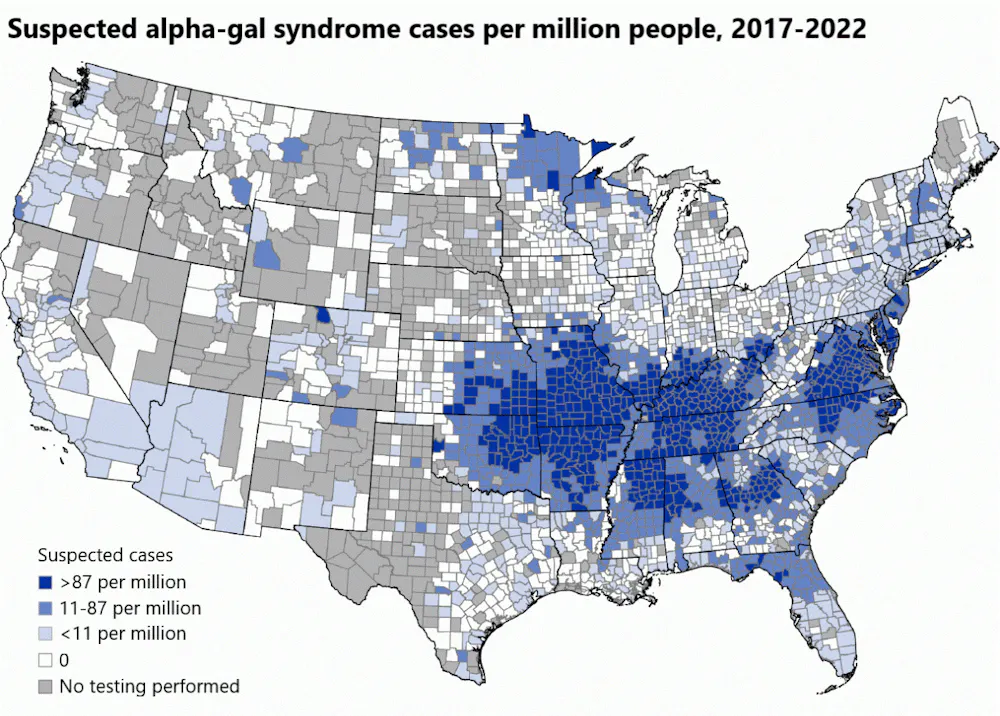
A map shows the numbers of confirmed alpha-gal syndrome cases in a band from Oklahoma and Nebraska to Virginia and the Carolinas. There is also a collection in northern Minnesota and Wisconsin, and another in Florida.
Cases of suspected alpha-gal syndrome based on confirmed laboratory evidence.
CDC

What is alpha-gal syndrome?

Alpha-gal syndrome is actually an allergy to a sugar molecule with a tongue-twisting name: galactose-alpha-1,3-galactose, shortened to alpha-gal.

The alpha-gal sugar molecule exists in the tissues of most mammals, including cows, pigs, deer and rabbits. But it’s absent in humans. When a big dose of alpha-gal gets into your bloodstream through a tick bite, it can send your immune system into overdrive to generate antibodies against alpha-gal. In later exposure to foods containing alpha-gal, your immune system might then launch an inappropriate allergic response.

A reddish-brown tick with a large yellow spot on its back sits on a leaf.
A lone star tick (Amblyomma americanum) found near Aden, Va. The tick can cause alpha-gal syndrome as well as carry other diseases, including ehrlichiosis, tularemia and Southern tick-associated rash illness.
Judy Gallagher via Wikimedia, CC BY

Often this allergy is triggered by eating red meat. But the allergy also can be set off by exposure to a range of other animal-based products, including dairy products, gelatin (think Jell-O or gummy bears), medications and even some personal care items. The drug heparin, used to prevent blood clotting during surgery, is extracted from pig intestines, and its use has triggered a dangerous reaction in some people with alpha-gal syndrome.

Once you have alpha-gal syndrome, it’s possible to get over the allergy if you can modify your diet enough to avoid triggering another reaction for a few years and also avoid more tick bites. But that takes time and careful attention to the less obvious triggers that you might be exposed to.

Why more people are being diagnosed

As an entomologist who studies bugs and the diseases they transmit, what I find alarming is how rapidly this allergy is spreading around the globe.

Several years ago, experts thought alpha-gal syndrome was primarily limited to the southeastern U.S. because it was largely associated with the geographical range of the lone star tick.

A Maryland woman finds a lone star tick on her skin in 2017.
How a tick feeds.
National Institute of Allergy and Infectious Diseases via Wikimedia Commons, CC BY

However, both local and global reports have now identified many different tick species across six continents that are capable of causing alpha-gal syndrome, including the prolific black-legged tick, or deer tick, which also transmits Lyme disease.

These ticks lurk in yards and urban parks, as well as forests where they can stealthily grab onto hikers when they touch tick-infested vegetation. As tick populations boom with growing deer and human populations, the number of people with alpha-gal syndrome is escalating.

Why ticks are blamed for alpha-gal syndrome

There are a few theories on how a tick bite triggers alpha-gal syndrome and why only a small proportion of people bitten develop the allergy. To understand the theories, it helps to understand what happens as a tick starts feeding on you.

When a tick finds you, it typically looks for a warm, dark area to hide and attach itself to your body. Then its serrated teeth chew through your skin with rapid sawing motions.

As it excavates deeper into your skin, the tick deploys a barbed feeding tube, like a miniature drilling rig, and it secretes a biological cement that anchors its head into its new tunnel.

A magnified view of a tick's mouth.
A tick’s mouth is barbed so it can stay embedded in your skin as it draws blood over hours and sometimes days.
National Institute of Allergy and Infectious Diseases

Once secure, the tick activates its pumping station, injecting copious amounts of saliva containing anesthetics, blood thinners and, sometimes, alpha-gal sugars into the wound so it can feed undetected, sometimes for days.

One theory about how a tick bite causes alpha-gal syndrome is linked to the enormous quantity of tick saliva released during feeding, which activates the body’s strong immune response. Another suggests how the skin is damaged as the tick feeds and the possible effect of the tick’s regurgitated stomach contents into the bite site are to blame. Or it may be a combination of these and other triggers. Scientists are still investigating the causes.

What an allergic reaction feels like

The allergy doesn’t begin right away. Typically, one to three months after the sensitizing tick bite, a person with alpha-gal syndrome has their first, disturbing reaction.

Alpha-gal syndrome produces symptoms that range from hives or swelling to crushing abdominal pain, violent nausea or even life-threatening anaphylactic shock. The symptoms usually start two to six hours after a person has ingested a meat product containing alpha-gal.

Due to a general lack of awareness about the allergy, however, doctors can easily miss the diagnosis. A study in 2022 found that 42% of U.S. health care practitioners had never heard of alpha-gal syndrome. A decade ago, people with alpha-gal syndrome might go years before the cause of their symptoms was accurately diagnosed. Today, the diagnosis is faster in areas where doctors are familiar with the syndrome, but in many parts of the country it can still take time and multiple doctor visits.

Unfortunately, with every additional tick bite or exposure to food or products containing alpha-gal, the allergy can increase in severity.

Ticks at different ages and sexes compared to a dime (which is quite a bit larger).
The lone star tick isn’t the only one that can cause alpha-gal syndrome. Black-legged ticks have also been connected to cases.
U.S. Army

If you think you have alpha-gal syndrome

If you suspect you may have alpha-gal syndrome, the first step is to discuss the possibility with your doctor and ask them to order a simple blood test to measure whether your immune system is reacting to alpha-gal.

If you test positive, the main strategy for managing the allergy is to avoid eating any food product from a mammal, including milk and cheese, as well as other potential triggers, such as more tick bites.

Read labels carefully. Some products contain additives such as carrageenan, which is derived from red algae and contains alpha-gal.

In extreme cases, people with alpha-gal syndrome may need to carry an EpiPen to prevent anaphylactic shock. Reputable websites, such as the CDC and alphagalinformation.org, can provide more information and advice.

Mysteries remain as alpha-gal syndrome spreads

Since alpha-gal syndrome was first formally documented in the early 2000s, scientists have made progress in understanding this puzzling condition. Researchers have connected the allergy to specific tick bites and found that people with the allergy can have a higher risk of heart disease, even without allergy symptoms.

But important mysteries remain.

Scientists are still figuring out exactly how the tick bite tricks the human immune system and why tick saliva is a trigger for only some people. With growing public interest in alpha-gal syndrome, the next decade could bring breakthroughs in preventing, diagnosing and treating this condition.

For now, the next time you are strolling in the woods or in long grasses, remember to check for ticks on your body, wear long sleeves, long pants and tick repellent to protect yourself from these bloodthirsty hitchhikers. If you do get bitten by a tick, watch out for odd allergic symptoms to appear a few hours after your next steak or handful of gummy bears.

The Conversation

Lee Rafuse Haines is affiliated with the Liverpool School of Tropical Medicine as an Honorary Fellow.

ref. A red meat allergy from tick bites is spreading – and the lone star tick isn’t the only alpha-gal carrier to worry about – https://theconversation.com/a-red-meat-allergy-from-tick-bites-is-spreading-and-the-lone-star-tick-isnt-the-only-alpha-gal-carrier-to-worry-about-262428

EPA removal of vehicle emissions limits won’t stop the shift to electric vehicles, but will make it harder, slower and more expensive

Source: The Conversation – USA (2) – By Alan Jenn, Associate Professor of Civil and Environmental Engineering, University of California, Davis

Customers have embraced electric vehicles; policy changes may decrease that interest but will not eliminate it. Carlin Stiehl/Los Angeles Times via Getty Images

The U.S. government is in full retreat from its efforts to make vehicles more fuel-efficient, which it has been waging, along with state governments, since the 1970s.

The latest move came on July 29, 2025, when the Environmental Protection Agency said it planned to rescind its landmark 2009 decision, known as the “endangerment finding,” that greenhouse gases pose a threat to public health and welfare. If that stands up in court and is not overruled by Congress, it would undo a key part of the long-standing effort to limit greenhouse gas emissions from vehicles.

As a scholar of how vehicle emissions contribute to climate change, I know that the science behind the endangerment finding hasn’t changed. If anything, the evidence has grown that greenhouse gas emissions are warming the planet and threatening people’s health and safety. Heat waves, flooding, sea-level rise and wildfires have only worsened in the decade and a half since the EPA’s ruling.

Regulations over the years have cut emissions from power generation, leaving transportation as the largest source of greenhouse gas emissions in the U.S.

The scientific community agrees that vehicle emissions are harmful and should be regulated. The public also agrees, and has indicated strong preferences for cars that pollute less, including both more efficient gas-burning vehicles and electric-powered ones. Consumers have also been drawn to electric vehicles thanks to other benefits such as performance, operation cost and innovative technologies.

That is why I believe the EPA’s move will not stop the public and commercial transition to electric vehicles, but it will make that shift harder, slower and more expensive for everyone.

A multilane highway is packed with cars and trucks.
Transportation is the largest source of greenhouse gas emissions in the U.S.
Brandon Bell/Getty Images

Putting carmakers in a bind

The most recent EPA rule about vehicle emissions was finalized in 2024. It set emissions limits that can realistically only be met by a large-scale shift to electric vehicles.

Over the past decade and a half, automakers have been building up their capability to produce electric vehicles to meet these fleet requirements, and a combination of regulations such as California’s zero-emission-vehicle requirements have worked together to ensure customers can get their hands on EVs. The zero-emission-vehicle rules require automakers to produce EVs for the California market, which in turn make it easier for the companies to meet their efficiency and emissions targets from the federal government. These collectively pressure automakers to provide a steady supply of electric vehicles to consumers.

The new EPA move would undo the 2024 EPA vehicle-emissions rule and other federal regulations that also limit emissions from vehicles, such as the heavy-duty vehicle emissions rule.

The possibility of a regulatory reversal puts automakers into a state of uncertainty. Legal challenges to the EPA’s shift are all but guaranteed, and the court process could take years.

For companies making decade-long investment decisions, regulatory stability matters more than short-term politics. Disrupting that stability undermines business planning, erodes investor confidence and sends conflicting signals to consumers and suppliers alike.

An aerial view shows a very large building with an even larger parking lot outside, filled with cars.
Car manufacturers in the U.S. have invested large sums of money to produce electric vehicles.
Elijah Nouvelage/Getty Images

A slower roll

The Trump administration has taken other steps to make electric vehicles less attractive to carmakers and consumers.

The White House has already suspended key provisions of the Inflation Reduction Act that provided tax credits for purchasing EVs and halted a US$5 billion investment in a nationwide network of charging stations. And Congress has retracted the federal waiver that allowed California to set its own, stricter emissions limits. In combination, these policies make it hard to buy and drive electric vehicles: Fewer, or no, financial incentives for consumers make the purchases more expensive, and fewer charging stations make travel planning more challenging.

Overturning the EPA’s 2009 endangerment finding would remove the legal basis for regulating climate pollution from vehicles altogether.

But U.S. consumer interest in electric vehicles has been growing, and automakers have already made massive investments to produce electric vehicles and their associated components in the U.S. – such as Hyundai’s EV factory in Georgia and Volkswagen’s Battery Engineering Lab in Tennessee.

Global markets, especially in Europe and China, are also moving decisively toward electrifying large proportions of the vehicles on the road. This move is helped in no small part due to aggressive regulation by their respective governments. The results speak for themselves: Sales of EVs in both the European Union and China have been growing rapidly.

But the pace of change matters. A slower rollout of clean vehicles means more cumulative emissions, more climate damage and more harm to public health.

The EPA’s proposal seeks to slow the shift to electric vehicles, removing incentives and raising costs – even though the market has shown that cleaner vehicles are viable, the public has shown interest, and the science has never been clearer. But even such a major policy change can’t stop the momentum of those trends.

The Conversation

Alan Jenn does not work for, consult, own shares in or receive funding from any company or organization that would benefit from this article, and has disclosed no relevant affiliations beyond their academic appointment.

ref. EPA removal of vehicle emissions limits won’t stop the shift to electric vehicles, but will make it harder, slower and more expensive – https://theconversation.com/epa-removal-of-vehicle-emissions-limits-wont-stop-the-shift-to-electric-vehicles-but-will-make-it-harder-slower-and-more-expensive-262384

When it comes to finance, ‘normal’ data is actually pretty weird

Source: The Conversation – USA (2) – By D. Brian Blank, Associate Professor of Finance, Mississippi State University

When business researchers analyze data, they often rely on assumptions to help make sense of what they find. But like anyone else, they can run into a whole lot of trouble if those assumptions turn out to be wrong – which may happen more often than they realize. That’s what we found in a recent study looking at financial data from about a thousand major U.S. companies.

One of the most common assumptions in data analysis is that the numbers will follow a normal distribution – a central concept in statistics often known as the bell curve. If you’ve ever looked at a chart of people’s heights, you’ve seen this curve: Most people cluster near the middle, with fewer at the extremes. It’s symmetrical and predictable, and it’s often taken for granted in research.

A one-minute introduction to the concept of the bell curve.

But what happens when real-world data doesn’t follow that neat curve?

We are professors who study business, and in our new study we looked at financial data from public U.S. companies – things like firm market value, market share, total assets and similar financial measures and ratios. Researchers often analyze this kind of data to understand how companies work and make decisions.

We found that these numbers often don’t follow the bell curve. In some cases, we found extreme outliers, such as a few large firms being thousands of times the size of other smaller firms. We also observe distributions that are “right-skewed,” which means that the data is bunched up on the left side of the chart. In other words, the values are on the lower end, but there are a few really high numbers that stretch the average upward. This makes sense, because in many cases financial metrics can only be positive – you won’t find a company with a negative number of employees, for example.

Why it matters

If business researchers rely on flawed assumptions, their conclusions – about what drives company value, for example – could be wrong. These mistakes can ripple outward, influencing business decisions, investor strategies or even public policy.

Take stock returns, for example. If a study assumes those returns are normally distributed, but they’re actually skewed or full of outliers, the results might be distorted. Investors hoping to use that research might be misled.

Researchers know their work has real-life consequences, which is why they often spend years refining a study, gathering feedback and revising the article before it’s peer-reviewed and prepared for publication. But if they fail to check whether data is normally distributed, they may miss a serious flaw. This can undermine even otherwise well-designed studies.

In light of this, we’d encourage researchers to ask themselves: Do I understand the statistical methods I’m using? Am I checking my assumptions – or just assuming they’re fine?

What still isn’t known

Despite the importance of data assumptions, many studies fail to report tests for normality. As a result, it’s unclear how many findings in finance and accounting research rest on shaky statistical grounds. We need more work to understand how common these problems are, and to encourage best practices in testing and correcting for them.

While not every researcher needs to be a statistician, everyone using data would be wise to ask: How normal is it, anyway?

The Conversation

The authors do not work for, consult, own shares in or receive funding from any company or organization that would benefit from this article, and have disclosed no relevant affiliations beyond their academic appointment.

ref. When it comes to finance, ‘normal’ data is actually pretty weird – https://theconversation.com/when-it-comes-to-finance-normal-data-is-actually-pretty-weird-259365

Football and faith could return to the Supreme Court – this time, over loudspeakers

Source: The Conversation – USA (3) – By Charles J. Russo, Joseph Panzer Chair in Education and Research Professor of Law, University of Dayton

Private schools want to pray over the loudspeaker – at a public facility, during games run by a state association. John Coletti/Photodisc via Getty Images

With the start of another high school football season around the corner, a long-simmering dispute has heated up: prayers at games.

Kennedy v. Bremerton, the case of a high school football coach praying on the field after games, has been in the spotlight since the Supreme Court’s 2022 ruling. But another football controversy first emerged in 2015, when two Christian schools in Florida made it to the state championships. The games were run by the state’s high school athletic association, a government body.

Association officials barred the teams from conducting a joint prayer over the loudspeaker at the public stadium before kickoff. Allowing a prayer, they said, would violate federal and constitutional law. The First Amendment’s establishment clause forbids the government from establishing an official religion, from giving preference to a specific religion and from giving favor to or disfavoring religion in general.

Officials at one of the schools, Cambridge Christian, filed suit, arguing that banning the prayer violated its right to free speech and to the free exercise of religion. Lower courts entered orders in the association’s favor, but attorneys for the school petitioned the Supreme Court to hear the case.

As a faculty member who teaches and researches law relating to religion and education, I believe the justices are likely to take the case – and that its outcome could be consequential. I say this because the Supreme Court’s recent record in First Amendment cases has been more friendly to religious plaintiffs than ever in its history.

A police officer with his back to the camera stands outside the Supreme Court.
The Supreme Court is expected to announce this fall whether it will hear Cambridge Christian’s case.
AP Photo/Mariam Zuhaib

Government speech

Following multiple rounds of litigation, Cambridge Christian School v. Florida High School Athletic Association reached a federal appeals court in September 2024. The 11th Circuit unanimously affirmed an order upholding the association’s policy not to allow prayer over the public address system.

The 11th Circuit based its findings in its view that prayer would be a form of “government speech”: that it would be perceived as representing the state association, not just the Christian schools. While the First Amendment limits the government’s ability to regulate private speech, the government is free to regulate its own speech.

Therefore, the court held that association officials did not violate the school’s right to free speech or free exercise of religion.

In part, the 11th Circuit relied on a similar Supreme Court case from 2000, which also examined prayer at a high school football game: Santa Fe Independent School District v. Doe.

In the Santa Fe ruling, the justices invalidated a board’s policy of allowing prayer over the public-address system “by a speaker representing the student body, under the supervision of school faculty.” Such a policy violated the First Amendment’s establishment clause, they determined, because “an objective Santa Fe High School student will unquestionably perceive the inevitable pregame prayer as stamped with her school’s seal of approval.”

Endorsement test

According to reasoning known as the “endorsement test,” a message violates the establishment clause if someone listening would reasonably assume that the government is endorsing religion. This test originated in Lynch v. Donnelly, a 1984 dispute over a public Christmas display in a Rhode Island park owned by a nonprofit.

Recently, however, the Supreme Court explicitly rejected the endorsement test – potentially strengthening Cambridge Christian’s case. The court rejected it and a similar set of criteria, called the “Lemon test,” in another football-related case, 2022’s Kennedy v. Bremerton School District.

The majority opinion upheld the right of a football coach in a public high school, Joseph Kennedy, to pray silently on the field at the end of games. The justices explained that the establishment clause does not “require the government to single out private religious speech for special disfavor,” adding that the court “long ago abandoned Lemon and its endorsement test offshoot.”

A man with silver hair who is wearing a short-sleeved blue polo stands before microphones, as a half-dozen people stand around him.
Former assistant football coach Joseph Kennedy after his case, Kennedy vs. Bremerton School District, was argued before the Supreme Court on April 25, 2022.
Win McNamee/Getty Images

The Lemon test“ was the standard the Supreme Court had used since 1971 to evaluate interactions between the government and religion. Under Lemon, there were three key criteria for whether a law or government speech violated the establishment clause. To be permitted, a governmental action must have a secular purpose, and its main effect cannot either advance or inhibit religion. Lastly, the action “must not foster ‘an excessive government entanglement with religion.‘”

In Bremerton, repudiating Lemon, the justices declared that courts should instead assess establishment clause claims based on “historical practices and understandings.”

If the Supreme Court agrees to hear Cambridge Christian’s appeal, the justices will face two issues. The first is whether communal prayer over a loudspeaker before a state athletic association game is indeed government speech – especially because officials permitted a wide array of nonreligious private speech over the loudspeaker. The second issue is whether the endorsement factor of the government-speech doctrine revives the endorsement test.

Recent record

If the justices agree to hear Cambridge Christian, it must be viewed against the court’s recent history in disputes over religion. The majority has often been friendly toward religious plaintiffs in cases under both religion clauses of the Constitution: establishment and free exercise.

In recent years, for example, the justices allowed aid to faith-based school students, found that a board could not prevent Kennedy from praying silently on the field after games, and granted employees time off to worship.

Two important issues remain to be seen: first, whether the justices will continue expanding the boundaries of religious freedom; and second, whether Cambridge Christian will generate such a result.

Regardless of how the Supreme Court rules – and whether it does rule – Florida has already adopted a law requiring athletic associations to allow participating high schools “to make brief opening remarks, if requested … using the public address system at the event.”

Come fall 2025, the Supreme Court will decide whether to hear the case. If so, its judgment may clarify whether private speech using public PA systems becomes governmental speech. Because the 11th Circuit relied on the endorsement test that the Supreme Court expressly repudiated, it seems likely that the justices will hear the appeal and rule in Cambridge Christian’s favor.

If the court does agree to review Cambridge Christian, it may well expand the parameters of religious expression in public – not just at football games.

The Conversation

Charles J. Russo does not work for, consult, own shares in or receive funding from any company or organization that would benefit from this article, and has disclosed no relevant affiliations beyond their academic appointment.

ref. Football and faith could return to the Supreme Court – this time, over loudspeakers – https://theconversation.com/football-and-faith-could-return-to-the-supreme-court-this-time-over-loudspeakers-262104