Israel opens new front in Gaza war

Source: The Conversation – UK – By Sam Phelps, Commissioning Editor, International Affairs, The Conversation

This article was first published in The Conversation UK’s World Affairs Briefing email newsletter. Sign up to receive weekly analysis of the latest developments in international relations, direct to your inbox.


The next phase of the war in Gaza has begun. Israel’s military is carrying out the early stages of an assault to capture Gaza City, with 60,000 reserve troops expected to be called up for the offensive. Hundreds of thousands of Palestinians will evacuate south.

World leaders have condemned the assault. The French president, Emmanuel Macron, said it “risks plunging the entire region into a cycle of permanent war”. Belgium’s foreign ministry added it would “lead to more death, destruction and mass displacement”.

These developments come days after Hamas officials accepted a new ceasefire proposal to pause the war. The offensive scuppers any hopes of such a deal moving forward, says Julie Norman of University College London.

Norman, associate professor in politics and international relations, sees this as an all-too familiar situation. Hamas has responded positively to various ceasefire proposals over the past year that have subsequently broken down.

Beyond a ceasefire, the two warring parties also remain far apart on what “ending the war” actually includes. There are major sticking points around the disarmament of Hamas and Israel’s intention to maintain “security control” in Gaza after the war.

So don’t expect the violence to end anytime soon, writes Norman. As one Israeli reservist told her during a recent trip to the region: “Last year at this time, I didn’t imagine there could possibly be another year of war. Now, it’s hard to imagine there not still being a war in another year from now.”


Read more:
No end to the violence as Israel launches its assault on Gaza City


The Israeli government has meanwhile approved the construction of a new settlement in the West Bank, comprised of about 3,500 new dwellings. Leonie Fleischmann, senior lecturer in international politics at City St George’s, University of London, lays out why the plan is particularly controversial.

She writes that the settlement’s construction, deemed illegal under international law, “would cut the West Bank into two separate parts, rendering it impossible to establish a contiguous Palestinian state with East Jerusalem as its capital”.

This certainly seems to be the intention of the Israeli government. Bezalel Smotrich, Israel’s hard-line finance minister, declared that the approval of construction plans “buries the idea of a Palestinian state”. He added: “Every town, every neighbourhood, every housing unit is another nail in the coffin of this dangerous idea”.


Read more:
Israel’s plan for massive new West Bank settlement would make a Palestinian state impossible


Trump the peacemaker?

Elsewhere, we have interrogated Donald Trump’s claim that he resolved six conflicts in a matter of months. We interviewed six experts on those regions to find out what Trump actually did, and whether it made a difference.

Some of Trump’s claims hold up, to an extent. In the case of Thailand and Cambodia, for example, his threat to suspend trade talks with both countries was the breakthrough that paused hostilities.

His mediation between Armenia and Azerbaijan has also resulted in the warring countries coming together to agree a possible pathway to peace after decades of conflict. But our experts were unanimous in their verdict that, ultimately, Trump’s claim doesn’t fully stand up.


Read more:
Did Trump really resolve six conflicts in a matter of months? We spoke to the experts to find out


One war Trump cannot claim to have solved is in Ukraine, which was the focus of two high-stakes summits over the past week. The first saw Trump roll out the red carpet for Vladimir Putin in Alaska. He signalled afterwards that the pair had discussed Ukraine ceding land to Russia in order to end the war.

Trump then met with Ukrainian president Volodymyr Zelensky and the leaders of some of Ukraine’s European allies at the White House a few days later. Zelensky will have left this hurriedly arranged meeting feeling a sense of relief.

There seems to have been no real pressure put on Ukraine to give land to Russia, and Trump even appeared to accept the European position that security guarantees for Kyiv will be vital if any peace deal is to stick. But the results of this meeting were still far from perfect, says Stefan Wolff.

Wolff, professor of international security at the University of Birmingham and a regular contributor to this newsletter, explains that Trump is hailing the fact that a direct meeting between Putin and Zelensky has not been ruled out as a major success of the past week’s diplomatic efforts.

However, as Wolff notes, a peace process remaining somewhat intact is a far cry from an actual peace agreement. Even then, he says, any further progress towards peace is likely to happen at a snail’s pace. Russia already looks to be dragging its feet.

Putin reportedly suggested to Trump that Zelensky could travel to Moscow for talks. This is an option Kyiv could not possibly have agreed to. Meanwhile, Russian foreign minister Sergei Lavrov has watered down hopes of any such meeting taking place, saying it would have to be prepared “gradually”.


Read more:
Transatlantic unity at the White House disguises lack of progress towards just peace for Ukraine


Security guarantees

Equally unclear are the details of security guarantees for Ukraine. Zelensky has praised Trump’s indication that the US is ready to be part of that guarantee, and says he hopes it will be “formalised in some way in the next week or ten days”. But what are the options?

One proposal includes western allies offering Ukraine what Italy’s prime minister, Giorgia Meloni, has called an “article 5-style” protection. We spoke to Mark Webber, professor of international politics also at the University of Birmingham, about what that means.

As Webber writes, Meloni was alluding to Nato’s collective defence pledge that treats an attack on one member as an attack on all. However, the route to an article 5 security guarantee through Ukrainian membership of Nato has been expressly ruled out by the Trump administration, he says.

A much more likely option is that Europeans will be “the first line of defence”, with the US instead offering intelligence, weapons and air support of some kind. Trump was clear there would be no US “boots on the ground”, writes Webber.

In any case, it remains doubtful whether a security guarantee for Ukraine can be reached. Lavrov has said discussing security guarantees without Russia’s involvement “is a road to nowhere”. He has since said proposals to deploy European troops in Ukraine would be unacceptable for Russia. In the meantime, Russia’s advance in eastern Ukraine continues to gather momentum.


Read more:
Ukraine war: what an ‘article 5-style’ security guarantee might look like


It’s from eastern Ukraine that Frank Ledwidge, a military strategist at the University of Portsmouth, has just returned from a week-long trip. He has provided this account of daily life in Ukraine’s eastern capital, Kharkiv, where air-raid sirens sound at all hours but shopping malls remain busy and bars lively.

Despite all this, Ledwidge notes, there was an abiding sense of emptiness in what has come to be known as Ukraine’s “unbreakable city”. No official figures are available, but Ledwidge estimates that more than half of Kharkiv’s pre-war population of 1.5 million have left since the war began in 2022. Many of these people may never return.


Read more:
Kharkiv: what I saw in Ukraine’s ‘unbreakable’ eastern capital


Sign up to receive our weekly World Affairs Briefing newsletter from The Conversation UK. Every Thursday we’ll bring you expert analysis of the big stories in international relations.


The Conversation

ref. Israel opens new front in Gaza war – https://theconversation.com/israel-opens-new-front-in-gaza-war-263484


Tit-for-tat gerrymandering wars won’t end soon – what happens in Texas and California doesn’t stay there

Source: The Conversation – USA – By Gibbs Knotts, Professor of Political Science, Coastal Carolina University

Congressional redistricting – the process of drawing electoral districts to account for population changes – was conceived by the Founding Fathers as a once-per-decade redrawing of district lines following the decennial U.S. census. Today it has devolved into a near-constant feature of American politics – often in response to litigation, and frequently with the intent of maintaining or gaining partisan advantage.

Polls show widespread public disapproval of manipulating political boundaries to favor certain groups, a process known as gerrymandering. However, we currently see little hope of preventing a race to the bottom, where numerous states redraw their maps to benefit one party in response to other states drawing their maps to benefit another party.

The most recent round of tit-for-tat gerrymandering began in Texas. After drawing their post-census congressional maps in 2021, Republicans in the Texas Legislature, at President Donald Trump’s behest, are advancing a new set of maps designed to increase the number of Republican congressional seats in their state. The goal is to help Republicans retain control of the U.S. House of Representatives in the 2026 midterm elections by converting five Democratic seats to ones that will likely result in a Republican victory.

In response, California Democratic Gov. Gavin Newsom is pushing to redraw his state’s map. Under Newsom’s plan, Democrats could gain five House seats in California, offsetting Republican gains in Texas. The California Legislature approved the new maps on Aug. 21 and Gov. Newsom signed the bills that day. Next, the maps will be presented to California voters on the November 2025 ballot for approval.

Newsom vows that he isn’t trying to disband the independent redistricting process that California enacted in 2021. Rather, he proposes to shift to these partisan gerrymandered maps temporarily, then return to independent, nonpartisan redistricting in 2031.

Democrats in Illinois and New York, and Republicans in Indiana, Missouri and South Carolina, have signaled that they may follow Texas and California’s leads. Based on our research on politics and elections, we don’t expect that the wave will stop there.

Gerrymandering dates back to struggles over U.S. foreign policy in the early 1800s and is named for a signer of the Declaration of Independence, Elbridge Gerry.

Rules for mapmakers

Redistricting has always been an inherently political process. But the advent of widespread, easily accessible computer technology, increasingly predictable voting patterns and tight partisan margins in Congress have turbocharged the process.

There are ways to tweak this gerrymandering run amok and perhaps block a bad map or two. But none of these approaches are likely to stop partisan actors entirely from drawing maps to benefit themselves and their parties.

The most obvious strategy would be to create guardrails for the legislators and commissions who draw the maps. Such guidelines often specify the types of data that could be used to draw the maps – for example, limiting partisan data.

Anti-gerrymandering rules could also limit the number of political boundaries, such as city or county lines, that would be split by new districts. And they could prioritize compactness, rather than allowing bizarrely-shaped districts that link far-flung communities.

These proposals certainly won’t do any harm, and might even move the process in a more positive direction, but they are unlikely to end gerrymandering.

For example, North Carolina had an explicit limitation on using partisan data in its 2021 mapmaking process, as well as a requirement that lawmakers could only draw maps in the North Carolina State Legislative Building. It was later revealed that a legislator had used “concept maps” drawn by an aide outside of the normal mapmaking process.

In a world where anyone with an internet connection can log onto free websites like Dave’s Redistricting to draw maps using partisan data, it’s hard to prevent states from incorporating nonofficial proposals into their maps.

Courts and commissions

A second way to police gerrymandering is to use the courts aggressively to combat unfair or discriminatory maps. Some courts, particularly at the state level, have reined in egregious gerrymanders like Pennsylvania’s 2011 map, which was overturned in 2018.

At the national level, however, the U.S. Supreme Court ruled in Rucho v. Common Cause in 2019 that partisan gerrymandering claims presented “political questions beyond the reach of the federal courts” and ultimately were better suited to state courts. There are still likely to be claims in federal courts about racial dilution and other Voting Rights Act violations in gerrymanders, but the door to the federal courthouse for partisanship claims appears to be closed for the time being.

A third option is for states to hand map-drawing power to an independent body. Recent studies show that independent redistricting commissions produce maps that are more competitive and fairer. For example, a nonpartisan scholarly review of the 2021-2022 congressional and state legislative maps found that commissions “generally produce less biased and more competitive plans than when one party controls the process.”

Commissions are popular with the public. In a 2024 study with political scientists Seth McKee and Scott Huffmon, we found that both Democrats and Republicans in South Carolina preferred to assign redistricting to an independent commission rather than the state Legislature, which has been in Republican control since 2000.

Studies using national polling data have also found evidence that redistricting commissions are popular, and that people who live in states that use commissions view the redistricting process more positively than residents of states where legislators draw congressional lines.

A national solution or bust

While redistricting commissions are popular and effective in states that have adopted them, current actions in California show that this strategy can fail if it is embraced by some states but not others.

Unfortunately, there is no simple solution for tit-for-tat gerrymandering. Litigation can help at the margins, and independent redistricting can make a difference, but even the best intentions can fail under political pressure.

The only wholesale solution is national reform. But even here, we are not optimistic.

A proportional representation system, in which seats are divided by the portion of the vote that goes to each party, could solve the problem. However, removing single-member districts and successfully implementing proportional representation in the United States is about as likely as finding a hockey puck on Mars.

A national ban on gerrymandering might be more politically palatable. Even here, though, the odds of success are fairly low. After all, the people who benefit from the current system would have to vote to change it, and the filibuster rule in the Senate requires not just majority but supermajority support.

So, brace for what’s about to come. As James Madison famously observed, forming factions – groups of people united by a common interest that threatens the rights of others – is “sown in the nature of man.”

Gerrymandering helps factions acquire and retain power. If U.S. leaders aren’t willing to consider a national solution, it won’t disappear anytime soon.

The Conversation

The authors do not work for, consult, own shares in or receive funding from any company or organization that would benefit from this article, and have disclosed no relevant affiliations beyond their academic appointment.

ref. Tit-for-tat gerrymandering wars won’t end soon – what happens in Texas and California doesn’t stay there – https://theconversation.com/tit-for-tat-gerrymandering-wars-wont-end-soon-what-happens-in-texas-and-california-doesnt-stay-there-262835

5 vital leadership takeaways from the life of Chief Poundmaker

Source: The Conversation – Canada – By Andrew J. Karesa, Adjunct Professor, Indigenous Business, The King’s University Canada

Chief Poundmaker photographed outside the North-West Mounted Police barracks, Regina, 1885. (O.B. Buell, Library and Archives Canada, C-001875 /Flickr), CC BY

In the 21st century, leadership is typically framed in the position of power, strategy and authority and oftentimes considered interchangeable with management.

What if there was a different way to perceive and demonstrate our leadership in a way that empowers and supports others?

For Pitikwahanapiwiyin (Chief Poundmaker), leadership was about something more: it was about service, peace and an unwavering, relentless commitment to his people.

Throughout the late 1800s, Cree Chief Poundmaker used his unique leadership abilities to navigate political and cultural tensions while successfully advocating for the survival of his community. His legacy, while often misunderstood or unknown, has the potential to provide significant value in the leadership development of contemporary leaders globally.

Legacy of leadership, love, conciliation

Because Chief Poundmaker is a distant relative, my family often discusses him, but we lacked the intimate knowledge of his story and experiences. The pursuit of understanding my great-great-granduncle has led me to see that how we currently describe leadership is missing some important elements.

In my recent article, “Poundmaker — A Legacy of Leadership, Love and Conciliation,” I explore how considering the events of Poundmaker’s life can be used to understand how specific leadership traits give us new insights when seen against the current leadership paradigms. This is accomplished by using a two-eyed seeing (Etuaptmumk) approach, blending Indigenous and western leadership theory to make insights relevant to multiple audiences. The article is published in Indigenous Business and Public Administration.

In western society, leadership is typically viewed as either based on governance and process, or connection and collaborative relationships.

On the other hand, Indigenous leadership is a temporary “sphere of influence” that is based in our need-fulfilling roles within a community in order to ensure communal well-being.

Lesson 1: Embrace diverse perspectives

A woman and a man stand in front of a tipi
Chief Poundmaker and his wife standing in front of a tipi, wrapped up in Hudson’s Bay blankets, circa 1884.
(Library and Archives Canada/Norman Denley collection/a066596)

Before he was a chief, Poundmaker went through a process of adult adoption to become the son of Chief Crowfoot and a member of the Blackfoot Confederacy. This process of adult adoption was not uncommon, according to my community discussions, but typically happened within the same communities. Cree would adopt Cree, Blackfoot would adopt Blackfoot. In this case, the adoption of a Cree individual by a Blackfoot chief led to a historic moment politically and culturally.

This adoption set the stage for further unity between Cree and Blackfoot nations and an ability for Poundmaker to navigate multiple worldviews to make effective leadership decisions.

For a modern leader, embracing different perspectives is important. It builds team trust and fosters long-term success personally and organizationally. Effective leadership requires that an individual can step outside their comfort zone to engage with different perspectives, ensuring understanding and unity.

Lesson 2: Balance firm advocacy with strategic engagement

During the 1876 negotiation of Treaty 6 with the Crown, Poundmaker was a fierce defender of Indigenous land rights, famously stating “this is our land, not a piece of pemmican to be cut off and given in little pieces.” While he believed that his people should not have to give up any of their land, he also recognized that engagement with the Crown was necessary for the Cree’s long-term survival.

Today, leaders also face dilemmas calling for high-stakes decisions: Should we hold firm to our values or give in for a strategic reason?

Poundmaker’s example shows that strong leadership is not about all or nothing. Instead, it is about being deliberate in choosing when to push back and when it is time to engage.

Lesson 3: Prioritize peace and long-term consequences

During the Battle of Cut Knife in 1885, the attacking 325 Canadian troops fled after the unexpectedly strong defence presented by the Cree and Assiniboine camps.

As his troops were ready to chase down the retreating soldiers, Poundmaker made a choice that, while being profound, is very difficult. Instead of leading to more bloodshed, he told his warriors to stand down and prioritize peace over vengeance.

This moment of restraint is important for the modern leader. Often, our acts of retaliation or aggression lead to short-term gains but cause long-term losses.

Regardless of the industry or space, choosing de-escalation over conflict, while difficult, can prevent lasting damage and open doors for future reconciliation.

Two men seated, one with short hair and one with long hair.
Chief Poundmaker (right) at Stony Mountain Penitentiary after being arrested for felony treason circa 1886. The photo also includes Chief Big Bear (left).
(Archives of Manitoba/Big Bear 3/N16092).

Lesson 4: Lead with compassion and community focus

Poundmaker’s leadership was rooted in service to his community and the overall well-being of his people. During the North-West Resistance, he sought food relief for the starving Cree communities instead of participating in a violent rebellion. This was further emphasized during his trial on felony treason charges for his actions at the Battle of Cut Knife, when he maintained: “Everything I could do was done to stop bloodshed.”

Modern leaders are often pressured to focus on financial or political gains instead of the benefit of their people. Poundmaker’s leadership is a reminder that sustainable success comes from putting our people first. Through a compassionate, community-centred approach, you can create loyalty, resilience and long-term success.

Painting of a group of people in a circle, some seated and some standing, in front of a seated soldier in uniform.
‘The Surrender of Poundmaker to Major-General Middleton at Battleford, Saskatchewan,’ painting by Robert William Rutherford, 1887.
(Library and Archives Canada, MIKAN 2837188, 2895893/Flickr), CC BY

Lesson 5: Stand firm in principles for lasting impact

Poundmaker was wrongly convicted of felony treason and sentenced to three years in prison. He accepted this punishment knowing that his people were safe. Ultimately, the poor prison conditions contributed to his worsening health, in part leading to his death a few months later.

In 2019, the Canadian government formally exonerated Chief Poundmaker and recognized the injustices he faced.

Group of men standing in a line focused on one man in the centre.
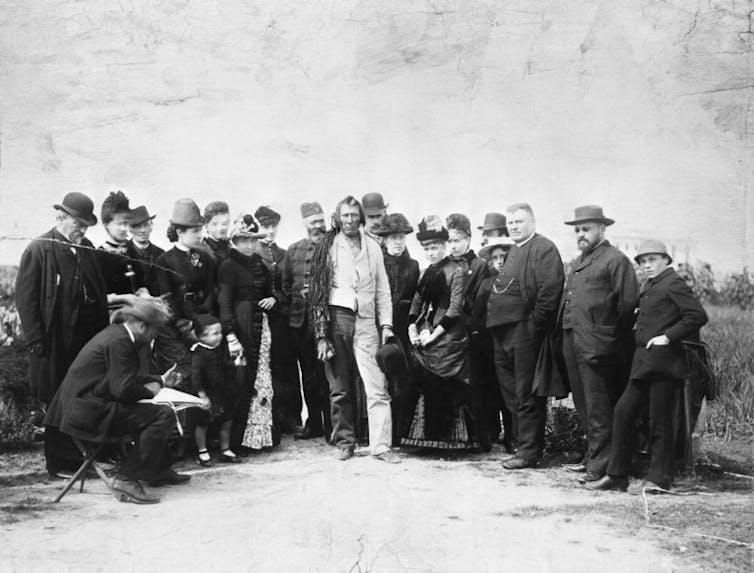
In 1886, French journalists visited Chief Poundmaker (centre) at the Stony Mountain Penitentiary.
(CU1124754/Glenbow Archives, University of Calgary)

While it took more than a century, his story proves that principled leadership outlasts momentary defeats.

Today, leaders can be inspired by this. When we choose to stand firm in our values, we may not see immediate victories. We may see struggles, but what’s important is doing what’s right. Regardless of whether this relates to social justice, ethical business practices or organizational change, leaders must be prepared to hold their ground when it matters most.

Chief Poundmaker’s leadership was rooted in love, reconciliation and an unwavering commitment to his people. His ability to unify nations, navigate high-stakes negotiations and prioritize peace over conflict offers timeless leadership lessons for the modern leader.

In our world, which is often divided by power struggles and short-term thinking, Poundmaker’s legacy should challenge us to lead differently — with humility, courage and a focus on the greater good.

The question we as leaders must ask ourselves is: what kind of leader do we want to be? Poundmaker’s example gives us a path forward.

The Conversation

Andrew J. Karesa does not work for, consult, own shares in or receive funding from any company or organisation that would benefit from this article, and has disclosed no relevant affiliations beyond their academic appointment.

ref. 5 vital leadership takeaways from the life of Chief Poundmaker – https://theconversation.com/5-vital-leadership-takeaways-from-the-life-of-chief-poundmaker-249343

Wildfire disasters are increasingly in the news, yet less land is burning globally – here’s why

Source: The Conversation – USA (2) – By Mojtaba Sadegh, Associate Professor of Civil Engineering; Senior Fellow at the United Nations University Institute for Water, Environment and Health, Boise State University

Residents try to put out flames as a wildfire threatens homes in Quito, Ecuador, in September 2024. AP Photo/Dolores Ochoa

Worldwide, an estimated 440 million people were exposed to a wildfire encroaching on their home at some point between 2002 and 2021, new research shows. That’s roughly equivalent to the entire population of the European Union, and the number has been steadily rising – up 40% over those two decades.

With intense, destructive fires often in the news, it can seem like more land is burning. And in parts of the world, including western North America, it is.

Globally, however, our team of fire researchers also found that the total area burned actually declined by 26% over those two decades.

How is that possible?

We found the driving reasons for those changes in Africa, which has the vast majority of all land burned, but the total burned area there has been falling. Agricultural activities in Africa are increasingly fragmenting wildland areas that are prone to burning. A cultivated farm field and roads can help stop a fire’s spread. But more farms and development in wildland areas also means more people can be exposed to wildfires.

Drawing on our expertise in climate and wildfire sciences and geospatial modeling, we analyzed global wildfire activity over the past two decades. The results highlight some common misperceptions and show how the fire risk to humans is changing.

Global burned area down, intense fires up

Wildfire is a natural process that has existed for as long as vegetation has covered the Earth. Occasional fires in a forest are healthy. They clear out dead wood and leaf and branch litter, leaving less fuel for future fires to burn. That helps to keep wildfires from becoming too intense.

However, intense fires can also pose serious threats to human lives, infrastructure and economies, particularly as more people move into fire-prone areas.

North and South America have both experienced a rise in intense wildfires over the past two decades. Some notable examples include the 2018 Camp Fire in California and the 2023 record-breaking Canadian wildfires, which generated widespread smoke that blanketed large parts of Canada and the eastern United States, and even reached Europe.

The increase in intense wildfires aligns with the intensification of fire weather around the world. Heat, low humidity and strong winds can make wildfires more likely to spread and harder to control. The number of days conducive to extreme fire behavior and new fire ignitions has increased by more than 50% over the past four decades globally, elevating the odds that the amount of land burned in a particular region sets a new record.

A high column of flames rises from a smoke-filled forest.
Flames rise amid the billowing smoke from a wildland fire burning along the ridges near the Ken Caryl Ranch development, southwest of Littleton, Colo., on,July 31, 2024.
AP Photo/David Zalubowski

But fire weather is not the only influence on wildfire risk. The amount of dry vegetation, and whether it’s in a continuous stretch or broken up, influences fire risk. So do ignition sources, such as vehicles and power lines in wildland areas. Human activities can start fires and fuel climate change, which further dries out the land, amplifying wildfire activity. Fire suppression practices that don’t allow low-intensity fires to burn can lead to the accumulation of flammable vegetation, raising the risk of intense fires.

North America is a fraction of total burned area

In recent years, a growing number of wildfire disasters in North America, Europe and Australia have captured global attention. From the deadly 2025 Los Angeles fires to the devastating 2019-2020 Australian bushfires and the 2018 wildfire in Athens, Greece, flames have increasingly encroached upon human settlements, claiming lives and livelihoods.

However, wildfire exposure isn’t limited to these high-profile regions − we simply hear more about them.

The United States, Europe and Australia collectively account for less than 2.5% of global human exposure to wildfire. Human exposure to fire occurs when people’s homes fall directly within the area burned by a wildfire.

In stark contrast, Africa alone accounts for approximately 85% of all wildfire exposures and 65% of the global burned area.

Remarkably, just five central African countries – the Democratic Republic of Congo, South Sudan, Mozambique, Zambia and Angola – experience half of all global human exposure to wildfires, even though they account for less than 3% of the global population. These countries receive sufficient moisture to support plant growth, yet they are dry enough that trees and plants burn in frequent fires that in some places occur multiple times per year.

Regional trends and drivers of wildfire

We found that wildfire exposure increased across all continents except Europe and Oceania, but the underlying drivers of the increase varied by region.

In Africa, agricultural expansion has led to more people living in fire-prone areas.

In North America, particularly the United States, intensifying fire weather – the hot, dry, windy conditions conducive to spreading fires – has led to increasingly uncontrollable wildfires that threaten human settlements.

Two firefighters spray water on the smoking remains of a building surrunuded by burned trees.
Firefighters hose down hot spots on a fire-ravaged property while battling the Bridge Fire on Sept. 11, 2024, in Wrightwood, Calif.
AP Photo/Eric Thayer

In South America, a combination of rising drought frequency and severity, intensifying heat waves and agricultural expansion has amplified wildfire intensity and increased the population in fire-prone regions.

In Asia, growing populations in fire-prone areas, combined with more days of fire-friendly weather, led to increased human exposure to wildfires.

In contrast, Europe and Oceania have seen declining wildfire exposures, largely due to more people moving to cities and fewer living in rural, fire-prone zones.

What to do about it

Communities can take steps to prevent destructive wildfires from spreading.

For example, vegetation management, such as prescribed fires, can avoid fueling intense fires. Public education, policy enforcement and engineering solutions – such as vegetation reduction and clearance along roads and power lines – can help reduce human-caused ignitions.

As climate change intensifies fire weather and people continue to move into fire-prone zones, proactive mitigation will be increasingly critical.

The Conversation

Mojtaba Sadegh receives funding from the US Joint Fire Science Program, the US National Science Foundation, and NASA. He is affiliated with the United Nations University Institute for Water, Environment and Health.

John Abatzoglou receives funding from the US National Science Foundation and US Joint Fire Science Program.

Seyd Teymoor Seydi does not work for, consult, own shares in or receive funding from any company or organization that would benefit from this article, and has disclosed no relevant affiliations beyond their academic appointment.

ref. Wildfire disasters are increasingly in the news, yet less land is burning globally – here’s why – https://theconversation.com/wildfire-disasters-are-increasingly-in-the-news-yet-less-land-is-burning-globally-heres-why-261072

The UK’s year of climate U-turns exposes a deeper failure

Source: The Conversation – UK – By Kevin Anderson, Professor of Energy and Climate Change, University of Manchester

Aerial-motion/Shutterstock

We’re now halfway through the UK government’s critical decade for tackling climate change – and 2025 is fast becoming a year of climate U-turns.

Airport expansions have been approved, the phaseout of gas-fired boilers shelved and, under the government’s latest industrial strategy, green levies on industrial energy bills that support renewables have been slashed. All while key indicators of global climate stability are deteriorating.

As carbon budget and energy policy researchers, we believe the UK’s official climate advisers, the Climate Change Committee (CCC), are failing to hold the government accountable for backsliding on climate action.

Worse still, the CCC’s recommendation that the UK reach net zero emissions by 2050 does not align with international commitments to limit global warming to 1.5°C and “well below 2°C”. It also fails to reflect the UN principle of fairness and equity whereby wealthier nations like the UK cut emissions earlier and faster than poorer countries.

In fact, it systematically undermines these promises, with the CCC’s 2025 seventh carbon budget (a landmark report that advises the UK government how to tackle its emissions for the period 2025-2050) a case in point.

Hiding carbon colonialism

As a signatory to UN climate agreements, the UK is obligated to “take precautionary measures” based on “best available scientific knowledge” to prevent “threats of serious or irreversible damage” to the climate. This includes setting carbon budgets rooted in the principles of equity and with a high chance of limiting warming to 1.5°C. Yet, scientists warn this window is closing fast.

Recent research concludes that from 2025, the world can emit no more than 160 gigatonnes of carbon dioxide (GtCO₂) for a 50% chance of not exceeding 1.5°C. Despite this, the CCC uses a global carbon budget almost 50% higher, at 235GtCO₂.

Internationally, the UK ranks tenth in wealth, fourth in historical cumulative emissions, and has per capita historical emissions four times the global average. Yet, the CCC disregards the UN principle that wealthy nations, whose prosperity was built on fossil fuels, must shoulder greater responsibility to rapidly cut emissions.

With just 0.84% of the global population, the UK’s equal share of the remaining 1.5°C carbon budget (160 GtCO₂) would be 1.34 GtCO₂. The CCC allocates it 3.7 GtCO₂ – nearly three times its equal per person share. However, even an equal share allocation would fall far short of the UN’s equity framework. Past CCC analyses have likewise embedded significant inequities.

Such misappropriation of the carbon budget shifts the burdens of climate change on to more vulnerable communities globally, prioritising the UK’s high-carbon norms over the right of low-income nations to sustainable development. The CCC’s departure from the UN’s core equity principle reveals how colonial norms remain deeply embedded in climate policy.

Net zero, explained by UCL’s climate scientist Mark Maslin.

Carbon removal roulette

Major societal transformations, such as moving from private car to public transport, are largely absent from the CCC’s recommendations. In contrast, large-scale engineered removals of carbon dioxide from the atmosphere and fossil fuel carbon capture and storage are assumed to be technically and socio-economically feasible.

The CCC definition of “feasible” prioritises near-term political convenience over scientific integrity and climate stability.

Despite a 4% decline in car travel over the past decade, the CCC estimates a per person increase of 10% by 2050. By avoiding pathways that challenge consumption norms, the CCC sidelines proven approaches like reducing car dependence or enforcing robust energy efficiency standards.

This highly cautious approach to behavioural change contrasts sharply with its assumptions on the future deployment of CDR, projecting UK engineered removals to increase from 0-13MtCO₂ by 2035, and 36MtCO₂ by 2050 – or nine and 26 times the total global level in 2024.

This scale of expansion contradicts historical trends. Similar heroic assumptions underpin CCS projections in electricity and blue hydrogen production (from natural gas). The CCC proposes the UK capture and store 33 MtCO₂ annually by 2050, triple the current global rate – for a technology that has barely advanced despite decades of promises and investment.

While some carbon removal is necessary to offset “impossible to mitigate” emissions from agriculture – for example, nitrous oxide from fertiliser use – using CDR to justify ongoing fossil fuel use is a high-risk approach that undermines the Paris climate commitments.


Read more:
Climate tipping points are nearer than you think – our new report warns of catastrophic risk


Nature-based carbon removal options are also overstated. The CCC projects removing 30 MtCO₂ per year by 2050 but insufficiently addresses the impacts on food security and land conflicts. Though reforesting offers ecological benefits, climate-driven wildfires, droughts and pests can rapidly re-release stored carbon. Such insecure carbon storage cannot offset guaranteed emissions from burning fossil fuels.

Ultimately, the CCC is deeply conservative on near-term changes to consumption norms, while embracing dangerously optimistic projections of future carbon removal technologies. It accepts temperatures will overshoot global targets significantly, and banks on future correction – despite the risk of triggering irreversible climate tipping points.

Hard truth

The allure of the CCC’s net zero 2050 advice is that it claims to offer a pathway to avoid both major social transformation and a rapid phaseout of fossil fuels, yet still meet the UK’s fair share of the 1.5°C commitment.

This politically appealing interpretation is scientifically flawed, downplays the gravity of climate risks and disregards principles of international justice. The CCC and others must stop being silent on these critical issues and end the carbon colonialism at the heart of the climate agenda.

The UK’s net zero 2050 framing isn’t just delaying urgent action, it normalises ecological breakdown while maintaining the illusion of responsible stewardship. It worsens climate impacts and undermines preparedness by presenting inadequate measures as 1.5°C compatible. A fundamental rethink of the UK’s climate policy requires a consensus that is grounded in equity, scientific integrity and transformative ambition.


Don’t have time to read about climate change as much as you’d like?

Get a weekly roundup in your inbox instead. Every Wednesday, The Conversation’s environment editor writes Imagine, a short email that goes a little deeper into just one climate issue. Join the 45,000+ readers who’ve subscribed so far.


The Conversation

Kevin Anderson is presenting views here that belong to the named authors, and do not necessarily reflect those of researchers within the Tyndall Centre for Climate Change Research.

Chris Jones has received funding from UKRI. The views in this article are of the author and do not necessarily reflect those of the Tyndall Centre for Climate Change Research.

Gaurav Gharde does not work for, consult, own shares in or receive funding from any company or organisation that would benefit from this article, and has disclosed no relevant affiliations beyond their academic appointment.

ref. The UK’s year of climate U-turns exposes a deeper failure – https://theconversation.com/the-uks-year-of-climate-u-turns-exposes-a-deeper-failure-254499

Hay fever: new immunotherapy approved in England for people with severe birch pollen allergies

Source: The Conversation – UK – By Heba Ghazal, Senior Lecturer, Pharmacy, Kingston University

Birch pollen allergy symptoms can sometimes last from January to June. Dragana Gordic/ Shutterstock

Around 25% of hay fever sufferers in the UK are allergic to birch tree pollen. This means that for a good chunk of the population, the arrival of spring and summer means sneezing, itchy eyes, blocked sinuses and days spent indoors avoiding pollen. But the recent approval of a new drug could mean relief from these symptoms for thousands living in England with severe allergies to birch pollen.

Birch pollen is the most common allergy-causing tree pollen across most parts of Europe and the UK. Pollen from birch-related trees including alder, hazel, oak, hornbeam and beech trees can also trigger symptoms – ranging from coughing, congestion and sneezing to itchy, watery eyes.

Symptoms are usually at their peak in April and May, but can sometimes last up to six months – from January to June. Research investigating UK pollen trends has also found that climate change – specifically rising temperatures – is making the UK birch pollen season longer and more severe.

Birch pollen allergies are triggered when the immune system mistakes pollen proteins for harmful pathogens. This causes the immune system to make immunoglobin E (IgE) antibodies – a type of immune defender that attaches itself to immune cells.

This means that the next time the body is exposed to the allergen, the IgE antibody will tell the immune cells to release the immune chemicals histamine, leukotrienes and prostaglandins to destroy the perceived pathogen. Histamine acts within seconds to cause itching, sneezing, swelling of blood vessels and mucus production.

New treatment

The standard treatment for birch pollen allergies include oral antihistamine and corticosteroid nasal sprays. However, a UK study found that even with both, only 38% reported good symptom control. That means up to 62% of people spend birch pollen allergy season fighting to control their symptoms.

But the National Institute for Health and Care Excellence (Nice) has just approved a new oral treatment for adults with severe allergies to birch tree pollen. The tablet, called Itulazax (betula verrucosa), is a type of immunotherapy.

Immunotherapy differs from standard allergy medications by targeting the root cause. The idea is simple: treat the allergy with the allergen that causes it – in this case birch pollen extract. Repeated exposure to tiny, controlled doses of the allergen then trains the immune system to build tolerance over time. The goal with immunotherapy is to change how the body reacts to the allergen entirely rather than just ease the symptoms.

A birch tree with pollen-producing flowers.
The new immunotherapy uses birch pollen extract to treat the allergy.
Animaflora PicsStock/ Shutterstock

Itulazax raises immune tolerance to birch pollen by reducing the number of IgE antibodies the immune system makes when exposed to birch pollen and increasing the number of protective antibodies the body makes. This significantly reduces major pollen allergy symptoms and prevents the body from mounting an immune response against birch pollen in the future.

The treatment is specifically approved for adults with severe birch pollen allergies who have not responded to regular allergy treatments. To qualify for treatment, a confirmed diagnosis is required through a skin prick or blood test showing a reaction to birch-related trees.

Clinical studies show the treatment is generally safe, with the most common side-effects being mild to moderate itching in the mouth and throat irritation – both linked to how it is taken under the tongue. As such, the first tablet must be taken under medical supervision – with at least 30 minutes of monitoring for immediate side-effects.

Though the treatment is effective, it’s not a quick fix. To see results treatment should start at least 16 weeks before the birch pollen season begins and continue through the season. So for people with severe symptoms, this means they may need to start taking the treatment in November. The course also lasts around three years.

Still, for the thousands of people in the UK who experience birch pollen allergies, this new treatment offers a solution for symptoms that can range from annoying to debilitating. The approval of this immunotherapy also offers hope that immunotherapies to treat other types of hay fever will someday be approved.

The Conversation

Heba Ghazal does not work for, consult, own shares in or receive funding from any company or organisation that would benefit from this article, and has disclosed no relevant affiliations beyond their academic appointment.

ref. Hay fever: new immunotherapy approved in England for people with severe birch pollen allergies – https://theconversation.com/hay-fever-new-immunotherapy-approved-in-england-for-people-with-severe-birch-pollen-allergies-263286

Climate change is profoundly affecting livelihoods across Canada

Source: The Conversation – Canada – By Sara Dorow, Professor of Sociology, University of Alberta

For years, the International Labour Organization (ILO) has been sounding the alarm: climate change is having significant effects on the conditions, characteristics and availability of work.

As wildfires and other extreme weather events are destroying forests and threatening communities, ocean heating is impacting marine habitats and fisheries. Across these and other impacts of climate change, there is an undeniable relationship between the degradation of the environment and the degradation of work.

A research project I led with colleagues, Work-Life in Canada, reinforces this truth, revealing how climate change shapes not just what we do for work and under what conditions, but who we are and how we understand ourselves.

Over the last four years, our research team has photographed and interviewed more than 100 people from diverse walks of life across seven provinces. While we focused on the social meanings of their work, we constantly bumped into the ways, both subtle and direct, that changing environmental conditions are unravelling the social and economic fabric of people’s work lives.

We draw on two of our project sites to illustrate how climate change is impacting livelihoods — Lac La Ronge in northern Saskatchewan and Grand Manan Island in New Brunswick. The stories of participants, gathered by me, gender and women’s studies professor Angele Alook and sociology professor Karen Foster, are paired with the evocative documentary photography of our project collaborator, Martin Weinhold.

Together, words and images convey both the beauty of, and threats to, work-nature relations.

Wildfire

Cathy Clinton-Ratt and Julia Clinton are a Cree mother and daughter from the Lac La Ronge Indian Band who participated in the Work-Life in Canada project. Both held strong connections to Robertson Trading.

For nearly 60 years, Robertson Trading sustained the livelihoods of Indigenous people in the region through fur trade and buying their craft work.

Even after it closed in December 2023 (six months after our team visited the community), it still operated as a town bank and, importantly, housed hundreds of unique Indigenous artworks and traditional craft items collected since its inception.

Cathy’s moose hides and beadwork were sold and displayed at Robertson Trading for decades, and back in the day, she worked out of the craft co-operative just down the street.

Julia learned traditional hide making and beading skills from her mother and also worked at Robertson Trading for many years.

On June 4, 2025, Robertson Trading burned down in one of the many wildfires that tore through the area.

Wildfires are a natural occurrence in the boreal forest, but their frequency and spread in recent decades has been unprecedented.

Indigenous communities are especially affected. In June, La Ronge and nearby communities received a mandatory evacuation notice.

The fire destroyed the store’s entire collection of handcrafted items, including some of Cathy’s work.

As former manager Scott Robertson put it:

“The building was just a building, but the loss of the remaining contents — hundreds of pieces of Indigenous art and historical artefacts — is catastrophic … the beaded moosehide jackets and moccasins, the birch bark baskets, the antler carvings, the original paintings, etc., represent thousands of hours of handwork done by talented Indigenous artists and craftspeople, and are absolutely irreplaceable.”

That these items cannot simply be remade tells us that work is more than effort exchanged for a paycheque. It carries tradition, memory, identity and meaning — the stuff that social life is made of.

The loss of Roberston Trading highlights how meaningful work is enmeshed in a web of social-natural relations threatened by climate change.

Warming oceans

Grand Manan Island in New Brunswick, another of our project sites, further illustrates the threat to this web of work-life. Weir fishing — a sustainable practice of guiding fish into trap nets — has been practised for hundreds of years in Atlantic Canada.

While it declined significantly by the 1980s, some could still make a go of it.

Jeff Foster, a participant in our project, was one of those people. He knew everything about herring — not just as a resource to make a living on, but as a species with unique traits and behaviours.

When Martin Weinhold first photographed him in 2016, his weir fishing business was in full swing. A couple years later, Jeff turned over the fishery to his sons, happy to see a tradition continued.

But in 2023, Jeff’s sons reluctantly told him there were neither herring nor mackerel in their nets. A combination of warming waters and overfishing, especially by larger purse seiner operations, had greatly depleted the stocks.

For a while, Jeff’s sons had been able to keep the family weir going by working side jobs. But by 2024, when the Work-Life team visited Jeff, he was heartbroken.

His sons had switched to seasonal work with the lobster industry, which itself had only become an option as lobsters moved further north due to warming waters. What’s more, the weirs Jeff had built for a larger fish operation were being sold off to a lobster outfit.

Since then, the family has made the difficult decision to take down the family weir at the end of this year’s season. It will be the last time that they work together as a family at sea, and it spells the end of a specific story of who the Fosters are and where they belong.

‘Good’ work

In a 2018 paper, the ILO asserted that “a good future for work requires a stable and healthy environment.” The question is what “good” means.

Government policy tends to focus on things that can be easily quantified, like wages and hours of work. Our research reinforces that people and communities are attached to work in deeper ways, and that economic and social viability are enmeshed in the inevitable connections to nature that all forms of work depend on.

Primary research shows that climate and employment policies often remain mutually blind to each other. However, when we view work as “the fundamental interface between society and nature,” we understand how essential this relationship is to building an equitable future where people are able to do decent work.

This means ensuring that the policies and principles of a just energy transition are applied to all forms of work, not just green jobs, and that the stories of working people serve as important evidence in this endeavour.

The Conversation

Sara Dorow does not work for, consult, own shares in or receive funding from any company or organisation that would benefit from this article, and has disclosed no relevant affiliations beyond their academic appointment.

ref. Climate change is profoundly affecting livelihoods across Canada – https://theconversation.com/climate-change-is-profoundly-affecting-livelihoods-across-canada-262704

The economic pros and cons of building more and more data centres in the UK

Source: The Conversation – UK – By Michael A. Lewis, Professor of Operations and Supply Management, University of Bath

yongheng200802/Shutterstock

About 100 new data centres, the large anonymous-looking buildings containing the complex computer systems which power the online world, are to be built in the UK. Vital for all of your digital needs – from Netflix and banking, to AI and social media – they are the heart of the modern digital economy.

They are also very expensive to build and operate, using up enormous amounts of energy and water (as a coolant). Ten years ago, a centre consuming 30 megawatts (MW) of power (enough to power 30,000 houses) was considered large. Today 200 MW is normal.

And the tech world is hungry for more capacity more quickly. It is expected that almost US$7 trillion (£5.2 trillion) will be spent on global data centre infrastructure by 2030.

The British government appears to see this kind of investment as a key part of the country’s economic future. As a result, the number of data centres in the UK looks likely to increase by one-fifth, from around 479 to around 580 within the next five years.

More than half of the new centres will be in the London area, including Google’s £740 million project in Hertfordshire. Others will be developed in South Wales, Greater Manchester and the north-east of England. All will require new infrastructure, including large amounts of cooling and power equipment.

But what are the economic benefits to being the home of so many data centres?

One clear advantage is for other tech companies operating in the UK. Being geographically close to a data centre improves digital performance. This is vital for British AI companies, which require rapid and reliable data processing, as well as sectors such as advanced manufacturing and financial services technology (fintech).

Having data centres in the UK also strengthens cyber resilience, supporting the country’s position as a secure hub for multinational operations.

More direct economic benefits from data centre construction include the thousands of contractors required to build them – as well as opportunities for local regeneration and subsidised skills training.

Operators will also pay business rates, corporation tax and energy levies which all contribute to government revenues. So overall, data centres can certainly do their bit to support the government’s industrial strategy and aims for economic growth.

Power to the processors

But data centres are by no means a golden ticket to prosperity – especially after they’ve been built. The permanent workforce at most data centres is small, with many able to operate with around 20 full-time staff.

Even Blackstone’s massive £10 billion project in Blyth, Northumberland, promises only hundreds of long-term jobs (compared to the 1,200 construction roles).

Data centres also bring considerable environmental costs. Concentrated data centre clusters, such as Slough in Berkshire, which has 14 new sites planned, risk overloading electricity grids. And data centres have so far been major users of non-renewable energy.

Corridor of servers inside a data centre.
Minimal staff requirement?
IM Imagery

Cooling requirements can also be substantial, with some facilities using millions of litres of water every year.

Other environmental concerns include the production and disposal of servers and other IT equipment, the extraction of rare minerals and the generation of electronic waste. These are all factors which may undermine the UK’s ability to implement its net zero policies.

Public investment is likely to be required to reinforce grid capacity and water systems. Such costs will ultimately be paid from tax revenue as well as household utility bills, highlighting one of the economic difficulties that data centres represent – the complex knotting together of public and private investment.

So data centres pose plenty of tricky political and economic questions. How many should there be? What size and where? Who will pay for them?

For now though, the UK government appears to be largely in favour of welcoming more, classifying data centres as “critical national infrastructure”. But it cannot ignore concerns over their environmental impact.

To this end, some cities including London, Leeds and Bristol have begun to pilot schemes to recycle waste heat from data centres to warm homes, which is a promising development.

International intelligence

The UK can also learn from the experience of other countries. In 2022, for example, Ireland’s data centres were consuming 18% of the country’s electricity – a proportion forecast to rise to almost one-third by 2026.

As a result, Ireland has effectively imposed a moratorium on new data centres. The Netherlands now links new data centre approvals directly to clean energy generation.

But data centres have to be build somewhere to meet ever increasing demand. The question is whether the UK can build them fast enough, and on terms that serve its own interests for maximum economic benefit.

Moving too slowly also creates national security risks including a dependency on foreign AI infrastructure and the potential loss of control over sensitive data processing. Jensen Huang, the boss of Nvidia recently described the UK as having “the largest AI ecosystem in the world without its own infrastructure”.

The British government certainly seems keen to develop that infrastructure to strength the country’s digital ecosystem. But it needs to do so in a way which champions a sustainable approach that other nations will follow – and reduces its technological dependence on other countries.

The Conversation

Michael A. Lewis receives funding from the ESRC, AHRC and EPSRC.

Phil Tomlinson receives funding from the Innovation and Research Caucus (IRC).

ref. The economic pros and cons of building more and more data centres in the UK – https://theconversation.com/the-economic-pros-and-cons-of-building-more-and-more-data-centres-in-the-uk-263302

Sorry, Baby: a sad, funny, profound film about life after trauma

Source: The Conversation – UK – By Laura O’Flanagan, PhD Candidate, School of English, Dublin City University

A critical success and award winner at this year’s Sundance Film Festival, Sorry, Baby is the directorial debut of its writer and star, Eva Victor. The film follows Agnes (Victor), an English professor at a small American college, in the aftermath of a sexual assault by one of her teachers when she was a student there.

The story, based on Victor’s own experience of trauma, is structured in non-linear chapters that encompass the time after, before and during the assault. This makes for a raw and unflinching, yet nuanced, depiction of trauma’s aftermath, which presents Agnes as a fully rounded and complex character.

The film resists the idea that trauma must define a character’s identity, instead exploring how people live with, around and beyond painful experiences. Agnes is funny, awkward, self-aware, sometimes messy, wholly real and excellent at her job. She refers to the sexual assault euphemistically as “the thing” or “the bad thing”, which Victor has said is an attempt to protect vulnerable audience members.

This sensitivity is evident throughout Sorry, Baby. The film is directed with a lightness of touch, and its naturalistic scenes are laced with both humour and emotion. Agnes’s story is told on her terms. The beautiful opening chapter celebrates the fierce love and loyalty of female friendship.

Agnes is visited by her friend Lydie (Naomi Ackie), who comes to announce her pregnancy. Ackie and Victor have strong onscreen chemistry, making the women’s bond a joy to watch, filled with humour, natural physical closeness and underlying emotional depth.

The narrative chapters move forwards and backwards in time. The facts of the assault are told in a tight, close-up monologue by Agnes. The assault itself is not depicted onscreen; the viewer sees Agnes enter her lecturer’s house, and the frame holds this exterior shot as darkness falls and time passes. Agnes emerges clearly upset, and the camera remains on her back as she returns home.

As she speaks to Lydie and recalls what she can remember about the assault, the camera acts like a patient and empathic listener, trained on Agnes’s face as she tells her story. This directorial choice by Victor gives Agnes agency in this moment. It is her experience, told in her words and in her own time. It is devastating.

In the decade since #MeToo, many films have emerged centring on women’s experiences of trauma. Typically, these narratives begin with the revelation of abuse or harm, move through the emotional or social consequences and then arrive at some form of reckoning or resolution.

Films such as Women Talking (2023) and Promising Young Woman (2020) follow this arc, using female trauma as a starting point for deeper questions around accountability, healing and resistance. This approach can create a powerful emotional impact while raising awareness of the issues presented.

But when film-makers like Victor depict female characters in a broader light, not solely defined by trauma, something arguably more authentic begins to emerge.

Agnes is a character who experiences trauma but also humour, joy, contradictions, desire and strength. This allows for rich storytelling and a deep emotional connection with the audience.

By rejecting a tidy narrative arc in favour of something more fragmented and realistic, Sorry, Baby becomes a reflection of Agnes’ healing journey. It engages with the realities of her trauma while also making space for agency, joy, and the absurdities of life.

Agnes’s story contains characters who are shockingly unwilling to help. She has an encounter with an indifferent doctor which must be seen to be believed. But she also meets kindness, and these scenes are often charming, bittersweet and profound. Lucas Hedges is a warm presence as Gavin, Agnes’s neighbour with whom she is in the early stages of a relationship. With care, the romantic subplot is shown as another layer of Agnes’s life, not as a means of healing or resolving her trauma, but as something which exists alongside it.

A scene with a kind stranger, a sandwich shop owner, speaks volumes without saying much and lingers powerfully. He is in exactly the right place at the right time for Agnes and shows her understanding and empathy when she needs it most.

Sorry, Baby is funny, sad and often profound. It feels real and natural, capturing the unpredictable rhythms of life with warmth and honesty. Eva Victor’s direction embraces complexity, offering a story which feels deeply lived-in and profoundly human.

Through Agnes, we see pain and humour side by side, awkwardness and strength intertwined. This debut marks Victor as a distinctive voice in contemporary cinema, one who trusts her characters and her audience alike. With Sorry, Baby, Victor shows us a new way to tell stories about trauma, healing, and the small, vital moments in between. This is a filmmaker to watch.

Sorry, Baby is in cinemas now


Looking for something good? Cut through the noise with a carefully curated selection of the latest releases, live events and exhibitions, straight to your inbox every fortnight, on Fridays. Sign up here.


The Conversation

Laura O’Flanagan does not work for, consult, own shares in or receive funding from any company or organisation that would benefit from this article, and has disclosed no relevant affiliations beyond their academic appointment.

ref. Sorry, Baby: a sad, funny, profound film about life after trauma – https://theconversation.com/sorry-baby-a-sad-funny-profound-film-about-life-after-trauma-262885

Football fans will see Nigel Farage’s branded kit for the cynical move it is

Source: The Conversation – UK – By Josh Bland, ESRC-DTP PhD Researcher, University of Cambridge

As a new season begins, Nigel Farage’s Reform UK is making a play for the affections of the nation’s football fans by launching its very own football shirt. It’s a move that has already proven popular among Reform supporters. According to Zia Yusuf, a leading figure in the party, thousands were sold on their first day of retail.

Reform’s move to exploit the cultural capital of football speaks to a wider trend in British society: the explosion of the football shirt as a cultural behemoth.

Quite simply, football shirts are everywhere. They have been incorporated into high fashion as part of the nostalgic 90s “blokecore” trend. They are used by bands such as Oasis and Fontaines DC as forms of branded merchandise. And now they are being mobilised by political movements, such as Palestinian solidarity organisation FC Palestina, to spread specific messaging.

Instead of being merely the domain of football supporters, football shirts have become cultural canvases.

Crucially, I believe football shirts are a symbolic medium that is tailor-made for Reform’s current political purposes. Ahead of the 2029 election Farage’s goal is clear. His aim is to win over and mobilise a largely working-class, provincial voting base who feel alienated by “mainstream” politics.

It appears that Reform see football as a potential weapon in this task. From its origins in the industrial cities of late Victorian England, modern football has long been a central pillar of working-class culture in Britain. In particular, it has played a potent role in binding communities around shared sentiments of local tribalism. Given that Farage’s political campaigning to date has often been based around a narrative of fighting for authentic, local community interests against out-of-touch metropolitan elites, the appeal of football in the context of Reform’s politics seems straightforward.

The efficacy of football shirts as a culturally loaded tool of communication means that Farage and Reform may feel they have found their own iteration of the Maga hat: a way for followers to embody their political allegiances with a loud, brash piece of statement clothing that also signals deep roots in the nation’s working-class culture.

But there’s a level of hypocrisy at work here. In the lead up to the Uefa Euro 2020 championship, Farage denounced the England team for taking the knee before games, imploring them to “keep politics out of football”. This was followed by another episode of public pearl clutching in 2024 when Farage decried England’s kit design for featuring a technicolour version of the England flag that bore “no relationship to St. George’s cross whatsoever”.

Now Reform has produced a shirt that both explicitly politicises football culture and features a turquoise Union Jack.

But beyond the flagrant double standards of the launch, Reform’s move into football merchandise is potentially a political miscalculation, too.

As the Labour party continues to flail, offering no resolution to the country’s gaping inequality or fixes for its failing public services, let alone a cure for the divisiveness that increasingly define contemporary Britain, it feels that the 2029 election will be won and lost in England’s football loving provinces.

Football and pride

Football’s roots in working-class culture, pride in place and patriotism means that the hard right has always seen the sport as fertile ground. In this sense, Reform’s kit launch is part of a long tradition of attempted infiltrations of the game by the hard right. Most notoriously, the National Front used terraces as recruitment grounds in the 1970s and the Football Lads Alliance attempted similar when it launched in 2017.

But here lies the problem for Reform. These attempts have largely failed. Even at the peak of the National Front’s influence in the 1970s and early 80s they only ever succeeded in establishing themselves as a fringe group on the terraces – albeit a noisy and intimidating one – and have often faced fierce and organised anti-fascist resistance.

Equally, the establishment of the Premier League in 1992 has seen professional football in the UK embrace a more cosmopolitan future. Progressive anti-racist organisations such as Kick It Out have gained significant influence. The cast of players and managers who populate elite level football is now impressively international. In short, despite its roots in local working-class communities, British football increasingly embodies many of the globalist, progressive ideals that Farage so vehemently rejects.

Even more crucially, as I have found in my own research on football supporting communities in the north-east, football culture prizes authenticity.

For the communities I work with, support of a football team is starkly different to support of a political cause. It is a form of living, breathing heritage. It is a tradition that is passed between generations of a family like an heirloom. It is a culture within which supporters constantly perform their own authenticity through a lifetime of ritual – match attendance, shirt wearing and suffering with the team through thick and thin.

The transparency of Farage’s hijacking of football culture for his own ends may therefore be his downfall. Farage’s credibility as a voice on football will simply not measure up to supporters’ lofty standards. They will be aware that he has openly declared his love of cricket over football. They will be cognisant of his lack of interest in the game other than when there’s a nationalist point to make. Above all, they will see through his cynical attempts to exploit the symbols of the football supporting culture they cherish so dearly for his own political cause.

Of course football is an everyday working-class tradition. Of course it has huge cultural salience in the provincial constituencies Farage will target to win in the 2029 election. But Reform should take heed that just because football is popular, that doesn’t mean it is inevitably populist.

The Conversation

Josh Bland receives funding from The Economic and Social Science Research Council.

ref. Football fans will see Nigel Farage’s branded kit for the cynical move it is – https://theconversation.com/football-fans-will-see-nigel-farages-branded-kit-for-the-cynical-move-it-is-263513