3 states push to put the Ten Commandments back in school – banking on new guidance at the Supreme Court

Source: The Conversation – USA (3) – By Charles J. Russo, Joseph Panzer Chair in Education and Research Professor of Law, University of Dayton
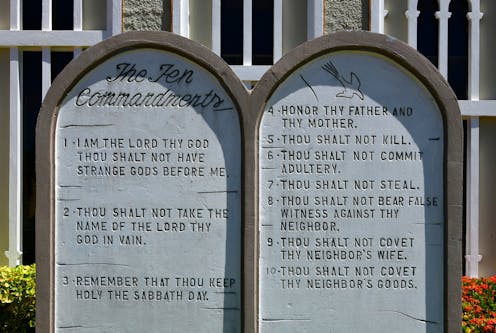
Louisiana, Arkansas and Texas have all passed laws — now on hold — to mandate the biblical laws’ display in classrooms. mtcurado/iStock via Getty Images Plus

As disputes rage on over religion’s place in public schools, the Ten Commandments have become a focal point. At least a dozen states have considered proposals that would require classrooms to post the biblical laws, and three passed laws mandating their display in 2024-2025: Louisiana, Arkansas and Texas.

All three laws have been at least partially blocked – most recently Texas’ law – after federal trial court rulings. But the ongoing cases seem aimed at overturning a 45-year-old U.S. Supreme Court precedent prohibiting the posting of the Ten Commandments in public schools.

As religion and education law researchers, we believe this situation is especially noteworthy because of its timing. The Supreme Court has been using a new standard to assess religious freedom cases – and its judgments on religion’s role in public education are perhaps the most religion-friendly they have ever been.

The Ten Commandments and the courts

Litigation over the Ten Commandments is not new. More than a dozen early cases generally upheld laws and policies mandating their recitation in schools. These enactments survived because the Supreme Court did not extend the First Amendment to the states until 1940.

However, the issue of posting the commandments in schools first surfaced in 1980. In a case called Stone v. Graham, the Supreme Court struck down a Kentucky statute requiring displays of the Ten Commandments in classrooms. The court reasoned that the law violated the First Amendment’s establishment clause: “Congress shall make no law respecting an establishment of religion.”

At the time, the court used three criteria, known as the “Lemon test,” to evaluate whether a government action violated the establishment clause. According to this test – which developed from a 1971 Supreme Court decision – governmental actions must have a secular legislative purpose, and their main effect may neither advance nor inhibit religion. In addition, they must avoid excessive entanglement with religion.

When Kentucky’s case came before the court, justices rejected its argument that the displays served a secular educational purpose. The majority did not think that a small notation on posters describing the Ten Commandments as the “fundamental legal code of Western Civilization and the Common Law of the United States” was sufficient, and wrote that the posters were “plainly religious in nature.”

Twenty-five years later, in 2005, disputes over public displays of the Ten Commandments reached the Supreme Court once more. This time, the displays were not in schools. But the first controversy arose, again, in Kentucky.

Officials in two counties had erected displays at courthouses that included the Ten Commandments, Magna Carta and the Declaration of Independence. The justices limited their order to one dispute, in McCreary County, invalidating the display for violating the establishment clause – largely because it lacked a secular legislative purpose.

On the same day, though, the Supreme Court reached the opposite result in another case, Van Orden v. Perry. The court permitted a display including the Ten Commandments to remain on the grounds of the Texas Capitol in Austin, where it was one of 17 monuments and 21 historical markers.

Two women walk by an ornately carved stone monument, with a building with a large rotunda in the background.
A Ten Commandments monument on the grounds of the Texas Capitol in Austin.
AP Photo/Eric Gay

Unlike the fairly new displays in Kentucky, the long-standing one in Texas, with the first monument erected in 1891, was built using private funds. The court left the Ten Commandments monument in place because it was a more passive display. The Capitol grounds are spread out over 22 acres, meaning the display was not as readily apparent as if it had been posted in classrooms for children to see every day.

‘Follow God’s law’

In 2024, a federal trial court in Louisiana blocked a state law mandating that the Ten Commandments be posted in public schools. Undeterred, Arkansas and Texas passed similar legislation the following year.

A large room, seen from above, with rows of desks encircling a central podium.
Arkansas representatives convene in the House chamber at the state Capitol in Little Rock on June 17, 2024.
AP Photo/Andrew DeMillo

Arkansas Act 573, signed into law in April 2025, obligated officials to display a “durable poster or framed copy” of the Ten Commandments in all state and local government buildings, including public school and college classrooms.

Republican Rep. Alyssa Brown, one of the Arkansas bill’s sponsors, described it as an effort to educate students on how the United States was founded and how the founders framed the Constitution.

“We’re not telling every student they have to believe in this God,” she told a legislative committee, “but we are upholding what those historical documents mean and that historical national motto.”

Texas, meanwhile, adopted a similar law in June 2025.

“It is incumbent on all of us to follow God’s law, and I think we would all be better off if we did,” the bill’s sponsor in the Texas House, Republican Rep. Candy Noble, said during debate.

Shift at SCOTUS

Supporters of these laws have claimed that they are constitutional because of an important shift at the Supreme Court. In 2022, the court adopted a new “history and tradition test” to assess religion in public places, including classrooms.

The “history and tradition test” originated in Kennedy v. Bremerton School District, a case about a public high school football coach who prayed on the field at the end of games. The Supreme Court ruled in 2022 that school officials could not prevent him from doing so, because it was personal religious observance protected by the First Amendment’s other religion clause: that the government shall not prohibit the “free exercise” of religion.

Kennedy charted a new course on religion’s place in public life. Acknowledging that it “long ago abandoned Lemon and its endorsement test offshoot,” the justices explained that “the Establishment Clause must be interpreted by ‘reference to historical practices and understandings.‘” It remains to be seen how this vague standard plays out in later cases.

Blocked – for now

Opponents quickly challenged Arkansas’ law. Seven families from various religious traditions filed suit, arguing that it was a direct violation of both the establishment and free exercise clauses of the First Amendment.

On Aug. 4, a federal trial court judge ruled in the families’ favor. The court found that the required display would have “forced [students] to engage with” the Ten Commandments, and “perhaps to venerate and obey” them. The trial court also applied the new historical practices and understandings test, holding that there was no evidence of a tradition to display the Ten Commandments in public schools permanently.

The court thus temporarily barred school boards from enforcing Act 573, pending any further appeals.

Two weeks later, a federal trial court in Texas temporarily blocked the law on the ground that it likely violated the First Amendment, though the judge’s order only applies to 11 districts.

Religion’s role

Controversy over the Ten Commandments continues to raise larger questions over the role of religion in public education.

Supporters of such bills seemingly fail to recognize that they cannot impose their religious values in the public sphere. At the same time, some opponents – including Jewish, Christian, Unitarian Universalist, Hindu and nonreligious plaintiffs – do not necessarily wish to remove religion entirely from educational institutions.

These critics want to uphold the principle, as the Supreme Court announced, that the government must demonstrate “neutrality between religion and religion, and between religion and nonreligion.” In other words, critics do not want one religion or religion generally to dominate.

Today’s challenge is to find the balance in public life. We believe the courts and legislatures must avoid sending the message that religion has no place in a free and open society – just as they must not permit one set of values to dominate, as the bills in Arkansas and Texas seem to aspire to do.

How the courts and legislatures balance the rights of the majority and minority in these disputes over the place of the Ten Commandments in public life may go a long way toward shaping the future of religious freedom in American public education.

The Conversation

The authors do not work for, consult, own shares in or receive funding from any company or organization that would benefit from this article, and have disclosed no relevant affiliations beyond their academic appointment.

ref. 3 states push to put the Ten Commandments back in school – banking on new guidance at the Supreme Court – https://theconversation.com/3-states-push-to-put-the-ten-commandments-back-in-school-banking-on-new-guidance-at-the-supreme-court-264423

Helping teens navigate online racism − study shows which parenting strategy works best

Source: The Conversation – USA – By Alvin Thomas, Associate Professor of Human Development and Family Studies, University of Wisconsin-Madison

Talking over teens’ experiences with online racism helps protect them without curbing their autonomy. NickyLloyd/E+ via Getty Images

Parents struggle to help teens deal with online racism. Online racism is different from in-person racism because the people behaving that way usually hide behind fake names, making it hard to stop them. Studies found that teens of color see more untargeted racism – memes, jokes, comments – and racism targeting others online than racism targeted directly at them. But vicarious racism hurts, too.

Teens are deeply immersed in the online world, and online spaces are quickly emerging as critical places where teens socialize and learn the rules and norms of their society. A survey in 2024 found that nearly half of U.S. teens ages 13 to 17 reported being online “almost constantly.” The rates were even higher among Black teens (53%) and Hispanic teens (58%).

Online spaces offer opportunities and risks. Black and Hispanic adolescents, in particular, face heightened exposure to online racial discrimination and harassment, which can seriously harm their emotional well-being.

Good parenting can help protect kids from racism’s harmful effects, but what works in person might not work online. Some parenting ideas such as talking openly about race and teaching kids to be proud of their culture seem helpful. However, teens who see or experience racism on social media are more likely to feel sad or use drugs and alcohol. This threat means parents need to understand the best ways to go beyond offline tactics to help their teens stay safe online.

We are researchers of human development and family studies. We studied Black and Hispanic teens’ experiences with online racial discrimination and found that the most common and effective strategy that parents used to help their teens was active guidance – talking about internet use – rather than monitoring their internet use. Black and Hispanic teens reported fewer symptoms of depression if their parents used this strategy more frequently.

What teens are saying

In our study, we surveyed 356 Black and Hispanic teens between the ages of 12 and 18 across the United States. We asked about their own online experiences as well as those they witnessed of people from their racial group being racially discriminated against. We also asked the teens about their mental health and the strategies parents used to interrupt or manage their internet use.

We found that parents more often employed active guidance to help their teens deal with online racial discrimination. Black and Hispanic teens reported fewer symptoms of depression if their parents used active guidance more frequently.

Parents who use this strategy navigate the appropriate use of social media together with their children. They may offer help when problems arise or initiate open conversations about internet use.

At the core of the success of active guidance might be its support of digital literacy and cultivation of responsible social media behaviors. This empowering parenting practice may also help teens develop autonomy and independence. Importantly, it might also make teens feel connected to and supported by their parents.

Another common strategy is monitoring, and it includes practices such as checking children’s browsing history, messages and social media contacts. Yet, we found that this strategy was not helpful when it came to teens’ mental health. Instead, adolescents in this study who received more parental monitoring suffered more anxiety symptoms. Even more concerning, parental monitoring appeared to exacerbate teens’ depression symptoms from online racial discrimination.

a Black woman stands behind a black teen girl seated at a table using a laptop
Close monitoring of teens’ internet use can have adverse effects.
VioletaStoimenova/E+ via Getty Images

How to help teens

Our work helps inform parents, educators and others involved in teen well-being about approaches they can take to support Black and Hispanic teens in navigating social media.

Parents can start conversations with their teens about healthy internet use. Parents can encourage teens to share positive and negative online experiences without judgment and reassure them that they can come to their parents if they run into trouble.

At the same time, parents can avoid excessive monitoring, especially if their child feels their autonomy is being invaded. If you believe monitoring is necessary, explain your reasoning clearly and work with your child on establishing a monitoring plan.

Educators can offer seminars on digital literacy for parents and children, equipping families with tools to navigate online spaces more safely. Mental health professionals can consider clients’ online experiences as part of their assessments and treatments, and they can also develop family-based interventions that promote adolescent well-being while counteracting online racism. Educators and professionals could collaborate to establish school and community support groups for teens.

Policymakers can recognize the particular online risks faced by adolescents of color and work to strengthen antidiscrimination policies and enhance protections for children online.

Researchers can investigate coping strategies and resources that empower Black and Hispanic teens and their parents, and evaluate their effectiveness in supporting adolescent well-being.

Next steps

We plan to explore how social media affects Black and Hispanic teens in three main ways. First, we want to see how online discrimination actually reaches and hurts minority teenagers. We want to understand how unfair treatment online, such as targeted harassment and biased algorithms, makes existing problems worse for these young people.

Second, it would be interesting to follow students over time to see how online experiences affect their grades, mental health, well-being and friendships in the long run.

And third, we want to know what policies at the school and national level might help make online spaces a safe and productive space for youth to gather and grow. This research is important because it will help parents learn specific ways to support their teens online while also showing how discrimination on social media affects minority youth differently. The goal is to give families real tools to help their teenagers stay safe and healthy in digital spaces.

The Conversation

Alvin Thomas is affiliated with
National Academies of Sciences, Engineering and Medicine (Forum for Children’s Well-Being), Scholars’ Action Network

Yeqing Li does not work for, consult, own shares in or receive funding from any company or organization that would benefit from this article, and has disclosed no relevant affiliations beyond their academic appointment.

ref. Helping teens navigate online racism − study shows which parenting strategy works best – https://theconversation.com/helping-teens-navigate-online-racism-study-shows-which-parenting-strategy-works-best-264021

Jury trials, a critical part of democracy, are disappearing

Source: The Conversation – USA – By Valerie P. Hans, Charles F. Rechlin Professor of Law, Cornell Law School, Cornell University

When jurors aren’t involved, rulings are less public − and private interests have more influence over outcomes. ftwitty/E+ via Getty Images

The right to trial by jury in criminal and civil cases is enshrined in the U.S. Constitution. It’s also a critically important way in which citizens can participate in democracy.

The French thinker Alexis de Tocqueville observed early American juries at work. He noted in “Democracy in America” in 1831 that trial by jury “places the real direction of society in the hands of the governed, or of a portion of the governed, instead of leaving it under the authority of the Government.”

Yet, in a change with profound implications, juries now decide only a tiny fraction of criminal and civil cases in the U.S. The decline over time has been dramatic, triggering warnings from scholars since at least the 1920s. In 1962, when federal judicial statistics became reliable enough to track the trend, juries decided about 6% of civil cases; today that share is less then 1%.

In a recent article we wrote with our colleague Robert Peck, we described how in the 1960s a federal judge would typically preside each year over 10 or more civil jury trials – legal disputes between private parties. In 2024, the average federal judge heard only one or two civil jury trials per year.

Criminal cases, in which a defendant is accused of a crime, show a similar pattern. The average federal judge presided over roughly two jury trials in 2024.

In state courts, jury trials have likewise declined over the past decade. In most states, juries now decide just 1% to 2% of criminal and civil cases that come before the courts.

We study how juries work in practice and the jury’s institutional role in the constitutional structure. Both of us have observed how legal and policy shifts in the United States have limited the role juries, and thus citizens, play as a vital democratic check on government power.

Trials make disputes public, and jury trials allow citizens to debate the issues and return verdicts that reflect their community. That visibility and participation make the legal system more accountable and legitimate.

Replacing juries

The U.S. Founding Fathers’ long list of grievances against King George III in the Declaration of Independence included “depriving us in many cases, of the benefits of Trial by Jury.” In drafting the U.S. Constitution, they embedded juries throughout the new federal framework, for both civil and criminal cases. State constitutions likewise entrenched robust jury rights.

Early Americans thus saw jury service not merely as a procedural safeguard against overreaching government authority, but as a way to distribute the power granted by the Constitution, ensuring that ordinary citizens played an important role.

Black-and-white photo of ten men sitting around a table and one standing at the head, addressing the group.
The 1957 film ‘12 Angry Men’ reflects democratic ideas about the role of juries and the importance of jury service.
Silver Screen Collection via Getty Images

But over time, state and private actors have chipped away at that authority.

In criminal cases, the main mechanism that has diminished juries’ influence has been private bargains between prosecutors and defendants. Guilty pleas now resolve more than 90% of criminal cases nationwide, according to a 2023 American Bar Association report.

In “Punishment without Trial: Why Plea Bargaining is a Bad Deal,” legal scholar Carissa Byrne Hessick describes how defendants are pressured to plead guilty by the all-too-real threat of longer sentences if they exercise their right to a jury trial rather than accepting an offer from prosecutors. This so-called “trial penalty” has produced what some scholars refer to as an innocence problem, in which even factually innocent people rationally plead guilty.

Efficiency has a role in clearing crowded court dockets. But when almost all cases end in pleas, the legal system loses transparency and public checks on police and prosecutors’ work.

The same trend emerges in civil cases. Mandatory arbitration in consumer and employment contracts, along with legislatively imposed limits on the size of damage awards, have displaced jury determinations of liability and awards.

Jury service dates back to medieval England. Throughout their history in the United States, juries have become more diverse and inclusive.

Procedural shifts since the 1980s also steer cases away from juries at the start. Federal and state rules of procedure are structured so that a civil jury trial is waived by default and must be affirmatively demanded.

The rise of what legal scholar Judith Resnik called “managerial judging,” where judges take a more activist role in supervising cases, channels cases toward private settlements where details are not divulged, even for those who prefer public resolution. Certain expanded pretrial procedures have also given judges the power to displace juries and terminate cases in light of their own “judicial experience and common sense,” as the U.S. Supreme Court put it in a 2008 opinion.

Although many of these changes were done in the name of efficiency, legal scholar Suja Thomas argues in her book “The Missing American Jury” that they also benefit political and economic elites by wresting away some of the power that formerly belonged to juries. The cumulative effect is fewer community judgments and more private, judicial and legislative control over outcomes.

How juries support democracy

In our view, restoring the jury to its original place within the constitutional structure would help revitalize the justice system’s democratic character.

As legal scholar Alexandra Lahav argues in her book “In Praise of Litigation,” trials make disputes public. Jurors hear evidence in open court, deliberate with other citizens about the issues and return verdicts that reflect community standards, in ways that backroom deals and private arbitration cannot.

Jury service also widens the circle of people invested in courts that work and that operate honestly. Although many people are initially dismayed when they are summoned to jury duty, most jurors become more favorable toward the courts once they serve.

These effects can reach beyond the courthouse. Some legal experts assert that restoring the jury could also spark broader democratic renewal at a time when civil society in the U.S. is under enormous strain.

This was evident in a set of studies by political scientist John Gastil and his colleagues that explored the connection between jury service and other forms of civic engagement. Examining jurors’ voting history before and after the period of jury service in seven states, they discovered that jury participation increased the likelihood of voting.

The presence of citizen participation in legal decision-making encourages civic engagement, fosters public trust and reanimates the participatory ideals on which the American republic was founded. John Adams put it well in 1774, when the British Parliament placed the judicial system of Massachusetts under royal control.

“Representative government and trial by jury are the heart and lungs of liberty,” Adams argued. “Without them we have no other fortification against being ridden like horses, fleeced like sheep, worked like cattle, and fed and clothed like swine and hounds.”

The Conversation

Valerie P. Hans is a member of the Board of Advisors of the Civil Justice Research Initiative. Her research on juries has been funded by the National Science Foundation, National Institute of Justice, State Justice Institute, and Cornell University.

Richard Lorren Jolly is a senior fellow with the Civil Justice Research Initiative.

ref. Jury trials, a critical part of democracy, are disappearing – https://theconversation.com/jury-trials-a-critical-part-of-democracy-are-disappearing-262471

An Arkansas group’s effort to build a white ethnostate forms part of a wider US movement inspired by white supremacy

Source: The Conversation – USA – By Paul J. Becker, Associate Professor of Sociology, University of Dayton

The group Return to the Land wants to build several whites-only sites in Arkansas and Appalachia. brazzo/iStock/Getty Images Plus

In October 2023, a group calling itself Return to the Land established its first “Whites only community” in the Ozark Mountains of Arkansas. They followed that with a second enclave nearby in 2025.

The group, which describes itself as a “private membership association” that helps groups form “European heritage communities,” plans to build four more sites, including another location in the Ozarks and two in Appalachia.

Return to the Land believes that by calling themselves a private membership association they can create a white ethnostate – a type of state in which residence is limited to white people – and legally exclude people based on race, religion and sexual orientation.

If you read the words of Eric Orwoll, the group’s co-founder, its mission is clear: “You want a white nation? Build a white town … it can be done. We’re doing it.”

As a scholar of right-wing extremism, I have examined several groups calling for a white homeland in America. The creation of a white ethnostate is often seen as an ultimate goal of such white nationalism, which argues that white people form part of a genetically and culturally superior race deserving of protection and preservation. While Return to the Land doesn’t identify as white nationalists, their statements often align with the ideology.

White ethnostates, big and small

One of the best-known plans for a white ethnostate is the Northwest Imperative, popularized by white nationalists during the 1970s and ’80s. The plan involved certain citizens taking 10% of the United States – the states of Washington, Oregon, Idaho, Wyoming and Montana – and excluding all nonwhite people from living there.

Proponents of the plan argued that these states were already majority white and contained large tracts of undeveloped land, making the territory ideal for white-only settlement. High-profile extremists of the time such as Richard Butler, Robert Mathews and David Lane supported the plan.

Still today, groups such as the Northwest Front, a white nationalist group founded in 2009 and located in the Pacific Northwest, continue to promote variations of this idea.

While the Pacific Northwest has a long history with right-wing extremist organizing, the proponents of whites-only communities have also targeted areas of the Northeast as possible locations for a white ethnostate.

In 2018, for example, Tom Kawczynski, town manager of Jackman, Maine, was fired when his views came to light, including views that have been characterized as “pro-white.”

A man dressed in a blue shirt and white baseball cap stands in front of a wood house.
White supremacist Craig Cobb stands in an empty lot he owns in Leith, N.D., on Aug. 26, 2013. Cobb tried unsuccessfully to turn the town into an all-white enclave.
AP Photo/Kevin Cederstrom

More recently, in 2023, the People’s Initiative of New England, a splinter group of the neo-Nazi organization National Socialist Club-131, introduced themselves on the online platform Substack. There, the group laid out its goal of establishing the six states of New England – Connecticut, Maine, Massachusetts, New Hampshire, Rhode Island and Vermont – as white-only.

The goal of gaining control of multiple states is unrealistic, of course, at least peacefully. Therefore, a popular alternative, along the lines of Return to the Land’s actions, is to establish smaller all-white communities.

In 2013, media outlets reported that neo-Nazi Craig Cobb was buying land in the small town of Leith, North Dakota, to build a white nationalist community. The town rallied to oppose this attempt.

Later that year, Cobb was charged with seven felonies related to confronting residents with a gun. He was sentenced to probation for four years and deeded the property back to the town in 2014.

And in 2021, leaked Telegram chats revealed that Christopher Pohlhaus, a former U.S. Marine and founder of the neo-Nazi group Blood Tribe, wanted to establish a whites-only community in Springfield, Maine. Pohlhaus was developing a military training facility as part of these efforts when media coverage led him to sell the property and move out of state.

The danger of a white ethnostate

These various attempts to develop a white ethnostate are not simply individual, isolated cases. They form part of a larger movement toward achieving white nationalism.

A major part of white nationalism today is focused on anti-immigrant hatred. That has spurred major acts of extreme violence such as the 2019 murders of 23 people in El Paso, Texas, the majority of whom were Hispanic.

A woman dressed in a black dress speaks outdoors in front of a podium.
U.S. Rep. Pramila Jayapal, D-Wash., with Rep. Brian Higgins, D-N.Y., speaks about a resolution condemning the great replacement theory in Washington, D.C., on June 8, 2022.
AP Photo/Manuel Balce Ceneta

The “great replacement theory,” a conspiracy theory popular among white nationalists, argues that various policies are leading to the destruction of the white race. This theory inspired the 2022 mass killing of 10 Black Americans in a supermarket in Buffalo, New York.

The shooter selected the supermarket because of its location in a predominantly Black neighborhood and left behind a white supremacy manifesto.

Communities across the U.S. have successfully resisted the establishment of white ethnostates.

The residents of Leith, North Dakota, did this by creating a website informing people about what was happening in their community. Public outcry also met Pohlhaus in Maine.

As for Return to the Land, Arkansas Attorney General Tim Griffin said in July 2025 that his office is reviewing the group’s actions and whether they violate the law.

“Racism has no place in a free society,” he said, “but from a legal perspective, we have not seen anything that would indicate any state or federal laws have been broken.”

The Conversation

Paul J. Becker does not work for, consult, own shares in or receive funding from any company or organization that would benefit from this article, and has disclosed no relevant affiliations beyond their academic appointment.

ref. An Arkansas group’s effort to build a white ethnostate forms part of a wider US movement inspired by white supremacy – https://theconversation.com/an-arkansas-groups-effort-to-build-a-white-ethnostate-forms-part-of-a-wider-us-movement-inspired-by-white-supremacy-261999

Federal judges are frustrated by defiance from the Trump administration and fuzziness from the Supreme Court

Source: The Conversation – USA – By John E. Jones III, President, Dickinson College

The U.S. Constitution’s first three articles are getting a lot of attention these days. giftlegacy, iStock/Getty Images Plus

In an emergency hearing before Judge Sparkle Sooknanan on Aug. 31, 2025, lawyers for a group of unaccompanied migrant children from Guatemala asked her to stop the Trump administration’s deportation of hundreds of them back to Guatemala. Concerned that the Trump administration might not follow her order to stop, the judge emphatically repeated her order that temporarily barred the deportations. And then she said something unusual:

“I am trying to do the best I can to fulfill my obligation as an Article 3 judge …

The Conversation’s senior politics editor, Naomi Schalit, talked with former federal judge John E. Jones III, now president of Dickinson College, about the meaning of the term “Article 3 judge,” why Sooknanan might have used it, and why recent discussions of politics and law in the news have included notably more references to “Article 1,” “Article 2” and “Article 3,” normally terms reserved for discussions of constitutional law.

What is the ‘Article 3’ that Judge Sooknanen referred to?

The meaning is not something that a lay person can necessarily intuit.

It’s quite clear that the course that the Trump administration has taken in the many lawsuits against its policies is to say, “We will obey the Supreme Court of the United States, but we’re going to pick and choose the lower court opinions that we deign to follow.” And of course, Judge Sooknanan’s comment invoking the phrase “Article 3” was meant to say that, the same as a Supreme Court justice, she is a fully vetted and confirmed jurist chosen by the president and confirmed by the Senate. That’s what’s known as an Article 3 judge, authorized under Article 3 of the Constitution.

So, inferentially, what she’s saying is, “I mean what I say, your administration can’t ignore it as you appear to have done with federal Judge James Boasberg, whose order you appear to have defied to return immigrants you deported. I’m going to do belt and suspenders and be very clear about this and not give you wiggle room because it is not an option for you to disobey the order of an Article 3 judge.”

A large, modern building covered in glass that sits on the waterfront.
The John Joseph Moakley United States Courthouse in Boston, which houses the U.S. Court of Appeals for the 1st Circuit and the U.S. District Court for the District of Massachusetts.
Douglas Sacha/Getty Images

OK, you’ve described Article 3. Tell us about articles 1 and 2.

Article 1 of the Constitution creates the United States Congress.

Article 2 creates the presidency and the executive branch. It’s somewhat light on details.

And Article 3, notably, creates the Supreme Court, but left it up to Congress to develop and create, as the article says, “such inferior courts.” I don’t love the word inferior; we tend to say “lower courts.”

Because of the caseload at the founding, the Supreme Court handled everything. The Supreme Court justices did what was called “riding the circuit.” They acted, in effect, as lower court federal judges, until business and commerce and the law burgeoned. Congress was then compelled to create district court judgeships and circuit court judgeships to relieve the Supreme Court of the burden of being everything to everybody in the federal courts.

That’s a helpful civics lesson.

I worked with Supreme Court Justice Sandra Day O’Connor, who had a real predilection for civics education. One of her comments always resonates for me, that civics is something that has to be learned and relearned because it’s not stamped on our DNA.

In a recent NBC story headlined ‘Some Republicans object to Trump’s move to cancel spending, warning of a shutdown,’ Sen. Kevin Cramer from North Dakota said he wants spending decided not by the president but by Congress in a bipartisan appropriations process. ‘I think that Congress has every right to defend its Article 1 role,’ he said.

Constitutionally and by custom, Congress has the power of the purse. The president can propose a budget, but it has to be passed by Congress. And it’s quite clear that, in this Trump administration, Congress is abdicating its Article 1 powers, being compliant and dormant in allowing the president to cancel otherwise-allocated funds repeatedly. If Congress would flex its muscles under Article 1, this wouldn’t be happening.

And back to Article 3 news: There’s been some charged back-and-forth between federal judges and two Supreme Court justices over criticism of lower court judges. And 10 federal judges criticized – anonymously – the Supreme Court’s handling of the Trump cases in the so-called ‘shadow docket’ because the rulings were so brief they couldn’t take direction from them. Is this all normal?

There’s rank frustration on the part of lower court judges. The Supreme Court is forcing lower court judges to decipher meaning from Supreme Court decisions as if they’re the Rosetta stone. They are so abbreviated and less than clear that it’s maddening. Having toiled in the lower courts, the worst situation you could have is a lack of guidance from higher courts, and then you have to guess. When you have to guess, you make mistakes, and that’s the frustration you see.

I think there is a duty on the U.S. Supreme Court to not rubber-stamp lower court judges, of course, but also to have some comity with lower court judges who are struggling through this plethora of cases that have arisen because of the Trump administration flooding the zone.

What does this conflict over courts and judges mean to the average person?

The integrity of our system of justice and the judicial system is based on the trust that people place in the jurists that populate that branch, the third branch of government. And as Alexander Hamilton said, the judiciary has neither the sword nor the purse, so it is the credibility of the judiciary that, at the end of the day, carries weight.

And when the president and highly ranked officials in his administration vilify lower court judges the way they have, and if the president says that he can pick and choose among lower court opinions, then I think you know, necessarily, his followers may think that they can do the same. That is not helpful to the rule of law and to our democracy. In fact, it tears at the fabric of our system.

The Conversation

John E. Jones III is affiliated with Keep Our Republic’s Article Three Coalition.

ref. Federal judges are frustrated by defiance from the Trump administration and fuzziness from the Supreme Court – https://theconversation.com/federal-judges-are-frustrated-by-defiance-from-the-trump-administration-and-fuzziness-from-the-supreme-court-264616

Constituency-level data reveals which parties are most threatened by Reform

Source: The Conversation – UK – By Paul Whiteley, Professor, Department of Government, University of Essex

A recent voting intentions poll from YouGov, completed on August 26, puts Reform on 28%, Labour 20% and the Conservatives on 17%.

The poll identifies the remarkable lead that Reform has built up over the other parties. The party is leading Labour by 8%, the Conservatives by 11% and the Liberal Democrats by 12%. The Liberal Democrats are now snapping at the heels of the Conservatives, and the Greens are doing much better than they did before the general election.

YouGov Voting Intentions Survey Responses 26th August 2025:

A chart showing voting intentions as of August 2025, with Reform in the lead and Labour second.
Voting intention in August 2025.
YouGov, CC BY-ND

Reform has been ahead of all the other parties since the end of April in successive surveys, so their current lead in the polls is not just a blip. However, there is an important qualification to be made about these results. They are more of a reflection of how people view national level politics than a reflection of how they would vote in their own constituency.

No less than 31% of respondents in the YouGov survey did not identify which party they supported when it applied to their constituency. Some said they would not vote; others that they would vote for another party. Yet more said they didn’t know how they would vote; and finally, some refused to answer the question. It appears that voting intentions are rather uncertain at the present time – something that is true for all parties.

The next election could be four years into the future so a lot can change between now and then. That said, by looking at how voting played out at the constituency level in the general election of 2024, we can get a better sense of which parties are most challenged by Reform as things currently stand.

Competition between parties

If we examine correlations between vote shares for parties in the 632 constituencies in Great Britain at the last election, this indicates how much competition there was between them. If, for example, the correlation between Reform voting and Conservative voting was -1.0 it would mean that on average a 1% increase in the Reform vote was associated with a 1% decrease in the Conservative vote.

If, on the other hand, the correlation between the two was zero, it would mean there was no competition between them at all. The reality lies somewhere in between these extremes.

Correlations only look at support for two parties at a time, and this can give a misleading picture because interactions between support for all five parties can change things. For example, the Labour vote share in constituencies depends in part on the rivalry between the Conservatives and Reform.

If Reform took a lot of votes from the Conservatives, this would help Labour, since Labour and the Conservatives are strong rivals. So, we really need to look at relationships between voting for all parties at the same time to get an accurate picture of party competition.

To untangle these relationships, we need to use a technique which identifies the correlation between Reform voting and support for other parties, while taking into account these interactions. This can be done using multiple regression, the most widely used statistical technique in social science. It adjusts the correlations to deal with this problem.

How Reform votes relate to other party votes:

A chart showing how voting for Reform correlates with voting for other parties.
The Relationships between Reform Voting and Other Party Voting in 2024 (adjusted correlations).
P Whiteley, CC BY-ND

The chart shows the relationships between Reform voting and support for the other parties in the 2024 election derived from the multiple regression analysis. All the adjusted correlations are negative, which means that the parties were all competitors to Reform. When the Reform vote increased, their vote shares decreased and vice versa.

There were big differences in party competition in the election. It turns out that the sharpest competition was between the Liberal Democrats and Reform, with an adjusted correlation of -0.72. When the Liberal Democrats did well in a constituency the Reform vote was hammered. Essentially this means that Reform just doesn’t appeal to voters in constituencies where the Liberal Democrats are strong.

The second most important competition was between Labour and Reform with a correlation of -0.52. Roughly speaking, when the average Labour vote increased by 1%, the Reform vote declined by half a percent. The third most important competition was between Reform and the other parties (the nationalists and small parties) with a correlation of -0.34. The Greens were in fourth place with a correlation of -0.28.

Further analysis shows that constituencies with many economically deprived voters who are male, define themselves as “English” rather than “British”, and who are more likely to spoil their ballots to protest about politicians are more likely to support Reform.

There are important social and political forces related to deprivation and voter grievances behind the party’s current political success. The Tories and Reform are at each other’s throats in Westminster, but this does not necessarily apply to voters at the constituency level.

The surprise is the weak negative adjusted correlation of -0.13 between Reform and the Conservatives. This means that once all the party contests are taken into account, the rivalry between Reform and Labour was four times greater than between Reform and the Conservatives.

This is because right-wing supporters of the Conservative party see Labour and the Liberal Democrats as their enemies whereas they see Reform and the Conservatives as potential allies. The Tories lost votes to Reform but fewer than many people think.

These results are likely to be a poor guide to what will happen at the next election in 2028 or 2029 since so much could change. But if the current support for Reform holds up, Labour is likely to face a greater challenge from Reform than the Conservatives in that election.


Want more politics coverage from academic experts? Every week, we bring you informed analysis of developments in government and fact check the claims being made.

Sign up for our weekly politics newsletter, delivered every Friday.


The Conversation

Paul Whiteley has received funding from the British Academy and the ESRC.

ref. Constituency-level data reveals which parties are most threatened by Reform – https://theconversation.com/constituency-level-data-reveals-which-parties-are-most-threatened-by-reform-264422

Israel’s ‘refuseniks’: a growing number of soldiers are refusing to serve in Netanyahu’s war on Gaza

Source: The Conversation – UK – By Leonie Fleischmann, Senior Lecturer in International Politics, City St George’s, University of London

The Israeli prime minister, Benjamin Netanyahu, has ordered the Israel Defense Forces to step up the offensive on Gaza City, despite internal and international condemnation.

Amid accusations by the International Association of Genocide Scholars that Israel is committing genocide, some 40,000 reservist soldiers were called-up to report for duty on Tuesday, August 2. An additional 90,000 are due for mobilisation by the end of the first quarter of 2026. But reports suggest that the numbers willing to accept their orders are dwindling.

Israel has mandatory national conscription for those leaving high school for a period of 18 to 36 months, with some exemptions. This is followed by compulsory reserve duty for some units, normally until the age of 40. In the wake of the October 7 2023 attacks on Israel by Hamas, 360,000 reservists were reportedly called up for duty, alongside the 100,000 high-school leavers on active duty.

This was one of the largest mobilisations in Israel’s history. There was an unprecedented 120% response rate, as Israelis rallied around the flag and other people not subject to the call-up opted to serve.

After almost two years of fighting, reports suggest that commanders are now struggling to find enough reservists willing to serve. Some calculations show a 30% downturn in reserve deployment. Kan, Israel’s national broadcaster, puts the decline closer to 50%.
Reasons vary among those who choose not to fulfil their reserve duty. A report from left-wing Israeli media outlet, +972mag, calculates that only about 1,500, roughly 1.5%, of soldiers who refused between October 2023 and April 2025 did so out of ideological and ethical concerns.

The majority have refused because they have grown weary of a war that has failed to achieve a resolution nor succeeded in returning the Israeli hostages taken by Hamas. Many are suffering from exhaustion, both physical and emotional.

Whatever their motivations, the unwillingness of a proportion of Israeli reserve soldiers to continue to fight poses a potential problem for Netanyahu in his pursuit of eradicating Hamas in Gaza or in conducting wars on other fronts. Simply put, the IDF cannot carry out its operations without sufficient soldiers.

Even if refusal numbers do not reach such a tipping point, their public declarations of refusal carry political clout. Historically, Israelis have refused to serve as a means to challenge the policies of the Israeli government.

A distinction should be made between the smaller numbers of Israeli teenagers who refuse to enlist in the IDF altogether and those who have refused their reserve duty. Some high-school refusers declare themselves as “conscientious objectors”. They tend to do so out of ideological contempt for the IDF and in rejection of the Israeli occupation of Palestinians.

A 2021 refusal letter by a group of high school students spelled it out: “It is our duty to oppose this destructive reality by uniting our struggles and refusing to serve these violent systems – chief among them the military.”

As I discovered in my research on Israeli peace and anti-occupation activism, these teenagers tend to be dismissed as radical anarchists. Reservists who refuse to return to serve are also not well received by the majority of Israeli society, but they are given a degree of support and sympathy because they have already served in the IDF, thus fulfilling their national duty.

As one recent refuser wrote in an opinion piece in the New York Times, “refusing to serve is not betrayal of the state. Refusing is the only way to save it”.

Israel’s history of military ‘refuseniks’

The first significant wave of reservist refusal came with the outbreak of the first Lebanon war in 1982. Almost 3,000 reservists signed a petition stating that they did not join the Israeli Defense Forces to “solve the Palestinian problem by warfare”. Some 160 were jailed. A movement called Yesh Gvul (There is a Limit) emerged and has promoted subsequent waves of reservist refusal, and supported those who are imprisoned.

The movement encouraged selective refusal to serve in the Occupied Palestinian Territories in response to the Israeli army’s brutal repression of the first Palestinian uprising in 1987. As Israeli scholar, Benjamin Kidron, noted in his book Refusenik!, they marked a difference between “legitimate” duties of the IDF in defending Israel and “unacceptable” assignments in the occupied territories.

During the second Intifada, beginning in 2000, there was a further wave of selective refusal, with the reservists gaining some legitimacy by “speaking with the authority of having come directly from the field”.

Threats of refusal have also been used as leverage for other issues dominating Israeli society. At the height of the protests against the proposed judicial reforms in summer 2023, 1,000 elite Israeli combat pilots refused to serve until the reforms were abandoned. They cited the government’s plans as a threat to Israeli democracy.

With an increasing number of Israelis taking a public stand against the Israeli government, the wave of soldiers refusing to serve could affect the ability of Netanyahu to continue his assault on Gaza as planned. But as the past two years have shown, Netanyahu has not been persuaded by either domestic or international pressure to abandoned his war on Gaza. It is unlikely that he will change course now.

The Conversation

Leonie Fleischmann does not work for, consult, own shares in or receive funding from any company or organisation that would benefit from this article, and has disclosed no relevant affiliations beyond their academic appointment.

ref. Israel’s ‘refuseniks’: a growing number of soldiers are refusing to serve in Netanyahu’s war on Gaza – https://theconversation.com/israels-refuseniks-a-growing-number-of-soldiers-are-refusing-to-serve-in-netanyahus-war-on-gaza-264707

When healthcare advice feels like blame – the problem with ‘Making Every Contact Count’

Source: The Conversation – UK – By Beth Nichol, Post-Doctoral Researcher in Disease Prevention, Northumbria University, Newcastle

Have you ever visited your GP for something specific – perhaps a sprained ankle or a routine check-up – only to find yourself receiving unsolicited advice about your weight, drinking habits or smoking? Sometimes this guidance feels supportive and timely. Other times it can feel intrusive, judgmental or irrelevant to why you’re there.

These increasingly common experiences aren’t accidental. Since 2016, NHS staff in England have been required to follow a policy called Making Every Contact Count, which mandates that healthcare workers use interactions with patients as an opportunity to encourage healthier lifestyles.

While you may never have heard of this term, if you’ve received unexpected health advice during a medical appointment, you’ve probably encountered this policy in action. Similar initiatives exist in other UK nations and in healthcare systems worldwide.

Making Every Contact Count has persisted for nearly a decade because the underlying principle appears sound. Research shows that brief advice – sometimes lasting just minutes or even seconds – can genuinely help people quit smoking, increase their physical activity, or reduce their alcohol consumption.

For the NHS, this approach offers particular appeal. It’s low-cost and allows the health service to demonstrate that it’s moving beyond simply treating disease towards actively preventing it.

When good intentions go wrong

However, the reality often falls short of these noble intentions. Many readers will recognise scenarios where this approach backfires.

A typical example involves someone seeking help for a minor injury who leaves the consultation clutching an unwanted leaflet about weight loss, despite not having mentioned weight at all. Receiving unwanted advice can leave patients feeling lectured to rather than supported, creating feelings of guilt and judgment instead of empowerment.

The frustration intensifies when patients lack the resources to act on the advice they’ve received. Being told to exercise more or eat better foods becomes particularly galling when you’re struggling financially, working multiple jobs or living in an area with limited access to healthy food or safe exercise facilities.

This resource gap reveals a fundamental flaw in the Making Every Contact Count approach. The policy claims it can help reduce health inequalities by encouraging discussions about broader issues like housing and employment, yet, in research my colleagues and I conducted, we found no evidence to support these claims.

Instead of addressing structural inequalities, these conversations risk reinforcing them by placing responsibility on people who may have limited power to change their circumstances.

An elderly woman talking with her GP.
Your knee hurts? Have you thought about being wealthier?
Monkey Business Images/Shutterstock.com

This problem is compounded by the NHS’s broader shift towards patient “empowerment” through increased choice and responsibility. The latest NHS strategy promises patients unprecedented choice over where they receive treatment, supported by league tables ranking healthcare providers. Patients will even influence provider payments through their feedback on care quality.

While these changes sound progressive, they rest on the false assumption that all patients have equal capacity to exercise choice. Those with internet access, education and flexible schedules may thrive in this system, navigating league tables and travelling to optimal providers.

Yet others may struggle to access or interpret the information, juggle appointments with work and childcare commitments, or face limitations imposed by public transport links. Without careful consideration of how to level this playing field, this policy risks widening rather than narrowing health inequalities.

The challenge lies in distinguishing between true empowerment and victim-blaming disguised as patient choice. Genuine empowerment in healthcare requires several key elements that are sometimes missing from current approaches.

First, conversations about health and lifestyle must be approached with tact and timing. Research my colleagues and I conducted shows that these discussions should occur at appropriate moments and focus on changes patients actually want to make. The interaction should be characterised by empathy, leaving patients feeling heard and motivated rather than criticised or overwhelmed.

Crucially, studies show people resist being told what to do, particularly when it feels like preaching. Instead, they prefer collaborative, two-way conversations that acknowledge their expertise about their own lives and circumstances. This means healthcare workers need skills in motivational interviewing and behaviour change, not just medical knowledge.

Beyond individual responsibility

However, improving the quality of these conversations alone isn’t enough. Making Every Contact Count and similar “empowerment” initiatives must work alongside – not instead of – strategies that provide people with the actual resources needed to live healthier lives. This means addressing housing quality, food security, employment conditions and access to recreational facilities.

True empowerment recognises that health choices occur within social, economic and environmental constraints. A person living in temporary accommodation, working zero-hours contracts or caring for elderly relatives faces different challenges to someone with stable housing, regular income and family support. Healthcare policies that ignore these realities risk perpetuating a cycle where those with the least power are held most responsible for their health outcomes.

The goal should be creating conditions where everyone can be genuinely empowered, because they have the capability to make choices about their life. This requires systemic change that goes far beyond brief conversations with a healthcare professional, acknowledging that individual behaviour change and structural reform must work hand-in-hand to create meaningful improvements in population health.

The Conversation

Beth Nichol receives funding from the National Institute for Health and Care Research (NIHR) Three Research Schools Prevention Research Programme (Grant Reference Number NIHR 20400 – Prev) and Policy Research Unit Behavioural and Social Sciences (project reference NIHR206124). The views expressed are those of the author and not necessarily those of the NIHR or the Department of Health and Social Care.

ref. When healthcare advice feels like blame – the problem with ‘Making Every Contact Count’ – https://theconversation.com/when-healthcare-advice-feels-like-blame-the-problem-with-making-every-contact-count-263594

Born With Teeth: queer imagining of Shakespeare and Marlowe tale is also a play about plays

Source: The Conversation – UK – By Will Shüler, Vice-Dean of Education and Senior Lecturer, School of Performing and Digital Arts, Royal Holloway University of London

Currently playing to enthusiastic reviews at London’s Wyndham Theatre, Born With Teeth imagines a historic moment in playwriting in which Liz Duffy Adams illuminates how history can be presented from a queer perspective, while revealing precisely how a play actually functions.

Starring Edward Bluemel as the Bard and Ncuti Gatwa as his contemporary Christopher “Kit” Marlowe, Adams’ play imagines the process of the two co-authoring Henry VI Parts 1, 2 and 3 – which historically have always been attributed solely to Shakespeare.

As the programme note makes clear, linguistic analysis points to Marlowe very likely having contributed to these plays – though of course, there is no hard evidence for the conversations that take place in Adams’ Elizabethan writers’ room.

This imagined collaboration is more than professional, as the sultry poster for the play reveals. While Marlowe is widely thought to have been gay, Born With Teeth builds on the knowledge that Shakespeare was probably interested in both female and male affections. The play contributes to a long line of queer Shakespeare work, including most recently Will Todd’s history, Straight Acting: The Many Queer Lives of William Shakespeare.

Bluemel and Gatwa display a magnetic chemistry and engaging physical presence on stage. The two young actors lead the audience through a rollercoaster of emotion, prompting them to root for the pair to kiss, fight, shake hands and ultimately write a classic trilogy of plays.

By creating this possible past, the imagined sensual co-writing of the Henry VI plays contributes to a queer retelling of history. Queer lives and experiences have traditionally been subject to erasure by historians; imagined pasts are a way of answering this homophobic practice.

My research looks at how imagined narratives provide a way of understanding queer experience and questioning what is “normal”. To queer something in an academic sense means to question any notions of dominance, legitimacy and normality in society. By foregrounding the homoerotic aspects of Shakespeare and Marlowe’s lives, Born With Teeth challenges presumptions of a dominant version of history.

Alongside exploring queer lives, the process of collaborative writing, and the tense religious environment of Elizabethan England, Adams’ play is also about plays themselves. This is an example of “meta-theatricality” – an artistic device of calling attention to the performative nature of a production. Born with Teeth does a clever job of employing meta-theatricality in three ways.

The first instance occurs as Will and Kit discuss their approach to writing the history of King Henry VI. Will is keen to rely heavily on a historic account provided by English chronicler Rafael Holinshed. Marlowe, on the other hand, doesn’t want the truth to get in the way of a good story. Of course, what a historian writes is always a version of the truth (at best), but this early disagreement between the two wordsmiths cleverly functions as almost a prologue to the play.

Will and Kit’s dialogue about writing Henry VI tells the audience the play will not necessarily be providing an accurate history of events – that while this is a play about the past informed by historical accounts, it is nevertheless a piece of theatre whose function is to entertain and invite contemplation.

So any Shakespeare enthusiast ready to call into question the veracity of the play’s events is immediately put right by the very meta-theatricality of Will and Kit’s conversation.

A second example occurs as the arrogant Kit, disdainful of his lesser-known contemporary throughout, begins to acknowledge Will’s artistic talent. In particular, Kit finds it quite powerful that Will has a way of endearing his villains to the audience.

In many ways, this is exactly what is happening within Born With Teeth. Kit is obnoxious, lecherous, threatening and petulant. And yet, his pride becomes him. His flaws are winsome and undeniably charming. In the same way that Kit commends Will’s ability to craft a lovable baddie, he himself achieves by enchanting the audience.

The third and most subtle bit of meta-theatricality – attributable to both Adams and director, Daniel Evans – is the way the characters play to the crowd. During one of their many intellectual sparring matches, Kit critiques Will’s comedic pandering to the pleasures of the pit – the part of the theatre inhabited by “groundlings”, who paid the least to stand and watch the play. Again, this is an instance of Born With Teeth commenting on theatrical practice while employing it.

The play regularly makes Shakespearean references and in-jokes which garner knowing laughter from the audience. For example, when Will comes up with lines that end up in other Shakespeare plays, or mentions how Kit will inspire his King of Cats (Tybalt in Romeo and Juliet), the audience reaction demonstrates their understanding and appreciation of these in-the-know jokes.

One of the biggest laughs comes from dramatic irony, where the audience is aware of something that the characters are not. Kit analyses and critiques some of Will’s scenes, to which the Bard replies: “It’s not like people are studying my writing.”

Of course, the joke is that Shakespeare is indeed one of the most studied and appreciated writers of all time. And so the wink-wink, pandering humour that the play comments on, it also enacts. With its clever exploration of theatrical collaboration and queer desire, there is much to enjoy here. See Born With Teeth if you can.

Born with Teeth plays at the Wyndham Theatre until November 1.

Looking for something good? Cut through the noise with a carefully curated selection of the latest releases, live events and exhibitions, straight to your inbox every fortnight, on Fridays. Sign up here.


The Conversation

Will Shüler does not work for, consult, own shares in or receive funding from any company or organisation that would benefit from this article, and has disclosed no relevant affiliations beyond their academic appointment.

ref. Born With Teeth: queer imagining of Shakespeare and Marlowe tale is also a play about plays – https://theconversation.com/born-with-teeth-queer-imagining-of-shakespeare-and-marlowe-tale-is-also-a-play-about-plays-264061

US obliteration of Caribbean boat was a clear violation of international ‘right to life’ laws – no matter who was on board

Source: The Conversation – Global Perspectives – By Mary Ellen O’Connell, Professor of Law and International Peace Studies, University of Notre Dame

The moment before an alleged drug boat was hit in a targeted U.S. strike. @realDonaldTrump/Truth Social

The U.S. government is justifying its lethal destruction of a boat suspected of transporting illegal drugs in the Caribbean as an attack on “narco-terrorists.”

But as an expert on international law, I know that line of argument goes nowhere. Even if, as the U.S. claims, the 11 people killed in the Sept. 2, 2025, U.S. Naval strike were members of the Tren de Aragua gang, it would make no difference under the laws that govern the use of force by state actors.

Nor does the fact that protests from other nations in the region are unlikely, due in large part to Washington’s diplomatic and economic power – and President Donald Trump’s willingness to wield it.

Protest is not what proves the law. Unlawful killing is unlawful regardless of who does it, why, or the reaction to it. And in regard to the U.S. strike on the alleged Venezuelan drug boat, the deaths were unlawful.

Domestic U.S. legal issues aside – and concerns have been raised on those grounds, too – the killings in the Caribbean violated the human right to life, an ancient principle codified today in leading human rights treaties.

Killing in war and peacetime

The International Covenant on Civil and Political Rights is one such treaty to which the United States is a party. Article 6 of the covenant holds: “Every human being has the inherent right to life. This right shall be protected by law. No one shall be arbitrarily deprived of his life.”

Through rulings of human rights and other courts, it has been well established that determining when a killing has been arbitrary depends on whether the killing occurred in the context of peace or armed conflict.

Peace is the norm. And in times of peace, government agents are only permitted to use lethal force to save a life immediately. The United Nations’ Basic Principles on the Use of Force and Firearms by Law Enforcement Officials reinforce this peacetime right-to-life standard, noting “intentional lethal use of firearms may only be made when strictly unavoidable in order to protect life.”

The principle is also supported by the fact the U.S. has bilateral treaties regarding cooperation in drug interdiction. The Coast Guard has a series of successful Maritime Law Enforcement Agreements – known as Shiprider Agreements – with nations in the Caribbean and elsewhere. They commit U.S. authorities to respecting fundamental due process rights of criminal suspects. Such rights obviously do not include summary execution at sea.

Bypassing these bilateral and international treaties to dramatically blow up a ship not only violates law, but it will, I believe, further undermine trust and confidence in these or any other agreements the U.S. makes.

Flouting international law

In armed conflict, intentionally targeting an enemy vessel with lethal force is permitted, so long as the attack complies with international humanitarian law.

But it would be very difficult, in my opinion, for the U.S. to argue that it took action in the context of an armed conflict. In international law, armed conflict exists when two or more organized armed groups engage in intense fighting lasting at least a day. The U.S. started ignoring the definition of armed conflict when it began targeted killings of terrorism suspects with drones and other military means in 2002. War was raging in Afghanistan, but I would argue that killings in Yemen and elsewhere were not sufficiently tied to the fighting there to be lawful. The killings in Caribbean on Sept. 2 are a worse violation – they had links to no hostilities.

Organized crime groups of the kind the Trump administration alleges the boat members belonged to may be highly violent, but they are not engaged in armed conflict.

And while some armed groups waging war against governments do deal in drugs to pay for their participation in conflict, there is no evidence the gang that President Donald Trump purportedly targeted is such a group.

The term the Trump administration has used for the group is “narco-terrorist.” But that is not a recognized term under international law. As such, using it creates no exception to established principles on the right to life.

Nor does the right to life change depending on whether killings took place in territorial waters or on the high seas.

Given that the U.S. likely flouted international law, one could be forgiven for expecting the Trump administration to be held to account by the mechanisms that support the complex and comprehensive international legal system, such as the International Court of Justice and the International Criminal Court.

But prosecuting alleged violations of international law is notoriously hard. And given the power of the U.S. government and the nature of the victims – members of an alleged drugs gang – the political will to hold Washington to account may be weak. Yet, the attack still presents an important opportunity to demand respect for international law and what it stipulates in regard to the right to life.

The Conversation

Mary Ellen O’Connell does not work for, consult, own shares in or receive funding from any company or organization that would benefit from this article, and has disclosed no relevant affiliations beyond their academic appointment.

ref. US obliteration of Caribbean boat was a clear violation of international ‘right to life’ laws – no matter who was on board – https://theconversation.com/us-obliteration-of-caribbean-boat-was-a-clear-violation-of-international-right-to-life-laws-no-matter-who-was-on-board-264568