Techno-utopians like Musk are treading old ground: The futurism of early 20th-century Europe

Source: The Conversation – USA – By Sonja Fritzsche, Senior Associate Dean and Professor of German Studies, Michigan State University

Twentieth-century futurists celebrated flight, communications and manufacturing. Today, they’re inspired by space, AI and biotechnology. Davide Mauro/Wikimedia, CC BY-SA

In “The Singularity is Nearer: When We Merge with AI,” the futurist Ray Kurzweil imagines the point in 2045 when rapid technological progress crosses a threshold as humans merge with machines, an event he calls “the singularity.”

Although Kurzweil’s predictions may sound more like science fiction than fact-based forecasting, his brand of thinking goes well beyond the usual sci-fi crowd. It has provided inspiration for American technology industry elites for some time, chief among them Elon Musk.

With Neuralink, his company that is developing computer interfaces implanted in people’s brains, Musk says he intends to “unlock new dimensions of human potential.” This fusion of human and machine echoes Kurzweil’s singularity. Musk also cites apocalyptic scenarios and points to transformative technologies that can save humanity.

Ideas like those of Kurzweil and Musk, among others, can seem as if they are charting paths into a brave new world. But as a humanities scholar who studies utopianism and dystopianism, I’ve encountered this type of thinking in the futurist and techno-utopian art and writings of the early 20th century.

Techno-utopianism’s origins

Techno-utopianism emerged in its modern form in the 1800s, when the Industrial Revolution ushered in a set of popular ideas that combined technological progress with social reform or transformation.

a bronze sculpture of a human form with bulging, distorted leg muscles and no arms
Umberto Boccioni’s 1913 sculpture ‘Unique Forms of Continuity in Space’ conveys speed, dynamism and the melding of human and machine.
Sepia Times/Universal Images Group via Getty Images

Kurzweil’s singularity parallels ideas from Italian and Russian futurists amid the electrical and mechanical revolutions that took place at the turn of the 20th century. Enthralled by inventions like the telephone, automobile, airplane and rocket, those futurists found inspiration in the concept of a “New Human,” a being who they imagined would be transformed by speed, power and energy.

A century ahead of Musk, Italian futurists imagined the destruction of one world, so that it might be replaced by a new one, reflecting a common Western techno-utopian belief in a coming apocalypse that would be followed by the rebirth of a changed society.

One especially influential figure of the time was Filippo Marinetti, whose 1909 “Founding and Manifesto of Futurism” offered a nationalistic vision of a modern, urban Italy. It glorified the tumultuous transformation caused by the Industrial Revolution. The document describes workers becoming one with their fiery machines. It encourages “aggressive action” coupled with an “eternal” speed designed to break things and bring about a new world order.

The overtly patriarchal text glorifies war as “hygiene” and promotes “scorn for woman.” The manifesto also calls for the destruction of museums, libraries and universities and supports the power of the rioting crowd.

Marinetti’s vision later drove him to support and even influence the early fascism of Italian dictator Benito Mussolini. However, the relationship between the futurism movement and Mussolini’s increasingly anti-modern regime was an uneasy one, as Italian studies scholar Katia Pizzi wrote in “Italian Futurism and the Machine.”

Further east, the Russian revolutionaries of 1917 adopted a utopian faith in material progress and science. They combined a “belief in the ease with which culture could be destroyed” with the benefits of “spreading scientific ideas to the masses of Russia,” historian Richard Stites wrote in “Revolutionary Dreams.”

a painting of people, arms raised, along a landscape with numerous giant planets in the sky and rays of light rising from beyond the horizon
Konstantin Yuon’s 1921 painting ‘New Planet’ captures the early Soviet Union’s revolutionary fervor and sense of cosmic societal transformation.
WikiArt

For the Russian left, an “immediate and complete remaking” of the soul was taking place. This new proletarian culture was personified in the ideal of the New Soviet Man. This “master of nature by means of machines and tools” received a polytechnical education instead of the traditional middle-class pursuit of the liberal arts, humanities scholar George Young wrote in “The Russian Cosmists.” The first Soviet People’s Commissar of Education, Anatoly Lunacharsky, supported these movements.

Although their political ideologies took different forms, these 20th-century futurists all focused their efforts on technological advancement as an ultimate objective. Techno-utopians were convinced that the dirt and pollution of real-world factories would automatically lead to a future of “perfect cleanliness, efficiency, quiet, and harmony,” historian Howard Segal wrote in “Technology and Utopia.”

Myths of efficiency and everyday tech

Despite the remarkable technological advances of that time, and since, the vision of those techno-utopians largely has not come to pass. In the 21st century, it can seem as if we live in a world of near-perfect efficiency and plenitude thanks to the rapid development of technology and the proliferation of global supply chains. But the toll that these systems take on the natural environment – and on the people whose labor ensures their success – presents a dramatically different picture.

Today, some of the people who espouse techno-utopian and apocalyptic visions have amassed the power to influence, if not determine, the future. At the start of 2025, through the Department of Government Efficiency, or DOGE, Musk introduced a fast-paced, tech-driven approach to government that has led to major cutbacks in federal agencies. He’s also influenced the administration’s huge investments in artificial intelligence , a class of technological tools that public officials are only beginning to understand.

Twentieth-century futurism influenced the politics of the day but was ultimately an artistic and literary movement, as this exhibit at the Guggenheim Museum shows.

The futurists of the 20th century influenced the political sphere, but their movements were ultimately artistic and literary. By contrast, contemporary techno-futurists like Musk lead powerful multinational corporations that influence economies and cultures across the globe.

Does this make Musk’s dreams of human transformation and societal apocalypse more likely to become reality? If not, these elements of Musk’s project are likely to remain more theoretical, just as the dreams of last century’s techno-utopians did.

The Conversation

Sonja Fritzsche does not work for, consult, own shares in or receive funding from any company or organization that would benefit from this article, and has disclosed no relevant affiliations beyond their academic appointment.

ref. Techno-utopians like Musk are treading old ground: The futurism of early 20th-century Europe – https://theconversation.com/techno-utopians-like-musk-are-treading-old-ground-the-futurism-of-early-20th-century-europe-259367

The surprising recovery of once-rare birds

Source: The Conversation – USA (2) – By Tom Langen, Professor of Biology, Clarkson University

Sandhill cranes can be spotted in many states, but in the 1930s their populations had crashed to a few dozen breeding pairs in the eastern U.S. Rsocol/Wikimedia Commons, CC BY

When I started bird-watching as a teenager, a few years after the first Earth Day in 1970, several species that once thrived in my region were nowhere to be found.

Some, like the passenger pigeon, were extinct. Others had retreated to more remote, wild areas of North America. In many cases, humans had destroyed their habitat by cutting down forests, draining wetlands and converting grasslands to agriculture. Pesticides such as DDT, air and water pollution, and the shooting of birds added to the drop in numbers.

Birds are still declining across the continent. A recent study of 529 species found their numbers fell nearly 30% from 1970 to 2017. In 2025, nearly one-third of all North American bird species are declining; 112 bird species that have lost over half their population in the past 50 years.

Yet, half a century after I started birding, I am starting to see a few long-missing species reappear as I ride my bike from my home through the village and surrounding farmland in rural New York.

Pileated woodpecker on a tree, with house in the background.
A pileated woodpecker foraging in a suburban neighborhood. This bird will excavate holes in trees, telephone poles and even wooden house siding to extract carpenter ants and beetle larvae or to create a nest cavity.
Christopher Langen

What has brought these species back while others are disappearing?

In some cases, like the bald eagle, state wildlife officials have reintroduced the birds. But others have returned on their own as habitat protection and restoration, the elimination of certain pesticides, and a shift away from shooting raptors and other large birds made the region less threatening for them.

As a wildlife biologist, I believe their return is a testament to conservation and the positive effect of reversing harms to the natural environment. Here are three examples.

Merlin: Pesticides’ collateral damage

The merlin is a falcon, a little smaller than a pigeon, that eats other birds.

Until the 1970s, merlins primarily bred in the vast coniferous forests of the far north. But in the early 1970s, they began nesting in Saskatoon, in Saskatchewan, Canada. Twenty years later, the city had 30 nests. Soon, merlins were breeding in towns across Canada’s prairie provinces, then spreading east into the cities and towns of eastern Canada and the northeastern U.S.

A falcon with alert eyes rests on a porch railing in the snow.
Merlins are falcons once rarely found outside remote boreal forests. They are now a familiar bird in many towns in Canada and the northeastern U.S. This one was spotted in Elmira, Ontario, Canada.
David St. Louis/Wikimedia Commons, CC BY

In Ontario, merlin populations have increased 3.5% per year over the past half-century, an explosive rate of increase.

Where I live in the Saint Lawrence Valley of New York, nearly every village has a pair nesting in an old crow nest at the top of a tall Norway spruce tree today. The loud ki-ki-kee of a territorial pair becomes a familiar sound when they’re in the area.

Why did merlin populations grow and spread so rapidly?

Merlin held in the author's hand, in front of a Christmas tree.
A merlin that was injured in a window strike − the left eye is swollen shut. The author delivered it to a licensed rehabilitator, who cared for it until it could be released. Window strikes are a frequent cause of injury to these falcons.
Tom Langen

Exposure to the pesticide DDT in the 1960s weakened the shells of eggs laid by merlins and other raptors, and fewer of their chicks survived. Their numbers plummeted as a result. When the U.S. and Canada began restricting DDT in the early 1970s – and other pesticides – it was possible for merlins to successfully breed once again in areas with extensive agriculture.

The indiscriminate shooting of birds of prey like the merlin has also declined. In the late 1800s, with farmers upset about losing poultry to raptors, Pennsylvania offered 50-cent bounties for the heads of merlins and other hawks and owls, and paid $90,000 over two years. People gathered at migratory passages, such as Hawk Mountain, to shoot birds of prey.

Ending bounty programs and enforcing laws prohibiting shooting helped stop this. More importantly, people became aware of the ecological value and beauty of raptors and turned against killing them. Today, Hawk Mountain is a site for bird-watching rather than bird-shooting.

Merlins may have also gotten some help from a large increase in urban-breeding crows. Merlins do not build their own nests but instead move into old crow nests. And it appears that merlins have adapted to the presence of humans, as well.

Pileated woodpecker: The need for big trees

Another bird that has dramatically increased in population and range is the pileated woodpecker. These black-and-white woodpeckers, recognizable for their bright red crest, are large – about the size of a crow.

The two other large woodpecker species in North America – the ivory-billed and imperial woodpeckers – are likely extinct today.

In the early 20th century the pileated woodpecker appeared to be on the same trajectory, as forest clearing took away their habitat. These woodpeckers rely on large dead or dying trees where they can excavate nesting cavities and feed on carpenter ants and wood-boring beetle larvae.

A closeup of a woodpecker with a bright red crest and black and white markings.
Pileated woodpeckers appeared to be at risk of extinction as their habitat disappeared in the early 20th century, but they have since rebounded.
Gary Leavens/Wikimedia Commons, CC BY-SA

The regrowth of forest in eastern North America boosted their population – as did protection from shooting.

They now forage in large trees in suburban yards, visit bird feeders, nest in parks with substantial tree cover, and are not shy around people.

Their return is good for other species, too. The pileated woodpecker is a keystone species: Several birds and mammals benefit from the large tree cavities that the woodpeckers excavate.

Sandhill crane: A Clean Water Act success story

It’s not every day that you see a 4-foot-tall (1.2-meter) bird in rural New York, but it’s happening more often. Sandhill cranes were once almost extinct in the eastern U.S. Today, they’re making a comeback.

These large waterbirds disappeared across much of their breeding range in the early 20th century as wetlands were drained for agriculture. They were also shot to prevent crop damage and heavily hunted for meat and were referred to as “ribeye of the sky.”

By the 1930s, there were only about three dozen pairs in the eastern half of the U.S., mainly in remote marshes of northern Wisconsin. Laws such as the Clean Water Act, and programs that protect and restore wetlands and grasslands, such as the USDA Agricultural Conservation Easement Program, have played an important part in this species’ recovery.

Sandhill cranes walk on a golf course, looking a lot like the the golfers ignoring them in the background.
A pair of sandhill cranes make themselves at home on a Florida golf course. These large birds turn up in towns and fields in many states today.
Jeffrey Greenberg/Universal Images Group via Getty Images

Hunting regulations and migratory bird treaties have also been key. Probably because of reduced shooting, cranes now tolerate the presence of people. They’re spotted foraging on golf courses and even breeding in suburban wetlands near Chicago.

Today, over 90,000 sandhill cranes exist in the U.S., and they can be found breeding across the Great Lakes states, New England and eastern Canada. They aren’t beloved everywhere, however – in some areas, the cranes cause crop damage in cornfields.

Lessons for the recovery of other species

Other bird species that are now breeding in my area, but weren’t in 1970, include the Canada goose, turkey, trumpeter swan, great egret, bald eagle, osprey, peregrine falcon and raven.

All have benefited from habitat protection and restoration, less shooting of birds and, in the case of the raptors, bans of certain pesticides such as DDT.

While other bird species are declining, these recoveries show that when habitat is restored and protected, when people remove harmful substances from the environment and address harms caused by human infrastructure such as lights at night and reflective windows, some species that are currently rare and found only in remote places may return to the places we live.

The Conversation

Tom Langen does not work for, consult, own shares in or receive funding from any company or organization that would benefit from this article, and has disclosed no relevant affiliations beyond their academic appointment.

ref. The surprising recovery of once-rare birds – https://theconversation.com/the-surprising-recovery-of-once-rare-birds-263595

Québec’s school cellphone ban won’t solve the challenges of family tech use

Source: The Conversation – Canada – By Alex Baudet, Assistant professor in Marketing, Université Laval

This back-to-school season, students across Québec are adjusting to a significant policy change: cellphones are now fully banned in elementary and secondary schools. This conversation, though contentious, is not new, nor is it unique to Québec.

With stories ranging from teenage suicide after conversations with ChatGPT to allegations of child exploitation on Roblox feeding parental anxiety, policymakers worldwide have been responding to rising concerns about the effects of digital technology on youth.

But as researchers of everyday technology use, we argue that a ban alone overlooks a key challenge that families face: once children return home for the day, parents must independently manage tech-related negotiations. But because much of children’s online activities are hidden, it’s difficult to set boundaries and maintain open communication.

Parents need digital literacy

According to l’Observatoire de la parentalité et de l’éducation numérique, a think tank based in France, 53 per cent of parents believe that they lack support when it comes to the digital education of their children.

Our research shows that the issue isn’t just screen time, but the invisibility of children’s activity that fuels household conflicts.

For example, a teenager we interviewed used gaming to stay in touch with friends, but his mother saw it as a way to isolate himself. A simple conversation might have eased tensions, but the stigma around gaming made it harder.

These misunderstandings widen the digital literacy gap between parents and children.

Thinking beyond screen time

Screen time alone doesn’t tell us much about youth’s online activities. Some studies link moderate use rather than none — roughly an hour a day — to lower depression rates, and show that digital platforms can foster more diverse and inclusive friendships than offline ones. Context matters: what children are doing, with whom, and under what conditions.

Focusing on gaming, our study explored how families experience technologies at home.

We found that parents worry not only about gaming itself — often seen as isolating and unproductive — but also about how it disrupts routines. A child refusing to quit a game for dinner is one example. Because technologies are designed to absorb the user, their impact on others in the household is often overlooked.

The challenge of invisibility

These struggles are worsened by the invisibility of online activity. Watching a child at a screen offers no insight into whether they are bonding with friends, arguing with strangers or facing harm.

We found that this opacity complicates household negotiations.

Parents certainly do set limits: “one hour of gaming,” “no phone after 9 p.m.,” but without understanding gaming dynamics, these rules can feel arbitrary and unfair to teens.

In our study, players were often caught between competing demands: leaving mid-session could mean penalties or letting down teammates, while staying online clashed with family expectations like coming to dinner. These clashes left parents feeling disrespected and children feeling misunderstood.

Why bans fall short

From a policy perspective, banning devices in classrooms may reduce distractions, but it does little to help families manage tech use at home, where tensions quickly resurface.

Evidence from abroad shows bans rarely solve deeper issues.

In Australia, for example, where several states restrict phones in schools, researchers warn such measures shouldn’t altogether replace broader digital literacy efforts.

Fostering literacy and dialogue

If we want to support families, we need to better understand the hidden aspects of digital life. This means helping parents develop the literacy to ask informed questions, grasp usage contexts and negotiate fair rules.

Phones and gaming consoles are often treated as private devices which leaves parents guessing about what’s happening behind the screen. Dialogue helps, but parents need specific support systems.

In Québec, for example, Vidéotron has partnered with CIEL to offer tools that help families discuss and manage phone use.

In our study of competitive gamers, we found that such initiatives show how intermediaries can act like coaches: guiding youth and adults toward healthier, more balanced tech practices. Rather than leaving families to navigate this alone or relying solely on school bans, structured support can make the invisible side of technology more manageable.

It also means recognizing that technology use is rarely solitary. A child gaming is connected to peers; a teen scrolling social media is navigating complex social pressures. By acknowledging these connections, parents can move beyond screen-time limits toward conversations about safety and balance.

Our research shows that when families can talk openly about online life, even if parents don’t fully understand the platforms, tensions ease and rules become easier to follow.

Where do we go from here?

Technology will always evolve faster than policy. And while bans may offer short-term relief, they’re no substitute for open dialogue, digital literacy and patient understanding at home.

As the new school year begins, the real challenge isn’t just deciding whether phones belong in class.

It’s finding realistic ways to support families in navigating a digital world where much remains hidden from view.

The Conversation

The authors do not work for, consult, own shares in or receive funding from any company or organisation that would benefit from this article, and have disclosed no relevant affiliations beyond their academic appointment.

ref. Québec’s school cellphone ban won’t solve the challenges of family tech use – https://theconversation.com/quebecs-school-cellphone-ban-wont-solve-the-challenges-of-family-tech-use-264079

How the global anti-scam community could come together to beat the criminals

Source: The Conversation – UK – By Mark Button, Professor of Security and Fraud, University of Portsmouth

iSOMBOON/Shutterstock

Consumers are increasingly being targeted by financial fraudsters who deceive them into sending money, access their bank accounts or take out loans using their identity. Over the summer, new and more sophisticated scams have been widespread. Behind these frauds – things like phishing emails and scam calls – are a variety of schemes designed to trap people from any section of society.

In England and Wales, there was a 33% increase in the number of people falling victim to fraud in 2024, meaning it now accounts for 40% of all crime against individuals. According to one study, looking at the scale of the problem internationally, 31% of all adults in the US were targeted by fraudsters between 2021 and 2023. This figure was just 8% for Japan.

Much of this fraud is cross-border, so much so that the UK Home Office estimated in 2023 that 70% of fraud has an international element. And while some fraud schemes involve only lone fraudsters, the spectrum runs right through to sophisticated organised crime groups. In some of the most disturbing cases in east Asia, scam compounds have evolved, filled with tens of thousands of people forced to carry out scams – generating billions of dollars for the crime gangs.


Read more:
Scam Factories: the inside story of Southeast Asia’s brutal fraud compounds


This cross-border nature of most fraud poses immense challenges for police. There are substantial barriers to conducting international investigations and securing extraditions. The truth is that most active fraudsters based in different countries to their victims have few worries about being caught and punished, or even of having their criminal activities interrupted.

Indeed, there is very little evidence of extradition in western countries. So what can be done about this cruel, complex and costly problem?

The UK government has taken a leading role against cross-border fraud, introducing several initiatives in its counter-fraud strategy. However, most of the action points are defensive – focused on protecting potential victims and tightening the systems fraudsters exploit, such as banks, tech firms and telecoms.

On the offensive

Campaigns centred on fraud awareness, as well as making banks invest in prevention and getting internet companies to take down fraudulent adverts, are all important measures that should form the basis of any strategy. But offensive measures targeted at fraudsters have been under-used so far.

Our own research has highlighted several ways to take more offensive actions against fraudsters. Disruption efforts such as taking down scam websites, fake profiles and using bots are already being carried out by private companies, nongovernmental organisations and the private anti-scam community (Pasc). This group includes “scambaiters” (people who pretend to be taken in by the fraud in order to keep the criminals occupied) and volunteers working against scammers.

Some tactics are widely accepted – things like talking to fraudsters to waste their time, taking down fraudulent websites and using bots to communicate with criminals. However, other disruption methods are more controversial as they often break the law. These include placing malware on scammers’ computers, using “call-flooders” to disable scam phone numbers, hacking scammers to destroy files and intervening to warn victims.

Some groups also expose known scammers by informing their associates, friends and family of what they are doing. Alternatively, they report them to internet service providers and regulators. But publicly outing scammers runs the risk of serious harm to the criminal outside the formal justice system. Worse, it has the potential for mistaken identity and innocent people being vilified or even harmed.

The Pasc community is larger than any one country or global body’s anti-fraud police infrastructure. Retail giant Amazon alone has 15,000 people in its global anti-fraud community. As well as engaging in disruption, it also possesses huge amounts of data.

finger hovering above a link in a scam text message
The focus is on keeping consumers alert to fraud – but more offensive strategies could also be effective.
mundissima/Shutterstock

For any kind of global anti-fraud strategy to work, governments must embrace this community. In this way, they could work together to share data and strategies to target scammers efficiently and effectively.

Much more offensive disruption is needed, but it needs to be done with proper legal and ethical safeguards and in a coordinated way. This means working with existing or new international structures.

And police based in the victims’ countries should work more closely with the nations that are home to large numbers of cross-border scammers.

Sanctions too are a big part of the solution. While actions such as freezing assets and travel bans have been used against individuals and groups (as well as governments) to target things like corruption, money-laundering and people-trafficking, they have not been used in the counter-fraud area. These measures could easily be used against known scammers.

Fraud prevalence looks set to continue to grow globally. Increasing investment in prevention is welcome, but it is only part of the solution. Both public and private groups must renew their focus on offensive measures to target the fraudsters themselves. Sanctions should be central to a suite of strategies to disrupt the scammers, slashing the profits of their criminal enterprises.

The Conversation

Mark Button receives funding from various Government funded bodies to conduct research on fraud and related areas. He is also a member of the Labour Party.

Branislav Hock receives funding from various Government funded bodies to conduct research on economic crime and related areas.

ref. How the global anti-scam community could come together to beat the criminals – https://theconversation.com/how-the-global-anti-scam-community-could-come-together-to-beat-the-criminals-258450

The hidden plastic problem in your daily dental routine – and what’s being done about it

Source: The Conversation – UK – By Saroash Shahid, Reader in Dental Materials, Queen Mary University of London

Vladimir Sukhachev/Shutterstock.com

You brush twice daily, floss religiously and see your dentist every six months. But what if these acts of oral hygiene are quietly contributing to one of the planet’s most pressing environmental crises?

A growing body of research reveals that our pursuit of clean, healthy teeth comes with an unexpected cost: we’re washing billions of microplastic particles down the drain every day.

Take toothpaste, for example. Decades of using toothpastes with plastic microbeads triggered bans in many countries, but studies show that many modern toothpastes still contain microplastic particles.

And toothpaste isn’t the only offender; dental floss is another stealth culprit. Most flosses are made of nylon or Teflon – non-biodegradable fibres – that shed and linger in ecosystems.

Even the simple toothbrush sheds dozens of nylon bristle fragments during normal use. These fragments enter sewage, pass through treatment systems and end up in marine food chains where they are ingested by plankton, shellfish, fish and, eventually, us.

Beyond daily hygiene products, the materials dentists use inside our mouths also matter. For years, dentists have been replacing mercury-containing silver amalgam fillings with white plastic ones, believing them safer for patients and the planet.

That shift got a boost in 2013, when the UN Minamata Convention treaty urged countries to phase out dental amalgam to cut mercury pollution.

Resin-based composite fillings (the white plastic kind) became the go-to alternative. However, new research suggests these plastic fillings might have their own hidden environmental costs.

A 2022 review in the British Dental Journal confirmed this risk, showing how resin-based composites could contribute to pollution. It found that all the ingredients in these fillings might act as pollutants once they start breaking down.

In other words, the plastic material in a filling doesn’t just sit harmlessly in your tooth forever. Over time, tiny fragments and chemical components can wear off and leach out.

These resin bits and monomers (the basic chemical building blocks of the plastic) can make their way into saliva and wastewater, and eventually into the wider environment.

These risks don’t only emerge while fillings are in the mouth. A key concern is the microscopic plastic dust produced during routine dental work. Drilling out an old composite or polishing a new one generates fine debris that gets suctioned up and flushed down the drain.

These particles, often only a few microns wide, are essentially microplastics. They spread easily through water, and their large surface area means they can leach even more of the filling’s chemicals as they break down.

The problem doesn’t stop with fillings. Acrylic dentures, worn by millions of older adults, are another constant source of microplastic exposure. With every bite and every cleaning, tiny particles can rub off their surfaces and be swallowed.

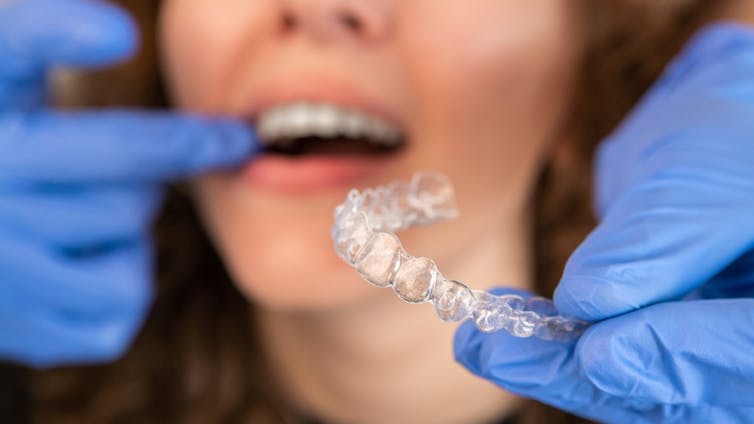
Similarly, acrylic mouthguards, nightguards, clear aligners and removable retainers are held in the mouth for hours each day and show visible wear over time. That wear is a sign that microscopic fragments are being released and either ingested or rinsed into the sink.

An orthodontist fitting a retainer.
Retainers and mouthguards can also shed plastic through wear and tear.
Rec Stock Footage/Shutterstock.com

Effect on health

All of this plastic debris inevitably raises a bigger question: what does it do to us? The effect of microplastics on our health is worrying. Bisphenol A, a chemical used in some dental resins (plastics), can mimic hormones and disrupt the endocrine system.

In 2024, a medical study detected microplastics embedded in arterial plaque and those patients were far more likely to suffer a heart attack or stroke. Other studies suggest swallowed microplastics may disturb gut microbes and trigger inflammation.

Given these mounting risks, solving this plastic invasion will take action from industry and consumers alike. Manufacturers are developing toothpastes with natural abrasives like silica or clay instead of plastic beads and researching biodegradable polymers for future dental products.

Over 15 countries have already banned plastic microbeads in toothpastes and cosmetics, removing one obvious source of pollution. Some dental clinics are testing filters (like activated carbon filters) to trap resin dust before it enters wastewater.

Consumer choice

Consumers also have choices. Toothpaste tablets or powders in plastic-free packaging are now available. Bamboo toothbrushes or those with natural bristles significantly reduce plastic waste.

Plastic-free natural fibre-based floss options can also help minimise the impact of plastics.

For orthodontics, traditional metal braces offer effective alternatives without adding plastic to your mouth or the environment.

Dental plastics have brought clear benefits such as whiter teeth, easy treatments and safer alternatives to mercury. Yet their environmental costs and possible health risks are now coming into focus.

With microplastics turning up from the oceans to the human bloodstream, even our mouths are not safe from this invisible contamination. The hope lies in innovation and vigilance so dentistry can continue to protect our smiles without adding to the plastic crisis.

The Conversation

Saroash Shahid does not work for, consult, own shares in or receive funding from any company or organisation that would benefit from this article, and has disclosed no relevant affiliations beyond their academic appointment.

ref. The hidden plastic problem in your daily dental routine – and what’s being done about it – https://theconversation.com/the-hidden-plastic-problem-in-your-daily-dental-routine-and-whats-being-done-about-it-264072

A rocky planet in its star’s ‘habitable zone’ could be the first known to have an atmosphere – here’s what we found

Source: The Conversation – UK – By Hannah Wakeford, Associate professor, University of Bristol

New research using Nasa’s powerful JWST telescope has identified a planet 41 light years away which may have an atmosphere. The planet is within the “habitable zone”, the region around a star where temperatures make it possible for liquid water to exist on the surface of a rocky world. This is important because water is a key ingredient that supports the existence of life.

If confirmed by further observations, this would be the first rocky, habitable zone planet that’s also known to host an atmosphere. The findings come from two new studies published in the journal Astrophysical Journal Letters.

The habitable zone is partly defined by the range of temperatures generated by heat from the star. The zone is located at a distance from its star where temperatures are neither too hot nor too cold (leading to it occasionally being nicknamed “the Goldilocks zone”).

But exoplanets (worlds orbiting stars outside our solar system) capable of hosting liquid water often also need an atmosphere with a sufficient greenhouse effect. The greenhouse effect generates additional heating due to absorption and emission from gases in the atmosphere and will help prevent evaporation of water into space.

Together with an international team of colleagues, we trained the largest telescope in space, Nasa’s JWST, on a planet called Trappist-1 e. We wanted to determine whether this rocky world, which lies in its star’s habitable zone, hosts an atmosphere. The planet is one of seven rocky worlds known to orbit a small, cool “red dwarf” star called Trappist-1.

Rocky exoplanets are everywhere in our galaxy. The discovery of abundant rocky planets in the 2010s by the Kepler and Tess space telescopes has profound implications for our place in the Universe.

Most of the rocky exoplanets we’ve found so far orbit red dwarf stars, which are much cooler than the Sun (typically 2500°C/4,500°F, compared to the Sun’s 5,600°C/10,000°F). This isn’t because planets around Sun-like stars are rare, there are just technical reasons why it is easier to find and study planets orbiting smaller stars.

Red dwarfs also offer many advantages when we seek to measure the properties of their planets. Because the stars are cooler, their habitable zones, where temperatures are favourable to liquid water, are located much closer in comparison with our solar system, because the Sun is much hotter. As such, a year for a rocky planet with the temperature of Earth that orbits a red dwarf star can be just a few days to a week compared to Earth’s 365 days.

Transit method

One way to detect exoplanets is to measure the slight dimming of light when the planet transits, or passes in front of, its star. Because planets orbiting red dwarfs take less time to complete an orbit, astronomers can observe more transits in a shorter space of time, making it easier to gather data.

During a transit, astronomers can measure absorption from gases in the planet’s atmosphere (if it has one). Absorption refers to the process whereby certain gases absorb light at different wavelengths, preventing it from passing through. This provides scientists with a way of detecting which gases are present in an atmosphere.

Crucially, the smaller the star, the greater the fraction of its light is blocked by a planet’s atmosphere during transit. So red dwarf stars are one of the best places for us to look for the atmospheres of rocky exoplanets.

Located at a relatively close distance of 41 light years from Earth, the Trappist-1 system has attracted significant attention since its discovery in 2016. Three of the planets, Trappist-1d, Trappist-1e, and Trappist-1f (the third, fourth, and fifth planets from the star) lie within the habitable zone.

JWST has been conducting a systematic search for atmospheres on the Trappist-1 planets since 2022. The results for the three innermost planets, Trappist-1b, Trappist-1c and Trappist-1d, point to these worlds most likely being bare rocks with thin atmospheres at best. But the planets further out, which are bombarded with less radiation and energetic flares from the star, could still potentially possess atmospheres.

We observed Trappist-1e, the planet in the centre of the star’s habitable zone, with JWST on four separate occasions from June-October 2023. We immediately noticed that our data was strongly affected by what’s known as “stellar contamination” from hot and cold active regions (similar to sunspots) on Trappist-1. This required a careful analysis to deal with. In the end, it took our team over a year to sift through the data and distinguish the signal coming from the star from that of the planet.

Our star-corrected JWST transmission spectrum of Trappist-1e’s atmosphere which could either be fit by the blue wiggles, suggestive of an atmospheric signal, or the orange flat line suggestive of no atmosphere at all. The white shows how these two possibilities overlap and thus the challenge to interpret our initial TRAPPIST-1e observations.
JWST

We are seeing two possible explanations for what’s going on at Trappist-1e. The most exciting possibility is that the planet has a so-called secondary atmosphere containing heavy molecules such as nitrogen and methane. But the four observations we obtained aren’t yet precise enough to rule out the alternative explanation of the planet being a bare rock with no atmosphere.

Should Trappist-1e indeed have an atmosphere, it will be the first time we have found an atmosphere on a rocky planet in the habitable zone of another star.

Since Trappist-1e lies firmly in the habitable zone, a thick atmosphere with a sufficient greenhouse effect could allow for liquid water on the planet’s surface. To establish whether or not Trappist-1e is habitable, we will need to measure the concentrations of greenhouse gases like carbon dioxide and methane. These initial observations are an important step in that direction, but more observations with JWST will be needed to be sure if Trappist-1e has an atmosphere and, if so, to measure the concentrations of these gases.

As we speak, an additional 15 transits of Trappist-1e are underway and should be complete by the end of 2025. Our follow-up observations use a different observing strategy where we target consecutive transits of Trappist-1b (which is a bare rock) and Trappist-1e. This will allow us to use the bare rock to better “trace out” the hot and cold active regions on the star. Any excess absorption of gases seen only during Trappist-1e’s transits will be uniquely caused by the planet’s atmosphere.

So within the next two years, we should have a much better picture of how Trappist-1e compares to the rocky planets in our solar system.

The Conversation

Hannah Wakeford receives funding from UK Research and Innovation (UKRI) framework under the UK government’s Horizon Europe funding guarantee for an ERC Starter Grant (grant number EP/Y006313/1).

Ryan MacDonald has recieved funding from NASA through the NASA Hubble Fellowship grant HST-HF2-51513.001, awarded by the Space Telescope Science Institute, which is operated by the Association of Universities for Research in Astronomy, Inc., for NASA, under contract NAS 5-26555.

ref. A rocky planet in its star’s ‘habitable zone’ could be the first known to have an atmosphere – here’s what we found – https://theconversation.com/a-rocky-planet-in-its-stars-habitable-zone-could-be-the-first-known-to-have-an-atmosphere-heres-what-we-found-264715

Gin Lane by William Hogarth is a critique of 18th-century London’s growing funeral trade

Source: The Conversation – UK – By Dan O’Brien, Visiting Research Fellow, Centre for Death and Society, University of Bath

Gin Lane by William Hogarth (1751). Royal Academy of Arts

In 1751, the English painter William Hogarth created a nightmarish depiction of the London slum of St Giles. The familiar spire of the parish church towered over a scene of human ruin. This is Gin Lane, an imagined thoroughfare where the consumption of gin has deprived the inhabitants of sense, finances – and in some instances life.

At the heart of the image, Hogarth depicted a series of steps on which different characters illustrated the gin drinker’s descent from propriety to death. At the top of the steps, residents deposited their goods with the prosperous pawnbroker, including a carpenter who handed over his saw – a reminder that gin disrupts industry.

Just below on the steps is a drunken mother whose eagerness to take a pinch of snuff causes her baby to slip from her arms to its death below. The drunken mother is the most striking aspect of Hogarth’s image, a focal point that represents how gin detaches the drinker from their closest bonds and duties. Beneath the mother, reclines an emaciated gin drinker whose skeletal features hint at his imminent death. He even lacks the strength to hold his gin glass.


This article is part of Rethinking the Classics. The stories in this series offer insightful new ways to think about and interpret classic books, films and artworks. This is the canon – with a twist.


Gin Lane was one of two contrasting Hogarth visions of life in England’s capital in which the fortunes of Londoners were shaped by the drinks they consumed. The inhabitants of the other, Beer Street (1751), are artisans enjoying a foaming tankard during their long day of work.

Black and white engraving of a busy London street, filled with people drinking beer.
Beer Street by William Hogarth (1751).
Royal Academy of Arts

A blacksmith and paviour (person who lays paving) are in the foreground, while a man tasked with carrying a sedan chair quenches his thirst in the background.

Beer Street is a scene of industriousness in which draughts were consumed without disrupting the effort of the day. High in the scene, a group of workers enjoys beer shared from a jug while a tailor toasts them from a nearby window. The inhabitants’ prosperity has just one noticeable consequence in the tattered premises of the pawnbroker.

While Gin Lane can be read as a commentary on the dangers of vice, I believe it also comments on another significant development in 18th-century London – the growth of the funeral trade.

Birth of the undertaker

Just above the shoulder of the drunken mother are two coffins. One lies on the ground as a body is placed in it and the other is suspended outside the premises of an undertaker. This latter coffin was a shop sign, which could be seen across the city in the mid- to late-18th century. Undertaking was a developing trade that had many advocates. These undertakers were artisans or traders who supplemented their existing businesses with funerary work.

Undertakers were primarily middlemen who sourced the items required for a funeral, as well as providing items from their own stock. A carpenter acting as undertaker, for example, might build a coffin himself, before turning to ironmongers, drapers and painters for other elements of funerary display.

The supplemental nature of early undertaking enabled many people to adopt the title and some of the most successful eventually specialised fully in funerary work. In the closing decades of the 17th century, the earliest undertakers organised the elaborate funerals of elites, having previously supplied goods for these occasions. As the trade spread, its development was driven by profit and therefore thrived in urban centres where there were more prospective customers.

drawing of an undertaker's shop
Detail of the undertaker’s shop in Gin Lane by William Hogarth (1751).
Royal Academy of Arts

The presence of the undertaker’s shop in Hogarth’s Gin Lane is a reflection of the trade’s increasing popularity beyond the early origins in funerals of the elite.

By the mid-18th century, undertaker-led funerals were a common sight on the city’s streets, travelling from bereaved households to parish churches. The upstart trade had drawn criticism as early as 1699 when the author Thomas Tryon argued that undertakers were diminishing the worth of the funerary customs of the elites. And for many critics, there was no group thought less deserving of funerary spectacle than the gin-drinking poor.

Critiquing the undertaker

Hogarth’s inclusion of the undertaker was also a comment on the motives of the developing trade and the worth of its service. In Gin Lane, he emphasised the way that undertakers profited from the misfortune and misery of others.

He places the undertaker’s shop at the heart of a ruined street, where other trades have failed and the residents lie incapacitated and dying. His message is clear – the undertaker gains from the loss of others and so is little different from the other thriving businesses of the fictional street, the pawnbroker and the gin shop.

engraving of people lowering a body into a coffin.
The open coffin and the distant funeral party, detail from Gin Lane by William Hogarth (1751).
Royal Academy of Arts

The opened coffin and distant funeral party can also be read as a comment on the worth of the funerary products that underpinned the trade’s success. The lidless coffin is presented as little more than a box to contain the half-naked remains of the woman who is lowered into it. And the depiction of the dead woman reminds us that the coffin does nothing for its inhabitant – its purpose is purely aesthetic.

A uniform aesthetic is important to the funerary party, wearing hatbands and mourning cloaks as they wander through the tattered background. Yet the neatly attired procession is lost within the image and fails to hold the attention of the neighbourhood. The cost of these items cannot influence the attitudes of those outside of the funeral. Through these small details, Hogarth reminds the viewer that funerary goods are a hollow expenditure, which cannot improve the circumstances of the dead or the bereaved.

Much as the inhabitants of Gin Lane ruin themselves in pursuit of gin, so might the viewer waste their money on funerary goods that do not serve any practical purpose. As such, Hogarth’s work is more than a simple comment on the consequences of the gin craze – it’s a wider critique of how 18th-century Londoners spent their money.

Beyond the canon

As part of the Rethinking the Classics series, we’re asking our experts to recommend a book or artwork that tackles similar themes to the canonical work in question, but isn’t (yet) considered a classic itself. Here is Dan O’Brien’s suggestion:

Juan Manuel Echavarría has used photography to document how people experience death in a time of crisis and brutality. His work Réquiem NN (2006-13) uses imagery of graves in a Colombian cemetery to explore how people’s treatment of the dead is both an act of dignity and a form of resistance.

Réquiem NN depicts graves used for unidentified bodies that have been recovered from Colombia’s Magdalena River as a result of civil war. We see each grave in two periods, bringing to life the act of mourning, which has been performed for the unnamed dead, and revealing how the living use the graves to record the names of victims who were their own relatives.


Looking for something good? Cut through the noise with a carefully curated selection of the latest releases, live events and exhibitions, straight to your inbox every fortnight, on Fridays. Sign up here.


The Conversation

Dan O’Brien does not work for, consult, own shares in or receive funding from any company or organisation that would benefit from this article, and has disclosed no relevant affiliations beyond their academic appointment.

ref. Gin Lane by William Hogarth is a critique of 18th-century London’s growing funeral trade – https://theconversation.com/gin-lane-by-william-hogarth-is-a-critique-of-18th-century-londons-growing-funeral-trade-234761

Why listening to stories and talking about them is so important for young children

Source: The Conversation – UK – By Fufy Demissie, Senior Lecturer in Early Years Education, Sheffield Hallam University

PeopleImages/Shutterstock

Story time – at home, at nursery and at school – is where young children encounter the magic of books. Reading stories to young children is a pleasurable activity in itself, but it also lays the foundation for language and literacy development and has social and emotional benefits.

What’s more, research for decades has shown a clear difference in the language skills of children who had story time at home and those who didn’t.

Parents and teachers can further expand the benefits of story time by getting children involved in what’s known as dialogic reading – engaging in conversations about stories. This means using questions to get children talking about the book. This talk can deepen children’s knowledge and understanding, and help them learn about language. It can include asking what children remember about plot points to encourage their recall of the book, and asking “why” questions about characters’ choices.

A wealth of evidence has highlighted the significance of these kind of conversations during story time. It has benefits for reading enjoyment, reading motivation, parent-child attachment and parental confidence.

Dialogic reading affects children’s vocabulary as well as their literacy outcomes. One particular study divided 36 children with vocabulary delays into groups taking part in shared reading or shared dialogic reading. While both groups showed improvements, the dialogic reading group had significantly larger gains in vocabulary.

It has benefits for reading enjoyment, reading motivation, parent-child attachment and parental confidence.

Language and communication is a prime area of the early years foundation stage in England – the guidelines for the education and development of children aged from birth to five. What’s more, the practice of dialogic reading is a valuable way to develop young children’s “oracy” – the ability to articulate ideas when speaking, listen carefully and communicate effectively.

Teacher reading to children in school library
Story time at school.
Rido/Shutterstock

However, curriculum pressures can make it difficult for teachers to prioritise story time at school. Policy directives that prioritise decoding skills – reading instruction that focuses on the ability to understand how letters and groups of letters represent sounds. This leaves less time for the development of oracy skills.

Oracy education

In 2024, the Oracy Commission, an independent body campaigning to embed oracy across the curriculum, published a report highlighting oracy’s importance. It pointed out that oracy prepares young children and pupils for the demands of their future lives: it’s needed to give a presentation, argue an idea, and take part confidently in university seminars and work meetings. The report noted that access to high-quality oracy education is not universal.

Oracy in education was a key part of the current Labour government’s election manifesto. But its absence from the interim report of an ongoing review into curriculum and assessment has campaigners worried.

My research project Talk with Tales for Children has worked to improve early years teachers’ skills in using dialogic reading techniques with three- and four-year-olds. The programme uses traditional tales, such as Goldilocks and the Three Bears. In addition to questions such as “what can you see on this page?” and “what happened next?”, practitioners are also encouraged to ask questions that provoke childrens’ thinking. These include “would it be good or bad to eat someone else’s porridge?” and “was Goldilocks brave?”

The early findings suggest that high-quality training through this programme has improved early years teachers and practitioners’ interactions during shared reading and enhanced childrens’ listening and attention, thinking skills and enjoyment of and engagement with stories.

The language, social, and emotional benefits of story time mean it should be seen as a fundamental part of the early years curriculum – rather than a luxury or an add-on.

The Conversation

Fufy Demissie receives funding from the Educational Endowment Foundation

ref. Why listening to stories and talking about them is so important for young children – https://theconversation.com/why-listening-to-stories-and-talking-about-them-is-so-important-for-young-children-249302

New type of ‘sieve’ detects the smallest pieces of plastic in the environment more easily than ever before

Source: The Conversation – Global Perspectives – By Shaban Sulejman, PhD Candidate, Faculty of Science, The University of Melbourne

Nanoplastic particles are captured by cavities in the optical sieve. Lukas Wesemann and Mario Hentschel

Plastic pollution is everywhere: in rivers and oceans, in the air and the mountains, even in our blood and vital organs. Most of the public attention has focused on the dangers of microplastics. These are fragments smaller than 5 millimetres.

But an even smaller class of fragments, nanoplastics, may pose a greater risk to our health and our environment. With diameters of less than a micrometre (one millionth of a metre), these tiny particles can cross important biological barriers and accumulate in the body. Because they’re so tiny, detecting nanoplastics is extremely difficult and expensive. As a result, determining the extent of their impact has been largely guesswork.

A cheap, easy and reliable way to detect nanoplastics is the first step in addressing their potential impact. In our new study published today in Nature Photonics, my colleagues and I describe a simple, low-cost method that detects, sizes and counts nanoplastics using nothing more than a standard microscope and a basic camera.

Breaking down into ever-smaller pieces

What makes plastics useful is their durability. But that is also what makes them problematic.

Plastics do not disappear. They are not broken down by the ecosystem in the same way as other materials. Instead, sunlight, heat and mechanical stress slowly split the plastic apart into ever-smaller fragments. Larger pieces become microplastics, which eventually become nanoplastics once they are less than a micrometre in size.

At such a small size, they can pass through important biological safeguards such as the blood–brain and placental barriers. They can then start to accumulate in our organs, including our lungs, liver and kidneys. They can also carry other contaminants into our bodies, such as pollutants and heavy metals.

Plastic pollution and a red drink can on a beach.
Plastics are not broken down in the ecosystem in the same way as other materials.
Brian Yurasits

Yet, despite these dangers, real-world data on nanoplastics are scarce.

Today, detecting and sizing particles below a micrometre often relies on complex separation and filtration methods followed by expensive processes, such as electron microscopy. These methods are powerful. But they’re also slow, costly and usually confined to advanced laboratories.

Other optical laboratory techniques, such as dynamic light scattering, work well in “clean” samples. However, they struggle in “messy” real-world samples such as lake water because they cannot easily distinguish plastic from organic material.

An optical sieve

To address these issues, our international team from the University of Melbourne and the University of Stuttgart in Germany set out to make detection simple, affordable and portable.

The result of our collaborative work is an optical sieve: an array of tiny cavities with different diameters etched into the surface of a type of semiconductor material called gallium arsenide. Essentially, a collection of tiny holes, invisible to the naked eye, in a flat piece of a suitable material.

Physicists call these cavities “Mie voids”. Depending on their size, they produce a distinct colour when light is shone on them. When a drop of liquid containing nanoplastics flows over the surface, the nanoparticles will tend to settle into cavities that closely match their size.

Then, with a chemical rinse, mismatched particles wash away while matched ones stay tightly held in place by electromagnetic forces.

A diagram showing a sieve dropping liquid onto a square.
The optical sieve consists of a cavities of different sizes. When pouring a droplet of liquid containing nanoplastics over it, the particles get captured by the cavities of matching size and a colour change is directly visible in a microscope image.
Lukas Wesemann

That part is simple. But it wouldn’t make the process cheaper or more portable if it still required a large, expensive electron microscope to visualise the trapped particles.

But here’s the key: when a particle is captured inside a cavity, it changes the colour of that cavity. This means filled cavities are easily distinguishable from empty ones under a standard light microscope with an ordinary colour camera, often shifting from bluish to reddish hues.

By observing colour changes, we can see which cavities contain particles. Because only certain-sized particles fill certain-sized cavities, we can also infer their size.

In our experiments, using nothing but our optical sieve, a standard light microscope and a simple camera, we were able to detect individual plastic spheres down to about 200 nanometres in diameter – right in the size range that matters for nanoplastics.

Tiny black balls covering a grey surface.
Nanoplastic particles with a size below one micrometer.
Lukas Wesemann and Mario Hentschel

Putting it to the test

To validate the concept, we first used polystyrene beads in a clean solution. We observed clear colour changes for particles with diameters between 200 nanometres and a micrometre.

We then tested a more “real-world” sample, combining unfiltered lake water (including biological material) with clean sand and plastic beads of known sizes: 350 nanometres, 550 nanometres and a micrometre.

After depositing this mixture onto the optical sieve and then giving it a rinse, we were able to see distinct bands of filled cavities with diameters that matched the beads we had added.

This confirmed the optical sieve had successfully detected the nanoplastic particles in the lake water sample and determined their sizes. Importantly, this did not require us to separate the plastics from the biological matter first.

What’s next?

Our new method is a first step in developing a cheap, easy and portable method for routine monitoring of waterways, beaches and wastewater, and for screening biological samples where pre-cleaning is difficult.

From here, we are exploring paths to a portable, commercially available testing device that can be adapted for a range of real-world samples, especially those like blood and tissue that will be crucial in monitoring the impact of nanoplastics on our health.


The author would like to acknowledge the contribution of Lukas Wesemann to this article.

The Conversation

Shaban Sulejman receives funding from The University of Melbourne under a Ernst & Grace Matthaei Scholarship, the Australian Government Research Training Program Scholarship, and the Australian Research Council.

ref. New type of ‘sieve’ detects the smallest pieces of plastic in the environment more easily than ever before – https://theconversation.com/new-type-of-sieve-detects-the-smallest-pieces-of-plastic-in-the-environment-more-easily-than-ever-before-264593

The legend of Troy explained

Source: The Conversation – Global Perspectives – By Marguerite Johnson, Honorary Professor of Classics and Ancient History, School of Historical and Philosophical Inquiry, The University of Queensland

Helen and Paris depicted on an Ancient Greek vase, 380–370 BC. Wikimedia Commons

The Trojan War is a legend that sprang from a distant memory of a real Greek incursion into the Bronze Age city of Troy (in modern day Türkiye). This may have taken the form of annual piracy raids and/or encounters based on control of the Aegean Sea.

These real life encounters between Greeks and Trojans, led to the destruction of Troy circa 1150 BCE (likely though warfare and fire). Over hundreds of years, they were transformed into oral tales.

Collectively known as the Trojan War Cycle, these tales were later committed to writing. They were retold and readapted over centuries in Greek and Roman antiquity, with writers and artists changing and adding to the basic plotline to suit their own purposes. Adaptations of the hundreds of stories that make up this cycle continue today, particularly in theatre.

The immediate cause of the legendary war, as storytellers have told it, was the abduction of King Menelaus’s wife Helen, Queen of Sparta, by the Trojan prince, Paris. (In the shame-based culture of Bronze Age Greek society, this act was deeply humiliating for a man, especially a king).

In response to the kidnapping, Menelaus’s brother, Agamemnon, King of Mycenae (a city in the Peloponnese), led a military campaign against Troy. The city of around 10,000 people was surrounded and held under siege for ten years.

The war ended with the ingenious deception of the Trojan Horse. This huge wooden beast was offered to the Trojans as a so-called gift from the Greeks, but secretly contained Greek soldiers. Once inside the city, they crept out, threw open the gates to their fellow Greeks and so began the city’s final days.

A painting of soldiers pulling a huge, white wooden horse.
Giovanni Domenico Tiepolo, The Procession of the Trojan Horse in Troy.
Wikimedia Commons, CC BY-SA

Is any of it true?

Most of us may find it strangely romantic to believe in a heroic quest for a stolen queen rather than accept that the city of Troy ultimately fell as a result of strategic and economic assaults at the hands of the Mycenaean Greeks.

Indeed, the actual city of Troy has been located, complete with two archaeological sublayers. Experts have found evidence that attests to the city’s destruction by siege. Similarly, the site of Bronze Age Mycenae, a palatial structure, as old as the particular sublayers of Troy, has been identified at the place of origin for the Greek expeditions.

But such physical sites cannot prove the historical existence of Helen, Achilles and the other superstars of the storytellers.

Such heroes and heroines most likely came into being as the stories developed, although some characters may have been partially based on historic leaders, their wives and families.

The ruins of Troy today.
Part of the excavated city of Troy today.
Marguerite Johnson, CC BY

The Iliad’s account

The Iliad (c. eighth century BCE) is the earliest example of how the shadowy, inglorious invasion of a prosperous city was transformed into a monumental national epic. Other stories tell aspects of the myth, for example Euripides’ tragedy, The Trojan Women (415 BCE).

Attributed to the poet Homer, the Iliad chronicles some weeks in the last year of the war. Composed in dactylic hexameter and divided into 24 “books” (chapters, if you will) that culminate in 15,693 lines of poetry, it is the definitive masterpiece of war literature.

Moving from the Greek encampment along the shores of northwest Asia Minor (modern-day Türkiye) to the fortified citadel of Troy (the modern-day city of Hisarlik) at the mouth of the Dardarnelles, the Iliad evokes the lives of both Greek and Trojan warriors as well as those of civilians.

As a war narrative, its battle scenes are visceral and drenched in blood, evoking both courage and cowardice, and certainly not for the squeamish. Yet it also captures the devastation war brings to children, wives, mothers, men too old to fight and hostages, along with soldiers.

The poem opens with an internal feud among the Greeks themselves, centring on the animosity between Agamemnon, and Achilles, leader of the Myrmidons (from modern-day Thessaly), who is also fighting for the Greeks.

At the heart of this bitter dispute are two hostages. Chryseis, daughter of the Trojan priest of Apollo, Chryses, has been taken by Agamemnon as a sex slave following a raid. Briseis was awarded to Achilles during a similar incursion.

The god Apollo sends a plague upon the Greeks as a result of Agamemnon’s refusal to return Chryseis to her father. Achilles – enraged and acting above his station – publicly confronts Agamemnon, demanding he return the young woman. Humiliated, Agamemnon eventually agrees but, in order to regain his preeminent status, takes Briseis from Achilles.

This scene evokes what modern people might recognise as combat fatigue. There is tension around decision-making, confused thinking, mistrust and anger. This personal feud depicts both men, not only as larger than life warriors, but also as complex human beings enduring almost unendurable conditions.

While such a situation may seem irrelevant in an epic that tells such a monumental tale, explicating the horrors of war on such a grand and devastating scale, the reality is quite the opposite.

Firstly, it is a reminder that war can be banal. Indeed, the “mini war” over two sex slaves seized during raiding parties reenacts the overarching “super war” at Troy, reinforcing the vanity of the human condition as well as the recklessness and even malignancy propelling some conflicts.

Karl Friedrich Deckler, ‘The Farewell of Hector to Andromaque and Astyanax’
Wikimedia, CC BY

Interestingly, the story of the Trojan Horse, the death of Achilles, and the many other instalments that constitute the Trojan War Cycle, do not interest the poet who compiled the Iliad. These are tales told elsewhere, in the fragments that remain of other epics, in the songs of lyric poets and in some of the extant tragedies of playwrights, right up to the literature and art of Late Antiquity.

Rather, Homer is interested in the stories of the humans trapped in the crossfire. For example, in Book Six of the Iliad, Hector, a Trojan prince and Troy’s greatest warrior, farewells his wife, Andromache, and his infant son, Astyanax, as he prepares to return to the battlefield. Andromache, who senses her husband is soon to die, says:

[…] for me it would be far better
to sink into the earth when I have lost you, for there is no other
consolation for me after you have gone to your destiny –
only grief […]

The Trojan Women

Andromache’s story and those of other women after the fall of Troy are of particular interest to Greek tragic playwrights of the fifth century BCE. The most powerful of the extant plays on this theme is Euripides’ The Trojan Women. The play consists of the voices of the four women who mourn the death of Hector at the hands of Achilles in the last book of the Iliad: Cassandra, the Trojan princess; Hecuba, the Queen of Troy; Andromache; and, finally, Helen herself.

To emphasise the suffering in war, the Chorus (the traditional collective narrators in Greek plays) is comprised of captive Trojan women, representing the nameless and forgotten human collateral.

This tragedy has been retold and re-imagined since its original production, including a heralded Australian adaptation by Barrie Kosky and Tom Wright in 2008.

Euripides details the fate of Cassandra, the princess also taken as a sex slave by Agamemnon; Hecuba, the wife of Priam, the last king of Troy, who is enslaved to Odysseus, King of Ithaca, and Andromache, indentured to Neoptolomus, son of Achilles. As for Helen, she is vilified as having caused the Trojan War, although in this play she, too, is a victim of war as she must beg her husband for her life.

The horror and inhumanity expressed in The Trojan Women culminates in the Greek execution of Astyanax, the baby son of Andromache and Hector. The tiny body is prepared for burial by his grandmother, Hecuba, while Andromache wails and Troy burns.

The endless interpretations of the siege of Troy in both literature and art can show courage and the triumph of the human spirit in the face of the worst of adversities. Yet others show that heroism is debatable and mutable, victory comes with loss of humanity, and women and children are always the victims.

The Conversation

Marguerite Johnson does not work for, consult, own shares in or receive funding from any company or organisation that would benefit from this article, and has disclosed no relevant affiliations beyond their academic appointment.

ref. The legend of Troy explained – https://theconversation.com/the-legend-of-troy-explained-263905