UK and other Western states recognize Palestinian state ahead of UN meetings – but symbolic action won’t make statehood happen

Source: The Conversation – Global Perspectives – By Maha Nassar, Associate Professor in the School of Middle Eastern and North African Studies, University of Arizona
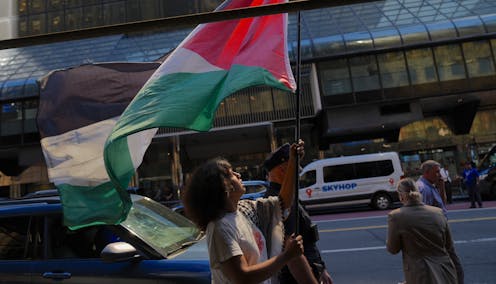
Pro-Palestinian Americans gather in New York at a march to the U.N. on Sept. 18, 2025. Selcuk Acar/Anadolu via Getty Images

Recognition of a Palestinian state is likely to dominate proceedings at the U.N. beginning Sept 23, 2025, when world leaders will gather for the annual general assembly.

Of the 193 existing U.N member states, some 150 now recognize a Palestinian state. Ahead of the U.N. gathering in New York, Australia, Canada and the United Kingdom become the latest. And that number is expected to increase in the coming days, with several more countries expected to officially announce similar recognition.

That a host of Western nations are adding their names to the near-universal list of Global South countries that already recognize a Palestinian state is a major diplomatic win for the cause of an independent, sovereign and self-governed nation for Palestinians. Conversely, it is a massive diplomatic loss for Israel – especially coming just two years after the West stood shoulder to shoulder with Israel following the Oct. 7 attack by Palestinian militant group Hamas.

As a scholar of modern Palestinian history, I know that this diplomatic moment is decades in the making. But I am also aware that symbolic diplomatic breakthroughs on the issue of Palestinian statehood have occurred before, only to prove meaningless in the face of events that make statehood less likely.
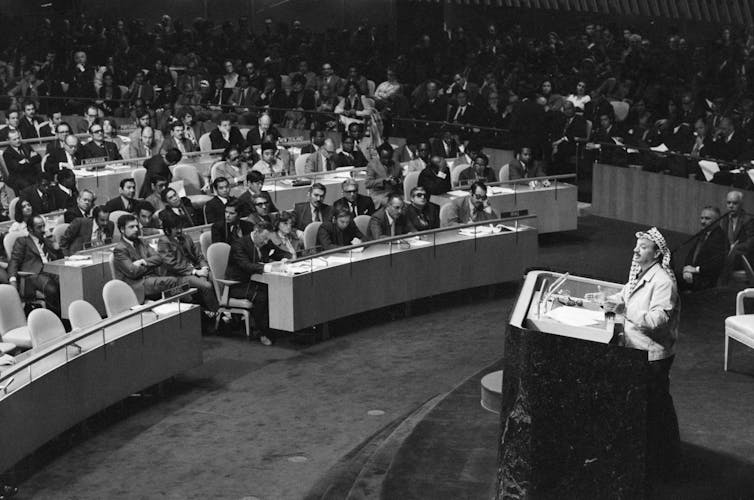
A man gives a speech before a crowd.
‘I have come bearing an olive branch and a freedom fighter’s gun,’ PLO leader Yasser Arafat said before the United Nations General Assembly in 1974.
Bettmann / Contributor

The non-state reality

The fight for Palestinian statehood can be traced back to at least 1967. Over the course of a six-day war against a coalition of Arab states, Israel conquered and expanded its military control over the remainder of what was historic Palestine – a stretch of land that extends from the Jordan River in the east to the Mediterranean Sea in the west.

At the war’s conclusion, Israel had taken control of the West Bank, East Jerusalem and the Gaza Strip.

Unlike after the 1948 war that led to its independence, Israel opted not to extend Israeli citizenship to Palestinians living in the newly conquered areas. Instead, the Israeli government began to rule over Palestinians in these occupied territories through a series of military orders.

These orders controlled nearly every aspect of Palestinian life – and many remain in effect today. For example, if a Palestinian farmer wants to harvest his olive trees near a Jewish settlement in the West Bank, they need a permit. Or
if a Gazan worker wants to work inside Israel, they need Israeli permission. Even praying in a mosque or church in East Jerusalem is dependent on obtaining a permit.

This permit system served as a constant reminder to Palestinians living in the occupied territories that they lacked control over their own daily lives. Meanwhile, Israeli authorities tried to squash the idea of Palestinian nationhood through policies such as outlawing public displays of the Palestinian flag. That, and other expressions of Palestinian national identity in the occupied territories, could result in up to 10 years in prison.

Such policies fit a belief, expressed in 1969 by then Israeli Prime Minister Golda Meir, that there was “no such thing in this area as Palestinians.”

The rise of Palestinian nationalism

Around the same time that Meir made that comment, Palestinians started organizing around the idea of statehood.

Although the idea had been floated before, statehood was codified into official doctrine in a resolution in February 1969 in Egypt. It occurred during a session of the Palestine National Council, the legislative body of the Palestine Liberation Organization, which formed in 1964 as the official representative of Palestinians in the occupied territories.

That resolution called for a free, secular democratic state in Palestine – including all of the State of Israel – in which Muslims, Christians and Jews would all have equal rights.

From that moment on, the Palestinian struggle against Israeli occupation took twin paths: diplomatic pressure and armed resistance.

But events on the ground undermined the idea of a single state for all along the lines envisioned by the Cairo resolution.

The 1973 Arab-Israeli War’s inconclusive ending opened the door to greater diplomacy between Israel and the Arab states. Egypt and Israel decided that diplomacy would help them achieve their aims, culminating in the Egyptian-Israeli peace treaty of 1979. But the treaty also left the Palestinians without unified Arab support.

Meanwhile, throughout the 1970s, the Israeli occupation deepened and entrenched with the building of Israeli settlements, especially in the West Bank.
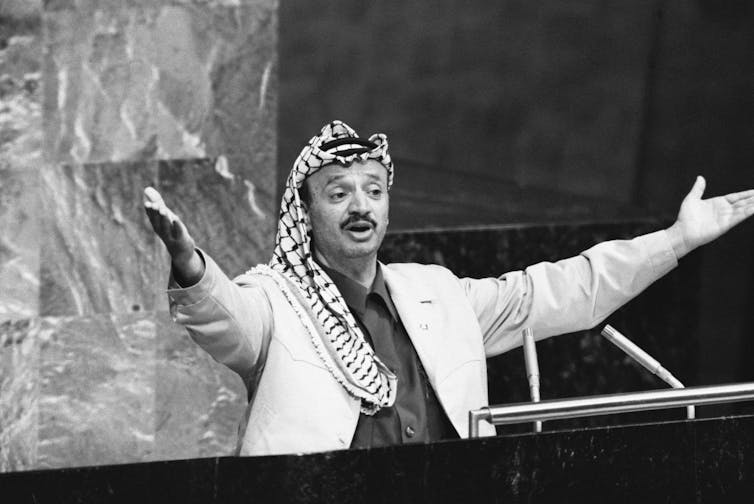
A man throws out his arms to make a point while he stands at a lectern.
Yasser Arafat addresses the United Nations General Assembly in 1974.
Bettmann / Contributor

The PLO responded in 1974 by issuing what became known as the 10-Point Plan, where they pivoted to seeking the establishment of a national authority in any part of historic Palestine that could be liberated.

It was, in effect, a way of threading the needle: It signaled to moderates that the PLO was adopting a more gradualist position, while also telling the group’s rejectionist front – which opposed peace negotiations with Israel – that they were not giving up completely on the idea of liberating all of Palestine.

Then in 1988 – a year into the first Palestinian intifada, or uprising – the PLO unilaterally declared Palestinian independence on the territories occupied in 1967.

The move was largely symbolic – the West Bank, Gaza and East Jerusalem were still under occupation, and the PLO was then in exile in Tunisia.

But it was nonetheless significant. It represented the bringing together of Palestinians in exile – most of whom were from towns and villages that were now part of the State of Israel – with Palestinians in the occupied territories.

The declaration itself was written by Palestinian poet Mahmoud Darwish, who grew up inside Israel, and declared by Yasser Arafat, the PLO leader in exile.

It was also a moment of tremendous hope and possibility for Palestinians. What most Palestinians wanted was for the international community to recognize them as a national body, deserving of a seat at the table with other nation-states.

Compromise and rejection

Yet at the same time, many Palestinians saw the declaration as a huge compromise. The West Bank, Gaza Strip and East Jerusalem comprise about 22% of historic Palestine. So the declaration effectively meant that Palestinians were giving up on the other 78% of what they saw as their land.

Reaction from the international community to the PLO’s declaration was split. Many formerly colonized countries of the Global South recognized Palestinian independence right away. By the end of the year, some 78 countries had issued statements recognizing Palestine as a state.

Israel rejected it outright, as did United States and most Western nations.

Such was Washington’s opposition that the U.S. denied Arafat a visa ahead of his planned address to the United Nations at its New York City headquarters. As a result, the December 1988 meeting had to be moved to Geneva.

While refusing to accept Palestinian statehood, the U.S. and Israel did begin to recognize the PLO as a representative body of the Palestinian people. This was part of the Oslo Accords – a diplomatic process that many believed would outline a road map for an eventual two-state solution.

While some Palestinians saw the Oslo Accords as a diplomatic breakthrough, others were more skeptical. Prominent Palestinians, including Darwish and Palestinian-American professor Edward Said, believed that Oslo was a poison pill: While framed as a step toward a two-state solution, the agreement said nothing about a Palestinian state in the interim. It only said that Israel would recognize the PLO as a representative of the Palestinian people.

In reality, the Oslo Accords have not lead to statehood. Rather, they created a system of fragmented autonomy under the newly created Palestinian Authority that, though meant to be interim, has in effect become permanent.

The Palestinian Authority was allowed only limited powers and deprived of real independence. While it had some say over schooling, health care and municipal services, Israel maintained control of Palestinian land, resources, borders and the economy. That remains true today.

Renewed push for statehood recognition

Disillusionment over the Oslo Accords contributed to the second, far more violent, intifada from 2000 to 2005.

Mahmoud Abbas, the leader of the Palestinian Authority after Arafat, responded by pushing again for international recognition for statehood.

And in 2012, the U.N. General Assembly voted to upgrade Palestine’s status, elevating it from a “nonmember observer” to a “nonmember observer state.”
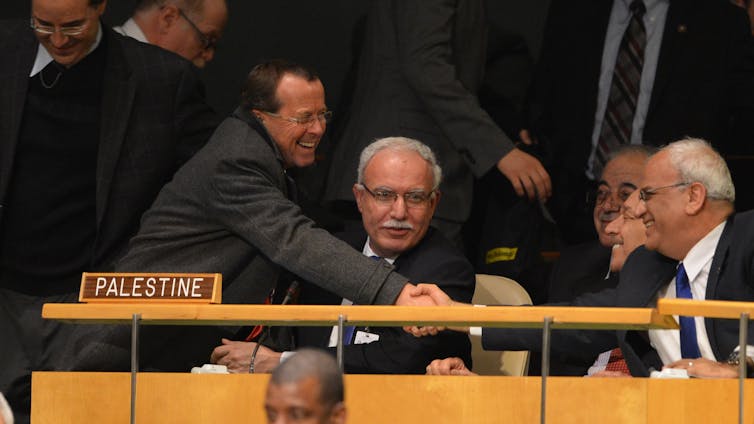
Two men shake hands.
The Palestinian delegation at the U.N. General Assembly before the vote to upgrade Palestinian status to a nonmember observer state in 2012.
Stan Honda/AFP via Getty Images

In theory, this meant Palestinians now had access to international bodies, like the International Criminal Court and the International Court of Justice.

But any meaningful change in the status of Palestinian sovereignty would need to come through the U.N. Security Council, not the U.N. General Assembly.

The U.S. remains opposed to Palestinians gaining statehood independent of the Oslo process. So long as the U.S. has a veto on the Security Council, achieving a truly sovereign Palestinian state will likewise be off the table. And that remains the case, regardless of what individual members – even fellow Security Council members like France and the U.K – do.

In fact, many Palestinians and other critics of the status quo say Western nations are using the issue of Palestinian statehood to absolve them from the far more challenging diplomatic task of holding Israel accountable for what a U.N. body just described as a genocide in Gaza.

This article is based on a conversation between Maha Nassar and Gemma Ware for The Conversation Weekly podcast.

The Conversation

Maha Nassar does not work for, consult, own shares in or receive funding from any company or organization that would benefit from this article, and has disclosed no relevant affiliations beyond their academic appointment.

ref. UK and other Western states recognize Palestinian state ahead of UN meetings – but symbolic action won’t make statehood happen – https://theconversation.com/uk-and-other-western-states-recognize-palestinian-state-ahead-of-un-meetings-but-symbolic-action-wont-make-statehood-happen-265534

UK and other Western states recognize Palestinian state ahead of U.N. meeting – but symbolic action alone won’t make statehood happen

Source: The Conversation – Global Perspectives – By Maha Nassar, Associate Professor in the School of Middle Eastern and North African Studies, University of Arizona

Pro-Palestinian Americans gather in New York at a march to the U.N. on Sept. 18, 2025. Selcuk Acar/Anadolu via Getty Images

Recognition of a Palestinian state is likely to dominate proceedings at the U.N. beginning Sept 23, 2025, when world leaders will gather for the annual general assembly.

Of the 193 existing U.N member states, some 150 now recognize a Palestinian state. Ahead of the U.N. gathering in New York, Australia, Canada and the United Kingdom become the latest. And that number is expected to increase in the coming days, with several more countries expected to officially announce similar recognition.

That a host of Western nations are adding their names to the near-universal list of Global South countries that already recognize a Palestinian state is a major diplomatic win for the cause of an independent, sovereign and self-governed nation for Palestinians. Conversely, it is a massive diplomatic loss for Israel – especially coming just two years after the West stood shoulder to shoulder with Israel following the Oct. 7 attack by Palestinian militant group Hamas.

As a scholar of modern Palestinian history, I know that this diplomatic moment is decades in the making. But I am also aware that symbolic diplomatic breakthroughs on the issue of Palestinian statehood have occurred before, only to prove meaningless in the face of events that make statehood less likely.

A man gives a speech before a crowd.
‘I have come bearing an olive branch and a freedom fighter’s gun,’ PLO leader Yasser Arafat said before the United Nations General Assembly in 1974.
Bettmann / Contributor

The non-state reality

The fight for Palestinian statehood can be traced back to at least 1967. Over the course of a six-day war against a coalition of Arab states, Israel conquered and expanded its military control over the remainder of what was historic Palestine – a stretch of land that extends from the Jordan River in the east to the Mediterranean Sea in the west.

At the war’s conclusion, Israel had taken control of the West Bank, East Jerusalem and the Gaza Strip.

Unlike after the 1948 war that led to its independence, Israel opted not to extend Israeli citizenship to Palestinians living in the newly conquered areas. Instead, the Israeli government began to rule over Palestinians in these occupied territories through a series of military orders.

These orders controlled nearly every aspect of Palestinian life – and many remain in effect today. For example, if a Palestinian farmer wants to harvest his olive trees near a Jewish settlement in the West Bank, they need a permit. Or
if a Gazan worker wants to work inside Israel, they need Israeli permission. Even praying in a mosque or church in East Jerusalem is dependent on obtaining a permit.

This permit system served as a constant reminder to Palestinians living in the occupied territories that they lacked control over their own daily lives. Meanwhile, Israeli authorities tried to squash the idea of Palestinian nationhood through policies such as outlawing public displays of the Palestinian flag. That, and other expressions of Palestinian national identity in the occupied territories, could result in up to 10 years in prison.

Such policies fit a belief, expressed in 1969 by then Israeli Prime Minister Golda Meir, that there was “no such thing in this area as Palestinians.”

The rise of Palestinian nationalism

Around the same time that Meir made that comment, Palestinians started organizing around the idea of statehood.

Although the idea had been floated before, statehood was codified into official doctrine in a resolution in February 1969 in Egypt. It occurred during a session of the Palestine National Council, the legislative body of the Palestine Liberation Organization, which formed in 1964 as the official representative of Palestinians in the occupied territories.

That resolution called for a free, secular democratic state in Palestine – including all of the State of Israel – in which Muslims, Christians and Jews would all have equal rights.

From that moment on, the Palestinian struggle against Israeli occupation took twin paths: diplomatic pressure and armed resistance.

But events on the ground undermined the idea of a single state for all along the lines envisioned by the Cairo resolution.

The 1973 Arab-Israeli War’s inconclusive ending opened the door to greater diplomacy between Israel and the Arab states. Egypt and Israel decided that diplomacy would help them achieve their aims, culminating in the Egyptian-Israeli peace treaty of 1979. But the treaty also left the Palestinians without unified Arab support.

Meanwhile, throughout the 1970s, the Israeli occupation deepened and entrenched with the building of Israeli settlements, especially in the West Bank.

A man throws out his arms to make a point while he stands at a lectern.
Yasser Arafat addresses the United Nations General Assembly in 1974.
Bettmann / Contributor

The PLO responded in 1974 by issuing what became known as the 10-Point Plan, where they pivoted to seeking the establishment of a national authority in any part of historic Palestine that could be liberated.

It was, in effect, a way of threading the needle: It signaled to moderates that the PLO was adopting a more gradualist position, while also telling the group’s rejectionist front – which opposed peace negotiations with Israel – that they were not giving up completely on the idea of liberating all of Palestine.

Then in 1988 – a year into the first Palestinian intifada, or uprising – the PLO unilaterally declared Palestinian independence on the territories occupied in 1967.

The move was largely symbolic – the West Bank, Gaza and East Jerusalem were still under occupation, and the PLO was then in exile in Tunisia.

But it was nonetheless significant. It represented the bringing together of Palestinians in exile – most of whom were from towns and villages that were now part of the State of Israel – with Palestinians in the occupied territories.

The declaration itself was written by Palestinian poet Mahmoud Darwish, who grew up inside Israel, and declared by Yasser Arafat, the PLO leader in exile.

It was also a moment of tremendous hope and possibility for Palestinians. What most Palestinians wanted was for the international community to recognize them as a national body, deserving of a seat at the table with other nation-states.

Compromise and rejection

Yet at the same time, many Palestinians saw the declaration as a huge compromise. The West Bank, Gaza Strip and East Jerusalem comprise about 22% of historic Palestine. So the declaration effectively meant that Palestinians were giving up on the other 78% of what they saw as their land.

Reaction from the international community to the PLO’s declaration was split. Many formerly colonized countries of the Global South recognized Palestinian independence right away. By the end of the year, some 78 countries had issued statements recognizing Palestine as a state.

Israel rejected it outright, as did United States and most Western nations.

Such was Washington’s opposition that the U.S. denied Arafat a visa ahead of his planned address to the United Nations at its New York City headquarters. As a result, the December 1988 meeting had to be moved to Geneva.

While refusing to accept Palestinian statehood, the U.S. and Israel did begin to recognize the PLO as a representative body of the Palestinian people. This was part of the Oslo Accords – a diplomatic process that many believed would outline a road map for an eventual two-state solution.

While some Palestinians saw the Oslo Accords as a diplomatic breakthrough, others were more skeptical. Prominent Palestinians, including Darwish and Palestinian-American professor Edward Said, believed that Oslo was a poison pill: While framed as a step toward a two-state solution, the agreement said nothing about a Palestinian state in the interim. It only said that Israel would recognize the PLO as a representative of the Palestinian people.

In reality, the Oslo Accords have not lead to statehood. Rather, they created a system of fragmented autonomy under the newly created Palestinian Authority that, though meant to be interim, has in effect become permanent.

The Palestinian Authority was allowed only limited powers and deprived of real independence. While it had some say over schooling, health care and municipal services, Israel maintained control of Palestinian land, resources, borders and the economy. That remains true today.

Renewed push for statehood recognition

Disillusionment over the Oslo Accords contributed to the second, far more violent, intifada from 2000 to 2005.

Mahmoud Abbas, the leader of the Palestinian Authority after Arafat, responded by pushing again for international recognition for statehood.

And in 2012, the U.N. General Assembly voted to upgrade Palestine’s status, elevating it from a “nonmember observer” to a “nonmember observer state.”

Two men shake hands.
The Palestinian delegation at the U.N. General Assembly before the vote to upgrade Palestinian status to a nonmember observer state in 2012.
Stan Honda/AFP via Getty Images

In theory, this meant Palestinians now had access to international bodies, like the International Criminal Court and the International Court of Justice.

But any meaningful change in the status of Palestinian sovereignty would need to come through the U.N. Security Council, not the U.N. General Assembly.

The U.S. remains opposed to Palestinians gaining statehood independent of the Oslo process. So long as the U.S. has a veto on the Security Council, achieving a truly sovereign Palestinian state will likewise be off the table. And that remains the case, regardless of what individual members – even fellow Security Council members like France and the U.K – do.

In fact, many Palestinians and other critics of the status quo say Western nations are using the issue of Palestinian statehood to absolve them from the far more challenging diplomatic task of holding Israel accountable for what a U.N. body just described as a genocide in Gaza.

This article is based on a conversation between Maha Nassar and Gemma Ware for The Conversation Weekly podcast.

The Conversation

Maha Nassar does not work for, consult, own shares in or receive funding from any company or organization that would benefit from this article, and has disclosed no relevant affiliations beyond their academic appointment.

ref. UK and other Western states recognize Palestinian state ahead of U.N. meeting – but symbolic action alone won’t make statehood happen – https://theconversation.com/uk-and-other-western-states-recognize-palestinian-state-ahead-of-u-n-meeting-but-symbolic-action-alone-wont-make-statehood-happen-265534

What the WTO’s deal to curb fisheries subsidies means and what it could achieve

Source: The Conversation – Canada – By Daniel Skerritt, Affiliated Researcher, Fisheries Economics Research Unit, University of British Columbia

After nearly 25 years of negotiations, the World Trade Organization (WTO) finally has its first legally binding agreement to tackle government fisheries subsidies. After two-thirds of WTO members ratified the Agreement on Fisheries Subsidies, the deal has entered into force. It marks a long-overdue step toward addressing the role harmful fisheries subsidies play in overfishing.

Fisheries subsidies can cause harm by distorting markets and creating unequal competition — so-called “trade injuries.” In addition, they can cause ecological harm by increasing the capacity of fishing vessels and fleets. The result is overcapacity: too many boats chasing too few fish, which often leads to overfishing.

When WTO talks on fisheries subsidies began in 2001, fish populations were already in decline. Today, 38 per cent of fish stocks are overfished, and a further 50 per cent are fully exploited. That means most of the world’s fisheries are being fished at or beyond their biological limits.

For decades, government subsidies have helped industrial fishing fleets expand, often with little regard for sustainability. These subsidies have distorted access to fish and seafood, fuelled overfishing and harmed coastal communities — especially in low-income countries where fish are critical to food security and livelihoods.

This agreement is a major milestone, but it’s only the beginning. Here’s what the agreement covers, why it matters and what needs to happen next to protect ocean health and ensure an equitable ocean economy for coastal communities.


Read more:
We have a deal. Can we now talk about some not-so-harmful fisheries subsidies?


What the agreement covers and why it matters

WTO members first raised the issue of harmful fisheries subsidies at the Fourth Ministerial Conference in Doha in 2001. For years, talks made little headway — until the adoption of the United Nations Sustainable Development Goals (SDGs) in 2015.

Target 14.6 of the SDGs explicitly called on the WTO to:

“Prohibit certain forms of fisheries subsidies which contribute to overcapacity and overfishing, eliminate subsidies that contribute to illegal, unreported and unregulated fishing and refrain from introducing new such subsidies.”

This helped re-energize negotiations, culminating in the adoption of the subsidies agreement at the WTO’s 12th Ministerial Conference in 2022.

The agreement includes three key prohibitions targeting the worst kinds of subsidies. First, ratifying WTO members must stop subsidizing illegal,
unreported and unregulated fishing (Article 3).

Second, they must end subsidies for vessels targeting overfished stocks unless they can demonstrate that effective management measures are in place to rebuild those stocks (Article 4). Third, subsidies for fishing on the unregulated high seas are banned (Article 5).

While these measures don’t address all subsidies that contribute to overcapacity, they target some of the most egregious forms of financial support.

Another critical part of the agreement is Article 8, which strengthens transparency and accountability. Members must now provide detailed information annually, including information on fish stocks, conservation and management measures, fleet capacity and the names of subsidized vessels.


Read more:
Illuminating dark seas: Why fisheries management must be more transparent


Historically, fisheries subsidies data has been patchy and incomplete. Better data will help identify who benefits from public financial support and whether it aligns with sustainability goals.

The agreement also introduces more equitable expectations for developing and least developed countries. These members are granted an extra two years before they must implement subsidy prohibitions and, crucially, can access the WTO Fish Fund — a funding mechanism that helps countries implement the agreement through technical assistance and partnerships.

While the agreement does not fully level the playing field, it establishes that major subsidizers must carry the greatest burden.

Challenges, Gaps and Next Steps

Despite its strengths on paper, the agreement only covers a fraction of the estimated $22 billion in harmful fisheries subsidies provided by governments each year. The most prevalent of all the harmful subsidies, fuel subsidies, remain largely untouched.

Another major limitation is that it only applies to countries that have ratified the agreement. As of now, some major subsidizers — including Indonesia and Thailand, two of the world’s top 10 subsidy providers — have yet to ratify.

In a 2021 report we wrote for ocean conservation group Oceana, we found that just 10 countries are responsible for 64 per cent of global harmful subsidies. Even with this agreement in force, without their participation, large gaps will remain.

Another challenge is ensuring transparency and data disclosure. While the agreement includes stronger notification requirements, it lacks detailed reporting guidelines. Much of the implementation will depend on self-reporting and peer accountability between members.

Without clear standards or enforcement mechanisms, many subsidy programs could remain opaque or under-reported. To have real impact, the WTO must develop robust and standardized reporting frameworks.

Whether this agreement will save fish, or merely save face, will come down to how it’s implemented. Success will hinge on whether WTO members hold each other accountable and whether industry, civil society and researchers can push their governments toward genuine compliance.

Importantly, the subsidies agreement was never meant to be the end of the conversation. Its entry into force triggers a four-year countdown to negotiate the next phase.

They must address the most damaging subsidies of all, those that fund fishing by rich foreign fleets in the waters of other nations, and those that drive overcapacity, to achieve a comprehensive agreement. These policies have the greatest potential ecological and equity impact but are the hardest to reach consensus on.

Fortunately, we’re now closer to that goal. The entry into force of this agreement provides the ideal platform from which SDG Target 14.6 can be fully achieved. Putting an end to billions in fishing subsidies would restore fish stocks, support coastal communities, and improve ocean health for all. The job is not yet done.

The Conversation

Daniel Skerritt is Senior Manager of Oceana’s Transparent Oceans Initiative, affiliated with the Fisheries Economics Research Unit at the University of British Columbia, School of Natural & Environmental Sciences at Newcastle University, and an International Board Member of the Fisheries Transparency Initiative.

Rashid Sumaila receives funding from SSHRC, NSERC and the World Bank. He is affiliated with Oceana, Stockholm University, the University of Cape Coast, Pew Charitable Trusts, Tyler Prize Foundation as a board member.

ref. What the WTO’s deal to curb fisheries subsidies means and what it could achieve – https://theconversation.com/what-the-wtos-deal-to-curb-fisheries-subsidies-means-and-what-it-could-achieve-265185

‘We want to be offensive too’ — Trump’s Department of War move shows his flimsy grasp of history

Source: The Conversation – Canada – By Ronald W. Pruessen, Emeritus Professor of History, University of Toronto

Explaining his move to rename the United States Department of Defense the Department of War, as it was known prior to 1949, President Donald Trump explained it had “a stronger sound.”

It offered better messaging too. “Defense is too defensive; we want to be offensive too,” he said.

The once and future Department of War would revive the spirit of the years when “we won everything.”

Trump’s language — and the logic behind it — demonstrates how little America’s current leaders have learned from the clear failures of their predecessors across 70 years.

American policies after the Second World War achieved great things: substantially aiding the reconstruction of devastated Europe and Japan, for instance, while spearheading the building of an integrated global economy that fostered unparalleled growth.

There were also grave flaws in American designs and actions, of course, though they rarely if ever stemmed from a lack of aggressive assertiveness and an appetite for winning. Trump’s failure to diagnose the real roots of real problems portends a worsening of already terrible costs and consequences.

Perpetual preparedness

A key source of Trump’s weaknesses is his shallow or distorted grasp of history. His failure here is understanding that the Department of Defense saw “offence” thoroughly embedded into its conception of defence.

Think “the best defence is a good offence” on steroids. George Kennan’s famous “containment policy,” for example, included calls for “unceasing pressure for penetration.”

The American military establishment created in the 1940s turbocharged earlier approaches to national security, moving limited spending and retrenchment between conflicts to proactive and perpetual preparedness. Because the world continued to be seen as a dangerous place even after 1945’s victories, expanding military power was prescribed to deter aggressors or to prevail over them if push came to war.

Emphasis on “the world” helps to explain the scale of power. Air power and other technological advances (in communications, for example) created the integrated international arena in which American leaders acted after the defeat of the Axis powers in the Second World War.

There was a rapid and dramatic growth in the policy agenda. For the new Department of Defense, this meant unparalleled budgets: US$997 billion by 2024 compared to China’s US$314 billion (greater than any other countries in the 1940s and ever since).

It also produced global reach greater than any empire in history: there are almost three million members of the U.S. armed forces today, based in 70 countries.

American power

Trump fails to grasp (or chooses to ignore) the fact that this vast power was used regularly and aggressively:

“Defence” served both as the foundation and the justification for the evolution of many elements of this repertoire over the decades.

Failures

A cost accounting of aggressive/offensive defence in the past is disturbing. The tabulation of a 75-year record has filled countless volumes, but two striking examples attest to some major failures:

  • A lack of “winning” in large-scale military operations: A “truce” in the Korean peninsula in 1953, giving way to failures in Indochina, Iraq and Afghanistan. (Success in Kuwait in 1990-91 does not significantly alter this problematic balance.)

  • Continued independence and resistance from states once thought weak enough to be managed, in particular Cuba and Iran.

Dubious results also had staggering price tags. There were 36,000 American deaths in Korea; 58,000 in Vietnam; 7,000 deaths and 53,000 wounded military personnel in Iraq and Afghanistan. Trillions of dollars were devoted to defence spending at the expense of economic and social programs on the home front.

Trump seems to believe that, with the Department of War, he’s replacing post-1945 defence policies rather than doubling down on them, meaning he is intensifying the offensive/aggressive approaches without grappling with their flaws. In particular, he has no apparent grasp of what bedevilled the post-1945 American drive for global domination.

American arrogance

Democratic Sen. J. William Fulbright famously critiqued the “arrogance of power” in the 1960s, countering the U.S. presumption of a right to impose values on distant corners of the world like Southeast Asia.

Other critics of the Vietnam War further questioned whether the U.S. had sufficient manpower and intellectual or economic resources to achieve its goals. Wasn’t the world too large and complex, with too many rival players and independent allies, and too many ever-evolving challenges, for one country to imagine holding global management capacities in its hands?

In recent years, former presidents Barack Obama and Joe Biden began to apply a pragmatic calculus to conflicts in Iraq and Afghanistan, even if their core vision continued to exhibit historic “Manifest Destiny” concepts. One example is Obama’s attempt to determine an effective troop level in Iraq while simultaneously retaining his faith in American “exceptionalism.”

Trump’s determination to go on the offensive threatens to reverse even tentative adjustments to American aspirations of global domination. He is reviving attitudes like those of former secretary of state Condoleezza Rice early in the Afghanistan war, when she chided cautious generals by saying “I’m an American. Nothing is impossible.”


Read more:
Out of Afghanistan: Joe Biden and the future of America’s foreign policy


Trump’s threats

The magnitude of Trump’s ego (his “I alone” mentality) risks intensifying such a revival — with potentially serious consequences.

Attacks on Venezuelan boats said to be carrying drugs, a failure to rein in Israel’s expanding campaigns in Gaza and the deployment of National Guard forces to Los Angeles, Washington, D.C. and Memphis are strong hints of what may be coming.

Recalling Trump’s speculations about military operations against Greenland and Canada just months ago makes it impossible to dismiss anxiety about his intentions.

The Conversation

Ronald W. Pruessen has received past research grants from Social Sciences and Humanities Research Council of Canada.

ref. ‘We want to be offensive too’ — Trump’s Department of War move shows his flimsy grasp of history – https://theconversation.com/we-want-to-be-offensive-too-trumps-department-of-war-move-shows-his-flimsy-grasp-of-history-265334

Trump renews push to end quarterly reporting — here’s what that would mean

Source: The Conversation – Canada – By Douglas A. Stuart, Assistant Teaching Professor of Accounting, Gustavson School of Business, University of Victoria

United States President Donald Trump is, once again, suggesting eliminating quarterly reporting for American public companies in favour of just two earnings reports per year. Trump made a similar proposal during his first presidential term in 2018.

Quarterly reporting is the practice by which publicly traded companies provide financial updates every three months. These reports are meant to give investors, regulators and other stakeholders information about a company’s financial performance.

In a social media post, Trump said such a move “will save money and allow managers to focus on properly running their companies.”

The U.S. Securities and Exchange Commission (SEC) is prioritizing Trump’s proposal. The SEC studied the issue in 2018 and held a roundtable but did not move forward with rule changes.

Canadian public companies also report quarterly, while other markets, including the European Union, have adopted a six-month reporting model.

Researchers have studied reporting frequency for decades, and the scientific evidence shows the thinking behind eliminating quarterly reports is not cut-and-dried.

Quarterly reporting as a monitoring tool

Quarterly reporting is expensive. Employees’ time, executive review, board oversight and investment in reporting systems add up. Cutting external quarterly reporting could free up a company’s internal resources and remove administrative red tape.

Even so, some companies report every three months without being required to. Preparation costs increase, but so does corporate accountability. In terms of agency theory, shareholders (the principals) can more closely monitor the behaviour of executives (the agents).

Executives are expected to represent shareholders, but their priorities do not always align. Corporate executives may, for example, reject profitable investments due to their risk tolerance or overspend on travel and leisure items.

With quarterly reporting gone, the potential for these “agency costs” may increase as misaligned managerial actions go unnoticed. Shareholders use accounting reports to check up on executive decisions and hold them accountable.

Importantly, even if semiannual reporting becomes the baseline for public companies, banks may still ask for more frequent results in loan agreements.

Quarterly reporting for investment decisions

If regulators drop quarterly reporting, investors and the public could lose out.

Many investors have a limited sense of how a business is performing. They may live half a globe away and never set foot in the company’s offices. Because of this, investors generally have access to less information than internal employees, managers and executives do. This is called “information asymmetry.”

Investors, regulators and the public depend on corporate financial reporting to fill in these information gaps. If quarterly reporting mandates were removed, they might be left in the dark. Investment decisions might be less informed, although news releases and disclosures online could still be found. Corporate transparency and accountability might be reduced.

On the other hand, quarterly reporting is not a cure-all. Analysts might under-react to earnings reports, leading to delays. Or they may overreact, causing unwarranted fluctuations in investment prices. Investors are human and are subject to shortcomings like overconfidence and the fear of missing out.

Short-term versus long-term decisions

While quarterly reporting can be seen as a compliance activity, like filing taxes or acquiring a business licence, it can also be framed as a structure for decision-making.

Quarterly reporting incentivizes executives to focus on short-term financial performance, potentially at the expense of long-term results. Researchers call this “short-termism.”

Researchers have found that short-termism is not limited to managers and might stem from investors looking for quick profits. Investors may, directly or indirectly, influence the kinds of projects managers invest in. Managers may get financial bonuses based on quarterly earnings to align their goals with shareholder aims.

Short-term decisions are frequently tactical rather than strategic, meaning they may prioritize current earnings over long-term corporate sustainability and resilience.

For example, managers might invest in carbon-intensive projects that pay back quickly, rejecting more sustainable projects with a longer return horizon, like energy efficiency. For this reason, some sustainability advocates support Trump’s initiative.

While some firms measure their performance along social and environmental lines, in addition to financial earnings, profits are often the focus of quarterly earnings calls.

Not one-size-fits-all

Quarterly reporting may affect small and large firms differently. Smaller firms may take a financial hit: on average, small firms in Singapore experienced a five per cent drop in market value when they were required to report quarterly in 2003.

However, larger firms may find that the benefits of prompt, high-quality information outweigh the costs of frequent reporting. Managers, executives and board members rely on accounting reports to show whether the firm is on track to meet its goals.

Furthermore, larger firms document industry conditions and future risks and opportunities in their accounting reports. Smaller firms in the same industry can look at this information for guidance. These are called “positive information spillovers.” Smaller firms may lose this information if larger firms file reports less often.

Information spillovers, however, can be a double-edged sword. Information may be taken out of context or applied to smaller firms incorrectly. At times, this may lead to temporarily poorly priced investments.

Treading carefully

We don’t know, yet, what the SEC will decide. If changes are to come, they should be made carefully and phased in. Pilot studies would give policymakers and researchers a chance to observe effects in real time.

Quarterly reporting mandates on the Vienna Stock Exchange were phased out between 2015 and 2019. Some companies continued to file quarterly financial results while others stopped. Firms used the increased flexibility to adjust the content of their reports, making them more relevant to their stakeholders.

Research shows corporate reporting frequency is a complicated topic. Switching from quarterly to semiannual reporting may have merit, but as with any decision affecting a wide range of stakeholders, a broader, global perspective highlights what some stand to lose and what others stand to gain.

The Conversation

Douglas A. Stuart does not work for, consult, own shares in or receive funding from any company or organisation that would benefit from this article, and has disclosed no relevant affiliations beyond their academic appointment.

ref. Trump renews push to end quarterly reporting — here’s what that would mean – https://theconversation.com/trump-renews-push-to-end-quarterly-reporting-heres-what-that-would-mean-265458

How Indigenous-led health education in remote communities can make reconciliation real

Source: The Conversation – Canada – By Jamaica Cass, Director, Queen’s-Weeneebayko Health Education Partnership, Queen’s University, Ontario

If Canada is serious about reconciliation, it must change how it trains health professionals. Right now, too few Indigenous doctors, nurses and other providers are working in communities that need them most. And too often, students learn about Indigenous health in ways that are optional, inconsistent or not led by Indigenous educators.

That’s where Indigenous-led health education comes in. When Indigenous communities shape how health professionals are trained, it supports a path toward trust, equity and a health system that finally reflects the people it serves.


Read more:
Indigenous community research partnerships can help address health inequities


As an Indigenous physician and medical educator practising in Tyendinaga Mohawk Territory, I know firsthand the challenges and the possibilities of this work. I am the first Indigenous woman in Canada to pursue both medicine and a PhD, a journey shaped as much by systemic barriers as by the support of my family and community.

Today, I practise primary care in my home community while helping to shape health education nationally, including via a new Queen’s University partnership program in Western James Bay, Ontario — the Queen’s–Weeneebayko Health Education Program on the traditional territory of the Moose Cree First Nation (Treaty 9).

Seeing the gaps in care in my own clinic, and working with students eager to change the system, informs my commitment to Indigenous-led education as the most direct path to reconciliation in health.

10 years after the TRC: promises vs. reality

It has been a decade since the Truth and Reconciliation Commission (TRC) released its Final Report. The Assembly of First Nations reports that of the 94 Calls to Action, only 14 have been fully implemented.

Two of them, No. 23 and No. 24, speak directly to health care: train and retain more Indigenous health professionals, and make sure all students learn about Indigenous health and the legacy of residential schools.

These aren’t symbolic. They are practical steps that would improve care and save lives. But progress has been slow. Indigenous professionals remain underrepresented, and cultural safety training is too often patchy or optional.

Indigenous-focused health education

A new national report from the Conference Board of Canada confirms what Indigenous leaders have been saying: reconciliation won’t happen unless Indigenous Peoples lead — in education, governance and workforce planning. Token gestures aren’t enough.

The report, Answering the Call: Strategies to Increase the Number of Indigenous Physicians in Canada, notes that “Indigenous students, especially in rural and remote areas, often lack career guidance and a culturally relevant curriculum, leading to lower graduation rates and fewer pathways to medical education.”

While systemic challenges persist, there are powerful examples across Canada that share the common goal of making sure Indigenous students can succeed in health education, and ensuring communities benefit from culturally safe, long-term providers.

The Queen’s–Weeneebayko program I’m directing is building a new health sciences Campus in Moosonee, Ont. Students from the Hudson and James Bay region — including from Moosonee, Fort Albany, Attawapiskat, Moose Factory, Kashechewan and Peawanuck — will be recruited locally, trained in Moosonee and supported to stay serving their home communities.

Video about the Queen’s–Weeneebayko Health Education Program.

This partnership, including the Weeneebayko Area Health Authority(WAHA), Queen’s University and the Mastercard Foundation, integrates local Indigenous knowledge and ways of knowing (for example, through Cree language, land-based learning and cultural safety) alongside biomedical science.

Indigenous leadership is embedded at every level — from community knowledge keepers and local education and health-care champions guiding what is taught and how to WAHA operating governance and mentorship frameworks rooted in local culture. I am the inaugural director.

Fostering culturally safe health care

Other programs across the country share the common goal of making sure Indigenous students can succeed in health education, and ensuring communities benefit from culturally safe, long-term providers.

For example:

  • At the University of British Columbia, the Northern and Rural MD Pathway is a distinct admissions stream designed to attract applicants with rural, remote northern or Indigenous community connections — or those passionate about serving such communities — by incorporating a rural and remote suitability Score (RRSS) and early rural placements to support rural and remote training and practice.

  • The University of Manitoba’s Mahkwa omushki kiim: Pathway to Indigenous Nursing Education (PINE) supports First Nations, Inuit and Métis students from start to finish. By combining academic help with cultural programming and community connection, it has the goal of boosting retention as it prepares more Indigenous nurses for practice.

Programs like these are concerned with helping whole communities gain consistent, trusted health care. And when trust grows, so does the likelihood that people will seek care early — improving outcomes for everyone.

Beyond such programs, system-wide change is needed to ensure Indigenous learners are supported at every stage, and to support viable pathways to medical training in rural and remote areas.

System-wide changes needed

Indigenous students face:

Location also matters. Research shows that students trained in rural or remote areas are far more likely to practise there after graduation.

For Indigenous students, viable pathways to practising medicine are even stronger when training is grounded in community values and led by Indigenous educators.


Read more:
Want to decolonize education? Where classes are held matters


Why this is reconciliation in action

Reconciliation is not just about apologies or ceremonies. It’s about real, structural change. In health care, that means:

  • Who delivers the care: building a stronger Indigenous health workforce.

  • Whose knowledge counts: recognizing Indigenous knowledge alongside Western medicine.

  • Who makes decisions: ensuring Indigenous voices lead the design and governance of health programs.

Indigenous-led health education tackles all three. It brings reconciliation down from the level of promises and into the day-to-day realities of patients, providers and communities.

The way forward

Ten years after the TRC, Canadians are right to ask whether reconciliation is real. The answer depends on whether we support Indigenous-led programs — not as small pilots, but as long-term, fully resourced commitments.

The initiatives described here show what’s possible. They are different in scope, but each demonstrates that Indigenous self-determination in health education is not only achievable, it’s already happening.

The next step is clear: supporting Indigenous-led education so that reconciliation moves from promise to practice in communities nationwide.

The Conversation

Jamaica Cass works for Queen’s University. She receives funding from the National Circle on Indigenous Medical Education, the CPFC and the CMA. She is a board member of the Indigenous Physicians’ Association of Canada and the Medical Council of Canada.

ref. How Indigenous-led health education in remote communities can make reconciliation real – https://theconversation.com/how-indigenous-led-health-education-in-remote-communities-can-make-reconciliation-real-264562

Deepfakes and South African law: remedies on paper, gaps in practice

Source: The Conversation – Africa (2) – By Nomalanga Mashinini, Senior Lecturer, University of the Witwatersrand

Deepfakes are forgeries of people’s faces, voices and likeness generated through artificial intelligence (AI). They create a serious digital deception. Deepfakes undermine constitutional rights, reduce trust in media and distort fairness in elections. While many countries have laws that address the risks caused by deepfakes, enforcement remains a challenge.

Deepfakes began to be widely created in 2017 after they’d first appeared on Reddit, a discussion website of forums where people exchange information. A Reddit user called Deepfakes shared an AI software tool that could superimpose celebrities’ faces on pornographic videos. AI-generated media became widely accessible through software apps that enable people to freely create deepfakes.

There are several types of deepfakes:

  • text deepfakes in the form of fake receipts and identification documents

  • photo deepfakes, often swapping faces and bodies using apps to create memes

  • audio deepfakes, where text-to-speech apps are used for voice cloning, often targeting politicians

  • video deepfakes, where face and movement are transferred onto someone else’s video, commonly used to create “revenge pornography”.

Deepfakes pose three main dangers:

  1. They deceive audiences into believing fabricated media.

  2. They enable cybercrimes, reputational harm and misrepresentation.

  3. They can be published by anyone, including anonymous social media users.

The key issue is how law can protect people from the illegal use of their images, voices, and likenesses in deepfakes.

Since 2020, I have looked at laws that regulate deepfakes in South Africa and their implementation. My findings show that the biggest problem with deepfakes is law enforcement, rather than any lack of laws that prohibit the unlawful creation and distribution of deepfakes.

Deepfake threats

South Africa has seen notable cases that highlight the growing impact of deepfakes. In 2024, Leanne Manas, an award-winning South African broadcast anchor, was a victim when her image was used in fake endorsement of weight loss products and online trading on Facebook and TikTok.

South African-born businessman Elon Musk also appeared in a deepfake video that induced many South Africans to invest in a financial scam that promised high returns.

In 2025, Professor Salim Abdool Karim, the director of the Centre for the AIDS Programme of Research in South Africa, appeared in a deepfake video showing him making anti-vaccination statements while endorsing counterfeit heart medicine.

Legal protection in South Africa

South Africa has a mixed legal system that combines constitutional rights, legislation and common law rules to provide deepfake victims with remedies.

There are laws that provide remedies in both civil and criminal cases. For example:

Common law remedies

Anyone can claim violation of privacy if their private images are used without permission. They can also enforce their right to identity if a deepfake misrepresents them or gives a perpetrator commercial advantage.

I investigated these principles in an article about the impact of deepfakes on the right to identity in South Africa. Using South African cases, I found that the unauthorised use of a person’s identity attributes in a deepfake deserves protection.

The Supreme Court of Appeal confirmed, in Grütter v Lombard, that South African law protects a person’s identity from being exploited without permission. And this protection is supported by the constitutional guarantee of human dignity. Grütter and Lombard once practised on the same premises under the name “Grütter and Lombard”, but Grütter later left. Lombard kept using Grütter’s name without consent. The court ordered him to stop as it falsely implied an ongoing professional association and infringed Grütter’s right to identity.


Read more:
Deepfakes in South Africa: protecting your image online is the key to fighting them


In another case, a surfer’s magazine called ZigZag published a photo of a 12-year-old girl as a pin-up cover image. The court stressed that the key issue was whether an image was exploited for another’s benefit without consent. The defendants were ordered to pay compensation and costs.

Another case is that of South African television personality, beauty pageant titleholder, businesswoman and philanthropist Basetsana Kumalo. She sued a business that took photos of her while she was shopping in their store and used those images in an advertisement for their products without her permission. The court ruled that using someone’s likeness for false endorsements infringes identity and privacy, because it creates the misleading impression of support for the product, service or business.

These cases fit squarely into the deepfakes misuses, showing that false endorsement, election disinformation and non-consensual pornography on social media can trigger liability.

Enforcement challenges

While South African law provides remedies against deepfakes, four hurdles frustrate enforcement:

  1. South African courts have capacity constraints and struggle to resolve backlogs.

  2. Litigation remains a “rich man’s” option. The poor struggle to access justice or wait too long for pro bono help.

  3. While South African courts can assert jurisdiction over global platforms like Meta and TikTok, serving court orders abroad and compelling compliance is still costly, and takedown notices are often enforced too late.

  4. Perpetrators hide behind fake profiles and are hard to trace through the South African Police Service. Social media companies delay revealing the perpetrators’ true identities upon request.


Read more:
Artificial intelligence carries a huge upside. But potential harms need to be managed


These enforcement challenges can be addressed through capacity building and legal reform. AI research centres should work with law enforcement to train personnel and provide practical skills and tools for tracing and authenticating deepfakes. Parliament must update social media laws so that platforms are directly accountable for fast and fair action when people’s identities are misused in deepfakes.

Legal rules should set minimum standards that deepfake apps and platforms must follow. Rather than relying on age restrictions or consent alone, the law should require these tools to embed watermarking to signal that content is a deepfake, enable tracing of where it comes from, and make sure takedown systems actually work.

Justice on paper

South African law clearly prohibits the misuse of identity through deepfakes, but enforcement gaps leave victims exposed. Without affordable legal access, faster platform accountability, and effective international cooperation, illegal deepfakes will continue to increase.

The Conversation

Nomalanga Mashinini receives funding from the National Research Foundation Thuthuka Grant.

ref. Deepfakes and South African law: remedies on paper, gaps in practice – https://theconversation.com/deepfakes-and-south-african-law-remedies-on-paper-gaps-in-practice-263850

Ethiopia’s two bids at democracy have failed: what it will take to succeed

Source: The Conversation – Africa (2) – By Terefe Gebreyesus, Lecturer, Griffith University

Ethiopia has attempted to transition to democracy twice. First in 1991, when a new government overthrew a dictatorial military regime. Second in 2018, when Abiy Ahmed took over as prime minister after protests against a repressive government.

In both attempts, there was optimism and excitement. But both failed.

Can Ethiopia still get it right? In a recent article, I tried to answer this question. I examined four preconditions that scholars of democratic transition identify. These are:

  • economic growth over a considerable period

  • political elites committed to tolerance, compromise and respect for democratic rules and practices

  • independent political institutions

  • international organisations, such as the African Union and the UN, being willing to force the country’s political elites to uphold democratic values.

In my view, based on my research, Ethiopia does not meet any of the preconditions.

Instead, democratic governance is made almost impossible by its poverty, culture of solving political differences with conflict and violence, absence of strong political institutions, and polarisation.

A democratic government in Ethiopia would help ensure people live in a country that respects human rights and dignity. It would help unlock accountability, stability and economic growth.

Failed attempts

In 1991, the country had endured a 17-year civil war that began in 1974. The winners of the war, the Tigray People’s Liberation Front, established control over the country by forming a coalition political party, the Ethiopian People’s Revolutionary Democratic Front.

The new government made radical reforms. It allowed political parties, radio and media communications to be free. It encouraged private publications and permitted public demonstrations.

But it didn’t take long for the new government to become authoritarian. It persecuted political competitors. Elections were held regularly, but they were not free and fair. Human rights and political freedoms were violated. Freedom of political communication was restricted.

As a result, protests started in 2015. They led to the appointment of Abiy as prime minister in 2018.

He began a second attempt at moving Ethiopia towards democracy. As The Guardian newspaper in the UK described it:

Something extraordinary is happening in Ethiopia … authoritarianism and state brutality appear to be giving way to something resembling democracy.

Again, this didn’t last. Instead, political order has worsened. The country went through a two-year civil war from 2020 to 2022 between the federal government and the Tigray People’s Liberation Front. Another guerrilla war started between the federal government and an Amhara youth group named the Fano shortly afterwards.

What democratic transition takes

No country has become democratic without at least some of the four preconditions in place. And they are not equally important. For instance, Ghana may not have a strong economy, but it has political elites who play by the rules of democratic governance.

Economic growth: if a society is economically advanced, generally, the people want democracy. This is because an undemocratic and unstable government threatens their economic security. As a result, citizens won’t take part in activities that go against democratic consolidation.

Ethiopia is one of the poorest countries in the world. While there is no magic number for this, one study found that a country with US$10,000 per capita income generally has a higher chance of adopting competitive elections. Ethiopia’s per capita income is US$1,011.

Economic growth is the foundation of strong political and civic institutions. These are important for transiting to and consolidating democracy.

But economic growth needs time. Ethiopia’s constant political instability has hurt its potential for economic development. In the two decades before 2018, its economy grew strongly, reducing the national poverty rate from 39% to 24%. Political instability and other factors since then had increased poverty rates to 32% by 2021.

Political elites: if political elites are committed to deliberating, compromising and cooperating, a country can successfully transit to democracy. One study found that when political elites are divided, the country will be authoritarian. The current civil war in Sudan offers an example of what can happen when political elites battle for power.

In Ethiopia, political disagreements often lead to violence or a government effort to silence and destroy the opposition. In 1991, when the Ethiopian People’s Democratic Front and other political groups couldn’t find common ground, the ruling elite eliminated dissenters. This allowed it to rule the country alone for 28 years. Similarly, when political elites couldn’t deliberate, compromise and cooperate in the second attempt, war broke out.

Political institutions: strong political institutions – such as an independent judiciary, police and electoral agency – support democratic transition. They also help sustain it. Political institutions prevent authoritarian leaders from persecuting political competition, and help solve any conflicts between competing elites.

External pressure: the best example of this was seen in 2022. The civil war between Tigray and the Ethiopian government ended when an African Union-led effort in South Africa forced the two sides to agree. It’s difficult, however, to transition to democracy by relying on external pressure, which would need to be constant and consistent. No country in Africa has been able to become and stay democratic based on external pressure.

What next

Democratic transition can only succeed in Ethiopia when at least one of three things occurs.

First, the country’s economy needs to grow for a substantial amount of time. Second, its diverse ethnic and religious identities must be integrated through policies that encourage the de-escalation of ethnic conflict. Third, society and, more specifically, the political elite need to commit to tolerance, compromise and respect for democratic principles.

All that will take a long time to achieve. Meanwhile, the country has two unfavourable choices: support a non-democratic government to consolidate political order and then gradually help it achieve democratic goals. Or attempt another transition, which may lead to anarchy and widespread inter-community violence. An untimely democratic transition would destroy political order.

With this in mind, Ethiopia’s political elites need to embrace discussion, debate and compromise. External forces can be a support by getting the political elite to move in this direction.

The Conversation

Terefe Gebreyesus does not work for, consult, own shares in or receive funding from any company or organisation that would benefit from this article, and has disclosed no relevant affiliations beyond their academic appointment.

ref. Ethiopia’s two bids at democracy have failed: what it will take to succeed – https://theconversation.com/ethiopias-two-bids-at-democracy-have-failed-what-it-will-take-to-succeed-263817

Why Jimmy Kimmel’s First Amendment rights weren’t violated – but ABC’s would be protected if it stood up to the FCC and Trump

Source: The Conversation – USA – By Wayne Unger, Associate Professor of Law, Quinnipiac University

A crowd protests in Hollywood, Calif., on Sept. 18, 2025, after the suspension of the ‘Jimmy Kimmel Live!’ taping earlier in the day. David Pashaee / Middle East Images via AFP, Getty Images

The assassination of conservative activist Charlie Kirk has sparked a wave of political commentary.

There were the respectful and sincere comments condemning the killing. Former President Barack Obama said, “What happened was a tragedy and … I mourn for him and his family.” And former Vice President Mike Pence said, “I’m heartsick about what happened to him.”

But Kirk’s killing also elicited what many saw as inappropriate comments. MSNBC terminated commentator Matthew Dowd after he said, “Hateful thoughts lead to hateful words, which then lead to hateful actions.” American Airlines grounded pilots accused of celebrating Kirk’s death.

Perhaps the most notable reaction to remarks seen as controversial about the Kirk killing hit ABC comedian Jimmy Kimmel. His network suspended him indefinitely after comments that he made about the alleged shooter in Kirk’s death.

Countless defenders of Kimmel quickly responded to his indefinite suspension as an attack on the First Amendment. MSNBC host Chris Hayes posted the following on X: “This is the most straightforward attack on free speech from state actors I’ve ever seen in my life and it’s not even close.”

But is it?

FCC Chairman Brendan Carr’s statement about how Jimmy Kimmel’s remarks could hurt ABC affiliate stations.

Free speech? It depends

The First Amendment limits government officials from infringing one’s right to free speech and expression.

For example, the government cannot force someone to recite the Pledge of Allegiance or salute the American flag, because the First Amendment, as one Supreme Court justice wrote, “includes both the right to speak freely and the right to refrain from speaking at all.”

And government cannot limit speech that it finds disagreeable while permitting other speech that it favors.

However, the First Amendment does not apply to private employers. With the exception of the 13th Amendment, which generally prohibits slavery, the Constitution applies only to government and those acting on its behalf.

So, as a general rule, employers are free to discipline employees for their speech – even the employees’ speech outside of the workplace. In this way, U.S. Sen. Lindsey Graham correctly said on X, “Free speech doesn’t prevent you from being fired if you’re stupid and have poor judgment.”

This is why Amy Cooper’s employer, an investment firm, was free to terminate her following her 2020 verbal dispute in New York’s Central Park with a bird-watcher over her unleashed dog. She called the police, falsely claiming that the bird-watcher, a Black man, was threatening her life. The incident, captured on video, went viral and Cooper was fired, with her employer saying, “We do not condone racism of any kind.”

This is also why ABC was able to fire Roseanne Barr from the revival of her show, “Roseanne,” after she posted a tweet about Valerie Jarrett, a Black woman who had been a top aide to President Obama, that many viewed as racist.

But as a scholar of constitutional law, I believe Kimmel’s situation is not as straightforward.

A small monument made out of marble has the First Amendment to the US Constitution printed on it.
A marble plaque inscribed with the First Amendment sits on Independence Mall in Philadelphia, Pa.
Raymond Boyd/Getty Images

Threat complicates things

Neither Cooper’s employer nor Barr’s employer faced any government pressure to terminate them.

Kimmel’s indefinite suspension followed a vague threat from the chairman of the Federal Communications Commission, Brendan Carr. As complaints about Kimmel’s statement exploded in conservative media, Carr suggested in a podcast interview that Kimmel’s statements could lead to the FCC revoking ABC affiliate stations’ licenses.

“We can do this the easy way or the hard way,” Carr said.

But the Supreme Court has been crystal clear. Government officials cannot attempt to coerce private parties in order to punish or suppress views that the government disfavors.

In a 2024 case, National Rifle Association v. Vullo, a unanimous Supreme Court plainly said that the government’s threat of invoking legal sanctions and other coercion to suppress speech it doesn’t like violates the First Amendment. That principle is so profound and fundamental that it got support from every member of an often bitterly divided court.

A threat to revoke broadcast licenses would almost certainly be seen in a court of law as a government action tantamount to coercion. And Carr’s public comments undoubtedly connect that threat to Kimmel’s disfavored comments.

If the FCC had indeed moved to strip ABC affiliates of their licenses to broadcast because of what Kimmel said, ABC and its parent company, Disney, could have sued the FCC to block the license revocations on First Amendment grounds, citing the NRA v. Vullo case.

But the network seemingly caved to the coercive threat instead of fighting for Kimmel. This is why so many are decrying the Kimmel suspension as an attack on free speech and the First Amendment – even though they might not fully understand the law they’re citing.

The Conversation

Wayne Unger does not work for, consult, own shares in or receive funding from any company or organization that would benefit from this article, and has disclosed no relevant affiliations beyond their academic appointment.

ref. Why Jimmy Kimmel’s First Amendment rights weren’t violated – but ABC’s would be protected if it stood up to the FCC and Trump – https://theconversation.com/why-jimmy-kimmels-first-amendment-rights-werent-violated-but-abcs-would-be-protected-if-it-stood-up-to-the-fcc-and-trump-265703

Lasting relief from depression after magic-mushroom treatment – new study

Source: The Conversation – UK – By Petri Kajonius, Associate Professor, Personality Psychology, Lund University

Fotema/Shutterstock.com

Two-thirds of people who underwent psilocybin-assisted therapy remained free from depression five years later, according to recent research that offers the first long-term glimpse into the lasting power of psychedelic treatment.

The findings, published by researchers at Ohio State University and Johns Hopkins University, followed up participants from a study published in 2021 to track whether the dramatic improvements in depression symptoms would endure. The results suggest they do – and, remarkably, without serious side-effects.

The original study involved 24 people aged 21 to 75 who were randomly assigned to receive psilocybin treatment in 2019 and 2020 either immediately or after an eight-week delay. Each participant received two doses of the psychoactive compound found in magic mushrooms, spaced two weeks apart, alongside 13 hours of psychotherapy support.

When researchers checked in five years later, the improvements in depression seen after one year were still holding strong, suggesting psilocybin therapy may last longer than traditional treatments, such as antidepressants or psychotherapy.

But the researchers are cautious about overselling their findings. The follow-up study lacked a comparison group, making it impossible to know whether people who recovered from depression through other means might experience similar long-term success. Eleven of the 18 participants who remained in the trial also reported using antidepressants during the study period, muddying the waters about what exactly drove their continued recovery.

The study design presents other puzzles as well. Was it the psilocybin itself that proved beneficial, or the extensive psychotherapy, or some combination of both? The original research didn’t include a placebo group – everyone knew they were taking psilocybin – raising questions about whether expectations alone might have influenced the outcomes.

Despite these limitations, other studies are painting a similar picture of psilocybin’s enduring effects on depression. While psychedelic research is still in its infancy and grapples with design challenges, the results consistently show significant reductions in depression symptoms following psychedelic-assisted therapy.

What makes these findings particularly intriguing is the suggestion that just one or two treatment sessions might deliver lasting benefits. This is in stark contrast to traditional antidepressants, which typically require daily use and often come with a catalogue of side-effects.

The researchers propose that psilocybin therapy may trigger “positive behavioural feedback loops”, helping people gain fresh perspectives and emotional insights that continue benefiting their lives long after the treatment ends. This could enable the development of healthier habits and relationships that serve as natural buffers against depression’s return.

One participant captured this transformation vividly: “I’m doing more of activities that I enjoy. My life these days is a lot more social with family. Helping out my family. Helping out friends. Connecting with old friends.”

Friends sitting on some steps outdoors, having a laugh.
People’s lives continued to improve after treatment.
DavideAngelini/Shutterstock.com

Psychology matters

At Lund University in Sweden, my colleagues and I are exploring similar territory, including an upcoming study on psilocybin and anorexia. And our early results, published in Scientific Reports, suggest that individual psychology plays a crucial role in both how people experience psychedelic sessions and the benefits they derive from them.

The picture becomes even more complex when considering that many people report personality changes after psychedelic experiences, particularly becoming more open to new experiences. This psychological shift adds another layer to understanding how and why psychedelics might produce lasting change.

Psychedelic research still faces significant hurdles, from creating convincing placebo groups to accounting for the self-selecting nature of many participants. These methodological challenges make it difficult to draw sweeping conclusions about psychedelics’ therapeutic potential.

Yet perhaps the most compelling evidence lies not in clinical scores but in participants’ own words about their transformed lives. As one person put it: “I think I’m more open to gratitude and more open to delight.” Such testimonies remind researchers why they’re exploring what some describe as potentially “one of the most meaningful experiences in life” – and why this emerging field of medicine deserves serious scientific attention.

The Conversation

Petri Kajonius does not work for, consult, own shares in or receive funding from any company or organisation that would benefit from this article, and has disclosed no relevant affiliations beyond their academic appointment.

ref. Lasting relief from depression after magic-mushroom treatment – new study – https://theconversation.com/lasting-relief-from-depression-after-magic-mushroom-treatment-new-study-265219