South Sudan is unstable: how a weak state benefits the ruling elite

Source: The Conversation – Africa (2) – By Steven C. Roach, Professor of Internatiional Relations, University of South Florida

Salva Kiir, the president of South Sudan, met with then US president Barack Obama at the White House in 2011 to discuss the future of the newly independent state.

Officials seated at the table were eager to hear about the vision for the political stability of the new country. But when Obama asked Kiir about his plan, Kiir turned to his chief advisor for an answer.

In my view, Kiir has never – then, or since – had a vision or plan to unify the country. This view is informed by my decades of research on the country and on-the-ground experience. I am a professor of international relations and the author of a book on South Sudan’s politics. I also served as a country expert for the United States Agency for International Development’s assessment team in South Sudan.

What’s happened since independence in 2011 is that Kiir has financed a patronage network and put his political rivals at arm’s length by keeping the country undeveloped and its institutions weak. Through the years, he has relied on the support of his cabinet and a tribal base of followers (he is from the Dinka community) to sow deep distrust of the opposition.

I researched this dynamic of governance in South Sudan in a recent study. I found that the country’s leaders have devised four fundamental strategies to exploit instability. These strategies are:

  • delaying elections to evade accountability

  • repressing any actors, such as civil society, that seek to unify the nation and modernise the state

  • playing up the threat of rebellion from political rivals to sustain violence and project fear

  • leaning on regional conflicts to hold on to power.

As a result, instability and division have shaped the country’s political system. This has been enabled by informal patronage networks, war and denial, but also through the behaviour and actions of a corrupt ruling elite.

Instability has allowed the elite to undermine the justice system and actively suppress efforts at reconciliation.

This highlights the need to place more power in regional and international actors to hold South Sudan’s leaders accountable, while empowering civil society to promote such accountability.

A troubled short history

South Sudan gained independence from Sudan on 9 July 2011.

Growing distrust among the country’s elites soon led to the outbreak of civil war between 2013 and 2015. The war resulted in nearly 400,000 deaths, with 2.3 million people fleeing to neighbouring countries.

Pressure from the UN and the United States saw warring parties agree to a peace deal in August 2015. However, tensions rose again in July 2016, leading to a fresh wave of violence.

In 2018, a new peace deal was signed, but it has yet to be fully implemented. Ensuing turmoil has led to implementation delays and exposed the country’s rampant corruption.

South Sudan is one of Africa’s poorest countries. Yet, it’s also ranked as the most corrupt country in the world, according to Transparency International. A recent report issued by the UN Commission on Human Rights in South Sudan found

The ensuing cycle of grand corruption aided by total impunity has produced a devastating humanitarian and human rights crisis.

The 2018 peace agreement led to the formation of a Transitional Government of National Unity, and renewed hope that the country would work toward democracy, stability and the rule of law. Unlike the 2015 peace deal, which involved negotiations with a few parties, the 2018 agreement brought several more groups to the table.

But the country has yet to hold its first elections, adopt a permanent constitution, integrate the armed forces or establish a war crimes court. It remains a fragile country torn by violence and turmoil.

In March 2025, for instance, Kiir arrested his main rival and former vice-president Riek Machar. He accused Machar of planning a rebellion against the government. A few months later in September, Machar was accused of treason.

Relations between Kiir and Machar have been strained since 2013, derailing efforts to implement the peace deal that stopped a war pitting forces loyal to Kiir against those allied to Machar.

The strategies at play

Instability has become a favoured tool among elites for maintaining political power. The process of governing through instability relies on four political strategies.

First, Kiir has used instability to delay the implementation of key pillars of the 2018 peace agreement. In October 2024, Kiir announced the postponement of long-awaited elections to 2026. He warned that there was too much instability to hold peaceful elections. This delay did little to stem violence or instability. In fact, it simply afforded Kiir more time to stave off efforts to hold government elites accountable.

Second, the government has used the threat of political instability to downplay the need for justice and democracy. This threat became a tool for repressing civil society actors and justifying their exclusion from the peace process in 2018.

Third, instability fuels political uncertainty, giving the government space to stoke fears of rebellion whenever it suits its interests. Such fears have been repeatedly exploited in the power struggle between Kiir and Machar.

Lastly, an increase in regional instability has extended, and in some ways complicated, the state’s ability to govern through instability. On one hand, regional conflicts have forced Kiir to assume a diplomatic posture for managing conflicts in neighbouring countries, such as in the Democratic Republic of Congo and Sudan. On the other hand, the spillover effects of war have hit South Sudan. Sudan’s civil war, for instance, has pushed South Sudan to the brink of renewed violence. A recent break in an oil pipeline linking the two countries has cut nearly 40% of South Sudan’s oil revenue.

The next steps

One way forward for South Sudan is to devise an effective strategy for succession in the country’s leadership.

Kiir, who has been in poor health, has taken steps toward a succession plan.

The president singlehandedly appointed Benjamin Bol Mel, his former advisor and money man, as an apparent successor in February 2025. He sacked two of his vice-presidents, Kuol Manyang Juuk and Daniel Awet Akot – the two main dissenting voices left in the government – in May 2025. Kiir then appointed his daughter, Adut Salva Kiir, to serve as a senior presidential envoy.

These decisions bypassed the ruling party’s procedures of appointing a successor, which require discussion and a vote on new appointees.

Kiir had argued that the 2018 peace agreement allowed him to appoint his own successor. However, allowing party procedure to determine the outcomes of a successor would be far more likely to calm tensions.

Moving beyond the dynamic of instability will also depend on the pressure placed on Kiir and other national elites by key international donors, and their continued support of civil society actors.

Neither option seems particularly possible at the moment. With civil war raging in Sudan and the US having dismantled the United States Agency for International Development (which provided nearly US$16 million in aid to civil society programmes in 2023), South Sudan’s fragility is unlikely to improve any time soon.

The Conversation

Steven C. Roach does not work for, consult, own shares in or receive funding from any company or organisation that would benefit from this article, and has disclosed no relevant affiliations beyond their academic appointment.

ref. South Sudan is unstable: how a weak state benefits the ruling elite – https://theconversation.com/south-sudan-is-unstable-how-a-weak-state-benefits-the-ruling-elite-265198


Former French President Nicolas Sarkozy sentenced to five years in prison: Republic’s judiciary frees itself

Source: The Conversation – France – By Vincent Sizaire, Maître de conférence associé, membre du centre de droit pénal et de criminologie, Université Paris Nanterre – Université Paris Lumières

Former French President Nicolas Sarkozy has been found guilty of criminal conspiracy in a case related to the Libyan funding of his 2007 presidential campaign. Sentenced to five years in prison, he is due to appear in court on 13 October to learn the date of his incarceration. The unprecedented ruling marks a turning point in the practices of the French justice, which has gradually freed itself from political power. It also enshrines the Republican principle of full and complete equality of citizens before the law, which was proclaimed in 1789 but long remained theoretical.

Nicolas Sarkozy has been found guilty of criminal conspiracy by the Paris criminal court on Thursday 25 September, following the transfer of millions of euros of illicit funds from the late Libyan leader Col Muammar Gaddafi to finance his 2007 election campaign. As might be expected, the decision promptly drew anger from a large part of the political class.

It’s perfectly legitimate to argue against the ruling on the grounds that is unfair and unfounded. This applies first and foremost to the defendants, who have every right to appeal the judgement. However, the context in which these outcries take place is a political tinderbox: indeed, in April, the leader of the far-right National Rally, Marine Le Pen, was already sentenced to a five-year ban on running for public office after she was found guilty of helping to embezzle €2.9m (£2.5m) of EU funds for use by her party. Following on its heels, Sarkozy’s latest sentence provides yet another opportunity for a large section of the ruling classes to stir controversy over what the French describe as the “government of judges” and others would dub “juristocracy”.

Sarkozy will soon be the first post-war president of France to be imprisoned

Admittedly, the sentence may seem particularly severe: a €100,000 fine, five years of ineligibility and, above all, five years’ imprisonment with a deferred warrant of arrest which, combined with provisional enforcement, forces the convicted person to begin serving their prison sentence even if they appeal.

But if we take a closer look at the offences at play, the penalties hardly appear disproportionate. The facts are undeniably serious: organising the secret financing of an election campaign with funds from a corrupt and authoritarian regime, Libya – whose responsibility for an attack on an airplane that killed more than 50 French nationals has been recognised by the courts – in return for championing it on the international stage.

Given the maximum sentence is ten years in prison, the penalty can hardly be considered as too harsh. But what is being contested is the very principle of the conviction of a political leader by the courts, which is seen and presented as an intolerable attack on the institutional balance.

If we take the time to put this into historical perspective, however, we see that the judgments handed down in recent years against members of the ruling class are, in fact, part of a movement to liberate the judiciary from other powers, particularly the executive. This emancipation finally allows the judiciary to fully enforce the requirements of the republican legal system.

Equality of citizens before the law, a republican principle

It should be remembered that the revolutionary principle proclaimed on the night of 4 to 5 August 1789 was that of full and complete equality before the law, leading to the corresponding disappearance of all special laws – ‘privileges’ in the legal sense of the term – enjoyed by the nobility and the high clergy. The Penal Code of 1791 went even further: not only could those in power be held accountable before the same courts as other citizens, but they also faced harsher penalties for certain offences, particularly those involving corruption.

The principles on which the republican legal system is based could not be clearer: in a democratic society, where every person has the right to demand not only the full enjoyment of their rights, but also, more generally, the application of the law, no one can claim to benefit from a regime of exception – least of all elected officials. It is because we are confident that their illegal actions will be effectively punished, in the same way as other citizens and without waiting for a highly hypothetical electoral sanction, that they can truly call themselves our representatives.

When the Law Favored the Powerful

For a long time, however, this requirement for legal equality remained largely theoretical. Taken over and placed in a more or less explicit relationship of subordination to the government during the First Empire (1804-1814), the judiciary remained under the influence of the executive at least until the middle of the 20th century. This is why, until the end of the last century, the principle of equality before the law came up against a singular privilege of ‘notability’ which, except in exceptional situations or particularly serious and highly publicised cases, guaranteed relative impunity for members of the ruling classes whose criminal responsibility was called into question.

The situation only began to change following the humanist awakening of the liberation in 1940s. From 1958, magistrates were recruited by open competition and benefited from a relatively shielded status, as well as a dedicated school, the National School for the Judiciary. The latter gradually took up a demanding code of ethics, encouraged in particular by the recognition of judicial trade unionism in 1972. A new generation of judges emerged, who now took their mission seriously: to ensure, in complete independence, that the law was properly enforced, regardless of the background of those in the dock.

Bernard Tapie, Jacques Chirac, Nicolas Sarkozy…

It was in this context that something that had been unthinkable a few decades earlier came to pass: the prosecution and conviction of prominent figures on the same basis as the rest of the population. From the mid-1970s, the movement gained momentum in the following decades with the conviction of major business leaders, such as Adidas and football tycoon Bernard Tapie, and then national political figures, such as former conservative minister, Alain Carignon, or the Lyon mayor and deputy, Michel Noir. The conviction of former presidents of the Republic from the 2010s onwards – Jacques Chirac in 2011, Nicolas Sarkozy for the first time in 2021 – completed the normalisation of this trend or, rather, put an end to the democratic anomaly of giving preferential treatment to elected officials and, more broadly, to the ruling classes.

This movement, which initially stemmed from changes in judicial practices, was also supported by certain changes to French law. One example is the constitutional revision of February 2007, which enshrines the jurisprudence of the Constitutional Council according to which the President of the Republic cannot be subject to criminal prosecution during his term of office, but which allows proceedings to be resumed as soon as he leaves office. We can also mention the creation, in December 2013, of the National Financial Prosecutor’s Office, which, although it does not enjoy statutory independence from the executive branch, has been able to demonstrate its de facto independence in recent years.

Any talk of “judicial tyranny” is intended to take aim at this historical development. This rhetoric seeks less to defend the sovereignty of the people than that of the oligarchic rulers.

The Conversation

Vincent Sizaire ne travaille pas, ne conseille pas, ne possède pas de parts, ne reçoit pas de fonds d’une organisation qui pourrait tirer profit de cet article, et n’a déclaré aucune autre affiliation que son organisme de recherche.

ref. Former French President Nicolas Sarkozy sentenced to five years in prison: Republic’s judiciary frees itself – https://theconversation.com/former-french-president-nicolas-sarkozy-sentenced-to-five-years-in-prison-republics-judiciary-frees-itself-266170

Close relatives of emperor penguins lived in NZ some 3 million years ago. What caused their extinction?

Source: The Conversation – Global Perspectives – By Daniel Thomas, Honorary Lecturer in Biological Sciences, University of Auckland, Waipapa Taumata Rau

Getty Images

Three million years ago, an extinct relative of todays’s great penguins – emperors and kings – lived in Aotearoa New Zealand.

We know this because our new study describes a spectacular fossilised skull of a great penguin found on the Taranaki coast.

Three images of skulls. Top: Fossil great penguin (Aptenodytes). Middle: King penguin. Bottom: Emperor penguin.
The fossil skull (top) of the extinct great penguin in its estimated original shape, in comparison with skulls from a king penguin (middle) and an emperor penguin (bottom).
CC BY-NC-ND

Overall, it is 31% longer than the skull of an emperor penguin (Aptenodytes forsteri), which can be more than a metre tall and weigh upwards of 35 kilograms.

Compared to emperor penguins, however, the Taranaki great penguin had a much stronger and longer beak. It probably looked more like a king penguin (Aptenodytes patagonicus), only much bigger.

At the time, the world was warmer than today. But when the climate cooled, this penguin vanished.

We argue the cold wasn’t to blame because crested and little penguins in New Zealand weathered the same change and remained. Great penguins shifted south and today live in the frozen wastes of Antarctica. So what drove their ancient relative to extinction?

An artistic reconstruction of a fossil penguin
Artist’s impression of the extinct great penguin that lived in New Zealand around three million years ago.
Simone Giovanardi, CC BY-SA

The sediments that now form beach-side cliffs in South Taranaki were deposited at a time when global temperatures were about 3°C above those of the pre-industrial era. Fossils from this period are transforming our understanding of how biodiversity might respond to rising temperatures.

For example, Aotearoa was home to box fish and monk seals, both of which are still (sub)tropical species today. In a strange contradiction, they coexisted with great penguins – now only found in much colder climates – in ancient New Zealand.

The northernmost breeding colonies of king penguins today are around latitude 46.1°S in the subantarctic Crozet Islands, where seawater temperatures reach 3-10°C. From there, it only gets colder towards the higher latitudes where emperor penguins live.

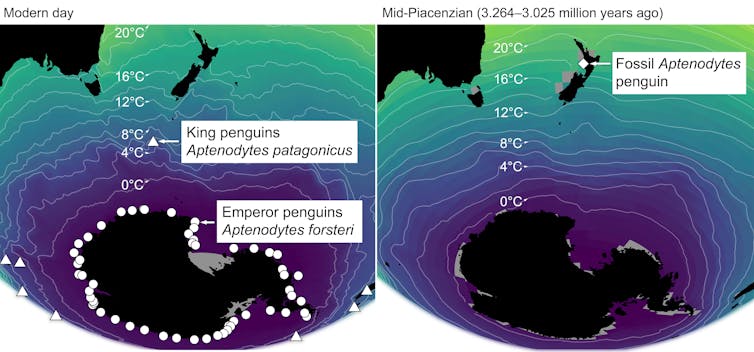
Two maps of the southern hemisphere at different times in Earth history. At left, where great penguins live today; at right, where a fossil Aptenodytes penguin was discovered. Sea surface temperature is represented in different colours.
Today, great penguins are limited to subantarctic islands and the coast of Antarctica (map on the left). But ancient New Zealand was home to an extinct species of great penguin around three million years ago, during a period in Earth’s history known as the mid-Piacenzian Warming Period.
CC BY-SA

Three million years ago, Aotearoa’s great penguins extended as far north as 40.5°S, where South Taranaki was located then. They foraged in waters that were 20°C, much warmer than their relatives experience today.

This balmy existence ended with the Pleistocene ice ages around 2.58 million years ago. Ice extent and sea level shifted back and forward as temperatures fluctuated and ultimately ratcheted downwards. But why would such cooling eradicate giant penguins, which thrive under polar conditions today, from New Zealand?

Giant aerial predators

Fossil evidence for giant penguins in Aotearoa is limited and the exact reasons for their demise remain unclear. Even so, their sheer presence suggests they were less constrained by sea surface temperatures than previously thought. Another mechanism must be at play.

Up until about 500 years ago, Aotearoa was the hunting ground of the giant Haast’s eagle and the huge Forbes’ harrier. These were big raptors. They included large birds like moa in their diet. Their ancestors arrived from Australia inside the last three million years.

Based on what we see with living great penguins, the Taranaki great penguin almost certainly formed large exposed colonies along the coast. These could have been easy targets for a giant eagle or harrier hunting from the air.

By contrast, the smaller penguins still found in Aotearoa today have more cryptic breeding behaviour. They nest in burrows, natural crevices and dense vegetation, and tend to cross beaches at night, which may have helped them avoid aerial predators.

Predation on land is just one hypothesis, though, to help explain why these penguins became extinct in the region while others survived. Other possibilities include changes in the marine environment.

We know that reduced food availability can be devastating for penguins, but it is challenging to see why this would single out the great penguins.

Importantly, our study provides new insight into the habitat tolerances of great penguins. Both king and emperor penguins today can withstand temperatures up to 20°C higher than those they usually forage in.

Three million years ago, their relative experienced such warmth. As the world continues to warm, we need to remember that the geographic range of a species can change as circumstances change.

The marine ecosystem of Aotearoa will move into the habitable zone of many new species, making investigations of the last warm period more important than ever before.


We would like to acknowledge our research co-author Dan Ksepka from The Bruce Museum, Kerr Sharpe-Young for discovering the fossil, and Ngāti Ruanui and Ngāruahine for supporting the collection and research of fossils from their rohe.


The Conversation

Daniel Thomas has received funding from Massey University.

Alan Tennyson and Felix Georg Marx do not work for, consult, own shares in or receive funding from any company or organisation that would benefit from this article, and have disclosed no relevant affiliations beyond their academic appointment.

ref. Close relatives of emperor penguins lived in NZ some 3 million years ago. What caused their extinction? – https://theconversation.com/close-relatives-of-emperor-penguins-lived-in-nz-some-3-million-years-ago-what-caused-their-extinction-265585

Trump’s dip into the Nile waters dispute didn’t settle the conflict – in fact, it may have caused more ripples

Source: The Conversation – Global Perspectives – By Fred H. Lawson, Professor of Government Emeritus, Northeastern University

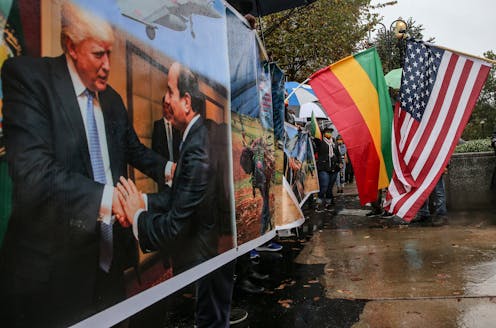
Activists from the Ethiopian community march in protest of Donald Trump’s comments on Ethiopia and the Renaissance Dam on Oct. 29, 2020, in Washington. J. Countess/Getty Images

President Donald Trump chided the United Nations on Sept. 23, 2025, for failing to resolve dangerous international conflicts around the world. “All they seem to do,” he groused during his address to the General Assembly in New York, “is write a really strongly worded letter and then never follow that letter up. It’s empty words, and empty words don’t solve war.”

In contrast, Trump, by his own estimation, has ended a half-dozen serious international conflicts. Among them is the long-standing dispute over the Nile River waters that flared up when Ethiopia proposed to build a massive dam over the Blue Nile, threatening the water supply of Egypt and Sudan.

As an international relations scholar who has studied this dispute, however, I find it hard to see how Trump’s interventions have brought it any closer to a resolution. In fact, they most likely made things worse.

The source of the dispute

Nile River water is essential to agriculture and public sanitation in both Egypt and Sudan. Distribution of that water has been regulated by an agreement drawn up in 1959 guaranteeing Egypt and Sudan most of the output of the Nile River basin. A body of international law also enjoins upstream nations – such as Ethiopia – against manipulating the cross-border flow of rivers in ways that harm downstream countries.

Ethiopia nonetheless declared in 2011 that it had the right to exploit any water resources that originate inside its borders. It further insisted that constructing an electricity-generating dam across the Blue Nile would provide cheap power to both impoverished Ethiopians and neighboring countries.

Egypt and Sudan immediately protested on the grounds that the project would inflict severe damage on their populations and implored international organizations and external powers to intervene.

Ambiguous wording

Trump waded into the Nile dispute at the urging of Egypt. Cairo approached Washington to mediate in late October 2019, as Ethiopia was ramping up construction of the Grand Ethiopian Renaissance Dam that would restrict the flow of the Blue Nile. After speaking personally with Egypt President Abdel Fattah el-Sissi, Trump agreed to become directly involved.

He and then-Secretary of the Treasury Steven Mnuchin invited the foreign ministers of Egypt, Sudan and Ethiopia to Washington for talks.

With the opening session of the ensuing November 2019 meeting still ongoing, Trump tweeted: “The meeting went well and discussions will continue during the day!”

The talks, however, ended with no progress being made. Instead, all four parties, along with representatives of the World Bank, agreed to confer a dozen more times over the next three months to hash out technical matters.

At these subsequent meetings, Egypt and Ethiopia haggled over definitions and measurement criteria concerning the dam’s possible impact. Mnuchin and his staff largely stood aside, although they reportedly expressed sympathy for Addis Ababa’s insistence that matters concerning the Grand Ethiopian Renaissance Dam be kept separate from questions concerning water management in the Nile Basin as a whole.

More importantly, U.S. representatives allowed imprecise wording to slip into the
statement released at the close of the December 2019 meeting.

The statement mandated that “the implementation of these technical rules and guidelines for the filling and operation of the dam will be undertaken by Ethiopia, and may be adjusted by the three countries.”

Cairo interpreted this to mean that all regulations and procedures would be drawn up jointly; Addis Ababa believed that it enshrined Ethiopia’s right to make decisions entirely on its own.

Talks blow up

The final round of talks in January 2020 produced a prospective agreement that left Ethiopia free to start filling the huge reservoir behind the dam, and minimized the country’s obligations to assist Egypt and Sudan during drought periods.

Yet, Ethiopia dragged its feet in accepting the draft document, claiming that crucial points remained unsettled. Egypt and Sudan flatly refused to revisit problems they believed had already been addressed, but did accept an offer from U.S. Treasury officials to prepare a revised text.

In February 2020, the U.S. Treasury Department circulated an amended version, and Trump telephoned al-Sissi to express hope that “an agreement would be finalized soon.”

Ethiopia, feeling pressured by Egypt and the U.S. to endorse an incomplete text – and worried about the domestic political consequences of doing so – did not send a representative to Washington to accept the revision. Treasury officials then declared that a comprehensive settlement to the dispute had now been reached and publicly called on Addis Ababa to sign it.

Egypt’s foreign ministry issued a statement asserting that “President Trump affirmed the U.S. administration’s continued efforts” to reach an acceptable deal. But Ethiopia’s foreign minister described Washington’s abrupt declaration as “undiplomatic.”

Ethiopia stalled for another two months, then circulated a provisional agreement of its own, which Egypt and Sudan dismissed out of hand.

Washington responded with insinuations that it would withhold economic assistance from Ethiopia unless Addis Ababa signed the agreement the Treasury Department had drafted in February 2020. Meanwhile, construction on the dam proceeded, and in July Ethiopia blocked the flow of the Blue Nile to begin filling its huge reservoir.

In September 2020, then-Secretary of State Mike Pompeo followed through on the U.S. threat and suspended US$130 million of aid to Ethiopia. However, the suspension had no impact on negotiations.

Incensed at the continuing impasse, Trump in October 2020 remarked during a telephone call with Sudanese and Israeli diplomats that Egypt “will end up blowing up the dam.”

Ethiopian officials condemned the outburst. The prime minister’s office complained that “these threats and affronts to Ethiopian sovereignty are misguided, unproductive and clear violations of international law.” Ethiopia installed anti-aircraft batteries around the dam and declared the airspace above it a no-fly zone.

Negotiations collapsed, and they remained dormant for the next three years.

Two men seated chat surrounded by flags.
Egyptian President Abdel-Fattah el-Sissi meets Donald Trump during the United Nations General Assembly in September 2019.
AP Photo/Evan Vucci

Assessing the impact of US mediation

Analysts tend to agree that Trump’s initial involvement in the Nile River dispute made a bad situation worse. His admiration for authoritarian leaders prompted him to accommodate Egypt’s al-Sissi and put U.S. credibility on the line.

Meanwhile, Trump’s contempt for the professionals in the U.S. State Department led him to sideline the diplomatic corps and entrust a complicated assignment to Mnuchin, a former financier and movie producer. And his lack of patience and blunt language disrupted the negotiations, alienating Egypt and Ethiopia alike.

Addis Ababa continues to insist that it “has no obligation to request permission from anyone to fill the Renaissance Dam.” In September 2025, Prime Minister Abiy Ahmed declared that work on the dam had finished and boasted of two other dams on the Blue Nile nearing completion.

Meanwhile, Egypt has opened a large naval base on the Red Sea coast and attached
its most advanced warships to a newly created Red Sea squadron. In July 2025, Egypt Foreign Minister Badr Abdelatty issued a veiled threat to use military means to settle the Nile dispute.

Despite rising tensions, and his first administration’s failure to make progress on the issue, Trump continues to point to his 2019-2020 mediation as a success.

In July 2025, he told NATO Secretary General Mark Rutte that a resolution lay just around the corner. President al-Sissi once again applauded the president’s involvement and voiced hope that it would produce a “just agreement.”

Yet there is little indication that the current Trump administration is in any better position to solve the Nile River dispute than was the previous one. Since Trump’s second inauguration, experienced State Department officials have been fired or resigned, leaving sensitive diplomatic missions in the hands of private businesspeople with personal ties to the president, rather than diplomats skilled in the art of negotiating intractable disputes among sovereign states.

This development seems unlikely to budge Trump from the conviction that he has already solved the conflict over the Nile River waters – and can somehow do it again.

The Conversation

Fred H. Lawson does not work for, consult, own shares in or receive funding from any company or organization that would benefit from this article, and has disclosed no relevant affiliations beyond their academic appointment.

ref. Trump’s dip into the Nile waters dispute didn’t settle the conflict – in fact, it may have caused more ripples – https://theconversation.com/trumps-dip-into-the-nile-waters-dispute-didnt-settle-the-conflict-in-fact-it-may-have-caused-more-ripples-263767

The crisis of Indonesian policing: Guardians of the people or protectors of power?

Source: The Conversation – Indonesia – By Perdian Tumanan, PhD Candidate in Ethics and Religion, Villanova School of Law

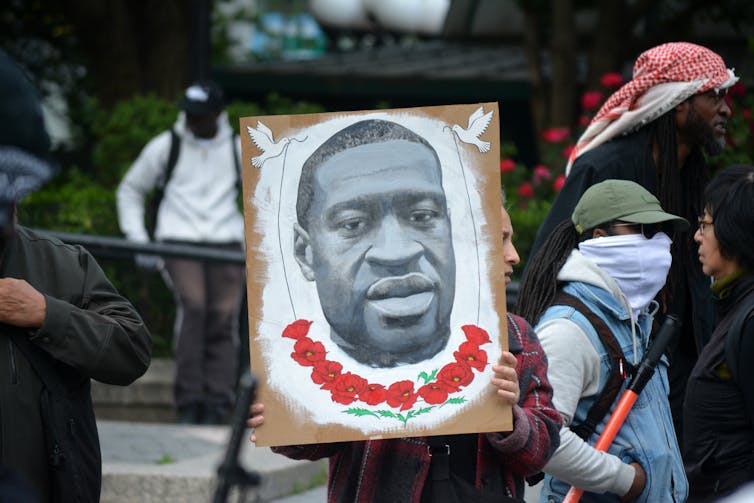
The death of 21-year-old Indonesian online delivery driver Affan Kurniawan, who was crushed by a Barracuda police vehicle during a protest, invites comparisons to George Floyd. The African American was killed by a police officer in Minneapolis in 2020, sparking global Black Lives Matter protests.

One thing unites both cases: they reflect arbitrary violence by those sworn to protect the people.

Policing in the two countries differs greatly in its context: while police in the US are deeply tied to political elites and economic power, the Indonesian police were, in principle, established to serve the people.

Yet this shared pattern of civilian killings raises a pressing question: who are the Indonesian police really protecting?

American police: Guardians of the elites

Alex Vitale, a leading scholar on American policing, argues in his influential book The End of Policing that the roots of American policing are inseparable from three foundational systems of inequality in the 18th century: slavery, colonialism, and the control over the emerging industrial working class.

The commemoration of George Floyd’s killing by Minneapolis police at Union Square in Midtown Manhattan. May 25, 2025.
Christopher Penler

In other words, the American police were not originally created to reduce or prevent crime. Rather, as in many Western nations, they emerged to protect elite interests and maintain control over the working class.

The police thus functioned less as protectors of the public and more as instruments of social control. In essence, they served political elites and economic powers in defending a status quo that favoured them — a legacy that continues to shape the U.S. legal and security system today.

According to Vitale, in such a society, equality existed only among the elites, while the broader nation became a policed society. In this context, crime was defined less by moral conduct than by a person’s socio-economic standing.

For the enslaved and the poor, political rights were nonexistent, and even free expression was unimaginable. Any protest against this imposed order was swiftly branded a crime and harshly punished.

Vitale argues that law enforcement is increasingly armed not only to control the public and instil fear, but also to shield themselves from their own fear of being attacked by the very people they are meant to protect.

This cycle of reciprocal fear persists because the police are never truly connected to, nor in solidarity with, the communities they police.

In such a system, fear governs daily life. It does not flow in just one direction but operates reciprocally — something clearly reflected in the very equipment the police carry.

Indonesian police: Once protectors of the people

I once asked my professor why police officers in the United States always carry guns, even in sacred spaces like churches.

I explained that in Indonesia, the mere presence of guns — regardless of who carries them — instils fear

The Indonesian Police's Mobile Brigade Unit spark public outcry after an officer runs over a civilian, killing him.
Protesters gather in front of the Mobile Brigade Police Headquarters, Jakarta, August 29, 2025.
Wulandari Wulandari/Shutterstock

He replied that police carry guns as a precaution, driven by fear of being attacked.

I then showed him photos of Indonesian police mingling freely with civilians, unarmed and unafraid. Intrigued, he asked how this was possible.

I explained that while Indonesian policing partly inherited its structure from the Dutch colonial apparatus, but it earned legitimacy during the nationalist struggle for independence.

In that struggle, the early police were closely tied to ordinary people, giving them a sense of belonging to the society they served.

This rootedness set them apart from the militarised culture of Western policing, where trust is absent. In Indonesia, the police and the people are inseparable — essentially one.

The social media post comparing Affan’s death to that of George Floyd raises a deeper question: whom do the Indonesian police truly serve today?

Once seen as protectors of the people, the police now increasingly appear aligned with elite interests. Public dissatisfaction is growing, fueled by recurring patterns of violence used to silence dissent, facilitate land dispossession, and suppress indigenous communities.

This perception is further reinforced by the conspicuous wealth displayed by some officers and their families, raising serious questions about integrity and accountability.

These realities deepen a crisis of trust, eroding the very foundations of police legitimacy in a democratic society.

A tool of repression

Affan’s death starkly symbolizes the police’s shift from protecting the people to serving elite interests — a perception reinforced when President Prabowo Subianto, instead of apologising or holding the institution accountable, chose to promote the officers who oversaw the protest.

Indonesian police are involved in a riot with protesters.
A police officer directing traffic at the Tugu Jogja intersection in Yogyakarta.
Rembolle/Shutterstock

Such actions deepen public wounds and confirm suspicions that the police now serve rulers rather than citizens. If this course continues, they will stray even further from their democratic mandate and erode the very trust on which their legitimacy rests.

The Indonesian police must reflect on their roots in the people and heed Vitale’s reminder: policing should not merely serve as a tool of elite power and crime control, but as a force rooted in morality and ethical authority.

If the police forget their roots among the people, they risk ceasing to be guardians of justice and becoming nothing more than guardians of power.

At that point, public trust will collapse. The democratic mandate that once gave birth to the police will be hollowed out, and the institution will no longer be seen as a friend of the people, but as an instrument of repression.

If Indonesia’s police do not have the courage to return to their true calling, the gulf between them and the people will only deepen, leaving behind an institution stripped of legitimacy.

The Conversation

Perdian Tumanan tidak bekerja, menjadi konsultan, memiliki saham, atau menerima dana dari perusahaan atau organisasi mana pun yang akan mengambil untung dari artikel ini, dan telah mengungkapkan bahwa ia tidak memiliki afiliasi selain yang telah disebut di atas.

ref. The crisis of Indonesian policing: Guardians of the people or protectors of power? – https://theconversation.com/the-crisis-of-indonesian-policing-guardians-of-the-people-or-protectors-of-power-264342

Mushrooms may have been part of early human diets: primate study explores who eats what and when

Source: The Conversation – Africa (2) – By Alexander Piel, Asso. Professor in Anthropology, University College London, UCL

Mushrooms may not be the first food that comes to mind when we imagine the diets of wild primates – or our early human ancestors. We tend to think of fruits and green leaves as the preferred foods for monkeys and apes.

But our new study from the Issa Valley in western Tanzania highlights a surprising, and potentially crucial, role for fungi in primate diets.

For nearly two decades, our work has centred on what it means to be a savanna-woodland primate in east Africa. Far from their forest-dwelling cousins, these populations are exposed to higher temperatures, as well as woodland and grassland vegetation where they can find food – or be in danger from predators like wild dogs and hyenas.

Broadly, we are interested in competition between species. For example, how do baboons and smaller monkeys avoid larger (and predatory) chimpanzees when looking for ripe fruits? Mushrooms may provide an answer.

We found that while all three primate species under study consumed mushrooms, their use and reliance differed throughout the year. Mushrooms were seasonally important for red-tailed monkeys and chimpanzees, becoming a fall-back food when ripe fruit was scarce, despite overall making up only 2% of their diet. For baboons, mushrooms were a preferred food, with fungi forming more than a tenth of their diet despite being available for only half the year.

Our findings not only shed light on the way that primates rely on and respond to their environment, but also hint at the evolutionary roots of human mycophagy (mushroom eating). Fungi have been overlooked in research into ancient diets because they don’t fossilise well and leave little trace in the archaeological record.

By examining which foods are consumed by primates, we can better reconstruct scenarios of how early human species may have competed with one another.

Issa fungi foraging

Over four years, we observed three co-inhabiting species – chimpanzees, yellow baboons and red-tailed monkeys – regularly consuming mushrooms.

We used over 50,000 observations of feeding among the three species and found that mushroom consumption wasn’t just incidental. While chimpanzees and red-tailed monkeys ate mushrooms mostly during the wet season, when availability peaked, baboons consumed mushrooms far longer, even when they were relatively scarce.

In fact, for two months of the year, mushrooms made up over 35% of baboons’ diets, suggesting they are a preferred food, not just consumed during fruit-scarce periods, as we suggest for the chimpanzees and red-tailed monkeys.

Chimpanzees and red-tailed monkeys, in contrast, treated mushrooms as a seasonal supplement, valuable when fruits were less abundant. This nuanced difference suggests that mushrooms play different roles within this primate community, depending on ecological strategies and competition dynamics.

Avoiding conflict through fungi

One of the most intriguing ideas to emerge from our study is the concept of niche partitioning: how animals adapt their diets to minimise competition. This is a well-established phenomenon which can manifest in various ways, from bird species occupying different canopy heights, to carnivores targeting different prey.

In habitats where multiple species coexist, finding one’s own food niche can be the key to survival. At Issa, baboons, chimpanzees and guenons (monkeys) might all be using mushrooms in strategic ways to improve feeding efficiency and reduce tension with each other as they respond to periods when (preferred) ripe fruits are insufficient for all three species.

What does this mean for us?

The implications of these findings stretch far beyond western Tanzania. First, they highlight how mushrooms can serve as a rich, seasonal food source, even for large mammals, providing protein, micronutrients and potentially medicinal benefits. This lends support to theories that fungi may have played a significant role in the diets of early hominins.

In fact, the habitat of Issa is thought to resemble the kind of mosaic woodland landscape where human ancestors evolved. If our primate relatives today are exploiting fungi in this environment, it’s plausible that Australopithecus, Homo habilis and other early human species did too.

Despite this, fungi are often overlooked in reconstructions of ancient diets, largely because they don’t fossilise well and leave little trace. Yet ancient DNA from Neanderthal dental plaque from about 40,000 years ago has revealed traces of mushrooms, tantalising clues that fungi may have been more central to prehistoric life than previously believed.

A caution and a call

The study also raises important questions about human-wildlife coexistence. In many parts of Tanzania, mushrooms are harvested by people and sold in local markets. As climate change and human population growth put pressure on wild resources, competition between humans and wildlife over edible fungi may increase. Understanding who eats what and when could help in managing these shared resources sustainably.

At a time when biodiversity is under threat and food security is a growing global concern, this research reminds us that hidden treasures like wild mushrooms aren’t just tasty; they’re significant for ecology and evolution.

Fungi can add to our understanding of where we came from and how we might share our ecosystems going forward.

The Conversation

Alexander Piel receives funding from the Salk/UCSD Center for Academic Research and Training in Anthropogeny and the Department of Human Origins, Max Planck Institute for Evolutionary Anthropology. He is an associate researcher with MPI-EVA.

Fiona Stewart receives funding from the Salk/UCSD Center for Academic Research and Training in Anthropogeny and the Department of Human Origins, Max Planck Institute for Evolutionary Anthropology. He is an associate researcher with MPI-EVA.

ref. Mushrooms may have been part of early human diets: primate study explores who eats what and when – https://theconversation.com/mushrooms-may-have-been-part-of-early-human-diets-primate-study-explores-who-eats-what-and-when-264089

Repatriation or political theatre? How the return of stolen artefacts can distort history

Source: The Conversation – Global Perspectives – By Will Brehm, Associate Professor of Comparative and International Education, University of Canberra

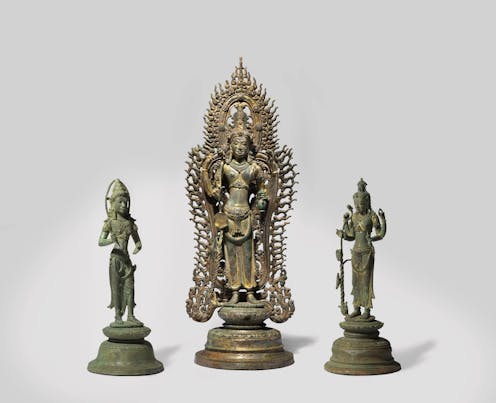
Champa Kingdom, Avalokiteshvara Padmapani, Vajrapani and Avalokiteshvara Padmapani, 9th­­–11th century, National Gallery of Australia, Kamberri/Canberra, Acquired 2011, deaccessioned 2021, repatriated 2023, On loan from the Kingdom of Cambodia, 2023–2026

In late July, during a visit to the National Gallery of Australia, three Buddhist bodhisattva statues caught my attention.

All three were created in the ancient Champa Kingdom that flourished from the 2nd to 19th centuries across present-day Vietnam, Cambodia and Laos. They were purchased by the National Gallery (NGA) in 2011, before being “repatriated” to the Kingdom of Cambodia in 2023 (and displayed in the NGA on loan).

But the Champa Kingdom bore little resemblance to Cambodia’s current borders. What does repatriation mean when the political geography of a place has entirely transformed?

As my research has shown, museums, schools and state institutions can help sanction certain versions of history, while marginalising others. The quiet presence of the bodhisattvas in a museum case embodies much larger questions about cultural heritage, political legitimacy, and who gets to define historical “truth”.

The
three sculptures were made between 9th-11th centuries in the Champa Kingdom.

Author provided

Decades of marginalisation

The decision to return the Cham artefacts to Cambodia, and to exclude Vietnam and Laos, highlights how contemporary politics shape our understanding of cultural heritage.

The Cham people are an ethnic minority in Cambodia, Vietnam, and Laos. In Cambodia, they have been marginalised by the ruling government’s Khmer ethno-nationalist vision of the country.

Although most Cham people today are Muslim, the statues were made between the 9th and 11th centuries during a pre-Islamic era. This period was marked by strong Hindu and Buddhist influence, and a lack of nation-state borders.

After receiving the repatriated statues in 2023, Cambodian Ambassador to Australia, Cheunboran Chanborey, said:

Indeed, putting looted artefacts to their countries of origin can have significant and positive impacts on local communities and their involvement in preserving their cultural heritage. It can foster a sense of pride, national identity and cultural continuity as artefacts hold immense value for the communities to which they belong.

But the very cultural tradition that created the bodhisattvas now finds itself sidelined in a modern nation-state claiming ownership of them.

Lootings by the Khmer Rouge

The historical context of how the Cham poeple’s artefacts were looted is crucial and disturbing.

Journalist Anne Davies’ account in the NGA’s documentation notes organised looting networks were “often headed by members of the military or the Khmer Rouge”. The Khmer Rouge was the political party that ruled Cambodia from 1975–79 under the notorious Pol Pot, carrying out a genocide of the Cham people (as well as other ethnic groups).

However, this looting actually took place in the 1990s, after the Khmer Rouge was overthrown by the precursors to the present-day Cambodian People’s Party.

In other words, the looting happened on the current government’s watch. Davies writes “members of the military” of the Royal Cambodian Armed Forces worked with former Khmer Rouge soldiers who continued to occupy parts of northern Cambodia, especially areas protected by thick forest.

Looted artefacts moved from the hands of former Khmer Rouge members to the Cambodian military, and eventually to international markets.

A revealing 2009 photograph shows Douglas Latchford, the antiquities dealer who sold the statues to the NGA, examining artefacts at the National Museum of Cambodia, alongside Sok An, the then-deputy prime minister of the Cambodian People’s Party. Latchford is wearing a medal signifying Cambodian knighthood, suggesting a collaborative relationship.

The 2009 photo, with Cambodia’s then-deputy prime minister Sok An (left) and British Khmer art collector Douglas Latchford (centre). Before his death in 20202, Latchford was implicated in the illegal trade of antiquities.
Tang Chhin Sothy/AFP via Getty Image

Parallels to other illegal trades

After retreating to border forests in 1979, the Khmer Rouge began systematic, illegal timber logging, selling the wood throughout Thailand and Cambodia. Global Witness has documented how the ruling elites in both countries have profited substantially from this trade.

The connections between logging and looting are striking: both involved illegal acts by former Khmer Rouge soldiers that ultimately enriched ruling parties.

When I saw photos of the Cambodian Ambassador to Australia formally receiving the repatriated statues in 2023, the irony was inescapable. His party, the Cambodian People’s Party, was likely complicit in the original theft.

Historical context transforms repatriation’s meaning. Rather than restoring cultural heritage to rightful guardians, these ceremonies may serve as elaborate exercises in political laundering, allowing those who profited from cultural destruction to rebrand themselves as cultural preservationists.

A new framework

The implications of this extend far beyond Cambodia. In a world where borders have been redrawn countless times, and where many cultural traditions transcend boundaries, we need new frameworks for thinking about cultural heritage.

The NGA says it followed the Protection of Movable Cultural Heritage Act 1986 in returning the bodhisattvas to Cambodia. But the wall text for the statues acknowledges their complexity:

While the works were almost certainly created in Vietnam […] the archaeological site where they were found is in Cambodia.

The wall text at the gallery explains how the statues were acquired by Douglas Latchford, before being sold to the NGA and eventually repatriated.
NGA

The statutes were found in a different country from where they were created because the borders of those territories shifted over time.

Borders in the Mekong region of Southeast Asia have long been porous. It was only in 2012 that the last border marker between Cambodia and Vietnam was agreed on. We have also seen recent fighting over the Cambodian–Thai border.

Contested sovereignty remains a live political issue affecting how we understand cultural heritage. Is country of “origin” determined by where objects were created, or where they were discovered?

Perhaps genuine cultural justice requires acknowledging complexity rather than seeking simple solutions. Instead of asking which modern nation-state deserves these artefacts, we might ask: how can cultural heritage serve all peoples who share connections to it?

The three bodhisattvas remind us repatriation is never simply about returning objects to their “rightful” place. It’s about who gets to define that place, whose version of history becomes officially sanctioned, and whether cultural justice might sometimes serve to obscure, rather than remedy, historical injustice.

The Conversation

Will Brehm does not work for, consult, own shares in or receive funding from any company or organisation that would benefit from this article, and has disclosed no relevant affiliations beyond their academic appointment.

ref. Repatriation or political theatre? How the return of stolen artefacts can distort history – https://theconversation.com/repatriation-or-political-theatre-how-the-return-of-stolen-artefacts-can-distort-history-265290

Warn, hide or stand out? How colour in the animal world is a battle for survival

Source: The Conversation – Global Perspectives – By Iliana Medina, Lecturer in Ecology, The University of Melbourne

The animal world is incredibly colourful, and behind this colour palette is a constant game of survival.

Most animals use camouflage, covering themselves in stealthy patterns to hide from predators. Others display bright and bold colours to warn potential predators they are not a good meal. This second strategy is known as aposematism or warning colouration. Although less common than camouflage, it has evolved hundreds of times in butterflies, beetles, bugs, sea slugs, poison frogs and even birds.

One long-standing question is why species use one of these strategies over the other. Is one of these strategies usually more successful? Under which specific circumstances does one strategy beat the other? Our new study, published today in Science, helps answer these questions.

A grey and brown moth on a grey and brown branch.
The hawk moth (Psilogramma casuarinae) has extraordinary camouflage.
Damien Esquerre

Testing multiple theories

Both camouflage and aposematism can co-exist in the same region. In Australia, for example, there are many examples of camouflaged insects such as the spotted predatory katydids and the lichen spiders.

On the other hand, species such as the cotton harlequin bug – a common stink bug found in urban areas – and the handmaiden moth display bright orange and red colours to advertise to predators they are not a pleasant meal. Some animals (but fewer) such as mountain katydids even use both strategies by changing colour, or hiding and revealing colourful patches.

A skinny brown and green spider camouflaged on a tree.
The Australian lichen spider (Pandercetes gracilis) hiding on a skinny tree trunk.
Kate Umbers

There are dozens of theories about why some species are camouflaged instead of warningly coloured, and it is a challenge to pull these ideas apart.

Small localised studies have independently tried to test the effect of different factors separately. For example, we know light levels are important in the success of camouflage strategies. We also know the success of warning colouration often relies on predators having experienced the prey before, and having learned to avoid warning signals.

But is lighting or predator learning ability more important?

Results from a single place tell us about that place, but we see the same strategies all over the world. Do strategies perform the same way everywhere?

To solve this mystery, our large team of collaborators ran the same experiment in 16 different countries around the world, in different forests with different levels of light, and different prey and predator communities.

Two shiny blue and red bugs sitting on a tree.
Cotton harlequin bugs (Tectochoris diophthalmus) display bright orange and red colours to advertise to their predators that they are not a pleasant meal.
Thomas Wallenius

15,000 paper moths

Together we deployed more than 15,000 artificial prey – paper moths – with three different colours: a classic warning pattern of orange-and-black, a sneaky brown that blends in, and an uncommon bright blue-and-black. Each paper target was baited with a mealworm, which allowed us to measure the survival of each type of colouration. If the bait was taken, we assumed a predator decided to consume that target.

The typical warning colour represented the widely distributed orange-and-black combination we see in many toxic animals, such as the monarch butterfly and poison frogs. The uncommon warning colour corresponded to a less used warning pattern that is still highly visible, similar to the Ulysses butterfly.

Having these two warning colourations allowed us to test whether predators avoid the orange-and-black signal because it is familiar or simply because it is highly visible.

We found there is no single “best” strategy. Instead, the local predators, local prey, and the forest light all contributed to whether camouflage or warning colours were most protective.

A blue and black butterfly on a green leaf.
The Ulysses butterfly uses striking blue-and-black colours to deter predators.
pamday4/iNaturalist, CC BY-NC

The predators present in the community – and how intensely they attacked prey – had the biggest impact on which prey colour was most successful at avoiding attack. We found that in places where there were lots of predator attacks – where competition for food is probably intense – predators are more likely to attack prey that looks dangerous or distasteful. This means camouflage was most protective in areas with lots of predation.

But the camouflaged prey couldn’t hide as well in every environment. For example, in well-lit environments, the benefits of camouflage were lost, while light conditions did not affect how the orange-and-black prey performed.

Familiarity with prey was also important. In places where camouflaged prey is abundant, hiding was less effective, as predators likely learn how to find camouflaged prey.

On the other hand, in places where warning colours were common, predators were better at avoiding the typical warning signal, but not the atypical one. This suggests predators learn to avoid familiar warning signals, which helps to explain why so many animals share similar colour combinations.

An insect with green and white spots hiding in in a green bush.
The spotted predatory katydid (Chlorobalius leucoviridis) uses camouflage to survive.
Amanda Franklin

Predicting future changes

Our study shows how multiple features of the environment determine which strategy is more protective. It also shows the success of camouflage strategies might be more dependent on ecological context than that of warning signals.

As climate change transforms habitats, conditions that are vital to the success of different antipredator strategies can also change.

For example, camouflage strategies could fare worse in transformed habitats that have little vegetation cover and high levels of light.

Our findings can help better predict the effect these changes might have on animals that use different colour strategies against predators and mitigate against them.

The Conversation

Iliana Medina receives funding from the Australian Research Council.

Alice Exnerova receives funding from the Czech Science Foundation.

Amanda M Franklin receives funding from the Australian Research Council, and has previously received funding from the University of Melbourne and the Fulbright Program.

Kate Umbers receives funding from Australian Research Council, Hermon Slade Foundation, Wedgetail Foundation, Atlas of Living Australia, Western Sydney University, and DCCEEW. She is on the Biodiversity Council and Managing Director of Invertebrates Australia.

William Allen does not work for, consult, own shares in or receive funding from any company or organisation that would benefit from this article, and has disclosed no relevant affiliations beyond their academic appointment.

ref. Warn, hide or stand out? How colour in the animal world is a battle for survival – https://theconversation.com/warn-hide-or-stand-out-how-colour-in-the-animal-world-is-a-battle-for-survival-265670

Aid workers around the world are in greater danger than ever. Will a new UN declaration protect them?

Source: The Conversation – Global Perspectives – By Amra Lee, PhD candidate in Protection of Civilians, Australian National University

Aid workers face more difficult and dangerous conditions in carrying out their work than ever before. The United Nations declared 2024 the worst year on record, with 385 aid workers killed in 20 countries. That was, in turn, almost 100 more deaths than in 2023.

As Deputy UN Emergency Relief Coordinator Joyce Msuya briefed the UN Security Council:

We have become numb to this violence. Being shot at is not – I repeat, NOT – part of our job.

In 2025, 300 aid workers have been killed as of September. Most these deaths were driven by unrestricted warfare in Gaza that has since been classified a genocide, followed by Sudan and South Sudan. The use of drones, praised for their precision, was responsible for killing seven aid workers in the World Central Kitchen convoy in Gaza, including Australian Zomi Frankcom.

Attacks on international aid workers attract high levels of attention and calls for accountability. However, the overwhelming majority of deaths and injuries are local aid workers who leave behind families and dependants often reliant on their income.

Why the global initiative matters

More than 100 states have signed the Australian-led declaration to protect aid workers at this week’s UN General Assembly meeting in New York.

While some may be sceptical of the power of a declaration at this time, it nonetheless offers a glimmer of hope for humanity in an otherwise highly contested and polarised geopolitical environment.

Attacks on aid workers have not only increased, they have become more brutal. This is due to unrestricted warfare being normalised, including new patterns of harm from remotely controlled drones killing aid and healthcare workers across Palestine, Ukraine, Myanmar, Sudan, Mali, Sudan and Ethiopia.

The glaring lack of legal accountability for increasing deliberate attacks and targeting of aid workers has enabled impunity. If it weren’t for the work of a few dedicated actors, including the Aid Work Security database and Legal Action Worldwide, we wouldn’t even know how many aid workers had been killed, injured, detained – and denied justice.

Accountability starts with reliable data and reporting. It must be followed by timely, impartial investigations and justice through national and international mechanisms.

Protecting aid workers is vital for protecting civilians

Soaring global conflict and declining respect for international law have contributed to record aid worker death tolls since 2023. In 2024, nearly half of aid worker deaths were in Gaza.

The multilateral system – including the laws, norms and institutions that support it – faces its greatest test since the creation of the UN in 1945. This includes the laws and norms designed to ensure aid workers can safely and quickly reach civilians in war zones. As Foreign Minister Penny Wong says,

We know that to protect civilians, we must also protect aid workers who deliver the food, water and medicine civilians need to survive.

The normalisation of unrestricted warfare alongside dramatic shifts in US foreign policy is stretching the institutions, laws and norms designed to protect civilians and those sent to help them. Aid workers have shouldered this burden quietly, reluctant to speak out due to fear of punitive measures from those who would deny them access to the civilian populations they serve.

The increase in attacks on aid workers also points to antagonism to the presence of aid workers in war zones, and their independent assessment and reporting of the terrible toll war takes on people’s lives.

This is why reinforcing member states’ commitment to international law obligations and fundamental humanitarian norms is vital at this time.

Beyond declaration to protection

Renewed political commitment by member states to protect aid workers and reinforce existing obligations under international law is both welcome and urgently needed.

The effectiveness of the initiative will be seen in pursuing accountability for aid worker attacks internationally and domestically. It will also be evident in how well it can address the longstanding impunity that has enabled the escalating danger of aid work.

And it will be further measured by whether local aid workers on the frontlines receive the necessary technical and financial support to reduce the rising threats they face.

The Conversation

Amra Lee does not work for, consult, own shares in or receive funding from any company or organisation that would benefit from this article, and has disclosed no relevant affiliations beyond their academic appointment.

ref. Aid workers around the world are in greater danger than ever. Will a new UN declaration protect them? – https://theconversation.com/aid-workers-around-the-world-are-in-greater-danger-than-ever-will-a-new-un-declaration-protect-them-265861

Babies can get hepatitis B at birth. Here’s why Trump is wrong about delaying the vaccine

Source: The Conversation – Global Perspectives – By Nicholas Wood, Professor, The Children’s Hospital at Westmead Clinical School and Sydney Infectious Diseases Institute, University of Sydney

Cavan Images/Getty

United States President Donald Trump this week claimed children should not be vaccinated against hepatitis B until they are 12 years old, rather than at birth. He also said the viral liver infection was a sexually transmitted disease.

The claims came amid a slew of other statements on autism, paracetamol and vaccines which medical experts have warned are not grounded in evidence.

So, what does the evidence say about hepatitis B? And why is it important to give babies the vaccine from birth?

What is hepatitis B?

Hepatitis B is a liver infection caused by the hepatitis B virus. The infection can be chronic (long-term) and puts the infected person at high risk of liver cirrhosis, liver cancer and death.

Hepatitis B virus can be spread through contact with infected body fluids. This includes blood, saliva, vaginal fluids and semen. So yes, as Trump suggested, hepatitis B can be sexually transmitted. But that’s not the only way to get infected.

Importantly, the virus can also pass from a mother to her baby via the birth canal during childbirth. If a newborn is exposed to hepatitis B at birth, there’s a 90% chance they’ll develop chronic infection. Over a lifetime, about one in four of those who have chronic infection will die from liver disease or liver cancer.

In countries where hepatitis B is widespread, the virus is most commonly passed from mother to child at birth, or from an infected child to an uninfected child during the first five years of life.

There is no cure, meaning a hepatitis B infection is for life. Fortunately, we have a highly effective vaccine that can prevent against infection.

Most effective hours after birth

The World Health Organization (WHO) recommends children receive the first dose of hepatitis B vaccine at birth. Since 2000, this has also been the standard recommendation for all infants in Australia – ideally within 24 hours of birth – as part of our National Immunisation Program.

If a pregnant woman tests positive for hepatitis B surface antigen (HBsAg) – meaning she has a chronic infection – her infant should ideally receive the first dose of hepatitis B vaccine within four hours of birth. This will be administered together with the hepatitis B immunoglobulin, a medicine that contains antibodies to hepatitis B.

Hepatitis B vaccine alone is estimated to be 75% effective at preventing infection during childbirth, while the vaccine and immunoglobulin together are 95% effective.

This birth dose of the vaccine, followed by three follow-up doses at two, four and six months, provides long-term protection for at least 20 years.

Protection lasts well into adolescence and adulthood, when behaviours such as sexual activity or injecting drug use can increase the risk of contracting the hepatitis B virus.

Hepatitis B vaccine is effective

Globally, 117 countries have introduced a dose of hepatitis B vaccine to newborns within the first 24 hours of life. This means millions of infants have safely received the vaccine at birth.

Vaccination of Australian newborns is high. For example, in 2023, 92% of babies in New South Wales received the hepatitis B birth dose. This rate has been relatively stable, between 92% and 95%, since 2007.

The impact of universal vaccination has been striking. Since Australia introduced free infant hepatitis B immunisation, newly acquired infections dropped by two thirds between 2000 and 2019.

Between 2014 and 2023, this program has supported a 60% decline in hepatitis B cases in people aged under 20.

Hepatitis B vaccination has been the cornerstone of controlling the disease for decades and has brought the US within reach of eliminating hepatitis B infections, which Australia is also aiming for by 2030.

Hepatitis B vaccine is safe

The baby may experience minor side effects following vaccination, including pain, redness or swelling at the injection site. These usually last no more than a couple of days. Sometimes a small lump appears that may last a few weeks.

Delaying can be dangerous

Delaying the first dose of hepatitis B vaccine is not recommended because:

  • The virus is silent and common. In Australia, about 0.9% of people live with chronic hepatitis B and almost one-third don’t know they’re infected. While transmission often happens during labour and delivery, babies can also pick it up later from household contact. Vaccination at birth and in infancy can protect against this type of transmission, known as horizontal transmission.

  • Screening isn’t perfect. Hepatitis B screening is recommended for all pregnant women, to help prevent newborns developing chronic hepatitis B from infection at birth. A woman may be referred to an infectious disease specialist and/or recommended anti-viral medication during pregnancy. However, not all mothers are tested during pregnancy. Even if they are, infection can occur after testing or be missed entirely. So the birth dose acts as an important safety net.

In a nutshell

Evidence shows vaccinating babies at birth is one of the safest, most effective and accessible ways to protect children against a lifetime of hepatitis B infection – and other complications that can lead to preventable deaths.

The Conversation

Nicholas Wood has previously received funding from the NHMRC for a Career Development Fellowship. He has held a Churchill fellowship.

Kristine Macartney administers Australian and NSW Government funding to the NCIRS and NCIRS receives funding from the National Health and Medical Research Council (NHMRC), and Gavi the Vaccine Alliance.

Lucy Deng does not work for, consult, own shares in or receive funding from any company or organisation that would benefit from this article, and has disclosed no relevant affiliations beyond their academic appointment.

ref. Babies can get hepatitis B at birth. Here’s why Trump is wrong about delaying the vaccine – https://theconversation.com/babies-can-get-hepatitis-b-at-birth-heres-why-trump-is-wrong-about-delaying-the-vaccine-265970