Specialised teachers can make mainstream schools better for children with special educational needs

Source: The Conversation – UK – By Johny Daniel, Associate Professor, School of Education, Durham University

PeopleImages/Shutterstock

Most pupils who go through the lengthy process of being identified with dyslexia, autism or another condition end up spending the bulk of their time supported not by a trained specialist teacher but by a teaching assistant.

Teaching assistants work with great dedication, but they are not equipped with the specialist training needed to teach children with special educational needs and disabilities effectively. The result is that pupils too often fall further behind, despite the system recognising their needs.

Later this year, the UK government will publish a long-awaited document on planned policy for schools and special educational needs in England. This is set to include the intention to establish more inclusive mainstream education – mainstream schools that are equipped to educate children with special educational needs. The way to do this is to ensure specialist support is available in mainstream schools.

The gaps are stark. By the end of primary school, children with special educational needs and disabilities are almost two years behind in writing, and about a year and a half behind in reading and maths. These are not inevitable outcomes. They reflect unmet needs and under-resourced classrooms.

Parents may value inclusion and want their children learning alongside peers. But studies consistently report parental frustration that schools are often not equipped with the specialist expertise needed to meet those needs.

True inclusion cannot mean simply placing pupils with educational needs and disabilities in the same room with their peers. Without expert teaching to adapt lessons, build literacy and support language and behaviour, inclusion risks becoming tokenistic.

Instead of prioritising investment in specialist teachers within schools, funding has increasingly been channelled into outsourced provision and tribunals. Research suggests that too much funding is tied up in a small minority of cases, when it could be used to strengthen special educational needs provision in every mainstream school.

A more useful approach treats inclusion and specialisation not as opposites but as partners. Specialist teachers bring the deep knowledge of how to support particular needs, while mainstream teachers provide the shared environment where all children can learn together. When these two are connected, pupils get the best of both worlds.

The cost of outsourcing

A central issue lies in how the special educational needs and disabilities system currently delivers support. Many families who can afford private assessments or are able to pursue tribunals succeed in securing additional help for their child, often through placements outside the local authority system. But this approach means only a small group of children gain access to specialist private or publicly funded provision, while many others with equally significant needs remain unsupported.

This reliance on outsourcing is also costly. Expensive independent placements and external assessments absorb government funds that could otherwise be invested in improving provision in mainstream schools. In effect, public resources are concentrated on the few rather than spread to benefit the many children in need.

A more sustainable model is to develop in-house expertise. If every school had specialist teachers able to identify needs early and provide targeted support, far fewer families would feel driven to seek help through tribunals or private routes. Bringing services into schools would ensure that specialist expertise is consistently available to all pupils who need it.

Children outside school in uniform
The UK government plans to prioritise special educational needs provision in mainstream schools.
Rawpixel.com/Shutterstock

If the government is serious about meaningful reform, I believe it must fund new special education teacher training programmes to expand the supply of specialist teachers, ensuring every mainstream primary and secondary school has access to them.

It should make training in special educational needs and disabilities mandatory across the teaching profession, to reduce variation in identification and support. And it should replace policy ambivalence with a clear commitment: inclusion must be backed by specialist expertise and enforceable entitlements, not just rhetoric.

The special educational needs system is under intense strain, but this is also a moment of choice. England can continue to oscillate between rhetoric and retrenchment, or it can finally embed specialist expertise in the heart of mainstream education.

The government’s decision this autumn will shape the life chances of hundreds of thousands of children. We should not expect children to succeed without the specialist teachers they urgently need.

The Conversation

Johny Daniel does not work for, consult, own shares in or receive funding from any company or organisation that would benefit from this article, and has disclosed no relevant affiliations beyond their academic appointment.

ref. Specialised teachers can make mainstream schools better for children with special educational needs – https://theconversation.com/specialised-teachers-can-make-mainstream-schools-better-for-children-with-special-educational-needs-264312


Most of your actions are driven by habit, not thought – here’s why that’s not a bad thing

Source: The Conversation – UK – By Benjamin Gardner, Professor in Psychology, University of Surrey

fizkes/Shutterstocl

Reaching for our phones upon waking, standing in the same point on the station
platform, sneaking in a sweet treat after the evening meal – we all have habits that shape our lives.

But you may underestimate the power habits have in your life. Our new study shows that the majority of actions people take in a day are carried out on autopilot.

Habitual behaviour is made up of the things that we do without thinking, prompted by our environment and learned through repeated enactment. Encountering a familiar trigger – such as a sound, a location or another person – can activate a learned association, which in turn prompts a non-conscious impulse to act. The sound of your alarm clock, for example, may be enough to prompt you to reach for your phone, without consciously deciding to.

Habits can influence our behaviour in two ways. We can habitually initiate something – selecting a behaviour without much thought – or habitually do something, where the steps involved in a sequence are carried out at least partly on autopilot.

But just how much of our day-to-day lives are shaped by habit?

Our new study aimed to find out. We recruited 105 people, aged 18-73 years old, and sent prompts to their phones six times a day over one week. Each prompt asked four questions: what were they doing when we interrupted them? To what extent was that action initiated without conscious thought? To what extent was it performed automatically? And how much had they wanted to do it?

The most commonly reported behaviour types were working or studying, domestic or childcare activities, and using a screen-based device. More importantly, 65% of all actions were initiated out of habit. People chose to do them without making a conscious decision. And 88% of actions were performed on autopilot.

This suggests that around two-thirds of the decisions we make each day are automated, instead of driven by conscious deliberation.

However, this does not mean that we simply act mindlessly, without awareness or free will.

Around one in three actions in our study were intentional but not habitual. People had consciously chosen to do them, probably because the action or setting was unfamiliar, or because their habits were not strong enough to exert influence.

Crucially, 76% of all actions – including 67% of those actions initiated or performed out of habit – were things people intended to do. Habits develop when we repeatedly do things in certain settings. Several studies suggest that, with once-daily repetition, it takes around two months to form a habit. This ranges considerably though. One 2021 study found habit formation to take anywhere from four to 335 days.

Hand reaching out from bedcovers to turn off alarm clock.
What do you do first thing in the morning? Chances are, it’s something out of habit.
Ana Blazic Pavlovic/Shutterstock

Only two people (2%) in our study said they always acted intentionally and never out of habit. The vast majority said they were acting in line with intentions or habits, or both, at least some of the time. For each of us, there appears to be variation, across time, in whether we act habitually or intentionally, probably due to the natural ebb and flow of our attention and motivation.

We would not exert the effort needed to repeatedly do these actions if they served no purpose. Our habits and goals are therefore often aligned. We may reach for our phones automatically, but that can help us stay informed. We might instinctively stand in the same spot on the platform, but that may help us find a seat on the train.

Habits are adaptive. We have limited mental resources at any one time. If we had to deliberate over all our mundane decisions each day – like when to have a shower – we would have less capacity to focus on more important matters, like preparing for that big presentation later in the day.

In fact, deliberating over actions that are usually done habitually can backfire. One 2017 paper showed that, when people were incentivised to perform effectively, they tended to eschew their habits and engage in more mindful performance. Ironically, participants who chose to deliberate gave a poorer quality performance than those who acted habitually.

Habits are not, therefore, the enemy of free will. In fact, they can make life easier.

The downside of habits appears when they stop serving our goals. Bad habits push us towards choices that undermine what we really want. People who are trying to lose weight, for example, often struggle against long-standing eating habits that favour unhealthy options. Staying on track in these moments often requires strong, sustained willpower to resist the pull of old habits. When we are distracted, stressed or fatigued it is harder to counteract our bad habits. Even brief dips in motivation can prompt lapses into our old ways, kickstarting a chain of negative emotions, denting our confidence in our ability to change, and so unravelling our efforts to change our behaviour.

Effective ways to break bad habits include identifying and avoiding triggers to unwanted habits, and making unwanted behaviour harder to automatically activate. A habitual evening snacker might, for example, avoid going to the kitchen in the evening so that they aren’t tempted by the snack cupboard.

Our findings show that habits play a huge role in shaping our everyday lives, often helping us act efficiently. Understanding how habits work provides a powerful tool for behaviour change. Whether you are making a new routine or breaking an old one, recognising the triggers that drive your actions – and how you respond to them – can help you stay in control.

The Conversation

Amanda L. Rebar receives funding from the National Institute of Health (US), the Australian Research Council, and the National Health and Medical Research Council (Australia).

Benjamin Gardner does not work for, consult, own shares in or receive funding from any company or organisation that would benefit from this article, and has disclosed no relevant affiliations beyond their academic appointment.

ref. Most of your actions are driven by habit, not thought – here’s why that’s not a bad thing – https://theconversation.com/most-of-your-actions-are-driven-by-habit-not-thought-heres-why-thats-not-a-bad-thing-266277

The sex lives of Presbyterians in 18th- and 19th-century Ulster were surprisingly colourful

Source: The Conversation – UK – By Leanne Calvert, Assistant Professor in Irish History, University of Limerick

In the 18th and 19th centuries, Presbyterians from Ulster in Northern Ireland had a somewhat surprising reputation for being especially – if not excessively – concerned with sex.

As the Ordnance Survey Memoirs Observer for the parish of Rashee in County Antrim candidly put it in 1835, while the Presbyterians of the north of Ireland “unhesitatingly” claimed for themselves a general character of “extreme morality”, they were “not the pious race so generally imagined”.

The records of the Presbyterian church in this period certainly give the impression of a community with a vibrant sexual culture – though one that was also strictly policed. It is this tension between piety and promiscuity that I explore in my new book, Pious and Promiscuous: Life, Love and Family in Presbyterian Ulster – revealing for the first time personal stories that shaped the rhythms and rituals of Presbyterian family life in 18th- and 19th-century Ulster.

The Presbyterian church closely regulated the intimate lives of its members through a system of church court discipline. Misbehaving members could find themselves before the Kirk Session (the church’s local court) for a wide range of offences including bigamy, drunkenness, slander, fist fights and skipping Sabbath services. But it was sexual misbehaviour that sent most to these courts.

Of the 375 cases considered by First Dromara Kirk Session in County Down between 1780 and 1805, 230 concerned sexual misbehaviour. Similarly, more than half of all cases heard by Carnmoney Kirk Session in County Antrim between 1786 and 1821 were of a sexual nature.

Sexual offences was a broad category that included sex between unmarried and about-to-be-married persons (known as fornication or pre-marital fornication), sex with someone who was not your spouse (adultery), and “scandalous carriage” – intimate acts that stopped short of full sexual intercourse, such as kissing or heavy petting.

Conduct which raised suspicions that sex had taken place also fell under this heading. Couples who spent time together alone and unchaperoned could be cited, as well as those who were caught in compromising situations.

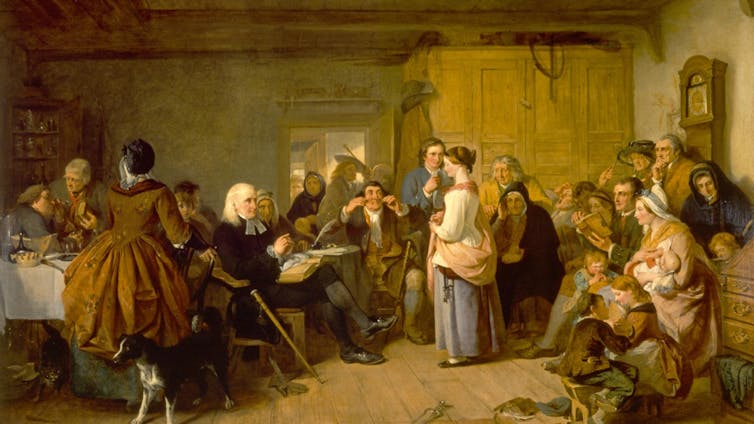
This painting shows the minister of the local kirk questioning a young parish girl about particular aspects of her Protestant faith.
Presbyterian Catechising by John Phillip (1847).
National Galleries of Scotland, CC BY-NC

This is what happened to John Woodend, a married man and member of the Aghadowey Presbyterian congregation in County Londonderry. His bedsharing practices roused suspicions that he had been guilty of adultery. In October 1704, Woodend was told off by the Kirk Session after he was seen lying “in naked bed” with his servant maid, Margaret.

A man named John Boil reported seeing the pair in bed together, then watching as Woodend got up and began “pulling on his cloths”. Since Woodend’s wife was also in the room at the time – she was sitting on a chair next to the bed – the session ruled it was unlikely the bedsharing pair had committed adultery. But Woodend’s conduct was still considered “unseemly and offensive”, resulting in his censure for “unseemly carriage”.

Sex first, marriage second?

The sheer volume of sexual misbehaviour cases heard by the church courts appears to suggest that Presbyterians were relatively permissive in their attitudes to sex outside marriage.

Fornication and pre-marital fornication were, after all, the most numerous sexual offences. Indeed, historians used to believe that Presbyterians were different from other religious communities in Ireland because of their perceived tolerance of extra-marital sex. But that impression is misleading.

Records of the church courts show that Ulster Presbyterians were far from “promiscuous” in their attitude to sexual morality. Kirk Session minute books reveal how Presbyterian women and men engaged in sexual intercourse as part of the rituals of courtship and marriage.

In Ulster, many Presbyterian couples entered a form of marriage known as verba de futuro – a promise to marry in the future that was then sealed with sexual intercourse.

This is how the marriage of Benjamin Green and Elizabeth Bell, members of Cahans Presbyterian church in County Monaghan, came about. In March 1753, the couple told Cahans Kirk Session they had sworn secretly to each other that they would marry “some [time] before actual marriage” – and then confirmed their promises to marry in the future by having sex.

More than 20 years later, Margaret Cunningham shared a similar story about her marriage to Robert Jackson. According to Cunningham, she and Jackson exchanged marriage vows on the “last Friday of March”, then “bedded” together “the following Monday”. Like many other Presbyterians, these couples may not have considered their sexual behaviour as sinful because they had every intention of progressing to marriage.

The stories contained in the Presbyterian archive – a term I use to describe records produced by and about members of Ulster’s Presbyterian community – provide a tantalising glimpse into the intimate worlds of women and men in Ulster, centuries ago.

Their stories remind us how individual experiences could both conform to, and deviate from, societal expectations. Presbyterians did indeed have colourful sex lives – just as they also valued marriage.


Looking for something good? Cut through the noise with a carefully curated selection of the latest releases, live events and exhibitions, straight to your inbox every fortnight, on Fridays. Sign up here.


The Conversation

Research for my book has received funding from: Arts and Humanities Research Council Postgraduate funding, the R.J. Hunter Bursary from the Royal Irish Academy, the Anna-Parnell Travel Grant from the Women’s History Association of Ireland and internal funding from the University of Hertfordshire.

ref. The sex lives of Presbyterians in 18th- and 19th-century Ulster were surprisingly colourful – https://theconversation.com/the-sex-lives-of-presbyterians-in-18th-and-19th-century-ulster-were-surprisingly-colourful-266078

Where does Trump’s peace plan leave the Palestinians?

Source: The Conversation – UK – By Jonathan Este, Senior International Affairs Editor, Associate Editor, The Conversation

This article was first published in The Conversation UK’s World Affairs Briefing email newsletter. Sign up to receive weekly analysis of the latest developments in international relations, direct to your inbox.


As the world waits for what remains of the Hamas leadership to respond to Donald Trump’s 20-point peace deal – which the US president says they had better accept or “pay in hell” – it’s important to remember that there’s no certainty that the deal, as published this week, will make it past Netanyahu’s cabinet either.

Trump announced on September 29 that the Israeli prime minister, Benjamin Netanyahu, had agreed to the terms of the deal, which includes what on the face of it appears to be a highly conditional reference to Palestinian self-determination. “While Gaza re-development advances and when the PA reform programme is faithfully carried out, the conditions may finally be in place [my italics] for a credible pathway to Palestinian self-determination and statehood, which we recognise as the aspiration of the Palestinian people.”

As they thrash out each clause of this, Hamas negotiators will be mindful of the fact that, on his return to Israel, Netanyahu said he had not agreed to a Palestinian state. He posted on social media saying that a promise of statehood was not written anywhere in the agreement and that Israel would “forcibly resist” such an outcome.

They will also note that according to the terms of the deal, their organisation is supposed to disband and disarm and they will be excluded, as representative of Hamas at least, from taking any further part in the governance of Gaza or indeed a Palestinian state.

Meanwhile, in the West Bank, Hamas’s counterpart Fatah, which runs the Palestinian Authority (PA), has lost the support of most Palestinians (a recent poll found just 6% would vote for Fatah leader Mahmoud Abbas, the PA president). Abbas is 89 years old and has surrounded himself with elderly supporters. The PA has been dogged by corruption scandals for years.

It’s clear that to have any chance of forming a coherent and credible government for a future Palestinian state, a new generation of leaders will be needed. The man who many think should lead that government is currently serving five life sentences in an Israeli jail.

Marwan Barghouti has been called “Palestine’s Mandela”. This is clearly partly for his lengthy spell of incarceration. But it’s also a reference to his preference for peaceful resistance – although, to be clear, he has not renounced violence as a means to political ends, either. Barghouti is respected by both Palestinian secularists and Islamist leaders, many of whom he has become friendly with in prison. Last year, the former head of the Israeli intelligence agency Shin Bet, Ami Ayalon, said releasing Barghouti would be a meaningful step towards constructive negotiations.

But as Leonie Fleischmann notes, powerful people want to keep him locked up. Fleischmann, an expert in Middle East conflict from City St Georges, University of London, says that the PA leadership has repeatedly opposed his release in prisoner swaps. And Netanyahu said, in response to an op-ed by Barghouti that was printed by the New York Times, that: “Calling imprisoned Fatah leader, Marwan Barghouti, a Palestinian leader and parliamentarian is like calling Syrian president, Bashar Assad, a paediatrician.”


Read more:
As Hamas considers a peace deal, the man most Palestinians want to lead them sits in an Israeli jail


It was interesting that, while the peace deal was largely pulled together in the fringes of the recent United Nations general assembly meeting in New York, representatives of the Palestinian authority were not there as the US had cancelled their US visas.

It’s not the first time that the US has undermined the ability of the PA to represent its people. And the irony, as Anne Irfan points out, is that the PA was actually set up as part of the Oslo Accords, the settlement famously signed at the White House by PLO chief Yasser Arafat and Israeli prime minister Yitzhak Rabin, with Bill Clinton presiding.

US president Bill Clinton holds his hands wide as  Israeli prime minister Yitzhak Rabin and Palestinian leader Yasser Arafat shake hands.
US president Bill Clinton with Israeli prime minister Yitzhak Rabin and Palestinian leader Yasser Arafat at the Oslo Accords signing ceremony on 13 September 1993.
Vince Musi/The White House

As Irfan, a historian of the Middle East from UCL, observes that not only did the accords favour Israel, giving Palestinians limited scope for self-governance, the summit that followed at Camp David was stage-managed to ensure a failure to reach an agreement. Successive US administrations, says Irfan, have undermined the ability of the PA to exercise leadership.


Read more:
How America helped create the Palestinian Authority – only to undermine it ever since


Still, the deal as presented – flawed as it is – does offer Palestinians some significant concessions. The violence will stop and the flow of aid into Gaza will resume – significantly, overseen by the UN and the Red Crescent rather than the widely discredited Gaza Humanitarian Foundation (GHF). The GHF has been running the system of aid distribution, which has seen so many Palestinians killed as they wait to get food for their families.

Israel has pledged not to annex Gaza or the West Bank. Nobody will be forced to leave. And the deal offers amnesty to Hamas members who give up their weapons and renounce violence. Julie Norman believes Hamas would be well advised to accept the deal. First, if they don’t, Trump has given the green light to Israel to “finish the job” in Gaza.

Norman, an expert in the Middle East and National Security at UCL and the Royal United Services Institute, also believes this is the best offer Hamas is going to get. As she observes: “Gazans are desperate for the devastation to end.” They may not react well to Hamas prolonging the violence for its own ends.


Read more:
Trump’s 20-point plan for Gaza is deeply flawed but it may be the best offer Hamas can expect


A regional perspective

A big factor in all this is what appears to be an enthusiastic buy-in from Israel’s Arab neighbours. As Scott Lucas says, they also want the killing to stop. There is a considerable economic upside in ending the conflict and pushing for further normalisation with Israel. There will also be money to be made in the reconstruction of post-war Gaza.

But at the same time, they will be aware of the need not to antagonise their own people, who are largely sympathetic to the Palestinian cause. Bringing an end to the violence in Gaza will ease those tensions while at the same time offering the chance to restore a measure of calm to a region that has been riddled with violence over the past two years.

Lucas, an expert in Middle East politics at University College Dublin, thinks that it will take time and the rebuilding of trust for normalisation to resume. But there is no chance of that at all while the killing continues in Gaza.


Read more:
Where does the Arab and Muslim world stand on Trump’s Gaza peace plan? Expert Q&A


Good news from Moldova

There were serious concerns ahead of last weekend’s election in Moldova that Russian interference might affect the result of the poll, which pitted pro-EU president, Maia Sandu, against the pro-Russian Patriotic Electoral Bloc led by Igor Dodon.

In the end, despite reports of widespread attempts to sway voters towards Russia (including recruiting Russian Orthodox clergy to try to persuade their flock to cast their votes for Dodon) it wasn’t even close. Sandu’s Party of Action (PAS) and Solidarity won with more than 50% of the votes cast, compared to the Patriotic Electoral Bloc’s 28.14%.

Stefan Wolff, an expert in international security at the University of Birmingham, pointed to the low turnout and the fact that the vast majority of votes cast by Moldova’s sizeable diaspora in Europe were for PAS is an indication of how deeply divided the country remains over its future direction.


Read more:
Moldova: pro-EU party wins majority in election dominated by Russian interference


Maga’s Viking obsession

There’s been a degree of hilarity over words uttered by the FBI boss, Kash Patel, at a press conference to announce that a suspect in the shooting of the rightwing influencer Charlie Kirk had been apprehended. Assuring Kirk that his work would continue, Patel signed off with the words: “I’ll see you in Valhalla.”

Some of those commenting thought it weird to eulogise a Christian nationalist with a reference to a pagan afterlife. Others pointed out that Viking mythology has long been an obsession with far-right movements and was an important part of Nazi iconography.

Tom Birkett, a professor of Old English and Old Norse at University College Cork, explains where the idea of Valhalla fits within Nordic myth systems and recounts the way it has subsequently been colonised by the far-right. He believes it’s far more likely that Patel was using the reference to elevate Kirk to hero warrior status than sending any kind of coded message to America’s far-right extremists.


Read more:
‘See you in Valhalla’: how the FBI director waded into the far-right’s obsession with the Vikings


Sign up to receive our weekly World Affairs Briefing newsletter from The Conversation UK. Every Thursday we’ll bring you expert analysis of the big stories in international relations.


The Conversation

ref. Where does Trump’s peace plan leave the Palestinians? – https://theconversation.com/where-does-trumps-peace-plan-leave-the-palestinians-266523

Why a quick compromise to the first government shutdown in nearly 7 years seems unlikely

Source: The Conversation – USA – By Charlie Hunt, Associate Professor of Political Science, Boise State University

The Capitol is seen in Washington, D.C., on Sept. 25, 2025. AP Photo/J. Scott Applewhite

Congress failed to meet an Oct. 1 deadline to adopt a spending measure and keep the federal government open, resulting in the first government shutdown in nearly seven years. With both Democrats and Republicans seemingly prepared for a long fight, Alfonso Serrano, a politics editor at The Conversation, interviewed Charlie Hunt, a congressional expert at Boise State University, about the prospects of a compromise and what’s at stake for both parties.

Both sides appear to be dug in. Do you see a path to a quick compromise?

Not at this point. The Democrats have made clear at least what their stated sticking point is: these health care subsidies that are set to expire at the end of this year that were part of the Obamacare legislation. Politically speaking, this is part of a larger tactic of pushing back broadly and finally having some point of leverage against the Trump administration. The Democrats are going to use this moment to draw attention to what they see as abuses in the administration.

There have been a number of incidents like the spectacle at the Department of Defense (on Sept. 30), the use of the military in cities, and a lot of the other uses or abuses of the Justice Department or the Trump administration. Even though those all are technically separate from the shutdown issue, it’s impossible to talk about the Democrats’ strategy without making reference to those as things that a lot of folks of the left are really upset about. And this is a vehicle by which the Democrats can push back politically and actually use some of their power to stop momentum and draw attention to what the administration is doing.

But on the Republican side of things, they have a pretty simple argument, which is they want to continue funding the government at current levels and the Democrats do not. Until those dynamics change, or until enough Democratic senators get nervous about the optics of what is going on, no, I don’t see a pathway out.

How does the White House’s power over government spending, in the form of impoundment, affect negotiations?

The process of impoundment is basically the executive branch declining to spend money that Congress has appropriated. Technically speaking, that is not legal under the Impoundment Act that was passed following Richard Nixon practicing this method in the 1970s. If you’re the Democrats and you’re trying to negotiate for some kind of spending, for instance on these health care subsidies, and say you win a concession from the Republicans, then the Democrats might rightfully say, “Why would we even agree to this when we think there’s a chance that you’re either going to impound these funds that we’re appropriating for these subsidies, or you’re just going to have another rescissions package and the Republican-led Congress, with a simple majority, is just going to take these funds back? And then we haven’t won any concessions.”

Who are key players and groups of senators and representative who might decide how long this shutdown lasts?

You have people like GOP Sen. Rand Paul who are sort of the Tea Party or Freedom Caucus wing of the party, who want to see less government spending overall, and on principal tend to oppose these continuing resolutions. He was the only Republican who voted against the GOP bill last night. I have the feeling that if Republicans like the Senate Majority Leader John Thune manage to peel off a few more Democrats, and Rand Paul ends up being the deciding vote, they might be able to get him on board to pass this package.

In terms of the Senate, the real sticking points are the Democrats. You’ve got a shrinking number of moderate Democrats who could end up joining the Republicans on future votes to pass their spending bill. (You have) John Fetterman of Pennsylvania, who has been a bit of a wild card for the Democrats ever since he took office in 2023. Then you’ve got other more moderate Democrats from middle-of-the-road states. People like Catherine Cortez Masto in Nevada and others from states like Arizona or Pennsylvania, or maybe Wisconsin. But, for the most part, the Democrats have held the line.

To me, at the end of the day it’s a question of how much leadership in these two parties can hold together their caucus. I think both Chuck Schumer and Hakeem Jeffries, the Democratic leaders in the Senate and House, respectively, have faced a ton of blowback from Democratic voters, who have made it really clear that their strategy last time was not something the left supported. So I think there’s a lot more political pressure on them this time. And (Schumer and Jeffries) are going to sort of use that pressure a lot more with their caucus members than they did last time.

The dome of the U.S. Capitol is seen surrounded by U.S. flags.
The dome of the U.S. Capitol is seen before dawn on Wednesday, Oct. 1, 2025, in Washington.
AP Photo/Mark Schiefelbein

Which party stands to lose more from the political backlash of the shutdown?

It’s perfectly possible that we end up having this fight and there are no winners. A lot of times in these negotiations it ends up being who can save the most face. Who can get away from the fight without having lost the respect of their own supporters.

I have the feeling that most Democratic senators understand that Republicans are not going to suddenly give in on these health care subsidies, or that Donald Trump is going to suddenly say, “You know what, you’re right. We shouldn’t use the military in American cities.” Or that (Director of the Office of Management and Budget) Russell Vought is suddenly going to say, “You’re right. The executive branch should really stop impounding funds and we’re just going to give you what you want.” The Democrats understand that, but they are trying to demonstrate to their voters that they are going to do some kind of fighting and use whatever small leverage they do have.

I think there is more on a policy basis for the Democrats to lose just based on their ideological principles. There are plenty of Republicans that, frankly, are happy to see the government shut down, to demonstrate to the American people that “hey, look, you don’t need this much government, you can get away with less, this is a good opportunity maybe to cut a bunch of government programs, do mass firings of federal workers, as the OMB director has suggested.” Whereas the Democrats favor more robust social safety net programs and more government spending to achieve their goals.

So the longer the government stays shut down, the less funding those programs are going to get. In that sense, the Democrats have more to lose. On the other hand, the Republicans can lose a lot in terms of public relations because of who is leading their party.

I think Donald Trump demonstrated in the last shutdown, back in 2018-2019, that he has a great deal of difficulty not making these fights all about him, at least from a public perspective. That doesn’t tend to go well for him because he’s a pretty unpopular president, because he tends to bite off more than he can chew in fights like these. And that’s something the Democrats can use to their advantage from a public relations or communications perspective, in terms of talking to their voters.

But the question is going to be: How much of that is worth the losses that are going to be incurred if we’re talking about a government that is shut down for weeks or even months? That’s going to be a lot of pain for Americans. Then it just turns to who ends up getting the blame. And I don’t think we know enough yet.

The Conversation

Charlie Hunt does not work for, consult, own shares in or receive funding from any company or organization that would benefit from this article, and has disclosed no relevant affiliations beyond their academic appointment.

ref. Why a quick compromise to the first government shutdown in nearly 7 years seems unlikely – https://theconversation.com/why-a-quick-compromise-to-the-first-government-shutdown-in-nearly-7-years-seems-unlikely-266450

The man who could lead an independent Palestine

Source: The Conversation – UK – By Jonathan Este, Senior International Affairs Editor, Associate Editor, The Conversation

This article was first published in The Conversation UK’s World Affairs Briefing email newsletter. Sign up to receive weekly analysis of the latest developments in international relations, direct to your inbox.


As the world waits for what remains of the Hamas leadership to respond to Donald Trump’s 20-point peace deal – which the US president says they had better accept or “pay in hell” – it’s important to remember that there’s no certainty that the deal, as published this week, will make it past Netanyahu’s cabinet either.

Trump announced on September 29 that the Israeli prime minister, Benjamin Netanyahu, had agreed to the terms of the deal, which includes what on the face of it appears to be a highly conditional reference to Palestinian self-determination. “While Gaza re-development advances and when the PA reform programme is faithfully carried out, the conditions may finally be in place [my italics] for a credible pathway to Palestinian self-determination and statehood, which we recognise as the aspiration of the Palestinian people.”

As they thrash out each clause of this, Hamas negotiators will be mindful of the fact that, on his return to Israel, Netanyahu said he had not agreed to a Palestinian state. He posted on social media saying that a promise of statehood was not written anywhere in the agreement and that Israel would “forcibly resist” such an outcome.

They will also note that according to the terms of the deal, their organisation is supposed to disband and disarm and they will be excluded, as representative of Hamas at least, from taking any further part in the governance of Gaza or indeed a Palestinian state.

Meanwhile, in the West Bank, Hamas’s counterpart Fatah, which runs the Palestinian Authority (PA), has lost the support of most Palestinians (a recent poll found just 6% would vote for Fatah leader Mahmoud Abbas, the PA president). Abbas is 89 years old and has surrounded himself with elderly supporters. The PA has been dogged by corruption scandals for years.

It’s clear that to have any chance of forming a coherent and credible government for a future Palestinian state, a new generation of leaders will be needed. The man who many think should lead that government is currently serving five life sentences in an Israeli jail.

Marwan Barghouti has been called “Palestine’s Mandela”. This is clearly partly for his lengthy spell of incarceration. But it’s also a reference to his preference for peaceful resistance – although, to be clear, he has not renounced violence as a means to political ends, either. Barghouti is respected by both Palestinian secularists and Islamist leaders, many of whom he has become friendly with in prison. Last year, the former head of the Israeli intelligence agency Shin Bet, Ami Ayalon, said releasing Barghouti would be a meaningful step towards constructive negotiations.

But as Leonie Fleischmann notes, powerful people want to keep him locked up. Fleischmann, an expert in Middle East conflict from City St Georges, University of London, says that the PA leadership has repeatedly opposed his release in prisoner swaps. And Netanyahu said, in response to an op-ed by Barghouti that was printed by the New York Times, that: “Calling imprisoned Fatah leader, Marwan Barghouti, a Palestinian leader and parliamentarian is like calling Syrian president, Bashar Assad, a paediatrician.”


Read more:
As Hamas considers a peace deal, the man most Palestinians want to lead them sits in an Israeli jail


It was interesting that, while the peace deal was largely pulled together in the fringes of the recent United Nations general assembly meeting in New York, representatives of the Palestinian authority were not there as the US had cancelled their US visas.

It’s not the first time that the US has undermined the ability of the PA to represent its people. And the irony, as Anne Irfan points out, is that the PA was actually set up as part of the Oslo Accords, the settlement famously signed at the White House by PLO chief Yasser Arafat and Israeli prime minister Yitzhak Rabin, with Bill Clinton presiding.

US president Bill Clinton holds his hands wide as  Israeli prime minister Yitzhak Rabin and Palestinian leader Yasser Arafat shake hands.
US president Bill Clinton with Israeli prime minister Yitzhak Rabin and Palestinian leader Yasser Arafat at the Oslo Accords signing ceremony on 13 September 1993.
Vince Musi/The White House

As Irfan, a historian of the Middle East from UCL, observes that not only did the accords favour Israel, giving Palestinians limited scope for self-governance, the summit that followed at Camp David was stage-managed to ensure a failure to reach an agreement. Successive US administrations, says Irfan, have undermined the ability of the PA to exercise leadership.


Read more:
How America helped create the Palestinian Authority – only to undermine it ever since


Still, the deal as presented – flawed as it is – does offer Palestinians some significant concessions. The violence will stop and the flow of aid into Gaza will resume – significantly, overseen by the UN and the Red Crescent rather than the widely discredited Gaza Humanitarian Foundation (GHF). The GHF has been running the system of aid distribution, which has seen so many Palestinians killed as they wait to get food for their families.

Israel has pledged not to annex Gaza or the West Bank. Nobody will be forced to leave. And the deal offers amnesty to Hamas members who give up their weapons and renounce violence. Julie Norman believes Hamas would be well advised to accept the deal. First, if they don’t, Trump has given the green light to Israel to “finish the job” in Gaza.

Norman, an expert in the Middle East and National Security at UCL and the Royal United Services Institute, also believes this is the best offer Hamas is going to get. As she observes: “Gazans are desperate for the devastation to end.” They may not react well to Hamas prolonging the violence for its own ends.


Read more:
Trump’s 20-point plan for Gaza is deeply flawed but it may be the best offer Hamas can expect


A regional perspective

A big factor in all this is what appears to be an enthusiastic buy-in from Israel’s Arab neighbours. As Scott Lucas says, they also want the killing to stop. There is a considerable economic upside in ending the conflict and pushing for further normalisation with Israel. There will also be money to be made in the reconstruction of post-war Gaza.

But at the same time, they will be aware of the need not to antagonise their own people, who are largely sympathetic to the Palestinian cause. Bringing an end to the violence in Gaza will ease those tensions while at the same time offering the chance to restore a measure of calm to a region that has been riddled with violence over the past two years.

Lucas, an expert in Middle East politics at University College Dublin, thinks that it will take time and the rebuilding of trust for normalisation to resume. But there is no chance of that at all while the killing continues in Gaza.


Read more:
Where does the Arab and Muslim world stand on Trump’s Gaza peace plan? Expert Q&A


Good news from Moldova

There were serious concerns ahead of last weekend’s election in Moldova that Russian interference might affect the result of the poll, which pitted pro-EU president, Maia Sandu, against the pro-Russian Patriotic Electoral Bloc led by Igor Dodon.

In the end, despite reports of widespread attempts to sway voters towards Russia (including recruiting Russian Orthodox clergy to try to persuade their flock to cast their votes for Dodon) it wasn’t even close. Sandu’s Party of Action (PAS) and Solidarity won with more than 50% of the votes cast, compared to the Patriotic Electoral Bloc’s 28.14%.

Stefan Wolff, an expert in international security at the University of Birmingham, pointed to the low turnout and the fact that the vast majority of votes cast by Moldova’s sizeable diaspora in Europe were for PAS is an indication of how deeply divided the country remains over its future direction.


Read more:
Moldova: pro-EU party wins majority in election dominated by Russian interference


Maga’s Viking obsession

There’s been a degree of hilarity over words uttered by the FBI boss, Kash Patel, at a press conference to announce that a suspect in the shooting of the rightwing influencer Charlie Kirk had been apprehended. Assuring Kirk that his work would continue, Patel signed off with the words: “I’ll see you in Valhalla.”

Some of those commenting thought it weird to eulogise a Christian nationalist with a reference to a pagan afterlife. Others pointed out that Viking mythology has long been an obsession with far-right movements and was an important part of Nazi iconography.

Tom Birkett, a professor of Old English and Old Norse at University College Cork, explains where the idea of Valhalla fits within Nordic myth systems and recounts the way it has subsequently been colonised by the far-right. He believes it’s far more likely that Patel was using the reference to elevate Kirk to hero warrior status than sending any kind of coded message to America’s far-right extremists.


Read more:
‘See you in Valhalla’: how the FBI director waded into the far-right’s obsession with the Vikings


Sign up to receive our weekly World Affairs Briefing newsletter from The Conversation UK. Every Thursday we’ll bring you expert analysis of the big stories in international relations.


The Conversation

ref. The man who could lead an independent Palestine – https://theconversation.com/the-man-who-could-lead-an-independent-palestine-266523

Cellphones in schools – more states are taking action to reduce student distraction without eliminating tech access

Source: The Conversation – USA (2) – By Kui Xie, Dean of College of Education and Human Development, University of Missouri-Columbia

States including Michigan and Colorado are restricting the ways students can use digital devices in school. Jim Watson/AFP via Getty Images

Across the United States, more schools are implementing policies restricting cellphones as concerns about digital distraction, mental health and academic performance rise.

The scale of the issue is significant. According to a 2023 report from Common Sense Media, 97% of students between the ages of 11 and 17 use their cellphones at least once during the school day. These students spend a median of 43 minutes online each day during school hours. Social media, YouTube and gaming were the students’ top cellphone uses.

Schools have already begun taking action. Data from the National Center for Education Statistics published in 2025 shows that 77% of public schools ban cellphones during classes. Thirty-eight percent of schools have cellphone policies that restrict use outside of class as well – including during free periods, between classes or during extracurricular activities.

Policymakers in different states and educators in school districts across the country are putting into place a variety of solutions. Some rely on partial restrictions, while others enforce complete bans.

Many are still searching for the balance between technology access and minimizing distraction.

What is clear, however, is that cellphones have become one of the central issues shaping today’s classroom environment.

The role of technology in the classroom

As researchers and professors who study the integration of technology for teaching and learning – and who are also parents of school-aged children – we firmly believe that digital technologies are no longer optional add-ons. They have become indispensable in modern classrooms, acting as versatile instruments for instruction, collaboration and student engagement.

Take, for example, the ongoing shift from traditional paper textbooks to digital ones. This transformation has broadened access and created new opportunities for interactive, personalized learning. Abundant evidence demonstrates the positive effects of technology in supporting students’ engagement in class and their academic performance.

Students’ access to digital devices has improved significantly as schools across the United States continue investing in technology infrastructure. A 2023 report from the National Center for Education Statisitics indicates that 94% to 95% of public schools now provide devices to students who need them – although disparities exist between states.

A growing number of districts are adopting 1:1 initiatives, ensuring that every student has access to a personal device such as a laptop or tablet. These initiatives accelerated after the COVID-19 pandemic made clear the need for reliable access to learning technologies in schools for all students. They highlight the central role technology now plays in shaping everyday classroom instruction.

These technologies hold great educational potential. Yet, when not integrated thoughtfully and regulated effectively, they can inadvertently reduce focus and undermine learning.

Our recent systematic review on digital distraction in classrooms, which synthesized 26 empirical studies, finds three main drivers of distraction among students:

  • Technology-related factors included constant social networking, texting and cellphone addiction. These accounted for over half of the reported distractions.

  • Personal needs, such as entertainment, made up more than one-third.

  • Instructional environment, including classroom instruction that isn’t engaging, poor classroom management and difficult course content, accounted for the rest.

To address these challenges, the authors of the papers we reviewed suggested strategies such as teaching students how to control their own behavior and focus, silencing notifications, issuing clear device policies or banning devices.

The studies in our review also drew a clear distinction between school-provided and personally owned mobile devices. Devices provided by schools are typically equipped for instructional purposes, enhanced with stronger security and designed to restrict distracting uses. Personal devices are far less regulated and more prone to off-task use.

As schools increasingly provide devices designed for learning, the role of personal cellphones in classrooms becomes harder to justify as they present more risks of distraction than educational benefits.

Laws and policies regarding cellphone use

Several states in the U.S. have passed laws banning or restricting cellphone use in schools, with some notable differences.

States vary in how they define wireless communication devices. In Michigan, Senate Bill 234, passed in May 2025, describes a wireless communication device as an “electronic device capable of, but not limited to, text messaging, voice communication, entertainment, navigation, accessing the internet, or producing email.”

While most of the states have several technology types listed under wireless communication devices, a Colorado bill passed in May 2025 clearly identified that laptops and tablets did not fall under the list of restricted wireless communication devices.

A white teen sits outside absorbed in her phone. She is wearing black clothing, glasses and headphones.
A high school student in Lafayette, Colo., checks her phone.
Hyoung Chang/The Denver Post via Getty Images

Most state laws don’t specify whether the bans apply to both personally owned devices and school-owned devices. One exception is the bill Missouri passed in July 2025, which clearly specifies its ban refers only to personal devices.

North Carolina made exceptions in a bill approved in July 2025, allowing students to use wireless communication devices for instructional purposes. Other exceptions in the North Carolina bill include an emergency, when students’ individual education programs call for it, and a documented medical condition.

In their bills, most states provide recommendations for school districts to create cellphone use policy for their students. To take one typical example, the policy for Wake County in North Carolina, one of the state’s largest school districts, specifically refers to personal wireless communication devices. For elementary and middle school students, they must be silenced and put away between morning and afternoon bells, either in a backpack or locker. For high school students, teachers may allow them to be used for lessons, but they must otherwise be silenced and put away during instructional time. They can be used on school buses with low volume and headphones.

The Conversation

The authors do not work for, consult, own shares in or receive funding from any company or organization that would benefit from this article, and have disclosed no relevant affiliations beyond their academic appointment.

ref. Cellphones in schools – more states are taking action to reduce student distraction without eliminating tech access – https://theconversation.com/cellphones-in-schools-more-states-are-taking-action-to-reduce-student-distraction-without-eliminating-tech-access-256968

Jane Goodall, the gentle disrupter whose research on chimpanzees redefined what it meant to be human

Source: The Conversation – USA (2) – By Mireya Mayor, Director of Exploration and Science Communication, Florida International University

Jane Goodall appears on stage at 92NY in New York on Oct. 1, 2023. Charles Sykes/Invision/AP

Anyone proposing to offer a master class on changing the world for the better, without becoming negative, cynical, angry or narrow-minded in the process, could model their advice on the life and work of pioneering animal behavior scholar Jane Goodall.

Goodall’s life journey stretches from marveling at the somewhat unremarkable creatures – though she would never call them that – in her English backyard as a wide-eyed little girl in the 1930s to challenging the very definition of what it means to be human through her research on chimpanzees in Tanzania. From there, she went on to become a global icon and a United Nations Messenger of Peace.

Until her death at age 91, Goodall retained a charm, open-mindedness, optimism and wide-eyed wonder that are more typical of children. I know this because I have been fortunate to spend time with her and to share insights from my own scientific career. To the public, she was a world-renowned scientist and icon. To me, she was Jane – my inspiring mentor and friend.

Despite the massive changes Goodall wrought in the world of science, upending the study of animal behavior, she was always cheerful, encouraging and inspiring. I think of her as a gentle disrupter. One of her greatest gifts was her ability to make everyone, at any age, feel that they have the power to change the world.

Jane Goodall documented that chimpanzees not only used tools but make them – an insight that altered thinking about animals and humans.

Discovering tool use in animals

In her pioneering studies in the lush rainforest of Tanzania’s Gombe Stream Game Reserve, now a national park, Goodall noted that the most successful chimp leaders were gentle, caring and familial. Males that tried to rule by asserting their dominance through violence, tyranny and threat did not last.

I also am a primatologist, and Goodall’s groundbreaking observations of chimpanzees at Gombe were part of my preliminary studies. She famously recorded chimps taking long pieces of grass and inserting them into termite nests to “fish” for the insects to eat, something no one else had previously observed.

It was the first time an animal had been seen using a tool, a discovery that altered how scientists differentiated between humanity and the rest of the animal kingdom.

Renowned anthropologist Louis Leakey chose Goodall to do this work precisely because she was not formally trained. When she turned up in Leakey’s office in Tanzania in 1957, at age 23, Leakey initially hired her as his secretary, but he soon spotted her potential and encouraged her to study chimpanzees. Leakey wanted someone with a completely open mind, something he believed most scientists lost over the course of their formal training.

Because chimps are humans’ closest living relatives, Leakey hoped that understanding the animals would provide insights into early humans. In a predominantly male field, he also thought a woman would be more patient and insightful than a male observer. He wasn’t wrong.

Six months in, when Goodall wrote up her observations of chimps using tools, Leakey wrote, “Now we must redefine tool, redefine Man, or accept chimpanzees as human.”

Goodall spoke of animals as having emotions and cultures, and in the case of chimps, communities that were almost tribal. She also named the chimps she observed, an unheard-of practice at the time, garnering ridicule from scientists who had traditionally numbered their research subjects.

One of her most remarkable observations became known as the Gombe Chimp War. It was a four-year-long conflict in which eight adult males from one community killed all six males of another community, taking over their territory, only to lose it to another, bigger community with even more males.

Confidence in her path

Goodall was persuasive, powerful and determined, and she often advised me not to succumb to people’s criticisms. Her path to groundbreaking discoveries did not involve stepping on people or elbowing competitors aside.

Rather, her journey to Africa was motivated by her wonder, her love of animals and a powerful imagination. As a little girl, she was entranced by Edgar Rice Burroughs’ 1912 story “Tarzan of the Apes,” and she loved to joke that Tarzan married the wrong Jane.

When I was a 23-year-old former NFL cheerleader, with no scientific background at that time, and looked at Goodall’s work, I imagined that I, too, could be like her. In large part because of her, I became a primatologist, co-discovered a new species of lemur in Madagascar and have had an amazing life and career, in science and on TV, as a National Geographic explorer.
When it came time to write my own story, I asked Goodall to contribute the introduction. She wrote:

“Mireya Mayor reminds me a little of myself. Like me she loved being with animals when she was a child. And like me she followed her dream until it became a reality.”

In a 2023 interview, Jane Goodall answers TV host Jimmy Kimmel’s questions about chimpanzee behavior.

Storyteller and teacher

Goodall was an incredible storyteller and saw it as the most successful way to help people understand the true nature of animals. With compelling imagery, she shared extraordinary stories about the intelligence of animals, from apes and dolphins to rats and birds, and, of course, the octopus. She inspired me to become a wildlife correspondent for National Geographic so that I could share the stories and plights of endangered animals around the world.

Goodall inspired and advised world leaders, celebrities, scientists and conservationists. She also touched the lives of millions of children.

Two women face each other, smiling and holding a book
Jane Goodall and primatologist Mireya Mayor with Mayor’s book ‘Just Wild Enough,’ a memoir aimed at young readers.
Mireya Mayor, CC BY-ND

Through the Jane Goodall Institute, which works to engage people around the world in conservation, she launched Roots & Shoots, a global youth program that operates in more than 60 countries. The program teaches children about connections between people, animals and the environment, and ways to engage locally to help all three.

Along with Goodall’s warmth, friendship and wonderful stories, I treasure this comment from her: “The greatest danger to our future is our apathy. Each one of us must take responsibility for our own lives, and above all, show respect and love for living things around us, especially each other.”

It’s a radical notion from a one-of-a-kind scientist.

The Conversation

Mireya Mayor does not work for, consult, own shares in or receive funding from any company or organization that would benefit from this article, and has disclosed no relevant affiliations beyond their academic appointment.

ref. Jane Goodall, the gentle disrupter whose research on chimpanzees redefined what it meant to be human – https://theconversation.com/jane-goodall-the-gentle-disrupter-whose-research-on-chimpanzees-redefined-what-it-meant-to-be-human-205909

Childhood wealth and social status can help people get leadership roles in adulthood

Source: The Conversation – Canada – By Steve Granger, Assistant Professor, John Molson School of Business, Concordia University

Consider two teenagers searching for summer work. One is offered an opportunity to assist a project manager at their uncle’s construction company. The other submits a dozen retail applications, hoping for a call back. Who is more likely to hold a formal leadership position in their 20s?

Stories like this play out across families of different economic backgrounds every day. Our recent research shows that pathways to leadership often begin much earlier than many assume, and are shaped by social capital that accumulates throughout childhood and adolescence.

We studied more than 6,700 people born in the same week in April 1970 across Great Britain, tracked from birth to age 26 through the British Cohort Study.

Rather than measuring socioeconomic status at just one point in time, we were able to capture it repeatedly: at birth, and ages 5, 10 and 16. This gave us a rare opportunity to see how persistent exposure to either wealth or adversity shaped who went on to take up formal leadership roles as young adults and who did not.

Affluence versus adversity

Our findings revealed a striking pattern. Children who grew up in persistent wealth — whose parents consistently held managerial or professional occupations — were more likely to occupy leadership roles by their mid-20s.

Conversely, those who grew up in persistent adversity — whose parents consistently worked in lower-skilled or semi-skilled occupations, such as routine service, manual or support roles as defined in the U.K. National Statistics Socio-economic Classification — were less likely to hold similar leadership positions.

But what makes these findings particularly revealing is that persistent exposure to wealth or adversity isn’t simply being on opposite ends of one continuum. Instead, they represent two very different paths that result in distinct socialization experiences.

On one hand, persistent wealth creates cumulative benefits by providing repeated access to resources, enriching experiences and better-connected social networks. On the other hand, persistent adversity can compound barriers, limiting opportunities for skill development, access to quality education and early exposure to professional environments.

Both paths land young people at very different career starting points that either open or close doors to leadership opportunities.

Pathways through social networks

For children from affluent families, leadership pathways often run through social networks. Access to what we call “nepotistic opportunities” — job connections through family and friends — partially explained why these children were more likely to emerge as leaders later on.

This isn’t always blatant favouritism. Instead, it reflects how affluent families more easily provide access to “weak ties” — the kinds of looser connections that open doors to new information and opportunities.

Consider again the teenager whose uncle arranges a summer job on a construction site. They don’t just earn money; they also learn about co-ordinating teams in professional environments and they form relationships. These encounters build social capital that can shape their path to leadership.

Not just a lack of connections

By contrast, we expected that children from disadvantaged backgrounds would show the mirror image of this pattern: that missing out on opportunities to build their social network would explain their lower odds of becoming leaders.

But our data told a different story.

Persistent early life adversity was linked to fewer leadership roles in adulthood, but not simply because of missed social opportunities. The teenager cold-applying to retail jobs does indeed face barriers to later leadership, but more complex and deeper-rooted factors are likely at play.

The disadvantages of growing up in persistent adversity may be rooted in other factors not measured in our study, such as reduced access to non-parental mentors, lower quality schooling or the toll of long-term economic stress on well-being.

What organizations can do

Addressing disadvantage requires tackling the deeper, systemic ways persistent economic wealth and adversity shape development. Employers can help level the playing field.

Acknowledging that social class differences exist in organizations is a crucial first step. This lays the groundwork for reducing bias in leadership recruitment, selection, retention efforts and improving access to leadership development.

Recruiting more widely through non-traditional networks and providing employer-sponsored preparation opportunities can make pathways into formal leadership positions more accessible. Dispelling myths about social class, for example through training, can also help reduce bias in selection and improve retention.

Finally, creating developmental networks and mentorship programs can provide the kind of career guidance and connections that affluent families often provide informally.

Leadership isn’t predetermined

The influence of childhood conditions can have lasting effects on career trajectories. In our study, the effects of early socioeconomic status conditions were still visible when participants reached their mid-20s, long after they had finished school and entered the workforce.

Addressing leadership diversity requires not just workplace interventions, but also early investment in supporting childhood development across all socioeconomic backgrounds.

Investments in quality education, mentorship programs and opportunities for young people to build professional networks is crucial for creating more equitable pathways to leadership.

While our findings highlight advantages for affluent youth and barriers for disadvantaged youth, they don’t dictate destiny. Among those who experienced at least some persistent adversity, 34 per cent still rose to leadership positions (compared to 46 per cent of those who experienced at least some persistent wealth).

What our research identifies is how socioeconomic status advantages and disadvantages compound over time, widening the disparity in social experiences that generate leadership opportunities.

Recognizing the distinction between these cumulative effects can help motivate us to create more equitable family and organizational systems where leadership potential is nurtured no matter where you start.

The Conversation

Steve Granger receives funding from the Social Sciences and Humanities Research Council of Canada.

Julian Barling receives funding from the Social Sciences and Humanities Research Council of Canada and the Borden Chair of Leadership.

Nick Turner receives research funding from Cenovus Energy Inc., Haskayne School of Business’s Future Fund, Mitacs, and the Social Sciences and Humanities Research Council of Canada (SSHRC).

ref. Childhood wealth and social status can help people get leadership roles in adulthood – https://theconversation.com/childhood-wealth-and-social-status-can-help-people-get-leadership-roles-in-adulthood-265457

How different mushrooms learned the same psychedelic trick

Source: The Conversation – UK – By Fabrizio Alberti, Associate Professor in Life Sciences, University of Warwick

Cannabis_Pic/Shutterstock

Magic mushrooms have been used in traditional ceremonies and for recreational purposes for thousands of years. However, a new study has found that mushrooms evolved the ability to make the same psychoactive substance twice. The discovery has important implications for both our understanding of these mushrooms’ role in nature and their medical potential.

Magic mushrooms produce psilocybin, which your body converts into its active form, psilocin, when you ingest it. Psilocybin rose in popularity in the 1960s and was eventually classed as a Schedule 1 drug in the US in 1970, and as a Class A drug in 1971 in the UK, the designations given to drugs that have high potential for abuse and no accepted medical use. This put a stop to research on the medical use of psilocybin for decades.

But recent clinical trials have shown that psilocybin can reduce depression severity, suicidal thoughts and chronic anxiety. Given its potential for medical treatments, there is renewed interest in understanding how psilocybin is made in nature and how we can produce it sustainably.

The new study, led by pharmaceutical microbiology researcher Dirk Hoffmeister, from Friedrich Schiller University Jena, discovered that mushrooms can make psilocybin in two different ways, using different types of enzymes. This also helped the researchers discover a new way to make psilocybin in a lab.

Based on the work led by Hoffmeister, enzymes from two types of unrelated mushrooms under study appear to have evolved independently from each other and take different routes to create the exact same compound.

This is a process known as convergent evolution, which means that unrelated living organisms evolve two distinct ways to produce the same trait. One example is that of caffeine, where different plants including coffee, tea, cacao and guaraná have independently evolved the ability to produce the stimulant.

This is the first time that convergent evolution has been observed in two organisms that belong to the fungal kingdom. Interestingly, the two mushrooms in question have very different lifestyles. Inocybe corydalina, also known as the greenflush fibrecap and the object of Hoffmeister’s study, grows in association with the roots of different kinds of trees. Psilocybe mushrooms, on the other hand, traditionally known as magic mushrooms, live on nutrients that they acquire by decomposing dead organic matter, such as decaying wood, grass, roots, or dung.

Mushrooms on brown leaves
Inocybe corydalina.
jimmiev/Wikimedia, CC BY-SA

The observation that mushrooms that inhabit two different niches make the same psychedelic compound raises questions regarding the ecological role of this molecule. A possible explanation as to why both mushrooms produce psilocybin could be that it is intended to deter predators, such as insects, that may be tempted to eat their fruiting bodies. This would be similar to the role of caffeine, which is also known to act as a natural pesticide, deterring insects and other pests from feeding on certain plants.

Turning discovery into opportunity

This study may provide scientists with additional tools to produce psilocybin to use for medical purposes. Mushrooms tend to grow slowly both in nature and in the laboratory. Psilocybe (magic mushrooms) take about two months to grow from spores to mature mushrooms.

If large amounts of psilocybin are needed for testing in clinical trials or for future medical use, quick and sustainable ways of producing it should be investigated. Currently, psilocybin is produced using synthetic material because it is faster than extracting the compound from mushrooms and has higher yields. This has its drawbacks though. The current synthetic extraction methods that scientists use generate hazardous waste and include key steps that can only be carried out on a small scale.

In a separate study published in April 2025, Hoffmeister and his coworkers came up with a new approach to produce psilocybin. His team used enzymes derived from fungi to catalyse the reactions to make psilocybin, rather than a fully synthetic approach, which uses lab-made materials and catalysts. This approach can be carried out on a larger scale than the usual, fully synthetic method. The immobilised enzymes they used are also reusable, making the process more sustainable.

Enzymes are inherently more sustainable than non-biological catalysts because they generally operate in mild conditions (such as low temperature and neutral pH) and are easier to purify, which reduces energy consumption and waste. Also, enzymes are biodegradable, which helps decrease the environmental impact of industrial processes.

Hoffmeisters’ most recent work provides the scientific community with additional enzymes that can be used to make psilocybin.

While we can only speculate as to why different mushrooms would come
up with alternative ways of making the same psychedelic compound, this discovery
opens new avenues for the large-scale production of a promising candidate drug.

The Conversation

Fabrizio Alberti receives funding from UKRI through grants MR/V022334/1, BB/X018369/1 and EP/X039587/1, and from the British Council through grant 1203466293.

ref. How different mushrooms learned the same psychedelic trick – https://theconversation.com/how-different-mushrooms-learned-the-same-psychedelic-trick-266401