Half the UK’s fish stocks are overfished – but the evidence shows how they can be revived

Source: The Conversation – UK – By Callum Roberts, Professor of Marine Conservation, University of Exeter

North-east Atlantic mackerel are being fished beyond sustainable limits. shocky/Shutterstock

Most of the UK’s commercial fish stocks are not in a healthy state, according to a new landmark report.

Marine conservation charity Oceana UK’s Deep Decline report – one of the most comprehensive analyses of fish stocks since Brexit – finds that half of the UK’s top ten commercial fish stocks are either critically low, overexploited, or both. These include icons of our seas such as North Sea cod, North Sea herring and north-east Atlantic mackerel.

Only 41% of the UK’s commercial fish populations have been found to be healthy. A quarter are being fished beyond sustainable limits. And one in six are both critically low and yet still being overfished, placing them on a course to collapse. Many others, like skates, have been so historically depleted that they have all but disappeared and no longer even appear in statistics.

This disaster was entirely predictable and avoidable. Nearly five years on from the UK’s historic rupture from Europe, most people struggle to name any benefits from Brexit. One of the few benefits I can think of is the power to manage our fisheries without being beholden to the annual horse trading for fishing quotas in Brussels.

Freed at last from the constraints of collective bargaining, the UK could make rational decisions to delivery healthier seas and prosperity for the fishing industry.

Management under the EU’s common fisheries policy was famously flawed. Rather than confront difficult decisions about how to share limited resources, politicians routinely set quotas far above scientific recommendation for sustainable fishing – exceeding them on average by a third over more than 20 years.

If a farmer took more sheep to market every year than they produced, they would soon be out of business. Fisheries ministers failed to apply the same logic, so fish stocks dwindled and fishermen lost their jobs.

But for UK fisheries ministers, it seems that bad habits are hard to unlearn, and they continue to ignore expert advice. Rather than enjoying a rebound, our seas remain in deep decline.

Orange and green colourful fishing nets lying in pile on land
Ocean health underpins the UK’s blue economy, from fishing to tourism.
Andrew Chisholm/Shutterstock

Take the humble cod. Once the cornerstone of UK’s national dish fish and chips, North Sea cod is now at such low levels that, in September 2025, the international body providing scientific evidence for fish catch regulation – the International Council for the Exploration of the Sea (Ices) – advised a zero catch quota to safeguard the future of the cod fishery. Yet North Sea cod is still being overexploited. Ignoring science risks a future where the nation’s favourite dish is no longer affordable or even available.

The Irish Sea is the worst affected region of the UK with four in ten of its stocks overfished according to Oceana’s report, up from a quarter just five years ago. In the Celtic Sea, quotas for cod in 2024 were set higher than the estimated number of adult fish left.

This is political negligence, not ignorance. The UK has world class fisheries science, yet ministers repeatedly ignore their own experts.

Ocean health underpins the UK’s blue economy, from fishing to tourism. Fishing alone supports tens of thousands of jobs, particularly in communities with few alternatives. When stocks collapse, boats tie up, processors shut down and skills honed over generations are lost.

Who is to blame for this avoidable calamity? Ministers obviously, but who are they listening to if not their scientific advisors? Paradoxically, for over 50 years, the large corporates of the fishing industry have been tireless cheerleaders for their own demise, urging ministers to let them catch more fish, in doing so putting short-term benefit over long-term sustainability and job security.

Those with small, local boats – those not raking in the big money – are left trying to eke out a living from a depleted ecosystem. The fact is, if you keep within nature’s limits, you can fish forever.


Read more:
The secret to healthy and sustainable fish fingers – an expert explains


Ocean ally

There is more at stake than just emptied seas and ailing fisheries. The sea is one of our strongest allies in fighting climate change. Seagrass meadows, kelp forests and seabed sediments capture and store carbon, acting as natural defences. Overfishing and destructive bottom trawling damage these habitats and release carbon dioxide into the sea and atmosphere, stripping away our climate resilience just when we need it most.

Imagine instead a future of abundance. Herring shoals flashing silver. Puffins plunging into dense fish swarms. Porpoises chasing mackerel. Fin whales blowing once more in our waters. This vision is not fanciful.


Read more:
Mussel power: how an offshore shellfish farm is boosting marine life


The good news is that recovery is possible. We need only look at healthiest stocks in Oceana’s report, such as west of Scotland haddock, western Channel sole and North Sea plaice. What did they all have in common? Catch limits set in line with scientific advice.

The truth is that strong nature protection is the friend of fishing, not the enemy it is often painted as. Globally, when areas of the sea are genuinely protected and destructive fishing methods are banned, nature rebounds at speed. Fish populations multiply, wildlife flourishes and coastal communities gain a secure future. Protected areas rebuild fish stocks and feed productive fisheries in surrounding waters.

With the right choices, the UK could have more abundant seas that provide both food and jobs while restoring the wonders of marine life. Overfishing is a political choice.

For too long, governments have chosen short term quotas over long term security. Recovery is also a choice: the UK should set a new course that gives both ocean life and fishing communities a fair deal and a prosperous future.


Don’t have time to read about climate change as much as you’d like?

Get a weekly roundup in your inbox instead. Every Wednesday, The Conversation’s environment editor writes Imagine, a short email that goes a little deeper into just one climate issue. Join the 45,000+ readers who’ve subscribed so far.


The Conversation

Callum Roberts receives funding from Convex Insurance Group and EU Synergy, and UK Natural Environment Research Council. He is a board member of Nekton and Maldives Coral Institute.

ref. Half the UK’s fish stocks are overfished – but the evidence shows how they can be revived – https://theconversation.com/half-the-uks-fish-stocks-are-overfished-but-the-evidence-shows-how-they-can-be-revived-266285

Will Rachel Reeves’ youth unemployment scheme force her to bend her own rules?

Source: The Conversation – UK – By Maha Rafi Atal, Adam Smith Senior Lecturer in Political Economy, School of Social and Political Sciences, University of Glasgow

Jacob Lund/Shutterstock

UK chancellor Rachel Reeves has set out a “youth guarantee” aimed at ending long-term unemployment among young people. Under the plan, a young person who has been out of work for 18 months would be offered a temporary job, apprenticeship or college place.

The UK has just under a million young people who are not in employment, education or training (Neet) – thought to be around 13% of the country’s 16- to 24-year-olds.

Under Reeves’ plans, those who refuse the offer could face benefit sanctions. The scheme is being positioned as a way to boost growth while keeping to Labour’s fiscal rules ahead of November’s budget.

The idea has some logic. Long-term youth unemployment has consequences that reach far beyond the individual. Research from the Organisation for Economic Co-operation and Development (OECD) and the Institute for Fiscal Studies shows that young people who are out of work for extended periods often face lower earnings for decades afterwards, as well as poorer health and social outcomes.

Economists sometimes describe this as “scarring” – that is, lasting negative economic effects. By contrast, job losses that come mid-career tend to have less lasting economic impact because these workers have more experience or skills that they can use to get their next job.

So the argument that tackling youth unemployment offers particularly high returns is, in theory, credible.

Long-term future

The difficulty is whether the guarantee, as outlined by Reeves, can deliver anything more than temporary relief. It is not yet clear where the promised jobs will come from.

If the government pays firms to create placements, they will have been specially created for the scheme, rather than representing real gaps that the firms need to fill to grow their business. When the government subsidy ends, the firms may have no reason to keep the young person on. And a short placement may not provide enough skills development to allow the young person to get a job elsewhere.

What’s more, the government is not proposing to pay the full cost of these placements. If the onus falls on businesses to absorb additional young workers in newly created roles at their own expense, the effect may be negligible. This is because Labour’s wider programme – from higher employer national insurance contributions to new employment rights – already imposes extra costs on employers.

That tension points to a broader issue in Reeves’ strategy. She has pledged not to increase headline tax rates. Instead she is seeking to expand the overall tax base by growing employment and productivity.

Yet that kind of growth usually requires sustained public investment in skills, infrastructure and industrial policy. A scheme that subsidises wages for 12 months may help individuals back into work, but it is unlikely to shift the productivity dial or generate lasting fiscal dividends without a wide programme of investment.

For Reeves, the challenge is that the guarantee must be large enough to create real career pathways and business growth. But to do so requires precisely the kind of government expenditure that is made difficult by her own “non-negotiable” fiscal rules.

Instead of a way to grow within the rules then, the youth guarantee may be added to the list of promises the government cannot fulfil without bending them.

The Conversation

Maha Rafi Atal does not work for, consult, own shares in or receive funding from any company or organisation that would benefit from this article, and has disclosed no relevant affiliations beyond their academic appointment.

ref. Will Rachel Reeves’ youth unemployment scheme force her to bend her own rules? – https://theconversation.com/will-rachel-reeves-youth-unemployment-scheme-force-her-to-bend-her-own-rules-266716

Would you watch a film with an AI actor? What Tilly Norwood tells us about art – and labour rights

Source: The Conversation – Global Perspectives – By Amy Hume, Lecturer In Theatre (Voice), Victorian College of the Arts, The University of Melbourne

Particle6 Productions

Tilly Norwood officially launched her acting career this month at the Zurich Film Festival.

She first appeared in the short film AI Commissioner, released in July. Her producer, Eline Van der Velden, claims Norwood has already attracted the attention of multiple agents.

But Norwood was generated with artificial intelligence (AI). The AI “actor” has been created by Xicoia, the AI branch of the production company Particle6, founded by the Dutch actor-turned-producer Ven der Velden. And AI Commissioner is an AI-generated short film, written by ChatGPT.

A post about the film’s launch on Norwood’s Facebook page read,

I may be AI generated, but I’m feeling very real emotions right now. I am so excited for what’s coming next!

The reception from the industry has been far from warm. Actors – and audiences – have come out in force against Norwood.

So, is this the future of film, or is it a gimmick?

‘Tilly Norwood is not an actor’

Norwood’s existence introduces a new type of technology to Hollywood. Unlike CGI (computer generated imagery), where a performer’s movements are captured and transformed into a digital character, or an animation which is voiced by a human actor, Norwood has no human behind her performance. Every expression and line delivery is generated by AI.

Norwood has been trained on the performances of hundreds of actors, without any payment or consent, and draws on the information from all those performances in every expression and line delivery.

Her arrival comes less than two years after the artist strikes that brought Hollywood to a stand-still, with AI a central issue to the disputes. The strike ended with a historic agreement placing limitations around digital replicas of actors’ faces and voices, but did not completely ban “synthetic fakes”.

SAG-AFTRA, the union representing actors in the United States, has said:

To be clear, ‘Tilly Norwood’ is not an actor; it’s a character generated by a computer program that was trained on the work of countless professional performers – without permission or compensation.

Additionally, real actors can set boundaries and are protected by agents, unions and intimacy coordinators who negotiate what is shown on screen.

Norwood can be made to perform anything in any context – becoming a vessel for whatever creators or producers choose to depict.

This absence of consent or control opens a dangerous pathway to how the (digitally reproduced) female body may be represented on screen, both in mainstream cinema, and in pornography.

Is it art?

We consider creativity to be a human quality. Art is generally understood as an expression of human experience. Norwood’s performances do not come from such creativity or human experience, but from a database of pre-existing performances.

All artists borrow from and are influenced by predecessors and contemporaries. But that human influence is limited by time, informed by our own experiences and shaped by our unique perspective.

AI has no such limits: just look at Google’s chess-playing program AlphaZero, which learnt by playing millions of games of chess, more than any human can play in a life time.

Norwood stands with a clapboard.
Norwood’s training can absorb hundreds of performances in a way no single actor could.
Particle6 Productions

Norwood’s training can absorb hundreds of performances in a way no single actor could. How can that be compared to an actor’s performance – a craft they have developed throughout their training and career?

Van der Velden argues Norwood is “a new tool” for creators. Tools have previously been a paintbrush or a typewriter, which have helped facilitate or extend the creativity of painting or writing.

Here, Norwood as the tool performs the creative act itself. The AI is the tool and the artist.

Will audiences accept AI actors?

Norwood’s survival depends not on industry hype but on audience reception.

So far, humans show a negative bias against AI-generated art. Studies across art forms have shown people prefer works when told they were created by humans, even if the output is identical.

We don’t know yet if that bias could fade. A younger generation raised on streaming may be less concerned with whether an actor is “real” and more with immediate access, affordability or how quickly they can consume the content.

If audiences do accept AI actors, the consequences go beyond taste. There would be profound effects on labour. Entry- and mid-level acting jobs could vanish. AI actors could shrink the demand for whole creative teams – from make-up and costume to lighting and set design – since their presence reduces the need for on-set artistry.

Economics could prove decisive. For studios, AI actors are cheaper, more controllable and free from human needs or unions. Even if audiences are ambivalent, financial pressures could steer production companies towards AI.

The bigger picture

Tilly Norwood is not a question of the future of Hollywood. She is a cultural stress-test – a case study in how much we value human creativity.

What do we want art to be? Is it about efficiency, or human expression? If we accept synthetic actors, what stops us from replacing other creative labour – writers, musicians, designers – with AI trained on their work, but with no consent or remuneration?

We are at a crossroads. Do we regulate the use of AI in the arts, resist it, or embrace it?

Resistance may not be realistic. AI is here, and some audiences will accept it. The risk is that in choosing imitation over human artistry, we reshape culture in ways that cannot be easily reversed.

The Conversation

Amy Hume does not work for, consult, own shares in or receive funding from any company or organisation that would benefit from this article, and has disclosed no relevant affiliations beyond their academic appointment.

ref. Would you watch a film with an AI actor? What Tilly Norwood tells us about art – and labour rights – https://theconversation.com/would-you-watch-a-film-with-an-ai-actor-what-tilly-norwood-tells-us-about-art-and-labour-rights-266476

The world’s most sensitive computer code is vulnerable to attack. A new encryption method can help

Source: The Conversation – Global Perspectives – By Qiang Tang, Associate Professor, Computer Science, University of Sydney

Joan Gammell/Unsplash

Nowadays data breaches aren’t rare shocks – they’re a weekly drumbeat. From leaked customer records to stolen source code, our digital lives keep spilling into the open.

Git services are especially vulnerable to cybersecurity threats. These are online hosting platforms that are widely used in the IT industry to collaboratively develop software, and are home to most of the world’s computer code.

Just last week, hackers reportedly stole about 570 gigabytes of data from a git service called GitLab. The stolen data was associated with major companies such as IBM and Siemens, as well as United States government organisations.

In December 2022, hackers stole source code from IT company Okta which was stored in repositories on GitHub.

Cyberattackers can also quietly insert malicious code into existing projects without a developer’s knowledge. These so-called “software supply-chain” attacks have turned development tools and update channels on git services into high-value targets.

As we explain in a new conference paper, our team has developed a new way to make git services more secure, with very little impact on performance.

The gold standard

We already know how to keep conversations private: secure messenger services such as Signal and WhatsApp use end-to-end encryption, which locks messages on your device and only unlocks them on the recipient’s device. This protects the data even if the service platform is hacked, which is why it’s considered the gold standard to protect data.

But git services, which are widely used by major tech companies and startups, currently don’t use end-to-end encryption. The same is true for most of the other tools we use to work together, such as shared documents.

Because git services allow a huge number of collaborators to work on the same project at the same time, the software codes they host are constantly written and updated at a very rapid rate. This makes using standard encryption impractical. To do so would take up too much bandwidth to transmit all of the data for even one word change, and make the services very inefficient.

But our new encryption method overcomes this challenge.

Striking an important balance

The method we have developed uses what’s known as “character-level encryption”. This means only edits to a software code stored on the git service are treated as new data to be encrypted – rather than the entire code.

Think of it as encrypting the tracked changes in a word document, instead of a new version every time.

This method strikes an important balance. It keeps the updated code private and secure while reducing the amount of communication between user and git services, as well as the amount of storage required.

Importantly, this new method is also compatible with existing git services, making it easy for people to adopt. It also doesn’t interfere with other functions of git servers, such as hosting, saving bandwidth and indexing, so people can keep using these servers as they normally would – just with the added benefit of extra security.

A broader end-to-end encrypted internet

This new tool is currently free and open-source for all users. It can be installed easily like a patch when using git services, and will run in the background as users access git services just like before.

But this is just the starting point for a broader shift towards online collaboration that is secured by end-to-end encryption.

Extending the same guarantees to shared documents, spreadsheets and design files is possible, but will require sustained research and investment.

One complication to ensure security is managing encryption keys or credentials for users to decrypt encrypted data. Fortunately, our previous research shows us how to create a secure cloud storage system that will allow users to safely store their credentials.

Just as importantly, we must balance security with compliance and accountability. Universities, hospitals and government agencies are required to retain and, in some cases, provide lawful access to certain data. Meeting these obligations, without weakening end-to-end encryption, pushes us to research new techniques.

The goal is not secrecy at all costs, but verifiable controls that respect both privacy and the rule of law.

We don’t need a brand new internet to get there. We need pragmatic upgrades that fit the tools people already use – paired with clear, provable guarantees.

Messaging proved that end-to-end encryption can scale to billions. Code and cloud files are next, and with continued research and targeted investment, the rest of our everyday collaboration can follow.

So before too long, you will hopefully be able to work on a shared document with colleagues with the peace of mind that it, too, has gold standard security.

The Conversation

Qiang Tang receives funding from Google via Digital Future Initiative to support the research on this project.

Moti Yung works for Google as a distinguished research scientist.

Yanan Li is supported by the funding from Google via Digital Future Initiative for doing this research at the University of Sydney.

ref. The world’s most sensitive computer code is vulnerable to attack. A new encryption method can help – https://theconversation.com/the-worlds-most-sensitive-computer-code-is-vulnerable-to-attack-a-new-encryption-method-can-help-266236

Today’s AI hype has echoes of a devastating technology boom and bust 100 years ago

Source: The Conversation – Global Perspectives – By Cameron Shackell, Sessional Academic, School of Information Systems, Queensland University of Technology

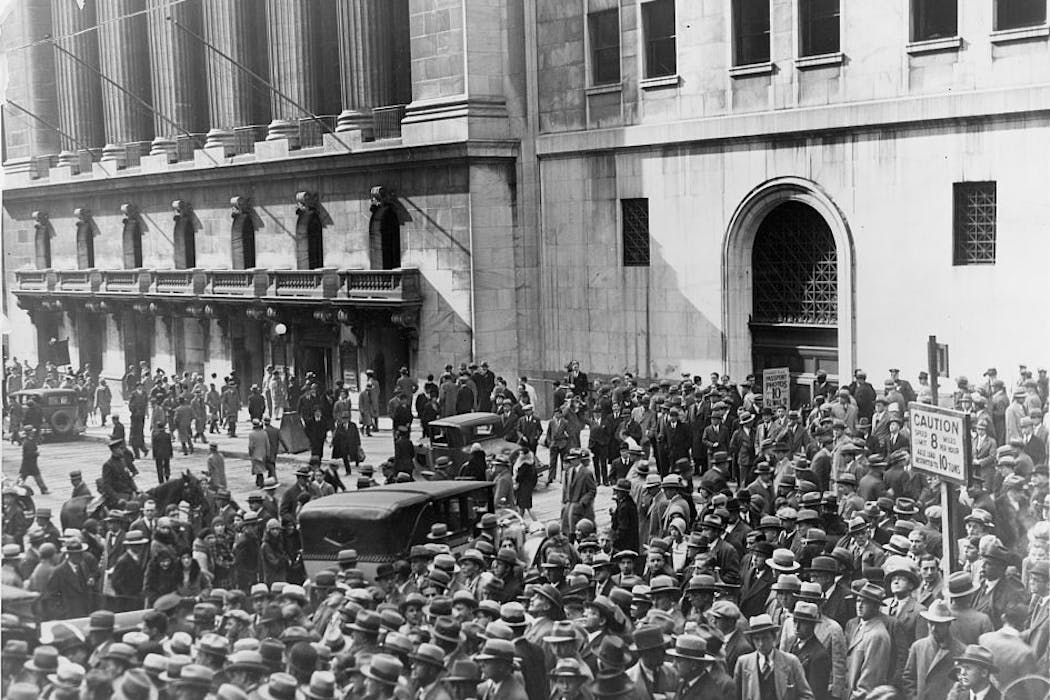
A crowd gathers outside the New York Stock Exchange following the ‘Great Crash’ of October 1929. New York World-Telegram and the Sun Newspaper Photograph Collection, US Library of Congress

The electrification boom of the 1920s set the United States up for a century of industrial dominance and powered a global economic revolution.

But before electricity faded from a red-hot tech sector into invisible infrastructure, the world went through profound social change, a speculative bubble, a stock market crash, mass unemployment and a decade of global turmoil.

Understanding this history matters now. Artificial intelligence (AI) is a similar general purpose technology and looks set to reshape every aspect of the economy. But it’s already showing some of the hallmarks of electricity’s rise, peak and bust in the decade known as the Roaring Twenties.

The reckoning that followed could be about to repeat.

First came the electricity boom

A century ago, when people at the New York Stock Exchange talked about the latest “high tech” investments, they were talking about electricity.

Investors poured money into suppliers such as Electric Bond & Share and Commonwealth Edison, as well as companies using electricity in new ways, such as General Electric (for appliances), AT&T (telecommunications) and RCA (radio).

It wasn’t a hard sell. Electricity brought modern movies, new magazines from faster printing presses, and evenings by the radio.

It was also an obvious economic game changer, promising automation, higher productivity, and a future full of leisure and consumption. In 1920, even Soviet revolutionary leader Vladimir Lenin declared: “Communism is Soviet power plus the electrification of the whole country.”

Today, a similar global urgency grips both communist and capitalist countries about AI, not least because of military applications.

A cover story of the New York Times Magazine in October 1927.
The New York Times

Then came the peak

Like AI stocks now, electricity stocks “became favorites in the boom even though their fundamentals were difficult to assess”.

Market power was concentrated. Big players used complex holding structures to dodge rules and sell shares in basically the same companies to the public under different names.

US finance professor Harold Bierman, who argued that attempts to regulate overpriced utility stocks were a direct trigger for the crash, estimated that utilities made up 18% of the New York Stock Exchange in September 1929. Within electricity supply, 80% of the market was owned by just a handful of holding firms.

But that’s just the utilities. As today with AI, there was a much larger ecosystem.

Almost every 1920s “megacap” (the largest companies at the time) owed something to electrification. General Motors, for example, had overtaken Ford using new electric production techniques.

Essentially, electricity became the backdrop to the market in the same way AI is doing, as businesses work to become “AI-enabled”.

No wonder that today tech giants command over a third of the S&P 500 index and nearly three-quarters of the NASDAQ. Transformative technology drives not only economic growth, but also extreme market concentration.

In 1929, to reflect the new sector’s importance, Dow Jones launched the last of its three great stock averages: the electricity-heavy Dow Jones Utilities Average.

But then came the bust

The Dow Jones Utilities Average went as high as 144 in 1929. But by 1934, it had collapsed to just 17.

No single cause explains the New York Stock Exchange’s unprecedented “Great Crash”, which began on October 24 1929 and preceded the worldwide Great Depression.

That crash triggered a banking crisis, credit collapse, business failures, and a drastic fall in production. Unemployment soared from just 3% to 25% of US workers by 1933 and stayed in double figures until the US entered the second world war in 1941.

Lithograph of Wall Street, New York City, with panicked crowd, lightning, people jumping out of buildings, buildings falling, at time of stock market crash in 1929.

Lithograph of Wall Street, New York City, after the 1929 stock market crash. Jame Rosenberg, Ben and Beatrice Goldstein Foundation collection, US Library of Congress

The ripple effects were global, with most countries seeing a rise in unemployment, especially in countries reliant on international trade, such as Chile, Australia and Canada, as well as Germany.

The promised age of shorter hours and electric leisure turned into soup kitchens and bread lines.

The collapse exposed fraud and excess. Electricity entrepreneur Samuel Insull, once Thomas Edison’s protégé and builder of Chicago’s Commonwealth Edison, was at one point worth US$150 million – an even more staggering amount at the time.

But after Insull’s empire went bankrupt in 1932, he was indicted for embezzlement and larceny. He fled overseas, was brought back, and eventually acquitted – but 600,000 shareholders and 500,000 bondholders lost everything.

However, to some Insull seemed less a criminal mastermind than a scapegoat for a system whose flaws ran far deeper.

Reforms unthinkable during the boom years followed.

The Public Utility Holding Company Act of 1935 broke up the huge holding company structures and imposed regional separation. Once exciting electricity darlings became boring regulated infrastructure: a fact reflected in the humble “Electric Company” square on the original 1935 Monopoly board.

Lessons from the 1920s for today

AI is rolling out faster than even those seeking to use it for business or government policy can sometimes manage properly.

Like electricity a century ago, a few interconnected firms are building today’s AI infrastructure.

And like a century ago, investors are piling in – though many don’t know the extent of their exposure through their superannuation funds or exchange traded funds (ETFs).

Just as in the late 1920s, today’s regulation of AI is still loose in many parts of the world – though the European Union is taking a tougher approach with its world-first AI law.

US President Donald Trump has taken the opposite approach, actively cutting “onerous regulation” of AI. Some US states have responded by taking action themselves. The courts, when consulted, are hamstrung by laws and definitions written for a different era.

Can we transition to AI being invisible infrastructure like electricity without a another bust, only then followed by reform?

If the parallels to the electrification boom remain unnoticed, the chances are slim.

The Conversation

Cameron Shackell works primarily as a Sessional Academic at the QUT School of Information Systems. He also works one day a week as CEO of Equate IT Consulting, a firm using AI to analyse brands and trademarks.

ref. Today’s AI hype has echoes of a devastating technology boom and bust 100 years ago – https://theconversation.com/todays-ai-hype-has-echoes-of-a-devastating-technology-boom-and-bust-100-years-ago-265492

These 4 aeroplane failures are more common than you think – and not as scary as they sound

Source: The Conversation – Global Perspectives – By Guido Carim Junior, Senior Lecturer in Aviation, Griffith University

redcharlie/Unsplash

“It is the closest all of us passengers ever want to come to a plane crash,”
a Qantas flight QF1889’s passenger said after the plane suddenly descended about 20,000 feet on Monday September 22, and diverted back to Darwin.

The Embraer 190’s crew received a pressurisation warning, followed the procedures, and landed normally – but in the cabin, that rapid drop felt anything but normal.

The truth is, in-flight technical problems such as this one are part of flying. Pilots train extensively for them. Checklists contain detailed instructions on how to deal with each issue. Aircraft are built with layers of redundancy, and warning systems alert pilots to problems. It is because of these safety systems that the vast majority of flights that experience technical issues end with a safe arrival rather than tragic headlines.

Here are four scary-sounding failures you might hear about (or even experience) and how they are actually dealt with in the air.

1. Air-conditioning and pressurisation hiccups

What it is

At cruising altitudes (normally around 36,000 feet), aeroplane cabins are kept at a comfortable “cabin altitude” of 8,000 feet using air from the engines that is cooled through the air conditioner.

This artificial air pressure allows us to survive while the atmosphere outside the plane is highly hostile to human life, with temperatures around -55°C and no breathable air. However, if the system misbehaves or the cabin altitude starts to rise for whatever reason, crews treat it as a potential pressurisation problem and initiate the preventive procedures immediately.

What you might feel/see

A quick, controlled descent (it can feel dramatic), ears popping, and sometimes oxygen masks – these typically drop automatically only if the cabin altitude exceeds roughly 14,000 feet. Similar to QF1889, a rapid descent without masks being deployed is the most common outcome.

What pilots do

As soon as they notice a problem with the cabin pressurisation, the pilots put on their own oxygen masks, declare an emergency, and follow the emergency descent checklist, bringing the aircraft as quickly as possible to about 10,000 feet. This is usually followed by a diversion or return to the departure airport.

2. Most feared: engine failures

What it is

Twin-engine airliners are certified to fly safely on one engine. Yet, one-engine failures are treated seriously and thoroughly rehearsed in flight simulators at least annually.

Dual failures, however, are exceptionally rare. The 2009 “Miracle on the Hudson”, for example, was a once-in-a-generation bird strike event that led to both engines stopping. The plane safely landed on the Hudson River in New York with no casualties.

US Airways Flight 1549 after crashing into the Hudson River, January 15 2009.
Wikimedia Commons, CC BY

What you might feel/see

A loud bang, vibration, sparks coming out of the engine, smell of burning or a sudden quietening. This may result in a turn-back and an emergency services welcome. Recent headlines on engine failures – from a 737 in Sydney to a multiple bird-strike-related return in the United States ended with safe landings.

What pilots do

After being alerted by the warning system, pilots identify the affected engine and follow the checklist. The checklist typically requires them to shut down the problematic engine, descent to an appropriate altitude and divert if in cruise, or return to the departure airport if after takeoff.

Even when an engine failure damages other systems, crews are trained to manage cascades of warnings – as Qantas A380 flight QF32’s crew did in 2010, returning safely to Singapore.

3. Hydraulic trouble and flight controls

What it is

The many aeroplane flight controls move because of multiple hydraulic or electric systems. If one system misbehaves – for example the left wing aileron, which is used to turn the aircraft, won’t move – redundancy keeps the aeroplane flyable because the right wing aileron will still work.

Crews use specific checklists and adjust speeds, distances and landing configurations to ensure a safe return to the ground.

Ailerons are the hinged parts you can see at the end of the aeroplane wing.
Stephan Hinni/Unsplash

What you might feel/see

A longer hold while the crew troubleshoots, a return to the departure airport or a faster-than-normal landing. In July, a regional Qantas flight to Melbourne made an emergency landing at Mildura after a hydraulics issue.

What pilots do

After the warning system’s detection, pilots run through a checklist, decide on the landing configuration, request the longest suitable runway and emergency services just in case.

All these resources are available because lessons learned from extreme events – such as United 232’s 1989 loss of all hydraulic systems – were brought into the design of modern aeroplanes and training programs.

4. Landing gear and brake system drama

What it is

Airliners have retractable landing gears that remain inside a compartment for most of the flight. Those are the wheels that come out of the aeroplane belly before landing. Assembled in the wheels are the brakes. They aim to reduce the aircraft speed after touchdown, like in a car.

With so many moving parts, sometimes the landing gear doesn’t extend or retract properly, or the braking system loses some effectiveness, such as the loss of a hydraulic system.

What you might feel/see

A precautionary return, cabin preparation for potential forced landing, or “brace for impact” instruction from the cabin crew right before landing can happen.

While scary, these are preventive measures if something doesn’t go as planned. Earlier this year, a Qantas flight returned to Brisbane after experiencing a problem with its landing gear; passengers were told to keep “heads down” while the aircraft landed safely.

What pilots do

They’ll use long checklists and eventually contact maintenance engineers to troubleshoot the problem. There are also redundancies available to lower the landing gear and to deploy the brakes.

In extreme cases, they may be required to land at the longest runway available (in case of brake problems) or land on the belly (if the landing gear can’t be lowered).

The big picture

Most in-flight failures trigger a chain of defences aimed at keeping the flight safe. Checklists, extensive training and decades of expertise are backed by multiple redundancies and robust design. And these flights typically end like QF1889 did: safely on the ground, with passengers a little shaken.

A dramatic descent or an urgent landing doesn’t mean disaster. It usually means the safety system (aircraft + crew + checklist + training + redundancy) is doing exactly what it’s supposed to do.

The Conversation

Guido Carim Junior does not work for, consult, own shares in or receive funding from any company or organisation that would benefit from this article, and has disclosed no relevant affiliations beyond their academic appointment.

ref. These 4 aeroplane failures are more common than you think – and not as scary as they sound – https://theconversation.com/these-4-aeroplane-failures-are-more-common-than-you-think-and-not-as-scary-as-they-sound-265866

People trust podcasts more than social media. But is the trust warranted?

Source: The Conversation – Global Perspectives – By Jason Weismueller, Lecturer, UWA Business School, The University of Western Australia

Medy Siregar/Unsplash

There’s been a striking decline in public confidence in social media platforms, according to the 2025 Ethics Index published by the Governance Institute of Australia. One in four Australians now rate social media as “very unethical”.

This is consistent with other reports on Australian attitudes towards social media. For example, the Digital News Report 2025 similarly identified widespread concern about misinformation and distrust in news shared on social media.

And such distrust isn’t limited to Australia. The sentiment is evident worldwide. The 2025 Edelman Trust Barometer, based on an annual global survey of more than 30,000 people across 28 countries, reports a decline in trust in social media companies.

So where does this negativity come from? And are other ways of consuming information online, such as podcasts, any better? Podcasts are booming in Australia and around the world, and are often perceived much more positively than social media.

Let’s look at what the evidence says about the impacts of social media, what it does and doesn’t yet tell us about podcasts, and what this reveals about the need for accountability across digital platforms.

Where does this distrust stem from?

While social media has enabled connection, creativity and civic participation, research also highlights its downsides.

Studies have shown that, on certain social media platforms, false and sensational information can often spread faster than truth. Such information can also fuel negativity and political polarisation.

Beyond civic harms, heavy social media use has also been linked to mental health challenges. The causes are difficult to establish, but studies report associations between social media use and higher levels of depression, anxiety and psychological distress, particularly among adolescents and young adults.

In 2021, Frances Haugen, a former Facebook product manager, made public thousands of internal documents that revealed Instagram’s negative impact on teen mental health. The revelations triggered global scrutiny and intensified debate about social media accountability.

Whistleblowers such as Haugen suggest social media companies are aware of potential harms, but don’t always act.


Read more:
Facebook data reveal the devastating real-world harms caused by the spread of misinformation


Podcasts have a much better reputation

In contrast to social media, podcasts appear to enjoy a very different reputation. Not only do Australians view them far more positively, but podcast consumption has significantly increased over the years.

More than half of Australians over the age of ten engage with audio or video podcasts on a monthly basis. It’s not surprising that the 2025 Australian election saw political leaders feature on podcasts as part of their campaign strategy.

YouTube, traditionally a video sharing platform, has a large section dedicated to podcasts on its home page.
YouTube

Why are podcasts so popular and trusted? Several features may help explain this.

Consumption is often more deliberate. Listeners choose specific shows and episodes instead of scrolling through endless feeds. Podcasts typically provide longer and more nuanced discussions compared with the short snippets served by social media algorithms.

Given these features, research suggests podcasts foster a sense of intimacy and authenticity. Listeners develop ongoing “relationships” with hosts and view them as credible, authentic and trustworthy.

Yet this trust can be misplaced. A Brookings Institution study analysing more than 36,000 political podcast episodes found nearly 70% contained at least one unverified or false claim. Research also shows political podcasts often rely on toxic or hostile language.

This shows that podcasts, while often perceived as more “ethical” than social media, are not automatically safer or more trustworthy spaces.

Rethinking trust in a complex media environment

What’s clear is that we shouldn’t blindly trust or dismiss any online platform, whether it’s a social media feed or a podcast. We must think critically about all the information we encounter.

We all need better tools to navigate a complex media environment. Digital literacy efforts must expand beyond social media to help people assess any information, from a TikTok clip to a long-form podcast episode.


Read more:
Critical thinking is more important than ever. How can I improve my skills?


To regain public trust, social media platforms will have to behave more ethically. They should be transparent about advertising, sponsorships and moderation policies, and should make clear how content is recommended.

This expectation should also apply to podcasts, streaming services and other digital media, which can all be misused by people who want to mislead or harm others.

Governments can reinforce accountability through fair oversight, but rules will only work if they are paired with platforms acting responsibly.

Earlier this year, the Australian government released a report that argued social media platforms have a “duty of care” towards their users. They should proactively limit the spread of harmful content, for example.

A healthier information environment depends on sceptical but engaged citizens, stronger ethical standards across platforms, and systems of accountability that reward transparency and reliability.

The lesson is straightforward: trust or distrust alone doesn’t change whether the information you receive is actually truthful – particularly in an online environment where anyone can say anything. It’s best to keep that in mind.

The Conversation

Jason Weismueller does not work for, consult, own shares in or receive funding from any company or organisation that would benefit from this article, and has disclosed no relevant affiliations beyond their academic appointment.

ref. People trust podcasts more than social media. But is the trust warranted? – https://theconversation.com/people-trust-podcasts-more-than-social-media-but-is-the-trust-warranted-266791

Federal shutdown deals blow to already hobbled cybersecurity agency

Source: The Conversation – USA – By Richard Forno, Teaching Professor of Computer Science and Electrical Engineering, and Associate Director, UMBC Cybersecurity Institute, University of Maryland, Baltimore County

The federal cybersecurity agency is crippled by layoffs and shutdown furloughs. The Conversation, CC BY-ND

As the United States experiences its latest government shutdown, most of the daily operations of the federal government have ground to a halt. This includes much of the day-to-day work done by federal information technology and cybersecurity employees, including those at the nation’s leading civilian cybersecurity agency, the Cybersecurity and Infrastructure Security Agency.

CISA is among the entities that will see the deepest staffing reductions during the shutdown that began Oct. 1, 2025, according to Department of Homeland Security documentation. Only about one-third of its employees remain on the job after federal employees were furloughed. As if cybersecurity wasn’t challenging enough, fewer CISA employees are being asked to do more and more work protecting American cyberspace during the shutdown. And they’ll be working with the promise of getting paid for their efforts at some date in the future once the shutdown ends.

The current CISA situation is grim, from my vantage point as a cybersecurity researcher and former industry practitioner. The agency was already experiencing deep cuts to its staff and resources before the shutdown. And now, coinciding with the shutdown, a key law that enabled the agency to facilitate information-sharing with the private sector has expired.

Taken together, the cyberdefense agency is being hobbled at a time when the need for its services has never been greater, from the ongoing China-led Salt Typhoon attack on U.S. telecommunications networks to ransomware, data breaches and threats to infrastructure.

CISA was created in 2007 within the Department of Homeland Security. As its name implies, the agency is charged with digital security matters across the federal government. The agency also works with the companies that operate and secure the numerous critical infrastructure sectors of the American economy, such as phone networks, the electric grid and energy pipelines. Additionally, it helps state and local governments across the country secure their vulnerable networks and data.

CISA also publishes threat and vulnerability alerts for the government and cybersecurity community and engages with public and private stakeholders on best practices in response to emerging vulnerabilities. Prior to the recent expiration of the 2015 Cybersecurity Information Sharing Act, the agency also made it easier for organizations to share useful information with the government to help cybersecurity teams better protect their systems.

Shutdown-mandated furloughs at the nation’s cybersecurity agency present an opportunity for malicious hackers.

Political football

The agency takes a nonpartisan approach to cybersecurity matters. However, some politicians have accused the agency of political bias for its work helping states protect their voting infrastructure from cyberattacks and external influence. Specifically, the agency was repeatedly maligned for calling the 2020 election the “most secure” in history. For some in elected office, this work on election security has tarnished CISA’s reputation and perhaps explains recent budgetary actions taken against the agency.

Since the Trump administration took office in January 2025, nearly 1,000 CISA employees have departed the agency through voluntary buyouts or deferred resignations. By the end of May 2025, nearly all of CISA’s senior leadership had resigned or had announced plans to do so.

For 2026, the president’s draft budget proposes to reduce CISA’s head count by nearly one-third, dramatically cutting staff from its risk management and stakeholder engagement divisions. Other cuts will significantly reduce the agency’s collaboration activities and funding for CISA’s various cybersecurity education and training programs.

Making the problem worse, the government shutdown began at the same time that Congress failed to renew the Cybersecurity Information Sharing Act. This law provided a legal shield that allowed companies and infrastructure operators to share timely and often sensitive information with CISA about the cyberattacks, vulnerabilities and incidents that they were encountering.

In the wake of the law’s expiration, prudent companies may consider restricting what information they share with the government. Without the indemnification provided by CISA, many companies will likely have their legal teams review any information to be shared with the government. And that takes time.

Unfortunately, adversaries do not reduce their attacks against the U.S. based on available federal cyber defense funding or the status of cybersecurity laws. In fact, malicious hackers often strike when their target’s guard is down.

Charting a better course

Early in my career I had to work through a prolonged government shutdown. I’ve also participated in and developed assorted public-private information-sharing environments to exchange intelligence and analysis on cyber- and national security matters. And having been in the D.C. area for over 30 years, I’ve seen how government works. So I have a good idea of what’s needed to improve American cybersecurity. The following suggestions are a starting point.

First, Congress could ensure that critical security agencies such as CISA are immune from the threat of recurring federal government shutdowns. If it desired, Congress could set budgets for America’s security agencies on a biennial basis – as 16 states already do for their entire budgets.

In terms of cybersecurity funding, the White House’s proposed 2026 budget reduces research and education on cybersecurity. For example, the nation’s premiere federal cybersecurity scholarship program to recruit, educate and place future federal cybersecurity workers would be reduced by over 60%. Protecting this funding would allow CISA and the federal government to maintain the pipeline for a robust and capable cybersecurity workforce both today and into the future.

Companies could develop new or expand existing nongovernmental information-sharing networks that are not completely dependent on the government to facilitate or fund, such as the Cyber Threat Alliance or the Center for Internet Security. Cybersecurity relies on trust. But right now, the instability of the federal government makes it difficult to rely on any entity under its policy or funding influence, no matter how well time-tested and trusted. Regardless, without legal protections, the information-sharing utility of these services will be limited.

Cybersecurity risks remain even if the federal government shuts down. So this is another reminder that each of us is responsible for our own cybersecurity. Individual users should continue to remain vigilant, follow accepted best practices for cybersecurity and always be mindful about online risks.

It’s ironic that the federal government is shutting down, CISA is being eviscerated and the Cybersecurity Information Sharing Act has expired just as the country begins to observe national Cybersecurity Awareness Month – another collaborative public engagement activity that CISA promotes to help improve cybersecurity for all Americans.

The Conversation

Richard Forno has received funding related to cybersecurity research and education from the National Science Foundation (NSF), the Department of Defense (DOD), the US Army, State of Maryland, and private companies during his academic career since 2010. From 2012-2025 he co-directed UMBC’s Scholarship For Service program.

ref. Federal shutdown deals blow to already hobbled cybersecurity agency – https://theconversation.com/federal-shutdown-deals-blow-to-already-hobbled-cybersecurity-agency-266862

AI tools promise efficiency at work, but they can erode trust, creativity and agency

Source: The Conversation – Canada – By Jordan Loewen-Colón, Adjunct Assistant Professor, Smith School of Business, Queen’s University, Ontario

What if your biggest competitive asset is not how fast AI helps you work, but how well you question what it produces?

Business leaders tend to prioritize efficiency and compliance in the workplace. It’s one of the reasons why so many are drawn toward incorporating generative AI technologies into their workflows. A recent survey found 63 per cent of global IT leaders worry their companies will be left behind without AI adoption.

But in the rush to adopt AI, some organizations are overlooking the real impact it can have on workers and company culture.

Most organizational strategies focus on AI’s short-term efficiencies, such as automation, speed and cost saving. What tends to be overlooked are the impacts AI has on cognition, agency and cultural norms. AI is fundamentally restructuring not only what we know, but how we know it.

As AI becomes more integrated, it will continue to influence organizational tone, pace, communication style and decision-making norms. This is why leaders must set deliberate boundaries and consciously shape organizational culture in relation to AI integration.

Once embedded into workflows, AI influences workplace defaults: which sources appear first, what tone a memo takes and where managers set the bar for “good enough.” If people don’t set these defaults, tools like AI will instead.

As researchers who study AI, psychology, human-computer interaction and ethics, we are deeply concerned with the hidden effects and consequences of AI use.

Psychological effects of AI at work

Researchers are beginning to document a number of psychological effects associated with AI use in the workplace. These impacts expose current gaps in epistemic awareness — how we know what we know — and how those gaps can weaken emotional boundaries.

Such shifts can affect how people make decisions, calibrate trust and maintain psychological safety in AI-mediated environments.

One of the most prominent effects is known as “automation bias.” Once AI is integrated into a company’s workflow, its outputs are often internalized as authoritative sources of truth.

Because AI-generated outputs appear fluent and objective, they can be accepted uncritically, creating an inflated sense of confidence and a dangerous illusion of competence.

One recent study found that in 40 per cent of tasks, knowledge workers — those who turn information into decisions or deliverables, like writers, analysts and designers — accepted AI outputs uncritically with zero scrutiny.


Read more:
AI is reshaping the workplace – but what does it mean for the health and well-being of workers?


The erosion of self-trust

A second concern is the erosion of self-trust. Continuous engagement with AI-generated content leads workers to second-guess their instincts and over-rely on AI guidance, often without realizing it. Over time, work shifts from generating ideas to merely approving AI-generated ones. This results in the diminishing of personal judgment, creativity and original authorship.

One study found that users have a tendency to follow AI advice even when it contradicts their own judgment, resulting in a decline in confidence and autonomous decision-making. Other research shows that when AI systems provide affirming feedback — even for incorrect answers — users become more confident in their decisions, which can distort their judgment.

Workers can end up deferring to AI as an authority despite its lack of lived experience, moral reasoning or contextual understanding. Productivity may appear higher in the short term, but the quality of decisions, self-trust and ethical oversight may ultimately suffer.

Emerging evidence also points to neurological effects of over-reliance on AI use. One recent emerging study tracked professionals’ brain activity over four months and found that ChatGPT users exhibited 55 per cent less neural connectivity compared to those working unassisted. They struggled to remember the essays they just co-authored moments later, as well reduced creative engagement.

So what can leaders and managers do about it?

What leaders and managers can do

Resilience has become something of a corporate buzzword, but genuine resilience can help organizations adapt to AI.

Resilient organizations teach employees to effectively collaborate with AI without over-relying on its outputs. This requires systematic training in interpretive and critical skills to build balanced and ethical human-AI collaboration.

Organizations that value critique over passive acceptance will become better at thinking critically, adapting knowledge effectively and will build stronger ethical capacity. One way of achieving this is by shifting from a growth-oriented mindset to an adaptive one. Which, practically speaking, means workplaces should seek to do the following:

  1. Train people to separate fluency from accuracy and to ask where information comes from rather than just being passive consumers of it. With better epistemic awareness, workers become active interpreters understanding what an AI tool is saying, as well as how and why it’s saying it.

  2. Teach people to monitor their thinking processes and question knowledge sources. A recent study showed professionals with strong metacognitive practices, like planning, self-monitoring and prompt revision, achieved significantly higher creativity when using AI tools, while others saw no benefit. That means metacognition could be the “missing link” for productive LLM use.

  3. Avoid a one-size-fits-all approach and consider levels of automation by task stages. AI tool developers should be encouraged to define clear roles for when the model drafts or analyzes, when the human leads and when verification is mandatory. Consider adding things like AI-use to responsibility and accountability charts.

  4. Create workplace cultures that encourage workers to question AI outputs, track those challenges as quality signals and budget time for verification. Workplaces should publish style norms for AI-assisted writing, set confidence thresholds and evidence requirements by function, and specify who signs off at each risk level.

  5. Hold quarterly “drift reviews” to spot shifts in tone, reliance or bias, before they calcify into organizational culture.

Efficiency will not decide the winners

As we are starting to see, the drive for efficiency will not decide which firms are most successful; the ability to interpret and critically assess AI outputs will.

The companies that pair speed with skepticism and protect judgment as a first-class asset will handle volatility better than those that treat AI as an autopilot. Speed may get you to the next decision, but judgment keeps you in business.

Ethical intelligence in organizations requires an ongoing investment in epistemic awareness, interpretive skill, psychological safety and active value-driven design.

Companies capable of balancing technological innovation with critical thinking and deep ethical understanding will be the ones to thrive in the AI era.

The Conversation

The authors do not work for, consult, own shares in or receive funding from any company or organisation that would benefit from this article, and have disclosed no relevant affiliations beyond their academic appointment.

ref. AI tools promise efficiency at work, but they can erode trust, creativity and agency – https://theconversation.com/ai-tools-promise-efficiency-at-work-but-they-can-erode-trust-creativity-and-agency-264865

Can Labour’s plan to fund deprived communities see off Reform? What the evidence shows

Source: The Conversation – UK – By Abigail Taylor, Research Fellow, City-Region Economic Development Institute (City-REDI), University of Birmingham

Sonicpuss/Shutterstock

More than a year after the UK government abandoned the phrase “levelling up”, it has now launched a fresh strategy to distribute funding to disadvantaged communities. The promise to these deprived areas is three-pronged: investment in community facilities, enhancing public spaces like parks, and revitalising town centres and high streets.

The “Pride in Place” programme will provide up to £5 billion over ten years to support around 250 communities. A further £150 million will be shared between around 95 places across England, Scotland and Wales through an associated impact fund.

The funding is aimed at building stronger, more empowered communities and enhancing physical infrastructure. It also forms part of the Labour government’s efforts to tackle the electoral threat posed by Reform UK in some of the country’s left-behind areas.

The programme is not a wholly new announcement. In its spending review earlier this year, the government announced that 25 trailblazer neighbourhoods would each receive up to £20 million over the next decade. This funding has now been rolled into the Pride in Place programme. For the additional 144 areas named recently, this will be new funding.

The programme is putting more decision-making power in local hands – and this is certainly a good thing. It includes proposals for facilities for young people, backed by a £66 million fund called #iwill as well as a £175 million Community Wealth Fund.

Another welcome aspect are plans to help communities share learning and best practice, and to empower them to drive change locally. For now though, there is little detail on how this will work.

What’s different about this fund is that it involves allocative rather than competitive funding. This means that there is no bidding or tender process. The plan to allocate funding directly to areas based on need is likely to be welcomed by councils that previously criticised competitive funding processes for being costly and time-consuming to apply for.


Read more:
The ‘levelling up’ bidding process wastes time and money – here’s how to improve it


Funding is allocated based on a ranking of neighbourhoods using indices that measure deprivation and community needs. The needs of some areas may have changed since the deprivation index was compiled but compared to the Levelling Up Fund, which was criticised for a lack of clarity, this selection process appears to be clearer and more robust.

Challenges and constraints

But the fund is disappointing in its scale and scope. Specifically, it appears to be focused on smaller-scale cosmetic improvements rather than larger-scale transformational change.

Compared to the New Deal for Communities (NDC) programme, which ran from 1998 to 2011 across the UK, funding for Pride in Place is small. The 39 area partnerships involved in NDC received an average of £50 million – equivalent to nearly £78 million today. By contrast, the highest award from the Pride in Place programme is £20 million.

And the aims of the NDC programme were broader than those of Pride in Place. When NDC was evaluated, litter and anti-social behaviour ranked highly among the issues that people wanted to see addressed. But the funding also supported holistic change by addressing the root causes of challenges such as creating jobs, improving education and training, action against crime, improving the environment and housing and social services.

It was measured against three place outcomes (crime, community, and housing and the physical environment) and three people-related outcomes (education, health and worklessness).

police tape with three uniformed officers in the background
Previous funds have invested in efforts to tackle crime.
Mr Doomits/Shutterstock

Today, it seems very unlikely that the new programme will offer substantial funding to develop training, education and housing given the sums involved. What’s more, the focus is on revitalising community spaces and boosting local pride rather than tackling inequality in housing or education. All these elements are crucial in driving change in disadvantaged neighbourhoods.

Research has emphasised the importance of long-term holistic funding in addressing regional inequalities in other countries. And a recent study that reviewed UK community and economic development programmes emphasised how important it is to create conditions for communities to harness their “agency and resources”.

But it is difficult to predict the impact of this fund on current or future Reform UK voters. Heading off the challenge from Nigel Farage’s party to Labour’s vote is likely to depend on how deeply the impact is seen and felt by voters at a local level.

This in turn depends on the scale and approach of the programme – things like holistic efforts to tackle social issues and a long-term commitment to the communities involved. This, together with events (the budget this autumn, for example), are likely to shape views both in terms of physical improvements to the areas involved and voters’ perceptions of being heard in policy decisions.

Research has found that constituencies that previously received levelling-up funding saw a lower Reform vote in the 2024 general election. This suggests that visible improvements may indeed erode some of the support for Reform.

But many of the planned projects may not bear fruit until after the next general election. So if the programme is to have a significant impact, it will be important that projects have a tangible impact promptly. Reducing litter, for example, could be a quick win.

The twin approaches of youth engagement and citizen participation are positive aspects of the Pride in Place programme. The sum of funding for developing community facilities is large. But at its core, the plan falls short in addressing economic disadvantages such as skills, employment and housing. Developing a more coherent strategy around these issues is vital if the government really wants to help voters feel pride in their communities.

The Conversation

Abigail Taylor has received funding from the Chartered Instiute of Public Policy and Accountancy (CIPFA) for research exploring success factors in how international city regions have made progress in addressing regional inequalities and how these factors map to the UK. Abigail has also received funding from CIPFA, the Daiwa Anglo-Japanese Foundation, the Great Britain Sasakawa Foundation and the Japan Foundation Endowment Committee for research examining how regional growth can be enabled outside of national capitals. It draws on lessons from two second cities: Birmingham in England and Osaka in Japan, and focuses on four critical issues: institutional conditions for growth, regional group formation, funding mechanisms, and monitoring and evaluation. Abigail is also a Co-Investigator on the ESRC, AHRC and UKRI funded Local Policy Innovation (LPIP) Hub.

Alice is the theme led for ‘Inclusive and Sustainable Local Economic Performance’ on the Local Policy Innovation Partnership Hub, funded by the ESRC, AHRC and UKRI. Alice is also currently on a part-time secondment to the Centre for Local Economic Strategies a charity focusing on the promotion of community wealth building for local economies.

Jason Lowther does not work for, consult, own shares in or receive funding from any company or organisation that would benefit from this article, and has disclosed no relevant affiliations beyond their academic appointment.

ref. Can Labour’s plan to fund deprived communities see off Reform? What the evidence shows – https://theconversation.com/can-labours-plan-to-fund-deprived-communities-see-off-reform-what-the-evidence-shows-266304