Northern England’s rail upgrade could signal change in direction for public transport

Source: The Conversation – UK – By Marcus Mayers, Visiting Research Fellow, Manchester Metropolitan University

M Barratt/Shutterstock

The UK government says it has learned valuable lessons from the expense, delays and political embarrassment of HS2. And now it has laid out detailed plans for train passengers in northern England who have been so badly “let down” in the past.

Northern Powerhouse Rail will apparently bring new and upgraded routes from east to west of the region, linking Liverpool, Manchester, Bradford, Leeds, Sheffield and Hull. Major capacity and journey time improvements have been promised.

Away from the actual tracks though, the scheme could come to represent a welcome change in the direction of travel for public transport more generally.

Funding for example, will follow a new hybrid model – with central government retaining overall control but with local authorities also contributing through devolved transport budgets and regional investment plans.

Delivery of the project will also involve a large amount of collaboration between the London-based Department for Transport (DfT) and politicians in the north of England. This could signal a welcome political commitment to a nationally significant scheme being shaped through regional collaboration.

But it could also prove to be quite a test for a government department that is often criticised for being too centralised and overly complex. So is the DfT ready to implement a genuinely devolved transport system?

As it is, the department has a fairly broad range of responsibility. Apart from railways, it covers roads and local transport, maritime issues and security, and decarbonisation and technology.

Over the years, each of these areas within the department has developed close relationships with the industries they oversee. And while such collaboration can be beneficial, it also risks creating a revolving door between government and industry.

This can distract from the fundamental objective of delivering an efficient transport system, as decisions are made which benefit industries rather than the travelling public.

Moving forward

An alternative approach for the department would be to redefine transport outputs more clearly in terms of social or economic value. After all, if journeys do not create value, why are they being made?

The department could then be reorganised to focus on specific demands and needs rather than particular modes of transport. There could be a section focused on commuting and local travel for example, with another specialising in intercity travel, and another devoted to international passengers.

For instance, suppose there is a departmental goal to support 150,000 business meetings and 150,000 social interactions each day between Manchester and Birmingham. A broad mix of tactics to achieve this might include high-speed rail, intercity coaches, private car travel and digital connectivity through virtual meetings.

Some devolved regions are already experimenting with this kind of demand-based approach. Manchester’s “Bee network” initiative – the first mayoral authority to take buses back from commercial operators – is one example.

Railway track stretches ahead to horizon.
On the right tracks?
semen semyonitch/Shutterstock

What is certain is that the DfT must adapt if it is to serve the UK population effectively, especially as regional powers grow and digital technology continues to reshape how people connect.

As the transport pioneer Henry Ford observed: “If you always do what you’ve always done, you’ll always get what you’ve always got.”

New links

The challenge for the UK government, beyond a plan to improve rail travel in northern England, is to configure the DfT’s resources in a way that ensures both physical and digital transport are fit to support the people and economy of the UK.

Northern Powerhouse Rail therefore becomes a test not just of investment ambition, but of institutional and operational design. Had the DfT been organised more clearly around outcomes or needs (rather than modes of transport), a more integrated set of solutions might have emerged sooner, combining rail, road and digital connectivity as a single system.

Even so, the programme signals a long overdue and welcome shift in direction. By forcing new ways of working between Whitehall and the regions, it creates the conditions for a more integrated approach to transport over time.

If the department is willing to learn from this experiment in devolution, Northern Powerhouse Rail could mark not just a new railway for the north, but the beginning of a more adaptive and effective transport system across the whole of England.

The Conversation

Marcus Mayers receives is a transport advisor to the MP JJulia Buckley.

David Bamford does not work for, consult, own shares in or receive funding from any company or organisation that would benefit from this article, and has disclosed no relevant affiliations beyond their academic appointment.

ref. Northern England’s rail upgrade could signal change in direction for public transport – https://theconversation.com/northern-englands-rail-upgrade-could-signal-change-in-direction-for-public-transport-273516

Does adding ‘please’ and ‘thank you’ to your ChatGPT prompts really waste energy?

Source: The Conversation – Global Perspectives – By Richard Morris, Postdoctoral Fellow, Faculty of Agriculture and Life Sciences, Lincoln University, New Zealand

Serene Lee/Getty Images

Cut the words “please” and “thank you” from your next ChatGPT query and, if you believe some of the talk online, you might think you are helping save the planet.

The idea sounds plausible because AI systems process text incrementally: longer prompts require slightly more computation and therefore use more energy. OpenAI’s chief executive Sam Altman has acknowledged it all adds to operating costs at the scale of billions of prompts.

At the same time, it is a stretch to suggest that treating ChatGPT politely comes at significant environmental cost. The effect of a few extra words is negligible compared with the energy required to operate the underlying data centre infrastructure.

What is more important, perhaps, is the persistence of the idea. It suggests that many people already sense AI is not as immaterial as it appears. That instinct is worth taking seriously.

Artificial intelligence depends on large data centres built around high-density computing infrastructure. These facilities draw substantial electricity, require continuous cooling, and are embedded in wider systems of energy supply, water and land use.

As AI use expands, so does this underlying footprint. The environmental question, then, is not how individual prompts are phrased, but how frequently and intensively these systems are used.

Why every AI query carries an energy cost

One structural difference between AI and most familiar digital services helps explain why this matters.

When a document is opened or a stored video is streamed, the main energy cost has already been incurred. The system is largely retrieving existing data.

By contrast, each time an AI model is queried it must perform a fresh computation to generate a response. In technical terms, each prompt triggers a fresh “inference” – a full computational pass through the model – and that energy cost is incurred every time.

This is why AI behaves less like conventional software and more like infrastructure. Use translates directly into energy demand.

The scale of that demand is no longer marginal. Research published in the journal Science estimates that data centres already account for a significant share of global electricity consumption, with demand rising rapidly as AI workloads grow.

The International Energy Agency has warned that electricity demand from data centres could double by the end of the decade under current growth trajectories.

Electricity is only one part of the picture. Data centres also require large volumes of water for cooling, and their construction and operation involve land, materials and long-lived assets. These impacts are experienced locally, even when the services provided are global.

AI’s hidden environmental footprint

New Zealand offers a clear illustration. Its high share of renewable electricity makes it attractive to data centre operators, but this does not make new demand impact-free.

Large data centres can place significant pressure on local grids and claims of renewable supply do not always correspond to new generation being added. Electricity used to run servers is electricity not available for other uses, particularly in dry years when hydro generation is constrained.

Viewed through a systems lens, AI introduces a new metabolic load into regions already under strain from climate change, population growth and competing resource demands.

Energy, water, land and infrastructure are tightly coupled. Changes in one part of the system propagate through the rest.

This matters for climate adaptation and long-term planning. Much adaptation work focuses on land and infrastructure: managing flood risk, protecting water quality, maintaining reliable energy supply and designing resilient settlements.

Yet AI infrastructure is often planned and assessed separately, as if it were merely a digital service rather than a persistent physical presence with ongoing resource demands.

Why the myth matters

From a systems perspective, new pressures do not simply accumulate. They can drive reorganisation.

In some cases, that reorganisation produces more coherent and resilient arrangements; in others, it amplifies existing vulnerabilities. Which outcome prevails depends largely on whether the pressure is recognised early and incorporated into system design or allowed to build unchecked.

This is where discussion of AI’s environmental footprint needs to mature. Focusing on small behavioural tweaks, such as how prompts are phrased, distracts from the real structural issues.

The more consequential questions concern how AI infrastructure is integrated into energy planning, how its water use is managed, how its location interacts with land-use priorities, and how its demand competes with other social needs.

None of this implies that AI should be rejected. AI already delivers value across research, health, logistics and many other domains.

But, like any infrastructure, it carries costs as well as benefits. Treating AI as immaterial software obscures those costs. Treating it as part of the physical systems we already manage brings them into view.

The popularity of the “please” myth is therefore less a mistake than a signal. People sense AI has a footprint, even if the language to describe it is still emerging.

Taking that signal seriously opens the door to a more grounded conversation about how AI fits into landscapes, energy systems and societies already navigating the limits of adaptation.

The Conversation

Richard Morris is the co-founder of Kirini Ltd, a nature-based solutions consultancy. He receives funding from Lincoln University.

ref. Does adding ‘please’ and ‘thank you’ to your ChatGPT prompts really waste energy? – https://theconversation.com/does-adding-please-and-thank-you-to-your-chatgpt-prompts-really-waste-energy-272258

How adults can use Stranger Things to talk to young people about their mental health

Source: The Conversation – Global Perspectives – By Stephen Goldsmith, Tutor in Mental Health Nursing, Swinburne University of Technology

Netflix

Beyond its monsters and 1980s nostalgia, Stranger Things resonates because it tells stories of struggles familiar to young people: trauma that lingers, identity that wavers, and friendships that buffer against fear.

And by turning inner struggles into visible monsters, Stranger Things can provide a lens to discuss trauma, identity and resilience.

Here are some of Stranger Things’ insights into adolescent development and mental health – and how adults can use the show to talk to teenagers about their own mental health.

Facing our fears

In the series, the Upside Down is a dark mirror of the Hawkins township – a shadow world where threats feed on secrecy and avoidance. It works as a metaphor for “unseen” unprocessed experiences, shame and anxious avoidance.

Avoidance often reduces fear in the short term, but it can maintain post traumatic stress symptoms over time and interfere with recovery. Avoidance and thought suppression have been shown to increase severity of post traumatic stress disorder (PTSD) symptoms.

One of the most effective ways to reduce trauma symptoms is exposure to feared memories, sensations or situations in safe, planned ways. Exposure-based treatment, including trauma-focused cognitive behaviour therapy (TF-CBT) and prolonged exposure produce meaningful reductions in PTSD symptoms for adolescents and adults.

Stranger Things dramatises this principle: the young people at the heart of the show must face their fears to overcome their power.

Teens can experience what we might call “Upside Down moments”: times when they feel overwhelmed, ashamed or tempted to withdraw. Adults can validate their feelings and then gently pivot toward exposure. This could be small, supported steps to face what’s difficult (a conversation, a memory, a classroom presentation), rather than escape.

Facing shame

Vecna’s attacks dramatise shame and self-criticism. His voice echoes characters’ darkest self-judgments: Max hears accusations about Billy’s death; Eleven relives failures to protect friends.

Shame and self criticism are strongly linked with adolescent distress and risk behaviours. Skills like reappraisal (rethinking a situation) and self-compassion reduce shame-proneness and improve emotion regulation.

Two characters in an eerie red world.
The show externalises inner battles, making coping strategies visible.
Netflix

The show externalises these inner battles, making coping strategies visible.

You can help young people by reminding them the harsh voice in their head isn’t who they are. It’s just a thought, like a bully they can fight. Ask, “What would you say to a friend in your shoes?” or “What’s one small step to feel more in control?”

Turn shame into something they can face, not something they are.

Grounding yourself

Max’s use of Kate Bush’s Running Up That Hill to break Vecna’s trance is a vivid example of sensory grounding. Teens can replicate this coping tool with music, movement or other sensory anchors during distress.

Music-based activities can support emotion regulation and grounding techniques are practical ways to reduce flashbacks and anxiety.

Adults can help teenagers “ground” by asking them to notice and name things around them, by counting down from five. This might look like naming five things they can see, four things they can touch, three things they can hear, two things they can smell, and one thing they can taste.

You might also like to work with young people to create a “Vecna playlist” as a sensory anchor – sounds, textures or scents a young person can use when anxiety spikes.

Impinging on daily life

Will experiences flashbacks and panic long after he escapes the Upside Down. In the show, these are dramatised as him vomiting slugs, sensing the Mind Flayer, and freezing during school events.

Will’s trauma persists beyond his reaching physical safety, mirroring post-traumatic symptoms.

Max embodies complicated grief and survivor guilt after her brother’s death. Her withdrawn demeanour, risk taking and fight-or-flight responses echo patterns seen in adolescents grappling with bereavement and trauma, where avoidance and rumination can amplify distress.

Max in the school hallway.
Max, played by Sadie Sink, embodies complicated grief and survivor guilt after her brother’s death.
Netflix

After Billy’s death, Max pulls away from her friends and starts taking risks, like skating alone at night. Her fight-or-flight response surges when Vecna targets her, showing how grief can spiral into something more complicated.

When grief becomes tangled like this, people often cope by avoiding reminders of their loss or getting stuck in painful, repetitive thoughts. Both patterns can make the hurt even harder to bear.

Like Will and Max, some teens experience persistent flashbacks, panic, avoidance or guilt. If symptoms impair daily life, adults should consider professional support. Trauma-focused CBT and exposure based therapies are evidence-based treatments for adolescent PTSD.

Friendship as a buffer

At its heart, Stranger Things is a friendship story.

The party’s loyalty and shared rituals provide a scaffold against isolation and fear. Rituals of D&D campaigns, walkie-talkie check-ins and bike rides create a safety net.

When Eleven loses her powers, friends rally to protect her. When Max is cursed, they mobilise with music and shared problem-solving.

The characters in Stranger Things hug.
At its heart, Stranger Things is a story of friendship.
Netflix

Supportive peer relationships in early adolescence are linked with better mental and physical health. Peer support can improve coping, happiness and self-esteem and reduce loneliness and depressive symptoms among young adults.

Adults can point out how the characters in Stranger Things share burdens and protect one another.

Teachers and parents can help teens build belonging by supporting activities like clubs, group hobbies and gaming nights, alongside creating family rituals. Connection reduces perceived threat and buffers stress. In schools, interventions that strengthen positive interactions among students and staff can enhance belonging and wellbeing.

The Conversation

Stephen Goldsmith does not work for, consult, own shares in or receive funding from any company or organisation that would benefit from this article, and has disclosed no relevant affiliations beyond their academic appointment.

ref. How adults can use Stranger Things to talk to young people about their mental health – https://theconversation.com/how-adults-can-use-stranger-things-to-talk-to-young-people-about-their-mental-health-272809

Googoosh, the ‘Voice of Iran,’ has gone quiet – and that’s her point

Source: The Conversation – Global Perspectives – By Richard Nedjat-Haiem, Ph.D. Candidate in Comparative Literature, University of California, Santa Barbara

Googoosh performs at Scotiabank Arena on Jan. 17, 2025, in Toronto. Jeremy Chan Photography/Getty Images

Before Beyoncé, before Cher, before Madonna, there was Googoosh.

The 75-year-old Iranian megastar catapulted to stardom in Iran during the 1970s, only to be silenced by the Islamist regime that took power after the 1979 Islamic Revolution. In 2000, she was finally allowed to leave Iran to live in exile.

For Iranians – particularly those in the diaspora – Googoosh symbolizes an era of cosmopolitanism in late-Pahlavi Iran, the period from the mid-1950s until 1979 when Iran’s popular music, cinema, television and fashion embraced modernity and questioned social norms.

But as protests roil Iran and the nation’s clerical leaders find their grip on power slipping, the “Voice of Iran,” as Googoosh is known, hasn’t turned up the volume. Instead, she’s found herself putting her farewell tour on pause.

“Everyone is waiting for my last concert in LA,” Googoosh told reporters in December 2025, “but … I am not going to sing until my country is rescued.”

Googoosh’s refusal to sing is not a sign of hesitation but a conscious political gesture – one that draws its force from her singular position in Iran’s cultural history.

Over the past several years, I’ve studied Googoosh’s trajectory as a musical and cultural icon. For Iranians inside and outside the country, she’s been a canvas onto which they’ve projected nostalgia for pre-revolutionary Iran, memories of rupture and loss, and fantasies of resistance.

A star is born

Born Faegheh Atashin in 1950, Googoosh was raised in Tehran by Muslim Azeri parents who had fled Soviet Azerbaijan. Although civil authorities registered her under the Perso-Arabic name Faegheh, her stage name, “Googoosh” – actually a male Armenian name – endured.

She grew up onstage and onscreen. Her father, an acrobat, incorporated her into his act when she was just 3 years old; by the age of 4, she was the family’s primary breadwinner.

As she matured, Googoosh moved across music, cinema, fashion and dance, rising to prominence within a cultural landscape shaped by Western influences and aligned with the state’s modernizing ambitions. By the mid-1970s, she had become the most recognizable figure of Iran’s pre-revolutionary popular culture.

According to Iranian studies scholar Abbas Milani, Googoosh “embodied the frivolous joys, the reckless abandon, the exuberant era of social experimentation, the defiant desire to debunk tradition and its taboos, and the vigor and vitality of youth.”

Onscreen, she wore the newest styles and cuts. Young Iranians copied her hair and hemlines. She danced, posed and sang like a global star – alongside Persian, she recorded in English, French, Italian, Spanish, Arabic and Turkish – and, in the process, redefined what a female pop star could look like in Iran.

Exiled from the stage

Yet to some Islamist critics of the Pahlavi order, she symbolized “gharbzadegi,” also known as “Westoxication” – the belief that by embracing the West, Iranians were betraying the traditions of their people and bringing about moral decay.

In the year preceding the 1979 Islamic Revolution, Googoosh had a residency at a Los Angeles club. Yet while many artists fled Iran in the wake of the revolution to rebuild their careers, Googoosh returned, only to be swiftly punished for her past.

Authorities charged her in 1979 with “moral corruption.” A couple of years later, the new regime briefly incarcerated her, confiscated her passport and prohibited her from publicly performing.

Just like that, a central figure in the nation’s cultural life was removed from the spotlight. It would be 21 years before she would perform again.

Googoosh wasn’t alone; musicians and performers across the country encountered the same fate: Ayatollah Ruhollah Khomeini, Iran’s supreme leader from 1979 to 1989, saw music as a vice. The regime also categorically prohibited women from performing solo in public.

Googoosh performs ‘Hejrat,’ one of her last big hits before the fall of the shah.

In December 2025, she published her memoir, “Googoosh: A Sinful Voice.” In it, she opens up about this period of her life – and her decision to return to Iran.

Even though she was at the height of her fame in the late-1970s, she alleges that her managers had misappropriated her earnings. As revolutionary unrest intensified and the Pahlavi regime imposed martial law and closed cabarets and theaters in an attempt to appease conservatives, her sources of income vanished. This prompted the move to Los Angeles. But mounting debt and substance abuse issues influenced her decision to return home.

She writes that revolutionary hostility wasn’t simply directed at popular culture; it went after pleasure itself, particularly when embraced, celebrated or expressed by women. To the Islamic Republic, music was not a form of art or a vocation; it was a provocation and a moral abomination.

Googoosh, who’d been a practicing Shiite Muslim who prayed, fasted and went on pilgrimage, describes the shock she felt that so much cruelty could coexist with claims of religious piety following the Islamic Revolution. Personal faith and public, secular performances had not been seen as contradictions in pre-revolutionary Iran.

That all changed in 1979.

Iranian culture in exile

The revolution catalyzed a mass cultural exodus: Millions of Iranians fled the country, with many settling in California, where other popular singers such as Hayedeh, Mahasti and Homeyra rebuilt their careers in exile.

A magazine cover featuring three young women wearing colorful, Western clothing and sipping drinks from straws.
An issue of Zan-e Rooz magazine, which translates to ‘Women of Today,’ features, from left, Googoosh, Mahasti and Ramesh, three of Iran’s biggest pop stars in the 1970s.
ramesh._music/Instagram

A proxy Iranian entertainment industry emerged in Los Angeles, allowing Iranian popular culture to live on outside the Islamic Republic. In what came to be called “Tehrangeles,” studios recorded Persian-language music and television, while entrepreneurs opened cabaret-style performance venues.

The entertainment infrastructure built in Tehrangeles later expanded to Europe, Canada and the Persian Gulf; much of the programming was saturated with motifs of memory, longing and nostalgia.

Meanwhile, Googoosh’s two decades off the stage had only amplified her mystique. When she finally received permission to leave Iran in 2000, she performed her first concert at Toronto’s Air Canada Centre before a sold-out crowd.

Since then, she’s recorded nine albums. Yet most of her fans have shown limited interest in these newer offerings. When she sings them, chants of “Ghadimi! Ghadimi!” (“Old! Old!”) often rise from the crowd.

Like many in the diaspora, they turn to Googoosh not to engage the present but to transport themselves to an earlier era – effectively freezing her, and their memories of Iran, in the past.

Silence reclaimed

Once silenced by the Islamic Republic, Googoosh now voluntarily withholds her voice in solidarity.

I see this refusal as a reclamation of her agency; with Iran again roiled by mass mobilization and protest, her silence resonates as loudly as her songs once did.

If Googoosh has long functioned as a vessel for collective memory, she now stands as a reminder that memory alone is not enough – that nostalgia cannot stand in for a political reckoning, and that voices shaped by exile remain tethered to unfinished struggles at home.

Googoosh performs her track “Pishkesh” in the mid-1970s.

The Conversation

Richard Nedjat-Haiem does not work for, consult, own shares in or receive funding from any company or organization that would benefit from this article, and has disclosed no relevant affiliations beyond their academic appointment.

ref. Googoosh, the ‘Voice of Iran,’ has gone quiet – and that’s her point – https://theconversation.com/googoosh-the-voice-of-iran-has-gone-quiet-and-thats-her-point-273447

The Insurrection Act is one of at least 26 legal loopholes in the law banning the use of the US military domestically

Source: The Conversation – USA – By Jennifer Selin, Associate Professor of Law, Arizona State University

Federal law enforcement agents confront anti-ICE protesters during a demonstration outside the Bishop Whipple Federal Building in Minneapolis, Minnesota, on January 15, 2026. Octavio Jones / AFP via Getty Images

As protesters and federal law enforcement clashed in Minneapolis in the wake of a second shooting of a civilian on Jan. 14, 2026 by federal agents, President Donald Trump threatened to invoke the Insurrection Act to send troops to Minnesota in response to protests.

This is not the first time Trump has invoked the act.

Is Trump’s warning just bluster? Does the president have the authority to send the military into American cities?

The answer to this question involves a web of legal provisions that help define the president’s constitutional roles as commander in chief and chief executive of the country and that simultaneously try to balance presidential power with the power of state leaders.

A social media post from January 15, 2026 by President Donald Trump, threatening to use the Insurrection Act to send U.S. military to Minneapolis.
Truth Social Donald Trump account

‘Protect states in times of violence’

Tracing back to the Magna Carta, the British charter of liberty signed in 1215, there is a longstanding tradition against military involvement in civilian affairs.

However, the U.S. Constitution guarantees that the national government will protect the states in times of violence and permits Congress to enact laws that enable the military to aid in carrying out the law.

Almost immediately after the Constitution’s enactment in 1787, Congress passed a law that allowed the president to use the military to respond to a series of citizen rebellions.

Troops serving as what’s called “posse comitatus,” which translates roughly to “attendants with the capacity to act,” could be called to suppress insurrections and help carry out federal laws.

Following the Civil War, the national government used troops in this capacity to aid in Reconstruction efforts, particularly in states that had been part of the Confederacy.

The use of troops in this manner may even have influenced the outcome of the 1876 presidential election of Republican Rutherford B. Hayes. That happened when, in return for agreeing to withdraw federal troops from the South, Democrats informally agreed to the election of Hayes when the disputed election was thrown to a congressional commission.

Two years later, Hayes signed into law the Posse Comitatus Act, which prohibited the use of the military in civilian matters.

The Posse Comitatus Act has not changed much since that time. The law prohibits the use of the military in civilian matters but, over time, Congress has passed at least 26 exemptions to the act that allow the president to send troops into states.

The exemptions range from providing military personnel to protect national parks to helping states in carrying out state quarantine and health laws.

Military troops arrive in Los Angeles to restore order after rioting occurred in the wake of the verdict in the Rodney King case in 1992.
Peter Turnley/Corbis/VCG via Getty Images

Insurrection Act

One of these exemptions is the Insurrection Act, which governs certain circumstances when the president can use the military. Signed by Thomas Jefferson in 1807, Congress originally passed the law in order to help fight citizen rebellions against federal taxes.

Over time, the law has evolved to allow the use of troops in other circumstances. For example, Presidents Eisenhower, Kennedy and Johnson used the Insurrection Act in the 1950s and 1960s to send the military to enforce court desegregation orders and to protect civil rights marchers.

It was last invoked by President George H.W. Bush in 1992, when he ordered 4,500 troops to Los Angeles after rioting erupted in response to the acquittal of police officers charged with beating Rodney King.

The Insurrection Act says that the president may use the armed forces to subdue an insurrection or rebellion and take such measures as he considers necessary to suppress violence.

But before doing so, he must issue a proclamation ordering insurgents to disperse and return to their homes.

While state governors and legislatures also have the legal authority to ask the president to use troops in this manner, the states have preferred to rely on a combination of local law enforcement and the National Guard, which is under state command, not federal.

Not only does this strategy enable governors to maintain authority over their states, but it also keeps things more straightforward legally and politically.

After President Trump’s threat in 2020 to send troops to quell violence, Illinois Gov. J.B. Pritzker, middle, told CNN ‘I reject the notion that the federal government can send troops into the state of Illinois.’
Chris Sweda-Pool via Getty Images

In December 2025, the Supreme Court refused to let President Trump deploy the National Guard in response to protests against ICE in Illinois. Yet in a concurring opinion, Justice Brett Kavanagh noted, “As I read it, the Court’s opinion does not address the President’s authority under the Insurrection Act.”

Authority uncertain

Reliance on the Insurrection Act raises a host of legal, political and practical questions about who is in charge when the military sends troops into a state.

For example, despite the fact that the act was invoked in response to the Rodney King riots, the military actually was not used as directed. The Joint Task Force Commander in control of the mission appears to have been confused regarding how the Insurrection Act worked alongside the provisions of the Posse Comitatus Act. He issued an order prohibiting troops from directly supporting law enforcement and that led to numerous denials of requests for assistance.

Questions about the federal government’s authority in the wake of the 2005 Hurricane Katrina in Louisiana raised similar concerns.

The administration of President George W. Bush determined that it had authority under the Insurrection Act to send federal troops to the area, despite the fact that Louisiana’s governor was opposed to military assistance.

For political reasons, President Bush did not end up deploying troops but, in 2006, Congress amended the law to address concerns that the military was unable to provide effective assistance to states in emergency situations.

The amendment was later repealed when all 50 state governors raised objections to what they perceived as a grant of unilateral power to the president.

These examples suggest a real difficulty balancing governmental responses to domestic crises. States need the flexibility and authority to respond as they see fit to the needs of their citizens.

But the federal government can and often does serve as a supplemental resource. As the events of the past week illustrate, striking an effective balance is rarely a straightforward thing.

This story is an update to a story originally published on June 2, 2020.

The Conversation

Jennifer Selin does not work for, consult, own shares in or receive funding from any company or organization that would benefit from this article, and has disclosed no relevant affiliations beyond their academic appointment.

ref. The Insurrection Act is one of at least 26 legal loopholes in the law banning the use of the US military domestically – https://theconversation.com/the-insurrection-act-is-one-of-at-least-26-legal-loopholes-in-the-law-banning-the-use-of-the-us-military-domestically-273649

Global power struggles over the ocean’s finite resources call for creative diplomacy

Source: The Conversation – USA (2) – By Jonas Gamso, Associate Professor and Deputy Dean of Knowledge Enterprise for the Thunderbird School of Global Management, Arizona State University

Oceans shape everyday life in powerful ways. They cover 70% of the planet, carry 90% of global trade, and support millions of jobs and the diets of billions of people. As global competition intensifies and climate change accelerates, the world’s oceans are also becoming the front line of 21st-century geopolitics.

How policymakers handle these challenges will affect food supplies, the price of goods and national security.

Right now, international cooperation is under strain, but there are many ways to help keep the peace. The tools of diplomacy range from formal international agreements, like the High Seas Treaty for protecting marine life, which goes into effect on Jan. 17, 2026, to deals between countries, to efforts led by companies, scientists and issue-focused organizations.

Examples of each can be found in how the world is dealing with rising tensions over Arctic shipping, seafloor mining and overfishing. As researchers in international trade and diplomacy at Arizona State University in the Thunderbird School of Global Management’s Ocean Diplomacy Lab, we work with groups affected by ocean pressures like these to identify diplomatic tools – both inside and outside government – that can help avoid conflict.

Arctic shipping: New sea lanes, new risks

As the Arctic Ocean’s sea ice cover diminishes, shipping routes that were once impassable most of the year are opening up.

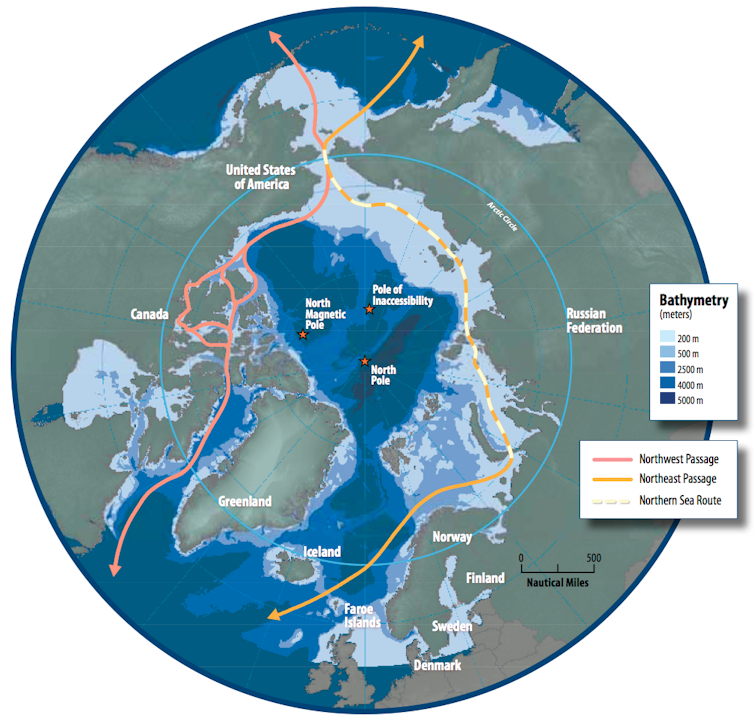
For companies, these routes – such as the Northern Sea Route along Russia’s coast and the Northwest Passage through Canada’s Arctic Archipelago – promise shorter transit times, lower fuel costs and fewer choke points than traditional passages.

However, Arctic shipping also raises complex challenges.

Declining sea ice is opening two shipping routes to greater use: the Northern Sea Route, off the Russian coast, and the Northwest Passage, along Alaska’s coast and through the Canadian islands.
Susie Harder/Arctic Council

The U.S., Russia, China and several European countries have each taken steps to establish an economic and military presence in the Arctic Ocean, often with overlapping claims and competing strategic aims. For example, Russia closed off access to much of the Barents Sea while it conducted missile tests near Norway in 2025. NATO has also been patrolling the same sea.

Geopolitical tensions compound the practical dangers in Arctic waters that are poorly charted, where emergency response capacity is limited and where extreme weather is common.

As more commercial vessels move through these waters, a serious incident – whether triggered by a political confrontation or weather – could be difficult to contain and costly for marine ecosystems and global supply chains.

A fleet of military ships at dusk with mountains in the background.
German Naval vessels sail near Harstad, Norway, during Arctic exercises on Oct. 13, 2025.
Sean Gallup/Getty Images

The Arctic Council is the region’s primary official forum for the Arctic countries to work together, but it is explicitly barred from addressing military and security issues – the very pressures now reshaping Arctic shipping.

The council went dormant for over a year starting in 2022 after Russia, then the Arctic Council president, invaded Ukraine. While meetings and projects involving the remaining countries have since resumed, the council’s influence has been undercut by unilateral moves by the Trump administration and Russia, and bilateral arrangements between countries, including Russia and China, often involving access to oil, gas and critical mineral deposits.

In this context, Arctic countries can strengthen cooperation through other channels. An important one is science.

For decades, scientists from the U.S., Europe, Russia and other countries collaborated on research related to public safety and the environment, but Russia’s invasion of Ukraine disrupted those research networks.

Going forward, countries could share more data on ice thaw, extreme weather and emergency response to help prevent accidents in a rapidly opening shipping corridor.

An image of the Arctic shows sea ice concentrations in 2025 were less than the 20-year average, and much less than the 20 years before then.
Arctic sea ice has been declining, with less multiyear ice and less coverage. The map shows the Arctic sea ice at its minimum extent in 2025, in September.
NOAA and CIRES/University of Colorado Boulder.

Critical minerals: Control over the seabed

The global transition to clean energy is driving demand for critical minerals, such as nickel, cobalt, manganese and rare earth elements, that are essential for everything from smartphones and batteries to fighter jets. Some of the world’s largest untapped deposits lie deep below the ocean’s surface, in places like the Clarion-Clipperton Zone near Hawaii in the Pacific. This has sparked interest from governments and corporations in sea floor mining.

Harvesting critical minerals from the seabed could help meet demand at a time when China controls much of the global critical mineral supply. But deep-sea ecosystems are poorly understood, and disruptions from mining would have unknown consequences for ocean health. Forty countries now support either a ban or a pause on deep sea mining until the risks are better understood.

These concerns sit alongside geopolitical tensions: Most deep-sea minerals lie in international waters, where competition over access and profits could become another front in global rivalry.

A map shows one area where companies are interested in mining.
A map of the Pacific Ocean between Mexico and Hawaii shows exploration targets for mining seafloor nodules that contain critical minerals in the Clarion-Clipperton Zone. National waters are shown in blue. The striped APEI squares are protected areas.
KA McQuaid, MJ Attrill, MR Clark, A Cobley, AG Glover, CR Smith and KL Howell, 2020, CC BY

The International Seabed Authority was created under the United Nations Convention on the Law of the Sea to manage seabed resources, but its efforts to establish binding mining rules have stalled. The U.S. never ratified the convention, and the Trump administration is now trying to fast-track its own permits to circumvent the international process and accelerate deep-sea mining in areas that are outside national jurisdictions.

Against this backdrop, a loose coalition of issue-focused groups and companies have joined national governments in calling for a pause on deep-sea mining. At the same time, some insurers have declined to insure deep-sea mining projects.

A visualization of deep-sea mining and the debris clouds created that could harm sea life.

Pressure from outside groups will not eliminate competition over seabed resources, but it can shape behavior by raising the costs of moving too quickly without carefully evaluating the risks. For example, Norway recently paused deep-sea mining licenses until 2029, while BMW, Volvo and Google have pledged not to purchase metals produced from deep-sea mines until environmental risks are better understood.

Overfishing: When competition outruns cooperation

Fishing fleets have been ranging farther and fishing longer in recent decades, leading to overfishing in many areas. For coastal communities, the result can crash fish stocks, threatening jobs in fishing and processing and degrading marine ecosystems, which makes coastal areas less attractive for tourism and recreation. When stocks decline, seafood prices also rise.

Unlike deep-sea mining or Arctic shipping, overfishing is prompting cooperation on many levels.

In 2025, a critical mass of countries ratified the High Seas Treaty, which sets out a legal framework for creating marine protected areas in international waters that could give species a chance to recover. Meanwhile, several countries have arrangements with their neighbors to manage fishing together.

For example, the European Union and U.K. are finalizing an agreement to set quotas for fleets operating in waters where fish stocks are shared. Likewise, Norway and Russia have established annual quotas for the Barents Sea to try to limit overfishing. These government-led efforts are reinforced by other forms of diplomacy that operate outside government.

Market-based initiatives like the Marine Stewardship Council certification set common sustainability standards for fishing companies to meet. Many major retailers look for that certification when making purchases. Websites like Global Fishing Watch monitor fishing activity in near real time, giving governments and advocacy groups data for action.

Collectively, these efforts make it harder for illegal fishing to hide.

How well countries are able to work together to update quotas, share data and enforce rules as warming oceans shift where fish stocks are found and demand continues to grow will determine whether overfishing can be stopped.

Looking Ahead

At a time when international cooperation is under strain, agreements between countries and pressure from companies, insurers and issue-focused groups are essential for ensuring a healthy ocean for the future.

The Conversation

The authors do not work for, consult, own shares in or receive funding from any company or organization that would benefit from this article, and have disclosed no relevant affiliations beyond their academic appointment.

ref. Global power struggles over the ocean’s finite resources call for creative diplomacy – https://theconversation.com/global-power-struggles-over-the-oceans-finite-resources-call-for-creative-diplomacy-272320

One uprising, two stories: how each side is trying to frame the uprising in Iran

Source: The Conversation – Global Perspectives – By Ali Mamouri, Research Fellow, Middle East Studies, Deakin University

Since the outbreak of the current wave of protests in Iran, two sharply competing narratives have emerged to explain what is unfolding in the streets.

For the ruling establishment, the unrest is portrayed as a foreign-engineered plot. They argue it is an externally-driven attempt to destabilise the state through manipulation, infiltration, and psychological operations.

For the opposition, the same events are framed as a nationwide uprising rooted in long-standing grievances. They argue the protests signal a rupture between society and the political system.

How the “story” of a conflict is told is a key component in warfare. The Iran protest are offering two very different stories.

Narrative crafting as psychological warfare

In the digital age, psychological warfare has moved beyond conventional propaganda into the realm of what academics Ihsan Yilmaz and Shahram Akbarzadeh call Strategic Digital Information Operations (SDIOs).

Psychological operations function as central instruments of power, designed not only to suppress dissent but reshape how individuals perceive reality, legitimacy, and political possibility. Their objective is cognitive and emotional:

  • to induce fear, uncertainty, and helplessness
  • to discredit opponents
  • to construct a sense of inevitability around a certain political scenario.

These techniques are employed not only by states, but increasingly by non-state actors as well.

Social media platforms have become the primary theatres of this psychological struggle. Hashtags, memes, manipulated images, and coordinated commenting – often amplified by automated accounts – are used to frame events, assign blame, and shape emotional responses at scale.

Crucially, audiences are not passive recipients of these narratives. Individuals sympathetic to a particular framing actively reproduce, reinforce, and police it within digital echo chambers. In this way, confirmation bias flourishes and alternative interpretations are dismissed or attacked.

Because of this, narrative control is not a secondary dimension of conflict but a central battleground. How an uprising is framed can shape its trajectory. It can determine whether it remains peaceful or turns violent, and whether domestic repression or foreign intervention comes to be seen as justified or inevitable.

The Iranian regime’s narrative

The Iranian regime has consistently framed the current uprising as a foreign-engineered plot, orchestrated by Israel, the United States and allied intelligence services. In this narrative, the protests are not an expression of domestic grievance but a continuation of Israel’s recent confrontation with Iran. This, it argues, is part of a broader campaign to overthrow the regime and turn the country into chaos.

Two weeks after the protests began, the state organised large pro-regime demonstrations. Shortly afterward, supreme leader Ayatollah Ali Khamenei declared these rallies had “thwarted the plan of foreign enemies that was meant to be carried out by domestic mercenaries”.

The message was clear: dissent was not only illegitimate but treasonous. Those participating in it were portrayed as instruments of external powers rather than citizens with political demands.

Demonising dissent serves a dual purpose. It is not only a method of silencing opposition, but also a tool for engineering perception and shaping emotional responses.

By portraying protesters as foreign agents, the regime seeks to manufacture compliance, discourage wavering supporters, and project an image of widespread popularity. The objective is not simply to punish critics, but to signal that public dissent will carry heavy costs.

To reinforce this narrative, pro-regime social media accounts have circulated content that blends ideological framing with selective factual material. Analyses arguing that events in Iran follow a familiar “regime change playbook” – have been widely shared, as have Israeli statements suggesting intelligence operations inside Iran. Cherry-picking expert commentary or isolated data points to justify repression is a common feature of this approach.

The timing and amplification of such content are also significant. Social media networks are deployed via “algorithmic manipulation” to make the regime’s framing go viral and marginalise counter views.

As this digital campaign unfolds, it is reinforced by more traditional forms of control. Internet restrictions and shutdowns limit access to alternative sources of information. This allows state media to dominate communications and thwart challenges to the official narrative.

In this environment, the regime’s story functions not merely as propaganda, but as a strategic instrument. It aims to redefine the uprising, delegitimise dissent, and preserving authority by controlling how events are understood.

The opposition narrative

Though the opposition is divided, but two main groups have appeared active in framing the opposition narrative: those who support an Iranian monarchy, and dissenting armed group Mojahedin-e-Khalq (MEK). Despite their differences, the two have contributed to the same story.

They have crafted a persuasive narrative, framing the uprising as a moral emergency requiring external intervention, particularly by the United States and Israel. This narrative does not represent all opposition voices, but it has gained visibility through social media, exile media outlets, and activist networks. Its core objective is to bring international attention to the conflict and put the case for, then bring about, regime change in Iran.

One central technique has been the legitimisation and encouragement of violence. Calls for armed protest and direct confrontation with security forces mark a clear shift away from demand-based, civilian mobilisation toward a violent uprising.

A high number of state forces casualties – reportedly more than 114 by January 11 – is an example of the effectiveness of this technique. This escalation is often justified as necessary to “keep the movement alive” and generate a level of bloodshed that would compel international intervention.

According to external conflict-monitoring assessments, clashes between armed protesters and state forces have in fact resulted in significant casualties on both sides.

A second technique involves the strategic inflation of casualty figures. Opposition platforms have claimed the death toll to be far higher than figures cited by independent estimates.

Such exaggeration serves a clear psychological and political purpose. It is intended to shock and sway international opinion, frame the situation as genocidal or exceptional, and increase pressure on foreign governments to act militarily.

A third element has been the use of intimidation and rhetorical coercion. In some high-profile media appearances, opposition figures have openly threatened pro-regime commentators, warning of retribution once power changes hands.

This language serves multiple functions. It seeks to silence alternative viewpoints, project confidence and inevitability, and present the situation as one of good versus evil. At the same time, such rhetoric risks alienating undecided audiences and reinforcing regime claims the uprising will lead to chaos or revenge politics.

These practices reveal how parts of the opposition have also embraced narrative warfare as a strategic tool. This narrative is used to amplify violence, inflate harm, and suppress competing interpretations. It aims to redefine the uprising not merely as a domestic revolt, but as a humanitarian and security crisis that demands foreign intervention.

In doing so, it mirrors the regime’s own effort to weaponise storytelling in a conflict where perception is as consequential as power.

In different ways, both narratives ultimately sideline the protesters themselves. They reduce a diverse, grassroots movement into an instrument of power struggle, either to legitimise repression at home or justify intervention from abroad.

The Conversation

Ali Mamouri does not work for, consult, own shares in or receive funding from any company or organisation that would benefit from this article, and has disclosed no relevant affiliations beyond their academic appointment.

ref. One uprising, two stories: how each side is trying to frame the uprising in Iran – https://theconversation.com/one-uprising-two-stories-how-each-side-is-trying-to-frame-the-uprising-in-iran-273573

What next for Iran as Trump pulls back?

Source: The Conversation – UK – By Jonathan Este, Senior International Affairs Editor, Associate Editor, The Conversation

This newsletter was first published in The Conversation UK’s World Affairs Briefing email. Sign up to receive weekly analysis of the latest developments in international relations, direct to your inbox.


For anyone who has watched Iranians take to the streets before, as they have at reasonably regular intervals over the years, this week’s protests had a depressingly familiar feel – viewed from the safety and comfort of the UK, that is.

What started as angry bazaar traders complaining about the economic mismanagement that had led to surging inflation and the collapse of the Iranian rial spread quickly across the country and to almost every level of society at the beginning of January. Tens of thousands of people, desperate to break free from the stifling oppression of the theocracy, took to the streets to call for an end to the Islamic Republic and for a system that would respect their fundamental rights and democratic freedoms.

For a while it felt as if this might be their chance. The Islamic Republic is close to breaking point, with an ageing Ayatollah presiding over a sclerotic regime, a parlous economy and a military weakened and demoralised by the 12-day war with Israel and the virtual destruction of its proxies across the Middle East.

But as has happened so many times before, the bravery of the protesters was met with the savagery of a regime with its backs to the wall, for whom the only response seems to be to massacre, rather than listen to, the people it should be protecting.

Many of those following the story had mixed feelings when the US president, Donald Trump, signalled the US would get involved. Maybe US intervention might be what was needed to collapse the regime and set the people of Iran free, or – at the very least – force the regime to negotiate and agree to some much-needed democratic reforms. On the other hand, a US military intervention in Iran had (and has) the potential to be an utter disaster.

Nevertheless, when Trump posted a message, “Iranian Patriots, keep protesting – take over your institutions!!! … help is on its way,” it felt as if this might be the moment of change. But the US pulled back – unready to act and uncertain of what intervention could achieve. Now the forces of repression are once again taking over Iran’s streets.

We spoke with Scott Lucas, a Middle East expert at the Clinton Institute, University College Dublin and a regular commentator on The Conversation, who addressed several of the key issues that will affect the future of Iran.


Read more:
Iran protests: Trump stalls on US intervention leaving an uncertain future for a bitterly divided nation – expert Q&A


It’s clear that the vast majority of Iranians reject the theocracy. And not just from the fact that there have been so many massive protests calling for democratic change. They’ve repeatedly told researchers the same thing. In the latest survey conducted late last year by Ammar Maleki of Tilburg University and Pooyan Tamimi Arab of the University of Utrecht they found the 80% of Iranians reject the regime.

But, interestingly, there was less of a consensus about what Iranians want to replace it. Only about one-third support the exiled crown prince Reza Pahlavi (although that number appears to be growing) and about twice as many felt that protests and strikes were more likely to force change than elections. The second most popular option for change was foreign pressure or intervention, but as we’ve seen this week, foreign intervention seems unlikely, for the present at least.


Read more:
Iran protests 2026: our surveys show Iranians agree more on regime change than what might come next


Bamo Nouri, meanwhile, believes that a US military intervention is pretty much the last thing that Iran needs right now. Experience has shown that the threat of foreign intervention has actually had the opposite effect, allowing the feared Islamic Revolutionary Guard Corps to consolidate its domestic power.

And Iranians tend to be wary of western interventions. Everyone knows about the coup of 1953 in which the US, with British help, unseated the democratically elected prime minister Mohammad Mosaddegh for the crime of nationalising Iran’s oil industry (as we’ve seen recently in Venezuela, this still goes down badly with energy superpowers).


Read more:
The use of military force in Iran could backfire for Washington


Soon after the protests started to really spread across Iran (and before the killing started in earnest) the regime employed a tactic they have used before to great effect. They shut down the internet. In a tech-savvy country like Iran, word of protests spreads like wildfire, so preventing people’s access to social media meant that it was far more difficult to organise online.

In theory, at least. But between 80 and 90% Iran’s aforementioned tech savvy population now uses a VPN to access the internet. This, writes Konstantinos Mersinas and Francesco Ferazza, tech experts at Royal Holloway, University of London, meant that the regime was forced to actually shut down the infrastructure that supports all communications networks in Iran.

It’s a measure of how seriously the authorities were taking these protests that the Islamic Republic was happy to live with the consequences of the shutdown, write Mersinas and Ferazza, that they were willing to suffer a breakdown in banking, payments, logistics and all the other facets of everyday life that depend on online communications.


Read more:
Iran: how the Islamic Republic uses internet shutdowns as a tool of repression


Greenland under pressure

The US president, meanwhile, continues to covet Greenland. Whether for its mineral wealth, its vital strategic position or just the fact that by acquiring it for the US would mean he has added more territory to the map of the US than any of his predecessors.

There’s no getting away from the fact that Greenland is slap bang in the middle of one of the Earth’s most contested regions. And Trump is right when he says it’s important for US national security to have a robust Nato military presence there. As Caroline Kennedy-Pipe, professor of war studies at Loughborough University, points out, Russia has spent the past decade beefing up its assets in the region and far outmatches western military capabilities across the Arctic.


Read more:
Whether or not US acquires Greenland, the island will be at the centre of a massive military build-up in the Arctic


This is only going to increase as the Arctic continues to warm, writes geopolitics specialist Klaus Dodds of Middlesex University. The region is at the heart of what he refers to as the “new great game” between global superpowers.

Vector map of the Arctic
Contested: the Arctic is increasingly seen as a potential area of conflict as the competition for great power status between Russia, China and the US develops.
Dimitrios Karamitros/Shutterstock

Dodds is concerned that 2026 may see a series of cynical but expedient territorial swaps, whereby Trump’s America is happy to see Putin’s Russia take the Norwegian archipelago of Svalbard in return for a free hand in Greenland (we’ll say nothing about Ukraine at this point). Taking a bigger picture view, Dodds concludes that: “The ground would thus be prepared for a new world order in which Putin, China’s president Xi Jinping and Trump all have their spheres of domination, not just influence.”


Read more:
As the Arctic warms up, the race to control the region is growing ever hotter


Danish foreign Minister, Lars Lokke Rasmussen, and his Greenlandic counterpart, Vivian Motzfeldt, went to the White House on January 14 to meet US vice-president, J.D. Vance, and secretary of state, Marco Rubio, to discuss the future of the world’s largest island. The meeting reportedly lasted less than an hour, ending when it was clear, as Rasmussen told journalists, that there is still a “fundamental disagreement” over the future of Greenland.

Still, at least Greenland was represented at the meeting. The island’s 57,000 people have been angered at times by Denmark’s failure to include them in some of the discussions about their future. As they say in Greenland: “nothing about Greenland without Greenlanders”.


Read more:
As US and Denmark fight, Greenland’s voices are being excluded once again


Ukraine observes a bitter landmark

There was a bitter landmark for Ukraine this week. On Tuesday Vladimir Putin’s “special military operation” moved beyond the 1,418 days it took the Soviet Union under Joseph Stalin to beat Hitler’s Germany.

Comparing the two conflicts, Stefan Wolff notes the unqualified support offered by the US under its president Franklin D. Roosevelt, compared to the vacillations of the current occupant of the White House. And free Europe had a rather more impressive leader in Winston Churchill.

As the fourth anniversary of the full-scale Russian war in Ukraine approaches, Wolff takes stock of the situation and worries that Ukraine is a long way from becoming another much-needed example of the maxim that “aggression never pays”.


Read more:
Russia’s full-scale invasion of Ukraine outlasts the Soviet fight with the Nazis – here’s what history tells us about Kyiv’s prospects


Sign up to receive our weekly World Affairs Briefing newsletter from The Conversation UK. Every Thursday we’ll bring you expert analysis of the big stories in international relations.


The Conversation

ref. What next for Iran as Trump pulls back? – https://theconversation.com/what-next-for-iran-as-trump-pulls-back-273622

China’s new condom tax will prove no effective barrier to country’s declining fertility rate

Source: The Conversation – Global Perspectives – By Dudley L. Poston Jr., Professor of Sociology, Texas A&M University

A Chinese visitor looks at condoms at the Beijing International Sex Supplies Exhibition. Zhang Peng/LightRocket via Getty Images

Once the world’s most populous nation, China is now among the many Asian countries struggling with anemic fertility rates. In an attempt to double the country’s rate of 1.0 children per woman, Beijing is reaching for a new tool: taxes on condoms, birth control pills and other contraceptives.

As of Jan. 1, such items were subject to a 13% value-added tax. Meanwhile, services such as child care and matchmaking remain duty-free.

The move comes after China last year allocated 90 billion yuan (US$12.7 billion) for a national child care program giving families a one-off payment of around 3,600 yuan (over $500) for every child age three or under.

I have studied China’s demography for almost 40 years and know that past attempts by the country’s communist government to reverse slumping fertility rates through policies encouraging couples to have more children have not worked. I do not expect these new moves to have much, if any, effect on reversing the fertility rate decline to one of the world’s lowest and far below the 2.1 “replacement rate” needed to maintain a stable population.

In many ways, the 13% tax on contraceptives is symbolic. A packet of condoms costs about 50 yuan (about $7), and a month supply of birth control pills averages around 130 yuan ($19). The new tax is not at all a major expense, adding just a few dollars a month.

Compare that to the average cost of raising a child in China – estimated at around 538,000 yuan (over $77,000) to age 18, with the cost in urban areas much higher. One 36-year-old father told the BBC he is not concerned over the price hike. “A box of condoms might cost an extra five yuan, maybe 10, at most 20. Over a year, that’s just a few hundred yuan, completely affordable,” he said.

Pronatalist failings

China is one of many countries to adopt pronatalist policies to address low fertility. But they are rarely effective.

The Singapore government has been concerned about the country’s very low fertility rate for a couple of decades. It tried to devise ways to boost it through programs such as paid maternity leave, child care subsidies, tax relief and one-time cash gifts. Yet, Singapore’s fertility rate – currently at 1.2 – remains one of the lowest in the world.

The government there even started limiting the construction of small, one-bedroom apartments in a bid to encourage more “family-friendly” homes of two bedrooms or more – anyone with children will appreciate the need for more space, right? Yet even that failed to budge the low fertility rate.

The Singaporean government got a helping hand in 2012 from candymaker Mentos. In a viral ad campaign, the brand called on citizens to celebrate “National Night” with some marital boom-boom as they “let their patriotism explode” – with a hoped-for corresponding burst in births in nine months’ time. Even with the assistance from the private sector, it appears, reversing declining fertility rates is a tricky thing.

South Korea, the country with the world’s lowest fertility rate – 0.7 – has been providing financial incentives to couples for at least 20 years to encourage them to have more children.

It boosted the monthly allowance already in place for married couples to become parents. In fact, since 2006 the South Korean government has spent well over $200 billion on programs to increase the Korean birth rate.

But South Korea’s fertility rate has continued to drop from 1.1 in 2006 to 1.0 in 2017, to 0.9 in 2019, to 0.7 in 2024.

Unfavorable headwinds

The plight of China is partly of its own doing. For a couple of decades the country’s one-child policy pushed to get fertility rates down. It worked, going from over 7.0 in the early 1960s to 1.5 in 2015.

That is when the government again stepped in, abandoning the one-child policy and permitting all couples to have two children. In May 2021, the two-child policy was abandoned in favor of a three-child policy.

The hope was that these changes would lead to a baby boom, resulting in sizable increases in the national fertility rate. However, the fertility rate continued to decline – to 1.2 in 2021 and 1.0 in 2024.

While China’s historic programs to push down fertility rates were successful, they were aided by wider societal changes: The policies were in force while China was modernizing and moving toward becoming an industrial and urbanized society.

It’s policies aimed at increasing the birth rate now find unfavorable societal headwinds. Modernization has led to better educational and work opportunities for women – a factor pushing many to put off having children.

In fact, most of China’s fertility reduction, especially since the 1990s, has been voluntary – more a result of modernization than fertility-control policies. Chinese couples are having fewer children due to higher living costs and educational expenses involved in having more than one child.

Plus, China is one of the world’s most expensive countries in which to raise a child, when compared to average income. School fees at all levels are higher than in many other countries.

The ‘low-fertility’ trap

Another factor to take into consideration is what demographers refer to as the “low-fertility trap.” This hypothesis, advanced by demographers in the 2000s, holds that once a country’s fertility rate drops below 1.5 or 1.4 – far higher than China’s now stands – it is very difficult to increase it by 0.3 or more.

The argument goes that fertility declines to these low levels are largely the result of changes in living standards and increasing opportunities for women.

Accordingly, it is most unlikely that China’s three-child policy will have any influence at all on raising the fertility rate. And all my years of studying China’s demographic trends lead me to believe that making contraceptives marginally more expensive will also have very little effect.

The Conversation

Dudley L. Poston Jr. does not work for, consult, own shares in or receive funding from any company or organization that would benefit from this article, and has disclosed no relevant affiliations beyond their academic appointment.

ref. China’s new condom tax will prove no effective barrier to country’s declining fertility rate – https://theconversation.com/chinas-new-condom-tax-will-prove-no-effective-barrier-to-countrys-declining-fertility-rate-273333

One in five Britons say losing their pet was worse than losing a person – new study

Source: The Conversation – UK – By Fiona Brook, Lecturer, Psychology, Birmingham City University

New Africa/Shutterstock.com

For one in five people, losing a pet has been more distressing than losing a human loved one. New research has revealed that 21% of those who experienced both types of bereavement found their pet’s death harder to bear.

The findings challenge how society views pet loss. It’s often dismissed as “disenfranchised grief” – a type of mourning that isn’t socially recognised or validated in the same way as other bereavements.

Yet for most pet owners, their animals are family. A 2025 survey by the animal charity RSPCA found that 99% consider their pets part of the family rather than “just a pet”. On Instagram, #dogsarefamily alone has 3.4 million posts.

The latest study of 975 British adults revealed something striking. Around 7.5% of people who’d lost pets met clinical criteria for “prolonged grief disorder” – comparable to rates following many human deaths.

A depressed woman staring out of a window.
Many suffer from prolonged grief disorder.
fizkes/Shutterstock.com

Grief typically involves a range of emotions including anger, denial, relief, guilt and sadness. Prolonged grief disorder, however, is more severe – the psychiatrists’ diagnostic manual, the DSM-V, defines it as “intense and persistent grief symptoms which are not only distressing in themselves but also associated with problems in functioning” lasting 12 months or more after a loss.

Currently, only human deaths qualify for this diagnosis. But the research, led by Philip Hyland of Maynooth University in Ireland, found no measurable differences in how prolonged grief disorder symptoms manifest, whether the loss involves a person or a pet.

Pet loss actually accounted for 8.1% of all prolonged grief disorder cases in the study – a higher proportion than many types of human losses. Those who had lost a pet were 27% more likely to develop prolonged grief disorder symptoms than those who hadn’t.

That figure sits between the rates for losing a parent (31%) and losing a sibling (21%). It’s higher than the rates for losing a close friend or other family member.

The findings suggest diagnostic criteria may be missing something important. What matters most isn’t who has died, but the quality and meaning of the relationship with the deceased.

One major risk factor for prolonged grief disorder is lack of social support after loss. People grieving pets often face this difficult period without adequate understanding from those around them, potentially leading to the disorder developing.

Many participants expressed embarrassment and shame about sharing their feelings. This can lead to isolation and make it harder to process the loss.

Lack of recognition and support

By excluding pet loss from diagnostic criteria, some people may struggle to access support or workplace adjustments during this difficult time. The lack of recognition can compound an already painful experience.

Pet death also comes with unique challenges. Owners may be involved in the decision to euthanise their pet – something that doesn’t happen with human loss.

For some, this brings comfort, feeling they’ve supported their pet at the end. For others, it’s traumatic – particularly if they’ve felt excluded from the decision by the vet or worried they acted too early. Traumatic circumstances are another risk factor for prolonged grief disorder.

While the study suggests the DSM-V diagnostic criteria may need updating, help is available now for those grieving a pet. The RSPCA offers a pet bereavement toolkit to help people navigate their loss.

Specialist counsellors also work with pet bereavement. Getting support from professionals who understand the significance of the bond between people and their pets could help reduce the risk of prolonged grief disorder, offering the understanding and compassion needed during such a painful time.

The Conversation

Fiona Brook runs a small private psychotherapy practice, Fiona Brook Counselling and Psychotherapy

ref. One in five Britons say losing their pet was worse than losing a person – new study – https://theconversation.com/one-in-five-britons-say-losing-their-pet-was-worse-than-losing-a-person-new-study-273410