Trump on a coin? When Julius Caesar tried that, the Roman republic crumbled soon after

Source: The Conversation – Global Perspectives – By Peter Edwell, Associate Professor in Ancient History, Macquarie University

A proposed one dollar coin featuring US President Donald Trump is causing ructions across the political divide. It’s also provoking discussion in the world of ancient Roman numismatics (coin studies).

The proposed coin depicts Trump in profile on one side (the obverse). On the other side (the reverse) the president raises his fist in defiance accompanied by the words “fight, fight, fight”.

While only a draft proposal, the coin could be minted in 2026 to mark 250 years since the US declaration of independence. But an old law prohibits the “likeness of any living person” from being “placed upon any of the bonds, securities, notes, fractional or postal currency of the United States.”

More than 2,000 years ago, the depiction of living figures on Roman coins caused similar ructions.

It came at a time when the Roman republic was in trouble. The republic would crumble altogether soon after, ushering in the long period of Rome being led by emperor-kings who saw themselves as almost akin to gods.

Perhaps the American republic is at a similar stage.

Sulla’s image on a coin

Rome was said to be founded by the mythical king Romulus, who killed his own twin (Remus). The fledgling state was led by seven kings before it became a republic in about 509 BCE.

By the late second century BCE it was led by Roman general and politician Gaius Marius. Marius and his later rival, Lucius Cornelius Sulla Felix, broke many of the republic’s long-held conventions. They also fought Rome’s first major civil war.

In 88 BCE, while consul, Sulla marched an army on Rome to defend the city from “tyrants” (by which he meant the faction of Marius, who had ousted him). After Sulla won the civil war that followed, he held the dictatorship from 82-79 BCE. Dictatorships were only to be held for six months in times of emergency. Sulla claimed the emergency was ongoing.

As part of this he ordered a list (known as proscriptions) of enemies drawn up. Hundreds or even thousands were killed and had property confiscated.

In the same year a silver coin (called a denarius) was minted in Sulla’s name. One side featured Sulla himself riding in a four-horse chariot.

Coin Denarius, L. SVLLA IMP, Ancient Roman Republic, 82 BC
In 82 BCE a silver coin (known as a denarius) was minted in Sulla’s name.
The Conversation/Museums Victoria Copyright Museums Victoria / CC BY (Licensed as Attribution 4.0 International), CC BY

This was the first time a living person was depicted on a Roman coin. Up to this point only gods and mythological figures had that honour.

It was highly unusual.

Caesar’s challenge to the old republic

Sulla was the first but he wouldn’t be the last leader of the Roman republic to have his image on a coin.

In 44 BCE Julius Caesar went a step further. Only months before his assassination, coins appeared with Caesar’s bust dominating their obverses. Some included the words dict perpetuo meaning “dictator for life”.

By this time, Caesar and many before him, including Marius and Sulla, had broken the mould of the old republic.

Early in 44 BCE, Caesar took the dictatorship for life.

From 46-44 BCE he held the consulship, which was only meant to be held for a one-year term at a time. (Sulla held the dictatorship three years running, which partly set the scene for Caesar’s later emergence and the final breakdown of the republic.)

For many at the time, it seemed Caesar was moving the republic in the direction of monarchy. In January 44 BCE, when a throng hailed him as “rex” (king) Caesar responded, “I am Caesar and no king”. His very name was by now more powerful.

The coins of 44 BCE containing a profile bust of Caesar were an important part of his public program, and part of his challenge to republican convention.

Sulla paved the way 40 years before.

The parallels with Trump are hard to miss

Some emphasise that Caesar did not directly order his image to be placed on coins. Those wanting to curry favour read the room and Caesar did not object.

A similar scenario appears to be playing out with the coin design bearing Trump’s image.

The parallels with Trump are hard to miss. Trump has signed more than 200 executive orders in less than nine months. His predecessor Joe Biden issued 162 in his entire presidency.

Trump’s deployment of federal troops to US cities under emergency decrees provokes cries of tyranny. Sulla’s march on Rome and the proscriptions that followed drew a similar response.

The possibility of a one dollar coin depicting Donald Trump on both sides echoes the coins of Sulla and Caesar.

They might not technically break the law but they would break convention. In the process they also symbolise a notable shift in the US from democracy to autocracy.

When the “no kings!” demonstrations took place in the US earlier this year, they reminded us of a key motivation for the declaration of independence.

A coin celebrating its 250-year anniversary may well symbolise its journey to demise.

The Conversation

Peter Edwell receives funding from the Australian Research Council.

ref. Trump on a coin? When Julius Caesar tried that, the Roman republic crumbled soon after – https://theconversation.com/trump-on-a-coin-when-julius-caesar-tried-that-the-roman-republic-crumbled-soon-after-266887


Child famine has reached the highest level in Gaza, with tens of thousands of kids affected – new study

Source: The Conversation – Global Perspectives – By Michael Toole, Associate Principal Research Fellow, Burnet Institute

More than 54,000 children aged under five in Gaza are suffering acute malnutrition, including more than 12,800 who are severely malnourished, according to a study published in The Lancet on Wednesday.

When more than 15% of the population experiences acute malnutrition, the World Health Organization classifies this as “very high” – its most severe category. In August, the overall rate of acute malnutrition among study participants in Gaza was 15.8%.

Rafah consistently had the highest acute malnutrition rate, across the 20-month study period to August 2025, reaching 32% of children in December 2024.

Acutely malnourished children are at higher risk of severe infections and premature death. If malnutrition becomes long term, the child may develop stunting (shortness for their age) and subsequent cognitive impairment.

A child with severe acute malnutrition is also up to 11 times more likely than a healthy child to die of common childhood illnesses such as pneumonia, the single largest infectious cause of death in children worldwide.

How was the study conducted?

The researchers assessed 219,783 children aged 6–59 months for acute malnutrition – also known as wasting – which reflects recent weight loss. This study size accounts for around 64% of children in Gaza in that age group.

It was conducted in 16 UN health centres and 78 medical points established in school shelters and tent encampments across the five local areas of Gaza.

According to the WHO, the gold standard of assessing the nutritional status of a child is to measure their weight (using standard hanging scales) and their height or length. It also recommends measuring arm circumference to detect acute malnutrition in community screening settings, as numerous studies have demonstrated this is an accurate way of detecting acute malnutrition.

The Lancet study measured the children’s height and weight, as well as their mid-upper arm circumference using a standard measuring tape developed by UNICEF.

However, a number of researchers have recommended increasing the diagnostic threshold, which is currently 125 mm, which would mean more children meet the threshold for malnutrition.

The researchers in Gaza calculated what is called the Z-score for each assessed child, as is standard practice. This is the number of standard deviations above or below the median of the WHO reference population. A Z-score between -2 and -3 represents moderate acute malnutrition and a Z-score of less than -3 is severe acute malnutrition.

What did the researchers find?

The monthly prevalence of acute malnutrition ranged from 5% to 7% between January and June 2024.

After around four months of severe aid restrictions, between September 2024 and mid-January 2025, the prevalence increased from 8.8% to 14.3%. The highest prevalence was seen in Rafah (32.2%).

After a six-week ceasefire and a substantial increase in the number of aid trucks entering Gaza, by March 2025, the prevalence of wasting had declined to 5.5%.

However, an 11-week blockade occurred from March to May 2025 and severely restricted entry of food, water, medicines, fuel and other essentials. By early August 2025, 15.8% of screened children were acutely malnourished, including 3.7% who were severely wasted. This equates to more than 54,600 children in need of treatment using ready-to-use therapeutic food – a paste containing high quantities of calories and other nutrients.

Boys were more likely to be malnourished than girls, which was consistent with the pre-war period. Studies across the globe have found malnutrition rates are usually higher in boys than girls.

Was the study well conducted?

This was a longitudinal (conducted over time, in this case 20 months) cross-sectional study, which means the researchers took their measurements at certain intervals (in this case, monthly).

The authors provide extensive details of the numbers of children included, in which local area, what kind of facility (a fixed medical centre or medical point), as well as age and sex.

Two-thirds of the participants were in Khan Younis and Middle governorates, with relatively low numbers in North Gaza and Rafah, which were highly affected by military activities.

The analysis was thorough, preceded by a data cleansing process which excluded values that were implausible. Standard statistical tests were applied to the data.

The paper was peer reviewed before publication.

What do the findings mean?

The Integrated Food Security Phase Classification, known as the IPC scale, defines famine as a situation in which at least one in five households has an extreme lack of food and faces starvation and destitution, resulting in extremely critical levels of acute malnutrition and death. The IPC uses the same classification of acute malnutrition as the WHO.

The IPC scale defines five phases of food insecurity. Famine (phase 5) is the highest phase of the scale, and is classified when an area has 20% of households facing extreme food shortage and 30% of children are acutely malnourished.

In late August 2025, the IPC released its fifth report on Gaza. It found for the period July 1 to August 15 2025, there was famine (phase 5) for the Gaza governorate and emergency (phase 4) for Deir al-Balah and Khan Younis. It was unable to adequately assess North Gaza because of insecurity.

The food insecurity situation in Gaza is among the worst in the world, comparable with the current situation in Sudan, Yemen and Haiti. It is a man-made disaster and can be reversed by urgent human action.

The Lancet study found spikes in acute malnutrition coincided with aid blockades. A ceasefire and a complete opening to international aid are fundamental to a resolution of the food crisis.

The Conversation

Michael Toole receives funding from the National Health and Medical Research Council..

ref. Child famine has reached the highest level in Gaza, with tens of thousands of kids affected – new study – https://theconversation.com/child-famine-has-reached-the-highest-level-in-gaza-with-tens-of-thousands-of-kids-affected-new-study-266988

How voice training can help teachers improve wellbeing in the classroom

Source: The Conversation – UK – By Claire Oakley, Researcher and Lecturer in Psychology, University of Essex

PeopleImages/Shutterstock

Teachers use their voices in the classroom to build enthusiasm, convey knowledge and defuse tensions.

A warm, encouraging voice boosts pupils’ motivation, reduces anxiety and improves connections with teachers and classroom dynamics. Controlling or harsh tones can unknowingly create stress for pupils, erode trust and lead to disengagement.

But teachers are also stressed, and stress can affect the way we speak. Being stressed affects the control we have over our speech. We tend to speak at a higher pitch with more variation, which can induce vocal strain.

Further, listeners can perceive the speaker’s stress from their speech. That perceived stress has the potential to influence the emotions of the listener, too, which in a school can negatively shape a classroom’s atmosphere.

Few teachers are trained in how to use their voice effectively. Neither are teachers trained in how to protect their voice to ensure career longevity and prevent voice-related illness. Providing voice awareness training for teachers could help reduce the impact of stress and overuse on teachers’ voices and transform communication within the classroom.

Supportive classrooms

It has long been known that children learn more and participate better in supportive and engaging classroom atmospheres. The way teachers speak can affect their pupils’ wellbeing, engagement and self-esteem.

Teachers can create these environments by using a tone or style of voice that demonstrates their interest in their pupils. Vocal delivery affects cooperation, and emerging evidence suggests that it has an influence on how pupils learn.

Pupils are less likely to engage in thinking about concepts and problem solving after hearing a harsh-sounding voice. Instead, they rely more on simple repetition, which is less effective for long-term learning. Together, these studies suggest that teachers can create supportive, optimal learning environments through a nuanced use of voice in the classroom.

After hearing harsh, controlling-sounding voices, pupils have reported heightened negative emotions and feeling disconnected from teachers. Listeners take less than a quarter of a second to detect harsh voices, suggesting specialised brain mechanisms for processing threat-inducing voices.

Listening to supportive-sounding voices, which are often soft, warm and slower-paced, enhances wellbeing, increasing feelings of self-esteem and competence.

Adult talking to child in school corridor
How teachers speak can encourage children to express themselves.
Rido/Shutterstock

Research has found that showing an interest in others through voice cues changes the way listeners disclose information. This means that teachers using a supportive tone of voice could help pupils talk to them about important or difficult issues, such as bullying.

Vocal training

One of us (Silke Paulmann) has carried out research to evaluate the vocal awareness training offered by a teacher training organisation. After training, the teachers spoke in a less monotone voice, increasing their pitch and volume range, and at a slower pace. They used softer ways of speaking, demonstrating that vocal awareness training can alter teachers’ speech patterns.

Teachers are also at risk of voice problems. In a 2018 study, 30% of teachers surveyed reported voice problems, such as hoarseness, a sign of vocal strain or fatigue, or voice loss. In general, teachers are more likely to develop voice disorders compared with the general population.

However, unlike actors or singers, who also rely extensively on their voices, teachers do not typically receive vocal training. Voice training helps prevent long-term voice damage or strain. Proactively addressing teacher voice health could reduce missed work days due to voice-related issues and help improve teacher wellbeing, as they often occur together.

The vocal training we evaluated included techniques to help the trainee teachers master vocal delivery, as well as tips and tricks around voice health. The training emphasised how harsh and sharp-sounding voices can negatively affect students’ wellbeing.

It focused on how classroom communications benefit from soft, warm-sounding tones, creating a supportive and motivating classroom environment. Comparisons of the teachers’ voices before and after training indicated that their vocal quality improved.

Incorporating even short voice awareness training into teacher education and professional development could better equip educators to create supportive, engaging learning environments, protect their vocal health and support their wellbeing. Currently, though, the availability of voice awareness training for teachers is sparse.

Vocal awareness training can improve teachers’ vocal delivery, enhancing classroom communication and engagement. As education systems focus on both teacher and student wellbeing, incorporating such training into teacher development programmes is a crucial step forward.

The Conversation

In future work, Claire Oakley will collaborate with Mario Education (https://marioeducation.com/) as part of an evaluation project.

Silke Paulmann receives funding from the University of Essex Impact Fund and work on motivational prosody has previously been funded by the Leverhulme Trust. She collaborates with Mario Education (https://marioeducation.com) and 5Voices (https://the5voices.com) on projects related to teacher voice use.

ref. How voice training can help teachers improve wellbeing in the classroom – https://theconversation.com/how-voice-training-can-help-teachers-improve-wellbeing-in-the-classroom-249771

Twenty-five years of data shows how link between identity and views on Scottish independence has grown stronger

Source: The Conversation – UK – By John Curtice, Professor of Politics, University of Strathclyde and Senior Research Fellow, National Centre for Social Research

Shoppers on Edinburgh’s famous Victoria Street. Shutterstock/Ssisabal

When the Labour government established the Scottish parliament in 1999, it hoped the new institution would demonstrate that Scotland’s distinctive needs and aspirations could be addressed within the framework of the UK. Consequently, the theory went, support for independence would melt away.

However, the project was not without its risks. As a symbol of Scotland’s distinctiveness, the parliament might foster people’s sense of Scottish identity rather than the British identity that helps bind the four parts of the UK together.

And by creating a space in which policy issues are discussed separately from Westminster – and sometimes different solutions implemented – the balance of public opinion north of the border might diverge from that in the rest of the UK, making it more difficult to keep the union together.

Ever since the parliament first met on July 1 1999, the Scottish Social Attitudes (SSA) survey has been charting the evolution of public opinion north of the border. Together with the British Social Attitudes (BSA) survey, it also provides a means of comparing the trend of public opinion on the two sides of the border.

A report published on October 9 by the Scottish Centre for Social Research and based on the 25 years of data collected by SSA shows that public opinion and identities in Scotland have not diverged from those elsewhere in the UK. Nevertheless, support for independence is higher now than 25 years ago. This is because some of the features of the country’s attitudinal landscape that were already distinctive to Scotland have come to be more closely aligned with whether people are for or against independence.

Consider national identity, for example. Acknowledgement of a British identity has always tended to play second fiddle to feeling Scottish. In 1999, two-thirds of SSA respondents said they were either “Scottish, not British” or “more Scottish than British”. Just 22% indicated they were “equally Scottish and British”, while only 7% stated they were either “British, not Scottish” or “more British than Scottish”.

The figures are little different in the latest survey conducted last autumn. Nearly three in five (59%) said they were wholly or predominantly Scottish, 22% (again) stated they were equally Scottish and British, while only one in ten (10%) claimed to be wholly or predominantly British.

It is often claimed that public opinion in Scotland is more leftwing than in England. The social attitudes data confirm this – though the gap is small and has not widened.

Both the Scottish and British surveys have regularly asked a suite of questions designed to ascertain people’s attitudes towards inequality and what the government should do about it. This produces a scale from 0 to 100, in which the higher the score, the more tolerant of inequality – and therefore more rightwing – somebody appears to be.

In 2000, the average score in Scotland was, at 34, just four points less than the equivalent figure for England (38). In our latest survey, the scores are 33 and 35 respectively.

Similar analysis of attitudes towards tax and spend shows that, while in any particular year, people in Scotland have usually been a little more likely to back more government spending and the taxes needed to fund it, the gap has not widened. Rather, attitudes have moved in parallel. When people in England have shifted away from tax and spend (or vice-versa), typically much the same shift has occurred north of the border.

Why the rise in support for independence?

Yet despite the absence of divergence in identity and policy preferences, support for Scottish independence is markedly higher now than when the Scottish Parliament was created. In 1999, just 27% said Scotland should become independent. As many as 59% backed having a devolved parliament, while just one in ten (10%) thought Scotland should not have any kind of parliament of its own.

Now, support for independence stands at 47%, while 41% back the devolved parliament and 9% do not want any kind of separate institution. Despite the 2014 vote against independence, the period before and after that ballot witnessed a sharp increase in support that has subsequently largely been sustained.

How has it been possible for independence to be more popular now even though the attitudes and identities of people in Scotland are no more distinctive now than in 1999? The answer lies in how some of the ways in which Scots’ attitudes and identities were already distinctive have become more closely aligned with their constitutional preferences.

People’s views on how Scotland should be governed have always reflected to some degree whether they feel Scottish or British. In 1999, only 6% of those who felt wholly or predominantly British said Scotland should become independent. In contrast, 44% of those who said they were “Scottish, not British” wanted Scotland to leave the UK.

Now, however, the link between people’s sense of national identity and their constitutional preference is much stronger. Support for independence among those who feel wholly or predominantly British is, at 14%, only eight points higher now than 25 years ago. In contrast, among those who say they are “Scottish, not British”, 74% now support independence, an increase of 30 points.

In 2000, those on the left on our scale (38%) were 15 points more likely than those on the right (23%) to say they supported independence. Now the gap is 34 points; 64% of those on the left are in favour, but only 30% of those on the right.

Public opinion and national identity in Scotland have not significantly diverged from the rest of the UK during the devolution years. Nevertheless, within Scotland, the constitutional debate has become more polarised.

No longer is it simply about how much sovereignty the country should have. Rather, it has become more strongly embedded in differences of identity and disagreements about the proper direction of public policy. That polarisation seems unlikely to make it any easier to find a lasting settlement to Scotland’s continuing constitutional debate any time soon.

The Conversation

John Curtice is currently in receipt of funding from the Economic and Social Research Council (ESRC) and has previously received funding from a range of government and charitable sources. The Scottish Social Attitudes survey is funded each year on a modular basis. This has included funding from both the Scottish and the UK governments, while the survey is currently in receipt of funding from the ESRC.

ref. Twenty-five years of data shows how link between identity and views on Scottish independence has grown stronger – https://theconversation.com/twenty-five-years-of-data-shows-how-link-between-identity-and-views-on-scottish-independence-has-grown-stronger-266963

Metal-organic frameworks: Nobel-winning tiny ‘sponge crystals’ with an astonishing amount of inner space

Source: The Conversation – USA – By Stavroula Alina Kampouri, Assistant Professor of Chemical and Biomolecular Engineering and Chemistry, Rice University

Three chemists will share the Nobel Prize for their work on metal-organic frameworks. Jonathan Nackstrand/AFP via Getty Images

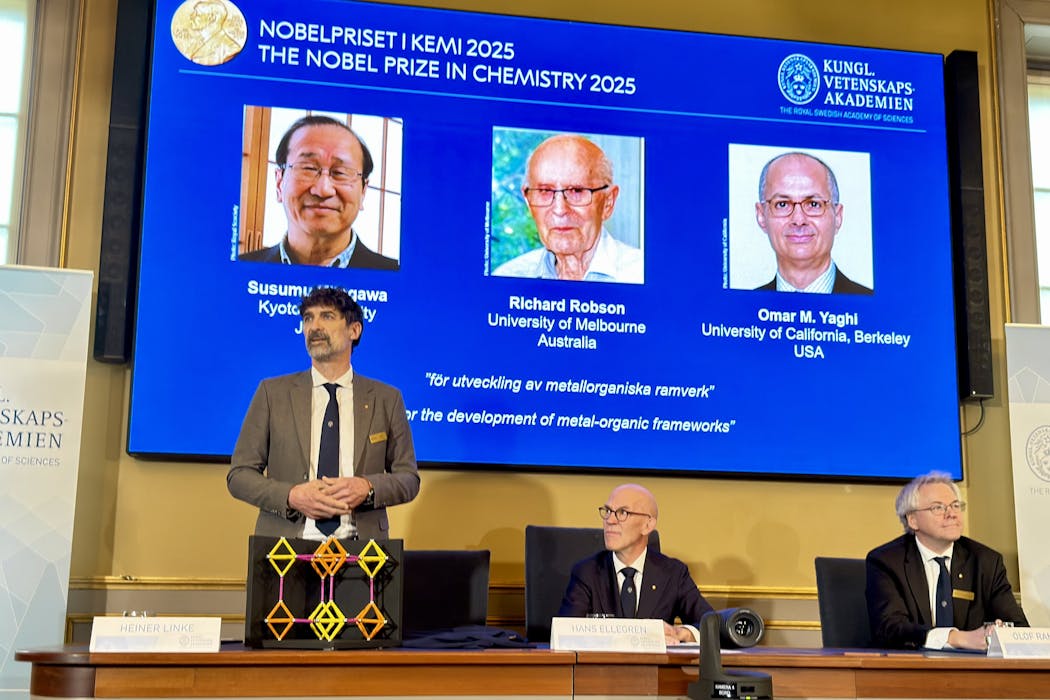
The 2025 Nobel Prize in chemistry was awarded to Richard Robson, Susumu Kitagawa and Omar Yaghi on Oct. 8, 2025, for the development of metal-organic frameworks, or MOFs, which are tunable crystal structures with extremely high porosity. These are a class of materials that have truly changed the way scientists design and think about matter, inspiring progress in various applications.

I’m a MOF scientist and for many of us in the field, this recognition feels both historic and deeply personal. MOFs are not just elegant crystals you’d admire under a microscope; they’re an entire universe of structures, each like a miniature city of tunnels and rooms waiting to be filled. They’ve been my scientific home since I first stepped into research, and they still feel a little bit like magic to me.

So, what exactly are MOFs?

Metal-organic frameworks are like crystalline scaffolds built from two ingredients: metals that act like connective joints and organic – that is, carbon-based – molecules that behave as bridges to link those joints in a repeating pattern. The result is a highly ordered, porous framework – a kind of molecular architecture that’s both sturdy and full of empty space.

A model constructed out of metal bars and spheres, showing a cubic structure with smaller molecule models in the center.
Metal-organic frameworks, shown in this model, can trap smaller molecules inside their larger frame.
Jonathan Nackstrand/AFP via Getty Images

These frameworks are so porous, like sponges with tiny voids, that it’s almost impossible to picture them. One gram of a MOF has so many pores that it can expose as much internal surface area as a soccer field. It’s astonishing that a handful of powder could hide an entire landscape of surface within it.

That enormous surface area is one of the unique things that make MOFs so powerful, and it comes from the nanoscale pores – tiny molecular rooms that can trap, separate, transform or transport gases, ions and other molecules. In a way, MOFs are like molecular hotels with countless doors, each programmed to admit only certain guests.

Why scientists love them

What fascinates me most about metal-organic frameworks is their limitless design space. Just by glancing at the periodic table, every metal could, in principle, serve as a cornerstone, and countless organic molecules can act as bridges connecting them. Even using the same combination can produce entirely different architectures.

Chemist Omar Farha compares metal-organic frameworks to Lego sets that you can build and customize.

So far, scientists have synthesized over 90,000 MOFs, and computational chemists have predicted hundreds of thousands more. Few material families offer this much versatility.

I like to think of MOFs as puzzles or Lego sets, but on the atomic scale. You can replace a single piece, or change its color or shape, and end up with a material that behaves completely differently.

Add a new “decoration” – what chemists call a functional group – and the framework suddenly recognizes a new molecule. Stretch the organic bridges, and the same architecture inflates like a balloon, giving what we call isoreticular MOFs. These have the same structure, but bigger pores. In short, MOFs can come in almost every imaginable shape, size and texture.

Pushing the boundaries of these materials

Beyond their scientific elegance, MOFs are incredibly promising for real-world technologies. Different structures and functionalities lead to different properties and, therefore, different uses.

Some MOFs act as molecular sieves, selectively capturing carbon dioxide from industrial exhaust or even directly from air. Others clean polluted water by removing heavy metals, dyes or “forever chemicals.”

Certain MOFs can also carry drugs or imaging agents inside the body for medical applications. In the energy world, they function as electrodes or electrolytes that make batteries safer and more efficient. And many serve as catalysts, accelerating chemical reactions that transform one molecule into another.

When I began my Ph.D., my senior colleagues warned me that MOFs might be too delicate – beautiful crystals that would crumble at the first hint of air or moisture. And indeed, some of the early frameworks were fragile curiosities, admired more for their elegance than their endurance. But that perception has changed dramatically.

A diagram of molecules arranged in a cube structure, with empty space in each cube.
Metal-organic frameworks, like MOF-5 shown here, have metal components, organic ‘linkers’ and a cavity which can allow in gases.
Tony Boehle/Wikimedia Commons, CC BY-SA

Many MOFs are now remarkably robust. The material I first worked on was a titanium-based metal-organic framework named MIL-125. It was first reported by Gérard Férey, one of the foundational figures in the MOF and porous framework community who sadly died in 2017. MIL-125 was not only stable, it was practically indestructible in my lab. After synthesizing two grams of it, I stored it on my bench in an open vial and used that same batch for every catalytic experiment throughout my Ph.D. No glovebox, no desiccator – just a jar of yellow powder sitting happily on my bench.

That experience taught me something important: While stability can be a legitimate concern, MOFs have grown up. Thanks to smart chemistry, we have materials that can withstand water, heat and repeated use. Since their foundation, researchers around the world have introduced new properties to these materials – from electrical conductivity to light responsiveness – and, crucially, made major progress in scaling up MOF synthesis for industrial applications.

Scaling is the key step in bridging the gap between fundamental discovery and large-scale deployment. Researchers are no longer content with studying MOFs in milligrams – we’re often planning for grams, kilograms and beyond.

Some startups are turning these advances into real technologies – from storing gases more safely, to pulling clean water straight from desert air, to building more energy-efficient air conditioners. What once felt like science fiction – powders that breathe, trap and transform molecules – is now science fact.

Despite these advances, researchers will need to continue improving the stability and scalability of MOFs to fully realize these materials’ potential in the real world.

A Nobel moment that honors creativity

The 2025 Nobel Prize in chemistry goes beyond honoring three remarkable scientists – it celebrates an entire community: a generation of chemists and engineers who transformed a single idea into a thriving field. The pioneering visions of Richard Robson, Susumu Kitagawa and Omar Yaghi laid the foundations for a vibrant discipline that has grown to encompass everything from gas storage and catalysis to energy and environmental technologies.

When I attended my first MOF conference as a second-year Ph.D. student, I listened in awe to many of the pioneers of this field, some of whom are now Nobel laureates. Back then, MOFs felt like magical sponges, and that sense of wonder never left me. It led me to continue my research on conductive MOFs: materials that can carry electricity. Now, in my own research group, we study how these frameworks can make batteries safer and more efficient, and how they can capture waste gases and turn them into useful chemicals using sunlight.

For me, this Nobel Prize celebrates more than a discovery, it celebrates a philosophy: Chemistry is creative, we can design and engineer matter with imagination, and sometimes emptiness can be the very essence of a material.

The Conversation

Stavroula (Alina) Kampouri receives research funding from the American Chemical Society Petroleum Research Fund (ACS PRF) and other public research agencies.

ref. Metal-organic frameworks: Nobel-winning tiny ‘sponge crystals’ with an astonishing amount of inner space – https://theconversation.com/metal-organic-frameworks-nobel-winning-tiny-sponge-crystals-with-an-astonishing-amount-of-inner-space-267089

Toronto Blue Jays: Amid Canada-U.S. tensions, ‘Canada’s team’ is excelling at America’s pastime

Source: The Conversation – Canada – By Noah Eliot Vanderhoeven, PhD Candidate, Political Science, Western University

Amid threats from United States President Donald Trump to make Canada the 51st state, the Toronto Blue Jays’ season started with protocols aimed at avoiding booing during the American national anthem and the removal of someone wearing a “Canada is not for sale hat” at the ballpark.

Nonetheless, the Blue Jays are being heavily marketed as “Canada’s team” as they advance to the American League championship after beating the New York Yankees, America’s most storied baseball team.

Why do the Blue Jays frame themselves as not just Toronto’s team, but Canada’s? And is their current post-season run their biggest and most important opportunity in years to fully establish themselves as representing all of Canada?

Truly Canada’s team?

The Jays serving as Canada’s team may make sense since they’re the only Canadian team currently playing in Major League Baseball (MLB). But to some Canadians, positioning the Jays as the nation’s team may not sit well.

After all, for baseball fans in Québec, memories of the now-defunct Montreal Expos still loom large.

For fans closer to the Windsor-Detroit border, the Detroit Tigers are a more proximate and accessible team.

Finally, some British Columbia MLB enthusiasts — despite the trips Blue Jays fans make to take over T-Mobile Park when the Blue Jays play the Seattle Marinersstill opt to support the Mariners since the team is so much closer than the Blue Jays are in Toronto.

What all this means is that to some Canadian baseball fans, the Blue Jays aren’t really Canada’s team — they’re just Toronto’s.

Huge market

It’s unsurprising that the Toronto Blue Jays organization, owned by Rogers Communications — “proud owner of Canada’s team” — is intent on framing the squad this way because it provides a substantial financial boon. The Jays benefit greatly from being Canada’s team by compelling baseball fans from across the country to attend their games, and most importantly, to watch them on television.

Despite playing north of the border and earning revenues in the weaker Canadian dollar, the Jays operate in one of MLB’s largest markets — Toronto — and can also market to fans across the country. That gives them the largest geographical market in professional baseball — an entire nation.

This massive audience contributes to equally massive television ratings, even at a time when most MLB teams are struggling for regional television revenues. Being “Canada’s team” has also allowed the Blue Jays to spend competitively over the past 10 years and operate a Top 5 payroll, as they have in 2025, alongside other teams in huge markets like Los Angeles and New York.

Cross-border trash-talking

In the midst of the series against the Yankees, Prime Minister Mark Carney met with Trump to discuss trade, tariffs and security. Intitial reports suggested the meeting, held just days after Trump made yet another veiled annexation threat, went well.

But the ongoing backdrop of tense relations between the U.S. and Canada is perhaps echoed by some of the commentary about both teams.

Early in the season, the Yankees’ play-by-play man, Michael Kay, called Toronto “not a first-place team” despite the Blue Jays having just passed the Yankees for first place in the American League East.

In September, Jays colour-commentator and former catcher, Buck Martinez, said that the Yankees were “not a good team.”

Also in September, a Baltimore Orioles television analyst, Brian Roberts, questioned how well Canadians understood baseball, leading to the Blue Jays themselves defending the baseball intelligence of their fans.

There was even a popular hoax online about Trump not inviting the Blue Jays to the White House should they win the World Series — an invite he’s extended to many championship teams in American sports leagues.

Stoking Canadian nationalism

Ultimately, the Blue Jays bested the Yankees and are advancing to the American League championship series. Blue Jays players and their manager, John Schneider, have spoken of the intense atmosphere Blue Jays fans create for their opponents and how the team draws on the support of the entire nation of Canada.

The Jays’ success so far in the post-season in this current political moment — as Trump is once again making veiled threats about making Canada the 51st state during tense trade negotiations — presents the Blue Jays with perhaps their best opportunity to fulfil their role as Canada’s team.

In a season defined by rivalry, politics and national pride, the Blue Jays are proving that even America’s pastime can become a canvas for Canadian nationalism.

The Conversation

Noah Eliot Vanderhoeven does not work for, consult, own shares in or receive funding from any company or organisation that would benefit from this article, and has disclosed no relevant affiliations beyond their academic appointment.

ref. Toronto Blue Jays: Amid Canada-U.S. tensions, ‘Canada’s team’ is excelling at America’s pastime – https://theconversation.com/toronto-blue-jays-amid-canada-u-s-tensions-canadas-team-is-excelling-at-americas-pastime-266882

Organised crime may be infiltrating Timor-Leste’s government. One minister is sounding the alarm

Source: The Conversation – Global Perspectives – By Michael Rose, Adjuct Lecturer, University of Adelaide

Two decades after Timor-Leste gained its independence, the country is a complicated and qualified success story. Poverty and deep economic problems persist, but the country boasts a thriving democracy. Its ascension to the ASEAN regional bloc will come later this month.

As this milestone approaches, however, a senior official with oversight over the national intelligence agency has gone public with explosive claims that Timorese institutions are allegedly being bought by organised crime.

His concerns come after a recent UN report that describes in vivid detail a sophisticated attempt by figures linked to triad gangs in China and Southeast Asia to allegedly establish a base of operations in the Timorese region of Oecusse-Ambeno.

If the allegations are true, they could pose the one of the greatest tests for Timor-Leste in its short history. Is its democracy robust enough to confront the challenge?

Allegations of corruption

Agio Pereira is the Timorese minister of the Presidency of the Council of Ministers. He is one of the most powerful elected officials in his country.

On September 21, Pereira published on Facebook what he called A Manifesto for the Defence of Timor-Leste. In it, he claims to have
“undeniable and damning evidence” that US$45 million (A$68 million) has been brought (in some cases flown) into the country by “transnational criminal syndicates from Cambodia, Malaysia, Macau and Hong Kong”.

He says the money was allegedly used to influence regulatory bodies to grant “fraudulent licences” and set up “protected enclaves” where “illegal gambling, cyber-scam centres and human trafficking would be able to operate under state protection”.

He said the country faces a simple choice:

Will we be a sovereign nation governed by democratic laws and institutions, or will we become a criminal state owned by foreign mafia syndicates?

Pereira also listed numerous demands, including:

  • the revocation of any licences that may have been granted to criminal networks
  • government cooperation with international law enforcement to dismantle the networks
  • an investigation of all officials who have allegedly taken any money.

Pereira did not provide any evidence in the post to back up his claims, but especially given his status and oversight of the national intelligence service, many are taking his claims seriously.

In response to the allegations, President José Ramos-Horta told me via WhatsApp:

I always said Timor-Leste does not have homegrown organised crime. […] But Timor-Leste, being still a fragile country, is very attractive to organised crime from Asia.

I have full confidence in our authorities with support from Australian Federal Police and from Indonesian police in tackling the challenges by organised crime.

Prime Minister Xanana Gusmao also took a measured response to the allegations. He told local media Pereira would be given a chance to raise the issue with the government directly.

On October 1, he was given his chance, addressing a meeting of Timor-Leste’s Counsel of Ministers. This resulted in the swift approval of a draft resolution cancelling all existing licences granted for online gambling and betting operations and prohibiting any new licences from being issued.

But Pereira’s other key demand – an investigation into officials accused of taking money from organised crime syndicates – appears not to have been addressed.

Scammers taking root

Cyber-scammming is a booming industry in Southeast Asia, bringing in billions of dollars in revenue annually.

Illegal gambling and scam centres have proliferated in recent years in “special economic zones” in Cambodia, Laos, Myanmar and the Philippines. The organised crime groups behind them are constantly looking for new bases of operations where local officials can be persuaded to look the other way, or lack the capacity to stop them.

Although Timor-Leste is small, it’s important due to its strategic location (just a 1.5-hour flight from Darwin) and the fact Australia and its allies are increasingly competing for influence there with China. Australia cannot afford to ignore any threat to the security of a fledgling democracy on its doorstep.

Pereira’s manifesto came in the wake of an August 25 raid on a suspected scam centre in Oecusse-Ambeno, where 30 foreign nationals from Indonesia, Malaysia and China were detained. The head of the regional government, Rogerio Lobato, was given notice two days later.

Oecusse, as it’s commonly known, is a rugged coastal exclave on the western half of Timor island, surrounded by Indonesia. Once extremely isolated, Oecusse was granted autonomy in 2014 and a special economic zone was established to spur foreign investment.

The report from the UN Office on Drugs and Crime in September described how organised crime groups took advantage of the region’s loose regulatory structures late last year to allegedly establish an “Oecusse Digital Centre”. It reads:

The Special Administrative Region of Oecusse-Ambeno (RAEOA), Timor-Leste appears to have already been targeted by criminal networks through FDI [foreign direct investment].

As Timor-Leste prepares to join ASEAN in October 2025, the reported infiltration of RAEOA and its national ID system by convicted cybercriminals poses a serious security risk.

The report notes that Timor-Leste shares “stark similarities” with the development of the scam industry in Cambodia, Laos and the Philippines, which have now become notorious hubs for cyber fraud, drug trafficking and human trafficking.

In his message to me, Ramos-Horta declined to address the allegations surfaced by the UN report, saying:

I know well the work of UN agencies. They should focus more on solid research and less on allegations against individuals because this is not their mandate.

In his manifesto, Pereira appears to suggest operations like the one recently raided in Oecusse are made possible through the bribery of Timorese officials. He says directly this influence is occurring on a scale that risks state capture.

Reactions to Pereira’s allegations

It’s unclear why Pereira chose to appeal directly to the people rather than take his concerns to others in the government.

Nelson Belo, director of the civil society and security monitoring organisation Fundasaun Mahein, criticised Pereira’s choice to go public. He said as a minister, he should “lead and act within the law”.

Belo’s group had also recently warned of the risks transnational organised crime groups could pose to the country.

Abel Pires, a former government minister and former member of Timor-Leste’s Council of Defence and Security, had a different view.

He reasoned that because “the problem may involve too many people within the system”, Pereira might have had no choice but to go public.

He also called the cancellation of gambling licences a positive step, but said there must be an independent investigation into Pereira’s allegations.

On the street, the allegations have fed into frustration with official greed and incompetence, which fuelled recent student demonstrations against government waste.

That a leading minister felt he needed to go public with the accusations to have them taken seriously by his own government is telling.

The potential subversion of Timor-Leste’s institutions by organised crime is a serious threat to the country’s security. Its government – as well as Australia’s – would do well to pay heed.

The Conversation

Michael Rose does not work for, consult, own shares in or receive funding from any company or organisation that would benefit from this article, and has disclosed no relevant affiliations beyond their academic appointment.

ref. Organised crime may be infiltrating Timor-Leste’s government. One minister is sounding the alarm – https://theconversation.com/organised-crime-may-be-infiltrating-timor-lestes-government-one-minister-is-sounding-the-alarm-265879

Nobel Prize in physics awarded for ultracold electronics research that launched a quantum technology

Source: The Conversation – USA – By Eli Levenson-Falk, Associate Professor of Physics and Astronomy and Electrical and Computer Engineering, USC Dornsife College of Letters, Arts and Sciences

The quantum behavior of superconducting circuits like the small white square above was a major discovery. K. Cicak and R. Simmonds/NIST

Quantum mechanics describes the weird behavior of microscopic particles. Using quantum systems to perform computation promises to allow researchers to solve problems in areas from chemistry to cryptography that have so many possible solutions that they are beyond the capabilities of even the most powerful nonquantum computers possible.

Quantum computing depends on researchers developing practical quantum technologies. Superconducting electrical circuits are a promising technology, but not so long ago it was unclear whether they even showed quantum behavior. The 2025 Nobel Prize in physics was awarded to three scientists for their work demonstrating that quantum effects persist even in large electrical circuits, which has enabled the development of practical quantum technologies.

I’m a physicist who studies superconducting circuits for quantum computing and other uses. The work in my field stems from the groundbreaking research the Nobel laureates conducted.

Big, cold, quantum

In their 1984 and 1985 work, then-Ph.D. student John Martinis, then-postdoctoral researcher Michel Devoret and UC Berkeley professor John Clarke showed that even large electrical circuits could exhibit quantum behavior. They used a circuit made from niobium and lead. When cooled to a few degrees above absolute zero, these metals become superconductors. A superconductor is a material that carries a current without generating any heat.

Martinis, Devoret and Clarke showed that in a superconductor, the voltages and currents are governed by quantum mechanics. The circuit has quantized – meaning discrete and indivisible – levels of energy, and it can be in superpositions of multiple states.

Any physical system can be described by a state, which tells you everything there is to know about that system. Quantum mechanics shows that a state can have certain quantized values of things that can be measured. An example is energy: A particular system could have energy 1 or energy 2, but nothing in between. At the same time, a quantum system can be in a superposition of more than one state, much like you can add different amounts of red/green/blue to get any color in a pixel of an image.

Importantly, the laureates showed that researchers can describe one of these superconducting circuits as if it’s a single quantum particle. This simple behavior is what makes superconducting circuits so useful as a technology.

four parallel brass-colored rings connected by vertical tubes
Dilution refrigerators like this chill their contents to near-absolute zero.
U.S. Air Force Research Laboratory

Today, superconducting circuits are used to study fundamental quantum physics, to simulate other physical systems and to test protocols for ultraprecise sensing. For instance, the Devoret group recently demonstrated a near-ideal microwave amplifier based on a superconducting circuit. Microwave amplifiers are widely used in communications, radar and scientific instruments.

The Martinis group has used superconducting circuits to emulate a group of electron-like particles. This type of simulation is a key technique in studying fundamental physics.

In my own group, we recently used a superconducting circuit to demonstrate a protocol for measuring a magnetic field more sensitively than standard techniques. Quantum sensors measure physical quantities with extreme precision, from biological activity to gravity anomalies.

But by far the biggest application of superconducting circuits is as a platform for quantum computing.

Superconducting quantum computers

Multiple quantum systems can interact with each other and become entangled, so that they act like a single system. This combination of quantization, superposition and entanglement is what gives quantum computers their power.

In quantum computing technology, researchers use a quantum system – a quantum bit or qubit – that can be in only two states. Qubits need to be coherent. This means that if we put it in a particular state, we want it to stay there and not get randomly scrambled to another state. Qubits need to be controllable. This means that researchers should be able to get a qubit to change state as needed and get it to interact with other qubits. And qubits need to be scalable, meaning that we need to make a lot of them.

Many technologies show promise, such as arrays of atoms in a vacuum, trapped ions, trapped electrons in seminconductors, and photons controlled by optical circuits. But all technologies make trade-offs, sacrificing coherence, controllability or scalability to improve something else.

The simplicity and flexibility of superconducting circuits mean that by changing the design of the circuit, researchers can get almost any qubit behavior we want, and that behavior is easy to predict. This hits the technological sweet spot for quantum computing. More obviously quantum technologies, such as trapped atoms, are so small that they can be hard to control and interact with. Superconducting qubits are big enough to be easy to control, simple enough to be reliable and quantum enough to make the whole thing work.

Today, academic research groups like mine develop new types of superconducting qubits, look for ways to make them more coherent, try to improve our control of them, and develop techniques to make them easier to scale up. Companies and government labs take these academic results along with their own basic research and apply them, doing the difficult engineering to create large-scale quantum processors for practical use.

Superconductor pioneers

Unsurprisingly, the Nobel laureates made and continue to make huge contributions beyond their work in the 1980s. In addition to their academic work, Martinis formerly headed the Google quantum processor effort and now has his own company, while Devoret now assists with the Google effort. Clarke, now retired, also did much of his late-career work on quantum circuits. And they have had major impacts on my career and on so many others.

I had the privilege to do a panel discussion with Devoret on May 22, 2025. He made a memorable claim: Picking an academic adviser can be even more of a big deal than picking a spouse, because “you can’t divorce your adviser.”

It’s often joked that half the researchers in the field of quantum superconductors can trace an academic lineage to Clarke. I can do it twice: My Ph.D. adviser, Irfan Siddiqi, was advised by Devoret, and Clarke was my secondary adviser. And one of my proudest accomplishments as a grad student was not panicking when Martinis snagged me after I gave a talk to grill me on the details.

Today they are honored for their work, and tomorrow I and the other researchers they trained will do our best to continue it.

The Conversation

Eli Levenson-Falk does not work for, consult, own shares in or receive funding from any company or organization that would benefit from this article, and has disclosed no relevant affiliations beyond their academic appointment.

ref. Nobel Prize in physics awarded for ultracold electronics research that launched a quantum technology – https://theconversation.com/nobel-prize-in-physics-awarded-for-ultracold-electronics-research-that-launched-a-quantum-technology-266979

How employers can promote physical activity among workers: 3 messages based on research

Source: The Conversation – Canada – By Aviroop Biswas, Assistant professor, University of Toronto

We all know about the benefits of physical activity — not just to reduce the risks of chronic disease and physical injuries but also to improve mental health and productivity at work. But many people just don’t get as much physical activity as they should.

The World Health Organization’s physical activity guidelines recommend adults strive for 150 to 300 minutes of moderately intense aerobic physical activity every week, or 75 to 150 minutes if the physical activity is vigorous.

Given the amount of time many people spend working, getting more physical activity at work and/or during commutes to and from work might make these goals more feasible for working people.

Evidence-based strategies for employers

My research conducted with colleagues at the Institute for Work and Health, an independent non-profit research institute, illustrates the many ways employers can play a role to encourage this part of a healthy lifestyle. Even small changes, such as encouraging workers to move more than they currently do, can yield meaningful heart health benefits.

Offering a range of physical activity options, from structured programs to pleasant walking spaces, can be motivating for a wide range of employees. Even fostering an environment that helps employees mentally disconnect from work for a short time can make it easier for them to engage in healthy behaviours.

Below are strategies employers can use to promote physical activity among workers, based on IWH research studies.

1. Promoting physical activity throughout the day

Employers can encourage workers to make it part of their workday routine to head to the gym before going to work or go on a run during their lunch hour.

To reinforce that message, our research shows that workplaces can offer a range of programs and amenities. These include access to a pleasant place to walk, jog or bike; access to a field or open space for ball games or other sports; a nearby gym or fitness centre; organized fitness classes; organized recreational sports teams; showers and/or change rooms; and programs to improve health, fitness or nutrition.

In our large study based on data from about 60,000 people (a sample chosen to be representative of the makeup of the Canadian population), those who said that their workplaces offered all of the programs and amenities listed above were twice as likely to be active as those who were offered none. They were also 1.5 times as likely to be moderately active.

Although such a buffet of offerings may seem out of reach for employers, a large group of workers — 25 per cent of the study sample — reported having all these offerings at or near their workplaces. We also found that people were more likely to be physically active when they had access to any combination of the above, compared to having none of the above.

When highlighting the benefits of a rewards package to potential employees, workplaces might want to showcase environmental features such as nearby parks and gyms as well as programs and amenities. All have been found to promote physical activity.

2. Emphasizing that every bit of movement counts

Workplace wellness advocates know that some workers are already committed workout aficionados who need no convincing. In another study focused on how workers actually move throughout the day, we found that exercise buffs made up one in 10 workers in a sample of more than 8,000 individuals (a sample that was also representative of the Canadian working population).

As part of our research findings, compared to the sedentary workers who sit most of the day (and who make up about three in 10 Canadian workers), these exercisers have a 42 per cent lower risk of developing heart disease over 10 years.

But here’s the good news: we also found 50 per cent of the working population fall somewhere between these two extremes in how much they move throughout the workday.

Think of the sales associates who don’t sit still for long at work or the nurses who do a mix of desk duties and highly physical tasks. These workers all have lower heart disease risks compared to the deskbound workers.

We should note one important exception from our research study, which is the group of workers who do strenuous, physical work all through the workday — for example, construction workers. Workers in this group — about one in 10 of the labour force — have the same heart health risks as sedentary workers. That’s because heavy, continuous exertion can place stress on the body, potentially raising blood pressure and counteracting the typical benefits of physical activity.

But for everyone else, the message from our study is that every little bit of movement counts in terms of lowering workers’ odds of developing heart disease.

3. Tapping into internal champions

One of our ongoing studies at the Institute for Work and Health suggests that workplace wellness champions can be powerful motivators. These can be formally designated advocates like wellness leads or human resources staff, but they can also be informal proponents — individuals who are genuinely and spontaneously passionate about healthy living.

Our study suggests that the informal champions tend be more trusted by colleagues and therefore more effective as motivators, but because they typically do this champion work on the side, they can run the risk of burnout.

Our message to employers is they should identify and support champions within their organizations, both formal and informal, by recognizing the value they bring to building a healthier workplace and equipping them with resources they need.

The importance of upstream factors

No matter what or how many initiatives are put in place to promote wellness, employers also need to look beyond individual behaviour and motivation if they want to encourage a physically active lifestyle among their employees. They have to recognize that upstream factors play a role in shaping individuals’ exercise choices. These include factors related to people’s working conditions.

Employers need to ask themselves: do their employees feel they can disconnect from work for 20 minutes to go for a walk? Do only certain employees (for example, the managers and high-performers) have the flexibility to join the company ball team? If the organization highlights the gyms and fitness clubs in the neighbourhood as one of the appeals of working there, can everyone afford the membership fees?

In short, while everyone would agree a more physically active lifestyle is important, employers may need to take a hard look at how workload, work flexibility, supervisor support and other psychosocial work factors contribute to motivating or disincentivizing a physically active lifestyle among their employees.

The payoff is worth it. Active workers are less likely to develop chronic diseases, are more resilient to stress and more engaged in their work. This translates into fewer absences, better performance and higher job satisfaction. By making it easier for employees to move during the day, employers can support a healthier workforce.

The Conversation

Aviroop Biswas receives funding from the Social Sciences and Humanities Research Council and the Canadian Institutes for Health Research. The Institute for Work & Health is supported in part through funding from the Ontario Ministry of Labour, Immigration, Training and Skills Development. He is also the President of the Canadian Association for Research on Work & Health.

ref. How employers can promote physical activity among workers: 3 messages based on research – https://theconversation.com/how-employers-can-promote-physical-activity-among-workers-3-messages-based-on-research-259897

For Trump’s perceived enemies, the process may be the punishment

Source: The Conversation – USA – By Paul M. Collins Jr., Professor of Legal Studies and Political Science, UMass Amherst

The costs – in time and money – may be incredibly significant for those targeted by the Trump administration. wenjin chen/DigitalVision Vectors via Getty Images

Former FBI Director James Comey pleaded not guilty to two criminal charges in a federal court in Alexandria, Virginia, on Oct. 8, 2025. The charges allege that Comey lied to Congress in September 2020 when he stood by earlier testimony that he did not authorize a leak of an FBI investigation involving Hillary Clinton.

Numerous legal commentators on both the left and right have argued that Comey’s indictment is little more than the Trump administration seeking vengeance on one of the president’s perceived enemies. They allege that the president has it out for Comey, who investigated Russian interference in the 2016 presidential election and was fired by Trump in 2017.

The president’s own words support the idea that the Trump administration is targeting Comey. In a social media post on Sept. 20, 2025, Trump directed Attorney General Pam Bondi to move forward with prosecutions against Comey, Democratic U.S. Sen. Adam Schiff and New York Attorney General Letitia James: “They’re all guilty as hell, but nothing is going to be done. …JUSTICE MUST BE SERVED, NOW!!!”

If the case against Comey is exceedingly weak – and little more than a political prosecution – then, in my view as a scholar of the U.S. legal system, it should result in the dismissal of charges by the judge or a not guilty verdict by the jury.

But even when an individual is not convicted, the process of defending against charges can itself be a form of punishment, as renowned legal scholar Malcolm Feeley pointed out almost 50 years ago.

Here’s how the criminal justice process punishes even innocent people.

The criminal justice process

The criminal justice process is complex.

After a grand jury returns an indictment at the request of a prosecutor, the accused appears in court for their arraignment. They are informed of the charges against them and typically enter a plea.

During what’s called “discovery,” the prosecution and defense investigate the evidence the other side plans to rely on. There are also pretrial motions in which the parties ask judges to dismiss charges and accept or exclude evidence.

The defense and prosecution may also meet to discuss a plea bargain, wherein the accused may plead guilty in exchange for a lesser sentence or reduced charges.

If there is no plea bargain, then the case moves to trial, which is itself a complicated process. If a defendant is found guilty, they can mount an appeal to higher courts in an attempt to have their conviction overturned.

To help navigate this process, criminal defendants typically hire a lawyer.

And good lawyers don’t come cheap.

Money and time

Indigent defendants, who do not have the financial resources to pay their own legal fees, can rely on public defenders paid for by the government.

But individuals who can afford to pay for their own lawyer face a substantial financial burden for attorney services and court fees. An experienced criminal defense lawyer can charge more than US$1,000 per hour, with fees quickly adding up. This means that mounting a legal defense can easily cost tens of thousands of dollars.

On top of this, it takes a great deal of time to prepare for a criminal case. While lawyers and their staff do much of the legwork for trial preparation, a client works with their attorneys to help formulate a defense.

As a result, criminal defendants lose one of the most precious commodities in the world: their time.

And this time can come at a tangible cost in the form of lost wages, which harms their day-to-day lives. Put simply, every hour spent preparing for trial is an hour defendants could spend working or enjoying their lives.

Three women holding each other as they stand outside.
Patrice Failor, center, wife of former FBI Director James Comey, is embraced by daughters Claire Comey, left, and Maurene Comey at the courthouse in Alexandria, Va., where James Comey was arraigned and pleaded not guilty on Oct. 8, 2025.
Chip Somodevilla/Getty Images

Stress and embarrassment

It’s not pleasant being charged with a crime.

The criminal process, which typically lasts months, takes a toll on one’s mental health. This is largely driven by the uncertainty surrounding the outcome of a criminal trial and the possibility of losing one’s freedom if convicted.

In addition, there is a social stigma that comes with being accused of a crime. This can result in reputational damage, anxiety and embarrassment.

The Trump administration appears to recognize this reality.

Several media outlets have reported that FBI leadership had planned a public perp walk for Comey.

According to a CBS News report, this was to have included “‘large, beefy’ agents … ‘in full kit,’ including Kevlar vests and exterior wear emblazoned with the FBI logo.” Apparently, the plan was aborted after several FBI supervisors refused to cooperate, viewing it as inappropriate. One agent was disciplined for insubordination after refusing to go along with the plan to embarrass Comey in this way.

Not all criminal defendants suffer the same

The extent to which criminal defendants experience the criminal justice process as a form of punishment varies from person to person.

For high-status people like Comey, lost wages and attorneys’ and court fees may not be that big of a deal.

But these costs may be incredibly significant for other people who have been, or are likely to be, targeted by the Trump administration.

The high costs of lawyers’ fees are well known to the president. For instance, his political action committee spent millions of dollars on attorneys’ fees in an unsuccessful effort to defend Trump from criminal charges in New York.

In addition, people no doubt experience the psychological stress and stigma of a possible criminal conviction differently. But regardless of one’s wealth, the lost time spent preparing a criminal defense is something that cannot be replaced.

The recognition that the criminal process is itself a form of punishment is one of the reasons that the Department of Justice has maintained independence from the president. By violating the tradition of staying out of politics, the Justice Department in the Trump administration has opened the door for the president to seek retribution on his perceived political enemies.

The mere act of putting them through the criminal process ensures that they suffer, regardless of their guilt or innocence.

The Conversation

Paul M. Collins Jr. does not work for, consult, own shares in or receive funding from any company or organization that would benefit from this article, and has disclosed no relevant affiliations beyond their academic appointment.

ref. For Trump’s perceived enemies, the process may be the punishment – https://theconversation.com/for-trumps-perceived-enemies-the-process-may-be-the-punishment-266747