The new president of The Church of Jesus Christ of Latter-day Saints will inherit a global faith far more diverse than many realize

Source: The Conversation – USA (3) – By Brittany Romanello, Assistant Professor of Sociology, University of Arkansas
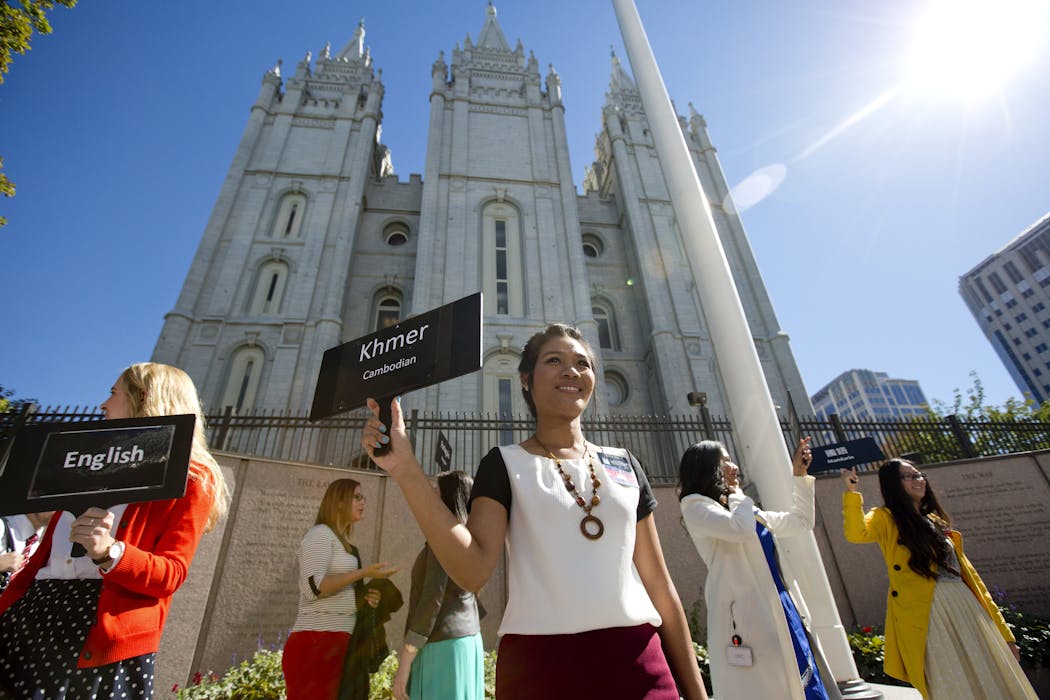
Missionary Sayon Ang holds up a sign signifying she speaks Cambodian during the twice-annual conference of The Church of Jesus Christ of Latter-day Saints on Oct. 4, 2014, in Salt Lake City. AP Photo/Kim Raff

The Church of Jesus Christ of Latter-day Saints has spent the past few weeks in a moment of both mourning and transition. On Sept. 28, 2025, a shooting and arson at a Latter-day Saints meetinghouse in Michigan killed four people and wounded eight more. What’s more, Russell M. Nelson, president of the church, died the day before at age 101. Based on protocol, his role will most likely be filled by Dallin H. Oaks, the longest-serving of the church’s top leaders.

The next president will inherit leadership of a religious institution that is both deeply American and increasingly global – diversity at odds with the way it’s typically represented in mainstream media, from “The Secret Life of Mormon Wives” to “The Book of Mormon” Broadway musical.

As a cultural anthropologist and ethnographer, I research Latter-day Saints communities across the United States, particularly Latina immigrants and young adults. When presenting my research, I’ve noticed that many people still closely associate the church with Utah, where its headquarters are located.

An ornate white building with a tall spire, and green mountains in the background.
The Latter-day Saints temple in Cochabamba, Bolivia, was dedicated in 2000.
Parallelepiped09/Wikimedia Commons, CC BY-SA

The church has played a pivotal role in Utah’s history and culture. Today, though, only 42% of its residents are members. The stereotype of Latter-day Saints as mostly white, conservative Americans is just one of many long-standing misconceptions about LDS communities and beliefs.

Many people are surprised to learn there are vibrant congregations far from the American West’s “Mormon Corridor.” There are devout Latter-day Saints everywhere from Ghana and the United Arab Emirates to Russia and mainland China.

Global growth

Joseph Smith founded The Church of Jesus Christ of Latter-day Saints in upstate New York in 1830 and immediately sent missionaries to preach along the frontier. The first overseas missionaries traveled to England in 1837.

Shortly after World War II, church leaders overhauled their missionary approach to increase the number of international missions. This strategy led to growth across the globe, especially in Central America, South America and the Pacific Islands.

Today, the church has over 17.5 million members, according to church records. A majority live outside the U.S., spread across more than 160 countries.

One way the church and researchers track this global growth is by construction of new temples.These buildings, used not for weekly worship but special ceremonies like weddings, were once almost exclusively located in the United States. Today, they exist in dozens of countries, from Argentina to Tonga.

During Nelson’s presidency, which began in 2018, he announced 200 new temples, more than any of his predecessors. Temples are a physical and symbolic representation of the church’s commitment to being a global religion, although cultural tensions remain.

Two men in suits walk by a large map of the world framed on the wall of a hallway.
Two missionaries for The Church of Jesus Christ of Latter-day Saints walk through the Missionary Training Center in Provo, Utah, in 2008.
AP Photo/George Frey

Among U.S. members, demographics are also shifting. Seventy-two percent of American members are white, down from 85% in 2007, according to the Pew Research Center. Growing numbers of Latinos – 12% of U.S. members – have played a significant role sustaining congregations across the country.

There are congregations in every U.S. state, including the small community of Grand Blanc, Michigan, site of the tragic shooting. Suspect Thomas Jacob Sanford, who was fatally shot by police, had gone on a recent tirade against Latter-day Saints during a conversation with a local political candidate.

In the following days, an American member of the church raised hundreds of thousands of dollars for Sanford’s family.

Growing pains

Despite the church’s diversity, its institutional foundations remain firmly rooted in the United States. The top leadership bodies are still composed almost entirely of white men, and most are American-born.

As the church continues to grow, questions arise about how well the norms of a Utah-based church fit the realities of members in Manila or Mexico City, Bangalore or Berlin. How much room is there, even in U.S. congregations, for local cultural expressions of faith?

Latino Latter-day Saints and members in Latin America, for example, have faced pushback against cultural traditions that were seen as distinctly “not LDS,” such as making altars and giving offerings during Dia de los Muertos. In 2021, the church launched a Spanish-language campaign using Day of the Dead imagery to increase interest among Latinos. Many members were happy to see this representation. Still, some women I spoke with said that an emphasis on whiteness and American nationalism, as well as anti-immigrant rhetoric they’d heard from other members, deterred them from fully celebrating their cultures.

A couple dressed nicely and holding hands walks by a large portrait of Jesus, portrayed as a bearded white man, inside a large hallway.
People attend the twice-annual conference of The Church of Jesus Christ of Latter-day Saints on April 6, 2024, in Salt Lake City.
AP Photo/Rick Bowmer

Even aesthetic details, like musical styles, often reflect a distinctly American model. The standardized hymnal, for example, contains patriotic songs like “America the Beautiful.” This emphasis on American culture can feel especially out of sync in places in countries with high membership rates that have histories of U.S. military or political interventions.

Expectations about clothing and physical appearance, too, have prompted questions about representation, belonging and authority. It was only in 2024, for instance, that the church offered members in humid areas sleeveless versions of the sacred garments Latter-day Saints wear under clothing as a reminder of their faith.

Historically, the church viewed tattoos as taboo – a violation of the sanctity of the body. Many parts of the world have thousands of years of sacred tattooing traditions – including Oceania, which has high rates of church membership.

Change ahead?

Among many challenges, the next president of the church will navigate how to lead a global church from its American headquarters – a church that continues to be misunderstood and stereotyped, sometimes to the point of violence.

A white building in the distance, with palm trees and a clear reflecting pool in the foreground.
The temple in Laie, Hawaii, opened in the early 1900s, making it one of the church’s oldest.
Kaveh/Wikimedia Commons, CC BY-SA

The number of Latter-day Saints continues to grow in many parts of the world, but this growth brings a greater need for cultural sensitivity. The church, historically very uniform in its efforts to standardize Latter-day Saints history, art and teachings, is finding that harder to maintain when congregations span dozens of countries, languages, customs and histories.

Organizing the church like a corporation, with a top-down decision-making process, can also make it difficult to address painful racial histories and the needs of marginalized groups, like LGBTQ+ members.

The transition in leadership offers an opportunity not only for the church but for the broader public to better understand the multifaceted, global nature of Latter-day Saints’ lives today.

The Conversation

Brittany Romanello does not work for, consult, own shares in or receive funding from any company or organization that would benefit from this article, and has disclosed no relevant affiliations beyond their academic appointment.

ref. The new president of The Church of Jesus Christ of Latter-day Saints will inherit a global faith far more diverse than many realize – https://theconversation.com/the-new-president-of-the-church-of-jesus-christ-of-latter-day-saints-will-inherit-a-global-faith-far-more-diverse-than-many-realize-266337

Political violence: What can happen when First Amendment free speech meets Second Amendment gun rights

Source: The Conversation – USA – By Gregory P. Magarian, Thomas and Karole Green Professor of Law, Washington University in St. Louis

The proliferation of guns in the U.S. can elevate political rhetoric to political violence. Douglas Sacha, Moment/Getty Images

The assassination in September 2025 of conservative activist Charlie Kirk has heightened attention on the relationship between political rhetoric and political violence.

Even before police had identified a suspect, President Donald Trump blamed the shooting on the “rhetoric” of the “radical left.” The Trump administration has since acted to silence left-leaning speakers and is threatening to intensify its attacks on left-wing political speech.

But my decades of studying free speech law have convinced me that suppressing political rhetoric, even through social norms rather than law, undermines the discussion, debate and constructive disagreement essential for a healthy democracy.

Gun proliferation complicates the problem by making political violence much easier to carry out.

Rise of political violence

Political violence – by which I mean any physical attack on people that aims to achieve a political goal – harms democracy by shifting the field of political disagreement from debate to aggression.

Under the U.S. constitutional system of limited government and individual rights, political violence by the government – for example, government assaults on anti-government protesters – is among the gravest threats to liberty.

But political violence committed by private individuals or groups also corrodes constitutional democracy. In the United States, acts of private political violence against members of government and against ordinary people have both increased dramatically in recent years.

Political assassinations are the most vivid form of political violence. The Kirk assassination is only the latest example.

An attendee wears a gun on their hip during a candlelight vigil and prayer event at which an American flag is displayed.
An attendee at a candlelight vigil and prayer event for assassinated Turning Point USA Founder Charlie Kirk on Sept. 10, 2025, in Seattle.
David Ryder/Getty Images

In June 2025, a shooter with a “hit list” of left-liberal targets assassinated Minnesota Democratic Rep. Melissa Hortman and her husband. In December 2024, a shooter angry about health insurance costs killed United Healthcare CEO Brian Thompson. In July 2024, a shooter wounded Trump at a campaign rally in a failed assassination attempt.

Political violence also includes bias-motivated murders. In 2022, a white supremacist murdered 10 Black patrons at a grocery store in Buffalo, N.Y. In 2019, an anti-immigrant racist murdered 23 mostly Latino shoppers at a Wal-Mart in El Paso, Texas. In 2018, an antisemite murdered 11 congregants at a Pittsburgh synagogue.

In those incidents and numerous others, extreme political ideas appear to have motivated the attackers. The linkage of extremist speech to lethal violence has prompted calls to legally restrict or punish extremist speech.

Political violence, free speech and cultural editing

The First Amendment, however, protects extremist speech, including advocacy of violence. Violent rhetoric must actually incite or threaten violence to lose the First Amendment’s shelter.

If law cannot curb the sorts of speech that may inspire political violence, what about social norms – widely shared beliefs about what speech is socially acceptable or appropriate?

Much speech that the First Amendment protects from government regulation eventually disappears from public discourse. That happens through a process I call “cultural editing”: popular and institutional rejection of outmoded or repellent ideas. For example, no serious medical conference discusses treating hay fever with cocaine, and no respectable political science panel includes Nazis.

In a social media post after Charlie Kirk’s killing, President Donald Trump blamed ‘radical left’ rhetoric for political violence.

The Trump administration’s blaming of the Kirk assassination on “radical left” rhetoric points toward a deeper level of cultural editing.

Trump and other conservatives have not cited speech that advocated violence against Kirk. Instead, some conservative activists, spurred on by Trump administration officials, called for harassing and punishing critics of Kirk’s statements and actions.

But such criticisms of Kirk, whatever their merits or lack thereof, fall within the scope of ordinary political debate.

Kirk was not a government official, but he had strong influence in the Trump administration. Robust democratic discourse requires space for people to criticize such powerful figures. Large-scale cultural editing of those criticisms, amounting to suppression of left-leaning views, would hurt the public’s ability to discuss and resolve political disagreements.

However, Trump and others who push for suppressing harsh political rhetoric might argue that the stakes of verbal attacks have increased. They might say that U.S. political culture can no longer indulge political invective because political violence has become more common.

Political violence and guns

That argument for suppressing harsh political speech ignores an independent cause of political violence: gun proliferation.

Most political violence in the U.S. involves guns. Guns make political violence easier by erasing the distance between extremist ideas and lethal action. Hate or fanaticism can end a life in an instant, hundreds of yards from the victim.

The U.S. has by far the highest number of civilian guns and rate of civilian gun ownership in the world. Since 2008, when the Supreme Court declared an individual Second Amendment right to keep and bear arms, annual U.S. gun purchases have increased from about 9 million to about 16 million.

Governments often find regulating speech easier, even though less effective, than tackling underlying problems. At times, federal and state governments have addressed political violence by regulating guns. The 1994 federal assault weapons ban exemplifies regulatory efforts to curb overall gun violence.

But the Supreme Court’s Second Amendment cases now appear to bar strong gun regulations.

People in a democratic society need freedom to make harsh, even extreme political statements with a minimum of cultural editing. The Second Amendment protects access to lethal weapons. This combination of free speech and gun rights makes the growing problem of political violence much harder to solve.

The Conversation

Gregory P. Magarian does not work for, consult, own shares in or receive funding from any company or organization that would benefit from this article, and has disclosed no relevant affiliations beyond their academic appointment.

ref. Political violence: What can happen when First Amendment free speech meets Second Amendment gun rights – https://theconversation.com/political-violence-what-can-happen-when-first-amendment-free-speech-meets-second-amendment-gun-rights-265223

Kerouac’s Road: The Beat of A Nation – this documentary can’t reconcile nostalgia with the true contemporary US

Source: The Conversation – UK – By Michael Collins, Reader in American Studies and Chair of The British Association for American Studies, King’s College London

When Jack Kerouac published On the Road in 1957, he presented the novel as the product of a single marathon writing binge. It was a method he had been working on since the late 1940s that his friend Allen Ginsberg dubbed “spontaneous bop prosody”.

Despite the manuscript actually being a synthesis of years of ten years of notes and fragments (as this film shows), the press went mad for the myth of spontaneous prose. What could be more exciting at the height of the cold war than presenting the US as the place of ultimate freedom and possibility, something apparently unavailable to non-western or socialist nations?

On the Road seemed to be an organic, undiluted product of America. It poured out raw and thick from the mind of a man whose voice was marketed as a synthesis of the repressed forces that lay buried beneath the veneer of American postwar prosperity. The US “culture industry” burned heavy diesel in the promotion of Kerouac.

There were naysayers. Other writers like Truman Capote loathed the book. Of the Beat generation in general he once quipped: “None of them can write, not even Mr Kerouac … [it] isn’t writing at all – it’s typing”.

There were also many conservative critics that denounced the work’s sexual morality. But here was the cleverness of the “culture industry”. These critics could be rendered as an older cultural elite unable to grasp the significance of the novel. Or even as dried-up husks of an obsolescent religious right. This was the late fifties; a new world was coming. Better get off the freeway if you can’t stand the speed.

The trailer for Kerouac’s Road: The Beat of A Nation.

However much his fans might cling to this vision of the novel, Kerouac does not have the reputation now he did in the 1960s and 1970s. Waves of feminist criticism, ecological theory and a more cautious stance in literary culture toward the American political project have left him something of a fossil.

It is intriguing, therefore, to see the director of Kerouac’s Road, Ebs Burnough (former deputy social secretary to the Obama White House), return to this mythologisation of the American open road. Does something of Kerouac’s Americana still exist, the film asks, in the era of Black Lives Matter (BLM), of militarised police, at a time when those conservatives who were once so easy to denounce have taken control of the public discourse?

Burnough’s film attempts to synthesise two competing narratives that do not quite hold together. First, it’s a strong (if not wholly original) account of the reception of Kerouac’s novel and the author himself. It uses interviews with celebrity fans, the American writer Joyce Johnson (a former girlfriend of Kerouac’s who has superb things to say about life for the “Beat” women) and Kerouac’s biographer Ann Charters.

Second, the director interweaves three micro-narratives of contemporary American road trips that have some rather loose relationship to the ideas of freedom Kerouac is held to represent. One follows a young Black man from Philadelphia who is in the process of leaving the poverty of his home city for the promises of Morehouse University (the reverse narrative of Kerouac who dropped out of Columbia). Another is a couple who are living on the road to re-energise their marriage. Another shows a woman’s reunion with her abusive father.

The principal issue is that the film cannot reconcile its nostalgia for Kerouac’s era with the true historical and political conditions of the contemporary US.

For one, Kerouac’s novel is anything but an account of American plurality. On the Road has a relentlessly over-determined first-person voice that is notable for its blind spots far more than the truly expansive panoramic vision of American life Burnough takes to it be.

To its credit, the film does address the fact that really, at core, On the Road is about one man’s (the narrator Sal Paradise) obsession with another (Dean Moriarty). Yet there is nothing much here about the irony that the very obsession with unfiltered first-person speech, which Kerouac’s novel made so fashionable in American literature, has since toxified. It is now associated with masculine “free speech” and the suppression of alternatives that define contemporary political discourse.

Today, Sal Paradise would have a podcast. And I am not convinced, swathed in deep misogyny and violence as the novel is, that it would be much different from some of the worst of the manosphere.

On The Road is an exercise in resource extraction (of people, especially women, fuel and landscape, seen as salve to the troubled male soul). This is what makes it interesting as a cultural account of the 1950s. In the film, only the singer-songwriter Natalie Merchant (who is predictably brilliant, insightful and wise) and the comic and cultural critic W. Kamau Bell come close to seeing this.

The Trayvon generation

At 25 minutes in the director overdubs Joyce Johnson speaking about the Beat generation as the voice of the underclass of the 1950s on to an image of Amin (the Morehouse student) wearing a BLM hoodie.

It is hard to know if the director is being ironic, or if what the poet Elizabeth Alexander has called “the Trayvon generation” (after Trayvon Martin, the 17-year-old African-American boy who was fatally shot by his neighbour in 2012) is meant to be seen as a Beat generation in utero. The chasm economically and socially between the conditions of the later 1940s-50s and the present day make this parallel seem highly dubious. Most Black men in the contemporary US would not risk crossing the country at 70mph while drinking and driving a Chevy, as Sal Paradise does in On the Road.

The film does address the pervasive culture of violence in contemporary America at moments. One of most poignant interviews is with Amin’s mother who is worried about her son being shot. Yet, the film does not suggest this could be the responsibility of the police. The fault, it seems to imply, lies within the community. This is an egregious misrepresentation of the purpose of BLM, and seems at best politically muted from the director.

The film is very unwilling to undertake the critique needed to measure the distance between the Beats and Trump’s America. Indeed, it actually reproduces many of the flaws of Kerouac himself in being so optimistic about the US. The problems of the world today are not solved by a road-trip anymore than they were in 1957.


Looking for something good? Cut through the noise with a carefully curated selection of the latest releases, live events and exhibitions, straight to your inbox every fortnight, on Fridays. Sign up here.


The Conversation

Michael Collins does not work for, consult, own shares in or receive funding from any company or organisation that would benefit from this article, and has disclosed no relevant affiliations beyond their academic appointment.

ref. Kerouac’s Road: The Beat of A Nation – this documentary can’t reconcile nostalgia with the true contemporary US – https://theconversation.com/kerouacs-road-the-beat-of-a-nation-this-documentary-cant-reconcile-nostalgia-with-the-true-contemporary-us-267030

Should you be concerned about ‘overspending’ your daily heart beats?

Source: The Conversation – UK – By Tom Brownlee, Associate Professor, Sport and Exercise Science, University of Birmingham

fizkes/Shutterstock.com

Imagine if your smartwatch didn’t just tell you how many steps you’ve walked or calories you’ve burned, but how many heartbeats you’ve “spent” each day. According to a recent study, that number might one day become another marker of health – a “heartbeat budget” that could, in theory, tell you if you’re overspending your most vital resource.

The idea of a lifetime heartbeat limit has floated around for decades. It’s based on an old myth that the heart comes with a fixed number of beats, often said to be about 2.5 billion, so every extra one you use brings you closer to running out. Thankfully, that’s pretty roundly accepted now to be untrue.

Exercise doesn’t shorten your life by making your heart beat faster. If anything, people who exercise tend to have lower resting heart rates and live longer. But the new research, published in JACC: Advances, borrows that same metaphor in a modern, data-driven way.

The scientists behind the study analysed fitness-app data from elite athletes, comparing resting heart rates with total daily beats. They estimated that endurance-trained athletes “save” around 11,500 heartbeats per day compared with untrained adults, thanks to lower resting rates.

But those savings don’t last. A single Tour de France stage can cost riders about 35,000 extra beats – according to the researchers’ estimates – reflecting just how hard the heart works during a competition.

This push and pull, saving beats at rest, spending them during exertion, is what researchers call heartbeat consumption. The concept is simple: your total beats per day reflect how your heart responds to everything you do, from sleep to stress to sport. Fitness trackers already measure heart rate continuously, so it wouldn’t take much to start summing those beats and turning them into a new health metric.

But does it actually mean anything? That’s where things get murkier. The study’s authors admit their analysis was small and observational. They didn’t track participants’ health outcomes, only patterns in their heart rate data. A high daily heartbeat count could mean someone is active, or it could reflect anxiety, poor fitness, caffeine or heat. Without context, the number itself tells us little.

One hand on a keyboard, the other on a mug of coffee.
A high daily heart beat count might just mean you’ve had too much coffee.
Anastasiia Bevziuk/Shutterstock.com

Still, the idea has intuitive appeal. Heart rate is one of the clearest windows into how our body is coping with life’s demands. A persistently high resting heart rate has been linked to an increased risk of heart disease, stroke and early death.

Meanwhile, variability in the timing between beats, known as heart rate variability, is a well-established indicator of stress and emotional wellbeing. Thinking in terms of “beat consumption” could help people visualise that connection between physical and mental load.

Athletes already know the power of that balance. Training too hard, too often, can elevate resting heart rate, reduce heart rate variability and blunt performance – a classic sign of overtraining.

Lighter, so-called active recovery sessions, where the heart rate stays low, are known to speed recovery, improve overall performance and stabilise mood. If a “heartbeat budget” helps people notice when their ticker is working overtime, it might encourage gentler activity days before burnout hits.

What the data doen’t tell us

There are also implications for people living with chronic conditions. Some health apps already use heart rate thresholds to help users avoid overexertion, especially when fatigue or heart strain can make recovery costly. In that sense, tracking heartbeat consumption could serve as a safety signal rather than a competition, a way of knowing when the body needs to slow down.

But as with most bright new ideas in fitness science, a note of caution is needed. The JACC authors acknowledge that they used fitness tracker data from a small sample of highly trained cyclists and runners. That’s a narrow slice of the population.

They didn’t measure blood pressure, oxygen levels or recovery biomarkers – all of which matter for heart health. Translating those findings into advice for ordinary smartwatch users will take larger, long-term studies.

Then there’s the philosophical question: should we really treat heartbeats as a finite commodity? Exercise “spends” heartbeats in the short term but often “earns” more life in the long run.

A long-distance runner’s heart might beat more times in a single day, but fewer times across a lifetime, because endurance training lowers resting rate and improves cardiac efficiency. In that sense, using your heart isn’t the problem, but not using it might be.

Heartbeat consumption, at least for now, remains a metaphor in search of meaning. Still, it’s a poetic one. Whether or not your fitness tracker or smartwatch ever starts counting total beats, the message behind it is simple: pay attention to how your heart behaves across the day. It’s not about saving beats – it’s about spending them wisely.

The Conversation

Tom Brownlee does not work for, consult, own shares in or receive funding from any company or organisation that would benefit from this article, and has disclosed no relevant affiliations beyond their academic appointment.

ref. Should you be concerned about ‘overspending’ your daily heart beats? – https://theconversation.com/should-you-be-concerned-about-overspending-your-daily-heart-beats-266829

Why do so many female animals live longer than males? New research

Source: The Conversation – UK – By Rob Salguero-Gomez, Professor of Ecology, University of Oxford

Female chimpanzees live for longer than their male counterparts. jindrich_pavelka/Shutterstock

I’ve long been fascinated by one of the most stubborn patterns in biology: males and females rarely live the same length of time. In humans, women nearly always outlive men, with an average advantage of about five years worldwide today. This pattern holds across history, from 18th-century Swedes to contemporary Japanese – though the magnitude of this sex-difference can vary considerably.

Humans are not alone in showing such sex biases in longevity. Across the Tree of Life, sex differences in longevity are widespread, but they are neither uniform nor always female-biased.

And a new study study led by evolution researcher Johanna Staerk, published in Science Advances, conducted the most comprehensive analysis of sex differences in longevity in birds and mammals. The study offered new insight into why these differences evolved and found these differences are more pronounced in the wild than in zoos.

Among mammals, females generally live longer. The recent comparative study examined 528 mammal species in zoos and found that 72% showed a female life expectancy advantage, averaging 12% longer lives for females. In the wild, where environmental pressures are stronger, the female advantage was even greater: around 19%.

In my own work with the Compadre animal demographic database and with wild populations, I’ve seen the same female advantage emerge time and again. Wild female African elephants often live into their 60s, while males rarely exceed their late 40s. This is in part because males spend much of adulthood in risky solitary ranging and competing through combat. Similarly, in moose, females live twice as long (17-22 years) as males.

Genetics plays a key role. Male mammals are the heterogametic sex (meaning males have an X and a Y sex chromosome), so males are more likely to inherit recessive x mutations. Also high levels of testosterone can suppress immune function.

However, the clearest evidence points to sexual selection. In polygynous mammals (males compete for access to harems of females) such as red deer or lions, males grow large bodies and weaponry, and fight for mates, which reduces their survival chances.

Close up of stag against sunset.
Those magnificent antlers come with a cost.
HMD_93/Shutterstock

Birds: the male advantage

The reversal in birds still surprises students when I teach life-history theory. Biology rarely hands us neat rules.

Across the 648 avian species studied in zoos by Staerk and colleagues, in 68% of them males outlived females, with an average 5% male advantage. In the wild, the gap widened to over 25%.

Female birds are the heterogametic sex (ZW chromosomes), which may expose them to greater genetic risks. More importantly, many female birds pay heavy reproductive costs. Egg production, incubation and chick rearing demand enormous energy. In some species such as ducks and songbirds, this burden translates into shorter female lifespans.

The exceptions are illuminating. Raptors like buzzards and eagles often show a female advantage. In the wild, female tawny owls live longer. But in zoos the advantage shifts to males. The reason is not yet known.

Beyond fur and feathers

Previous research has shown insects have vivid contrasts in longevity. In many moths and mayflies, females live only a few hours or days as adults, exhausting themselves in egg laying, while males persist days or weeks longer. Insects who live in highly organised colonies reverse this pattern: ant and bee queens can live decades, far outlasting short-lived male drones.

Here, the colony shields queens from many ecological risks, such as the need to evade predators when out looking for food, illustrating how social organisation can radically alter the relationship between sex and survival.

Amphibians and reptiles are known to showcase mixed patterns. Male frogs often die younger due to the costs of calling and combat at breeding sites, whereas female frogs sometimes pay higher survival costs through egg production.

Fish often show flexibility in sex roles, alongside variability in female and male lifespans. In stickleback fish, males provide sole parental care, defending nests at great cost. They often die shortly after the breeding season, while females survive to reproduce again. Conversely, in species where females produce enormous clutches, their shorter lives balance the equation.

Humans in context

Across cultures and history, women live longer than men. In 21st-century Japan, female life expectancy exceeds 87 years, compared to 81 for men. Among Hadza hunter–gatherers, who live in Tanzania, women live longer than men too.

Social and medical advances, such as better maternal care, have widened the human female edge in modern populations.

Intriguingly, the human “female advantage” is smaller than in apes, probably because sexual selection is weaker in humans. Female chimpanzees and gorillas live substantially longer than males, often by more than a decade. Indeed, men face fewer risks from mate competition than chimpanzees.

Why does sex-based longevity differ so much?

There are two main hypotheses. First is the heterogametic sex hypothesis, as mentioned above, which predicts that the sex with two different sex chromosomes (XY in mammals, ZW in birds) suffers shorter lives. However, this fails to explain the exceptions, such as long-lived female raptors.

Second are life history and sexual selection trade-offs. Traits that increase reproductive success often reduce survival. Among mammals, males die younger when they invest heavily in competition, size or weaponry. Among birds, females pay with their lives for egg production and parental care. The new study supported this explanation. Non-monogamous mammals with significantly larger males show the largest female advantage.

Who wants to live forever anyway

A longer life does not necessarily translate into better quality of life. In humans, although women live longer almost everywhere, they often spend more years in poor health compared to men, burdened by chronic conditions such as osteoporosis, dementia or autoimmune disorders. Similarly, in some nonhuman animals, females survive longer but may experience prolonged periods of reduced reproduction or physical performance.

A “female advantage” in survival may therefore come with hidden costs.

So, do females live longer than males across the Tree of Life? Often, yes, but not because of a universal law. The patterns are the messy product of chromosomes, hormones, competition, care and chance. That’s what makes it such an interesting question to study.

The Conversation

Rob Salguero-Gomez receives funding from NERC.

ref. Why do so many female animals live longer than males? New research – https://theconversation.com/why-do-so-many-female-animals-live-longer-than-males-new-research-266824

It’s not screen time that matters, it’s what you do and when you do it – new study

Source: The Conversation – UK – By Daniel Joinson, PhD Candidate, Engineering and Maths, University of Bristol

Olezzo/Shutterstock.com

What if the problem with social media isn’t just how much we use it, but when? A new study suggests that scrolling and posting through the small hours may be a red flag for mental wellbeing – and the effects could be as significant as binge drinking.

For the study, published in Scientific Reports, my colleagues and I analysed the Twitter (now X) habits of 310 adults and discovered that those who regularly posted between 11pm and 5am showed meaningfully worse mental wellbeing than daytime users. This finding challenges the current policy obsession with screen time limits and points toward a more nuanced understanding of how social media affects our mental health.

Australia has passed a law to ban social media for anyone under 16, with 68% of the population supporting the new law. Similar proposals are being debated across the western world, where policymakers cite rising concern about youth mental health. But is the solution that simple? Science tells a more complicated tale.

Studies examining social media use have found associations with worse mental health, better mental health and even no change at all. And a large analysis of over 350,000 people found that while more time on social media was associated with poorer mental health, the effect was minuscule.

The trouble with this research is its fixation on amounts of time spent on social media. Two people might spend identical amounts of time on social media yet have completely different experiences – one scrolling passively, the other engaged in fraught late-night exchanges. The difference in behaviour matters, and so does the platform where it occurs.

Complete bans will eliminate harmful effects, but they also remove potential benefits. Many young people rely on these platforms to form and maintain friendships. For those already struggling mentally, social media can provide support, guidance and community that might otherwise remain out of reach.

On the other hand, late-night use could push back bedtimes, fracture sleep quality and consequently harm mental health. The harm may intensify with highly interactive activities – posting, messaging – compared with passive browsing.

Understanding what people do on social media – and crucially, when they do it – is essential to grasping its real effect.

A phone screen showing a number of different social media apps.
The harms depend on what you do online.
aileenchik / Shutterstock.com

The night shift: what we found

Our study explored this using real-world Twitter data from participants in the Avon Longitudinal Study of Parents and Children, matched with detailed self-reported mental health measures. These include the Warwick-Edinburgh Mental Wellbeing Scale – a 14-item measure of how someone feels and functions. We produced statistical models, aiming to predict these measures of mental health from the average time of day our participants posted their tweets.

We found strong evidence that the time someone posts on Twitter was associated with their mental wellbeing. Posting time accounted for about 2% of the differences in wellbeing between participants. This may sound small, but it’s a similar effect size to that found for binge drinking in other research.

Regular nighttime tweeters (23:00 to 05:00) consistently reported worse mental wellbeing than those posting primarily during daylight hours.

We also looked at how posting times related to symptoms of depression and anxiety. While mental wellbeing captures the positive side of mental health, depression and anxiety reflect specific problems that can undermine it.

The links between posting time and these symptoms were weaker overall, but they varied by age and sex. For example, the relationship between posting time and anxiety was about twice as strong in older participants, with posting time explaining 1.3% of the differences in anxiety levels among older users compared with 0.6% among younger ones.

Critical questions remain. Are we witnessing the harmful consequences of late-night posting, or do people with worse mental health gravitate toward nighttime social media use? Do these patterns translate to other platforms or different demographics, particularly adolescents and children?

If nighttime social media use genuinely harms mental health, then targeted solutions could be valuable. TikTok recently launched “wind down”, which replaces the homepage for under-16s with calming music and breathing exercises after 10pm. And in the UK, the government is now considering legislation to restrict multiple platforms after 10pm for this age group.

Nighttime use demonstrates how policy and platforms can address potentially harmful behaviour without resorting to outright bans. It represents a shift away from crude measurements of screen time toward considering what people do, when and where they do it, and who they are.

This approach moves us beyond simple measurements, toward a better understanding of how our digital lives affect our mental health.

The Conversation

Daniel Joinson receives funding from the EPSRC (grant number EP/S023704/1)

ref. It’s not screen time that matters, it’s what you do and when you do it – new study – https://theconversation.com/its-not-screen-time-that-matters-its-what-you-do-and-when-you-do-it-new-study-266845

Friendships aren’t just about keeping score – new psychology research looks at why we help our friends when they need it

Source: The Conversation – USA – By Jessica D. Ayers, Assistant Professor of Psychological Science, Boise State University

Friendship isn’t about a running tally of who’s doing more. miodrag ignjatovic/E+ via Getty Images

Despite how natural friendship can feel, people rarely stop to analyze it. How do you know when someone will make a good friend? When is it time to move on from a friendship? Oftentimes, people rely on gut intuitions to answer these kinds of questions.

In psychology research, there’s no universally accepted definition of a friend. Traditionally, when psychologists have analyzed friendship, it’s often been through the lens of exchange. How much did that friend do for me? How much did I do for them? The idea is that friendships are transactional, where friends stick around only as long as they are getting at least as much as they are giving in the friendship.

But this focus doesn’t capture what feels like the essence of friendship for many people. We and our colleagues think another model for relationships – what we call risk-pooling – better matches what many people experience. In this kind of friendship, no one is keeping track of who did what for whom.

Our research over the past decade suggests that this kind of friendship was essential for our ancient ancestors to survive the challenges they encountered. And we feel it’s essential for surviving the challenges of life today, whether navigating personal struggles or dealing with natural disasters.

three men drink wine at cafe table with bill on it
Social exchange theory focuses on whether friends are investing and getting the same amount from the relationship.
tim scott/Moment via Getty Images

A focus on what friends give you

The traditional social exchange theory of friendship views relationships as transactions where people keep a tally of costs and benefits. Building on this framework, researchers have suggested that you approach each friendship with a running list of pluses and minuses to decide whether to maintain the bond. You keep friendships that provide more benefits than costs, and you end those that don’t.

The theory holds that this balancing act comes into play when making decisions about what kinds of friendships to pursue and how to treat your friends. It’s even made its way into pop psychology self-help spaces.

We contend that the biggest issue with social exchange theory is that it misses the nuances of real-life relationships. Frankly, the theory’s wrong: People often don’t use this cost-to-benefit ratio in their friendships.

Less accounting, more supporting

Anybody who has seen a friend through tough times – or been the one who was supported – can tell you that keeping track of what a friend does for you isn’t what friendships are about. Friendships are more about companionship, enjoyment and bonding. Sometimes, friendship is about helping just because your friend is in need and you care about their well-being.

Social exchange theory would suggest that you’d be better off dropping someone who is going through cancer treatment or a death in the family because they’re not providing as many benefits to you as they could. But real-life experiences with these situations suggest the opposite: These are the times when many people are most likely to support their friends.

Our research is consistent with this intuition about the shortcomings of social exchange theory. When we surveyed people about what they want in a friend, they didn’t place a high value on having a friend who is conscientious about paying back any debts – something highly valued from a social exchange perspective.

People considered other traits – such as loyalty, reliability, respectfulness and being there in times of need – to be much more important. These qualities that relate to emotional commitment were seen as necessities, while paying back was seen as a luxury that mattered only once the emotional commitment was met.

Having friends who will help you when you’re struggling, work with you in the friendship and provide emotional support all ranked higher in importance than having a friend who pays you back. While they might not always be able to provide tangible benefits, friends can show they care in many other ways.

Of course, friendship isn’t always positive. Some friends can take advantage by asking too much or neglecting responsibilities they could handle themselves. In those cases, it can be useful to step back and weigh the costs and benefits.

Friendship is more than the sum of its parts

But how do friendships actually help people survive? That is one question that we investigated as part of The Human Generosity Project, a cross-disciplinary research collaboration.

The risk-pooling rather than exchange pattern of friendship is something that we found across societies, from “kere kere” in Fiji to “tomor marang” among the Ik in Uganda. People help their friends in times of need without expecting to be paid back.

Two Maasai herders in traditional clothing with herd of cattle against dusty landscape
Maasai people cultivate lifelong relationships called osotua partnerships.
calm_eyes/iStock via Getty Images Plus

The Maasai, an Indigenous group in Kenya and Tanzania who rely on cattle herds to make their living, cultivate friends who help them when they are in need, with no expectation about paying each other back. People ask for help from these special friends, called osotua partners, only when they are in genuine need, and they give if they are asked and able.

These partnerships are not about everyday favors – rather, they are about surviving unpredictable, life-altering risks. Osotua relationships are built over a lifetime, passed down across generations and often marked with sacred rituals.

When we modeled how these osotua relationships function over time, we found they help people survive when their environments are volatile and when they ask those most likely to be able to help. These relationships lead to higher rates of survival for both partners compared to those built on keeping track of debts.

These friends act as social insurance systems for each other, helping each other when needs arise because of unpredictable and uncontrollable events.

And we see this in the United States, just as we do in smaller-scale, more remote societies. In one study, we focused on ranchers in southern Arizona and New Mexico embedded in a network of what they call “neighboring.” They don’t expect to be paid back when they help their neighbors with unpredictable challenges such as an accident, injury or illness. We also found this same pattern in an online study of U.S.-based participants.

In contrast, people such as the ranchers we studied are more likely to expect to be paid back for help when needs arise because of more predictable challenges such as branding cattle or paying bills.

Catastrophic insurance, not tit for tat

What all this research suggests is that friendship is less about the exchange of favors and more about being there for each other when unforeseeable disaster strikes. Friendship seems more like an insurance plan designed to kick in when you need it most rather than a system of balanced exchange.

What lets these partnerships endure is not only generosity, but also restraint and responsibility: Maasai expect their osotua partners to take care of themselves when they can and to ask only when help is truly needed. That balance of care, respect and self-management offers a useful model.

In a world of growing uncertainty, cultivating risk-pooling friendships and striving to be a good partner yourself may help you build resilience. Our ancestors survived with the help of this kind of relationship; our future may depend on them too.

The Conversation

Athena Aktipis receives funding from the National Science Foundation. She is the Executive Director of the Cooperative Futures Institute.

Jessica D. Ayers does not work for, consult, own shares in or receive funding from any company or organization that would benefit from this article, and has disclosed no relevant affiliations beyond their academic appointment.

ref. Friendships aren’t just about keeping score – new psychology research looks at why we help our friends when they need it – https://theconversation.com/friendships-arent-just-about-keeping-score-new-psychology-research-looks-at-why-we-help-our-friends-when-they-need-it-258549

Our engineering team is making versatile, tiny sensors from the Nobel-winning ‘metal-organic frameworks’

Source: The Conversation – USA – By Jie Huang, Chair Professor of Electrical and Computer Engineering, Missouri University of Science and Technology

Prof. Jie Huang stands with the MOF-based breathalyzer his lab developed with support from the NIH. Michael Pierce/Missouri S&T

When the 2025 Nobel Prize in Chemistry honored Omar Yaghi – the “father of metal-organic frameworks,” or MOFs – along with Susumu Kitagawa and Richard Robson, it celebrated more than the creation of a new class of crystalline materials. It recognized a revolution quietly reshaping how scientists capture, store and sense molecules. These MOFs could allow for sensor technologies that make workplaces, the environment and human bodies safer.

What are MOFs, and why do they matter?

MOFs are made by linking metal ions – atoms that carry an electrical charge – with organic molecules, the carbon-based building blocks found in most living things. Together they form tiny, sponge-like structures full of microscopic pores. You can imagine them as an atomic-scale scaffold filled with nano-sized rooms, each precisely engineered to host certain molecules like guests.

A diagram of molecules arranged in a cube structure, with empty space in each cube.
Metal-organic frameworks, such as MOF-5 shown here, have metal components, organic ‘linkers’ and a cavity that can allow in gases.
Tony Boehle/Wikimedia Commons, CC BY-SA

Because chemists can mix and match different metals and organic linkers, there are thousands of possible MOFs – each with unique properties. Depending on how they’re structured, some have so much internal surface area that a single gram could cover a football field.

This sponge-like porosity – meaning lots of tiny holes inside – lets MOFs trap and release gases, store energy-rich fuels like hydrogen, and capture harmful pollutants. MOFs can use a variety of chemicals in their structure, which lets researchers fine-tune how strongly an MOF interacts with specific molecules.

These features have already inspired potential uses such as capturing carbon dioxide from the air to reduce greenhouse gas concentrations in the atmosphere, pulling clean water from humid air, and delivering medicines inside the body. Over the past decade, the unique properties of MOFs have also opened new possibilities for sensing and detection.

Since 2016, our team of engineers has been developing MOF-based sensors that can detect certain gases and vapors in an environment in real time. These materials’ unique properties are opening new possibilities for sensing in health, safety and environmental monitoring.

From a storage material to a sensing material

When an MOF takes in gas or liquid molecules, its tiny framework changes ever so slightly: It may change in size, how it bends light, or how it conducts electricity, depending on what and how many molecules it absorbs.

By connecting MOFs to devices that can sense changes in light or electricity, researchers can turn these tiny shifts into measurable signals such as light, frequency or voltage. The signals then reveal what chemical is present and how much of it there is. In simple terms, when molecules enter or leave the MOF’s pores, they slightly change how light travels through it or how electricity behaves around it, and those changes become the sensor’s readable output.

Our group at Missouri University of Science and Technology has developed several kinds of MOF-based sensor platforms. Across all these platforms, the core idea is the same: MOFs act as selective sponges that temporarily hold certain gas molecules in their tiny cages, and our devices measure the timing and amount of this uptake and release.

In one study, we attached a single crystal of a copper-based MOF called HKUST-1 to the smooth, flat end of a cut optical fiber – the same kind of thin glass strand used to carry internet and phone signals.

This crystal-fiber combination worked as a tiny device that could measure how light waves interfere with each other. As nearby gas molecules moved into the tiny pores of the MOF crystal, the way it bent and reflected light changed slightly. The optical fiber – connected to a light source and detector – picked up these changes, allowing us to see in real time how many gas molecules the material was taking in.

Our probes show not just that gas molecules enter the tiny cages of the MOF, but also how fast they come and go. By measuring both the amount and the speed of adsorption and release, we can tell which molecules are being taken up and in what proportion, when several are present together. This dynamic view helps us see, in real time, how the material selects one target gas over others. It turns adsorption into a measurable, useful signal for sensing and identification.

In health care, an MOF can act like a selective sponge for specific breath molecules that indicate real, measurable diseases. For example, an MOF designed to adsorb acetone can capture and concentrate this gas from exhaled breath. Acetone levels rise above normal values in people with diabetic ketoacidosis, allowing the sensor to clearly and quantitatively detect the disease.

A photo showing a tube-like device, and a person exhaling into it out of their nose. A cloud of breath hangs in the air between.
Prof. Jie Huang and his team at Missouri S&T developed an MOF–based breath sensor, funded by the NIH, that was developed for COVID-19 and can also be employed for detecting disease biomarkers such as acetone and ammonia in exhaled breath.
Michael Pierce/Missouri S&T

Likewise, an MOF that selectively adsorbs ammonia can concentrate this compound from exhaled breath. Ammonia levels increase above normal values in people with chronic kidney disease, so the sensor can provide a definite indicator of reduced kidney function. Integrating such MOFs into sensor hardware would allow for sensitive, noninvasive screening for these two diseases, based on quantifiable breath markers.

Coating a material in a thin layer of MOFs can take hours. But recently, we developed a quick and simple “droplet-drying” method that forms a crystal layer of the copper-based MOF HKUST-1 directly onto the end of an optical fiber in under two minutes. The resulting film, only about 1/20th the width of a human hair, acted as a high-performance gas sensor that detected humidity, ethanol or carbon dioxide in the environment within seconds.

We also combined MOFs with a hand-held metal device that can sense changes in microwave signals – a bit like how a radio antenna picks up invisible waves in the air. When gas molecules entered the MOF layer, they slightly changed how the device responded to those waves, allowing it to detect gases with remarkable sensitivity.

This sensor made for a low-cost, portable device that could tell one kind of gas molecule apart from another, rather than just detecting that some gas is present. It’s like having a nose that can tell apples from oranges, not just detect that something smells fruity.

Our research suggests that MOF sensors within compact, energy-efficient devices can pick out specific molecules – even when only trace amounts are present in the air. The pores of an MOF can be designed to concentrate specific target molecules. All molecules smaller than the window to an MOF cage will get into the cage. So, we design the sensors so that the molecules we are interested in sensing will reside in the cages longer. The huge internal surface area created by these pores makes them incredibly responsive. Even just a few trapped molecules can trigger a clear signal.

These sensors also work at room temperature and our research suggests they are more precise and adaptable than many traditional chemical sensors.

Toward real-world impact

The main challenges lie in improving MOFs’ long-term durability and environmental resistance. Many frameworks degrade under humidity or heat, though some research groups are looking into how to make them more stable.

When combined with machine-learning algorithms, these sensors can learn to recognize patterns from several gases at once, rather than detecting just one chemical at a time – much like how a human nose can tell different smells apart. This capability could even extend to human breath monitoring, where subtle changes in exhaled gases provide early clues to diseases such as diabetes, lung infections or cancer.

Researchers are working to embed MOFs into flexible films, printed circuits and wireless devices. With these new advances and further research, MOFs could bridge chemistry and engineering one day. As the Nobel Prize recognized, MOFs exemplify how design at the molecular scale can help mitigate problems humans face at a global scale.

If researchers can scale up this technology and overcome the challenges, networks of fiber-optic and microwave MOF sensors could one day monitor industrial plants, pipelines and even human breath for unwanted chemicals to improve safety, efficiency and health.

The Conversation

Jie Huang receives research funding from the U.S. Army Research Laboratory and the National Institutes of Health.

Rex Gerald receives research funding from the U.S. Army Research Laboratory and the National Institutes of Health.

Bohong Zhang and Chen Zhu do not work for, consult, own shares in or receive funding from any company or organization that would benefit from this article, and have disclosed no relevant affiliations beyond their academic appointment.

ref. Our engineering team is making versatile, tiny sensors from the Nobel-winning ‘metal-organic frameworks’ – https://theconversation.com/our-engineering-team-is-making-versatile-tiny-sensors-from-the-nobel-winning-metal-organic-frameworks-267103

Travelling to the U.S.? How the government shutdown will impact tourism

Source: The Conversation – Canada – By Frédéric Dimanche, Professor and former Director (2015-2025), Ted Rogers School of Hospitality and Tourism Management, Toronto Metropolitan University

A shutdown of the United States federal government started on Oct. 1 after President Donald Trump and Congress failed to reach an agreement on the funding legislation required to finance the government.

Tens of thousands of government employees will continue working without pay, and some may be furloughed, affecting many public services with interruptions or delays, depending on how long the shutdown lasts.

Politics and travel are very closely connected, and the current situation is likely to have a strong ripple effect far beyond Washington, D.C.

Although essential services such as border security and air traffic control continue to operate, the shutdown can still create disruptions, uncertainty and reduced service quality for travellers, while also causing significant economic stress for travel businesses.

For Canadians, the shutdown presents risks that could affect travel experiences, safety and trip values to the U.S.

Border delays and processing challenges

The Canada-U.S. border, the world’s longest international boundary, is administered by U.S. Customs and Border Protection, an agency whose employees are considered essential. This means ports of entry remain open. However, essential does not necessarily mean fully staffed.

During past shutdowns, U.S. Customs officers were required to work without pay until government funding resumed, leading to increased absenteeism, low morale and slower processing times. This turns into longer and more stressful travel experiences.

For Canadians travelling on the road, this can translate into longer waits at land crossings, particularly during weekends and holiday periods. Even air travellers face such risks.

At Canadian airports offering U.S. pre-clearance, U.S. customs officers perform entry inspections before departure. Any staff shortage or delay in pay could result in longer queues or flight delays at pre-clearance facilities. A further long-term risk could be the closure of pre-clearance at some airports.

Air travel disruptions

Airports are another critical pressure point. Both air traffic controllers and Transportation Security Administration (TSA) agents continue to work during a shutdown, yet without pay.

As seen in previous government shutdowns, absenteeism tends to rise when employees struggle with financial uncertainty. The result can be longer security lines, flight delays and even cancellations.

The Federal Aviation Administration also halts non-essential activities, such as training new controllers or performing certain maintenance and safety inspections. The U.S. already faces a significant shortage of air traffic controllers. A shutdown freezes recruitment and training, worsening the shortage and magnifying safety risks.

Disruptions at U.S. airports typically begin to appear after about a week, but the longer the shutdown continues, the more likely these disruptions become.

For travellers, this means a greater likelihood of delayed flights at major U.S. hubs like New York, Chicago or Los Angeles, which serve as major gateways for connecting flights. A shutdown may also disrupt smaller regional airports, which have less staffing flexibility.

People flying to the U.S. should build extra buffer time into their itineraries and avoid tight connecting flights. The safety of air travel will only be assured through further ground delays at airports and flight cancellations.

Federal attractions closed but private ones open

Canadians visiting the U.S. for leisure could face disappointment when federal attractions and parks close. The National Park Service, Smithsonian museums and numerous monuments depend on federal funding and staffing.

In past shutdowns, parks like Yellowstone and the Grand Canyon closed their visitor centres, limited maintenance and suspended ranger programs. Although some parks may initially use “carry-over” funds to stay open, those reserves will run out. Visitors might find roads unmaintained, restrooms locked and emergency services unavailable.

Even if the gates remain open, safety and cleanliness often deteriorate, making the experience less enjoyable and potentially hazardous. In addition, National Park websites and social media accounts will not be maintained, and updates will not be provided to visitors.

Although the public sector shutdown affects travel to and within the U.S., the good news for travellers is that private operators in the tourism sector are less directly impacted. Hotels, private museums, restaurants and tour operators will continue to operate, but they may also suffer from delays, cancellations or border frictions.

The economic impact of a shutdown

The shutdown adds to the woes of the U.S. travel and tourism sector, which continues to suffer from a drop in the number of visitors from Canada — its largest international market — and other countries.

The US Travel and Tourism Association has warned that inbound visits are projected to decrease by 6.3 per cent, from 72.4 million in 2024 to 67.9 million in 2025 — a decline not seen since COVID-19. The association also estimates that the travel economy is at risk of losing US$1 billion a week due to the disruptions.

Additional financial pressures may further deter travellers. The cost of the Electronic System for Travel Authorization (ESTA) rose from US$21 to US$40 on Sept. 30, and a new US$250 “visa integrity fee” for visitors from non–visa waiver countries like Mexico, China and India could contribute to fewer international visits.

For Canadians, the shutdown is yet another reason to avoid travelling to the U.S. Business travellers may delay a trip, and leisure tourists may also defer or cancel a trip across the border. This situation may continue to negatively impact the economy of border towns that depend on unrestricted mobility of travellers.

Know your risks before you travel

The concerns are growing, and likely will continue to grow if the shutdown extends for several weeks, as it did in 2018-19. The year 2025 has not been a good year for U.S. tourism and the Canadian market, and travellers continue to rethink travel plans.

In addition to the risks that travel to the U.S. presents for Canadians, there is now the added possibility of disrupted travel, closed national attractions like parks and museums and a general decline in service quality.

The U.S. government shutdown is just the latest in a series of crises that have impacted U.S.-Canada tourism since 9/11. Response and recovery are not enough when it comes to risk and disasters; businesses, but also travellers, must engage in contingency planning and risk and crisis management to avoid negative consequences.

The Conversation

The authors do not work for, consult, own shares in or receive funding from any company or organisation that would benefit from this article, and have disclosed no relevant affiliations beyond their academic appointment.

ref. Travelling to the U.S.? How the government shutdown will impact tourism – https://theconversation.com/travelling-to-the-u-s-how-the-government-shutdown-will-impact-tourism-266650

For war-weary Syria, potential benefits of security pact with Israel comes with big risks

Source: The Conversation – Global Perspectives – By Mireille Rebeiz, Chair of Middle East Studies, Dickinson College

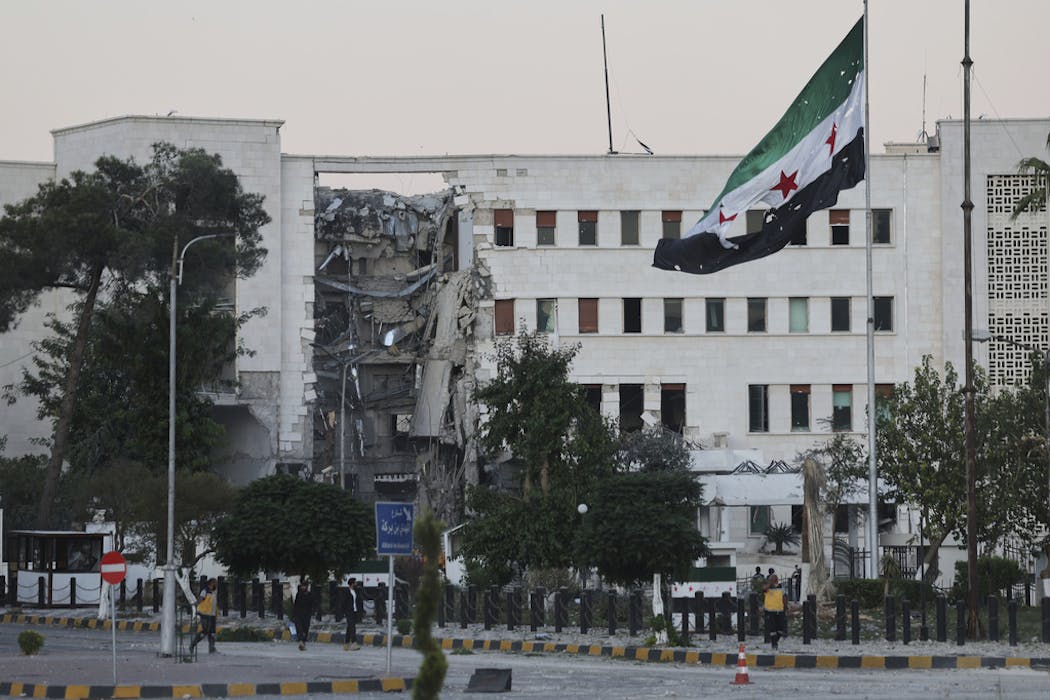
The Syrian Defense Ministry was heavily damaged after airstrikes in Damascus on July 16, 2025.
AP Photo/Ghaith Alsayed

On Sept. 21, 2025, a senior U.S official boasted that an Israeli-Syrian security agreement to resolve months of conflict was “99% complete” and would be announced within two weeks.

Those two weeks have now passed. And the reality on the ground suggests that the two countries are still far from sealing any deal to end the Israeli military incursions into Syrian territory that have occurred since the fall of Syrian President Bashar Assad in December 2024. Just days after the American official gave his prognosis and as negotiations continued, Israel struck several Syrian targets.

Citing negotiation sources, several news outlets reported that the delay in securing a deal was primarily related to Israel’s 11th-hour demand of creating a so-called humanitarian corridor that would link the Israeli-occupied Golan Heights to Sweidah, a city in southern Syria. Israel said the purpose is to protect religious minorities in the Golan Heights and Sweidah.

The hitch, after months of U.S.-mediated talks, reflects Syria’s vulnerability in these negotiations. Seeking to move on after year of war, the current Syrian leadership is eager to snuff out remaining internal violence, secure the borders and return to the United Nations-brokered truce with Israel that had been in place for decades. However, concluding a deal with its militarily superior neighbor risks the further fragmentation of Syria and an entrenched violation of its sovereignty.

Indeed, as an expert on the Middle East, I believe the talks and the potential last-minute snag point to Israel believing it has the upper hand. Meanwhile for Syria, a desire for security can’t mask what it sees as Israel’s expansionist policy in the region, and concerns that it is using things like a proposed humanitarian corridor as a way to achieve recognition of areas only recently under Israeli control.

The fraught history of Syrian-Israeli relations

Following the United Nations’ partition of Palestine in 1947 and the proclamation of the state of Israel in 1948, a coalition of five Arab armies, including Syria, declared war on Israel and lost the ensuing conflict.

Soldiers stand by barbed-wire fences.
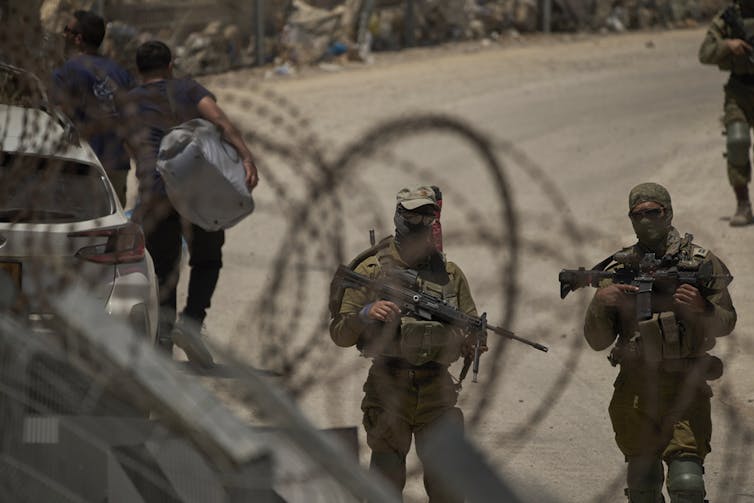
Israeli soldiers stand guard as Syrian Druze people cross back into Syria at the Israeli-Syrian border in the Israeli-occupied Golan Heights town of Majdal Shams.
AP Photo/Leo Correa

As a result, Syria was forced to sign an armistice agreement with Israel on July 20, 1949.

Yet de facto peace never lasted long. The two countries squared off in repeated conflicts in the next 25 years, including the Six-Day War in 1967 that launched Israel’s still-ongoing occupation of Syria’s Golan Heights.

In 1974, the U.N. brokered the Agreement on Disengagement between Israeli and Syrian forces. While not a peace agreement, the pact served to codify a ceasefire and created a buffer zone between the two countries monitored by U.N. observers.

For 50 years, that status quo held uneasily, as subsequent peace efforts failed. The conflict was effectively frozen, punctuated by occasional flare-ups of violence.

Entering the post-Assad era

The fall of Assad and his goverment in December 2024 suddenly injected a new dose of uncertainty into Israel-Syria relations.

As rebel-turned interim President Ahmed al-Sharaa worked to consolidate power and vowed to restore peace and stability for his war-torn country, Israel went on the offensive.

Shortly after the collapse of the Assad government, Israeli Prime Minister Benjamin Netanyahu declared the 1974 Disengagement Agreement “void until order is restored in Syria.” As a result, and in violation of the agreement, Israel occupied the demilitarized zone in the Golan Heights and expanded its control inside Syria. For months, Israel has conducted a campaign of airstrikes across Syria, repeatedly bombing Syrian military positions, including near the presidential palace in Damascus. Israel says it is doing so to stop weapon transfers from Iran and to protect its borders and ensure its security.

At the same time, it has pressed the U.S. to keep Syria weak and divided, in part due to Netanyahu’s and his far-right coalition’s hostility to an Islamist-governed neighbor.

The U.S., at the urging of allies like Saudi Arabia which are close with the Sharaa government, recently lifted sanctions on Syria. For months, officials of the Trump administration have likewise mediated talks and pushed Israel and Syria to conclude an agreement to stop Israel’s seizures and air campaign.

For his part, Sharaa and his negotiators have continually pressed for a halt to Israeli incursions and a return to the 1974 disengagement agreement and the de facto borders it established, describing it as a “necessity.”

Hints of common ground on Hezbollah and Iran

Aside from Syria’s immediate desire and chief priority to end all hostilities on its territory, there are some potential benefits to a new arrangement with Israel from both countries’ perspective.

Before its fall, the Assad government was close to Hezbollah and the Islamic Republic of Iran. Hezbollah, a Lebanese Shia Islamist political party and paramilitary group funded by Iran, supported Assad and played a major role in Syria’s civil war.

Furthermore, under Assad’s government, Syria served as a land bridge between Iran and Lebanon through which Hezbollah fighters transported their military equipment, money and drugs.

Under Sharaa, Syria’s central government is now closely allied to the Arab Gulf countries that have long been Iran’s regional rivals. In strengthening its security, Syria will no longer serve as Hezbollah-Iran meeting point, which will subsequently benefit Israel. For Syria, it will also stabilize the country against Iranian interference.

The risk of Syria’s further fragmentation

The risks of a deal with Israel from Syria’s standpoint, however, are significant.

In defending its incursions into Syria, Israel has pointed to both the security threat it says Syria poses to Israel and also the situation of minority groups in Syria, where sectarian violence has risen against communities like the Christian Orthodox and the Druze.

Israel has floated a number of plans for how it intends to retain a heavy footprint in Syria beyond the occupation of the Golan Heights and the 1974 Agreement of Disengagement.

One option on the table is an extension of the historical buffer zone and splitting Syria into autonomous zones, in which Sweidah province would be a demilitarized buffer zone between Israel and Syria. With the most recent idea of a humanitarian corridor couched in the language of protecting Syrian minorities, Israel could be seeking a wider area under more explicit control.

From the Syrian perspective, all of the above are backdoor ways by Israel to cement post-Assad military actions beyond the scope of the 1974 truce. As such, agreement to a security pact on Israeli terms would mean jeopardizing or shrinking Syria’s sovereignty and territorial integrity.

Demonstrators hold up flags.
Syrian protesters gather in front of Damascus Citadel to denounce Israel’s attacks on the Gaza Strip and to oppose any potential agreement that would lead to normalization of relations with Israel.
Hasan Belal/Anadolu via Getty Images

The Syrian leadership’s challenge going forward

After years of war and fragmentation, most Syrians will take any cessation of hostilities with Israel as a welcome development – but not at any cost. Many Syrians are opposed to further fragmentation of the country. And considering the ongoing killing and displacement of Palestinians in Gaza – described recently by a U.N. body as genocide – and Syria’s historic commitment to pan-Arabism, many Syrians will likely be skeptical if a security deal with Israel means a de facto recognition of the land and sovereignty Israel has acquired since December 2024.

That points to the major dilemma underpinning Sharaa’s position. Syria is in a vulnerable place and is not in position to negotiate from strength, especially as Sharaa tries to open Syria to the Western world, boost its economy and bring back the civil war refugees from neighboring countries. Seeking to consolidate his government’s hold on power and end the presence of a foreign military, Sharaa likely sees a security agreement as in his immediate interest.

While such a pact may bring some stability to Syria and the region, it could also codify Israel’s nearly unchallenged regional power.

The Conversation

Mireille Rebeiz is affiliated with the American Red Cross.

ref. For war-weary Syria, potential benefits of security pact with Israel comes with big risks – https://theconversation.com/for-war-weary-syria-potential-benefits-of-security-pact-with-israel-comes-with-big-risks-265785