Why omega-3s may be vital to getting the most out of your daily workouts

Source: The Conversation – UK – By Fernando Naclerio, Professor in Strength and Conditioning and Sports Nutrition, University of Greenwich

People who exercise regularly may want to consider taking an omega-3 supplement. Olenaduygu/ Shutterstock

Most people know omega-3 fish oils are good for health – especially heart health. But what many people might not realise is that these friendly fats can also be beneficial to your workouts.

Research has linked omega-3s to better exercise performance – making them a potentially valuable supplement for people who train regularly.

Omega-3 fatty acids are special fats found mainly in fish, seafood, nuts and seeds (such as walnuts and flaxseed), as well as some plant oils.

The main forms of omega-3s are eicosapentaenoic acid (EPA) and docosahexaenoic acid (DHA). EPA and DHA are essential for the structure and function of cells, especially in the muscles, heart and brain. This is because they help with “membrane fluidity” – the flow of nutrients or chemicals into cells.

To ensure adequate omega-3 levels, people need to get them from their diet. Although there’s no universal agreement on how much to eat, most health bodies recommend 1.4-2.5g a day of omega‑3 – with 140-600mg per day coming specifically from EPA and DHA. Around 500mg daily of EPA and DHA combined is enough to support health and benefit exercise.

Omega-3s and exercise

Exercise – especially resistance training (such as lifting weights) and hard-training sessions (such as cross-fit) – places stress on the muscles, causing small amounts of damage that triggers inflammation as part of the body’s repair process. Some inflammation is necessary for adaptation, but too much or prolonged inflammation may delay recovery and reduce performance.

Omega-3s have been found to act like “traffic controllers,” helping regulate the body’s inflammatory response to exercise so muscles recover more efficiently.

EPA also appears to support better blood flow to muscles after training and enhances the process of muscle protein synthesis (the body’s way of building new muscle tissue). Both of these processes may improve recovery following repeated sessions.

Research in physically active adults has even shown that taking fish oil containing EPA and DHA for several weeks enhanced muscle strength gains in resistance exercise performance compared to those who did the same type of training but did not take an omega-3 supplement.

EPA and DHA therefore appear to help the body recover and adapt to training more effectively over time.

DHA is important for the brain and nervous system, supporting cognitive function and nerve signals that help muscle to work efficiently while exercising. People who exercise regularly and take an omega-3 supplement also have higher DHA levels in their muscle cell membranes compared to those who are sedentary. This could be key for recovery and adaptation from exercise.

Omega-3 balance

Although omega-3 can be obtained from the diet, the amount of EPA and DHA in food can vary depending on the type of fish, whether it’s wild or farmed, what these farmed fish are fed and how the food is stored or cooked.

Modern diets also often provide far more omega-6 than omega-3, which may promote inflammation. This is because omega-6 fats produce pro-inflammatory compounds, whereas omega-3s produce anti-inflammatory ones. This balance can be improved by increasing omega-3s, reducing consumption of processed foods and omega-6-rich oils (such as corn, safflower and soybean oils).

An overview of omega-3 rich foods laid out on a table, including salmon, sardines, eggs and nuts.
Many foods are also rich in omega-3s.
mama_mia/ Shutterstock

To support a healthy omega‑3 status, include a variety of fatty fish, seafood and plant sources such as chia or linseed. Also aim to choose low glycaemic carbohydrates such as oats, legumes and most fruits. This is because low glycaemic foods release sugar slowly into the blood, which helps your body use fats as fuel more effectively.

High-glycaemic foods on the other hand, such as white bread, sugary drinks or refined grains, release sugar quickly. This can reduce how well omega-3s are incorporated into cells and may increase inflammation.

Most people can get enough omega-3 from a healthy diet that contains oily fish, but supplements can be a practical option if these foods aren’t eaten or if higher intakes are needed. While fish oil supplements can be a beneficial strategy to boost your omega-3 levels, to see measurable changes in muscles and overall health, daily intake for at least two weeks is recommended.

For most active people, this means 3-5g of fish oil per day, ideally with a high concentration of EPA and DHA. Omega-3s are best absorbed when taken with meals containing some fat. Therefore, splitting the dose (such as taking some with breakfast and dinner) improves absorption and tolerance.

For muscle growth and functional performance, a supplement providing around 1.8g of EPA and 1.5g of DHA per day is suggested. This is roughly equivalent to the omega-3 content found in 200–400g of fatty fish such as salmon, herring or sardines.

If your goal is to support brain health, cognitive function or mood, a higher proportion of DHA may be beneficial. So instead of getting a supplement containing an equal 1:1 ratio of EPA and DHA, aim to purchase a supplement containing a 1:8 ratio of EPA to DHA (such as 100mg EPA and 800mg DHA). Typical products vary widely, so readers should check the EPA and DHA content rather than the total fish oil amount.

Omega-3 supplements are generally safe, but some people may experience a mild, fishy aftertaste or upset stomach after taking one – particularly when taking higher doses or when taken without food. Intakes above 5g per day of EPA+DHA from supplements should be avoided, unless medically advised.

Omega-3s may help support both health, recovery and adaptation to training, and indeed may be an important nutritional component for those who exercise regularly. While a balanced diet should come first, omega-3 supplements can be helpful in keeping up with training demands when diet is insufficient.

The Conversation

Professor F Naclerio has previously received external research funding unrelated to this article.

Professor Roberts has previously received external research funding unrelated to this article.

ref. Why omega-3s may be vital to getting the most out of your daily workouts – https://theconversation.com/why-omega-3s-may-be-vital-to-getting-the-most-out-of-your-daily-workouts-279409


The six best Shakespeare adaptations that aren’t in English

Source: The Conversation – UK – By Sarah Olive, Senior Lecturer in Literature, Aston University

The future of Shakespeare may well lie beyond the English language. That was the striking message I took away from a talk by translation studies scholar Professor Susan Bassnett at the British Shakespeare Conference in Hull in 2016.

Her point was simple but powerful: Shakespeare’s works are likely to survive and flourish not only in English, but through translation, adaptation and reinvention across the world. Inspired by this, I asked six of my colleagues around the globe to share some Shakespeare adaptations in other languages that you might enjoy.

1. Goliyon Ki Raasleela Ram-Leela (2013)

Hindi, based on Romeo and Juliet

Ram‑Leela is as heady a mix as Shakespeare’s own play, in equal parts comic and tragic, tender and flamboyant. Director Sanjay Leela Bhansali relocates the action of Verona to an Indian town riven by two criminal clans: Rajadis and Sanedas. Violence saturates daily life. Bullets spill from spice jars and a Rajadi child urinating on Saneda territory ignites a vicious brawl.

The trailer for Goliyon Ki Rasleela: Ram-Leela.

In such a world, can love bring peace? The leads’ scorching chemistry makes us hope. My students practically swooned during a screening. At the end, soulful lyrics such as “Tera naam ishq / Mera naam ishq” (“Your name is love / My name is love”) frame the film’s Romeo and Juliet – Ram and Leela – through love rather than their hate-fuelled lineage.

The film also gives depth to its Lady Capulet and nurse figures, while Leela is sensual, witty and brave. Juliet exactly as Shakespeare imagined her.

Varsha Panjwani teaches at New York University, London, and is the creator and host of the podcast Women and Shakespeare.

2. Otel·lo (2012)

Catalan, based on Othello

An award-winning work of Catalan cinema, Otel·lo transposes Shakespeare’s play to a contemporary film studio. Such a meta-narrative approach feels in line with the play’s focus on the enticing power of storytelling – famously embodied in the character of Iago as its arch-villain.

The trailer for Otel.lo.

Blending documentary, mockumentary and thriller aesthetics, the film turns Iago into an unscrupulous filmmaker willing to cross every boundary in the name of art. With his role played by the actual director of the film (Hammudi Al-Rahmoun Font), the adaptation skilfully integrates form and content. We are, like Othello, manipulated into thinking that the fiction he has created is reality.

The film asks: To what extent are the images we absorb real? What purpose do they serve? And how do they affect our views on gendered and racialised minorities?

Inma Sánchez García is a lecturer in European languages and culture at the University of Edinburgh.

3. Throne of Blood (1957)

Japanese, based on Macbeth

The genius of Throne of Blood is that despite being set in 16th century Japan and changing almost everything about the original, it is immediately recognisable as the Scottish play. It’s considered by many to be the greatest Shakespeare film ever made.

The trailer for Throne of Blood.

The mist-swirled locations, the screeching flute and ominous drumbeats, the spooky old lady in the forest, and above all the samurai, barking orders and getting lost on their horses, can mean only that “Macbeth doth come”. The final scene when Washizu’s (Macbeth’s) soldiers turn on him with a hail of arrows may even represent an improvement on Shakespeare. Meanwhile his poker-faced lady clearly wears the kimono-trousers in their marriage.

Daniel Gallimore is a professor of literature and linguistics at Kwansei Gakuin University

4. Bhrantibilas (1963)

Bengali, based on Comedy of Errors

If you asked me to pick a favourite Shakespeare film, I’d probably surprise people by saying Bhrantibilas. It’s one of the earliest filmed Shakespeare adaptations in Indian cinema. It was also the inspiration for the globally popular film Angoor (1982).

A scene from Bhrantibilas.

What I love about it is how confidently it relocates Shakespeare’s farce into a Bengali urban world without ever feeling like a dutiful “literary” exercise. A huge part of its lasting appeal is Bengali superstar Uttam Kumar. It’s pure pleasure watching him play the twin roles – Antipholus of Syracuse and Antipholus of Ephesus, identical twins separated at birth, whose accidental reunion causes chaos. His comic timing is razor-sharp, and there’s also an ease and charm that makes the confusion feel human, never mechanical.

Decades on, audiences still return to Bhrantibilas, often knowing every gag by heart, which says a lot about its cultural afterlife. For me, it’s a perfect example of how Shakespeare survives not through reverence but through reinvention – absorbed into popular cinema and kept alive by star power, humour and sheer re-watchability.

Koel Chatterjee is a lecturer in English at Regent College, and the creator and host of The Shakespop Podcast and The Shakesfic Podcast.

5. Rahm (2016)

Urdu, based on Measure for Measure

Measure for Measure has long been regarded as a “problem play”. Disfavoured among Shakespeare’s works for centuries, it hit stages again in the 20th-century and reached new audiences through its resonances with the #MeToo movement.

The trailer for Rahm.

A local leader tells a devout woman that if she loses her virginity to him, he will spare her imprisoned brother’s life. This film shifts the action from early modern, Catholic Vienna to an ambiguous period in Islamic Lahore. Moderate and extremist versions of faith contend, against the backdrop of the city. This film’s billing as a thriller, and status as the only big screen version of the play, help raise it from obscurity.

Sarah Olive is a senior lecturer in English literature at Aston University.

6. To The Marriage of True Minds (2010)

Arabic, based on Sonnet 116

This freely available short film expands on one of Shakespeare’s shortest forms: the sonnet. It riffs on Sonnet 116, heard at countless weddings: “Let me not to the marriage of true minds … admit impediments.” Here, its Arabic translation provides both the back story to – and future hope for – an asylum-seeking couple in a same-sex relationship, Falah (Amir Boutrous) and Hayder (Waleed Elgadi).

The story of their journey by sea, and shots of a tossed-about paper boat reference the poem’s sea-voyage imagery. Over 12 tense minutes, we hold our breath to see whether the Iraqi poet and his childhood beloved will overcome the impediments of religious conservatism, on one shore, and an apparently hostile asylum system on the other.

Sarah Olive is a senior lecturer in English literature at Aston University.

This article features references to books that have been included for editorial reasons, and may contain links to bookshop.org. If you click on one of the links and go on to buy something from bookshop.org The Conversation UK may earn a commission.

The Conversation

Sarah Olive does not work for, consult, own shares in or receive funding from any company or organisation that would benefit from this article, and has disclosed no relevant affiliations beyond their academic appointment.

ref. The six best Shakespeare adaptations that aren’t in English – https://theconversation.com/the-six-best-shakespeare-adaptations-that-arent-in-english-277804

Philanthropy is reshaping global health. Here’s how

Source: The Conversation – France – By Annabelle Littoz-Monnet, Professor in International Relations, Graduate Institute – Institut de hautes études internationales et du développement (IHEID)

Over the past two decades, global health has undergone a profound transformation. As public funding for international health and development has become increasingly unpredictable, private philanthropy has largely stepped in to fund global programmes.

It is well known that large foundations, such as the Gates Foundation, Bloomberg Philanthropies, or the Chan Zuckerberg Initiative, to list a few, now largely contribute to the budgets of the World Health Organization (WHO), a number of public-private partnerships, or initiate private initiatives.

What is less visible though is the way philanthropic organisations are increasingly producing the data, research, and knowledge infrastructures through which global health problems are known, prioritised and eventually governed. This shift is often presented as pragmatic, in the face of constrained budgets and an urgent global health crisis. Yet the expanding epistemic presence of philanthropic actors in global health is interrogating, when it shapes the very frameworks though which health issues are understood.

When philanthropic foundations produce global health data

Philanthropic foundations have, in recent years, widely invested in the production of metrics on the “burden” of specific health conditions and the “costs” and “returns” of given health interventions.

These metrics, while necessary, do not only describe reality, but define what counts as a health problem and what kinds of interventions are deemed valuable.

In 2007, the Gates Foundation (formerly known as the Bill & Melinda Gates Foundation) created the Institute of Health Metrics and Evaluation (IHME) to provide “timely, relevant, and scientifically valid evidence to improve health policy and practice” (IHME website).

Since its establishment, the IHME’s has been calculating the so-called Global Burden of Disease (GBD) metrics.

The GBD is the largest-scale project ever set up aimed at measuring morbidity and mortality rates throughout the globe using the metric of DALYs (Disability Adjusted Life Years).

The IHME, which has benefited from generous funding from the Gates Foundation, produces profuse metrics and estimates, calculations, and projections, which nowadays deeply shape the way health problems are being known, compared, and governed.

Although the WHO initially attempted to equal the IHME as a provider of health metrics, the IHME has now reached a position of dominance in global health. The WHO itself now increasingly relies on those numbers for its own sense-making and agenda-setting exercises.

Other “data” initiatives have since then further stabilised the strong presence of philanthropists in global health. In 2015, Bloomberg Philanthropies, for instance, launched its own Data for Health initiative, also co-funded with the Australian government and the Gates Foundation, to “strengthen and standardise birth and death records and to better inform policymaking and improve public health outcomes”.

Vital Strategies, which describes itself as a global health non-profit organisation, entirely funded by Bloomberg Philanthropies, acts as the implementing partner of Data for Health. In that capacity, Vital Strategies supports the WHO in its risk monitoring work. As their resources often surpass those of the WHO, philanthropists’ data centers have come to sit at the core of global infrastructures of quantification, providing data and metrics to the WHO and supporting it in its own monitoring work.

It is on the basis of those estimates that philanthropic organisations themselves and global health actors at large produce calculations to identify which health interventions could “save the most lives” and be most cost-effective. Interventions considered to be “best buys” and funding priorities have, thus, been identified on the basis of such metrics.

Effects on global health governance

GBD results have highlighted that diseases like malaria, HIV, and later non-communicable diseases (NCDs) account for a massive “burden” of DALYS.

Such numbers have helped, for instance, scale-up interventions for malaria and HIV treatment. The distribution of hundreds of millions of insecticide-treated nets has become a flagship intervention to solve malaria, with quantifiable impact, supported by the Gates Foundation but also global health actors at large. As philanthropic foundations increasingly partner with the WHO and other global health actors, they can, indeed, effectively translate this evidence in identifiable targets which all global health actors try to reach.

While supporting such interventions is in itself laudable, what is questioning is that this calculative logic introduced a particular way of valuing health interventions, toward an approach in which ‘results’ must be continuously and quantitatively evidenced. This logic has favoured, first, a move toward population-based interventions, which alone can be shown to be producing significant and measurable results. This approach implies that problems are seen mainly in terms of their magnitude and that interventions need to have “scalability” and “reach population impact”. Such interventions enable funders to calculate impact and returns on investment in a standardised way.

Second, this approach also favours highly technical interventions, rather than complex, structural interventions, as it is easier to produce evidence on their impact and the economic returns they generate.

With regard to the treatment of high blood pressure, for instance, anti-hypertensive therapy has been privileged. While philanthropists and the WHO also promote interventions that target salt intake and trans-fat in food, these tend to be less central and fashioned by philanthropists as more complex, because population-based impact measurements are unavailable. The identification of hypertensive therapy as a most effective intervention was largely identified through the funding of modelling scenarios and projections by Bloomberg Philanthropies, which has largely invested in the field to find out which hypothetical interventions would bring the best returns.

The involvement of philanthropists has therefore contributed to reinforcing a solutionist approach to health, where “quick fixes” are favoured, while factors relating to socioeconomic and environmental conditions problems are too often ignored.

Understanding this shift is crucial. It reveals that as private resources are called in to fill existing funding gaps, such a move is not neutral but deeply political.

Although the prevention of diseases is in itself a laudable objective for improving public health, what is interrogating is how the knowledge produced by these philanthropic actors, largely rooted in for-profit strategies and logics, is instrumental in making health conditions known, treated, and governed.


A weekly e-mail in English featuring expertise from scholars and researchers. It provides an introduction to the diversity of research coming out of the continent and considers some of the key issues facing European countries. Get the newsletter!


The Conversation

Annabelle Littoz-Monnet a reçu des financements du Fonds National Suisse de la recherche Scientifique (FNS).

ref. Philanthropy is reshaping global health. Here’s how – https://theconversation.com/philanthropy-is-reshaping-global-health-heres-how-280942

Why the world needs the UN to keep an eye on AI

Source: The Conversation – UK – By Yu Xiong, Chair Professor of Business Analytics, University of Surrey; Northumbria University, Newcastle

Summit Art Creations/Shutterstock

AI doesn’t have a boss. It doesn’t really care about rules. And most of us don’t have any say over what it will do next.

Yet the technology is all around us, firmly established in workplaces, financial systems, healthcare and defence. So maybe it needs someone to keep an eye on its progress and set some boundaries.

The UN certainly thinks so, and recently decided to set up an independent panel to monitor AI’s future development. It seems like a sensible move, but this attempt to create a successful forum for “rigorous, independent scientific insight” also highlights the inherent difficulties of governing technology on a global scale.

For a start, the US, which dominates AI development, doesn’t want anything to do with the panel. It voted against the UN’s idea (so did Paraguay), calling it “significant overreach”.

But the UN argues that AI affects everyone, and requires some global coordination. UN secretary-general António Guterres has described the new panel as the first “fully independent scientific body dedicated to helping close the AI knowledge gap and assess the real impacts of AI”.

As with some of the UN’s other forums, like the Intergovernmental Panel on Climate Change or the International Atomic Energy Agency, the AI panel would not write the laws, but would help establish common ground rules and standards that everyone can agree on.

AI is a different beast though. Unlike climate policy or nuclear materials, which are the responsibility of national governments, AI’s progress is largely driven by private – and very wealthy – firms.

International coordination is much more difficult, and already the US, the EU and China are taking different approaches to governance.

The EU takes a fairly cautious line, with strict rules on high-risk applications in areas like recruitment or law enforcement. The US favours voluntary standards within the industry. Meanwhile, China treats AI development and control as a matter of state.

When different parts of the world approach things so differently, there is a risk that any attempt at global cooperation will simply not work. Big firms could simply move their headquarters to whichever part of the world they consider to be the least restrictive. Technical rules can then become geopolitical tools rather than shared protections.

But the biggest challenge goes beyond technical coordination, because AI is fundamentally a technology of power which involves control over information, opportunity and surveillance.


Read more:
Could revisiting Asimov’s laws help us avoid AI’s ‘Chernobyl moment’?


There have already been cases of AI being used in predictive policing models that disproportionately target communities. It has been part of automated welfare systems that exclude the vulnerable and decide on access to credit or housing.

Digital accountability

This is not the first time that a powerful digital force has surged ahead while oversight lags behind.

I witnessed this firsthand with research I carried out with colleagues about Bitcoin.

When we published our findings about Bitcoin’s massive energy footprint in 2021, the reaction was immediate and global. It triggered a debate that shook the industry, and demonstrated that digital systems can cause to the world.

AI is now on the same path, but the stakes are exponentially higher, affecting not just energy grids, but society itself.

AI-generated political statements, religious sermons and news footage circulate on screens everywhere. And when people cannot reliably distinguish authentic authority from artificial output, social trust is eroded.

AI could make online incitement easier, cheaper, more personalised and more widespread. Some civil leaders have claimed that digital radicalisation, the process by which people adopt extremist views through online content, could be intensified by these tools.

Societies everywhere are already grappling with AI’s wider social consequences.

The head of the Muslim World League, an international non-governmental Islamic organisation, Mohammad bin Abdulkarim Al-Issa, has warned that AI may “manipulate the ideologies and beliefs that connect and influence billions” with extremist messaging.

Having seen how groups like Islamic State exploited social platforms for recruitment and division, he also argues that the danger lies not only in what is said, but in the loss of identifiable authority behind it. Elsewhere, the Pope has warned that AI must never diminish human dignity or reduce people to data points.


Read more:
AI laws overlook environmental damage – here’s what needs to change


These kinds of worry reflect legitimate concerns about how technological platforms can fracture societies when ethical guardrails fall behind. And this is precisely where the UN may have an important role to play.

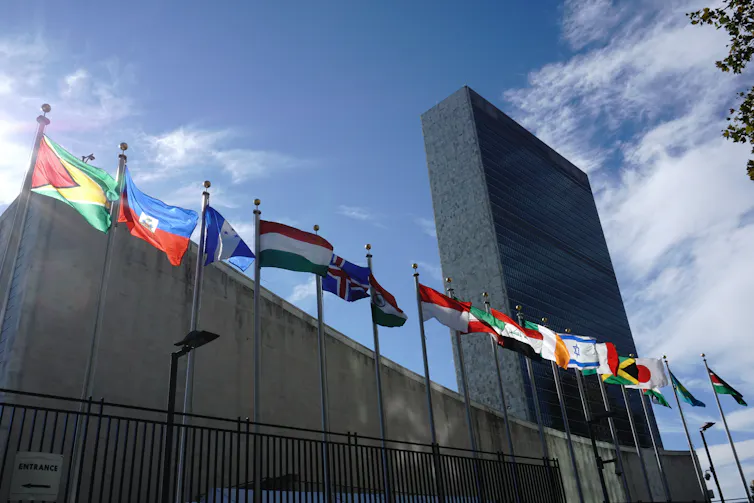
The UN building in New York.
UN v AI?
Aditya E.S. Wicaksono/Shutterstock

Historically, its strength has never depended on enforcement power so much as on symbolic authority and its ability to articulate widely shared goals designed to improve people’s lives.

The UN’s 1948 Universal Declaration of Human Rights became the foundation of modern human rights law, by reshaping what governments could plausibly justify. Likewise, the global eradication of smallpox showed how a shared UN-backed objective could enable cooperation even across geopolitical divides.

Perhaps the real question, then, is not whether the UN should try to regulate AI directly. It is whether the world can afford a fragmented AI order defined solely by markets, geopolitics and billionaires, with no common ground.

Because while the promise of AI is staggering, serious and dangerous failings could yet emerge from the unfilled gaps in governance. The UN could help to avoid them.

The Conversation

Yu Xiong does not work for, consult, own shares in or receive funding from any company or organisation that would benefit from this article, and has disclosed no relevant affiliations beyond their academic appointment.

ref. Why the world needs the UN to keep an eye on AI – https://theconversation.com/why-the-world-needs-the-un-to-keep-an-eye-on-ai-277143

The Iran war has depleted supplies of tungsten, a critical mineral for the world’s militaries

Source: The Conversation – UK – By Gavin D. J. Harper, Research Fellow, Birmingham Centre for Strategic Elements & Critical Materials, University of Birmingham

Sample of rough wolframite rock (tungsten ore) from Altai, Russia. vvoe / Shutterstock

The US and Israel’s conflict with Iran has drained munitions at an astonishing rate. This is placing pressure on the supply of a crucial metal: tungsten.

Tungsten is used in armour piercing munitions, in components that need to withstand high levels of heat and is an important additive in steel. Militaries around the world would grind to a halt without this strategically important element.

Yet, despite the current demand, the amount of tungsten mined each year is dwarfed by other metal ores, such as iron and aluminium (bauxite).

In addition, most of the world’s tungsten comes from China, which has recently placed restrictions on supplies. For some countries, including the UK, the push to secure new tungsten resources has never been more vital.

The English name for tungsten, comes from the Swedish “tung sten”, meaning heavy stone. Tungsten’s extreme hardness and resistance to thermal shock are what make it sought after for military technology.

In armour piercing munitions, dense tungsten alloy rods use the sheer velocity of their impact to tear through the armour on fighting vehicles and other hardened targets.

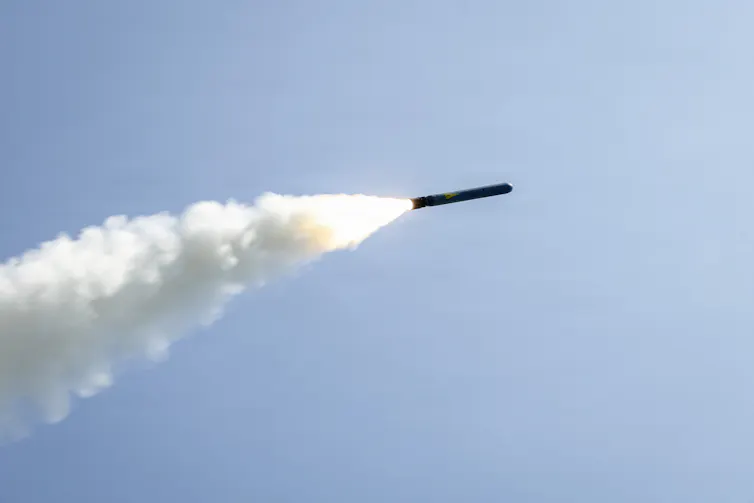
Tomahawk Land Attack Missile launched during Operation Epic Fury, February 28 2026.
Tungsten’s properties mean it is widely used in munitions.
US Navy

When purified, tungsten has the highest melting point of all metals: 3,422°C (6,192°F). Unsurprisingly, it is used in components that need to withstand high temperatures, such as those inside aircraft engines.

Tungsten, along with other metals such as molybdenum, is added to steel to improve its “hot hardness”. Where normal steel would deform at high temperatures, adding the other metals improve steel’s resistance to deformation at high temperatures.

They form carbides with the carbon in steel, making it more resistant to wear, and resisting “creep”, where steel deforms in response to constant stress at high temperatures. Because the tungsten and molybdenum atoms are significantly larger than iron atoms, they improve the “yield strength” of steel, preventing defects in the metal lattice from spreading. Steel is used to make lots of military hardware so tungsten is vitally important.

Limited availability

Having said all that, the global tungsten market is small, tungsten is what is known as a “minor metal”, because it isn’t traded openly on exchanges like the London Metal Exchange. This makes pricing data opaque. While mining operations around the world produce around 2.6 billion tonnes of iron ore every year they only produce around 84,000 tonnes of tungsten.

Tungsten is also considered (alongside tin, tantalum and gold – a group often known as 3TG metals) as a conflict mineral. A significant quantity is mined in regions plagued by violence, forced labour and human rights abuses.

China produces around 80% of global tungsten – and does it so cheaply that it is hard for western firms to compete. In the US, commercial tungsten mining ceased in 2015.

Beijing is leveraging its dominant position to control tungsten supply through a sophisticated state trading and licensing regime. Exports of critical derivatives are restricted to a “whitelist” of authorised state owned firms.

This funnels a huge supply of the metal through a government monitored pipeline. In February 2026, China imposed export controls and reduced mining quotas, limiting tungsten availability. Beijing’s actions have introduced significant friction into western supply chains for military and aerospace applications of tungsten.

Draining stockpiles

Amid the geopolitical turmoil that is unfolding in the Middle East, there is a newfound gargantuan appetite for tungsten, with every bomb, missile and kinetic interceptor further draining stockpiles.

This presents an intractable problem for the defence industry. There has been a 12% increase in the use of military tungsten this year alone – in helicopters, fighter jets and munitions. This is hard to accommodate in a market with no availability.

Global logistics are further complicated by the challenges to global shipping created by the war. This puts a strain on the movement of mining equipment and supplies for processing by the handful of mines outside of China.

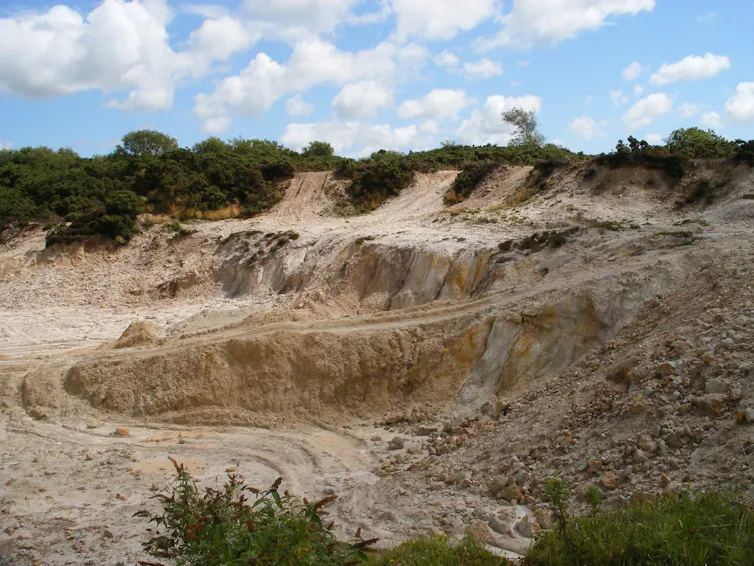
The Hemerdon Mine in Devon hosts the fourth-largest tin-tungsten deposit in the world
The Hemerdon Mine in Devon hosts the fourth-largest tin-tungsten deposit in the world.
Southwesterner / Wikimedia

Today, there is an economic and strategic opportunity for the UK. The Hemerdon mine in Devon hosts the fourth-largest tin-tungsten deposit in the world, and is a “shovel ready” project being revived by Tungsten West, a mining development company.

Further south, Cornwall Resources’ Redmoor site has revealed high-grade tungsten, tin and copper deposits. This could give the UK a competitive edge in mining and primary extraction, given the current market conditions.

Tungsten also has a recycling rate of 42%, which is higher than for many other critical materials. The recycling rate is the proportion of end-of-life tungsten that is diverted from landfill and made available for reuse. Around 30-35% of the global tungsten supply is derived from scrap (which is to say the proportion of new material made from recycled content).

In western markets, this figure is approximately double – around 70%, because of China’s dominance of the tungsten market. This scrap comes from both manufacturing waste and end-of-life products.

How the British military dealt with a molybdenum shortage in second world war.

However, supply shortages can often be a catalyst for innovation. In the second world war, metallurgists faced a critical shortage of molybdenum. German U-boat attacks on shipping convoys stymied supplies of this material. This forced metallurgists at UK engineering company Vickers to innovate, and recycle molybdenum from mining drill bits.

In the past, war has forced innovation to ensure the flow of critical materials – We can learn lessons from Britain’s response to molybdenum shortage in the second world war.

The limited global tungsten supply continues to present significant challenges for many countries. One factor that limits stocks is deteriorating ore grades from primary supply (which is to say the concentration of valuable metal inside mined rock is dropping over time). Another is the restrictive export licensing from China.

The current situation has pushed prices to historic highs and challenges the just-in-time nature of many supply chains.

The Conversation

Gavin D. J. Harper receives funding from the EPSRC funded REcycling CRitical Elements in Advanced Technologies for the Environment, RECREATE project (EP/Y53058X/1).

ref. The Iran war has depleted supplies of tungsten, a critical mineral for the world’s militaries – https://theconversation.com/the-iran-war-has-depleted-supplies-of-tungsten-a-critical-mineral-for-the-worlds-militaries-279243

How King Charles charmed the US while taking digs at Trump

Source: The Conversation – Global Perspectives – By Philip Murphy, Director of History & Policy at the Institute of Historical Research and Professor of British and Commonwealth History, School of Advanced Study, University of London

King Charles’s speech to the US Congress – only the second such address by a British monarch – demonstrates how much both the US and the UK have changed in the last three decades.

The first speech was in May 1991 during his mother, Queen Elizabeth II’s, third state visit to the US. The underlying purpose of both speeches was the same: to stress the enduring links between Britain and the US. But the circumstances in which they were delivered were very different.

The late queen’s speech came in the wake of joint action by US and British forces, along with other allies, to eject Saddam Hussein’s Iraqi troops from Kuwait. She referenced this in her speech as a concrete example of the strength of the Anglo-American alliance.

In 2026, the UK has pointedly refused to join the US-Israeli attack on Iran, angering President Donald Trump. Charles’s speech adroitly inverted the moral of this apparent diplomatic rift, suggesting that tensions in the past had always been overcome. Referring to the revolution of 1776 he noted: “Ours is a partnership born out of dispute, but no less strong for it”, because ultimately “our nations are in fact instinctively like-minded”.

A speech like this, voiced by the monarch, can serve at least two useful purposes. The first is to portray things that are, at heart, profoundly political, as being somehow above politics. The second is to place the transitory difficulties of day-to-day diplomacy within the much longer-term perspective of a dynasty that traces its lineage back to the Norman Conquest.

These two elements featured in how both Elizabeth II and Charles’s speeches depicted the Anglo-American alliance. The latter was the basis of a joke by the king, who referred to the actions of the Founding Fathers “250 years ago, or, as we say in the United Kingdom, just the other day”.

Charles’s speech was beautifully crafted and delivered with a degree of warmth and conviction that was always beyond the range of his mother’s public oratory. That, in itself, was almost an implicit reproach to the president’s own rambling, undisciplined public pronouncements.

And in more than one way the address was pitched over the head of Trump. The lack of any immediate pushback from the president suggests that the subtlety of some of the messaging eluded him. But in a more significant sense, it was an appeal to causes that still resonate with much of the American political class if not with the Trump administration itself.

Charles stressed the value of Nato and the importance of “the defence of Ukraine and her most courageous people”. He made a sly reference to his proud association with the Royal Navy – an institution that has been the subject of some disparagement by Trump in recent weeks.

He emphasised the importance of protecting the environment, although couched in a Trumpian language of profit and loss: “We ignore at our peril the fact that these natural systems – in other words, Nature’s own economy – provide the foundation for our prosperity and our national security.”

Perhaps his most pointed remarks – and those that generated the loudest applause from some (although not all) in the hall – were directed at the US itself. He described Congress as “this citadel of democracy created to represent the voice of all American people”. He mentioned the role of Magna Carta in laying the foundation for the constitutional principle that “executive power is subject to checks and balances”. Trump’s opponents clearly enjoyed that.

Saving the special relationship

State visits by British monarchs to the US have been relatively rare, and state visits to London by US presidents are even rarer. Trump is unique in having made two. This in itself is a mark of the desperate attempts by British governments, both Tory and Labour, to find ways of managing relations with his administration. This desperation was also apparent in Keir Starmer’s reckless decision to appoint Peter Mandelson as British ambassador to Washington.

The king’s speech pushed in interesting ways at the boundaries of what a British monarch might be expected to have said in Trump’s America. Yet some of the sentiments in his mother’s 1991 address to Congress – considered uncontroversial at the time – could no longer be expressed without the risk of offending the current administration.

Queen Elizabeth noted: “Some people believe that power grows from the barrel of a gun. So it can, but history shows us that it never grows well nor for very long. Force, in the end, is sterile.”

That may be a lesson Trump will have to learn the hard way. But for the moment, he and his immediate circle seem to have an unwavering belief in the primacy of kinetic force, and have little interest in the objective Charles described of stemming “the beating of ploughshares into swords”.

The queen also commended “the rich ethnic diversity of both our societies”. Charles spoke instead about interfaith understanding. This is not quite the same thing – but is certainly more compatible with the Trump administration’s disturbingly relaxed approach to the rise of white-supremacist politics.

Perhaps the saddest feature of a comparison of the two speeches is the queen’s proud boast in 1991 that “Britain is at the heart of a growing movement towards greater cohesion within Europe, and within the European Community in particular”. If the US has changed since 1991, so has Britain. It would be nice to think that one day the monarch might give an equally generous speech about shared history and values in front of the UK’s European neighbours.

The Conversation

Philip Murphy has received funding from the AHRC. He is a member of the European Movement UK.

ref. How King Charles charmed the US while taking digs at Trump – https://theconversation.com/how-king-charles-charmed-the-us-while-taking-digs-at-trump-281766

Do birds have accents? The fascinating regional differences in birdsong

Source: The Conversation – UK – By Louise Gentle, Principal Lecturer in Wildlife Conservation, Nottingham Trent University

Yellowhammers have two main dialects in the UK. WaceQ/Shutterstock

Birds sing the most around an hour before dawn, when the air is at its stillest. Theoretically, this enables sounds to travel further, making song up to 20 times more effective than if sung at midday.

With International Dawn Chorus day approaching, it’s time to take a moment to soak in the spring birdsong and notice the individual harmonies blending together.


International Dawn Chorus Day brings casual bird appreciators, ornithological experts and dedicated twitchers together in a celebration of birdsong. In our series, experts give their insights on nature’s chorus.


The dawn chorus is beautiful anywhere, but your local birdsong may sound rather different to nearby areas. Even in the same neighbourhood, birds of the same species don’t always sound exactly alike. I was recently teaching undergraduates about bird song, and they recorded blue tits singing around campus. The students found plenty of differences between individual birds. Some blue tits sang their classic song, which sounds a bit like they are saying “he-llo, I’m a little blue tit”. Some sang a more elaborate “he-llo, I’m a little blue tit, blue tit”, and some only bothered with “he-llo”.

Alongside individual differences, birds have regional differences in song. For example, the birdsong that sounds a bit like “my toe bleeds Be-tty”, commonly sung by the woodpigeon is, in some parts of the UK, “my toe bleeds Ju-li-a”, with an extra syllable to the final section of the song. These sorts of regional dialects have been reported in several British bird species including blackbirds and great tits.

However, one of the most interesting accents comes from farmland bird the yellowhammer, who typically sings birdsong that sounds like “a little bit of bread and no cheese please”. In the UK, the yellowhammer largely has two distinct dialects, differing in the final “cheese please” part of the song. In the east of England, “cheese” has a lower pitch than “please”, and this is reversed in south and west England.


Read more:
Why do birds sing?


The yellowhammer was introduced to New Zealand from the UK in the 1860s and 70s. But, unlike the UK, the New Zealand yellowhammers have around seven dialects, despite originating from the south of England. These five extra dialects have also been detected in birds across Europe, indicating that the New Zealand birds still sing the 19th century British dialects that have since disappeared in the UK. This is likely due to the large decline in the number of yellowhammers in the UK which caused some populations to go extinct. An ongoing project allows you to view a map of yellowhammer dialects or help with citizen science research on their song.

Most birds only sing one dialect, learned from parents or neighbours, resulting in a geographical mosaic of regional accents. Dialects often overlap but can dominate certain areas, essentially producing geordie, brummie, cockney and scouse birds.

Although some bird species have an innate ability to sing the song of their species (the cuckoo, for example), species with more elaborate song must learn to sing. Young birds inherit a template which they add to from listening to songs around them.

For example, chaffinches that have been hand-reared in isolation produce simple songs, whereas wild chaffinches learn complexities from their parents or immediate neighbours in their first weeks of life. Finer details of their song are acquired the following breeding season when they come into contact with neighbouring territory owners. Interestingly, corn buntings, a farmland bird, sing the same song as their nearest neighbour rather than their parents, seeming to learn most after dispersing from their nest.

Birds are also adapting to humans. In urban areas, wildlife is subjected to human-made noise such as cars and machinery. Consequently, urban birds now sing at a higher pitch than rural birds as higher-pitched songs carry better over low-pitch urban noise. And it’s not just the pitch of the song that has been altered.

Great tits sing shorter and faster songs in cities compared to forests, and blackbirds sing louder in urban areas. However, even when cities are quiet, like in the early hours, urban birds maintain these song features, which suggests that sounds echo off large buildings and don’t travel as far in urban areas.

Birds are singing earlier in response to traffic noise, with city blackbirds starting their dawn chorus up to five hours earlier than rural birds. The effect of artificial light also leads to an earlier start of dawn singing, with song thrushes starting ten minutes earlier, and robins and great tits 20 minutes earlier than in areas without street lighting. And, artificial light causes blackbirds to sing around an hour earlier than those exposed to natural light.

Scientists still have much to learn about the differences in birdsong within a species. When you hear birdsong, it’s easy to assume that it’s a male. And it is more usually males that sing. Females choose males with the best song so that his high quality genes will be inherited by her offspring. But female birds have been massively under-represented in archives and scientific studies. A 2016 analysis found that for 3,500 out of 4,814 species we don’t even have enough data to know whether or not the females of the species sing. As researchers take a closer look at female birdsong, we may learn of even more differences.

Next time you listen to a bird singing, see if you can hear the nuances in the dialect, or spot the difference between urban and rural birds.

The Conversation

Louise Gentle works for Nottingham Trent University.

ref. Do birds have accents? The fascinating regional differences in birdsong – https://theconversation.com/do-birds-have-accents-the-fascinating-regional-differences-in-birdsong-278108

Were enormous octopuses apex predators in ancient oceans?

Source: The Conversation – UK – By Thomas Clements, Lecturer, University of Reading

Illustration of the giant octopus. Image: Yohei Utsuki, Department of Earth and Planetary Sciences, Hokkaido University

At the time of the dinosaurs, the oceans were teeming with life. Below the waves, giant marine reptiles, such as the fearsome 4m (13ft) long mosasaurs, were the undisputed apex predators.

In artistic reconstructions of these ancient oceans, cephalopods – the animal group that includes squid, cuttlefish, octopuses, and their ancestors – are almost always portrayed as prey, often seen desperately swimming away from the jaws of a marine reptile to avoid becoming lunch.

However, a remarkable new fossil suggests our view of the ancient oceans is incomplete, and that giant octopuses, perhaps reaching as long as 19m (62ft), may have been the ones doing the hunting.

The fossil in question is a giant octopus jaw, belonging to a new species called Nanaimoteuthis haggarti. It is found in Late Cretaceous rocks of Japan, making it between 100 million and 72 million years old.

Like other cephalopods, octopuses have a hard beak that looks like a parrot’s bill, used to bite and tear prey, and this fossil example is enormous – larger than that of the famous giant squid Architeuthis.

Based on the shape and size of the beak, Shin Ikegami, from Hokkaido University, Japan, and colleagues, identify it as belonging to the Cirrata, a group of finned octopuses still found today in the deepest oceans. They estimate that the animal may have reached between seven and 19 metres in length. Details have been published in the journal Science.

If that upper estimate is even close to correct, Nanaimoteuthis, would represent the largest invertebrate yet described from the fossil record — an animal rivalling the largest marine reptiles in scale.

The authors also use the wear and damage on the octopus beak as indicators of ancient behaviour. Scratches and pits on the surface point to an animal hunting and crushing prey with bones or shells, not scavenging or feeding on soft-bodied organisms.

Additionally, the wear pattern is asymmetric, interpreted by the authors as evidence of a preference for chewing on one side over the other, a trait associated with higher cognitive function.

Far from being food, Nanaimoteuthis may have been one of the most formidable predators in its ecosystem, in an era we have long assumed was defined by vertebrate dominance.

That such a claim can be made at all is remarkable, because cephalopods almost never leave any trace in the fossil record. Unlike fish, marine reptiles, or even ammonites, most cephalopods have no hard parts like bones.

Octopuses, in particular, are almost entirely “skin bags” filled with water. When they die, they rot quickly, and even the few hard parts, such as the beak, are seldom preserved.

This creates a systematic bias that skews our understanding of ancient ecosystems: animals that preserve well dominate our reconstructions, and the animals that don’t, even if they were common among certain ancient ecosystems, are largely invisible to us.

Every fossil cephalopod, therefore, represents a vital piece of palaeontological information, giving us a fleeting glimpse into a lost world of squishy invertebrates.

But not all cephalopodologists are convinced by the size estimate, with the potential length of 19m in particular drawing scrutiny on social media.

Scaling cephalopod body sizes from beaks is not straightforward. The relationship between jaw dimensions and total body size varies considerably across cephalopod species, a problem compounded by the patchy data available for rarely caught deep-water cirrate octopuses.

Other researchers have also questioned the behavioural inferences drawn from the wear patterns, arguing that bite asymmetry can be caused by many factors, and that drawing conclusions about animal intelligence from a single specimen is premature.

It is also important to put this finding into context of the living relatives of Nanaimoteuthis. Modern cirrate octopuses are not known to swim after prey, typically hunting small invertebrates on the seafloor, raising questions about whether their giant ancient cousins would ever have encountered, let alone challenged, the formidable marine reptiles.

But step back from the debate over metres and scaling equations, and something fundamental comes into view. Our reconstructions of ancient ecosystems are shaped by what preserves (bones, shells, teeth) and often systematically blind to what doesn’t.

While future investigations may test the size estimate or refine behavioural interpretations, this remarkable fossil shows that there may have been giants lurking in the vast, deep, and dark waters of the ancient oceans. We just couldn’t see them until now.

The Conversation

Thomas Clements does not work for, consult, own shares in or receive funding from any company or organisation that would benefit from this article, and has disclosed no relevant affiliations beyond their academic appointment.

ref. Were enormous octopuses apex predators in ancient oceans? – https://theconversation.com/were-enormous-octopuses-apex-predators-in-ancient-oceans-281518

Gaza: six months of ceasefire have left the territory in rubble and little vision for the future of its people

Source: The Conversation – UK – By Rafeef Ziadah, Senior Lecturer in Politics and Public Policy (Emerging Economies), King’s College London

Municipal elections in the occupied West Bank and in the central Gaza city of Deir al-Balah on April 25 have been quickly framed by Fatah, the dominant faction within the Palestinian Authority (PA), as a sweeping victory.

But it’s worth taking a closer look at how the election was organised. Candidates were required to commit to the political programme of the Palestine Liberation Organisation (PLO), which which includes the recognition of Israel, the renunciation of terrorism and the pursuit of a two-state solution. It was a condition that was widely seen as effectively excluding Hamas, which does not support these policies.

Hamas – which is understood to be preparing to hold elections for its leadership, which has been decimated during the 30-month conflict in Gaza – did not field candidates. A number of other groups, including the People’s Front for the Liberation of Palestine, the Democratic Front for the Liberation of Palestine, the Palestine People’s Party, FIDA, and Palestinian National Initiative, also opted not to field candidates in the election.

It’s important, when looking at the turnout and results, to bear this in mind. In the West Bank, turnout reached around 56%, but Fatah-affiliated lists were elected unopposed in 197 councils, roughly half of all municipalities in this round.

In the Gaza Strip, voting took place only in the central city of Deir al-Balah. Here, turnout was significantly lower, at around 23%, reflecting the mass displacement, incomplete voter registries and widespread loss of life. The Fatah-backed list won six of 15 seats. A list widely seen as aligned with Hamas secured two seats, with the remainder going to non-affiliated groups.

For the Fatah-dominated Palestinian Authority, these municipal elections serve several purposes. They are presented as a way to reaffirm a political link between the West Bank and Gaza, and to signal a continued role in Gaza’s future governance. They also offer a platform promising reforms to the watching world at a moment when the PA faces pressure to demonstrate political legitimacy.


Read more:
Council elections take place for some Palestinians – but continuing mass displacement makes Gaza poll farcical


While regular municipal elections have been held in the West Bank, presidential and legislative elections have not been held since 2005 and 2006. In the intervening two decades, concerns over the concentration of power under Fatah leader Mahmoud Abbas have intensified. In this context, the municipal elections represented a lower-stakes form of participation. It was a way to show electoral activity without reopening the broader question of national leadership.

Rather than a clear mandate, the results point to a constrained political landscape, shaped as much by exclusion and limited participation as by electoral competition. What these elections will change on the ground is unclear, particularly in Gaza, which remains stricken by 30 months of war.

Gaza in ruins

According to the UN, over 1.9 million people – between 80% and 90% of Gaza’s population – are displaced – six months into what is supposed to be a ceasefire. Families live in damaged homes, tents or overcrowded shelters, without reliable access to clean water, electricity, food or healthcare.

According to the World Health Organization, only 19 of Gaza’s 36 hospitals function even partially and nearly half of essential medicines have run out. Conditions in displacement sites are deteriorating. Around 81% of sites show signs of rodents or pests, affecting 1.45 million people and increasing public health risks.

A recent joint World Bank–EU–UN assessment estimates that the recovery and reconstruction of the Gaza Strip will cost more than US$70 billion (£52 billion). The restoration of housing alone accounts for US$18 billion in damage, while more than 68 million tonnes of debris will need to be removed before rebuilding can begin.

But reconstruction depends on access to materials, land and infrastructure and Israel continues to control all of these. Israeli authorities control the entry of aid into Gaza, funnel deliveries through a single crossing, impose inspection regimes that delay or halt shipments, and close crossings altogether. Aid entering Gaza fell by 37% in the three months to April 2026, as raids and other ceasefire violations continue.

Reconstruction without Palestinians

While the people of Gaza remain in these conditions, outsiders are moving ahead with plans to shape Gaza’s future. In November 2025, the UN Security Council endorsed resolution 2803, backing a US-led initiative known as the Board of Peace to oversee the territory. When it first met on February 19, the Board of Peace pledged around US$17 billion – including US$10 billion from the US and additional commitments from Gulf states such as the UAE, Qatar, Saudi Arabia and Kuwait.

Palestinians have no representatives on the Board of Peace, which is chaired by the US president Donald Trump, who also sets the agenda and calls meetings. Israel, however, does, as do Trump’s most prominent envoys, Jared Kushner and Steven Witkoff, who both have considerable business and real estate interests in the Middle East.

Palestinian civil society organisations have warned that the Board of Peace excludes Palestinians from meaningful decision-making and undermines their right to self-determination. European governments have also raised concerns about the concentration of authority in the hands of the US president and the lack of oversight.

Control over funding is also taking shape. The Gaza Reconstruction and Development (Grad) fund is structured as a World Bank Financial Intermediary Fund, with the bank acting as “limited trustee”. In practice, this means the World Bank manages donor money but has no say in how the money is spent. But World Bank president Ajay Banga also sits on the Board of Peace executive board, placing the institution inside the political structure that sets priorities.

In documents related to the Grad, the World Bank describes this moment as an opportunity to “fundamentally reshape” Gaza’s economy through private investment. The vision, as has been widely covered in the media, is to transform Gaza into a “hub” in the Imec development corridor that links India to the Middle East and beyond. The rebuilt Gaza would include a major port, high-tech industrial development, data centres and tourism resorts. Little provision has been made for the restoration of Palestinian homes, healthcare or water and power infrastructure.


Read more:
Donald Trump’s vision for Gaza’s future: what a leaked plan tells us about US regional strategy


Recent discussions with the Dubai-based port operator and logistics company DP World appear to highlight Board of Peace priorities. In April 2026, representatives linked to the board explored bringing the company in to manage key parts of Gaza’s supply chains, including warehousing, tracking systems and the movement of both humanitarian and commercial goods.

The talks also included proposals for a new port in Gaza or on the Egyptian coast, as well as a free-trade zone. It’s a plan for market-led development in its most concentrated form, which envisages the reconstruction of Gaza to serve regional and global economic interests. It reflects external priorities, not the needs on the ground in Gaza.

The Conversation

Rafeef Ziadah does not work for, consult, own shares in or receive funding from any company or organisation that would benefit from this article, and has disclosed no relevant affiliations beyond their academic appointment.

ref. Gaza: six months of ceasefire have left the territory in rubble and little vision for the future of its people – https://theconversation.com/gaza-six-months-of-ceasefire-have-left-the-territory-in-rubble-and-little-vision-for-the-future-of-its-people-281541

What women’s work songs reveal about the changing climate

Source: The Conversation – UK – By Reetika Revathy Subramanian, Senior Research Associate, Global Development, University of East Anglia

Anusuyabai Pandekar and her daughter-in-law Mandabai sit facing each other beside a stone grindmill. The mill is still. No grain rests between its stones. No flour gathers at the edges. Instead it sits between them like an object from another time.

One of the women begins to sing. The other joins. The melody carries the rhythm of a labour no longer being done, cyclical and without clear beginning or end:

It is raining heavily, let the soil become wet.

Women go to the fields, carrying baskets of bhakri (bread).

The pre-monsoon rain is beating down on the fields.

Under the jasmine tree, the ploughman is working with the drill-plough.

Scenes like the one this song describes, once common across rural western India, now belong increasingly to the archive. Hand-grinding has given way to electric mills. The work that once informed these songs has thinned out, leaving behind recordings, fragments and memory.

Accounts of drought and environmental change rarely include such voices. In official records and news reports, what is measured often overshadows what is lived. Climate change is typically explained through numbers, including emissions targets, temperature thresholds and rainfall variability. This data is necessary. But it cannot capture how change is inhabited: how it settles into bodies, reshapes routines and presses into everyday life.

Long before climate science named the crisis, women were registering these shifts in another language – song.

Anusuyabai Pandekar and her daughter-in-law Manda singing in May 2017 for the Grindmill Songs Project archive.

Climate, labour and everyday life

Across the world, women’s work songs function as informal archives of environmental change. Emerging from repetitive labour – including grinding, pounding, planting and carrying – they register shifts in seasons, resources and survival long before these enter formal records.

I began to understand this during my doctoral work in 2020 and 2021. I was researching labour arrangements within the sugar industry in drought-affected regions of western India. Policy reports described rainfall deficits, groundwater depletion and crop loss. But women spoke instead of work – walking further for water, delaying planting and stretching food across uncertain seasons.

Their voices extended beyond conversation into an unexpected archive – The Grindmill Songs Project. First documented in the 1990s and now hosted by the People’s Archive of Rural India, the project brings together around 100,000 songs organised by people, places and themes. I used this archive alongside ethnographic interviews to trace labour, marriage and drought in the sugarcane industry, where women’s voices were largely absent from official records.

Here, labour and environmental strain were articulated with a precision often absent from formal accounts. Climate was not abstract; it was embedded in the rhythms of work.


The climate crisis has a communications problem. How do we tell stories that move people – not just to fear the future, but to imagine and build a better one? This article is part of Climate Storytelling, a series exploring how arts and science can join forces to spark understanding, hope and action.


The water-guzzling sugarcane crop, around which the region’s economy turns, surfaced repeatedly in both speech and song. It appeared as a metaphor for happiness, for domestic violence, even for dowry; a substance moving between fields and households, binding labour, desire and coercion. Environmental stress did not stand apart from these concerns, but moved through them. As one song goes:

A daughter’s existence is like a sack of sugar

Father got his daughter married, he became a merchant

Another describes married life through the language of extraction:

Father says, daughter, how are you treated by your in-laws

Like a 12-year-old sugarcane crushed in the sugar-mill

A broader pattern emerges from this context. Across regions, environmental change is first encountered through its effects on labour, and only later abstracted into data. Comparable dynamics appear elsewhere. In west African farming communities, songs synchronise collective labour while expressing shared experience of seasonal uncertainty. In Malawi, during famine, women sang:

Koke kolole … pull, pull hard, pull the clouds –

why does the rain not come?

Our dead fathers, what have we done?

Forgive us … do you want us to die?

Send us rain.

Here, ecological crisis is framed as a breakdown within a moral and social order. Such songs interpret environmental failure through relationships between the living and the dead and between obligation and neglect.

On the Swahili coast, fishing songs similarly accompany sailing and net-making, embedding weather knowledge, labour discipline and social commentary within everyday maritime life. These songs accompany work, but they also organise it, giving rhythm to collective effort while encoding knowledge about seasons, risk and survival.

A Gaelic waulking song that helps women beat cloth to a specific rhythm, sung in the Outer Hebrides.

This relationship between labour and environment extends across very different histories. In the Caribbean, work songs bear the imprint of plantation economies shaped by extraction and environmental vulnerability. In Latin America, women’s traditions carry histories of colonial labour within their rhythms.

In Colombia’s San Basilio de Palenque, women still sing as they coax peanuts from rain-softened soil, gathering food, language and memory in the same gesture. Elsewhere, songs track movement itself: young men leaving with the dry-season wind, rivers in flood separating families.

Along cold North Sea coasts, herring workers, known as the “gutters”, sang Gaelic work songs in the 19th century while gutting fish at speed, their rhythms coordinating labour under harsh conditions. Beyond work, women also composed laments that dwelt on separation from men at sea.

Listening to climate differently

These songs describe hardship. But they also make it perceptible, situating environmental stress within labour, social relations and obligation. Climate change follows existing inequalities. In many contexts, its earliest effects are absorbed through women’s work, through longer hours, shifting responsibilities and increased strain.

Importantly, these songs were not intentionally composed as records of environmental change. They emerge from labour, relationships and survival. Yet because women’s work is so closely tied to land, water and season, environmental shifts are registered within them, often indirectly, as part of their lived experience.

Work songs therefore offer a distinct kind of record. Against archives that have historically privileged elite and male voices, they preserve forms of knowledge grounded in everyday labour.

But the conditions that sustained such singing are fading. Mechanisation and the decline of collective work have reduced the spaces in which these songs were produced and shared, with many now confined to ritual settings such as weddings and childbirth gatherings. As these practices decline, so too do the forms of knowledge embedded within them.

Listening to these songs does not replace data-driven, scientific knowledge about climate change. It complements it by making visible dimensions of change that are otherwise difficult to capture, including the reorganisation of labour, the strain on relationships and the uncertainty of survival.

The Conversation

Reetika Revathy Subramanian received funding from the Gates Cambridge Trust for her doctoral research at the University of Cambridge Centre for Gender Studies (2019–2024), on which this article primarily draws.

ref. What women’s work songs reveal about the changing climate – https://theconversation.com/what-womens-work-songs-reveal-about-the-changing-climate-280964