Baseball returns to a Japanese American detention camp after a historic ball field was restored

Source: The Conversation – USA (2) – By Susan H. Kamei, Adjunct Professor of History and Affiliated Faculty, USC Shinso Ito Center for Japanese Religions and Cultures, USC Dornsife College of Letters, Arts and Sciences
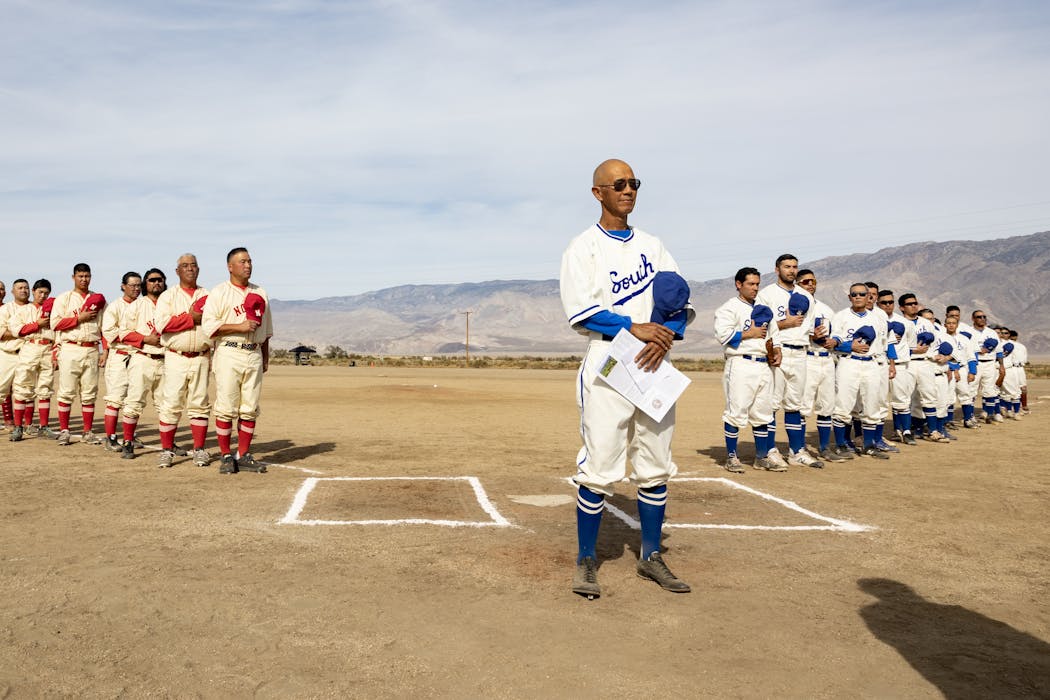
In a 2024 exhibition game at Manzanar, players – many of them descendants of internment camp detainees – donned custom 1940s-style uniforms. Aaron Rapoport, CC BY-SA

In the spring of 1942, 15-year-old Momo Nagano needed a way to fill her time.

She was imprisoned at the Manzanar Relocation Center along with approximately 10,000 other people of Japanese ancestry. When she’d arrived with her mother and two brothers, she’d been horrified.

The detention facility was located in the middle of the desert, about 225 miles northeast of Los Angeles. As I describe in my book “When Can We Go Back to America? Voices of Japanese American Incarceration during World War II,” barbed wire surrounded the perimeter and armed soldiers peered down from guard towers. The toilets and showers lacked partitions, and Nagano was forced to stand in long lines for hours in mess halls that served canned food. Her bed was a metal cot. She was directed to stuff straw into a bag for a makeshift mattress. She didn’t know whether she and her family would ever be able to return to their Los Angeles home.
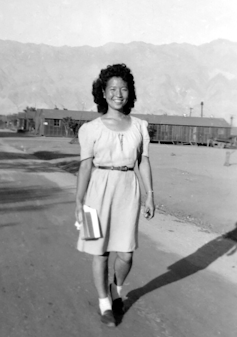
Black and white photo of Asian female teenager smiling and wearing a blouse.
Momo Nagano, in a photograph taken during her time spent at the Manzanar Relocation Center.
Courtesy of Dan Kwong, CC BY-SA

One day, the teenager decided to pick up a glove and play softball. Her son, Dan Kwong, told me in an interview that Nagano ended up playing catcher for The Gremlins, one of the camp’s many women’s softball teams.

“In one game, a batter connected with the ball and then threw the bat, clocking my mom in the nose, breaking it,” he said. “But despite her injury, she still enjoyed playing, even though she didn’t think her team was very good.”

Eighty years later, the descendants of prisoners – such as Nagano’s son, Kwong – are playing baseball again in Manzanar. Thanks to an effort spearheaded by Kwong, a baseball field on the site has been restored as a way to both celebrate the resiliency of so many prisoners and memorialize this dark period in U.S. history.

A massive removal effort

After Japan attacked Pearl Harbor in 1941, the U.S. government wrongly assumed that Japanese-descended West Coast residents would be more loyal to Japan and presented an espionage risk.

So on Feb. 19, 1942, President Franklin D. Roosevelt issued an executive order that gave the U.S. Army the authority to forcibly remove all first-generation immigrants from Japan and their American-born descendants from their West Coast homes.

In March 1942, U.S. soldiers began transporting the detainees to temporary detention sites under Army jurisdiction. The Manzanar site opened on March 21, 1942, and it eventually became one of 10 long-term detention centers, colloquially known as “the camps.”

According to Duncan Ryȗken Williams, the director of The Irei Project, which has compiled the most comprehensive list of those detained, nearly 127,000 people of Japanese ancestry were incarcerated between 1942 and 1947, when the last camp closed. Two-thirds of them were American citizens. Most were imprisoned for the duration of the war, and all were held without hearings or charges leveled against them.
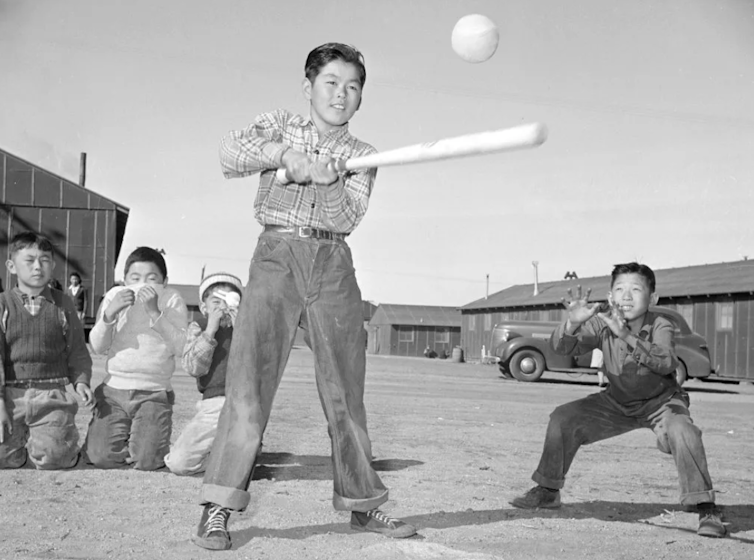
An Asian American boy swings a baseball bat at an approach ball as other boys watch in the background.
Sixth-grade boys play softball during recess at the Manzanar Relocation Center on Feb. 10, 1943.
Francis Leroy Stewart, courtesy of California State University Dominguez Hills Gerth Archives & Special Collections

A love of the game

Adjusting to their new grim reality, the detainees embraced the Japanese spirit of “gaman,” which means to endure hardship with dignity and resilience. They set up an education system and coordinated an array of activities. And they immediately organized baseball and softball games.

Many Japanese American families had already developed a passion for the two sports.

Horace Wilson, an educator from Maine, is credited with introducing baseball to Japan in the early 1870s. In 1872 the Yeddo Royal Japanese Troupe became the first Japanese people to play baseball on U.S. soil. When young Japanese men started immigrating to the U.S. in the late 19th century, they brought with them a love of America’s pastime.

Kerry Yo Nakagawa, the director of the Nisei Baseball Research Project, has written about the vanguards of Japanese American baseball. At a time when players of color were excluded from Major League Baseball, talented Japanese American ballplayers such as Kenichi Zenimura formed teams that barnstormed the country. They even played alongside Babe Ruth and Lou Gehrig in an exhibition game in Fresno, Calif., on Oct. 29, 1927.
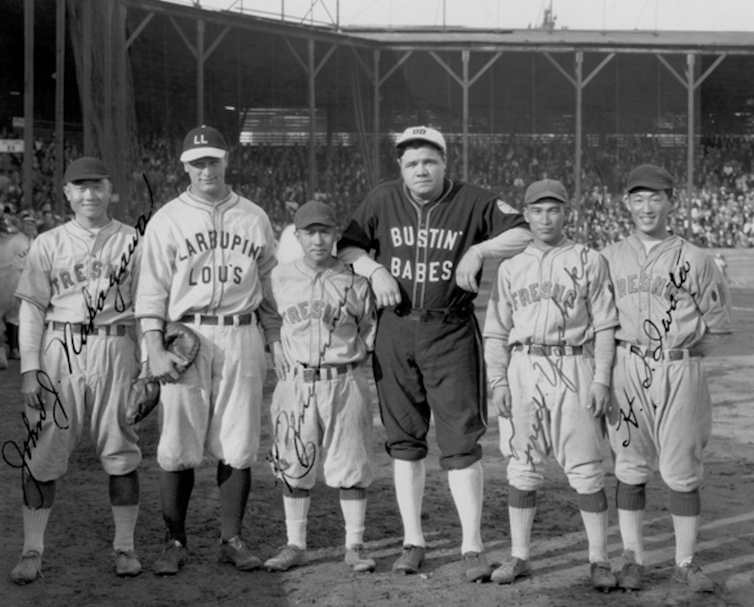
A black and white photograph of six baseball players – four Asian Americans and two white Americans – posing on a diamond while wearing baseball uniforms.
Lou Gehrig, second from left, and Babe Ruth, third from right, pose with Japanese American ballplayers at an exhibition game. Kenichi Zenimura is third from left.
Frank Kamiyama, courtesy of the family of Taizo Toshiyuki and the Nisei Baseball Research Project

“Every pre-war Japanese American community had a baseball team and they brought their love of baseball with them to the assembly centers and their camps,” Nakagawa explained to me. Though Zenimura was forced to leave his Fresno home and go to a camp in Gila River, Arizona, he soon had a baseball diamond and a 32-team league up and running.

Patriotism on the diamond

At Manzanar, baseball was easily the most popular sport. According to Dave Goto, the Manzanar National Historic Site arborist, the camp had 10 baseball and softball diamonds on the grounds and more than 120 teams divided into 12 leagues. The camp newspaper, the Manzanar Free Press, provided detailed game recaps, and thousands turned out to watch the games at Manzanar’s “A” Field.

“Watching baseball played at a semi-pro level was entertainment and also gave them a sense of normalcy and community,” Nakagawa said.
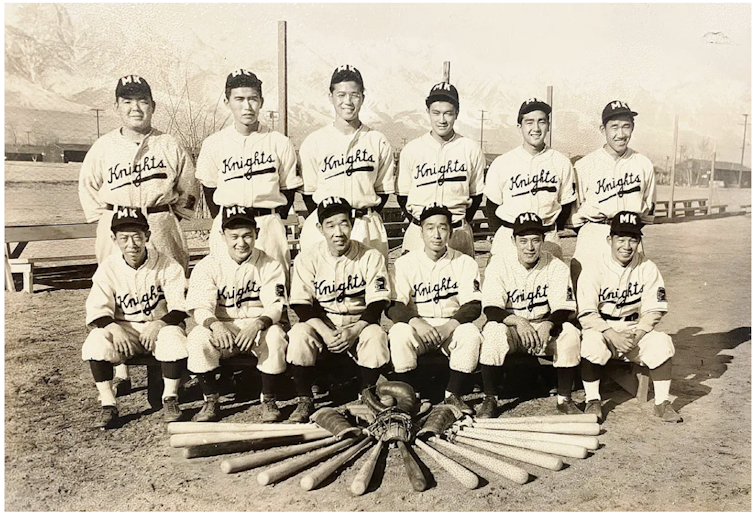
Sepia toned photograph of Japanese Americans wearing baseball uniforms and posing for a team picture.
The ManzaKnights were one of the 100-plus teams formed at the Manzanar camp.
Courtesy of the Maruki Family/Manzanar Historic Site

But for those who felt their loyalty to the U.S. was unfairly questioned, baseball was also a powerful way to express their identity as Americans, especially for the U.S.-born children of Japanese immigrants. Takeo Suo, who was incarcerated at Manazarer, recalled, “Putting on a baseball uniform was like wearing the American flag.” Or, as Nakagawa put it,
“What could be more American than playing the all-American pastime?”

After the war was over and the camps closed, those who’d been imprisoned had to focus on rebuilding their lives. Many were unable to return to their prewar hometowns. For those who ended up back on the West Coast, baseball continued to play an important role.

As Japanese American journalist and sports historian Chris Komai explained in a program at the Japanese American National Museum, “Baseball was a way for them to reestablish their communities while they dealt with antagonism and discrimination. Through the games they stayed connected with their friends and relatives who were now scattered.”

Postwar community baseball gave rise to the Southern California Nisei Athletic Union Baseball Leagues and other leagues that still operate. Kwong began playing for the Nisei Athletic Union in 1971 and does so to this day.

Rebuilding a dusty field of dreams

Nagano instilled in her son a commitment not only to baseball but also to social justice. A performance artist, Kwong stages a one-man play, “Return of the Samurai Centerfielder,” to shed light on this episode in history through the lens of playing baseball at Manzanar. Two years ago, he set out to restore the main Manzanar ball field and to bring baseball back to the site as a tribute to his late mother and other Manzanar detainees.

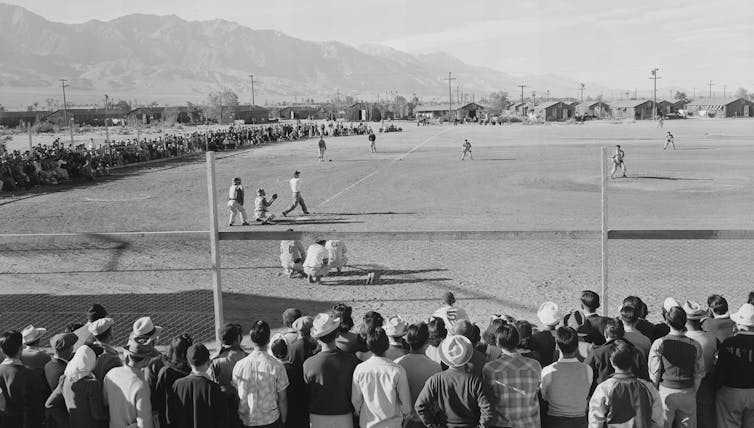
Working with Goto, the site arborist, volunteer construction supervisor Chris Siddons, Manzanar archaeologist Jeff Burton and other Manzanar site staff, Kwong and his team have restored the field almost exactly as it was. They carefully scrutinized archival photos, some taken by famed landscape photographer Ansel Adams and others snapped by studio photographer Toyo Miyatake, who’d been imprisoned at Manzanar. Miyatake’s photos were provided by his grandson, Alan Miyatake.
Crowds of onlookers watch a baseball game on a dusty field.
Organizers used archival materials – such as this 1943 Ansel Adams photograph of a baseball game at the Manzanar camp – to restore the field.
Ansel Adams/Library of Congress

From November 2023 to October 2024, volunteers cleared sagebrush, dug post holes and poured concrete, enduring intense heat, strong winds and relentless dust.

On Oct. 26, 2024, baseball returned to Manzanar after more than 80 years before an invitation-only audience. In the inaugural game, Kwong’s Li’l Tokio Giants beat the Lodi JACL Templars. In the game that followed, players donned custom 1940s-style uniforms and used vintage baseball equipment lent by History For Hire prop house. Many of the players were descendants of Japanese Americans who’d been incarcerated at Manzanar and other camps.

That day, Kwong was emotional as he said, “Mom would have gotten such a kick out of this.”

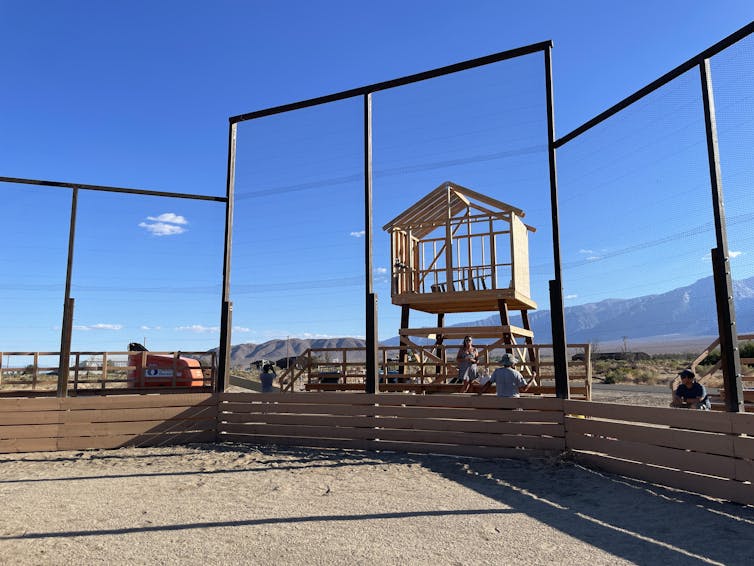
Kwong’s team has completed an announcer’s booth in time for this year’s grand opening, a doubleheader open to the public. The games were originally scheduled for Oct. 18, 2025, but have been postponed due to the U.S. government shutdown.
A wood-framed, enclosed booth on wooden legs behind a baseball field backstop.
The new announcer’s booth under construction at the restored Manzanar ball field.
Dan Kwong, CC BY-SA

For Kwong, staging a historical reenactment of how detainees played ball behind barbed wire pays tribute to their resilience, connects camp survivors and descendants with their past, and allows them to share their story with the American public. He hopes the games can become an annual event, a recurring celebration.

His motto: “In this place of sadness, injustice, and pain, we will do something joyous, righteous, and healing. We will play baseball.”

The Conversation

Susan H. Kamei is a researcher with The Irei Project and is a member of the Japanese American National Museum.

ref. Baseball returns to a Japanese American detention camp after a historic ball field was restored – https://theconversation.com/baseball-returns-to-a-japanese-american-detention-camp-after-a-historic-ball-field-was-restored-265954

AI-generated lesson plans fall short on inspiring students and promoting critical thinking

Source: The Conversation – USA (2) – By Torrey Trust, Professor of Learning Technology, UMass Amherst

When teachers rely on commonly used artificial intelligence chatbots to devise lesson plans, it does not result in more engaging, immersive or effective learning experiences compared with existing techniques, we found in our recent study. The AI-generated civics lesson plans we analyzed also left out opportunities for students to explore the stories and experiences of traditionally marginalized people.

The allure of generative AI as a teaching aid has caught the attention of educators. A Gallup survey from September 2025 found that 60% of K-12 teachers are already using AI in their work, with the most common reported use being teaching preparation and lesson planning.

Without the assistance of AI, teachers might spend hours every week crafting lessons for their students. With AI, time-stretched teachers can generate detailed lesson plans featuring learning objectives, materials, activities, assessments, extension activities and homework tasks in a matter of seconds.

However, generative AI tools such as ChatGPT, Gemini and Copilot were not originally built with educators in mind. Instead, these tools were trained on huge amounts of text and media drawn largely from across the internet and then launched as general-purpose chatbots.

As we started using these tools in our practice as educators, we noticed they often produced instructional materials and lessons that echoed the “recite and recall” model of traditional schooling. This model can be effective for memorizing basic facts, but it often fails to engage students in the active learning required to become informed citizens. We wondered whether teachers should be using these general-purpose chatbots to prepare for class.

For our research, we began collecting and analyzing AI-generated lesson plans to get a sense of what kinds of instructional plans and materials these tools provide to teachers. We decided to focus on AI-generated lesson plans for civics education because it is essential for students to learn productive ways to participate in the U.S. political system and engage with their communities.

To collect data for this study, in August 2024 we prompted three GenAI chatbots – the GPT-4o model of ChatGPT, Google’s Gemini 1.5 Flash model and Microft’s latest Copilot model – to generate two sets of lesson plans for eighth grade civics classes based on Massachusetts state standards. One was a standard lesson plan and the other a highly interactive lesson plan.

We garnered a dataset of 311 AI-generated lesson plans, featuring a total of 2,230 activities for civic education. We analyzed the dataset using two frameworks designed to assess educational material: Bloom’s taxonomy and Banks’ four levels of integration of multicultural content.

Bloom’s taxonomy is a widely used educational framework that distinguishes between “lower-order” thinking skills, including remembering, understanding and applying, and “higher-order” thinking skills – analyzing, evaluating and creating. Using this framework to analyze the data, we found 90% of the activities promoted only a basic level of thinking for students. Students were encouraged to learn civics through memorizing, reciting, summarizing and applying information, rather than through analyzing and evaluating information, investigating civic issues or engaging in civic action projects.

When examining the lesson plans using Banks’ four levels of integration of multicultural content model, which was developed in the 1990s, we found that the AI-generated civics lessons featured a rather narrow view of history – often leaving out the experiences of women, Black Americans, Latinos and Latinas, Asian and Pacific Islanders, disabled individuals and other groups that have long been overlooked. Only 6% of the lessons included multicultural content. These lessons also tended to focus on heroes and holidays rather than deeper explorations of understanding civics through multiple perspectives.

Overall, we found the AI-generated lesson plans to be decidedly boring, traditional and uninspiring. If civics teachers used these AI-generated lesson plans as is, students would miss out on active, engaged learning opportunities to build their understanding of democracy and what it means to be a citizen.

Why it matters

Teachers can try to customize lesson plans to their situation through prompts, but ultimately generative AI tools do not consider any actual students or real classroom settings the way a teacher can.

Although designed to seem as if they understand users and be in dialogue with them, from a technical perspective chatbots such as ChatGPT, Gemini and Copilot are machines that predict the next word in a sequence based on massive amounts of ingested text.

When teachers choose to use these tools while preparing to teach, they risk relying on technology not designed to enhance, aid or improve teaching and learning. Instead, we see these tools producing step-by-step, one-size-fits-all solutions, when what’s needed in education is the opposite – flexibility, personalization and student-centered learning.

What’s next

While our study revealed that AI-generated lesson plans are lacking in many areas, this does not mean that teachers should not use these tools to prepare for class. A teacher could use generative AI technologies to advance their thinking. In the AI-generated lesson plans we analyzed, there were occasional interesting activities and stimulating ideas, especially within the homework suggestions. We would recommend that teachers use these tools to augment their lesson-planning process rather than automate it.

By understanding AI tools cannot think or understand context, teachers can change the way they interact with these tools. Rather than writing simple, short requests – “Design a lesson plan for the Constitutional Convention” – they could write detailed prompts that include contextual information, along with proven frameworks, models and teaching methods. A better prompt would be: “Design a lesson plan for the Constitutional Convention for 8th grade students in Massachusetts that features at least three activities at the evaluate or create level of Bloom’s Taxonomy. Make sure to incorporate hidden histories and untold stories as well as civic engagement activities at the social action level of Banks’ four levels of integration of multicultural content model.”

Our study emphasizes the need for teachers to be critical users, rather than quick adopters, of AI-generated lessons. AI is not an all-in-one solution designed to address the needs of teachers and students. Ultimately, more research and teacher professional development opportunities are needed to explore whether or how AI might improve teaching and learning.

The Conversation

The authors do not work for, consult, own shares in or receive funding from any company or organization that would benefit from this article, and have disclosed no relevant affiliations beyond their academic appointment.

ref. AI-generated lesson plans fall short on inspiring students and promoting critical thinking – https://theconversation.com/ai-generated-lesson-plans-fall-short-on-inspiring-students-and-promoting-critical-thinking-265355

Trump administration’s layoffs would gut department overseeing special education, eliminating parents’ last resort

Source: The Conversation – USA (2) – By Joshua Cowen, Professor of Education Policy, Michigan State University

A sign marks the outside of the Department of Education headquarters in Washington, D.C. J. David Ake/Getty Images

A federal judge on Oct. 16, 2025, paused the Trump administration’s latest round of layoffs, which targeted more than 4,000 federal workers at a range of agencies, including 466 workers at the Department of Education.

U.S. District Judge Susan Illston said that the administration’s layoffs, which it has justified because of a lapse of funding during the government shutdown, are “both illegal and in excess of authority” and called them “arbitrary and capricious.” The Trump administration is expected to appeal the judge’s decision.

The Trump administration first eliminated about half of the Department of Education’s more than 4,200 positions in March 2025. This latest round of cuts would eliminate almost all of the work of the remaining Department of Education offices, including that of the Office of Special Education Programs. OSEP is responsible for ensuring children with disabilities across the U.S. receive a free, appropriate public education, as required by federal law.

Amy Lieberman, the education editor at The Conversation U.S., spoke with Josh Cowen, a scholar of education policy, to understand how these cuts would hinder the educational opportunities for children with special needs.

A large group of people hold yellow signs in front of a building. Some of the signs say
People rally in front of the Department of Education to protest budget cuts on March 13, 2025.
Kayla Bartkowski/Getty Images

What would these cuts mean for parents, children and schools?

With these cuts, we are talking about getting rid of some really important positions. People in these roles serve kids and families across the country. They help them answer questions about how school districts are providing for their children, in the way they are legally required to, if their child has special needs.

Special education is a very broad category. Under the Department of Education, it encompasses everything from dyslexia to a child who is blind. There is no educational need so severe that a child is not entitled to free and adequate education.

When navigating challenges related to your child’s special needs education, you really need an advocate – in the legal sense of the term rather than the political one. You need someone whose job it is to take your call and walk you through options, or just document your call and start an inquiry into your case.

What does the Office of Special Education Programs do?

The Office of Special Education Programs is part of the Department of Education’s Office of Special Education and Rehabilitative Services, which has about 179 employees. The government spent more than US$20 billion on its work from April 2024 through March 2025, making the broader Office of Special Education and Rehabilitation Services the third-largest branch of the Education Department, in terms of spending.

There are very strong federal legal obligations – and often state ones, too – for schools to serve kids with whatever need they have. This office’s main job is to be a resource to parents for their child’s education, particularly if parents feel they are not having these legal obligations met.

Let’s say a child with autism is in school. Their parent does not believe the school district is providing the accommodations that their child is legally entitled to. The school district disagrees and thinks the child is doing well in school. When things get fuzzy about what a child’s needs actually are, or parents feel they are being ignored, OSEP can help parents learn what their options are, and then can even become involved and serve as an arbitrator to figure out the best course of action.

Sometimes, public school districts and state departments of education have very clear, accessible ways for parents to receive information about their rights and obtain instructions for putting together an individualized education plan for their child. If those rights are not met, states may open an investigation into the matter to ensure compliance.

Throughout this process, parents may seek support and guidance from OSEP to make sure state investigations into special education cases are being done and being done well.

What could these investigations result in?

The Department of Education can help hold states and districts accountable and push districts and schools to be more responsive. In the best-case scenario, additional or tailored programming and support – whether it is a teacher’s aide or something else – can come from an OSEP investigation.

An older white woman wears a cream suit and sits at a table, with two men on either side of her.
U.S. Secretary of Education Linda McMahon, center, speaks during a cabinet meeting at the White House on Aug. 26, 2025.
Mandel Ngan/AFP via Getty Images

What does your research show about the impact of cutting services like these?

Well, we don’t really know what happens when you gut OSEP because no one has tried to gut OSEP before.

But it’s safe to say that parents will get really frustrated. I have been contacted by parents who have shared heartbreaking examples of the special education system not working over the past couple of years.

Feeling like the education system is really not serving you can push parents to leave the public school system and consider homeschooling or private options. In the long run, this may actually make parents even worse off because those sectors have have no obligation at all to serve students with special needs. So what’s happening at the U.S. Department of Education right now is not only creating more dissatisfaction and distrust in the system as it stands, but it’s also going to leave parents and kids with fewer options to get the support they need.

The Conversation

Josh Cowen ran for Congress as a Democrat prior to ending his campaign and returning to research and teaching during the fall of 2025.

ref. Trump administration’s layoffs would gut department overseeing special education, eliminating parents’ last resort – https://theconversation.com/trump-administrations-layoffs-would-gut-department-overseeing-special-education-eliminating-parents-last-resort-267684

Baseball returns to a Japanese American detention camp after a historic ball field was restored to honor the resilience of those incarcerated

Source: The Conversation – USA (2) – By Susan H. Kamei, Adjunct Professor of History and Affiliated Faculty, USC Shinso Ito Center for Japanese Religions and Cultures, USC Dornsife College of Letters, Arts and Sciences

In a 2024 exhibition game at Manzanar, players – many of them descendants of internment camp detainees – donned custom 1940s-style uniforms. Aaron Rapoport, CC BY-SA

In the spring of 1942, 15-year-old Momo Nagano needed a way to fill her time.

She was imprisoned at the Manzanar Relocation Center along with approximately 10,000 other people of Japanese ancestry. When she’d arrived with her mother and two brothers, she’d been horrified.

The detention facility was located in the middle of the desert, about 225 miles northeast of Los Angeles. As I describe in my book “When Can We Go Back to America? Voices of Japanese American Incarceration during World War II,” barbed wire surrounded the perimeter and armed soldiers peered down from guard towers. The toilets and showers lacked partitions, and Nagano was forced to stand in long lines for hours in mess halls that served canned food. Her bed was a metal cot. She was directed to stuff straw into a bag for a makeshift mattress. She didn’t know whether she and her family would ever be able to return to their Los Angeles home.

Black and white photo of Asian female teenager smiling and wearing a blouse.
Momo Nagano, in a photograph taken during her time spent at the Manzanar Relocation Center.
Courtesy of Dan Kwong, CC BY-SA

One day, the teenager decided to pick up a glove and play softball. Her son, Dan Kwong, told me in an interview that Nagano ended up playing catcher for The Gremlins, one of the camp’s many women’s softball teams.

“In one game, a batter connected with the ball and then threw the bat, clocking my mom in the nose, breaking it,” he said. “But despite her injury, she still enjoyed playing, even though she didn’t think her team was very good.”

Eighty years later, the descendants of prisoners – such as Nagano’s son, Kwong – are playing baseball again in Manzanar. Thanks to an effort spearheaded by Kwong, a baseball field on the site has been restored as a way to both celebrate the resiliency of so many prisoners and memorialize this dark period in U.S. history.

A massive removal effort

After Japan attacked Pearl Harbor in 1941, the U.S. government wrongly assumed that Japanese-descended West Coast residents would be more loyal to Japan and presented an espionage risk.

So on Feb. 19, 1942, President Franklin D. Roosevelt issued an executive order that gave the U.S. Army the authority to forcibly remove all first-generation immigrants from Japan and their American-born descendants from their West Coast homes.

In March 1942, U.S. soldiers began transporting the detainees to temporary detention sites under Army jurisdiction. The Manzanar site opened on March 21, 1942, and it eventually became one of 10 long-term detention centers, colloquially known as “the camps.”

According to Duncan Ryȗken Williams, the director of The Irei Project, which has compiled the most comprehensive list of those detained, nearly 127,000 people of Japanese ancestry were incarcerated between 1942 and 1947, when the last camp closed. Two-thirds of them were American citizens. Most were imprisoned for the duration of the war, and all were held without hearings or charges leveled against them.

An Asian American boy swings a baseball bat at an approach ball as other boys watch in the background.
Sixth-grade boys play softball during recess at the Manzanar Relocation Center on Feb. 10, 1943.
Francis Leroy Stewart, courtesy of California State University Dominguez Hills Gerth Archives & Special Collections

A love of the game

Adjusting to their new grim reality, the detainees embraced the Japanese spirit of “gaman,” which means to endure hardship with dignity and resilience. They set up an education system and coordinated an array of activities. And they immediately organized baseball and softball games.

Many Japanese American families had already developed a passion for the two sports.

Horace Wilson, an educator from Maine, is credited with introducing baseball to Japan in the early 1870s. In 1872 the Yeddo Royal Japanese Troupe became the first Japanese people to play baseball on U.S. soil. When young Japanese men started immigrating to the U.S. in the late 19th century, they brought with them a love of America’s pastime.

Kerry Yo Nakagawa, the director of the Nisei Baseball Research Project, has written about the vanguards of Japanese American baseball. At a time when players of color were excluded from Major League Baseball, talented Japanese American ballplayers such as Kenichi Zenimura formed teams that barnstormed the country. They even played alongside Babe Ruth and Lou Gehrig in an exhibition game in Fresno, Calif., on Oct. 29, 1927.

A black and white photograph of six baseball players – four Asian Americans and two white Americans – posing on a diamond while wearing baseball uniforms.
Lou Gehrig, second from left, and Babe Ruth, third from right, pose with Japanese American ballplayers at an exhibition game. Kenichi Zenimura is third from left.
Frank Kamiyama, courtesy of the family of Taizo Toshiyuki and the Nisei Baseball Research Project

“Every pre-war Japanese American community had a baseball team and they brought their love of baseball with them to the assembly centers and their camps,” Nakagawa explained to me. Though Zenimura was forced to leave his Fresno home and go to a camp in Gila River, Arizona, he soon had a baseball diamond and a 32-team league up and running.

Patriotism on the diamond

At Manzanar, baseball was easily the most popular sport. According to Dave Goto, the Manzanar National Historic Site arborist, the camp had 10 baseball and softball diamonds on the grounds and more than 120 teams divided into 12 leagues. The camp newspaper, the Manzanar Free Press, provided detailed game recaps, and thousands turned out to watch the games at Manzanar’s “A” Field.

“Watching baseball played at a semi-pro level was entertainment and also gave them a sense of normalcy and community,” Nakagawa said.

Sepia toned photograph of Japanese Americans wearing baseball uniforms and posing for a team picture.
The ManzaKnights were one of the 100-plus teams formed at the Manzanar camp.
Courtesy of the Maruki Family/Manzanar Historic Site

But for those who felt their loyalty to the U.S. was unfairly questioned, baseball was also a powerful way to express their identity as Americans, especially for the U.S.-born children of Japanese immigrants. Takeo Suo, who was incarcerated at Manazarer, recalled, “Putting on a baseball uniform was like wearing the American flag.” Or, as Nakagawa put it,
“What could be more American than playing the all-American pastime?”

After the war was over and the camps closed, those who’d been imprisoned had to focus on rebuilding their lives. Many were unable to return to their prewar hometowns. For those who ended up back on the West Coast, baseball continued to play an important role.

As Japanese American journalist and sports historian Chris Komai explained in a program at the Japanese American National Museum, “Baseball was a way for them to reestablish their communities while they dealt with antagonism and discrimination. Through the games they stayed connected with their friends and relatives who were now scattered.”

Postwar community baseball gave rise to the Southern California Nisei Athletic Union Baseball Leagues and other leagues that still operate. Kwong began playing for the Nisei Athletic Union in 1971 and does so to this day.

Rebuilding a dusty field of dreams

Nagano instilled in her son a commitment not only to baseball but also to social justice. A performance artist, Kwong stages a one-man play, “Return of the Samurai Centerfielder,” to shed light on this episode in history through the lens of playing baseball at Manzanar. Two years ago, he set out to restore the main Manzanar ball field and to bring baseball back to the site as a tribute to his late mother and other Manzanar detainees.

Working with Goto, the site arborist, volunteer construction supervisor Chris Siddons, Manzanar archaeologist Jeff Burton and other Manzanar site staff, Kwong and his team have restored the field almost exactly as it was. They carefully scrutinized archival photos, some taken by famed landscape photographer Ansel Adams and others snapped by studio photographer Toyo Miyatake, who’d been imprisoned at Manzanar. Miyatake’s photos were provided by his grandson, Alan Miyatake.

Crowds of onlookers watch a baseball game on a dusty field.
Organizers used archival materials – such as this 1943 Ansel Adams photograph of a baseball game at the Manzanar camp – to restore the field.
Ansel Adams/Library of Congress

From November 2023 to October 2024, volunteers cleared sagebrush, dug post holes and poured concrete, enduring intense heat, strong winds and relentless dust.

On Oct. 26, 2024, baseball returned to Manzanar after more than 80 years before an invitation-only audience. In the inaugural game, Kwong’s Li’l Tokio Giants beat the Lodi JACL Templars. In the game that followed, players donned custom 1940s-style uniforms and used vintage baseball equipment lent by History For Hire prop house. Many of the players were descendants of Japanese Americans who’d been incarcerated at Manzanar and other camps.

That day, Kwong was emotional as he said, “Mom would have gotten such a kick out of this.”

Kwong’s team has completed an announcer’s booth in time for this year’s grand opening, a doubleheader open to the public. The games were originally scheduled for Oct. 18, 2025, but have been postponed due to the U.S. government shutdown.

A wood-framed, enclosed booth on wooden legs behind a baseball field backstop.
The new announcer’s booth under construction at the restored Manzanar ball field.
Dan Kwong, CC BY-SA

For Kwong, staging a historical reenactment of how detainees played ball behind barbed wire pays tribute to their resilience, connects camp survivors and descendants with their past, and allows them to share their story with the American public. He hopes the games can become an annual event, a recurring celebration.

His motto: “In this place of sadness, injustice, and pain, we will do something joyous, righteous, and healing. We will play baseball.”

The Conversation

Susan H. Kamei is a researcher with The Irei Project and is a member of the Japanese American National Museum.

ref. Baseball returns to a Japanese American detention camp after a historic ball field was restored to honor the resilience of those incarcerated – https://theconversation.com/baseball-returns-to-a-japanese-american-detention-camp-after-a-historic-ball-field-was-restored-to-honor-the-resilience-of-those-incarcerated-265954

Protein powders and shakes contain high amounts of lead, new report says – a pharmacologist explains the data

Source: The Conversation – USA (3) – By C. Michael White, Distinguished Professor of Pharmacy Practice, University of Connecticut

If consumed in high doses, lead and other heavy metals have serious, well-documented health risks. whitebalance.space/E+ via Getty Images

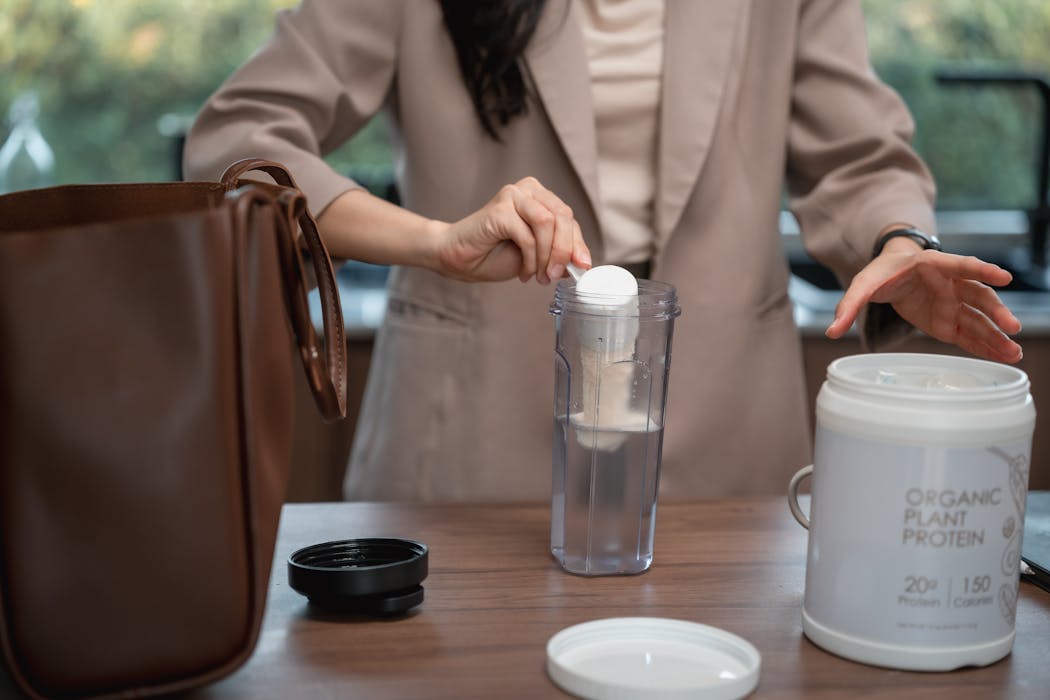
Powder and ready-to-drink protein sales have exploded, reaching over US$32 billion globally from 2024 to 2025. Increasingly, consumers are using these protein sources daily.

A new study by Consumer Reports, published on Oct. 14, 2025, claims that some such protein products contain dangerously high levels of lead, as well as other heavy metals such as cadmium and arsenic. At high levels, these substances have serious, well-documented health risks.

I am a clinical pharmacologist who has evaluated the heavy metal content of baby food, calcium supplements and kratom products. Lead and other heavy metals occur naturally in soil and water, so achieving zero-level exposure would be impossible. Additionally, the level of lead exposure that Consumer Reports deems safe is significantly lower than those set by the Food and Drug Administration.

However, regardless of the safety cutoff, the study does show that a few products are delivering a concerningly high dose of heavy metals per serving.

How Consumer Reports did the study

The new study assessed 23 powder and ready-to-drink protein products from popular brands by sending three samples of each product to an independent commercial laboratory.

Consumer Reports considered anything over 0.5 micrograms per day from any single source to be above recommended maximum lead levels. That number comes from the California Office of Environmental Health Hazard Assessment, which established recommended maximum levels for a variety of substances that could cause cancer or fetal harm.

It is significantly more conservative than the safety standard for lead exposure used by the FDA for drugs and supplements. The discrepancy is driven by Consumer Reports’ aspirational goals of very low exposure versus the more realistic but actionable requirements from the FDA.

According to the FDA, the limit for the amount of lead that a person should consume from any single dietary supplement product is 5 micrograms per day. That number is 10 times higher than the Consumer Report limit.

The FDA has another standard for the total daily amount of lead a person can safely consume from food, drugs and supplements combined. This number, called the Interim Reference Level, or IRL, for lead is based on concentrations of lead in the blood that are associated with negative health effects in different populations.

For people who could become pregnant, that level is 8.8 micrograms per day, and for children it’s 2.2 micrograms per day. For everyone else, it’s 12.5 micrograms per day. Every food, drug and dietary supplement that contains lead contributes to the total daily exposure, which should be less than this amount.

Bodybuilder at the gym drinking a protein shake
In assessing lead levels, Consumer Reports used a more conservative safety standard than the one used by the FDA for drugs and supplements.
lakshmiprasad S/iStock via Getty Images Plus

What the report found

The nonprofit advocacy group found that 16 of the 23 products it tested exceeded 0.5 micrograms, the level of lead in a standard serving that the organization deems safe.

Four of the 23 products exceeded 2.2 micrograms, the FDA’s cutoff for the total daily amount of lead children should consume. Two products contained 72% and 88%, respectively, of the total daily amount of lead that the FDA deems safe for pregnant women.

In addition, Consumer Reports found that two of the 23 products delivered more than what it considers a safe amount of cadmium per serving, and one had more arsenic than was recommended.

The organization’s safety cutoff for cadmium is 4.1 micrograms per day, and for arsenic it is 7 micrograms per day. These numbers align fairly closely with the FDA’s recommended exposure limit for cadmium and arsenic from a single product. For cadmium, the FDA’s limit is set at 5 micrograms per day for a given dietary supplement product and 15 micrograms per day for arsenic.

The study found that the source of protein was key: Plant-derived protein products had nine times the lead found in dairy proteins like whey, and twice as much as beef-based protein.

Where are these heavy metals coming from?

Lead and other heavy metals are present in high amounts in volcanic rock, which comes from molten rock called magma beneath the Earth’s surface. When volcanic rock is eroded, the heavy metals contaminate the local soil and water supply. What’s more, some crop plants are especially efficient at extracting heavy metals from the soil and placing them in the parts of the plants that consumers ingest.

Fossil fuels, which come from deep within the Earth, also billow heavy metals into the air when they are burned. These substances then settle out into the soil and water. Finally, some fertilizers, herbicides and pesticides also contain heavy metals that can further contaminate soil and local water.

High levels of heavy metals have been found in plant-based protein powder, spices like cinnamon, dark chocolate, root vegetables like carrots and sweet potatoes, rice, legumes such as pea pods and many herbal supplements.

A cast iron pot of cubed sweet potatoes
Root vegetables such as sweet potatoes can absorb heavy metals from the soil.
Virginia State Parks, CC BY

Should consumers be concerned? And what can they do?

Occasionally exceeding the daily recommended heavy metal doses is unlikely to result in serious health issues.

Repeated, heavy exposure to heavy metals can cause harm, however. When they accumulate in the blood, these substances can delay or impair mental functioning, damage nerves, soften bones and raise blood pressure – which in turn increases the risk of strokes and heart attacks. Heavy metals can also increase the risk of developing cancer.

It’s important to note that all the products Consumer Reports flagged have lead levels significantly lower than the maximum daily exposure levels established by the FDA.

Consumers can limit exposure by choosing dairy- or animal-based sources of protein products, since they generally seemed to have less heavy metal contamination than plant-based ones. However, some plant-based protein products in the study did not have high levels of heavy metals. Heavy metal levels vary widely in the environment, so the results from the Consumer Reports study show a snapshot in time. They might not be consistently accurate across batches if, for example, a manufacturer changes the source of its raw ingredients.

For protein products that do show an especially high heavy metal content, using them more sporadically, rather than daily, can reduce exposure. Studies suggest that organic plant-based products generally yield less heavy metal content than traditionally farmed ones.

Finally, the Consumer Reports study measured heavy metals in a single serving of protein products, so it’s helpful to understand what constitutes a serving for specific products and to avoid sharply increasing daily consumption.

Overall, the wide variation in lead levels across different protein powders and ready-made protein products highlights the need for manufacturers to tighten product testing and good manufacturing practices.

The Conversation

C. Michael White does not work for, consult, own shares in or receive funding from any company or organization that would benefit from this article, and has disclosed no relevant affiliations beyond their academic appointment.

ref. Protein powders and shakes contain high amounts of lead, new report says – a pharmacologist explains the data – https://theconversation.com/protein-powders-and-shakes-contain-high-amounts-of-lead-new-report-says-a-pharmacologist-explains-the-data-267591

How new foreign worker visa fees might worsen doctor shortages in rural America

Source: The Conversation – USA (3) – By Patrick Aguilar, Managing Director of Health, Washington University in St. Louis

Many physicians who aren’t U.S. citizens come to the U.S. to do medical residency programs. SDI Productions/E+ via Getty Images

There are almost 1.1 million licensed physicians in the United States. That may sound like a lot, but the country has struggled for decades to train enough physicians to meet its needs – and, in particular, to provide care in rural and underserved communities.

Foreign-born physicians have long filled that gap, reducing the overall national shortage and signing up to practice in often overlooked regions and specialties. Today, 1 in 5 doctors licensed to practice in the U.S. were born and trained in another country.

But the ability of physicians from other countries to obtain work in the U.S. may be threatened by the Trump administration’s aims of limiting foreign workers. In September, Trump issued a proclamation requiring employers sponsoring foreign-born workers through a type of work visa called an H-1B to pay a fee of US$100,000 to the government. The White House has signaled doctors may be exempt but has not clarified its position.

As a physician and professor who studies the intersection of business and medicine, I believe increasing restrictions on H-1B visas for physicians may exacerbate the physician shortage. To grasp why that is, it’s important to understand how foreign-trained doctors became such an integral part of U.S. health care – and the role they play today.

The roots of today’s physician shortage

The Association of American Medical Colleges, a trade association representing U.S. medical schools, estimates there will be a deficit of about 86,000 physicians in the country by 2036.

The roots of this shortage stretch back more than a century. In 1910, a landmark study called the Flexner Report detailed significant inconsistencies in the quality of education at American medical schools. The report resulted in the closure of over half the country’s medical schools, winnowing their numbers down from 148 to 66 over two decades.

As a result, the number of doctors in the U.S. declined until new training programs emerged. Between 1960 and 1980, 40 new medical schools launched with the help of federal funding. In 1980, a congressionally mandated assessment deemed the problem solved, but by the early 2000s, a physician shortage emerged once more. In 2006, the American Association of Medical Colleges called for raising medical school enrollment by 30%.

Doctor looking at x-rays
Foreign-born doctors have helped the U.S. bridge a physician shortage for decades.
stevecoleimages/E+ via Getty Images

Growth in medical school enrollment hit that target in the late 2010s, but even so, the U.S. still lacks enough medical graduates to fill yearslong training programs, called residencies, that early-career physicians must complete to become fully qualified to practice.

Especially lacking are primary care physicians – particularly in rural areas, where there are one-third as many physicians per capita as in urban areas.

Opportunities for foreign-born doctors

Even as the U.S. built up medical school enrollment in the 1960s and 1970s, the government joined other countries such as the U.K. and Canada in creating immigration policies that drew physicians from developing countries to practice in underserved areas. Between 1970 and 1980, their numbers grew sharply, from 57,000 to 97,000.

Foreign-born and -trained physicians have remained a key pillar of the U.S. medical system. In recent years, the majority of those physicians have come from India and Pakistan. Citizens of Canada and Middle Eastern countries have added significantly to that count, as well. Most arrive in the U.S. as trainees in residency programs through one of two main visa programs.

The majority come on J-1 visas, which allow physicians to enter the U.S. for training but require them to return to their home country for at least two years when their training is complete. Those who wish to remain in the U.S. to practice must transition to an H-1B visa.

A small percentage of physicians come to the U.S. on H-1Bs from the start.

H-1B visas are employer-sponsored temporary work permits that allow foreign-born, highly skilled workers to obtain U.S. employment. Employers directly petition the government on behalf of visa applicants, certifying that a foreign worker will be paid a similar wage to U.S. workers and will not adversely affect the working conditions of Americans.

Several programs sponsor H-1B visas for physicians, though the most common requires a three-year commitment to work in an underserved area after completing their training.

Foreign physicians fill a crucial need

In 2025, foreign-trained medical graduates filled 9,700 of the nearly 40,000 training positions. Of those, roughly one-third were actually U.S. citizens who attended medical schools in other countries, with the remainder being foreign citizens seeking more training in the U.S.

After residency, these doctors frequently practice in precisely the geographic areas where the physician shortage is most severe. A nationwide survey of international medical graduates found that two-thirds practice in regions that the federal government has designated as lacking sufficient access to health care.

These doctors also occupy a disproportionate number of primary care positions. In a sample of 15,000 physicians who accepted new jobs in one year, foreign-born doctors were nine times more likely to enter primary care specialties. In 2025, 33.3% of internal medicine, 20.4% of pediatric and 17.6% of family medicine training positions were filled by physicians trained in other countries.

Who will pay?

Approximately 8,000 foreign-born physicians received H-1B visas in 2024. The new requirement of a $100,000 sponsorship fee would hit hardest for hospitals, health systems and clinics in areas of the country most significantly affected by the physician shortage.

These organizations are already under economic strain due to increasing labor costs and Medicare payments that have not kept pace with inflation. Dozens of these hospitals have closed in recent years, and many currently do not make enough money to support their operations.

On Sept. 25, 2025, 57 physician organizations cosigned a letter petitioning Homeland Security Secretary Kristi Noem to waive the new application fee for physicians.

Already, however, the new rule may be having a chilling effect. Despite years of annual growth in the number of foreign-born applicants to U.S. physician training programs, 2025 has seen a nearly 10% drop. If the new H-1B fee is applied to physicians, the number is likely to keep falling.

The Conversation

Patrick Aguilar Washington University, an employer of physicians.

ref. How new foreign worker visa fees might worsen doctor shortages in rural America – https://theconversation.com/how-new-foreign-worker-visa-fees-might-worsen-doctor-shortages-in-rural-america-266544

Antioxidants help stave off a host of health problems – but figuring out how much you’re getting can be tricky

Source: The Conversation – USA (3) – By Nathaniel Johnson, Assistant Professor of Nutrition and Dietetics, University of North Dakota

Many fruits and vegetables are high in antioxidants. istetiana/Moment via Getty Images

When it comes to describing what an antioxidant is, it’s all in the name: Antioxidants counter oxidants.

And that’s a good thing. Oxidants can damage the structure and function of the chemicals in your body critical to life – like the proteins and lipids within your cells, and your DNA, which stores genetic information. A special class of oxidants, free radicals, are even more reactive and dangerous.

As an assistant professor of nutrition, I’ve studied the long-standing research showing how the imbalances in antioxidants and oxidants lead to oxidative stress, which is linked to cancer, diabetes, cardiovascular disease and dementia and Alzheimer’s disease. In fact, a primary cause of aging is the damage accumulated across of a lifetime of oxidative stress.

Simply put: To help prevent oxidative stress, people need to eat foods with antioxidants and limit their exposure to oxidants, particularly free radicals.

The research: Food, not supplements

There’s no way for any of us to avoid some oxidative stress. Just metabolism – the processes in your body that keep you alive, such as breathing, digestion and maintaining body temperature – are a source of oxidants and free radicals.
Inflammation, pollution and radiation are other sources.

As a result, everyone needs antioxidants. There are many different types: enzymes, minerals, vitamins and phytochemicals.

Two types of phytochemicals deserve special mention: carotenoids and flavonoids. Carotenoids are pigments, with the colors yellow, orange and red; they contain the antioxidants beta-carotene, lycopene and lutein. Some flavonoids, called anthocyanins, are pigments that give foods a blue, red or purple color.

Although your body produces some of these antioxidants, you can get them from the foods you eat, and they’re better for you than supplements.

In fact, researchers found that antioxidant supplements did not reduce deaths, and some supplements in excessive amounts contribute to oxidative stress, and may even increase the risk of dying.

It should be pointed out that in most of these studies, only one or two antioxidants were given, and often in amounts far greater than the recommended daily value. One study, for example, gave participants only vitamin A, and at an amount more than 60 times an adult’s recommended intake.

A synopsis of the study that measured the antioxidant content of more than 3,000 foods.

Foods rich in antioxidants

In contrast, increased antioxidant intake from whole foods is related to decreased risk of death. And although antioxidant supplementation didn’t reduce cancer rates in smokers, the antioxidants in whole foods did.

But measuring antioxidants in foods is complicated. Extensive laboratory testing is required, and too many foods exist to test them all anyway. Even individual food items that are the same exact variety of food – such as two Gala apples – can have different amounts of antioxidants. Where the food was grown and harvested, how it was processed and how it was stored during transportation and while in the supermarket are factors. The variety of the food also matters – the many different types of apples, for instance, can have different amounts of antioxidants.

Nonetheless, in 2018, researchers quantified the antioxidant content of more than 3,100 foods – the first antioxidant database. Each food’s antioxidant capacity was determined by the amount of oxidants neutralized by a given amount of food. The researchers measured this capacity in millimoles per 100 grams, or about 4 ounces.

For fruits easily found in the grocery store, the database shows blueberries have the most antioxidants – just over 9 millimoles per 4 ounces. The same serving of pomegranates and blackberries each have about 6.5 millimoles.

For common vegetables, cooked artichoke has 4.54 millimoles per 4 ounces; red kale, 4.09 millimoles; cooked red cabbage, 2.15; and orange bell pepper, 1.94.

Coffee has 2.5 millimoles per 4 ounces; green tea has 1.5; whole walnuts, just over 13; whole pecans, about 9.7; and sunflower seeds, just over 5. Herbs and spices have a lot: clove has 465 millimoles per 4 ounces; rosemary has 67; and thyme, about 64. But keep in mind that those enormous numbers are based on a quarter-pound. Still, just a normal sprinkle packs a powerful nutritional punch.

A young woman picks up a package of fresh produce at the supermarket.
The antioxidant levels of a food can be affected by its storage time in the supermarket.
d3sign/Moment via Getty Images

Other tips

Other ways to choose antioxidant-rich foods: Read the nutrition facts label and look for antioxidant vitamins and minerals – vitamins A, C, E, D, B2, B3 and B9, and the minerals selenium, zinc and manganese.

Just know the label has a drawback. Food producers and manufacturers are not required to list every nutrient of the food on the label. In fact, the only vitamins and minerals required by law are sodium, potassium, calcium, iron and vitamin D.

Also, focus on eating the rainbow. Colorful foods are often higher in antioxidants, like blue corn. Many darker foods are rich in antioxidants, too, like dark chocolate, black barley and dark leafy vegetables, such as kale and Swiss chard.

Although heat can degrade oxidants, that mostly occurs during the storage and transportation of the food. In some cases, cooking may increase the food’s antioxidant capacity, as with leafy green vegetables.

Keep in mind that while blueberries, red kale and pecans are great, their antioxidant profile will be different than that of other fruits, vegetables and nuts. That’s why diversity is the key: To increase the power of antioxidants, choose a variety of fresh, flavorful, colorful and, ideally, local foods.

The Conversation

Nathaniel Johnson does not work for, consult, own shares in or receive funding from any company or organization that would benefit from this article, and has disclosed no relevant affiliations beyond their academic appointment.

ref. Antioxidants help stave off a host of health problems – but figuring out how much you’re getting can be tricky – https://theconversation.com/antioxidants-help-stave-off-a-host-of-health-problems-but-figuring-out-how-much-youre-getting-can-be-tricky-256974

Madagascar’s military power grab shows Africa’s coup problem isn’t restricted to the Sahel region

Source: The Conversation – Global Perspectives – By John Joseph Chin, Assistant Teaching Professor of Strategy and Technology, Carnegie Mellon University

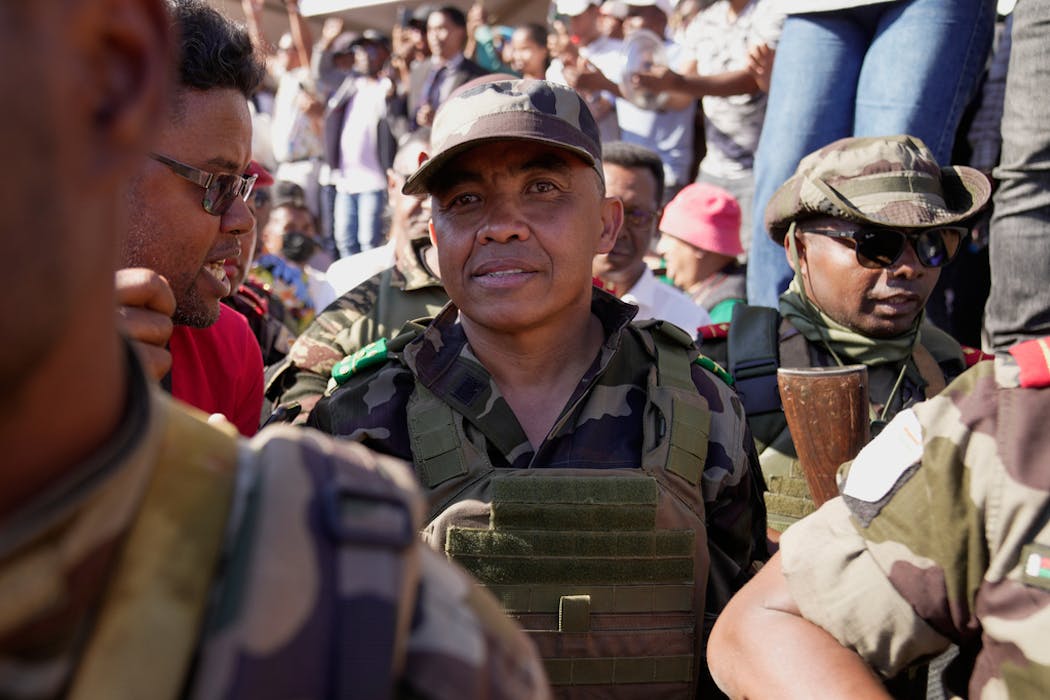
Military Col. Michael Randrianirina joins protesters as he announces that the armed forces are taking control of Madagascar on Oct. 14, 2025.
AP Photo/Brian Ingang

Those who rise to power through a coup often fall by the same means.

That is one of the takeaways from events in Madagascar, where on Oct. 14, 2025, the military seized power after weeks of protests largely driven by Gen Z. Ironically, it was the same elite military unit that helped bring Andry Rajoelina, former mayor of the capital Antananarivo, to power in a March 2009 coup that now supported anti-government protesters and ultimately forced the president to flee.

I lead a research team that compiles the Colpus Dataset of coup types and characteristics and have written on the history of coups d’état from 1946 through 2025.

Our data suggests that even as coups have declined globally overall, coup risk remains comparatively high in Africa. Since 2020, the continent has now seen 10 successful coups across eight countries.

But the military takeover in Madagascar marks only the second coup in that period to take place outside of the Sahel region, stretching from the Atlantic to the Horn of Africa – a signal that Africa’s coup problem is becoming a continental one.

But why do some coups succeed and others fail? And why do Madagascar and various states in Africa have trouble escaping so-called coup traps?

Our data provides some answers. But first it is worth exploring what we mean when we use the term coup.

What is a coup?

A coup d’état is a seizure of executive power involving one or more concrete, observable and illegal actions by security personnel or civilian officials.

Here, Madagascar’s military takeover appears to qualify. Despite claims by the country’s new military leader, Col. Michael Randrianirina, that he had an order from the High Constitutional Court legitimizing his seizure of power, this seemed to be contradicted by statements a day earlier that Randrianirina’s military council had suspended the high court’s powers.

That’s not to say that every political event that smells like a coup is, in fact, a coup.

Many coup plots never come to fruition. A bona fide plot may be preempted and the plotters arrested, or plotters may abandon their plan before taking any concrete action. Moreover, sometimes a leader falsely alleges a coup plot to purge members of the government suspected of disloyalty.

A plot without an attempt to oust the leader is not, in our book, a coup.

Conversely, attempts to target a leader without a plan to seize power are not coups. This includes leader assassination attempts by political opponents or lone wolves or mutinies by disgruntled soldiers who might even march on the presidential palace to demand higher pay, promotions or other policy concessions.

Nor do most civilian-led mass uprisings entail coups, even if they are successful in toppling the government. Take Nepal, where in September a Gen Z-led protest turned violent and ousted the government. But there was no coup insofar as the military remained quartered rather than actively joining the protests or issuing a threat to compel the prime minister to resign.

However, some revolutions and coups do co-occur, resulting in a “coupvolution” or “endgame coup.”

Determining whether a coup accompanies anti-government protests depends on how elites and the military behave, not on how violent protesters may be.

In Madagascar, mostly peaceful civilian protests turned into a coup attempt once troops actively joined the demonstrations. That attempt succeeded when Randrianirina, commander of the elite CAPSAT force, claimed the interim presidency and insisted a military council would rule for the time being.

Why do coups succeed?

There have been 601 coup attempts since 1946, according to our database, with 299 being successful – or about 50%. In Africa during that period, 111 out of 225 coup attempts were successful.

Coups come in a variety of forms, with different causes and outcomes, and not all are equally likely to succeed. The events in Madagascar, however, tick many of the boxes associated with determining coup success.

Coups depend on coordinating a lot of people, while simultaneously preventing the leader from finding out about the plot. Mass protests of the kind that rocked Madagascar in recent weeks provide cover – as well as motive and opportunity – for coup plotters.

Counterintuitively, military force is rarely decisive. In a typical coup attempt, much of the military remains neutral, biding its time to see whether the leader or coupists will prevail. Consequently, the perceived momentum of events influences how the military rank and file react: If they think the coupmakers will succeed, they typically join; if they think the coup will fail, they generally oppose it.

A coup’s momentum depends on a variety of factors, including the identity, location and strategy of coup leaders, as well as domestic and international reactions to the coup.

Coups that are launched by government insiders and senior military officers in the capital and are nonviolent and result in pro-coup mass mobilization are the most likely to succeed. By contrast, coups that are launched by government outsiders and junior officers outside the capital and are bloody and generate fierce anti-coup mass mobilization are the most likely to fail.

Coup violence is inversely correlated with success. When no force is threatened – usually because the security forces remain united under a senior command – coups succeed 85% of the time.

By contrast, less than 40% of coups that escalate into civil-war levels of violence – that is, resulting in over 1,000 fatalities – succeed.

In Madagascar, we saw the involvement of government elites and senior officers in the capital, mass pro-coup mobilization, low levels of coup violence and a history of prior successful coups – all of which make coup success likely.

A crowd of protesters.
Coup supporters cheer police officers in Gabon in August 2023.
AP Photo/Betiness Mackosso

Madagascar is not alone

Since 2020, military actors have also taken power in coups in Burkina Faso, Chad, Gabon, Guinea, Mali, Niger and Sudan.

So why are so many African countries prone to falling into a coup trap?

Scholars have asked this question for decades. Development economist Paul Collier suggests that Africa is the most coup-prone region because it is the poorest region of the world, and it is poverty and low growth – and associated political violence – that drive coups.

Others have pointed to high levels of ethnic diversity, and a history of ethnic exclusion and ethnic militaries, as long-standing drivers of coups on the continent.

But since 2020, a number of other factors also appear to be driving up structural coup risk on the continent. Many African countries have seen declining trust in public institutions and leaders and a rise of terrorist violence, which have generated mass popularity for recent coups on the continent.

Anti-coup norms have also weakened in recent years. International pressure to restore civilian rule was quite strong in the 1990s and 2000s, contributing to the decline of African military coups. But new post-coup African governments appear more resilient to sanctions, are cooperating more with each other and are able to draw on the support of authoritarian “patrons,” notably Russia and China.

As a result, African post-coup governments are staying in power longer, which in turn emboldens coup plotters elsewhere who see a more permissive environment.

So even if there are limits to Africa’s “coup contagion,” Madagascar likely won’t be the last domino to fall, given structural conditions on the continent.

The Conversation

John Joseph Chin does not work for, consult, own shares in or receive funding from any company or organization that would benefit from this article, and has disclosed no relevant affiliations beyond their academic appointment.

ref. Madagascar’s military power grab shows Africa’s coup problem isn’t restricted to the Sahel region – https://theconversation.com/madagascars-military-power-grab-shows-africas-coup-problem-isnt-restricted-to-the-sahel-region-267581

Academic freedom: how to defend ‘the very condition of a living democracy’ in France and worldwide

Source: The Conversation – France – By Stéphanie Balme, Director, CERI (Centre de recherches internationales), Sciences Po

Director of the CERI at SciencesPo, Stéphanie Balme conducted a study for France Universités, an organisation whose members are presidents of universities, titled “Defending and promoting academic freedom. A global issue, an urgent matter for France and Europe. Findings and proposals for action.” She shares some of her insights here.


Unofficially unveiled on October 2, 2025, US President Donald Trump’s Compact for Academic Excellence in Higher Education is a striking illustration of the politicisation of knowledge and the desire for ideological control over scientific output in the United States. Behind the rhetoric of “restoring excellence” lies a new stage in the institutionalisation of “sciento-populism”: mistrust of science is being strategically exploited to flatter populist sentiments and turn academics into scapegoats, held responsible for the “decline” of US civilisational hegemony.

This phenomenon, although exaggerated, is not isolated. At the same time as Trump’s announcement, the 2025 edition of the Global Innovation Index (GII) revealed that China had entered the top 10 most innovative nations for the first time, while the US, still in third place, showed signs of structural weakness. Eight European countries, a little-known fact, are among the top 15. France has been downgraded to 13th place, the position occupied by China three years ago.

The GII’s 80 indicators, covering nearly 140 countries, are not limited to measuring technological or scientific performance: they also assess the ability of states to guarantee a comprehensive, free and secure political-institutional, economic and financial environment. By cross-referencing these data with those of the Academic Freedom Index, the main reference tool developed since 2019, we can see that academic freedom is no longer solely threatened in authoritarian regimes. It is now being undermined at the very heart of democracies, affecting the humanities and social sciences as much as the experimental sciences.

The awarding of the 2025 Nobel prize in economics to Philippe Aghion, Peter Howitt and Joel Mokyr is a timely reminder that growth and innovation depend on an ecosystem based on freedom of research and the free flow of ideas. Their work on the historical and structural conditions of technological progress shows that no economy can prosper sustainably when knowledge is constrained or subject to ideological control.

Authoritarian regimes and ‘techno-nationalism’

Paradoxically, authoritarian regimes are now among the main investors in research, although they strictly control its objectives in line with their political priorities. Engaged in a phase of rapid “techno-nationalist” development, they are investing heavily in science and technology as instruments of power, without yet suffering the corrosive effects of mistrust of knowledge.

Democracies, on the other hand, struggle to fund research while maintaining their defence spending and must contend with the rise of movements that challenge the very legitimacy of science as it is practiced. In order to better understand these dynamics, I conducted a study for France Universités titled “Defending and promoting academic freedom. A global issue, an urgent matter for France and Europe. Findings and proposals for action”.

Multiple violations in France

France is a particularly striking example of the vulnerabilities described above. In 2024–2025, attacks on academic freedom took many forms: increased foreign interference, regional public funding made conditional on charters with vague criteria, ideological pressure on teaching and research content, conference cancellations, campaigns to stigmatise teachers and researchers on social media, interventions by politicians even in university boards of governors, restrictions on access to research sites or grants, and finally, an increase in gag orders.

Unlike other fundamental rights, academic freedom in France is distinguished by the absence of a firmly rooted political, professional and civic culture. Academics who are victims of attacks on their freedom to practice their profession often find themselves isolated, while the institutional capacity of universities to act as a counterweight remains limited.

This vulnerability is exacerbated by dependence on public funding, career insecurity, administrative overload and a lack of real institutional autonomy. Nevertheless, the current fragility could be transformed into a lever for renewal, promoting the emergence of a strong culture of academic freedom and, in so doing, strengthening France’s position in global science geopolitics.

A multidimensional strategy

The study for France Universités proposes a proactive strategy based on several complementary areas, targeting four categories of stakeholders: the state, the universities, civil society, and those at the European level.

The first area concerns strengthening the legal foundation: constitutionalising academic freedom, reaffirming the autonomy of institutions and the independence of staff, and finally, recognising the principle of source confidentiality (as for journalists) and incorporating a specific regime into the French research code for sensitive data. It is also proposed to extend the system for protecting the nation’s scientific and technical potential (PPST) to the humanities and social sciences, incorporating risks of interference to reconcile scientific security and freedom.

The second area focuses on action by universities: coordinating initiatives at the national level via an independent body, rolling out academic freedom charters across all institutions and research organisations, strengthening the protection of teachers through a dedicated national fund, and establishing rapid assistance protocols. It also provides for the creation of an independent observatory to monitor violations of academic freedom, training for management and advisers on these issues, and the coordination of legal, psychological and digital support for academics who are targeted. Finally, this area aims to promote cross-collaboration between security or defence officials and researchers and teacher-researchers.

The third area aims to promote a genuine culture of academic freedom in the public sphere: launching a national awareness campaign, encouraging student initiatives, transforming France’s Fête de la science (Science Festival) into a Festival of Science and Academic Freedom, organising a national conference to define a participatory action plan, and rolling out a wide-ranging campaign to promote research in partnership with all operators, starting with the National Centre for Scientific Research (CNRS). This campaign, supported by visual aids, posters, drawings and a unifying hashtag, should celebrate research in all media and highlight its essential role in serving a democratic society.

The fourth and final priority aims to incorporate these measures into European science diplomacy by re-establishing a European ranking of universities worldwide that includes an academic freedom index, and by working to have that included in major international rankings. It also aims to strengthen cooperation between the European University Association and European university alliances, establish a European observatory on academic freedom, create a European talent passport for refugee researchers, and make Europe a safe haven for scientists in danger, with the ultimate goal of obtaining recognition in the form of a Nobel Peace Prize dedicated to academic freedom.

A precious common good

Defending academic freedom is not a corporatist reflex: on the contrary, it means protecting a precious common good and the very condition of a living democracy. Of course, this right belongs to only a small number of people, but it benefits everyone, just like freedom of the press, which in France is guaranteed by the law of 1881. Contrary to popular belief, academics are often the last to defend their professional rights, while journalists, quite rightly, actively protect theirs.

The French university system, as it has been constructed since 1945, and even more so after 1968, was not designed to confront authoritarianism. Today, French institutions would not be able to resist systematic attacks for very long if a populist and/or authoritarian regime came to power. Powerful, wealthy and autonomous, the Ivy League universities themselves faltered in the face of the MAGA movement and are still struggling to recover. Many US scientists are now moving to Europe, Japan or South Korea.

How, then, could French universities, which are both financially and institutionally dependent and have only recently established alumni associations, cope with such an onslaught? Not to mention that this would ultimately spell the end of the ambition behind the EU’s Choose Europe for Science programme.

Despite the gravity of the situation, it opens up unprecedented opportunities for collective action, democratic innovation and the development of concrete solutions. Now is the time to act collectively, coordinate stakeholders and launch a broad French and European campaign in support of academic freedom: this is the purpose of the study I conducted.


A weekly e-mail in English featuring expertise from scholars and researchers. It provides an introduction to the diversity of research coming out of the continent and considers some of the key issues facing European countries. Get the newsletter!


The Conversation

Stéphanie Balme ne travaille pas, ne conseille pas, ne possède pas de parts, ne reçoit pas de fonds d’une organisation qui pourrait tirer profit de cet article, et n’a déclaré aucune autre affiliation que son organisme de recherche.

ref. Academic freedom: how to defend ‘the very condition of a living democracy’ in France and worldwide – https://theconversation.com/academic-freedom-how-to-defend-the-very-condition-of-a-living-democracy-in-france-and-worldwide-267689

The Life of Violet: three unearthed early stories where Virginia Woolf’s genius first sparks to life

Source: The Conversation – UK – By Jade French, Postdoctoral Researcher , Loughborough University

BotaniHue/Shutterstock/Wikimedia

Few feelings are more thrilling for a literature scholar than unearthing an archival gem. Urmila Seshagiri, professor of English at the University of Tennessee, got to experience such a jolt when she was told about previously unseen typescripts of three short stories by Virginia Woolf.

These interconnected tales, written in 1907, comprise a mock biography of Woolf’s friend Mary Violet Dickinson, an independent woman who moved in aristocratic circles and who would be crucial to the development of Woolf’s early writing.

In 2022, Seshagiri was finally able to make the trip to Longleat House, a stately home in south-west England, and open up a cream-coloured case containing a polished version of the stories. Another set exists in the US at the New York Public Library, catalogued as Friendships Gallery (the title of the first story). However, to see these drafts reworked by Seshagiri gives them fresh editorial impetus.

It had previously been presumed these stories were a lighthearted footnote to Woolf’s canon in draft form, written as a joke for a friend rather than work to be taken seriously. But now they have been published, bound and critically contextualised for the first time as The Life of Violet: Three Early Stories.

In contextualising these stories, Seshagiri introduces us to a young Virginia Stephen’s “first fully realised literary experiment”, written as she stood on the precipice of Bloomsbury Group-inflected fame.

Juvenilia – work produced when an artist is still young – often isn’t taken seriously. Woolf was even quoted as saying: “I don’t want immaturities, things torn out of time, preserved.”

But the typescripts stored at Longleat House suggest otherwise. Woolf had made amendments and opinions were sought from her sister Vanessa Bell, who thought the work was “very witty and brilliant”.

Seshagiri writes about the seemingly minor changes made by Woolf in detail, with “each clause balanced and weighted for impact”, as well as her overall compositional vision. And she explains how Woolf wove in Dickinson’s own pencilled edits.

Despite such attention to detail, the stories are short – unlike Dickinson, who stood at six feet two inches. Woolf conceptualises her friend as a giant, both literally and figuratively.


Read more:
How Virginia Woolf’s work was shaped by music


Together, Friendships Gallery, The Magic Garden and A Story to Make You Sleep can be read as a manifesto on female friendship and the importance of intergenerational exchange (Woolf was 20 and Dickinson 37 at their first meeting).

These were not merely society ties – their friendship ran deep: Dickinson cared for Woolf during a mental health crisis in 1904 at her home in Welwyn in Hertfordshire. Dickinson is also credited with enabling Woolf’s early literary ambitions as she took steps toward her inimitable style.

In Friendships Gallery, we meet Violet as a child and follow her to middle age, although Woolf’s narrator refuses to fill in the blanks that “yawn like awful caverns”. Instead of facts, we find anecdotes woven into an elevated mediation on biography.

Woolf asks: “Where does care for others become care for oneself?” Individual care is extended collectively outwards, as Violet’s bold laughter and antics slough off Victorian values. Through her friend’s example, Woolf maps out a route towards independence for a new generation of women.

In The Magic Garden, Violet takes tea in an aristocratic home, fielding information on gardening and plumbing. Such information fuels her quest for autonomy, as she cries out with joy about the benefits of having “a cottage of one’s own”. Such calls for creative independence preempt Woolf’s later manifesto, A Room Of One’s Own (1929).

While the first two stories are anchored in an insider’s perspective of English class dynamics, skewering prevailing social norms, the last, A Story to Make You Sleep, takes inspiration from Dickinson’s visit to Japan and the letters she wrote to Woolf.

Turning from mock biography to ancient myth, the story follows a giant princess who saves a village through laughter, before riding a sea monster into an unknown destiny. Unmoored from a context Woolf knew, the use of made-up words and faux Japanese customs stand out – a point Seshagiri reflects on with nuance in the Afterword.

These fantastical, farcical, anti-fairytales offer a glimpse into the early friendships that underpinned Woolf’s world in the years after her parents passed away. They also hint at the playfulness to come in Flush: A Biography (1933) – a social commentary told from the perspective of poet Elizabeth Barrett Browning’s cocker spaniel. They equally foreshadow the tale of queer love and time travel in Orlando: A Biography (1928), based on Woolf’s relationship with the writer and gardener Vita Sackville-West.

Beyond Woolf’s own canon of experimental biography, they also connect her to a tradition of surreal, feminist fabulists. In them, she finds odd kinship with the likes of Leonora Carrington and Angela Carter.


Read more:
Virginia Woolf on the magic of going to the cinema


In bringing together these stories under the title The Life of Violet, the edition charts a literary turning point in the Woolf’s life. The stories are filled with recurring subjects found in her writing: of women’s history and education, of egalitarianism, of experimenting, and of blending biographical fact with fiction.

They remind us that Woolf had a playful, sardonic side and used comedy, as much as highbrow literary experiments, to push beyond the boundaries of tradition. Discoveries such as this also show that the steady image of literary figures (especially those with a booming industry behind them) is never fixed – but rather, reshaped through new readers and ongoing interpretation.

This article features references to books that have been included for editorial reasons, and may contain links to bookshop.org. If you click on one of the links and go on to buy something from bookshop.org The Conversation UK may earn a commission.


Looking for something good? Cut through the noise with a carefully curated selection of the latest releases, live events and exhibitions, straight to your inbox every fortnight, on Fridays. Sign up here.


The Conversation

Jade French receives funding from The Leverhulme Trust.

ref. The Life of Violet: three unearthed early stories where Virginia Woolf’s genius first sparks to life – https://theconversation.com/the-life-of-violet-three-unearthed-early-stories-where-virginia-woolfs-genius-first-sparks-to-life-266005