Is air travel about to get greener? Our study shows how ‘coopetition’ is helping aircraft companies tackle sustainability

Source: The Conversation – France – By Audrey Rouyre, Enseignante-chercheuse en Management Stratégique, Montpellier Business School, Montpellier Business School

Although air transport contributes a small proportion to global greenhouse gas emissions (approximately 3.5%), the expected growth in traffic compels the industry to minimize its environmental footprint. The European Commission aims to have carbon neutrality in 2050. To help reach this goal, the industry needs to change its practices.

However, making a greener aircraft is no small feat. No single company possesses all the required resources and expertise. There is a need to bring minds together to accomplish this task. Aircraft manufacturing competitors are best positioned to accomplish it.

A weekly e-mail in English featuring expertise from scholars and researchers. It provides an introduction to the diversity of research coming out of the continent and considers some of the key issues facing European countries. Get the newsletter!

Coopetition: a paradoxical relationship that can work

Cooperating with competitors is commonly referred to as coopetition. The concept is well recognized in strategic management and has been extensively studied since its popularization in the early 2000s by Swedish researchers Maria Bengtsson and Soren Kock.

Coopetition can bring greater benefits than pure cooperation or competition. Competitors hold complementary and compatible resources that facilitate knowledge sharing and cooperation. However, cooperating with rivals is not a natural instinct. In fact, it introduces greater risks, because firms that are fierce market competitors could be tempted to behave opportunistically. While cooperating to create a common pie, they are also competing for the biggest share of it.

Benefits and risks

While coopetition can yield greater benefits, such as faster innovation, than strategies focused solely on competition, it also introduces greater risks, especially when multiple competitors are involved. By increasing the number of competitors, firms may have access to more resources. However, there is also a higher risk of the pursuit of self-interest, with guile. With more companies involved, competitors may be tempted and find it easier to conceal attempts to acquire more than an agreed share of knowledge and resources.

So, what is the secret to successful collaboration with rivals? That is what we are trying to find out. Our study focuses on how companies can successfully manage multilateral coopetition on a large scale by examining the case of CleanAviation, an initiative consisting of eleven competitors including industry players like Airbus, Safran and Dassault, as well as the European Commission. Our study involved 34 semi-structured interviews with project managers and directors and a review of archival documents to understand how the competitors managed their cooperation.

CleanAviation: a case of multilateral coopetition

Since 2008, CleanAviation (originally CleanSky) has been at the forefront of developing innovations aimed at reducing environmental impacts. Its players are brought together in a governing board, which includes representatives of the founding members. They make decisions on the strategic management of CleanAviation by, for example, deciding on technological development priorities and how to achieve them.

The collaboration among the 11 manufacturers in the initiative allows for access to a broad array of resources, enhancing innovation. With over 100 key technologies and 30 prototypes developed, CleanAviation has made significant contributions to creating environmentally friendly European aircraft. One example is Airbus and Saab’s effort to develop the Smart Fixed Wing Aircraft, an advanced plane with wings that are designed to adapt to varying flight conditions, thus optimizing performance. The effort aims at reducing fuel consumption and emissions in future aircraft.

However, in our study, these companies reported difficulties in knowledge sharing that at times slowed the technology development process and created tensions. For example, while collaboration through knowledge sharing was necessary to ensure technological compatibility, due to uncertainty about how to collaborate safely, companies restricted their interactions and limited knowledge sharing by protecting important information.

Managing multilateral coopetition

Our analysis suggests that balancing these benefits and risks requires specific management approaches. We identified two critical levels: the governing board level and the operational level.

CleanAviation’s governing board strategizes about the management of the intiative. It drafted a joint technology roadmap to outline necessary technological advancements and implementation strategies. At this level, shared governance between the European Commission and the competitors, managed through rotating leadership, helps prevent power concentration and reduces tensions. Decisions within the board are made by consensus.

On the operational level, managing coopetition involves separating activities to compartmentalize daily knowledge sharing, ensuring each party’s contributions and benefits are protected. In our study, we found that even though the separation of activities was essential, connection and interaction through knowledge sharing was also needed. To help this effort, individuals called liaisons officers acted at the interfaces to push competing companies to cooperate. They helped manage the coopetitive paradox by acting as knowledge arbitrators between competitors when discrepancies occur.

Finally, our results also confirm the indispensability of implementing both contractual and relational governance mechanisms to deal with coopetition. Contractual governance refers to the use of contracts, documents and other reporting or knowledge-sharing guidelines; relational governance refers to social interaction among companies through the liaisons officers.

Large-scale projects with several competitors can help fight climate change

Thanks to these management approaches, the manufacturers have reported several successful green innovations. For example, the Open Rotor programme, created by Safran in partnership with Airbus and other companies, has developed a new aircraft engine that reduces fuel consumption and CO2 emissions by 20%, representing a significant cost reduction and environmental benefit.

As cooperation among competitors becomes more common, especially in tackling significant challenges like climate change, managing it will be crucial. The results of our study can apply to settings beyond the aircraft industry. The Covid-19 crisis has highlighted the need for firms to adopt more environmentally sustainable business practices, but achieving sustainability is a complex challenge that no company can tackle alone. That’s why companies need to join forces to find collective solutions.


The European Academy of Management (EURAM) is a learned society founded in 2001. With over 2,000 members from 60 countries in Europe and beyond, EURAM aims at advancing the academic discipline of management in Europe.

The Conversation

Audrey Rouyre est membre de la Chaire Pégase.

Anne-Sophie Fernandez et Olga Bruyaka ne travaillent pas, ne conseillent pas, ne possèdent pas de parts, ne reçoivent pas de fonds d’une organisation qui pourrait tirer profit de cet article, et n’ont déclaré aucune autre affiliation que leur poste universitaire.

ref. Is air travel about to get greener? Our study shows how ‘coopetition’ is helping aircraft companies tackle sustainability – https://theconversation.com/is-air-travel-about-to-get-greener-our-study-shows-how-coopetition-is-helping-aircraft-companies-tackle-sustainability-256632

How ongoing deforestation is rooted in colonialism and its management practices

Source: The Conversation – France – By Justine Loizeau, Postdoctoral research fellow in sustainability and organization, Aalto University

As early as 1917, the Michelin company invested in plantations to produce rubber in what is now Vietnam. Here, hevea trees are seen in Southeast Asia in 1913. W. F. de Bois Maclaren, The Rubber Tree Book.

Half of the world’s forests were destroyed during the 20th century, with three regions mainly affected: South America, West Africa and Southeast Asia. The situation has worsened to the point that, in 2023, the European Parliament voted to ban the import of chocolate, coffee, palm oil and rubber linked to deforestation.

A weekly e-mail in English featuring expertise from scholars and researchers. It provides an introduction to the diversity of research coming out of the continent and considers some of the key issues facing European countries. Get the newsletter!

A long-standing dependence on raw materials

These products are at the heart of our economies and consumption habits. The case of rubber is particularly emblematic. Without this material, there would be no tyres and, thus, no cars, bicycles, sealing joints or submarine communication cables. Industrial rubber production depends on extracting latex, a natural substance that rubber trees such as hevea produce. Under pressure from corporations and states, Brussels last October announced a one-year postponement of its law regulating rubber imports.

This dependence on the rubber industry is not new. Rubber was central to the second industrial revolution, especially with the rise of automobiles and new management methods. While this history often centres on factories, citing contributions from figures such as Frederick Taylor and Henry Ford and industrial giants like Michelin, its colonial roots are less well known.

Indeed, rubber – like the other resources mentioned above – has been and continues to be primarily produced in former colonial territories. In many cases, rubber trees are not native to the regions where they have been cultivated. Rubber seeds from South America, where latex was already extracted by picking, were transported by colonists to empires for the development of plantations. In particular, the French colonial empire, spanning Africa and Southeast Asia, saw a significant expansion of hevea plantations at the expense of primary forests. Monocultures of rubber trees replaced thousands of hectares.

Ford in the Amazon, Michelin in present-day Vietnam

This management model was favoured because it allowed for lower extraction costs from the coloniser’s perspective. For example, in 1928, Henry Ford negotiated an agreement with the Brazilian government granting him a 10,000 km2 concession of forest land to establish Fordlandia, a settlement designed to produce the rubber needed for his factories. However, this industrial utopia in the Amazon failed due to resistance from Indigenous people and a fungal disease that ruined the plantations.

Business Insider reports on the Fordlandia fiasco.

Following the same model, Michelin invested in plantations in present-day Vietnam as early as 1917. The plantation model and new management methods reduced the cost of rubber production and accelerated its global distribution. These management practices spread across the British, Dutch and French empires, becoming dominant in Southeast Asia in the early 20th century at the expense of primary forests.


À lire aussi :
Allowing forests to regrow and regenerate is a great way to restore habitat


The ‘Taylorization’ of work and nature

Rubber plantations resulted from applying Taylorism not only to workers – especially colonised workers – but also to nature. Both people and trees were subjected to a so-called “scientific” organisation of labour. In our article, L’arbre qui gâche la forêt The Tree That Spoils the Forest, published in the Revue française de gestion (French Journal of Management) in 2024, we analysed historical archives, including a variety of newspapers from 1900 to 1950, covering national, local, colonial and thematic (scientific, cultural, etc.) perspectives. We show that this organisational model is based on an accounting undervaluation of indigenous people’s labour and of nature. This undervaluation is embodied in the metric of the cost price (i.e. the total cost of production and distribution) and in the shared concern to see it lowered. “Ultimately, it’s the cost price that must determine the fate of rubber,” stated the newspaper L’Information financière, économique et politique on February 1, 1914.

In the eyes of some, Asians who were labelled as “coolies” and Brazilian “seringueiros” comprised a low-cost labour pool, with no mention of their working conditions and despite very high mortality rates. “Coolie” is a derogatory colonial term that refers to agricultural labourers of Asian heritage, while “seringueiros” refers to workers in South American rubber plantations.

“By the way, in the Far East, there are reservoirs of labour (Java Island, English Indies), which supply plantations with workers who, while not the most robust, provide regular work at a very advantageous cost price.” (L’Information financière, économique et politique, November 11, 1922)

Concerning trees, only the plantation costs were considered, silencing the human and ecological costs of primary forest destruction.

“In the first year, some 237 francs will have to be spent on the clearing itself; then the planting, with staking […] and weeding, will represent an expense of 356 francs. […] For the following years, all that remains to be done is to consider the maintenance costs, cleaning, pruning, care, supply of stakes, replacement, etc. This will result in an expenditure of 1,250 francs for the first five years.” (L’Information financière, économique et politique, January 31, 1912)

The ‘Cheapization’ of life

The focus on cost price leads to standardisation of management practices by aligning with what is cheapest, at the expense of ever more intense exploitation of human and non-human workers. In other words, these assumptions about the construction of accounting metrics and the circulation of these metrics play a role in the “cheapization” of human and non-human labour. We borrow the concept of “cheapization” from the environmental historian Jason W. Moore. In his view, the development of capitalism is marked by a “cheapization of Nature”, which includes, within the circuits of capitalist production and consumption, humans and non-humans whose work does not initially have a market value. Living beings are thus transformed into a commodity or factor of production: “animals, soils, forests and all kinds of extra-human nature” are being put to work.


À lire aussi :
What actually makes avocados bad for the environment?


Why does this colonial past matter?

These ways of managing people and nature continue to this day. Many industries still rely on the extraction of natural resources at low cost and in large quantities in the countries of the global south. Rubber is not the only resource whose exploitation dates to the Industrial Revolution: palm oil, sugar, coffee and cocoa have also had, and still have, an impact on the forests of the global south and are based on the work of local people. The exploitation of these resources is also often the fruit of colonial history. In 1911, the Frenchman Henri Fauconnier brought the first palm oil seeds, a plant originally from Africa, to Malaysia. More than a century later, the country remains a leading palm oil producer, a resource largely responsible for the deforestation of primary forests.

Beyond the case of rubber alone, we question the link between the pursuit of profit in formerly colonised territories, the destruction of the environment and the exploitation of local populations on two levels. Not only are primary forests destroyed to feed short-term profits, but habituation to this mode of environmental management is a historical construct. We must remember this when looking at news from countries with colonial pasts. Whether we’re talking about preserving the Amazon rainforest, poisoning soil and human bodies with chlordecone in the Antilles, or building a pipeline in Uganda, we need to take a step back. What are the historical responsibilities? What are the links between creating economic activities here and exploiting ecosystems and local populations there? What role do management theories and tools play in realising or reproducing these exploitative situations?

At a time when the ecological and social emergency is constantly invoked to call for the transformation of management practices and business models, the rubber example invites us to consider the colonial matrix of managerial practices and the Western historical responsibilities that led to this same emergency. And suppose we have to turn to other forms of management tomorrow: who may legitimately decide how to bring about this change? Are former colonisers best placed to define the way forward? Knowledge of colonial history should encourage us to recognise the value of the knowledge and practices of those who were and remain the first to be affected.


The COCOLE project is supported by the French National Research Agency (ANR), which funds project-based research in France. The ANR’s mission is to support and promote the development of fundamental and applied research in all disciplines, and to strengthen dialogue between science and society. To find out more, visit the ANR website.

The Conversation

Antoine Fabre has received funding from the French National Research Agency
via the programme “Counting in a colonial situation. French Africa (1830-1962)” (ANR-21-CE41-0012, 2021-2026).

Pierre Labardin is a professor at La Rochelle University. He has received funding from the French National Research Agency via the programme “Counting in a colonial situation. French Africa (1830-1962)” (ANR-21-CE41-0012, 2021-2026).

Clément Boyer et Justine Loizeau ne travaillent pas, ne conseillent pas, ne possèdent pas de parts, ne reçoivent pas de fonds d’une organisation qui pourrait tirer profit de cet article, et n’ont déclaré aucune autre affiliation que leur poste universitaire.

ref. How ongoing deforestation is rooted in colonialism and its management practices – https://theconversation.com/how-ongoing-deforestation-is-rooted-in-colonialism-and-its-management-practices-257578

I’m a business professor who asked dozens of former students how they define success. Here are their lessons for today’s grads

Source: The Conversation – USA (2) – By Patrick Abouchalache, Lecturer in Strategy and Innovation, Boston University

As the Class of 2025 graduates into an uncertain and fast-changing working world, they face a crucial question: What does it mean to be successful?

Is it better to take a job that pays more, or one that’s more prestigious? Should you prioritize advancement, relationship building, community impact or even the opportunity to live somewhere new? Sorting through these questions can feel overwhelming.

I am a business school professor who spends a lot of time mentoring students and alumni in Generation Z – those born between 1997 and 2012. As part of this effort, I’ve surveyed about 300 former undergraduate students and spoken at length with about 50 of them.

Through these conversations, I’ve watched them wrestle with the classic conflicts of young adulthood – such as having to balance external rewards like money against internal motivations like wanting to be of service.

I recently revisited their stories and reflections, and I compiled the most enduring insights to offer to the next generation of graduates.

Here’s their collective advice to the Class of 2025:

1. Define what matters most to you

Success starts with self-reflection. It means setting aside society’s noise and defining your own values.

When people are driven by internal rewards like curiosity, purpose or pleasure in an activity itself – rather than outside benefits such as money – psychologists say they have “intrinsic motivation.”

Research shows that people driven by intrinsic motivation tend to display higher levels of performance, persistence and satisfaction. Harvard Business School professor Teresa Amabile’s componential theory further suggests that creativity flourishes when people’s skills align with their strongest intrinsic interests.

The alternative is to “get caught up in society’s expectations of success,” as one consulting alum put it. She described struggling to choose between a job offer at a Fortune 500 company or one at a lesser-known independent firm. In the end, she chose to go with the smaller business. It was, she stressed, “the right choice for me.” This is crucial advice: Make yourself proud, not others.

One related principle I share with students is the “Tell your story” rule. If a job doesn’t allow you to tell your story – in other words, if it doesn’t mirror your vision, values, talents and goals – keep looking for a new role.

2. Strive for balance, not burnout

A fulfilling life includes time for relationships, health and rest. While many young professionals feel endless pressure to hustle, the most fulfilled alumni I spoke with learned to take steps to protect their personal well-being.

For example, a banking alum told me that business once dominated his thoughts “24/7.” He continued, “I’m happier now that I make more time for a social life and paying attention to all my relationships – professional, personal, community, and let’s not forget myself.”

And remember that balance and motivations can change throughout your life. As one alum explained: “Your goals change and therefore your definition of success changes. I think some of the most successful people are always adapting what success means to them – chasing success even if they are already successful.”

3. Be kind, serve others and maximize your ‘happy circle’

“Some people believe to have a positive change in the world you must be a CEO or have a ton of money,” another alum told me. “But spreading happiness or joy can happen at any moment, has no cost, and the results are priceless.”

Many alumni told me that success isn’t just a matter of personal achievement – it’s about giving back to society. That could be through acts of kindness, creativity, innovation, or other ways of improving people’s lives. A retail alum shared advice from her father: “When your circle is happy, you are going to be happy,” she said. “It’s sort of an upward spiral.”

Your “happy circle” doesn’t need to consist of people you know. An alum who went into the pharmaceutical industry said his work’s true reward was measured in “tens of thousands if not millions of people” in better health thanks to his efforts.

In fact, your happy circle doesn’t even need to be exclusively human. An alum who works in ranching said he valued the well-being of animals – and their riders – more than money or praise.

4. Be a good long-term steward of your values

Success isn’t just about today – it’s what you stand for.

Several alumni spoke passionately about stewardship: the act of preserving and passing on values, relationships and traditions. This mindset extended beyond family to employees, customers and communities. As one alum who majored in economics put it, success is “leaving a mark on the world and creating a legacy that extends beyond one’s quest for monetary gain.”

One alum defined success as creating happiness and stability not just for herself, but for her loved ones. Another, who works in hospitality, said he had a duty to further his employees’ ambitions and help them grow and develop – creating a legacy that will outlast any title or paycheck.

In an analysis by the organizational consulting firm Korn Ferry, Gen Z employees were found to be more prone to burnout when their employers lacked clear values. These findings reinforce what my students already know: Alignment between your values and your work is key to success.

Final words for the Class of 2025

To the latest crop of grads, I offer this advice: Wherever life takes you next — a family business or corporate office, Wall Street or Silicon Valley, or somewhere you can’t even imagine now — remember that your career will be long and full of ups and downs.

You’ll make tough choices. You’ll face pressures. But if you stay grounded, invest in your well-being, celebrate your happy circle and honor your values, you’ll look back one day and see not just a job well done, but a life well lived.

Bon voyage!

The Conversation

Patrick Abouchalache does not work for, consult, own shares in or receive funding from any company or organization that would benefit from this article, and has disclosed no relevant affiliations beyond their academic appointment.

ref. I’m a business professor who asked dozens of former students how they define success. Here are their lessons for today’s grads – https://theconversation.com/im-a-business-professor-who-asked-dozens-of-former-students-how-they-define-success-here-are-their-lessons-for-todays-grads-256189

When does a kid become an adult?

Source: The Conversation – USA (2) – By Jonathan B. Santo, Professor of Psychology, University of Nebraska Omaha

They might not be grown-ups yet. Klaus Vedfelt/DigitalVision via Getty Images

Curious Kids is a series for children of all ages. If you have a question you’d like an expert to answer, send it to CuriousKidsUS@theconversation.com.


When does a kid become an adult? – Avery, age 8, Los Angeles


Not everyone grows up at the same pace, even though U.S. law holds that you reach adulthood when you turn 18. This is the age where you are treated like an adult in terms of criminal responsibility. However, states differ on the “civil age of majority,” which means that you don’t necessarily get all the rights and privileges reserved for grown-ups at that point.

For example, U.S. citizens may vote or get a tattoo without their parents’ consent when they’re 18, but they can’t legally buy or consume alcohol until their 21st birthday. Young Americans are subject to extra restrictions and fees if they want to rent a car before they’re 25 – even if they got a driver’s license when they turned 16 and have been earning a living for years.

Even physical signs of maturity don’t provide an easy answer to this question. Puberty brings about physical changes associated with adulthood like facial hair or breast development. It also marks the onset of sexual maturity – being able to have children.

Those changes don’t happen at the same time for everyone.

For example, girls typically start going through puberty and beginning to look like adults at an earlier age than boys. Some people don’t look like grown-ups until they’re well into their 20s.

In my view, as a professor of developmental psychology, what really matters in terms of becoming an adult is how people feel and behave, and the responsibilities they handle.

18th Birthday cake with fruit and chocolate.
Even if you’ve developed a sophisticated palate by the time you turn 18, you still aren’t necessarily a full-fledged adult.
nedomacki/Getty Images

Age at milestones may vary

Because everybody is unique, there’s no standard timeline for growing up. Some people learn how to control their emotions, develop the judgment to make good decisions and manage to earn enough to support themselves by the age of 18.

Others take longer.

Coming of age also varies due to cultural differences. In some families, it’s expected that you’ll remain financially dependent on your parents until your mid-20s as you get a college education or job training.

Even within one family, your personality, experiences, career path and specific circumstances can influence how soon you’d be expected to shoulder adult responsibilities.

A young blonde woman stands while her photo is taken.
Drew Barrymore attends a movie premiere at the age of 15 – one year after a judge declared her to be an adult in the eyes of the law through emancipation.
Ron Galella, Ltd. via GettyImages

Some young people technically enter adulthood before they turn 18 through a process called “emancipation” – a legal status indicating that a young person is responsible for their own financial affairs and medical obligations.

Economic independence is hard to attain for young teens, however, because child labor is restricted and regulated in the U.S. by federal law, with states setting some of these rules. States also determine how old you have to be to get married. In most states, that’s 18 years old. But some states allow marriage at any age.

Differentiating between kids and adults

Understanding the differences between how children and adults think can help explain when a kid becomes an adult.

For example, children tend to think concretely and may struggle more than adults with abstract concepts like justice or hypothetical scenarios.

Kids and teens also have shorter attention spans than adults and are more easily distracted, whereas adults are generally better at filtering out distractions.

What’s more, children, especially little ones, tend to have more trouble controlling their emotions. They’re more prone to crying or screaming when they are frustrated or upset than adults.

One reason why being fully grown up by the time you turn 18 or even 21 might not be possible is because of our brains. The prefrontal cortex, which is a part of the brain that plays a crucial role in planning and weighing risks, doesn’t fully develop in most people before their 25th birthday.

Making choices that have lifelong consequences

The delay in the brain’s maturity can make it hard for young adults to fully consider the real-world consequences of their actions and choices. This mismatch may explain why adolescents and people in their early 20s often engage in risky or even reckless behavior – such as driving too fast, not wearing a seatbelt, using dangerous drugs, binge drinking or stealing things.

Despite the medical evidence about the late maturation of the brain, the law doesn’t provide any leeway for whether someone has truly matured if they’re accused of a breaking the law. Once they’re 18 years old, Americans can be tried legally as adults for serious crimes, including murder.

These still-developing parts of the brain also help explain why children are more susceptible to peer pressure. For instance, adolescents are more prone to confess to crimes they didn’t commit under police interrogation, partly because they can’t properly weigh the long-term consequences of their decisions.

However, there are benefits to adolescents’ having a higher tolerance to risks and risk-taking. This can help explain why many young people are motivated to engage in protests regarding climate change and other causes.

Feeling like a real adult

In North America, some young people who by many standards are adults – in that they are over 20 years old, own a car and have a job – may not feel like they’re grown-ups regardless of what the law has to say about it. The psychologist Jeffrey Arnett coined the term “emerging adults” to describe Americans who are 21-25 years old but don’t yet feel like they’re grown-ups.

When someone becomes an adult, regardless of what the law says, really depends on the person.

There are 25-year-olds with full-time jobs and their own children who may still not feel like adults and still rely on their parents for a lot of things grown-ups typically handle. There are 17-year-olds who make all of their own doctor’s appointments, take care of their younger siblings or grandparents, and do all the grocery shopping, meal planning and laundry for their household. They probably see themselves as adults.

Growing up is about gaining experiences, making mistakes and learning from them, while also taking responsibility for your own actions. As there’s no single definition of adulthood, everyone has to decide for themselves whether or not they’ve turned into a grown-up yet.


Hello, curious kids! Do you have a question you’d like an expert to answer? Ask an adult to send your question to CuriousKidsUS@theconversation.com. Please tell us your name, age and the city where you live.

And since curiosity has no age limit – adults, let us know what you’re wondering, too. We won’t be able to answer every question, but we will do our best.

The Conversation

Jonathan B. Santo does not work for, consult, own shares in or receive funding from any company or organization that would benefit from this article, and has disclosed no relevant affiliations beyond their academic appointment.

ref. When does a kid become an adult? – https://theconversation.com/when-does-a-kid-become-an-adult-246287

Where tomorrow’s scientists prefer to live − and where they’d rather not

Source: The Conversation – USA (2) – By Christopher P. Scheitle, Associate Professor of Sociology, West Virginia University

Many students have strong feelings about where they want to move after graduation. Tony Garcia/Stone via Getty Images

Graduate students interested in an academic career after graduation day have often been told they need to be open to moving somewhere they may not want to live. This advice is because of how hard it is to get a tenure-track professor position.

These days, this advice may be less relevant as graduate students are increasingly pursuing and ending up in careers outside of academia.

Where graduate students want to settle post-graduation has potential consequences for communities and states across the country that depend more and more on a steady stream of skilled workers to power their economies. Locations seen as undesirable may struggle to attract and retain the next generation of scientists, engineers, professors and other professions filled by today’s graduate students.

We are sociologists who are examining some of the factors that influence graduate students’ educational and career paths as part of a research project supported by the National Science Foundation. In March 2025 we distributed a survey to a sample of U.S.-based graduate students in five natural and social science disciplines: physics, chemistry, biology, psychology and sociology.

As part of our survey, we asked students to identify states they would prefer to live in and places where they would be unwilling to go. To some extent, our findings match some past anecdotes and evidence about the varying number of applications received for academic positions across different states or regions.

But little data has directly assessed students’ preferences, and our survey also provides some evidence that some states’ policies are having a negative impact on their ability to attract highly educated people.

Most preferred, most unwilling

For our study, we built our sample from the top 60 graduate programs for each of the five disciplines based on rankings from U.S. News and World Report. We received responses from nearly 2,000 students. Almost all of these students – 98%, specifically – are pursuing Ph.D.s in their respective fields.

As part of our survey, we asked students to identify locations where they would “prefer” to live and also those where they would be “unwilling” to live after finishing their graduate program. For each of these questions, we presented students with a list of all states along with the option of “outside of the United States.”

Just looking at the overall percentages, California tops the list of preferred places, with 49% of all survey-takers stating a preference to live there, followed by New York at 45% and Massachusetts with 41%.

On the other hand, Alabama was selected most often as a state students said they’d be unwilling to move to, with 58% declaring they wouldn’t want to live there. This was followed by Mississippi and Arkansas, both with just above 50% saying they’d be unwilling to move to either state.

Clusters of preference

While the two lists in many respects appear like inversions of one another, there are some exceptions to that. Looking beyond the overall percentages for each survey question, we used statistical analysis to identify underlying groups or clusters of states that are more similar to each other across both the “prefer” and “unwilling” questions.

One cluster, represented by California, New York and Massachusetts, is characterized by a very high level of preference and a low level of unwillingness. About 35% to 50% of students expressed a preference for living in these places, while only 5% to 10% said they would be unwilling to live in them. The response of “outside of the United States” is also in this category, which is noteworthy given recent concerns about the current generation of Ph.D. students looking to leave the country and efforts by other nations to recruit them.

A second cluster represents states where the preference levels are a bit lower, 20% to 30%, and the unwillingness levels are a bit higher, 7% to 15%. Still, these are states for which graduate students hold generally favorable opinions about living in after finishing their programs. This cluster includes states such as Colorado, Illinois, Pennsylvania, Maryland and New Jersey.

A third group of states represents locations for which the rate of preference is similar to the rate of unwillingness, in the range of 10% to 20%. This cluster includes states such as Minnesota, Delaware and Virginia.

The fourth and fifth clusters consist of states where the rate of unwillingness exceeds the rate of preference, with the size of the gap distinguishing the two clusters. In the fourth cluster, at least some students – 5% to 10% – express a preference for living in them, while around 30% to 40% say they are unwilling to live in them. This cluster includes Florida, Montana, South Carolina and Utah.

Almost no students express a preference for living in the states contained in the fifth cluster, while the highest percentages – 40% to 60% – express an unwillingness to live in them. This cluster includes Alabama, Kansas, Oklahoma and South Dakota.

Signs of current politics

Many factors influence our preferences for where we want to live, including family, weather and how urban, rural or suburban it is. The politics of a community can also influence our perceptions of a place’s desirability.

Indeed, political factors may be of particular concern to graduate students. In recent years, some states have taken a more hostile stance toward specific academic disciplines, institutions of higher education in general, or professions that are of interest to graduate students. While states such as Florida and Texas have been leading such efforts, many others have followed.

Interestingly, our statistical grouping of states finds that students’ unwillingness to live in states such as Texas, Florida, Georgia and Ohio is higher than we would expect given those states’ corresponding preference levels. For example, about 10% of students selected Texas as a place they would prefer to live in after graduation. Looking at other states with similar preference levels, we would expect about 10% to 20% of students to say they are unwilling to live in Texas. Instead, this percentage is actually 37%. Similarly, 5% of students say they would prefer to live in Florida. Other states with this preference rate have an unwillingness rate of around 35%, but Florida’s is 45%.

Although our data does not tell us for sure, these gaps could be a function of these states’ own policies or alignment with federal policies seen as hostile to graduate students and their future employers.

These findings suggest that communities and employers in some states might continue to face particularly steep hurdles in recruiting graduate students for employment once they finish their degrees.

The Conversation

Christopher P. Scheitle receives funding from the National Science Foundation and the John Templeton Foundation. This article is based on a study supported by the National Science Foundation (Award #2344563).

Katie Corcoran receives funding from the National Science Foundation, the John Templeton Foundation, and the Patient-Centered Outcomes Research Institute.

Taylor Remsburg receives funding from the National Science Foundation and the John Templeton Foundation as a research assistant. This article is based on a study supported by the National Science Foundation (Award #2344563).

ref. Where tomorrow’s scientists prefer to live − and where they’d rather not – https://theconversation.com/where-tomorrows-scientists-prefer-to-live-and-where-theyd-rather-not-254431

Taking intermittent quizzes reduces achievement gaps and enhances online learning, even in highly distracting environments

Source: The Conversation – USA (2) – By Jason C.K. Chan, Professor of Psychology, Iowa State University

More Americans are learning remotely. Drazen/E+ via Getty Images

Inserting brief quiz questions into an online lecture can boost learning and may reduce racial achievement gaps, even when students are tuning in remotely in a distracting environment.

That’s a main finding of our recent research published in Communications Psychology. With co-authors Dahwi Ahn, Hymnjyot Gill and Karl Szpunar, we present evidence that adding mini-quizzes into an online lecture in science, technology, engineering or mathematics – collectively known as STEM – can boost learning, especially for Black students.

In our study, we included over 700 students from two large public universities and five two-year community colleges across the U.S. and Canada. All the students watched a 20-minute video lecture on a STEM topic. Each lecture was divided into four 5-minute segments, and following each segment, the students either answered four brief quiz questions or viewed four slides reviewing the content they’d just seen.

This procedure was designed to mimic two kinds of instructions: those in which students must answer in-lecture questions and those in which the instructor regularly goes over recently covered content in class.

All students were tested on the lecture content both at the end of the lecture and a day later.

When Black students in our study watched a lecture without intermittent quizzes, they underperformed Asian, white and Latino students by about 17%. This achievement gap was reduced to a statistically nonsignificant 3% when students answered intermittent quiz questions. We believe this is because the intermittent quizzes help students stay engaged with the lecture.

To simulate the real-world environments that students face during online classes, we manipulated distractions by having some participants watch just the lecture; the rest watched the lecture with either distracting memes on the side or with TikTok videos playing next to it.

Surprisingly, the TikTok videos enhanced learning for students who received review slides. They performed about 8% better on the end-of-day tests than those who were not shown any memes or videos, and similar to the students who answered intermittent quiz questions. Our data further showed that this unexpected finding occurred because the TikTok videos encouraged participants to keep watching the lecture.

For educators interested in using these tactics, it is important to know that the intermittent quizzing intervention only works if students must answer the questions. This is different from asking questions in a class and waiting for a volunteer to answer. As many teachers know, most students never answer questions in class. If students’ minds are wandering, the requirement of answering questions at regular intervals brings students’ attention back to the lecture.

This intervention is also different from just giving students breaks during which they engage in other activities, such as doodling, answering brain teaser questions or playing a video game.

Why it matters

Online education has grown dramatically since the pandemic. Between 2004 and 2016, the percentage of college students enrolling in fully online degrees rose from 5% to 10%. But by 2022, that number nearly tripled to 27%.

Relative to in-person classes, online classes are often associated with lower student engagement and higher failure and withdrawal rates.

Research also finds that the racial achievement gaps documented in regular classroom learning are magnified in remote settings, likely due to unequal access to technology.

Our study therefore offers a scalable, cost-effective way for schools to increase the effectiveness of online education for all students.

What’s next?

We are now exploring how to further refine this intervention through experimental work among both university and community college students.

As opposed to observational studies, in which researchers track student behaviors and are subject to confounding and extraneous influences, our randomized-controlled study allows us to ascertain the effectiveness of the in-class intervention.

Our ongoing research examines the optimal timing and frequency of in-lecture quizzes. We want to ensure that very frequent quizzes will not hinder student engagement or learning.

The results of this study may help provide guidance to educators for optimal implementation of in-lecture quizzes.

The Research Brief is a short take on interesting academic work.

The Conversation

Jason C.K. Chan receives funding from the USA National Science Foundation.

Zohara Assadipour does not work for, consult, own shares in or receive funding from any company or organization that would benefit from this article, and has disclosed no relevant affiliations beyond their academic appointment.

ref. Taking intermittent quizzes reduces achievement gaps and enhances online learning, even in highly distracting environments – https://theconversation.com/taking-intermittent-quizzes-reduces-achievement-gaps-and-enhances-online-learning-even-in-highly-distracting-environments-254046

Trump’s battle with elite universities overlooks where most students actually go to college

Source: The Conversation – USA (2) – By Amy Li, Associate Professor of Higher Education, Florida International University

There are nearly 20 million undergraduate college students in the United States. Anadolu/Getty Images

Headlines often mention the ongoing power struggle between President Donald Trump’s administration and private colleges such as Columbia University and Harvard University.

But such elite universities educate only a small portion of America’s total undergraduate population, which stood at 20 million in fall 2024.

As an associate professor of higher education, I have published research on policies that affect college access, retention and graduation. My work has examined data across different types of higher education institutions.

The Ivies and other elites

Less than 1% of American college students attend elite private colleges.

A small group of colleges, consisting of Ivy League schools and other highly selective universities known as “Ivy-Plus,” fit in this category.

The Ivy League consists of eight private schools that formed an athletic conference in the 1950s. The member universities are known for their academic excellence.

The Ivy-Plus are highly prestigious colleges located across the country with similar reputations for outstanding academics such as Stanford University, Duke University and the Massachusetts Institute of Technology.

These colleges have extremely competitive admissions, often accepting less than 10% of applicants.

They enroll students from high-income backgrounds more than any other type of institution. Students from upper-income families represent 60% to 70% of attendees at elite privates.

Elite private universities confer undergraduate and graduate degrees and focus on research.

Elite public colleges

Elite public colleges, such as the University of California, Berkeley, and the University of Virginia, are near the top of the U.S. News & World Report’s rankings. They also are often the flagship university in their state, such as the University of Michigan.

These colleges have highly selective admissions processes as well and often accept about 10% to 20% of applicants.

The largest portion of revenue at public universities, roughly 40%, comes from government sources that include federal, state and local government grants, contracts and appropriations, according to the National Center for Education Statistics.

Students from upper-income families constitute 50% to 55% of attendees at elite public colleges.

Like elite private colleges, elite public colleges confer undergraduate and graduate degrees and focus on research.

Community colleges

There are 1,024 community colleges in the U.S., serving 39% of undergraduate students.

These public, two-year colleges grant associate degrees and occasionally bachelor’s degrees. They also offer certificates, workforce training and noncredit courses to prepare students for college-level courses.

Community colleges have a strong teaching focus and a mission to serve their communities. They tend to guarantee admission to anyone who wants to enroll and offer lower tuition and fees.

Community colleges are also critical entry points for students from lower-income households and those who identify as racial or ethnic minorities or who are the first in their family to attend college.

Like other public institutions, community colleges depend heavily on state funding, as well as local property taxes.

Regional universities

Students with backpacks walk on campus during warm weather.
Roughly 70% of undergraduate students who attend public, four-year institutions enroll at regional public universities.
Newsday RM via Getty Images

Of all undergraduates who attend public, four-year institutions, roughly 70% enroll in regional institutions.

They include colleges in state-run systems such as the State University of New York and California State University.

There is wide variation in acceptance rates among regional public universities, but they tend to be moderately selective, accepting between half and 70% of applicants.

Regional public universities offer a wide range of academic programs mostly at the bachelor’s and master’s levels. They also depend heavily on state funding.

Small private colleges

Small, less selective private colleges often have acceptance rates of 60% or higher and enroll 3,000 or fewer students.

Their budgets depend primarily on tuition and fees.

Some of these types of colleges have suffered from enrollment declines since the early 2000s, exacerbated by the COVID-19 pandemic.

Many of these institutions lacked the large endowments that allowed elite privates to weather the financial challenges brought on by the pandemic.

A number of small private colleges, such as Eastern Nazarene College in Massachusetts, have closed or merged with other universities due to financial difficulties.

These small private colleges often offer academic programs at the bachelor’s and master’s levels.

Private for-profit

About 5% of students attend private for-profit colleges.

These colleges offer courses in convenient formats that may be attractive to older adult students, including those with full-time jobs.

For-profit college students disproportionately identify as older, Black and female. Students who attend these colleges are also more likely to be single parents.

In recent years, the federal government has cracked down on false promises some for-profit institutions made about their graduates’ job and earnings prospects and other outcomes.

The enforcement led to the closure of some colleges, such as ITT Technical Institute and Corinthian Colleges.

Minority-serving institutions

Students dressed in graduation regalia stand in rows.
Minority-serving institutions, including historically Black colleges and universities, have a mission to serve certain populations.
Andrew Caballero-Reynolds/AFP via Getty Images

Minority-serving institutions have a mission to serve certain student populations.

Minority-serving institutions include historically Black colleges and universities, or HBCUs, such as Morehouse College; Hispanic-serving institutions, or HSIs, such as Florida International University; Asian American, Native American and Pacific Islander-serving institutions, or AANAPISIs, such as North Seattle College; and tribal colleges and universities, or TCUs, such as Blackfeet Community College, which serve Native American students.

The federal government determines which colleges fit the criteria.

These are primarily two- and four-year colleges, but some grant graduate degrees.

The Conversation

Amy Li does not work for, consult, own shares in or receive funding from any company or organization that would benefit from this article, and has disclosed no relevant affiliations beyond their academic appointment.

ref. Trump’s battle with elite universities overlooks where most students actually go to college – https://theconversation.com/trumps-battle-with-elite-universities-overlooks-where-most-students-actually-go-to-college-254680

Beyond the backlash: What evidence shows about the economic impact of DEI

Source: The Conversation – USA (2) – By Rodney Coates, Professor of Critical Race and Ethnic Studies, Miami University

DEI has a long history. Nora Carol Photography via Getty Images

Few issues in the U.S. today are as controversial as diversity, equity and inclusion – commonly referred to as DEI.

Although the term didn’t come into common usage until the 21st century, DEI is best understood as the latest stage in a long American project. Its egalitarian principles are seen in America’s founding documents, and its roots lie in landmark 20th-century efforts such as the 1964 Civil Rights Act and affirmative action policies, as well as movements for racial justice, gender equity, disability rights, veterans and immigrants.

These movements sought to expand who gets to participate in economic, educational and civic life. DEI programs, in many ways, are their legacy.

Critics argue that DEI is antidemocratic, that it fosters ideological conformity and that it leads to discriminatory initiatives, which they say disadvantage white people and undermine meritocracy. Those defending DEI argue just the opposite: that it encourages critical thinking and promotes democracy − and that attacks on DEI amount to a retreat from long-standing civil rights law.

Yet missing from much of the debate is a crucial question: What are the tangible costs and benefits of DEI? Who benefits, who doesn’t, and what are the broader effects on society and the economy?

As a sociologist, I believe any productive conversation about DEI should be rooted in evidence, not ideology. So let’s look at the research.

Who gains from DEI?

In the corporate world, DEI initiatives are intended to promote diversity, and research consistently shows that diversity is good for business. Companies with more diverse teams tend to perform better across several key metrics, including revenue, profitability and worker satisfaction.

Businesses with diverse workforces also have an edge in innovation, recruitment and competitiveness, research shows. The general trend holds for many types of diversity, including age, race and ethnicity, and gender.

A focus on diversity can also offer profit opportunities for businesses seeking new markets. Two-thirds of American consumers consider diversity when making their shopping choices, a 2021 survey found. So-called “inclusive consumers” tend to be female, younger and more ethnically and racially diverse. Ignoring their values can be costly: When Target backed away from its DEI efforts, the resulting backlash contributed to a sales decline.

But DEI goes beyond corporate policy. At its core, it’s about expanding access to opportunities for groups historically excluded from full participation in American life. From this broader perspective, many 20th-century reforms can be seen as part of the DEI arc.

Consider higher education. Many elite U.S. universities refused to admit women until well into the 1960s and 1970s. Columbia, the last Ivy League university to go co-ed, started admitting women in 1982. Since the advent of affirmative action, women haven’t just closed the gender gap in higher education – they outpace men in college completion across all racial groups. DEI policies have particularly benefited women, especially white women, by expanding workforce access.

Many Ivy League universities didn’t admit women until surprisingly recently.

Similarly, the push to desegregate American universities was followed by an explosion in the number of Black college students – a number that has increased by 125% since the 1970s, twice the national rate. With college gates open to more people than ever, overall enrollment at U.S. colleges has quadrupled since 1965. While there are many reasons for this, expanding opportunity no doubt plays a role. And a better-educated population has had significant implications for productivity and economic growth.

The 1965 Immigration Act also exemplifies DEI’s impact. It abolished racial and national quotas, enabling the immigration of more diverse populations, including from Asia, Africa, southern and eastern Europe and Latin America. Many of these immigrants were highly educated, and their presence has boosted U.S. productivity and innovation.

Ultimately, the U.S. economy is more profitable and productive as a result of immigrants.

What does DEI cost?

While DEI generates returns for many businesses and institutions, it does come with costs. In 2020, corporate America spent an estimated US$7.5 billion on DEI programs. And in 2023, the federal government spent more than $100 million on DEI, including $38.7 million by the Department of Health and Human Services and another $86.5 million by the Department of Defense.

The government will no doubt be spending less on DEI in 2025. One of President Donald Trump’s first acts in his second term was to sign an executive order banning DEI practices in federal agencies – one of several anti-DEI executive orders currently facing legal challenges. More than 30 states have also introduced or enacted bills to limit or entirely restrict DEI in recent years. Central to many of these policies is the belief that diversity lowers standards, replacing meritocracy with mediocrity.

But a large body of research disputes this claim. For example, a 2023 McKinsey & Company report found that companies with higher levels of gender and ethnic diversity will likely financially outperform those with the least diversity by at least 39%. Similarly, concerns that DEI in science and technology education leads to lowering standards aren’t backed up by scholarship. Instead, scholars are increasingly pointing out that disparities in performance are linked to built-in biases in courses themselves.

That said, legal concerns about DEI are rising. The Equal Employment Opportunity Commission and Department of Justice have recently warned employers that some DEI programs may violate Title VII of the Civil Rights Act of 1964. Anecdotal evidence suggests that reverse discrimination claims, particularly from white men, are increasing, and legal experts expect the Supreme Court to lower the burden of proof needed by complainants for such cases.

The issue remains legally unsettled. But while the cases work their way through the courts, women and people of color will continue to shoulder much of the unpaid volunteer work that powers corporate DEI initiatives. This pattern raises important equity concerns within DEI itself.

What lies ahead for DEI?

People’s fears of DEI are partly rooted in demographic anxiety. Since the U.S. Census Bureau projected in 2008 that non-Hispanic white people would become a minority in the U.S by the year 2042, nationwide news coverage has amplified white fears of displacement.

Research indicates many white men experience this change as a crisis of identity and masculinity, particularly amid economic shifts such as the decline of blue-collar work. This perception aligns with research showing that white Americans are more likely to believe DEI policies disadvantage white men than white women.

At the same time, in spite of DEI initiatives, women and people of color are most likely to be underemployed and living in poverty regardless of how much education they attain. The gender wage gap remains stark: In 2023, women working full time earned a median weekly salary of $1,005 compared with $1,202 for men − just 83.6% of what men earned. Over a 40-year career, that adds up to hundreds of thousands of dollars in lost earnings. For Black and Latina women, the disparities are even worse, with one source estimating lifetime losses at $976,800 and $1.2 million, respectively.

Racism, too, carries an economic toll. A 2020 analysis from Citi found that systemic racism has cost the U.S. economy $16 trillion since 2000. The same analysis found that addressing these disparities could have boosted Black wages by $2.7 trillion, added up to $113 billion in lifetime earnings through higher college enrollment, and generated $13 trillion in business revenue, creating 6.1 million jobs annually.

In a moment of backlash and uncertainty, I believe DEI remains a vital if imperfect tool in the American experiment of inclusion. Rather than abandon it, the challenge now, from my perspective, is how to refine it: grounding efforts not in slogans or fear, but in fairness and evidence.

The Conversation

Rodney Coates does not work for, consult, own shares in or receive funding from any company or organization that would benefit from this article, and has disclosed no relevant affiliations beyond their academic appointment.

ref. Beyond the backlash: What evidence shows about the economic impact of DEI – https://theconversation.com/beyond-the-backlash-what-evidence-shows-about-the-economic-impact-of-dei-252143

Extreme weather’s true damage cost is a mystery – that’s a problem for understanding storm risk

Source: The Conversation – USA (2) – By John Nielsen-Gammon, Regents Professor of Atmospheric Sciences, Texas A&M University

Hail can be destructive, yet the cost of the damage often isn’t publicly tracked. NOAA/NSSL

On Jan. 5, 2025, at about 2:35 in the afternoon, the first severe hailstorm of the season dropped quarter-size hail in Chatham, Mississippi. According to the federal storm events database, there were no injuries, but it caused $10,000 in property damage.

How do we know the storm caused $10,000 in damage? We don’t.

That estimate is probably a best guess from someone whose primary job is weather forecasting. Yet these guesses, and thousands like them, form the foundation for publicly available tallies of the costs of severe weather.

If the damage estimates from hailstorms are consistently lower in one county than the next, potential property buyers might think it’s because there’s less risk of hailstorms. Instead, it might just be because different people are making the estimates.

Hail can damage vehicles as well as roofs, agriculture and other property.
Hail damage in Dallas in June 2012.
Rondo Estrello/Flickr, CC BY-SA

We are atmospheric scientists at Texas A&M University who lead the Office of the Texas State Climatologist. Through our involvement in state-level planning for weather-related disasters, we have seen county-scale patterns of storm damage over the past 20 years that just didn’t make sense. So, we decided to dig deeper.

We looked at storm event reports for a mix of seven urban and rural counties in southeast Texas, with populations ranging from 50,000 to 5 million. We included all reported types of extreme weather. We also talked with people from the two National Weather Service offices that cover the area.

Storm damage investigations vary widely

Typically, two specific types of extreme weather receive special attention.

After a tornado, the National Weather Service conducts an on-site damage survey, examining its track and destruction. That survey forms the basis for the official estimate of a tornado’s strength on the enhanced Fujita scale. Weather Service staff are able to make decent damage cost estimates from knowledge of home values in the area.

They also investigate flash flood damage in detail, and loss information is available from the National Flood Insurance Program, the main source of flood insurance for U.S. homes.

Volunteers help clean up debris from storm damage in the Sunshine Hills neighborhood in London, Ky., Monday, May 19, 2025
Tornadoes in May 2025 destroyed homes in communities in several states, including London, Ky.
AP Photo/Timothy D. Easley

Most other losses from extreme weather are privately insured, if they’re insured at all.

Insured loss information is collected by reinsurance companies – the companies that insure the insurance companies – and gets tabulated for major events. Insurance companies use their own detailed information to try to make better decisions on rates than their competitors do, so event-based loss data by county from insurance companies isn’t readily available.

Losing billion-dollar disaster data

There’s one big window into how disaster damage has changed over the years in the U.S.

The National Oceanic and Atmospheric Administration, or NOAA, compiled information for major disasters, including insured losses by state. Bulk data won’t tell communities or counties about their specific risk, but it enabled NOAA to calculate overall damage estimates, which it released as its billion-dollar disasters list.

From that program, we know that the number and cost of billion-dollar disasters in the United States has increased dramatically in recent years. News articles and even scientific papers often point to climate change as the primary culprit, but a much larger driver has been the increasing number and value of buildings and other types of infrastructure, particularly along hurricane-prone coasts.

Critics in the past year called for more transparency and vetting of the procedures used to estimate billion-dollar disasters. But that’s not going to happen, because NOAA in May 2025 stopped making billion-dollar disaster estimates and retired its user interface.

Previous estimates can still be retrieved from NOAA’s online data archive, but by shutting down that program, the window into current and future disaster losses and insurance claims is now closed.

Emergency managers at the county level also make local damage estimates, but the resources they have available vary widely. They may estimate damages only when the total might be large enough to trigger a disaster declaration that makes relief funds available from the federal government.

Patching together very rough estimates

Without insurance data or county estimates, the local offices of the National Weather Service are on their own to estimate losses.

There is no standard operating procedure that every office must follow. One office might choose to simply not provide damage estimates for any hailstorms because the staff doesn’t see how it could come up with accurate values. Others may make estimates, but with varying methods.

The result is a patchwork of damage estimates. Accurate values are more likely for rare events that cause extensive damage. Loss estimates from more frequent events that don’t reach a high damage threshold are generally far less reliable.

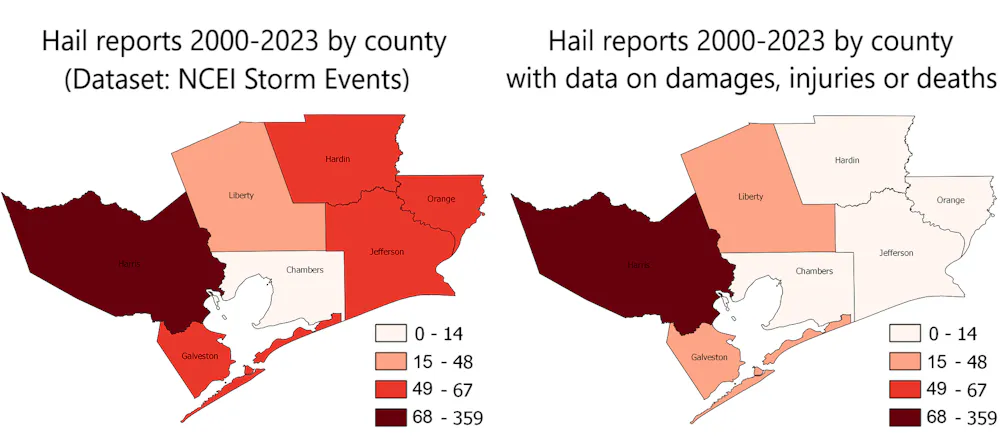
Two maps of the counties that are home to Houston and Galveston, along with five counties to their East, show major differences in storm damage reporting.
The number of severe hail reports in southeast Texas listed in the National Centers for Environmental Information’s storm events database is strongly correlated with population. The county with the most reports and greatest detail in those reports is home to Houston. Hailstorms in the three easternmost counties are rarely associated with damage estimates.
John Nielsen-Gammon and B.J. Baule

Do you want to look at local damage trends? Forget about it. For most extreme weather events, estimation methods vary over time and are not documented.

Do you want to direct funding to help communities improve resilience to natural disasters where the need is greatest? Forget about it. The places experiencing the largest per capita damages depend not just on actual damages but on the different practices of local National Weather Service offices.

Are you moving to a location that might be vulnerable to extreme weather? Companies are starting to provide localized risk estimates through real estate websites, but the algorithms tend to be proprietary, and there’s no independent validation.

4 steps to improve disaster data

We believe a few fixes could make NOAA’s storm events database and the corresponding values in the larger SHELDUS database, managed by Arizona State University, more reliable. Both databases include county-level disasters and loss estimates for some of those disasters.

First, the National Weather Service could develop standard procedures for local offices for estimating disaster damages.

Second, additional state support could encourage local emergency managers to make concrete damage estimates from individual events and share them with the National Weather Service. The local emergency manager generally knows the extent of damage much better than a forecaster sitting in an office a few counties away.

Third, state or federal governments and insurance companies can agree to make public the aggregate loss information at the county level or other scale that doesn’t jeopardize the privacy of their policyholders. If all companies provide this data, there is no competitive disadvantage for doing so.

Fourth, NOAA could create a small “tiger team” of damage specialists to make well-informed, consistent damage estimates of larger events and train local offices on how to handle the smaller stuff.

With these processes in place, the U.S. wouldn’t need a billion-dollar disasters program anymore. We’d have reliable information on all the disasters.

The Conversation

John Nielsen-Gammon receives funding from the National Oceanic and Atmospheric Administration and the State of Texas.

William Baule receives funding from NOAA, the State of Texas, & the Austin Community Foundation.

ref. Extreme weather’s true damage cost is a mystery – that’s a problem for understanding storm risk – https://theconversation.com/extreme-weathers-true-damage-cost-is-a-mystery-thats-a-problem-for-understanding-storm-risk-257105

AmeriCorps is on the chopping block – despite research showing that the national service agency is making a difference in local communities

Source: The Conversation – USA (2) – By Pamela Paxton, Professor of Sociology, The University of Texas at Austin

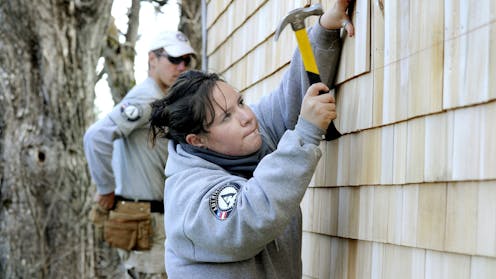
Many AmeriCorps crews, like this one seen at work in Maine in 2011, restore and renovate public parks. John Patriquin/Portland Press Herald via Getty Images

Hundreds of thousands of U.S. nonprofits provide vital services, such as running food banks and youth programs, supporting public health initiatives and helping unemployed people find new jobs. Although this work helps sustain local communities, obtaining the money and staff they require is a constant struggle for many of these groups.

That’s where AmeriCorps often comes in. The independent federal agency for national service and volunteerism has facilitated the work of approximately 200,000 people a year, placing them through partnerships with thousands of nonprofits that provide tutoring, disaster relief and many other important services.

But Americorps’ fate is now uncertain. In April 2025, the Trump administration canceled more than 1,000 grants, suddenly ending the stipends that were supporting more than 32,000 AmeriCorps volunteers. On June 5, a judge ordered that these grants be restored in Washington D.C. and 24 states in response to a lawsuit they had filed. The judge also ordered that all volunteers who had been deployed in those places be reinstated “if they are willing and able to return.”

The Trump administration has also put most of AmeriCorps administrative staff on leave and indicated that it wants to eliminate the independent agency, along with its US$1.2 billion annual budget. AmeriCorps doesn’t appear in a detailed 2026 budget request the administration released on May 30.

I’m a sociology and public affairs professor who has studied nonprofits and volunteering for decades. My research suggests that dismantling AmeriCorps would harm the organizations that rely on national service members and take a toll on the communities that benefit from their work.

AmeriCorps explains what the independent national service agency does.

What AmeriCorps does

AmeriCorps traces its roots to the mid-1960s, when Volunteers in Service to America, known as VISTA, was founded as a domestic counterpart to the Peace Corps. Several earlier service programs were consolidated when Congress passed the National and Community Service Trust Act in 1993. AmeriCorps was officially launched in 1994 – and VISTA became one of its programs.

Since then, AmeriCorps members have built housing and infrastructure, delivered disaster relief, tutored in low-income schools, provided health care and helped older adults age with dignity in both urban and rural communities across the nation.

AmeriCorps includes a variety of programs, each designed to address specific public needs. Some AmeriCorps volunteers provide direct services, such as tutoring, food delivery and in disaster response efforts. Others focus on building the long-term capacity of local nonprofits through volunteer recruitment, fundraising strategy and community outreach.

AmeriCorps volunteers, whom the agency calls “members,” are placed in thousands of nonprofits, schools and local agencies. Many of them are recent college graduates or early-career professionals. Some programs specifically ask people over 55 to serve. Those “senior” volunteers support children through the Foster Grandparents program, volunteer for organizations or assist other older people through the Senior Companions program.

Many AmeriCorps volunteers are paid a modest allowance for this work that runs about $500 per week. AmeriCorps senior volunteers receive smaller sums in hourly stipends to offset the costs of volunteering.

Fox40 News in Sacramento, Calif., covers the Trump administration’s reduction of AmeriCorps’ ranks in April 2025.

Helping nonprofits gain traction

AmeriCorps has long funded research that assesses its impact.

One such study found that every dollar invested in national service generates $11.80 in benefits for society, such as higher earnings, better mental and physical health, and economic growth. Additionally, every federal dollar spent on national service produces $17.30 in savings across other government programs through reductions in public assistance, health and criminal justice spending.

As part of AmeriCorps’ research grants program, I have received funding to study civic engagement and AmeriCorps programming.

In one of those studies, which I conducted with two former colleagues at the University of Texas at Austin in 2021, we found that VISTA volunteers were able to help nonprofits gain volunteers. After two years, an organization with that support had 71% more volunteers than those that didn’t participate in the VISTA program.

We also found that the longer a nonprofit had a staffer supported by the VISTA program, the more its overall pool of volunteers increased.

Nonprofits with VISTA volunteers also had three times as many donations two years later, compared with nonprofits without VISTA service members. But the total value of donations the nonprofit obtained didn’t always rise. That is, we found that VISTA builds people power, but not necessarily fundraising revenue.

Findings like these indicate that AmeriCorps hasn’t just helped the people it serves or the people who volunteer through the program. It also strengthens nonprofits and increases engagement within local communities, reinforcing the civic fabric that knits communities together.

As members of Congress and the White House decide whether to preserve AmeriCorps, I hope they consider the evidence that demonstrates this worthwhile program’s positive impact.

The Conversation

Pamela Paxton has received funding from the Office of Research and Evaluation at AmeriCorps.

ref. AmeriCorps is on the chopping block – despite research showing that the national service agency is making a difference in local communities – https://theconversation.com/americorps-is-on-the-chopping-block-despite-research-showing-that-the-national-service-agency-is-making-a-difference-in-local-communities-257430