This tropical plant builds isolated ‘apartments’ to prevent battles among the aggressive ant tenants it relies on for survival

Source: The Conversation – USA – By Guillaume Chomicki, Professor of Evolutionary Biology, Durham University

When aggressive ant species come in contact, deadly conflicts ensue G. Chomicki

In the middle of the South Pacific, a group of Fijian plants have solved a problem that has long puzzled scientists: How can an organism cooperate with multiple partners that are in turn competing for the same resources? The solution turns out to be simple – compartmentalization.

Imagine an apartment building where unfriendly neighbors might clash if they run into each other, but smart design keeps everyone peacefully separated. In our new research published in the journal Science, we show how certain plants build specialized structures that allow multiple aggressive ant species to live side by side inside them without ever meeting.

Ants and plants cooperate in Fijian rainforest

Squamellaria plants are epiphytes – meaning they don’t have roots attached to the ground, and instead grow on another plant for physical support. They live high up in the rainforest canopy, in the South Pacific.

Because they don’t have direct access to the soil’s nutrients, Squamellaria plants have evolved an original strategy to acquire what they need: In a mutually beneficial relationship, they grow structures that appeal to ants looking for a place to live. This kind of long-term relationship between species – whether helpful or harmful – is called symbiosis.

Here’s how it works in this case. The base of the Squamellaria plant stem forms a swollen, hollow structure called a domatium – a perfect place for ants to live. Domatia gradually enlarge to the size of a soccer ball, containing ever more plant-made houses ready for ants to move into. Each apartment can house a colony made up of thousands of ants.

A bulbous plant attached to a branch in a canopy
A multicompartment Squamellaria (S. tenuiflora) in its natural habitat: rainforests in Fiji. This large plant likely contains a dozen or more compartments.
G. Chomicki

The relationship between the ants and the plants is mutualistic, meaning both parties benefit. The ants gain a nice sturdy and private nest space, while the plants gain essential nutrients. They obtain nitrogen and phosphorus from the ants’ feces and from detritus – including dead insects, plant bits and soil – that the ants bring inside the domatium.

However, tropical rainforest canopies are battlegrounds for survival. Ants compete fiercely for nesting space, taking over any hollow branch or space under tree bark. Any Squamellaria ant house would thus be at risk of being colonized and taken over by other incoming ants, disrupting the existing partnership.

Until now, it was unclear how the cooperative relationships between ants and plants remain stable in this competitive environment.

Walls keep the peace

Our first hint about what keeps the peace in the Squamellaria real estate came when we discovered several ant species living in the same plant domatium. This finding just didn’t make sense. How could aggressively competing ant species live together?

We investigated the structure of domatia using computed-tomography scanning, which revealed an interesting internal architecture. Each plant domatium is divided into distinct compartments, with thick walls isolating each unit. Independent entrances prevent direct contact between the inhabitants of different units. The walls safeguard the peace as they prevent encounters between different ant species.

A close-up view of the domatium, showing three overlapping regions in different colors
A 3D model of a Squamellaria tenuiflora domatiium based on CT-scanning data reveals its compartmentalization. Each color-coded cavity is a distinct ‘ant apartment,’ isolated of the others, but connected to the outside.
S. Renner & G. Chomicki

Back in the lab, when we removed the ant apartments’ walls, placing inhabitants in contact with their neighbors, deadly fights broke out between ant species. The compartmentalized architecture is thus critical in preventing symbiont “wars” and maintaining the stability of the plant’s partnership with all the ants that call it home. By minimizing deadly conflicts that could harm the ants it hosts, this strategy ensures that the plant retains access to sufficient nutrients provided by the ants.

This research reveals a new mechanism that solves a long-standing riddle – the stability of symbioses involving multiple unrelated partners. Scientists hadn’t previously discovered aggressive animal symbionts living together inside a single plant host. Our study reveals for the first time how simple compartmentalization is a highly effective way to reduce conflict, even in the most extreme cases. The ant colonies are living side by side, but not really together.

What’s next

The key to conflict-free living of multipartner symbioses discovered in these Fijian plants – compartmentalization – is likely important in other multispecies partnerships. However, it remains unknown whether compartmentalization is widespread in nature. Research on cooperation between species has long focused on pairwise interactions. Our new insights suggest a need to reinvestigate other multispecies mutualistic symbioses to see how they maintain stability.

The Conversation

Guillaume Chomicki receives funding from UKRI.

Susanne S. Renner received previous funding from the German Research Foundation (DFG)

ref. This tropical plant builds isolated ‘apartments’ to prevent battles among the aggressive ant tenants it relies on for survival – https://theconversation.com/this-tropical-plant-builds-isolated-apartments-to-prevent-battles-among-the-aggressive-ant-tenants-it-relies-on-for-survival-260674

Justice Department efforts to strip citizenship from naturalized Americans likely violate constitutional rights

Source: The Conversation – USA – By Cassandra Burke Robertson, Professor of Law and Director of the Center for Professional Ethics, Case Western Reserve University

New American citizens recite the Oath of Allegiance during a naturalization ceremony in Miami on Aug. 17, 2018. AP Photo/Wilfredo Lee

The Trump administration wants to take away citizenship from naturalized Americans on a massive scale.

While a recent Justice Department memo prioritizes national security cases, it directs the department to “maximally pursue denaturalization proceedings in all cases permitted by law and supported by the evidence” across 10 broad priority categories.

Denaturalization is different from deportation, which removes noncitizens from the country. With civil denaturalization, the government files a lawsuit to strip people’s U.S. citizenship after they have become citizens, turning them back into noncitizens who can then be deported.

The government can only do this in specific situations. It must prove someone “illegally procured” citizenship by not meeting the requirements, or that they lied or hid important facts during the citizenship process.

The Trump administration’s “maximal enforcement” approach means pursuing any case where evidence might support taking away citizenship, regardless of priority level or strength of evidence. As our earlier research documented, this has already led to cases like that of Baljinder Singh, whose citizenship was revoked based on a name discrepancy that could easily have resulted from a translator’s error rather than intentional fraud.

A brief history

For most of American history, taking away citizenship has been rare. But it increased dramatically during the 1940s and 1950s during the Red Scare period characterized by intense suspicion of communism. The United States government targeted people it thought were communists or Nazi supporters. Between 1907 and 1967, over 22,000 Americans lost their citizenship this way.

Everything changed in 1967 when the Supreme Court decided Afroyim v. Rusk. The court said the government usually cannot take away citizenship without the person’s consent. It left open only cases involving fraud during the citizenship process.

After this decision, denaturalization became extremely rare. From 1968 to 2013, fewer than 150 people lost their citizenship, mostly war criminals who had hidden their past.

A man dressed in a suit and tie speaks and points his right index finger.
Sen. Joseph McCarthy appears at a March 1950 hearing on his charges of communist infiltration at the State Department.
AP Photo/Herbert K. White

How the process works

In criminal lawsuits, defendants get free lawyers if they can’t afford one. They get jury trials. The government must prove guilt “beyond a reasonable doubt” – the highest standard of proof.

But in most denaturalization cases, the government files a civil suit, where none of these protections exist.

People facing denaturalization get no free lawyer, meaning poor defendants often face the government alone. There’s no jury trial – just a judge deciding whether someone deserves to remain American. The burden of proof is lower – “clear and convincing evidence” instead of “beyond a reasonable doubt.” Most important, there’s no time limit, so the government can go back decades to build cases.

As law professors who study citizenship, we believe this system violates basic constitutional rights.

The Supreme Court has called citizenship a fundamental right. Chief Justice Earl Warren in 1958 described it as the “right to have rights.”

In our reading of the law, taking away such a fundamental right through civil procedures that lack basic constitutional protection – no right to counsel for those who can’t afford it, no jury trial, and a lower burden of proof – seems to violate the due process of law required by the Constitution when the government seeks to deprive someone of their rights.

The bigger problem is what citizenship-stripping policy does to democracy.

When the government can strip citizenship from naturalized Americans for decades-old conduct through civil procedures with minimal due process protection – pursuing cases based on evidence that might not meet criminal standards – it undermines the security and permanence that citizenship is supposed to provide. This creates a system where naturalized citizens face ongoing vulnerability that can last their entire lives, potentially chilling their full participation in American democracy.

The Justice Department memo establishes 10 priority categories for denaturalization cases. They range from national security threats and war crimes to various forms of fraud, financial crimes and, most importantly, any other cases it deems “sufficiently important to pursue.” This “maximal enforcement” approach means pursuing not just clear cases of fraud, but also any case where evidence might support taking away citizenship, no matter how weak or old the evidence is.

This creates fear throughout immigrant communities.

About 20 million naturalized Americans now must worry that any mistake in their decades-old immigration paperwork could cost them their citizenship.

A two-tier system

This policy effectively creates two different types of American citizens. Native-born Americans never have to worry about losing their citizenship, no matter what they do. But naturalized Americans face ongoing vulnerability that can last their entire lives.

This has already happened. A woman who became a naturalized citizen in 2007 helped her boss with paperwork that was later used in fraud. She cooperated with the FBI investigation, was characterized by prosecutors as only a “minimal participant,” completed her sentence, and still faced losing her citizenship decades later because she didn’t report the crime on her citizenship application – even though she hadn’t been charged at the time.

A woman accepts a small American flag handed to her from a man across a counter.
A woman receives a U.S. flag after passing her citizenship interview in Newark, N.J., on May 25, 2016.
AP Photo/Julio Cortez

The Justice Department’s directive to “maximally pursue” cases across 10 broad categories – combined with the first Trump administration’s efforts to review over 700,000 naturalization files – represents an unprecedented expansion of denaturalization efforts.

The policy will almost certainly face legal challenges on constitutional grounds, but the damage may already be done. When naturalized citizens fear their status could be revoked, it undermines the security and permanence that citizenship is supposed to provide.

The Supreme Court, in Afroyim v. Rusk, was focused on protecting existing citizens from losing their citizenship. The constitutional principle behind that decision – that citizenship is a fundamental right which can’t be arbitrarily taken away by whoever happens to be in power – applies equally to how the government handles denaturalization cases today.

The Trump administration’s directive, combined with court procedures that lack basic constitutional protections, risks creating a system that the Afroyim v. Rusk decision sought to prevent – one where, as the Supreme Court said, “A group of citizens temporarily in office can deprive another group of citizens of their citizenship.”

The Conversation

The authors do not work for, consult, own shares in or receive funding from any company or organization that would benefit from this article, and have disclosed no relevant affiliations beyond their academic appointment.

ref. Justice Department efforts to strip citizenship from naturalized Americans likely violate constitutional rights – https://theconversation.com/justice-department-efforts-to-strip-citizenship-from-naturalized-americans-likely-violate-constitutional-rights-260353

Gene-edited pigs may soon enter the Canadian market, but questions about their impact remain

Source: The Conversation – Canada – By Gwendolyn Blue, Professor, University of Calgary

The Canadian government is currently considering approving the entry of gene-edited pigs into the food system.

Using CRISPR gene-editing technology, genetic changes can be created precisely and efficiently without introducing foreign genetic material. If approved, these pigs would be the first gene-edited food animals available for sale in Canadian markets. My research examines how including the public in decision-making around emerging applications of genomics can help mitigate potential harms.

These pigs are resistant to porcine reproductive and respiratory syndrome (PRRS), a horrible and sometimes fatal disease that affects pigs worldwide. PRRS has significant economic, food security and animal welfare implications.


Read more:
What is gene editing and how could it shape our future?


The United States Food and Drug Administration recently greenlit the commercial production of gene-edited pigs. Will the Canadian government follow suit?

AquAdvantage and EnviroPig

In 2016, Canada approved the first transgenic animal for human consumption — an Atlantic salmon called AquAdvantage salmon that contains DNA from other species of fish.

This approval came more than 25 years after the genetically modified fish was created by scientists at Memorial University in Newfoundland. The approval and commercialization of AquAdvantage salmon faced strong public opposition on both sides of the border, including protests, supermarket boycotts and court battles. In 2024, the company that produced AquAdvantage salmon announced that it was shutting down its operations.


Read more:
The science and politics of genetically engineered salmon: 5 questions answered


In 2012, the Canadian government approved the manufacture of a transgenic pig known by its trade name, EnviroPig. Created by scientists at the University of Guelph, EnviroPigs released less phosphorus than conventionally bred pigs.

EnviroPig did not make it to market; the same year, the University of Guelph ended the EnviroPig project. Funding for the project had been suspended, in part because of consumer concerns.

Government regulation

Some researchers argue that government regulation of gene-edited animals should be less restrictive than for transgenic techniques. Gene editing introduces genetic changes that can occur with conventional animal breeding that is not subject to regulation. Gene-edited crops in Canada are treated the same as conventionally bred crops.

Others insist that stringent government regulation is necessary for gene editing to identify potential problems and ensure that laws keep up with industry and scientific ambition. Regulation plays a vital role in minimizing risk, encouraging public involvement and building trust.

Social science research has, for decades, demonstrated that resistance to biotechnology is not because of the public’s lack of knowledge, as is often argued by biotechnology proponents. Public resistance to biotechnology is better understood as a rejection of potential harms imposed by governments and industry without public input and consent.

Ethical, moral, cultural and political concerns

At present, little opportunity exists for public engagement in Canadian assessments of gene-edited animals.

Similar to the U.S., Canada does not have specific gene technology regulation. Rather, the federal government relies on pre-existing environmental and food safety legislation. Canadian regulatory agencies use a risk, novelty and product-based approach to assess animal biotechnology. From a regulatory standpoint, distinctions between technical processes — like transgenic modification versus gene editing — are less important than the safety of the final product.

The Canadian government has recently updated its federal environmental and health regulations. This includes introducing mandatory public consultations for animals (vertebrates, specifically) created using biotechnology.

Even with these changes, there’s still room for improvement. Public engagement is limited to consultations conducted within a short time frame. Interested parties are invited to provide scientific information about potential risks of animal biotechnology to human health or the environment, but comments that address ethical, moral, cultural or political concerns are not taken into consideration.

More broadly, regulatory and academic debates about the gene editing of animals are largely informed by scientists and industry proponents with considerably less input from the public, Indigenous communities and social sciences and humanities researchers.

Consulting the public

From a social standpoint, the process by which gene editing is assessed matters as much as the safety of the final product. Inclusive public engagement is essential to ensure that the production of gene-edited food animals aligns with societal needs and values.

Reactions to gene technologies are based on underlying values and beliefs, and sustained opportunities for public reflection and deliberation are vital for responsible innovation.

Important questions should be addressed: Who will reap the benefits of gene-editing techniques? Who will bear the costs and harms? What are the potential implications, including hard-to-anticipate social and political changes? How should decision-making proceed to ensure that Canadians have sufficient opportunities for input?

Currently, for the gene-edited pigs, members of the public can submit comments to the government until July 20, 2025.

Public reactions to previous biotech food animals in Canada — including AquAdvantage salmon and the EnviroPig — show that lack of inclusive engagement can contribute to the rejection of animal biotechnology.

The Conversation

Gwendolyn Blue receives funding from the Social Sciences and Humanities Research Council. She is a member of Gene Editing for Food Security and Environmental Sustainability, a multi-university consortium based at McGill University, and funded by the Natural Sciences and Engineering Research Council of Canada.

ref. Gene-edited pigs may soon enter the Canadian market, but questions about their impact remain – https://theconversation.com/gene-edited-pigs-may-soon-enter-the-canadian-market-but-questions-about-their-impact-remain-260627

International students’ stories are vital in shaping Canada’s future

Source: The Conversation – Canada – By Emilda Thavaratnam, PhD student, Leadership and Higher Education, University of Toronto

Over the past decade, international students have navigated a complex and challenging landscape shaped by neoliberal policies.

Neoliberal economic and political ideology upholds entrepreneurship, individualism, free trade, open markets, minimal government intervention and reduced public services for citizens.


Read more:
What exactly is neoliberalism?


Neoliberal governance has transformed higher education into a mechanism for economic growth, shifting the burden of funding onto students.

As my doctoral research examines, international students in Ontario’s colleges of applied arts and technology face barriers related to neoliberal restructuring. Drawing on interviews with students and front-line staff, my study examines experiences across five key themes: pre-arrival, housing insecurity, pandemic survival, precarious labour and future aspirations.

Through these challenges, the resilience and drive of international students to build community reveal powerful forms of everyday resistance.

This has been seen through their front-line work during the pandemic, their persistent pursuit of education and their collective efforts to challenge marginalization. Their stories are vital in shaping Canada’s social, economic and educational fabric.

Shifts towards neoliberal education

Since the late 1970s, higher education in Ontario and elsewhere has experienced significant changes. In the province, public funding per student has steadily declined, shifting the cost onto students, with higher educational institutions adopting models of privatization and corporatization to survive.

Though higher education continues to serve the public good, these changes reflect a broader adaptation to the new economic realities driven by market principles.

As David Harvey, a scholar of urban and political economy, explains, neoliberal approaches hold that economic growth and prosperity occur when markets are allowed to operate with minimal government regulation. Over time, these approaches have shaped policies and practices globally across various sectors, including education, media, corporations and international institutions such as the International Monetary Fund.

Neoliberal policies are presented as naturally occurring or unavoidable; however, this framing prioritizes market principles over social protections and often masks the deeper political and social dynamics.

Education as a product serving the job market

Neoliberal values have reshaped the purpose and practice of higher education. The problem with this market-driven approach is it often prioritizes individual gain and profit over social equity and the public good. This shift aligns learning with market-oriented approaches.

Scholars concerned with the adverse effects of neoliberal education policy highlight how education is often treated as a product designed to serve economic interests, with measurable outcomes and links to the job market becoming the primary focus.

This shift is evident when policymakers and institutions prioritize competition, performance, metrics and individual achievement — often at the expense of collaboration, critical thinking and shared goals.

COVID-19 pandemic

The COVID-19 pandemic highlighted the effects of neoliberal ideology in higher education, revealing both the precarity of post-secondary finance and living conditions for many international students.


Read more:
The pandemic exposed the vulnerability of international students in Canada


When colleges and universities faced pandemic closures and uncertain enrolment, international students came under scrutiny as learners who pay high fees. They contribute more than $21 billion annually to the Canadian economy and pay an average of five times more than domestic students.

It also became clear that international students make significant contributions to Canada by working on the front lines in sectors such as health care, long-term care and food supply chains.

At the same time, this situation revealed broader tendencies rooted in the neoliberal market logic.

During the pandemic, the federal government acknowledged how it has positioned international students as a flexible, commodified labour resource integral to the Canadian economy and essential services. For example, in April 2020, Immigration, Refugees and Citizenship Canada announced it would “temporarily lift the 20 hour per week work restriction on study permit holders working off-campus during their academic session, provided they are working in an essential service or function.”

While international student contributions are vital, this framing begs deeper questions around the protection of international students’ labour rights, student well-being and potential exploitation.

Housing, food insecurity, high tuition

Before the pandemic, many international students struggled with housing, food insecurity and tuition payments due to work restrictions and financial constraints.

With the current cap in place as of 2024, it’s ironic that international students have been treated as both “essential” and “disposable” simultaneously.

Despite facing housing insecurity, food shortages and inaccessible health care, international students have continued to demonstrate their resilience and resistance. Their efforts extend beyond individual acts of survival.

Post-pandemic protest

International students have also organized petitions, protests and advocacy campaigns to challenge unjust policies.

For example, in November 2022, hundreds of students (domestic and international) rallied at the Ontario legislature in Toronto under the banner “Need or Greed.” A coalition of student associations representing 120,000 students united to protest.

The protests were partly a response to unfair and unpredictable jumps in already high tuition fees for international students: the average undergraduate international tuition fees in Ontario rose from about $35,000 to just under $50,000 between 2018 and 2025. The coalition urged the provincial government and Colleges Ontario to freeze tuition for international students.

Following these efforts, nationwide protests erupted in August 2024 when 70,000 international student graduates faced possible deportation due to tightened immigration rules. Students set up encampments outside the Prince Edward Island legislative assembly for three months to protest the 25 per cent cut in permanent resident nominations, which left many students in limbo.

A notable aspect of this activism was the solidarity shown from labour organizations and people across the country. Laura Walton, president of the Ontario Federation of Labour, joined the protests in solidarity, stating: “Your right is our fight.

The Naujawaan Support Network, an advocacy group for youth and international students based in Brampton, Ont., issued a statement declaring:“International students are not the cause of the crisis, but we are being made into scapegoats.


Read more:
International students cap falsely blames them for Canada’s housing and health-care woes


Power of collective organizing

Collective organizing and calls for action are powerful acts of resistance that transcend the neoliberal ideology of individualism. Through petitions and protests, international students demonstrate a profound commitment to their education and aspirations.

As Canada continues to welcome international students, and post-secondary institutions, governments and public sector organizations navigate turbulent economic times, it’s essential to uphold the rights of international students.

It’s also essential to provide the support necessary for them to succeed and affirm their value as vital members of the community.

International students’ resilience offers a valuable lesson about the human capacity to reframe challenges and persist. Students and citizens across the country have a role in celebrating their contributions and building bridges to foster more resilient communities.

The Conversation

Emilda Thavaratnam does not work for, consult, own shares in or receive funding from any company or organisation that would benefit from this article, and has disclosed no relevant affiliations beyond their academic appointment.

ref. International students’ stories are vital in shaping Canada’s future – https://theconversation.com/international-students-stories-are-vital-in-shaping-canadas-future-258271

Returning to the office isn’t the answer to Canada’s productivity problem — and it will add pressure to urban housing

Source: The Conversation – Canada – By Dilara Baysal, Research Fellow in Sociology, Concordia University

As companies face pressure to increase productivity, many are calling workers back to the office — even though there is limited evidence that return-to-office policies actually improve innovation or performance.

In cities like Toronto and Vancouver, where many major companies are headquartered, this is putting pressure on people to live near expensive downtown areas.

As of April 2025, average one-bedroom rents were $2,317 in Toronto and $2,536 in Vancouver, with North Vancouver even higher at $2,680. If return-to-office policies continue, more workers may be forced into these pricey city centres, adding pressure to already overheated housing markets.

Since early 2025, return-to-office policies have added to Canada’s housing stress. The Royal Bank of Canada, for instance, now requires staff in the office four days a week, and Amazon ended remote work in January. While rents haven’t jumped yet, similar policies in the U.S. have already pushed up demand, and may be a sign of what’s to come.

In Washington, D.C., rents rose 3.3 per cent after federal employees were called back to offices. Cities like New York and San Francisco also saw rent increases linked to companies like JPMorgan Chase, Meta and Salesforce reversed remote work policies.

The myth of office productivity

According to the Bank of Canada, Canada’s economy is being negatively affected by low productivity. Low productivity slows Canada’s economic growth and keeps wages low. It also makes inflation worse because supply can’t keep up with demand. A productive economy meets demand more easily, keeping prices stable.

In response, many companies are pushing return-to-office as the answer. RBC CEO Dave McKay endorsed a return to the office back in 2023, saying that “the absence of working together” has hurt innovation and productivity.

At Google, under mounting pressure to compete in artificial intelligence, co-founder Sergey Brin also pushed for full-time office work, calling a 60-hour week the “sweet spot” for productivity.

But recent research shows the story isn’t so simple. A University of Chicago working paper found that strict return-to-office rules can cause senior staff to leave, which hurts innovation.


Read more:
Working one day a week in person might be the key to happier, more productive employees


Another study of 48,000 knowledge workers in India found that hybrid setups — where some people are in the office and others work from home — can make it harder to share ideas and work together.

Meanwhile, a Stanford-led study found that working in the office just two days a week kept productivity strong and cut employee turnover by 33 per cent.

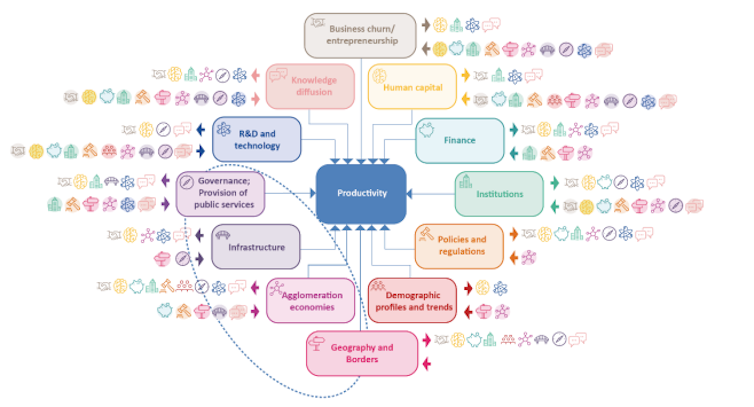
A mind map with productivity in the centre and different determinants of productivity branching out from it, including: entrepreneurship, human capital, finance, institutions, policies/regulations, demographic profiles and trends, infrastructure, governan
The determinants of productivity and their underlying factors. These determinants connect across industries, businesses and places.
(Organization for Economic Co-operation and Development), CC BY

Where people live matters more

Return-to-office mandates also aren’t a guaranteed way to boost productivity. A 2023 study supported by housing organizations across Canada found that affordable, well-located housing helps people find better jobs and specialize in their work.

But when housing costs are high and commutes are long, productivity drops, especially for lower-income workers. Long commutes and high living costs create stress, limit mobility and cause people to miss out on job opportunities.

Studies show that investing in technology and training workers matters much more. Research from the Canadian Research Data Centre Network finds that workplace training improves productivity in most sectors.

A recent report from the Canada Mortgage and Housing Corporation also shows that high housing costs make it harder for many people to live in big cities, which ultimately reduces diversity in the workforce and weakens the economy.

Affordable housing could boost productivity

Housing in Canada is often viewed in two ways. One treats it as a commodity, where prices follow supply and demand. In this view, policies focus on increasing supply and offering market incentives. The other sees housing as a public need and a basic right, and calls for government action to ensure affordability and stability.


Read more:
Housing is both a human right and a profitable asset, and that’s the problem


In practice, market forces can undermine policies designed to meet housing needs and ensure affordability. In Toronto, for example, developers resisted inclusionary zoning rules that require or encourage developers to include a certain percentage of affordable housing units within new residential developments. Instead, they delayed projects or chose to build high-end condos in different zones.

This tension between housing as a commodity and housing as a public good is central to Canada’s current housing strategy. Prime Minister Mark Carney’s government has pledged to build 500,000 new homes annually by 2035 using tools like public lands, modular housing and tax incentives.

While this supply-focused strategy targets long-term housing needs, it must also account for today’s complex economic realities such as inflation, increasing unemployment and economic stagnation due to lagging productiviy.

Without tackling affordability and access directly, building more homes alone won’t be enough.

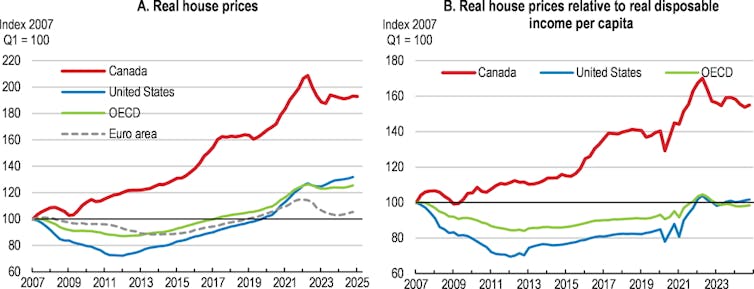
Two line graphs showing how housing has increased since 2004 in Canada
Rising home prices and rents have played a major role in driving inflation. In Canada’s Consumer Price Index, shelter makes up about 29 per cent of overall household spending.
(Organization for Economic Co-operation and Development), CC BY

The real foundation of a productive economy

Return-to-office policies often focus too much on one thing: how much each worker produces. But that narrow view of productivity ignores what really supports good work: access to affordable housing, time for training and flexibility to relocate for better job opportunities.

To address productivity challenges, companies should invest in job-specific training, digital skills and ongoing learning to help employees adapt to new tools and processes, and the should offer more flexibility. What workers need most are affordable homes, shorter commutes and real opportunities to grow — not added stress and rising costs.

The Conversation

Dilara Baysal does not work for, consult, own shares in or receive funding from any company or organisation that would benefit from this article, and has disclosed no relevant affiliations beyond their academic appointment.

ref. Returning to the office isn’t the answer to Canada’s productivity problem — and it will add pressure to urban housing – https://theconversation.com/returning-to-the-office-isnt-the-answer-to-canadas-productivity-problem-and-it-will-add-pressure-to-urban-housing-260395

Wimbledon’s electronic line-calling system shows we still can’t replace human judgment

Source: The Conversation – UK – By Feng Li, Chair of Information Management, Associate Dean for Research & Innovation, Bayes Business School, City St George’s, University of London

The Wimbledon tennis tournament in 2025 has brought us familiar doses of scorching sunshine and pouring rain, British hopes and despair, and the usual queues, strawberries and on-court stardust. One major difference with this year’s tournament, however, has been the notable absence of human line judges for the first time in 147 years.

In a bid to modernise, organisers have replaced all 300 line judges with the Hawk-Eye electronic line-calling (ELC) system powered by 18 high-speed cameras and supported by around 80 on-court assistants.

It has been sold as a leap forward but has already caused widespread controversy. In her fourth-round match against Britain’s Sonay Kartal, Anastasia Pavlyuchenkova was forced to replay a point she had clearly won, because ELC had failed to register that a ball had landed out. Furious, Pavlyuchenkova told the umpire: “You took the game away from me … they stole the game from me.”

British players Emma Raducanu and Jack Draper have also voiced concerns about the accuracy and reliability of the technology.

We have seen this before in business, government and elite sport (think VAR in football). Promising technologies fail, not necessarily because the systems are flawed – though some are – but because the institutions around them have not kept up. The belief that technology can neatly replace human judgement is seductive. It’s also deeply flawed.


Get your news from actual experts, straight to your inbox. Sign up to our daily newsletter to receive all The Conversation UK’s latest coverage of news and research, from politics and business to the arts and sciences.


Systems like Hawk-Eye at Wimbledon offer measurable gains in accuracy, but accuracy is not the same as legitimacy. People don’t just want correct decisions, they also want understandable and fair ones. When human line judges made mistakes, they were visible and open to appeal. When a machine fails, with no explanation and no route for redress, it breeds confusion and frustration.

Consider Formula 1. At the 2025 British Grand Prix in Silverstone, driver Oscar Piastri was handed a 10-second penalty by race stewards for erratic braking during a safety car restart. He called it inconsistent and harsh, and many fans agreed.

The key difference? We knew who made the call. There was someone to question, and a process to scrutinise. With machines, however, there’s no one to challenge. You can’t argue with a black box, or hold it to account.

Beyond performance

Technology is usually introduced to improve performance or reduce costs, but the full story is rarely made explicit. Wimbledon’s adoption of the new system was framed as a move towards greater accuracy and consistency, but it was also likely driven by the desire to speed up matches, cut costs, and reduce reliance on human labour.

Yet sport is not just about accuracy. It is entertainment. It thrives on emotion, tradition and theatre. For 147 years, line judges were part of Wimbledon’s identity. Their posture, uniforms, gestures, indeed even the drama of a close call, added to the spectacle. Removing them may have improved accuracy (and cut costs), but the atmosphere was also changed.

Tradition is often dismissed as nostalgia, but in institutions like Wimbledon, tradition is part of what makes the experience legitimate and enjoyable. When it’s stripped away with only a token explanation, players and audiences can lose trust, not just in the change, but in the institution itself. It is a cultural change, which is never easy.

One common solution is to combine human judgement with the technology especially during the transition period, but hybrids rarely work well in practice as responsibilities get blurred.

In business, this is known as the “hybrid trap”: bolting new technologies onto old systems without rethinking or redesigning either. Instead of the best of both worlds, the result is often confusion, duplication and failure.

Wimbledon did not seem to offer a formal challenge system or human override during matches. Although 80 former line judges were retained as on-court assistants, their role was not adjudicative. This might speed up play, but it leaves the system brittle. When something breaks, there is no immediate redress. We have seen this elsewhere.

What this tells us about AI

Wimbledon’s failure was a textbook case of poor tech adoption. Hawk-Eye did what it was designed to do, but the institution wasn’t ready, least of all the players, umpires and spectators.

The same pattern is playing out with artificial intelligence (AI) and other emerging technologies, from customer service bots to healthcare triage systems. These tools are being rolled out at speed, often with minimal oversight. When they hallucinate, embed bias or produce erratic results, there is rarely a clear route to appeal, and often no one to hold accountable.

The real problem is not just technical but institutional. Most organisations aren’t ready for what they’re adopting. Instead of transforming themselves to harness new technologies, they bolt them onto legacy systems and carry on as before. Key questions go unanswered: Who decides? Who benefits? Who is accountable when things go wrong? Without clear answers, new technologies don’t solve dysfunction, they entrench it. Sometimes, they hardwire it.

If we want technology to improve how the world works, we can’t just automate tasks, processes or jobs. We need to rethink and redesign the institutions these systems are meant to serve, using new capabilities these technologies make possible. Until then, even the best systems will continue to fall short, both quietly and occasionally spectacularly.

The Conversation

Feng Li does not work for, consult, own shares in or receive funding from any company or organisation that would benefit from this article, and has disclosed no relevant affiliations beyond their academic appointment.

ref. Wimbledon’s electronic line-calling system shows we still can’t replace human judgment – https://theconversation.com/wimbledons-electronic-line-calling-system-shows-we-still-cant-replace-human-judgment-260845

Tackling the chaos at home might be the secret to a more successful work life

Source: The Conversation – UK – By Yasin Rofcanin, Professor of Management Strategy & Organisation, University of Bath

Maria Svetlychnaja/Shuttersotck

In a world of hybrid working and four-day weeks, most workers are asked to be agile, creative and strategic – not just at work but also at home. But what if the energy and focus workers invest into solving family life challenges could actually make them better at adapting and innovating in their jobs?

Our recent study suggests that managing household life – what we call “strategic renewal at home” – doesn’t just benefit family functioning. It also boosts employees’ ability to generate ideas, reshape their roles and respond effectively to change at work.

In short, proactively adapting and reorganising your home life could be a hidden asset for your career.

“Strategic renewal” is a concept long associated with business transformation – think of a company reinventing its operations to respond to shifts in the market. But we argue that this same concept can apply to people managing life at home.


Get your news from actual experts, straight to your inbox. Sign up to our daily newsletter to receive all The Conversation UK’s latest coverage of news and research, from politics and business to the arts and sciences.


Imagine a working parent who streamlines their childcare routine, redistributes chores with their partner or introduces a new system for managing family meals. These efforts – far from mundane – are proactive, forward-thinking moves to adapt to a changing environment. That’s strategic renewal, just in a different setting.

Our findings show that when people engage in this kind of domestic renewal, it creates powerful ripple effects, shaping how they think, feel and perform at work.

The hidden power of home life

We followed 147 dual-earning couples in the US over six weeks. Each week, employees reported how much they engaged in strategic renewal at home and at work. We also captured their experiences of “flow” at home (those rare, deeply focused and enjoyable moments).

For instance, when someone is completely absorbed in gardening, painting a room, or even following a complex recipe – activities that are both enjoyable and require focus – time seems to fly. We also captured their confidence in handling challenges (self-efficacy), and their partner’s view of how well they were managing work–family balance.

We uncovered several interesting points. Employees who took proactive steps to improve family routines felt more “in flow” at home.

These moments of flow built their confidence (self-efficacy), making them feel more capable of tackling future challenges – not just at home, but at work too. That confidence translated into more strategic renewal at work. Employees were more likely to change how they approached tasks, pitch ideas or redesign their roles.

Crucially, their partners also noticed. Employees high in self-efficacy were rated as better at balancing work and family, as well as being more effective in family life.

In other words, strategic behaviour at home doesn’t stay there – it travels with us. What happens at the breakfast table can spill over into the boardroom.

But not all environments are equal. The benefits of home-based strategic renewal were much stronger when the family was supportive of creativity. When people felt free to try new things, take risks and share ideas at home, the gains from their efforts were amplified.

This could be as simple as trying out a new meal, brainstorming weekend plans together or encouraging a partner to experiment with a new hobby. These activities reflect openness, curiosity and support for creative expression in everyday life.

The same was true at work. Employees who felt their organisations fostered a climate of creativity – valuing new ideas, experimentation and autonomy – were more likely to act on their confidence and engage in strategic behaviour.

We found a big takeaway for workers. Cultivating open, creative climates in both domains makes all the difference. Encouraging new ideas at home or at work doesn’t just make people feel good – it helps workers to be flexible and adaptive.

What employers can do

There’s a crucial lesson here for organisations too. The home is not a “black box” – some kind of impenetrable space that has no bearing on work. Instead, home life can play an active and meaningful role in shaping employees’ energy, confidence and creative capacity. Home can be a source of renewal, resilience and even innovation.

Forward-thinking companies should avoid treating home and work as separate silos. Instead, they can invest in developing self-efficacy in employees. This could be providing training, coaching and feedback that reinforces workers’ belief in their ability to handle challenges.

They should also encourage family-supportive leadership. Managers who ask about employees’ home life, support flexible arrangements and accommodate caring responsibilities help create the space for home-based renewal to thrive.

a surprised woman receiving a gift at her desk from her colleagues
Celebrating employees – for things beyond their professional achievements – is important.
La Famiglia/Shutterstock

And they should recognise “off-the-clock” moments. Celebrating life milestones, offering childcare support or simply acknowledging the mental load of home life all signal that organisations value the full person, not just the professional.

For decades, companies have looked inward for solutions to innovation and adaptability – to things like better tech, better processes and better metrics. But our study found leaders should instead look outward — toward employees’ lives beyond work.

When employees reorganise their domestic life, they’re demonstrating foresight, adaptability and leadership. These are precisely the qualities workplaces are looking for in a world of constant disruption.

When workplaces start seeing the home not just as a stressor but as a source of strength, they can open the door to smarter, more sustainable strategies for resilience, creativity and growth.

So the next time you redesign your morning routine, don’t think of it as just surviving the chaos. You might just be sharpening your edge for the workday ahead.

The Conversation

The authors do not work for, consult, own shares in or receive funding from any company or organisation that would benefit from this article, and have disclosed no relevant affiliations beyond their academic appointment.

ref. Tackling the chaos at home might be the secret to a more successful work life – https://theconversation.com/tackling-the-chaos-at-home-might-be-the-secret-to-a-more-successful-work-life-258487

Five unusual ways to make buildings greener (literally)

Source: The Conversation – UK – By Paul Dobraszczyk, Lecturer in Architecture, UCL

Belgian architect Luc Schuiten’s vision of ‘the Vegetal City’. Luc Schuiten

Buildings adorned with plants are an increasingly familiar sight in cities worldwide. These “green walls” are generally created using metal frames that support plastic plates, onto which pre-grown plants are inserted. These plants are able to survive without soil because they’re sustained by nutrient-packed rolls of felt and artificial sprinklers.

Some are fabulously rich tapestries of luxuriant vegetation, like French botanist Patrick Blanc’s coating of part of the Athenaeum hotel in London. Here, small shrubs sprout from an almost tropical green wall, with an abundance of mosses and ferns. In summer, butterflies peruse the flowers. All this next to Piccadilly, one of the busiest streets in central London.

Others are objects of ridicule: the sadly common outcome of poor design and a lack of maintenance (all green walls need careful planning and a great deal of care). If they’re not carefully tended, green walls will quickly turn into brown ones, with the plastic supports all too visible beneath the dying plants.

But there are many others ways of integrating plants into buildings beyond simply trying to grow them on walls. Here are five examples that straddle the mundane and the marvellous.

A wall with a metal grid and dying plants.
A wilted green wall in Tokyo, Japan.
Wikimedia Images, CC BY

Growing buildings

German architectural practice Baubotanik (a word that means “botanic building”) has taken the radical step of creating buildings that flout the conventional idea of architecture as static and inert. After all, plants grow – they are living organisms.

Baubotanik uses pre-grown trees to create multi-storey structures, with trees replacing the conventional steel girders of most tall buildings. Its Plane-Tree-Cube in Nagold, begun in 2012, is made of plane trees supported on a steel scaffold, with a built-in irrigation system to water the trees until they’re large enough for the steel to be removed.

A square-framed building composed of a metal lattice and growing plants.
Baubotanik’s Plan-Tree-Cube is intended to grow into a usable structure.
Baubotanik

It’ll probably be another ten years before this structure is ready to be used, but as what? It’s hard to imagine making a home in such an unruly structure, let alone plugging in your internet or other electrical appliances.

Building in trees

Baubotanik takes grafting, an age-old horticultural technique, and uses it to create structural frames for buildings. Grafting joins the tissue of plants so that they can grow together (it’s most commonly used in the cultivation of fruit trees).

As the architects themselves acknowledge, there are many interesting historical precedents, such as the Lindenbaum concentrated in a small region of rural Germany in northwestern Bavaria.

These are accessible platforms built into large lime (linden) trees to accommodate dancers in a yearly ritual known as the Tanzlinden (“dance linden”), which originated in the middle of the 17th century and still happen in early September.

In the surviving Lindenbaum in the small village of Peesten (one of around 12 that are still around), a stone stairwell spirals up to the wooden platform built inside the tree: dancing happens on this platform, while musicians provide accompaniment beneath.

A curved stone staircase leading into a structure obscured by a tree growing around it.
Lindenbaum in Peesten, Germany.
Wikimedia Images, CC BY

Weaving buildings

It’s possible to take this practice of integrating buildings and trees one step further and imagine whole cities redesigned in this way. This has been the lifelong preoccupation of Belgian architect Luc Schuiten, particularly in his speculative drawings of “vegetal cities”.

These are urban environments in which the branches of trees and the stems of climbing plants have become completely enmeshed with buildings made of steel and glass. One of his designs, called Habitarbres, imagines a house constructed within a living tree. The structure would flex as the tree grows, while hot-air pipes and other infrastructure would be embedded in the trunk. It’s an attempt to envisage how the infrastructure of our buildings – pipes, wire, cables and the like – can be accommodated in a living structure with its own vascular network.

An artist's sketch of a house built around the main body of a tree.
With Habitarbes, Schuiten proposes a house built within a living tree.
Luc Schuiten

It’s a speculative proposal, but perhaps not so different from a common building type normally associated with enterprising children, namely treehouses. Schuiten is merely taking a human desire – to live in a tree – and suggesting how it might be squared with our equally strong desire for comfort.

Architecture as compost

When plants die and decay they create the conditions for the next cycle of vegetal growth; they are sustainable in a way that the vast majority of our buildings are not. While there is a drive to recycle existing building materials (metals and plastics mostly), it’s another thing entirely to make buildings truly regenerative.

Martin Miller and Caroline O’Donnell’s “Primitive Hut” project from 2017 created a building that does just this. They made a wooden lattice structure to support the growth of four red maple saplings. Another lattice decomposed over time, providing food for the growing trees. Eventually the whole structure was overwhelmed by the trees.

A shed-like building composed of a lattice and trees.
Martin Miller and Caroline O’ Donnell’s ‘Primitive Hut’.
OMG!

In calling this a primitive hut, the architects questioned how western architectural thinking tends to see indigenous architecture as both an origin point and a model for more sustainable forms of construction. It asks whether the industrial technologies that dominate construction in the global north should be more informed by architects that have continued to build with natural and compostable materials for centuries.

Letting be

It’s worth remembering that we don’t have to design green buildings; given enough time, they will happen anyway.

Roof slates sandwiched together with moss.
Moss on the roof of the Sandringham estate’s visitors’ centre in Norfolk, eastern England.
Wikimedia Images, CC BY

The sloping roof of my house, directly below the window where I’m writing this article, is gradually acquiring its own green patina of lichen and moss. The roof is old and I’ve been told it needs to be replaced soon. A cloud of spores and seeds peppers this and every single roof every day with the prospect of new life.

Without any human intervention whatsoever, this process of vegetal succession can produce a complex ecosystem of not only plant but also animal life (from microbes to insects). That architects so rarely call such a surface “green” betrays something that’s deep-seated in ideas about green design. For it is precisely the absence of human control that allows vegetation to colonise a building; there is, in effect no design involved at all – unless, of course, we accept that plants have designs of their own.


Don’t have time to read about climate change as much as you’d like?

Get a weekly roundup in your inbox instead. Every Wednesday, The Conversation’s environment editor writes Imagine, a short email that goes a little deeper into just one climate issue. Join the 45,000+ readers who’ve subscribed so far.


The Conversation

Paul Dobraszczyk does not work for, consult, own shares in or receive funding from any company or organisation that would benefit from this article, and has disclosed no relevant affiliations beyond their academic appointment.

ref. Five unusual ways to make buildings greener (literally) – https://theconversation.com/five-unusual-ways-to-make-buildings-greener-literally-259721

The Bangladesh delta is under a dangerous level of strain, analysis reveals

Source: The Conversation – UK – By Md Sarwar Hossain, Senior Lecturer in Environmental Science & Sustainability, University of Glasgow

The Ganges delta in Bangladesh. Emre Akkoyun/Shutterstock

Bangladesh is known as the land of rivers and flooding, despite almost all of its water originating outside the territory. The fact that 80% of rivers that flow through Bangladesh have their sources in a neighbouring country, can make access to freshwater in Bangladesh fraught. And the country’s fast-growing cities and farms – and the warming global climate – are turning up the pressure.

In a recent analysis, my colleagues and I found that four out of the ten rivers that flow through Bangladesh have failed to meet a set of conditions known as their “safe operating space”, meaning that the flow of water in these rivers is below the minimum necessary to sustain the social-ecological systems that rely on them. These rivers included the Ganges and Old Brahmaputra, as well as Gorai and Halda.

This puts a safe and reliable food and water supply not to mention the livelihoods of millions of fishers, farmers and other people in the region, at risk.

Water flow on the remaining six rivers may be close to a dangerous state too, due to the construction of hydropower dams and reservoirs, as well as booming irrigated agriculture.


Get your news from actual experts, straight to your inbox. Sign up to our daily newsletter to receive all The Conversation UK’s latest coverage of news and research, from politics and business to the arts and sciences.


The concept of a safe operating space was devised by Stockholm University researchers in 2009 and typically assesses the Earth’s health as a whole by defining boundaries such as climate warming, water use and biodiversity loss which become dangerous to humanity once exceeded. A 2023 update to this research found that six of the nine defined planetary boundaries have been transgressed.

Since the Bangladesh delta is one of the world’s largest and most densely populated (home to around 170 million people), we thought it prudent to apply this thinking to the rivers here. We found that food, fisheries and the world’s largest intertidal mangrove forest, a haven for rich biodiversity, are all under strain from water demand in growing cities such as Dhaka.

The knock-on effects

During all seasons but winter, river flows in the Bangladesh delta have fallen over the past three decades.

An infographic depicting the relative health of five rivers in Bangladesh.
No river in the Bangladesh delta is within its safe operating space.
Kabir et al. (2024)

Our analysis highlights the limits of existing political solutions. The ability of the Ganges river to support life and society is severely strained, despite the Ganges water sharing treaty between India and Bangladesh, which was signed in 1996.

Rivers in Bangladesh have shaped the economy, environment and culture of South Asia since the dawn of human civilisation here. And humans are not the only species suffering. Hilsha (Tenualosa ilisha), related to the herring, is a fish popular for its flavour and delicate texture. It contributes 12% to national fish production in Bangladesh but has become extinct in the upper reaches of the Ganges due to the reduction of water flow.

Excessive water extraction upstream, primarily through the Farakka barrage, a dam just over the border in the Indian state of West Bengal, has also raised the salinity of the Gorai river. A healthy river flow maintains a liveable balance of salt and freshwater. As river flows have been restricted, salinity has crept up, particularly in coastal regions that are also beset by sea level rise. This damages freshwater fisheries, farm yields and threatens a population of freshwater dolphins in the Ganges.

Low river flows and increasing salinisation now threaten the destruction of the world’s largest mangrove forest, the loss of which would disrupt the regional climate of Bangladesh, India and Nepal. It would also release a lot of stored carbon to the atmosphere, accelerating climate change and the melting of snow and ice in the Himalayan mountain chain.

Resilience to climate change

Solving this problem is no simple task. It will require cooperation across national boundaries and international support to ensure fair treaties capable of managing the rivers sustainably, restoring their associated ecosystems and maintaining river flows within their safe operating spaces.

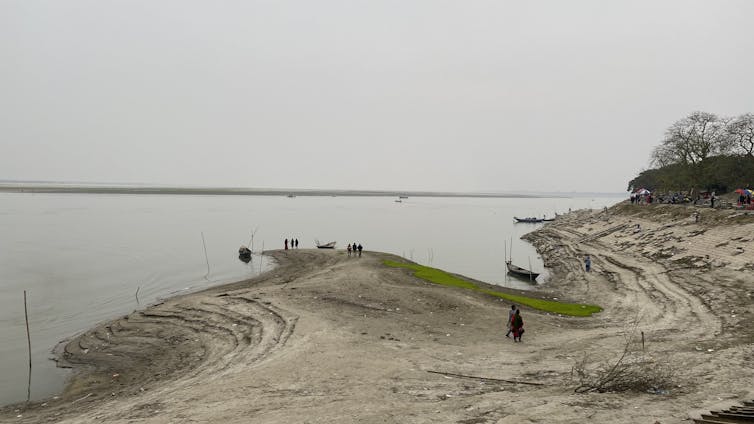
A dry river bank.
The mighty Ganges is running dry in some parts of Bangladesh during the hotter months.
Md Sarwar Hossain

This is particularly challenging in the Bangladesh delta, which contains rivers that drain many countries, including China, India, Nepal and Pakistan. The political regimes in each country might oppose transboundary negotiations, which could nevertheless resolve conflict over water which is needed to sustain nearly 700 million people.

There have been success stories, however. The Mekong river commission between Cambodia, Laos, Thailand and Vietnam is a useful template for bilateral and multilateral treaties with India and Nepal for the Ganges, and China and Bhutan for the Jamuna river.

Tax-based water sharing can help resolve conflicts and decide water allocation between countries in the river basin. The countries using more water would pay more tax and the revenue would be redistributed among the other countries who share rivers in the treaty. Additionally, water sharing should be based on the historical river flow disregarding existing infrastructure and projections of future changes.

Reducing deforestation, alternating land use and restoring wetlands could enhance resilience to flooding and drought and ensure water security in the Bangladesh delta. Ultimately, to secure a safe operating space for the rivers here is to secure a safe future for society too.


Don’t have time to read about climate change as much as you’d like?

Get a weekly roundup in your inbox instead. Every Wednesday, The Conversation’s environment editor writes Imagine, a short email that goes a little deeper into just one climate issue. Join the 45,000+ readers who’ve subscribed so far.


The Conversation

Md Sarwar Hossain does not work for, consult, own shares in or receive funding from any company or organisation that would benefit from this article, and has disclosed no relevant affiliations beyond their academic appointment.

ref. The Bangladesh delta is under a dangerous level of strain, analysis reveals – https://theconversation.com/the-bangladesh-delta-is-under-a-dangerous-level-of-strain-analysis-reveals-241097

The Salt Path scandal: defending a memoir’s ‘emotional truth’ is a high-risk strategy

Source: The Conversation – UK – By Robert Eaglestone, Professor of Contemporary Literature and Thought, Royal Holloway University of London

Raynor Winn, author of the award-winning memoir The Salt Path, which was recently adapted into a film, has been accused of “lies, deceit and desperation”. Writing in The Observer, reporter Chloe Hadjimatheou claims that Winn left out significant facts and invented parts of the story.

The Salt Path follows a transformative 630-mile trek along England’s South West Coast Path that Winn took with her terminally ill husband Moth after they lost their home and livelihood.

The Observer article claims that aspects of both the story of losing their home and Winn’s husband’s illness were fabricated. In a statement on her website, Winn has defended her memoir, calling the claims “grotesquely unfair” and “highly misleading”.

There’s a long list of memoirs which have been shown to be problematic. James Frey’s recovery memoir A Million Little Pieces (2003) was allegedly exaggerated. In 2006, he apologised for fabricating portions of the book. Worse, Binjamin Wilkomirski’s feted Holocaust survivor memoir Fragments: Memories of a Wartime Childhood (1995) was completely fake. Wilkomirski’s real name was Bruno Dössekker and he was not a Holocaust survivor, he had simply invented his “memories” of a death camp, though he seemed to believe they were true.

But, for readers, how much does this matter? Novelist D.H. Lawrence wrote that readers should: “Never trust the artist. Trust the tale.” As readers of The Salt Path, we fear for Raynor and Moth as they desperately try to escape drowning from a freak high tide at Portheras Cove. We are relieved when we hear that Moth’s terminal disease was “somehow, for a while, held at bay”.

The origin of the word fiction is from the Latin fingere, which means not to lie, but to fashion or form. All memoirs – indeed, all texts, from scientific articles to history books to bestselling novels – are “formed” or “shaped”. Writing doesn’t just fall from a tree, we make it, and it reveals the world by mediating the world.


Looking for something good? Cut through the noise with a carefully curated selection of the latest releases, live events and exhibitions, straight to your inbox every fortnight, on Fridays. Sign up here.


But this idea, that writing is a “shaping”, is why this case matters. Writing, done by oneself, or by a ghostwriter (or even by AI) has conventions, not-quite-rules that underlie its creation and reception. Some of these are in the text (the enemies eventually become lovers); some are outside the text itself (you really can judge a book by its cover). But most conventions are both inside and outside at the same time.

Works by historians have footnotes to sources, so you (and other historians) can check the claims. Each scientific article refers to many others, because each article is just one tiny piece of the whole puzzle on which a huge community of scientists are working, and the extensive references show how this piece fits (or doesn’t). Non-fiction follows conventions, while novelists can do whatever they want, of course, to challenge or obey the conventions (that’s one reason why novels are exciting).

Memoir has a particularly important convention, revealed most clearly by the historian Stefan Maechler’s report on Wilkomirski’s fraudulent memoir. Maechler argued that Wilkomirski broke what the French critic Philippe Lejeune called the “autobiographical pact”, a contract of truth between the author and the reader.

For Lejeune, however, this pact is not like a legal agreement. A memoir, unlike a scientific article, need only put forward the truth as it appeared to the author in that area of their life. While the information needs to be accurate to some degree, its level of verifiability is less than a legal document or work of history. Much more important for Lejeune is the harder-to-pin-down fidelity to meaning.

After all, many meaningful things – falling in love, for example, or grief – happen mostly inside us and are hard to verify. Even more, the developing overall shape of our life as it seems to us is not really a historical fact, but our own making of meaning. For Lejeune, in a memoir, this emotional truth is more significant than the verifiable truth.

Playing with ‘emotional truth’

The author of The Salt Path seems to have leaned into this idea. In her first statement after The Observer’s piece she claims that her book “lays bare the physical and spiritual journey Moth and I shared, an experience that transformed us completely and altered the course of our lives … This is the true story of our journey”. How, after all, could one verify a “spiritual journey”?

However, I don’t fully agree with Lejeune. Perhaps our inner and outer worlds are not as separate as he supposes. Our public actions, including sharing facts, show who we are as much as our words describing our inner journeys.

In a memoir, the verifiable truth and the emotional truth are linked by a kind of feedback loop. As readers, we allow some degree of playing with verifiable truth: dialogue is reconstructed, not recorded; we accept some level of dramatisation; we know it’s from one person’s perspective. But we also make a judgment about these things (there’s no fixed rule, no science to this judgment).

If there’s too much reconstruction, too much dramatisation, we begin to get suspicious about the emotional truth too: is this really how it felt for them? Was it honestly a spiritual journey? And, in turn, this makes us more suspicious of the verifiable claims. By contrast, the novelist’s pact with the reader admits they fake emotional truth, which somehow makes it not fake at all: that’s one reason why novels are complicated.

This is why defending a memoir’s “emotional truth” is a high-risk strategy. We know from our own lives that people who are unreliable in small (verifiable) things are often unreliable in large (emotional, meaningful) ones.

So, for readers, the facts behind The Salt Path matter less in themselves and more because each question points to a larger issue about the book’s meaning. When you call someone “fake”, you don’t really mean that “their factual claims are inaccurate”, but that they are somehow inauthentic, hollow or – it’s a teenager’s word, but still – phoney. Once the “autobiographical pact” looks broken in enough small details, the reader no longer trusts the teller or the tale.

In a lengthy statement published on her website in which she addresses the allegations in detail, Winn said that the suggestion that Moth’s illness was fabricated was an “utterly vile, unfair, and false suggestion” and added: “I can’t allow any more doubt to be cast on the validity of those memories, or the joy they have given so many.”


This article features references to books that have been included for editorial reasons, and may contain links to bookshop.org. If you click on one of the links and go on to buy something from bookshop.org The Conversation UK may earn a commission.

The Conversation

Robert Eaglestone does not work for, consult, own shares in or receive funding from any company or organisation that would benefit from this article, and has disclosed no relevant affiliations beyond their academic appointment.

ref. The Salt Path scandal: defending a memoir’s ‘emotional truth’ is a high-risk strategy – https://theconversation.com/the-salt-path-scandal-defending-a-memoirs-emotional-truth-is-a-high-risk-strategy-260937