Boys, bullying and belonging: understanding violent initiation at a South African school

Source: The Conversation – Africa – By Ndumiso Daluxolo Ngidi, Senior Lecturer, University of KwaZulu-Natal

Violence among learners in South African schools is a pressing concern. The minister of basic education told parliament in 2025 that hundreds of bullying cases had been reported in the first few weeks of the year. Since then, a series of alarming incidents have further drawn public attention.

While these occurrences mirror the high rates of violence in the country, they are also symptoms of systemic challenges within South African schools.

In 2015 the government introduced the National School Safety Framework to set minimum standards of safety and help schools understand and meet their responsibilities. It noted “the relationship between violence and other ecological factors relating to safe and caring schools by locating the school within its broader community”.

The framework suggests an awareness of structural determinants of violence in schools. But the sustained rise in incidents of interpersonal violence among learners points to the need for renewed attention, especially among schoolboys.

We are researchers whose interests include the anthropology of masculinities and health, and inclusive education and children’s geographies. In a recent study we encountered a practice in schools called ukufikisana: a kind of initiation through which senior boys assert their dominance over junior boys, often through violence and intimidation.

Derived from the isiZulu phrase ukufikisana emandleni (“testing each other’s power”), the practice shares similarities with “hazing” or bullying. But it also reveals the social and cultural dimensions of violence within schools. For instance, schoolboys described ukufikisana as how one becomes “fully a boy”, suggesting that the experience and exertion of violence are inevitable.

Our findings demonstrate how ukufikisana reinforces hierarchical gender relations and normalises violence as a means of navigating power and identity among boys. This is deeply entrenched in the school environment.

We suggest that solutions lie in the interplay of poverty, violence and gender norms.

What boys said about bullying

The study
drew on a larger photovoice study exploring learners’ perspectives on violence in and around their school. It focused on 14 teenage boys (aged 14-17) attending a poorly resourced, co-educational school in Inanda, KwaZulu-Natal province. Inanda is an urban area characterised by poverty, unemployment and high levels of violence and crime. Its circumstances are a legacy of the policies applied to black South Africans under apartheid.

The study engaged boys as experts in their own lives, allowing them to share their experiences through images and films. We followed ethical protocols to get consent from schools, parents and learners. A social worker was available to provide support.

We prompted the participants to visually depict what violence looked like in their school environment.

Working in pairs, the boys captured images of simulated acts and experiences of violence using cellphones, discussed them and added captions. Then they presented this material in focus group discussions, which were recorded audiovisually and transcribed. We looked for themes in what was discussed.

The boys produced images showing the various ways that violence emerged at school. In one instance, two participants recreated a stabbing incident in which senior boys threatened to stab a junior boy.

Senior boys spoke of ukufikisana as an initiation practice that reinforced their position as “leaders”. One described the “younger and powerless boys” as “puppets”; another said “it’s to show them who is boss in this school”. Another spoke of it as a “baptism of fire”, saying:

they must always be prepared for it because it is coming for them … We show them that we are in charge of the school and they must respect that.

Younger boys told us:

They don’t listen when we try to stop them; they just threaten to beat us.

I was scared of them. So I just kept quiet and let them do whatever they wanted.

It hurt in more ways than one. One boy said:

Ukufikisana is not just what they do; it is also what they say to you … After that experience, I just kept to myself, and I am now more reserved at school.

What ukufikisana does

From our analysis of what the boys said, it appears that ukufikisana serves a dual function. For senior boys, it works as a rite of passage that solidifies their position as “fully boys”, and warrants their demonstration of physical strength, authority and control. For junior boys, the experience enforces submission and vulnerability, framing them as incomplete or “lesser boys”.


Read more:
Bullies in South African schools were often bullied themselves – insights from an expert


This dynamic normalises violence among boys in school settings. It also perpetuates rigid and harmful ways of being boys at school. At school, boys must always be ready to fight and to show their power through violence.

From this perspective, it’s possible to understand why violence may be prevalent and persisting in some South African schools.


Read more:
Violent behaviour shows up at primary school — and can end there too


For most boys, ukufikisana primes boys to think that bullying and the reinforcement of power through violence are key attributes for their lives. The participants described how this practice shaped their daily interactions, fostering a culture where dominance and submission were ingrained in their understanding of what it meant to be a man.


Read more:
Why girls continue to experience violence at South African schools


These findings align with broader concerns raised in recent anti-bullying research, globally and locally, which highlights the need for school approaches to address bullying.

What needs to change

We suggest that to effectively combat bullying, schools should move beyond punitive measures and zero-tolerance policies. Instead, they should adopt participatory and community-driven strategies that not only consider the interplay of poverty, violence and gender norms, but also allow learners to contribute to possible solutions to violence.

One way this might be done is through actively involving learners as equal stakeholders in school violence interventions.

The Conversation

Melusi Andile Dlamini receives funding from the National Research Foundation.

Ndumiso Daluxolo Ngidi does not work for, consult, own shares in or receive funding from any company or organisation that would benefit from this article, and has disclosed no relevant affiliations beyond their academic appointment.

ref. Boys, bullying and belonging: understanding violent initiation at a South African school – https://theconversation.com/boys-bullying-and-belonging-understanding-violent-initiation-at-a-south-african-school-256008

Africa’s trade deal with the US was left in limbo: what exporters can do about it

Source: The Conversation – Africa – By Bedassa Tadesse, Professor of Economics, University of Minnesota Duluth

The US-Africa preferential trade deal – in place for a quarter century – expired on 30 September 2025. It’s far from certain if the trade deal will be renewed and, if so, how. Through the African Growth and Opportunity Act (Agoa), roughly 35 sub-Saharan African countries could export thousands of products to the American market duty-free.

First signed into law in 2000, it was designed to encourage African exports, create jobs, and deepen trade ties. Its usage varied widely: South Africa shipped cars and citrus; Kenya and Ethiopia focused on apparel; Lesotho and Eswatini relied heavily on garments; Mauritius sent textiles and seafood.

Those exports support hundreds of thousands of jobs. A sizeable proportion are held by women and young workers, particularly in areas where formal employment is scarce. For African exporters, a world without Agoa and with broader US tariffs is a double squeeze on competitiveness.

Will Agoa be revived at all or quickly enough? It rests with the US Congress rather than the White House, which has publicly supported a one-year extension. Transitional deals are being floated, but only an enacted law restores certainty. If the deal remains off – or remains uncertain – the sharpest pain falls on smaller, apparel-focused exporters that employ many low-income workers.


Read more:
US-Africa trade deal turns 25 next year: Agoa’s winners, losers and what should come next


I am a scholar of international trade with an interest in the economic development problems of developing countries. My 2023 analysis of scholarly articles and policy reports examined the impact of Agoa on the economic performance of sub-Saharan Africa.

If Congress cannot agree quickly, the lapse continues. Even if a renewal arrives later, some damage, such as cancelled orders and lost shifts, will already have occurred, and any retroactive fix will be uneven across sectors and firms. Uncertainty is costly: ambiguity surrounding Agoa’s renewal dampens orders and investment, particularly in labour-intensive sectors such as apparel and automotive components.

Amid the present economic uncertainties, Agoa exporters should prioritise three key measures. First, take steps to redirect vulnerable orders to the EU preference schemes, and regional buyers under the African Continental Free Trade Area (AfCFTA). Second, invest in competitiveness through improved ports and predictable customs. Finally, lobby smartly in Washington to argue for a short, retroactive “bridge” renewal.

The high cost of uncertainty for Africa

The duty-free status matters for Africa. Take the case of a basic cotton T-shirt from a country like Kenya or Lesotho that qualifies under Agoa enters the US duty-free. Without Agoa, the standard most-favoured-nation duty is about 16.5% on cotton T-shirts. That swing alone can erase thin margins and redirect orders.

The US imported $791 billion worth of goods from 2001 to 2021 from Agoa eligible countries. The corresponding value of US economic assistance to these countries amounted to $145 billion from 2001 through 2019. The striking difference in magnitude indicates the significance of Agoa in the US-Africa economic relationship.

The trade preferences have particularly benefited apparel, textiles, agriculture and light manufacturing. However, the impact has been uneven. Some countries have used the opportunities more effectively than others, so the consequences of a lapse will likewise be uneven among exporters.

Apparel hubs hit hardest: Lesotho, Eswatini, Madagascar, Kenya and Mauritius built entire export bases around Agoa’s duty-free access for clothing. Without it, typical US most-favoured-nation tariffs (usually 10%-20%) apply immediately, razor-thin margins vanish, and orders get pulled. Factory closures and job losses follow quickly.

South Africa’s cars and fruit: South Africa’s shipments of vehicles, parts, wine, citrus and nuts also face new tariffs. These globally competitive sectors are highly cost-sensitive; the loss of preferences undercuts auto supply-chain investment and farm incomes.

Oil exporters are less exposed: Crude oil generally faces low US tariffs already, so countries like Nigeria and Angola are less affected than non-oil manufacturers and farmers.

Recent returnees are vulnerable: Countries that only recently regained eligibility – after earlier suspensions over concerns about human rights, governance (including coups), or labour rights – are likely to see investors hesitate again amid renewed uncertainty.

What African exporters can do

Given the mix of US statute and presidential practice, there are three realistic paths out of the trade limbo. Congress could pass a multi-year extension in the weeks ahead. That would restore certainty for buyers and factories. Another is a short “bridge” renewal in which lawmakers agree to a one- or two-year extension. This scenario averts a cliff but keeps investment on pause: buyers may place smaller, repeat orders, and postpone new lines until the long-term outlook is resolved. The last is a continued lapse.

While the uncertainty persists, African exporters can look to other measures to shore up business. I propose these three:

Plan for uncertainty: Redirect vulnerable orders to the European Union’s preference routes. Use the Generalised Scheme of Preferences and relevant Economic Partnership Agreements where rules of origin are met. Also pivot to regional buyers under the African Continental Free Trade Area. This can be paired with quick logistics wins such as:

  • pre-clearance: allowing customs processing before goods reach port, cutting dwell times

  • single-window customs: a digital portal where all trade documents are submitted once, reducing delays and paperwork

  • scheduled sailings: fixed, reliable shipping timetables that shorten delivery cycles and improve buyer confidence.

Together, these steps can improve margins through faster lead times. Countries can also bridge working-capital gaps for exposed firms with trade guarantees or invoice discounting, so confirmed orders don’t collapse. They should also maintain a standing public–private task force ready to pivot as US decisions evolve.

Lobby smartly in Washington: Affected countries should coordinate with embassies and lead exporters. They should present hard evidence, including buyer letters, job counts and likely US price pass-through, to argue for a short, retroactive “bridge” renewal. They can also stress that predictable access supports US supply-chain diversification away from China and stabilises consumer prices.

These countries could also align their messages across affected sectors, ranging from apparel to autos and agro-processing. The goal is to show a broad economic impact rather than narrow special pleading. They should also time their outreach to coincide with congressional windows and committee calendars.

Invest in competitiveness: Trade officials should compete on reliability. This is because dependable power, faster ports and predictable customs often matter more to buyers than wages alone. Build regional inputs (yarn-to-garment, packaging, parts) so a shock in one market doesn’t halt production, and scale testing and certification so one run meets US, EU and UK standards.

They should aim to move up the value chain: from free-on-board/full-package (for example, in apparel, not just cut-make-trim but also sourcing fabric and trims and arranging logistics) to components, branded, and ready-to-eat lines, where margins are stickier. Tie investment incentives to verifiable outcomes: jobs, on-time-in-full delivery, and clean production.

For three decades, African governments were urged to liberalise and build export capacity on the promise of predictable rules. A sudden US pullback moves the goalposts—raising prices at home, cutting jobs abroad, and shrinking the space for rules-based trade. Exporters can buy time with EU routes, regional buyers and logistics fixes. But only Congress can restore certainty: pass a short, retroactive bridge renewal now, then set a clear timeline for a multi-year AGOA update.

The Conversation

Bedassa Tadesse does not work for, consult, own shares in or receive funding from any company or organisation that would benefit from this article, and has disclosed no relevant affiliations beyond their academic appointment.

ref. Africa’s trade deal with the US was left in limbo: what exporters can do about it – https://theconversation.com/africas-trade-deal-with-the-us-was-left-in-limbo-what-exporters-can-do-about-it-268515

What is Françafrique? The taboo word that reveals the shifting influence of France in Africa

Source: The Conversation – Africa (2) – By Christophe Premat, Professor, Canadian and Cultural Studies, Stockholm University

The term “Françafrique” describes the political, economic and military networks built to preserve French influence in Africa. It refers to a past era but many believe that it still shapes relations between France and its former colonies today.

The word was popularised by French economist, historian and activist François-Xavier Verschave in his 1998 book Françafrique: The Longest Scandal of the Republic. He used it to condemn a neocolonial system that created dependence and allowed for French interference. Originally, the idea meant a close cooperation between France and Francophone Africa.

As a researcher in political discourse and Franco-African relations, I am interested in how the idea of Françafrique still affects the way both sides see each other today.

How Françafrique got its name

The term Françafrique was first used in 1945 by Jean Piot, editor-in-chief of L’Aurore newspaper. He saw it as a way to unite France and Africa to renew the French Empire. Later, Félix Houphouët-Boigny, the first president of independent Côte d’Ivoire, gave the term a positive meaning. In 1955, he used it to describe a positive partnership. He wanted to celebrate the shared language, culture and economic ties between France and Africa.

Verschave completely redefined the meaning of the term. For him, Françafrique symbolised a shadowy system of corruption, patronage and political interference.

A key architect of this system was Jacques Foccart. He was the African affairs adviser to French presidents between 1958 and 1974 and then adviser to Prime Minister Jacques Chirac between 1986 and 1988. He also served as the secretary-general for the Community and African and Malagasy Affairs, a body designed by General Charles de Gaulle to manage France’s relations with its former colonies.

The pillars of Françafrique

Françafrique is based on three main pillars:

1. Political and military support

Since African independence in the 1960s, France has maintained close ties with leaders considered to be “friends of France”. Through specific defence agreements, Paris retained the right to conduct military interventions to stabilise or protect allied governments. Key examples include Operation Manta in Chad in 1983 and Operation Serval in Mali in 2013. This structure was upheld by a shadow network. It was made up of unofficial advisors, intelligence services and personal connections among the elite. It was best symolised by the so-called “African cell” within the Élysée Palace, which was long led by Foccart.

2. Economic ties

The economic pillar of Françafrique is defined by deep financial ties. The CFA franc currency, created in 1945, is a clear legacy of colonial-era monetary dependence. Major French corporations like Elf, Bolloré, Bouygues and Total gained privileged access to key sectors such as oil, infrastructure and telecommunications in Africa. In return, these companies often funded a hidden system of financial support for African political parties and regimes. This corrupt system was exposed in the 1990s when a judicial investigation revealed that the French state-owned oil giant, Elf-Aquitaine, operated a vast network of corruption that involved both French politicians and African leaders.

3. Personal and informal networks

Beyond official diplomacy, Françafrique thrived on personal and informal networks. It operated through a web of businessmen, diplomats and military figures. These intermediaries formed a powerful “parallel state”. Their networks mixed business deals, intelligence work and personal friendships. This system effectively bypassed standard diplomatic channels. The importance of these personal ties is confirmed in the 2024 memoirs of Robert Bourgi, a key insider. As a disciple of Foccart, he details his extensive relationships with numerous African political leaders.

Is Françafrique really over?

The Francafrique system was weakened by major global and regional shifts. The Soviet Union’s collapse, growing demands for democracy in Africa, and financial scandals in France all challenged its existence.

A key turning point was the 1990 La Baule speech by French president François Mitterrand. He declared that French aid would be tied to democratic reforms. Despite this, French influence persisted, simply changing its form through privatisation, new military partnerships and economic diplomacy.

In the 2000s, successive French presidents – Jacques Chirac, Nicolas Sarkozy and François Hollande – all vowed to end the Françafrique era. However, continued French military action in Côte d’Ivoire in 2002, Mali in 2013, and the wider Sahel region until 2023 demonstrated a lasting French security role on the continent.

A concept in crisis

Today, the concept of Françafrique is in crisis. Under President Emmanuel Macron, the term itself has become politically taboo. Since his 2017 speech in Ouagadougou, he has insisted on breaking with the old logic of paternalism. He advocates instead for a “partnership of equals”.

Symbolic initiatives aim to modernise the relationship. These include returning looted artworks to Benin, acknowledging France’s role in the Rwandan genocide, and creating a new Africa-France Summit format.

Yet for many Africans, this new rhetoric does not match reality. French military presence in the Sahel, the ongoing use of the CFA franc (even as it is slowly rebranded), and the dominance of large French companies fuel a powerful feeling that French influence remains largely unchanged.

In countries like Mali, Burkina Faso, and Niger rejection of France is now expressed through pan-Africanist and sovereignty rhetoric, which has led to regime changes.

The rise of competing powers

A key feature of the current era is the diversification of Africa’s international partners. Countries like China, Turkey, Russia and Gulf states are now major players in both economic and security sectors. The era of France having an exclusive “backyard” in Africa is over. African states now enjoy significantly greater geopolitical leeway.

In this new competitive landscape, France is attempting to redefine its policy. It now emphasises targeted bilateral relations, support for civil society, and academic and cultural cooperation. However, this strategic shift is struggling to overcome decades of deep-seated mistrust.

The powerful and enduring image of Françafrique continues to shape perceptions, especially among a younger generations of Africans who view past relations with scepticism.

An unfinished break

Today, discussing Françafrique means confronting both a historical system and a powerful political idea. While the shadowy networks of the past have faded, the underlying structures of economic influence remain. So too do the powerful postcolonial emotions that shape relations between France and Africa.

Françafrique may no longer be an official policy. Yet it remains a powerful lens. It is the key to understanding how colonial legacies continue to shape the present day.

The Conversation

Christophe Premat is a Professor of Francophone Cultural Studies and Director of the Centre for Canadian Studies at Stockholm University. He is also Co-Editor-in-Chief of the Nordic Journal of Francophone Studies. He recently published Sensibilités intellectuelles africaines with Buata Malela (Hermann Editions, https://www.editions-hermann.fr/livre/sensibilites-intellectuelles-africaines-buata-b-malela).

ref. What is Françafrique? The taboo word that reveals the shifting influence of France in Africa – https://theconversation.com/what-is-francafrique-the-taboo-word-that-reveals-the-shifting-influence-of-france-in-africa-268129

Why do giraffes have such long legs? Animal simulations reveal a surprising answer

Source: The Conversation – Global Perspectives – By Roger S. Seymour, Professor Emeritus of Physiology, University of Adelaide

If you’ve ever wondered why the giraffe has such a long neck, the answer seems clear: it lets them reach succulent leaves atop tall acacia trees in Africa.

Only giraffes have direct access to those leaves, while smaller mammals must compete with one another near the ground. This exclusive food source appears to allow the giraffe to breed throughout the year and to survive droughts better than shorter species.

But the long neck comes at a high cost. The giraffe’s heart must produce enough pressure to pump its blood a couple of metres up to its head. The blood pressure of an adult giraffe is typically over 200mm Hg – more than twice that of most mammals.

As a result, the heart of a resting giraffe uses more energy than the entire body of a resting human, and indeed more energy than the heart of any other mammal of comparable size. However, as we show in a new study published in the Journal of Experimental Biology, the giraffe’s heart has some unrecognised helpers in its battle against gravity: the animal’s long, long legs.

Meet the ‘elaffe’

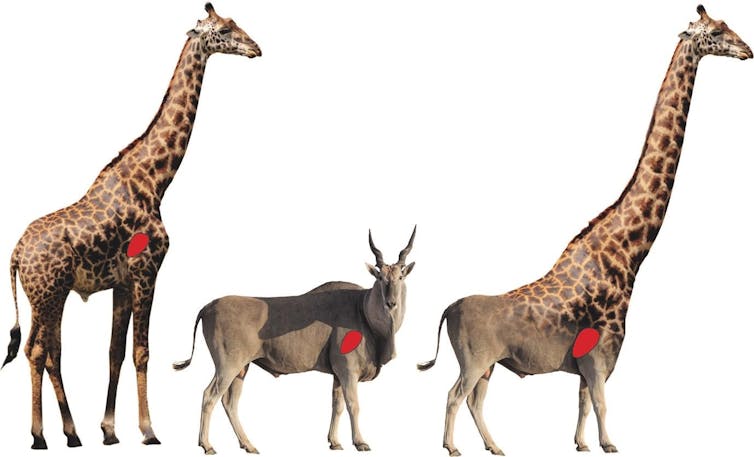
In our new study, we quantified the energy cost of pumping blood for a typical adult giraffe and compared it to what it would be in an imaginary animal with short legs but a longer neck to reach the same treetop height.

This beast was a Frankenstein-style combination of the body of a common African eland and the neck of a giraffe. We called it an “elaffe”.

Images of a giraffe, an eland, and the half-giraffe half-eland 'elaffe', each with the location of its heart highlighted.
The imaginary ‘elaffe’, with the lower body of an eland and an extended giraffe neck, would use even more energy to pump blood from its heart all the way up to its head.
Estelle Mayhew / University of Pretoria

We found the animal would spend a whopping 21% of its total energy budget on powering its heart, compared with 16% in the giraffe and 6.7% in humans.

By raising its heart closer to its head by means of long legs, the giraffe “saves” a net 5% of the energy it takes in from food. Over the course of a year, this energy saving would add up to more than 1.5 tonnes of food – which could make the difference between life and death on the African savannah.

How giraffes work

In his book How Giraffes Work, zoologist Graham Mitchell reveals that the ancestors of giraffes had long legs before they evolved long necks.

This makes sense from an energy point of view. Long legs make the heart’s job easier, while long necks make it work harder.

A herd of giraffes on a grassy plain
The ancestors of giraffes evolved long legs before their long necks.
Zirk Janssen Photography

However, the evolution of long legs came with a price of its own. Giraffes are forced to splay their forelegs while drinking, which makes them slow and awkward to rise and escape if a predator should appear.

Statistics show giraffes are the most likely of all prey mammals to leave a water hole without getting a drink.

How long can a neck be?

The skeleton of a dinosaur in a museum, arranged with its extremely long neck almost vertical
In life, the Giraffatitan dinosaur would most likely have been unable to lift its head this high.
Shadowgate / Wikimedia, CC BY

The energy cost of the heart increases in direct proportion to the height of the neck, so there must be a limit. A sauropod dinosaur, the Giraffatitan, towers 13 metres above the floor of the Berlin Natural History Museum.

Its neck is 8.5m high, which would require a blood pressure of about 770mm Hg if it were to get blood to its head – almost eight times what we see in the average mammal. This is implausible because the heart’s energy cost to pump that blood would have exceeded the energy cost of the entire rest of the body.

Sauropod dinosaurs could not lift their heads that high without passing out. In fact, it is unlikely that any land animal in history could exceed the height of an adult male giraffe.

The Conversation

The authors do not work for, consult, own shares in or receive funding from any company or organisation that would benefit from this article, and have disclosed no relevant affiliations beyond their academic appointment.

ref. Why do giraffes have such long legs? Animal simulations reveal a surprising answer – https://theconversation.com/why-do-giraffes-have-such-long-legs-animal-simulations-reveal-a-surprising-answer-266230

Why do giraffes have such long legs? Animal simulations reveal a suprising answer

Source: The Conversation – Global Perspectives – By Roger S. Seymour, Professor Emeritus of Physiology, University of Adelaide

If you’ve ever wondered why the giraffe has such a long neck, the answer seems clear: it lets them reach succulent leaves atop tall acacia trees in Africa.

Only giraffes have direct access to those leaves, while smaller mammals must compete with one another near the ground. This exclusive food source appears to allow the giraffe to breed throughout the year and to survive droughts better than shorter species.

But the long neck comes at a high cost. The giraffe’s heart must produce enough pressure to pump its blood a couple of metres up to its head. The blood pressure of an adult giraffe is typically over 200mm Hg – more than twice that of most mammals.

As a result, the heart of a resting giraffe uses more energy than the entire body of a resting human, and indeed more energy than the heart of any other mammal of comparable size. However, as we show in a new study published in the Journal of Experimental Biology, the giraffe’s heart has some unrecognised helpers in its battle against gravity: the animal’s long, long legs.

Meet the ‘elaffe’

In our new study, we quantified the energy cost of pumping blood for a typical adult giraffe and compared it to what it would be in an imaginary animal with short legs but a longer neck to reach the same treetop height.

This beast was a Frankenstein-style combination of the body of a common African eland and the neck of a giraffe. We called it an “elaffe”.

Images of a giraffe, an eland, and the half-giraffe half-eland 'elaffe', each with the location of its heart highlighted.
The imaginary ‘elaffe’, with the lower body of an eland and an extended giraffe neck, would use even more energy to pump blood from its heart all the way up to its head.
Estelle Mayhew / University of Pretoria

We found the animal would spend a whopping 21% of its total energy budget on powering its heart, compared with 16% in the giraffe and 6.7% in humans.

By raising its heart closer to its head by means of long legs, the giraffe “saves” a net 5% of the energy it takes in from food. Over the course of a year, this energy saving would add up to more than 1.5 tonnes of food – which could make the difference between life and death on the African savannah.

How giraffes work

In his book How Giraffes Work, zoologist Graham Mitchell reveals that the ancestors of giraffes had long legs before they evolved long necks.

This makes sense from an energy point of view. Long legs make the heart’s job easier, while long necks make it work harder.

A herd of giraffes on a grassy plain
The ancestors of giraffes evolved long legs before their long necks.
Zirk Janssen Photography

However, the evolution of long legs came with a price of its own. Giraffes are forced to splay their forelegs while drinking, which makes them slow and awkward to rise and escape if a predator should appear.

Statistics show giraffes are the most likely of all prey mammals to leave a water hole without getting a drink.

How long can a neck be?

The skeleton of a dinosaur in a museum, arranged with its extremely long neck almost vertical
In life, the Giraffatitan dinosaur would most likely have been unable to lift its head this high.
Shadowgate / Wikimedia, CC BY

The energy cost of the heart increases in direct proportion to the height of the neck, so there must be a limit. A sauropod dinosaur, the Giraffatitan, towers 13 metres above the floor of the Berlin Natural History Museum.

Its neck is 8.5m high, which would require a blood pressure of about 770mm Hg if it were to get blood to its head – almost eight times what we see in the average mammal. This is implausible because the heart’s energy cost to pump that blood would have exceeded the energy cost of the entire rest of the body.

Sauropod dinosaurs could not lift their heads that high without passing out. In fact, it is unlikely that any land animal in history could exceed the height of an adult male giraffe.

The Conversation

The authors do not work for, consult, own shares in or receive funding from any company or organisation that would benefit from this article, and have disclosed no relevant affiliations beyond their academic appointment.

ref. Why do giraffes have such long legs? Animal simulations reveal a suprising answer – https://theconversation.com/why-do-giraffes-have-such-long-legs-animal-simulations-reveal-a-suprising-answer-266230

Adult ADHD is diagnosed when you are ‘functionally impaired’. But what does that mean?

Source: The Conversation – Global Perspectives – By David Coghill, Financial Markets Foundation Chair of Developmental Mental Health, The University of Melbourne

Tim Roberts/Getty Images

Attention-deficit hyperactivity disorder (ADHD) is a neurodevelopmental condition that affects around 2.5% of adults and 7% of children. It causes difficulties with attention, impulsivity and hyperactivity.

If unrecognised and untreated, ADHD can significantly impact educational and work achievements, and social and emotional wellbeing. It can also increase the risks of serious accidents and injuries, offending, mental illness and substance abuse.

When accurately identified and appropriately treated, these negative outcomes can be significantly reduced.

But as a recent article in the Medical Journal of Australia highlights, some people struggle to access and afford diagnoses and treatment the disorder.

Meanwhile, some popular social media channels that provide online “tests” for ADHD are sponsored by private clinics that, once you have screened positive, direct you to their sites for an online assessment. This has raised concern about potential over-diagnosis.

So, what is ADHD diagnosis actually based on? A key component is functional impairment. Let’s take a look at what that means.


Read more:
Put a finger down if TikTok has made you think you have ADHD


Why a brief assessment isn’t enough

In Australia, there are reports of business models where clinics are charging several thousand dollars for a quick, brief online assessment and diagnosis.

These brief assessments don’t comply with evidence-based guidelines and are problematic because they:

  • focus solely on ADHD and don’t attempt to assess other aspects of a person’s difficulties

  • rely heavily on information from the person being assessed and don’t seek the opinions of significant others

  • rely heavily on information about symptoms, gathered through questionnaires, and don’t assess their impact on day-to-day functioning.

This is important because a core requirement for a diagnosis of ADHD is evidence that the:

symptoms must interfere significantly with social, academic, or occupational functioning.

No matter how many symptoms you have, if they’re not having an impact on your day-to-day life, a diagnosis of ADHD shouldn’t be made.

So what is a comprehensive assessment?

To make an accurate diagnosis of ADHD, a comprehensive assessment is needed. This includes a clinical interview to evaluate the current and past presence (or absence) of each of the 18 core ADHD symptoms and associated impairment.

While there are scales such as the Weiss Functional Impairment Rating Scale and the World Health Organisation Disability Assessment Schedule that can aid assessment, these are best used as conversation starters rather than stand-alone tools.

A comprehensive assessment also includes a broader assessment for current mental and physical health problems, developmental history, personal and family mental health, substance use, addiction and, where appropriate, interactions with the justice system.

This interview shouldn’t be conducted as a simple tick-box exercise, with yes and no answers. A detailed interview is needed to explore and identify symptoms, and evaluate their impact on functioning.

It’s also strongly recommended the clinician hears from one or more people who can speak to the person’s childhood and current functioning.

What counts as ‘functional impairment’ is very individual

The diagnostic manuals don’t give detailed accounts of what counts as significant enough impairment to be diagnosed with ADHD.

This has led some commentators to complain that lack of a standardised definition could lead to over-diagnosis.

But the impacts of ADHD are so broad it would be very difficult to formulate a clear, comprehensive and encompassing list of valid impairments.

Such a list would also fail to capture the very personalised nature of these impairments. What is impairing for me may not be for you and vice versa.

So a rigid definition would likely result in missed as well as mis-diagnoses.

How do clinicians determine if someone is impaired?

Clinicians are very used to assessing the impact of symptoms on functioning. They do so for many other mental and physical health conditions, including depression and anxiety.

Research has identified several common themes in ADHD:

  • impaired romantic, peer and professional relationships
  • parenting problems
  • impaired educational and occupational achievements
  • increased accidents and unintentional injuries
  • driving offences
  • broader offending
  • substance use and abuse
  • risky sexual behaviours.

ADHD symptoms are often associated with:

  • emotional dysregulation
  • exhausting levels of mental and physical restlessness
  • low self-esteem
  • fatigue
  • high stress levels.


Read more:
Parents are increasingly saying their child is ‘dysregulated’. What does that actually mean?


One caveat is that some people are receiving a lot of support and scaffolding or have found ways to compensate for their difficulties. Whether or not this should count as impairment depends on the circumstances and requires considerable thought.

However, ADHD shouldn’t be ruled out on the basis of high levels of achievement in certain aspects of life like school or work. A person may be under-achieving relative to their potential, or having to put in extreme levels of effort to keep afloat.

An adult with ADHD, for example, may be excelling at work but by the end of the workday is too exhausted to do anything but sleep. They may also be experiencing impairments in other aspects of their lives that aren’t obvious unless specifically asked about.

Others will present multiple impacts that, when explored, aren’t true functional impairments.

So it’s crucial clinicians drill down into the details until they’re confident that it is or isn’t a genuine impairment related to the core ADHD symptoms.

Clinician training is essential

The skill of accurately assessing impairments in ADHD is not difficult to train or learn. This is done by observing experienced clinicians and practising with structured protocols.

Newly trained clinicians quickly become confident in assessing impairment and there is generally close agreement between different professionals about whether an ADHD diagnosis should be made.

However, few health professionals currently get high-quality training in ADHD either during their core or more advanced training. This must change if we’re going to improve the accuracy of assessment and reduce missed and mis-diagnoses.


Read more:
You might have heard ADHD risks being over-diagnosed. Here’s why that’s not the case


The Conversation

David Coghill has received honoraria from Medice, Novartis, Takeda and Servier and royalties from Oxford University Press and Cambridge University Press. He receives research funding from the National Health and Medical Research Council of Australia, the Australian Medical Research Futures Fund, and the Financial Markets Foundation for Children. He is the President and a director of the Australasian ADHD Professionals Association.

ref. Adult ADHD is diagnosed when you are ‘functionally impaired’. But what does that mean? – https://theconversation.com/adult-adhd-is-diagnosed-when-you-are-functionally-impaired-but-what-does-that-mean-268092

Is it aliens? Why that’s the least important question about interstellar objects

Source: The Conversation – Global Perspectives – By Laura Nicole Driessen, Postdoctoral Researcher in Radio Astronomy, University of Sydney

Interstellar comet 3I/ATLAS, captured by NASA’s Hubble Space Telescope captured on July 21 2025. NASA, ESA, David Jewitt (UCLA); Image Processing: Joseph DePasquale (STScI)

On October 29, Comet 3I/ATLAS reached its closest point to the Sun.

This point, known as perihelion, was around 210 million kilometres from the Sun, or 1.4 times the distance between the Sun and Earth, and it was on the opposite side of the Sun to Earth. This means the Sun has been blocking the comet from our view (from Earth). There are already reports it’s been detected again using ground-based telescopes.

The comet is the third interstellar object (hence the “3I”) we’ve detected flying through our Solar System.

When it was first detected on July 1 2025 by the Asteroid Terrestrial Last Alert System (or “ATLAS”), one of the first questions people asked was “but is it aliens?”.

This isn’t the first time the alien question has come up in the context of a new astronomical discovery. But although it might be fun, it can also detract from the real (and very cool) science, and fuel misinformation.

A long history of speculation

Similar alien speculation arose when the first two interstellar objects were discovered: 1I/2017 U1 ‘Oumuamua and Comet 2I/Borisov.

And it doesn’t just happen for interstellar objects.

In 2019, I wrote my first public article about a discovery I made as a PhD student. I had found radio light coming from a binary star system, the first object found by the MeerKAT telescope to be changing brightness over time. Even though this had nothing to do with aliens, the editor asked me to include speculation about them.

In 1967, Jocelyn Bell Burnell, then a PhD student, discovered a rapidly repeating flash of radio light.

As a joke, she labelled it LGM 1 for “Little Green Men”, but the astronomers working on it did not really believe they had discovered aliens. They were, however, concerned about the possibility that alien-related media coverage would sensationalise the discovery and hinder their scientific investigations.

A 7 billion-year-old visitor

This concern remains for astronomers today.

Comet 3I/ATLAS is possibly the oldest thing we’ve ever seen in our Solar System. Our Solar System formed 4.6 billion years ago, while recent research points to Comet 3I/ATLAS possibly being more than 7 billion years old.

It has spent a lot of that time zipping through the universe just to spend a few months in our Solar System. When the comet reached perihelion, that’s probably the closest it’s been to a star in at least millions of years.

Research has shown the comet has more carbon dioxide in its outer layers than has been seen in most comets in our Solar System. It also has a higher ratio of nickel to other elements than has been seen in local comets.

These chemical signatures give us a unique insight into the chemical composition of the cloud of gas that formed the solar system where the comet came from.

This is one of the key reasons why we should only be asking about aliens when all other possibilities are exhausted. When we talk about aliens first, we might miss all this amazing information.

As astronomer Carl Sagan said (in his rewording of a principle by French mathematician Pierre-Simon Laplace), “extraordinary claims require extraordinary evidence”. It’s true we can’t completely explain every detail of the comet yet, but not knowing everything is not evidence of aliens.

Embrace the uncertainties

Talking about aliens also leaves room for misinformation to spread.

For example, there have been claims of things such as trajectory shifts and Comet 3I/ATLAS “hiding” behind the Sun. Despite no evidence to support this, I received many questions along these lines when I spoke about the comet online. This demonstrates how easy it is for misinformation to be generated and spread when we’re talking about “aliens”.

There are ways to see the comet while it’s on the other side of the Sun. For example, the European Space Agency plans to observe the comet using the Mars Express, ExoMars Trace Gas Orbiter and the Jupiter Icy Moons Explorer.

And if you’d like to see the trajectory of Comet 3I/ATLAS and find out where it is right now, you can.

There might be something to be learned from poets here. Romantic poet John Keats wrote about something he called “negative capability”. It’s a strange name, but the concept is about being able to sit with “uncertainties, mysteries and doubts” and be content with not knowing.

There’s a lot we don’t know about Comet 3I/ATLAS and about the universe. It wouldn’t be much fun to be an astronomer if we knew everything already. But when there’s something unknown, we humans like to fill that gap.

For astronomy mysteries, the gap tends to be filled with aliens. However, not knowing all the answers is not proof of aliens. It just means that we have work to do.

The Conversation

Laura Nicole Driessen is an ambassador for the Orbit Centre of Imagination at the Rise and Shine Kindergarten, in Sydney’s Inner West.

ref. Is it aliens? Why that’s the least important question about interstellar objects – https://theconversation.com/is-it-aliens-why-thats-the-least-important-question-about-interstellar-objects-268665

The anguish of losing: The Blue Jay fan’s guide to dealing with feelings of despair

Source: The Conversation – Canada – By Craig Greenham, Associate Professor, Department of Kinesiology, University of Windsor

The thrill of victory and the agony of defeat. This tidy maxim has been used for years to describe sports outcomes.

This polarized expression, however, oversimplifies fan reaction to events like the Blue Jays’ World Series loss, ignores the complicated emotional terrain of fandom and fails to recognize the psycho-social forces at work.

So, why are many Canadians so deeply invested in the Blue Jays?

Fans develop parasocial relationships with players, teams and even broadcasters — evident in the outpouring of emotion surrounding Jays’ announcer Buck Martinez’s cancer journey — through repeated media exposure.

Over time, these constant encounters foster a sense of familiarity and emotional intimacy, as if a genuine personal relationship exists. In a way, it makes sense: over the course of a long season, many Blue Jays fans see and hear more from slugger George Springer than from some of their real-life friends.

Personal pain

Jays losses therefore feel personal — and so, too, does the team’s success. This connection is captured by the concept of what’s known as BIRGing — basking in the reflected glory — when fans feel a sense of personal triumph when their team performs well, as though there’s a twinning of fates.

The phenomenon was playfully illustrated in a 2024 A&W promotion — “Blue Jays Win, You Win” — that offered free or discounted food after each victory, literally tying fan rewards to team success.

Of course, the opposite is true too. When the Jays fall short, fans feel lacerated. The more crucial the game, the deeper the cut. Given this emotional investment, it’s no surprise that Blue Jays fans felt like a bundle of nerves heading into Game 7 and were devastated by the result.

The nature of the Game 7 loss inflames the emotions further — a game the Jays were leading until the ninth inning. There were opportunities to increase that lead that went maddeningly unrealized, embattled relievers yielded home runs to Dodger lesser lights, there were near-collisions in the outfield that could have jarred loose a key run from an outfielder’s glove, and a play at home plate that required frame-by-frame analysis to determine an outcome ultimately unfavourable to the Jays.

Canadians understand the description “sudden death” as a hockey term, but there’s no denying that Game 7 created a similar profound sense of loss, not just in Toronto but across the country.

In the sports realm, the ninth inning events resembled a funeral for Jays fans. The finality and closure was symbolized by the final out; the loss of routine and community created a void and disconnection for fans; feelings of mourning a dream amid the vanquished hope as the team fell just short of the ultimate World Series goal; and an unknown future that brings with it the anxiety of not knowing which players will return and an understanding these opportunities are rare.

Players and fans have to navigate and negotiate their way through the loss. The tears on the field and in the clubhouse mirrored those in the stands and living rooms across the country, a vivid reminder that fandom is as much about emotional commitment as the scoreboard.

Haunted by the Maple Leafs

Of course, Blue Jays fandom isn’t siloed — especially for those in Ontario. Many of the club’s loyal supporters are equally passionate about the forlorn Toronto Maple Leafs, who have not won a Stanley Cup since 1967.

The hockey club has put the fan base through the proverbial wringer with prolonged periods of ineptitude, mixed with inexplicable collapses and controversial playoff defeats.

The fragility of this fan base is palpable — excited in hope, but also braced for doom because of its frequent visits. Toronto sports fans aren’t used to being favoured by fortune. That’s why moments like the Joe Carter World Series home run in 1993 or the Kawhi Leonard buzzer-beater baseline jumper in the 2019 NBA playoffs have been immortalized.

Kawhi Leonard’s iconic buzzer beater in 2019. (NBA)

They’re outliers, those precious times when the fan base evaded the grim reaper’s scythe and grasped the greater glory.

The rarity of these victories elevates them to mythic moments — reminders that even in a history full of sports heartbreak, there are flashes of transcendent jubilation that justify the fan’s emotional investment.

Five stages of grief

Sports fans are nothing if not resilient, however, and Blue Jays fans are working themselves through the classic five stages of grief — denial, anger, bargaining, depression and acceptance.

What has likely expedited the process and softened the blow for some is the fact that the Blue Jays weren’t expected to challenge for the World Series at all in 2025. The club finished last in its division in 2024 and surprised the baseball world with its rise to prominence.

This process is called framing and it explains how people interpret and give meaning to events. It’s the lens. So instead of focusing on the anguish of Game 7, diehard fans emphasize team growth, memorable moments and optimism for next season.

Naturally, nothing in baseball is guaranteed and a Blue Jays return to the World Series in 2026 will require the personnel, performance, health and luck necessary to have success. Fans, meantime, will use the off-season to emotionally steel themselves for, potentially, another wild ride. Spring, after all, is the season of hope when anything seems possible.

The Conversation

Craig Greenham does not work for, consult, own shares in or receive funding from any company or organisation that would benefit from this article, and has disclosed no relevant affiliations beyond their academic appointment.

ref. The anguish of losing: The Blue Jay fan’s guide to dealing with feelings of despair – https://theconversation.com/the-anguish-of-losing-the-blue-jay-fans-guide-to-dealing-with-feelings-of-despair-268756

Trump’s squeeze of Venezuela goes beyond ‘Monroe doctrine’ – in ideology, intent and scale, it’s unprecedented

Source: The Conversation – Global Perspectives – By Alan McPherson, Professor of History, Temple University

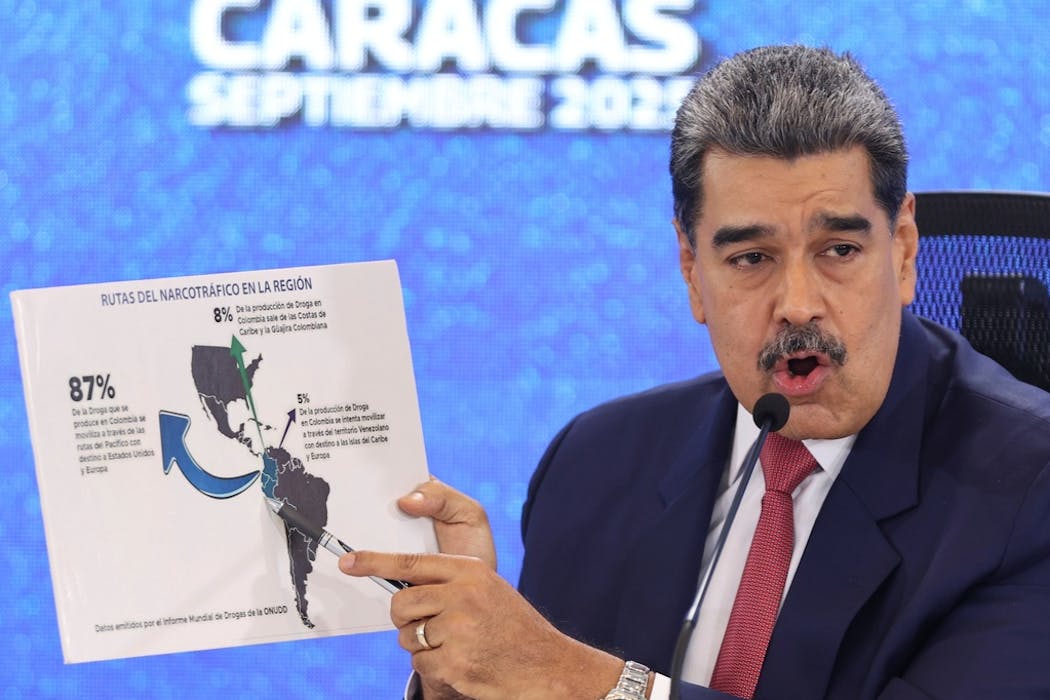
Venezuelan President Nicolás Maduro points at a map in September 2025. AP Photo/Jesus Vargas

A massive military buildup in the Caribbean has sparked speculation that the U.S. is now engaged in its latest chapter of direct intervention in Latin America.

For now, at least, President Donald Trump has walked back suggestions that Washington is eyeing strikes inside Venezuela, seemingly content with attacking numerous naval vessels under the guise of a counter-narcotics operation. But nonetheless, U.S. presence in the region will enlarge further in the coming weeks with the arrival of the world’s largest aircraft carrier, the USS Gerald R. Ford.

As a scholar of U.S.-Latin American relations, I know the actions of the current U.S. administration smack of a long history of interventions in the region. Should escalation develop from attacks on ships into direct military confrontation with Venezuela, such aggression would appear to be par for the course in inter-American relations.

And certainly, governments across Latin America – in and out of Venezuela – will place it in this historical context.

But while it does hearken back to some quasi-piratical practices of the U.S. Navy, the military buildup now is in key respects both unprecedented and shocking. It could also damage U.S. relations with the rest of the hemisphere for a generation to come.

A history of intervention

In the most obvious way, deploying a flotilla of warships to the southern Caribbean evokes dark echoes of “gunboat diplomacy” – the unilateral dispatch of marines or soldiers to strong-arm foreign governments that was especially prevalent in Latin America. One reliable account tallies 41 of these in the region from 1898 to 1994.

Of these, 17 were direct U.S. cases of aggression against sovereign nations and 24 were U.S. forces supporting Latin American dictators or military regimes. Many ended in the overthrow of democratic governments and the deaths of thousands. From 1915 to 1934, for example, the U.S. invaded and then occupied Haiti and may have killed as many as 11,500 people.

A man demonstrates at a rally.
A Venezuelan supporter of Maduro takes part in a rally against U.S. military activity in the Caribbean.
Federico Parra/AFP via Getty Images

During World War II and the Cold War, Washington continued to dictate Latin America’s politics, showing an eagerness to respond to any perceived threat to U.S. investments or markets and backing pro-Washington dictatorships such as Augusto Pinochet’s rule over Chile from 1973 to 1990.

Latin Americans have, by and large, chafed at such naked displays of Washington’s power. This opposition from Latin American governments was the main reason that President Franklin D. Roosevelt gave up interventions with his “Good Neighbor” policy in the 1930s. Intervention continued, though, throughout the Cold War, with moves against leftist governments in Nicaragua and Grenada in the 1980s.

The end of the Cold War did not quite end military interventions. Some U.S. armed forces still operated in the hemisphere, but, since 1994, they had done so as part of multilateral forces, as in Haiti, or responding to invitations or collaborated with host nations, for instance in anti-narcotics operations in the Andes and Central America.

Showing respect for national sovereignty and non-intervention – both sacred principles in the hemisphere – especially in the context of rising drug violence, has largely quieted the resistance to the presence of U.S. troops in the largest nations in the hemisphere, such as Mexico and Brazil.

No mere Monroe Doctrine reboot

So is Trump merely reviving a long-abandoned stance on the U.S. role in the region?

Not even close. In two key ways, aggression against Venezuela or any other Latin American country now – rationalized by Washington as a response to insufficient law enforcement against drug-running – would be dangerously unprecedented.

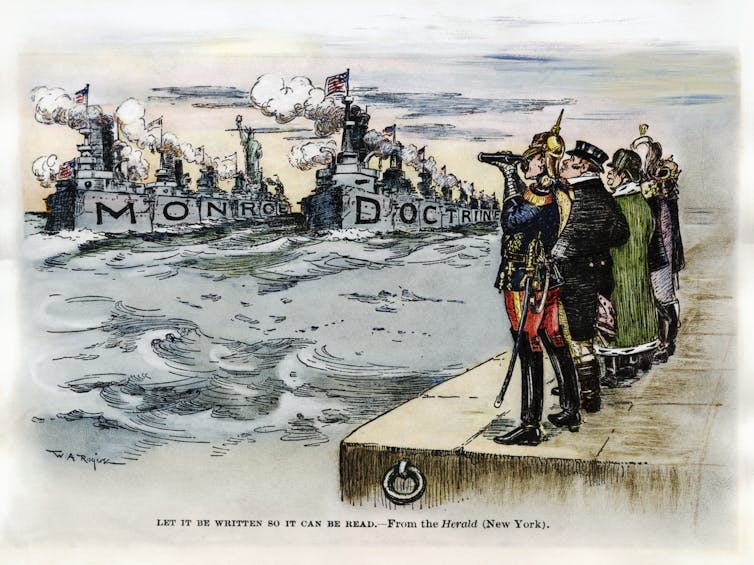
First, it would blow out of the water the age-old justification for U.S. armed intervention called the Monroe Doctrine.

Since 1823, when President James Monroe announced it, the U.S. has aimed to keep outside powers out of the republics of the hemisphere.

Once a Latin American people won its independence, Washington believed, it had the right to keep it, and the U.S. Navy helped in any way it could.

By the early 20th century, that purported help took on the look of a policeman patrolling the Caribbean Sea on a beat, wielding what then-U.S. President Theodore Roosevelt called a “big stick” and keeping Europeans from landing and, say, collecting debts. Sometimes this was done by having the Marines land first and move a country’s gold to Wall Street.

An old political cartoon shows a map of people looking at naval vessels.
A 1904 cartoon in the New York Herald shows European leaders observing American naval power under the Monroe Doctrine.
Bettmann/Getty Images

An expansion of the Panama precedent

Even during the Cold War, the Monroe Doctrine could be logically invoked to keep the Soviets out of the hemisphere – whether in Guatemala in 1954, Cuba in 1961, the Dominican Republic in 1965 or Grenada in 1983.

Often, as in Guatemala, the Soviet link was weak, even nonexistent. But there was still a thin thread of keeping out a “foreign ideology” that seemed to keep Monroe relevant.

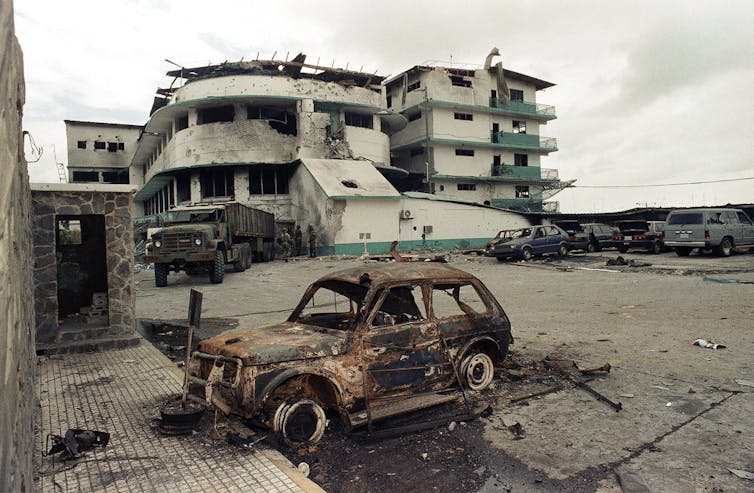
The doctrine died a surer death with the 1989 invasion of Panama to remove its rogue leader, Manuel Noriega, convicted of drug-running and guilty of trouncing his country’s democracy. No one fingered an extra-hemispheric accomplice.

Noriega’s removal by about 26,000 U.S. troops might be the closest parallel to Trump’s targeting of alleged drugs boats in the Caribbean. Trump has already – and repeatedly – alleged Venezuelan President Nicolás Maduro is, like Noriega, not the head of state of his own country and therefore indictable. More fantastically, he has alleged that the Venezuelan leader is the head of the Tren de Aragua gang that has been designated a “foreign terrorist organization” by U.S. authorities. It is not too big a leap from there to calling for – and participating in – the overthrow of Maduro on the grounds of removing an international “narco-terrorist.”

But even there, the parallel with Panama diverges in a crucial way: A U.S. attack on Venezuela would be far different in scale and geography. Maduro’s country is 12 times larger, with about six times the population. Its active troops number at least 100,000.

A photo of a bombed out vehicle.
A 1989 photo of the bombed out Panamanian Defense Forces Headquarters after being destroyed in the American invasion of Panama.
AP Photo/Matias Recar

Another Iraq?

In all of the U.S. invasions and occupations of Latin America, none has occurred in South America or in a large country.

To be sure, troops from “the colossus of the north” invaded Mexico several times, beginning in 1846, but never did they hold the entire country. In the Mexican War, U.S. troops soon retreated after 1848. In 1914, they occupied a single city, Veracruz, and in 1916, they chased around a bandit in the Punitive Expedition.

In all these episodes, it found taking parts of Mexico expensive and unproductive.

And a U.S.-provoked regime change in a sovereign country today, such as in Venezuela, would likely trigger a massive resistance not only from its military but throughout the country.

Maduro’s threat of a “republic in arms” should the U.S. invade might be bluster. But it might not. Many experts predict that such an invasion would meet with disaster. Maduro has already asked for military assistance from Russia, China and even Iran. Even without such help, the mobilization of U.S. assets in the Caribbean is no guarantee of success.

And while many governments in the rest of the hemisphere would no doubt love to see Maduro gone, they would dislike more the method of his going. The presidents of Colombia and Mexico have criticized the attacks, and others have warned of the resentment in the hemisphere were an intervention to follow.

In part, this is informed by the U.S. interventionist past in Latin America, but it also comes from a place of self-preservation, particularly among the left-leaning governments who have already drawn Trump’s ire. As President Luiz Inácio Lula da Silva of Brazil said, “If this becomes a trend, if each one thinks they can invade another’s territory to do whatever they want, where is the respect for the sovereignty of nations?”

Venezuela is, contrary to the White House’s statements, not much of a producer or trans-shipment point of narcotics. What if Trump turned his sights on other government even more compromised by drug corruption, such as Mexico, Colombia, Bolivia and Peru?

The concern there will be over becoming the next domino in line.

The Conversation

Alan McPherson does not work for, consult, own shares in or receive funding from any company or organization that would benefit from this article, and has disclosed no relevant affiliations beyond their academic appointment.

ref. Trump’s squeeze of Venezuela goes beyond ‘Monroe doctrine’ – in ideology, intent and scale, it’s unprecedented – https://theconversation.com/trumps-squeeze-of-venezuela-goes-beyond-monroe-doctrine-in-ideology-intent-and-scale-its-unprecedented-268845

Lasting peace and recovery in Gaza depends on local participation, not just ceasefires

Source: The Conversation – Canada – By Mahmood Fayazi, Assistant Professor and Head of Disaster and Emergency Management Program, Royal Roads University

Two years into the Israeli war in Gaza, world leaders recently gathered in Sharm El-Sheikh, Egypt, to deliberate on a long-awaited peace plan to end the conflict.

As part of this plan, both Israel and Hamas agreed to another ceasefire agreement — the latest in a series of truces that have repeatedly collapsed since the war began in late 2023.

The meeting, involving Egypt, Qatar, Turkey and the United States, marks the most concerted diplomatic effort yet to halt a conflict that has killed more than 67,000 Palestinians, according to the Gaza Health Ministry, and at least 1,200 Israelis, according to Israel. It’s also displaced nearly 400,000 Palestinians.

Yet even if the fighting does stop, fundamental questions persist: how, when and by whom will Gaza be rebuilt? The recovery and reconstruction of the Gaza Strip will undoubtedly be an immense and complex undertaking, but the history of past conflicts sheds light on the way forward.

The scale of destruction

A February report from the World Bank estimated that recovery and reconstruction needs in Gaza and the West Bank will cost US$53.2 billion. Around US$20 billion of this is required to restore essential services, rebuild infrastructure and revitalize the economy — an amount exceeding the annual GDP of Belarus and Slovenia.

The scale of devastation is staggering. An estimated 84 per cent of the Gaza Strip and up to 92 per cent of Gaza City has been destroyed, with satellite data showing 292,904 homes destroyed or damaged. More than 60 million tonnes of debris — equivalent to 24,000 Olympic-sized swimming pools — is awaiting removal.

The conflict has devastated Gaza’s economic sectors. Up to 96 per cent of agricultural assets and 82 per cent of businesses were damaged or destroyed, halting production and eliminating key income sources.

Years of Israel’s blockade on Gaza — which predates Hamas’s Oct. 7, 2023 attacks on Israel — have further restricted the movement of goods and people in and out of Gaza, severing access to international markets and vital raw materials. As a result, there has been near-total economic collapse and the private sector faces complete paralysis.

Beyond the physical and economic devastation, Gaza’s population faces severe psychological trauma. High rates of post-traumatic stress disorder, depression and anxiety, coupled with displacement and community breakdown, risk creating an intergenerational cycle of suffering through the psychological and epigenetic transmission of trauma.

Trump’s controversial peace plan

In an attempt to jump-start Gaza’s recovery, U.S. President Donald Trump introduced a 20-point peace plan envisioning interim governance by a committee of Palestinian technocrats under a “Board of Peace.” Authority would later be transferred to the Palestinian Authority following institutional reforms.


Read more:
The Gaza ceasefire deal could be a ‘strangle contract’, with Israel holding all the cards


The plan outlines an economic development program to be designed by experts who “helped birth some of the thriving modern miracle cities in the Middle East.” It also includes the creation of a “special economic zone” and temporary security provided by International Stabilization Forces made up of U.S., Arab and international partners.

Under the proposal, Hamas, which has governed Gaza for nearly two decades, would be expected to disarm, accept amnesty and transfer control to international forces. Yet even if Hamas disarms, experts estimate up to 100,000 members could remain in Gaza’s political landscape and reconstitute under new forms to maintain influence.

While the peace plan outlines a framework for recovery, past post-conflict settings shows that externally designed plans rarely succeed without active local engagement.


Read more:
Hamas is battling powerful clans for control in Gaza – who are these groups and what threat do they pose?


Learning from past failures

As an expert in disaster and emergency management, I am conducting an ongoing systematic literature review (not yet published) analyzing recovery processes across post-war settings in Europe, Asia and Africa.

Experiences from Iraq and Afghanistan demonstrate that it’s naive to assume economic, administrative and security frameworks can succeed without genuinely engaging the local population.

This research shows that externally driven recovery plans often fail, and underscores the importance of adapting lessons from places where recovery has been effective.

My developing review suggests several critical factors for sustainable recovery:

  • Developing local capacities
  • Building strong and transparent institutions
  • Implementing gradual and sequenced reforms
  • Ensuring there is a deliberate transition from external to local leadership

Conversely, over-relying on external powers, neglecting capacity-building and failing to address social exclusion and power imbalances can undermine long-term outcomes.

Rebuilding hope through local participation

A common theme across nearly all the studies I looked at is the importance of restoring household livelihoods. This can be done by revitalizing economic production, supporting small businesses and implementing reforms that empower communities and restore hope.

After financing more than US$6.2 billion across 157 post-conflict operations in 18 countries, the World Bank concluded in 1997 that “without economic hope, we will not have peace.” This underscores the central role of economic recovery and livelihood restoration in post-war reconstruction.

An analysis of 36 post-civil war peace episodes (1990–2014) highlights the need for co-ordinated international efforts focused on administrative restructuring, judicial reform and local government elections.

Successfully integrating diverse political voices in post-war governance promotes transparency, accountability and local ownership, while helping to restore hope among populations affected by war.

In contrast, top-down reforms implemented without local engagement, as seen in Cambodia and Pakistan, can deepen divisions and undermine peace and development.

Toward a people-centred reconstruction

Although each post-war context is unique and requires its own approach, research consistently shows that actively including survivors in recovery efforts is essential.

Gaza’s reconstruction will only succeed if its people regain hope and play a central role in shaping a safe, peaceful and prosperous future for themselves and their communities.

Any international coalition or political initiatives aimed at rebuilding Gaza must recognize that survivors are not passive victims. They are central agents of their own recovery, whose voices must guide the reconstruction process.

Once immediate humanitarian needs are met through international support, all subsequent decisions about Gaza’s long-term development must be made through inclusive, democratic processes.

Fair and transparent elections must follow the urgent restoration of security, food, clean water, health care and education. Only through such an inclusive and locally grounded process can Gaza move toward genuine recovery, lasting peace and sustainable development.

The Conversation

Mahmood Fayazi does not work for, consult, own shares in or receive funding from any company or organisation that would benefit from this article, and has disclosed no relevant affiliations beyond their academic appointment.

ref. Lasting peace and recovery in Gaza depends on local participation, not just ceasefires – https://theconversation.com/lasting-peace-and-recovery-in-gaza-depends-on-local-participation-not-just-ceasefires-268176