Can brain training really shave ten years off brain ageing, as a recent study suggests?

Source: The Conversation – UK – By Yolanda Lok Yiu Lau, Postdoctoral Research Associate, Dementia and Neurodegenerative Diseases, Queen Mary University of London

A ten-week online brain training programme helped older adults’ brains act as though they were a decade younger, a recent study has found.

Much like exercise for the body, regular mental workouts can help keep the brain in shape. As we age, brain processes that support memory, attention and decision-making can become less efficient. Keeping the mind active is thought to build a reserve that helps people cope better with these age-related changes.

Studies suggest that people who stay mentally, physically and socially active have a lower risk of developing dementia. For example, in a study involving 120 older adults, those who engaged in regular aerobic exercise had larger brain volumes and better cognitive performance than those who were less active, reversing age-related loss in brain volume over a couple of years.

Studies have also found that brain training can improve older adults’ cognitive performance.

The latest study adds to what we know by testing whether brain training programmes – BrainHQ, in this instance – can change the brain’s chemistry, offering biological clues about how brain training might work.

BrainHQ is a brain training app that offers short, game-like exercises that train cognitive skills such as attention, memory and brain speed. As users improve, the challenges get harder, pushing the brain to adapt – much like increasing the weights during a workout.

Ninety-two healthy adults from Canada, 65 and older, took part. Half of them completed brain training exercises using BrainHQ for 30 minutes a day, five days a week, over ten weeks. The other half, a comparison group, spent the same amount of time playing games designed just for entertainment, such as solitaire.

To see whether the programme made a difference to the brain, all participants had specialised scans before and after the ten weeks of training. These scans can detect tiny chemical changes in brain activity.

The researchers focused on a region called the anterior cingulate cortex, which plays an important role in attention, learning and memory. Those who completed the speed-based exercises showed stronger activity in this area compared to those in the comparison group. The change in brain chemicals seen is described by the researchers as equivalent to shaving ten years off their biological age.

Ageing and cognitive decline (including Alzheimer’s disease) are often linked to reduced activity in this part of the brain. Strengthening it may therefore help delay or reduce cognitive decline and lower the risk of developing dementia later in life.

Although the results look promising, we should be careful about how we interpret them. The study measured many different outcomes. Although the brain training group showed increased activity compared with their own baseline, the difference between the two groups was not statistically significant.

Because the study looked at so many outcomes and involved only a small number of people, some of these changes may simply be due to chance rather than real effects of the training.

An older man and a woman. The man looks confused and troubled.
With ageing, there is often a decline in part of the brain called the anterior cingulate cortex.
LightField Studios/Shutterstock.com

The bigger picture

This was a small study involving healthy, mostly white older adults, and it looked at one specific brain training app. The findings may not apply to people with memory problems or to other types of brain-training programmes, or to longer-term outcomes.

This intervention is relatively short. Research found that most interventions aiming to improve cognitive performance that are successful typically last at least four to six months. Longer-term participation is almost certainly key to achieving lasting improvement in brain health.

Studies like this rely on brain scans as early indicators of benefit, but it remains to be seen whether these biological changes translate into lasting improvements in functioning. Researchers are testing whether similar brain-training programmes can help people who show early signs of dementia. These studies will reveal whether boosting brain activity this way can slow cognitive decline in those already showing symptoms.

High-intensity interventions – such as the one tested that required two and a half hours of training per week – may not suit everyone.

For example, people with existing cognitive concerns who want to improve their cognitive wellbeing may struggle to access digital programmes. They may need more community-based, supportive and lower-intensity interventions. To be an effective dementia programme, recruitment needs to be inclusive, especially reaching people from underserved groups who are at the highest risk.

Cognitive ageing is shaped by many factors – including physical activity, social connection, healthy diet and mental wellbeing – so brain training is likely to be just one part of a broader approach to supporting brain health and dementia prevention. Keeping the mind active may not stop ageing, but it could help the brain stay younger for longer.

The Conversation

Yolanda Lok Yiu Lau does not work for, consult, own shares in or receive funding from any company or organisation that would benefit from this article, and has disclosed no relevant affiliations beyond their academic appointment.

ref. Can brain training really shave ten years off brain ageing, as a recent study suggests? – https://theconversation.com/can-brain-training-really-shave-ten-years-off-brain-ageing-as-a-recent-study-suggests-268904

Five key issues at the UN climate summit in Brazil – and why they matter to you and the planet

Source: The Conversation – UK – By Alix Dietzel, Senior Lecturer in Climate Justice, University of Bristol

The world’s most important climate summit – known this year as Cop30 – has begun in the Amazonian port city of Belém, Brazil. It promises to be contentious: key countries haven’t submitted new climate plans, and negotiations are held up by disputes over who should pay for climate action.

We attended a preliminary round of negotiations in June, which ended with very few concrete agreements. Many outcome documents were instead heavily caveated as “not agreed”, “open to revision”, or “without formal status”.

Those fractious pre-summit talks followed a disappointing Cop29 in Azerbaijan last year. This year, here are five key issues to watch – and why they matter.

Are countries keeping their Paris pledges?

Ten years after the Paris agreement, countries are due to submit their third round of national climate plans, or nationally determined contributions (NDCs) in the jargon. These are refreshed every five years and are supposed to present “best efforts” to scale up climate action.

Yet as of November 2025, only 79 countries – covering 64% of global emissions – have submitted their NDCs. Countries not submitting include some of the highest emitters, such as India, while the US has (once again) left the Paris agreement and will not have high-level representatives at Cop30.

This is a big deal because these plans give us a snapshot of how countries’ planning matches up to global goals, including keeping temperature changes to below 1.5°C, which is looking increasingly unlikely (even if every country fulfilled its pledges, we’re still on course for nearly 3°C).

Who pays for this?

At Cop29 last year, countries agreed to pledge US$300 billion (£227 billion) a year by 2035 to help developing countries. While this was three times higher than the previous goal, it is barely a dent in the US$1.3 trillion developing countries requested – an amount now sidelined as “aspirational”.

Several countries, including India and Nigeria accused the Cop29 host Azerbaijan of forcing through a deal without consensus. Disappointment still lingers, and the fallout delayed agreement on an agenda for Cop30.

The question of who pays for climate change remains unresolved. Without agreement talks risk further breakdown, potentially stalling both adaptation and mitigation efforts worldwide.

What does a ‘just transition’ actually mean?

If the switch from a high to low-emissions world is to be successful it must be fair and inclusive, with no one left behind. This is known as the “just transition”.

Just transition talks have been fraught since Cop28, where richer countries insisted that it focus narrowly on finding new jobs for workers in fossil fuel industries. Various developing and middle-income countries, including China and some of the most climate-vulnerable nations, were more radical and ambitious. In their view, a just transition involves systemic change, arguing that “business as usual” perpetuates inequality.

This would have meant an overhaul of how we approach climate change. However, the wealthier countries eventually got their way in the final agreement, as the text was watered down to focus on the energy and labour sector. The broader ambition was effectively erased. This short-term win for the wealthier countries led to long-term fallout: negotiations collapsed at last year’s Cop29.

At this year’s preliminary meeting in Bonn, Germany, committee chairs enforced strict timekeeping and repeatedly urged delegates to focus on moving forward the text, at one point openly saying, “we already know everyone’s positions, let’s get down to brass tacks, let’s stop with general statements”. This approach seemed to work, as the working group did end up submitting an informal note (rather than a fully-fledged agreement), heavily caveated as not being final.

Unfortunately, as a result, the UN process still lacks agreement on what “just transition” really means or how to achieve it. Without clarity, the term risks becoming empty rhetoric rather than a roadmap for fair and inclusive climate action.

Saving tropical rainforests

The summit’s Amazonian setting has turned attention to tropical forests. Brazil’s president, Luiz Inácio Lula da Silva, has proposed a bold initiative – the Tropical Forest Forever Facility – that aims to raise US$125 billion to reward countries for preservation efforts. Yet the UK, for instance, has already opted out of contributing to the forest facility, despite reports detailing its alarming global deforestation footprint.

The Amazon stores up to 20 years of global CO₂ emissions, holds 10% of terrestrial biodiversity, and supports billions of dollars
in ecosystem services. Its destruction endangers Indigenous sovereignty and the planet’s climate stability. If Cop30 can meet its aim to protect rainforests, it stands a real chance of making a difference.

Inequity at the negotiations

Cop30 may be turn out to be one of the least equitable climate talks in recent memory. Belém’s astronomical accommodation costs mean many low-income countries and marginalised communities will struggle to attend, exacerbating longstanding UN issues.

Around 3,000 Indigenous representatives are expected, but so are thousands of fossil fuel lobbyists – a record number attended last year. However, as reports continually show, people linked to fossil fuels continue to participate – even in the main formal negotiations – without needing to disclose their affiliation.

If Cop30 could centre Indigenous rights, ensure equitable discussion, and limit lobbyist influence, it could restore some legitimacy to the process. Otherwise, it risks deepening the divide between rhetoric and reality in global climate governance.

The summit is set to be anything but technocratic and boring. We expect to see a tumultuous and controversial set of negotiations that will likely have repercussions well into the future.

The Conversation

The authors do not work for, consult, own shares in or receive funding from any company or organisation that would benefit from this article, and have disclosed no relevant affiliations beyond their academic appointment.

ref. Five key issues at the UN climate summit in Brazil – and why they matter to you and the planet – https://theconversation.com/five-key-issues-at-the-un-climate-summit-in-brazil-and-why-they-matter-to-you-and-the-planet-269216

Why has the BBC’s director general resigned and what could happen next?

Source: The Conversation – UK – By Colleen Murrell, Full Professor in Journalism, Dublin City University

Just when the BBC should have been basking in its success at the record 12 million viewers who watched the Celebrity Traitors finale, the corporation has been brought to its knees. Tim Davie, BBC director general, and Deborah Turness, the CEO of news, resigned following a leaked memo concerning alleged bias in BBC programming.

The memo, written last May by Michael Prescott, then independent advisor to the BBC’s editorial standards committee, raised a number of concerns about alleged bias in the BBC’s coverage of transgender issues, and alleged anti-Israel bias in the BBC Arabic service.

But the key issue appears to have been in the editing of a 2024 Panorama documentary titled Trump: A Second Chance? In the documentary, two different sections from President Donald Trump’s speech on the day of the January 6 2021 riots had been spliced together into one clip, which could have led viewers to conclude that Trump was calling on protesters to carry out the riot. Trump is now threatening to sue the corporation.

In the past week, the Telegraph has repeatedly accused the BBC of institutional bias. The broadcasters’s lack of public response, other than to declare that it did not comment on leaked information, was totally inadequate in the face of such an onslaught.

But while BBC supporters looked on aghast, internally, BBC news staff were attempting to respond. According to Today presenter Nick Robinson, BBC news executives had “agreed the wording of a press release” explaining that the programme should have made clear an edit had been made, but that at no point was there any “intention to mislead the audience”.

The BBC board refused to sign off on this statement, and the BBC was left looking like it was keeping schtum for possibly nefarious purposes.

The BBC’s chairman, Samir Shah, has now finally delivered a statement apologising for an “error of judgement”. He said that the BBC had discussed the corporation’s US election coverage and: “We accept that the way the speech was edited did give the impression of a direct call for violent action.”

Meanwhile, BBC journalists in Washington had to front up at the White House where Trump has declared that BBC journalists “are very dishonest people”.

Trump has now threatened to sue the BBC for $1 billion if they do not retract the documentary. As Shah has noted, Trump is “a litigious fellow”.

In July, Paramount settled a prospective lawsuit for US$16 million (£12.1 million) after Trump made a “false editing” accusation against 60 Minutes over an edit on a Kamala Harris interview headline during the last election campaign. Last year he also secured a US$15 million payment from ABC News as part-settlement in a defamation case against that network.

It is hard to imagine a scenario where the BBC would settle a dispute with the US government for cash. But with Trump, one never knows if his posturing might lead a media company to fold. For the BBC, this is a decisive own goal.

Internal politics

Arriving at the BBC this morning, Turness acknowledged the mistake in the Trump edit, but was clear that the BBC was not institutionally biased.

Some critics, however, have pointed the finger at the BBC’s own internal political challenges. Among them is David Yelland, a former editor of the Sun who now presents a BBC podcast. He called Turness and Davie’s resignations a “coup”, attributing it to alleged political bias on the BBC board.

Alongside this drama, BBC journalists such as Nick Robinson, David Sillito and Katie Razzall are carrying out a thorough job of examining the chaos. But a less-reported fact is that it is yet again an outsourced independent production programme that has led to the BBC’s current problems.

October Films Ltd made the film for BBC Panorama, just as it was HOYO Films that made the documentary Gaza: How to Survive a Warzone. That film was narrated by the 13-year-old son of a Hamas deputy minister of agriculture, something that wasn’t explained to viewers, leading to an Ofcom sanction last October.

However, outsourcing production to an independent company doesn’t outsource the editorial checking, which should have been exhaustive in the case of this Panorama programme.


Read more:
BBC Gaza documentary: how an editorial blame game overshadowed an important film and destroyed trust


What’s next?

The BBC must now recruit two high-level executives, just as it should be readying for its 2027 royal charter renewal (major talks over the broadcaster’s future and funding). According to the Today programme, the top contenders are three women: Apple’s Jay Hunt, former Channel 4 CEO Alex Mahon and former BBC chief content officer Charlotte Moore. But these are early days.

Some commentators will no doubt call for a “BBC cleanskin” so as to not be tainted by present controversies. But is this wise when the person will be called on to lead such a vastly complex and sprawling media organisation? Tim Davie had no background in journalism before becoming director general, and Deborah Turness had never worked for the BBC before.

The new broom may have to handle similar disputes to those over Gary Lineker’s social media posts or Bob Vylan’s anti-Israel Defense Forces chants at Glastonbury. Perhaps this should be the role of a deputy director, a post that used to exist at the BBC until recently.

It is worth remembering that the most important commodity in journalism is trust. To that end, the BBC continues to top the charts in the UK, according to the annual Reuters Digital News Report. The BBC houses some of the best journalists and news programming available today. The poor handling of this crisis puts all of their reputations at stake.

The Conversation

Colleen Murrell receives has received funding in the past from Irish regulator Coimisiún na Meán for the Reuters Digital News Report Ireland. She is chair of The Conversation’s UK editorial board.

ref. Why has the BBC’s director general resigned and what could happen next? – https://theconversation.com/why-has-the-bbcs-director-general-resigned-and-what-could-happen-next-269408

Why threats to academic freedom are growing – and how universities can respond to intimidation

Source: The Conversation – UK – By Kirsten Roberts Lyer, Chair, Human Rights Program, Associate Professor, Central European University

Mongkolly/Shutterstock

Recent accusations that China pressured a UK university into pausing research on alleged human rights violations have raised questions about the state of academic freedom.

In early November 2025, it was reported that Sheffield Hallam University had paused Professor Laura Murphy’s research on Uyghur forced labour in China, later apologised, and restarted the work. Media outlets linked the pause to pressure from Chinese authorities. South Yorkshire Police have referred the allegations on to counter-terrorism police as they are thought to fall under the National Security Act.

A spokesperson for Sheffield Hallam said the pause arose from insurance and other procedural issues and denied any China-related commercial motive.

“We have apologised to Professor Murphy and wish to make clear our commitment to supporting her research and to securing and promoting freedom of speech and academic freedom within the law,” the spokesperson said.

Academic freedom is “the human right to acquire, develop, transmit, apply, and engage with a diversity of knowledge and ideas through research, teaching, learning, and discourse.” When scholarship is restricted or politically steered, the public loses access to evidence and the means to hold power to account.

Academic freedom is a measure of democratic health, and tracks closely with the quality of democratic institutions. Declines often appear before other signs of democratic erosion. Global datasets such as the Academic Freedom Index and V-Dem show a decade of decline across much of the world.

Scholars at Risk, a non-governmental organisation supporting threatened academics, reports similar patterns. Their findings of 395 attacks on scholars, students, and institutions in 49 countries and territories between July 2024 and June 2025 are “indicative of deteriorating global conditions for academic freedom”.

How pressure on academic freedom happens

Pressure on academic freedom is rarely dramatic. In domestic cases, where a government puts pressure on academics in its own country, it often accumulates through policies and decisions that narrow intellectual space and encourage self-censorship.

A familiar playbook targets institutions, academics and students. It includes politicised appointments, selective funding or budget cuts, legal intimidation through strategic lawsuits and travel and conference bans.

Alongside domestic pressures, transnational repression is a rising threat. This is intimidation, surveillance or coercion directed from outside a country’s borders. This is what is alleged in the Sheffield Hallam case.

Photo of modern office style building under blue sky
Sheffield Hallam University buildings.
Steve Travelguide/Shutterstock

Transnational repression increasingly targets civil society organisations, journalists, and academia. It undermines democratic life, and reminds us that universities are part of the infrastructure of scrutiny and accountability.

Human rights organisations Freedom House and Amnesty International have documented the experiences of scholars and students from China, Hong Kong, Iran, Russia and elsewhere working abroad. These scholars have reported monitoring, online harassment and even contact by domestic authorities with family members back home after campus events.

Pressure on academic freedom is a democratic problem first. Wherever it originates, the effect is the same: less evidence in the public sphere.

A societal right

Academic freedom is increasingly recognised as a human right, grounded in article 15 (the right to science) of the international covenant on economic, social and cultural rights. This is an important connection. It underscores the societal importance of freedoms in research, teaching and academic debate.

Its connection to international human rights standards also means that states and institutions have duties to respect, protect and fulfil the right. They must refrain from unlawful interference and prevent third-party pressure. They should take positive measures so teaching and research can proceed without fear.

In England, the Higher Education (Freedom of Speech) Act 2023 places duties on universities to protect lawful speech. The Office for Students confirms the main duties took effect on 1 August 2025.

Where intimidation on UK soil is state linked, the National Security Act 2023 includes offences of assisting a foreign intelligence service and foreign interference. The Foreign Influence Registration Scheme adds further levers.

For example, it requires the disclosure of political influence directed by foreign powers. It is important that these frameworks are used to enable, not chill, teaching, research, campus debate and external engagement.

What universities can do

The following three steps reflect emerging international standards. Universities need clear policy, structured protection, and transparent escalation, creating workable defences they can implement.

1. Adopt a clear policy on academic freedom and transnational repression

Universities should commit to non-interference in research and teaching. They should have a single confidential reporting channel for intimidation, and protection for diaspora and exiled communities. Make these rules visible in staff and student guidance.

2. Build a protection pipeline

Universities should assess risks for sensitive research or fieldwork, including digital and family exposure. They should assign a case lead, provide legal and security advice, and, where needed, relocate or host threatened scholars. They should embed funding rules that are neutral towards different viewpoints and insert academic freedom clauses in all partnerships.

3. Document and escalate threats

Universities should keep an anonymised log of interference attempts. They should publish funding and partnership registers, and report credible threats to the appropriate authorities.

They should train staff to spot red flags such as pressure through consulates, funders or foreign institutions. University staff responding to threats should act in line with their country’s human rights obligations to protect human rights defenders, including exiled academics.

Academic freedom keeps evidence and ideas in public view. When institutions or authorities yield to pressure, whether foreign or domestic, the loss extends beyond academia. Protecting scholars’ freedom to inquire protects the public’s freedom to know.

The Conversation

Kirsten Roberts Lyer does not work for, consult, own shares in or receive funding from any company or organisation that would benefit from this article, and has disclosed no relevant affiliations beyond their academic appointment.

ref. Why threats to academic freedom are growing – and how universities can respond to intimidation – https://theconversation.com/why-threats-to-academic-freedom-are-growing-and-how-universities-can-respond-to-intimidation-269121

A Roman emperor grovelling to a Persian king: the message behind a new statue in Tehran

Source: The Conversation – Global Perspectives – By Peter Edwell, Associate Professor in Ancient History, Macquarie University

A new statue unveiled in recent days in Iran depicts a Roman emperor in subjection to a Persian king.

Erected in Tehran’s Enghelab Square, the statue titled Kneeling Before Iran shows the emperor grovelling before Shapur I (who ruled around 242–270 CE).

But where did this imagery come from? And why has this statue gone up now?

The rise of Shapur

In the third century CE, a new dynasty known as the Sasanians came to power in ancient Iran.

Within a few years, the first Sasanian king, Ardashir I, threatened Roman territory in Mesopotamia (in modern-day Turkey, Iraq and Syria). The Romans had captured this territory from the Parthians, the predecessors of the Sasanians.

Now Ardashir wanted to recover some of the territory previously lost to the Romans. He met with some successes in the 230s. But his son and successor, Shapur I, took this to another level.

Shapur defeated an invading Roman army in 244 CE, leading to the death of the teen Roman emperor Gordian III.

In the 250s CE, Shapur invaded Roman territory across Iraq, Syria and Turkey. Two large Roman armies were defeated and dozens of cities were captured.

In 253 CE, Shapur captured the city of Antioch, one of the most important cities in the Roman empire. Some of its citizens were at the theatre and fled in terror as arrows rained down from above.

Capture of an emperor

While the Persian capture of Antioch was a major loss for the Romans, the events of 260 CE were earth-shattering.

After a battle between the Romans and Persians at Edessa (modern-day southern Turkey), the emperor Valerian was captured. This was the first and only time a Roman emperor was taken alive by the enemy.

Valerian was taken back to Persia, along with thousands of other captives.

Legendary stories about his fate as a captive later emerged. In one, Valerian and captive soldiers were forced to build a bridge over the river Karun at Shushtar. The remains, known as the Band-e Qayṣar (emperor’s bridge) can still be seen today.

Roman-built Band-e Kaisar in Shushtar, Iran, said to have been built by Roman prisoners during the reign of Shapur I.
The remains of the bridge, known as the Band-e Qayṣar (emperor’s bridge) can still be seen today.
Ali Afghah/Wikimedia

In another tale, Shapur demanded Valerian stoop on all fours to be used as a footstool so the Persian king could mount his horse.

Shapur supposedly ordered Valerian’s body preserved, stuffed and placed in a cabinet after his death.

With this, Valerian’s humiliation was complete.

Depictions of Shapur’s victories over Rome were put up all over the Persian empire. A number of carved rock reliefs celebrating these victories survive.

Perhaps the most famous is at Bishapur in southern Iran, where Shapur built a magnificent palace.

In this image, Shapur is spendidly dressed and sits on a horse. Underneath the horse is the dead Gordian III. Behind is the captive Valerian clasped by Shapur’s right hand. The figure in front is the emperor Philip I (ruled 244–249 CE) who replaced Gordian. He is begging for the release of the defeated Roman army.

Bishapur, Relief 2, Central scene: Shapur, Gordian, Philip, Valerian, courtiers
In this image, Shapur sits on a horse, under which is dead Gordian III. Behind is the captive Valerian.
Marco Prins via Livius, CC BY

Shapur also carved an enormous inscription in three languages, which partly celebrated his great victories over the Romans. Known today as the SKZ Inscription, it can still be seen at Naqsh-i Rustam in southern Iran.

The great Roman empire had been thoroughly humiliated. The Persians took huge resources (including skilled people such as builders, architects and craftsmen) from the captured cities. Some cities in the Persian empire were populated with these captives.

A new statue celebrating an old victory

The new statue recently unveiled in Tehran appears to be a partial copy of a celebratory Sasanian rock relief at Naqsh-i Rustam.

The kneeling figure is reported to be Valerian. If it is indeed modelled on the Naqsh-i Rustam relief, then the kneeling figure is usually identified as Philip I (as in the original relief Valerian is standing before Shapur). Nevertheless, official statements identify the kneeling figure as Valerian.

Mehdi Mazhabi, head of Tehran’s Municipal Beautification Organization, is quoted in one report as saying:

The Valerian statue reflects a historical truth that Iran has been a land of resistance throughout history […] By implementing this plan in Enghelab Square, we aim to forge a bond between this land’s glorious past and its hopeful present.

Shapur’s great victories over the Romans are still a source of national Iranian pride.

The statue has been described as a symbol of national defiance following the American bombing of Iran’s nuclear facilities in June.

While Shapur’s victories occurred more than 1,700 years ago, Iran still celebrates them. The statue is clearly aimed at an internal audience following the American attacks. Only time will tell if it is also a warning to the west.

The Conversation

Peter Edwell receives funding from the Australian Research Council.

ref. A Roman emperor grovelling to a Persian king: the message behind a new statue in Tehran – https://theconversation.com/a-roman-emperor-grovelling-to-a-persian-king-the-message-behind-a-new-statue-in-tehran-269367

Kneecap is revitalising Irish. These 5 artists are doing the same for Indigenous languages

Source: The Conversation – Global Perspectives – By Jill Vaughan, Senior Lecturer, Monash University

Emily Wurramara/Instagram

Northern Irish hip hop trio Kneecap have been making waves, not just as musicians, but as language activists who rap in both English and their native Irish. In Belfast’s Gaeltacht Quarter, Irish is a living language. It is also a political statement – a form of resistance against British cultural dominance.

Kneecap’s music is having a big impact, particularly on young Irish people. While language study in Northern Ireland is declining overall, the number of students taking Irish at the GCSE level has increased in recent years.

This isn’t an isolated trend. Indigenous communities the world over are working to save and strengthen their own languages. Languages don’t die on their own. They are driven to endangerment by colonialism and assimilation – actively minoritised.

In the modern nation of Australia, all Aboriginal and Torres Strait Islander languages are now under threat. Australia suffers from a bad case of “monolingual mindset” which can blind us to the cultural and social benefits of multilingualism.

About 120 First Nations languages are spoken here today. A dozen traditional and several new languages are still learned by Aboriginal children.

Many other “sleeping” First Nations languages are being revitalised through inspiring work around the country.

Resistance through language and music

Kneecap’s impact shows music can be a powerful force for language revival. Songs are the crown jewels of cultural heritage, and a common way to connect with a treasured heritage language.

They belong to the family and community domains, which are crucial for passing on language. Songs can make language more visible, memorable, and even help it go viral.

From punta-rock in Belize to pop-folk in Chulym (Siberia), communities are using old and new songs to revitalise their languages.

In Australia, song has always been central to language keeping and storytelling. This is felt powerfully among the Yorta Yorta people, including co-author Josef Tye.

Take the song Ngarra Burra Ferra, a Yorta Yorta translation of the African-American spiritual Turn Back Pharoah’s Army. It was introduced in 1887, at the Maloga mission in New South Wales, by the African-American travelling Fisk Jubilee Singers. The song’s theme of escaping enslavement resonated with the Yorta Yorta’s own experiences of colonisation.

Translated by Yorta Yorta Elder Theresa Clements, and transposed by Tye’s great-great Grampa Thomas Shadrach James, Ngarra Burra Ferra became a powerful act of defiance and language preservation. It would go on to feature in the 2012 film The Sapphires.

In the Victorian context, language revitalisation is a key component of resistance to colonial oppression. It also plays a crucial role in implementing our Peoples’ ambitions around Truth Telling and Treaty.

Many Victorians are unaware they’re speaking terms from Indigenous languages every day. The linguistic landscapes of Victoria and Naarm are rich with Indigenous names and words, and should serve as a reminder of the First Peoples of this continent.

Activating languages through song

Many contemporary Australian artists are centring First Nations languages in their music. Earlier acts such Yothu Yindi, Warumpi Band and Saltwater Band paved the way for newer artists including Baker Boy, King Stingray and Electric Fields.

The public’s enthusiastic response suggests a bright future for musicians who look beyond English in their work. Here are five artists leading the way:

Emily Wurramara

A Warnindhilyagwa woman, Wurramara sings blues and roots in Anindilyakwa – the language of Groote Eylandt – and English. Her 2024 album Nara won the ARIA Award for Best Adult Contemporary Album, making Wurramara the first Indigenous woman to win the award. She was also named Artist of the Year at the National Indigenous Music Awards.

Ripple Effect

This all-female rock band from Maningrida (north-central Arnhem Land) sings about country, bush food, local animals and mythological beings in five languages: Ndjébbana, Burarra, Na-kara, Kune and English. Ripple Effect broke new ground in bringing female voices into Maningrida’s already prolific music scene. Their song Ngúddja (“language”) explicitly celebrates Maningrida’s linguistic diversity.

Neil Morris (also known as DRMNGNOW)

A Yorta Yorta, Dja Dja Wurrung and Wiradjuri yiyirr (“man”), Morris weaves together hip-hop, experimental electronic elements and sound design to explore Indigenous rights and culture in his work as DRMNGNOW. A passionate language advocate, he entwines Yorta Yorta language revitalisation with muluna (“spirit”), Yenbena (“ancestors”) and Woka (“Country”). His latest release Pray is out now.

Aaron Wyatt

Noongar man Wyatt is a violist, composer, conductor and academic, as well as the first Indigenous Australian to conduct a major Australian orchestra. He has conducted works that have been trailblazers of language revitalisation, such as Gina Williams and Guy Ghouse’s opera Wundig Wer Wilura in Noongar and Deborah Cheetham Fraillon’s children’s opera Parrwang Lifts the Sky, sung partly in Wadawurrung.

Jessie Lloyd

A musician, historian and song-keeper, Lloyd founded the Mission Songs Project to collect songs from the Aboriginal mission era. She recently launched the Aboriginal and Torres Strait Islander Songbook to support schools in bringing Indigenous music into the classroom.

For First Nations languages to thrive in the music scene and beyond, they need support through grassroots initiatives in communities, schools and public life. One such example is an award-winning song project run by Bulman School in the Northern Territory.

This project is revitalising the local Dalabon and Rembarrnga languages, showing music can be a powerful and fun way to keep languages strong.

Where communities are supported to strengthen, use and teach their languages, the benefits for cultural and emotional wellbeing are clear.

The Conversation

Jill Vaughan receives funding from the Australian Research Council and the Endangered Languages Documentation Programme.

Josef Noel Tye serves on the Yorta Yorta Traditional Owner Land Management Board and is a member of the Yorta Yorta Nation Aboriginal Corporation.

ref. Kneecap is revitalising Irish. These 5 artists are doing the same for Indigenous languages – https://theconversation.com/kneecap-is-revitalising-irish-these-5-artists-are-doing-the-same-for-indigenous-languages-261754

Sex work on trial: What the recently dismissed constitutional challenge means

Source: The Conversation – Canada – By Treena Orchard, Associate Professor, School of Health Studies, Western University

Most Canadians have access to workplaces that are safe, promote health and autonomy and, most importantly, are protected by the law. But for people in criminalized professions, including sex work, it’s a different story.

In Canada, sex work itself is legal. But most aspects associated with doing sex work — purchasing sexual services and communicating for that purpose — are illegal.

R. v. Kloubakov, a recent Supreme Court of Canada case, demonstrates how basic elements of the workplace for sex workers are not only contested under the law, but they’re also being decided upon without the input of people in the profession.

This ruling upholds the constitutionality of Canada’s sex work legislation, which many sex workers advocated against in 2014 when the laws were changed to include the criminalization of clients. This legislative shift negatively impacts sex workers because it creates a climate of anxiety among clients, who can become more aggressive with workers because they fear being “outed” or arrested by police.

For more than two decades, I have had the privilege of learning about these issues directly from women, men and transgender people in India and several Canadian cities, including Vancouver, London and Kitchener-Waterloo, who do this work.

Alongside their intelligence, wit and deep insights into human nature, the sex workers I’ve known cultivate profoundly meaningful communities and care for one another in exemplary ways.

The ‘legal-but-illegal’ paradox

When it comes to sex work, there are three primary approaches to legislation, beginning with the abolitionist framework, sometimes called the Sex Buyer Law or the Swedish or Nordic model. This system decriminalizes people who sell sex, provides supports to help workers exit sex work and makes the purchase of sex a criminal offence.

Canada adopted this framework in 2014 as part of Bill C-36, the Protection of Communities and Exploited Persons Act.

Next is legalization, a legislative model in which governments introduce specific laws and regulations allowing certain forms of sex work to take place under controlled conditions. Authorities can impose a very controlled framework governing numerous aspects of the sex industry, including forced HIV/STI testing, restrictions on advertising and strict workplace-licensing rules.

Examples of this legislative approach are seen in countries like the Netherlands, Germany and Greece.

The third approach is decriminalization, which removes all laws and regulations that criminalize or penalize sex work, including its sale, purchase, advertisement and involvement of third parties such as managers and brothel keepers. This framework allows sex workers to retain agency and control over their work.

New Zealand and Belgium are examples of countries that have decriminalized sex work.

Over the past decade, Canada’s sex work laws, however, have grown increasingly punitive, even though the number of arrests has decreased. Canadian sociologist Chris Smith found sex work–related arrests peaked at nearly 2,800 in 1992 and fell to just 11 by 2020.

And, as Smith argues, there is a mismatch between legislation and the actual crime, which significantly affects sex workers’ conditions and safety.

Inside the R. v. Kloubakov decision

In a unanimous decision on July 24, 2025, the Supreme Court of Canada dismissed the constitutional challenge by Mikhail Kloubakov and Hicham Moustaine against Canada’s sex work laws. At issue were two parts of Canada’s sex-work criminalization legislation: receiving material benefits from sex workers and the procuring of sexual services.

The men, who were drivers for an escort agency in Calgary and were also responsible for transferring money earned by sex workers to the agency operators, pleaded guilty of separate charges related to human trafficking.

The trial judge had found them guilty of violating the Criminal Code by profiting from sex workers. She stayed proceedings on whether current sex work laws impacted the safety of sex workers.

The case challenged the constitutionality of the sex work laws, but ignored the difficulties of working in a criminalized profession subject to intense police surveillance stemming from receiving material benefits and procuring offences.

These offences make sex workers vulnerable to a range of harms, including institutional abuse, targeted violence, xenophobic raids leading to deportations and closures of safe indoor workspaces, constant threats of surveillance, and unwanted contact with law enforcement.

Research shows that in some Canadian cities, fears associated with police surveillance (such as being outed as a sex worker and racially profiled) are so prevalent that sex workers hesitate to contact police after facing violent armed robberies.

The court overlooks dignity

In R. v. Kloubakov, the Supreme Court of Canada did not prioritize the safety and security objective in its analysis. Instead, it treated it as just another issue among others. The court also failed to engage meaningfully with evidence relating to the lived experiences of sex workers. Decisions about sex workers’ rights under the Charter of Rights and Freedoms should not be made without sex workers at the table.

Criminalizing sex work is not a benign act with abstract consequences.

It isolates sex workers from society and resources, and positions them as targets for violence, discrimination and labour exploitation. It also contravenes regulatory approaches from the United Nations Human Rights Council, which views the criminalization of sex workers as a form of gender-based discrimination and advocates for a human-rights framework that aligns with decriminalization.

In a country that claims to care about all of its citizens, it’s imperative that we stand with those among us who are forced to struggle for basic human rights in their chosen profession — whether taking up that profession is dictated by pleasure, empowerment or survival.

What to expect going forward

This debate is far from over. Some of the issues the court declined to rule on will be raised in the Canadian Alliance for Sex Work Law Reform v. Canada case that is currently pending before the Ontario Court of Appeal after being struck down in 2021 by the Ontario Supreme Court.

This case challenges several sex work prohibitions on the grounds that they violate sex workers’ rights to freedom of expression, life, liberty, security of the person and equality, all of which are protected by the Canadian Charter.

While the case is on hold, Canadians can enhance what they know about sex work from organizations who advocate for sex worker rights, sex workers who write about their experiences and a host of other cultural spaces.

The Conversation

Treena Orchard has received funding from CIHR, SSHRC, and Western University, but no research funds were used in the creation of this article.

ref. Sex work on trial: What the recently dismissed constitutional challenge means – https://theconversation.com/sex-work-on-trial-what-the-recently-dismissed-constitutional-challenge-means-267163

Governments can protect marine environments by supporting small-scale fishing

Source: The Conversation – Canada – By Rashid Sumaila, Director & Professor, Fisheries Economics Research Unit, University of British Columbia

The world’s oceans are vital for life on Earth. Drifting phytoplankton provide almost half the oxygen released into the atmosphere. Marine and coastal ecosystems provide food and protect communities from storms.

Nearly 30 per cent of the world’s population lives in coastal areas. However, rapidly changing climate and massive biodiversity losses represent an unprecedented threat to these ecosystems and to life on Earth as we know it. Research shows that coastal regions bear the brunt of climate change and extractive impacts.

Industrial fishing can extract in a day what a small boat might take in a year. Since 1950, carbon dioxide emissions from global marine fisheries have quadrupled. Bottom trawling — where a ship tows a large net along the seafloor — adds further damage by disturbing carbon-rich seafloor sediments.

Scientists estimate that between 1996 and 2020, 9.2 billion tons of carbon dioxide were released into the atmosphere due to bottom trawling — about 370 million tons annually, double the emissions from fuel combustion of the entire global fishing fleet of four million vessels.

By the middle of this century, 12 per cent of nearshore ocean areas could be transformed beyond recognition. In the tropics — Earth’s life ring — human-driven impacts are expected to triple by 2041-60. Our planet’s oceans are facing a critical risk, and we must act urgently to protect them in ways that also benefit the people who rely on them.

As COP30 gets underway in Belem, Brazil, developing measures to protect the world’s oceans and fisheries must be on the agenda.

The key lies in empowering those who have long stewarded these ecosystems: Indigenous and coastal communities. Their traditional fishing practices, passed down through generations, offer a model for balancing ecological recovery with human well-being. Governments must listen to and learn from them.

The industrial threat

To include climate-regulating habitats in global conservation goals, governments must develop policy solutions that prioritize small-scale fishers and Indigenous and coastal communities and mitigate the destructive impacts of industrial fishing fleets.

One in every 12 people globally — nearly half of them women — depend at least partly on small-scale fishing for their livelihood. In contrast to destructive industrial fleets, small-scale fisheries are among the most energy-efficient, animal-sourced food production systems, with low environmental impacts in terms of greenhouse gas and other stressors and outsized economic and social value.

An important measure that could both support small-scale fisheries and contribute to countries’ contributions under global frameworks such as the United Nations Sustainable Development Goals is the formal exclusion of destructive industrial fishing from nearshore waters.

Inshore exclusion zones (IEZs) — also called preferential access areas — are coastal areas that prohibit certain methods of industrial fishing and grant preferential access to small-scale fishers.

When paired with co-management between governments and communities, IEZs can help restore fish populations and strengthen food security and livelihoods.

A promising example is in Ghana, where a bill has just been signed by the president to extend IEZs from six to 12 nautical miles, protecting more coastal waters for small-scale fishers.

An inclusive solution

To support these essential producers while meeting climate and biodiversity goals, governments must apply existing policies in ways that centre people.

The UN’s Global Biodiversity Framework, adopted in 2022, recognizes Indigenous Peoples and local communities as custodians of biodiversity. It also commits governments to protect at least 30 per cent of land and sea by 2030.

But governments must avoid the trap of “paper protection” — designating areas as protected without real enforcement or community involvement. Instead, we need practical, inclusive approaches that uphold both conservation and equity.

Locally led protection

I’m an adviser to Blue Ventures, a non-governmental organization working with coastal communities to restore their seas and build lasting prosperity. The organization helped pioneer the Locally Managed Marine Area (LMMA) model, which blends traditional knowledge and spiritual belief with modern conservation science.

LMMAs protect coral, mangrove and seagrass habitats, increase participation in biodiversity stewardship, enhance food security and build climate resilience.

Supporting coastal communities to establish functional and legal LMMAs — while excluding carbon-intensive industrial fishing from these areas — and recognizing and embedding the approach into global biodiversity frameworks and targets would mark an important shift in valuing conservation outcomes in areas where humans and marine life coexist.

If inclusive marine protection methods, like LMMAs and similar areas under traditional governance, were recognized as key tools to protect biodiversity, we could see a welcome alliance of formally protected areas and those under local governance, all contributing to global conservation targets.

Ultimately, governments should aim to protect more than just 30 per cent of the ocean. To do so, they must pursue equitable, inclusive solutions that align with global goals. We need a future where community-led management of nearshore waters supports both people and nature. We owe it to each other, and to the ocean that gives us life.

The Conversation

Rashid Sumaila receives funding from SSHRC, NSERC and the World Bank. He is affiliated with Blue Ventures, Oceana, Pew Charitable Trusts, and the Tyler Prize Foundation as a board member.

ref. Governments can protect marine environments by supporting small-scale fishing – https://theconversation.com/governments-can-protect-marine-environments-by-supporting-small-scale-fishing-265651

Zohran Mamdani’s win shows how multilingualism bridges divides in diverse democracies

Source: The Conversation – Canada – By Kashif Raza, Postdoctoral Fellow, Faculty of Education, University of British Columbia

When Zohran Mamdani campaigned for New York City mayor, he didn’t sound like a typical American politician, speaking only English at his rallies and public appearances.

Instead, he switched between Arabic, Bangla, English, Hindi, Luganda, Spanish and Urdu to connect with diverse communities. He also made appearances on transnational media outlets to discuss issues that crossed borders.

I am a post-doctoral fellow at the University of British Columbia, studying the integration patterns of immigrants and how they’re shaped by the intersection of language, ethnicity and migration.

For me, Mamdani’s story is more than a local success. It signals how politics is being reshaped by migration and multilingualism and how language itself has become a foundation of belonging in diverse democracies.

Multilingual politics

Mamdani’s campaign began with a simple but powerful line:

“It’s time to take back our power and unleash the public sector to build housing for the many.”

This message resonated across the city’s working-class neighbourhoods — taxi drivers, nurses, delivery workers and students, many of them immigrants trying to make ends meet. What made it even more effective was how he delivered it: not just in English, but in the many languages New Yorkers speak.

He repeated his call for affordability and fairness in Arabic, Bangla, Urdu-Hindi, and Spanish. His campaign videos and flyers mixed languages the way people do in everyday life, switching easily between English and the languages of home.

This was about more than translation; it was about recognition and connection with people.

New York is one of the most linguistically diverse cities in the world, with more than 800 languages spoken. Nearly 35 per cent of its residents are born outside the United States.

Mamdani understood that voters don’t leave their languages behind when they migrate. They use them to make sense of work, community and politics. By speaking to them in those languages, he showed that their voices mattered in shaping the city’s future.

Political integration

This approach reflects what scholars of migration linguistics — the study of how language and mobility shape one another in the process of migration, settlement and belonging — describe as multilingual political integration.

It is a way migrants connect identity to civic participation. Mamdani’s campaign turned that bridge into a political strategy: one that viewed multilingualism not as an obstacle to democracy, but as its living proof.

It also serves as a quiet reality check on the long-standing “melting pot” ideal in the United States, which assumes immigrants must shed their languages and traditions to blend into a single American identity.

A transnational campaign

Mamdani’s multilingual strategy also reflected the transnational reality of modern migration. His Urdu interview on Pakistan’s Geo News and his criticism of India’s Narendra Modi during conversations with Indian-origin voters in the U.S. blurred the line between domestic and global audiences.

These appearances were not campaign gimmicks; they acknowledged that diaspora communities are shaped by more than one national story.

Migration linguistics helps explain this dynamic. It studies how language practices move across borders and connect places of origin, settlement and diaspora. In Mamdani’s case, multilingual communication created what scholars call transnational publics — shared spaces of conversation that stretch from New York to Karachi and Delhi.

When a politician addresses issues such as Islamophobia, immigration or housing in multiple languages, they are not only appealing to voters at home. They are engaging with a wider world of shared experiences that migration has woven together.


Read more:
How Zohran Mamdani’s ‘talent for listening’ spurred him to victory in the New York mayoral election


Culture as communication

Language was only part of Mamdani’s strategy. His campaign also used cultural expression — food, music and festivals — as forms of communication.

From Iftar gatherings during Ramadan to Diwali celebrations and South Asian street fairs, these events became spaces of multilingual interaction where taste, sound, and ritual carried political meaning.

Migration linguistics views such practices as intercultural competence: the use of cultural forms to express belonging and solidarity.

Mamdani’s campaign showed that civic participation doesn’t only happen in speeches or debates; it also happens in shared meals, songs and celebrations that remind people they belong to the same city.

Lessons for Canada

Mamdani’s brand of of politics holds lessons for Canada. Since I wrote on this topic earlier this year, immigrant and racialized voters are already changing how campaigns are organized and how communities mobilize.


Read more:
How racialized voters are reshaping Canadian politics through digital networks


Canada’s largest cities, in particular Toronto and Vancouver, are among the most linguistically diverse in the world. Yet a lot of political outreach still assumes an English- or French-only audience.

Mamdani’s campaign suggests another path. By engaging multilingual voters through their languages, stories and digital networks, politicians can build deeper, more authentic relationships.

It’s time for Canadian politicians to move beyond teleprompters and translators and learn and use minority languages as a genuine way to connect with multilingual voters as they make up a significant portion of the electorate.

The Conversation

Kashif Raza receives funding from the Social Sciences and Humanities Research Council (SSHRC) of Canada.

ref. Zohran Mamdani’s win shows how multilingualism bridges divides in diverse democracies – https://theconversation.com/zohran-mamdanis-win-shows-how-multilingualism-bridges-divides-in-diverse-democracies-269232

Why the 2025 federal budget won’t really make Canada strong

Source: The Conversation – Canada – By Robert Chernomas, Professor Of Economics, University of Manitoba

Canada’s 2025 federal budget, and those that follow in the coming years, may prove to be the most important since the beginning of the Second World War.

Canada’s longstanding, co-dependent economic relationship with the United States has abruptly and involuntarily ended following U.S. President Donald Trump’s imposition of tariffs and threats of annexation.

These actions have forced Canada to rethink its economic future and reduce its dependence on the U.S. Canada can no longer assume that 75 per cent of its merchandise exports will go to the U.S. in key sectors like energy and manufacturing, which together accounted for 19 per cent of Canada’s GDP in 2023.

No other country accounts for more than five per cent of Canadian exports, and about 45 per cent of foreign direct investment still originates from the U.S. Canada is in an economic war, with national security at risk and thousands of industrial jobs on the line in the immediate future.

How Ottawa responds through an alternative comprehensive economic strategy, beginning with the 2025 federal budget, will determine whether Canada can navigate this new geopolitical and economic reality.

Lessons from history

Canada’s history provides guidance on how to deal with a crisis of this scale. Given the isolationism south of the border, the only serious option for Canada is a national industrial policy similar to the one Canada (and the U.S.) had during the Second World War. That policy transformed Canada into a dynamic, advanced industrialized economy that paid dividends for decades

In 1933, the Canadian unemployment rate was 30 per cent, while 20 per cent of the population became dependent on government welfare for survival. The unemployment rate remained above 12 per cent until the start of the Second World War.

Between 1939 and 1945, as Canada restructured its economy for the war effort, gross national product more than doubled, the unemployment rate fell to one per cent and wages grew nearly 70 per cent.

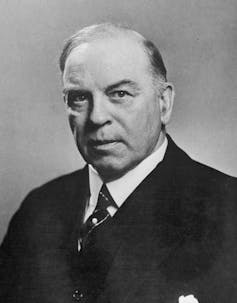
A black and white photo of a middle-aged white man
A portrait of William Lyon Mackenzie King in 1942.
(Dutch National Archives)

This transformation was driven by William Lyon Mackenzie King’s government, which took control of the economy in the form of a publicly funded and a directed supply-side industrial policy. Resources and labour were channelled to produce for the war effort and the core needs of the community.

Twenty-eight Crown corporations were established, factories multiplied, corporate taxes were doubled and excess profits were taxed, generating revenue for these investments.

Canada’s ‘Golden Age’

The decades that followed the Second World War from the 1940s through to the early 1970s is often referred to as the Canadian “Golden Age.”

It was a time of unprecedented prosperity for Canada, characterized by rapid and stable economic growth, rising living standards, improved health outcomes, education-based upward mobility and Canada’s most income-equal period.

The extraordinary debt-to-income ratio that existed at the end of the Second World War (109 per cent) shrank to a fraction (20 per cent) as the Canadian gross domestic product expanded, driven by progressive government supply-side policy.

Public programs were not cut during this period, but expanded as spending for health care, education and welfare grew. The debt rose again as economic growth slowed after Canadian corporate tax rates were reduced by more than 50 per cent between 1960 and 2020, while corporate prerogatives replaced industrial strategy.

The Carney promise

Only weeks after the April 28 federal election, the newly re-minted finance minister, Françoise-Philippe Champagne, indicated that wartime industrial policies were serving as at least a reference point for the Liberal government.

“When I look at 2025, it reminds me of 1945, where C.D. Howe kind of reinvented modern industrial Canada. It’s one of these moments in history where we’re really rebuilding the nation,” he said.

Champagne was referring to Canada’s wartime industry minister, C.D. Howe, who implemented the War Measures Act in 1939 and the War Appropriation Act to rapidly industrialize the Canadian economy. In Howe’s words: “If private industry cannot or will not do the job, then the state must step in. The need is too great to wait.”

Today, Canada’s current private for-profit sector is a notorious laggard when it comes to research, development and investment compared to its G20 and OECD counterparts. Canadian companies are currently holding $727 billion in cash deposits, a situation once called out by Prime Minister Mark Carney as “dead money.”

The collapse of Canada’s corporate-led free trade and deep-integration model with the U.S. has presented a window of opportunity to influence a state-led, national industrial policy.

Does Carney’s budget come to the rescue?

The 2025 budget includes several important investment plans, including the new Build Canada Homes agency, science research and development, clean technology manufacturing, transit and health-care infrastructure, and digital transformation programs.

However, the Canada Strong budget remains too small in scale and relies far too much on indirect incentives for private-sector investment. These measures may or may not materialize, given the tariff threats and profit opportunities south of the border.

The budget’s claims of generational increases in investment — much of which was announced before budget day — appear to be more optics than anything meaningful.

The only significant new corporate tax measure, the “productivity super-deduction,” is tied directly to investment spending in targeted industries, and is a model supported by many progressive economists.

Canada needs to meet the moment

It’s worth remembering that the Mackenzie King government raised corporate taxes to finance direct investment. The higher tax rate corporations paid during the Golden Age were used to fund targeted investments and the expansion of Canada’s care economy, which in turn contributed not only to the welfare of the Canadian population, but also productivity growth in the economy.

By contrast, the 2025 budget provides modest increases to total public investment, but does not meet the challenge of the moment, despite the exaggerated narrative of a generational investment in Canada’s future.

A greater scale of investment and conditionality imposed on the private sector would make Canada a leader in green energy, sustainable agriculture, green transportation, biotechnology and a resilient and digitized, high valuated economy. Canada is now embroiled in a full scale economic war and needs to respond accordingly.

The Conversation

Robert Chernomas is a Professor of Economics at the University of Manitoba and a member of Elbows Up: A Practical Program for Canadian Sovereignty. I am not affiliated with a political party or industry association but I am politically active.

ref. Why the 2025 federal budget won’t really make Canada strong – https://theconversation.com/why-the-2025-federal-budget-wont-really-make-canada-strong-268984