The feelings that surged through the pub that I watched the women’s Euro 2022 cup final in were electric. England had won. My friends were in tears. Strangers were shaking hands, patting each other on the back, smiling goofily at anyone who would catch their eye. It was wonderful. I’m hoping for repeat scenes this Sunday when the Lionesses face Spain in the 2025 Uefa European Women’s Championship.
Whether they win or not, the journey has been a joy. I watched the quarter-final between England and Sweden at a pub hosting an Irish trad folk night. With every England goal, the fiddlers celebrated with a rowdy song. The street I was watching the semi-final on erupted as different pockets of fans celebrated as Chloe Kelly scored the goal that would send the Lionesses into the final.
Women’s football has gone from strength to strength since that monumental win in 2022. Many of the Lionesses are now household names (Kelly, Lucy Bronze, Ella Toone and Beth Mead to name a few). As someone who attends women’s games, I’ve never seen the stands so full. You’ve also never been able to see so many games broadcast.
The situation for players has also massively improved with female footballers earning more than ever. In this piece, sports financing expert Christina Philippou, celebrates these many wins but also highlights where there is room for improvement.
A lot of the gains made in women’s football in England can be attributed to that win in 2022. Here’s hoping that on Sunday we see another win, which leads to many more strides for women’s football.
The 2025 Uefa European Women’s Championship final will be available to watch on the BBC at 5pm, July 27.
On Sunday, the Lionesses will march onto the pitch wearing their all-white home kit. The purpose of such clothing is to unite the players, to show they are a team and representatives of a country. In this, we can see how, as the philosopher Kate Moran writes in her new book, clothes are much more than just what we put on.
In A Philosopher Looks at Clothes, Moran shows that what we choose to wear is a worthy topic of deep philosophical inquiry.
Our reviewer, Sarah Richmond, a philosophy expert, found the book an engaging and unpretentious exploration of an ubiquitous aspect of daily life. Clothing provides Moran with fertile ground for ethical, political, aesthetic and identity-related reflections.
Also challenging how we have historically seen things is the new book by writer and curator Alayo Akinkugbe. In Reframing Blackness, Akinkugbe invites the reader to challenge art history and its approach to blackness.
How has the teaching of art history excluded blackness? How does such teaching then affect the creation and curation of art in relation to blackness.
Wanja Kimani, a curator herself, found the book engaged with many of the issues that black artists and those teaching and working in the arts have been grappling with since at least the 1960s in a clear-eyed and refreshingly optimistic manner.
For at least the last ten years there has been a growing trend for exhibitions that tackle climate change and the collapse of nature. Pandora Syperek, an expert in design, and Sarah Wade, an expert in museums, have been great supporters of the ability of such curation to communicate the urgency of such issues.
Putting their research into practice, the pair have put on their first exhibition entitled Sea Inside. Asking the question “can the sea survive us?” the show features art works that show how connected humanity is to the ocean.
These works are, as they write, emotive, imaginative and often very funny. From an aquarium full of tears to videos of jelly fish having sex in a lab, these works hope to move us closer to a care and understanding for fragile sea ecosystems.
Sea Inside is on at Sainsbury Centre in Norwich until 26 October, 2025
At The King’s Gallery, Buckingham Palace you can explore the glamour of the Edwardian age through some of Britain’s most fashionable royal couples – King Edward VII and Queen Alexandra, their son George V and his wife Mary of Teck.
As our reviewer, professor of modern British history Jane Hamlett notes, one of the most interesting things about The Edwardians: Age of Elegance is what it reveals about the personal taste of the royals. Featuring more than 300 objects from the Royal Collection – almost half for the first time – it is fascinating to see what they chose to collect. You’ll get the chance to see work by recognisable artists of the period, including Carl Fabergé, John Singer Sargent and William Morris.
This article features references to books that have been included for editorial reasons, and may contain links to bookshop.org. If you click on one of the links and go on to buy something from bookshop.org The Conversation UK may earn a commission.
I’m not sure if it was the effect of the atomic bomb, but I have always had a weak body, and when I was born, the doctor said I wouldn’t last more than three days.
These are the words of Kazumi Kuwahara, a third-generation hibakusha – a survivor of the atomic bombing of Hiroshima and Nagasaki in Japan 80 years ago.
Kuwahara, who still lives in Hiroshima, was in London on May 6 this year to give a speech at a Victory Over Japan Day conference organised and hosted by the University of Westminster. Now 29, she told the conference that she felt she had been “fighting illness” throughout her 20s. When she was 25, she needed abdominal surgery to remove a tumour which post-surgery tests showed was benign.
When she found out about the operation, her grandmother, Emiko Yamanaka – now aged 91 and a direct survivor of the atomic bombing of Hiroshima – told her: “I’m sorry, it’s my fault.” Kuwahara explained:
Ever since I was young, whenever I became seriously ill, my grandmother would repeatedly say: ‘I’m sorry.’ The atomic bombing didn’t end on that day and the survivors – we hibakusha – continue to live within its shadow.
Kazumi Kuwahara with her grandmother, Emiko Yamanaka, outside Hiroshima Peace Dome in 2025. Kazumi Kuwahara, CC BY-NC-ND
Kuwahara came to stay with me ten years ago during a study abroad break after I had interviewed her grandmother for my doctoral research. When I’d made a film about Yamanaka in 2012, I immediately noticed her reluctance to share her harrowing experience. But she then invited me to interview her in Hiroshima – the first of ten trips I made there for research which would become an interview archive.
I wanted to research hibakusha like Kuwahara and her grandmother as they continue to confront the physical, social and psychological effects of the atomic bombs dropped on August 6 and August 9 1945, on Hiroshima and Nagasaki respectively.
The 16-kiloton bomb dropped on Hiroshima at 8.15am by a US B-29 bomber was codenamed “Little Boy” by the Americans. It exploded about 600 metres above the Shima Hospital in the downtown area of Nakajima – a mix of residential, commercial, sacred and military sites. The bomb emitted a radioactive flash as well as a sonic boom. A gigantic fireball formed (about 3,000–4,000°C), as well as an atomic mushroom cloud which climbed up to 16km in the air.
In Japan in the immediate aftermath of the bombing, people couldn’t even utter the phrase “atomic bomb” due to censorship rules initially enforced by the Japanese military authorities, up until the day of surrender on August 15. The censorship was reinstated and expanded by the US during its occupation of the Japanese islands from September 2 1945.
The Insights section is committed to high-quality longform journalism. Our editors work with academics from many different backgrounds who are tackling a wide range of societal and scientific challenges.
For decades, the hibakusha have faced discrimination and difficulty in obtaining work and finding marriage partners due to a complex combination of suppression, stigma, ignorance and fear around the dropping of the atomic bombs and their aftereffects.
Wartime propaganda in Imperial Japan precluded free speech while also imposing bans on luxury goods, western language and customs (including clothes) and public displays of emotion.
However, the US occupation – which lasted until the San Francisco treaty was signed on April 28 1952 – went further, establishing an extensive Civil Censorship Department (the CCD) which monitored not only all newspapers, magazines, pamphlets, books, films and plays but also radio broadcasts, personal mail, as well as telephone and telegraph communications. Little wonder the scars of the bomb remained untreated, for generations.
Emiko Yamanaka’s story
Yamanaka was 11 years old when she was exposed to the atomic bombing, just 1.4km from ground zero.
Emiko Yamanaka (far left) with her four brothers and parents during wartime before the atomic bombing in 1945. Emiko Yamanaka
She told me about her experiences of surviving on the bank of the River Ota, which divides into seven rivers in the estuary of Hiroshima. Yamanaka was the oldest of five siblings in 1945. Although the family had been evacuated to an island near Kure 25km away, she returned to their home on the outskirts of the city with her mother and nine-year-old brother early on the morning of August 6, so she could attend an appointment with an eye-doctor for a case of conjunctivitis.
Making her way into the city by herself, the tram she was travelling on needed to stop due to an air-raid warning. It was a “light” warning as just two B-29s had been spotted approaching the mainland (a third photography plane was not yet visible on the horizon), so Yamanaka needed to continue her journey on foot. She recalled:
When I got to Sumiyoshi shrine, the strap of one of my wooden geta [Japanese clogs] had snapped off. I tried to fix it with a torn piece of my handkerchief in the shade of a nearby factory building. Then a man came out of the factory and gave me a string of hemp. He advised me to enter the doorway because the sun was very hot already.
When I was repairing my strap, there was a flash. I was blinded for a moment because the light was so strong, as if the sun or a fireball had fallen down over my head. I couldn’t tell where it came from – side, front or behind. I didn’t know what had happened to me. It felt like I was mowed down, pinned or veiled in by something very strong. I couldn’t exhale.
I cried out: “I can’t breathe! I’m choking! Help me!” I fainted. It all happened in a matter of seconds. I heard something rustling nearby and suddenly recovered my senses. “Help me. Help me,” I cried.
A man wearing what seemed like an apron, tattered gaiters and ammo boots came towards her and called out: “Where are you? Where are you?” He pushed aside the debris and extended his arm to Yamanaka:
When I caught his hand, the skin of his hand stripped off and our hands slipped. He adjusted his hand and dragged me out of the debris, grabbing my fingers … I felt a sense of relief, but I forgot to say thank you to him. Everything happened in a moment.
Yamanaka started to run back the way she had come along the river, as “the city was not yet burning”. She saw the shrine just beyond Sumiyoshi bridge, not far from the river. But the bridge had been damaged by the bomb, so she couldn’t cross it.
Yamanaka’s family home was at Eba across the river. In those days, the River Ota was used for river transport and business, and there were huge stone steps going down to the river for loading. She said:
I wanted to get across to the other side. Then the city started to burn: the fires were chasing me and I had to run along the riverbank. I had to keep running as fast as possible until I finally reached Yoshijima jail. I was so scared but the area was not burning yet. I felt so relieved, I lost my consciousness.
She awoke hearing shouts of “is there anyone who is going back to Eba from Funairi?” and recognised a neighbour. She asked him to take her across, but he couldn’t recognise her. “I shed big tears when I heard his voice,” she told me. There were about ten people in a small wooden boat, all with “big swollen grotesque faces and frizzy hair. I thought they were old people. Maybe I also looked like an old woman,” she added.
After crossing the river in the small boat, Yamanaka ran to her Eba home which, even though it was 3km from ground zero, had collapsed. She couldn’t find her mother. Someone told her to go to the air-raid shelter nearby, but there were too many people to fit inside.
When she finally found her mother, she was barely recognisable, wrapped in bandages from her injuries. Yamanaka herself had to go to hospital as tiny pieces of glass from the factory windows where she had been exposed were lodged in her body.
She told me how some shards of glass still emerge from her body occasionally, secreting a chocolate-coloured pus. The family – Yamanaka, her mother and her younger brother (her father, grandparents and the other siblings had remained evacuated) – stayed up all night in a shelter on Eba hill, listening to the sounds of the burning city, the cries for mothers, the sounds of carts filled with refugees.
“All those sounds horrified me,” Yamanaka recalled – decades on from the day that changed everything.
The aftermath of the atomic bomb showing the former Hiroshima Industrial Promotion hall. The Peace Memorial Park, dedicated to the victims, would later be built here. Shutterstock/CG Photographer
The day the world changed
The immediate effects of the bomb, including heat, blast and radiation, extended to a 4km radius – although recent studies show the radioactive fallout from “black rain” extended much further, due to the winds blowing the mushroom cloud. And some survivors told me they witnessed the blast effects of the bomb, including windows blown out or structures disturbed, in outlying towns and villages up to 30km away.
But the closer you were to ground zero, the more likely you were to suffer severe effects. At 0.36km from ground zero, there was almost nothing left; about 4km away, 50% of the inhabitants died. Even 11km away, people suffered from third-degree burns due to the effects of radiation. The neutron rays also penetrated the surface of the earth, causing it to become radioactive.
The mushroom cloud was visible from the hills of neighbouring prefectures. Those who were beyond the immediate blast radius may not have shown any external injuries immediately – but they commonly became sick and died in the days, weeks, months and years that followed.
And those outside the city were exposed to radiation when they tried to enter to help the injured.
Radiation also affected children who were in the womb at the time. Common radiation-related diseases were hair loss, bleeding gums, loss of energy (“no more will” in Japanese) and pain, as well as life-threatening high fever.
About 650,000 people were recognised by the Japanese government as having been affected by the atomic bombings of Hiroshima and Nagasaki. While most have now passed away, figures held by the Ministry of Labour, Health and Welfare from March 31 2025 show there are an estimated 99,130 still alive, whose average age is now 86.
In a radio broadcast following the atomic bombings, Emperor Hirohito announced Japan’s surrender and called on the Japanese people to “bear the unbearable”, referring to the “most cruel weapons” that had been used by the Allied forces without directly identifying the nuclear attack. Due to ill-feeling about the defeat, shame over Japan’s imperial past and role in the war, plus censorship and ignorance about the reality of nuclear weapons, the idea grew that the dead and injured hibakusha were simply “sacrifices” (‘生贄 になる’) for world peace.
Generations affected
It took Yamanaka around seven years to recover her strength enough to lead a relatively normal life, so she barely graduated from high school. She has subsequently been diagnosed with various blood, heart, eye and thyroid diseases as well as low immunity – symptoms that can be related to radiation exposure.
Her daughters also suffered. In 1977, when her eldest daughter was 19, she had three operations for skin cancer. In 1978, when her second daughter was 14, she developed leukaemia. In 1987, her third daughter suffered from a unilateral oophorectomy (a surgical procedure to remove one ovary).
I interviewed Yamanaka’s daughters, granddaughter and several other survivors repeatedly, beginning with experiences prior to the atomic bombing and then continuing up to the present day.
While these interviews generally started in the official location of the Hiroshima Peace Memorial Museum, I also conducted walking interviews and went to sites of special importance to their personal memories. I shared car journeys, coffees and meals with them and their helpers, because I wanted to see their lives in context, as part of a community.
Their trauma and suffering are dealt with socially. For the relatively few survivors who tell their stories in public, it is through the help of strong local networks. While I was at first told I would not find survivors who wanted to share their stories, gradually more came forward through a snowball effect.
Returning to interview Yamanaka in August 2013, we travelled by car to her former home of Eba, pausing at the site where she had alighted after her journey across the river. There, Yamanaka struck up conversation with a fellow survivor who was passing on his bicycle. His name was Maruto-San. They had attended the same temple-based elementary school.
Emiko Yamanaka meets a fellow hibakusha, Maruto San, on a visit to her hometown in Eba with the author in August 2013. Elizabeth Chappell
The two hibakusha, who had both been exposed when young (part of a category known as jakunen hibakusha) exchanged stories about their experiences after “that day” (ano hi) – as August 6 and 9 are still known in the atomic-bombed cities.
They talked about how just one or two friends were still alive – one survivor ran a well-known patisserie in the local department store. Yamanaka informed Maruto-San that she had met a few friends from childhood on a reunion coach trip, during which they had tried to retrieve some happier pre-bomb memories. The meeting offered a rare glimmer of recognition and reconnection.
Keisaburo Toyanaga’s story
In 2014, I travelled to the childhood home of hibakusha Keisaburo Toyanaga, a retired teacher of classical Japanese who was nine on August 6 1945. After visiting his original home in east Hiroshima, we took the route he, his mother, grandfather and three-year-old younger brother had travelled, fleeing Hiroshima towards his grandfather’s house in the suburb of Funakoshi, about 8km away. He told me:
I remember coming this way on that day … My family was just one of many others, we were all travelling with our belongings on push-carts.
The family set up home in this poor suburb, which was shared with many Korean families who could not find a way out of poverty due to historic discrimination. Korea was annexed by Imperial Japan, and Koreans had been recruited en masse into Japan’s war effort. An estimated 40,000-80,000 were in Hiroshima in 1945.
Some high-ranking Koreans were accepted by the Japanese – for example, royals like Prince Yi U who was said to have been astride his horse at the time of the bombing. But ordinary Koreans had to refrain from using their language or wearing Korean clothes in public. Even after the war was over, they needed to use Japanese names outside the home. After the war, Koreans in Hiroshima took menial agricultural work – in Funakoshi, they kept pigs.
Confronted with discrimination in the classroom where he taught at the Electricity Workers’ school, Toyanaga became a campaigner for the right of repatriated South and North Koreans to be officially recognised as hibakusha from the 1970s onwards. He showed me the wooden talisman he wore around his neck, awarded by the Korean community for his support.
The author (far right) with Keisaburo Toyanaga (far left) and Keiko Ogura, both hibakusha, at the Hiroshima Peace Memorial Museum library in 2014. Elizabeth Chappell
The ghosts of Hiroshima
When I was living and working in Japan from 2004, before I started my academic research, I was advised to stay away from the atomic-bombed cities because speaking of the atomic bombings was considered “kanashii” (悲しい) “kowai” (怖い) and “kurushimii” (苦しみい) – sad, scary and painful. Some Japanese friends even expressed horror when I first went to Hiroshima and Nagasaki to do research. They seemed to feel it was like an act of self-harm. A young student I met warned me that the ghosts of the victims of Hiroshima rise at night to take over the city.
On my first visit in 2009, I stayed for one night in a youth hostel beside the railway tracks and the Hiroshima Carp baseball stadium. That night, a friend and I went for a drink with a couple, both second-generation hibakusha or “hibaku nisei”.
This couple, Nishida San and his wife Takeko, were involved in organising the annual Hiroshima Peace Memorial ceremony. Takeko sang in a choir that had been involved in several exchange visits to Europe, including visiting Notre Dame in Paris and Christ Church Cathedral in Oxford.
She said her parents had never told her about their experiences of the bomb, even though her father had been exposed close to ground zero. I was surprised to discover that hibakusha were reluctant to share their stories even within their own families, often for fear of physical and psychological harm being passed through the family line.
After our meeting in the bar, we went to eat okonomiyaki (“delicious food”), a pancake with cabbage, egg, pork and noodles, in a building known as “okonomiyaki mura” or okonomiyaki village. To me, it recalled a New York tenement block with an outdoor staircase serving as the entrance to all floors – the outlines of unbuilt rooms decorating its temporary facade. Such temporariness had lasted from the 1950s when concrete blocks like these went up around the city centre to service a whole new population after Hiroshima’s near-erasure. Since 1945, most inhabitants come from outside the city.
‘Flash … boom’
I was sitting with Nishida San on makeshift bar seats in front of a counter with a huge, heated iron plate. The chef, Shin San, took our order and as we chatted, one of our Hiroshima friends asked him if he remembered the atomic bomb. Shin replied: “Of course I do.”
Then he spread his arms wide and a strange expression appeared on his face, as he said: “Pikaaaaa… doon.” This translates as “flash… boom” – two onomatopoeic words that encapsulate so much for Hiroshima people. Many survivors, especially those downtown, only experienced the flash. Others, usually at some distance, experienced the sonic boom. So these two words were used in place of “gembakudan” (原爆弾) – meaning atomic bomb – due to censorship.
Nobel prize-winning author Kenzaburo Ōe, in his 1981 work Hiroshima Notes, wrote, ‘For 10 years after the atomic bomb was dropped there was so little public discussion of the bomb or of radioactivity that even the Chugoku Shimbun, the major newspaper of the city where the atomic bomb was dropped, did not have the movable [kanji] type for the words “atomic bomb” or “radioactivity.”’ To support this, I noticed how some monuments for those who died in downtown Hiroshima bear the simple inscription E=MC², Einstein’s formula for relativity – the source of the science that created the bomb, but not the actual words for “atomic bomb”.
Keiko Ogura: ‘40 years of nightmares’
The older generation often told me how they dreaded visiting the Hiroshima Peace Memorial Museum and its surrounding park, as they are built over ground zero. However, some found that after encountering visiting foreigners there who had also experienced mass suffering, such as the Holocaust or a nuclear test, they were more able to open up.
Keiko Ogura, now aged 87, was eight on August 6 1945 and was exposed to black rain at her home in Ushitamachi, 5km from the centre of Hiroshima. She said:
For 40 years, I had nightmares and did not want to tell the story. Growing up, our mothers did not speak of the atomic bombing as they were afraid of discrimination and prejudice. Getting older, we started to worry about our children and grandchildren’s health. After the Atomic Bomb Casualty Commission was established in 1947, some people expected to be cured of ABI [atomic bomb injury] … but in fact, the doctors there were just gathering blood and data.
Ogura had thought, as a child, that she would never find a partner due to the discrimination against hibakusha, but she was also acutely aware that other survivors had suffered more than her.
The author outside Mitaki Temple with Keiko Ogura (left) and Shoko Ishida in November 2013. Elizabeth Chappell
However, when Robert Jungk, a Holocaust survivor, came to research his book Children of the Ashes with the help of Kaoru Ogura – a bilingual American who had been interned during the second world war and would become Keiko’s husband – things started to shift for her. Finding out about the Holocaust lent a new dimension to her own experiences of discrimination.
Jungk – along with Robert J. Lifton, a genocide historian – wrote their interview-based studies of Hiroshima in the 1950s and ‘60s, when ordinary citizens around the world were largely ignorant of the enormity of what had happened in Hiroshima, Nagasaki and the nuclear test sites. Lifton, originally a military psychiatrist, explained that after the 1962 Cuban missile crisis, he had been motivated to study in Hiroshima as he was afraid the world was in danger of “making the same mistake again”.
However, the link between Hiroshima and the Holocaust was first made by Otto Frank, Anne Frank’s father, who organised for an Anne Frank rose garden to be planted in the Peace Memorial Park in honour of an 11-year-old girl, Sadako Sasaki, who died from leukaemia nine years after the bomb.
One autumnal afternoon in 2013, after my third round of interviews with my cohort of hibakusha, I visited Mitaki Temple Cemetery, about 6km outside Hiroshima. The graveyard is dedicated to hibakusha, many of whose ashes are kept there. The hibakusha headstones are engraved with haiku written by family members. However, many of the headstones which existed prior to 1945 have been left at jagged angles – positioned as they were after being upset by the seismic effects of the atomic bombing.
In among the recent graves, I was shown some Jewish hanging mobile memorials – gifts from Oświęcim in Poland, location of the Auschwitz concentration camp. The temple’s former head priest had been involved in the Hiroshima-Auschwitz Peace Committee, an interfaith group which had started with a walk around the world to link atomic bomb survivors with Holocaust and other war victims.
Making the connection was important to hibakusha who were accused, then as now, of highlighting the atrocities of the bomb but downplaying the importance of Japan’s role in the war. When visiting Japan’s former colonies and elsewhere, hibakusha still offer apologies for Japanese behaviour in the second world war.
For institutions in Hiroshima, it’s important to change the narrative around nuclear weapons – not only through more and better medical research, but by disseminating hibakusha stories. The local newspaper, Chugoku Shimbun, aims to strengthen informal networks of hibakusha who meet up to share memories of that day. Some local journalists I met, Rie Nii and Yumi Kanazaki, help young people to interview their grandparents’ generation, building up a valuable archive of experiences.
There are two ways the younger generation can carry these stories forward: either by training as denshōsha (ambassadors) or by interviewing family members.
Kazumi Kuwahara decided to do both. When she was just 13, she wanted to pass on her grandmother’s story, becoming the winner of a prefecture-wide speaking competition about the bomb. In her 20s, after graduating from university, she also decided to train as a denshōsha and peace park guide, a role that requires intensive training over a six-month period. As the youngest guide to the Hiroshima Peace Park, she says:
Each visitor has a unique nationality and upbringing and, as I interact with them, I constantly ask myself how best to share Hiroshima’s significant history.
Toward the end of my field work, having gained interviews with three generations of survivors as well as their helpers, I realised this was just the beginning of a much larger conversation.
John Hersey, author of the Pulitzer-prize winning 1946 work Hiroshima, said: “What has kept the world safe from the bomb since 1945 has been the memory of what happened at Hiroshima.”
However, as our memories get more spotty with the passing of time, and as more survivors’ names are added to the roll of the dead at the cenotaphs of Japan’s atomic-bombed cities, perhaps our greatest hope is to grow the cohort of today’s listeners – so that tomorrow’s storytellers may emerge.
To hear about new Insights articles, join the hundreds of thousands of people who value The Conversation’s evidence-based news. Subscribe to our newsletter.
Elizabeth Chappell does not work for, consult, own shares in or receive funding from any company or organisation that would benefit from this article, and has disclosed no relevant affiliations beyond their academic appointment.
The U.S. has an important choice to make regarding agriculture.
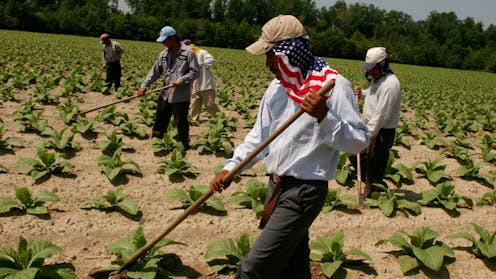
It can import more people to pick crops and do other kinds of agricultural labor, it can raise wages enough to lure more U.S. citizens and immigrants with legal status to take these jobs, or it can import more food. All three options contradict key Trump administration priorities: reducing immigration, keeping prices low and importing fewer goods and services.
As a professor of Latin American politics and U.S.-Latin American relations, I teach my students to consider the difficult trade-offs that governments face. If the Trump administration removes a significant share of the immigrants living in the U.S. without legal permission from the agricultural labor force to try to meet its deportation goals, farm owners will have few options.
Few options available
First, farm owners could raise wages and improve working conditions enough to attract U.S. citizens and immigrants who are legal permanent residents or otherwise in the U.S. with legal status.
Second, farm owners could employ fewer people. That would require either growing different crops that require less labor or becoming more reliant on machinery to plant and harvest. But that would mean the U.S. could have to import more food. And automation for some crops is very expensive. For others, such as for berries, it’s currently impossible.
It’s also possible that some farm owners could put their land to other uses, ceasing production, but that would also necessitate more imported food.
Trump administration’s suggested fixes
U.S. Agriculture Secretary Brooke Rollins has predicted that farm owners will soon find plenty of U.S. citizens to employ.
She declared on July 8 that the new Medicaid work requirements included in the same legislative package as the immigration enforcement funds would encourage huge numbers of U.S. citizens to start working in the fields instead of losing their health insurance through that government program.
Few people enrolled in Medicaid live close enough to a farm to work at one, and even those who do aren’t capable of doing farmwork. When farm owners tried putting people enrolled in a welfare program to work in the fields in the 1990s, it failed. Another experiment in the 1960s, which deployed teenagers, didn’t pan out either because the teens found the work too hard.
It seems more likely that farm owners will try to hire many more foreign farmworkers to do temporary but legal jobs through the H-2A program.
In June, for example, Trump said his administration was working on “some kind of a temporary pass” for immigrants lacking authorization to be in the U.S. who are working on farms and in hotels.
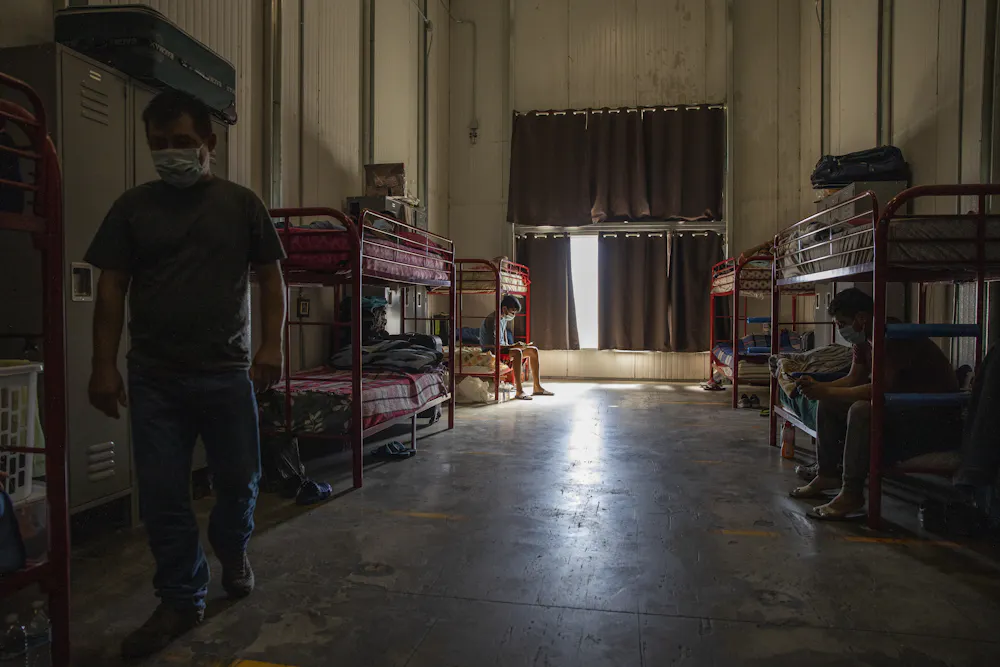
Farmworkers with H-2A visas spend time in their employer-provided dormitory on April 28, 2020, in King City, Calif. Brent Stirton/Getty Images
Established in 1952, numbers now rising quickly
The guest worker system, established in 1952 and revised significantly in 1986, has become a mainstay of U.S. agriculture because it offers important benefits to both the farm owners who need workers and the foreign workers they hire.
There is no cap on the number of potential workers. The number of H-2A visas issued is based only on how many employers request them. Farm owners may apply for visas after verifying that they are unable to locate enough workers who are U.S. citizens or present in the U.S. with authorization.
To protect U.S. workers, the government mandates that H-2A workers earn an “adverse effect wage rate.” The Labor Department sets that hourly wage, which ranges from $10.36 in Puerto Rico to about $15 in several southern states, to more than $20 in California, Alaska and Hawaii. These wages are set at relatively high levels to avoid putting downward pressure on what other U.S. workers are paid for the same jobs.
After certification, farm owners recruit workers in a foreign country who are offered a contract that includes transportation from their home country and a trip back – assuming they complete the contract.
The program provides farm owners with a short-term labor force. It guarantees the foreign workers who obtain H-2A visas relatively high wages, as well as housing in the U.S. That combination has proven increasingly popular in recent years: The annual number of H-2A visas rose to 310,700 in 2023, a more than fivefold increase since 2010.
Possible downsides
Boosting the number of agricultural guest workers would help fill some gaps in the agricultural labor force and reduce the risk of crops going unharvested. But it seems clear to me that a sudden change would pose risks for workers and farm owners alike.
Relying even more on guest farmworkers than the U.S. does today would also swap workers who have built lives and families north of the border with people who are in the U.S. on a temporary basis. Immigration opponents are unlikely to object to this trade-off, but to immigrant rights groups, this arrangement would be cruel and unfair to workers with years of service behind them.
The U.S. Government Accountability Office has researched the H-2A visa program and observed many problems it recommends be fixed.
For farm owners, the downside of ramping up guest worker programs is that it could increase costs and make production less efficient and more costly. That’s because transporting Mexican farmworkers back and forth each year is complicated and expensive. Farm groups say that compliance with H-2A visa requirements is cumbersome. It can be particularly difficult for small farms to participate in this program.
To be sure, these problems aren’t limited to agriculture. Hotels, restaurants and other hospitality businesses, which rely heavily on undocumented workers, can also temporarily employ some foreigners through the H-2B visa program – which is smaller than the H-2A program, limits the number of visas issued and is available only for jobs considered seasonal.
If the U.S. does deport millions of workers, the price of tomatoes, elder care, restaurant meals and roof repairs would probably rise substantially. A vast increase in the number of guest workers is a potential but partial solution, but it would multiply problems that are inherent in these temporary visa programs.
Scott Morgenstern does not work for, consult, own shares in or receive funding from any company or organization that would benefit from this article, and has disclosed no relevant affiliations beyond their academic appointment.
Source: The Conversation – USA (2) – By Wilfredo José Burgos Matos, Adjunct Assistant Professor of Latin American and Latino Studies, Lehman College, CUNY
What began as songs about heartbreak in the brothels and barrios of the Dominican Republic in the 1960s has become a worldwide sensation.
Even the Bee Gees have gotten a bachata spin. Prince Royce’s bilingual take on the 1977 hit “How Deep Is Your Love” has topped the Latin music charts this summer and proves bachata is no longer chasing the mainstream but reimagining the pop canon.
I’m a scholar of Dominican culture and the senior researcher for the History of Dominican Music in the U.S. project at the City University of New York’s Dominican Studies Institute. I see bachata as a revealing window into modern post-1960s Dominican history – and one that spotlights the emotional truths and everyday experiences of poor and Black Dominicans in particular.
Music from the margins
Bachata was born in the Dominican countryside and later developed in the shantytowns of Santo Domingo, the capital. In most Latin American dictionaries, the word “bachata” is loosely defined as “revelry” or “a spree.”
The distinctive sound is formed from guitars, bongos, bass and the güira – a percussion instrument also used in merengue music – and accompanied by typically romantic or bittersweet lyrics.
The genre’s first recording came in 1962, just over a year after Rafael Leónidas Trujillo, a brutal dictator who ruled the island for 31 years, was assassinated. Trujillo’s death marked the beginning of a new cultural and political era in the Dominican Republic, although democratic hopes were soon shattered by a military coup, civil war and a second U.S. intervention following an earlier one between 1916-1924.
Urban and middle-class Dominicans looked down on bachata as the music played in brothels and favored by poor, rural people who started to migrate to urban areas in large numbers in the 1960s. It was played almost exclusively on Radio Guarachita, a Santo Domingo station run by Radhamés Aracena, a key promoter of the genre.
Amid a country reeling from political upheaval, bachata emerged as a soundtrack to working-class survival. The guitar-based rhythms were shaped by Cuban bolero and son and Mexican ranchera music, while the lyrics chronicled daily struggles, grief and marginalization.
In most Latin American dictionaries, the word ‘bachata’ is loosely defined as ‘revelry’ or ‘a spree.’ This reflects its early development in informal social spaces where friends gathered to sing their hearts out, share drinks and escape daily hardships. CUNY Dominican Studies Institute Library, The Deborah Pacini Hernández Bachata Music Collection
Bachata’s shifting language
In the 1960s, bachata lyrics centered on heartache and were often directed at a romantic partner.
“Understand me, you know I love only you. Don’t deny me the hope of kissing you again,” Rafael Encarnación sang in Spanish in his 1964 song “Muero Contigo,” or “I Die With You.”
“I gave you everything you ever wanted, but it was all useless because you went looking for another man,” Blas Durán sang in 1985. “I was left like the orange vendor – peeling so someone else could suck the fruit.”
To reclaim respect for bachata, some artists, such as Luis Segura and Leonardo Paniagua, in the mid-1980s began calling their music música de amargue, or “music of romantic bitterness.”
What began as a genre label gradually transformed into a sensibility. “Amargue” came to name a feeling marked by longing, loss and quiet introspection – akin to “feeling the blues” in the U.S.
American blues similarly emerged from the hardships faced by Black Americans in the South and expressed themes of sorrow, resilience and reflection.
As acceptance of the genre grew, traditional bachateros in the Dominican Republic continued releasing bachata albums. However, Dominican pop, rock and other artists also began recording bachatas – such as 1990’s “Yo Quiero Andar” by Sonia Silvestre and 1998’s “Bufeo” by Luis “El Terror” Días.
Migration to the U.S. is a pivotal chapter in Dominican history after the 1960s. The U.S. Immigration Act of 1965 functioned as a de facto immigration policy and encouraged a large-scale exodus from the Dominican Republic.
By the mid-1990s, a strong and vibrant Dominican diaspora was firmly established in New York City. The Bronx became the birthplace of Grupo Aventura, a group that revolutionized bachata by blending its traditional rhythms with urban genres such as hip-hop.
“Obsesión,” released in 2002, was an international hit.
Their music reflected the bicultural diaspora, often torn between nostalgia for their homeland and everyday challenges of urban American life. Against the backdrop of city life, bachata found a new voice that mirrored the immigrant experience. The genre shifted from a shared feeling of loss and longing to a celebration of cultural community.
In 2002, the song “Obsesión” by Aventura and featuring Judy Santos topped music charts in France, Germany, Italy, the U.S. and elsewhere. The group Aventura and, later, lead singer Romeo Santos as a solo artist sold out Madison Square Garden and Yankee Stadium, respectively.
As they rose in fame, Aventura became global ambassadors for Dominican culture and made bachata mainstream.
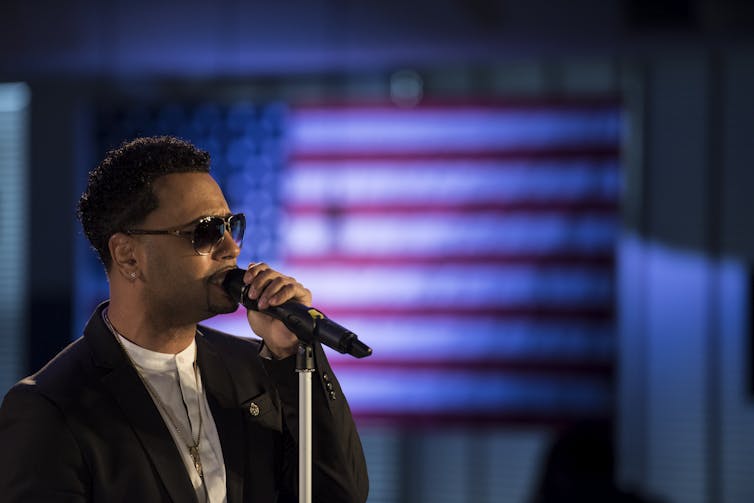
Puerto Rican bachatero Toby Love performs during an event held by Democratic presidential candidate Hillary Clinton on April 9, 2016, in New York City. Andrew Renneisen via Getty Images
Global spin on bachata
Bachata’s popularity has also spread to other countries in Latin America, and especially among working-class and Afro-descendant communities in Central America that see their own realities reflected in the music.
At the same time, Dominican diasporic communities in countries such as Spain and Italy carried the genre with them, where it continued to evolve.
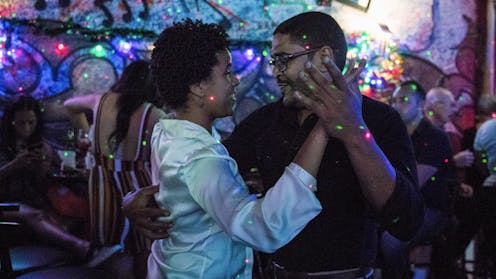
In Spain, for example, bachata experienced a creative transformation. By the mid-2000s, bachata sensual had emerged as a dance style influenced by zouk and tango, emphasizing smooth, body-led movements and close partner connection.
Around the same time, modern bachata also developed between Spain and New York City. This style is a departure from traditional bachata, which focuses on the box step and fast footwork, and incorporates more turns and other elements from salsa.
Today, bachata’s influence is truly global. International conferences dedicated to the genre attract dancers, musicians and scholars from around the world. Puerto Rican, Colombian and other artists from diverse cultural and racial backgrounds continue to nurture and reinvent bachata.
At the same time, more women, such as Andre Veloz, Judy Santos and Leslie Grace, are building careers as bachata performers and challenging a traditionally male-dominated genre.
Natti Natasha performs at an album release party for ‘En Amargue,’ her 2025 album produced by bachata icon and former Aventura singer Romeo Santos. John Parra/WireImage via Getty Images
Bachata holds a place not only on the world stage but in the hearts of Latino, Black, Asian and many other communities in the U.S. that recognize the genre’s power to tell stories of love, loss, migration and resilience.
Wilfredo José Burgos Matos does not work for, consult, own shares in or receive funding from any company or organization that would benefit from this article, and has disclosed no relevant affiliations beyond their academic appointment.
I saw it firsthand after my cat Murphy died earlier this year. She’d been diagnosed with cancer just weeks before.
She was a small gray tabby with delicate paws who, even during chemotherapy, climbed her favorite dresser perch – Mount Murphy – with steady determination.
The day after she died, a colleague said with a shrug: “It’s just part of life.”
That phrase stayed with me – not because it was wrong, but because of how quickly it dismissed something real.
Murphy wasn’t just a cat. She was my eldest daughter – by bond, if not by blood. My shadow.
But when someone grieves them like family, the cultural script flips. Grief gets minimized. Support gets awkward. And when no one acknowledges your loss, it starts to feel like you weren’t even supposed to love them that much in the first place.
And I’ve seen firsthand how often grief following pet loss gets brushed aside – treated as less valid, less serious or less worthy of support than human loss. After a pet dies, people often say the wrong thing – usually trying to help, but often doing the opposite.
Psychologists describe this kind of unacknowledged loss as disenfranchised grief: a form of mourning that isn’t fully recognized by social norms or institutions. It happens after miscarriages, breakups, job loss – and especially after the death of a beloved animal companion.
The pain is real for the person grieving, but what’s missing is the social support to mourn that loss.
Even well-meaning people struggle to respond in ways that feel supportive.
And when grief gets dismissed, it doesn’t just hurt – it makes us question whether we’re even allowed to feel it.
Here are three of the most common responses – and what to do instead:
‘Just a pet’
This is one of the most reflexive responses after a loss like this. It sounds harmless. But under the surface is a cultural belief that grieving an animal is excessive – even unprofessional.
That belief shows up in everything from workplace leave policies to everyday conversations. Even from people trying to be kind.
Pets often become attachment figures; they’re woven into our routines, our emotional lives and our identities. Recent research shows that the quality of the human-pet bond matters deeply – not just for well-being, but for how we grieve when that connection ends.
What’s lost isn’t “just an animal.” It’s the steady presence who greeted you every morning. The one who sat beside you through deadlines, small triumphs and quiet nights. A companion who made the world feel a little less lonely.
But when the world treats that love like it doesn’t count, the loss can cut even deeper.
It may not come with formal recognition or time off, but it still matters. And love isn’t less real just because it came with fur.
If someone you care about loses a pet, acknowledge the bond. Even a simple “I’m so sorry” can offer real comfort.
‘I know how you feel’
“I know how you feel” sounds empathetic, but it quietly shifts the focus from the griever to the speaker. It rushes in with your story before theirs has even had a chance to land.
That instinct comes from a good place. We want to relate, to reassure, to let someone know they’re not alone. But when it comes to grief, that impulse often backfires. Grief doesn’t need to be matched. It needs to be honored and given time, care and space to unfold, whether the loss is of a person or a pet.
Instead of responding with your own story, try simpler, grounding words:
“You can always get another one” is the kind of thing people offer reflexively when they don’t know what else to say – a clumsy attempt at reassurance.
Underneath is a desire to soothe, to fix, to make the sadness go away. But that instinct can miss the point: The loss isn’t practical – it’s personal. And grief isn’t a problem to be solved.
This type of comment often lands more like customer service than comfort. It treats the relationship as replaceable, as if love were something you can swap out like a broken phone.
But every pet is one of a kind – not just in how they look or sound, but in how they move through your life. The way they wait for you at the door and watch you as you leave. The small rituals that you didn’t know were rituals until they stopped. You build a life around them without realizing it, until they’re no longer in it.
You wouldn’t tell someone to “just have another child” or “just find a new partner.” And yet, people say the equivalent all the time after pet loss.
Rushing to replace the relationship instead of honoring what was lost overlooks what made that bond irreplaceable. Love isn’t interchangeable – and neither are the ones we lose.
So offer care that endures. Grief doesn’t follow a timeline. A check-in weeks or months later, whether it’s a heart emoji, a shared memory or a gentle reminder that they’re not alone, can remind someone that their grief is seen and their love still matters.
When people say nothing
People often don’t know what to say after a pet dies, so they say nothing. But silence doesn’t just bury grief, it isolates it. It tells the griever that their love was excessive, their sadness inconvenient, their loss unworthy of acknowledgment.
And grief that feels invisible can be the hardest kind to carry.
So if someone you love loses a pet, don’t change the subject. Don’t rush them out of their sadness. Don’t offer solutions.
Instead, here are a few other ways to offer support gently and meaningfully:
Say their pet’s name.
Ask what they miss most.
Tell them you’re sorry.
Let them cry.
Let them not cry.
Let them remember.
Because when someone loses a pet, they’re not “just” mourning an animal. They’re grieving for a relationship, a rhythm and a presence that made the world feel kinder. What they need most is someone willing to treat that loss like it matters.
Brian N. Chin does not work for, consult, own shares in or receive funding from any company or organization that would benefit from this article, and has disclosed no relevant affiliations beyond their academic appointment.
Demographers generally gauge births in a population with a measure called the total fertility rate. The total fertility rate for a given year is an estimate of the average number of children that women would have in their lifetime if they experienced current birth rates throughout their childbearing years.
Fertility rates are not fixed – in fact, they have changed considerably over the past century. In the U.S., the total fertility rate rose from about 2 births per woman in the 1930s to a high of 3.7 births per woman around 1960. The rate then dipped below 2 births per woman in the late 1970s and 1980s before returning to 2 births in the 1990s and early 2000s.
But while the total fertility rate offers a snapshot of the fertility landscape, it is not a perfect indicator of how many children a woman will eventually have if fertility patterns are in flux – for example, if people are delaying having children.
Picture a 20-year-old woman today, in 2025. The total fertility rate assumes she will have the same birth rate as today’s 40-year-olds when she reaches 40. That’s not likely to be the case, because birth rates 20 years from now for 40-year-olds will almost certainly be higher than they are today, as more births occur at older ages and more people are able to overcome infertility through medically assisted reproduction.
A more nuanced picture of childbearing
These problems with the total fertility rate are why demographers also measure how many total births women have had by the end of their reproductive years. In contrast to the total fertility rate, the average number of children ever born to women ages 40 to 44 has remained fairly stable over time, hovering around two.
In other words, it doesn’t seem to be the case that birth rates are low because people are uninterested in having children; rather, it’s because they don’t feel it’s feasible for them to become parents or to have as many children as they would like.
The challenge of predicting future population size
Standard demographic projections do not support the idea that population size is set to shrink dramatically.
One billion people lived on Earth 250 years ago. Today there are over 8 billion, and by 2100 the United Nations predicts there will be over 10 billion. That’s 2 billion more, not fewer, people in the foreseeable future. Admittedly, that projection is plus or minus 4 billion. But this range highlights another key point: Population projections get more uncertain the further into the future they extend.
Predicting the population level five years from now is far more reliable than 50 years from now – and beyond 100 years, forget about it. Most population scientists avoid making such long-term projections, for the simple reason that they are usually wrong. That’s because fertility and mortality rates change over time in unpredictable ways.
The U.S. population size is also not declining. Currently, despite fertility below the replacement level of 2.1 children per woman, there are still more births than deaths. The U.S. population is expected to grow by 22.6 million by 2050 and by 27.5 million by 2100, with immigration playing an important role.
Despite a drop in fertility rates, there are still more births than deaths in the U.S. andresr/E+ via Getty Images
Will low fertility cause an economic crisis?
A common rationale for concern about low fertility is that it leads to a host of economic and labor market problems. Specifically, pronatalists argue that there will be too few workers to sustain the economy and too many older people for those workers to support. However, that is not necessarily true – and even if it were, increasing birth rates wouldn’t fix the problem.
As fertility rates fall, the age structure of the population shifts. But a higher proportion of older adults does not necessarily mean the proportion of workers to nonworkers falls.
For one thing, the proportion of children under age 18 in the population also declines, so the number of working-age adults – usually defined as ages 18 to 64 – often changes relatively little. And as older adults stay healthier and more active, a growing number of them are contributing to the economy. Labor force participation among Americans ages 65 to 74 increased from 21.4% in 2003 to 26.9% in 2023 — and is expected to increase to 30.4% by 2033. Modest changes in the average age of retirement or in how Social Security is funded would further reduce strains on support programs for older adults.
What’s more, pronatalists’ core argument that a higher birth rate would increase the size of the labor force overlooks some short-term consequences. More babies means more dependents, at least until those children become old enough to enter the labor force. Children not only require expensive services such as education, but also reduce labor force participation, particularly for women. As fertility rates have fallen, women’s labor force participation rates have risen dramatically – from 34% in 1950 to 58% in 2024. Pronatalist policies that discourage women’s employment are at odds with concerns about a diminishing number of workers.
Research shows that economic policies and labor market conditions, not demographic age structures, play the most important role in determining economic growth in advanced economies. And with rapidly changing technologies like automation and artificial intelligence, it is unclear what demand there will be for workers in the future. Moreover, immigration is a powerful – and immediate – tool for addressing labor market needs and concerns over the proportion of workers.
Overall, there’s no evidence for Elon Musk’s assertion that “humanity is dying.” While the changes in population structure that accompany low birth rates are real, in our view the impact of these changes has been dramatically overstated. Strong investments in education and sensible economic policies can help countries successfully adapt to a new demographic reality.
Leslie Root receives funding from the Eunice Kennedy Shriver National Institute of Child Health and Development (NICHD) for work on fertility rates.
Karen Benjamin Guzzo has received funding from the Eunice Kennedy Shriver National Institute of Child Health and Human Development in the United States.
Shelley Clark receives funding from the Social Sciences and Humanities Research Council of Canada.
As a scholar who examines the history of U.S. immigration law and enforcement, I believe that it remains far from clear whether the Trump White House will significantly reduce the undocumented population. But even if the administration’s efforts fail, the fear and damage to the U.S. immigrant community will remain.
Presidents Bush and Obama
To increase deportations, in 2006 President George W. Bush began using workplace raids. Among these sweeps was the then-largest immigration workplace operation in U.S. history at a meat processing plant in Postville, Iowa in 2008.
U.S. Immigration and Customs Enforcement deployed 900 agents in Postville and arrested 398 employees, 98% of whom were Latino. They were chained together and arraigned in groups of 10 for felony criminal charges of aggravated identity theft, document fraud and use of stolen Social Security numbers. Some 300 were convicted, and 297 of them served jail sentences before being deported.
In 2008, Bush also initiated Secure Communities, a policy that sought to deport noncitizens – both lawful permanent residents as well as undocumented immigrants – who had been arrested for crimes. Some 2 million immigrants were deported during Bush’s two terms in office.
The Obama administration limited Secure Communities to focus on the removal of noncitizens convicted of felonies. It deported a record 400,000 noncitizens in fiscal year 2013, which led detractors to refer to President Barack Obama as the “Deporter in Chief.”
Trump’s first administration broke new immigration enforcement ground in several ways.
He began his presidency by issuing what was called a “Muslim ban” to restrict the entry into the U.S. of noncitizens from predominantly Muslim nations.
Early in Trump’s first administration, federal agents expanded immigration operations to include raids at courthouses, which previously had been off-limits.
In 2019, Trump implemented the Remain in Mexico policy that for the first time forced noncitizens who came to the U.S. border seeking asylum to wait in Mexico while their claims were being decided. He also invoked Title 42 in 2020 to close U.S. borders during the COVID-19 pandemic.
Immigration-rights activists stage a rally outside President Barack Obama’s Democratic Congressional Campaign Committee fundraiser in Los Angeles, after the president signed a bill that tightened security at the Mexico border in August 2010. Mark Ralston/AFP via Getty Images
In January 2025, he announced an expanded, expedited removal process for any noncitizen apprehended anywhere in the country – not just the border region, as had been U.S. practice since 1996.
These issues have not been seriously addressed by any modern U.S. president. Until it is, we can expect the undocumented population to remain in the millions.
Kevin Johnson does not work for, consult, own shares in or receive funding from any company or organization that would benefit from this article, and has disclosed no relevant affiliations beyond their academic appointment.
China has long maintained that it does not supply arms to any party at war – a central tenet of its “noninterference” foreign policy. But in recent years, Beijing has repeatedly faced accusations of doing the opposite: providing direct military assistanceto nations engaged in conflict, while publicly denying doing so and even adopting a position of diplomatic neutrality.
That has seemingly been the case for two of China’s closest allies: Russia in its war against Ukraine and Pakistan during its recent armed standoff with India in May.
Now, Beijing is facing scrutiny over alleged military links to Iran – a country engaged in a long-running shadow conflict with Israel that recently tipped into a short-lived hot war.
After the ceasefire that followed the 12-day war in the Middle East, China reportedly supplied batteries for surface-to-air missiles to Iran in exchange for oil. Such parts are a critical military need for Tehran after its air defense network was severely damaged by Israeli missiles.
The Chinese Embassy in Israel denied the reports, stating that China firmly opposes the proliferation of weapons of mass destruction and does not export arms to countries at war. But China’s Ministry of Foreign Affairs has yet to issue an official statement on the alleged transfer.
As an expert specializing in China’s grand strategy, I think it is highly possible that China would offer Iran military support while denying it publicly. Such plausible deniability would allow Beijing to assert military influence and showcase some of its hardware, while deflecting international criticism and preserving diplomatic flexibility.
But the tactic works only so far. As indirect evidence accumulates, as many suggest it is, such covert action may gradually develop into an open secret – leading to what scholars term “implausible deniability,” where denial is no longer credible even if it is still officially maintained.
An air-to-air missile on display at the 15th China International Aviation and Aerospace Exhibition in November 2024. Shen Ling/VCG via Getty Images
China’s support for Russia’s war
Although Beijing has consistently said it is neutral in the Russia-Ukraine war that broke out in 2022, China has, in practice, quietly supported Russia. In part, that is because China shares the same strategic goal of challenging the Western-led international order.
Recently, Chinese Foreign Minister Wang Yi reportedly told European Union foreign policy chief Kaja Kallas that Beijing cannot afford to see Russia lose the war in Ukraine. He was said to have warned that a Russian defeat would likely bring the full force of U.S. strategic pressure to bear on China.
From Beijing’s perspective, Moscow plays a vital role in keeping the West preoccupied, offering China valuable strategic breathing room by diverting American attention and resources away from the Asia-Pacific region.
Beyond deepening trade relations that have become a lifeline for Moscow’s economy under Western sanctions, China has reportedly supplied Russia with large quantities of dual-use goods – goods that can be used for civilian and military purposes – to enhance both Moscow’s offensive and defensive capabilities, as well as to boost China’s military-industrial production. Beijing has also allegedly provided satellite imagery to assist Russia on the battlefield.
While the U.S. and Europe have repeatedly tried to call out China for aiding Russia militarily, Beijing has consistently denied such claims.
Most recently, on April 18, 2025, Ukraine formally accused China of directly supporting Russia and slapped sanctions on three Chinese-based firms that Kyiv said was involved in weapons production for the Russian war effort.
In what has become a common refrain, China’s Foreign Ministry rejected the Ukrainian accusation, reaffirming that China has never provided lethal weapons to any party in the conflict and reiterating its official stance of promoting a ceasefire and peace negotiations.
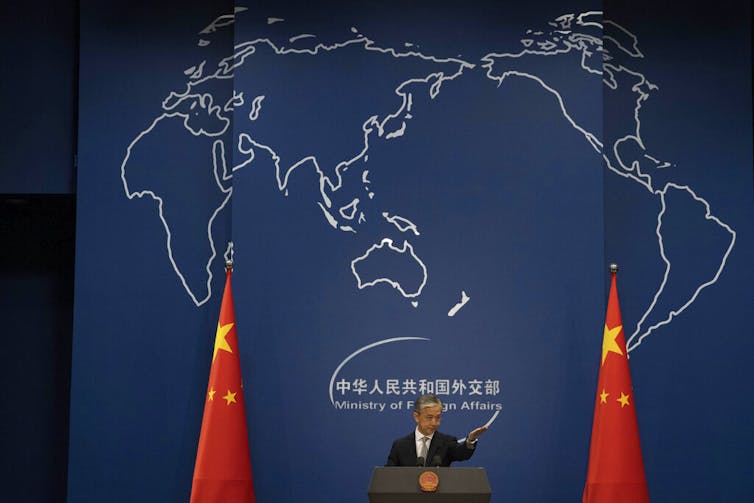
A Chinese Foreign Ministry spokesperson gestures for questions during a daily briefing in Beijing in 2020. AP Photo/Ng Han Guan
China’s quiet backing of Pakistan
Beijing has long presented itself as a neutral party in the India-Pakistan conflict, too, and has called for restraint on both sides and urged peaceful dialogue.
But in practice, China is allied with Pakistan. And the direct military support it has provided to Lahore appears driven by China’s desire to curb India’s regional influence, counterbalance the growing U.S.–India strategic partnership and protect the China–Pakistan Economic Corridor, a massive bilateral infrastructure project.
In the latest flare-up between India and Pakistan in May, Pakistan deployed Chinese-made J-10C fighter jets in combat for the first time, reportedly downing five Indian aircraft.
Pakistan’s air defense relied heavily on Chinese equipment during the short conflict, deploying Chinese-made surface-to-air missile systems, air-to-air missiles, advanced radar systems and drones for reconnaissance and strike operations. Overall, more than 80% of Pakistan’s military imports have come from China in the past five years.
In what would be a far more stark example of military support if proven true, the deputy chief of India’s army alleged that China had provided Pakistan with real-time intelligence on Indian troop movements during the conflict.
When asked to respond, a spokesperson for China’s Ministry of Foreign Affairs said they had no knowledge of the matter. They reaffirmed that China’s ties with Pakistan are not directed against any third party and reiterated Beijing’s long-standing position in favor of a peaceful resolution to any India–Pakistan dispute.
Extending ‘deniability’ to Iran?
Like with Russia and Pakistan, Iran has increasingly been seen as a partner to China.
In 2021, China and Iran signed a 25-year, US$400 billion comprehensive cooperation agreement that covered trade, energy and security, signaling the depth of their strategic relationship.
The accord was indicative of the strategic value Beijing places on Iran. From Beijing’s perspective, Tehran presents a counterbalance to the influence of the U.S. and its allies – especially Israel and Saudi Arabia – in the region and helps divert Western resources and attention away from China.
But recently, Tehran’s position in the region has become far weaker. Not only has its air defense infrastructure suffered badly in the confrontations with Israel, but its regional proxies and allies – Hamas, Hezbollah and the Assad regime in Syria – have either been devastated by Israel or collapsed altogether.
If China does do this, I believe it is likely to follow the same playbook it has used elsewhere by denying involvement publicly while covertly providing assistance.
Doing so allows China to maintain diplomatic ties with Iran’s regional rivals, such as Israel and Saudi Arabia, while simultaneously benefiting from a turbulent Middle East that distracts Washington and grants Beijing strategic breathing room.
China’s use of plausible deniability reflects a broader strategic ambition. Namely, it wants to assert influence in key regional conflicts without triggering open backlash. By quietly supporting partners while maintaining a facade of neutrality, Beijing aims to undermine Western dominance, stretch U.S. strategic focus and secure its own interests – and all while avoiding the risks and responsibilities of open military alignment.
Linggong Kong does not work for, consult, own shares in or receive funding from any company or organization that would benefit from this article, and has disclosed no relevant affiliations beyond their academic appointment.
Conspiracy theories are a widespread occurrence in today’s hyper connected and polarised world.
Events such as Brexit, the 2016 and 2020 United States presidential elections, and the COVID pandemic serve as potent reminders of how easily these narratives can infiltrate public discourse.
The consequences for society are significant, given a devotion to conspiracy theories can undermine key democratic norms and weaken citizens’ trust in critical institutions. As we know from the January 6 riot at the US Capitol, it can also motivate political violence.
But who is most likely to believe these conspiracies?
My new study with Daniel Stockemer of the University of Ottawa provides a clear and perhaps surprising answer. Published in Political Psychology, our research shows age is one of the most significant predictors of conspiracy beliefs, but not in the way many might assume.
People under 35 are consistently more likely to endorse conspiratorial ideas.
This conclusion is built on a solid foundation of evidence. First, we conducted a meta analysis, a “study of studies”, which synthesised the results of 191 peer-reviewed articles published between 2014 and 2024.
This massive dataset, which included over 374,000 participants, revealed a robust association between young age and belief in conspiracies.
To confirm this, we ran our own original multinational survey of more than 6,000 people across six diverse countries: Australia, Brazil, Canada, Germany, the US and South Africa.
The results were the same. In fact, age proved to be a more powerful predictor of conspiracy beliefs than any other demographic factor we measured, including a person’s gender, income, or level of education.
Why are young people more conspiratorial?
Having established conspiracy beliefs are more prevalent among younger people, we set out to understand why.
Our project tested several potential factors and found three key reasons why younger generations are more susceptible to conspiracy theories.
1. Political alienation
One of the most powerful drivers we identified is a deep sense of political disaffection among young people.
A majority of young people feel alienated from political systems run by politicians who are two or three generations older than them.
This under representation can lead to frustration and the feeling democracy isn’t working for them. In this context, conspiracy theories provide a simple, compelling explanation for this disconnect: the system isn’t just failing, it’s being secretly controlled and manipulated by nefarious actors.
2. Activist style of participation
The way young people choose to take part in politics also plays a significant role.
While they may be less likely to engage in traditional practices such as voting, they are often highly engaged in unconventional forms of participation, such as protests, boycotts and online campaigns.
These activist environments, particularly online, can become fertile ground for conspiracy theories to germinate and spread. They often rely on similar “us versus them” narratives that pit a “righteous” in-group against a “corrupt” establishment.
3. Low self-esteem
Finally, our research confirmed a crucial psychological link to self-esteem.
For individuals with lower perceptions of self worth, believing in a conspiracy theory – blaming external, hidden forces for their problems – can be a way of coping with feelings of powerlessness.
Understanding these root causes is essential because it shows simply debunking false claims is not a sufficient solution.
To truly address the rise of conspiracy theories and limit their consequences, we must tackle the underlying issues that make these narratives so appealing in the first place.
Given the role played by political alienation, a critical step forward is to make our democracies more representative. This is best illustrated by the recent election of Labor Senator Charlotte Walker, who is barely 21.
By actively working to increase the presence of young people in our political institutions, we can help give them faith that the system can work for them, reducing the appeal of theories which claim it is hopelessly corrupt.
More inclusive democracy
This does not mean discouraging the passion of youth activism. Rather, it is about empowering young people with the tools to navigate today’s complex information landscape.
Promoting robust media and digital literacy education could help individuals critically evaluate the information they encounter in all circles, including online activist spaces.
The link to self-esteem also points to a broader societal responsibility.
By investing in the mental health and wellbeing of young people, we can help boost the psychological resilience and sense of agency that makes them less vulnerable to the simplistic blame games offered by conspiracy theories.
Ultimately, building a society that is resistant to misinformation is not about finding fault with a particular generation.
It is about creating a stronger, more inclusive democracy where all citizens, especially the young, feel represented, empowered, and secure.
Jean-Nicolas Bordeleau receives funding from Social Sciences and Humanities Research Council of Canada.
Efforts to end the relentless siege of Gaza have been set back by the abrupt end to peace talks in Qatar.
Both the United States and Israel have withdrawn their negotiating teams, accusing Hamas of a “lack of desire to reach a ceasefire”.
US President Donald Trump’s special envoy Steve Witkoff says it would appear Hamas never wanted a deal:
While the mediators have made a great effort, Hamas does not appear to be coordinated or acting in good faith. We will now consider alternative options to bring the hostages home and try to create a more stable environment for the people in Gaza
State Department spokesman Tommy Piggott reads Steve Witkoff’s statement on the collapse of the Gaza peace talks.
The disappointing development coincides with mounting fears of a widespread famine in Gaza and a historic decision by France to formally recognise a Palestinian state.
French President Emmanuel Macron says there is no alternative for the sake of security of the Middle East:
True to its historic commitment to a just and lasting peace in the Middle East, I have decided that France will recognise the State of Palestine
What will these developments mean for the conflict in Gaza and the broader security of the Middle East?
‘Humanitarian catastrophe’
The failure to reach a truce means there is no end in sight to the Israeli siege of Gaza which has devastated the territory for more than 21 months.
Amid mounting fears of mass starvation, Australian Prime Minister Anthony Albanese says Gaza is in the grip of a “humanitarian catastrophe”. He is urging Israel to comply immediately with its obligations under international law:
Israel’s denial of aid and the killing of civilians, including children, seeking access to water and food cannot be defended or ignored.
According to the United Nations Palestinian refugee agency UNRWA, more than 100 people – most of them children – have died of hunger. One in five children in Gaza City is malnourished, with the number of cases rising every day.
Commissioner-General Philippe Lazzarini says with little food aid entering Gaza, people are
neither dead nor alive, they are walking corpses […] most children our teams are seeing are emaciated, weak and at high risk of dying if they don’t get the treatment they urgently need.
The UN and more than 100 aid groups blame Israel’s blockade of almost all aid into the territory for the lack of food.
Lazzarini says UNRWA has 6,000 trucks of emergency supplies waiting in Jordan and Egypt. He is urging Israel – which continues to blame Hamas for cases of malnutrition – to allow the humanitarian assistance into Gaza.
It included a 60-day truce, during which time Hamas would release ten living Israeli hostages and the remains of 18 others. In exchange, Israel would release a number of Palestinian prisoners, and humanitarian aid to Gaza would be significantly increased.
During the ceasefire, both sides would engage in negotiations toward a lasting truce.
While specific details of the current sticking points remain unclear, previous statements from both parties suggest the disagreement centres on what would follow any temporary ceasefire.
Israel is reportedly seeking to maintain a permanent military presence in Gaza to allow for a rapid resumption of operations if needed. In contrast, Hamas is demanding a pathway toward a complete end to hostilities.
A lack of mutual trust has dramatically clouded the negotiations.
From Israel’s perspective, any ceasefire must not result in Hamas regaining control of Gaza, as this would allow the group to rebuild its power and potentially launch another cross-border attack.
However, Hamas has repeatedly said it is willing to hand over power to any other Palestinian group in pursuit of a Palestinian state based on the 1967 borders. This could include the Palestinian National Authority (PNA), which governs the West Bank and has long recognised Israel.
Support for a Palestinian state
Israeli leaders have occasionally paid lip service to a Palestinian state. But they have described such an entity as “less than a state” or a “state-minus” – a formulation that falls short of both Palestinian aspirations and international legal standards.
In response to the worsening humanitarian situation, some Western countries have moved to fully recognise a Palestinian state, viewing it as a step toward a permanent resolution of one of the longest-running conflicts in the Middle East.
Macron’s announcement France will officially recognise a full Palestinian state in September is a major development.
France is now the most prominent Western power to take this position. It follows more than 140 countries – including more than a dozen in Europe – that have already recognised statehood.
While largely symbolic, the move adds diplomatic pressure on Israel amid the ongoing war and aid crisis in Gaza.
However, the announcement was immediately condemned by Israeli Prime Minister Benjamin Netanyahu, who claimed recognition “rewards terror” and
risks creating another Iranian proxy, just as Gaza became. A Palestinian state in these conditions would be a launch pad to annihilate Israel – not to live in peace beside it.
Annexing Gaza?
A Palestinian state is unacceptable to Israel.
Further evidence was recently presented in a revealing TV interview by former Israeli Prime Minister Ehud Barak who stated Netanyahu had deliberately empowered Hamas in order to block a two-state solution.
Instead there is mounting evidence Israel is seeking to annex the entirety of Palestinian land and relocate Palestinians to neighbouring countries.
Given the current uncertainty, it appears unlikely a new ceasefire will be reached in the near future, especially as it remains unclear whether the US withdrawal from the negotiations was a genuine policy shift or merely a strategic negotiating tactic.
Ali Mamouri does not work for, consult, own shares in or receive funding from any company or organisation that would benefit from this article, and has disclosed no relevant affiliations beyond their academic appointment.