Apocalyptic images of melting glaciers and sinking islands won’t help anyone imagine a better future

Source: The Conversation – UK – By Natalie Pollard, Professor of Contemporary Literature and Culture, University of Exeter

What do you picture when you think about climate change? For many of us, it is the same set of dramatic images: melting glaciers, sinking landforms, rising seas or extreme weather.

These are powerful visuals. They shock, grab headlines and galvanise environmentalism. However, this imagery offers a partial account of transformation, often underplaying political responsibility and colonial history. In my new book, 21st-Century Climate Imaginaries, I call these charismatic images “climate memes”.

Monumental images of melting or calving glaciers lend drama to earth’s changing form, but tend to bypass the thorny social and economic roots of ice loss. Research shows that glacial melt is accelerating especially in regions at the frontline of resource extraction and colonial occupation. My research asks: why is this?

glacier crashing into sea
The polar effect: house-sized blocks of ice come crashing down into the sea.
Troutnut/Shutterstock

Imagine a glacier melting in the Andes. Blood-red threads of wool – like streams of meltwater – are running down the mountain. It is 2006. This is an activist intervention by Chilean-born artist Cecilia Vicuña. It is the first in her series of performances and soft sculptures, The Blood of the Glaciers. Her giant-order red threads spell out the effects of foreign direct investment in the wake of Augusto Pinochet’s regime, which sparked a dramatic rise in overseas mining corporations in Chile.

Here, as in many regions of the developing world, mining and industrial transportation make the glaciers bleed. The problem is acute because glaciers are water savings banks, essential in years with low rainfall. Glaciers sustain life. Industry-heavy sacrifice zones bleed life dry. Vicuña’s artistic activism shows how extractive mining is a primary driver of glacial recession. Melting is not just a “climate” issue or “natural” disaster. The cause is human activity.

Standing knee-deep in seawater on the shoreline of Tuvalu, the country’s foreign minister addresses Cop26 delegates with these words: “We are sinking”. Simon Kofe’s 2021 speech was broadcast globally from a point that had recently been above sea level. From his semi-submerged podium, Kofe made visible to the world the situation people endure in low-lying Pacific islands.

Tuvalu’s foreign minister, Simon Kofe, delivered his “we are sinking” speech from a podium knee-deep in water.

Since the 1980s, sinking islands have become a powerful shorthand for climate crisis. Apocalyptic spectacles of raging seas symbolise planetary transformation. An often-cited example is the documentary of Al Gore’s An Inconvenient Truth. It showed Tuvalu engulfed by tides, alongside the incorrect remark that “Pacific nations have all had to evacuate”.

In 2009, Marshallese activist Kathy Jetñil-Kijiner joined forces with Greenlandic climate poet Aka Niviâna and environmentalist organisation 350.org. They produced an influential video-poem: Rise: From One Island to Another. The performance connects changing Greenlandic ice and Pacific waters with Indigenous resistance to fossil capitalism.

Rise: From one island to another.

Climate images of melting and sinking often go hand-in-hand with colonial narratives of Indigenous vulnerability. In contrast, Rise brings to life the history of Greenlandic and Marshallese opposition to development for extraction and scientific exploitation. The two activists highlight the nuclear colonial legacy of the Pacific Proving Grounds and Greenland’s Camp Century, linking military histories in the Arctic and Pacific: “nuclear waste / dumped / in our waters / on our ice”.

It is not always easy to remember that environmental change is caused by specific technological, military and political acts. Indigenous arts activism helps by showing how climate memes make sense only in the context of histories of exploitation and resistance, which often take place in developing countries.

Today, activists and artists across the world are challenging popular, generalised climate memes, such as those of melting and sinking. As I show in 21st-Century Climate Imaginaries, attention to the local and specific helps people process how social and environmental violence are intimately linked. Arts activism, working directly with people’s lived experiences of change, can offer much-needed, grounded alternatives to spectacular climate soundbites. How far these interventions are positively reshaping how we understand our responsibilities to a fast-changing world is yet to be seen.


Don’t have time to read about climate change as much as you’d like?

Get a weekly roundup in your inbox instead. Every Wednesday, The Conversation’s environment editor writes Imagine, a short email that goes a little deeper into just one climate issue. Join the 45,000+ readers who’ve subscribed so far.


The Conversation

Natalie Pollard does not work for, consult, own shares in or receive funding from any company or organisation that would benefit from this article, and has disclosed no relevant affiliations beyond their academic appointment.

ref. Apocalyptic images of melting glaciers and sinking islands won’t help anyone imagine a better future – https://theconversation.com/apocalyptic-images-of-melting-glaciers-and-sinking-islands-wont-help-anyone-imagine-a-better-future-268909

How the market for international students puts pressure on universities’ academic freedom

Source: The Conversation – UK – By David Yates, Senior Lecturer in Accounting, University of Sheffield

Ground Picture/Shutterstock

It is difficult to ignore the intertwined nature of the commercialised UK higher education model and its reliance on international student fee income. One in four students enrolled in higher education courses in the UK in 2023-24 is of non-UK origin. This is an increase from just over one in five in 2019-20. A total of over £10 billion of universities’ student fee income is raised from non-UK students.

Recent reports that Sheffield Hallam University stymied an academic’s research as a result of pressure from China has thrust the influence that foreign nations may have on UK universities into the spotlight.

Sheffield Hallam has denied that commercial interests played a part in the decision. “For the avoidance of doubt, the decision was not based on commercial interests in China,” a university spokesperson said. “Regardless, China is not a significant international student market for the University.”

For many UK universities, though, international student fees are a vital part of their income. This has followed the reduction of government financial support for universities and successive steps towards marketisation of the higher education sector.

Marketisation means universities compete with each other to attract students, who pay fees for their education. However, fees in the UK are regulated (and Scottish and Welsh governments subsidise students from their respective juridictions) and often do not cover the total cost of teaching and administration of courses. Universities have responded by increasing recruitment of international students to plug the funding gap.

In a marketised model, international students are attractive as their fees are uncapped, meaning that institutions can charge much higher amounts for the same number of students.

Universities are also judged in rankings that include things like how international their student body is, and the ratio of staff to students. Recruiting more international students helps keep the ratio of staff to students lower because higher international student fees mean that fewer students are needed to fund a course.

In 2016-17, international student fee income made up 15.2% of an average institution’s total income. This has risen to 24.6% in 2022-23. This greater reliance on international student fee income as a percentage of overall revenues has been driven by several factors.

Data from the Higher Education Statistics Agency also shows how important individual regions are as part of the overall international student cohort. In 2023-24, the top two countries are India and China. India provided 107,480 students to the UK higher education sector, 25.1% of all international students. China contributed 98,400 students, 23.0% of international students.

Financial risk

The implications of such rises in the proportion of revenues being raised from international student fee income are vast. Most apparent is the increased risk that this exposes UK universities to in terms of volatility in international student numbers.

This is much more unpredictable than changes in government finance, which tend to be announced in advance. Simply put, fluctuations in international student numbers have a big effect on income. And this is a key factor in the current financial crisis in UK higher education.

Marketisation has been linked to cuts that universities are imposing on departments, closing courses and making significant redundancies. This is because greater volatility means that institutions are likely to seek to cut costs such as staff in response to lower revenues, as staff costs represent a large portion of the overall cost base for universities.

The Universities and Colleges Union estimates total job losses within the sector to be in the region of 15,000. Such widespread and rapid cuts are likely to have severe knock on effects for the UK economy as a whole and the universities sector. Industrial action is already affecting the delivery of courses, research activity, and key knowledge exchange and practical impact activities.

Current government policy implies a perseverance with the marketised model, although a proposed 6% levy on international student fees seeks to encourage institutions to pursue more diverse sources of revenue. However, this is unlikely to have any material effect on where institutions draw their students.

The Higher Education Policy Institute has suggested that such a levy could cost an already financially precarious sector in the region of £621 million. Universities may well react by increasing the volume of international students they take on board, as increasing domestic fees may deter home applicants.

Back view of students walking
International student fees are a key part of university revenue.
Daniel Hoz/Shutterstock

Such behavioural effects may well exacerbate such risks in the future. Alternatively, further staff cuts are likely to have prolonged effects for the sector in terms of the quality of education it can provide, and the value delivered to students. Courses may become shorter, student-staff contact time reduced, and optional modules cut.

Rather than focus on one incident, it is the marketised model itself that has landed universities in this the current crisis. They find themselves beholden to the fee income that the market provides. Currently, the need to promise – and provide – a superior experience to their prospective student applicants is driving many financial decisions in the sector.

This includes large amounts of spending on capital projects that has left many institutions with budget deficits and in some cases, heavily depleted cash reserves.

Incentives are required that will encourage sustainable stewardship of our higher education institutions. Until that happens, it is unlikely that anything will change. Capital remains all powerful. The pursuit of it will continue to supplant traditional ideological values of the university, with seemingly no cost too high for universities seeking to “remain in the game”.

The Conversation

David Yates has historically received research funding grants from the British Accounting and Finance Association, the Grantham Centre for Sustainable Futures, and the Joseph Rowntree Foundation, all for projects unrelated to this article. He is a former member of the Labour Party.

ref. How the market for international students puts pressure on universities’ academic freedom – https://theconversation.com/how-the-market-for-international-students-puts-pressure-on-universities-academic-freedom-269007

Sulfur-based batteries could offer electric vehicles a greener, longer-range option

Source: The Conversation – USA (2) – By Golareh Jalilvand, Assistant Professor of Chemical Engineering, University of South Carolina

Sulfur is abundant and inexpensive, making it an attractive ingredient for making batteries. Alanna Dumonceaux/Design Pics Editorial/Universal Images Group via Getty Images

Picture an electric car that could go 600, 700 or even 1,000 miles on a single charge. That’s much farther than the longest-range electric vehicles on the U.S. market, according to Car and Driver magazine – and twice as far the official rating for the long-range, rear-wheel-drive Tesla Model 3, which has a maximum rated range of 363 miles.

Current EVs use lithium-ion batteries, which are also found in smartphones, laptops and even large-scale energy storage systems connected to the power grid. A standard for decades, these batteries have been tweaked and improved by generations of scientists and are now close to their physical limits. Even with the best materials and most optimized designs, there is only so much energy that can be packed into a lithium-ion battery.

I’m a materials engineer who studies these batteries and seeks alternatives with better performance, improved environmental sustainability and lower cost. One promising design uses sulfur, which could boost battery capacity significantly, though some key roadblocks remain before it can be widely used.

Lithium-sulfur vs. Lithium-ion

Any battery has three basic components: a positively charged region, called the cathode; a negatively charged region, called the anode; and a substance called the electrolyte in between, through which charged atoms, also known as ions, move between the cathode and anode.

In a lithium-ion battery, the cathode is made of a metal oxide, typically containing metals such as nickel, manganese and cobalt, bonded with oxygen. The materials are layered, with lithium ions physically between the layers. During charging, lithium ions detach from the layered cathode material and travel through the electrolyte to the anode.

The anode is usually graphite, which is also layered, with room for the lithium ions to fit between them. During discharge, the lithium ions leave the graphite layers, travel back through the electrolyte and reinsert into the layered cathode structure, recombining with the metal oxide to release electricity that powers cars and smartphones.

A schematic diagram of the inner workings of a lithium-sulfur battery.
Lithium-sulfur batteries like this one have different chemistry than more commonly known lithium-ion batteries.
Egibe via Wikimedia Commons, CC BY-SA

In a lithium-sulfur battery, the lithium ions still move back and forth, but the chemistry is different. Its cathode is made of sulfur embedded in a carbon matrix that conducts electricity, and the anode is made primarily of lithium itself, rather than graphite layers with lithium in between.

During discharging, the lithium ions travel from the anode, through the electrolyte to the cathode, where – rather than sliding in between the cathode layers – they chemically convert sulfur in sequential steps to a series of compounds called lithium sulfides. During charging, the lithium ions separate from the sulfide compounds, leave the cathode behind and travel back to the anode.

The charging and discharging process for lithium-sulfur batteries is a chemical conversion reaction that involves more electrons than the same process in lithium-ion batteries. That means a lithium-sulfur battery can theoretically store much more energy than a lithium-ion battery of the same size.

Sulfur is inexpensive and abundantly available worldwide, meaning battery manufacturers do not need to rely on scarce metals such as nickel and cobalt, which are unevenly distributed on Earth and often sourced from regions such as the Democratic Republic of Congo, which has limited worker safety regulations and fair labor practices.

Those advantages could deliver batteries with far more capacity and that are cheaper and more sustainable to produce.

Why aren’t lithium-sulfur batteries widely used yet?

The biggest obstacle to mass production and use of sulfur-based batteries is durability. A good lithium-ion battery, like those in an electric vehicle, can go through thousands of cycles of discharging and recharging before its capacity starts to fade. That amounts to thousands of car rides.

But lithium-sulfur batteries tend to lose capacity much more quickly, sometimes after fewer than 100 cycles. That’s not very many trips at all.

The reason lies in the chemistry. During the chemical reactions that store and release energy in a lithium-sulfur battery, some of the lithium sulfide compounds dissolve into the liquid electrolyte of the battery.

When that happens, those amounts of both sulfur and lithium are removed from being used in any remaining reactions. This effect, known as “shuttling,” means that with each round of discharging and recharging, there are fewer elements available to release and store energy.

In the past couple of decades, research has produced improved designs. Earlier versions of these batteries lost much of their capacity within a few dozen discharge–recharge cycles, and even the best laboratory prototypes struggled to survive beyond a few hundred.

New prototypes retain more than 80% of their initial capacity even after thousands of cycles. This improvement comes from redesigning the key parts of the battery and adjusting the chemicals involved: Special electrolytes help prevent the lithium sulfides from dissolving and shuttling.

The electrodes have also been improved, using materials such as porous carbon that can physically trap the intermediate lithium sulfides, stopping them from wandering away from the cathode. This helps the discharge and recharge reactions happen without so many losses, making the reactions more efficient so the battery lasts longer.

The road ahead

Lithium-sulfur batteries are no longer fragile laboratory curiosities, but there are significant challenges before they can become serious contenders for real-world energy storage.

In terms of safety, lithium-sulfur batteries have a less volatile cathode than lithium-ion batteries, but research is continuing into other aspects of safety.

Another problem is that the more energy a lithium-sulfur battery stores, the fewer cycles of charging it can handle. That’s because the chemical reactions involved are more intense with increased energy.

This trade-off may not be a major obstacle for using these batteries in drones or grid-level energy storage, where ultrahigh energy densities are less critical. But for electric vehicles, which demand both high energy capacity and long cycle life, scientists and battery researchers still need to sort out a workable balance. That means the foundation for the next generation of lithium-sulfur batteries is likely still a few years down the road.

The Conversation

Golareh Jalilvand receives funding from NantG Power LLC, and the US Department of Energy for research on lithium-sulfur batteries.

ref. Sulfur-based batteries could offer electric vehicles a greener, longer-range option – https://theconversation.com/sulfur-based-batteries-could-offer-electric-vehicles-a-greener-longer-range-option-263896

Want to make America healthy again? Stop fueling climate change

Source: The Conversation – USA (2) – By Jonathan Levy, Professor and Chair, Department of Environmental Health, Boston University

Extreme heat can threaten human health, but it’s only one way climate change puts lives at risk. Drew Angerer/Getty Images

If you’ve been following recent debates about health, you’ve been hearing a lot about vaccines, diet, measles, Medicaid cuts and health insurance costs – but much less about one of the greatest threats to global public health: climate change.

Anybody who’s fallen ill during a heat wave, struggled while breathing wildfire smoke or been injured cleaning up from a hurricane knows that climate change can threaten human health. Studies show that heat, air pollution, disease spread and food insecurity linked to climate change are worsening and costing millions of lives around the world each year.

The U.S. government formally recognized these risks in 2009 when it determined that climate change endangers public health and welfare.

However, the Trump administration is now moving to rescind that 2009 endangerment finding so it can reverse U.S. climate progress and help boost fossil fuel industries, including lifting limits on greenhouse gas emissions from vehicles and power plants. The administration’s arguments for doing so are not only factually wrong, they’re deeply dangerous to Americans’ health and safety.

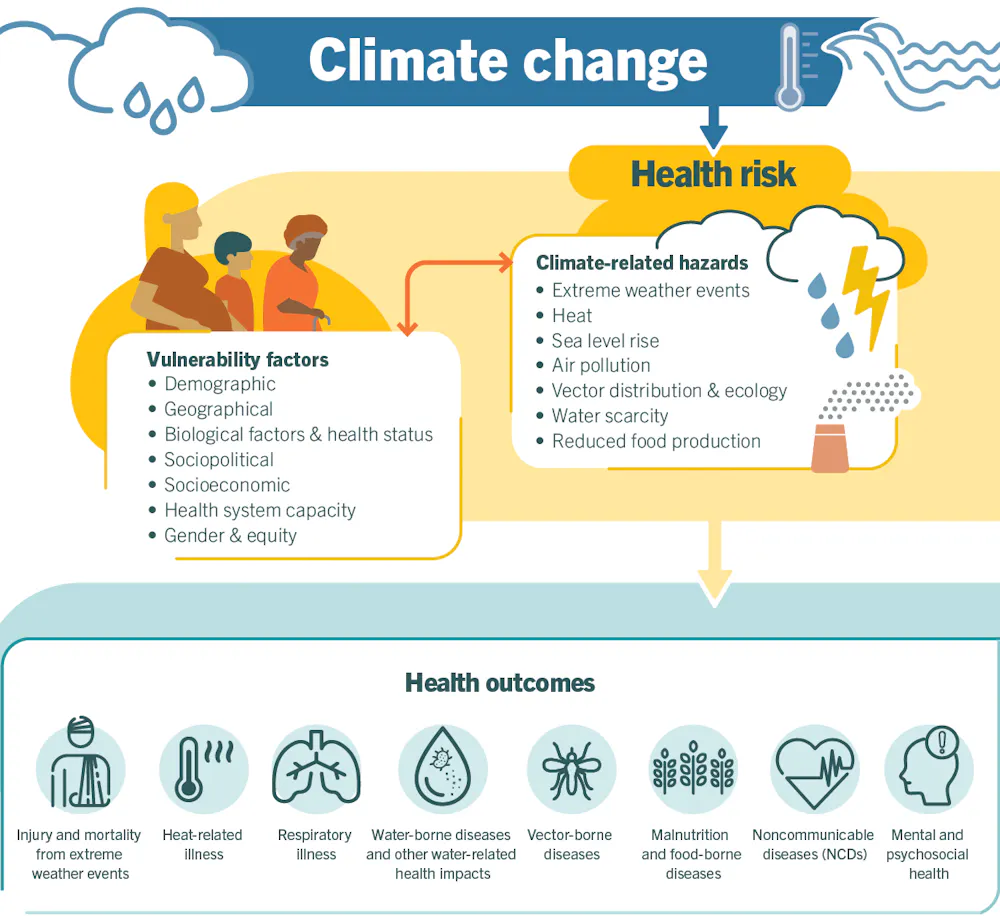
Health risks and outcomes related to climate change.
World Health Organization

As physicians, epidemiologists and environmental health scientists who study these effects, we’ve seen growing evidence of the connections between climate change and harm to people’s health. More importantly, we see ways humanity can improve health by tackling climate change.

Here’s a look at the risks and some of the steps individuals and governments can take to reduce them.

Extreme heat

Greenhouse gases from vehicles, power plants and other sources accumulate in the atmosphere, trapping heat and holding it close to Earth’s surface like a blanket. Too much of it causes global temperatures to rise, leaving more people exposed to dangerous heat more often.

Most people who get minor heat illnesses will recover, but more extreme exposure, especially without enough hydration and a way to cool off, can be fatal. People who work outside, are elderly or have underlying illnesses such as heart, lung or kidney diseases are often at the greatest risk.

Heat deaths have been rising globally, up 23% from the 1990s to the 2010s, when the average year saw more than half a million heat-related deaths. Even in the U.S., the Pacific Northwest heat dome in 2021 killed hundreds of people.

Climate scientists predict that with advancing climate change, many areas of the world, including U.S. cities such as Miami, Houston, Phoenix and Las Vegas, will confront many more days each year hot enough to threaten human survival.

Extreme weather

Warmer air holds more moisture, so climate change brings increasing rainfall and storm intensity, worsening flooding, as many U.S. communities have experienced in recent years. Warm ocean water also fuels more powerful hurricanes.

Increased flooding carries health risks, including drownings, electrocution and water contamination from human pathogens and toxic chemicals. People cleaning out flooded homes also face risks from mold exposure, injuries and mental distress.

A man carries boxes out of a house that flooded up to its second story.
Flooding from hurricanes and other extreme storms can put people at risk of injuries during the cleanup while also triggering dangerous mold growth on wet wallboard, carpets and fabric. This home flooded up to its second flood during Hurricane Irma in 2017.
Sean Rayford/Getty Images

Climate change also worsens droughts, disrupting food supplies and causing respiratory illness from dust and dry conditions as well as wildfires. And rising temperatures and aridity dry out forest and grasslands, making them more vulnerable to catching fire, which creates other health risks.

Air pollution

Wildfires, along with other climate effects, are also worsening air quality around the country.

Wildfire smoke is a toxic soup of microscopic particles (known as fine particulate matter, or PM2.5) that can penetrate deep in the lungs and hazardous compounds such as lead, formaldehyde and dioxins generated when homes, cars and other materials burn at high temperatures. Smoke plumes can travel thousands of miles downwind and trigger heart attacks and elevate lung cancer risks, among other harms.

Meanwhile, warmer conditions favor the formation of ground-level ozone, a heart and lung irritant. Burning of fossil fuels also generates dangerous air pollutants that cause a host of health problems, including heart attacks, strokes, asthma flare-ups and lung cancer.

Infectious diseases

Because they are cold-blooded organisms, insects are directly influenced by temperature. So as temperatures have risen, mosquito biting rates have risen as well. Warming also shortens the development time of disease agents that mosquitoes transmit.

Mosquito-borne dengue fever has turned up in Florida, Texas, Hawaii, Arizona and California. New York state just saw its first locally acquired case of chikungunya virus, also transmitted by mosquitoes.

A world map shows where mosquitos are most likely to transmit the dengue virus
As global temperatures rise, regions are becoming more suitable for mosquitoes to transmit dengue virus. The map shows a suitability scale, with red areas already suitable for dengue transmissions and yellow areas becoming more suitable.
Taishi Nakase, et al., 2022, CC BY

And it’s not just insect-borne infections. Warmer temperatures increase diarrhea and foodborne illness from Vibrio cholerae and other bacteria and heavy rainfall increases sewage-contaminated stormwater overflows into lakes and streams. At the other water extreme, drought in the desert Southwest increases the risk of coccidioidomycosis, a fungal infection known as valley fever.

Other impacts

Climate change can threaten health in numerous other ways. Longer pollen seasons can increase allergen exposures. Lower crop yields can reduce access to nutritious foods.

Mental health can also suffer, with anxiety, depression and post-traumatic stress following disasters, and increased rates of violent crime and suicide tied to high-temperature days.

A older man holds a door for a woman at a cooling center.
New York and many other cities now open cooling centers during heat waves to help residents, particularly older adults who might not have air conditioning at home, stay safe during the hottest parts of the day.
Angela Weiss/AFP via Getty Images

Young children, older adults, pregnant women and people with preexisting medical conditions are among the highest-risk groups. Often, lower-income people are also at greater risk because of higher rates of chronic disease, higher exposures to climate hazards and fewer resources for protection, medical care and recovery from disasters.

What can people and governments do?

As an individual, you can reduce your risk by following public health advice during heat waves, storms and wildfires; protecting yourself against tick and mosquito bites; and spending time in green space that improves your mental health.

You can also make healthy choices that reduce your carbon footprint, such as:

However, there are limits to what individuals can do alone.

Actions by governments and companies are also necessary to protect people from a warmer climate and stop the underlying causes of climate change.

Workplace safety can be addressed through rules to reduce heat exposure for people who work outdoors in industries such as agriculture and construction. Communities can open cooling centers during heat waves, provide early warning systems and design drinking water systems that can handle more intense rainfall and runoff, reducing contamination risks.

Governments can ensure that public transit is available and not overly expensive to reduce the number of vehicles on the road. They can promote clean energy rather than fossil fuels to cut emissions, which can also save money since the cost of solar energy has dropped spectacularly. In fact, both solar and wind energy are less expensive than fossil fuel energy.

Yet the U.S. government is currently going in the opposite direction, cutting support for renewable energy while subsidizing the fossil fuel industries that endanger public health.

To really make America healthy, in our view, the country can’t ignore climate change.

The Conversation

Jonathan Levy receives funding from the National Institutes of Health, the Federal Aviation Administration, the City of Boston, and the Mosaic Foundation.

Howard Frumkin has no financial conflicts of interest to report. He is a member of advisory boards (or equivalent committees) for the Planetary Health Alliance; the Harvard Center for Climate, Health, and the Global Environment; the Medical Society Consortium on Climate Change and Health; the Global Consortium on Climate and Health Education; the Yale Center on Climate Change and Health; and EcoAmerica’s Climate for Health program—all voluntary unpaid positions.

Jonathan Patz receives funding from the National Institutes of Health. He is affiliated with the Medical Society Consortium for Climate and Health, and its affiliate Healthy Climate Wisconsin.

Vijay Limaye is affiliated with the Natural Resources Defense Council.

ref. Want to make America healthy again? Stop fueling climate change – https://theconversation.com/want-to-make-america-healthy-again-stop-fueling-climate-change-269269

How a Sudanese university kept learning alive during war

Source: The Conversation – Africa – By Gihad Ibrahim, Assistant Professor and E-learning Department Head, Mashreq University

The civil war in Sudan began in April 2023, causing death, hunger, displacement and destruction on a huge scale. Gihad Ibrahim, head of e-learning and senior manager at Mashreq University in Sudan’s capital, Khartoum, spoke with The Conversation Africa about how his institution continued to educate thousands of students despite the destruction of its campuses during the ongoing conflict.

What was Mashreq University like before the war?

Mashreq University (established in 2003) was a thriving academic community of over 10,000 students across 10 faculties, including healthcare, engineering, information technology and business. We were known for innovation, being the first in Sudan to offer degrees in fields like artificial intelligence and mechatronics engineering. We ranked highly in both global and national rankings.

Our status as a private university allowed us agility in decision-making and investing in digital infrastructure early, a crucial factor in our later survival. However, our success was also rooted in operating within a national system that, before the war, permitted and accredited such innovation. This highlights a vital policy lesson: governments can foster resilience not by micromanaging, but by creating a regulatory environment that allows universities the autonomy to adapt and invest in their own futures.

Our main campus was in Khartoum North, a hub of student life.

While teaching was primarily in-person, we had already begun integrating online elements for some courses. This digital foundation, though modest, would later become our lifeline.

We established a learning management system back in 2013. When the COVID-19 pandemic struck in 2020, we were among the few Sudanese universities that could transition seamlessly online.

That crisis was a dress rehearsal; it forced us to build a system for blended learning that saved us when a far greater crisis emerged.

What happened when the fighting broke out in April 2023?

The war began on a Saturday morning – a normal teaching day. Students were already commuting. I remember I had a morning meeting with three female students working on their graduation project. I called one of them immediately and told her to warn the others and return home. Unfortunately, one didn’t get the message and was trapped near campus for two weeks – a harrowing reminder of the immediate human cost.

Our first priority was evacuation. But in those first chaotic hours, our information technology team performed a critical act: an emergency cloud backup of all academic records. It was a decision born of foresight, and it preserved the academic history of thousands.

Within weeks, our main campus was occupied by the paramilitary Rapid Support Forces (RSF). They looted laboratories and burned lecture halls. Because of the buildings’ height, they used them as military positions. Our campus was not just damaged; it was weaponised.

How did you keep teaching after such devastation?

Khartoum became a ghost city. With people fleeing in all directions – to other states or across borders to neighbouring countries like Egypt and Saudi Arabia – our university community scattered. The first step was to find them. We launched an online survey to locate our displaced students and staff.

Using that data, we established a network of “teaching centres” in safer locations. We created hubs in Port Sudan (after relocating from the city of Atbara), and internationally in Cairo (in Egypt), Jeddah (in Saudi Arabia), and a virtual campus in the United Arab Emirates (UAE). The UAE group was smaller, but because many students there held temporary “war victim” visas that restricted travel, we offered live virtual classes instead of physical ones.

How does this new teaching model work?

We had to be strategic. We categorised every course:

Non-applied courses (like many in business or theory) moved entirely online.
Applied courses (like lab sciences) were delivered face-to-face at the teaching centres.

Advanced specialised courses were taught live online to all centres simultaneously.

Consistency was key. Each course had a “lead lecturer” who coordinated content across all locations to ensure every student received the same quality. We partnered with local hospitals and factories for practical training, turning a constraint into an opportunity for real-world learning.

Exams were held online on university tablets, but invigilated in person at the centres to ensure integrity. The system was built on flexibility, but also on rigorous standards.

What lessons has Mashreq University learned?

We learned three profound lessons:

Technology is a lifeline. Our pre-war investment in digital infrastructure was what allowed us to survive.

Flexibility and compassion must replace rigid bureaucracy. We focused on the goal – education – not on the old rules.

Crisis can fuel innovation. Many students gained deeper, more relevant experience training in real hospitals and factories than they ever would in a simulated campus lab.

The most powerful moments have been the messages from graduates. They write to thank us, often noting that their peers at other universities are still waiting, their education frozen. One message captures it all:

You gave me my future back.

This reminds us that education is not a luxury; in times of war, it is a testament to normalcy, hope, and the future.

What comes next?

We have already begun refurbishing our main campus in Khartoum North, hoping to return soon. But the old model is gone for good.

This experience has taught us that education has no borders. It can reach anyone, anywhere, if guided by compassion and strategic purpose.

For universities everywhere, our story is a stark lesson: investing in resilient, flexible systems is not just about innovation; in today’s world, it is fundamentally about survival.

The Conversation

Gihad Ibrahim works as the Head of E-learning department at Mashreq University

ref. How a Sudanese university kept learning alive during war – https://theconversation.com/how-a-sudanese-university-kept-learning-alive-during-war-269325

Nana Konadu Agyeman-Rawlings: the first lady who redefined women’s power in Ghana.

Source: The Conversation – Africa (2) – By Nancy Henaku, Lecturer, Department of English, University of Ghana

Tributes for Nana Konadu Agyeman-Rawlings (1948-2025) have been pouring in since her death on 23 October 2025. For many Ghanaians, her broad-ranging empowerment work as leader of the 31st December Women’s Movement is deserving of full recognition. The non-governmental organisation started as a women’s political movement and is still active.

Born on 17 November 1948, she became the wife of Jerry John Rawlings, who governed Ghana from 1981 until he handed over power in 2001.

Mourners, including Ghana’s President John Dramani Mahama, have referenced Agyeman-Rawlings’ social welfare interventions through her organisation as evidence of her achievements. These include the provision of credit facilities and advocacy for women’s and children’s rights. She also established daycare centres for children, adult literacy centres and edible oil extraction industries.

A dimension of Agyeman-Rawlings’ politics that has been mainly overlooked, however, is her rhetorical leadership. This refers to the various persuasive means through which she performed her roles as a public figure.

I am a scholar of English who studies how people use language and other communicative forms (such as sound and visuals) to influence public discourse. I have used rhetorical and linguistic methods to study various sources on Agyeman-Rawlings, including a personal interview I conducted with her in 2017.

Agyeman-Rawlings’ speeches and writing reveal her motivations for shifting prevailing ideas about women’s social roles, her complex responses to public anxieties about her power (real or imagined) and her attempt at disrupting the archives by narrating herself into history.

Advocating for change

Agyeman-Rawlings’ rhetorical leadership transformed the role of the first lady in Ghana. In her own words:

A first lady’s work does not end with the collection of flowers and doing some protocols … I’d rather work and be emulated than to sit down and not do anything and not change anybody’s life.

For this reason, Agyeman-Rawlings spoke and wrote extensively in national and international contexts. Her rhetoric of empowerment centred the plights of women, children and the poor. For instance, she asserted at Beijing that “for us in Africa, the girl child is a special concern.”

Agyeman-Rawlings articulated a cosmopolitan ideology shaped by multiple influences. These include UN rights discourses, the language of mothering (such as nurturing, protecting), liberal feminism with its emphasis on gender reform through legal means, and the populist rhetoric of the Rawlings regime, with its emphasis on people power.

An assessment of Agyeman-Rawlings’ legacy must recognise that speaking and writing for change involve extensive physical, mental and emotional energy. And for many years, under her husband’s military regime, she performed this role without the professional support of a communications team.

The sociologist Mansah Prah describes Agyeman-Rawlings’ tenure as the era of the “grand feminist illusion” because although her organisations were seemingly pro-woman, their activities did not result in substantial changes in the lives of women.

However, as my research suggests, discussions on the limitations of Agyeman-Rawlings’ advocacy must consider at least two factors. First, the patriarchal postcolonial state always constrains women’s mass efforts at transformation. Second, the discourses that influence Agyeman-Rawlings’ rhetoric are themselves contradictory. For instance, the term “empowerment” is a catchall phrase that means different things to different people. Its vagueness makes it a safe political term. It does not radically shift conversations on gender.

Contesting power

Agyeman-Rawlings had an intense political life. One could say that through her gendered advocacy and mass mobilisation, she politicised the first lady role. For that reason, she was highly scrutinised during her active political years. In response to efforts to restrain her power, she drew on ambiguous gendered rhetorics, moral values and familial legacy

She was variously accused of being corrupt, power drunk and ostentatious, often with sexist undertones.

People rumoured that she, as first lady, was the real power behind the presidency. When her husband was preparing to leave office, there were stories that she wanted to succeed him. One news report claims that she countered such allegations by saying: “I have never said anywhere that I want to be president” while implying that she could change her mind if her husband said so. It takes a keen rhetorical intellect to navigate the slippery political terrain Agyeman-Rawlings found herself in.

She remained politically active after her tenure as first lady ended. In 2011, she contested against John Evans Atta Mills, Ghana’s president at the time, for the candidacy of the National Democratic Congress, which she helped form. She would later defect from the party to form her own, the National Democratic Party.

In these complex political tussles, she consistently appealed to morality and truth. In one instance, she countered ten years of media “bashing” by claiming that she had been raised right. Her 2016 acceptance speech for the National Democratic Party candidacy centred on “what is right” for the “people”.

My interview with her and other primary sources point to the influence of the calm, ethical and non-ideological pragmatism of Agyeman-Rawlings’ father, J.O.T. Agyeman, in her appeal to morality. Her father was a technocrat who was connected to Ghanaians belonging to different sides of Ghana’s two main political traditions, the Nkrumahist and the Danquah-Busia traditions. According to Agyeman-Rawlings, her parents’ home was a space for “spirited” conversations shaped by her father’s emphasis on logical and ethical argumentation rather than parochial political interests. This suggests that examining African first ladies merely in relation to their husbands’ politics, however crucial, would be a limited view.

Disrupting the archive

Agyeman-Rawlings wrote a memoir, unusually for a Ghanaian woman politician. As the historian Jean Allman suggests, there is a connection between the erasure of women in Ghanaian politics and the absence of autobiographical writings by nationalist women. My studies argue that Agyeman-Rawlings’ narrative (though incomplete) should be read as a rhetorical disruption of the postcolonial archives. These archives tend to erase or subordinate women’s contributions within a dominant masculine framing of the nation-state.

Agyeman-Rawlings is not the only woman to have laboured for the nation-state. Other women like pro-independence activist Hannah Kudjoe who were involved in similar social welfare activities have been written out of Ghanaian history. Agyeman-Rawlings understood that despite her extensive work, words still mattered if she was to be remembered.

By asserting that “it takes a woman” to “birth” the strength and future of a nation, she boldly inserts a feminine voice into a postcolonial national allegory that centres men. By so doing, she demands a rereading of “great men” like Ghana’s first president, Kwame Nkrumah, and Jerry Rawlings. And in the absence of a Jerry Rawlings autobiography, Agyeman-Rawlings’ writing becomes doubly subversive.

Because women have been historically marginalised from the public sphere, a female politician would be scrutinised whether or not she was vocal. Agyeman-Rawlings chose to be visible and outspoken.

The Conversation

Nancy Henaku does not work for, consult, own shares in or receive funding from any company or organisation that would benefit from this article, and has disclosed no relevant affiliations beyond their academic appointment.

ref. Nana Konadu Agyeman-Rawlings: the first lady who redefined women’s power in Ghana. – https://theconversation.com/nana-konadu-agyeman-rawlings-the-first-lady-who-redefined-womens-power-in-ghana-269013

New technologies like AI come with big claims – borrowing the scientific concept of validity can help cut through the hype

Source: The Conversation – USA (2) – By Kai R. Larsen, Professor of Information Systems, University of Colorado Boulder

Closely examining the claims companies make about a product can help you separate hype from reality. Flavio Coelho/Moment via Getty Images

Technological innovations can seem relentless. In computing, some have proclaimed that “a year in machine learning is a century in any other field.” But how do you know whether those advancements are hype or reality?

Failures quickly multiply when there’s a deluge of new technology, especially when these developments haven’t been properly tested or fully understood. Even technological innovations from trusted labs and organizations sometimes result in spectacular failures. Think of IBM Watson, an AI program the company hailed as a revolutionary tool for cancer treatment in 2011. However, rather than evaluating the tool based on patient outcomes, IBM used less relevant measures – possibly even irrelevant ones, such as expert ratings rather than patient outcomes. As a result, IBM Watson not only failed to offer doctors reliable and innovative treatment recommendations, it also suggested harmful ones.

When ChatGPT was released in November 2022, interest in AI expanded rapidly across industry and in science alongside ballooning claims of its efficacy. But as the vast majority of companies are seeing their attempts at incorporating generative AI fail, questions about whether the technology does what developers promised are coming to the fore.

Black screen with IBM Watson logo on a Jeopardy stand with $1,200 stood between two contestants with $0 each
IBM Watson wowed on Jeopardy, but not in the clinic.
AP Photo/Seth Wenig

In a world of rapid technological change, a pressing question arises: How can people determine whether a new technological marvel genuinely works and is safe to use?

Borrowing from the language of science, this question is really about validity – that is, the soundness, trustworthiness and dependability of a claim. Validity is the ultimate verdict of whether a scientific claim accurately reflects reality. Think of it as quality control for science: It helps researchers know whether a medication really cures a disease, a health-tracking app truly improves fitness, or a model of a black hole genuinely describes how it behaves in space.

How to evaluate validity for new technologies and innovations has been unclear, in part because science has mostly focused on validating claims about the natural world.

In our work as researchers who study how to evaluate science across disciplines, we developed a framework to assess the validity of any design, be it a new technology or policy. We believe setting clear and consistent standards for validity and learning how to assess it can empower people to make informed decisions about technology – and determine whether a new technology will truly deliver on its promise.

Validity is the bedrock of knowledge

Historically, validity was primarily concerned with ensuring the precision of scientific measurements, such as whether a thermometer correctly measures temperature or a psychological test accurately assesses anxiety. Over time, it became clear that there is more than just one kind of validity.

Different scientific fields have their own ways of evaluating validity. Engineers test new designs against safety and performance standards. Medical researchers use controlled experiments to verify treatments are more effective than existing options.

Researchers across fields use different types of validity, depending on the kind of claim they’re making.

Internal validity asks whether the relationship between two variables is truly causal. A medical researcher, for instance, might run a randomized controlled trial to be sure that a new drug led patients to recover rather than some other factor such as the placebo effect.

External validity is about generalization – whether those results would still hold outside the lab or in a broader or different population. An example of low external validity is how many early studies that work in mice don’t always translate to people.

Construct validity, on the other hand, is about meaning. Psychologists and social scientists rely on it when they ask whether a test or survey really captures the idea it’s supposed to measure. Does a grit scale actually reflect perseverance or just stubbornness?

Finally, ecological validity asks whether something works in the real world rather than just under ideal lab conditions. A behavioral model or AI system might perform brilliantly in simulation but fail once human behavior, noisy data or institutional complexity enter the picture.

Across all these types of validity, the goal is the same: ensuring that scientific tools – from lab experiments to algorithms – connect faithfully to the reality they aim to explain.

Evaluating technology claims

We developed a method to help researchers across disciplines clearly test the reliability and effectiveness of their inventions and theories. The design science validity framework identifies three critical kinds of claims researchers usually make about the utility of a technology, innovation, theory, model or method.

First, a criterion claim asserts that a discovery delivers beneficial outcomes, typically by outperforming current standards. These claims justify the technology’s utility by showing clear advantages over existing alternatives.

For example, developers of generative AI models such as ChatGPT may see higher engagement with the technology the more it flatters and agrees with the user. As a result, they may program the technology to be more affirming – a feature called sycophancy – in order to increase user retention. The AI models meet the criterion claim of users considering them more flattering than talking to people. However, this does little to improve the technology’s efficacy in tasks such as helping resolve mental health issues or relationship problems.

AI sycophancy can lead users to break relationships rather than repair them.

Second, a causal claim addresses how specific components or features of a technology directly contribute to its success or failure. In other words, it is a claim that shows researchers know what makes a technology effective and exactly why it works.

Looking at AI models and excessive flattery, researchers found that interacting with more sycophantic models reduced users’ willingness to repair interpersonal conflict and increased their conviction of being in the right. The causal claim here is that the AI feature of sycophancy reduces a user’s desire to repair conflict.

Third, a context claim specifies where and under what conditions a technology is expected to function effectively. These claims explore whether the benefits of a technology or system generalize beyond the lab and can reach other populations and settings.

In the same study, researchers examined how excessive flattery affected user actions in other datasets, including the “Am I the Asshole” community on Reddit. They found that AI models were more affirming of user decisions than people were, even when the user was describing manipulative or harmful behavior. This supports the context claim that sycophantic behavior from an AI model applies across different conversational contexts and populations.

Measuring validity as a consumer

Understanding the validity of scientific innovations and consumer technologies is critical for scientists and the general public. For scientists, it’s a road map to ensure their inventions are rigorously evaluated. And for the public, it means knowing that the tools and systems they depend on – such as health apps, medications and financial platforms – are truly safe, effective and beneficial.

Here’s how you can use validity to understand the scientific and technological innovations happening around you.

Because it is difficult to compare every feature of two technologies against each other, focus on which features you value most from a technology or model. For example, do you prefer a chatbot to be accurate or better for privacy? Examine claims for it in that area, and check that it is as good as claimed.

Consider not only the types of claims made for a technology but also which claims are not made. For example, does a chatbot company address bias in its model? It’s your key to knowing whether you see untested and potentially unsafe hype or a genuine advancement.

By understanding validity, organizations and consumers can cut through the hype and get to the truth behind the latest technologies.

The Conversation

The authors do not work for, consult, own shares in or receive funding from any company or organization that would benefit from this article, and have disclosed no relevant affiliations beyond their academic appointment.

ref. New technologies like AI come with big claims – borrowing the scientific concept of validity can help cut through the hype – https://theconversation.com/new-technologies-like-ai-come-with-big-claims-borrowing-the-scientific-concept-of-validity-can-help-cut-through-the-hype-259030

Turn shopping stress into purposeful gift giving by cultivating ‘consumer wisdom’ during the holidays

Source: The Conversation – USA (2) – By Michael Luchs, JS Mack Professor of Business, William & Mary

The most meaningful gifts reflect the giver’s values and identity – and the recipient’s, too. Halfpoint images/Moment via Getty Images

Every fall I anticipate the winter holidays with almost childlike joy. I look forward to familiar traditions with friends and family, eggnog in my coffee, and the sense that everyone is feeling a little lighter and more connected.

At the same time, I feel anxious and annoyed by the manufactured sense of urgency around gift giving: the endless searching and second-guessing shaped by advertisers, retailers and cultural expectations.

Don’t get me wrong, I mostly love giving – and, yes, receiving – gifts during the holidays. But as a researcher who studies consumer psychology, I see how those same forces, amplified by constant buying opportunities and frictionless online payments, make us especially vulnerable and often unwise this time of year.

Buying behavior, including gift giving, doesn’t just reflect needs and wants but also our values. Frequently, the values we talk about are more akin to aspirational ideals. Our actual values are revealed in the seemingly inconsequential choices we make day after day – including shopping.

The cumulative effects of our spending behaviors carry enormous implications for society, the environment and everyone’s well-being – from the purchaser and recipient to people working throughout the supply chain. This makes consumer behavior an especially important place to apply the emerging social science research on wisdom. While wisdom is defined in different ways, it can be understood as seeing decisions through a broader, values-informed perspective and acting in ways that promote well-being.

Over the past decade, consumer psychology researcher David Mick and I have studied what that means when it comes to consumption. “Consumer wisdom?” you may wonder. Isn’t that an oxymoron?

But there are vast differences in how we consume – and as our research shows, this can lead to very different effects on individual well-being.

Defining consumer wisdom

Building on some of David’s earlier work, I began my own research on consumer wisdom in the summer of 2015, interviewing dozens of people across the U.S. whom others in their communities had identified as models of wisdom. Previous research guided me to settings where I could easily find people who represented different aspects of wisdom: practicality on farms in upstate New York; environmental stewardship in Portland, Oregon; and community values in Tidewater, Virginia.

I didn’t use the term “wisdom,” though. It can be intimidating, and people often define it narrowly. Instead, I spoke with people whose peers described them as exemplary decision-makers – people leading lives that considered both the present and the future, and who balanced their needs with others’ needs.

'A woman wearing a green headscarf and holding a credit card in one hand smiles as she looks down at a tablet.
Consumer wisdom helps support well-being – and not just the purchaser’s.
Fajrul Islam/Moment via Getty Images

From those conversations, David and I developed a theory of consumer wisdom. With the help of a third co-author, Kelly Haws, we validated this framework through national surveys with thousands of participants, creating the consumer wisdom scale.

The scale shows how consumer wisdom is not some lofty ideal but a set of practical habits. Some are about managing money. Some are about goals and personal philosophy, and others are about broader impact.

We have found that six dimensions capture the vast majority of what we would call consumer wisdom:

  1. Responsibility: managing resources to support a rewarding yet realistic lifestyle.
  2. Purpose: prioritizing spending that supports personal growth, health and relationships.
  3. Perspective: drawing on past experiences and anticipating future consequences.
  4. Reasoning: seeking and applying reliable, relevant information; filtering out the noise of advertising and pop culture.
  5. Flexibility: being open to alternatives such as borrowing, renting or buying used.
  6. Sustainability: spending in ways that support the buyer’s social or environmental goals and values.

These are not abstract traits. They are everyday ways of aligning your spending with your goals, resources and values.

Importantly, people with higher scores on the scale report greater life satisfaction, as well as better health, financial security and sense of meaning in life. These results hold even after accounting for known determinants of well-being, such as job satisfaction and supportive relationships. In other words, consumer wisdom makes a distinctive and underappreciated contribution to well-being.

A man and woman who appear to be in the 60s or 70s pause and look at a product as they push a grocery cart through a market.
One tenet of consumer wisdom is sustainability: Does your purchase support the world you want to live in?
Luis Alvarez/Digital Vision via Getty Images

Putting it in practice

These six dimensions offer a different lens on holiday norms – one that can reframe how to think about gifts.

Interestingly, the English word “gift” traces back to the Old Norse rune gyfu, which means generosity. It’s a reminder that true giving is not about checking boxes on referral, revenue-generating gift guides or yielding to slick promotions or fads. Generosity is about focusing on another person’s well-being and our relationship with them.

From the perspective of consumer wisdom, that means asking what will genuinely contribute to the recipient’s life. One of the most important dimensions of consumer wisdom is “purpose”: the idea that thoughtful spending can nurture personal growth, health, enjoyment and sense of connection. Out with trendy gadgets, fast fashion and clutter-creating décor or knickknacks – things that feel exciting in the moment but are quickly forgotten. In with quality headphones, a shared cooking class, a board game, and a workshop or tools to support a hobby – gifts that can spark growth, joy and deeper connection.

In my ongoing research, people have described wise gifts as those that define value from the recipient’s perspective – gifts that stay meaningful and useful over time. The wisest gifts, respondents say, also affirm the recipient’s identity, showing that the giver truly understands and values them.

Wiser consumption is learnable, measurable and consequential. By choosing gifts that reflect purpose and the original spirit of “gyfu” – true generosity – we can make the holidays less stressful. More importantly, we can make them more meaningful: strengthening relationships in ways that bring joy long after.

The Conversation

Michael Luchs received funding from the Templeton Foundation through a grant from the University of Chicago School of Divinity.

ref. Turn shopping stress into purposeful gift giving by cultivating ‘consumer wisdom’ during the holidays – https://theconversation.com/turn-shopping-stress-into-purposeful-gift-giving-by-cultivating-consumer-wisdom-during-the-holidays-265564

A-League women: Wellington Phoenix players happy but fans stay away

Source: Radio New Zealand

Phoenix Mackenzie Barry (R with Melbourne City Leticia Mckenna during the A-League Women - Wellington Phoenix v Melbourne City FC at Porirua Park, Wellington on the 30 March 2025

Phoenix Mackenzie Barry during a game against Melbourne City FC at Porirua Park on 30 March 2025. Photo: Photosport

The Wellington Phoenix women lost more than half of their attending fans last season compared to the season prior.

On average the Phoenix had 739 people at their home games at Porirua Park in the 2024/25 A-League Women season. This was 61 percent fewer fans than the 2023/24 season and the biggest decline in the 12-team competition.

A report by Professional Footballers Australia (PFA) showed Adelaide United had the most supporters at home games with an average crowd of 2731.

Adelaide was one of two clubs to have have grown their attending fan base season-on-season with a 58 percent increase. Brisbane Roar had a minor increase of 1 percent to an average of 2344 supporters.

Western United, a club currently in hibernation, had an average of 676 fans, the lowest of all clubs.

Across the A-League Women the average attendance was 1559 in 2024/25, down by 26 percent.

The Wellington Phoenix women opened their current season on Saturday, as part of the double-header with the men’s New Zealand derby, and the club reported 4655 fans in attendance at Sky Stadium. It was the second highest women’s attendance in the club’s history.

The Phoenix have nine more home games this season to prove this was not an anomaly.

The A-League Women peaked at an average attendance of 2139 in the 2017/18 season and had been in a decline until the 2023/24 season.

The PFA report noted the biggest factor in the downturn last season was likely that the Women’s World Cup-driven boost in the the 2023/24 season crowds had not been sustained.

“These findings change the narrative around the league’s trajectory. Instead of asking whether the league is growing fast enough, the question now is whether the league is in fact growing,” the PFA report said.

In August Auckland FC announced it would now not enter the A-League Women until at least the 2027/28 season as the APL, who run the league, wanted to review the competition before committing to expanding.

“It is important we take into consideration the challenges unique to our women’s game, and we expand the league at the right pace and with the right investment to ensure long-term sustainable growth,” APL executive chairperson Stephen Conroy said.

Fans during the A-League Women - Wellington Phoenix v Melbourne City FC at Porirua Park on the 30 March 2025.

Fans during the A-League Women – Wellington Phoenix v Melbourne City FC at Porirua Park on the 30 March 2025. Photo: Photosport

A survey of Australian fans by Gemba and included in the PFA report claimed “…the women’s supporter experience is really quite second rate”.

Fans were asked to rank factors that would attract supporters to games. At the bottom of the list was high quality on-field performance. At the top was access to players in-person and through digital content.

While fans were not flocking to Phoenix games the players ranked their own satisfaction in the club environment very highly.

The PFA report showed the Phoenix players had seen a large improvement in scores for club operations and culture last season.

The Phoenix women believed their integration with the men’s side of the club was better than it had ever been. The Phoenix were the top of the league in this category and still quite a way ahead of the next best Melbourne City.

“Given that Wellington finished ninth, this result is evidence that the players’ survey feedback is not simply a reflection of the vibes created by on-field results, but a genuine attempt to assess distinct elements of their experiences. The club deserves credit for the environment it has created,” the PFA report said.

Not everything was rosy for players across the league. According to the report 67 percent of players experienced sport-related psychological distress last season.

The share of players experiencing global (general) psychological distress, anxiety, and depression was also significantly higher in 2025 than in 2020.

In 2024/25, 41 percent of the women experienced disordered eating, 34 percent experienced alcohol misuse and 28 percent had disturbed sleep.

Players across the A-League Women would also rather be playing in a different competition. Results showed the players were eyeing the WSL in the United Kingdom, the NWSL in the United States or another overseas league, making the A-League the competition they least wanted to be playing in.

– Published by EveningReport.nz and AsiaPacificReport.nz, see: MIL OSI in partnership with Radio New Zealand

A portrait of a ‘tragic’ heiress is expected to sell for more than $265 million

Source: Radio New Zealand

Two years ago, Gustav Klimt’s final portrait – a vibrant portrait of an unidentified woman with a fan – topped the artist’s auction record when it sold for a staggering US$108 million (NZ$191m).

The Austrian painter’s record is expected to be shattered again by a monumental, six-foot-tall portrait of a young heiress that was looted by the Nazis and nearly destroyed during World War II.

Rarely seen for decades, it hung in the home of the Estée Lauder heir Leonard A. Lauder until the last years of his life (he passed away in June).

Leonard Lauder at the Elton John AIDS Foundation's 17th Annual An Enduring Vision Benefit on 5 November, 2018 in New York City.

Leonard Lauder at the Elton John AIDS Foundation’s 17th Annual An Enduring Vision Benefit on 5 November, 2018 in New York City.

AFP / Angela Weiss

– Published by EveningReport.nz and AsiaPacificReport.nz, see: MIL OSI in partnership with Radio New Zealand