Source: The Conversation – Canada – By Lauren McNamara, Research Scientist (Diversity and Equity in Schools), Diversity Insitute, Ted Rogers School of Management, Toronto Metropolitan University
The ministry mentions “new flexibility in the scheduling of recess and lunch — for example, schools may choose to offer one longer recess period in place of two shorter ones, while still providing a lunch break,” plus the 300 daily minutes of instructional time.
As researchers who have long studied the links between school environments and children’s well-being, we know that reducing or restructuring recess time can negatively impact learning and development.
Cognitive science tells us that young children need regular breaks from focused academic work. These breaks reduce mental fatigue, improve concentration and help children return to class refreshed and ready to learn.
Simply switching from mathematics to reading isn’t enough. What’s needed are genuine pauses from cognitive effort, ideally involving unstructured play.
The power of play
Recess offers a chance for unstructured play, something children do freely and joyfully. Play isn’t just fun, it’s essential to healthy brain development. Whether they’re running, building, imagining or exploring, play activates the brain’s reward systems, releasing endorphins that enhance mood and reduce stress.
Play is so fundamental to healthy development that the United Nations Convention on the Rights of the Child has long deemed it a basic human right, and as a signatory, Canada is obligated to uphold this right.
It’s important to note that gym class or other structured physical activities don’t offer the same benefits. Children need time to follow their own interests, move at their own pace and interact freely with peers.
Movement, the outdoors
Kids aren’t meant to sit still all day. Recess gives them a chance to move, whether that’s running, jumping or just walking and stretching. Regular movement improves circulation, boosts energy, supports mental clarity and improves mood. Even short bursts of physical activity can help offset the long hours spent sitting in classrooms.
Time outside can have meaningful effects. Nature has a calming effect on the brain, reduces anxiety and helps with attention and emotional regulation. Green spaces and natural materials like trees, grass and fresh air offer benefits that indoor classrooms simply can’t replicate.
Socializing, mental wellness
To children, recess isn’t just a break, it’s a vital social time. It’s when they form friendships, practise conflict resolution and feel a sense of belonging. These connections support emotional development and make school a place where kids want to be.
Unfortunately, as schools focus more on maximizing instructional minutes, this social time can be undervalued. But connection and belonging are not side benefits — they are essential to academic motivation, engagement and overall student success.
Physical activity, outdoor time, free play and meaningful social interaction all work together to support mental health and overall well-being.
Recess creates space for laughter, joy, relaxation and calm. Students who feel emotionally safe, happy and supported are more likely to pay attention in class, co-operate with peers and persist through academic challenges. In summary, healthy children are better learners.
Schools are more than instruction
Schools are communities where children spend much of their waking lives. They are places not only of academic growth but also social, emotional and physical development.
It’s a critical part of the school day and must be protected and well supported, not minimized.
Recommendations for recess
According to Physical and Health Education Canada’s National Position Paper on Recess, all students — from kindergarten through high school — should have regularly scheduled recess across the school day.
Children in kindergarten through Grade 2 should receive at least four 15-minute recesses daily, ideally outdoors. Children in grades 2 to 6 should have at least two 20-minute recesses, not including time spent putting on coats or lining up.
These are research-backed guidelines that support children’s full development. And, of course, the quality of recess matters, which is described further in the position paper.
The Ontario memo invites us all to revisit the role of recess in the school day. We must remember that time to play, move, connect and breathe is not a break from learning, it’s a vital part of learning.
Tracy Vaillancourt is affiliated with the Centre for International Governance Innovation.
Lauren McNamara does not work for, consult, own shares in or receive funding from any company or organisation that would benefit from this article, and has disclosed no relevant affiliations beyond their academic appointment.
These frameworks are meant to address the ongoing effects of historical and structural marginalization. Emerging from the four designated categories in Canada’s Employment Equity Act, EDI policies in Canadian universities tend to centre race, Indigeneity as well as gender, with limited attention to religious affiliation.
To understand this oversight, we conducted a content and discourse analysis of the most recent (at the time of the study) EDI policies and Canada Research Chair EDI documents from 28 Canadian universities.
Our sample included English-speaking research universities of more than 15,000 students and a few smaller universities to ensure regional representation.
We focused on how these documents referred to Jewish identity, antisemitism and related terms, as well as how they situated these within broader EDI discourses. We found that, in most cases, antisemitism and Jewish identity were either completely absent or mentioned only superficially.
Three patterns emerged from our analysis:
1. Antisemitism is marginalized as a systemic issue: Where it appears, antisemitism is generally folded into long lists of forms of discrimination, alongside racism, sexism, homophobia, Islamophobia and other “isms.” Unlike anti-Black racism or Indigenous-based racism, which often have dedicated sections and careful unpacking, antisemitism is rarely examined. While EDI policies can be performative, they still represent institutional commitment and orientation. Not specifically considering antisemitism renders it peripheral and unimportant, even though it remains a pressing issue on campuses.
EDI politices represent institutional commitment and orientation. (David Schultz/Unsplash)
2. Jewish identity is reduced to religion: When Jewishness is acknowledged in EDI frameworks, it is almost always under the category of religious affiliation, appearing as part of the demographic sections. This framing erases the ethnic and cultural dimensions of Jewish identity and peoplehood and disregards the ways in which many Canadian Jews understand themselves. The lack of understanding of Jewishness as an intersectional identity also erases the experiences of Jews of colour, LGBTQ+ Jews, and Mizrahi and Sephardi Jews.
While some Jews may identify as white, some do not, and even those who benefit from white privilege may still experience antisemitism and exclusion.
But Zionism presents a challenge for EDI for several reasons. Firstly, Zionism enters into a tension with (mis)conceptions of Jews as non-racialized people within anti-racism discourses.
3. Pairing antisemitism and Islamophobia: In the EDI policies we examined, antisemitism is rhetorically paired with Islamophobia: In nearly every case where antisemitism was mentioned, it was coupled with Islamophobia. This rhetorical symmetry may be driven by institutional anxiety over appearing biased or by attempts to balance political sensitivities. Yet it falsely implies that antisemitism and Islamophobia are similar or are inherently connected.
The erasure of antisemitism from EDI policies affects how Jewish students and faculty experience campus life. Jews may not be marginalized in the same way as other equity-seeking groups, yet they are still deserving of protection and inclusion.
The EDI principle of listening to lived experiences cannot be applied selectivity. Jewish identity is complex, and framing it narrowly contributes to undercounting Jewish people in institutional data and EDI policies. Simplistic classifications erase differences, silence lived experiences and reinforce assimilation.
By failing to name and analyze Jewish identity and antisemitism, universities leave Jewish members of the academic community without appropriate mechanisms of support. The lack of EDI recognition reflects and reproduces the perceptions of Jews as powerful and privileged, resulting in a paradox: Jewish people are often treated as outside the bounds of EDI, even as antisemitism intensifies.
The question of Jewish connection to Israel or Zionism introduces another layer of complexity that most EDI policies avoid entirely. While criticism of Israeli state policies is not antisemitic, many Jews experience exclusion based on real or perceived Zionist identification. Universities cannot afford to ignore this dynamic, even when it proves uncomfortable or politically fraught.
What needs to change
If Canadian universities are to build truly inclusive campuses, then their EDI frameworks must evolve in both language and structure.
First, antisemitism must be recognized as a form of racism, not merely religious intolerance. This shift would reflect how antisemitism has historically operated and continues to manifest through racialized tropes, conspiracy theories and scapegoating.
Second, institutions must expand their data collection and demographic frameworks to reflect the full dimensions of Jewish identity: religious, ethnic and cultural. Without this inclusion, the understanding of Jewish identity will remain essentialized and unacknowledged.
Third, Jewish voices, including those of Jews of colour, LGBTQ+ Jews and Jews with diverse relationships to Zionism, must be included in EDI consultation processes. These perspectives are critical to understanding how antisemitism intersects with other forms of marginalization.
Fourth, the rhetorical pairing of antisemitism and Islamophobia, while perhaps intended to promote balance, should be replaced with a deep unpacking of both phenomena and their intersections.
Finally, universities must resist the urge to treat difficult conversations as too controversial to include. Complex dialogue should not be a barrier to equity work. The gaps we identified reveal how current EDI frameworks can exclude any group whose identities fall outside established categories.
In a time of polarization and disinformation, universities must model how to hold space for complexity and foster real inclusion.
Lilach Marom receives funding from Ronald S. Roadburg Foundation
Ania Switzer does not work for, consult, own shares in or receive funding from any company or organisation that would benefit from this article, and has disclosed no relevant affiliations beyond their academic appointment.
African cities are growing at an incredible pace. With this growth comes a mix of opportunity and challenge. How do we build cities that are not only smart but also fair, inclusive and resilient?
A smart city uses digital tools such as sensors, data networks and connected devices to run services more efficiently and respond to problems in real time. From traffic and electricity to public safety and waste removal, smart technologies aim to make life smoother, greener and more connected.
Ideally, they also help governments listen to and serve citizens better. But without community input, “smart” can end up ignoring the people it’s meant to help.
That’s why a different approach is gaining ground. One that starts not with tech companies or city officials, but with the residents themselves.
I’ve been exploring what this looks like in practice, in collaboration with Terence Fenn from the University of Johannesburg. We invited a group of Johannesburg residents to imagine their own future neighbourhoods, and how technology could support those changes.
Our research shows that when residents help shape the vision for a smart city, the outcomes are more relevant, inclusive and trusted.
Rethinking smart cities
Our research centred on Westbury, a dense, working-class neighbourhood west of central Johannesburg, South Africa. Originally designated for Coloured (multi-racial) residents under apartheid, Westbury remains shaped by spatial injustice, high unemployment and gang-related violence, challenges that continue to limit access to opportunity and basic services. Despite this, it is also a place of resilience, cultural pride and strong community ties.
We tested a method called Participatory Futures, which invites people to imagine and shape the future of their own communities. In Westbury, we worked with a group of 30 residents, selected through local networks to reflect a mix of ages, genders and life experiences. Participants took part in workshops where they mapped their neighbourhood, created stories and artefacts and discussed the kind of futures they wanted to see. This approach builds on similar methods used in cities like Helsinki, Singapore and Cape Town, where local imagination has been harnessed to inform urban planning in meaningful, grounded ways.
We invited residents to imagine their own future neighbourhoods. What kind of changes would they like to see? How could technology support those changes without overriding local values and priorities?
Through this process, it became clear that communities wanted a say in how technology shapes their world. They identified safety, culture and sustainability as priorities, but wanted technology that supports, not replaces, their values and everyday realities.
The workshops revealed that when people imagine their future neighbourhoods, technology isn’t about gadgets or buzzwords; it’s about solving real problems in ways that fit their lives.
Safety was a top concern. Residents imagined smart surveillance systems that could help reduce crime, but they were clear: these systems needed to be locally controlled. Cameras and sensors were fine, as long as they were managed within the community by people they trusted, not some distant authority. The goal was safer streets, not more control from afar.
Safety is a deeply rooted concern in Westbury, where residents live with the daily reality of gang violence, drug-related crime and strained relations with law enforcement. Trust in official structures is eroded. The desire for smart safety technologies is not about surveillance but about reclaiming a sense of control and protection.
Energy came up constantly. Power cuts are a regular part of life in Westbury. People wanted solar panels, not as a green luxury but as basic infrastructure. They imagined solar hubs that powered homes, schools and local businesses even during blackouts. Sustainability wasn’t an abstract goal; it was about self-sufficiency and dignity.
Technology also opened the door to cultural expression. Residents dreamed up tools that could make their stories visible, literally. One idea was using augmented reality, a technology that adds digital images or information to the real world through a phone or tablet, to overlay neighbourhood landmarks with local history, art and personal memories. It’s tech not as a spectacle, but as a way to connect past and future.
And then there were ideas about skills and education: digital centres where young people could learn to code, produce music or connect globally. These were spaces to build the future, not just survive the present. People imagined smart tools that could showcase local art, amplify community voices, or support small businesses.
In short, the technology imagined in Westbury wasn’t about creating a futuristic cityscape. It was about building tools that reflect the community’s values: safety, creativity, shared power and resilience.
Lessons for the future
If we want African smart cities to succeed, they need to be designed with, not just for, the people who live in them. Top-down models can miss the nuances of everyday life.
There are growing examples of participatory approaches reshaping urban futures around the world. In Cape Town, the “Play Khayelitsha” initiative used interactive roleplay and games to engage residents in imagining and co-planning future neighbourhoods. This helped surface priorities such as safety, mobility and dignity.
In Medellín, Colombia, a history of top-down planning was transformed by including local voices in decisions about transport, public space and education.
These cases, like Westbury, show that when communities are treated as co-creators rather than passive recipients, the outcomes are more inclusive, sustainable and grounded in real-life experience.
This shift is especially important in African cities, where the effects of colonial history and structural inequality still shape urban development. Technology isn’t neutral. It carries the assumptions of its designers. That’s why it matters who’s in the room when decisions are made. The smartest cities are those built with the people who live in them.
Rennie Naidoo does not work for, consult, own shares in or receive funding from any company or organisation that would benefit from this article, and has disclosed no relevant affiliations beyond their academic appointment.
Armed banditry in Nigeria has escalated into a full-blown security crisis, particularly in the north-west and north-central regions. What began as sporadic attacks has now morphed into coordinated campaigns of terror affecting entire communities.
In March 2022, bandits attacked an Abuja-bound train with over 900 passengers, killing several and abducting an unknown number. Earlier, in January 2022, around 200 people were killed and 10,000 displaced in Zamfara after over 300 gunmen on motorcycles stormed eight villages, shooting indiscriminately and burning homes.
Between 2023 and May 2025, at least 10,217 were killed by armed groups, including bandits, in northern Nigeria. Most of the victims were women and children.
States like Zamfara, Sokoto and Katsina in the North-West and Niger, Kogi and Benue in the north-central region are especially hard hit. Farmers are abducted en route to their fields, travellers are kidnapped on major highways, and whole villages have been displaced. In many rural areas, residents are now forced to pay “taxes” to bandits before they can even harvest their crops.
Insecurity is now reshaping daily life in rural Nigeria. Families are abandoning their homes. Food supply chains are being disrupted. School attendance is falling. The rise in banditry is fuelling poverty, eroding trust in the state, and contributing to emigration in Nigeria.
While existing studies on armed banditry in Nigeria have largely focused on causes like ungoverned spaces, poverty and marginalisation, they often under-emphasise the fact that, since banditry is a law enforcement issue, the capacity of the police to address the crisis is paramount. Effective policing is the bedrock of internal security.
I’m a PhD researcher and have just completed my thesis on the link between institutional weakness and insecurity in Nigeria. A recent paper draws on my thesis.
This study examines how factors such as police manpower, funding, welfare conditions and structural organisation shape the ability of the Nigeria Police Force to respond effectively.
I found that the Nigeria Police Force has too few officers, is chronically underfunded, works under poor conditions, and is over-centralised, resulting in a lack of local ownership and initiative. These shortcomings aren’t just bureaucratic – they create an environment where organised violence thrives.
Tackling armed banditry in Nigeria requires addressing the institutional weaknesses of the police: expanding recruitment; improving salaries and welfare infrastructure; decentralising the force to enable state and community policing; and ensuring transparent, accountable use of security funds.
Between 2022 and 2023, I conducted virtual interviews with 17 respondents including police and civil defence personnel serving in north-central Nigeria. I also conducted informal focus group discussions with police personnel and individuals affected by banditry in Abuja. Additionally, I analysed security reports and public documents from civil society organisations and media sources related to banditry and the Nigerian police.
What emerged was a troubling yet consistent story: the Nigerian Police Force wants to do more and has some dedicated officers, but is constrained by deep structural and institutional challenges. These challenges fall into four interlinked areas:
Manpower crisis: too few officers, spread too thin
Nigeria has over 220 million citizens but only about 370,000 police officers. The impact is most severe in regions where insecurity is rampant. In some local governments in northern Nigeria, only 32 officers are tasked with protecting hundreds of thousands of residents.
Rural areas where banditry is most active remain dangerously under-policed, while safer cities in the south have a visible police presence. This imbalance has left vast regions vulnerable to bandit attacks.
Chronic under-funding and operational paralysis
Nigeria’s 2024 police budget stands at about US$808 million, a fraction of what countries like South Africa and Egypt spend. The result is that most police stations lack basic items like paper, computers, or internet access. Officers use personal mobile phones for official work. Some stations can’t even fuel their patrol vehicles without financial help from the public. Specialised equipment like bulletproof vests, tracking devices and functional armoured vehicles is either outdated or unavailable.
Even the Nigeria Police Trust Fund, established in 2019 to address these gaps, has been plagued by corruption and mismanagement. The result is a force that improvises its way through crises with minimal tools.
Poor welfare and working conditions
Morale within the police force is alarmingly low. Junior officers earn as little as US$44 per month – barely enough to live on in today’s Nigeria. Officers buy their own uniforms, pay for basic medical needs, and often live in rundown barracks that lack water, toilets, or electricity. In one barracks in Lagos, several families share a single bathroom.
Healthcare is patchy at best. Insurance schemes don’t cover critical conditions. Officers injured on duty have been abandoned in hospitals, while families of fallen officers sometimes wait years to receive death benefits. With no sense of protection or career dignity, many officers are demoralised and disengaged. This isn’t just a labour rights issue, it’s a national security issue.
Over-centralised structure and lack of local ownership
Nigeria’s police is centrally controlled from Abuja, leaving state governors, who are legally responsible for security, without real authority over officers in their states. This top-down structure causes delays, confusion and weak accountability.
In banditry-prone rural areas, officers often lack local knowledge, language skills and community trust. As a result, the response to attacks is slow, and the security presence feels distant. Bandits exploit this disconnect, operating freely in areas where the state appears absent or ineffective.
To stop armed banditry in Nigeria, the institutional challenges confronting the police must be dealt with. The country must:
increase police recruitment, especially in rural areas
raise police salaries and invest in welfare infrastructure
decentralise the police structure, allowing for state and community policing
ensure transparent use of security funds, particularly the Police Trust Fund.
Onyedikachi Madueke does not work for, consult, own shares in or receive funding from any company or organisation that would benefit from this article, and has disclosed no relevant affiliations beyond their academic appointment.
Imagine two people in their 70s. Both are active, live independently and enjoy life. But over the next 15 years, one of them develops two or three chronic illnesses – heart disease, diabetes, depression – while the other remains relatively healthy. What made the difference?
According to our new research, diet may be a key part of the answer.
In our new study, our group at the Aging Research Center at the Karolinska Institutet, Sweden, followed more than 2,400 older Swedish adults for 15 years.
We found that people who consistently ate a healthy diet developed chronic diseases more slowly, in contrast to those whose diets were considered more inflammatory; that is, diets high in processed meats, refined grains and sugary drinks, which are known to promote low-grade chronic inflammation in the body.
The strongest associations were seen for cardiovascular and psychiatric conditions. So, people who ate better were less likely to develop diseases including heart failure, stroke, depression or dementia. We did not, however, find a clear link between diet and musculoskeletal diseases such as arthritis or osteoporosis.
Some of the benefits of healthy eating were more pronounced in women and in the oldest participants: those aged 78 and above. This suggests that it is never too late to make changes. Even in very old age, diet matters.
Another reason is that healthy diets support the body’s resilience. They provide essential nutrients that help maintain immune function, muscle mass and cognitive health. Over time, this can make a big difference in how people age.
Our study is one of the longest and most comprehensive of its kind. We used repeated dietary assessments and tracked more than 60 chronic health conditions. We also tested our findings using different analytical methods to make sure they held up.
Of course, diet is just one piece of the puzzle. Physical activity, social connections and access to healthcare all play important roles in healthy ageing. But improving diet quality is a relatively simple and accessible way to help older adults live longer, healthier lives.
So what should older adults eat? The message is clear: eat plenty of vegetables, fruits, legumes, nuts and whole grains. Choose healthy fats like rapeseed oil and fish. Limit red and processed meats, sugary drinks and solid fats.
Ageing is inevitable. But people can shape how it unfolds. Our findings suggest that even small changes in diet can make a meaningful difference in how people experience later life, regardless of their age.
Adrián Carballo Casla receives funding from the Foundation for Geriatric Diseases at Karolinska Institutet (project numbers 2023:0007 and 2024:0011); the Karolinska Institutet Research Foundation Grants (project number 2024:0017); the David and Astrid Hagelén foundation (project number 2024:0005); and the Swedish Research Council for Health, Working Life and Welfare (project number STY-2024/0005).
Amaia Calderón-Larrañaga receives funding from the Swedish Research Council (project number 2021-06398), the Swedish Research Council for Health, Working Life and Welfare (project numbers 2024-01830 and 2021-00256), Karolinska Institutet’s Strategic Research Area in Epidemiology and Biostatistics SFOepi (consolidator bridging grant, 2023), and Alzheimerfonden (AF-1010573, 2024).
David Abbad Gomez receives funding from Hospital del Mar Research Institute as a research assistant.
Source: The Conversation – UK – By Yvonne Reddick, Reader in English Literature and Creative Writing, University of Lancashire
“Far over the misty mountains cold,” Dad read. Every evening before my light was turned out, he read me a story about a hobbit who left his comfortable burrow to journey to the Lonely Mountain. Searching for gold at the mountain’s roots, talking to eagles, scaring wolves off by starting a forest fire, tricking a dragon: these were the tales he read to me.
View of the south-eastern slopes of Braeriach. The River Dee flows out of An Garbh Choire. By Angus, CC BY-SA
We lived in a granite house on the western edge of Aberdeen. Mum planted rhubarb and runner beans in the garden. Summer holidays meant going to Aviemore, in the lap of the Cairngorm mountains. We’d stay in a wooden chalet, where knots in the pine planks looked down at me like the eyes of owls. We’d always walk near the gentle hill of Craigellachie, fledged with silver birches. I learnt to recognise the mountains: Braeriach with its three scooped-out corries, Cairngorm scarred with ski runs.
Dad knew how to disappear. Some weeks, he’d leave before dawn to take the helicopter out to the North Sea oil platforms. During summer weekends, he’d vanish for the summits of those rounded Cairngorm hills. One day, he marched in through the door with his muddy boots still on, and hoisted his battered blue Berghaus backpack onto the kitchen table, grinning:
I’ve got a surprise for you.
What is it?
He hefted out a football-sized lump of mountain quartz and put it on the table in front of me. It shone white as a glacier.
Dad’s “Munro Book” was a gift from my mum, given shortly after I was born. It was always referred to as the Munro Book, never by its title, and it detailed all of Scotland’s peaks over 3,000 feet high – first charted by the tweedy Victorian baronet, Sir Hugh Munro. Getting to the top of all 282 of them is a popular challenge for hikers. For dad, it was an obsession.
Dad was a hillwalker, but the Munro Book was written by mountaineers. It contained sentences such as: “A pleasantly airy scramble, for which some might prefer the security of a rope.” (I only ever saw Dad attempting a climbing wall once, when the two of us clambered up – and slithered off – orange and green plastic holds at a gym in Scotland.)
He never acquired the paraphernalia that winter hikers (or walkers who fancy themselves as climbers) accumulate: crampons, ice axes, ropes, the ironmongery of nut-keys, hexes and cams. However, he did claim that he scrambled up Ben More on the Isle of Mull via a route he termed “the wrong one”. It was one of his favourite stories.
The Munro Book shared bookshelves with Mountaincraft and Leadership, The Pennine Way, The South Downs Way, The Northern Fells, and 30 battered, pink Ordnance Survey maps in miles and feet.
From the age of nine, dad dragged me out with him. At first, I’d whine about the mud and midges. Later, I felt my heart lifting when I reached a cairn and could see as far as Mull and Skye. I learnt to name the whaleback of Ben Nevis.
The Insights section is committed to high-quality longform journalism. Our editors work with academics from many different backgrounds who are tackling a wide range of societal and scientific challenges.
Dad kept a weather-eye on the forecasts. His kit list included: cheese-and-pickle sandwiches; an itchy wool balaclava; a Berghaus waterproof; a survival blanket; a map, compass and GPS; spare batteries in case the ones in the GPS went flat; a second compass, in case the first compass malfunctioned; and the phone number of Mountain Rescue. All of this was crammed into the ancient blue rucksack.
Dad’s love of the outdoors developed alongside his work as an oil reservoir engineer. There are North Sea oilfields named Everest, Banff, Cairngorm and Munro. And the ease with which Dad read charts of mountains and valleys deep below the sea translated into the mathematical precision with which he navigated with map, compass and GPS.
When I was old enough to read for myself, I read The Hobbit and longed to journey through the Misty Mountains: “The mountain smoked beneath the Moon … The trees like torches blazing bright.” I’d never seen a forest fire, but even in rainy Scotland, there were signs that blazes were becoming more frequent. Just south of Loch an Eilein (the loch with the island), you came across bunches of strange brooms and paddles by the path: fire beaters, in case the heather caught alight. Aviemore was a busy ski resort in winter, but the snowline was inching higher and higher up the mountains.
I never worried about Dad. Even when he grumbled about tightness in his chest before his last holiday in the Cairngorms, it never occurred to me that the path could run out so soon.
Peak oil
Mountains rise skywards when one of Earth’s plates collides against another. Deep in the guts of great ranges, rocks fold and buckle. Ancient seabeds, turned to stone, are heaved upwards. The same rock-fold, the anticline, can forge mountains and harbour oil.
The Rockies stand on the largest reservoir of untapped shale oil in the world. The richest oilfields west of Russia are near the Carpathians. Iran’s oil and gas deposits lie at the feet of the Zagros, the high range that transects the country from north-west to south-east. North Sea oilfields are named for Highland mountains: Beinn, Schiehallion, Foinaven.
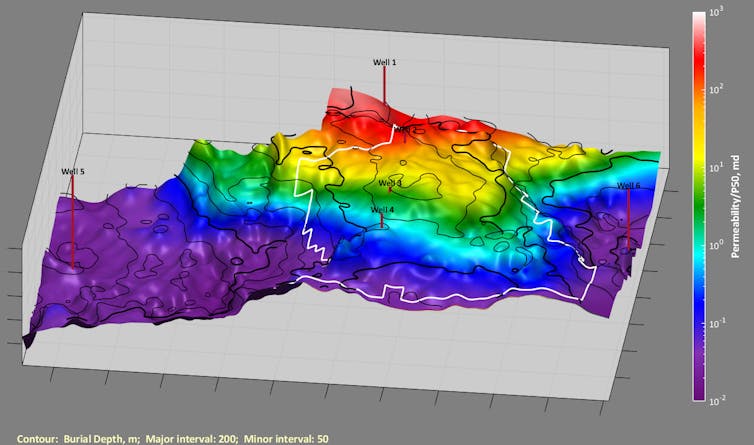
I look up a 3D schematic of an oil deposit, not unlike the one pictured below. It reminds me of a miniature massif: oil and gas seeping upwards through rock, resembling ice-falls in reverse. In place of a summit scarved with cloud, there’s a pointed deposit of trapped methane gas.
The next zone down, where a mountain’s glaciers would be, is an area on the diagram that is coloured green, showing oil. I look at a seismology map – the kind Mum used to work on in Oman. This time, the image shows a vertical cross-section through layers of rock. Its contours are shallower – more hillock than Himalayan peak. I think of knolls and hill forts – Arnside Knott on the Lancashire coast, or Torside on the shoulder of Bleaklow in the Peaks.
A 3D schematic of the reservoir properties of the Illizi Basin in eastern Algeria. SEG Wiki, CC BY
Mountains and petroleum share a similar vocabulary. Exploration, frontiers, surveying. I look at graphs of peak oil production and note coincidences with the so-called golden age of mountaineering. 1854-1865: the dawn of a prolific decade of Alpine mountaineering, the time of Edward Whymper and the Matterhorn disaster. 1859: the drilling of the first oil well by the Pennsylvania Rock Oil Company in Titusville. The 1950s and ’60s saw western companies exploiting deposits in the Middle East and South America, leading to my grandfather’s time working in Venezuela and Iran. Expansion to the Earth’s highest peaks; drilling into its rocky depths.
Richard Bass, the first man to climb the “Seven Summits” – the highest peaks on each continent – ran a Texan oil-and-gas business. Black gold funded Bass’s Snowbird ski resort in Utah. The first rope access workers on North Sea oil platforms were climbers and cavers.
Many of dad’s friends found that a youthful passion for rock climbing gave them an intimate knowledge of the character of different kinds of stone, or that reading maps translated easily into mapping the deep layers of Earth’s bedrock. For a geology or engineering graduate with an enjoyment of adventure and a love of travel, a career in oil exploration was an exciting and well-paid career path.
But expanding oil frontiers and summiting the world’s highest peaks bring similar controversies. It is no coincidence that mountaineering exploits and oil extraction share common ground with colonialism, foreign control, nation-building and struggles for self-rule. Local and Indigenous people are determined to protect their land, or want a stake in the wealth of an industry whose history is mired in colonial exploitation.
I think of the far-north of Canada and Alaska – of Athabasca people either fierce in their resistance to the incursions of oil companies under the ice, or wanting their fair share of the industry’s colossal profits. Sherpas, Sherpanis and Nepalis reclaiming Mount Everest after decades of western exploitation, smashing the time records for summit successes.
Murky soot and tiny microplastics from the oil industry touch even the shining Alpine summits that I love. They taint the high snows of Everest. The cataclysmic impact of fires, blowouts and everyday fossil-fuel burning strips them of their ice. Oil is there in the mountains of plastic waste I saw on the outskirts of Himalayan towns. And perhaps the most explosive place where fossil fuels meet mountains is Azerbaijan’s Yanar Dag, which dad visited in 2002 on the back of a drunken horse.
Mountain of Fire
Nightfall in the countryside near Baku. The horses hung their heads in the stalls. Bahram the guide poured beer on their oats. They shook themselves awake, started munching. Dad hauled himself into the stirrups and thudded into the saddle like a sack of gravel: “Don’t drink and ride!” The horses began the slow plod uphill.
Rocks and thirsty thorn-scrub. A wooden bridge over a parched river. Bahram paused, dismounted, lit a cigarette and flicked the ash towards the riverbed. It touched off flame.
Wink of fire through twilight. Whiff of gasoline on the breeze. Flames surged from a blackened fissure in the rocks. Yanar Dag means Mountain of Fire. This fissure has burned for 3,000 years at least. People raised temples where priests tend eternal fires. Did fires like this inspire Zoroastrianism, one of the world’s most ancient faiths? I look up the prophet Zarathustra, glance through Nietzche’s imagining of his words. I read about Zoroastrian fire rituals and trial by flame. I read about sacred fire, symbolising the light of the deity and the illuminated mind.
Dad worked in the Caspian region when I was a teenager, flying to Baku for one week every month. He admired the Flame Tower skyscrapers, relished lamb-and-rice plov. Deals were toasted with copious quantities of vodka. I heard about Shah Deniz, the King of the Sea, a gargantuan gas field under fathoms of rock and water.
Dad longed to hike the ochre-red foothills of the Caucasus, and loved spinning yarns about “Hell’s Doorway”, the crater over a natural gas deposit that burst into flames after a Russian drilling rig collapsed. At garden parties for his colleagues back in the Home Counties, I met Bahram and Mehtab, their daughters Farah and Donya.
The Caspian seabed was tough drilling. One of Dad’s Azeri colleagues showed me a map of the bedrock, riddled with faults. Dad enjoyed the reservoir engineering challenge this posed, in much the same way he relished building Meccano or getting my second-hand Scalextric cars to work.
Forty-eight billion barrels lie under the world’s largest inland water-body. The Caspian is split into four basins; the most southerly is the deepest, divided from the others by the Apsheron Ridge. This anticline linked to the Caucasus Mountains spans the entire Caspian from Baku to Turkmenistan. The Caspian was formed by a complex interplay of plates shifting and rifting.
One of the greatest hazards for oil exploration in the region – apart from the earthquakes – are the mud volcanoes. Found near petroleum deposits and mountainous regions, these bizarre formations belch up methane, creating mucky splatter cones. They may bubble up under a body of water, or erupt on land. The rounder ones on land are known as “mud domes”; the flatter ones are sometimes referred to as “mud pies”.
Dad loved telling stories about them. Soviet scientists wanted to predict their habits, proposing that variable water levels in the Caspian, and even sunspots, might trigger their eruptions. Mud volcanoes are found in the Carpathians, the Caucasus, California, and even in the Gulf of Mexico. Dashli Island in the Caspian Sea is one giant mud volcano which exploded near an oil platform in 2021, erupting flames 500 metres high.
The Caspian region is one of the oldest oil-producing areas in the world. Troops of the emperor Cyrus the Great used Baku’s oil as an incendiary weapon. Caspian oil lit the way for Alexander the Great’s soldiers. Medieval Arab historians and travellers noted the region’s dependence on oil for heating and trade. An inscription from 1593 commemorates a manually-dug oil well near Baku.
Baku has been an oil town for centuries. An enterprising Azeri merchant drilled two oil wells in the Caspian in 1803, likely the world’s first offshore extraction, although a storm made short work of them in 1825. Robert Nobel arrived in Baku in 1873, tasked with finding walnut trees for wood to build rifles for the tsar’s army; instead, he decided to buy an oil refinery. Grainy sepia images of Russian oil production show forests of wooden derricks. In 1898, Franco-Russian filmmaker Alexandre Mishon filmed gushers and blowouts. Russian production of Azeri oil was the most prolific petroleum source on the planet from 1899 to 1901.
Azerbaijan is the birthplace of many innovations: the first mechanically drilled oil-wells, the first pipelines, the first tankers. Following the collapse of the Soviet Union, competition for oil production partnerships in newly independent Azerbaijan was intense. A deal with BP in 1992 began three decades of exploration and drilling. The offshore platforms became enormous: photos show helipads, flarestacks, workers’ quarters, tangles of pipework. As the shallower oil reserves were exhausted, drilling became more ambitious. The Deepwater Gunashli platform began to pump petroleum from 175 metres below the water’s surface.
After “peak oil” – the height of demand and production – economists predict that we are entering the age of “tough oil”. Deep water, distant locations, greater danger. The oil reserves that dad and his colleagues explored were already becoming increasingly hazardous and hard to reach.
Portrait of Madeleine by Marie-Guillemine Benoist (1800).Louvre
According to one strand of history, slavery was abolished when Europeans found their conscience. According to another, it was abolished when it stopped being profitable. Both approaches tend to underplay the significance of Black resistance.
In a revolution that upended ideas about white superiority, the enslaved Black people of the French Caribbean colony Saint-Domingue liberated themselves to create Haiti, the first free Black nation in the Americas. The country was established in 1804, after more than a decade of armed struggle. This historic victory is part of a long series of violent rebellions that regularly shook the Caribbean islands and undermined the transatlantic slave economy.
These rebellions helped make the “slavery question” one of the most contested political issues of its time. Philosophers and statesmen balanced the wrongs of enslavement against the huge profits to be made for individual merchants and for nations as a whole. One after the other, European nations abolished first the trade in enslaved people and later slavery itself.
Looking for something good? Cut through the noise with a carefully curated selection of the latest releases, live events and exhibitions, straight to your inbox every fortnight, on Fridays. Sign up here.
Yet, even in abolition, European nations kept a close eye on their rivals. Britain’s abolition of the slave trade was followed by the creation of a West Africa Squadron of the Royal Navy. Its task was to interrupt the trade of other nations by capturing their slave ships and “liberating” their African captives.
These “liberated Africans” were given the choice of working for the Royal Navy or contributing to Britain’s colonisation of Sierra Leone. None of them were allowed to return home.
While this was going on, romanticism spread throughout Europe. It was a movement that affected every aspect of culture – art, literature, music, philosophy, science and politics. It centred on the idealisation of human freedom in all its forms. Old monarchies were to be swept away by democratic revolutions, stale aesthetic forms by sublime feeling, constrictive gender norms by free love.
The romantic drive for freedom is generally interpreted in relation to the French Revolution and the Industrial Revolution. Both symbolise a shift of power from the old nobility to the new bourgeoisie (or middle classes) and a concurrent shift from agrarian to urban economies. Romantic freedom is rarely read in the context of the slavery question.
My new book, The Trembling Hand, addresses this omission. It explores how enslavement shaped European culture in the late 18th and early 19th centuries. I trace how profits made from slavery supported literary work. I analyse how writers absorbed and refracted ideas about Africans that emerged in the public debate around slavery. Above all, I try to recover the presence of Black people, hovering at the edges of the archive.
How do we teach this history?
The links between ongoing Black insurrection in the Caribbean and the romantic obsession with freedom were felt by writers and artists at the time. But they have been obscured by the ways in which this period has traditionally been taught in schools and universities.
Today, the status quo is beginning to shift. In response to calls to decolonise and diversify the curriculum, a new canon of Black romantic writing is beginning to be taught. It’s centred on a handful of authors, especially Phillis Wheatley and Olaudah Equiano, as well as the unknown author of the novel The Woman of Colour (1808). Their presence in the curriculum is definitely an improvement – yet it also raises some problems.
To study Black writing of the romantic period inevitably means to study the history of slavery. This is because the only Afro-diasporic people who wrote in English in the 18th and 19th centuries had acquired the language in context of the transatlantic slave economy. It is very hard, if not impossible, to find a Black bildungsroman, gothic romance, or epic poem.
This is a historical fact. Yet it also means that only focusing on works published by Black authors risks playing into the notion that Black people’s only contribution to history was as “slaves”. This erases the multifaceted ways in which Afro-diasporic peoples affected the course of European history in the 18th and 19th centuries. Not only as “slaves” but also as cultural agents in their own right.
This points to the problem of the archive: its gaps and silences, but also its violent distortions.
Many of the archives that we have access to were created by enslavers. They had a vested interest in perpetuating the slave system even as it was being challenged by Black rebels and abolitionists. They threw all their rhetorical force at demonising Black people so as to justify enslavement.
Literature, alongside art, philosophy and the social and natural sciences contributed to spreading these ideas. These writings were instrumental in shaping public understanding about race, enslavement and empire.
We need to understand how literary writers contributed to constructing a vision of Britain as an imperial power entitled to subjugate foreign peoples and extract their resources.
How does the brutal violence of colonisation come to seem like a reasonable activity for a civilised nation to engage in? How does the idea that white Europeans have a “natural” right to rule over the whole world become widely accepted? Or the idea that people with a darker skin tone are born to serve? Or the idea that being a European power involves having colonies outside of Europe?
These questions prompt us, as readers interested in decolonising and diversifying the teaching of English literature, to turn our gaze on white authors. Especially those major authors whose work had an “impact” on their society. In addition to studying marginalised voices, we need to interrogate the ideas about race that have been created and propagated through canonical literature.
As these works become part of our national heritage, for example by being selected to be taught in schools, so the racial prejudice they harbour become wired into our own minds. Some of the racist ideas that I find in the historical archive are intimately familiar from my own experience.
That’s why I set out to write a new history of romanticism, one that reckons with the impact of the transatlantic slave economy on British culture – an impact so strong that it still resonates today.
This article features references to books that have been included for editorial reasons, and may contain links to bookshop.org. If you click on one of the links and go on to buy something from bookshop.org The Conversation UK may earn a commission.
Mathelinda Nabugodi has received funding from The Leverhulme Trust, The Deborah Rogers Foundation, and the Whiting Foundation.
Source: The Conversation – UK – By Georgia MacMillan, PhD Scholar – Research Ireland Employment Based Scheme, University of Galway
Without a view of the stars at night, Don McLean would never have been able to write Vincent and Vincent van Gogh would not have painted Starry Night. Viewing a sky full of stars is part of what makes us human. The light from stars has travelled thousands of miles to reach our eyes.
So where is all this extra light coming from? A recent German study reveals that, contrary to common assumption, public street lighting may not be the biggest cause of light pollution. The sources are closer to home. Improved energy efficiencies in LED technology means that artificial light is now cheaper than ever to run. As a result, people are lighting up front doors, sheds and garden paths like never before.
Artist Vincent van Gogh’s famous Starry Night painting was inspired by clear, dark skies. Rawpixel.com/Shutterstock
Artificial light at night has undoubtedly revolutionised our productivity and transformed our social environment as the sun sets. However, when used excessively or inappropriately, artificial light at night becomes light pollution. This changes our outdoor spaces by creating daytime conditions at night.
In particular, LEDs emitting high levels of harsh blue-white light are known to scatter more widely into the atmosphere, increasing levels of light pollution, which can have unintended consequences by interrupting our sleep cycles and circadian rhythms and disrupting nature at night.
Just one lamp can attract hundreds of insects, many of them important nocturnal pollinators, away from their natural environment, every single night. Once trapped in what’s called the “vacuum cleaner effect” of artificial light, scientists estimate that over 30% of these insects will die before dawn from exhaustion or predation. This disrupts the balance of nocturnal ecosystems.
The German researchers used a specially developed mobile app called NightLights to survey sources of light at night. More than 250 citizen scientists surveyed their local surroundings. The results challenged common assumptions that streetlights are the primary contributor to urban light pollution, and showed that residential, commercial and other non-street lighting sources play a significant role in brightening our night skies.
Insects are attracted to lights on houses, in gardens and public spaces. eleonimages/Shutterstock
In Ireland, we are coordinating similar surveys as part of a pilot programme to raise awareness of light pollution. Some of the most noticeable sources of night light include home security lights being angled up instead of down, garden runway lights over-illuminating pathways throughout the night and considerable light spilling from large windows without blinds or curtains.
Another growing issue in Ireland is the increasing intensity of illuminated sports grounds, often reported to the environmental non-profit group Dark Sky Ireland by concerned residents.
These issues can be easily resolved. Light pollution is just about the simplest of all pollutants to fix. Our study focuses on County Mayo’s Dark Sky Park, a place where naturally dark skies are protected and internationally recognised as a cherished form of natural heritage. We examined the role of dark sky tourism and community engagement in addressing light pollution. By making some simple changes to the type of light and being a little more judicious about how it is used, the level of unnecessary light currently polluting our night skies can be reduced.
Seeing the light
The community of Newport, County Mayo, has led the way in making these changes with some impressive results. Light pollution over the town of Newport has been reduced by 50% by redesigning the town’s lighting scheme – this award-winning project focused on replacing excessive flood lighting on heritage and architectural structures with a sensitively designed lighting scheme to enhance the town’s nightscape. As a feature of this initiative, the beautiful stained glass window at St Patrick’s Church in Newport, created by 20th-century artist Harry Clarke is delicately interpreted with light at night.
Lighting solutions that help protect dark skies include angling outdoor lights downwards and using shielded lamps to avoid illuminating the sky. Only direct light towards the area that needs to be lit, not into a neighbour’s garden or home. Use a visually warmer colour of light (such as amber) to reduce glare and improve conditions for wildlife and natural sleep cycles. Employing timers ensures that lights are only switched on when needed.
By making small changes to how we light our homes and gardens at night, the beauty of a starry night can be restored for generations to come.
Don’t have time to read about climate change as much as you’d like?
Georgia MacMillan is affiliated with Dark Sky Ireland as a voluntary director (unpaid). Dark Sky Ireland is a non-profit CLG.
Marie Mahon receives funding from Horizon Europe
I am the Lead PI for the Research Ireland funded PhD project for Georgia McMillan. While I don’t directly receive/benefit the funds I have a role in managing them for Georgia.
Source: The Conversation – UK – By Jonathan Este, Senior International Affairs Editor, Associate Editor, The Conversation
For the past few weeks the headlines about Gaza have focused on the hundreds of people who have been killed while queueing for food. The aid distribution system put in place in May, backed by the US and Israel and run by the Gaza Humanitarian Foundation, has proved to be chaotic and allegedly resulted in violence, with both Israel Defense Forces personnel and armed Palestinian gangs blamed for killing about 1,000 people in the two months the new system has been operating.
Now the headlines are focusing on the growing number of people dying of starvation.
Harrowing reports from the Gaza Strip report almost daily on the children dying of malnutrition in hospitals and clinics that simply don’t have the food to keep them alive. Writing in the Guardian this week, a British volunteer surgeon working in one of Gaza’s hospitals, Nick Maynard, described patients who “deteriorate and die, not from their injuries, but because they are too malnourished to survive surgery”.
The UK and 27 other countries this week has condemned the “drip feeding of aid and the inhumane killing of civilians” who are trying to get food and water. And yet, writes Simon Mabon, still the world’s leaders look on: “Most are apparently content to condemn – but little action has been taken.”
Mabon, a professor of international relations at Lancaster University, quotes the latest report from the IPC, which monitors food security in conflict situations. It estimates that 500,000 people in Gaza are considered to be facing “catastrophe”, while a further 1.1 million fall into the “emergency” risk category. Both categories anticipate a steadily rising death rate among civilians in Gaza.
So how can Israel’s allies apply pressure on Benjamin Netanyahu’s government to bring an end to the violence and allow Palestinian civilians access to the food, water and medical supplies they so desperately need?
Mabon canvasses a range of options. First of all, countries that have yet to recognise the state of Palestine can do so. It’s nonsense, Madon believes, to talk of a two-state solution – as the UK government does – when you haven’t actually recognised the second state in the equation.
Then they could stop selling arms to Israel. Many countries already have. But the US still issues export licenses for some weapons that are sold to Israel.
There are a plethora of other things world leaders could do to pressure Israel. Mabon recommends having a look at what the world did to isolate South Africa during the apartheid years, measures which eventually helped bring about meaningful change there.
As for Netanyahu, the Israeli prime minister is reported to be considering an early election. In previous months this looked like a move freighted with jeopardy. An election loss brought on by a disenchanted electorate, heartbroken at the hostage situation and exhausted by the conflict, would probably mean having to face the charges of corruption which have hung over him for more than five years.
But recent polls have suggested a bump in popularity following his 12-day campaign against Iran. Netanyahu is nothing if not a clever political manipulator. But Brian Brivati, a professor of contemporary history and human rights at Kingston University, believes that to have a chance of winning, the prime minister will need to fight a campaign on three narratives of his government’s success: securing the release of the hostages, defeating Hamas and delivering regional security. “It is a tall order,” Brivati concludes.
Anyone following the situation in Gaza over the past 18 months will have encountered Francesca Albanese, the UN’s special rapporteur for Palestine’s occupied territories. For three years she has monitored the human rights situation in Gaza and the West Bank, delivering trenchant criticism of Israel’s conduct and those who, by their inaction – and sometimes contrivance – have enabled it.
Earlier this months, the US government imposed sanctions on Albanese, because – as US secretary of state Marco Rubio insisted – she has engaged with the International Criminal Court (also subject to US sanctions) “in efforts to investigate, arrest, detain, or prosecute nationals of the United States or Israel”. Also she has written “threatening letters to dozens of entities worldwide, including major American companies”.
Alvina Hoffman, an expert in diplomatic affairs and human rights at SOAS, University of London, explains what a special rapporteur does and why their work is so valuable in the defence of human rights.
To Istanbul, where delegations from Russia and Ukraine met yesterday for their third round of face-to-face talks. All 40 minutes of them. There was another agreement of prisoner swaps and the two sides decided to set up some working groups to look into various political, military and humanitarian issues – but online rather in person.
The brevity of the talks came as no surprise to Stefan Wolff. Wolff, an expert in international security at the University of Birmingham who has provided commentary for The Conversation throughout the conflict in Ukraine, points out that both sides remain wedded to their maximalist war aims. For Russia, this is for Ukraine to accept Russia’s annexation of Crimea and four provinces of eastern Ukraine, a ban on Ukraine’s membership of Nato and a much reduced military capacity. For Ukraine, it is getting their territory back and Russian acceptance of their national sovereignty, meaning it gets to determine for itself what alliances it seeks.
Donald Trump has told Vladimir Putin that, if there’s no ceasefire in 50 days, he’ll apply harsh secondary sanctions on the countries buying Russian oil and that he plans to supply Ukraine with American weapons (via Nato’s European member states, that is). Wolff believes both sides will now play the waiting game. They will calculate their next move after September 2, when the 50 days run out, and when they know more about what the US president plans to do.
Volodymyr Zelensky, meanwhile, faces pressure from his own people. There have been days of protest at his decision to bring two formerly independent anti-corruption organisations under the direct control of the government. He argues that this was necessary to prevent Russian infiltration, while critics are saying that the Ukrainian president has launched a power grab designed to prevent independent investigation of alleged corruption against people close to him.
Jenny Mathers says these protests, which involve people from all political shades, including people who have fought in the defence of Ukraine since 2022, some with visible injuries, represents a fracture of the “informal agreement between the government and society to show a united front to the world while the war continues”.
Ukrainians protest after Zelensky signs law clamping down on anticorruption agencies.
It’s not as if Zelensky is in clear and present danger of losing his job. His party holds a majority of seats in the Ukrainian parliament, so he governs without having to depend on coalition partners. And the country’s constitution prohibits the holding of elections in wartime – whatever Putin, who regularly insists that Zelensky is an illegitimate leader because he is governing past his term limit, might think. Plus his approval rating sits at 65%.
Zelensky has been quick to soften his stance on this. Mathers says that political corruption is a very sore point in Ukraine, where there was decades of it until the Maidan protests of 2013-14 unseated the pro-Russian president Viktor Yanukovych. As she writes here, “the ‘Revolution of Dignity’ that rejected Yanukovych’s leadership and his policies was also a resounding demonstration of the strength of Ukraine’s civil society and its determination to hold its elected officials to account. Zelensky would be rash not to heed that.
He also knows it’s important for him to present a squeaky clean image to his supporters in the west. So while the protests may not present an immediate threat to his own position, he knows that unless he acts to root out corruption in Ukraine, it’ll be a threat to the future of the country itself.
But ethicist Marcel Vondermassen from the University of Tübingen believes another recent decision by the Ukrainian government is storing up trouble for the future. Ukraine has recently announced its decision to pull out of the Ottawa convention, the treaty that forbids the use of anti-personnel landmines.
In doing so, he’s following the example of Finland, Poland, Lithuania and Estonia which have all also quite the treaty in recent months for fear of Russian aggression.
But as Vondermassen points out, landmines don’t usually switch themselves off when a conflict ends and people are still being killed an maimed in former conflict zones around the world. Often it is farmers at work or children at play who are the victims. If other ways to protect countries from aggression aren’t pursued, as he puts it, in future decades we’ll still be “counting thousands of child casualties … from the landmines laid in the 2020s”.
Thailand-Cambodia: centuries-old dispute flares again
A dispute between the two south-east Asian countries that has been simmering since May flared into life yesterday when five Thai soldiers patrolling the border region were injured after stepping on a landmine – the second such incident in the past week. Both countries have sealed their border and there have been tit-for-tat ambassadorial expulsions.
Cambodia fired rockets and artillery into Thailand, killing 12 civilians. Thailand in turn has launched airstrikes against Cambodia. Both countries are blaming the other for starting it.
Petra Alderman, an expert in south-east Asian politics from London School of Economics and Political Science, traces the origins of this row, which go back to the colonial era in the 19th and early 20th centuries.
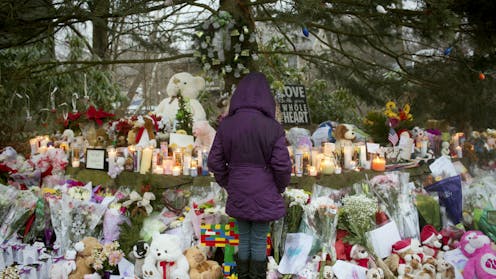
A mourner pays tribute to the victims of the mass shooting at Sandy Hook Elementary School in Newtown, Conn., in December 2012.Lisa Wiltse/Corbis via Getty Images
Fatal school shootings don’t just devastate communities emotionally – they also harm their economies, new research shows. People eat out less, avoid public spaces and generally spend less money after a tragedy strikes a local school. This has real economic consequences for neighborhoods that are already reeling.
Weare a team of marketingprofessors, and in a recent study we looked at household spending in more than 60 U.S. counties that had experienced fatal school shootings between 2012 and 2019. We found that in the six months following an attack, people spent an average of 2.1% less on groceries.
In a separate analysis of store-level data from 2019 to 2022, we examined 44 more school shootings and found similar declines. Spending at restaurants and bars dropped by 8%, and purchases at food and beverage stores – a category that includes grocery stores – fell by 3%. For the average U.S. county, this represents about US$5.4 million in lost grocery revenue.
Importantly, we found no evidence that consumers spent more on online shopping or food delivery to compensate. The reductions represent real losses in economic activity.
To understand why this happens, we conducted three behavioral experiments. We found that people who read news about fatal school shootings said they were more anxious about being in public and less likely to visit a grocery store or restaurant than those who read about other similarly tragic events involving children, such as fatal car accidents or drownings.
Among several potential psychological explanations, anxiety about public safety best predicted this reduction in spending. That fear, we found, consistently hits harder in politically liberal areas. For example, grocery spending fell 2.4% in liberal-leaning counties compared to 1.3% in conservative-leaning counties in the six months following a fatal school shooting.
Why it matters
School shootings have become tragically common in the United States. Between 2013 and 2024, there were 1,843 such shootings – nearly three every week. Since the Columbine High School shooting in 1999, 203 children and educators have been killed in these tragedies.
We found that school shootings reshape communities far beyond the schoolyard. Many residents withdraw from public spaces. Local businesses can lose customers. The result is a lasting decline in consumer activity.
And our findings could understate the problem. We studied spending categories such as groceries and food, which are typically resistant to short-term change. This suggests that the actual economic toll, especially in sectors such as retail and entertainment, may be even greater.
These effects aren’t caused by damaged infrastructure. They are behavioral, rooted in fear and avoidance.
This points to the need for broader, more coordinated community responses following fatal school shootings. In addition to providing trauma care and improving school safety procedures and infrastructure, local governments may need to consider proactive policies that support economic recovery. Relief grants, public communication campaigns and community engagement initiatives could help restore a sense of normalcy and public confidence.
What still isn’t known
While our study shows that fatal school shootings hurt local economies, it leaves an urgent practical question unanswered: How can policymakers and local businesses help these communities bounce back?
Right now, there’s not much solid evidence about which strategies actually work. For example, could public safety messaging help restore consumer confidence? Would investments in visible security or mental health services reduce anxiety and encourage people to reengage with local businesses? These are important questions for future research.
Researchers can also help businesses by identifying practical ways to rebuild trust and foot traffic. While industry best practices emphasize environmental modifications, staff training and enhanced communication about safety protocols, much of that guidance is drawn from other crisis contexts rather than from systematic research on responses to school shootings.
The potential for retailers to adopt trauma-informed approaches – such as updating store layouts, providing specialized staff training or offering community outreach programs – represents an area where more research could do a lot of practical good. It’s also possible that coordinated responses involving multiple businesses could be more effective than efforts led by individual retailers.
Figuring out what works is essential for protecting local economic stability and helping residents heal. Without stronger evidence, communities may be left to navigate their own recovery process in the dark.
The authors do not work for, consult, own shares in or receive funding from any company or organization that would benefit from this article, and have disclosed no relevant affiliations beyond their academic appointment.















.png)
