Netflix’s ‘Mo’ delivers humour and heartache as it explores Israel-Gaza war, Palestinian and Mexican migrant life in the U.S.

Source: The Conversation – Canada – By Faiza Hirji, Associate Professor, Department of Communication Studies and Media Arts, McMaster University

I recently watched both seasons of the Netflix drama-comedy Mo (2022-25), expecting a good laugh, since the show is headlined and written by funny and smart comedian Mohammed Amer.

Mo does provoke a lot of laughter, but it also stirs deep emotions, including despair, loneliness and helplessness, as the episodes explore life in America for people on the margins.

Mo is a semi-autobiographical depiction of Amer’s life. He’s a Palestinian who grew up in Houston, Texas, immigrating to that city when he was nine years old by way of Kuwait.

In the series, Amer plays Mo Najjar as he navigates a complex balancing act between the different cultures that have shaped his life. Mo undergoes struggles to obtain asylum status in the United States as a “stateless person” with no passport.

Amer uses elements of a situation comedy to introduce increasingly troubling sociopolitical themes, leavening an existential darkness with the love and laughter of the main character’s friends and family.

The comedy-drama format allows Mo to address difficult and divisive issues, such as immigration in America and the Israel-Gaza war, in non-threatening ways.

Amer’s comedic writing also serves to humanize his characters. This is particularly important accomplishment in the case of Palestinians, both at home and in the diaspora — and more broadly for Muslims globally — given the long history of misrepresentation of Islam in western discourse.

Comedy tackles erasure of Palestine

In his writing on the first Gulf War, Canadian researcher Karim H. Karim explains how western war propaganda attempted to dehumanize their enemy. He cites comments from the U.S. army members during the Gulf War as examples. They described Iraqis as non-human and animals: “fish in a barrel,” “cockroaches” and part of a “turkey shoot,” alongside the use of longstanding stereotypes about Arabs and Muslims

Dehumanizing techniques can also be seen in today’s conflicts in the Middle East.

For example, Israeli Finance Minister Bezalel Smotrich delivered a speech in October 2024 in which he said: “There is no such thing as a Palestinian nation. There is no Palestinian history. There is no Palestinian language.” Israeli Defense Minister Yoav Gallant also said: “We are fighting human animals and we act accordingly.”


Read more:
How colonialist depictions of Palestinians feed western ideas of eastern ‘barbarism’


Mo counters these types of messages repeatedly as features representations of strong women, respectful men and loving families, instead of the angry terrorists or oppressed women depicted in western imaginings.

Several researchers have previously documented such stereotypes, including Edward Said, Leila Ahmed, Yasmin Jiwani, Karim Karim and Ross Perigoe and Mahmoud Eid.

Comedy is non-threatening

Viewers get to know Mo’s family, the Najjars, and their quirks and idiosyncracies, as well as the complicated path they tread.

During the family’s asylum hearing, an opposing lawyer raises an objection to their claim, saying the U.S. does not recognize Palestine as a state. The statement is brief and the moment passes quickly, but the viewer is now aware of this kind of daily erasure of Palestinian people.

Over the course of the show, viewers see the many ways Mo protests the general erasure of Palestinian culture, including a recurring argument over the origin of hummus (made with chickpeas, garlic, tahini and olive oil).

Building that statement into a comedy is less likely to attract negative attention than a high-profile drama or documentary. For example, Hamdan Ballal, one of the directors of the Oscar-winning Israel-Palestine documentary, No Other Land, was injured in an attack by masked settlers and then arrested by the Israel Defence Forces in the West Bank. Israel’s culture minister said changes had been made to public funding rules to help prevent similar films from being made in future..

Comedy as simultaneous defusion and resistance is also practised by the Palestinian-Canadian comedian Eman el Husseini, whose stand-up routine touches on the idea that Arabs are perceived to be dangerous while painting a picture of her own family as affectionate, overbearing and harmless.

The strategic use of comedy to make characters relatable is a technique that has proven successful with racialized comedians tackling difficult issues, both for stand-ups like Russell Peters and situation comedy formats like Black-ish.

Crushing challenges

Humour may seem like an odd response to the characters’ crushing challenges. At one point, while in negotiation with a criminal who is threatening to amputate the foot of his friend, Mo suggests cutting off just a pinkie instead, hissing to his outraged friend, “Hey, you don’t wear pinkie rings, anyway!”

But in this series, humour becomes the coping mechanism for Mo‘s characters, however fraught or fragile the issue, from a lighthearted chuckle to the darkness of gallows humour.

At times, Mo’s mother, Yusra (Farah Bsaiso), seems utterly consumed by stories of dispossession taking place back in Palestine, while Mo becomes increasingly angry about examples of appropriation and erasure.

His sister, Nadia (Cherien Dabis), trying to forge a way forward, urges her mother to pull herself away from stories of tragedy back home and resist oppression finding moments of happiness. She insists:

“We’re more than our pain and suffering.”

Ultimately, it is Yusra who summarizes what it means to smile through one’s pain, telling Mo:

“The world will always try to tear us down. And when they do…we smile. Because we know who we are.”

Resilience

In Season 2, Mo, still undocumented in Texas, gets accidentally trapped in Mexico after unwittingly crossing the border. His Mexican fiancée leaves him in frustration and loneliness.

Throughout this season, Mo’s anger at the American immigration system grows as he repeatedly tries — and fails — to get home. He seems to be engaging in constant self-sabotage, in which he simply cannot accept the process that his lawyer and the bureaucracy have outlined for him.

Yet, as the depth of the dehumanization experienced by Mo and his family becomes more and more apparent, Mo’s simmering, ever-present anger starts to seem less dysfunctional. Instead, the world’s indifference becomes spotlighted.

During these episodes, Mo begins to learn how to live with — but never accept — injustice.

However, this is still a sitcom, and some things do work out for Mo. At the end of Season 2, Mo and his family get their U.S. passports and so can finally visit their family in Palestine.

As Mo is getting ready to return to Texas, after a joyful and also heartbreaking visit with his relatives, he is harassed by an Israeli border guard. At this moment, Mo realizes he must develop the same inner strength and resolve embodied by his mother, earned after years of having to bear such harassment.

Although Mo is consumed by anger and sadness at the unjust actions towards him by the guard, against all his instincts, he thanks the border guard, smiles and walks on.

The Conversation

Faiza Hirji receives funding from the Social Sciences and Humanities Research Council of Canada.

ref. Netflix’s ‘Mo’ delivers humour and heartache as it explores Israel-Gaza war, Palestinian and Mexican migrant life in the U.S. – https://theconversation.com/netflixs-mo-delivers-humour-and-heartache-as-it-explores-israel-gaza-war-palestinian-and-mexican-migrant-life-in-the-u-s-249684

Forcing Zelensky to hand Putin Ukraine’s ‘fortress belt’ in Donetsk will lose it the war

Source: The Conversation – UK – By Rod Thornton, Senior Lecturer in International Studies, Defence and Security., King’s College London

In the recent summit talks in Alaska designed to halt the Russia-Ukraine war, Vladimir Putin demanded that Kyiv cede control of the entirety of its Donetsk oblast (region) to Russia. But this would effectively be tantamount to an acceptance of overall defeat for Ukraine.

In giving up this region, Kyiv would also be giving up its principal defensive barrier against further Russian encroachment into the whole of Ukraine – that is, it will lose its “fortress belt”. This is the name given (by the Russians themselves) to a series of fortified Ukrainian-held cities, towns and settlements in the west of the Donetsk region. This belt roughly links the city of Slovyansk in the north to Kostyantynivka, some 50 km to the south.

The current situation on the battlefield needs to be viewed with a certain context in mind – that of geography. The state that we now call Russia (which has included Ukraine for much of its existence) has been subject to many invasions throughout its long history. Foreign invaders – whether coming from the east, south or west – were generally able to make rapid initial progress in their invasions, not least because Russia had few natural barriers that could act as defensive lines.

In particular, the open steppe lands, lacking hilly or mountainous terrain, have represented an open invitation to invaders. This issue still pertains. But today, ironically, these largely indefensible steppe lands are Ukrainian territory that is under threat from Russian forces.

In light of this, Kyiv cannot rely on terrain to form defensive lines. It has to rely on creating urban barriers. Towns and cities are notoriously difficult to capture or to fight through. Buildings, especially large ones, provide ideal cover and fire points for defenders. Getting into urban areas is difficult because of the channelling effect of the road systems. Obvious routes can be well defended with mines, obstacles and covering fire. Rubble also makes movement difficult. Urban scenarios very much favour the defender.

The normal tactic for an assaulting force would be to try and outflank and surround such urban areas and to then to essentially lay siege to them to prevent their resupply and thus force their surrender. This is what happened, but on a smaller scale, with the capture of Mariupol by Russian forces early in the war.

The other alternative has been to “squeeze out” Ukrainian forces from any town they are holding. In such scenarios, towns have been enveloped on three sides by Russian troops. This has then forced the under-pressure Ukrainians to withdraw though the only remaining egress routes. Russian forces then occupy the abandoned town.

This is what happened at towns that Ukrainian forces lost earlier in the Donbas region: Avdiivka, Bakhmut and Soledar.

But both of these forms of attack on urban areas are currently being denied to Russian forces. This is because of the complex series of Ukrainian defensive lines that have been established now between the series of towns and cities in the Donetsk fortress belt. These make use of minefields, anti-tank obstacles, enfilading fire (firing along the enemy line to inflict maximum casualties) provided by tube artillery and copious drone use.

Because the Russians have largely been unable to break through these lines they have been prevented from surrounding or enveloping any of the major urban areas within the fortress belt.

Last line of defence

It is strategically vital for the Ukrainians that this belt continues to hold back the Russians. It appears that one of the main aims of the 2025 summer offensive by Moscow (according to Russian officers captured by the Ukrainians) has been to break through this belt. It was said to represent the “poslednii ryvok” (the “final push”) that would settle the war’s outcome in Russia’s favour.

ISW map showing the potential for a rapid Russian advance west of the Donetsk oblast.
Handing over the remainder of the Donetzk oblast, with its ‘fortress belt’ of fortified cities, would clear the way for a rapid Russian advance into central Ukraine.
Institute for the Study of War

But this has not happened and looks unlikely to happen anytime soon. Indeed, as the Institute for the Study of War put it recently, Russian forces “are engaged in an effort … to seize [the ‘fortress belt’] that would likely take several years to complete”.

Hence, it becomes easier to understand why Putin needed to make the demand that he did at Anchorage. What cannot be achieved on the ground in terms of breaking through the fortress belt he is trying to achieve via a peace deal brokered with US assistance.

Gaining control of the west of the Donetsk region is the key to winning the war. Putin knows this. If Donetsk and its fortress belt are given up, then the open steppe land to the west would be exposed to Russian advances. Great swaths of Ukrainian territory would rapidly fall.

As one Russian source put it this week, the fortress belt “is the last serious line of defence for the Ukrainian Armed Forces. Beyond it, Kyiv has no other prepared lines of defence to Zaporizhzhia and the Dnipropetrovsk region … [and] … the Russian army can … advance to the Dnieper River”.

If Russian forces came to be camped on this part of the Dnieper, then it’s hard to imagine that Ukraine would not then have to accede to yet further, strategically damaging, territorial demands from Moscow. With such a scenario in mind, the future course of the whole war hinges on Ukraine not giving up its fortress belt in western Donetsk.

Perhaps an irony in Putin’s demand that the whole of the Donetsk region be handed over is that it could be seen as coming from a position of what appears to be weakness and not strength. He cannot wait the years it may take to seize the cities and towns that form the fortress belt. Russia cannot remain on a war footing for too much longer, according to reliable reports on the state of its economy.

But even so, Kyiv may have to accede to Putin’s demands because it will potentially come under pressure from the Trump administration, which itself does not want to wait years to see a resolution to this conflict. If Kyiv does accede, though, then this may amount to Ukraine accepting its overall defeat. It may, indeed, lose the war.

The Conversation

The authors do not work for, consult, own shares in or receive funding from any company or organisation that would benefit from this article, and have disclosed no relevant affiliations beyond their academic appointment.

ref. Forcing Zelensky to hand Putin Ukraine’s ‘fortress belt’ in Donetsk will lose it the war – https://theconversation.com/forcing-zelensky-to-hand-putin-ukraines-fortress-belt-in-donetsk-will-lose-it-the-war-263980

Phones and other tech can enhance teens’ connection to nature

Source: The Conversation – UK – By Samantha Friedman, Lecturer in Applied Psychology, University of Edinburgh

New Africa/Shutterstock

Screens, and technology more generally, are often seen to be at odds with engagement and connection with nature. Teenagers are implored to put down their phones and go outside instead.

This is a key premise in recently announced measures by the UK government to “to re-connect young people with the world around them”. Funding for youth clubs and after-school activities is intended to remedy a situation in which young people are “stuck in their bedrooms or behind a screen”.

Certainly, investment in youth activities, especially those which support young people to build their relationships with nature, is necessary and welcome. But viewing these as merely an antidote to chronic screen use is missing the point entirely.

Screens can be an important part of how young people interact with and understand the natural world. Those screens might be the very key to getting teenagers out of their bedrooms and into the outdoors.

Placing blame

At first glance, it is tempting to place the blame on screens when considering the reasons behind why many people have spent less time outside over the last few decades.

Author and journalist Richard Louv, in his popular book Last Child in the Woods, does just this. He points to time spent watching television and using computers as contributing to a rise in what he calls nature deficit disorder – an ailment related to human separation from nature. Nature deficit disorder supposedly affects physical health and attention spans, among other negative outcomes (though many criticisms exist about this concept).

Alongside suggestions that people of all ages have spent less time outdoors over past decades, mental health difficulties in teenagers have increased in recent years. Technology is often pointed to as one potential driving force. It is important to note that the current evidence appears mixed about whether this is the case.

Given the benefits to wellbeing associated with spending time in nature, it is easy to see how a certain narrative emerges: that teens are suffering from poor mental health because they spend too much time indoors on screens, and this problem could be solved if only they would put their phones away and spend time looking at trees.

Connection to nature – the relationship that a person has with the natural world – is also known to dip in early adolescence (around age 12) and remain low until early adulthood. Encouraging young people to spend more time outside could address this issue, too.

However, when approached with the mentality of “screens versus time outdoors”, this risks being a pointless effort. Technology is central to nearly everything we do, for better or worse. It is not realistic to suggest that the answer to any of these modern difficulties – poor wellbeing, increased screentime, or decreased connection to nature – lies in restricting technology or framing time outdoors as a replacement.

Nature with tech

Instead, technology should be seen to have a role in supporting outdoor experiences. At a basic level, technology helps make the outdoors more accessible for many. Maps, location apps such as what3words and location tracking can ensure people stay safe.

Group of young people hiking and looking at phone
Tech can make access to nature and the outdoors easier.
f.t.Photographer/Shutterstock

Technology can be used to enable communication for people who communicate differently, such as through the use of iPad apps or speech-generating devices. It can help those with sensory needs feel more comfortable going outside; for instance, using a phone and headphones to listen to music can help block out unwanted sensory stimuli outdoors.

Placing higher value on tech-free outdoor experiences only serves to distance people and gatekeep experiences for those who can easily disconnect. People with caring responsibilities or health conditions, for instance, might find it impossible or dangerous to put their phones away completely when spending time outdoors. In many ways, it is a privileged position to be able to go tech-free outdoors.

Rather than taking an approach that views engagement with screens as the opposite to nature experiences, we should encourage young people to use their technology responsibly to support their experiences with nature.

For instance, phones can be used to identify bird song, plants, and animal tracks or to report wildlife sightings through citizen science projects. Even indoors, looking at photos of natural things, watching nature documentaries, or listening to nature sounds can help support relationships with nature.

Despite the drawbacks of social media, nature content can be an effective way in to experiencing the outdoors for many people. See, for instance, the extreme popularity of Outdoor Boys – a recently retired YouTube channel with 16.5 million subscribers which featured videos of an American man partaking in a range of outdoor activities with his children in Alaska and elsewhere.

With the potential to translate online interests into real-life experiences, embracing the power of nature-based social media content is one way of meeting teenagers where they already are.

People who have stronger relationships with nature are more likely to act in service of the environment. Building upon young people’s interest in the environment can provide opportunities to have frank discussions about the environmental effects of the technology we use every day. This could include, for instance, the rare earth minerals in our phones or the huge amount of energy used by generative AI.

Taking this more balanced approach will help young people see technology as a potential enabler of their experiences with nature.

The Conversation

Samantha Friedman does not work for, consult, own shares in or receive funding from any company or organisation that would benefit from this article, and has disclosed no relevant affiliations beyond their academic appointment.

ref. Phones and other tech can enhance teens’ connection to nature – https://theconversation.com/phones-and-other-tech-can-enhance-teens-connection-to-nature-263082

Being funny helps populist politicians create bonds and get voters on board

Source: The Conversation – UK – By Adam R. North, Early Career Researcher, Religions and Theology Department, University of Manchester

Humour has become one of the most potent weapons in the populist politician’s playbook. Comedic populists like Donald Trump, Boris Johnson, Nigel Farage and Argentinian president Javier Milei use ridicule, absurdity and sarcasm not just to entertain, but to deflect criticism, confuse opponents and present themselves as relatable outsiders. Their tomfoolery and comedic stunts often dominate headlines and capture attention online.

These uses of humour have been widely discussed in this context. But one key function of populist humour still receives too little attention: its power to mobilise disaffected voters.

My own research has examined how humour functions as a means of speaking truth to power. But I now believe that comedy, long mobilised as a subversive tool, is being appropriated by populists as a strategy for building political loyalty.

Beyond softening rhetoric or mocking political opponents, humour helps politicians create emotional bonds, build group identity and energise voters who feel let down by traditional politics and politicians. It isn’t just comic relief – it’s a call to action.

The appeal of comedic populists is often invisible to their critics. Dislike and distaste can blind people to the way these figures connect with large audiences – especially disaffected voters. This blind spot prevents understanding how humour fuels political support.

Take this New York Times guest essay from August 2024, titled Trump is losing the humor war. While it concedes that “Donald Trump is funny”, it argues his humour had lost its edge. That assessment was premature.

Throughout the 2024 campaign, Trump remained humorous – from working in a McDonald’s drive-through, to driving around as a bin man at a rally to mock Joe Biden, he deployed several humorous stunts to amplify his message and entertain supporters.

These stunts gained widespread coverage and went viral on platforms like TikTok – where, according to Pew Research, nearly half of US users under 30 now follow political news. Humour, in this context, becomes both strategy and spectacle.

Trump recognises this. On one Joe Rogan podcast – viewed over 60 million times – Rogan praises Trump’s comedic instincts. Trump replies: “You need at least the attitude of a comedian when you’re doing this business”. Considering Trump and other comedic populists’ success in the previous decade, it’s hard to disagree.

Who is mobilised by humour?

Populist humour resonates most strongly with disaffected voters – people who feel ignored or betrayed by traditional politics – and research shows that disenfranchised voters often vote for radically different candidates. In an era of declining trust in political institutions in many western nations, it’s unsurprising that voters should turn to political alternatives who break the conventional mould.

Some of these figures were comedians before they were politicians. Others cultivated humorous personas over time. Many have successfully capitalised on this situation. The best known is Ukraine’s Volodymyr Zelenskyy a former comedian who once played a fictional president on Ukrainian TV.

Other former comedians who have gone on to win national or regional office include Guatemala’s Jimmy Morales, Slovenia’s Marjan Šarec, and Iceland’s Jón Gnarr. Italy’s Beppe Grillo, a stand-up comic, co-founded the Five Star Movement which went on to enter government, though Grillo himself never held elected office.

Boris Johnson, Donald Trump, and Javier Milei all cultivated entertaining personalities through TV appearances and a variety of stunts. A consistent pattern emerges: these leaders tend to rise in contexts of low political trust, where their humour grabs attention and appeals to disaffected voters.

But another trend is equally clear: the sustainability of support for comedic populism often diminishes once in office. The performative and oppositional strengths that fuel electoral success often translate poorly into the demands of serious governance.

Zelenskyy appears to be an exception, although recent legislation threatens his approval ratings. Nevertheless, he remains popular due to the Russian invasion, and his shift from comic performer to a serious leader of resolve and emotional authenticity.

Populist humour in the media

Populist humour thrives on public attention. Social media rewards wit over substance; jokes, memes and soundbites travel fast. In a media environment driven by anger, disinformation and tribalism, comedy is a perfect vehicle of delivery. Humour creates sharable content, frames opponents as humourless and signals in-group identity.

A striking example came during Trump’s 2024 presidential campaign when he claimed that Haitian migrants were eating pets in a town in Ohio. The statement, though baseless and inflammatory, went viral. Critics expressed outrage, supporters laughed, and Kamala Harris scoffed at the absurdity. Yet, the allegation provided an effective means of communicating anti-migrant, racist rhetoric across news outlets and social media platforms.

It even inspired a parody song called Eating the Cats ft. Donald Trump, by the South African musician The Kiffness, which has racked up millions of views across social media.

This is the paradox of populist humour: it doesn’t need to be factual, tasteful or substantive. It just needs to resonate with its intended audience and spread across media platforms.

If we want to understand modern populism, we need to take its humour seriously. It’s not a distraction from politics; it’s a vital tool in the populist toolkit. Humour builds community, projects authenticity and drives participation and feelings of inclusion. For disaffected voters, it offers something traditional politics often doesn’t: a reason to laugh, and a reason to listen.

The Conversation

Adam R. North does not work for, consult, own shares in or receive funding from any company or organisation that would benefit from this article, and has disclosed no relevant affiliations beyond their academic appointment.

ref. Being funny helps populist politicians create bonds and get voters on board – https://theconversation.com/being-funny-helps-populist-politicians-create-bonds-and-get-voters-on-board-260343

The problem with Auschwitz-Birkenau’s new digital camp replica

Source: The Conversation – UK – By Emily-Rose Baker, Research Fellow, Department of English, University of Southampton

At this year’s Cannes Film Festival, the Auschwitz-Birkenau Memorial and Museum announced the launch of a new digital replica of the concentration camp for filmmakers. Titled Picture from Auschwitz, the virtual film location is designed to facilitate a range of productions set on the grounds, where preservation regulations currently restrict filming to documentaries.

Established in the town of Oświęcim in German-occupied Poland, Auschwitz consisted of three main camps where over 1.1 million European Jews were murdered: the Auschwitz I concentration camp, the Auschwitz II (Birkenau) killing centre and the Auschwitz III (Monowitz) labour camp.

With this new technology, the museum hopes to support the “true story” of the camp, “without compromising the memorial’s historical integrity”. It intends to do so not only by digitally preserving the Holocaust site, which receives over two million visitors annually, but by submitting the scripts for all new feature film projects involving the replica to a team of historians for review.

The panel that launched Picture From Auschwitz at Cannes.

A glimpse of the digitised location shows a virtual model of Auschwitz I which, as its name suggests, provides a clear snapshot of the camp’s barracks, grounds and infamous wrought iron gates. The two-minute trailer claims that the certified 1:1 digital representation is the “biggest and most detailed documentation of the camp”. It will eventually include the interior as well as exterior environment of Auschwitz I and II.

The project’s use of digital technology to safeguard Holocaust memories for future generations is symptomatic of a global shift towards digitising the Holocaust as the survivor generation passes on and heritage sites decay over time – a process accelerated by extreme weathering associated with the climate crisis.

As the Holocaust recedes from living memory, cultural institutions are increasingly reliant on digital tools to remember the past. While some have used virtual reality to digitally reconstruct and maintain key Holocaust sites, others have turned to AI to generate interactive survivor holograms.

These technologies are becoming popular educational tools designed for use in classrooms as well as museums and memorial sites.

Ethical implications

Digital memory projects protect and make Holocaust sites globally accessible. Yet these same technologies risk distorting the historical record.

In the UK, public debates concerning the ethics of digital Holocaust technologies including AI and VR have involved high profile politicians as well as scholars. Meanwhile, international bodies including Unesco and the World Jewish Congress have reported that generative AI in particular may fuel Holocaust distortion.

Picture from Auschwitz aims to address these issues and its creators purport to enable “ethical storytelling”. The director of the Auschwitz-Birkenau Foundation, Wojciech Soczewica, referred to the project on the Memorial’s website as a “powerful example of how culture and technology can unite to protect our shared human history from distortion and denial”. The replica will “preserve the relevance of the history of Auschwitz”, he added, ensuring it won’t “fade with time”.

While the virtual site digitally preserves and encourages historically rooted depictions of the camp, it cannot ensure ethical engagement with the Holocaust. In fact, its creation only raises further issues about the extent to which the Holocaust’s digitisation goes hand-in-hand with ethical modes of remembrance and representation.

A glimpse of the Picture from Auschwitz project

A wholly “authentic” depiction of any Holocaust site or experience is something that digital and filmic interventions can only gesture towards.

Even if such a depiction were possible, ethical portrayals of the Holocaust are not contingent on the accurate representation of sites themselves. They are equally concerned with the kinds of stories being told as well as formal and stylistic factors. As film researcher Archie Wolfman argues, filmmakers’ choices “about camera movements, angles, lighting and editing have as much ethical significance as what is in front of the camera”.

The implication that Auschwitz must be digitised for its legacy to be protected suggests that the wealth of material that already exists on the camp – including its extant remains, the personal belongings of victims and survivor testimonies – are no longer sufficient memorial tools. It also problematically suggests that Holocaust history must somehow keep up with digital culture to remain relevant.

The digitisation of Auschwitz perpetuates the privileging of some Holocaust sites and stories above others, such as the rural landscapes across central and eastern Europe where no human structures or visible traces of the past remain. Even within this, Picture from Auschwitz plans to offer only a selective representation of the camp complex. It excludes Auschwitz III, its network of sub-camps and the surrounding environment.

At the same time, the proposed script review process demonstrates the memorial’s involvement in presiding over cultural narratives of the event. The only artistic representations that are of value, the project implies, are those favouring realism, disregarding Holocaust films that diverge from this aesthetic. This includes stylised films like Jojo Rabbit (2019), The Cremator (1969) and Distant Journey (1949), the latter of which was shot on location in Terezín in the Czech Republic. It showed that films using Holocaust sites need not possess an indexical link to reality to meaningfully represent the event.

The replica ultimately reveals a tension between growing public demand for cultural Holocaust production and the difficulty in cultivating ethical representations of the event. Navigating the ethical dimensions of Holocaust narratives has always been a challenge. But this challenge is rendered ever more complex by digital innovations, which are evolving and difficult to police.

Picture from Auschwitz shows the extent to which the digital is changing how knowledge of the event is understood and disseminated – not always for the better.


Looking for something good? Cut through the noise with a carefully curated selection of the latest releases, live events and exhibitions, straight to your inbox every fortnight, on Fridays. Sign up here.


The Conversation

Emily-Rose Baker does not work for, consult, own shares in or receive funding from any company or organisation that would benefit from this article, and has disclosed no relevant affiliations beyond their academic appointment.

ref. The problem with Auschwitz-Birkenau’s new digital camp replica – https://theconversation.com/the-problem-with-auschwitz-birkenaus-new-digital-camp-replica-263469

Nearly a third of female gamers feel guilty about their hobby – new study

Source: The Conversation – UK – By Steph Rennick, Philosopher & Lecturer in Interactive Media, University of Stirling

DC Studio/Shutterstock

While playing video games has traditionally been thought of as a male-dominated pastime, 51% of women now game in some capacity compared to 53% of men. However, although the number of women playing video games continues to increase, their representation varies across different genres, platforms and games.

We surveyed 1,000 women of all ages across the UK who play mobile games (the most popular way for women to play).Our analysis, published in the journal Sex Roles, found that despite being an important part of their lives, many female gamers experience negative emotions in relation to games.

Twenty-nine per cent felt guilty for taking time to play video games, and 16% keep gaming a secret for fear of judgment.

More than 41% of the women we surveyed agreed that playing games is one of the things they most look forward to each day. However, almost 60% felt that they do not play enough games to consider themselves a “gamer” and more than 30% said they would be embarrassed to call themselves one. Women who look forward to playing were more likely to feel guilty than those who do not.

While 75% of participants classified themselves as “casual gamers”, nearly 25% of them were not only playing mobile games, but also spending more than an hour a day playing games on PC or console. Strikingly, even among women who spent more than five hours a day playing games, only 16% identified as a “hardcore gamer”.

Our results suggest that many women feel excluded from video game culture. But while we expected that feelings like guilt would reduce the amount of time women spent playing games, we didn’t find such a connection. Those who feel guilty or keep their gaming a secret don’t play less – but they feel worse. This surprised us, and led us to dig further into the data.

Woman holding her phone and wearing headphones, focusing on a game
The most common way for women to play games is via their mobile phone.
GBJSTOCK/Shutterstock

We found that younger players are particularly guilt prone. Women aged 16-24 were three times more likely to feel guilt than those older than 54. While many people feel guilty about indulging in hobbies, women often get less leisure time than men and feel pressure to spend their leisure time doing productive tasks.

But that’s not the only barrier. Women were twice as likely to feel guilty if they didn’t know which games to try or if they thought games were too violent. This finding aligns with previous research that found that one of the main barriers to gaming for women is a lack of awareness of the diversity of available games available – not least because there is a limited range marketed to women.

Finally, guilt seemed to be related to whether women felt they fit into gaming culture. Women were twice as likely to feel guilty if they also thought that gaming was mainly a male pastime, or if they said they would be embarrassed to call themselves a gamer. In contrast, women who felt that occasionally playing any game made you a gamer were 42% less likely to feel guilty.

We found that 16% of participants keep their gaming a secret for fear of judgment. Women who reported feeling anxious or depressed when scrolling social media were more than twice as likely to do so compared to women who did not.

Feeling and expressing pride in gaming as a woman is a difficult balancing act. Women who felt very proud of their achievements in games were slightly more likely to keep it a secret than those who did not feel as proud. In contrast, women who were motivated to play games to challenge themselves were half as likely to keep it a secret.

Removing barriers to play

Our findings suggest that many women feel games and gaming culture are not intended for or open to them. Women spend less time playing if they believe that gaming is a male pastime, or that they don’t play enough games to be a gamer, are embarrassed to call themselves a gamer, or think video games are too violent.

We think that guilt and keeping secrets are just symptoms. While they are clearly negatively affecting female gamers, they don’t seem to be the root of the problem.

There’s more work to do. This study focused on participants who identify as women, and there are probably other barriers to play facing people of other gender identities. Understanding these barriers and how they interrelate is important for overcoming them, to increase the quantity and quality of gaming experiences in general.

Removing barriers to play will require deeper structural changes, such as reducing leisure inequality. But people in the games industry and gaming culture can also help by broadening the perception of who plays video games, who games are for, and what types of games are available. Given that pride is associated with more time playing, it would also benefit both the games industry and players to normalise the celebration of gaming achievements for women. You can help too. If you play games, why not recommend one to a friend?


Looking for something good? Cut through the noise with a carefully curated selection of the latest releases, live events and exhibitions, straight to your inbox every fortnight, on Fridays. Sign up here.


The Conversation

Stephanie Rennick conducted this research in collaboration with Unity consulting and Undone Games.

Seán Roberts conducted this research in collaboration with Unity consulting and Undone Games.

ref. Nearly a third of female gamers feel guilty about their hobby – new study – https://theconversation.com/nearly-a-third-of-female-gamers-feel-guilty-about-their-hobby-new-study-263752

Earth-size stars and alien oceans – an astronomer explains the case for life around white dwarfs

Source: The Conversation – USA – By Juliette Becker, Assistant Professor of Astronomy, University of Wisconsin-Madison

White dwarf stars, like this one shown shrouded by a planetary nebula, are much smaller than stars like our Sun. NASA/R. Ciardullo (PSU)/H. Bond (STScI)

The Sun will someday die. This will happen when it runs out of hydrogen fuel in its core and can no longer produce energy through nuclear fusion as it does now. The death of the Sun is often thought of as the end of the solar system. But in reality, it may be the beginning of a new phase of life for all the objects living in the solar system.

When stars like the Sun die, they go through a phase of rapid expansion called the Red Giant phase: The radius of the star gets bigger, and its color gets redder. Once the gravity on the star’s surface is no longer strong enough for it to hold on to its outer layers, a large fraction – up to about half – of its mass escapes into space, leaving behind a remnant called a white dwarf.

I am a professor of astronomy at the University of Wisconsin-Madison. In 2020, my colleagues and I discovered the first intact planet orbiting around a white dwarf. Since then, I’ve been fascinated by the prospect of life on planets around these, tiny, dense white dwarfs.

Researchers search for signs of life in the universe by waiting until a planet passes between a star and their telescope’s line of sight. With light from the star illuminating the planet from behind, they can use some simple physics principles to determine the types of molecules present in the planet’s atmosphere.

In 2020, researchers realized they could use this technique for planets orbiting white dwarfs. If such a planet had molecules created by living organisms in its atmosphere, the James Webb Space Telescope would probably be able to spot them when the planet passed in front of its star.

In June 2025, I published a paper answering a question that first started bothering me in 2021: Could an ocean – likely needed to sustain life – even survive on a planet orbiting close to a dead star?

An illustration showing a large bright circle, with a very small white dot nearby.
Despite its relatively small size, a white dwarf – shown here as a bright dot to the right of our Sun – is quite dense.
Kevin Gill/Flickr, CC BY

A universe full of white dwarfs

A white dwarf has about half the mass of the Sun, but that mass is compressed into a volume roughly the size of Earth, with its electrons pressed as close together as the laws of physics will allow. The Sun has a radius 109 times the size of Earth’s – this size difference means that an Earth-like planet orbiting a white dwarf could be about the same size as the star itself.

White dwarfs are extremely common: An estimated 10 billion of them exist in our galaxy. And since every low-mass star is destined to eventually become a white dwarf, countless more have yet to form. If it turns out that life can exist on planets orbiting white dwarfs, these stellar remnants could become promising and plentiful targets in the search for life beyond Earth.

But can life even exist on a planet orbiting a white dwarf? Astronomers have known since 2011 that the habitable zone is extremely close to the white dwarf. This zone is the location in a planetary system where liquid water could exist on a planet’s surface. It can’t be too close to the star that the water would boil, nor so far away that it would freeze.

A diagram showing a sun, with three planets at varying distances away. The closest one is labeled 'too hot' the next 'just right' and the farthest 'too cold'
Planets in the habitable zone aren’t so close that their surface water would boil, but also not so far that it would freeze.
NASA

The habitable zone around a white dwarf would be 10 to 100 times closer to the white dwarf than our own habitable zone is to our Sun, since white dwarfs are so much fainter.

The challenge of tidal heating

Being so close to the surface of the white dwarf would bring new challenges to emerging life that more distant planets, like Earth, do not face. One of these is tidal heating.

Tidal forces – the differences in gravitational forces that objects in space exert on different parts of a nearby second object – deform a planet, and the friction causes the material being deformed to heat up. An example of this can be seen on Jupiter’s moon Io.

The forces of gravity exerted by Jupiter’s other moons tug on Io’s orbit, deforming its interior and heating it up, resulting in hundreds of volcanoes erupting constantly across its surface. As a result, no surface water can exist on Io because its surface is too hot.

A diagram showing Jupiter, with four Moons orbiting around it. Io is the Moon closest to Jupiter, and it has four arrows pointing to the planet and other moons, representing the forces exerted on it.
Of the four major moons of Jupiter, Io is the innermost one. Gravity from Jupiter and the other three moons pulls Io in varying directions, which heats it up.
Lsuanli/Wikimedia Commons, CC BY-SA

In contrast, the adjacent moon Europa is also subject to tidal heating, but to a lesser degree, since it’s farther from Jupiter. The heat generated from tidal forces has caused Europa’s ice shell to partially melt, resulting in a subsurface ocean.

Planets in the habitable zone of a white dwarf would have orbits close enough to the star to experience tidal heating, similar to how Io and Europa are heated from their proximity to Jupiter.

This proximity itself can pose a challenge to habitability. If a system has more than one planet, tidal forces from nearby planets could cause the planet’s atmosphere to trap heat until it becomes hotter and hotter, making the planet too hot to have liquid water.

Enduring the red giant phase

Even if there is only one planet in the system, it may not retain its water.

In the process of becoming a white dwarf, a star will expand to 10 to 100 times its original radius during the red giant phase. During that time, anything within that expanded radius will be engulfed and destroyed. In our own solar system, Mercury, Venus and Earth will be destroyed when the Sun eventually becomes a red giant before transitioning into a white dwarf.

For a planet to survive this process, it would have to start out much farther from the star — perhaps at the distance of Jupiter or even beyond.

If a planet starts out that far away, it would need to migrate inward after the white dwarf has formed in order to become habitable. Computer simulations show that this kind of migration is possible, but the process could cause extreme tidal heating that may boil off surface water – similar to how tidal heating causes Io’s volcanism. If the migration generates enough heat, then the planet could lose all its surface water by the time it finally reaches a habitable orbit.

However, if the migration occurs late enough in the white dwarf’s lifetime – after it has cooled and is no longer a hot, bright, newly formed white dwarf – then surface water may not evaporate away.

Under the right conditions, planets orbiting white dwarfs could sustain liquid water and potentially support life.

Search for life on planets orbiting white dwarfs

Astronomers haven’t yet found any Earth-like, habitable exoplanets around white dwarfs. But these planets are difficult to detect.

Traditional detection methods like the transit technique are less effective because white dwarfs are much smaller than typical planet-hosting stars. In the transit technique, astronomers watch for the dips in light that occur when a planet passes in front of its host star from our line of sight. Because white dwarfs are so small, you would have to be very lucky to see a planet passing in front of one.

The transit technique for detecting exoplanets requires watching for the dip in brightness when a planet passes in front of its host star.

Nevertheless, researchers are exploring new strategies to detect and characterize these elusive worlds using advanced telescopes such as the Webb telescope.

If habitable planets are found to exist around white dwarfs, it would significantly broaden the range of environments where life might persist, demonstrating that planetary systems may remain viable hosts for life even long after the death of their host star.

The Conversation

Juliette Becker does not work for, consult, own shares in or receive funding from any company or organization that would benefit from this article, and has disclosed no relevant affiliations beyond their academic appointment.

ref. Earth-size stars and alien oceans – an astronomer explains the case for life around white dwarfs – https://theconversation.com/earth-size-stars-and-alien-oceans-an-astronomer-explains-the-case-for-life-around-white-dwarfs-262301

How the conservative Federalist Society will affect the Supreme Court for decades to come

Source: The Conversation – USA – By Paul M. Collins Jr., Professor of Legal Studies and Political Science, UMass Amherst

Supreme Court Justices Samuel Alito and Clarence Thomas look on during the 60th presidential inauguration on Jan. 20, 2025, in the U.S. Capitol in Washington. Chip Somodevilla/Pool Photo via AP

During the 2016 presidential election campaign, candidate Donald Trump took the unprecedented move of releasing a list of his potential Supreme Court nominees.

But Trump didn’t assemble this list himself. Instead, he outsourced the selection of his judicial appointments to leaders of the Federalist Society, an organization in the conservative legal movement.

As Trump explained in a 2016 interview, “We’re going to have great judges, conservative, all picked by the Federalist Society.”

This was a strategic decision by Trump. By turning to the Federalist Society, he was able to court conservative and evangelical voters who may have been otherwise uneasy with supporting the former New York City real estate mogul.

In his first presidential term, Trump appointed three justices affiliated with the Federalist Society – Neil Gorsuch, Brett Kavanaugh, and Amy Coney Barrett – in addition to hundreds of lower federal court judges. Federalist Society affiliates are current or former members of the organization, as well as individuals who interact with the group, such as by attending Federalist Society events, but who may not claim membership.

We are political science scholars who recently published research in a peer-reviewed journal showing that Supreme Court justices affiliated with the Federalist Society are more conservative and more consistently conservative than other justices, meaning they seldom deviate from their conservative voting behavior.

Our research suggests that, despite Trump’s recent criticism of the organization and its leadership, justices affiliated with the Federalist Society will advance the conservative legal agenda decades into the future. But this won’t always involve supporting Trump’s agenda.

Here’s what you should know, and why it matters.

The Federalist Society

The Federalist Society for Law and Public Policy Studies was founded in 1982 with the goal of providing intellectual spaces for conservative law students who felt their views were dismissed by the legal field. It has grown tremendously over the past 40 years. Today, it boasts more than 200 chapters and over 70,000 members.

Unlike other conservative public interest groups, it does not advocate for specific issue positions. Instead, it promotes its goals primarily through education and networking.

The Federalist Society’s educational mission is pursued chiefly in law schools. That’s where it trains the next generation of lawyers in the approaches and goals of the conservative legal movement. This includes promoting the judicial philosophy of originalism – the idea that the best way to interpret the U.S. Constitution is according to how it was understood at the time of its adoption.

Originalism is often used to justify conservative outcomes.

For example, Justice Clarence Thomas, a prominent member of the Federalist Society, has called for using originalism to reconsider Supreme Court precedents involving the right to contraception, same-sex marriage and same-sex consensual relations.

A woman, her image projected on a big screen, speaks to an audience.
Supreme Court Justice Amy Coney Barrett speaks at the 2023 Antonin Scalia Memorial Dinner, part of the Federalist Society’s National Lawyers Convention, on Nov. 9, 2023, in Washington, D.C.
Jahi Chikwendiu/The Washington Post via Getty Images

The Federalist Society network also connects junior members with more senior members, helping young lawyers obtain prestigious clerkships and positions in government and the legal profession. These lawyers tend to associate with the Federalist Society throughout their careers.

Federalist Society affiliates learn that promoting the group’s interest is also a way of promoting their self-interests as they move up in the legal world.

For Supreme Court justices, this networking has tangible benefits. For instance, Justice Samuel Alito accepted a luxury fishing vacation in 2008 organized by Leonard Leo, the former executive vice president and current co-chair of the Federalist Society. The estimated cost of the fishing trip was more than $100,000.

And Thomas was treated to decades of high-end vacations and private school tuition for his grandnephew – whom he raised as a son – by billionaire businessman Harlan Crow, a Federalist Society donor.

In short, the Federalist Society is a network of lawyers and judges who share a conservative outlook on the world and aspire to etch the conservative agenda into law through judicial decisions.

Our research

Our research sought to answer two interrelated questions. Are justices affiliated with the Federalist Society more conservative than nonaffiliated justices, and are they more consistently conservative?

To illustrate this, consider former Justice David Souter, whom President George H.W. Bush appointed in 1990 and who had no connections to the Federalist Society. Despite being a Republican appointee, Souter often voted with the court’s liberal members, such as upholding abortion rights in 1992. In 2005, he wrote the majority opinion in a ruling that prevented the Ten Commandments from being displayed in courthouses and public schools.

A man in a suit and tie places his left hand on a bible and raises his right hand as he receives an oath.
President George H.W. Bush appointed David Souter to the Supreme Court in 1990.
Mark Reinstein/Corbis via Getty Images

To determine whether justices affiliated with the Federalist Society are different from even other judges appointed by Republican presidents, we examined almost 25,000 votes cast by Supreme Court justices between 1986 and 2023. We started with 1986 because that’s when the first justice affiliated with the Federalist Society – Antonin Scalia – joined the high court.

We classified votes as conservative or liberal according to a well-established methodology. For example, conservative votes support the restriction of reproductive freedom, are anti-business regulation and generally disfavor policies that promote the rights of vulnerable populations, such as the LGBTQ+ community. Liberal votes do the opposite.

We found that justices connected to the Federalist Society are about 10 percentage points more likely to cast a conservative vote than other justices, even other justices appointed by Republican presidents. And they are more consistent in their voting behavior, seldom casting votes that go against their conservative values.

The Federalist Society’s lasting impact

These findings have important implications. Justices on the modern Supreme Court serve for about a quarter century on average. And every current Republican-appointed member of the court is affiliated with the Federalist Society.

This means that Americans are likely to see justices affiliated with the Federalist Society advance the agenda of the conservative legal movement for decades to come. This has already happened in recent decisions that curtailed reproductive freedom, eliminated affirmative action in college admissions and expanded the powers of the president, including immunizing the president from criminal prosecution.

President Trump has recently had a high-profile breakup with the Federalist Society, calling Leo a “sleazebag” and expressing his disappointment with the organization.

Trump’s outburst followed a ruling by the U.S. Court of International Trade that blocked his sweeping tariff program against China and other nations. This happened despite one of Trump’s first-term judicial appointees sitting on the panel.

Notwithstanding this acrimony, this term will give justices affiliated with the Federalist Society the opportunity to further solidify the conservative agenda. Cases involving LGBTQ+ rights and federal elections are on the docket. And the court will be adding other important issue areas as it fills out its caseload for the 2025-26 term, which starts on the first Monday in October.

The Conversation

The authors do not work for, consult, own shares in or receive funding from any company or organization that would benefit from this article, and have disclosed no relevant affiliations beyond their academic appointment.

ref. How the conservative Federalist Society will affect the Supreme Court for decades to come – https://theconversation.com/how-the-conservative-federalist-society-will-affect-the-supreme-court-for-decades-to-come-263397

As National Park System visitor numbers hit record highs, here’s how visitors can adapt for a better experience

Source: The Conversation – USA (2) – By Allie McCreary, Assistant Professor of Parks and Recreation, Auburn University

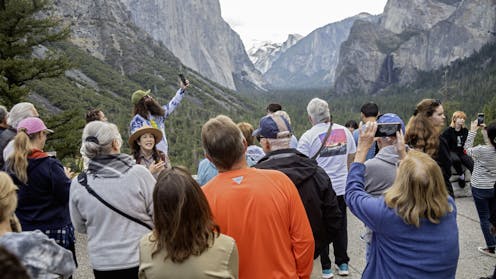
Crowds often form at popular places in U.S. national parks, like the entrance to Yosemite Valley in California. Jim West/UCG/Universal Images Group via Getty Images)

Visiting America’s national parks is a treasured public pastime. The wetlands of Congaree in South Carolina, the depths of the Grand Canyon in Arizona and the vistas provided by peaks in Yosemite in California are iconic American experiences for residents and for people who travel from other countries to vacation.

There are lots of benefits of visiting national parks, or parks in general. Spending time in nature is good for people’s mental health. Moving in the outdoors – walking, biking, running, paddling – benefits people’s physical health. Sharing experiences with others helps build social connections with old friends or newfound ones. Visitors also learn about ecosystems and cultural history, developing their own relationship to the landscape.

National park visitation is growing, with record-high visitor numbers in 2024 across the entire 398-property system, as well as at the 63 formally designated national parks. And there has been a general trend of people gravitating to Instagram-popular parks, and even specific spots within popular parks.

Reductions in federal funding and staffing at national parks means visitors may see longer lines to enter parks or popular locations within them, fewer visitor services and educational programs, and fewer rangers to ask for advice or assistance.

As scholars of parks and recreation, we know crowded conditions make it harder to enjoy national parks. But we also know that if you plan carefully, you can create a great experience.

What gets in the way of fun?

In general, research identifies three main barriers to recreational fun.

One is how confident people are in their own physical abilities and how safe they feel in the park. For example, someone may want to go kayaking in Florida’s Everglades or Minnesota’s Voyageurs National Park but doesn’t know where to rent a boat, where to put it in the water, or which stretches of water are best for a beginner.

Another is the presence – or absence – of people to enjoy the space with, or family obligations or relationships that might preclude them from an activity. Culture can also play a role in where people visit and what they do there. For instance, a national park may be a source of escape where individuals seek autonomy and independence. For others, a national park visit can be a focal point for social gatherings and a time to reconnect with family and friends.

A large group of people stand in a line looking at an area where steam is rising from the ground.
For many years, Old Faithful in Yellowstone National Park in Wyoming has drawn massive crowds to witness the natural phenomenon of an erupting geyser.
Joe Sohm/Visions of America/Universal Images Group via Getty Images

There are also external factors, like how much free time a person has for recreation and how easy it is to get to a national park from their home. Someone may live a short drive from a national park but not visit simply because they do not know what they can do there, or how to have a positive experience.

More recently, research has also identified environmental barriers outside visitors’ control. Thin ice or lack of snow prevents many winter activities in Colorado’s Rocky Mountain National Park and Maine’s Acadia National Park, just as excessive heat can decrease the attractiveness of summer recreation in parks like the Everglades or California’s Death Valley. Extreme weather events such as inland flooding and coastal hurricanes can block roads and damage parks, posing both physical and logistical barriers in parks such as Cape Lookout National Seashore in North Carolina.

Wildlife habits also affect visitors, who may flock to an area where they can see wildlife. Or they may avoid – or may be restricted from – areas with dangerous wildlife.

Adapting to find enjoyment anyway

If the national park places you want to visit seem too busy, think about your options. You could change your travel dates to a less busy time. People who want to visit Yellowstone in Wyoming, Idaho and Montana could find campground reservations unavailable for some weeks but plentiful for other weeks – or they could choose to stay in a local hotel instead of camping.

You could try a different park or activity. For example, an angler who typically visits Great Smoky Mountains National Park in North Carolina and Tennessee to fish for trout may find that some streams are warming and no longer support this activity. They might go fishing elsewhere or stay in the Smokies and bird-watch, hike or read by a stream.

If you really want to visit during a busy time, you can also simply change your expectations, like not expecting Old Faithful to be a quiet place with only a few visitors.

Park personnel often seek to manage visitor numbers to protect the park from too much traffic, but also so everyone who visits can enjoy the experience. For example, implementing reservations for Acadia’s Cadillac Mountain at sunrise means at least some people get a relatively serene experience, as opposed to lots of people having an overcrowded experience.

Park staff also design park amenities so roads, boat ramps, trailheads and parking are in useful locations that work well for the number of visitors expected. And park workers provide advance information for visitors, in brochures and on websites, charge fees for entry, conduct tours or other programs at the location – and ticket or arrest people who are in places or doing activities they’re not supposed to – to reduce the effects of overcrowding.

A group of people stand on a mountaintop looking at a bay with islands as the sun rises over the horizon.
The National Park Service requires advance reservations to see the sunrise atop Cadillac Mountain in Acadia National Park in Maine.
AP Photo/Robert F. Bukaty

Planning is key

We have found that the most effective way for people to have the park experiences they want, and enjoy them as much as they hope, is to plan ahead.

Planning can include looking at parks’ websites for ideas and considering the best time to visit – both for your own schedule and what you want to do.

Understanding the weather and climate of the region will help you determine what to bring, but also what conditions will be like if you’re hiking, paddling or driving.

Advance preparation definitely includes finding lodging – and making reservations whenever possible. If reservations aren’t possible, see whether you can increase your chances of finding a place to sleep when you arrive by choosing lesser-visited parts of the park or identifying nearby backup options, such as state parks and private campgrounds, that might provide a break from the crowds.

And you can make sure you’re prepared for whatever you’re going to do, whether it’s getting used to walking long distances before a big hike or learning about local flora and fauna before you arrive.

Thinking ahead also means you can share your itinerary with friends and family – either as invitations to join you or for periodic safety check-ins.

It is also helpful to talk to park personnel. Park staff will have great insights into hidden gems that might be slightly off the beaten path but away from the crowds and able to provide a unique visitor experience. Rangers or other staff can help you determine the best choices for settings and activities that match your abilities, interests, time and needs.

And finally, don’t forget to be considerate of other visitors. Have patience in the parking lots, visitor centers, trailheads and lookout points. Others in the park seek the same awe-inspiring views and heart-pumping recreation activities as you. In many cases, it’s not the number of people but the attitudes and behaviors of those people that can make a place either feel crowded or like a community of like-minded outdoor enthusiasts.

The Conversation

Allie McCreary receives funding from the Public Lands Service Coalition and New Frontiers in Research Fund (Government of Canada).

Michael Brunson is affiliated with The Appalachian Trail Conservancy and the National Association for Interpretation .

ref. As National Park System visitor numbers hit record highs, here’s how visitors can adapt for a better experience – https://theconversation.com/as-national-park-system-visitor-numbers-hit-record-highs-heres-how-visitors-can-adapt-for-a-better-experience-262407

American capitalism is being remade by state power

Source: The Conversation – USA (2) – By H. Sami Karaca, Professor of Business Analytics, Questrom School of Business, Boston University

Is the Trump administration trying to reshape American capitalism? Recent moves by Washington, such as taking a 10% share of semiconductor maker Intel, point to a shift in that direction. For decades, Washington has supported free-market capitalism. Today, the government appears to be supporting a new direction – state-directed capitalism.

As a professor at the Questrom School of Business who studies different economic systems, I find this reversal striking. My research is supported by the Ravi K. Mehrotra Institute, which is trying to understand how business, markets and society interact. My previous research – finding, for example, that U.S. news coverage of capitalism was far more negative in the 1940s than it is now – suggests capitalism isn’t in retreat but is rather evolving.

In what direction is the Trump administration pushing it?

Types of capitalism

While many people bandy around the term “capitalism,” it actually comes in many different forms. The most basic definition of capitalism is when the means of production – such as factories, farms and offices – are owned by private individuals.

Capitalism is driven by profit. Some of the earliest descriptions of the profit motive that drives the whole system come from Adam Smith. As he wrote in 1776, “It is not from the benevolence of the butcher, the brewer or the baker that we expect our dinner, but from their regard to their own interest.”

Who gets the profits and who controls the means of production determine the specific forms of capitalism. While there are many types, I want to focus on three of the most important.

Free-market capitalism, also called laissez-faire capitalism, is when the government takes a hands-off approach to the economy. The U.S. after the Civil War is a good example of free-market capitalism. During the late 1800s, the federal government imposed few regulations on businesses.

State-guided capitalism is when the government chooses industries or companies to support. Favored sectors are given money and face looser regulations than nonfavored sectors. China today is an example of state-guided capitalism, where the state provides support for industries such as shipbuilding, steel and AI.

Oligarchic capitalism is when a very small part of the population owns key industries and controls the economy. Russia today is an example of this type of capitalism.

Each form of capitalism has its strengths and weaknesses. For example, free-market capitalism provides the most incentives to grow the economy, but the lack of rules often leads businesses to run roughshod over consumers. U.S. historians describe the late 1800s as the era of robber barons.

State-guided capitalism can dramatically boost the output of favored industries. However, if the government invests in the wrong industries, huge amounts of money can be wasted propping up dying firms.

Oligarchic capitalism can rapidly invest in new areas and shift resources, but the profits enrich only a tiny elite.

Recent changes

The U.S. currently appears to be operating under a hybrid model of capitalism, blending free-market principles with elements of state capitalism.

One of the most recent changes is the Trump administration’s decision to take a 10% stake in Intel. Congress passed the multibillion-dollar CHIPS and Science Act in 2022 to bolster U.S. computer chipmakers. Intel is slated to receive US$11.1 billion in grants from the program and other government funding. The current administration has converted that public support into a 10% ownership of the semiconductor maker.

Intel isn’t alone. The government has recently become a shareholder in other companies it views as strategically important – a trend that seems likely to continue and possibly result in the creation of a “sovereign wealth fund.” In July 2025, the Department of Defense agreed to buy $400 million of convertible preferred stock in MP Materials. MP Materials is the only U.S. rare-earth minerals mine with integrated production capacity. The company said the Department of Defense would be positioned to become its largest shareholder.

The government is also requiring a share of revenue from large computer chip manufacturers. Nvidia and AMD will have to remit 15% of revenue from certain chip sales to China as a condition for export licenses.

Why the US change is important

The CHIPS and Science Act has already funneled billions into U.S. semiconductor manufacturing via grants, tax credits and R&D support. MP Materials and Intel could serve as pilot models for further strategic intervention. However, the U.S. government spends trillions each year, and the amounts invested in American industries and companies represent only a small percentage of total spending.

While the CHIPS and Science Act was passed in 2022 under the Biden administration, the implementation relied on traditional tools of industrial policy such as grants, tax credits and milestone-based funding. In contrast, the Trump administration has converted these grants into equity arrangements, with officials stating the government should get a return on its investment.

This shift from an incentive-based approach to a direct ownership model represents one of the most fascinating experiments in modern American capitalism. The real question is what happens if – or when – this strategy expands. The government could become more involved in energy, biotech and AI, or any place where markets show signs of lagging or supply chains are geopolitically fragile.

The U.S. isn’t rejecting capitalism but recalibrating its boundaries. The next few years will show exactly how Washington’s interventions will reshape U.S. capitalism.

The Conversation

H. Sami Karaca receives funding from the Ravi K. Mehrotra Institute.

ref. American capitalism is being remade by state power – https://theconversation.com/american-capitalism-is-being-remade-by-state-power-263881