Mars has a solid core, resolving a longstanding planetary mystery — new study

Source: The Conversation – UK – By Kevin Olsen, UKSA Mars Science Fellow, Department of Physics, University of Oxford

NASA

Scientists have discovered that Mars has an interior structure similar to Earth’s. Results from Nasa’s Insight mission suggest that the red planet has a solid inner core surrounded by a liquid outer core, potentially resolving a longstanding mystery.

The findings, which are published in Nature, have important implications for our understanding of how Mars evolved. Billions of years ago, the planet may have had a thicker atmosphere that allowed liquid water to flow on the surface.

This thicker atmosphere may have been kept in place by a protective magnetic field, like the one Earth has. However, Mars lacks such a field today. Scientists have wondered whether the loss of this magnetic field led to the red planet losing its atmosphere to space over time and becoming the cold, dry desert it is today.

A key property of the Earth is that its core has a solid centre and liquid outer core. Convection within the liquid layer creates a dynamo, producing the magnetic field. The field deflects charged particles ejected by the Sun, preventing them from stripping the Earth’s atmosphere away over time and leading to the habitable conditions we know and enjoy.

From residual magnetisation in the crust, we think that Mars did once have a magnetic field, possibly from a core structure similar to that of Earth. However, scientists think that the core must have cooled and stopped moving at some point in its history.

On the surface of Mars there is a tremendous amount of evidence that liquid water once flowed, suggesting more hospitable conditions in the past. The evidence comes in many forms, including dry lake beds with minerals that formed under water, or the dramatic valley networks carved by rivers and streams. However, the Martian atmosphere is thin today and the necessary amount of water is nowhere to be found.

Teams working with the seismometers on Nasa’s InSight Mars lander first identified the Martian core and determined that it was actually still liquid. Now, the new results from Huixing Bi, at the University of Science and Technology of China in Hefei and colleagues, show that there may also be a solid layer inside the liquid core.

The nature of the interior structure of Mars has been an intriguing mystery. Was it ever like Earth’s, with a dynamic liquid layer around a solid centre? Or did Mars’ smaller size prevent such a formation? How big must a planet be to gain the protection of a magnetic field, like Earth’s, and support a habitable climate?

To understand what happened, how Mars evolved, we need to understand Mars today. These questions about Mars’ atmosphere, water, and core have motivated several high profile Mars missions. While the Nasa Mars rovers, Spirit, Opportunity, Curiosity, and Perseverance have studied the surface mineralogy, the European Space Agency’s ExoMars Trace Gas Orbiter is studying the water cycle, Nasa’s Maven spacecraft is studying atmospheric loss to space, and Nasa’s InSight lander was sent to study seismic activity.

Insight
The Insight mission landed on Mars in 2018.
JPL-Caltech

In 2021, Simon Stähler, from ETH Zurich in Switzerland, and colleagues, published a seminal paper from the InSight mission. In it, they presented an analysis of the way that seismic waves pass through Mars from Mars quakes in the vicinity of InSight, through the mantle, through the core, and then reflecting off the other side of the planet and reaching InSight.

They detected evidence of the core for the first time and were able to constrain its size and density. They modelled a core with a single liquid layer that was both larger and less dense than expected and without a solid inner core. The size was huge, about half of Mars’ radius of 1,800 km, and the low density implied that it was full of lighter elements. The light elements, such as carbon, sulphur, and hydrogen, change the core’s melt temperature and affect how it could crystallise over time, making it more likely to remain liquid.

The solid inner core (610 km radius) found by Huxing Bi and colleagues is hugely significant. The very presence of a solid inner core shows that crystallisation and solidification is taking place as the planet cools over time.

The core structure is more like Earth’s and therefore more likely to have produced a dynamo at some point. On Earth, it is the thermal (heat) changes between the solid inner core, the liquid layer, and the mantle that drive convection in the liquid layer and create the dynamo that leads to a magnetic field. This result makes it more likely that a dynamo on Mars was possible in the past.

With Simon Stähler and co-authors reporting a fully liquid core and Huxing Bi and colleagues reporting a solid inner core, it might seem as if there will be some controversy. But that is not the case. This is an excellent example of progress in scientific data collection and analysis.

The findings will help guide scientists towards a better understanding of Mars’ evolution as a planet.
JPL-Caltech

Competing models of Mars

InSight landed in November 2018 and its last contact with Earth occurred in December 2022. With Stähler publishing in 2021, there is some new data from InSight to look at. Stähler’s model was revised in 2023 by Henri Samuel, from the Université Paris Cité, and colleagues. A revised core size and density helped reconcile the InSight results with some other pieces of evidence.

In Stähler’s paper, a solid inner core is specifically not ruled out. The authors state that the signal strength of the analysed data was not strong enough to be used to identify seismic waves crossing an inner core boundary. This was an excellent first measurement of the core of Mars, but it left the question of additional layers and structure open.

For the latest study in Nature, the scientists achieved their result through a careful selection of specific seismic event types, at a certain distance from InSight. They also employ some novel data analysis techniques to get a weak signal out of the instrument noise.

This result is sure to have an impact within the community, and it will be very interesting to see whether additional re-analyses of the InSight data support or reject their model. A thorough discussion of the broader geological context and whether the model fits other available data that constrain the core size and density fit will also follow.

Understanding the interior structure of planets in our Solar System is critical to developing ideas about how they form, grow, and evolve. Prior to InSight, models for Mars that were similar to Earth were investigated, but were certainly not favoured.

The Conversation

The authors do not work for, consult, own shares in or receive funding from any company or organisation that would benefit from this article, and have disclosed no relevant affiliations beyond their academic appointment.

ref. Mars has a solid core, resolving a longstanding planetary mystery — new study – https://theconversation.com/mars-has-a-solid-core-resolving-a-longstanding-planetary-mystery-new-study-264325
Why Indonesia’s parliament struggles to maintain independence and trust

Source: The Conversation – Indonesia – By Jefferson Ng, PhD student, Australian National University

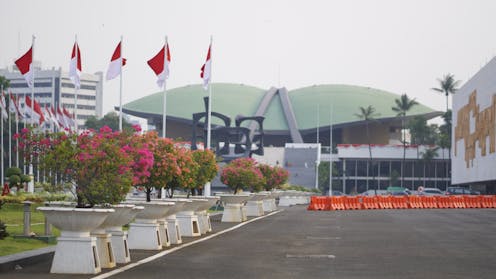
The iconic building of the Indonesian Parliament complex in Jakarta on July 20, 2023 ahead of the Independence Day celebration preparation.
Disto De Niro/Shutterstock

Large demonstrations hit Jakarta over the past week as angry protesters demanded the dissolution of Indonesia’s Parliament.

Under the hashtag #BubarkanDPR (“Dissolve the Parliament”), frustration spilled onto the streets, fuelled by discontent over the country’s economic direction and the perceived disconnect between lawmakers and ordinary citizens.

The spark was the revelation that each Member of Parliament (MP) receives a monthly housing allowance of Rp50 million (US$3,000) — about 10 times Jakarta’s minimum wage and 20 times the minimum wage in poorer regions. On top of this, each MP also receives Rp4.2 billion ($242,000) annually in constituency expenses.

The anger deepened when one MP reportedly dismissed critics as “dumb”, and another publicly complained about traffic jams on the way to the Parliament building.

For citizens facing layoffs and higher taxes amid a government “efficiency” drive, parliament seemed tone-deaf and out of touch.

But the problem runs deeper than high salaries or insensitive remarks. The crisis of legitimacy facing the Indonesian lawmakers reflects the slow erosion of the parliament’s independence and relevance within the country’s democracy.

Why reforms fail to live up to their promise

When Suharto fell in 1998, democratic reformers sought to build a strong parliament that could counterbalance presidential power. The constitutional amendments that followed introduced term limits, direct presidential elections, and more robust checks and balances.

Large-scale protests against the Indonesian parliament and police occurred in Indonesia in the past week.
A crowd of protesters in front of the Mobile Brigade Police Headquarters, Jakarta, on 29 August 2025.
Wulandari Wulandari/Shutterstock

The president could no longer dissolve parliament. Its agreement was required to pass laws and budgets, and it was tasked with overseeing the executive.

For a time, it lived up to that role. As one MP told political scientist Patrick Ziegenhain in his 2008 book “The president has a lot of power, and it is our job to limit it.”

Between 1999 and 2014, MPs frequently used their powers to scrutinise the government and speak on behalf of the public. But two institutional flaws weakened this democratic experiment.

First, reformers’ fears of continued dominance of Golkar — once Suharto’s electoral vehicle — led them to adopt proportional representation. This produced extreme multipartyism: a fragmented party system in which no president commands a stable majority.

Second, parliament retained the New Order’s consensus procedure. In the parliamentary commissions, faction leaders or MPs appointed by party bosses act as proxies for party elites. Real bargaining happens behind closed doors between party chairs and the president, leaving individual MPs with little voice.

The result is a parliament where members are more accountable to their party boards than to their voters. Meaningful policy debate is minimal, and MPs have little incentive to develop expertise in their committees.

As one MP bluntly told a minister lobbying for a bill: “Please don’t lobby here, sir. We are all subordinates. Speak to the party chairmen first.”

Electoral costs and representation

One of the root causes of parliament’s institutional decline is that electoral campaign costs have spiralled beyond the reach of most citizens.

Indonesia's parliament sparks public outcry over high salaries, triggering large-scale protests across the country.
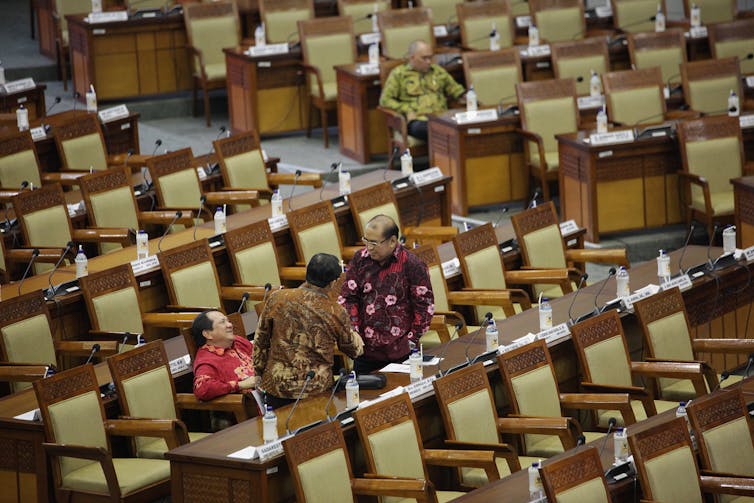
Several members of parliament chat in the plenary meeting hall at the parliament building in Jakarta.
Stagehunter.id/Shutterstock

Unsurprisingly, nearly half of the MPs elected for the 2019–2024 period came from business backgrounds or had wealthy patrons. A study, for instance, found that in average, a legislative candidate might have spent millions of dollars to get elected during the 2024 election.

This trend has further narrowed representation. Elected MPs are widely perceived as serving their financiers and party leaders rather than their constituents.

Once elected, MPs are reluctant to challenge the system. Having sunk fortunes into their campaigns, they need to stay on good terms with party elites to secure their political future.

⁠In Indonesia’s fragmented multiparty system, where campaign costs are very high, access to ministries and state resources is critical for parties to sustain themselves — often resulting in an oversized coalition supporting the ruling party.

Between elections, political parties scramble for access to positionsministries, parliamentary chairs, state-owned companies’ executives — and government contracts. Government ministries also fund a variety of discretionary appointments that can be filled by party members.

Conversely, a party that becomes too critical risks losing access to patronage or face direct government intervention. As such, institutional incentives are heavily stacked in favour political parties being within rather than without the system.

Loss of independence

Since the start of Indonesia’s democratic era, every Indonesian president had been a minority president, unable to secure a parliamentary majority through his own party, including Prabowo-led Gerindra Party.

In a fragmented multi-party system where the president’s party does not hold a majority, a powerful parliament can easily become obstructionist or disruptive.

Indonesian parliament sparks public outcry over high salaries, corruption and low legislative performance.
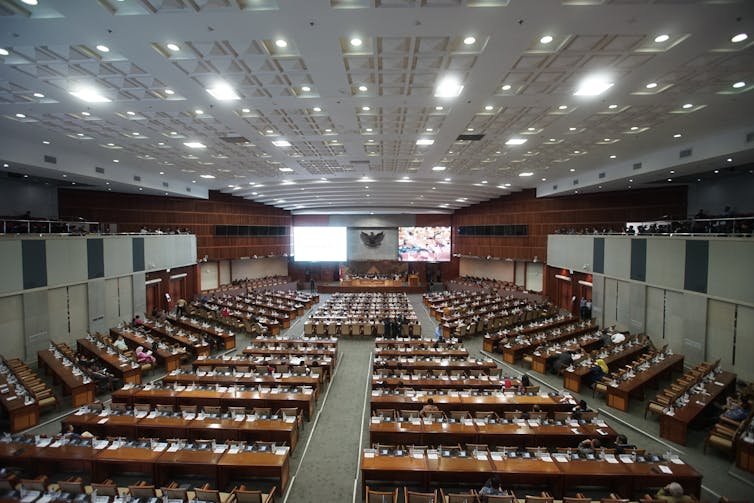
A situation inside the plenary session hall of the Indonesian Parliament building in Jakarta, on Dec. 3, 2024.
Stagehunter.id/Shutterstock

Former President Susilo Bambang Yudhoyono lamented in his memoir that Indonesia had effectively become “semi-parliamentary or semi-presidential,” with parties in parliament strong enough to block presidential agendas.

The response from successive presidents has been to co-opt parliament by controlling political parties from within. Yudhoyono, for example, brought the Golkar Party into his coalition by backing then–Vice President Jusuf Kalla’s bid for party chairmanship.

His successor, President Joko “Jokowi” Widodo, followed a similar playbook. Although he initially promised a “slim coalition”, he quickly expanded it after facing legislative resistance — even intervening directly in party leadership disputes to secure loyal chairs.

President Prabowo Subianto inherited Jokowi’s broad coalition and rewarded party leaders with key cabinet posts.

As a result, almost every major party in parliament is now part of the ruling coalition. Lawmakers answer primarily to their party chairmen — who are themselves embedded in government — making parliament a subordinate institution rather than an independent counterweight.

Institutional decline

To maintain stability in an extreme multiparty system, Indonesian presidents are compelled to build oversized coalitions — a safeguard in case one or more parties defect.

During the presidential election campaign, Prabowo Subianto was endorsed by majority of political parties in Indonesia.
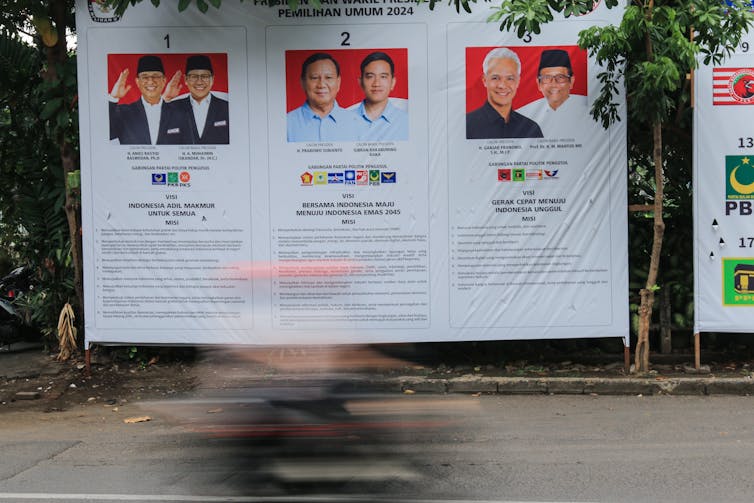
A large billboard in Surabaya, East Java, with information about the three pairs of candidates of the Indonesia’s 2024 Presidential Election.
Ridho Sakti/Shutterstock

Presidential pressure, combined with the need to access state resources, makes parties reluctant to challenge the government.

In addition, the high cost of entry and Parliament’s poor public image deters many capable Indonesians from running for office.

There is also little incentive for MPs to develop strong capabilities in the policy area that they are overseeing. As a result, Parliament has become less representative and less capable over time.

This hollowing out of parliament has left it neither independent from the executive branch nor accountable to voters.

The chants of “Bubarkan DPR” carry a truth reformers cannot ignore: unless parliament is reformed to restore its independence, transparency, and representativeness, Indonesia’s democratic institutions will continue to decay.

The Conversation

Jefferson Ng tidak bekerja, menjadi konsultan, memiliki saham, atau menerima dana dari perusahaan atau organisasi mana pun yang akan mengambil untung dari artikel ini, dan telah mengungkapkan bahwa ia tidak memiliki afiliasi selain yang telah disebut di atas.

ref. Why Indonesia’s parliament struggles to maintain independence and trust – https://theconversation.com/why-indonesias-parliament-struggles-to-maintain-independence-and-trust-264282

Donald Trump’s penchant for bullshit explains MAGA anger about the Epstein files

Source: The Conversation – Canada – By Tim Kenyon, Professor, Faculty of Humanities, Brock University

In July 2025, the connection between United States President Donald Trump and his base of supporters was fractured by the announcement from the U.S. Department of Justice and the FBI that no “Epstein list” exists.

That is, they say, there is no list of clients or participants identified by convicted child sex offender Jeffrey Epstein prior to his death by apparent suicide in 2019. No further documents related to the Epstein case would be released.

This announcement angered and confused many among Trump’s core constituency, including prominent loyalists and influencers. Weeks later, alienation among his base continues.


Read more:
Trump’s Epstein problem is real: New poll shows many in his base disapprove of his handling of the files, and some supporters are having second thoughts about electing him


This is puzzling. But in part, it’s unsurprising. Trump’s support base includes the conspiracist “QAnon” believers who are convinced that Democratic Party politicians and donors run a hidden global ring of child sex abuse.

In QAnon circles, it has been practically an article of faith that the Epstein files would validate these accusations against liberal elites. Trump’s release of the files was keenly anticipated. Naturally they’re upset that he and his appointees have changed their tune.

Longtime friendship

Yet their dismay is surprising nonetheless. Trump’s extensive relationship with Epstein has been well known for years. His repeated well wishes for Epstein’s longtime associate, convicted collaborator Ghislaine Maxwell, were widely reported following her sentencing on child sexual trafficking charges.

His comments about “getting away with” walking into beauty pageants’ backstage areas among young women and underage girls wearing “no clothes” were made prominently, on the Howard Stern Show. His base somehow managed to believe Trump was a secret champion of minors against sexual exploitation in the face of his own boasts.

The role of bullshit

How could this new development somehow be worse for Trump than his own confessions?

One partial explanation centres on Trump’s use of what’s known as bullshit rhetoric as a weapon against political enemies. Bullshit in this context is a quasi-technical notion meaning, roughly, an indifference to truth or to the audience’s right to truth.


Read more:
Why Donald Trump is such a relentless bullshitter


Even most liars respect the truth enough to try and deceive people about it, but the bullshitter doesn’t much care either way. As my colleague Jennifer Saul and I have argued in our research, Trump’s brand of authoritarian speech is deliberate and explicit in its bullshit. It advertises its status in order to show contempt for one audience, typically as part of a performance of strength for another audience.

This helps explain why Trump’s relentless bullshitting never harmed his standing with his base in the past, and has even buoyed it. His supporters know he’s a bullshitter, but they recognize he isn’t bullshitting them. They are in on the joke, enjoying the spectacle as Trump performs his power over mutual enemies, including political opposition, news media and state institutions.

The new tension over the Epstein files reflects the extent to which some among Trump’s base perceive, perhaps for the first time, that they are now targets of his weaponized political bullshit rather than amused witnesses to it. And they don’t like it.


Read more:
Bullshit is everywhere. Here’s how to deal with it at work


Trump responds with more bullshit

In one striking example, news media have reported that, before the FBI/Department of Justice announcement, Trump was informed by Attorney General Pam Bondi that his name occurs repeatedly in the unreleased documents.

The significance or context of those occurrences is of course not known; other people who deny wrongdoing are also named in them. But after the existence of a list was denied, Trump responded to questioning about whether his name appears in the documents by claiming that the files were made up by former presidents Barack Obama and Joe Biden and former FBI Director James Comey.

The assertion that the Epstein files are merely hoax documents cooked up by Obama, Biden and Comey is so outrageously false that it can’t be meant even as a serious deception. That makes Trump’s claim a bald-faced lie to many people.

Bald-faced lies count as bullshit, Saul and I argue, because they lack the deceptive intent of other lies. They are a kind of unconcealed bullshit that advertises the speaker’s impunity. For Trump, this sort of overt bullshit has been reserved for liberals and news reporters. This time his own supporters are in the line of fire.

Strongman politics

Trump’s base can’t be truly dismayed by the facts about his relationship with Epstein because they should have been upset long before now in terms of his own past confessions and well-known association with Epstein.

Instead, they seem to be irked they’ve been lumped in with their enemies in being recipients of Trump’s bullshit rather than onlookers to it. And if we focus on polarization and strongman politics, we can better understand Trump’s responses to the criticism from his base.

After all, Trump didn’t say these angry supporters have misunderstood the evidence. He said they were “pretty bad people,” likened them to “fake news” and said he didn’t want their support. He didn’t call them mistaken; he called them weaklings.

To some this might sound absurd or childish. To supporters of an authoritarian figure, being called weak is more serious than being accused of being wrong.

The Conversation

Tim Kenyon does not work for, consult, own shares in or receive funding from any company or organisation that would benefit from this article, and has disclosed no relevant affiliations beyond their academic appointment.

ref. Donald Trump’s penchant for bullshit explains MAGA anger about the Epstein files – https://theconversation.com/donald-trumps-penchant-for-bullshit-explains-maga-anger-about-the-epstein-files-263983

China’s WWII anniversary parade rekindles cross-strait battle over war narrative − and fears in Taiwan of future conflict

Source: The Conversation – Global Perspectives – By Meredith Oyen, Associate Professor of History and Asian Studies, University of Maryland, Baltimore County

World War II casts a very long shadow in East Asia. Eighty years after ending with Japan’s surrender to Allied forces on Sept. 2, 1945, the conflict continues to stir debate over the past, in the context of today’s geopolitical tensions.

China’s high-profile military parade commemorating the conclusion of what Beijing calls the “War of Resistance against Japanese Aggression” is a case in point.

In the run-up to the Sept. 3, 2025, event, the Chinese Communist Party has been criticized in Tokyo for stoking anti-Japanese sentiment and in the U.S. for downplaying America’s role while playing up Russia’s.

But as an expert on Taiwan-China relations, I’m interested in the battle over the narrative between Taipei and Beijing. During World War II, China’s communists and nationalists became uneasy internal allies, putting their civil war on pause to unite against Japan. Afterward, the communists prevailed and the nationalists fled to Taiwan, where they set up their own government – one the mainland has never recognized. Months of bickering over the commemorations shine a light on how both sides view their respective roles in defeating Japan – and what the show of military force by Beijing signals today.

To whom did Japan surrender?

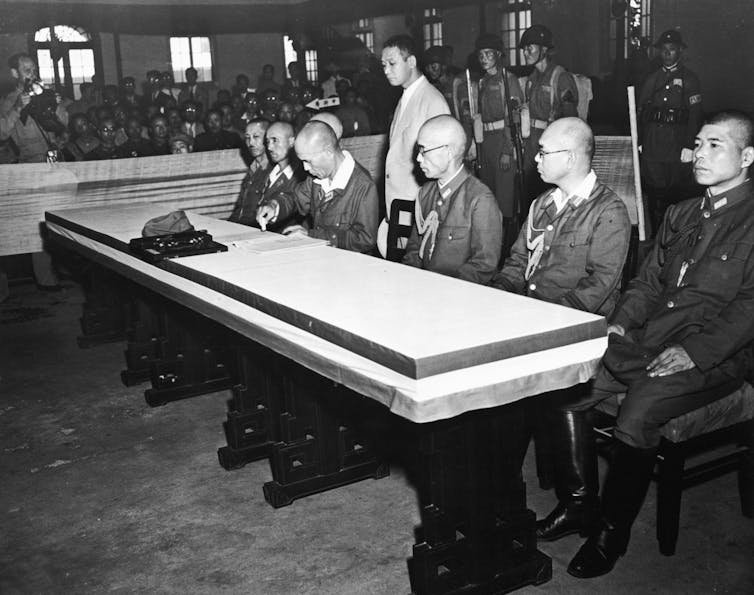
A peculiarity of the current commemorations is that Japan did not actually surrender to Communist China, or technically to China at all. On Sept. 9, 1945, a week after agreeing to the terms laid out by the Allied forces, Japan, at a ceremony in Nanjing, formally surrendered to China’s National Revolutionary Army – the military wing of the nationalist Kuomintang led by Chiang Kai-shek.

A group of men sit around a table.
Gen. Okamura, supreme commander of the Japanese army in China, officially surrenders to Chinese authorities in Nanjing, China.
Bettmann/Getty Images

And this gets to the heart of why many in Taiwan – where the nationalists fled at the conclusion of China’s civil war in 1949 – are unhappy with Beijing’s projection of Communist China as the victors against Japan.

By the time that war in East Asia took hold, in 1937, China was a decade into its own civil war between the nationalists under Chiang Kai-shek and Mao Zedong’s communists.

The nationalists and communists fell into an uneasy truce with the creation of the second united front in 1937. But the role of both sides in fighting the Japanese has long been the source of disagreement.

The nationalist army bore the brunt of conventional warfare. But it was criticized for being disorganized and too dependent on men forced into service. Those soldiers were often ill-trained and underfed.

To the communists, the army – and its failings – were the product of the corrupt government under Chiang. And it was largely responsible for China’s inept response to Japan’s initial advances.

In Beijing’s telling today, it was the communist forces, which relied more on guerrilla tactics, that helped push back the Japanese.

Conversely, the nationalists cast events during World War II very differently. China’s nationalist administration under Chiang was the first government in the world to fight a fascist power.

For eight or even 14 years, depending on whether you date the start of the conflict to 1937 or 1931, the nationalist army fought hard and sacrificed a lot as it put up the bulk of the resistance against Japan. To Taiwan’s Chinese nationalists, the Chinese communist contribution was minimal.

Worse, to them, the communists took the opportunity of Japan’s invasion to further their own position against the nationalists. Indeed, when the civil war began again after Japan’s defeat, Mao’s communists had the upper hand, leading to the nationalists’ retreat to Taiwan four years later.

From Japanese to Chinese rule

The status of Taiwan at the end of World War II presents another wrinkle.
By then, the island had been under Japanese colonial control since 1895. Indeed, a second surrender ceremony took place on Oct. 25, 1945, when the Japanese forces in Taiwan surrendered to a nationalist official who had come over from the mainland.

What followed was a period of Chinese nationalist takeover of Taiwan and a corresponding Japanese retreat – it took several years for all Japanese officials and families to be repatriated to Japan.

Meanwhile, the nationalist Kuomintang that came into Taiwan were not terribly well received by the local population, many of whom were hoping for independence and resisted a Chinese nationalist, authoritarian takeover.

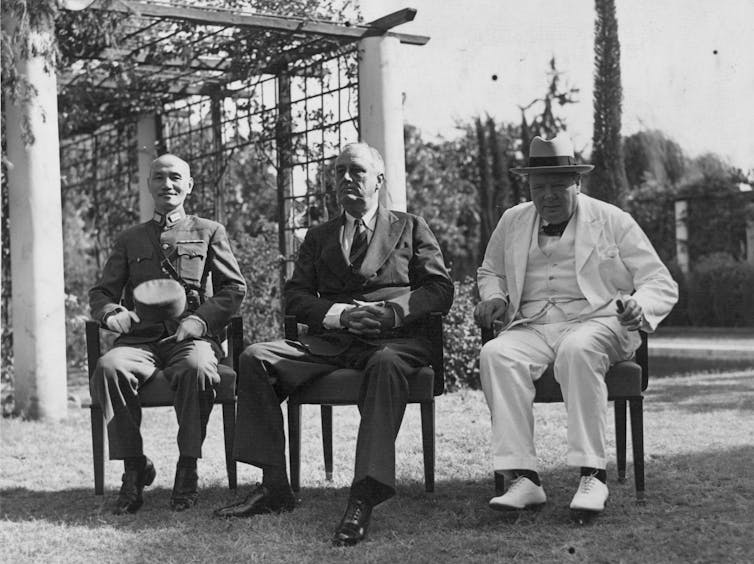
Complicating matters was that a 1943 agreement between the leaders of the Allied nations in Cairo declared that in the event of Japan’s defeat, Formosa, as Taiwan was then called, would be returned to the Republic of China.

But now you had two claimants to being “China” – the communists on the mainland and the nationalists on Taiwan. Either way, the Cairo Declaration served the interests of the “One-China” principle – under which both Beijing and Taipei view Taiwan as part of unified China, but differ over which is the country’s legitimate government – over that of those seeking the island’s formal independence from the mainland.

Three men sit in the sunshine wearing suits.
Chinese nationalist leader Chiang Kai-shek, U.S. President Franklin D. Roosevelt and British Prime Minister Winston Churchill at the Cairo Conference in November 1943.
Keystone/Getty Images

From the past to the future

The conflicting war narratives from Communist China, pro-unification nationalists in Taiwan and those seeking the island’s independence have been present since the end of World War II – and they tend to flare up around commemorations and anniversaries.

They did so, for example, when China held a big military celebration in 2015 to commemorate the 70th anniversary of Japan’s surrender.

This year’s event seeks to do a couple of things. First, Beijing is using it to reshape the memory of the Chinese Communist Party’s role in the world as a result of World War II.

The war is seen as a critical moment in Chinese history – not just in the context of defeating Japan and its role in the subsequent founding of the People’s Republic, but because in Asia it marked the end of the colonial era. During the war, foreign powers in China gave up their concessions and ended a century of partial colonial control over port cities such as Shanghai.

The war also marked China’s emergence as a major player on the world scene. As a result of its contributions in World War II, China gained a role on the United Nations Security Council. The Republic of China on Taiwan maintained that seat and that vote until 1971, when U.N. recognition finally shifted to the People’s Republic of China.

In recent years, promoting a prominent role in defeating fascism and shaping the postwar world order has been particularly important as China looks to carve out a space for itself in a multipolar world and show an alternative to a world dominated by the United States and Western Europe.

For these reasons, Beijing is keen to keep focus on its preferred narrative, highlighting communist contributions to the war effort.

But given Beijing’s adherence to the one-party principle, Taiwan – as part of China – could not be ignored. So, invites to Taiwanese officials to the commemorative events were sent out.

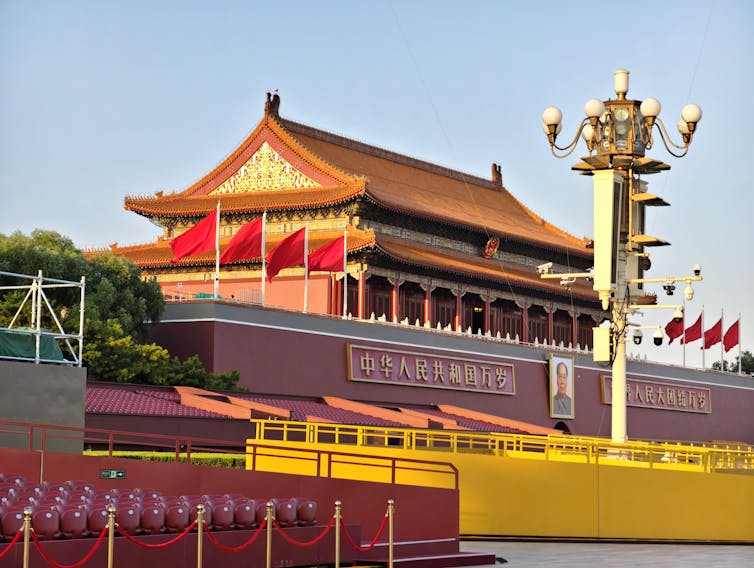
A pagoda-style building is seen in the sunlight.
Tiananmen Square gears up for a military parade marking the 80th anniversary of the end of World War II.
VCG/VCG via Getty Images

Representatives from the pro-independence ruling Democratic People’s Party and the main opposition party, the pro-unification Kuomintang, have largely declined to attend. The executive government has said that no current government officials in Taiwan should attend the military parade. Nonetheless, on Sept. 2, former Kuomintang chairperson Hung Hsiu-chu announced that she would be in Beijing for the event.

For its part, Taiwan has opted for more low-key commemorations of the end of Japanese rule of the island.

Many Taiwanese are much more concerned about current events than those of 80 years ago. The anniversary comes at a time of increased tension across the Taiwan Strait. Echoing concern over Chinese military might and potential intent, earlier this year “Zero Day Attack” – a new series depicting a future, fictionalized invasion of the island by the People’s Republic of China – dropped and has since become hugely popular.

Its streaming launch date in Japan was Aug. 15 – the 80th anniversary of the announcement of Japan’s surrender in World War II.

This article is based on a conversation between Meredith Oyen and Gemma Ware for The Conversation Weekly podcast that will be available later this week. Subscribe to The Conversation Weekly podcast.

The Conversation

Meredith Oyen does not work for, consult, own shares in or receive funding from any company or organization that would benefit from this article, and has disclosed no relevant affiliations beyond their academic appointment.

ref. China’s WWII anniversary parade rekindles cross-strait battle over war narrative − and fears in Taiwan of future conflict – https://theconversation.com/chinas-wwii-anniversary-parade-rekindles-cross-strait-battle-over-war-narrative-and-fears-in-taiwan-of-future-conflict-264401

Reform v the Nottingham Post: why local media is crucial to democracy

Source: The Conversation – UK – By Richard Jones, Director of Journalism, Politics and Contemporary History, University of Salford

Steve Travelguide/Shutterstock

The proposed reorganisation of council boundaries was probably not the issue which prompted British voters to elect hundreds of Reform councillors at May’s local elections.

Nigel Farage’s surging party won 677 seats and gained control of ten councils, including Nottinghamshire in the East Midlands. There, a choice about whether the districts of Gedling or Rushcliffe should be included in a redrawn Nottingham city council has led to an apparent split in the new Reform council contingent. This was reported by Nottinghamshire Live, the online brand used by venerable local newspaper the Nottingham Post.

Council leader Mick Barton was so angry, he banned all his Reform councillors from speaking to Nottinghamshire Live. Its journalists won’t be sent press releases or be invited to council events.

Requests for interviews will be rejected, although they can still attend council meetings held in public. The same goes for its BBC-funded local democracy reporters.

Branding the article “misinformation”, Barton said he welcomed “scrutiny” but added: “We also have a duty to protect the credibility of our governance and the voices that we represent. For this reason, we will not be engaging with Nottinghamshire Live or with any other media outlet we consider to be consistently misrepresenting our policies, actions or intentions.”

Nottinghamshire Live editor Natalie Fahy pointed out this rather goes against Reform’s stated interest in upholding free speech and transparency, and warned: “When the press is not welcome, you know democracy itself is in danger.”

A Guardian editorial called Barton’s decision “petty and alarming”. Spokespeople for the other main UK parties chimed in, with the Liberal Democrats fretting about Donald Trump-style politics. Even Reform UK backed away, with a national party spokesperson saying it supported free speech and it was up to the local party to explain its decision.

There was already a bit of history between local reporters and Nottinghamshire Reform’s group of mostly inexperienced politicians. An excruciating video interview with Reform councillor James Walker-Gurley was widely shared online in June. It’s fair to say he was not yet fully across his cabinet portfolio of economic development.

Local journalism and democracy

This gets us to why it matters. Reporting local politics is a classic function of journalism. The fact that our politicians regularly meet, consider business and debate issues in public has long been part of democracy.

But hardly anyone actually goes to council meetings. It is journalists who can keep a close eye and tell us all what’s happening, including Nottinghamshire’s 800,000 plus residents.

Not that scrutiny means constant criticism. While councillors and reporters often do bump up against each other, studies of the local press have generally bemoaned it for being more of a lapdog than a watchdog, guilty of skirting controversy and avoiding proper scrutiny of institutions.

In their seminal 1973 book on local government and the media, researchers Harvey Cox and David Morgan argued local newspaper editors have always been interested in “the good of the town” as a general concept, and those editors are therefore in favour of anything that fits into this theme rather than being too negative.

A broadly constructive connection between town hall and local paper is normal and helps both sides, in turn allowing citizens to be better informed. Reform’s posturing in Nottinghamshire harms its relationship with a key player that may be as likely to help trumpet the party’s successes as point out its failures.

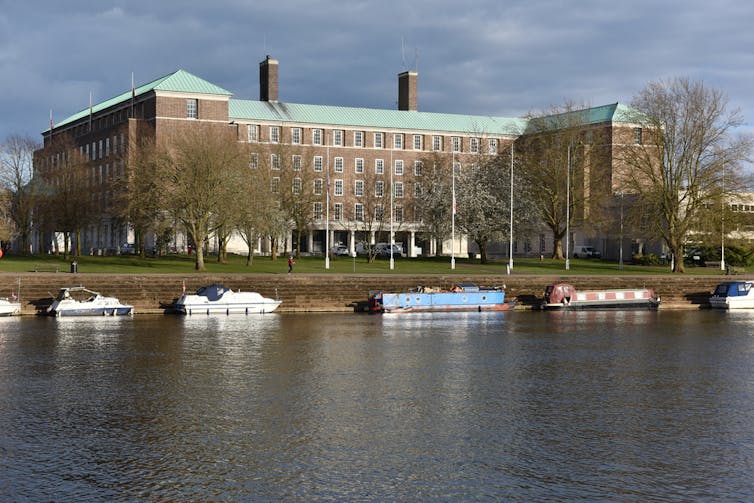
Nottinghamshire County Hall
In Nottinghamshire and elsewhere, local journalists keep an eye on what’s happening in council meetings and other democratic business.
Destinos Espetaculares/Shutterstock

While Reform’s attitude to reporters in Nottinghamshire is a concern, a far bigger threat to local journalism than grumpy politicians is money, or the lack of it. The business model of newspapers has been under desperate stress for two decades, as advertising cash floods to digital platforms and print sales decline.

In 2007, the local sector employed about 9,000 journalists and had revenue of £2.4 billion. By 2022, those figures had declined below 3,000 and £600 million.

Consigned to regional hubs and home offices, local journalists are no longer working for grand civic institutions. However, flexible use of digital publishing tools and a continuing commitment to public interest journalism, alongside lighter content, has kept titles such as Nottinghamshire Live prominent in our social feeds.

In the US these trends have moved faster, so we can see where we might be heading. In last year’s presidential election, Donald Trump won 91% of counties which are so-called “news deserts”. These are areas without a remaining professional source of local news. Voters in these places turn more to national media and therefore make choices based on national issues, not local ones.

American academics Danny Hayes and Jennifer Lawless have argued this decline in local media makes it harder for citizens to hold politicians accountable. There becomes less incentive for politicians to do their jobs ethically, and their policies may be less likely to reflect the will of the local electorate.

This is what we can see the beginnings of in Nottinghamshire. Where journalists face a battle to find out what’s going on at the council, residents will know less about their areas. Politicians can operate more in the shadows, only appearing to deliver prepared soundbites on their own channels.

These fraying connections in local public-life mean residents may soon discover the council is not following their wishes, whether on boundary changes or anything else. If Reform’s example becomes the new normal, everyone loses.


This article features references to books that have been included for editorial reasons, and may contain links to bookshop.org. If you click on one of the links and go on to buy something from bookshop.org The Conversation UK may earn a commission.

The Conversation

Richard Jones does not work for, consult, own shares in or receive funding from any company or organisation that would benefit from this article, and has disclosed no relevant affiliations beyond their academic appointment.

ref. Reform v the Nottingham Post: why local media is crucial to democracy – https://theconversation.com/reform-v-the-nottingham-post-why-local-media-is-crucial-to-democracy-264218

Cats can get dementia too – here are the eight signs to look out for

Source: The Conversation – UK – By Emily Blackwell, Senior Lecturer in Animal Behaviour and Welfare, University of Bristol

Behavioural changes can be a sign of dementia in cats. larisa Stefanjuk/ Shutterstock

Many cat owners don’t realise that just like humans, cats can suffer from dementia. A recent paper has even found many similarities between feline and human dementia, finding that cognitive impairment may develop in similar ways.

Some of the symptoms of dementia in cats are even similar to what we might see in humans – though not all of them, of course. Knowing what signs to look out for is important so you can provide your cat with the best care during this phase of its life.

Feline cognitive dysfunction syndrome (also known as feline dementia) is an age-related decline in a cat’s cognitive abilities. It’s generally characterised by behavioural changes that cannot be attributed to other medical conditions.

Feline dementia is thought to be very common in older cats. One study found that by 15 years of age, more than half of cats showed signs of dementia. However, some behaviour associated with the condition has also been identified in cats as young as seven. A separate survey of cat owners also found that around 28% of cats aged between 11 and 14 exhibited at least one behavioural change associated with dementia.

Behavioural changes are often the first indication that there may be something wrong. There are eight signs to look out for that might indicate your cat has dementia.

1. Unusual vocalisation: Your cat might start to vocalise excessively, or in new situations. A common example of this is meowing loudly at night.

2. Altered interactions: Cats with dementia sometimes seek attention more often or become “clingy”. Equally, cats with dementia might interact less than previously, appear irritable or seem not to recognise familiar people.

3. Sleep changes: You may notice changes in your cat’s sleeping habits – often becoming restless at night and sleeping more during the day.

4. House soiling: Changes in toilet habits can be a sign of several different conditions, but toileting outside the litter tray can be a common sign of dementia in cats.

5. Disorientation: Just like people with dementia, cats may show signs of confusion or wandering behaviour. This might appear as losing their bearings, staring blankly at walls, getting stuck behind objects or going to the wrong side of the door.

A black and white tuxedo cat lays on its owner's stomach while he pets it.
Cats with dementia may become more clingy than they were previously.
Creative Family/ Shutterstock

6. Changes in activity levels: A cat with dementia may be more or less active than usual. They may play less often or be less inclined to explore. You might also notice them spending less time taking care of themselves, for example grooming or washing themselves less.

7. Appearing anxious: A cat with dementia might show signs of anxiety in situations that they were previously confident with – such as around familiar people, places or sounds. An anxious cat might hide more often, going under the bed or on top of cupboards to escape.

8. Learning problems: Cats with dementia may be less unable to perform previously learned tasks, such as finding their food bowl, and may have difficulty learning new tasks.

Caring for your cat

There’s significant overlap between symptoms of feline dementia and other common conditions, such as arthritis and kidney disease . So if you see any of these behavioural changes in your cat, you should speak to your vet to rule out these other conditions.

Research into feline dementia is limited. Much of what we know about prevention and treatment is extrapolated from research into humans and dogs. And, as with these other species, there’s no cure for dementia in cats. But there are ways of limiting the impact of the disease.

Certain environmental modifications can help stimulate cats, activating their brains and causing nerves to grow. But the severity of your cat’s dementia must be considered before making any of these changes.

In healthy or mildly affected cats, promoting play or simulating hunting with interactive toys and encouraging exploration using hide and seek games is thought to delay the progression of cognitive dysfunction.

But in cats with severe cognitive impairment, changing their environment could lead to confusion and anxiety – worsening behavioural symptoms.

Diet changes – specifically the addition of supplements containing antioxidants (vitamin E and C) and essential fatty acids – may also help to reduce inflammation in the brain, slowing the disease’s progression.

However, only dog-specific supplements have been tested in scientific research and proven to enhance cognition in dogs. But if you do want to try giving these supplements to your cat, be sure you only give them supplements approved for felines. Dog supplements should not be given to cats as they may include substances that are toxic to cats – such as alpha lipoic acid.

Feline dementia is a condition both highly prevalent and challenging to manage. Knowing what symptoms to look out for can ensure your cat gets diagnosed earlier on. This will also ensure you’re able to make the necessary changes to its environment or diet that will ultimately improve its quality of life.

The Conversation

Emily Blackwell receives funding from Cats Protection, Zoetis, Defra and Waltham Petcare Science Institute.

Sara Lawrence-Mills receives funding from Zoetis.

ref. Cats can get dementia too – here are the eight signs to look out for – https://theconversation.com/cats-can-get-dementia-too-here-are-the-eight-signs-to-look-out-for-263148

Our survey of Green party members suggests Zack Polanski has the mandate to take his party in a more radical direction

Source: The Conversation – UK – By Tim Bale, Professor of Politics, Queen Mary University of London

Thanks to the media interest in his election as leader of the Green party of England and Wales, there’s now plenty of information available about Zack Polanski, the so-called “eco-populist” who won a landslide victory over his arguably more moderate rivals.

But what do we know about the nearly 65,000 grassroots members who gave Polanski an overwhelming 85% of the vote, albeit on a turnout of just 38%? A survey we conducted of party members following the 2024 election sheds light on why he won so convincingly. It also gives us some idea of how easy Polanski will find it to achieve his goal of moving the party in a more radical, left-liberal direction.

As part of the Party Members Project, we’ve surveyed members of the country’s five most popular nationwide parties, including 732 people who belonged to the Greens.

The Greens had easily the most gender-balanced membership, coming in at a satisfyingly precise 50:50. However, in common with those of other parties, Green members are no spring chickens: fewer than one in 20 were in the 18-24 age group. The rest were evenly spread across the 25-49, 50-64 and 65+ groups.

And, like most other parties (Reform UK being a partial – but only a partial – exception) Green members are overwhelmingly middle class. Indeed, to use a commonly employed classification, some 83% of Green members we surveyed were ABC1s – meaning they come from one of the three higher (and generally better-off) social grades.

Geographically, they are rather more likely than the population as a whole to live in London, the south and the east of England rather than in the north or the Midlands.

How leftwing are Green members?

In terms of attitudes and values, some 88% of Green members voted Remain in the 2016 Brexit referendum compared to just 5% who plumped for Leave. And when asked whether “the government should increase taxes and spend more on public services or cut taxes and spend less on public services?” agreement with the first option was near universal at 96%. This beats even the 89% of Labour and Lib Dem members who said the same.

When asked to place themselves on a left-right scale, some 27% of Green members labelled themselves “very left wing”, with 54% picking “fairly left wing” and 16% going for “slightly left wing”. This again suggests the Greens’ grassroots stand somewhere to the left of Labour’s membership.

More broadly, Green members are clearly at the far end of what political scientists sometimes refer to as the green alternative libertarian v traditional authoritarian nationalist, GAL-TAN scale. This appears, these days, to be as if not more important than its left-right equivalent.

Predictably enough, some 98% of Green members supported cutting emissions to get to net zero. On immigration only 18% thought it had been too high over the last decade, with 29% thinking it had actually been too low and 41% “about right”. Eight out of ten disagreed with the notion that men and women had different roles in society, and three quarters said they weren’t proud of this country’s history.

Were we betting people, then, all the above would have led us to put a fair bit of our spare cash on Polanski to win the Green party leadership – and to do so fairly easily. Our findings suggest, too, that he’ll have considerable support in his bid to take the party in a more radical direction.

We also, incidentally, asked party members what qualities they thought it important for a leader to possess, getting them to pick their top three from a list we gave them. For the Greens, having “a strong moral compass” came in at number one, selected by two thirds of members.

Second was being “a good communicator”, picked by just over half. Number three on their list, mentioned by just under half of Green members, was “the ability to empathise with others”.

Reading the portraits of him published since his big win, and judging by his media appearances both during and after the contest, Polanski would appear to be just the kind of leader the Green grassroots is looking for. Whether that’s also true of voters remains to be seen.

The Conversation

Tim Bale has received funding from the ESRC and Research England (via QMUL) to conduct research on party members.

Paul Webb has previously received funding from the ESRC to conduct research on political parties.

Stavroula Chrona does not work for, consult, own shares in or receive funding from any company or organisation that would benefit from this article, and has disclosed no relevant affiliations beyond their academic appointment.

ref. Our survey of Green party members suggests Zack Polanski has the mandate to take his party in a more radical direction – https://theconversation.com/our-survey-of-green-party-members-suggests-zack-polanski-has-the-mandate-to-take-his-party-in-a-more-radical-direction-264510

Three reasons why the climate crisis must reshape how we think about war

Source: The Conversation – UK – By Duncan Depledge, Senior Lecturer in Geopolitics and Security, Loughborough University

Rawpixel.com / Shutterstock

Earth’s average temperature rose more than 1.5°C above pre-industrial levels in 2024 for the first time – a critical threshold in the climate crisis. At the same time, major armed conflicts continue to rage in Ukraine, Gaza, Sudan and elsewhere.

What should be increasingly clear is that war now needs to be understood as unfolding in the shadow of climate breakdown.

The relationship between war and climate change is complex. But here are three reasons why the climate crisis must reshape how we think about war.


Wars and climate change are inextricably linked. Climate change can increase the likelihood of violent conflict by intensifying resource scarcity and displacement, while conflict itself accelerates environmental damage. This article is part of a series, War on climate, which explores the relationship between climate issues and global conflicts.


1. War exacerbates climate change

The inherent destructiveness of war has long degraded the environment. But we have only recently become more keenly aware of its climatic implications.

This follows efforts primarily by researchers and civil society organisations to account for the greenhouse gas emissions resulting from fighting, most notably in Ukraine and Gaza, as well as to record emissions from all military operations and post-war reconstruction.

One study, conducted by Scientists for Global Responsibility and the Conflict and Environment Observatory, has made a best guess that the total carbon footprint of militaries across the globe is greater than that of Russia, which currently has the fourth-largest footprint in the world.

The US is believed to have the highest military emissions. Estimates by UK-based researchers Benjamin Neimark, Oliver Belcher and Patrick Bigger suggest that, if it were a country, the US military would be the 47th-largest emitter of greenhouse gases in the world. This would put it between Peru and Portugal.

These studies, though, rest on limited data. Sometimes partial emissions data is reported by military agencies, and researchers have to supplement this with their own calculations using official government figures and those of associated industries.

There is also significant variation from country to country. Some military emissions, most notably those of China and Russia, have proved almost impossible to assess.

Wars can also put international cooperation on climate change and the energy transition at risk. Since the start of the Ukraine war, for instance, scientific cooperation between the west and Russia in the Arctic has broken down. This has prevented crucial climate data from being compiled.

Critics of militarism argue that the acknowledgement of war’s contribution to the climate crisis ought to be the moment of reckoning for those who are too willing to spend vast resources on maintaining and expanding military power. Some even believe that demilitarisation is the only way out of climate catastrophe.

Others are less radical. But the crucial point is that recognition of the climate costs of war increasingly raises moral and practical questions about the need for more strategic restraint and whether the business of war can ever be rendered less environmentally destructive.

2. Climate change demands military responses

Before the impact of war on the climate came into focus, researchers debated whether the climate crisis could act as a “threat multiplier”. This has led some to argue that climate change could intensify the risk of violence in parts of the world already under stress from food and water insecurity, internal tensions, poor governance and territorial disputes.

Some conflicts in the Middle East and Sahel have already been labelled “climate wars”, implying they may not have happened if it were not for the stresses of climate change. Other researchers have shown how such claims are deeply contentious. Any decision to engage in violence or go to war is always still a choice made by people, not the climate.

Harder to contest is the observation that the climate crisis is leading militaries to be deployed with greater frequency to assist with civilian emergencies. This encompasses a wide range of activities from combating wildfires to reinforcing flood defences, assisting with evacuations, conducting search-and-rescue operations, supporting post-disaster recovery and delivering humanitarian aid.

Chinese soldiers stacking sandbags in a flooded area.
Chinese soldiers stacking sandbags in a flooded area of Hebei province.
chinahbzyg / Shutterstock

Whether the climate crisis will result in more violence and armed conflict in the future is impossible to predict. If it does, military force may need to be deployed more frequently. At the same time, if militaries are depended upon to help respond to the growing frequency and intensity of climate-related disasters, their resources will be further stretched.

Governments will be confronted with tough choices about what kinds of tasks should be prioritised and whether military budgets should be increased at the expense of other societal needs.

3. Armed forces will need to adapt

With geopolitical tensions rising and the number of conflicts increasing, it seems unlikely that calls for demilitarisation will be met any time soon. This leaves researchers with the uncomfortable prospect of having to rethink how military force can – and ought to be – wielded in a world simultaneously trying to adapt to accelerating climate change and escape its deep dependence on fossil fuels.

The need to prepare military personnel and adapt bases, equipment and other infrastructure to withstand and operate effectively in increasingly extreme and unpredictable climatic conditions is a matter of growing concern. In 2018, two major hurricanes in the US caused more than US$8 billion (£5.95 billion) worth of damage to military infrastructure.

My own research has demonstrated how, in the UK at least, there is growing awareness among some defence officials that militaries need to think carefully about how they will navigate the major changes unfolding in the global energy landscape that are being brought about by the energy transition.

Militaries are being confronted with a stark choice. They can either remain as one of the last heavy users of fossil fuels in an increasingly low-carbon world or be part of an energy transition that will probably have significant implications for how military force is generated, deployed and sustained.

What is becoming clear is that operational effectiveness will increasingly depend on how aware militaries are of the implications of climate change for future operations. It will also hinge on how effectively they have adapted their capabilities to cope with more extreme climatic conditions and how much they have managed to reduce their reliance on fossil fuels.

Soldiers delivering humanitarian aid.
photos_adil / Shutterstock

In the early 19th century, the Prussian general Carl von Clausewitz famously argued that while war’s nature rarely changes, its character is almost constantly evolving with the times.

Recognising the scale and reach of the climate crisis will be essential if we are now to make sense of why and how future wars will be waged, as well as how some might be averted or rendered less destructive.

The Conversation

Duncan Depledge receives funding from the UK Economic and Social Research Council. He is an Associate Fellow of the London-based Royal United Services Institute and a Non-Resident Fellow of the Washington D.C.-based Center for Climate Security (part of the Council on Strategic Risks).

ref. Three reasons why the climate crisis must reshape how we think about war – https://theconversation.com/three-reasons-why-the-climate-crisis-must-reshape-how-we-think-about-war-262469

Indonesia violence: state response to protests echoes darker times in country’s history

Source: The Conversation – UK – By Soe Tjen Marching, Senior Lecturer in the Department of Languages, Cultures and Linguistics, SOAS, University of London

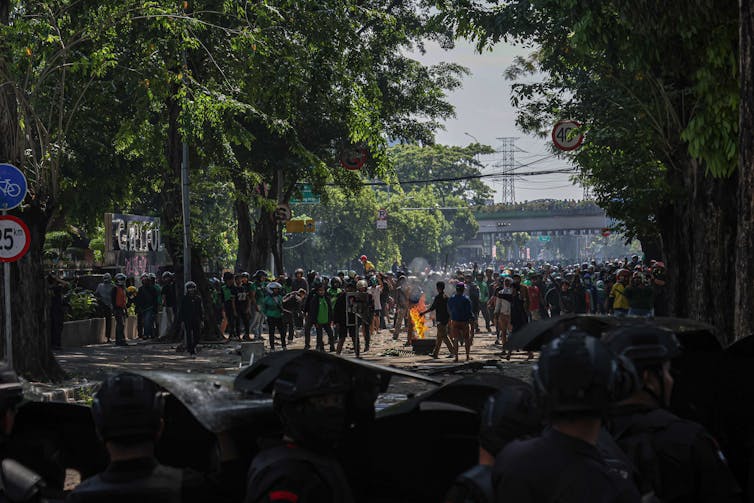
Indonesians have taken to the streets over the past week to protest against elite corruption. The demonstrations began peacefully on August 25 with protests outside parliament in the capital, Jakarta. They soon spread across the country.

The Indonesian People’s Revolution, a group at the centre of the demonstrations, is demanding an investigation into corruption allegations involving the family of former president Joko “Jokowi” Widodo. Jokowi has strongly rejected these accusations, painting them as a smear campaign.

Protesters are also calling for the dissolution of parliament and the impeachment of the current vice-president, Gibran Rakabuming Raka, who is Jokowi’s son.

Gibran’s path to the vice-presidency was controversial. In Indonesia, presidential and vice-presidential candidates must be at least 40 years old, yet he was only 36 during the 2024 election. The constitutional court – led by Gibran’s uncle, Anwar Usman – changed the rules to grant an exception for regional leaders. Usman was dismissed from his post by an ethics council less than a month later.

The group’s demands resonate with wider public anger over the gulf between privilege and poverty in Indonesia. Parliamentarians pocket high salaries, while millions of workers scrape by on some of the lowest minimum wages in the world. News in mid-August that MPs had secured another pay rise only added fuel to the fire.

The protests have now erupted into violence in several areas of the country. The trigger for this came on August 28, when an armoured police vehicle struck and killed a motorcycle taxi driver in Jakarta, before fleeing the scene. Listyo Sigit Prabowo, Indonesia’s national police chief, issued an apology to the victim’s family and has confirmed the case is being investigated.

Indonesia’s current president, Prabowo Subianto, initially denounced demonstrators as “traitors” and “terrorists”, vowing decisive action against them. But he has now backtracked, pledging on August 31 to heed public demands and even cut lawmakers’ allowances.

In the days leading up to this abrupt reversal, echoes of a darker chapter in the nation’s history resurfaced – one marked by state-led violence and intimidation, the mobilisation of Islamist groups, and the scapegoating of minorities.

Indonesia prides itself on bhinneka tunggal ika, unity in diversity. But Prabowo has long relied on conservative Islamist groups to strengthen his power, push through hardline policies and help silence dissent. This includes the Islamic Defenders Front, which the Jokowi government banned in 2020.

Back in 2014, when Jokowi and Prabowo contested presidential elections, Islamist hardliners perpetrated smear campaigns against Jokowi, accusing him of being a communist agent. They also orchestrated the mass mobilisation that toppled Jakarta’s ethnic Chinese Christian governor, Basuki Tjahaja Purnama, in 2017.

The alliance cooled after Prabowo entered Jokowi’s coalition at the end of 2019, but has seemingly been revived amid the current protests. On August 30, the president summoned 16 Islamic organisations to his private residence, reportedly urging them to work with the government to “guard security and peace”.

Meanwhile, racist threats targeting Chinese Indonesian women have flooded online platforms. Popular content creator Elsa Novia Sena, among others, have received rape threats from an account named @endonesaatanpacinak (“Indonesia without Chinese”). I too received rape threats online after criticising the government on X.

For many in Indonesia’s Chinese minority, the atmosphere is chillingly reminiscent of May 1998. That month saw hundreds of women brutally raped – some with sharp tools – in riots characterised by widespread looting and killing. Human rights activists say the 1998 riots were orchestrated or exacerbated by the military to divert public attention from anti-government demonstrations.

Prabowo, an army general at the time, is suspected of being involved in human rights violations during the 1998 riots. He has rejected his alleged involvement in any acts of violence – but was discharged from the military over the allegations, and banned from entering the US for two decades.

Departure from the past

During the blackouts on August 31 in parts of Jakarta (which also occurred prior to the 1998 riots), looting broke out. Yet, in my opinion, something feels different this time. Protesters deliberately targeted the homes of four MPs accused of sneering at the public after securing a pay rise.

The house of Sri Mulyani, Indonesia’s finance minister, was also attacked. She is seen by many Indonesians as complicit in imposing draconian tax policies on ordinary people while sparing elite lawmakers. Sri has dismissed the accusation, stating that any laws are passed in an “open and transparent manner”.

No Chinese Indonesians have been attacked so far. A new slogan, “people looking after people”, has circulated on social media. Many insist the old trick of scapegoating Indonesia’s Chinese minority no longer works.

In May 1998, public anger against the then-president, Suharto, was driven by an economic crash. Indonesia’s ethnic Chinese population – seen as disproportionately successful in business – became convenient scapegoats. This time, however, many Indonesian people have turned against the army.

The protests are no longer only about economic grievances or corruption – they seem to be a stand against the authoritarian playbook of divide and rule. Many even suspect that some of the looters in the current demonstrations are soldiers in disguise.

In Surabaya, a city on the Indonesian island of Java, suspicions deepened when several police posts were torched. People online pointed out that the arsonist, caught in a viral photo, wore an outdated motorcycle taxi uniform paired with Adidas Terrex shoes worth millions of rupiah (hundreds of pounds). The caption asked: “Why would a taxi driver wear a uniform no longer in circulation and, if he really were one, how could he possibly afford such shoes?”

Prabowo may not have anticipated such a reaction from the Indonesian people, forcing him into a U-turn. But despite his gestures of appeasement, many remain unconvinced, dismissing his offers as merely cosmetic.

That scepticism appeared vindicated almost immediately. Late on September 1, the Islamic University of Bandung and Pasundan University came under attack as security forces fired tear gas and rubber bullets at student protesters.

The mass protests, which have spread to 32 provinces of Indonesia, are unlikely to subside soon. The question is whether the government can still weaponise fear and prejudice to cling to power – or whether ordinary Indonesians will stand firm and united against corruption and state violence in demanding justice.

The Conversation

Soe Tjen Marching does not work for, consult, own shares in or receive funding from any company or organisation that would benefit from this article, and has disclosed no relevant affiliations beyond their academic appointment.

ref. Indonesia violence: state response to protests echoes darker times in country’s history – https://theconversation.com/indonesia-violence-state-response-to-protests-echoes-darker-times-in-countrys-history-264374

Genetic tests for cancer can give uncertain results: new science is making the picture clearer to guide treatment

Source: The Conversation – Africa (2) – By Claudia Christowitz, Postdoctoral Research Fellow, Stellenbosch University

Cancer treatment is becoming more personalised. By considering a patient’s unique genetic and molecular profile, along with their lifestyle and environmental factors, doctors can make more accurate treatment decisions. This approach, known as personalised or precision medicine, has been increasingly used in South Africa and has expanded to other African countries in recent decades. It requires doctors to rely more on genetic tests to guide decisions. But these tests don’t always give clear answers. Functional genomics may offer a way to improve the interpretation of unclear genetic test results. We spoke to physiological scientist Claudia Christowitz about it.


Is cancer a genetic disease and what is personalised medicine?

Cancer is fundamentally a genetic disease. It arises when changes in a person’s DNA (referred to as variants or mutations) disrupt normal cell functions such as cell growth and division. It eventually leads to tumour formation. These changes can be inherited from families or acquired during a person’s lifetime. This can be due to lifestyle and environmental risk factors such as smoking, ultraviolet radiation and infectious agents, among others.

Over the past few decades, we’ve entered the era of personalised medicine. As a result, the role of genetics in cancer treatment has become more prominent. Personalised medicine involves tailoring cancer treatment to each patient’s unique characteristics.

For example, even if two people are diagnosed with the same type and stage of cancer, their treatment outcomes may differ. This is because factors such as their genetic and molecular make-up, overall health status, age, body composition, lifestyle habits, and use of other medication can all influence how well a treatment works for them.

How have advances in genetic testing helped in treating cancer?

Advances in DNA sequencing technologies have made it possible to detect genetic variants more quickly and accurately. The tests can look for just a few genes linked to certain medical conditions, or they can describe the entire genome of an individual, or just the protein-coding regions of the genome (the exome).

DNA sequencing has revolutionised cancer care. Doctors can use it to improve prevention in people who are at risk of cancer, detect cancer early, and select the most appropriate treatment.

Africa’s first high-throughput Genomics Centre was launched in 2019 by the South African Medical Research Council. Cancer patients can now undergo whole exome sequencing and whole genome sequencing locally for around R10,000 (about US$566) to R20,000 (about US$1,132). This is sometimes covered by medical insurance. These services are also available at research facilities like the Centre for Proteomic and Genomic Research or the Centre for Epidemiological Research and Innovation at Stellenbosch University.

These facilities strengthen the capacity to sequence, analyse and store human genomes, particularly for the diverse gene pool in Africa. But routine genome sequencing, especially in the public health sector, remains limited due to high costs, limited awareness and the need for trained personnel.

What are the shortcomings of genetic testing?

Genetic testing doesn’t provide all the answers. Unfortunately, not all genetic results are clear-cut. In many cases, patients receive results showing changes in their DNA that cannot be confidently classified as either harmful (pathogenic variants or mutations) or harmless (benign variants). These unclassified variants are known as variants of uncertain significance. The uncertainty often leaves both patients and their oncologists (cancer doctors) unsure of the way forward.

With the advancement of sequencing technologies, rare or novel variants are more frequently detected. But without a clear understanding of whether the variant affects gene function, clinicians are often forced to wait – sometimes for years – until more information emerges.

When patients undergo genetic testing – often as part of a hereditary cancer screening or in response to early-onset or familial cancers – the hope is to find a variant that clearly explains their condition. But sequencing may yield variants of uncertain significance, raising questions about its usefulness in patient care and whether the tests are worth the cost.

What is functional genomics and how can it make genetic test results clearer?

Functional genomics is a growing field that could transform how we interpret these unresolved genetic results and make it possible to improve clinical care for cancer patients.

Functional genomics goes beyond simply reading the DNA code. It investigates how genetic variants behave in biological systems. By examining how a variant alters gene expression, protein function, cell behaviour, or response to treatments, scientists can determine whether it is likely to be benign or pathogenic.

This information is crucial for making timely medical decisions. Importantly, cells derived from patients can be used to mimic real biological conditions more accurately. By using cells carrying such a variant and comparing them to cells without the variant, scientists can determine whether the variant is influencing the response of cells to certain treatments or not.

In short: genetic testing is like reading the “instruction manual” of a cell. Functional genomics is like testing the effects of changes to these instructions.

My study, using patient-derived cells, investigated the effects of a rare TP53 variant that was identified for the first time in germline (inherited) DNA through whole exome sequencing in a South African family with multiple cancers. I found that this variant made cells resistant to the chemotherapy drug doxorubicin. Instead of undergoing cell death as expected, the cells went into a kind of “sleep mode” called senescence, where damaged cells stop dividing.

Although this prevents the growth of damaged cells, senescent cells can release signals that may inflame and harm nearby healthy cells. The variant also reduced how well immune cells can move, which may affect their ability to go to cancer cells and attack them. This study, supervised by Prof Anna-Mart Engelbrecht, Prof Maritha Kotze, and Dr Daniel Olivier from Stellenbosch University, highlighted how functional genomics can unravel the impact of a variant of uncertain significance, which may guide medical decisions.

In a world where personalised medicine is rapidly evolving, functional genomics represents a critical step forward, offering more clarity, better care, and renewed hope to those facing cancer.

The Conversation

Claudia Christowitz received funding from the National Research Foundation, South Africa.

ref. Genetic tests for cancer can give uncertain results: new science is making the picture clearer to guide treatment – https://theconversation.com/genetic-tests-for-cancer-can-give-uncertain-results-new-science-is-making-the-picture-clearer-to-guide-treatment-262545