Trump is close to naming the new Federal Reserve chief. His choice could raise the risk of stagflation

Source: The Conversation – Global Perspectives – By Henry Maher, Lecturer in Politics, Department of Government and International Relations, University of Sydney

US President Donald Trump has signalled in an interview with the Wall Street Journal he is close to announcing his pick for the next chair of the US Federal Reserve.

With inflation again increasing amid widespread focus on the crisis of affordability, Trump’s appointment will be closely watched by financial markets and consumers alike.

The central bank has become a battleground as Trump seeks to extend his influence over Federal Reserve policy.

But the last time a US president attempted to interfere with the independence of the Federal Reserve provides a strong cautionary tale of the dangers of presidential interference.

Trump’s tumultuous relationship with the Fed

Trump has a tumultuous relationship with the Federal Reserve and its current Chair Jerome Powell. Powell was first appointed chair by Trump in 2018, but the relationship quickly turned sour, with Trump repeatedly threatening to fire Powell for not cutting interest rates quickly enough.

Just last month, Trump called Powell a “clown” with “some real mental problems”, adding “I’d love to fire his ass”.

Existing protections mean Trump cannot fire Powell “without cause”, which the US Supreme Court has interpreted to mean corruption or misconduct. Trump has been forced then to wait for the end of Powell’s second term to replace him.

In the meantime, Trump has attempted to fire Lisa Cook, one of the seven Fed governors, by having his Justice Department investigate claims of mortgage fraud against her. The charges however appear to be baseless, and Cook continues to serve as a Fed governor.

At the heart of the dispute with the Federal Reserve is Trump’s view that as president, he should be consulted on the setting of interest rates. With Americans facing a deepening affordability crisis, and Trump taking the blame, he is feeling the pressure to cut interest rates to boost growth.

Accordingly, Trump has insisted that the next chair of the Fed must be someone who is prepared to immediately and significantly cut interest rates, and listen to Trump’s views on monetary policy going forward.

Central bank independence

Reduced interest rates might provide short-term juice to spur spending. However, in the long-term artificially low interest rates cause inflation, only worsening any cost-of-living crisis. For this reason, most developed countries maintain strictly independent central banks.

Central bank independence ensures short-term political considerations like elections and polling numbers do not interfere with long-term planning of monetary policy.

Back to the 70s?

In 1970, during a growing inflation crisis, President Richard Nixon appointed economist Arthur Burns as chairman of the Federal Reserve. Like Trump, Nixon demanded that Burns reduce interest rates and listen to the president’s advice in crafting monetary policy. At Burns’ swearing in, Nixon said he would meet with Burns regularly, adding:

You see, Dr Burns, that is a standing vote of appreciation in advance for lower interest rates and more money […] I respect his independence. However, I hope that independently he will conclude that my views are the ones that should be followed.

Under pressure from the president, who threatened to pass legislation diluting Fed independence if Burns did not comply, Burns repeatedly cut interest rates. However, prematurely low interest rates and the perception that the president was influencing monetary policy only deepened the economic crisis facing the US in the 1970s.

The result was stagflation, the dismal economic situation in which both inflation and unemployment increase simultaneously. Under Burns’ watch, annual inflation peaked at 11% and unemployment at 8.5%.

A protest march in 1970s New York against surging inflation.
H. Armstrong Roberts/Getty

The “Great Inflation” of the 1970s was eventually ended by another Fed chief, Paul Volcker. Recognising that Burns had created a spiral of inflationary expectations, in 1980 Volcker drastically increased interest rates to 19%. Volcker then kept interest rates in double digits until inflation permanently fell.

The so-called “Volcker shock” did eventually tame inflation, but at the cost of cripplingly high interest rates and surging unemployment.

The Great Inflation of the 1970s, and the price paid to end it, stands as a strong warning against the short-term sugar hit of reducing interest rates in response to political pressure.

Will Trump learn the lessons of history?

With some economists warning signs of stagflation are once more emerging, Trump must now pick the next chair of the Federal Reserve.

Prediction markets suggest the most likely candidate is Kevin Hassett, an economist appointed last year by Trump as director of the National Economic Council.

Like Trump, Hassett believes interest rates should be much lower. Having served in both Trump administrations, Hassett also appears likely to offer loyalty and compliance with Trump’s demands.

The second candidate under consideration by Trump is economist Kevin Warsh, a former Fed governor and bank executive. Warsh brings a reputation as an inflation hawk from his time at Federal Reserve during the Global Financial Crisis.

However, a recent interview with the president appears to have assured Trump that Warsh shares his goals, and he is now “at the top of the list” of candidates.

Regardless of who Trump appoints, the crucial question remains whether the next Fed chair will pursue an independent monetary policy free from political interference.

With the president continuing to concentrate power in the hands of the executive, the Federal Reserve remains an important site for the exercise of independent power.

The stagflation crisis of the 1970s stands as a clear warning of what might happen if that independence is compromised.

The spectre of stagflation means financial markets, consumers, and the rest of the world remain unwilling participants in the political drama continuing to play out between the Federal Reserve and the White House.

The Conversation

Henry Maher does not work for, consult, own shares in or receive funding from any company or organisation that would benefit from this article, and has disclosed no relevant affiliations beyond their academic appointment.

ref. Trump is close to naming the new Federal Reserve chief. His choice could raise the risk of stagflation – https://theconversation.com/trump-is-close-to-naming-the-new-federal-reserve-chief-his-choice-could-raise-the-risk-of-stagflation-272052

School shootings dropped in 2025 – but schools are still focusing too much on safety technology instead of prevention

Source: The Conversation – USA (2) – By James Densley, Professor of Criminal Justice, Metropolitan State University

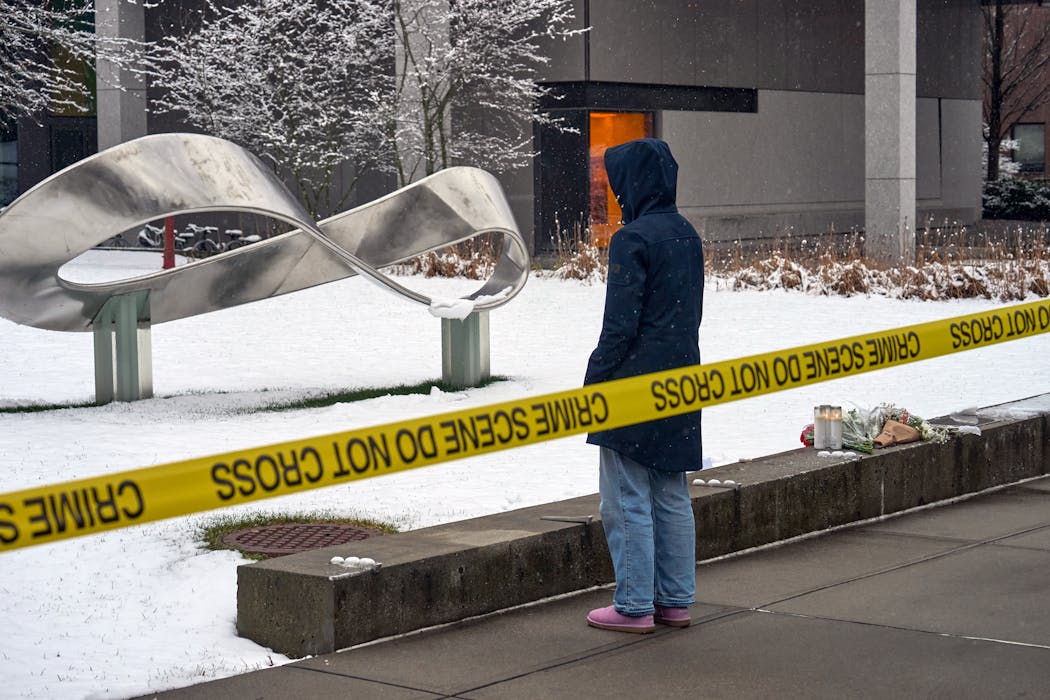
A person mourns at a makeshift memorial outside the Barus and Holley engineering building on the campus of Brown University in Providence, R.I., on Dec. 14, 2025. Bing Guan/AFP via Getty Images

Active shootings represent a very small percentage of on-campus university violence.

But among those that do happen, there are patterns. And as law enforcement officials continue to investigate the Dec. 13, 2025, Brown University shooting, similarities can be seen with other active shooter cases on college campuses that scholar James Densley has studied. “They tend to happen inside a classroom, and there tends to be multiple victims,” Densley explains.

The Brown University tragedy, in which a shooter killed two students and injured nine more, marks the fourth deadly shooting at a U.S. university in 2025.

The Department of Education in Rhode Island, where Brown University is located, said on Dec. 16 that it is urging local elementary and secondary schools to review safety protocols.

Amy Lieberman, the education editor at The Conversation U.S., spoke with Densley about how schools have been given what he describes as an “impossible mandate” to try to prevent shootings.

A group of officials wearing green and blue FBI and law enforcement shirts and vests stand inside a room, seen through glass doors with dark paneling.
Members of the FBI’s evidence response team work at the scene of the Brown University shooting on Dec. 13, 2025.
Kyle Mazza/Anadolu via Getty Images

What is the overall trajectory of school shootings over the past few years?

K-12 school shootings appear to be trending downward, at least in the past two years. But we actually saw the largest jumps in this type of violence in the three to five years leading up to 2024, which trends closely with the broader rise in homicide and violent crime we saw in the pandemic era.

In 2025, there have been 230 school shooting incidents in the U.S. – still a staggeringly high number. This compares with 336 school shootings in 2024, 352 in 2023, 308 in 2022, and 257 in 2021.

How this relates to an increase in schools trying to institute security measures to prevent shootings is an open question. But it’s true that many schools are experimenting with certain solutions, like cameras, drones, AI threat detection, weapons scanners, panic apps and facial recognition, even if there is only weak or emerging evidence about how well they work.

Schools are treated as the front line, because the larger, structural solutions are too difficult to confront. It is much easier to blame schools after a tragedy than to actually address firearm access, grievance pathways – meaning how a person becomes a school shooter – and the other societal problems that are creating these tragedies.

How have schools responded to the rise of school shootings in recent years?

Schools are being asked to solve a societal gun violence problem that they didn’t create and they cannot control. Even the best-run school cannot eliminate all risks when causes accumulate outside of their purview. These attacks are rare but catastrophic, and they create an impossible mandate for schools because when they occur, schools are told it reflects a failure in their preparation. Educators are expected to be teachers, social workers, threat assessors and first responders. It normalizes fear and shifts the responsibility downward.

There is a growing school safety industry that markets fear as a solvable, technical problem. It promises faster ways to detect weapons, for example, but the evidence base for those products is thin, proprietary or nonexistent. One example is an AI detection software that mistook a bag of Doritos for a gun, resulting in a large police response.

Schools are pressured to buy something from these companies to show they are doing something. But some of these systems create false positives, and, more importantly, they shift attention away from human relationships. Technology alone cannot resolve grievances, replace trust and create belonging, but most schools are focused on technology as a means of prevention.

How effective are other prevention systems schools have put in place?

If a school shooter is an outsider trying to attack the building, having a single point of entry, access control or multiple locks on doors creates time and space, which are essential for delaying an attacker until law enforcement can arrive, thus mitigating casualties.

But the evidence shows that nearly all school shooters are either current or former students at the school. They are very familiar with entry and exit points, and they are potentially already inside the building before the school can act on a potential threat of violence.

So, what happens if a school locks down, but you are actually locking the shooter in a room with their potential victims? What if students are forced to hide when it would be safer to run? What if you have a door that locks only from the inside and a student or staff member uses that room to bully or sexually assault another student? We’re building schools to protect against the rare events, but we are not mitigating the more common problems they face.

Students are being asked to practice preventing their own deaths in active shooter drills and learn in environments designed around worst-case scenarios. In general, interpersonal violence and spillover of community violence, like gang-related shootings, are the most common form of school shooting. Most shootings at schools occur in parking lots or at sports events, but we do very little to prepare for those types of scenarios.

Are there any benefits, then, to schools having certain non-tech safety measures in place, like making sure every person has an ID?

Of course, you don’t want strangers walking around in a school building. The fact that someone coming to the school has to get their ID scanned and wear a badge makes perfect sense, not just to prevent shootings but to also prevent theft and assaults and other risks.

The paradox is that school shooters tend to be children already affiliated with the school, and when someone walks in already firing, checkpoints and metal detectors are useless. Historically, several mass shootings in K-12 schools have started outside of the building then moved inside. The issue is not slipping past barriers but overwhelming them in seconds with irresistible force.

A group of people stand in a circle together and hold candles.
People hold candles and sing together on Dec. 14, 2025, at a vigil in Lippitt Memorial Park in Providence, R.I., for the recent mass shooting at Brown University.
Ben Pennington/The Boston Globe via Getty Images

Absent policy change, what is the clearest way to prevent school shootings, according to current evidence?

Evidence shows that we often see signs of a crisis or withdrawal beforehand from school attackers. And that is why school-based behavioral threat assessment and management is so important. It is really about noticing changes in behavior and having the authority to intervene early. This is not about profiling people or relying on law enforcement alone. It is about having a structured, team-based process for identifying concerning behavior, assessing risk and coordinating appropriate supports – such as counseling – to prevent harm before it occurs. So often in these cases, people had a gut feeling that something was off with a particular student, but they didn’t know what to share or who to share it with.

For decades we’ve invested far more in responding to school shootings once they occur rather than in preventing them. You can lock doors and run drills, but no school can become a fortress.

Attackers leak warning signs in advance. Real prevention is about creating human systems that get upstream of this.

The Conversation

James Densley has received funding from the National Institute of Justice, the Joyce Foundation, and the Sandy Hook Promise Foundation.

ref. School shootings dropped in 2025 – but schools are still focusing too much on safety technology instead of prevention – https://theconversation.com/school-shootings-dropped-in-2025-but-schools-are-still-focusing-too-much-on-safety-technology-instead-of-prevention-272140

School breaks privilege Christmas, and classroom strategies are needed to foster inclusion

Source: The Conversation – Canada – By Amina Yousaf, Associate Head, Early Childhood Studies, University of Guelph-Humber

What some school boards now call the “winter break,” over the days leading up to and after Christmas, is approaching.

But in Canada’s diverse public schools, centring one religious holiday sends a subtle message to many children: your family’s traditions don’t quite belong here.

Our publicly funded schools are designed to be welcoming to everyone. Ministries of education and school curricula acknowledge the importance of equity and inclusion in supporting student learning, yet how this is applied in different contexts and classrooms can vary widely.

The focus around Christmas — experienced as holidays that privilege this festival, and sometimes also experienced as winter-themed events that pick up Christmas aspects — can make students from different cultural and religious backgrounds feel marginalized or left out.

As educators look to best practices for implementing guidance around supporting inclusion and affirming diversity in their classrooms, there are opportunities to build in-classroom activities that genuinely reflect and embrace every learner in our vibrant pluralistic communities.

The real impact of feeling left out

When a child’s family life, traditions or identity are missing from the school environment, this can have adverse consequences.

Research shows that school social exclusion is consistently linked to poorer well‑being, higher emotional distress and even changes in adolescent brain development. Large-scale studies have also shown that exclusion undermines belonging, while belonging acts as a protective factor for mental health and engagement. In other words, inclusion isn’t optional, it is essential for students’ emotional safety and academic success.

On the flip side, when students feel they belong, they thrive. Feeling personally accepted and socially valued at school is associated with better mental health and stronger academic trajectories, including lower depression, anxiety and stress into young adulthood. Creating a truly inclusive school environment is therefore not just an extra step, it’s fundamental to student well-being.

Four simple, powerful strategies for inclusion

While overhauling the entire school calendar may be out of reach, educators can start with four classroom changes that research shows are meaningful.

1. Start a storytelling circle with a trauma-informed lens.

Where generic holiday parties exist near the end of term, instead consider a storytelling circle: invite students to share “something special I enjoy in winter,” “a tradition from my community” or “a tradition I’d like to create.”

This keeps open invitations for students who may not have stable family contexts, such as children in foster care or those who’ve experienced loss.


Read more:
What ‘The Lion King’ teaches us about children’s grief


Why storytelling? Oral storytelling, especially when culturally referenced and developmentally scaffolded, builds identity, empathy and early literacy and has shown measurable gains for Indigenous learners. Story‑based routines are also a powerful vehicle for culturally responsive teaching across subjects.

Guidance from the the National Association for the Education of Young Children, a non-profit organization in the U.S., emphasizes that holiday activities should be approached through an anti-bias lens, ensuring they affirm all children’s identities rather than privileging one tradition.

Evidence shows that storytelling circles can support both cultural identity and emotional safety when implemented thoughtfully, through predictable routines and student choice. Trauma-informed classroom frameworks emphasize safety, trust and empowerment as core principles — all of which align with open-ended storytelling prompts.

So, instead of focusing on family-centric tasks, try the following:

  • Make participation voluntary and provide alternative options;

  • Use broad prompts that don’t require family disclosures;

  • Embed predictable routines and emotional safety as recommended by trauma-informed frameworks.

2. A “celebrations wall.”

Mindful of open-ended prompts and children’s emotional safety, create a “celebrations wall” or “seasonal traditions corner” that invites students and families to share images, artifacts or descriptions of winter or year‑end traditions.

These could include religious and cultural festivals such as Hanukkah, Kwanzaa and Lunar New Year.

It could also include personal family traditions such as a special recipe or a trip.

Culturally responsive environments and tasks increase engagement and participation among diverse learners.

Feeling recognized in affirmative ways also strengthens belonging, which relates to motivation and persistence. Practical exemplars from classrooms show how inclusive displays foster voice and connection.

3. Use language that includes everyone.

Language signals who belongs. Replace event names and communications that tie activities to one tradition with neutral, inclusive terms (for example, “winter celebration,” “year‑end gathering”) alongside culturally affirming practices.

Canadian federal guidance provides explicit strategies for inclusive wording that avoids bias across gender, culture, religion and ability. Equity, diversity and inclusion resources align with these practices and emphasize mirroring how people self‑identify. Resources such as Celebrate! An Anti-Bias Guide to Including Holidays in Early Childhood Programs provide practical steps for creating inclusive celebrations.

4. Partner with communities.

Reach beyond school walls. School‑community partnerships bring cultural expertise, resources and authentic experiences into classrooms, and are associated with better attendance, engagement, social‑emotional outcomes and academics.


Read more:
If I could change one thing in education: Community-school partnerships would be top priority


This reduces the burden on educators while widening access to experiences that enrich curriculum and affirm diversity.

Examples could include nurturing community partnerships that support Indigenous storytelling, Lunar New Year presentations or settlement supports for refugee children.

A call for active inclusion

Fostering an inclusive environment is an active choice. It means examining inherited structures and building classroom cultures that affirm every student’s sense of self.

By celebrating the many narratives students bring, educators counteract the emotional toll of exclusion, strengthen resilience and equip young people to navigate a pluralistic society with confidence and respect.

The most important message schools can offer during holidays, and year round, is the certainty that every child belongs.

The Conversation

Amina Yousaf does not work for, consult, own shares in or receive funding from any company or organisation that would benefit from this article, and has disclosed no relevant affiliations beyond their academic appointment.

ref. School breaks privilege Christmas, and classroom strategies are needed to foster inclusion – https://theconversation.com/school-breaks-privilege-christmas-and-classroom-strategies-are-needed-to-foster-inclusion-271671

Spotify Wrapped reminds us even our leisure time is being surveilled and sold

Source: The Conversation – UK – By John Singleton, Lecturer in Journalism & Global Media Studies, University of Galway

Each year as Spotify Wrapped drops, social media timelines fill with neon slides declaring who we “really” are. We trade our top artists and most-played songs like postcards from a year already fading.

It feels communal, a party game to end the year of listening. But this cheerful ritual shows how deeply surveillance has woven itself into our leisure – and, how readily we accept it. It’s what the social psychologist and philosopher Shoshana Zuboff describes in her book The Age of Surveillance Capitalism the “claiming of human experience as free raw material” for predictive data.

Wrapped does more than reflect our taste. It turns private listening into public connection, and connection into content. What looks like play can instead be seen as work. And what feels like recognition of our uniqueness is a reflection of how well we have conformed to the algorithm.


No one’s 20s and 30s look the same. You might be saving for a mortgage or just struggling to pay rent. You could be swiping dating apps, or trying to understand childcare. No matter your current challenges, our Quarter Life series has articles to share in the group chat, or just to remind you that you’re not alone.

Read more from Quarter Life:


At first glance, it’s simple. You listen, Spotify counts. Then it wraps those counts in bright colours and confident language, diagnosing who you are, or who the platform imagines you to be.

Wrapped acts as an identity machine: statistics made into self-portrait. You appear as the “indie purist” or “pop maximalist”. But behind the graphics lies the attention economy, turning every pause into data. What looks like a mirror is really a map drawn to lead you back to using Spotify. That map is built from collecting data on your skipping habits, workout playlists and time-of-day listening.

Leisure once stood apart from labour. Datafication – turning everyday behaviour into trackable, monetisable data – is an answer to an old problem: how to profit from free time. Through this perspective, nearly every facet of life now includes some form of labour.

With apps like Spotify, every engagement creates the highly valuable byproduct of data. Every skip or replay generates data that can be traded and sold. Every share is free advertising. Even when we think we’re unwinding, we’re producing value for someone else.

The sociologist David Beer, who researches the role of data in social and cultural life, wrote that his Wrapped “in some ways … feels like a performance review of [his] leisure time”.

Being told you’re in the top 1% of listeners of a certain artist feels like recognition, but that pleasure masks a loss of agency. Beer felt his Wrapped was humouring him and rewarding him for being a “good listener”, which seems like a byword for “worker”.

By telling him how long and “well” he had listened, by informing him he had “found ways to grow”, he felt like it was boosting his sense of self in order to keep him coming back.

It is an effective platform strategy. Wrapped spikes app downloads and engagement each December, with Spotify crediting it as a major driver of growth.

Narrowing your tastes

Another thing to be wary of is how Wrapped and Spotify’s algorithm could be shaping your taste. Research suggests recommendation loops tend to reinforce existing habits rather than expand them, producing what scholars call “taste tautology”.


Read more:
Four ways to cultivate a unique taste in music in the age of streaming algorithms


These recommendations – new albums like the ones you love, artists spotlighted who are like your favourites – are presented on the interface so readily or built into the design. For instance, the feature where tracks chosen by the algorithm start playing immediately when the song or album you put on ends. Or “curated” playlists like Discover Weekly – described as “your shortcut to hidden gems, deep cuts, and future faves”.

But the more we click on these curated options and the more data we feed the app about our listening habits the more we teach the algorithm to serve more of the same rather than surprise us.

Engagement becomes affirmation of who we seemingly are as predictions reshape preferences, and the preferences it serves us harden into identity. Research suggests that rather than expanding your taste by introducing you to new tracks and artists, this type of algorithmic recommendation can actually narrow your taste.

What kind of individuality can exist in a system that decides what we see and rewards compliance? This subtle erosion of choice isn’t accidental. Wrapped struggles to capture eclectic or erratic listening, flattening diversity into generic categories that distort more than they reveal.

Posting your Wrapped is a small cultural performance, part taste, part humour, part self-awareness. Friends reply with theirs; brands join in. The ritual doubles as free global marketing. Each share delivers a flicker of pleasure that keeps the attention economy turning, our emotions becoming raw material.

A better use of Wrapped is to treat it as a prompt, not a verdict or refelection. Close the app, follow a friend’s suggestion, watch a band live. Keep some of your taste uncounted. Not because numbers are evil, but because taste is more than what can be measured and you deserve to find something you love off the beaten track.

The Conversation

John Singleton does not work for, consult, own shares in or receive funding from any company or organisation that would benefit from this article, and has disclosed no relevant affiliations beyond their academic appointment.

ref. Spotify Wrapped reminds us even our leisure time is being surveilled and sold – https://theconversation.com/spotify-wrapped-reminds-us-even-our-leisure-time-is-being-surveilled-and-sold-270119

Canada’s North is warming from the ground up, and our infrastructure isn’t ready

Source: The Conversation – Canada – By Mohammadamin Ahmadfard, Postdoctoral Fellow, Mechanical & Industrial Engineering, Toronto Metropolitan University

On a winter day in Northern Canada, the cold feels absolute. Snow squeaks underfoot and rivers lie silent beneath thick ice. Yet beneath that familiar surface, the ground is quietly accumulating heat.

That hidden warming is destabilizing the frozen foundation on which northern communities depend. Permafrost — the permanently frozen ground that supports homes, roads, airports and fuel tanks across much of Northern Canada — is warming as a result of climate change. The North has warmed roughly three times faster than the global average, a well-documented effect of Arctic amplification — the process causing the Arctic to warm much faster than the global average.

Permafrost does not fail suddenly. Instead, it responds slowly and cumulatively, storing the heat of warm summers year after year. Over time, that heat resurfaces in visible ways: tilted buildings, cracked foundations, slumping roads and buckling runways. Long-term borehole measurements across Northern Canada confirm that permafrost temperatures continue to rise even in places where the ground surface still refreezes each winter.

Communities in the Northwest Territories, Nunavut and the Yukon are already living with these consequences. As permafrost degrades, it undermines housing and transportation corridors and disrupts mobility and land-based activities. The impacts are uneven, with Indigenous communities often facing the greatest exposure and paying the highest costs.

A damaged access road or unstable fuel tank is not just an engineering inconvenience; it can interrupt supply chains, emergency access and daily life. What these patterns reveal is that permafrost thaw is not simply a surface problem. It’s the result of long-term, uneven warming below ground that reshapes soils, water, ice and infrastructure together, often accelerating damage well after climate warming begins.


Read more:
Collapsing permafrost is transforming Arctic lakes, ponds and streams


Permafrost failure

A map of canada with areas of the north shaded in different colours
A map showing areas of Canada with continuous permafrost (purple) and discontinuous permafrost (blue) and sporadic permafrost (green).
(Natural Resources Canada)

Monitoring and numerical modelling point to a consistent conclusion: permafrost degradation is controlled less by individual warm years than by the long-term balance of heat entering and leaving the ground. Accumulated energy, combined with the large amount of heat required to thaw ice-rich soils, explains why damage often accelerates long after warming begins.

Summer warmth penetrates deeper into the ground than winter cold can fully remove. Snow further reshapes this balance by insulating the ground, especially as a warmer, more moisture-laden atmosphere delivers heavier snow in cold regions, earlier autumn cover, longer spring persistence and uneven accumulation around infrastructure, all of which limit winter heat loss.

Buildings, foundations and buried infrastructure add their own steady sources of warmth. Each input may seem modest on its own. Over decades, their combined effect becomes decisive.

For much of the past century, northern engineering has been designed to keep heat out of frozen ground. Practices such as elevating structures on piles, minimizing ground disturbance and installing passive cooling systems like thermosyphons have proven effective under historically cold conditions. But these approaches depend on long, reliably cold winters. As winters shorten and insulating snow arrives earlier, the benefits of those practices are becoming harder to sustain.


Read more:
Heat waves, wildfire & permafrost thaw: The North’s climate change trifecta


From blocking heat to managing it

Engineers in Canada have already demonstrated ways to deliberately influence subsurface temperatures. Along northern highways and embankments, ventilated shoulders and air-convection systems have been used to increase winter heat loss from permafrost foundations, measurably cooling the ground beneath key infrastructure. These projects show that underground temperatures can be deliberately managed, not just endured.

More recently, work in the Yukon has shown that sloped thermosyphons installed beneath highway embankments can lower permafrost temperatures and raise the permafrost table, stabilizing ice-rich ground that would otherwise continue to settle. These systems are effective but only as long as winters remain cold enough to drive heat extraction.

Geothermal engineering offers a more adaptable approach. In southern Canada and elsewhere, some buildings already use foundation piles that serve two purposes: structural support and heat exchange. Rather than allowing waste heat to leak passively into surrounding soil, these systems circulate fluid to move heat in or out of the ground as conditions require.

In northern permafrost regions, the same principle could be applied differently. Instead of allowing heat from buildings, pipelines or power systems to migrate downward into thaw-sensitive soils, foundation piles could intercept some of that energy and return it to buildings during winter, when heat demand is highest. In summer, operation would focus on limiting new heat input, preserving seasonal cooling gains.

This is not about turning permafrost into an energy resource. It is about preventing uncontrolled heat leakage, sustaining the very foundations that hold northern infrastructure in place.

Protecting what holds communities together

The implications extend far beyond individual buildings. Roads, airstrips, fuel storage facilities, water treatment plants, power lines and communication systems across Northern Canada all depend on stable ground. Many also introduce persistent sources of warmth through traffic, buried utilities and electrical infrastructure.

As thaw progresses, roads deform, fuel tanks shift and runways become unsafe. A settling airport runway, for example, can ground flights that deliver food, fuel and medical supplies for weeks at a time.

For infrastructure expected to remain in service for 50 years or more, managing subsurface temperature may matter as much as structural design itself. When these systems fail, the effects ripple outward, increasing isolation, raising costs and limiting access to essential services.

Indigenous partnership is essential

The impacts of permafrost thaw are not shared equally. Indigenous communities are often the most exposed, facing disproportionate damage to housing and infrastructure that underpins mobility, food security and access to health and education services.

Many northern communities also remain heavily dependent on diesel for heat and electricity, locking in energy systems that add persistent heat to the ground and raise the long-term cost of maintaining infrastructure.

Any approach to geothermal or ground-temperature management must therefore be developed in genuine partnership with Indigenous governments and residents. Engineering solutions that stabilize the ground while reducing fuel dependence will only succeed if they align with local priorities and support long-term community self-determination.

None of this replaces the need to rapidly reduce greenhouse-gas emissions. No technology can preserve all permafrost under unchecked warming. But in Northern Canada, adaptation is no longer optional.

Research shows that long before damage becomes visible, heat accumulates underground, weakening soils and reshaping landscapes. This is where infrastructure can play a central role, by influencing how heat enters, moves throughout and leaves the ground.

Canada now faces a choice: it can continue building as if frozen ground were static, or it can design for permafrost as what it is: a sensitive thermal system with a long memory. The heat accumulated below ground over decades reflects past decisions. But how much heat we add next, and how carefully we manage it, is a choice.

The Conversation

Mohammadamin Ahmadfard receives funding from the Natural Sciences and Engineering Research Council of Canada and Mitacs Inc. for his postdoctoral research at Toronto Metropolitan University.

Ibrahim Ghalayini receives funding from the Natural Sciences and Engineering Research Council of Canada (NSERC) and Mitacs, and has also been the recipient of academic scholarships in support of his research at Toronto Metropolitan University.

Seth Dworkin does not work for, consult, own shares in or receive funding from any company or organisation that would benefit from this article, and has disclosed no relevant affiliations beyond their academic appointment.

ref. Canada’s North is warming from the ground up, and our infrastructure isn’t ready – https://theconversation.com/canadas-north-is-warming-from-the-ground-up-and-our-infrastructure-isnt-ready-272005

From record warming to rusting rivers, 2025 Arctic Report Card shows a region transforming faster than expected

Source: The Conversation – Global Perspectives – By Matthew L. Druckenmiller, Senior Scientist, National Snow and Ice Data Center (NSIDC), Cooperative Institute for Research in Environmental Sciences (CIRES), University of Colorado Boulder

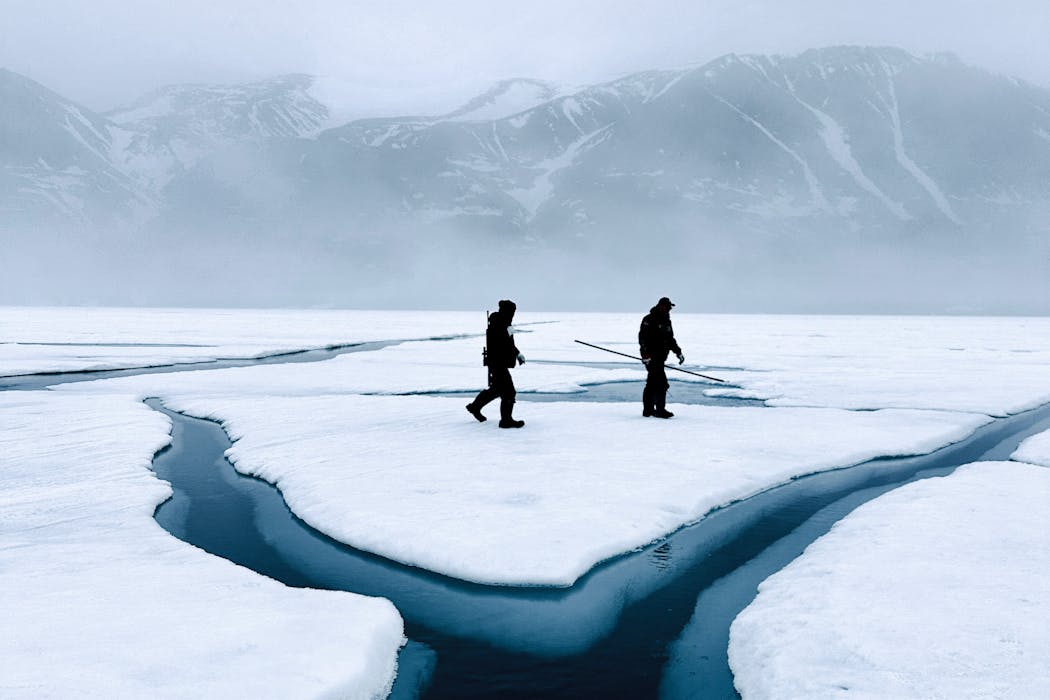
As temperatures rise, the timing of the ice thaw changes. Vincent Denarie via Arctic Report Card

The Arctic is transforming faster and with more far-reaching consequences than scientists expected just 20 years ago, when the first Arctic Report Card assessed the state of Earth’s far northern environment.

The snow season is dramatically shorter today, sea ice is thinning and melting earlier, and wildfire seasons are getting worse. Increasing ocean heat is reshaping ecosystems as non-Arctic marine species move northward. Thawing permafrost is releasing iron and other minerals into rivers, which degrades drinking water. And extreme storms fueled by warming seas are putting communities at risk.

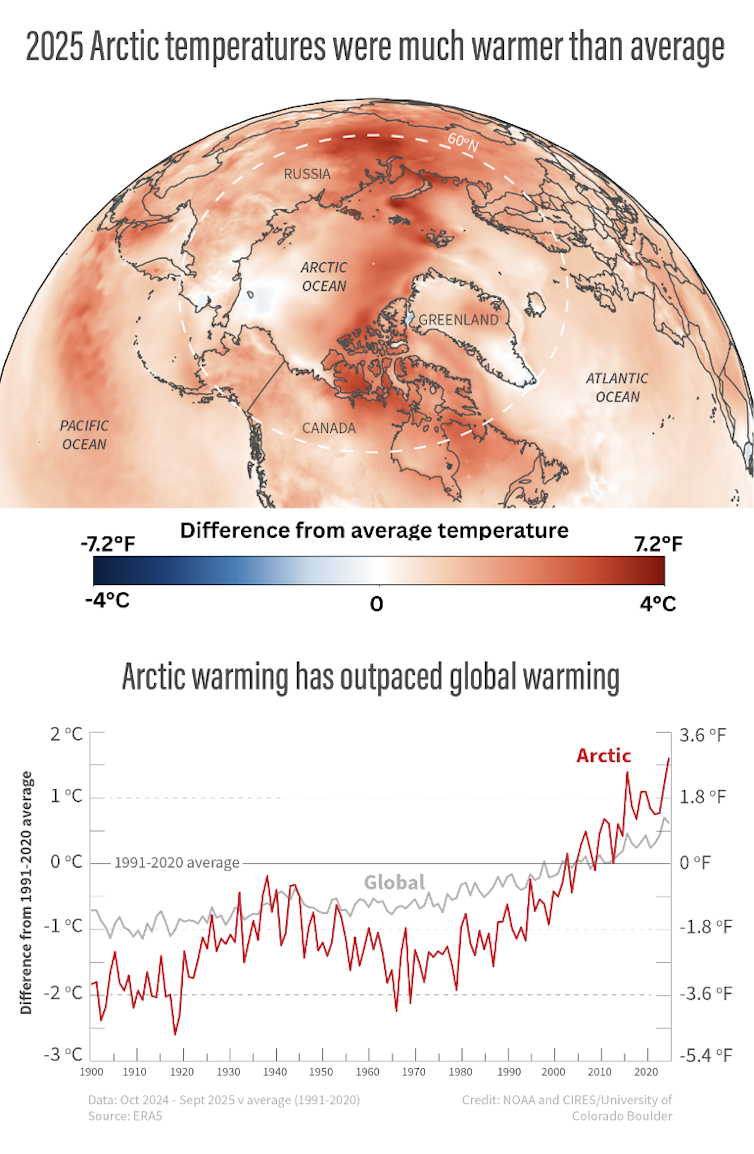
The past water year, October 2024 through September 2025, brought the highest Arctic air temperatures since records began 125 years ago, including the warmest autumn ever measured and a winter and a summer that were among the warmest on record. Overall, the Arctic is warming more than twice as fast as the Earth as a whole.

Highlights from the National Oceanic and Atmospheric Administration’s 2025 Arctic Report Card.

For the 20th Arctic Report Card, we worked with the National Oceanic and Atmospheric Administration, an international team of scientists and Indigenous partners from across the Arctic to track environmental changes in the North – from air and ocean temperatures to sea ice, snow, glaciers and ecosystems – and the impacts on communities.

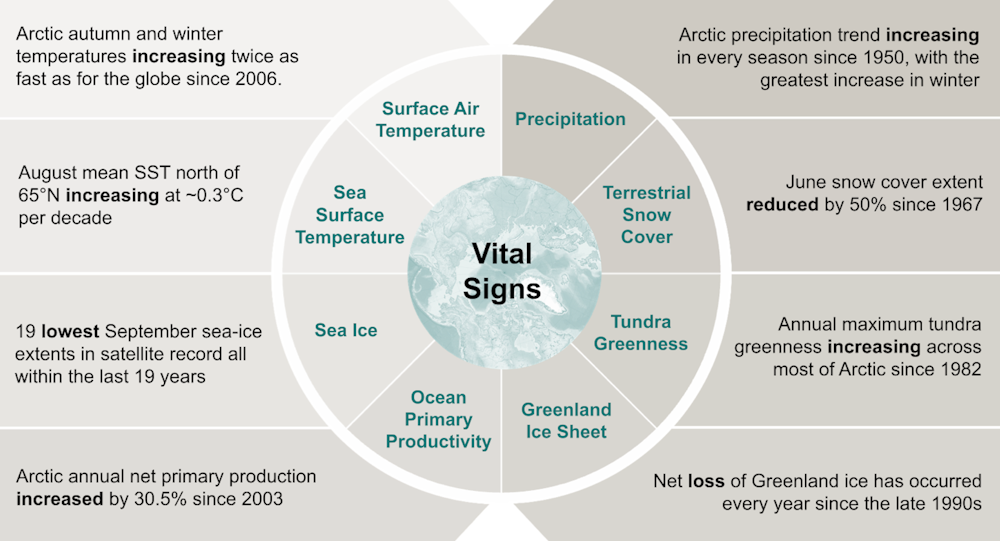
Together, these vital signs reveal a striking and interconnected transformation underway that’s amplifying risks for people who live there.

A wetter Arctic with more extreme precipitation

Arctic warming is intensifying the region’s water cycle.

A warmer atmosphere increases evaporation, precipitation and meltwater from snow and ice, adding and moving more water through the climate system. That leads to more extreme rainstorms and snowstorms, changing river flows and altering ecosystems.

Charts show how the Arctic has warmed faster than the global average.
Arctic surface air temperatures are warming much faster than the global average.
NOAA and CIRES/University of Colorado Boulder.

The Arctic region saw record-high precipitation for the entire 2025 water year and for spring, with the other seasons each among the top-five wettest since at least 1950. Extreme weather – particularly atmospheric rivers, which are long narrow “rivers in the sky” that transport large amounts of water vapor – played an outsized role.

These wetter conditions are reshaping snow cover across the region.

Snow and ice losses accelerate warming, hazards

Snow blankets the Arctic throughout much of the year, but that snow cover isn’t lasting as long. In 2025, snowpack was above average in the cold winter months, yet rapid spring melting left the area covered by snow far smaller than normal by June, continuing a six-decade decline. June snow cover in recent years has been half of what it was in the 1960s.

Losing late spring snow cover means losing a bright, reflective surface that helps keep the Arctic cool, allowing the land instead to be directly warmed by the sun, which raises the temperature.

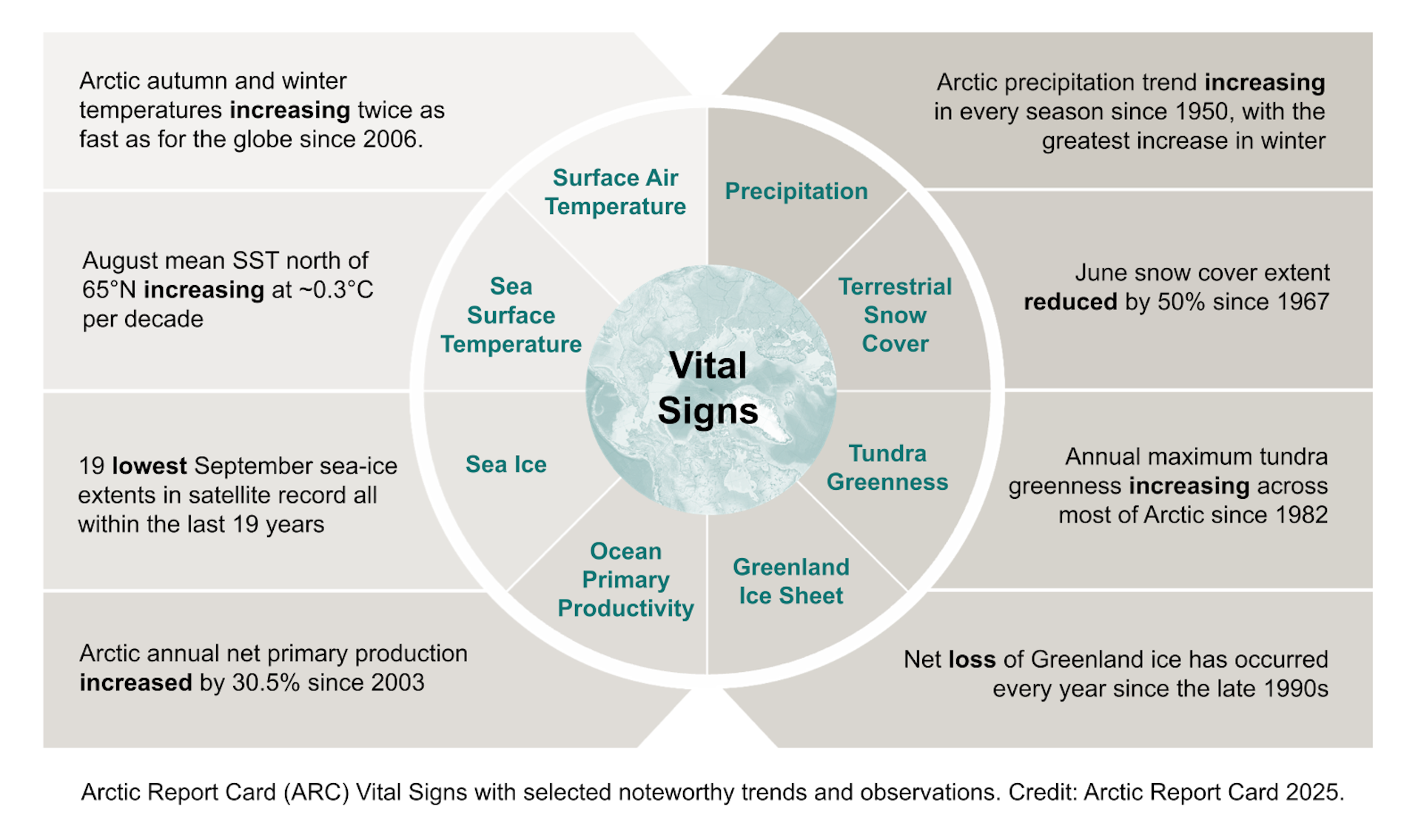
An illustration shows changes in sea level rise, temperature, precipitation, sea ice and other vital areas.
Eight vital signs and observations in 2025 from the 20th edition of the Arctic Report Card.
Arctic Report Card 2025

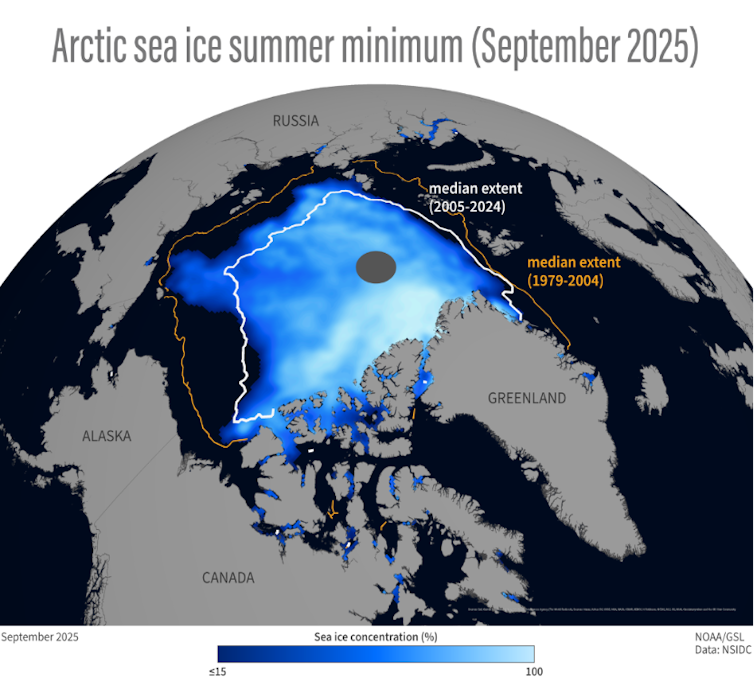
Sea ice tells a similar story. The year’s maximum sea ice coverage, reached in March, was the lowest in the 47-year satellite record. The minimum sea ice coverage, in September, was the 10th lowest.

Since the 1980s, the summer sea ice extent has shrunk by about 50%, while the area covered by the oldest, thickest sea ice – ice that has existed for longer than four years – has declined by more than 95%.

The thinner sea ice cover is more influenced by winds and currents, and less resilient against warming waters. This means greater variability in sea ice conditions, causing new risks for people living and working in the Arctic.

Map shows sea ice extent in 2025 and the 2005-2024 median is much smaller than the 1979-2004 median extent.
Arctic sea ice concentration in September 2025, during its annual minimum extent at the end of summer, was much smaller than the 1979-2004 median extent. The shades of blue reflect the concentration of sea ice.
NOAA and CIRES/University of Colorado Boulder.

The Greenland Ice Sheet continued to lose mass in 2025, as it has every year since the late 1990s. As the ice sheet melts and calves more icebergs into the surrounding seas, it adds to global sea-level rise.

Mountain glaciers are also losing ice at an extraordinary rate – the annual rate of glacier ice loss across the Arctic has tripled since the 1990s.

This poses immediate local hazards. Glacial lake outburst floods – when water that is dammed up by a glacier is suddenly released – are becoming more frequent. In Juneau, Alaska, recent outburst floods from Mendenhall Glacier have inundated homes and displaced residents with record-setting levels of floodwater.

A mountain view shows where the retreating glacier and possible permafrost thaw influenced valley walls exposed above open water.
An aerial photo shows the result of an Aug. 10, 2025, landslide at South Sawyer Glacier in Alaska. The light-colored area of the mountainside is where the slide occurred.
USGS

Glacier retreat can also contribute to catastrophic landslide impacts. Following the retreat of South Sawyer Glacier, a landslide in southeast Alaska’s Tracy Arm in August 2025 generated a tsunami that swept across the narrow fjord and ran nearly 1,600 feet (nearly 490 meters) up the other side. Fortunately, the fjord was empty of the cruise ships that regularly visit.

Record-warm oceans drive storms, ecosystem shifts

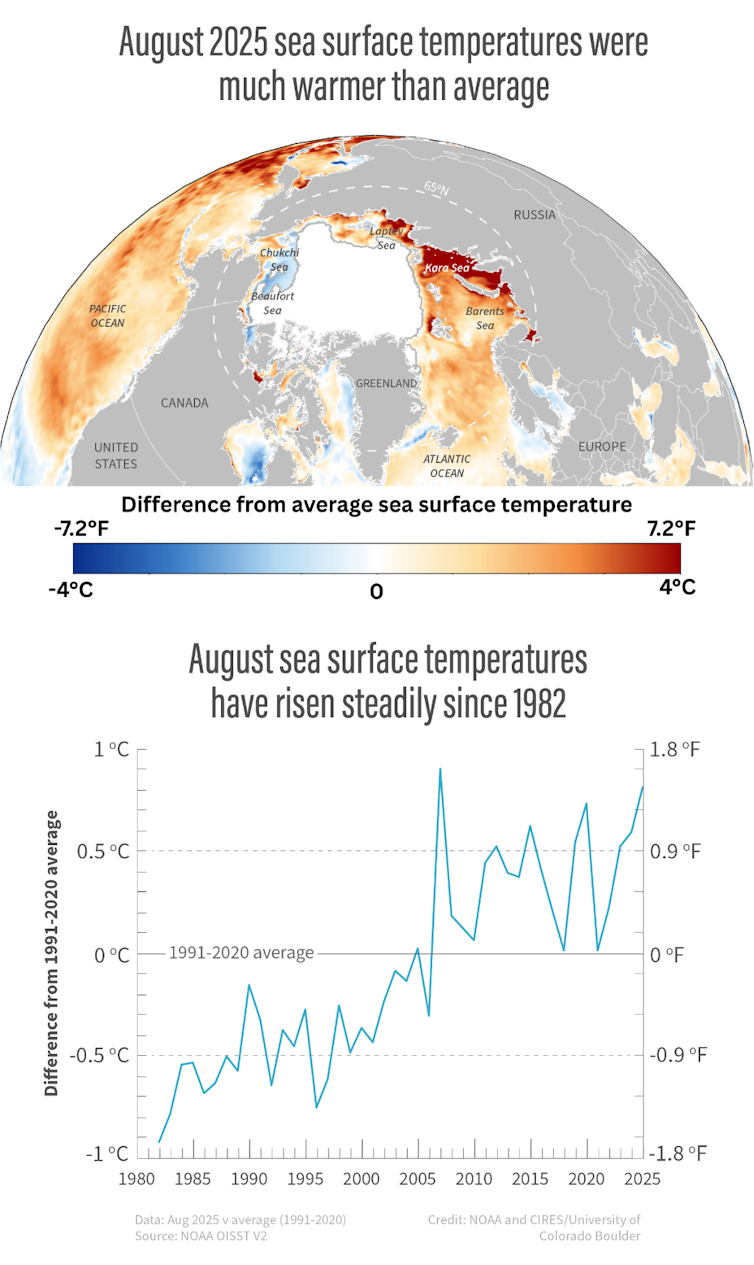
Arctic Ocean surface waters are steadily warming, with August 2025 temperatures among the highest ever measured. In some Atlantic-sector regions, sea surface temperatures were as much as 13 degrees Fahrenheit (7.2 Celsius) above the 1991-2020 average. Some parts of the Chukchi and Beaufort seas were cooler than normal.

A map and chart show temperatures rising.
Arctic sea surface temperatures are much warmer today than in past decades, as this map and chart of August 2025 sea surface temperatures shows.
NOAA and CIRES/University of Colorado Boulder.

Warm water in the Bering Sea set the stage for one of the year’s most devastating events: Ex-Typhoon Halong, which fed on unusually warm ocean temperatures before slamming into western Alaska with hurricane-force winds and catastrophic flooding. Some villages, including Kipnuk and Kwigillingok, were heavily damaged.

As seas warm, powerful Pacific cyclones, which draw energy from warm water, are reaching higher latitudes and maintaining strength longer. Alaska’s Arctic has seen four ex-typhoons since 1970, and three of them arrived in the past four years.

A town with homes surrounded by water.
The village of Kipnuk, shown on Oct. 12, 2025, was devastated by ex-Typhoon Halong. The storm displaced at least 1,500 people from across western Alaska.
Alaska National Guard

The Arctic is also seeing warmer, saltier Atlantic Ocean water intrude northward into the Arctic Ocean. This process, known as Atlantification, weakens the natural layering of water that once shielded sea ice from deeper ocean heat. It is already increasing sea ice loss and reshaping habitat for marine life, such as by changing the timing of phytoplankton production, which provides the base of the ocean food web, and increasing the likelihood of harmful algal blooms.

From ocean ‘borealization’ to tundra greening

Warming seas and declining sea ice are enabling southern, or boreal, marine species to move northward. In the northern Bering and Chukchi seas, Arctic species have declined sharply – by two-thirds and one-half, respectively – while the populations of boreal species expand.

On land, a similar “borealization” is underway. Satellite data shows that tundra vegetation productivity – known as tundra greenness – hit its third-highest level in the 26-year record in 2025, part of a trend driven by longer growing seasons and warmer temperatures. Yet greening is not universal – browning events caused by wildfires and extreme weather are also increasing.

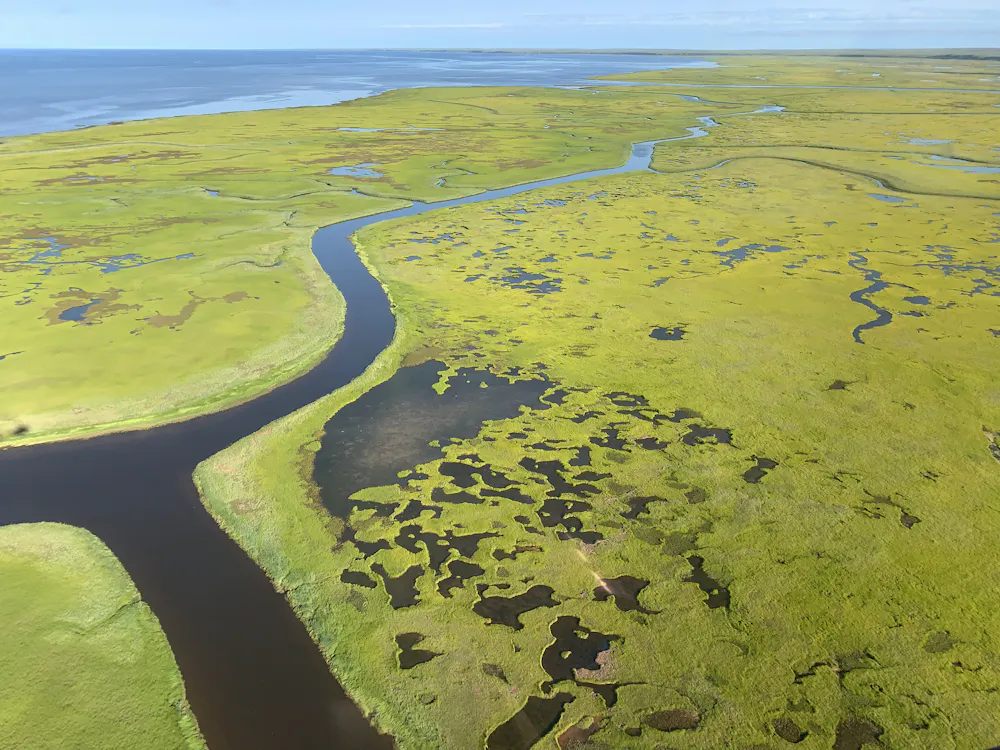
An aerial view of green land dotted with lakes and a river.
Coastal tundra vegetation on the Baldwin Peninsula of Alaska. The tundra is seeing longer growing seasons with warmer temperatures, leading to the overall ‘greening’ of the region.
G. V. Frost

Summer 2025 marked the fourth consecutive year with above-median wildfire area across northern North America. Nearly 1,600 square miles (over 4,000 square kilometers) burned in Alaska and over 5,000 square miles (over 13,600 square kilometers) burned in Canada’s Northwest Territories.

Permafrost thaw is turning rivers orange

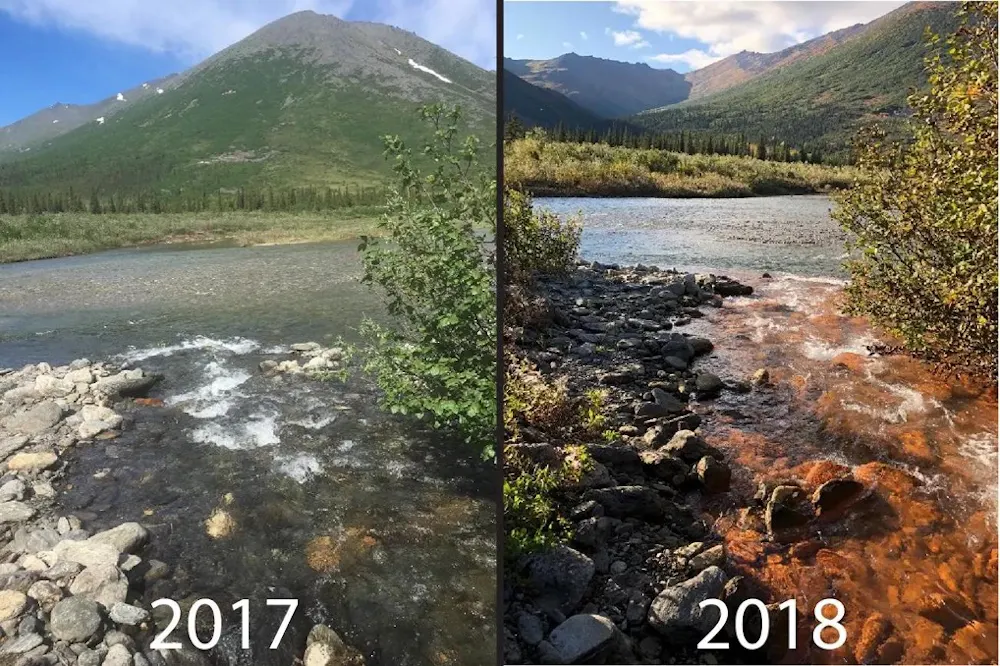
As permafrost – the frozen ground that underlies much of the Arctic – continues its long-term warming and thaw, one emerging consequence is the spread of rusting rivers.

As thawing soils release iron and other minerals, more than 200 watersheds across Arctic Alaska now show orange discoloration. These waters exhibit higher acidity and elevated levels of toxic metals, which can contaminate fish habitat and drinking water and impact subsistence livelihoods.

In Kobuk Valley National Park in Alaska, a tributary to the Akillik River lost all its juvenile Dolly Varden and slimy sculpin fish after an abrupt increase in stream acidity when the stream turned orange.

Side-by-side images show the same stream a year apart, one with rust-colored water.
Rust-colored water in a tributary of the Akillik River in Kobuk Valley National Park reflects permafrost thaw releasing metals into the water.
National Park Service/Jon O’Donnell

Arctic communities lead new monitoring efforts

The rapid pace of change underscores the need for strong Arctic monitoring systems. Yet many government-funded observing networks face funding shortfalls and other vulnerabilities.

At the same time, Indigenous communities are leading new efforts.

The Arctic Report Card details how the people of St. Paul Island, in the Bering Sea, have spent over 20 years building and operating their own observation system, drawing on research partnerships with outside scientists while retaining control over monitoring, data and sharing of results. The Indigenous Sentinels Network tracks environmental conditions ranging from mercury in traditional foods to coastal erosion and fish habitat and is building local climate resilience in one of the most rapidly changing environments on the planet.

A group of people with binoculars watch the water.
Observers with the Indigenous Sentinel Network, together with National Oceanic and Atmospheric Administration scientists, monitor the population and health of northern fur seals on St. Paul Island.
Hannah-Marie Ladd, CC BY

The Arctic is facing threats from more than the changing climate; it’s also a region where concerns of ecosystem health and pollutants come sharply into view. In this sense, the Arctic provides a vantage point for addressing the triple planetary crisis of climate change, biodiversity loss and pollution.

The next 20 years will continue to reshape the Arctic, with changes felt by communities and economies across the planet.

The Conversation

Matthew L. Druckenmiller receives funding from the National Oceanic and Atmospheric Administration (NOAA) to serve as an editor for the Arctic Report Card.

Rick Thoman receives funding from the National Oceanic and Atmospheric Administration (NOAA) to serve as an editor for the Arctic Report Card.

Twila A. Moon receives funding from the National Oceanic and Atmospheric Administration (NOAA) to serve as an editor for the Arctic Report Card.

ref. From record warming to rusting rivers, 2025 Arctic Report Card shows a region transforming faster than expected – https://theconversation.com/from-record-warming-to-rusting-rivers-2025-arctic-report-card-shows-a-region-transforming-faster-than-expected-271572

Humans aren’t the only animals that gather to hunker down together at Christmas

Source: The Conversation – UK – By Anna Champneys, Senior Lecturer in Wildlife Conservation, Nottingham Trent University

Just as humans have historically gathered during winter, many animals do the same. Animals may not be exchanging presents or decorating their nests and dens but a lot of species become more social in winter – even ones that are normally solitary.

Animals have more to worry about this time of year than bickering relatives or the last date for Christmas post. Winter poses severe challenges for wildlife, from freezing temperatures to a scarcity of food. One of the main reasons animals aggregate during the winter is to keep warm. Some species avoid these harsh conditions by migrating to warmer areas, such as cuckoos in the UK overwintering in central Africa. Others grow insulating coats (like mountain hares in the Scottish highlands), or develop a thick layer of blubber (grey seals and harbour porpoises for example) to keep the cold at bay.

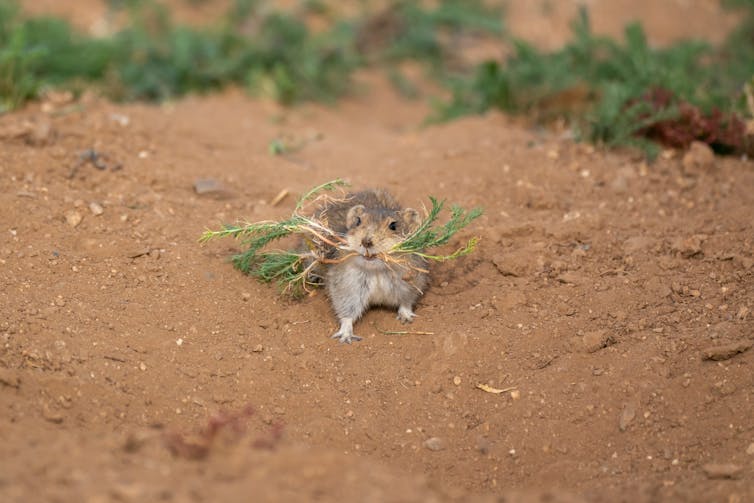
But some animals come together instead. Brandt’s voles inhabit the grasslands and steppe of inner Mongolian, where winter temperatures drop as low as -30 °C and strong winds and blizzards are frequent.

Portrait of a Brandt's vole carrying vegetation to its underground den.
Brandt’s vole is surprisingly tough.
Danita Delimont/Shutterstock

During the summer months, the voles are largely solitary. However, throughout the
long, harsh winters, they form small huddling groups of around four in the nesting chambers of their underground burrows to share body heat. Huddling conserves energy by reducing resting metabolic rate by up to 37% and limits heat loss.

Safety in numbers

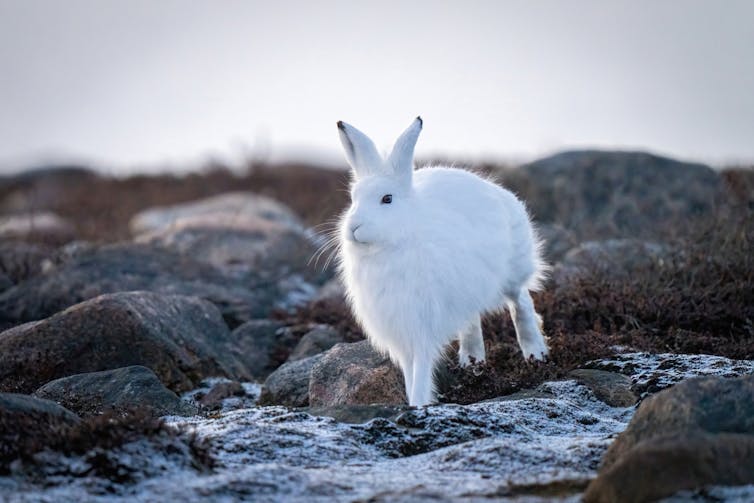
Arctic hares live in one of the harshest environments on Earth in northern Canada
where the long winters last up to nine months and temperatures can drop to -40°C.
During this time, they abandon their solitary summer habits and form large aggregations of up to a hundred hares.

The purpose of this behaviour is not for thermoregulation, since they do not come into close contact. Rather, it is for safety against predators. When Arctic hares form winter groups, they are increasing vigilance against predators including Arctic foxes and wolves.

Arctic hare bounding across tundra.
Arctic hares have to stay alert for foxes and wolves.
Nick Dale Photo/Shutterstock

A major advantage for prey species living in a group is that each animal can spend less time on the lookout for predators (and more time feeding). This is crucial for Arctic hares in winter when food is scarce and they need more energy to keep warm.

Larger groups also cause predator confusion, making it harder for predators to target individual animals. The group dilution effect means that in the event of an attack each hare’s chance of being caught is reduced.

Information network

Rooks are highly social birds living in small flocks of typically ten or fewer unrelated birds all year round. During the winter months many small flocks will join up to form huge colonies of hundreds or thousands of birds from the surrounding area.

Buckenham Carrs woodland in Norfolk has the largest rookery in Britain where an estimated 50,000 rooks have been gathering every winter for centuries. Each evening birds travel to the roost from across the Norfolk Broads, sometimes up to 20 miles, when the bare trees become foliated with rooks.

During the day, the rooks go off in smaller foraging groups and then return to the roosts each evening. Roosting closely together not only helps reduce heat-loss but also makes it easier to find food. These large communal roosts also function as information exchange centres about where the best places to forage are.

When rooks leave their roosts in the morning, they pay close attention to inadvertent cues given by other rooks such as their body condition (as an indicator of recent foraging success) and the direction in which they fly. Less successful rooks copy their more prosperous roost mates. Group foraging is more efficient and therefore reduces exposure to danger.

Water conservation

Another example of the benefits of winter groups is water conservation. Ladybirds
enter a physiological dormancy, called diapause, which allows them to survive the
winter months without feeding. During this period, they form clusters of hundreds or even thousands of ladybirds, which helps conserve energy, as clustered individuals have lower metabolic rates.

Moreover, these aggregations create a microclimate with more stable temperatures and higher humidity, which helps reduce the risk of desiccation, as ladybirds do not consume water during overwintering.

Large numbers of ladybirds resting on log.
Ladybirds tough out winter together.
A. Saunders/Shutterstock

In addition, ladybirds gain extra protection when they form large clusters because their warning colouration, advertising their toxicity, is more obvious to predators.

In the UK, native seven-spot ladybirds aggregate under tree bark or leaf litter, whereas the non-native harlequin ladybird prefers houses and pack together in huge numbers around windows and in lofts during the winter.

Record warm temperatures for both spring and summer in the UK during 2025 may have led to a surge in insect populations. This may explain why many people have noticed large clusters of ladybirds around windows in their homes.

If you find a cluster of ladybirds in your home, it is best just to leave them alone as they pose no risk to people or wooden surfaces. Plus, long term data indicates insect populations are dwindling.

Reproductive advantage

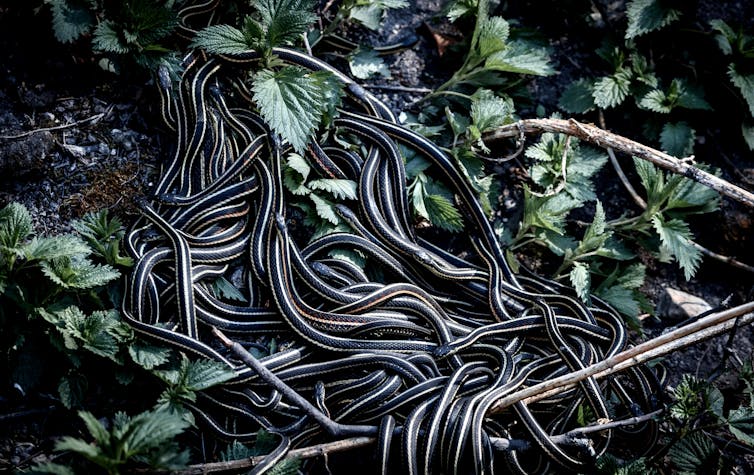
In the cold prairies of Manitoba (Canada), red sided garter snakes congregate in
communal, overwintering dens, sometimes by the thousand. Snakes rely on existing underground structures such as the abandoned burrows of chipmunks, disused wells or limestone sink holes to overwinter. These snakes detect and follow the pheromone trails left by other snakes, which leads them directly to the communal dens.

This seasonal assembly not only increases survival rate during the winter months but also facilitates mating success come the spring. The close proximity of males and females after emergence reduces the time spent searching for a mate during the
short northern breeding season. Courtship begins immediately upon emergence from the dens. Multiple males coil around single females in a “mating ball” ensuring the chances of mating before the females disperse.

Dozens of snakes coiled together in undergrowth
Red sided garter snakes form mating balls in the spring.
Mark F Lotterhand/Shutterstock

This seasonal social behaviour are adaptations for survival in harsh conditions. Similar to many animal species, early humans likely congregated during severe winters to share warmth and resources, illustrating a shared strategy for survival in challenging environments. Understanding this behaviour is vital as climate change alters winter severity and availability of food and shelter.

The Conversation

Anna Champneys does not work for, consult, own shares in or receive funding from any company or organisation that would benefit from this article, and has disclosed no relevant affiliations beyond their academic appointment.

ref. Humans aren’t the only animals that gather to hunker down together at Christmas – https://theconversation.com/humans-arent-the-only-animals-that-gather-to-hunker-down-together-at-christmas-271015

Could your boss be lonely? Here’s why it matters more than you might think

Source: The Conversation – UK – By Karolina Nieberle, Associate Professor of Social and Organisational Psychology, Durham University

PeopleImages/Shutterstock

Loneliness is the pain we feel when our social connections fall short of fulfilling our needs. At its core, it reflects a fundamental human need: to feel close to and connected with others. But it is also often an invisible experience.

Loneliness is not just a personal issue. It is also a workplace one. Gallup’s 2025 global workplace report showed that 22% of employees felt lonely on their previous workday. Managers weren’t immune either: 23% of them reported feeling lonely.

Workplace loneliness can affect anyone and can quietly damage engagement, wellbeing and performance. For leaders, the stakes are high. When they experience loneliness, it can subtly shape how they interact with their teams. They may communicate less openly, avoid feedback or appear withdrawn. A lonely leader influences their entire workplace environment, shaping team dynamics, morale and performance.

With our colleagues, Michelle Hammond (Oakland University) and Keming Yang (Durham University), we have studied loneliness in the workplace and found that managers might feel lonely due to the demands of their role and the things they experience during the workday. These things can vary from day to day.

As managers move up the hierarchy, their status and responsibilities increase, which can create distance from both their team members and peers. Building connections depends on being able to show vulnerability. But daily pressures, tough decisions and confidentiality constraints often make it difficult for managers to open up. As a result, their need for social connection can go unmet on some days, while on other days they may feel engaged and well connected.

Our research looked at the consequences of short-term loneliness among leaders. In two independent studies with UK managers, we found that fluctuations in their loneliness levels had implications for how they approached leadership.

On days or in situations when managers felt lonely, they engaged less with their work (this could be spending time on matters unrelated to work or letting others do their tasks) and lower levels of engagement with their team members (avoiding their employees, for instance).

The consequences of short-term loneliness for managers did not stop at the end of the workday. After a day in which they felt lonely, managers distanced themselves more from others in the evening. This created a loop that perpetuated loneliness into the next workday, and it helps to explain why managers sometimes feel lonely for extended periods.

work papers scattered on a desk with a framed photo of a young child in the background.
There’s more to life than reports.
Khakimullin Aleksandr/Shutterstock

But our research uncovered a key resource outside of work that helped managers mitigate the consequences of loneliness and stopped it from affecting them for a longer period. This centred on how important their relationships with family and friends were in their life – something we called “family identity salience”.

Managers who placed greater value on their family and social connections were better able to switch off from work in the evenings, and loneliness from their workday did not spill over into their home life. Loneliness still affected their leadership at work, but it didn’t lead them to withdraw socially at home. As a result, they were able to start the next workday with a clean slate.

This “family identity salience” motivates managers to create protective boundaries between their daily work and home domains. It helps them shift out of work mode and reconnect with their friends and families after work – especially important on tough days.

Not just managers

Although managers’ loneliness has the greatest implications for the health of the workplace overall, anyone can feel lonely at work sometimes, whether or not they are a manager.

It may be helpful for workers to explore which experiences and situations make them feel lonely. They could also consider the situations when their manager might feel lonely. On the other hand, some situations might make them feel close to others, including managers. Talking to peers and sharing experiences can help to raise awareness of the issue.

To prevent occasional loneliness, workers could make themselves (and others) aware of the networks and groups that offer connection. These could be immediate team members, peers, (senior) managers, colleagues in other departments or external partners. They should think about what connects them with each of these groups and the steps they can take to strengthen their connection with them.

In addition to workplace networks, employees should invest in their relationships outside work. They can remind themselves why these relationships matter, and keep family and social goals visible (with photos, reminders or personal notes) to reinforce a sense of identity beyond work. The energy and support resources that people gain from time with friends and family outside work can unlock benefits in the professional sphere too.

Workers can also take steps to sustain and expand their relationships outside of work. For example, they might be the one who arranges dates, phone calls and shared activities with the people they value.

The best way for people to shield themselves from workplace loneliness is by not placing all their eggs in their “work basket”. Building resilience by nourishing and investing in interests and connections to places and people is a good way to celebrate all the facets of what makes us human.

The Conversation

The authors do not work for, consult, own shares in or receive funding from any company or organisation that would benefit from this article, and have disclosed no relevant affiliations beyond their academic appointment.

ref. Could your boss be lonely? Here’s why it matters more than you might think – https://theconversation.com/could-your-boss-be-lonely-heres-why-it-matters-more-than-you-might-think-272129

How Europe could use billions in frozen Russian assets to fund Ukraine’s war effort – and why it’s so risky

Source: The Conversation – UK – By Nikiforos Panourgias, Senior Lecturer, Queen Mary University of London

Euroclear’s Brussels headquarters building. Werner Lerooy/Shutterstock

Most people outside of banking won’t have heard of Euroclear. It’s a Brussels-based settlement provider that enables the transfer of ownership of securities between seller and buyer. The firm is the focal point of a major geopolitical confrontation between Russia and the European Union.

The controversy stems from an EU initiative to leverage frozen Russian assets held at Euroclear to finance Ukraine’s war effort. In response, Russia’s central bank has filed a lawsuit in Moscow seeking damages for the freezing of its assets.

This legal manoeuvre represents an attempt to seize assets worth €17 billion (£14.89 billion) held by Euroclear in Russia on behalf of its clients and pursue further claims on similar Euroclear assets in other jurisdictions not part of the international sanctions imposed on Russia. These could include China, Hong Kong and states in the Gulf and Central Asia.

To appreciate the implications of these competing claims, it is essential to understand Euroclear’s role and origins.

Euroclear functions as a central securities depository (CSD). These are invisible, yet vital, pieces of infrastructure for financial markets. The function of a CSD is to transfer ownership of securities – titles of ownership of financial assets – from seller to buyer once payment is confirmed.

Euroclear is an international CSD. This means it handles not just equities traded on a particular stock exchange like national CSDs do, but a vast range of financial instruments across many markets and jurisdictions.

This includes Eurobonds, supranational agency bonds, government and corporate debt, money market instruments, asset-backed securities and more. It also provides critical collateral management and securities borrowing and lending services.

In 2024, it processed 331 million transactions worth €1,162 trillion (£877 billion) and held more than €40 trillion of clients’ assets.

This privileged position depends on trust. Depositories such as Euroclear process ownership changes via book-entry transfer. That means assets are held by the CSDs and recorded in a database of holdings, which confers legal ownership of the titles. This ensures uncontested and efficient transactions and reduces the risk of one side of a trade not fulfilling its obligations.

If the trust that allows market participants to assign their assets to a CSD like Euroclear for safekeeping falters, the book-entry transfer system breaks down and markets suffer.

Risks of EU’s plan

The EU’s plan to use frozen Russian assets as collateral for loans to Ukraine introduces significant risks. If market participants fear politically motivated asset seizures, they may relocate holdings to jurisdictions perceived as safer. This could potentially weaken Euroclear’s position and destabilise the markets it serves.

The recent EU proposals have evolved to avoid outright seizure of the Russian assets. Instead it has opted for freezing them indefinitely. Under this arrangement, legal ownership remains with Euroclear’s Russian clients, while Euroclear uses these assets as collateral for loans to the EU to finance Ukraine.

But this raises important questions. What happens if sanctions are lifted or Russia’s legal challenges are successful? Could Euroclear demand immediate repayment from the EU? And could Euroclear withstand the financial strain of restoring all these assets to their Russian owners en masse? These uncertainties are a threat to Euroclear’s stability – and, by extension, the smooth operation of the global markets it serves.

Even unsuccessful litigation on the side of Euroclear’s Russian clients could freeze Euroclear’s holdings at national CSDs in non-sanction jurisdictions for prolonged periods. This could create operational problems for Euroclear and unsettle its clients.

The European Commission has suggested that Euroclear compensate clients for Russian-related losses using its immobilised Russian funds. But this would mean fewer funds available for loans to the EU for financing Ukraine.

The issues above are further complicated by Euroclear’s history and its part in the vast multitrillion dollar Eurodollar and Eurobond markets for offshore currency deposits and debt securities. Founded in 1968 by Morgan Guaranty Trust in Brussels, Euroclear supported the burgeoning Eurodollar and Eurobond markets.

These markets were based on offshore dollar pools that included Soviet dollar deposits seeking refuge from US jurisdiction during the cold war.

Belgium and Euroclear had an interest in nurturing Soviet trust. This was formalised in the 1989 Belgium–Luxembourg Economic Union–USSR bilateral investment treaty that is still in force between Belgium and Russia.

The treaty guarantees fair treatment, protection against expropriation, free transfer of funds and provides for dispute resolution and arbitration mechanisms. Allowing Russian assets to be used as loan collateral may be in breach of that treaty.

European financial leadership under threat

Europe’s world leadership in offshore currency and debt markets and the international financial infrastructures that support them) was achieved in the 1950s and 1960s due to perceived political risks in the US. But it’s now threatened by similar perceived risks in Europe if this plan to leverage Russian assets against its will is realised.

Euroclear is a rare example of a European global financial services champion which could provide valuable economic returns to fund Europe’s future ability to counter external threats. This could be both directly, through the generation of revenues and taxes, as well as indirectly.

Euroclear acts as part of a backbone for the EU’s financial infrastructures. It helps make Europe a central and critical part of the global financial system, enhancing market integration in Europe and across the globe, and channelling large reserves of international capital into the European financial system.

A misstep now could damage that competitive advantage, as well as cause financial turmoil and – in the longer run – potentially divert asset flows away from Europe to other, competing jurisdictions.

The Conversation

Nikiforos Panourgias currently receives research funding from the Chartered Institute of Management Accounting. He has also received funding in the past from the European Commission Horizon 2020 programme and worked on a project with funding from the Science Foundation of Ireland.

ref. How Europe could use billions in frozen Russian assets to fund Ukraine’s war effort – and why it’s so risky – https://theconversation.com/how-europe-could-use-billions-in-frozen-russian-assets-to-fund-ukraines-war-effort-and-why-its-so-risky-272087

The twelve viruses of Christmas, and how to make your own – out of paper

Source: The Conversation – UK – By Ed Hutchinson, Professor, MRC-University of Glasgow Centre for Virus Research, University of Glasgow

Virus snowflakes. Ed Hutchinson, MRC-University of Glasgow Centre for Virus Research, CC BY-SA

Viruses, as we all know, are invisibly small things that make us sick. But is that the whole story?

Zoom in close enough and you’ll discover the complex, unseen world of viruses. Some do make us sick, but many others simply exist alongside us as part of the natural world. Most are very beautiful and many, it turns out, look a bit like snowflakes.

It’s the time of year for seasonal decorations. So the MRC-University of Glasgow Centre for Virus Research has created a set of papercraft virus snowflakes you can print and cut out. They’re a fun way to explore the viruses around us this winter – and the vaccines that protect us from them.

Here are some of our favourites.

Three snowflake-like images of viruses
The First, Second and Third Viruses of Christmas.
Ed Hutchinson, MRC-University of Glasgow Centre for Virus Research, CC BY

On the first day of Christmas a virus gave to me: a world that is too small to see

An elegantly decorated adenovirus, just 100 nanometres across – that’s a ten-thousandth of a millimetre, or smaller than a quarter of the wavelength of visible light.

On the second day of Christmas a virus gave to me: two twinned capsids

Many viruses use repeating protein blocks to package their genetic material (genome) into regular, rounded “capsids”. The geminiviruses of plants pull off a beautiful geometrical trick, stacking their proteins into a doubled capsid structure.

On the third day of Christmas a virus gave to me: three genome segments

Most viruses store their genes in one molecule, but some split them into segments – just like how our DNA is divided into multiple chromosomes. This virus, Heartland virus, has three of them.

Three snowflake-like images of viruses
The Fourth, Fifth and Sixth Viruses of Christmas.
Ed Hutchinson, MRC-University of Glasgow Centre for Virus Research, CC BY

On the fourth day of Christmas a virus gave to me: four COVID vaccines

There are four main types of COVID vaccine (clockwise from top left): protein subunit vaccines (which use harmless virus fragments), inactivated virus vaccines (using killed virus particles), mRNA vaccines (delivered in tiny lipid bubbles), and adenoviral vector vaccines (using a harmless virus as a delivery vehicle).

On the fifth day of Christmas a virus gave to me: FIIIIVE TIIINY RIIIIIIINGS

Anelloviruses (named after the Latin word for “ring” because of their circular genomes) are extremely common blood-borne viruses. Despite infecting almost everyone on the planet, they don’t appear to cause any disease – so they went completely unnoticed for decades.

On the sixth day of Christmas a virus gave to me: six wasps a-laying

Bracoviriforms have formed a remarkable partnership with a particular type of wasp. The wasp passes the virus’s genes directly to its offspring, and in return, the virus provides capsids (protein shells) for the wasp to use. The wasp then uses those capsids to disable a caterpillar’s immune system, allowing it to lay eggs inside the living caterpillar. Not the nicest story, but that’s nature for you.

Three snowflake-like images of viruses
The Seventh, Eighth and Ninth Viruses of Christmas.
Ed Hutchinson, MRC-University of Glasgow Centre for Virus Research, CC BY

On the seventh day of Christmas a virus gave to me: seven dogs a-barking

A vaccine made from inactivated rabies virus particles. Rabies vaccines were among the first ever developed, and, unusually, they can protect someone even after a dog bite has exposed them to this otherwise deadly virus.

On the eighth day of Christmas a virus gave to me: eight tools for teaching

Bacteriophage lambda infects the most commonly studied strain of lab bacteria, E coli. Instead of being a nuisance, it turned out to be a revelation. By manipulating its host with a clever set of genetic switches, lambda helped scientists understand how cells and genes are controlled.

On the ninth day of Christmas a virus gave to me: nine childhood vaccines

From January 1 2026, all children in the UK will be offered free vaccines against these nine viruses. They are (clockwise from top left) measles virus (the cause of measles and of measles encephalitis), varicella zoster virus (chickenpox, shingles, and a potential contributor to dementia), poliovirus (poliomyelitis and paralysis), mumps virus (mumps), hepatitis B virus (hepatitis, cirrhosis and liver cancer), human papillomavirus (cervical cancer), influenza virus (influenza), rotavirus (gastroenteritis) and rubella virus (German measles, miscarriage, congenital rubella syndrome).

Three snowflake-like images of viruses
The Tenth, Eleventh and Twelfth Viruses of Christmas.
Ed Hutchinson, MRC-University of Glasgow Centre for Virus Research, CC BY

On the tenth day of Christmas a virus gave to me: ten lunar landers

Bacteriophage T4 is one of the most complex and beautiful of the bacterial viruses. It lands on a bacterium like a tiny lunar module, then squats down to inject its genome and take over the cell. One small step.

On the eleventh day of Christmas a virus gave to me: eleven Christmas dinners

A wreath of ten crAssviruses – hugely abundant viruses that infect gut bacteria and are part of your normal, healthy microflora. They surround one norovirus, which causes winter vomiting disease, and is not part of your normal, healthy microflora.

On the twelfth day of Christmas a virus gave to me: twelve fights worth winning

Viruses representing pandemics or major outbreaks since the start of the 20th century: four influenza viruses (from the pandemics of 1918, 1957, 1968 and 2009), SARS-CoV-1, SARS-CoV-2, Zika virus, mpox virus, HIV, polio virus and Ebola virus.

The responses to all of these outbreaks were complex and flawed, but in every case their effects would have been far worse were it not for the tireless work of healthcare professionals, scientists and public health specialists. This work must continue – with a space for “disease X”, the ghost of viruses yet to come.

If you’d like to see more, you can download and try out the virus snowflakes for yourself, along with lesson plans and other free resources.

The Conversation

Ed Hutchinson receives funding from UKRI and the Wellcome Trust. He has unpaid positions on the board of the European Scientific Working group on Influenza, on Virus Division of the Microbiology Society and as an scientific advisor for Pinpoint Medical.

ref. The twelve viruses of Christmas, and how to make your own – out of paper – https://theconversation.com/the-twelve-viruses-of-christmas-and-how-to-make-your-own-out-of-paper-271008