Rising electricity prices and an aging grid challenge the nation as data centers demand more power

Source: The Conversation – USA (2) – By Barbara Kates-Garnick, Professor of Practice in Energy Policy, The Fletcher School, Tufts University

Energy prices are going up – still. zpagistock/Moment via Getty Images

Everyone – politicians and the public – is talking about energy costs. In particular, they’re talking about data centers that drive artificial intelligence systems and their increasing energy demand, electricity costs and strain on the nation’s already overloaded energy grid.

As a former state energy official and utility executive, I know that many of the underlying questions involving energy affordability are very complex and have been festering for decades, in part because of how many groups are involved. Energy projects are expensive and take a long time to build. Where to build them is often also a difficult, even controversial, question. Consumers, regulators, utilities and developers all value energy reliability but have different interests, cost sensitivities and time frames in mind.

The problem of high energy prices is not new, but it is urgent. And it comes at a time when the U.S. is deeply divided on its approaches to energy policy and the politics of solving collective problems.

A person in an elevated bucket works with tools and wires.
To stay reliable, the electricity grid needs long-term investment, not just repairs after storms.
Miguel J. Rodriguez Carrillo/Getty Images

Rising costs

From September 2024 to September 2025, average U.S. residential electricity prices have risen 7.4%, from 16.8 to 18 cents per kilowatt-hour. Government analysts expect prices will continue to rise and outpace inflation in 2026.

With household earnings basically flat when adjusted for inflation, these increases hit consumers hard. They take up higher percentages of household expensesespecially for lower-income households. Electricity prices have effects throughout the economy, both directly on consumers’ budgets and indirectly by raising operating costs for business and industry, which pass them along to customers by raising prices for goods and services.

The problem

By 2030, energy analysts expect U.S. electricity demand to rise about 25%, and McKinsey estimates that data centers’ energy use could nearly triple from current levels by that year, using as much as 11.7% of all electricity in the U.S. – more than double their current share.

The nation’s current electricity grid is not ready to supply all that energy. And even if the electricity could be generated, transmission lines are aging and not up to carrying all that power. Their capacity would need to be expanded by about 60% by 2050.

Orders of key generating equipment often face multiyear delays. And construction of new and expanded transmission lines has been very slow.

A Brattle Group analysis estimates all that new and upgraded equipment could cost between US$760 billion and $1.4 trillion in the next 25 years.

The reasons

The enormous scale of the work needed is a result of a lack of investment over time and delays in the investments that have been made.

For instance, since at least 2011 there has been an effort to bring Canadian hydropower to the New England electricity grid. Political opposition to cutting a path for a transmission line through forestland meant the project was subjected to a statewide referendum in Maine – and then a court case that overturned the referendum results. During those delays, inflation raised the estimated price of the project by half, from $1 billion to $1.5 billion – an added cost that will be paid by Massachusetts electricity customers.

That multiyear effort is just one example of how the vast web of companies that generate power, transmit it from power plants to communities, and distribute it to homes and businesses complicates attempts to make changes to the power grid.

State and federal government agencies have roles in these processes. States’ public utilities commissions oversee the utility companies that distribute power to customers. The Federal Energy Regulatory Commission oversees connections of power generators to the grid and the transmission lines that move electricity across state lines.

Often, those efforts aren’t aligned with each other, leading to delays over jurisdiction and decision-making.

For instance, as new generators prepare to operate, whether they are solar farms or gas-fired power plants, they need permission from FERC to connect to the transmission grid. The commission typically requests technical engineering studies to determine how the project would affect the existing system. Delays in this process increase the timeline and cost of development and postpone adding new capacity to the grid.

The costs

A key question for regulators and consumers alike is who should pay for adding more electricity to the grid and making the system more reliable.

Utilities traditionally charge customers for the costs of generating and delivering power. And it’s not clear how much power the data centers will ultimately require.

Some large data centers have taken to paying to build their own on-site power plants, though often they can supply energy to the grid as well.

In some states, efforts have begun to address public concern about electricity bills. In November 2025, two utility commissioners in Georgia, who had consistently approved electricity rate hikes over the previous two years, were voted out of office in a landslide.

New Jersey’s Gov.-elect Mikie Sherrill has pledged to declare a utility-price emergency and freeze costs for a year.

In New York, Gov. Kathy Hochul has paused implementation of state law, driven by environmental concerns, requiring that all new buildings over seven stories tall only use electricity and not natural gas or other energy sources. Hochul has said that requirement would increase electricity demand too much, raising prices and making the grid less stable.

In Massachusetts, Gov. Maura Healey has filed legislation seeking to provide energy affordability, including eliminating some charges from utility bills, capping bill increases and barring utility companies from charging customers for advertisement costs.

A wind turbine stands near a large group of block-shaped buildings.
Generating more power – from wind, nuclear or other sources – is only part of the potential solution.
Scott Olson/Getty Images

The solutions

Clearly, there are no quick fixes or easy solutions to this complex situation.

However, innovation in regulation, combined with new technologies and even AI itself, may enable creative regulatory and technical solutions. For instance, devices that can be programmed to use energy efficiently, time-sensitive pricing and demand monitoring to smooth out peaks and valleys in electricity use can potentially ease both grid load and customers’ bills. But those solutions will work only if all the players are willing to cooperate.

There are a lot of ideas about how to lower the public’s burden of paying for data centers’ power. New ideas like this need careful scrutiny and possible revisions to ensure they are effective at lowering costs and increasing reliability.

As the country grapples with the effort to upgrade the grid, perform long-deferred maintenance and build new power plants, consumers’ costs are likely to continue to rise, further increasing pressure on Americans. Existing regulations and government oversight may no longer lower electricity costs immediately or help people plan for the rising costs over the long term.

The Conversation

Barbara Kates-Garnick receives funding from

I received funding from the Mass Clean Energy Center through Tufts University for a grant on Offshore wind..
I serve on the board of Resources for the Future

ref. Rising electricity prices and an aging grid challenge the nation as data centers demand more power – https://theconversation.com/rising-electricity-prices-and-an-aging-grid-challenge-the-nation-as-data-centers-demand-more-power-271465

Where the wild things thrive: Finding and protecting nature’s climate change safe havens

Source: The Conversation – USA (2) – By Toni Lyn Morelli, Adjunct Full Professor of Environmental Conservation, UMass Amherst; U.S. Geological Survey
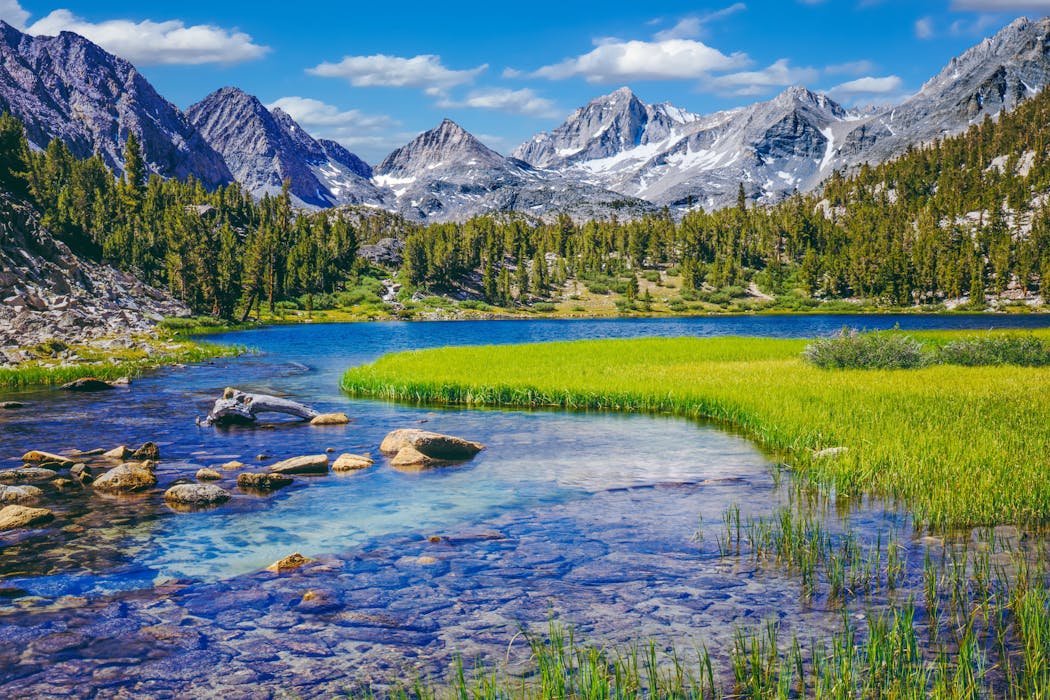
Much wildlife relies on cool streams and lush meadows in the Sierra Nevada. Ron and Patty Thomas/E+ via Getty Images

The idea began in California’s Sierra Nevada, a towering spine of rock and ice where rising temperatures and the decline of snowpack are transforming ecosystems, sometimes with catastrophic consequences for wildlife.

The prairie-doglike Belding’s ground squirrel (Urocitellus beldingi) had been struggling there as the mountain meadows it relies on dry out in years with less snowmelt and more unpredictable weather. At lower elevations, the foothill yellow-legged frog (Rana boylii) was also being hit hard by rising temperatures, because it needs cool, shaded streams to breed and survive.

A ground squirrel with a skinny tail sits up on its back legs.
A Belding’s ground squirrel in the Sierra Nevada.
Toni Lyn Morelli

As we studied these and other species in the Sierra Nevada, we discovered a ray of hope: The effects of warming weren’t uniform.

We were able to locate meadows that are less vulnerable to climate change, where the squirrels would have a better chance of thriving. We also identified streams that would stay cool for the frogs even as the climate heats up. Some are shaded by tree canopy. Others are in valleys with cool air or near deep lakes or springs.

These special areas are what we call climate change refugia.

Identifying these pockets of resilient habitat – a field of research that was inspired by our work with natural resource managers in the Sierra Nevada – is now helping national parks and other public and private land managers to take action to protect these refugia from other threats, including fighting invasive species and pollution and connecting landscapes, giving threatened species their best chance for survival in a changing climate.

An illustration shows protected lakes and glaciers and shaded streams
Examples of climate change refugia.
Toni Lyn Morelli, et al., 2016, PLoS ONE, CC BY

Across the world, from the increasingly fire-prone landscapes of Australia to the glacial ecosystems at the southern tip of Chile, researchers, managers and local communities are working together to find and protect similar climate change refugia that can provide pockets of stability for local species as the planet warms.

A new collection of scientific papers examines some of the most promising examples of climate change refugia conservation. In that collection, over 100 scientists from four continents explain how frogs, trees, ducks and lions stand to benefit when refugia in their habitats are identified and safeguarded.

People walk along a mountain ridge with a glacier in the background.
Chile has been rapidly losing its glaciers as global temperatures rise. Humans and wildlife depend on them for water.
Joaquin Fernandez

Saving songbirds in New England

The study of climate change refugia – places that are buffered from the worst effects of global warming – has grown rapidly in recent years.

In New England, managers at national parks and other protected areas were worried about how species are being affected by changes in climate and habitat. For example, the grasshopper sparrow (Ammodramus savannarum), a little grassland songbird that nests in the open fields in the eastern U.S. and southern Canada, appears to be in trouble.

We studied its habitats and projected that less than 6% of its summer northeastern U.S. range will have the right temperature and precipitation conditions by 2080.

The grasshopper sparrow. American Bird Conservancy

The loss of songbirds is not only a loss of beauty and music. These birds eat insects and are important to the balance of the ecosystem.

The sand plain grasslands that the grasshopper sparrow relies on in the northeastern U.S. are under threat not only from changes in climate but also changes in how people use the land. Public land managers in Montague, Massachusetts, have used burning and mowing to maintain habitat for nesting grasshopper sparrows. That effort also brought back the rare frosted elfin butterfly for the first time in decades.

Protecting Canada’s vast forest ecosystems

In Canada, the climate is warming at about twice the global average, posing a threat to its vast forested landscapes, which face intensifying drought, insect outbreaks and destructive wildfires.

We have been actively mapping refugia in British Columbia, looking for shadier, wetter or more sheltered places that naturally resist the worst effects of climate change.

A young moose and an adult moose run through a meadow.
Forests and wetlands used by moose and other wildlife are becoming more vulnerable to climate change as temperatures rise.
Alexej Sirén, Northeast Wildlife Monitoring Network

The mapping project will help to identify important habitat for wildlife such as moose and caribou. Knowing where these climate change refugia are allows land-use planners and Indigenous communities to protect the most promising habitats from development, resource extraction and other stressors.

British Columbia is undertaking major changes to forest landscape planning in partnership with First Nations and communities.

Lions, giraffes and elephants (oh, my!)

On the sweeping vistas of East Africa, dozens of species interact in hot spots of global biodiversity. Unfortunately, rising temperatures, prolonged drought and shifting seasons are threatening their very existence.

In Tanzania, working with government agencies and conservation groups through past USAID funding, we mapped potential refugia for iconic savanna species including lions, giraffes and elephants. These areas include places that will hold water in drought and remain cooler during heat waves. The iconic Serengeti National Park, home to some of the world’s most famous wildlife, emerged as a key location for climate change refugia.

Giraffe wander among trees with a mountain in the distance.
In East Africa, climate change refugia remain cooler and hold water during droughts. Protecting them can help protect the region’s iconic wildlife.
Toni Lyn Morelli

Combining local knowledge with spatial analysis is helping prioritize areas where big cats, antelope, elephants and the other great beasts of the Serengeti ecosystem can continue to thrive – provided other, nonclimate threats such as habitat loss and overharvesting are kept at bay.

The Tanzanian government has already been working with U.S.-funded partners to identify corridors that can help connect biodiversity hot spots.

Hope for the future

By identifying and protecting the places where species can survive the longest, we can buy crucial decades for ecosystems while conservation efforts are underway and the world takes steps to slow climate change.

Across continents and climates, the message is the same: Amid our rapidly warming world, pockets of resilience remain for now. With careful science and strong partnerships, we can find climate change refugia, protect them and help the wild things continue to thrive.

The Conversation

Toni Lyn Morelli receives funding from U.S. Geological Survey.

Diana Stralberg receives funding from Natural Resources Canada, the Governments of the Northwest Territories and British Columbia, Canada, and the Wilburforce Foundation.

ref. Where the wild things thrive: Finding and protecting nature’s climate change safe havens – https://theconversation.com/where-the-wild-things-thrive-finding-and-protecting-natures-climate-change-safe-havens-270350
The US already faces a health care workforce shortage – immigration policy could make it worse

Source: The Conversation – USA (2) – By Bedassa Tadesse, Professor of Economics, University of Minnesota Duluth

As Americans gather for holiday celebrations, many will quietly thank the health care workers who keep their families and friends well: the ICU nurse who stabilized a grandparent, the doctor who adjusted a tricky prescription, the home health aide who ensures an aging relative can bathe and eat safely.

Far fewer may notice how many of these professionals are foreign-born, and how immigration policies shaped in Washington today could determine whether those same families can get care when they need it in the future.

As an economist who studies how immigration influences economies, including health care systems, I see a consistent picture: Immigrants are a vital part of the health care workforce, especially in roles facing staffing shortages.

Yet current immigration policies, such as increased visa fees, stricter eligibility requirements and enforcement actions that affect legally present workers living with undocumented family members, risk eroding this critical workforce, threatening timely care for millions of Americans. The timing couldn’t be worse.

A perfect storm: Rising demand, looming shortages

America’s health care system is entering an unprecedented period of strain. An aging population, coupled with rising rates of chronic conditions, is driving demand for care to new heights.

The workforce isn’t growing fast enough to meet those needs. The U.S. faces a projected shortfall of up to 86,000 physicians by 2036. Hospitals, clinics and elder-care services are expected to add about 2.1 million jobs between 2022 and 2032. Many of those will be front-line caregiving roles: home health, personal care and nursing assistants.

For decades, immigrant health care workers have filled gaps where U.S.-born workers are limited. They serve as doctors in rural clinics, nurses in understaffed hospitals and aides in nursing homes and home care settings.

Nationally, immigrants make up about 18% of the health care workforce, and they’re even more concentrated in critical roles. Roughly 1 in 4 physicians, 1 in 5 registered nurses and 1 in 3 home health aides are foreign-born.

State-level data reveals just how deeply immigrants are embedded in the health care system. Consider California, where immigrants account for 1 in 3 physicians, 36% of registered nurses and 42% of health aides. On the other side of the country, immigrants make up 35% of hospital staff in New York state. In New York City, they are the majority of health care workers, representing 57% of the health care workforce.

Even in states with smaller immigrant populations, their impact is outsized.

In Minnesota, immigrants are nearly 1 in 3 nursing assistants in nursing homes and home care agencies, despite being just 12% of the overall workforce. Iowa, where immigrants are just 6.3% of the population, relies on them for a disproportionate share of rural physicians.

These patterns transcend geography and partisan divides. From urban hospitals to rural clinics, immigrants keep facilities operational. Policies that reduce their numbers – through higher visa fees, stricter eligibility requirements or increased deportations – have ripple effects, closed hospital beds.

While health care demand soars, the pipeline for new health care workers could struggle to keep pace under current rules. Medical schools and nursing programs face capacity limits, and the time required to train new professionals – often a decade for doctors – means that there aren’t any quick fixes.

Immigrants have long bridged this gap – not just in clinical roles but in research and innovation. International students, who often pursue STEM and health-related fields at U.S. universities, are a key part of this pipeline. Yet recent surveys from the Council of Graduate Schools show a sharp decline in new international student enrollment for the 2025-26 academic year, driven partly by visa uncertainties and global talent competition.

If this trend holds, the smaller cohorts arriving today will mean fewer physicians, nurses, biostatisticians and medical researchers in the coming decade – precisely when demand peaks. Although no major research organization has yet modeled the full impact that stricter immigration policies could have on the health care workforce, experts warn that tighter visa rules, higher application fees and stepped-up enforcement are likely to intensify shortages, not ease them.

These policies make it harder to hire foreign-born workers and create uncertainty for those already here. In turn, that complicates efforts to staff hospitals, clinics and long-term care facilities at a moment when the system can least afford additional strain.

The hidden toll: Delayed care, rising risks

Patients don’t feel staffing gaps as statistics – they feel them physically.

A specialist appointment delayed by months can mean worsening pain. Older adults without home care aides face higher risks of falls, malnutrition and medication errors. An understaffed nursing home turning away patients leaves families scrambling. These aren’t hypotheticals – they’re already happening in pockets of the country where shortages are acute.

The costs of restrictive immigration policies won’t appear in federal budgets but in human tolls: months spent with untreated depression, discomfort awaiting procedures, or preventable hospitalizations. Rural communities, often served by immigrant physicians, and urban nursing homes, reliant on immigrant aides, will feel this most acutely.

Most Americans won’t read a visa bulletin or a labor market forecast over holiday dinners. But they will notice when it becomes harder to get care for a child, a partner or an aging parent.

Aligning immigration policy with the realities of the health care system will not, by itself, fix every problem in U.S. health care. But tightening the rules in the face of rising demand and known shortages almost guarantees more disruption. If policymakers connect immigration policy to workforce realities, and adjust it accordingly, they can help ensure that when Americans reach out for care, someone is there to answer.

The Conversation

Bedassa Tadesse does not work for, consult, own shares in or receive funding from any company or organization that would benefit from this article, and has disclosed no relevant affiliations beyond their academic appointment.

ref. The US already faces a health care workforce shortage – immigration policy could make it worse – https://theconversation.com/the-us-already-faces-a-health-care-workforce-shortage-immigration-policy-could-make-it-worse-271586

Billionaires with $1 salaries – and other legal tax dodges the ultrawealthy use to keep their riches

Source: The Conversation – USA (2) – By Ray Madoff, Professor of Law, Boston College

Who pays the most taxes? Javier Zayas Photography/Moment via Getty Images

Ray Madoff, a Boston College law professor, has written a new book: “The Second Estate: How the Tax Code Made an American Aristocracy.” She recently spoke to Kara Miller, host of the podcast “It Turns Out,” about how the American tax system has changed over the past 40 years, widening inequality. Below is a condensed and edited version of the interview.

Miller: Mark Zuckerberg was the lowest-paid employee at Meta in 2024, and he made US$1. But he is not the only very rich person who has collected $1 for a year’s work. Why would incredibly rich CEOs make only $1 a year when they could pay themselves millions?

Madoff: The reason is taxes. Income from work is the most heavily taxed type of income, as it is subject to both income and payroll taxes. A self-employed person who makes a modest income of $60,000 will pay over $13,000 of it in payroll and income taxes. Meanwhile, high-income earners who earn a $400,000 salary can pay about 30% of their income in payroll and income taxes.

So the first step in avoiding taxes is avoiding salary, and that is what our richest Americans often do.

Ray Madoff on the ‘It Turns Out’ podcast.

Elon Musk received a salary of $0 from Tesla in 2024. Jeff Bezos earns $81,840 a year of income, low enough to get the child tax credit, which he took in 2021. One of our higher-paid billionaires is Warren Buffett, and he only gets $100,000 a year in salary and bonus combined.

All of these people are keeping their taxes down by keeping their salaries down. They are not avoiding compensation altogether, however, as they are well paid through the growing value of their stock. In 2024, Bezos’ wealth increased by $80 billion, Zuckerberg’s by $113 billion, Musk’s by $213 billion. Even better, they can enjoy this growing wealth entirely free of income tax and reporting.

You make the case that part of the reason that these individuals have been able to accumulate wealth so quickly is because of the tax system. How has the tax system enabled their wealth to continue to grow so quickly?

Historically, the tax system has operated as a bulwark against concentrations of wealth. And in this way, it has served to legitimate our capitalist system by showing how it can work to extract large amounts of money from our wealthiest citizens for the common good.

The cover of a book is shown with the title 'The Second Estate: How the Tax Code Made an American Aristocracy.'

University of Chicago Press

However, over the past 40 years or so there have been a number of changes that have allowed the wealthy to avoid taxes altogether on their investments and inheritances. One area where this has particularly been the case is when it comes to investment in stocks. Prior to 1982, companies could only directly share profits with shareholders by issuing dividends. These dividends were taxed at the highest rate. In 1982, however, a subtle change to the SEC rules allowed companies to purchase their own stock on the open market. This may sound innocuous, but it led to a massive transformation.

Now, instead of issuing dividends, companies can purchase shares, which boosts the value of the stock. So any shareholders who do not need to sell can make a profit from their stock going up in value and do not need to pay taxes on this profit.

At some point, one might expect that the ultrawealthy would have to sell their shares to finance their lifestyle. Do they? In selling those shares, wouldn’t they have to pay a capital gains tax?

For most of us, when we own property or stock that has increased in value, it doesn’t mean anything to us unless we sell it. But those with great wealth can access that wealth without paying taxes by simply borrowing against their assets. And that is what our richest Americans do.

Billionaires like Larry Ellison and Elon Musk borrow huge sums of money to support their lifestyle, pledging their stock as collateral. This borrowing is entirely tax-free and comes at good rates. In addition, in recent years the growth in stock value more than compensates for any interest that might accrue. To pay the interest and pay back the loans, they simply borrow again.

Does this mean the people with the most money are not contributing to the common expenses of the government? What about through the estate tax?

One would think that the estate tax would do a good job here. After all, it is a 40% tax on all transfers by gift or at death in excess of approximately $15 million. However, this tax no longer accomplishes what it once did.

During the George W. Bush presidency, 18 wealthy families launched a campaign to repeal the federal estate tax. It labeled the estate tax the “death tax,” calling it an unfair double-taxation that harms family farms and businesses. Chester Thigpen, who owned a Christmas tree farm, was the face of this movement. He argued that the estate tax took away his right to pass his Christmas tree farm to his children.

Ripped $100 bill against a blue background
The mighty $100 bill.
dem10/Getty

This narrative was completely false. The estate tax has many provisions to protect family farms and businesses. And Thigpen was misled; he was never subject to the estate tax, as his estate was much smaller than the exclusion amount.

But much of the public began to believe that the estate tax – or the “death tax” – was unfair. Though there is nominally an estate tax today, Congress has not enacted a single provision to close loopholes in 35 years. As a result, loopholes abound that allow the wealthy to shelter their money from taxation. These mechanisms are so effective that even though the wealthiest 1% of Americans own $50 trillion, the entire amount collected by the estate tax in 2024 was about $30 billion, an amount that Musk has gained and lost in a day.

Now, the estate tax serves as a cover for the richest Americans, who are served better by preserving a tax that makes it look like they pay taxes.

If the richest Americans do not pay taxes, who does the brunt of the burden fall to?

In terms of our yearly income tax, the brunt of the burden falls on high-income earners, people earning hundreds of thousands of dollars a year. These people can be paying up to 50% of what they make in payroll and income taxes. Confused, they think their interests align with the ultrawealthy more than regular workers. In fact, people who earn a lot through their job – from doctors to executives – are carrying the largest burden, alongside lower-wage workers.

Popular statistics make it seem as though the richest Americans are paying the majority of taxes. One such statistic is that the top 1% pay 40% of the income taxes, while 40% of Americans pay no income tax at all. The top 1% here refers to income earners.

Remember, the very richest Americans do not acquire their wealth through taxable income and are just as likely to be a part of the 40% of the lowest earners who pay no income tax.

In reality, 30% of U.S. wealth is now controlled by the richest 1% of Americans, and our current rules provide no assurances that they will ever pay taxes on their growing wealth.

The Conversation

Ray Madoff does not work for, consult, own shares in or receive funding from any company or organization that would benefit from this article, and has disclosed no relevant affiliations beyond their academic appointment.

ref. Billionaires with $1 salaries – and other legal tax dodges the ultrawealthy use to keep their riches – https://theconversation.com/billionaires-with-1-salaries-and-other-legal-tax-dodges-the-ultrawealthy-use-to-keep-their-riches-271714

Unpaid caregiving work can feel small and personal, but that doesn’t take away its ethical value

Source: The Conversation – USA (3) – By Jen Zamzow, Instructor, University of California, Los Angeles; Concordia University Irvine

Work and family are both central to many people’s sense of identity and how they hope to make a difference. Kobus Louw/E+ via Getty Images

As child care costs outpace wages, more families are facing difficult decisions about whether to scale back work in order to care for loved ones. Caregiving remains the top reason women ages 25-54 leave the workforce.

And it’s not just parents who struggle. Nearly 60 million Americans provide care for an adult family member, and two-thirds say they have trouble balancing their jobs with their caregiving responsibilities. Nearly 1 in 4 working caregivers reported either missing work or being less productive because of their care duties.

When the demands become too much to juggle, some people quit their jobs, cut back on their hours or turn down promotions in order to provide unpaid care. For many households, that’s a financial strain; others save money that way. But even so, the decision can feel heavy – like leaving behind a sense of purpose that extends beyond the family.

These choices force deeper questions: What counts as meaningful work? What do we owe to others, and what’s reasonable to expect of any one person?

For many people, work and family are central to identity and how they hope to make a difference in the world. Men and women struggling with whether to step back from a career may wonder whether doing so is the best use of skills or training. Do we owe the world something “bigger”? As much as we care about loved ones, caregiving can feel too small and personal to matter.

As someone who writes and teaches about ethics and social policy, I believe philosophy can help people see these decisions more clearly. Ethics doesn’t give tidy answers or eliminate the tension between work and care, but it can help us understand their moral value.

‘Too small’?

Today, American culture often measures moral worth in terms of results and impact – where doing good means doing more. In this context, stepping back from a professional career to care for a loved one can feel like a failure of ambition or responsibility.

If ambition is measured by observable progress, caregiving is especially vulnerable to being misread as “leaning out.” Many of the daily tasks of caregiving – feeding, bathing, dressing and driving to appointments – can seem inconsequential. The end result of much of this work is invisible: You wind up in the same place you were before. For all the work that goes into sustaining life, there aren’t many “impressive outcomes” to point to.

A brunette man with glasses holds an infant in one arm as he reaches into a sink in a cluttered kitchen.
Doing the dishes brings you back to where you started, but it also keeps life going.
AJ_Watt/E+ via Getty Images

In fact, one of care’s most important benefits lies in preventing outcomes: avoiding injuries, medication errors, hospital admissions, developmental delays, cognitive decline, loneliness, depression and so on. These “nonevents” are easy to overlook. In public health, this is sometimes referred to as the “preparedness paradox”: The better prevention works, the less visible its effects.

Appreciating the full value of care means considering what would happen without it. If the answer is that there would be more risk, more crises or more downstream costs, then care is making a difference. Health care ethicists, for example, use this kind of counterfactual reasoning to evaluate harm and benefit, asking how a patient would have fared without an intervention. Caregiving that reduces vulnerability and prevents suffering is a genuine moral achievement.

Still, helping a handful of people can look minor compared to careers measured by reach or scale. Good care requires a level of presence and attentiveness that just can’t be scaled.

But that isn’t a failure. “Smallness” is actually part of the point: Care is personal – and “personal” doesn’t mean morally trivial.

In fact, there’s a rich philosophical tradition that puts meeting the needs of the people we’re responsible for at the very heart of moral life. Relationships are core to who we are. In care ethicists’ view, attachments to other people are not distractions from morality but expressions of what it means to live a good human life.

Close relationships make special claims on us. Ties with particular people carry moral weight, not just emotions – they give genuine reasons to act. As philosopher Samuel Scheffler notes, it makes little sense to say we value a relationship if we don’t think it places any demands on us. Caring about another person’s needs is part of what it means to care about them.

Attending to a loved one’s needs and interests honors those special claims and imbues care tasks with extra meaning – showing someone that we believe they’re worth our time and attention. Caring for loved ones might be modest in reach, but making another person feel truly seen and valued can make a deep impact.

‘Too personal’?

Even if care isn’t “too small” to matter, it might still seem too personal to matter much to the wider world. But while care is certainly personal, it’s also socially significant.

A young Asian woman reaches around to hug an older Asian woman from behind, as they sit in a sun-lit room.
Seen in the right light, caregiving work shouldn’t feel ‘small.’
travelism/E+ via Getty Images

As care ethicists like Joan Tronto and Eva Kittay argue, caring for particular people reveals something universal about the human condition: Everyone is dependent and sustained by care at different points in our lives. Former first lady Rosalynn Carter captured it simply: “There are only four kinds of people in the world – those who have been caregivers, those who are currently caregivers, those who will be caregivers and those who will need caregivers.”

Understanding dependency as a shared human condition helps explain why care is foundational to collective well-being. Unpaid caregiving in the U.S. is worth an estimated US$1.1 trillion annually, making it one of the largest sources of social support.

However, care has value beyond its economic impact. Care makes family, community and civic life possible, with benefits that reach well beyond the household. As economist Nancy Folbre writes in “The Invisible Heart”: “Parents who raise happy, healthy, and successful children create an especially important public good” – one that will benefit employers, neighbors and fellow citizens.

Treating care as a private matter rather than a shared social good has consequences. It places the moral and practical weight of caregiving on individual families – most often on women. I believe this narrow view unfairly shifts responsibility and also distorts value, limiting society’s sense of what matters.

Policy changes could ease the strain on caregivers but wouldn’t remove the personal choices families face every day. Even in a more supportive system, I believe Americans would need ways of thinking about work and care that give a fuller account of their value. Caregiving’s broader public benefits are diffuse and hard to measure. But recognizing that care sustains not only families but communities too is a reminder that paid work and unpaid care are not opposites. They are both ways to contribute to the common good.

Of course, loved ones’ needs can often be met without career changes. But when families need to make tough choices, it helps to have a fuller picture. Care ethics is not a demand for perfect caregiving or self-sacrifice; it’s an argument that care matters and that people deserve support as they respond to real limits. Stepping back from work to care doesn’t have to mean stepping back from contributing to the world – it changes where contribution happens.

The Conversation

Jen Zamzow has received funding from UC Berkeley’s Greater Good Science Center, as part of its “Spreading Love Through the Media” initiative, supported by the John Templeton Foundation.

ref. Unpaid caregiving work can feel small and personal, but that doesn’t take away its ethical value – https://theconversation.com/unpaid-caregiving-work-can-feel-small-and-personal-but-that-doesnt-take-away-its-ethical-value-265025

Canada’s exile of Japanese Canadian citizens: A shameful 80-year anniversary few remember

Source: The Conversation – Canada – By Jordan Stanger-Ross, Professor, History and Director, Past Wrongs, Future Choices, University of Victoria

In the closing weeks of 1945, months after the Second World War had ended, the Canadian cabinet enacted executive orders to banish more than 10,000 Canadians of Japanese descent to Japan, stripping many of them of Canadian citizenship in the process.

At the same moment that Canada began to turn its attention to the importance of human rights in the post-war world, it contemplated a brazen rights violation at home of enormous scale and cruelty. Canadian history has mostly forgotten about the exile of Japanese Canadians.

Our book Challenging Exile: Japanese Canadians and the Wartime Constitution delves into those dark days.

The end of a crisis often draws less attention than its onset. Dec. 7, 1941 has become, as United States President Franklin D. Roosevelt predicted, a date that lives in infamy.

Japan’s attacks on Hong Kong and Pearl Harbor plunged Canada and the Allies into war in the Pacific. In the months that followed, amid fears that the North American West Coast might become a new front in the Second World War and following decades of entrenched racism in law and policy, Canada ordered the uprooting of every Japanese Canadian from their home in coastal British Columbia.

Rendered stateless, homeless

The uprooting is largely remembered for the internment of more than 22,000 Japanese Canadians in more than a dozen sites scattered across the interior of British Columbia. But that was just the beginning of a cascade of injustice which followed.

Unlike in the U.S., internment did not end in 1945 in Canada. When the Second World War ended, Japanese Canadians had no homes to return to. Years earlier, the Canadian government had made the fateful decision to dispossess uprooted Japanese Canadians of everything they owned, including many of their personal possessions, as well as their businesses, farms and houses.

Dispossession carved the path to exile. As Canada contemplated how to end the internment of a dispossessed people, it settled on scattering and exile. Japanese Canadians would be encouraged to relocate to uncertain lives in eastern Canada or accept banishment to Japan.

To ensure as many Japanese Canadians as possible opted for exile, government officials toured internment camps stressing that rights to voting, the education of children and secure housing or employment would not be assured to Japanese Canadians in post-war Canada.

a smiling asian woman with her arm around a young girl with mountains in the background
Irene Kato, right, was born in Vancouver in 1925. She was uprooted from Vancouver to the Tashme internment camp in 1942 and exiled to Japan after the war.
(Image courtesy of Carol L. Tsuyuki), CC BY

The policy was devastatingly effective. More than 10,000 Canadians of Japanese descent, all of whom had been uprooted and dispossessed from their homes, signed up for exile in the summer of 1945. When thousands wrote to the government to withdraw those signatures in the months that followed, Canada enacted the orders of exile on the premise that anyone who signed — and their children along with them — were no longer fit to reside in Canada.

As courts grappled with whether the exile was legal, Canada arranged for the exile of nearly 4,000 Japanese Canadians from May to December 1946. RCMP officers loaded men, women and children onto decommissioned warships and sent them to Japan.

Naturalized citizens were stripped of status, rendered stateless and placeless. Families arrived to a Japan devastated by war and wracked by famine. Many would never set foot in Canada again.

Rationales rooted in racism

Canada’s expulsion of thousands of Japanese Canadians offers lessons in a world of sharpening borders, insecurity and talk of who does and does not belong in a national community.

In the U.S., arguments have resurfaced about denaturalizing citizens, deporting people based on status and about the supposed racial character of citizenship. The same perspectives can be found in the legal and political arguments the governments of Canada and British Columbia employed to justify the exile of Japanese Canadians.

Turning our historical attention to the end of conflict rather than the beginning reminds us of the ways in which harms set in motion in one moment can twist and persist long after the originating crisis has abated.

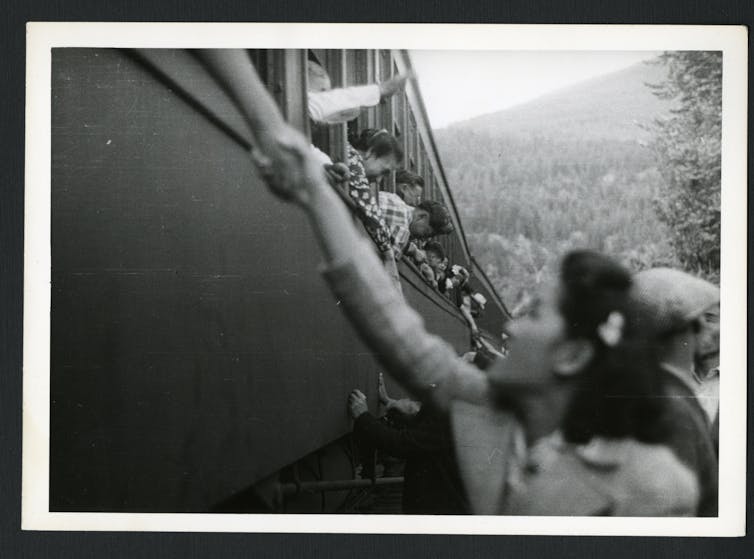
An Asian woman reaches up to clasp the hand of an unseen person on a train.
Japanese Canadians in the British Columbia interior bid farewell to community members bound for Japan in 1946.
(Library and Archives Canada)

It reminds us that rationales rooted in racism can become security claims, whether real or imagined. The history of exile should give us pause too about arguments we are hearing again that human rights should never prevent a government from implementing a policy favoured by the majority.

In December 1945, neither courts, legislatures, cabinets nor civil servants stopped the exile of Japanese Canadians. But here too is a final lesson worth remembering.

Although Canada claimed the legal power to exile many more than the 4,000 Canadians it banished to Japan, our book describes how it abandoned the policy when newspapers across Canada began to denounce the policy as fundamentally un-Canadian, anti-democratic and contrary to the equal promise of Canadian citizenship without discrimination.

Fragile rights to citizenship

If Canadian law allowed exile to occur, Japanese Canadians argued, then fundamental Canadian laws needed to change. Eighty years later, the consequences of the exile of Japanese Canadians lingers largely unseen — the trajectories of the lives of thousands of Canadians and the Japanese Canadian community would never be the same.

The Canada that emerged from the exile changed too. It was not that racism or rights abuses disappeared. And yet in the growing movement demanding greater protection for constitutional rights lay recognition of the harms vulnerable communities are exposed to, especially in moments of insecurity and its aftermath.

On the 80th anniversary of the exile of Japanese Canadians, we should remember the harmful way Canada’s Second World War ended for so many thousands. And we should remember that the fragile rights to citizenship we sometimes take for granted were hard won and emerged, in part as a result of their denial. In that sense, we all live in the shadow cast by exile.

The Conversation

Jordan Stanger-Ross receives funding from the Social Sciences and Humanities Research Council of Canada. He is affiliated with the University of Victoria.

Eric M. Adams receives funding from SSHRC.

ref. Canada’s exile of Japanese Canadian citizens: A shameful 80-year anniversary few remember – https://theconversation.com/canadas-exile-of-japanese-canadian-citizens-a-shameful-80-year-anniversary-few-remember-272202

Hacked phones and Wi-Fi surveillance have replaced Cold War spies and radio waves in the delusions of people with schizophrenia

Source: The Conversation – USA – By Alaina Vandervoort Burns, Assistant Clinical Professor of Psychiatry and Biobehavioral Sciences, University of California, Los Angeles

Everyday tech of modern life can take on sinister dimensions for people with thought disorders. Busà Photography/Moment via Getty Images

A young woman starts to become suspicious of her cellphone. She notices it listing Wi-Fi networks she does not recognize, and the photos on her contact cards seem to mysteriously change at random times. One day she tries to make a call and just hears static on the line. She begins to think that someone – or an entire organization – has hacked her phone or placed spyware in it, and she wonders what crime she is being framed for.

Built-in laptop webcams, unfamiliar Wi-Fi networks, targeted ads on search engines and personalized algorithms on social media sites: Most people have come to accept and ignore the quirks and drawbacks of daily contact with the internet and devices such as cellphones and computers. But for people with severe mental illness, new technologies are fertile ground for the start of false ideas that can lead eventually to a break with reality.

Psychiatrists like me help people who are bothered by their thoughts, behaviors or emotional states. For the past 10 years I’ve been working closely with people who have schizophrenia.

Schizophrenia, sometimes referred to as a type of thought disorder, is a chronic condition in which alterations in brain function change the way one perceives the world. People with schizophrenia can become hyperaware of their surroundings, often interpreting things they see or hear as being hostile and directed toward them even when there’s no real danger.

Over time, people with schizophrenia can develop delusions: beliefs that are fully held even though they are not based in reality and even when there is evidence to the contrary.

With technology and the internet now such an integral part of daily life, it’s no wonder that people with schizophrenia have incorporated new technologies into their delusional beliefs. In my recent research, my colleagues and I set out to explore the ways modern tech influences the content of delusions for people today.

Old delusional themes expressed in new ways

Most delusions are persecutory, meaning a person believes they are being watched, followed or monitored. Other delusional forms involve the belief that a person has special powers, is being controlled by outside forces, or that a spouse is unfaithful even when they are not.

Prior research has shown that these themes are consistent among people with schizophrenia, but the sociopolitical context in which a person lives shapes the form in which they are expressed.

For example, Americans living during World War II developed persecutory delusions involving Germans, while those living during the Cold War focused on communists. People with thought disorders have incorporated important events such as the fall of the Berlin Wall and the O.J. Simpson trial into delusional frameworks.

Surveillance camera with red lens glowing in the dark.
New technologies offer new raw material for persecutory delusions to work with.
hernan4429/iStock via Getty Images Plus

The past three decades have seen incredible strides in technological advances and easy access to the internet. How have these old themes become repackaged and expressed in the digital age?

For this research, my colleagues and I reviewed medical records of 228 people with thought disorders who participated in a specialized day treatment program between 2016 and 2024.

We identified any mention of delusional thought content and examined the ways in which these beliefs incorporated new technology. We also analyzed the data to see whether certain people were more likely to express delusions tied to technology, or if there was a change in the frequency of these delusions over time.

Delusions of persecution via common tech

Over half of our study’s participants mentioned new technology or the internet when describing delusional beliefs. Most commonly, people felt they were being persecuted via their electronics – that their Wi-Fi networks, computers or cellphones had been hacked or implanted with tracking devices. One person reported believing that neighbors had access to their Wi-Fi network and were monitoring their activities, while another worried that family members had put tracking devices on their phone.

About a quarter of participants reported delusional beliefs surrounding social media. For example, people believed that celebrities were communicating with them directly through social media posts, that they were receiving encoded messages through suggested playlists, or that social media algorithms were linked directly to their thoughts.

Some participants felt they were being monitored through hidden cameras or microphones implanted in their homes or even in their bodies. Several reported what’s known as the “Truman Show delusion” – the belief that their lives are staged and recorded, their daily activities broadcast as a reality TV show.

hand holds phone with emojis, hearts, likes etc rising in a cloud around it
The universe of social media figured in a number of delusions.
d3sign/Moment via Getty Images

With each passing year of the 21st century, we found participants were significantly more likely to express delusions connected to technology.

Stretching the bounds of past realities

Our study confirms that common delusional themes, such as persecution, have become repackaged for the digital age. Interestingly, people often described fears that were based on misunderstanding how technology works – or fails to work. A Wi-Fi router that needed to be reset, a familiar app with a new logo, and text messages that disappeared over time were all cause for suspicion.

The issue that has become hardest for me to grapple with as a psychiatrist is how any of us can distinguish delusional beliefs from reality, given things we never could have imagined would be possible just 10 years ago are now commonplace. Although social media algorithms are not currently linked to our thoughts, is it such a stretch to imagine that in a few short years they may be?

Given recent advances in AI, our collective perception of reality is likely to be further distorted in the years to come. We will all need to find ways to anchor ourselves in a common truth and determine what’s real – and what isn’t.

The Conversation

Alaina Vandervoort Burns does not work for, consult, own shares in or receive funding from any company or organization that would benefit from this article, and has disclosed no relevant affiliations beyond their academic appointment.

ref. Hacked phones and Wi-Fi surveillance have replaced Cold War spies and radio waves in the delusions of people with schizophrenia – https://theconversation.com/hacked-phones-and-wi-fi-surveillance-have-replaced-cold-war-spies-and-radio-waves-in-the-delusions-of-people-with-schizophrenia-271620

Trump’s second term is reshaping US science with unprecedented cuts and destabilizing policy changes

Source: The Conversation – USA – By Kenneth M. Evans, Fellow in Science, Technology, and Innovation Policy, Baker Institute for Public Policy, Rice University

Before 2025, science policy rarely made headline news. Through decades of changing political winds, financial crises and global conflicts, funding for U.S. research and innovation has remained remarkably stable, reflecting the American public’s strong support for investing in basic science.

In his first year back in office, President Donald Trump’s relentless attempts to overhaul the federal support system for research and development has put science policy back above the fold.

As a policy scholar, I study how American presidents treat science and technology. Trump is far from the first president to be deeply skeptical of the academic research community. But his second-term actions have set a new precedent for the level of mutual distrust and its consequences for scientists.

Unlike Trump’s first term, which lacked a coherent science policy beyond its attempted across-the-board cuts to federal research agencies, his current administration has used science policy as a vehicle for its ideological goals. Policy levers historically used to drive science in the national interest have instead been repurposed to punish universities, limit freedom of inquiry and promote private sector interests.

Given science and technology’s critical importance to the nation’s economic growth, industrial competitiveness and national security, it’s worth taking a look back at science policy in 2025, a year of unprecedented reform – and resilience.

Science gets a voice

The conservative Heritage Foundation’s Project 2025, which provided much of the blueprint for Trump’s second term, recommended the president “increase the prominence” of the director of the White House Office of Science and Technology Policy. To that end, then-President-elect Trump named Michael Kratsios as Office of Science and Technology Policy director and his chief scientific adviser weeks before taking office, tasking him with “(blazing) a trail to the next frontiers of science.”

Michael Kratsios stands behind Trump, seated and holding up a signed document
As head of the White House Office of Science and Technology Policy, Michael Kratsios’ role is to advise President Trump on science-related matters.
Roy Rochlin/Hill & Valley Forum via Getty Images

Kratsios, a high-ranking alum of the first Trump administration and protégé of billionaire tech investor Peter Thiel, shares Trump’s skepticism of universities. His tenure in the White House has so far been marked by highlighting the failures of the U.S. science policy system rather than its successes. For Kratsios, American science is suffering from an outdated and morally corrupt incentive system too reliant on research universities.

Kratsios arrived at the White House with a clear vision for redesigning America’s 80-year-old social compact for science in line with Trump’s political agenda. In under a year, he helped push through four major science policy reforms.

Gold Standard Science” recommits the U.S. to scientific integrity and adds political oversight into agency operations.

Another sweeping executive order works to centralize federal grantmaking and align research activities with presidential priorities.

The White House AI Action Plan supports AI upskilling and reskilling workforce programs and catalyzes private sector innovation through deregulation.

And Project Genesis, branded as a successor to the Manhattan Project and Apollo program, leverages public datasets and the computing infrastructure of the Department of Energy’s national labs to advance AI for science.

Taken together, Trump’s second-term science policy reflects several emerging trends in U.S. research policy: the public’s growing distrust of higher education, the private sector’s accelerating investment in fundamental research, and the government’s increasing appetite for state interventions to increase scientific and industrial competitiveness.

A broken partnership

Science has always been a system of patronage. Since the end of World War II, the U.S. government has served as the primary patron of fundamental research at American universities.

The year 2025 has laid bare the fragility of this setup, where research universities sit at the center of the U.S. innovation system. The Trump administration spent the year inventing and deploying new strategies to pause, terminate and severely curtail grants to academic institutions, testing the limits of executive authority over budget decisions.

hands hold up cardboard sign 'DOGE HANDS OFF US GOVT' in front of NIH building
Demonstrators protested funding cuts at NIH in May.
Kayla Bartkowski/Getty Images

The chaos of canceled awards, court challenges and reinstatements prompted NSF and NIH to get creative. Rushing to spend their appropriations before the end of the fiscal year on Oct. 1, they distributed over 20% fewer grants but paid out more money up front to multiyear awards – a fundamental change to how agencies have spent money.

In parallel, Trump proposed massive spending cuts to federal research agencies as part of his administration’s stated effort to dismantle the administrative state.

A budget impasse between the White House and House Democrats over certain Medicaid expansion subsidies led to a historic 43-day government shutdown. To end the shutdown, Congress opted to punt its final budget for this fiscal year to the end of January 2026 through what’s known as a continuing resolution. The stopgap law keeps budget levels unchanged from the prior year but makes it nearly impossible for agencies to plan for the following year.

Trump’s outright attacks on higher education aren’t the only source of uncertainty about next year’s science budget. The White House’s push to cap overhead costs at 15% and the university endowment tax passed this past summer in what the GOP calls the “One Big Beautiful Bill” have universities scrambling to balance the books.

Students caught in the crossfire

For many students and early-career scientists, the Trump administration’s actions toward higher education pose an existential threat to their research careers in the United States. As universities tighten their belts, they’re significantly reducing available spots in Ph.D. programs.

back of a graduating crowd with 'PROTECT INTERNATIONAL STUDENTS' on top of mortarboard
Students at Harvard, one of Trump’s biggest targets for reform, responded to policies that affected international students.
Selcuk Acar/Anadolu via Getty Images

Trump’s immigration policies and anti-DEI actions have further jeopardized the career viability of international students and scholars and students from minority or historically marginalized groups. A battery of executive orders, immigration reforms and enforcement have upended the lives of thousands of young scientists. International student enrollment in U.S. colleges and universities dropped by an estimated 17% this fall.

The effects of these actions extend far beyond the elite universities targeted by Department of Justice investigations, undermining American soft power and placing a generation of future U.S.-based scientists at risk.

The ghost of DOGE lingers

The early days of Trump’s second term will likely be remembered for Elon Musk’s outsize influence inside the White House and the launch of the Department of Government Efficiency. DOGE was tasked with reigning in the federal bureaucracy and rooting out alleged “billions and billions in fraud, waste and abuse.”

For science, DOGE’s cost-cutting crusade meant hollowing out agency expertise, ripping up contracts and searching for keywords from Sen. Ted Cruz’s list of woke science topics, such as climate change, DEI, misinformation or even “women,” in grant applications to terminate.

In practice, DOGE made little measurable progress toward Musk’s target of $1 trillion in reduced spending. Instead, DOGE closed shop in November 2025, eight months before its charter was set to expire.

DOGE’s well-publicized flop masks its less visible but more pernicious legacy: Instead of disappearing, it has been institutionalized. Trump’s budget director, Russell Vought, who spent 2025 taking aim at the federal workforce, is leveraging DOGE’s network to continue its core mission. Through forced relocations, layoffs, a deferred resignation program and the legal gray area of the shutdown, Vought is pushing science-mission agencies to reform their grant review processes and align new grants with Trump’s priorities.

By the start of December 2025, over 200,000 civil servants had left the federal workforce, including nearly 5,000 from NASA, 600 from NSF and at least 14,000 from the Department of Health and Human Services, the parent department of NIH.

The politics of science advice

In the 80 years following Vannevar Bush’s 1945 report to President Harry Truman, Science, the Endless Frontier, scientists have found themselves outside the president’s inner circle more than inside it. Even Bush, despite his legendary stature in science policy then and now, left the White House just two years later, frustrated by Truman’s unwillingness to take his advice.

With only occasional exceptions, when the interests of the president and the scientific community aligned, science advisers have rarely captured the attention of presidents in the decades since.

Kratsios seems to have Trump’s ear. The future of U.S. science rests not on whether government-sponsored research will survive the next three years. Instead, it rides on U.S. higher ed’s ability to regain the trust of the American public – and the White House.

The Conversation

Kenneth Evans receives funding from the National Science Foundation, the American Institute of Physics, and the Clinton Foundation. He is affiliated with Rice University’s Baker Institute for Public Policy

ref. Trump’s second term is reshaping US science with unprecedented cuts and destabilizing policy changes – https://theconversation.com/trumps-second-term-is-reshaping-us-science-with-unprecedented-cuts-and-destabilizing-policy-changes-271079

Who really photographed Napalm Girl? The famous war photo is now contested history

Source: The Conversation – Global Perspectives – By Kate Cantrell, Senior Lecturer, Writing, Editing and Publishing, University of Southern Queensland

The Terror of War, commonly known as “Napalm Girl”, is one of the most enduring and influential images of the 20th century.

Captured on June 8 1972, the photograph shows nine-year-old Kim Phúc running naked toward a camera. She has her arms outstretched, and is flanked by other children screaming in terror after a napalm strike on their village during the Vietnam War.

For five decades, the photo has been credited to Nick Út, a then 21-year old Vietnamese photographer working for the Associated Press (AP) in Saigon.

The image earned Út the Pulitzer Prize and World Press Photo of the Year in 1973, and the National Medal of Arts (America’s highest honour for artists) in 2021.

His account of the moment – how he photographed Phúc, then rushed her to hospital to save her life – has become inseparable from the photo’s legacy. But a new documentary calls this narrative into question.

Recently released on Netflix, The Stringer is directed by Bao Nguyen and narrated by photojournalist Gary Knight. It claims the iconic image was actually taken by a local freelance photographer – a “stringer” – paid just US$20 by the AP and given a print of the photo, before his contribution was erased from history.

If true, Napalm Girl becomes not only a damning indictment of war’s brutality, but also of the systematic exploitation of non-Western journalists by Western media organisations – a pattern that persists today.

The first media war

The Vietnam War, dubbed the living room war, was the first conflict fought in the global media spotlight.

While reporters were embedded in military units during the World Wars, the horrors of those conflicts remained carefully curated – limited by the technological constraints of monochrome print and government censorship.

By the late 1960s, everything had changed. War’s violence arrived in full colour, broadcast on the evening news and splashed across the pages of magazines. America’s failure in Vietnam was increasingly apparent. And media coverage of the 1968 Mai Lai massacre turned the tide of public opinion, intensifying the anti-war movement.

By 1972, the writing was on the wall. Australian troops withdrew following massive protests during the 1970 moratoriums.

In the United States, anti-war sentiment reached fever pitch. The publication of an image showing a young Vietnamese girl naked and severely burned as she fled a misdirected attack by South Vietnamese forces only accelerated the inevitable.

A theatre of conflict

The Stringer is a kind of detective story that hinges largely on testimony from Carl Robinson, the AP’s photo editor in Vietnam at the time the photo was taken.

Now in his eighties, Robinson claims once the photo was developed, AP’s Saigon bureau chief Horst Faas ordered the credit be changed to Nick Út instead of the actual freelance photographer, Nguyễn Thành Nghệ, ensuring the image remained AP property.

The filmmakers build their case methodically through archival footage and witness accounts, including an interview with the stringer.

Perhaps the most compelling evidence emerges at the film’s climax, when French independent forensic-investigation company, Index, presents a visual-spatial timeline of the day’s events using aerial photographs, video recording and satellite imagery.

Through 3D modelling, the investigators propose Út was not in the right position to take the photo. In fact, 15 seconds after the photo was taken, Út was standing 250 feet away.

To have taken the shot, he would have needed to sprint about 75 metres in seconds, while somehow remaining outside the frame of another camera crew filming the scene.

Index concludes Út’s authorship is “highly unlikely” and editorially “doesn’t really make sense”, since Út, if he had taken the photograph, would have then moved away from the action rather than toward it.

The stringer too is unequivocal:

Nick Út came with me on that assignment, but he didn’t take that photo […] That photo was mine.

Út declined to be interviewed for the film. In a statement posted to Facebook, he called the accusation “a slap in the face”.

The fallout

Following The Stringer’s premiere at Sundance in January this year, both World Press Photo and the AP launched investigations into the documentary’s claims.

In May, World Press Photo suspended the attribution of authorship to Út, concluding that “based on analysis of location, distance, and the camera used on that day, photographers Nguyễn Thành Nghệ or Huỳnh Công Phúc may have been better positioned to take the photograph than Nick Út”.

The statement went on:

Importantly, the photograph itself remains undisputed, and the award for this significant photo […] remains a fact. Only the authorship is suspended and under review. This remains contested history, and it is possible that the author of the photograph will never be fully confirmed.

At the same time, the AP published a 97-page report concluding there is no definitive evidence Út did not take the photo, and therefore retained the attribution to him.

In the same report, however, the AP conceded its internal investigation raised “unanswered questions”, and that it “remains open to the possibility” Út did not take the photo.

The image remains available from the AP under Út’s byline. But World Press Photo now lists the photograph’s author as “indeterminate/unknown”.

Attribution in the AI age

Questions of authorship and attribution have taken on new urgency in a world of generative AI, where fabricated images, text and video are virtually indistinguishable from human-made work.

Despite huge technological advances since the 1970s, the underpinning systems remain unchanged: large corporations still appropriate the work of the less powerful without attribution or compensation.

The filmmakers claim “this was something that happened to Nick” as well, and that he had no agency in the AP’s reported decision to change the photo credit. The documentary concludes:

What we accept as the official record is often shaped more by power than perspective […] even the most entrenched histories deserve to be reexamined.

The Conversation

The authors do not work for, consult, own shares in or receive funding from any company or organisation that would benefit from this article, and have disclosed no relevant affiliations beyond their academic appointment.

ref. Who really photographed Napalm Girl? The famous war photo is now contested history – https://theconversation.com/who-really-photographed-napalm-girl-the-famous-war-photo-is-now-contested-history-267440

Is democracy the worst form of government – apart from all the others? We asked 5 experts

Source: The Conversation – Global Perspectives – By James Ley, Deputy Books + Ideas Editor, The Conversation

Claims that democracy is in crisis are certainly not new, but recent history has given the claim a new urgency. Over the past decade or so, there has been no shortage of people expressing concern that democratic institutions are under strain.

Recent studies have indeed shown declining levels of trust in democratic systems around the world. The trend is evident in the United States, Japan, the United Kingdom and New Zealand. In Australia, too, a recent study found that trust in politics was at record lows.

We asked 5 experts to reflect on the strengths and weaknesses of democratic governance, taking as their prompt Winston Churchill’s famously backhanded observation that “democracy is the worst form of government, apart from all the others that have been tried”.


Adele Webb

“No one pretends that democracy is perfect or all-wise,” Churchill told the House of Commons in 1947, before delivering his famous line.

Democracy is not meant to rest on blind faith. It makes room for wariness, disappointment and ambivalence. Once we accept its built-in flaws and its tendency to decay from within, a lot of the anxious commentary about “eroding public trust” starts to look misplaced.

For a start, people are mostly losing trust in the governments of the day, not in democracy itself – 95% of Australians say living in a democracy is important to them. And a certain level of scepticism toward whoever currently holds temporary power is not a crisis; it’s a safeguard.

That kind of circumspection is what a living democracy depends on. Slowing down and asking how our democratic institutions are working in practice can put real limits on those who currently benefit from the status quo.

If sceptical or mistrusting citizens are not democracy’s transgressors, but its canaries in the coal mine – warning us that current democratic institutions need recalibrating – the real question is how well are we listening to the dissatisfied.

Those who benefit from the current rules have weak incentives to acknowledge the flaws, let alone rewrite them.

Adele Webb is research fellow, democracy and citizen engagement, at the Centre for Deliberative Democracy, University of Canberra.


Russell Blackford

In today’s world, democracy refers to a system of representative government with free, fair and relatively frequent elections. The particular institutions and the rationales for them vary greatly, but the essential criterion for a country to count as a genuine democracy is that it holds elections with realistic opportunities to remove unpopular governments through a non-violent process.

Where democratic institutions are in place, they provide a strong incentive for the incumbent government to avoid being seen as corrupt, tyrannical or simply incompetent. In practice, this should encourage governments to make efforts to avoid corruption and govern effectively in the common interest of the people. It isn’t foolproof, but it does give democracy one huge advantage over other systems.

Alas, democracy is fragile and it’s almost miraculous that it ever survives. The government of the day is expected to take a psychologically unnatural attitude to its opponents.

It has to maintain, firstly, that it is objectively better at governing than its opponents, whom it is justified in criticising without mercy. But then it must accept that, if it should lose an election, it will graciously hand over control of the treasury, the military, and all the agencies and powers of the state to those same opponents.

I suspect that the conditions in which this attitude seems rational and commendable are very rare, and that they are all too easy to erode. We ought to give them more thought if we really care about preserving democracy.

Russell Blackford is conjoint senior lecturer in philosophy at the University of Newcastle


Jill Sheppard

When Churchill spoke of democracy he spoke of a particular form: representative democracy. Political scientists and philosophers will take pains to tell you there are many forms of democracy: deliberation until we reach something close to consensus; random selection of citizens to decide laws; regular plebiscites to approve or veto policies.

None of them are perfect, but elections – even when they feel tedious and produce frustrating results – strike the best compromise.

Supporting democracy means supporting the idea that citizens will have some degree of oversight of the people making laws on their behalf. But oversight takes time and effort. As a citizen, I don’t want to have to learn about and vote on every act before the parliament. I also don’t want to be randomly recruited to deliberate on complex policies. I want to spend time with my family, my pets, on my hobbies and my job.

Sending representatives to Canberra to negotiate laws on our behalf and holding them to account every three years is a good deal for citizens. Do political parties work to undermine this accountability? Absolutely. Are the candidates we are offered the best available? Absolutely not. But this form of democracy hits the sweet spot of accountability and everyday life.

Jill Sheppard is senior lecturer in politics and international relations, Australian National University


Matthew Sharpe

Winston Churchill’s record dealing with colonised people merits review, but there are many reasons to support his claim about democracy.

Democracy is, above all, a system enshrining the accountability of leaders to the people who are affected by their decisions. The accountability is embodied principally in elections for public office, in which leaders who have failed their constituents can be thrown out.

When the democratic franchise extends to all adults, it is the system most true to the basic fact – long denied or obscured in history – that all adult men and women are capable of thinking for themselves. People have an intrinsic dignity which means they can and should have a say in decisions which affect their lives.

All other political systems hold that there are morally salient distinctions between people which mean entire classes, races or genders should have no say in how they are governed, nor means (short of revolution) to overthrow bad governments. Democracy is thus the least worst system in a stronger sense than Churchill granted.

That said, other political systems are easier to sustain. Democracies, over time, stand or fall on their ability to foster a public that is engaged, materially secure and educated enough to decide wisely. For this reason, democracy requires an independent media, willing and supported to fearlessly hold the feet of the powers of money and government to the fires of critical publicity.

There is a need for ongoing critical vigilance, so that the media and public offices remain free from capture by interested lobbies who support policies which so disadvantage so many ordinary people as to make law and governance, in all but name, their own exclusive prerogative.

Matthew Sharpe is associate professor in philosophy, Australian Catholic University

Jean-Paul Gagnon

Churchill’s father was an aristocrat and “meteoric conservative”. His mother was the daughter of a wealthy New York financier. He attended a private all-boys school called Harrow – today its annual fees are £63,735.

Its mottos – Stet fortuna domus (May the fortune of the House stand) and Donorum dei dispensatio fidelis (The faithful dispensation of the gifts of God) – put family (think war-won crests and land that can be inherited) and the Anglican Christian God at the forefront.

I offer this brief genealogy to ask one question: why should we care about a quip by an elite man during a sitting of the UK Parliament in 1947? Especially one who surely understood democracy to mean the mid-20th century’s inheritance of Edward Longshanks’ model parliament, founded in 1295?

This was very same Edward Longshanks who colonised Wales and began the colonisation of Scotland. Churchill himself thought well of the two-and-a-half years or so he spent with the 4th Hussars in British occupied India.

So what did Churchill know of democracy? Not much. He knew of a bicameral system held hostage by a duopoly of major parties that was overseen by hereditary peers and lords. In his career, he was surrounded almost entirely by white men of means, who were elected to parliament in a medieval plurality system that permitted voting by men and women of at least 21 years of age.

Maybe he recognised this. If he did, he would have still been right to say democracy is bad, but better than all other known non or less democratic options.

Today we know there are many other ways of being democratic and developing our respective democracies.

Jean-Paul Gagnon is senior lecturer in democracy studies, University of Canberra

The Conversation

ref. Is democracy the worst form of government – apart from all the others? We asked 5 experts – https://theconversation.com/is-democracy-the-worst-form-of-government-apart-from-all-the-others-we-asked-5-experts-271293