How farmers are finding greener ways to produce food, from East Anglia to Andhra Pradesh in India

Source: The Conversation – UK – By Lynn Dicks, Professor of Ecology, University of Cambridge

An innovative sustainable farming method which avoids fertilisers and pesticides in favour of natural soil regeneration has helped farmers in India increase profits while also benefiting wild birds. Our new research shows how “zero budget natural farming” has more than doubled farmer profits.

Ecologists like us evaluate low-tech agroecological approaches that harness the power of nature and people to produce food with skilled labour, knowledge and active management of ecological functions like pollination and soil nutrient cycling.

We’ve been studying two promising agroecological systems, both devised by farming communities to address the soil degradation that threatens the long-term future of food.

Zero budget natural farming is a sustainable farming system that is being heavily incentivised by the government of Andhra Pradesh, a state on the east coast of southern India. Zero budget natural farming is generating considerable interest from other countries, including Brazil, Mexico, Zambia and Indonesia.

The other farming system we’ve been examining is “regenerative farming”, increasingly popular in the UK, US and Europe. While similar, these two farming systems have very different cultural framings.

Regenerative farming is a set of principles that aims to regenerate rather than degrade soil. Farmers are encouraged to monitor their own outcomes and adaptively manage their soils.

Zero budget natural farming aims to boost crop yields and reduce costs by ending the use of synthetics (fertilisers and pesticides) and regenerating natural ecological functions. Farmers are encouraged to work together and share resources such as straw, manures and soil treatments at village level.

To understand whether these two systems could really be scalable, we measured their outcomes for nature, food production and profitability on real working farms. We focused on these key aspects because there is often a direct trade-off between them. Having more nature locally can mean that less food is produced on farmed land.

Nature-friendly farming can lower overall food production or profits, especially at scales larger than individual fields and farms, because land is taken out of production for wildlife-friendly strips around fields, for example.

If there is no change in overall food demand, this creates a risk of driving even greater nature loss and greenhouse gas emissions elsewhere, as agriculture continues to expand into natural habitats.

For agroecological systems to be a solution, they must be highly productive, minimising the footprint (total area) of agriculture on Earth, while supporting enough wild nature to maintain ecological functions such as soil nutrient cycling and pollination.

big black bird with yellow beak eating yellow berries on tree branch
Some native birds such as the Malabar pied hornbill rely on natural forests to thrive.
Chris Barber71/Shutterstock

Our research shows that the shift to zero budget natural farming more than doubles farmer profits and does not reduce food production relative to chemical farming. These farms also support more wild birds, especially those that help control pests by eating insects and other invertebrates, such as drongos, pipits and warblers. For the rice-dominated small farms we studied in south India, zero budget natural farming avoids the direct trade-off between nature and food production.

But this agroecological farmland is no substitute for natural forest in terms of bird conservation. Forests are vital for birds threatened with extinction, many of which cannot thrive on farmland of any kind, such as the Malabar pied hornbill.


Read more:
Regeneratively farmed is the new buzz label on supermarket shelves – but what does it actually mean?


The situation is different for the arable farmers we’re working with in eastern and southern England, who are farming regeneratively. This approach is challenging to define so we calculated a “regenerative score” for each farm based on the consistency with which farmers adhered to the five principles of regenerative farming. Those principles include keeping the soil covered to reduce erosion and increase its organic content, and increasing crop diversity.

Becoming more regenerative on this scale has clear benefits for some indicators of healthy soils such as earthworm numbers. But our initial data indicated some declines in yield at field scale. This is likely to be larger when scaled up to landscapes, because of crop choices. The regenerative system in these arable farms is more sustainable by many measures, but not quite as productive, in terms of food output, as intensive chemical farms.

The future of farming

Things might look different in the future, as accelerating climate change makes the soil’s abilities to absorb and retain water much more important. Regenerative farming potentially offers resilience to climate change, through better soils and higher diversity, but this is challenging to demonstrate empirically. For now, regenerative farming in the English farms where we work is not a straightforward solution that delivers high food production and better nature, like zero budget natural farming in India.

One reason for the difference might be that UK arable farms are largely constrained to working with crop varieties engineered to thrive in very intensive systems with high chemical inputs. These varieties have weaker roots and potentially lower disease resistance than more traditional crop varieties. Part of the solution here is to breed crop varieties that thrive in agroecological systems without heavy chemical fertiliser use (so-called “lower input systems”). For industrial agriculture systems, this will involve the plant breeding industry.

Zero budget natural farmers are encouraged to use traditional crop varieties, and are more likely to re-use their own seeds, rather than buying them in every year. Perhaps this means their crops are better adapted to lower input conditions, with stronger roots or better positive associations with soil microbes. To cement its future, those who live and work in the region are calling for zero budget natural farming to be recognised by buyers, so farmers can access new markets for sustainable produce and take advantage of higher retail prices.

In both cases, the key to long term success may be economic, rather than purely scientific, with changes in the crop breeding industry, markets and value chains as important as how farms themselves are managed.


Don’t have time to read about climate change as much as you’d like?

Get a weekly roundup in your inbox instead. Every Wednesday, The Conversation’s environment editor writes Imagine, a short email that goes a little deeper into just one climate issue. Join the 45,000+ readers who’ve subscribed so far.


The Conversation

Lynn Dicks receives funding from UKRI (NERC and BBSRC). She is affiliated with Natural England, as a Board Member, and the East Suffolk Trust as a Trustee.

Katherine Berthon receives funding from UKRI BBSRC. She is affiliated with the H3 Project (https://h3.ac.uk/) and a member of the British Ecological Society.

Iris Berger does not work for, consult, own shares in or receive funding from any company or organisation that would benefit from this article, and has disclosed no relevant affiliations beyond their academic appointment.

ref. How farmers are finding greener ways to produce food, from East Anglia to Andhra Pradesh in India – https://theconversation.com/how-farmers-are-finding-greener-ways-to-produce-food-from-east-anglia-to-andhra-pradesh-in-india-261890

How workplace bullying can affect your personality

Source: The Conversation – UK – By Samuel Farley, Senior Lecturer in Work Psychology, University of Sheffield

Littleaom/Shutterstock

Sadly, most people will come across a workplace bully at some point. Unwarranted criticism, ostracism, personal insults, and verbal or physical threats are just some of the tools in the bully’s locker. Over time, the target of bullying can find it increasingly difficult to defend themselves from this behaviour.

Bullying undermines productive workplaces, and can damage the reputations of both the bully and the organisation. Of course, it is even more damaging for the targets of the bully, who report physical and psychological health problems, job loss, and even symptoms of post-traumatic stress.

With up to one in ten UK employees experiencing bullying, this problem could affect more than three million workers across the country.

In a recent research study drawing on data from 2,469 employees over a four-year period, we examined whether experiences of bullying were related to changes in the “big five” personality traits: openness, conscientiousness, extroversion, agreeableness and neuroticism.

It’s well known that bullying is bad for wellbeing, performance and mood. But why would we think that bullying might change core aspects of a person, including their personality?

Our predictions were primarily based on a personality change theory. The core idea is that repeatedly experiencing thoughts, emotions and reactions that are at odds with a person’s normal traits can actually change them over time.

For example, extroverts are typically cheerful, sociable people who seek excitement. However, an extrovert exposed to bullying would in all likelihood start to experience negative emotions regularly. They might withdraw socially, and could learn that social isolation is an effective way to avoid bullying. As a result, their normal outgoing traits might reduce over time.

Our results showed that being bullied was associated with significant reductions in extrovert traits and conscientiousness (that is, being dependable and organised). The drop in conscientiousness could be because the target feels demotivated by the unfairness of being bullied – or the bullying may even take the form of removing meaningful tasks from the colleague.

Being bullied was also linked to increased neuroticism, which is the tendency to experience negative emotional states such as anxiety, anger and depression.

We also found that longer periods of bullying were associated with the target becoming less of an extrovert and more neurotic.

This suggests that, in addition to all the other harms, bullying can also rob people of their cheerfulness, sociability, dependability and calmness.

Who do bullies target?

Our research also explored whether personality traits were a risk factor for experiencing bullying. We discovered that conscientiousness and extroversion may put workers at greater risk of attracting the attention of a workplace bully.

A cautious interpretation of this might infer that conscientious employees are targeted by those envious of their higher performance levels (tall poppy syndrome – where high-flying people are “cut down” out of a misplaced sense of egalitarianism). It is less clear however why extroverts might be targeted.

Interestingly, when we looked at people who experienced sustained bullying over longer periods of time, we found that other personality traits were risk factors. Neuroticism, openness (encompassing traits of imagination, curiosity and novelty) and disagreeableness were all linked to experiencing bullying for a longer duration.

This indicates that emotional, unconventional and argumentative people tend to experience the most bullying. However, it’s still not fully understood whether it is personality that attracts bullying, or whether in fact the bullying is driving personality change.

HR policy manual on a desk beside a computer keyboard
An effective anti-bullying policy can help to mitigate the harm to employees.
Vitalii Vodolazskyi/Shutterstock

There is little other research on the personality types most likely to be targeted by bullies. And we don’t yet know if the personality changes suffered by them are likely to be permanent. However, we do have concrete knowledge about the factors that are most helpful in limiting the impact of bullying on victims.

Working in a supportive environment where wellbeing is prioritised and where there are processes to enable a resolution can really help those experiencing bullying. Equally, receiving support from colleagues, friends and family can limit the damaging effects.

Ultimately, bullying is an escalating process that causes lasting harm. The best medicine is to end the experience as soon as possible, or better yet, prevent it altogether.

The Conversation

The authors do not work for, consult, own shares in or receive funding from any company or organisation that would benefit from this article, and have disclosed no relevant affiliations beyond their academic appointment.

ref. How workplace bullying can affect your personality – https://theconversation.com/how-workplace-bullying-can-affect-your-personality-265350

A violent dystopian thriller, KPop Demon Hunters and an updated Ibsen play: what to see this week

Source: The Conversation – UK – By Jane Wright, Commissioning Editor, Arts & Culture, The Conversation

No one wants to see a good Jedi turn bad, but that’s exactly what happens to Luke Skywalker actor Mark Hamill in The Long Walk, an adaptation of a Stephen King story of the same name. Hamill plays the terrifying major who presides over a group of young men taking part in a barbaric televised contest that requires them to walk continuously at a speed above 3mph or be summarily executed.

The setting for this violent dystopian thriller is a bleak 1970s America in the grip of economic decline that follows an unnamed war. A forerunner to the Hunger Games (the film is directed by Francis Lawrence, who helmed four of the five-film franchise), The Long Walk focuses on the idea of suffering and survival as spectacle. It’s not hard to see the source material’s influence on series like Squid Game or films like Koushun Takami’s Battle Royale.

Written in 1967, King’s story was a heartfelt response to the Vietnam draft and the impact of the war on his generation. Our reviewer Matt Jacobsen found the setting of a dark, inhospitable America a clever inversion that distils many of the familiar themes of the Vietnam movie. Indeed, he points to the deadly road march as reminiscent of GIs trudging through the jungle of Vietnam in 1980s films like Platoon and Full Metal Jacket.

At the film’s heart is the relationship between Ray Garraty (Cooper Hoffman) and Peter McVries (David Jonsson) with distinct echoes of Stand By Me in its depiction of friendship between boys. It has particular resonance in today’s bleak cultural environment for young men, vulnerable to the darker influences of social media and the conflicting expectations placed on them.

In The Long Walk, wit, tenderness and compassion come to the fore as the contestants are made vulnerable by the punishing exertions of the march and the violence meted out to those who falter. Some consolation perhaps, in what is undoubtedly a grim but compelling watch.

The Long Walk is in cinemas now


Read more:
The Long Walk: a brutal, brilliant film about suffering in the name of patriotism


KPopping and queer Americana

I have to say I’m late to the KPop Demon Hunters thing, and only started paying attention when a colleague mentioned his young daughters were crazy for it, and explained it was now Netflix’s most watched film ever.

That’s quite an achievement, and it ticks all the boxes: catchy tunes, stunning animations and relatable themes, not to mention a good dose of girl power in the form of three K-pop girl-banders who use their voices to protect the world from demonic forces (of course). But how much does the film reflect the real K-pop phenomenon? Our Korean culture expert Cholong Sung has the answers.

KPop Demon Hunters is on Netflix now


Read more:
KPop Demon Hunters gives a glimpse into K-pop culture in South Korea


What at first seems like a forbidden love story between a young woman and her fiance’s brother, On Swift Horses unexpectedly pivots to the hidden queer culture that existed in the United States of the 1950s. At the height of the American dream, when culture celebrated marriage and family as duty-bound goals, both characters turn out to be attracted to their own sex.

The glossy iconography of 1950s Americana is reimagined for this hidden world, making visible the queer lives that existed below the radar at a time of social censure and legal repression. This is an enjoyable watch that perhaps, according to our reviewer, would have worked better as a TV series, affording the space to develop characters more fully.

On Swift Horses is in cinemas now


Read more:
On Swift Horses: a film that fails to go deep enough on the complex queer lives of people in the 1950s


Love in a warm climate

I do love a bit of dark Scandinavian intrigue, so a new adaptation of Ibsen’s The Lady From The Sea makes a welcome addition to London’s theatrical fare. Starring Alicia Vikander as Ellida, a woman drawn ineluctably to the ocean, and Andrew Lincoln as her husband Edward, the setting is transferred from the Norwegian fjords to the Yorkshire coast.

Loaded with contemporary relevance, writer and director Simon Stone references Beyoncé and Just Stop Oil activism, and features a millennial protagonist struggling with climate anxiety. Does it work in this updated incarnation? Read our review and find out.

The Lady From The Sea is on at the Bridge Theatre in London until November 8


Read more:
The Lady from the Sea: a fierce play that shies from the wonderful unknowability of Henrik Ibsen’s original


From the late medieval period to the Arts and Crafts movement of the late 19th and early 20th centuries, The Nature of Gothic at the Blackburn Museum and Art Gallery explores the fascinating history of decorative borders. The show takes in in a diverse array of historical examples, from Islamic calligraphy adorned with floral frames, to vividly illuminated medieval manuscripts and the lush decorated margins of Pre-Raphaelite paintings.

The Nature of Gothic at the Blackburn Museum and Art Gallery until December 13


Read more:
New exhibition explores history of decorative borders: from medieval manuscripts to William Morris


Looking for something good? Cut through the noise with a carefully curated selection of the latest releases, live events and exhibitions, straight to your inbox every fortnight, on Fridays. Sign up here.


The Conversation

ref. A violent dystopian thriller, KPop Demon Hunters and an updated Ibsen play: what to see this week – https://theconversation.com/a-violent-dystopian-thriller-kpop-demon-hunters-and-an-updated-ibsen-play-what-to-see-this-week-265553

Robert Redford: ten great films from a brilliant career

Source: The Conversation – UK – By Daniel O’Brien, Lecturer, Department of Literature Film and Theatre Studies, University of Essex

Over the course of an illustrious film career which began in 1960, Robert Redford starred in more than 50 films and directed nine. He was nominated for an Oscar four times, won best director for his debut Ordinary People in 1980, and received an honorary Oscar for his contribution to the film industry in 2001. It’s an extraordinary body of work – here we pick our ten favourites.

1. Butch Cassidy and the Sundance Kid (1969)

Robert Redford defined his Hollywood stardom in 1969 with George Roy Hill’s Butch Cassidy and the Sundance Kid, a film that reconfigured both the western and the buddy movie. Riding the momentum of New Hollywood titles like Easy Rider and Midnight Cowboy, Hill’s film struck a balance between fresh storytelling and classic Hollywood style.

Playing opposite Paul Newman’s wily Butch, Redford’s cool, sharp-shooting Sundance creates one of cinema’s most iconic duos. Their charisma and wit onscreen are as striking as their arresting good looks. But this is also carefully balanced. Sundance’s inability to swim, for example, adds humour and vulnerability, humanising Redford’s star power. The final defiant freeze-frame is culturally iconic, while the film’s legacy lives on through the Sundance Film Festival, providing a platform for independent filmmakers.

2. Jeremiah Jonhnson (1972)

Redford’s portrayal of 19th-century mountain man Jeremiah Johnson tells the tale of a disillusioned figure retreating into the wilderness, seeking solace in the solitude, beauty and danger of the Rocky Mountains.

Sparse in dialogue and narrative, the film relies on Redford’s quiet authority to carry it. Very much a product of its era, it frames Johnson in violent clashes with both Native Americans and nature itself. Most significantly, it marked the beginning of Redford’s long partnership with director Sydney Pollack, a fruitful collaboration that would later include The Way We Were, Three Days of the Condor, and Out of Africa.

3. The Sting (1973)

Reuniting with director George Roy Hill, Redford teamed up again with Paul Newman for The Sting, a stylish 1930s caper about two grifters scheming to outwit a crime boss, played with icy menace by Robert Shaw – a stark contrast to the warmth between the leads. This time it’s Newman’s turn to wear the moustache, with Redford clean-shaven, a playful reversal of their Butch Cassidy look. With its clever twists, Scott Joplin ragtime piano score and screen-wipe transitions, the film won seven Oscars at the 46th Academy Awards, including best picture and best director, and earned Redford a nomination for best actor.

4. All the President’s Men (1976)

Alan J. Pakula’s All the President’s Men paired Redford with Dustin Hoffman in a serious contemporary role, dramatising the Watergate scandal just two years after Nixon’s resignation. A taut, uncompromising account of investigative journalism, the film showcases Redford’s range in a part that eschews glamour for realism and the pursuit of truth. Fifty years later it remains one of cinema’s most sophisticated political dramas. The project owed much to Redford, who approached Bob Woodward and Carl Bernstein before securing rights to their book, and adapting it for the screen.

5. Ordinary People (1980)

Redford’s directorial debut, Ordinary People was a huge success, winning best picture and earning him the Oscar for best director. A powerful family drama about grief and alienation, it starred Donald Sutherland, Mary Tyler Moore and Timothy Hutton. The film transformed Redford’s career, expanding his influence behind the camera.

6. Sneakers (1992)

Directed by Phil Alden Robinson, Sneakers let Redford dip back into the caper genre, this time with a tech-age twist. He plays a former hacker turned security consultant who, along with a mismatched crew (Sidney Poitier, Dan Aykroyd, River Phoenix), is pulled into a plot over a code-breaking device. The film mixes comedy, intrigue and early 1990s paranoia about surveillance, while retaining a breezy touch as Redford holds it all together with his familiar charm.

7. Quiz Show (1994)

Redford’s fourth feature film, Quiz Show, returned to his interest in public scandal – this time shifting from the White House to NBC’s 1950s game show Twenty-One and the controversy surrounding contestant Charles Van Doren (Ralph Fiennes). Exposing how producers rigged the contest to engineer Van Doren’s success, the film probes questions of truth, media and morality, echoing Redford’s enduring fascination with power and integrity in American culture. Nominated for four Oscars, Quiz Show remains one of Redford’s most accomplished and incisive directorial works.

8. The Great Gatsby (1974)

Jack Clayton’s adaptation of F. Scott Fitzgerald’s The Great Gatsby cast Redford as one of literature’s most enigmatic figures: Jay Gatsby, the wealthy, detached, and obsessive dreamer pining for Daisy Buchanan (Mia Farrow). With his good looks and charisma, Redford embodied Gatsby’s allure, mystery and melancholy, even as the film itself divided critics. Lavish costumes and period design capture the excess of the Jazz Age, while Redford grounds the story’s glittering parties with Gatsby’s aching loneliness.

9. All Is Lost (2013)

J.C. Chandor’s All Is Lost is an engaging piece of action survival cinema, with Redford at 77 proving he could still carry a film entirely alone. He plays an unnamed sailor in the Indian Ocean whose boat is punctured by a drifting shipping container, an accident that escalates into a fight for survival on the open sea. With almost no dialogue (just 51 words), the drama relies on Redford’s presence and physicality. Like Jeremiah Johnson transposed from mountains to water, the film is elemental and meditative, and Redford delivers a late-career performance of remarkable endurance, which earned him the New York Film Critics Circle Award for best actor.

10. The Old Man & the Gun (2018)

David Lowery’s The Old Man & the Gun was announced as Redford’s final starring role, and it feels like a fitting farewell. While he later appeared briefly in Avengers: Endgame (2019) and in the anthology film Omniboat: A Fast Boat Fantasia (2020), this was the last feature he headlined.

Redford plays Forrest Tucker, a real-life career criminal who, well into his seventies, escapes prison and keeps robbing banks with a smile. The film isn’t about suspense so much as presence, and Redford brings the same easy charisma that defined his early career. Gentle, nostalgic and playful, it stands as an apt curtain call for a legendary performer and filmmaker.


Looking for something good? Cut through the noise with a carefully curated selection of the latest releases, live events and exhibitions, straight to your inbox every fortnight, on Fridays. Sign up here.


The Conversation

Daniel O’Brien does not work for, consult, own shares in or receive funding from any company or organisation that would benefit from this article, and has disclosed no relevant affiliations beyond their academic appointment.

ref. Robert Redford: ten great films from a brilliant career – https://theconversation.com/robert-redford-ten-great-films-from-a-brilliant-career-265687

Elon Musk’s speech to far-right rally should have us all thinking about the power social media companies hold over our democracies

Source: The Conversation – UK – By Verena K. Brändle, Assistant Professor, Department of Political Science and International Studies, University of Birmingham

Elon Musk seems to enjoy awkward surprise appearances. Joining a far-right rally in London via livestream, he demanded the “dissolution” of the British parliament, falsely linked immigration to violence, and warned that the only option for protesters was to “fight back” or “die”.

He did similar in January 2025 when he joined a campaign event of the German far-right party Alternative for Germany (AfD). Again over video he told supporters that “the German people are really an ancient nation” and the AfD is “the best hope for the future of Germany”.

It appears that the currently second-richest person in the world has become a mascot for the European far-right. In 2022, Musk bought one of the major social media platforms, then Twitter, to promote “free speech”. He stepped right into the ongoing “culture war” that is currently polarising US politics and finding traction across Europe. This makes him a problem for democratic politics.

The combination of massive wealth, far-right ideology and power over a large share of public discourse is a recurrent issue for democracy in general, but its negative effects have become even more prevalent in the age of social media. Two aspects are of particular importance here: social media companies’ monetising of user data and a dependence of democratic politics on platform discourse.

Social media runs on an advertisement-based revenue model. Every click or lingering over a post produces data and metadata which are a lucrative resource. Social media companies make a lion’s share of their revenue from charging advertisers to show ads to specific users based on such data. Some of us might remember Mark Zuckerberg replying “Senator, we run ads” when asked during testimony before the US Senate in 2018 how he made money without charging users for his services.

Importantly, advertisers do not only come in the form of clothing brands, restaurant chains and protein shakes. Political parties, governments, think-tanks, and foundations have all paid for ads on social media.

Studies show that social media has contributed to political polarisation during crucial political moments such as Brexit. It also harms democratic discourse when it facilitates online abuse that excludes already minoritised groups from democratic debate. Too often, such abuse is directed at minority women and girls as well as LGBTQ+ people.

Meta has followed X’s turn towards a right-leaning interpretation of “free speech”. It has abolished its third party fact-checking programme, widely credited with helping to manage disinformation.

Meanwhile, politicians across Europe struggle to decide what to do about Musk’s destabilising comments. Keep in mind that governments are doing (or thinking about doing) business with big tech leaders. This situation is politically complex, to say the least, because Musk and others, while being outspoken about their annoyance with aspects of democracy, are also at the forefront of developing the AI technologies many nations are relying on in their hope for economic growth.

This means that Musk has cracked the code for success in capitalist democracies: he makes the headlines with extreme statements, allows debates to unfold “freely” on his platform, and makes some of his money from the generated data.

This situation has created a strange relationship between democratic politics and social media leaders. For people like Musk, there is almost an economic incentive to engage in politics, riling up people and pressuring governments. He is both a business leader and a political actor.

“Free speech” regulations on social media platforms and their leaders’ political stances are increasingly at odds with democratic guidelines. Democracies need to have a more focused debate about how to minimise this incentive structure for destabilising politics.


Want more politics coverage from academic experts? Every week, we bring you informed analysis of developments in government and fact check the claims being made.

Sign up for our weekly politics newsletter, delivered every Friday.


The Conversation

Verena K. Brändle does not work for, consult, own shares in or receive funding from any company or organisation that would benefit from this article, and has disclosed no relevant affiliations beyond their academic appointment.

ref. Elon Musk’s speech to far-right rally should have us all thinking about the power social media companies hold over our democracies – https://theconversation.com/elon-musks-speech-to-far-right-rally-should-have-us-all-thinking-about-the-power-social-media-companies-hold-over-our-democracies-263074

Lasting relief from depression after magic-mushroom treatment – new study

Source: The Conversation – UK – By Petri Kajonius, Associate Professor, Personality Psychology, Lund University

Fotema/Shutterstock.com

Two-thirds of people who underwent psilocybin-assisted therapy remained free from depression five years later, according to recent research that offers the first long-term glimpse into the lasting power of psychedelic treatment.

The findings, published by researchers at Ohio State University and Johns Hopkins University, followed up participants from a study published in 2021 to track whether the dramatic improvements in depression symptoms would endure. The results suggest they do – and, remarkably, without serious side-effects.

The original study involved 24 people aged 21 to 75 who were randomly assigned to receive psilocybin treatment in 2019 and 2020 either immediately or after an eight-week delay. Each participant received two doses of the psychoactive compound found in magic mushrooms, spaced two weeks apart, alongside 13 hours of psychotherapy support.

When researchers checked in five years later, the improvements in depression seen after one year were still holding strong, suggesting psilocybin therapy may last longer than traditional treatments, such as antidepressants or psychotherapy.

But the researchers are cautious about overselling their findings. The follow-up study lacked a comparison group, making it impossible to know whether people who recovered from depression through other means might experience similar long-term success. Eleven of the 18 participants who remained in the trial also reported using antidepressants during the study period, muddying the waters about what exactly drove their continued recovery.

The study design presents other puzzles as well. Was it the psilocybin itself that proved beneficial, or the extensive psychotherapy, or some combination of both? The original research didn’t include a placebo group – everyone knew they were taking psilocybin – raising questions about whether expectations alone might have influenced the outcomes.

Despite these limitations, other studies are painting a similar picture of psilocybin’s enduring effects on depression. While psychedelic research is still in its infancy and grapples with design challenges, the results consistently show significant reductions in depression symptoms following psychedelic-assisted therapy.

What makes these findings particularly intriguing is the suggestion that just one or two treatment sessions might deliver lasting benefits. This is in stark contrast to traditional antidepressants, which typically require daily use and often come with a catalogue of side-effects.

The researchers propose that psilocybin therapy may trigger “positive behavioural feedback loops”, helping people gain fresh perspectives and emotional insights that continue benefiting their lives long after the treatment ends. This could enable the development of healthier habits and relationships that serve as natural buffers against depression’s return.

One participant captured this transformation vividly: “I’m doing more of activities that I enjoy. My life these days is a lot more social with family. Helping out my family. Helping out friends. Connecting with old friends.”

Friends sitting on some steps outdoors, having a laugh.
People’s lives continued to improve after treatment.
DavideAngelini/Shutterstock.com

Psychology matters

At Lund University in Sweden, my colleagues and I are exploring similar territory, including an upcoming study on psilocybin and anorexia. And our early results, published in Scientific Reports, suggest that individual psychology plays a crucial role in both how people experience psychedelic sessions and the benefits they derive from them.

The picture becomes even more complex when considering that many people report personality changes after psychedelic experiences, particularly becoming more open to new experiences. This psychological shift adds another layer to understanding how and why psychedelics might produce lasting change.

Psychedelic research still faces significant hurdles, from creating convincing placebo groups to accounting for the self-selecting nature of many participants. These methodological challenges make it difficult to draw sweeping conclusions about psychedelics’ therapeutic potential.

Yet perhaps the most compelling evidence lies not in clinical scores but in participants’ own words about their transformed lives. As one person put it: “I think I’m more open to gratitude and more open to delight.” Such testimonies remind researchers why they’re exploring what some describe as potentially “one of the most meaningful experiences in life” – and why this emerging field of medicine deserves serious scientific attention.

The Conversation

Petri Kajonius does not work for, consult, own shares in or receive funding from any company or organisation that would benefit from this article, and has disclosed no relevant affiliations beyond their academic appointment.

ref. Lasting relief from depression after magic-mushroom treatment – new study – https://theconversation.com/lasting-relief-from-depression-after-magic-mushroom-treatment-new-study-265219

Chimpanzees ingest more than the equivalent of one alcoholic drink a day – new research

Source: The Conversation – UK – By Stefano Kaburu, Senior Lecturer in Conservation Biology, Nottingham Trent University

apple2499

Drinking more than you intended may be something that many humans do, but now research is showing that a taste for alcohol is surprisingly common among animals. In fact a new study has found that chimpanzees may ingest the equivalent of two alcoholic drinks a day from eating fermented fruit.

In the last ten years or so, there has been growing evidence that the ingestion of alcohol might be more widespread across the animal kingdom than previously thought. Fruit flies, for example, lay their eggs in alcohol-rich fermented fruits, which offer the newly hatched larvae nutrients to feed on.

In 2015, scientists observed groups of chimpanzees in west Africa drinking large amounts of raffia palm alcoholic sap harvested by the local villagers. More recently, in April 2025, a population of chimpanzees at Guinea-Bissau were recorded feasting on ripe African breadfruits which contained high concentrations of alcohol.

The published studies mark a shift because evidence of alcohol consumption in wild animals tends to rely more on anecdotal observations. In Sweden, a moose made the news in 2011 when it was found stuck in a tree, apparently drunk from eating fermented apples.

And vervet monkeys in St Kitts, whose ancestors were brought there with enslaved people from west Africa, are often spotted stealing fruity cocktails from tourists.

The new study, led by biologist Aleksey Maro of the University of California, Berkeley, offers insights into how much alcohol is in the ripe fruits favoured by two wild chimpanzee communities living in eastern and western Africa.

Having spent almost a year studying chimpanzees in the wild myself, I have always been mesmerised by how excited they get when they spot their favourite fruits. Chimpanzees go crazy for fruit. They rush over to grab them and stuff their mouths full, all while making joyful noises of appreciation.

In their research, Maro and his colleagues collected more than 200 fruits from about 20 of chimpanzees’ favourite trees. They found large variation in alcohol content with some having zero or nearly zero alcohol content. But some of the fruits most enjoyed by the chimps, such as figs and plums, tend to have a very high alcohol content.

This suggests that chimps may intentionally select fruits for their high levels of alcohol. Because of the large quantity of fruits chimpanzees can eat every day (up to 4kg), the authors worked out that both female and male chimps consume roughly 14 grams of alcohol per day. This corresponds to a standard US alcoholic drink (UK standard drinks contain eight grams of alcohol).

Close up of baby chimpanzee eating fruit.
Chimpanzees have a strong liking for fruit.
Michaela Pilch/Shutterstock

But it’s not fair to directly compare these numbers between humans and chimps since the effect of alcohol depends on how big an individual is. Alcohol tends to be less potent in bigger people.

With an average weight of around 40kg, chimps tend to be smaller than humans. So the amount of equivalent alcohol that chimps consume actually corresponds to two American standard drinks per day. It sounds like chimps know how to have a party.

The drunken monkey hypothesis

Twenty-five years ago, Robert Dudley, who is one of the authors of the new study, proposed the “drunken monkey hypothesis”. This suggests that alcohol consumption in humans might have an ancient history. Dudley’s idea is that ingesting alcoholic fruits might have given an evolutionary advantage to animals. The alcoholic content in fruits can, for example, indicate to animals which ones are rich in energy and sugar.

Drinking alcohol can be good for health. Fruit flies, for example, ingest alcohol to kill parasites. Even in humans, studies have shown that low levels of alcohol consumption may reduce the risk of heart disease.

Support for the drunken monkey hypothesis came from research showing that the proteins humans need to break down alcohol in their body was already present in the common ancestor we share with gorillas, chimpanzees and bonobos that lived 10 million years ago.

This was a time when African forests started shrinking, and apes started coming down from the tree, adopting a more land-based lifestyle. It’s possible that these apes gained an advantage in eating ripe fermented fruits that had fallen onto the ground, avoiding the competition with other fruit-eating animals who could eat unripe fruit on trees.

Researchers also think that alcohol might make them more sociable. Chimpanzees in west Africa, for example, were observed in April 2025 eating and drinking fermented fruits together.

However, according to Dudley, in addition to having the same human protein that breaks down alcohol, chimpanzees may drink alcohol in low concentrations due to the high volume of liquid and food they ingest. So their stomach may fill up before alcohol reaches intoxicating levels.

This would explain why, in the 11 months that I spent watching chimps in Tanzania, I didn’t once see them wobbling around the forest, clutching a juicy fruit while laughing uncontrollably.

The Conversation

Stefano Kaburu does not work for, consult, own shares in or receive funding from any company or organisation that would benefit from this article, and has disclosed no relevant affiliations beyond their academic appointment.

ref. Chimpanzees ingest more than the equivalent of one alcoholic drink a day – new research – https://theconversation.com/chimpanzees-ingest-more-than-the-equivalent-of-one-alcoholic-drink-a-day-new-research-265644

Intervision: Russia’s bid to rival Eurovision song contest – but with more conservative values

Source: The Conversation – UK – By Vitaly Kazakov, Postdoctoral Fellow, University of Manchester

If you were to read this: “Unity through music: top artists from across the globe come together on one stage to inspire and unite millions” you could be forgiven for thinking it’s an advertising blurb for next year’s Eurovision. But it isn’t. On the contrary, it’s the slogan for this year’s Intervision song contest, which takes place in Moscow on September 20.

Intervision was initially conceived during the cold war as a “counterweight” to Eurovision, but it never really caught on and was discontinued in 1980. Russia subsequently took part in Eurovision between 1994 and 2021, and it was ultimately expelled after the invasion of Ukraine. It recorded its only win in 2008, and hosted the contest in 2009.

The Russian president, Vladimir Putin, issued a decree in February this year announcing that Intervision would be revived “to further develop international cultural and humanitarian cooperation”. This year’s contest will feature artists from 23 countries, including representatives from China, Africa, Asia, Latin America, Central Asia and the Middle East. Interestingly, the US will also have an entry – although the original artist pulled out “for family reasons” on September 17. His place has been taken by an Australian singer who is resident in the US.

Intervision is a prime example of the way in which, in today’s highly febrile geopolitical situation, popular cultural and sporting events are being weaponised.

Russia’s Intervision entry is Straight to the Heart, performed by Shaman, a controversial, pro-war musician.

This is nothing new, nor is it exclusive to contemporary Russia. In the sporting world, many people saw Qatar’s enthusiasm for hosting the 2022 World Cup as a way of cementing its position as an important regional hub in the Middle East. In the sports world, the use of major events to project soft power is known as “sportswashing” – and everyone does it. Think of the opening ceremony of the London 2012 Olympics which was directed by the multi-award winning film-maker Danny Boyle.

Now, analysts are examining the way the Putin administration is using music to further its political end and calling it “songwashing”.

Intervision is clearly being taken very seriously by the Kremlin. The deputy prime minister, Dmitry Chernyshenko – who presided over the planning for the Sochi Winter Olympics in 2014 – is chair of the organising committee. Konstantin Ernst, head of Russia’s Channel One TV network and mastermind behind the Sochi 2014 opening ceremony, is also heavily involved.

In what appeared to be a direct snipe at Eurovision, the Russian foreign minister, Sergei Lavrov – a close ally of Putin – said Intervision would be free from “perversions or affronts to human nature”. After Eurovision in 2024, the country’s foreign ministry spokesperson, Maria Zakharova, said the contest had “surpassed any orgy, sabbath, or ritual sacrilege”. This sort of
conservative messaging has been a staple of Moscow’s political communication to audiences at home and abroad for more than a decade.

The cultural boycott of Russia since its full-scale invasion of Ukraine has hurt the country’s efforts to reach audiences. Russia has been barred from an array of major sporting and cultural events such as the Olympics, the football World Cup and European Championships and Eurovision. Its ballet, opera companies and orchestra have been barred from many of the world’s most prestigious venues and works by Russian composers and playwrights have been blacklisted in many countries.

Nastya Kravchenko of Belarus performs her country’s entry, Moth.

The Kremlin’s response has been to arrange its own versions of what is sometimes dubbed “mega-events”, albeit on a much smaller scale. In 2023, Putin announced Russia would host a World Friendship Games, to be held in Yekaterinburg the following year, “to ensure the guaranteed free access of Russian athletes and sports organisations to international sports activities, and the development of new formats for international sports cooperation”. The event was subsequently postponed over fears that it would not attract enough top competitors, despite a large prize pot on offer.

A Brics Games featuring competitors from 82 countries was held in Kazan in the Russian republic of Tatarstan in June 2024. Russia topped the medals table.

Delegates to the 2024 Brics Games holding up their national flags.
The 2024 Brics Games were held in Kazan, in the Russian republic of Tartarstan, and attracted athletes from 82 countries.
Brics Games

Likewise, the University International Sports Festival was Russia’s response to being barred from hosting the FISU 2023 World University Games.

Seeking new audiences for ‘Russian values’

Russia’s use of such sporting and cultural events has been described as a new form of “Potemkinism” – after the showcase villages built in Imperial-era Russia to impress visitors. Although, to be fair, projecting soft power in this way is in no way exclusive to Russia or any other authoritarian states.

Intervision is the same. It’s designed to appeal to both a domestic crowd, legitimising Putin’s regime, as well as projecting “Russian values” and cultural depth to the rest of the world (at least to those paying attention). These events signal to audiences at home and abroad that things are “normal” in Russia, despite the country being engaged in a bitter war with its neighbour Ukraine.

It dovetails with attempts to build anti-western coalition through its efforts on the diplomatic stage. It is also an effort to send a message about Russia and the state of the world to audiences which might be wary of what they regard as an all-pervasive US influence.

At first glance, these Soviet-era events may appear as a quirky manifestation of cold war nostalgia. But they are part of a push by countries like Russia, China and others to build a rival cultural and international order.

It’s highly unlikely that Intervision will send the Russian entry Shaman – a controversial, pro-war singer described as one of Russia’s chief propagandists – into the global pop stratosphere. But it’s worth keeping an eye on how global audiences respond, particularly those beyond the west. It may be that some people outside the joyously camp Eurovision bubble are receptive to Intervision’s more conservative messaging.

The Conversation

Vitaly Kazakov receives funding from the European Commission’s Horizon Europe programme.

ref. Intervision: Russia’s bid to rival Eurovision song contest – but with more conservative values – https://theconversation.com/intervision-russias-bid-to-rival-eurovision-song-contest-but-with-more-conservative-values-265685

Palestinian statehood is winning major new supporters at UN – but symbolic action won’t make it happen

Source: The Conversation – Global Perspectives – By Maha Nassar, Associate Professor in the School of Middle Eastern and North African Studies, University of Arizona

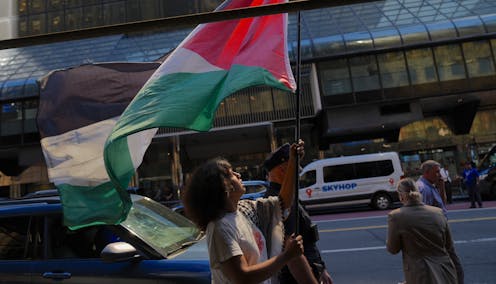
Pro-Palestinian Americans gather in New York at a march to the U.N. on Sept. 18, 2025. Selcuk Acar/Anadolu via Getty Images

Recognition of a Palestinian state is likely to dominate proceedings at the U.N. beginning Sept 23. 2005, when world leaders will gather for the annual general assembly.

Of the 193 existing U.N member states, some 147 already recognize a Palestinian state. But that number is expected to swell in the coming days, with several more countries expected to officially announce such recognition. They include Australia, Belgium, Canada, France, Portugal and the U.K. – although Britain says it won’t support statehood if Israel takes steps to alleviate the plight of Palestinians in Gaza.

That a host of Western nations are adding their names to the near-universal list of Global South countries that already recognize a Palestinian state is a major diplomatic win for the cause of an independent, sovereign and self-governed nation for Palestinians. Conversely, it is a massive diplomatic loss for Israel – especially coming just two years after the West stood shoulder to shoulder with Israel following the Oct. 7 attack by Palestinian militant group Hamas.

As a scholar of modern Palestinian history, I know that this diplomatic moment is decades in the making. But I am also aware that symbolic diplomatic breakthroughs on the issue of Palestinian statehood have occurred before, only to prove meaningless in the face of events that make statehood less likely.

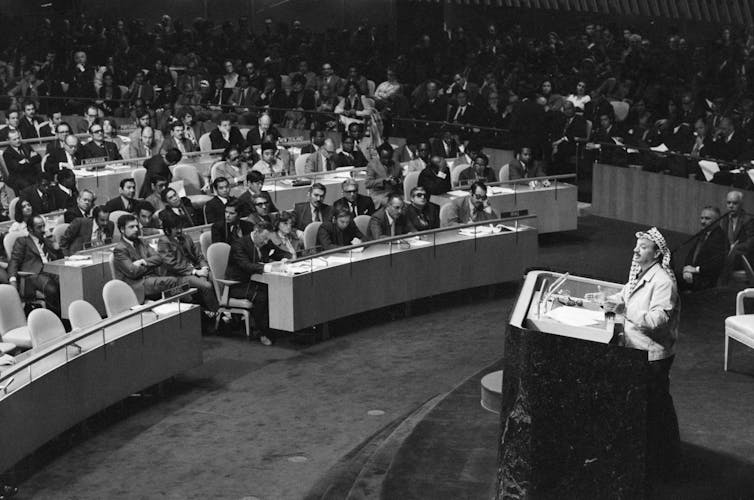
A man gives a speech before a crowd.
‘I have come bearing an olive branch and a freedom fighter’s gun,’ PLO leader Yasser Arafat said before the United Nations General Assembly in 1974.
Bettmann / Contributor

The non-state reality

The fight for Palestinian statehood can be traced back to at least 1967. Over the course of a six-day war against a coalition of Arab states, Israel conquered and expanded its military control over the remainder of what was historic Palestine – a stretch of land that extends from the Jordan River in the east to the Mediterranean Sea in the west.

At the war’s conclusion, Israel had taken control of the West Bank, East Jerusalem and the Gaza Strip.

Unlike after the 1948 war that led to its independence, Israel opted not to extend Israeli citizenship to Palestinians living in the newly conquered areas. Instead, the Israeli government began to rule over Palestinians in these occupied territories through a series of military orders.

These orders controlled nearly every aspect of Palestinian life – and many remain in effect today. For example, if a Palestinian farmer wants to harvest his olive trees near a Jewish settlement in the West Bank, they need a permit. Or
if a Gazan worker wants to work inside Israel, they need Israeli permission. Even praying in a mosque or church in East Jerusalem is dependent on obtaining a permit.

This permit system served as a constant reminder to Palestinians living in the occupied territories that they lacked control over their own daily lives. Meanwhile, Israeli authorities tried to squash the idea of Palestinian nationhood through policies such as outlawing public displays of the Palestinian flag. That, and other expressions of Palestinian national identity in the occupied territories, could result in up to 10 years in prison.

Such policies fit a belief, expressed in 1969 by then Israeli Prime Minister Golda Meir, that there was “no such thing in this area as Palestinians.”

The rise of Palestinian nationalism

Around the same time that Meir made that comment, Palestinians started organizing around the idea of statehood.

Although the idea had been floated before, statehood was codified into official doctrine in a resolution in February 1969 in Egypt. It occurred during a session of the Palestine National Council, the legislative body of the Palestine Liberation Organization, which formed in 1964 as the official representative of Palestinians in the occupied territories.

That resolution called for a free, secular democratic state in Palestine – including all of the State of Israel – in which Muslims, Christians and Jews would all have equal rights.

From that moment on, the Palestinian struggle against Israeli occupation took twin paths: diplomatic pressure and armed resistance.

But events on the ground undermined the idea of a single state for all along the lines envisioned by the Cairo resolution.

The 1973 Arab-Israeli War’s inconclusive ending opened the door to greater diplomacy between Israel and the Arab states. Egypt and Israel decided that diplomacy would help them achieve their aims, culminating in the Egyptian-Israeli peace treaty of 1979. But the treaty also left the Palestinians without unified Arab support.

Meanwhile, throughout the 1970s, the Israeli occupation deepened and entrenched with the building of Israeli settlements, especially in the West Bank.

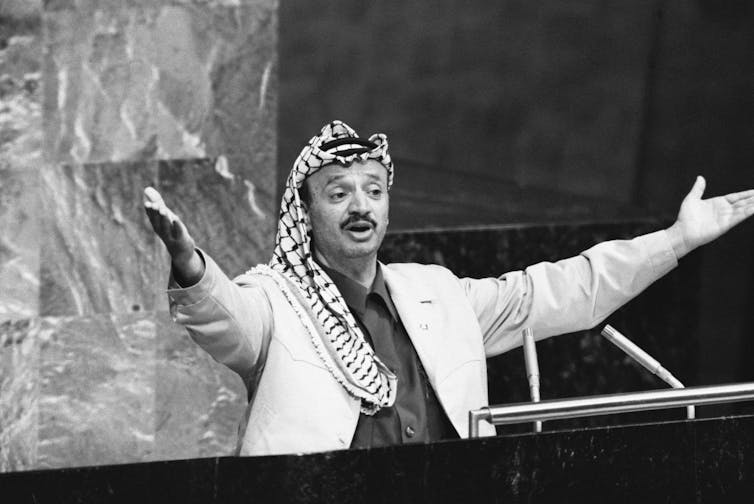
A man throws out his arms to make a point while he stands at a lectern.
Yasser Arafat addresses the United Nations General Assembly in 1974.
Bettmann / Contributor

The PLO responded in 1974 by issuing what became known as the 10-Point Plan, where they pivoted to seeking the establishment of a national authority in any part of historic Palestine that could be liberated.

It was, in effect, a way of threading the needle: It signaled to moderates that the PLO was adopting a more gradualist position, while also telling the group’s rejectionist front – which opposed peace negotiations with Israel – that they were not giving up completely on the idea of liberating all of Palestine.

Then in 1988 – a year into the first Palestinian intifada, or uprising – the PLO unilaterally declared Palestinian independence on the territories occupied in 1967.

The move was largely symbolic – the West Bank, Gaza and East Jerusalem were still under occupation, and the PLO was then in exile in Tunisia.

But it was nonetheless significant. It represented the bringing together of Palestinians in exile – most of whom were from towns and villages that were now part of the State of Israel – with Palestinians in the occupied territories.

The declaration itself was written by Palestinian poet Mahmoud Darwish, who grew up inside Israel, and declared by Yasser Arafat, the PLO leader in exile.

It was also a moment of tremendous hope and possibility for Palestinians. What most Palestinians wanted was for the international community to recognize them as a national body, deserving of a seat at the table with other nation-states.

Compromise and rejection

Yet at the same time, many Palestinians saw the declaration as a huge compromise. The West Bank, Gaza Strip and East Jerusalem comprise about 22% of historic Palestine. So the declaration effectively meant that Palestinians were giving up on the other 78% of what they saw as their land.

Reaction from the international community to the PLO’s declaration was split. Many formerly colonized countries of the Global South recognized Palestinian independence right away. By the end of the year, some 78 countries had issued statements recognizing Palestine as a state.

Israel rejected it outright, as did United States and most Western nations.

Such was Washington’s opposition that the U.S. denied Arafat a visa ahead of his planned address to the United Nations at its New York City headquarters. As a result, the December 1988 meeting had to be moved to Geneva.

While refusing to accept Palestinian statehood, the U.S. and Israel did begin to recognize the PLO as a representative body of the Palestinian people. This was part of the Oslo Accords – a diplomatic process that many believed would outline a road map for an eventual two-state solution.

While some Palestinians saw the Oslo Accords as a diplomatic breakthrough, others were more skeptical. Prominent Palestinians, including Darwish and Palestinian-American professor Edward Said, believed that Oslo was a poison pill: While framed as a step toward a two-state solution, the agreement said nothing about a Palestinian state in the interim. It only said that Israel would recognize the PLO as a representative of the Palestinian people.

In reality, the Oslo Accords have not lead to statehood. Rather, they created a system of fragmented autonomy under the newly created Palestinian Authority that, though meant to be interim, has in effect become permanent.

The Palestinian Authority was allowed only limited powers and deprived of real independence. While it had some say over schooling, health care and municipal services, Israel maintained control of Palestinian land, resources, borders and the economy. That remains true today.

Renewed push for statehood recognition

Disillusionment over the Oslo Accords contributed to the second, far more violent, intifada from 2000 to 2005.

Mahmoud Abbas, the leader of the Palestinian Authority after Arafat, responded by pushing again for international recognition for statehood.

And in 2012, the U.N. General Assembly voted to upgrade Palestine’s status, elevating it from a “nonmember observer” to a “nonmember observer state.”

Two men shake hands.
The Palestinian delegation at the U.N. General Assembly before the vote to upgrade Palestinian status to a nonmember observer state in 2012.
Stan Honda/AFP via Getty Images

In theory, this meant Palestinians now had access to international bodies, like the International Criminal Court and the International Court of Justice.

But any meaningful change in the status of Palestinian sovereignty would need to come through the U.N. Security Council, not the U.N. General Assembly.

The U.S. remains opposed to Palestinians gaining statehood independent of the Oslo process. So long as the U.S. has a veto on the Security Council, achieving a truly sovereign Palestinian state will likewise be off the table. And that remains the case, regardless of what individual members – even fellow Security Council members like France and the U.K – do.

In fact, many Palestinians and other critics of the status quo say Western nations are using the issue of Palestinian statehood to absolve them from the far more challenging diplomatic task of holding Israel accountable for what a U.N. body just described as a genocide in Gaza.

This article is based on a conversation between Maha Nassar and Gemma Ware for The Conversation Weekly podcast.

The Conversation

Maha Nassar does not work for, consult, own shares in or receive funding from any company or organization that would benefit from this article, and has disclosed no relevant affiliations beyond their academic appointment.

ref. Palestinian statehood is winning major new supporters at UN – but symbolic action won’t make it happen – https://theconversation.com/palestinian-statehood-is-winning-major-new-supporters-at-un-but-symbolic-action-wont-make-it-happen-265534

Hepatitis B shot for newborns has nearly eliminated childhood infections with this virus in the US

Source: The Conversation – USA (3) – By David Higgins, Assistant Professor of Pediatrics, University of Colorado Anschutz Medical Campus

About 80% of parents currently choose to follow CDC guidelines to vaccinate their babies for hepatitis B at birth. timnewman/iStock via Getty Images Plus
Graphic saying '95% Drop in U.S. childhood hepatitis B infections since 1991, when routine infant vaccination began'

The Conversation, CC BY-ND

Before the United States began vaccinating all infants at birth with the hepatitis B vaccine in 1991, around 18,000 children every year contracted the virus before their 10th birthday – about half of them at birth. About 90% of that subset developed a chronic infection.

In the U.S., 1 in 4 children chronically infected with hepatitis B will die prematurely from cirrhosis or liver cancer.

Today, fewer than 1,000 U.S. children or adolescents contract the virus every year – a 95% drop. Fewer than 20 babies are reported infected at birth.

I am a pediatrician and preventive medicine specialist who studies vaccine delivery and policy. Vaccinating babies for hepatitis B at birth remains one of the clearest, most evidence-based ways to keep American children free of this lifelong, deadly infection.

On Sept. 18, 2025, the Advisory Committee on Immunization Practices, an independent panel of experts that advises the Centers for Disease Control and Prevention, debated changing the recommendation. According to the proposed language of the vote, infants whose mothers test positive for hepatitis B would still receive the vaccine at birth. Infants whose mothers do not test positive for hepatitis B would get the vaccine at 1 month of age, though parents would have the choice for them to receive it earlier. On Sept. 19, however, the committee tabled the vote, delaying it to the next committee meeting, scheduled for Oct. 22-23.

Although such a proposed change sounds small, it is not based on any new evidence. It would undo more than three decades of a prevention strategy that has nearly eliminated early childhood hepatitis B in the U.S.

While the committee regularly reviews vaccine guidance, nothing is business as usual about this meeting. In June 2025, Secretary of Health and Human Services Robert F. Kennedy Jr. disbanded the entire committee and handpicked new members. The committee has long-standing procedures to evaluate the evidence supporting the risks and benefits of a given vaccine, as well as other parameters of its use. But in this case, these procedures are not being followed.

Why the CDC adopted universal hepatitis B shots

Hepatitis B is a virus that infects liver cells, causing inflammation and damage. In adults, it is spread through blood and bodily fluids, which can happen through unprotected sex, contaminated needles or contact with open cuts or sores of someone who is carrying it.

The hepatitis B vaccine has been available since the early 1980s. Before 1991, public health guidance recommended giving newborns and young children the hepatitis B vaccine only if they were at high risk of being infected – for example, if they were born to a mother infected with hepatitis B or living in a household with someone known to have hepatitis B.

That targeted plan failed. Tens of thousands of children were still infected each year.

Newborn lying on exam table touching doctor's stethoscope
Children are most likely to get infected by hepatitis B at birth, when contact with their mother’s blood can transmit the virus.
Ekkasit Jokthong/iStock via Getty Images Plus

Some newborns were exposed when their mothers weren’t properly screened or if their mothers got infected late in pregnancy. Children also became infected through household contacts or in child care settings by exposures as ordinary as shared toothbrushes or a bite that breaks the skin. Because hepatitis B can survive for a week on household surfaces, and many carriers are unaware they are infected, even babies and toddlers of uninfected mothers remained at risk.

Recognizing these gaps, in 1991 the CDC recommended hepatitis B vaccination for every child starting at birth, regardless of maternal risk.

Vaccinating at birth

The greatest danger for infants contracting hepatitis B is at birth, when contact with a mother’s blood can transmit the virus. Without preventive treatment or vaccination, 70% to 90% of infants born to infected mothers will become infected themselves, and 90% of those infections will become chronic. The infection in these children silently damages their liver, potentially leading to liver cancer and death.

About 80% of parents choose to follow the CDC’s guidance and vaccinate their babies at birth. If the CDC’s recommendations change to delaying the first dose to 1 month old, it would leave babies unprotected during this most vulnerable window, when infection is most likely to lead to chronic infection and silently damage the liver.

The hepatitis B vaccines used in the U.S. have an outstanding safety record. The only confirmed risk is an allergic reaction called anaphylaxis that occurs in roughly 1 in 600,000 doses, and no child has died from such a reaction. Extensive studies show no link to other serious conditions.

The current recommendations are designed to protect every child, including those who slip through gaps in maternal screening or encounter the virus in everyday life. A reversion to the ineffective risk-based approach threatens to erode this critical safety net.

The Conversation

David Higgins is a member of the American Academy of Pediatrics and volunteer board member for Immunize Colorado.

ref. Hepatitis B shot for newborns has nearly eliminated childhood infections with this virus in the US – https://theconversation.com/hepatitis-b-shot-for-newborns-has-nearly-eliminated-childhood-infections-with-this-virus-in-the-us-265560