A Great Lakes oil pipeline faces 3 controversies with no speedy resolutions

Source: The Conversation – USA (2) – By Mike Shriberg, Professor of Practice & Engagement, School for Environment & Sustainability; Director of the University of Michigan Water Center, University of Michigan

A section of Enbridge’s Line 5 runs along the bottom of the Straits of Mackinac in Michigan. Michigan Department of Environment, Great Lakes and Energy via AP

For more than a decade, controversy over an oil pipeline that passes directly through a Native American reservation and then across a sensitive waterway that is also a key shipping lane has brewed in Wisconsin and Michigan.

Since taking office in January 2025, the Trump administration has joined an already complex fray, with policy decisions and legal filings as well as administrative and judicial appointments that have shifted the strategies and potential outcomes of the situation. The changes affect not just pipeline operator Enbridge but also the environmental, Indigenous and political leaders working to shut down the pipeline, known as Line 5.

Part of the dispute is slated to come before the U.S. Supreme Court in the coming months, but that will not deliver the final resolution of the situation.

I am a water policy and politics analyst and a former gubernatorial appointee to Michigan’s Pipeline Safety Advisory Board. I see these controversies raising critical questions about the environmental and economic future of the Great Lakes region and serving as a proxy for wider national battles over water policy, Indigenous rights and the role of fossil fuels in the nation’s future.

Scrutiny of the pipeline

Built in 1953, Enbridge’s Line 5 oil pipeline carries petroleum products mostly from western Canada’s tar sands to refineries in eastern Canada, using the Great Lakes as a shortcut. It traverses 645 miles (1,040 km) through Wisconsin and Michigan and transports approximately 23 million gallons of oil and natural gas liquids per day from Superior, Wisconsin, to Marysville, Michigan, and then across the Saint Clair River to Sarnia, Ontario.

The pipeline has been the subject of intense scrutiny since soon after a 2010 oil spill into the Kalamazoo River in Michigan from another Enbridge pipeline with a similar start and endpoint. The 2012 publication of Sunken Hazard, a report from the National Wildlife Federation about the potential for a spill from Line 5, fomented public concern and launched an advocacy movement that began with questions about Line 5’s safety and has led to calls for its complete shutdown.

While the entire pipeline is being scrutinized, there are two primary areas of concern. In Wisconsin, the pipeline runs for 12 miles (19 km) across the reservation of the Bad River Band of Lake Superior Chippewa. And when it crosses from Michigan’s Upper Peninsula to its Lower Peninsula, the line splits into two parallel pipes that run along the bottom of the Straits of Mackinac, which connect Lake Michigan and Lake Huron.

Shutting down Line 5 in Michigan

In 2021, Michigan Gov. Gretchen Whitmer revoked Enbridge’s easement to operate the pipeline across the Straits of Mackinac. The governor asserted that Enbridge “repeatedly violated the 1953 easement and that the continued operation of the dual pipelines violates the state’s solemn duty to protect the Great Lakes.”

Some of her concerns exist because the pipeline sits in the open water of the Great Lakes and has been damaged multiple times by ship’s anchors, is subject to corrosion, and has been found to be bent and deformed by the extremely powerful currents in the Straits of Mackinac.

Enbridge refused to comply with the shutdown order and has taken the battle into the courts while continuing to send petroleum products through the pipeline across the straits. The Trump administration – through a Sept. 19, 2025, court filing – is supporting Enbridge’s claim that the pipeline is not subject to state regulation and oversight.

There has been a long back-and-forth about whether state courts have jurisdiction, as state officials argued, or whether federal courts should handle it, as Enbridge claimed. In June 2025 the trial was set for a state court when the U.S. Supreme Court unexpectedly stepped in at Enbridge’s request. The case has not yet been scheduled for oral arguments before the court, but they – and a potential ruling – are expected sometime between October 2025 and June 2026.

The state court has said it will continue its proceedings without waiting for a Supreme Court decision. But the ground is set for the continuation of an extended and complicated legal battle.

The Great Lakes tunnel

While Enbridge is fighting the shutdown of its existing pipeline, the company is seeking state and federal permission to build a replacement, by digging a new tunnel below the Straits of Mackinac.

The company needs both federal and state permits before construction can begin. The federal permits are expected to come quickly as a result of a Trump administration policy.

On the first day of his second term, Trump declared a “national energy emergency.” In general, the policy is being used to try to slow the transition away from fossil fuels and toward clean energy sources, and to remove climate change as a factor in environmental reviews and permitting.

For Line 5, the most consequential provisions of the order are those that call for “emergency approvals” and “expediting the Delivery of Energy Infrastructure.” The tunnel is on the Army Corps of Engineers’ list of projects eligible for fast-track approval.

However, Enbridge still needs state permits, which many groups are opposing based on potential environmental damage to the shoreline, the safety of the tunnel and the need to address climate change by slowing down oil extraction.

In addition, all of the federally recognized tribal governments in Michigan oppose Line 5’s continued existence, contending that Indigenous fishing rights in the Straits of Mackinac are at risk from the pipeline both ecologically and culturally. Their position, expressed in a state-court challenge to the tunnel, could end up testing the power of their rights under treaties with the U.S. government.

Bad River Band’s effort

In addition to both of those disputes, a Native American tribe in Wisconsin undertook its own efforts to reduce the risk of environmental damage from the pipeline on its land and the surrounding watershed.

In 2013, the Bad River Band declined to renew Enbridge’s pipeline easement through its territory, which is sometimes referred to as the “Everglades of the Great Lakes” because of its extensive and pristine wetlands. In 2017 the tribe voted to require Enbridge to remove the line from its land.

Enbridge refused to comply and has contested the validity of the Bad River Band’s decision, inherently challenging the tribe’s sovereignty. At the same time, the company is attempting to reroute the pipeline around the reservation – though still within the Bad River watershed.

In 2019 the tribe sued Enbridge to force the removal and ultimately won a federal judge’s ruling that the company must remove the pipeline by June 2026 and pay US$5.15 million for ongoing trespassing. Enbridge has appealed, and many observers expect that case to also come to the Supreme Court.

As that process unfolds, Enbridge is seeking expedited state and federal permits for the reroute. Environmental advocates, tribe members and others have asked a court to decide whether state permits that were granted in late 2024 were given without following the proper procedure. Hearings on that question continue.

Pipeline opponents are also asking the Army Corps of Engineers, which must issue its own permits, to reject the application for the new route, effectively cutting off the pipeline. However, this federal permit is also subject to Trump’s “national energy emergency,” and so it is unlikely to be stopped by federal agencies and is expected by the end of 2025.

A convoluted puzzle

On all three parallel fronts, the Trump administration’s shaping of policy and the judiciary has put advocates on the defensive.

The state of Michigan is concerned that its autonomy over its portion of the Great Lakes is at risk if the federal government and courts can overrule its revocation of Enbridge’s easement to operate.

Native American governments are concerned that their treaty-guaranteed fishing and land rights will be sacrificed in service of an energy company’s interests.

And, of course, Line 5 has major implications for Great Lakes protection and mitigating climate change, where the Trump administration has tilted the playing field in favor of fossil fuels and away from clean energy and environmental protection.

Yet the outcomes are not at all clear, and Enbridge would likely have to win on all fronts to avoid the pipeline being shut down, since it cannot operate the pipeline if any segment is inoperable. I expect the implications of Line 5’s ultimate fate to reverberate across the country for years to come.

The Conversation

Mike Shriberg previously served as a gubernatorial appointee to the Michigan Pipeline Safety Advisory Board and as the Great Lakes Regional Executive Director for the National Wildlife Federation, which is referenced in this article and has taken positions on Line 5. He currently has no formal affiliation with this organization.

ref. A Great Lakes oil pipeline faces 3 controversies with no speedy resolutions – https://theconversation.com/a-great-lakes-oil-pipeline-faces-3-controversies-with-no-speedy-resolutions-264105


How Squishmallow collecting helped me cope with grief, make new enemies and find ‘villains’ worth studying

Source: The Conversation – USA (2) – By Danielle Hass, Ph.D. Candidate, Department of Marketing, West Virginia University

I was one of the millions of people who lost someone to the COVID-19 pandemic. Despite the nonstop news about the “new normal,” my grief felt invisible. I took shallow solace in my phone and turned to social media to numb me from the reality that I now lived in: a world without my dad.

One day, while mindlessly scrolling, I came across the r/Squishmallow subreddit, where a girl had posted her collection of more than 100 round plush toys. They were called Squishmallows – round stuffed animals invented in 2017 that have become one of the most popular toy lines in the world, with more than 100 million sold each year.

I was hypnotized. I expected that my dive into the Squishmallow phenomenon would be the usual two-hour rabbit hole, but spending time in that community was the first joy I’d felt in months.

After scrolling through endless photos of Squishmallow hauls, I worked up the courage to post. I asked if there was a cardinal Squishmallow, since that bird was my dad’s symbol for his own father. I was bombarded with compassion; even though cardinal Squishmallows were rare at the time, someone sent me theirs for free. That single act of generosity started my collection.

Stumbling into the Squishmallow world

But alongside kindness and joy, I encountered a darker side of the community: resellers. Finding the most coveted Squishmallows could turn into a fierce competition.

This wasn’t just my personal frustration. As a doctoral candidate in marketing, I wanted to understand how communities like this function when outsiders exploit their passion for profit. That became the focus of my dissertation — the first study to examine resellers’ psychological and emotional impact on brand communities.

That research – which my colleagues and I published in one of the field’s top journals – echoed what I had lived through as a collector: Resellers are one of the most consistent sources of pain for members of brand communities.

A Squishmallow reseller discusses his technique.

For example, when I heard that my local Hot Topic would be selling two Reshmas, the coveted strawberry cow Squishmallow, I, like any rational adult, found myself outside of a mall at 6:30 in the morning. When the doors finally opened at 11 a.m., I sprinted to the storefront – only to find that I had been beaten by some people who had dressed as mall employees to sneak in early. I left devastated and cowless.

Later that day, I saw the same people gloating in local Squishmallow Facebook groups, trying to resell the cow for more than 10 times the retail price. I was heartbroken and angry; I swore I’d never collect again. And I wasn’t the only one to feel that way: Across social media, you’ll find countless collectors venting about resellers.

What is a brand community?

I didn’t know it then, but I had joined my first brand community: a group of consumers who form strong, meaningful connections through their shared admiration of a product. Brand communities range from giant online hubs with more than 100,000 members to tiny local groups that host trading parties in empty lots.

You might be in a brand community without realizing it. These communities can be created by a company – like Harley-Davidson, Lego and Hot Wheels – or emerge organically from fans, like the Facebook group “Walt Disney World Tips and Tricks.”

And they aren’t just about buying and selling. They’re creative ecosystems, full of posts showing collections, inventive displays and even goodbye messages when someone “rehomes” an item to another loving collector. Community members help each other solve problems, share leads on hard-to-find items and sometimes even mail strangers a plush toy because they know it will make them smile.

But while collectors use these communities to exchange information, so do resellers.

The reseller paradox: A shared enemy can unite a community

Resellers are outsiders who buy the most sought-after items and flip them online for a profit. They scout inventory tips, track hot products and plan their shelf-clearing strategies accordingly. And they infuriate collectors like me. Nothing sours the thrill of the hunt faster than seeing a shelf cleared by someone who only wants to use your sacred collectibles for profit.

After feeling emotional pain myself, I wanted to understand why resellers bothered me so much, and what they meant for the communities that had become my lifeline. That frustration became the spark for my research. What I found surprised me.

As a collector, nothing frustrates me more than to say: According to my research, resellers paradoxically strengthen brand communities. Yes, you read that right. Resellers help communities, but not because they try to help members acquire their desired items. In fact, my findings indicate that resellers inflict heartbreak on community members – which was in line with what I saw and experienced.

Resellers help brand communities because they create a common enemy that the community can rally against. When resellers grab all the stock from a store shelf, collectors turn to each other. They vent. They strategize. They share tips on where to find certain items, offer to pick up extras for strangers and organize trades to help each other avoid inflated resale prices. Ironically, the people causing the most frustration also increase community engagement.

Brand communities are real communities

These communities reminded me that you are never truly alone in your darkest moments. Joining a niche community, whether for sneakers, trading cards, cars or even Squishmallows, can enrich your life far beyond the products themselves. It wasn’t the Squishmallows that helped me heal from loss; it was the connection that lived in threads, comments and group chats.

I even came to appreciate the “villains” of the community – resellers – for their role in bringing people together. Although I still think I deserve that strawberry cow more than they did.

The Conversation

Danielle Hass does not work for, consult, own shares in or receive funding from any company or organization that would benefit from this article, and has disclosed no relevant affiliations beyond their academic appointment.

ref. How Squishmallow collecting helped me cope with grief, make new enemies and find ‘villains’ worth studying – https://theconversation.com/how-squishmallow-collecting-helped-me-cope-with-grief-make-new-enemies-and-find-villains-worth-studying-264569

How Philly anarcho-punks blended music, noise and social justice in the 1990s and 2000s

Source: The Conversation – USA (2) – By Edward Avery-Natale, Professor of Sociology, Mercer County Community College

A scene from R.A.M.B.O.’s last-ever show in Philadelphia (before a reunion in 2024) at Starlight Ballroom on May 27, 2007. Joseph A. Gervasi/LOUD! FAST! PHILLY!

While New York City is commonly considered the birthplace of American punk rock, just 100 miles south of the famous CBGB club where the Ramones and other early punk bands got their start is Philadelphia, which has had its own vibrant punk rock scene since at least 1974 – and it has persisted through the present day.

I am a professor of sociology at Mercer County Community College in New Jersey, lead editor of a forthcoming edited volume titled “Being and Punk,” and author of the 2016 book “Ethics, Politics, and Anarcho-Punk Identifications: Punk and Anarchy in Philadelphia.”

I’ve been a fan of punk rock music since I was 15 years old and have been an active member of punk scenes in Philadelphia and Fargo, North Dakota. I still attend punk shows and participate in the scene whenever I can.

Though the “birth” of punk is always a contentious subject, it is fair to say that, with the Ramones forming in 1974 and releasing the “Blitzkrieg Bop” single in February 1976 in the U.S., and the Sex Pistols performing their first show in November 1975 in the U.K., punk is at least 50 years old.

Given this milestone, I believe it’s worth looking back at the heyday of the anarchist-inflected punk scene in Philly in the 1990s and 2000s, and how the political ideology and activism – encouraging opposition to capitalism, government, hierarchy and more – is still influential today.

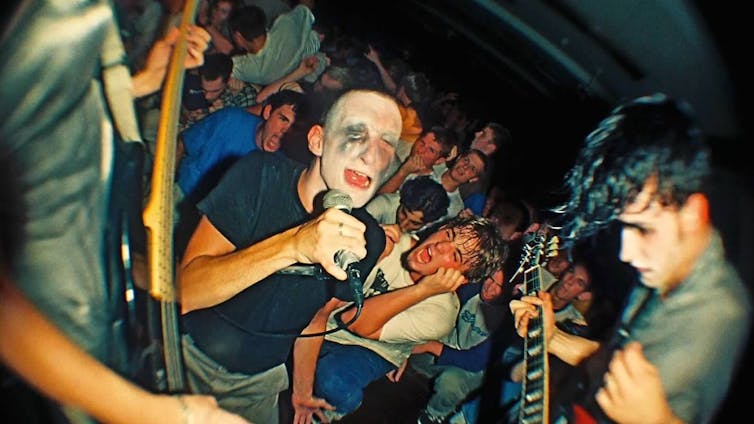
Man with face painted holds microphone and stands between two guitar players while fans scream and dance behind him
Philly hardcore punk band Ink & Dagger performs at the First Unitarian Church, circa late 1990s.
Justin Moulder

‘Not your typical rebellion’

In Philadelphia, and especially in West Philly, a number of collectively organized squats, houses and venues hosted shows, political events and parties, along with serving as housing for punks, in the 1990s and 2000s. In some cases, the housing itself was a form of protest – squatting in abandoned buildings and living cooperatively was often seen as a political action.

There was the Cabbage Collective booking shows at the Calvary Church at 48th and Baltimore Avenue. Stalag 13 near 39th and Lancaster Avenue is where the famous Refused played one of their final shows, and The Killtime right next door is where Saves the Day played in 1999 before becoming famous. The First Unitarian Church, an actual church in Center City, still regularly puts on shows in its basement.

These largely underground venues became central to the Philadelphia punk scene, which had previously lacked midsized spaces for lesser known bands.

Many Philly punks during this era mixed music subculture with social activism. As one anarcho-punk – a subgenre of punk rock that emphasizes leftist, anarchist and socialist ideals – I interviewed for my book told me:

“My mom … said, ‘I thought you were going to grow out of it. I didn’t understand it, and your dad and I were like, ‘What are we doing? She’s going out to these shows! She’s drinking beer!’ But then we’d be like, ‘She’s waking up the next morning to help deliver groceries to old people and organize feminist film screenings!’ We don’t know what to do, we don’t know how to deal with this; it’s not your typical rebellion.’”

Black-and-white photo of two male tattooed musicians singing and playing guitar while young men watch
Philly punk band R.A.M.B.O. performs in January 2006, with Tony
Joseph A. Gervasi/LOUD! FAST! PHILLY!

This quote captures the complex and ambiguous rebellion at the heart of anarcho-punk. On the one hand, it is a form of rebellion, often beginning in one’s teenage years, that contains the familiar trappings of youth subcultures: drug and alcohol consumption, loud music and unusual clothing, hairstyles, tattoos and piercings.

However, unlike other forms of teenage rebellion, anarcho-punks also seek to change the world through both personal and political activities. On the personal level, and as I showed in my book, many become vegan or vegetarian and seek to avoid corporate consumerism.

“I do pride myself on trying to not buy from sweatshops, trying to keep my support of corporations to a minimum, though I’ve loosened up over the years,” another interviewee, who was also vegan, said. “You’ll drive yourself crazy if you try to avoid it entirely, unless you … go live with [British punk band] Crass on an anarcho-commune.”

Love and rage in the war against war

Philly’s punk activists of that era spread their anarchist ideals through word and deed.

Bands like R.A.M.B.O., Mischief Brew, Flag of Democracy, Dissucks, Kill the Man Who Questions, Limp Wrist, Paint it Black, Ink and Dagger, Kid Dynamite, Affirmative Action Jackson and The Great Clearing Off, The Sound of Failure, and countless others, sang about war, capitalism, racism and police violence.

For example, on its 2006 single “War-Coma,” Witch Hunt reflected on the ongoing wars in Iraq and Afghanistan, laying blame on voters, government and religion:

24 years old went away to war / High expectations of what the future holds / Wore the uniform with pride a rifle at hand / Bringing democracy to a far away land / Pregnant wife at home awaiting his return / Dependent on faith, will she ever learn? / Ignore the consequences have faith in the Lord / Ignorance is bliss until reality sets in / Never wake up again

During live performances, bands would commonly discuss what the songs were about. And at merchandise tables, they sold T-shirts and records along with zines, books, patches and pins, all of which commonly contained political images or slogans.

Some bands became meta-critics of the punk scene itself, encouraging listeners to recognize that punk is about more than music.

In “Preaching to the Converted,” Kill The Man Who Questions critiqued the complaints bands would receive for becoming too preachy at shows:

“Unity” the battle cry / Youth enraged but don’t ask why / They just want it fast and loud, with nothing real to talk about / 18 hours in a dying van / Proud to be your background band.

In West Philadelphia, punks also staffed the local food cooperative and organized activist spaces – like the former A-Space on Baltimore Avenue and LAVA Zone on Lancaster Avenue where groups such as Food Not Bombs and Books Through Bars, among others, would operate. I personally organized a weekend gathering of the Northeastern Anarchist Network at LAVA in 2010.

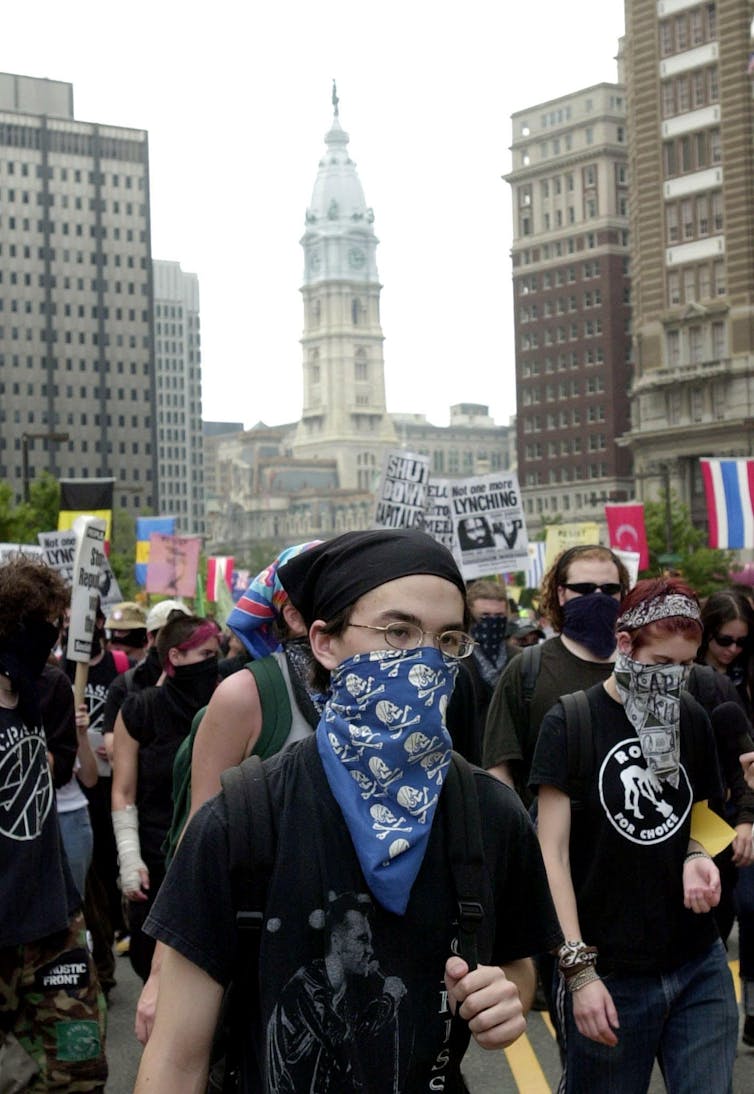
Young adults wearing black clothes and bandannas and holding protest signs
Masked protesters walk away from City Hall after a march on July 30, 2000, a day before the start of the Republican National Convention in Philadelphia.
Roberto Schmidt/AFP via Getty Images

Punks raised money for charities and showed up to local protests against capitalist globalization and countless other causes. At the Republican National Convention in Philadelphia in the summer of 2000, black-clad punks whose faces were hidden behind masks marched in the streets along with an enormous cadre of local community organizations.

Punk not dead in Philly

Since punk’s earliest days, people have bemoaned that “punk is dead.”

In Philadelphia, I’ve seen how the anarcho-punk scene of the 1990s and 2000s has changed, but also how it continues to influence local bands and the values of punk rock broadly.

Many former and current members of the Philly anarcho-punk scene are still activists in various personal and professional ways. Among those I interviewed between 2006 and 2012 were social workers, labor organizers, teachers and professors, and school and drug counselors. For many, their professional lives were influenced by the anarchist ethics they had developed within the punk rock scene.

And many local punks showed up at the Occupy Philly camp and protests outside City Hall in 2011, and later marched in the streets during Black Lives Matter protests following the murder of George Floyd and killing of Breonna Taylor in 2020. They also participated in the homeless encampment on the Benjamin Franklin Parkway, also in 2020. And local punks I know continue to participate in grassroots campaigns like Decarcerate PA.

Anarchism and punk rock open up avenues for disaffected youth – in Philadelphia or anywhere else – to dream of a world without capitalism, coercive authorities, police and all forms of injustice.

In the words of R.A.M.B.O., one of the better known hardcore punk bands of the era and who released their latest Defy Extinction album in 2022: “If I can dream it, then why should I try for anything else?”

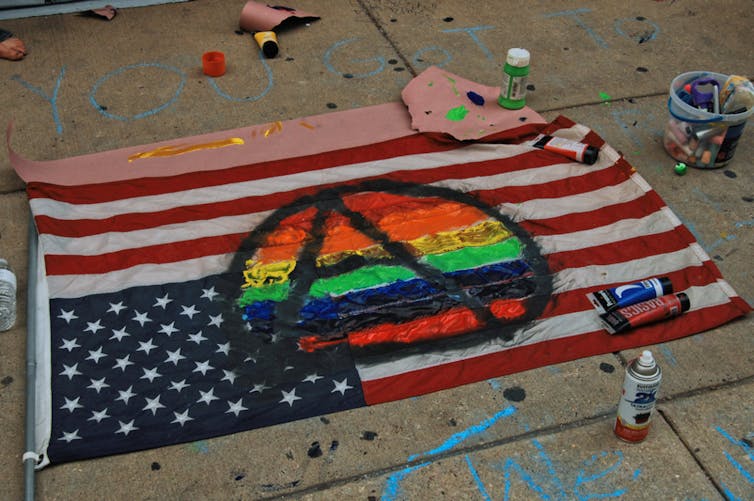
American flag on ground painted over with rainbow-filled anarchist symbol
Protesters alter a flag at the Occupy I.C.E. Philly encampment at City Hall in 2018.
Cory Clark/NurPhoto via Getty Images

Read more of our stories about Philadelphia, or sign up for our Philadelphia newsletter.

The Conversation

Edward Avery-Natale does not work for, consult, own shares in or receive funding from any company or organization that would benefit from this article, and has disclosed no relevant affiliations beyond their academic appointment.

ref. How Philly anarcho-punks blended music, noise and social justice in the 1990s and 2000s – https://theconversation.com/how-philly-anarcho-punks-blended-music-noise-and-social-justice-in-the-1990s-and-2000s-264178

Vaccine mandates misinformation: 2 experts explain the true role of slavery and racism in the history of public health policy – and the growing threat ignorance poses today

Source: The Conversation – USA (3) – By Lauren MacIvor Thompson, Assistant Professor of History and Interdisciplinary Studies, Kennesaw State University

Vaccination rates in Florida schools have dipped below the threshold for immunity to certain preventable diseases. Suzi Media Production/iStock via Getty Images Plus

On Sept. 3, 2025, Florida announced its plans to be the first state to eliminate vaccine mandates for its citizens, including those for children to attend school.

Current Florida law and the state’s Department of Health require that children who attend day care or public school be immunized for polio, diphtheria, rubeola, rubella, pertussis and other communicable diseases. Dr. Joseph Ladapo, Florida’s surgeon general and a professor of medicine at the University of Florida, has stated that “every last one” of these decades-old vaccine requirements “is wrong and drips with disdain and slavery.”

As experts on the history of American medicine and vaccine law and policy, we took immediate note of Ladapo’s use of the word “slavery.”

There is certainly a complicated history of race and vaccines in the United States. But, in our view, invoking slavery as a way to justify the elimination of vaccines and vaccine mandates will accelerate mistrust and present a major threat to public health, especially given existing racial health disparities. It also erases Black Americans’ key work in centuries of American public health initiatives, including vaccination campaigns.

What’s clear: Vaccines and mandates save human lives

Evidence and data show that vaccines work, as do mandates, in keeping Americans healthy. The World Health Organization reported in a landmark 2024 study that vaccines have saved more than 154 million lives globally in just the past 50 years.

In the United States, vaccines for children are one of the top public health achievements of the 20th century. Rates of eight of the most common vaccine-preventable diseases in school-age children dropped by 97% or more from pre-vaccine levels, preventing an estimated 1,129,000 deaths and resulting in direct savings of US$540 billion and societal savings of $2.7 trillion.

History of vaccine mandates in the United States

Vaccine mandates in the United States date to the Colonial period and have a complex history. George Washington required his troops be inoculated, the predecessor of vaccination, against smallpox during the American Revolution.

To prevent outbreaks of this debilitating, disfiguring and deadly disease, state and local governments implemented smallpox inoculation and vaccination campaigns into the early 1900s. They targeted various groups, including enslaved people, immigrants, people living in tenement and other crowded housing conditions, manual laborers and others, forcibly vaccinating those who could not provide proof of prior vaccination.

Although religious exemptions were not recognized by law until the 1960s, some resisted these vaccination campaigns from the beginning, and 19th-century anti-vaccination societies urged the rollback of state laws requiring vaccination.

By the turn of the 20th century, however, the U.S. Supreme Court also began to intervene in matters of public health and vaccination. The court ultimately upheld vaccine mandates in Jacobson v. Massachusetts in 1905, in an effort to strike a balance between individual rights with the need to protect the public’s health. In Zucht v. King in 1922, the court also ruled in favor of vaccine mandates, this time for school attendance.

Vaccine mandates expanded by the middle of the 20th century to include vaccines for many dangerous childhood diseases, such as polio, measles, rubella and pertussis. When Jonas Salk’s polio vaccine became available, families waited in long lines for hours to receive it, hoping to prevent their children from having to experience paralysis or life in an iron lung.

Scientific studies in the 1970s demonstrated that state declines in measles cases were correlated with enforcement of school vaccine mandates. The federal Childhood Immunization Initiative launched in the late 1970s helped educate the public on the importance of vaccines and encouraged enforcement. All states had mandatory vaccine requirements for public school entry by 1980, and data over the past several decades continues to demonstrate the importance of these laws for public health.

Most parents also continue to support school mandates. A survey conducted in July and August 2025 by The Washington Post and the Kaiser Family Foundation finds that 81% of parents support laws requiring vaccines for school.

Black Americans’ long fight for public health equity

Despite the proven success of vaccines and the importance of vaccine mandates in maintaining high vaccination rates, there is a vocal anti-vaccine minority in the U.S. that has gained traction since the COVID-19 pandemic.

Misinformation proliferates both online and off. Some of the misinformation originates in the historical realities of vaccines and social policy in the United States.

When Ladapo, the Florida surgeon general, invoked the term “slavery” to refer to vaccine mandates, he may have been referring to the history of racism in the medical field, such as the U.S. Public Health Service Untreated Syphilis Study at Tuskegee. The study, which started in 1932 and spanned four decades, involved hundreds of Black men who were recruited without their knowledge or consent so that researchers could study the effects of untreated syphilis. Investigators misled the participants about the nature of the study and actively withheld treatment – including penicillin, which became the standard therapy in the late 1940s – in order to study the effects of untreated syphilis on the men’s bodies.

Today, the study is remembered as one of the most egregious instances of racism and unethical experimentation in American medicine. Its participants had enrolled in the study because it was advertised as a chance to receive expert medical care but, instead, were subjected to lies and painful “treatments.”

Three men standing shoulder to shoulder in long-sleeve shirts.
The 40-year untreated syphilis study at Tuskegee ended in 1972.
National Archives Catalog/Centers for Disease Control and Prevention

Despite these experiences in the medical system, Black Americans have long advocated for better health care, connecting it to the larger struggle for racial equality.

Vaccination is no exception. Despite the fact that they were often the subject of forced innoculation, enslaved people helped to lead the first American public health initiatives around epidemic disease. Historians’ research on smallpox and slavery, for example, has found that inoculation was widely accepted and practiced by West Africans by the early 1700s, and that enslaved people brought the practice to the Colonies.

Although his role is often downplayed, an African man known as Onesimus introduced his enslaver Cotton Mather to inoculation.

Throughout the next century, enslaved people often continued to inoculate each other to prevent smallpox outbreaks, and enslaved and free people of African descent played critical roles in keeping their own communities as healthy as possible in the face of violence, racism and brutality. The modern Civil Rights Movement explicitly drew on this history and centered health equity for Black Americans as one of its key tenets, including working to provide access to vaccines for preventable diseases.

In our view, Ladapo’s reference to vaccines as “slavery” ignores this important and nuanced history, especially Black Americans’ role in the history of preventing communicable disease with vaccines.

Black and white scanned engraving of colonialist Cotton Mather.
Puritan slave owner Cotton Mather learned about smallpox inoculation from one of his slaves, an African man named Onesimus.
benoitb/DigitalVision Vectors via Getty Images

Lessons to learn from Tuskegee

Ladapo’s word choice also runs the risk of perpetuating the rightful mistrust that continues to exist in communities of color about vaccines and the American health system more broadly. Studies show that lingering effects of Tuskegee and other instances of medical racism have had real consequences for the health and vaccination rates of Black Americans.

A large body of evidence shows the existence of persistent health disparities for Black people in the United States compared with their white counterparts, leading to shorter lifespans, higher rates of maternal and infant mortality and higher rates of communicable and chronic diseases, with worse outcomes.

Eliminating vaccine mandates in Florida and expanding exemptions in other states will continue to widen these already existing disparities that stem from past public health wrongs.

There is an opportunity here, however, for health officials, not just in Florida but across the nation, to work together to learn from the past in making American public health better for everyone.

Rather than weakening vaccine mandates, national, state and local public health guidance can focus on expanding access and communicating trustworthy information about vaccines for all Americans. Policymakers can acknowledge the complicated history of vaccines, public health and race, while also recognizing how advancements in science and medicine have given us the opportunity to eradicate many of these diseases in the United States today.

The Conversation

The authors do not work for, consult, own shares in or receive funding from any company or organization that would benefit from this article, and have disclosed no relevant affiliations beyond their academic appointment.

ref. Vaccine mandates misinformation: 2 experts explain the true role of slavery and racism in the history of public health policy – and the growing threat ignorance poses today – https://theconversation.com/vaccine-mandates-misinformation-2-experts-explain-the-true-role-of-slavery-and-racism-in-the-history-of-public-health-policy-and-the-growing-threat-ignorance-poses-today-265175

Criticisms against Spotify keep mounting. Luckily there are alternatives

Source: The Conversation – Global Perspectives – By Michael James Walsh, Associate Dean and Associate Professor in Social Sciences, University of Canberra

Spotify has been subject to various lingering critiques. These range from criticism of its payment model, to the presence of “fake artists”, the Joe Rogan boycott saga, and controversies around AI-made music.

More recently, cofounder and chief executive Daniel Ek has come under fire for investing €600 million (more than A$1 billion) in the military AI company Helsing. The news prompted several artists to remove their music from the platform, including King Gizzard and the Lizard Wizard, Xiu Xiu, Deerhoof, Wu Lyf and, as of last week, Massive Attack.

To top it all off, Spotify has been steadily raising its prices for premium subscribers.

We’ve seen a spate of headlines targeting users who for one reason or another are considering, or determined to, tune out from the platform. For many, this may not be a hassle-free adjustment – but that doesn’t mean it can’t be done.

Users are picking up the tab

As of 2022, streaming accounted for 67% of the revenue generated by the music industry.

The IFPI 2025 global music report shows streaming generates the biggest proportion of revenue for the music industry.
IFPI Global Music Report 2025. All statements in this report attributable to IFPI represent The Conversation’s interpretation of data, research opinion or viewpoints published as part of the IFPI Global Music Report in March 2025, and have not been reviewed by IFPI. Each IFPI publication speaks as of its original publication date (and not as of the date of this article).

It’s estimated one in 12 people are regular Spotify users – putting the streaming giant well ahead of its nearest rivals YouTube Music (a Google subsidiary) and the China-domiciled Tencent Music.

While most users access Spotify for free, about 268 million of its 696 million monthly active users pay a premium for ad-free access.

For many years, Spotify kept prices fairly steady as it concentrated on growth. It did not make a profit until 2024. But chief business officer Alex Norström recently said price rises “were part of our toolbox now”.

Spotify has promised price rises will be accompanied by new features. Norström said the platform was developing a feature for “superfans” of popular artists, not to mention introducing (belatedly) “lossless” (higher-quality) sound.

Other music streaming services, such as Amazon Music, are also raising prices, to varying degrees of success.

Why Spotify dominates music streaming

There are several reasons for the dominance of streaming, and the broader dematerialisation of music media. As David Bowie foresaw in 2002: “music itself is going to become like running water or electricity”.

Streaming services such as Spotify avoid the stigmas associated with consuming pirated music recordings. They also remunerate artists (although many would say these payments are inadequate).

Ek made it clear a key aim of the company was to ensure no perceivable “latency” (annoying delays due to buffering) when songs were selected to play.

Spotify has also been at the forefront of leveraging the social dimensions of music streaming. It promotes user-created playlists and wayfinding functions that allow fans to feel like they own “their” music collection, despite not having the physical artefacts such as vinyl or CDs.

Users can interact with one another. They can share their listening activity on dating profiles, with peers, and through marketing initiatives such as Spotify Wrapped.

From the early days, Spotify sought to present itself in ways that resembled social media. More recently, it has released TikTok-inspired feeds, comments, polls, artist stories, collaborative playlists and a messaging feature.

Calling the tune through algorithms

A significant part of Spotify’s success stems from its continuous development of its interface and recommendation algorithms. These algorithms have become central to how users find, access and listen to music.

Importantly, Spotify caters to what scholars identify as a “lean-back” mentality. Users are encouraged to consume editorial playlists, rather than actively browse for tracks. This increases its power to influence the music with which listeners engage.

It aims to be an easy-to-use, always-convenient service, catering to any moment:

Spotify has a playlist to match your mood. Not only in the morning, but at every moment of your day.

Switching may be hard, but not impossible

The move away from streaming may now be hard to reverse, even as it becomes more expensive. Despite the resurgence of vinyl, many listeners have given up on physical music collections.

Spotify has also developed features to increase “stickiness” for subscribers. Users have created nearly nine billion playlists. As it’s difficult to transfer playlists to another streaming service, it makes users more likely to stick with Spotify.

It also has a reputation for having the most songs available. There is a large chance it will have the song you want to listen to.

Nonetheless, that doesn’t mean alternatives aren’t available. And most of them are cheaper than the A$15.99 per month Spotify charges in Australia.

Apple Music is an audio (and now video) streaming app developed by Apple, and launched in 2015. It promotes spatial and high-resolution music and integrates effectively with iOS devices.

Amazon Music is a music streaming platform included with an Amazon Prime subscription, offering access to songs, podcasts and playlists. It also integrates with Amazon’s Alexa virtual assistant devices.

YouTube Music is available to YouTube Premium subscribers. Succeeding Google Play Music, it offers various playlists and radio station features, with strong integration into YouTube’s video ecosystem.

Tidal is a music streaming service that positions itself as the leader in high-fidelity audio. Alongside Spotify, Tidal was one of the first platforms to allow users to follow selected Facebook friends and receive music recommendations from them.

Anghami, launched in 2012, is the leading music streaming service dedicated to music from the Middle East and North Africa.

There are also third-party apps (both paid and unpaid) you can use to transfer your old Spotify playlists to a new service, such as Free Your Music, Tune My Music, Soundiiz and SongShift (only for iOS).


Read more:
‘I almost feel like stuck in a rut’: how streaming services changed the way we listen to music


The Conversation

The authors do not work for, consult, own shares in or receive funding from any company or organisation that would benefit from this article, and have disclosed no relevant affiliations beyond their academic appointment.

ref. Criticisms against Spotify keep mounting. Luckily there are alternatives – https://theconversation.com/criticisms-against-spotify-keep-mounting-luckily-there-are-alternatives-264982

Is Benjamin Netanyahu on a mission to realise a Greater Israel?

Source: The Conversation – Global Perspectives – By Amin Saikal, Adjunct Professor of Social Sciences, The University of Western Australia, Victoria University, Australian National University

Much of the world is focused on a two-state solution in resolving the long-running Israeli-Palestinian conflict, but Israeli Prime Minister Benjamin Netanyahu appears devoted to realising his vision of a “Greater Israel” instead.

Netanyahu appears to be halfway through achieving this goal, despite all the international condemnation of his war in Gaza and the increasing isolation of Israel.

The two-state solution now seems to be no more than a catchword for governments around the world that want to show their solidarity with the Palestinian cause at a time when Israel is hard at work to ensure the concept becomes totally defunct.

The prospects for creating an independent Palestinian state out of the West Bank, East Jerusalem and Gaza Strip to live side-by-side with Israel in peace and security have never been dimmer.

Israel maintains Trump’s unwavering support

In the wake of Israel’s attack on Hamas leaders in Qatar earlier this month, an emergency Arab-Muslim summit was convened by Qatar to provide a collective response.

The meeting proved to be very ineffective. The leaders issued a strong condemnation of the strike on Qatar, but no plan for how to prevent Israel from attacking its neighbours or halt what a United Nations commission has now called a genocide in Gaza.

Instead, the leaders offered a tepid statement, saying they would:

take all possible legal and effective measures to prevent Israel from continuing its actions against the Palestinian people.

Middle East leaders know the only power that can rein in Israel is its committed strategic partner, the United States.

Washington does not appear prepared to do that. While President Donald Trump has assured the region Israel will not repeat its attack on Qatar, his secretary of state, Marco Rubio, urgently flew to Israel to reconfirm America’s unshakeable alliance with the Jewish state.

In praying together with Netanyahu at the Western Wall with a kippah on his head, Rubio demonstrated the Trump administration would stand by the prime minister all the way.

And Netanyahu was quick to declare that Israel reserves the right to hit the “Hamas terrorists” anywhere. He has demanded Qatar expel Hamas officials or face Israel’s wrath again.

A vision for a ‘Greater Israel’

Based on the language used by the Israeli leader and his extremist ministers, the creation of “Greater Israel” appears to be a priority.

In recent weeks, Netanyahu has publicly alluded to this, saying he was “very” connected to the idea.

The “Greater Israel” phrase was used after the Six-Day War in 1967 to refer to the lands Israel had conquered: the West Bank, East Jerusalem, Gaza, the Golan Heights and the Sinai peninsula (which has since been returned to Egypt).

This concept was enshrined in 1977 in the founding charter of Netanyahu’s Likud Party, which said “between the [Mediterranean] Sea and the Jordan [River] there will only be Israeli sovereignty”.

Last year, Netanyahu affirmed that Israel must have “security control over the entire territory west of the Jordan River”. He added, “That collides with the idea of [Palestinian] sovereignty. What can we do?”

Netanyahu is now firmly in a position to annex the Gaza Strip, followed by formally extending Israeli jurisdiction over all the illegal Israeli settlements in the West Bank, where more than 700,000 settlers live under the protection of the Israel Defence Forces (IDF), and potentially annex the entire area.

In addition, Israel has made extraterritorial gains in both Lebanon and Syria after degrading Hezbollah and striking both southern Syria and Iran. He has said the IDF’s footprint in both countries will not be pulled back any time soon.

Arab and Muslim leaders have strongly condemned Netanyahu’s references to a “Greater Israel”. The US also has not publicly endorsed it, though the US ambassador to Israel, Mike Huckabee, has been a supporter of the idea.

What can the world do?

Netanyahu and his colleagues have weathered the international criticism over their catastrophic Gaza operations for nearly two years, with unwavering US security, economic and financial backing.

Equally, Netanyahu’s critics say he has shown little concern about the safety and freedom of the remaining Israeli hostages still in Hamas’s custody. He has brushed off the desires of a majority of Israelis for a ceasefire and release of the hostages.

For Netanyahu and his ruling clique, the end justifies the means. Given this, the expected recognition of the state of Palestine by many Western countries at the UN General Assembly this week will have little or no bearing on Israel or, for that matter, the US. They have both already rejected it as a meaningless and unworthy symbolic exercise.

This begs the question of what needs to be done to divert Israel from its path. The only means that could possibly work would be sanctioning Netanyahu and his government and severing all military, economic and trade ties with Israel.

Anything short of this will allow the Israeli leadership to continue its pursuit of a “Greater Israel”, if this is indeed their ultimate plan.

This would come at a terrible cost not only for the Palestinians and the region, but also for Israel’s global reputation. When Netanyahu eventually leaves office, he will leave behind a state in international disrepute. And it may not recover from this for a very long time.

The Conversation

Amin Saikal does not work for, consult, own shares in or receive funding from any company or organisation that would benefit from this article, and has disclosed no relevant affiliations beyond their academic appointment.

ref. Is Benjamin Netanyahu on a mission to realise a Greater Israel? – https://theconversation.com/is-benjamin-netanyahu-on-a-mission-to-realise-a-greater-israel-265662

UK and other Western nations recognize Palestinian state ahead of UN meetings – but symbolic action won’t make statehood happen

Source: The Conversation – Global Perspectives – By Maha Nassar, Associate Professor in the School of Middle Eastern and North African Studies, University of Arizona

Pro-Palestinian Americans gather in New York at a march to the U.N. on Sept. 18, 2025. Selcuk Acar/Anadolu via Getty Images

Recognition of a Palestinian state is likely to dominate proceedings at the U.N. beginning Sept 23, 2025, when world leaders will gather for the annual general assembly.

Of the 193 existing U.N member states, some 150 now recognize a Palestinian state. Ahead of the U.N. gathering in New York, Australia, Canada and the United Kingdom become the latest. And that number is expected to increase in the coming days, with several more countries expected to officially announce similar recognition.

That a host of Western nations are adding their names to the near-universal list of Global South countries that already recognize a Palestinian state is a major diplomatic win for the cause of an independent, sovereign and self-governed nation for Palestinians. Conversely, it is a massive diplomatic loss for Israel – especially coming just two years after the West stood shoulder to shoulder with Israel following the Oct. 7 attack by Palestinian militant group Hamas.

As a scholar of modern Palestinian history, I know that this diplomatic moment is decades in the making. But I am also aware that symbolic diplomatic breakthroughs on the issue of Palestinian statehood have occurred before, only to prove meaningless in the face of events that make statehood less likely.

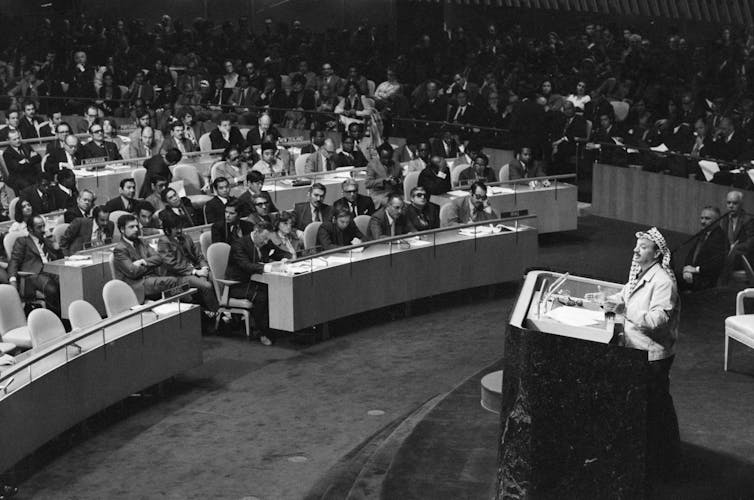
A man gives a speech before a crowd.
‘I have come bearing an olive branch and a freedom fighter’s gun,’ PLO leader Yasser Arafat said before the United Nations General Assembly in 1974.
Bettmann / Contributor

The non-state reality

The fight for Palestinian statehood can be traced back to at least 1967. Over the course of a six-day war against a coalition of Arab states, Israel conquered and expanded its military control over the remainder of what was historic Palestine – a stretch of land that extends from the Jordan River in the east to the Mediterranean Sea in the west.

At the war’s conclusion, Israel had taken control of the West Bank, East Jerusalem and the Gaza Strip.

Unlike after the 1948 war that led to its independence, Israel opted not to extend Israeli citizenship to Palestinians living in the newly conquered areas. Instead, the Israeli government began to rule over Palestinians in these occupied territories through a series of military orders.

These orders controlled nearly every aspect of Palestinian life – and many remain in effect today. For example, if a Palestinian farmer wants to harvest his olive trees near a Jewish settlement in the West Bank, they need a permit. Or
if a Gazan worker wants to work inside Israel, they need Israeli permission. Even praying in a mosque or church in East Jerusalem is dependent on obtaining a permit.

This permit system served as a constant reminder to Palestinians living in the occupied territories that they lacked control over their own daily lives. Meanwhile, Israeli authorities tried to squash the idea of Palestinian nationhood through policies such as outlawing public displays of the Palestinian flag. That, and other expressions of Palestinian national identity in the occupied territories, could result in up to 10 years in prison.

Such policies fit a belief, expressed in 1969 by then Israeli Prime Minister Golda Meir, that there was “no such thing in this area as Palestinians.”

The rise of Palestinian nationalism

Around the same time that Meir made that comment, Palestinians started organizing around the idea of statehood.

Although the idea had been floated before, statehood was codified into official doctrine in a resolution in February 1969 in Egypt. It occurred during a session of the Palestine National Council, the legislative body of the Palestine Liberation Organization, which formed in 1964 as the official representative of Palestinians in the occupied territories.

That resolution called for a free, secular democratic state in Palestine – including all of the State of Israel – in which Muslims, Christians and Jews would all have equal rights.

From that moment on, the Palestinian struggle against Israeli occupation took twin paths: diplomatic pressure and armed resistance.

But events on the ground undermined the idea of a single state for all along the lines envisioned by the Cairo resolution.

The 1973 Arab-Israeli War’s inconclusive ending opened the door to greater diplomacy between Israel and the Arab states. Egypt and Israel decided that diplomacy would help them achieve their aims, culminating in the Egyptian-Israeli peace treaty of 1979. But the treaty also left the Palestinians without unified Arab support.

Meanwhile, throughout the 1970s, the Israeli occupation deepened and entrenched with the building of Israeli settlements, especially in the West Bank.

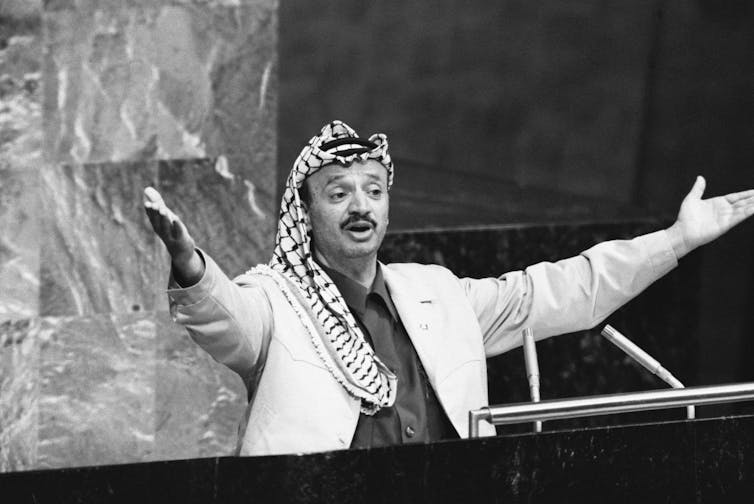
A man throws out his arms to make a point while he stands at a lectern.
Yasser Arafat addresses the United Nations General Assembly in 1974.
Bettmann / Contributor

The PLO responded in 1974 by issuing what became known as the 10-Point Plan, where they pivoted to seeking the establishment of a national authority in any part of historic Palestine that could be liberated.

It was, in effect, a way of threading the needle: It signaled to moderates that the PLO was adopting a more gradualist position, while also telling the group’s rejectionist front – which opposed peace negotiations with Israel – that they were not giving up completely on the idea of liberating all of Palestine.

Then in 1988 – a year into the first Palestinian intifada, or uprising – the PLO unilaterally declared Palestinian independence on the territories occupied in 1967.

The move was largely symbolic – the West Bank, Gaza and East Jerusalem were still under occupation, and the PLO was then in exile in Tunisia.

But it was nonetheless significant. It represented the bringing together of Palestinians in exile – most of whom were from towns and villages that were now part of the State of Israel – with Palestinians in the occupied territories.

The declaration itself was written by Palestinian poet Mahmoud Darwish, who grew up inside Israel, and declared by Yasser Arafat, the PLO leader in exile.

It was also a moment of tremendous hope and possibility for Palestinians. What most Palestinians wanted was for the international community to recognize them as a national body, deserving of a seat at the table with other nation-states.

Compromise and rejection

Yet at the same time, many Palestinians saw the declaration as a huge compromise. The West Bank, Gaza Strip and East Jerusalem comprise about 22% of historic Palestine. So the declaration effectively meant that Palestinians were giving up on the other 78% of what they saw as their land.

Reaction from the international community to the PLO’s declaration was split. Many formerly colonized countries of the Global South recognized Palestinian independence right away. By the end of the year, some 78 countries had issued statements recognizing Palestine as a state.

Israel rejected it outright, as did United States and most Western nations.

Such was Washington’s opposition that the U.S. denied Arafat a visa ahead of his planned address to the United Nations at its New York City headquarters. As a result, the December 1988 meeting had to be moved to Geneva.

While refusing to accept Palestinian statehood, the U.S. and Israel did begin to recognize the PLO as a representative body of the Palestinian people. This was part of the Oslo Accords – a diplomatic process that many believed would outline a road map for an eventual two-state solution.

While some Palestinians saw the Oslo Accords as a diplomatic breakthrough, others were more skeptical. Prominent Palestinians, including Darwish and Palestinian-American professor Edward Said, believed that Oslo was a poison pill: While framed as a step toward a two-state solution, the agreement said nothing about a Palestinian state in the interim. It only said that Israel would recognize the PLO as a representative of the Palestinian people.

In reality, the Oslo Accords have not lead to statehood. Rather, they created a system of fragmented autonomy under the newly created Palestinian Authority that, though meant to be interim, has in effect become permanent.

The Palestinian Authority was allowed only limited powers and deprived of real independence. While it had some say over schooling, health care and municipal services, Israel maintained control of Palestinian land, resources, borders and the economy. That remains true today.

Renewed push for statehood recognition

Disillusionment over the Oslo Accords contributed to the second, far more violent, intifada from 2000 to 2005.

Mahmoud Abbas, the leader of the Palestinian Authority after Arafat, responded by pushing again for international recognition for statehood.

And in 2012, the U.N. General Assembly voted to upgrade Palestine’s status, elevating it from a “nonmember observer” to a “nonmember observer state.”

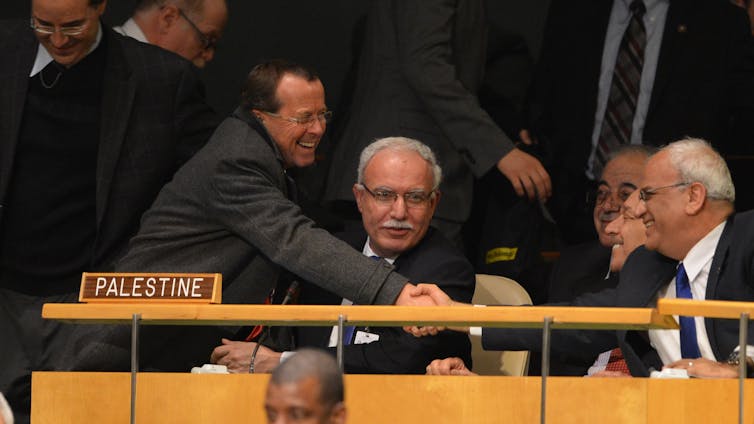
Two men shake hands.
The Palestinian delegation at the U.N. General Assembly before the vote to upgrade Palestinian status to a nonmember observer state in 2012.
Stan Honda/AFP via Getty Images

In theory, this meant Palestinians now had access to international bodies, like the International Criminal Court and the International Court of Justice.

But any meaningful change in the status of Palestinian sovereignty would need to come through the U.N. Security Council, not the U.N. General Assembly.

The U.S. remains opposed to Palestinians gaining statehood independent of the Oslo process. So long as the U.S. has a veto on the Security Council, achieving a truly sovereign Palestinian state will likewise be off the table. And that remains the case, regardless of what individual members – even fellow Security Council members like France and the U.K – do.

In fact, many Palestinians and other critics of the status quo say Western nations are using the issue of Palestinian statehood to absolve them from the far more challenging diplomatic task of holding Israel accountable for what a U.N. body just described as a genocide in Gaza.

This article is based on a conversation between Maha Nassar and Gemma Ware for The Conversation Weekly podcast.

The Conversation

Maha Nassar does not work for, consult, own shares in or receive funding from any company or organization that would benefit from this article, and has disclosed no relevant affiliations beyond their academic appointment.

ref. UK and other Western nations recognize Palestinian state ahead of UN meetings – but symbolic action won’t make statehood happen – https://theconversation.com/uk-and-other-western-nations-recognize-palestinian-state-ahead-of-un-meetings-but-symbolic-action-wont-make-statehood-happen-265534

UK and other Western states recognize Palestinian state ahead of UN meetings – but symbolic action won’t make statehood happen

Source: The Conversation – Global Perspectives – By Maha Nassar, Associate Professor in the School of Middle Eastern and North African Studies, University of Arizona

Pro-Palestinian Americans gather in New York at a march to the U.N. on Sept. 18, 2025. Selcuk Acar/Anadolu via Getty Images

Recognition of a Palestinian state is likely to dominate proceedings at the U.N. beginning Sept 23, 2025, when world leaders will gather for the annual general assembly.

Of the 193 existing U.N member states, some 150 now recognize a Palestinian state. Ahead of the U.N. gathering in New York, Australia, Canada and the United Kingdom become the latest. And that number is expected to increase in the coming days, with several more countries expected to officially announce similar recognition.

That a host of Western nations are adding their names to the near-universal list of Global South countries that already recognize a Palestinian state is a major diplomatic win for the cause of an independent, sovereign and self-governed nation for Palestinians. Conversely, it is a massive diplomatic loss for Israel – especially coming just two years after the West stood shoulder to shoulder with Israel following the Oct. 7 attack by Palestinian militant group Hamas.

As a scholar of modern Palestinian history, I know that this diplomatic moment is decades in the making. But I am also aware that symbolic diplomatic breakthroughs on the issue of Palestinian statehood have occurred before, only to prove meaningless in the face of events that make statehood less likely.

A man gives a speech before a crowd.
‘I have come bearing an olive branch and a freedom fighter’s gun,’ PLO leader Yasser Arafat said before the United Nations General Assembly in 1974.
Bettmann / Contributor

The non-state reality

The fight for Palestinian statehood can be traced back to at least 1967. Over the course of a six-day war against a coalition of Arab states, Israel conquered and expanded its military control over the remainder of what was historic Palestine – a stretch of land that extends from the Jordan River in the east to the Mediterranean Sea in the west.

At the war’s conclusion, Israel had taken control of the West Bank, East Jerusalem and the Gaza Strip.

Unlike after the 1948 war that led to its independence, Israel opted not to extend Israeli citizenship to Palestinians living in the newly conquered areas. Instead, the Israeli government began to rule over Palestinians in these occupied territories through a series of military orders.

These orders controlled nearly every aspect of Palestinian life – and many remain in effect today. For example, if a Palestinian farmer wants to harvest his olive trees near a Jewish settlement in the West Bank, they need a permit. Or
if a Gazan worker wants to work inside Israel, they need Israeli permission. Even praying in a mosque or church in East Jerusalem is dependent on obtaining a permit.

This permit system served as a constant reminder to Palestinians living in the occupied territories that they lacked control over their own daily lives. Meanwhile, Israeli authorities tried to squash the idea of Palestinian nationhood through policies such as outlawing public displays of the Palestinian flag. That, and other expressions of Palestinian national identity in the occupied territories, could result in up to 10 years in prison.

Such policies fit a belief, expressed in 1969 by then Israeli Prime Minister Golda Meir, that there was “no such thing in this area as Palestinians.”

The rise of Palestinian nationalism

Around the same time that Meir made that comment, Palestinians started organizing around the idea of statehood.

Although the idea had been floated before, statehood was codified into official doctrine in a resolution in February 1969 in Egypt. It occurred during a session of the Palestine National Council, the legislative body of the Palestine Liberation Organization, which formed in 1964 as the official representative of Palestinians in the occupied territories.

That resolution called for a free, secular democratic state in Palestine – including all of the State of Israel – in which Muslims, Christians and Jews would all have equal rights.

From that moment on, the Palestinian struggle against Israeli occupation took twin paths: diplomatic pressure and armed resistance.

But events on the ground undermined the idea of a single state for all along the lines envisioned by the Cairo resolution.

The 1973 Arab-Israeli War’s inconclusive ending opened the door to greater diplomacy between Israel and the Arab states. Egypt and Israel decided that diplomacy would help them achieve their aims, culminating in the Egyptian-Israeli peace treaty of 1979. But the treaty also left the Palestinians without unified Arab support.

Meanwhile, throughout the 1970s, the Israeli occupation deepened and entrenched with the building of Israeli settlements, especially in the West Bank.

A man throws out his arms to make a point while he stands at a lectern.
Yasser Arafat addresses the United Nations General Assembly in 1974.
Bettmann / Contributor

The PLO responded in 1974 by issuing what became known as the 10-Point Plan, where they pivoted to seeking the establishment of a national authority in any part of historic Palestine that could be liberated.

It was, in effect, a way of threading the needle: It signaled to moderates that the PLO was adopting a more gradualist position, while also telling the group’s rejectionist front – which opposed peace negotiations with Israel – that they were not giving up completely on the idea of liberating all of Palestine.

Then in 1988 – a year into the first Palestinian intifada, or uprising – the PLO unilaterally declared Palestinian independence on the territories occupied in 1967.

The move was largely symbolic – the West Bank, Gaza and East Jerusalem were still under occupation, and the PLO was then in exile in Tunisia.

But it was nonetheless significant. It represented the bringing together of Palestinians in exile – most of whom were from towns and villages that were now part of the State of Israel – with Palestinians in the occupied territories.

The declaration itself was written by Palestinian poet Mahmoud Darwish, who grew up inside Israel, and declared by Yasser Arafat, the PLO leader in exile.

It was also a moment of tremendous hope and possibility for Palestinians. What most Palestinians wanted was for the international community to recognize them as a national body, deserving of a seat at the table with other nation-states.

Compromise and rejection

Yet at the same time, many Palestinians saw the declaration as a huge compromise. The West Bank, Gaza Strip and East Jerusalem comprise about 22% of historic Palestine. So the declaration effectively meant that Palestinians were giving up on the other 78% of what they saw as their land.

Reaction from the international community to the PLO’s declaration was split. Many formerly colonized countries of the Global South recognized Palestinian independence right away. By the end of the year, some 78 countries had issued statements recognizing Palestine as a state.

Israel rejected it outright, as did United States and most Western nations.

Such was Washington’s opposition that the U.S. denied Arafat a visa ahead of his planned address to the United Nations at its New York City headquarters. As a result, the December 1988 meeting had to be moved to Geneva.

While refusing to accept Palestinian statehood, the U.S. and Israel did begin to recognize the PLO as a representative body of the Palestinian people. This was part of the Oslo Accords – a diplomatic process that many believed would outline a road map for an eventual two-state solution.

While some Palestinians saw the Oslo Accords as a diplomatic breakthrough, others were more skeptical. Prominent Palestinians, including Darwish and Palestinian-American professor Edward Said, believed that Oslo was a poison pill: While framed as a step toward a two-state solution, the agreement said nothing about a Palestinian state in the interim. It only said that Israel would recognize the PLO as a representative of the Palestinian people.

In reality, the Oslo Accords have not lead to statehood. Rather, they created a system of fragmented autonomy under the newly created Palestinian Authority that, though meant to be interim, has in effect become permanent.

The Palestinian Authority was allowed only limited powers and deprived of real independence. While it had some say over schooling, health care and municipal services, Israel maintained control of Palestinian land, resources, borders and the economy. That remains true today.

Renewed push for statehood recognition

Disillusionment over the Oslo Accords contributed to the second, far more violent, intifada from 2000 to 2005.

Mahmoud Abbas, the leader of the Palestinian Authority after Arafat, responded by pushing again for international recognition for statehood.

And in 2012, the U.N. General Assembly voted to upgrade Palestine’s status, elevating it from a “nonmember observer” to a “nonmember observer state.”

Two men shake hands.
The Palestinian delegation at the U.N. General Assembly before the vote to upgrade Palestinian status to a nonmember observer state in 2012.
Stan Honda/AFP via Getty Images

In theory, this meant Palestinians now had access to international bodies, like the International Criminal Court and the International Court of Justice.

But any meaningful change in the status of Palestinian sovereignty would need to come through the U.N. Security Council, not the U.N. General Assembly.

The U.S. remains opposed to Palestinians gaining statehood independent of the Oslo process. So long as the U.S. has a veto on the Security Council, achieving a truly sovereign Palestinian state will likewise be off the table. And that remains the case, regardless of what individual members – even fellow Security Council members like France and the U.K – do.

In fact, many Palestinians and other critics of the status quo say Western nations are using the issue of Palestinian statehood to absolve them from the far more challenging diplomatic task of holding Israel accountable for what a U.N. body just described as a genocide in Gaza.

This article is based on a conversation between Maha Nassar and Gemma Ware for The Conversation Weekly podcast.

The Conversation

Maha Nassar does not work for, consult, own shares in or receive funding from any company or organization that would benefit from this article, and has disclosed no relevant affiliations beyond their academic appointment.

ref. UK and other Western states recognize Palestinian state ahead of UN meetings – but symbolic action won’t make statehood happen – https://theconversation.com/uk-and-other-western-states-recognize-palestinian-state-ahead-of-un-meetings-but-symbolic-action-wont-make-statehood-happen-265534

UK and other Western states recognize Palestinian state ahead of U.N. meeting – but symbolic action alone won’t make statehood happen

Source: The Conversation – Global Perspectives – By Maha Nassar, Associate Professor in the School of Middle Eastern and North African Studies, University of Arizona

Pro-Palestinian Americans gather in New York at a march to the U.N. on Sept. 18, 2025. Selcuk Acar/Anadolu via Getty Images

Recognition of a Palestinian state is likely to dominate proceedings at the U.N. beginning Sept 23, 2025, when world leaders will gather for the annual general assembly.

Of the 193 existing U.N member states, some 150 now recognize a Palestinian state. Ahead of the U.N. gathering in New York, Australia, Canada and the United Kingdom become the latest. And that number is expected to increase in the coming days, with several more countries expected to officially announce similar recognition.

That a host of Western nations are adding their names to the near-universal list of Global South countries that already recognize a Palestinian state is a major diplomatic win for the cause of an independent, sovereign and self-governed nation for Palestinians. Conversely, it is a massive diplomatic loss for Israel – especially coming just two years after the West stood shoulder to shoulder with Israel following the Oct. 7 attack by Palestinian militant group Hamas.

As a scholar of modern Palestinian history, I know that this diplomatic moment is decades in the making. But I am also aware that symbolic diplomatic breakthroughs on the issue of Palestinian statehood have occurred before, only to prove meaningless in the face of events that make statehood less likely.

A man gives a speech before a crowd.
‘I have come bearing an olive branch and a freedom fighter’s gun,’ PLO leader Yasser Arafat said before the United Nations General Assembly in 1974.
Bettmann / Contributor

The non-state reality

The fight for Palestinian statehood can be traced back to at least 1967. Over the course of a six-day war against a coalition of Arab states, Israel conquered and expanded its military control over the remainder of what was historic Palestine – a stretch of land that extends from the Jordan River in the east to the Mediterranean Sea in the west.

At the war’s conclusion, Israel had taken control of the West Bank, East Jerusalem and the Gaza Strip.

Unlike after the 1948 war that led to its independence, Israel opted not to extend Israeli citizenship to Palestinians living in the newly conquered areas. Instead, the Israeli government began to rule over Palestinians in these occupied territories through a series of military orders.

These orders controlled nearly every aspect of Palestinian life – and many remain in effect today. For example, if a Palestinian farmer wants to harvest his olive trees near a Jewish settlement in the West Bank, they need a permit. Or
if a Gazan worker wants to work inside Israel, they need Israeli permission. Even praying in a mosque or church in East Jerusalem is dependent on obtaining a permit.

This permit system served as a constant reminder to Palestinians living in the occupied territories that they lacked control over their own daily lives. Meanwhile, Israeli authorities tried to squash the idea of Palestinian nationhood through policies such as outlawing public displays of the Palestinian flag. That, and other expressions of Palestinian national identity in the occupied territories, could result in up to 10 years in prison.

Such policies fit a belief, expressed in 1969 by then Israeli Prime Minister Golda Meir, that there was “no such thing in this area as Palestinians.”

The rise of Palestinian nationalism

Around the same time that Meir made that comment, Palestinians started organizing around the idea of statehood.

Although the idea had been floated before, statehood was codified into official doctrine in a resolution in February 1969 in Egypt. It occurred during a session of the Palestine National Council, the legislative body of the Palestine Liberation Organization, which formed in 1964 as the official representative of Palestinians in the occupied territories.

That resolution called for a free, secular democratic state in Palestine – including all of the State of Israel – in which Muslims, Christians and Jews would all have equal rights.

From that moment on, the Palestinian struggle against Israeli occupation took twin paths: diplomatic pressure and armed resistance.

But events on the ground undermined the idea of a single state for all along the lines envisioned by the Cairo resolution.

The 1973 Arab-Israeli War’s inconclusive ending opened the door to greater diplomacy between Israel and the Arab states. Egypt and Israel decided that diplomacy would help them achieve their aims, culminating in the Egyptian-Israeli peace treaty of 1979. But the treaty also left the Palestinians without unified Arab support.

Meanwhile, throughout the 1970s, the Israeli occupation deepened and entrenched with the building of Israeli settlements, especially in the West Bank.

A man throws out his arms to make a point while he stands at a lectern.
Yasser Arafat addresses the United Nations General Assembly in 1974.
Bettmann / Contributor

The PLO responded in 1974 by issuing what became known as the 10-Point Plan, where they pivoted to seeking the establishment of a national authority in any part of historic Palestine that could be liberated.

It was, in effect, a way of threading the needle: It signaled to moderates that the PLO was adopting a more gradualist position, while also telling the group’s rejectionist front – which opposed peace negotiations with Israel – that they were not giving up completely on the idea of liberating all of Palestine.

Then in 1988 – a year into the first Palestinian intifada, or uprising – the PLO unilaterally declared Palestinian independence on the territories occupied in 1967.

The move was largely symbolic – the West Bank, Gaza and East Jerusalem were still under occupation, and the PLO was then in exile in Tunisia.

But it was nonetheless significant. It represented the bringing together of Palestinians in exile – most of whom were from towns and villages that were now part of the State of Israel – with Palestinians in the occupied territories.

The declaration itself was written by Palestinian poet Mahmoud Darwish, who grew up inside Israel, and declared by Yasser Arafat, the PLO leader in exile.

It was also a moment of tremendous hope and possibility for Palestinians. What most Palestinians wanted was for the international community to recognize them as a national body, deserving of a seat at the table with other nation-states.

Compromise and rejection

Yet at the same time, many Palestinians saw the declaration as a huge compromise. The West Bank, Gaza Strip and East Jerusalem comprise about 22% of historic Palestine. So the declaration effectively meant that Palestinians were giving up on the other 78% of what they saw as their land.

Reaction from the international community to the PLO’s declaration was split. Many formerly colonized countries of the Global South recognized Palestinian independence right away. By the end of the year, some 78 countries had issued statements recognizing Palestine as a state.

Israel rejected it outright, as did United States and most Western nations.

Such was Washington’s opposition that the U.S. denied Arafat a visa ahead of his planned address to the United Nations at its New York City headquarters. As a result, the December 1988 meeting had to be moved to Geneva.

While refusing to accept Palestinian statehood, the U.S. and Israel did begin to recognize the PLO as a representative body of the Palestinian people. This was part of the Oslo Accords – a diplomatic process that many believed would outline a road map for an eventual two-state solution.

While some Palestinians saw the Oslo Accords as a diplomatic breakthrough, others were more skeptical. Prominent Palestinians, including Darwish and Palestinian-American professor Edward Said, believed that Oslo was a poison pill: While framed as a step toward a two-state solution, the agreement said nothing about a Palestinian state in the interim. It only said that Israel would recognize the PLO as a representative of the Palestinian people.

In reality, the Oslo Accords have not lead to statehood. Rather, they created a system of fragmented autonomy under the newly created Palestinian Authority that, though meant to be interim, has in effect become permanent.

The Palestinian Authority was allowed only limited powers and deprived of real independence. While it had some say over schooling, health care and municipal services, Israel maintained control of Palestinian land, resources, borders and the economy. That remains true today.

Renewed push for statehood recognition

Disillusionment over the Oslo Accords contributed to the second, far more violent, intifada from 2000 to 2005.

Mahmoud Abbas, the leader of the Palestinian Authority after Arafat, responded by pushing again for international recognition for statehood.

And in 2012, the U.N. General Assembly voted to upgrade Palestine’s status, elevating it from a “nonmember observer” to a “nonmember observer state.”

Two men shake hands.
The Palestinian delegation at the U.N. General Assembly before the vote to upgrade Palestinian status to a nonmember observer state in 2012.
Stan Honda/AFP via Getty Images

In theory, this meant Palestinians now had access to international bodies, like the International Criminal Court and the International Court of Justice.

But any meaningful change in the status of Palestinian sovereignty would need to come through the U.N. Security Council, not the U.N. General Assembly.

The U.S. remains opposed to Palestinians gaining statehood independent of the Oslo process. So long as the U.S. has a veto on the Security Council, achieving a truly sovereign Palestinian state will likewise be off the table. And that remains the case, regardless of what individual members – even fellow Security Council members like France and the U.K – do.

In fact, many Palestinians and other critics of the status quo say Western nations are using the issue of Palestinian statehood to absolve them from the far more challenging diplomatic task of holding Israel accountable for what a U.N. body just described as a genocide in Gaza.

This article is based on a conversation between Maha Nassar and Gemma Ware for The Conversation Weekly podcast.

The Conversation

Maha Nassar does not work for, consult, own shares in or receive funding from any company or organization that would benefit from this article, and has disclosed no relevant affiliations beyond their academic appointment.

ref. UK and other Western states recognize Palestinian state ahead of U.N. meeting – but symbolic action alone won’t make statehood happen – https://theconversation.com/uk-and-other-western-states-recognize-palestinian-state-ahead-of-u-n-meeting-but-symbolic-action-alone-wont-make-statehood-happen-265534

What the WTO’s deal to curb fisheries subsidies means and what it could achieve

Source: The Conversation – Canada – By Daniel Skerritt, Affiliated Researcher, Fisheries Economics Research Unit, University of British Columbia

After nearly 25 years of negotiations, the World Trade Organization (WTO) finally has its first legally binding agreement to tackle government fisheries subsidies. After two-thirds of WTO members ratified the Agreement on Fisheries Subsidies, the deal has entered into force. It marks a long-overdue step toward addressing the role harmful fisheries subsidies play in overfishing.

Fisheries subsidies can cause harm by distorting markets and creating unequal competition — so-called “trade injuries.” In addition, they can cause ecological harm by increasing the capacity of fishing vessels and fleets. The result is overcapacity: too many boats chasing too few fish, which often leads to overfishing.

When WTO talks on fisheries subsidies began in 2001, fish populations were already in decline. Today, 38 per cent of fish stocks are overfished, and a further 50 per cent are fully exploited. That means most of the world’s fisheries are being fished at or beyond their biological limits.

For decades, government subsidies have helped industrial fishing fleets expand, often with little regard for sustainability. These subsidies have distorted access to fish and seafood, fuelled overfishing and harmed coastal communities — especially in low-income countries where fish are critical to food security and livelihoods.

This agreement is a major milestone, but it’s only the beginning. Here’s what the agreement covers, why it matters and what needs to happen next to protect ocean health and ensure an equitable ocean economy for coastal communities.


Read more:
We have a deal. Can we now talk about some not-so-harmful fisheries subsidies?


What the agreement covers and why it matters

WTO members first raised the issue of harmful fisheries subsidies at the Fourth Ministerial Conference in Doha in 2001. For years, talks made little headway — until the adoption of the United Nations Sustainable Development Goals (SDGs) in 2015.

Target 14.6 of the SDGs explicitly called on the WTO to:

“Prohibit certain forms of fisheries subsidies which contribute to overcapacity and overfishing, eliminate subsidies that contribute to illegal, unreported and unregulated fishing and refrain from introducing new such subsidies.”

This helped re-energize negotiations, culminating in the adoption of the subsidies agreement at the WTO’s 12th Ministerial Conference in 2022.

The agreement includes three key prohibitions targeting the worst kinds of subsidies. First, ratifying WTO members must stop subsidizing illegal,
unreported and unregulated fishing (Article 3).

Second, they must end subsidies for vessels targeting overfished stocks unless they can demonstrate that effective management measures are in place to rebuild those stocks (Article 4). Third, subsidies for fishing on the unregulated high seas are banned (Article 5).

While these measures don’t address all subsidies that contribute to overcapacity, they target some of the most egregious forms of financial support.

Another critical part of the agreement is Article 8, which strengthens transparency and accountability. Members must now provide detailed information annually, including information on fish stocks, conservation and management measures, fleet capacity and the names of subsidized vessels.


Read more:
Illuminating dark seas: Why fisheries management must be more transparent


Historically, fisheries subsidies data has been patchy and incomplete. Better data will help identify who benefits from public financial support and whether it aligns with sustainability goals.

The agreement also introduces more equitable expectations for developing and least developed countries. These members are granted an extra two years before they must implement subsidy prohibitions and, crucially, can access the WTO Fish Fund — a funding mechanism that helps countries implement the agreement through technical assistance and partnerships.

While the agreement does not fully level the playing field, it establishes that major subsidizers must carry the greatest burden.

Challenges, Gaps and Next Steps

Despite its strengths on paper, the agreement only covers a fraction of the estimated $22 billion in harmful fisheries subsidies provided by governments each year. The most prevalent of all the harmful subsidies, fuel subsidies, remain largely untouched.

Another major limitation is that it only applies to countries that have ratified the agreement. As of now, some major subsidizers — including Indonesia and Thailand, two of the world’s top 10 subsidy providers — have yet to ratify.

In a 2021 report we wrote for ocean conservation group Oceana, we found that just 10 countries are responsible for 64 per cent of global harmful subsidies. Even with this agreement in force, without their participation, large gaps will remain.

Another challenge is ensuring transparency and data disclosure. While the agreement includes stronger notification requirements, it lacks detailed reporting guidelines. Much of the implementation will depend on self-reporting and peer accountability between members.

Without clear standards or enforcement mechanisms, many subsidy programs could remain opaque or under-reported. To have real impact, the WTO must develop robust and standardized reporting frameworks.

Whether this agreement will save fish, or merely save face, will come down to how it’s implemented. Success will hinge on whether WTO members hold each other accountable and whether industry, civil society and researchers can push their governments toward genuine compliance.

Importantly, the subsidies agreement was never meant to be the end of the conversation. Its entry into force triggers a four-year countdown to negotiate the next phase.

They must address the most damaging subsidies of all, those that fund fishing by rich foreign fleets in the waters of other nations, and those that drive overcapacity, to achieve a comprehensive agreement. These policies have the greatest potential ecological and equity impact but are the hardest to reach consensus on.

Fortunately, we’re now closer to that goal. The entry into force of this agreement provides the ideal platform from which SDG Target 14.6 can be fully achieved. Putting an end to billions in fishing subsidies would restore fish stocks, support coastal communities, and improve ocean health for all. The job is not yet done.

The Conversation

Daniel Skerritt is Senior Manager of Oceana’s Transparent Oceans Initiative, affiliated with the Fisheries Economics Research Unit at the University of British Columbia, School of Natural & Environmental Sciences at Newcastle University, and an International Board Member of the Fisheries Transparency Initiative.

Rashid Sumaila receives funding from SSHRC, NSERC and the World Bank. He is affiliated with Oceana, Stockholm University, the University of Cape Coast, Pew Charitable Trusts, Tyler Prize Foundation as a board member.

ref. What the WTO’s deal to curb fisheries subsidies means and what it could achieve – https://theconversation.com/what-the-wtos-deal-to-curb-fisheries-subsidies-means-and-what-it-could-achieve-265185