Scary stories for kids: Watership Down made me aware of my mortality at four

Source: The Conversation – UK – By Aislinn Clarke, Lecturer in Film Studies, Queen’s University Belfast

When I think of my first encounter with horror, I don’t think of a vampire, a witch, or even a possessed girl’s head spinning round (I saw The Exorcist at the age of seven). I think of a Sun God, I think of teeth and claws slicked with blood, I think of the Black Rabbit of Death. And he wasn’t even the bad guy.

I’m not talking about some campy folk horror from the 1960s. I’m talking about the 1978 animated version of Richard Adams’ Watership Down.

I was perhaps four when I saw it. The opening sequence remains a core memory: the myth of the Prince with a Thousand Enemies, the Original Rabbit, rendered in gorgeous animation that evoked Aboriginal art via the films of New Zealand artist Len Lye. Then the great crimson wave of blood flowing across the fields. Death, cold and indiscriminate, was coming to the gentle slopes of Watership Down.

That was the moment I first felt awe and terror at the fragility of life. And the utter indifference of death. The kind of awe and terror we assume children’s minds can neither comprehend nor bear.

And that was just the beginning.


This article is part of a series of expert recommendations of spooky stories – on screen and in print – for brave young souls. From the surprisingly dark depths of Watership Down to Tim Burton’s delightfully eerie kid-friendly films, there’s a whole haunted world out there just waiting for kids to explore. Dare to dive in here.


It’s easy to assume that because Watership Down is a cartoon about woodland animals, it must be gentle. It isn’t. And that’s why it’s so powerful. My parents had already let my older siblings and I watch the campy spectacle of Hammer Horror at Halloween, but they couldn’t have guessed the deeper impact of Adams’s rabbits – they let me watch alone from the safe distance of the shag rug one sunny afternoon in 1984.

Nothing terrible had yet happened to me. I hadn’t known grief or loss. Watership Down cracked that open. For the first time, I understood, viscerally, that all the earth’s creatures – including myself – are mortal, and that death was coming for us all.

But don’t let that put you off sharing it with your four-year-old.

The value of horror is that it gives us a safe space to process fear. It takes the anxieties we can’t name and turns them into something we can face. I watched horror films with my family every weekend – Poltergeist, Day of the Dead, The Evil Dead.

Afterwards I slept like the actual dead. Soundly. Peacefully. I didn’t have nightmares, even if I did dream of rabbits. I didn’t need nightmares. For, what is a horror film, after all, if not a nightmare you share with people you love – a nightmare that can be switched off and tucked back into its case?

And, yes, I am saying that Watership Down is a horror film. Like Lovecraft’s cosmic horror, like The Thing or Alien, the terror of Watership Down arises from mortal insignificance. We too are small, powerless, unmoored, no different to the rabbits fleeing the down.

The film’s horror depends on empathy, the recognition that every creature wants what we want: to live, to love, to survive. Children understand that we are not special.

However, it is perhaps the most primal and defining characteristic of humanity that, not only do we fear death, but we know it is coming. Such darkness is part of being human and we can’t insulate children from the fullness of being human.

If we try, the chances are that the darkness will come out anyway in their nightmares, understood as a terrible thing that their own mind created in the dead of night. To share a film like Watership Down with them is to say: “I trust you with this. You are ready for awe, wonder, and yes, for fear too. And it is because we fear that we hope.”

Richard Adams opened his novel with a gruesome quote from the ancient Greek tragedian Aeschylus and added: “If that makes the child put it back on the shelf, then to Hell with the child.”

His provocation was not contempt but a refusal to patronise. Children, he argued, deserve stories that take them seriously. Indeed, to live without curiosity, without discomfort, without provocation, is the stuff of nightmares. That is hell.

Both the book and the film trust their audience to confront mortality honestly. That trust makes for stronger children – and stronger adults. Adams rejected allegorical readings of his story, insisting that this gut wrenching heroes’ journey, with its keen sense of justice, really was about rabbits.

Children understand that not everything has to be about us. Only adults insist on being the default main character. Children know that in this beautiful, terrible world, everything – even us – just wants to live.

Perhaps all of this is more than one would expect from a cartoon film about woodland animals. Maybe we could all use a sunny afternoon on the rug, watching Watership Down, and remembering what it is like to be small and afraid and full of hope.


Watership Down has a PG rating, which means some material may not be suitable for young children, so parental guidance is advised.

This article features references to books that have been included for editorial reasons, and may contain links to bookshop.org. If you click on one of the links and go on to buy something from bookshop.org The Conversation UK may earn a commission.


Looking for something good? Cut through the noise with a carefully curated selection of the latest releases, live events and exhibitions, straight to your inbox every fortnight, on Fridays. Sign up here.


The Conversation

Aislinn Clarke does not work for, consult, own shares in or receive funding from any company or organisation that would benefit from this article, and has disclosed no relevant affiliations beyond their academic appointment.

ref. Scary stories for kids: Watership Down made me aware of my mortality at four – https://theconversation.com/scary-stories-for-kids-watership-down-made-me-aware-of-my-mortality-at-four-267052

Protecting Brazil and Indonesia’s tropical forests requires political will, law enforcement and public pressure

Source: The Conversation – UK – By Rachael Garrett, Moran Professor of Conservation and Development, University of Cambridge

Tarcisio Schnaider/Shutterstock

The vast tropical forest nations of Brazil and Indonesia are both home to millions of people, including Indigenous communities. They store enormous amounts of carbon to protect our climate and are home to staggering numbers of species found nowhere else in the world.

How are their forests still standing while other forests have fallen? Answering this question is critical in the current global moment. As people gear up for the 30th UN climate summit (Cop30) in Belém, Brazil, in November, this “Amazon Cop” could help galvanise action to save the world’s forests with a clearer blueprint for success.

While progress at global climate and biodiversity summits often seems limited, our study highlights how sustained pressure from civil society and international commitments can lead to improved political will for forest protection.

In the agricultural powerhouse of Brazil, 60% of the land area (511 million hectares – more than 20 times the size of the UK) is still covered in natural forests. In the diverse archipelago of Indonesia, known for its globally important production of palm oil, among other tropical crops, 50% of the land (nearly 94 million hectares) is remaining.

Last year, global records for deforestation were shattered, with 6.7 million hectares of pristine tropical forests being cleared – an area almost the size of Ireland. Even by recent standards this was a huge amount of loss, driven by raging fires in the hottest year on record. Yet over a billion hectares of tropical forests remain. Two of the forest giants – Brazil and Indonesia – have both bucked the trend of increasing forest loss at different times in recent years.

aerial shot of rainforest and river
Brazil reduced deforestation in the Amazon rainforest by 84% between 2004 and 2012.
Curioso.Photography/Shutterstock

Brazil reduced deforestation in the Amazon rainforest by 84% between 2004 and 2012. However, deforestation picked up again in the late 2010s and under President Jair Bolsonaro’s administration.

In Indonesia, a similarly impressive 78% reduction in deforestation was achieved between 2016, when devastating forest fires created a haze across south-east Asia, and 2021. Fortunately these reductions have been sustained, at least for now.

To understand the reasons for Brazil and Indonesia’s success, we brought together the world’s leading experts in forest conservation in these two regions. Most of them came from these two countries. By asking our experts to participate in multiple rounds of surveys and providing feedback on responses from one round to the next, we could identify the full range of factors that are important for protecting forests. This approach, known as a Delphi process, enabled us to avoid groupthink or excessive influence by strong-willed or well-respected characters.

Still standing?

Our results were clear: across both countries, our experts judged that political will and law enforcement were by far the most important factors for protecting forests.

The study revealed how international diplomacy and advocacy by civil society have been pivotal in creating the awareness and demand for political leadership to emerge. Moving to the 2010s, Indigenous rights were seen as an important complement to political will and law enforcement.

These results point to the need to accelerate pressure on policymakers to protect forests and continue to spread public awareness. This is a difficult task with a human toll: worldwide, more than 2100 environmental defenders were killed between 2012 and 2023.

Political will to conserve forests also waned in the late 2010s in Brazil, and is in question under the current Indonesian administration.

Yet the need for instant results and a temptation to pursue the latest big idea should not overshadow the long-lasting and hard-won consequences of sustained pressure for good forest stewardship.

As policymakers, activists and scientists from around the world converge on the Amazon for the next UN climate summit, the message from our research is clear: above the fray of tense negotiations and discussions over policy minutiae, political leadership and persistent advocacy can and do protect forests. We’ve done it before, and we can do it again.


Don’t have time to read about climate change as much as you’d like?

Get a weekly roundup in your inbox instead. Every Wednesday, The Conversation’s environment editor writes Imagine, a short email that goes a little deeper into just one climate issue. Join the 45,000+ readers who’ve subscribed so far.


The Conversation

Rachael Garrett consults for the businesses Sumthing and Rainforest Builder. She receives funding from the European Research Council (ERC) grant 949932 and the company Suzano. She is affiliated with the Global Land Programme as co-chair of the Science Steering Committee and the UK Joint Nature Conservation Committee. She serves on the UN Science Panel for the Amazon and UN Forum on Sustainability Standards Academic Advisory Board.

Joss Lyons-White receives funding from the European Research Council (ERC) grant 949932.

Matthew Spencer works for IDH, which works on forest-risk commodities and agricultural market transformation and is funded by European government donors and philanthropic foundations. His visiting fellowship at the Cambridge Conservation Initiative is supported by the Turner Kirk Trust.

ref. Protecting Brazil and Indonesia’s tropical forests requires political will, law enforcement and public pressure – https://theconversation.com/protecting-brazil-and-indonesias-tropical-forests-requires-political-will-law-enforcement-and-public-pressure-261958

How an international security force in post-war Gaza could work

Source: The Conversation – UK – By Nir Arielli, Associate Professor of International History, University of Leeds

With the first phase of the ceasefire agreement in Gaza nearing completion, diplomatic discussions are underway to establish a multinational security force that could pave the way for longer-term stability in the war-riven territory.

The US is already planning to deploy 200 troops to the region to monitor and support the ceasefire. Several Arab and Muslim countries, including Egypt, Turkey and Indonesia, are also considering contributing troops to assist the implementation of the ceasefire agreement inside Gaza.

But at the same time, the prospects of a long-term ceasefire hang in the balance. Hamas has started to redeploy its forces around the enclave, and has attacked civilians it sees as opposing its rule. Israel’s prime minister, Benjamin Netanyahu, has also threatened to return to war if Gaza is not completely demilitarised.

This is why an international stabilisation force (ISF) is a central plank in the plans for post-war Gaza that have been put forward by the US president, Donald Trump.

In November 2023, a few weeks after the war in Gaza began, we worked with Mary Elizabeth Walters from the US Air Force to produce a proposal for deploying a multinational peacekeeping force in Gaza.

We examined historical cases where the deployment of peacekeeping troops had been unsuccessful, such as in Lebanon from 1982. We also analysed cases that yielded more positive outcomes, including the missions sent to Bosnia and Herzegovina in late 1995 and East Timor and Kosovo in 1999. Many of our recommendations remain relevant.

Equipped, mandated and ready

For the ceasefire to last, the ISF will need to tackle the thorny problem of disarming Hamas and other Palestinian armed groups. In the event that Hamas refuses to hand over its weapons, the ISF must be equipped, mandated and ready to compel militants to do so.

The UN’s peacekeeping mission in southern Lebanon, Unifil, has never been equipped, mandated or ready to disarm Hezbollah. Lacking a mandate that would allow the use of force (other than in self-defence), Unifil troops have been unable to prevent Hezbollah from establishing fortifications – even right next to Unifil positions.

Had Unifil been more robust, perhaps the war along the Israeli-Lebanese border between Israel’s military and Hezbollah in 2024 could have been prevented.


Read more:
Israel-Hezbollah ceasefire deal promises a precarious peace in a region racked by conflict


The ISF in Gaza, if it does materialise, will require endorsement by the UN security council. While this is not guaranteed, none of the council’s five permanent member states – China, France, Russia, the UK and US – have an obvious interest in blocking it.

Such endorsement could empower the peacekeepers to use force where they deem it necessary. Chapter VII of the UN Charter gives the security council the power to authorise peacekeepers to target particular combatant groups, demobilise warring parties and decommission their weapons.

There are historical examples of such forces achieving a degree of success. The Kosovo Force (Kfor) was deployed to Kosovo in 1999 in the wake of Nato’s bombing campaign, which halted Serbia’s ethnic cleansing of Albanian Kosovars.

Kfor was authorised by the UN security council under Chapter VII of the UN Charter, granting the mission the legal standing to adopt robust rules of engagement. Numbering 50,000 troops, Kfor’s mandate was to ensure the withdrawal of Serbian forces, disarm and demilitarise the Kosovo Liberation Army militant group, and provide security and public safety.

It was also tasked with supporting humanitarian assistance and the return of refugees, and coordinating with the UN’s Interim Administration Mission in Kosovo. Kfor’s robust mandate and capabilities allowed it to prove largely successful in these tasks.

The legitimacy of the Gaza force among Palestinians will also be crucial. Without it, the ISF will constantly need to defend itself and would struggle to carry out any other tasks. Some Palestinian armed groups, including the Democratic Front for the Liberation of Palestine, have already rejected suggestions of an international security mission in Gaza.

But the ISF may be able to boost its standing among Gazans by playing a role in relief efforts and coordinating international aid. Ensuring that the supply of electricity and water returns quickly, and minimising any risk caused by sewage spillages, may help the force gain initial legitimacy.

In the longer term, the ISF must be prepared to train local forces so that its responsibilities could gradually be handed over to Palestinians. A peacekeeping mission in Gaza should be an interim phase – otherwise, it will be seen by many Gazans as just another foreign occupying force.

The ISF in Gaza is rightly conceived as just one part of a broader plan to improve Palestinian governance and promote peace between Israel and Palestine.

But for this broader plan to succeed – and for the current precarious moment to be traversed – a carefully planned and adequately staffed security force will be key. Without it, Gaza is likely to become embroiled in conflict once again.

As we pointed out in 2023, successfully deploying a robust and capable multinational force in Gaza could send a message to Palestinians, Israelis and the rest of the region that a new path has been taken. It would make clear that there will not be a return to the conditions prevailing before the war in Gaza began.

The Conversation

The authors do not work for, consult, own shares in or receive funding from any company or organisation that would benefit from this article, and have disclosed no relevant affiliations beyond their academic appointment.

ref. How an international security force in post-war Gaza could work – https://theconversation.com/how-an-international-security-force-in-post-war-gaza-could-work-267657

Europe’s climate is changing fast – here’s how it’s affecting people and the economy

Source: The Conversation – UK – By Rosemary Anthony, Lecturer in Climate Change and Sustainability, University of Salford

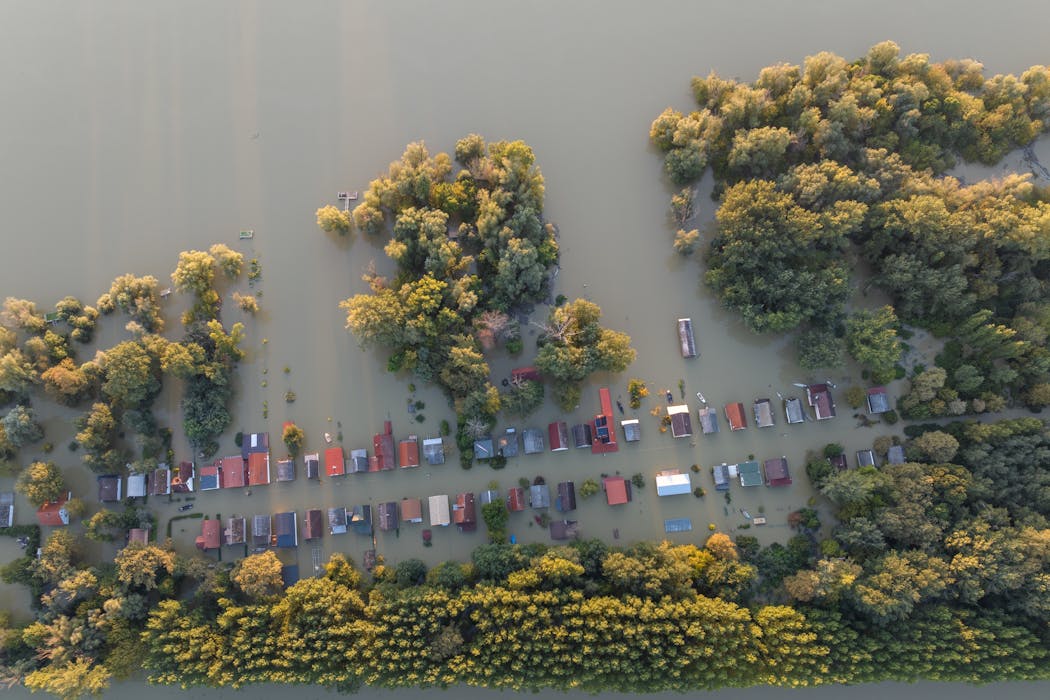
Rising floodwaters near the River Danube in 2024. My StockPhotos/Shutterstock

Temperatures across Europe are rising at twice the global average. This alarming trend is leading to more frequent and intense heatwaves, droughts, floods and storms.

But climate change isn’t just about extreme weather. It damages ecosystems, infrastructure and economies, plus people’s resilience and prosperity, meaning the European way of life is at risk.

The latest information from the European Environment Agency shows that while progress is being made, the state of the environment is deteriorating. Europe is the fastest warming continent and major economic and social losses from climate-related events are mounting – with more than €738 billion (£643 billion) in losses from 1980-2023, and over €162 billion from the last three years.

Adaptation (action required for societies to adjust to the adverse effects of climate changes) is needed but lagging behind the escalating risk due to inconsistent and under-resourced approaches. As a result, ecosystem and societal resilience are undermined.

Healthy ecosystems underpin sustainable living by ensuring food and water security, and providing essential goods and services.

For people living in Europe, the effects are already visible and personal. People are increasingly exposed to disease, pollution, and even premature death due to extreme weather. Homes and communities face destruction. In 2025, extreme weather has included extensive floods in Valencia, Spain, and wildfires raging across Turkey, Portugal, Cyprus, France and Spain.


Read more:
Three ways to reduce Europe’s flood risk


Public services – such as health services and early responders, like the fire service – come under pressure. Daily life becomes more uncertain. More than 464,000 people across Europe are already experiencing the trauma of forced displacement, due to floods, wildfires and storms.

Currently, these are internal displacements, meaning they have not crossed borders into other countries. But this extreme weather is now occurring more frequently, so the risk of wider displacement is rising.

Storm Amy hit the UK in early October. It brought down many trees and cut thousands of people off from power for days, disrupting train travel and leaving many homes without internet access – cutting off a lifeline for many. Scotland was particularly affected, with Scottish and Southern Electricity Networks having to restore power to over 86,000 properties.

roof damage on block of flats
Storm Amy brought in high winds and rain throughout Scotland.
Euan Cherry/Shutterstock

These disruptions do not just take a physical toll. They bring significant financial and emotional stress. Families, businesses and entire communities are shouldering growing economic burdens from climate-related damages.

There is a growing sense of stress and anxiety tied to the uncertainty and inevitability of climate-induced extreme weather. The emotional strain only deepens when particularly vulnerable communities are faced with the aftermath, such as villages in Spain and Portugal, where wildfires tore through forests, homes and businesses.

With extreme weather being predicted more frequently, it is distressing and frightening to rebuild when resilience has already been lowered by damage.

Political shifts across Europe are adding pressure to an already fragile situation. Progress is jeopardised by a rollback of green policies, denial of climate science, and a return to polluting practices such as the EU’s delayed launch of its anti-deforestation reporting law for the second time, meaning forests continue to be in threat of destruction to produce goods and commodities such as palm oil, soy and beef. As these setbacks mount, climate anxiety grows, and our ability to meet climate goals drifts further out of reach.

A more prosperous path

Failing to act now will lead to higher costs down the line and deepen existing inequalities. On the other hand, strengthening green policies and sustainable practices offers a path to a healthier, fairer and more prosperous future. The cost of inaction far outweighs the costs associated with acting now.

Some parts of Europe are building resilience by focusing on clean energy, building a more circular economy and protecting natural assets such as forests and rivers.

Schemes such as the €4.2 billion fund to support 77 decarbonisation projects as part of the EUs clean energy transition should help to reduce emissions by 2050. Plus, there are plans to protect and properly manage natural environments such as peatlands, which are excellent carbon stores.

Despite challenges, such as the future of political agendas and willingness to engage in the green agenda, there is reason for optimism. The EU has already cut greenhouse gas emissions by 37% since 1990, proving that meaningful change is possible. Europe has emerged as a global leader in climate action, and with continued effort, it can stay on course to meet ambitious green goals to reach net zero by 2050.

But success requires everyone, governments, businesses and communities, to work together. By uniting social, political and environmental efforts, we can still secure a liveable, thriving planet for future generations.


Don’t have time to read about climate change as much as you’d like?

Get a weekly roundup in your inbox instead. Every Wednesday, The Conversation’s environment editor writes Imagine, a short email that goes a little deeper into just one climate issue. Join the 45,000+ readers who’ve subscribed so far.


The Conversation

Rosemary Anthony does not work for, consult, own shares in or receive funding from any company or organisation that would benefit from this article, and has disclosed no relevant affiliations beyond their academic appointment.

ref. Europe’s climate is changing fast – here’s how it’s affecting people and the economy – https://theconversation.com/europes-climate-is-changing-fast-heres-how-its-affecting-people-and-the-economy-266399

Misunderstanding the tide is putting millions at risk on UK coasts – here’s what you need to know

Source: The Conversation – UK – By Martin Austin, Senior Lecturer in Coastal Dynamics, Bangor University

Imagine you’re walking along a beach, talking to your friend, enjoying the sunshine. Time goes by and it’s time to head back. But as you approach the headland you had walked around previously, you realise that’s not possible anymore: the tide has come in and there is no path around it now. You’re trapped in a bay with the tide continuing to submerge the beach.

The scary, and sometimes life-threatening, experience of being cut off by the tide is not as rare as you might think. Our survey found that millions of people – 15% of the UK public – have been cut off by the tide (or nearly so) at least once.

Often there is a simple enough solution, such as climbing up a hill or getting your feet wet. But sometimes there is no easy way out, and the danger increases quickly as the water level rises fast.

That’s when it is essential to call for help. Since 2020, tidal cut-offs in the British Isles have resulted in around 3,600 Royal National Lifeboat Institution (RNLI) lifeboat and lifeguard rescues, with some 35,500 people being assisted.

This high frequency of tidal cut-offs tells us that getting into danger is not down to exceptional misfortune or, as some might think, people’s own stupidity. It is much too common for that. Our survey shows there are systematic reasons – in particular, misconceptions about how the tide works – that regularly lead to people getting into difficulty.

The tide is principally driven by the gravitational pull of the Moon and Sun. But because their positions relative to the Earth are always changing, and the coastal geography varies, tidal movements are more complex than most people realise.

The gravitational pull of the Moon is strongest during full and new Moons. This leads to larger tides every two weeks, known as spring tides. The Sun has a stronger effect when it is closest to the equator, so tidal changes near the spring and autumn equinoxes are greater.

The timing and height of tides therefore vary widely in both time and space. When school holidays coincide with large spring tides, the risk of incidents increases.

Tidal literacy

To avoid getting cut off by the tide, be aware of what the water is doing – even if you don’t intend to go swimming. In our study, 60% of those cut off were never intending to enter the water. They were simply engaging in activities on the shore such as walking, rockpooling, dog walking and fishing.

Four in ten people in our survey were unaware that tides come in twice daily, that they vary in timing each day, and that they differ in height across the country. So, even if you’ve seen and understood the effects of tidal movement in one place, you won’t automatically know how it works elsewhere and at a different time.

Despite this variation, tides can be predicted accurately and tide tables are publicly available online which show tidal movements in different locations. Every time you visit the coast, choose a website you trust and understand, and work out what the tide will be doing when.

This useful habit requires some practice. Over a quarter of our survey respondents struggled with basic tide-table reading, and only a quarter could extract more complex information – such as when to safely return from a walk to an island that is cut off from land at high tide.

Many people overestimate their ability. So, don’t just rely on your own knowledge – if you’re visiting a place for the first time, ask the locals, coastguards or RNLI about any specific dangers.

In some places such as sand or mudflats, the tide can come in faster than you can run – especially if it comes in behind you, cutting you off from the safe shore. The word “flat” is very misleading, as these areas are usually scattered with deceptive channels and creeks.

Our survey revealed that many people believe the tide comes in slowly, consistently and directly toward the shore, and this is what can easily result in dangerous situations. In reality, the water uses the uneven surface to advance from various directions, and can unexpectedly and very rapidly cut off sandbanks from behind.

As you walk around headlands, cross a causeway or head out on to sand flats, always make sure there is an escape route should the tide behave in unexpected ways. Stay alert: being distracted frequently leads to being cut off, according to our survey participants.

Efforts are underway to restore society’s relationship with the sea, including via the worldwide ocean literacy agenda. Wales is the first country to include “safe access” in its national ocean literacy strategy. Hopefully, other countries will follow suit.

By highlighting the extent of misconceptions around tides for the first time, the insights from our survey suggest that ocean literacy should include understanding of tides. This will enable safe and enjoyable access to coasts, nurturing positive relationships and behaviour that support the planet’s health.


Swimming, sailing, even just building a sandcastle – the ocean benefits our physical and mental wellbeing. Curious about how a strong coastal connection helps drive marine conservation, scientists are diving in to investigate the power of blue health.

This article is part of a series, Vitamin Sea, exploring how the ocean can be enhanced by our interaction with it.


The Conversation

Martin Austin receives funding from the NERC and EPSRC.

Elisabeth S. Morris-Webb receives funding from The Research Council of Norway

Thora Tenbrink receives funding from the AHRC and ESRC. She is a co-director of the community enterprise Together for Change.

ref. Misunderstanding the tide is putting millions at risk on UK coasts – here’s what you need to know – https://theconversation.com/misunderstanding-the-tide-is-putting-millions-at-risk-on-uk-coasts-heres-what-you-need-to-know-265037

Why The Traitors is still a masterclass in the psychology of human deception

Source: The Conversation – UK – By Paul Jones, Associate Dean for Education and Student Experience at Aston Business School, Aston University

The Traitors might sound like another reality TV gimmick. But look closer, and you’ll find a psychological pressure cooker where deception, trust and paranoia are all on view.

Contestants live together in a Scottish castle. A few are secretly chosen as Traitors, tasked with “murdering” their fellow players while avoiding suspicion. The rest are “Faithfuls”, trying to banish the Traitors before it’s too late.

With no evidence, alliances are fragile and instinct becomes weaponised. Let’s unpack the psychology driving every twist, accusation, and betrayal.

At the heart of The Traitors is theory of mind. This is our ability to guess what others are thinking. In normal life, it helps us empathise. In the castle, it fuels suspicion.

Players spiral through layers of paranoid thinking: “Does she know I suspect her?” It’s mentally exhausting. Stress impairs our judgement. We misread silence, mistake nerves for guilt, and project our fears.

Alyssa (who featured in the first series) was banished simply for being quiet. Her calmness was seen as coldness, and that was enough to say goodbye, despite the fact that she was a Faithful, not a Traitor.

Lying is mentally taxing. Suppressing the truth, inventing a story, managing facial expressions, it all increases our cognitive load. Under pressure, even skilled liars show cracks: pauses, micro-expressions (brief, involuntary facial expressions that reveal a person’s true emotions) and anxiety.

But here’s the twist, truth-tellers look just as twitchy. Psychologist Paul Ekman called this the “Othello error”: mistaking fear for deceit. Series 2’s Paul played a cool, calculated game, manipulating perception with emotional detachment. The group couldn’t keep up.

The roundtable is where logic crumbles. Once a few confident voices point fingers, others fall in line. This is known as groupthink, and it is where the drive for agreement overrides critical thinking.

Add confirmation bias, which is where we see what we expect, and things escalate fast. In Series 2, contestant Kyra was banished after one comment was misread. No one challenged it. Bye Kyra. Often, they don’t just get it wrong, they agree on getting it wrong.

The problem with ‘vibes’

When facts fail, instinct fills the gap. But “weird vibes” are shaped by in-group bias. We can’t help but trust those who seem like us.

Players who don’t match the group’s emotional script – those who are too
quiet, too blunt, too intense – become scapegoats. In contrast, Traitors who mirror emotions survive. Wilf (Series 1) played this to perfection: loyal friend on the outside, silent assassin within.

Traitors don’t see themselves as villains. They rationalise: “It’s just a game.” By rewriting the story, their cognitive dissonance (the discomfort of acting against their values) is soothed away.

Faithfuls do it too. When they wrongly banish someone, they convince themselves the signs were there. It’s not evil. It’s self-preservation. Few people enjoy the tension of contrasting values and actions.

In the absence of truth, perception rules. Every laugh, pause or raised eyebrow becomes part of the performance.

Sociologist Erving Goffman called this “impression management”. On The Traitors, it’s survival. Too passive? You’re hiding something. Too assertive? You’re manipulative.

The goal is to appear confident, sincere and harmless. Even silence is strategic, but dangerous if misread.

We watch The Traitors knowing more than the players, and yet we still get it wrong. It flatters our instincts, then flips them. We shout at the screen and we fall for the same tricks.

It reflects our real lives: teams, friendships, group chats. We all manage impressions. We all judge others. And under pressure, we all rewrite reality to stay safe. The real twist? The psychological traps of The Traitors aren’t locked in a castle. They’re everywhere.

The Conversation

Paul Jones does not work for, consult, own shares in or receive funding from any company or organisation that would benefit from this article, and has disclosed no relevant affiliations beyond their academic appointment.

ref. Why The Traitors is still a masterclass in the psychology of human deception – https://theconversation.com/why-the-traitors-is-still-a-masterclass-in-the-psychology-of-human-deception-267750

Baseball returns to a Japanese American detention camp after a historic ball field was restored

Source: The Conversation – USA (2) – By Susan H. Kamei, Adjunct Professor of History and Affiliated Faculty, USC Shinso Ito Center for Japanese Religions and Cultures, USC Dornsife College of Letters, Arts and Sciences

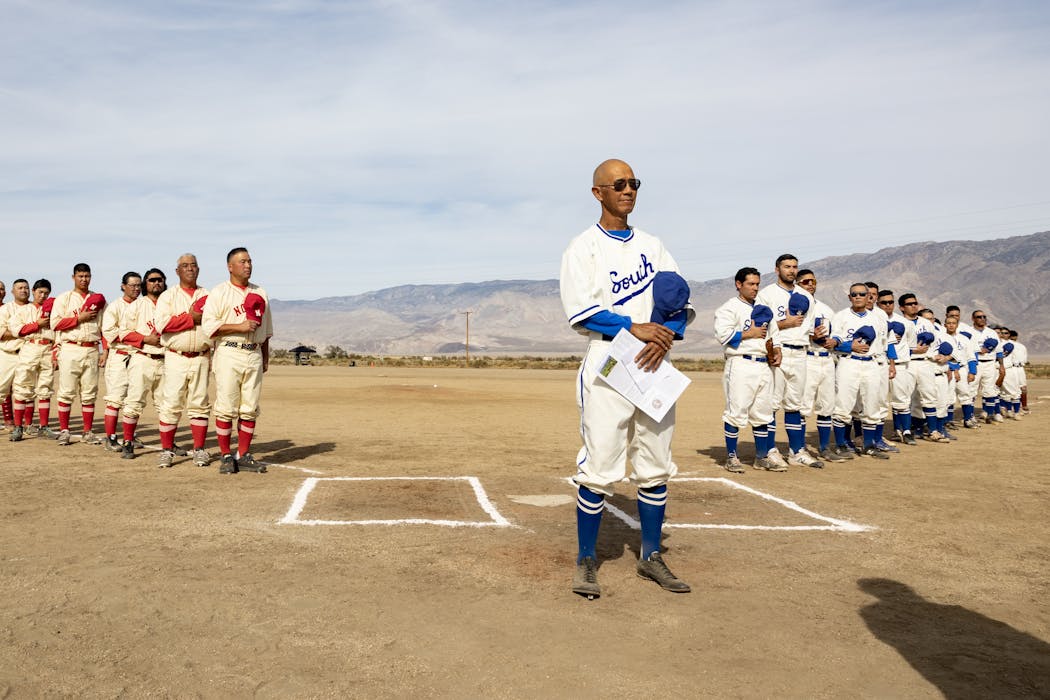
In a 2024 exhibition game at Manzanar, players – many of them descendants of internment camp detainees – donned custom 1940s-style uniforms. Aaron Rapoport, CC BY-SA

In the spring of 1942, 15-year-old Momo Nagano needed a way to fill her time.

She was imprisoned at the Manzanar Relocation Center along with approximately 10,000 other people of Japanese ancestry. When she’d arrived with her mother and two brothers, she’d been horrified.

The detention facility was located in the middle of the desert, about 225 miles northeast of Los Angeles. As I describe in my book “When Can We Go Back to America? Voices of Japanese American Incarceration during World War II,” barbed wire surrounded the perimeter and armed soldiers peered down from guard towers. The toilets and showers lacked partitions, and Nagano was forced to stand in long lines for hours in mess halls that served canned food. Her bed was a metal cot. She was directed to stuff straw into a bag for a makeshift mattress. She didn’t know whether she and her family would ever be able to return to their Los Angeles home.

Black and white photo of Asian female teenager smiling and wearing a blouse.
Momo Nagano, in a photograph taken during her time spent at the Manzanar Relocation Center.
Courtesy of Dan Kwong, CC BY-SA

One day, the teenager decided to pick up a glove and play softball. Her son, Dan Kwong, told me in an interview that Nagano ended up playing catcher for The Gremlins, one of the camp’s many women’s softball teams.

“In one game, a batter connected with the ball and then threw the bat, clocking my mom in the nose, breaking it,” he said. “But despite her injury, she still enjoyed playing, even though she didn’t think her team was very good.”

Eighty years later, the descendants of prisoners – such as Nagano’s son, Kwong – are playing baseball again in Manzanar. Thanks to an effort spearheaded by Kwong, a baseball field on the site has been restored as a way to both celebrate the resiliency of so many prisoners and memorialize this dark period in U.S. history.

A massive removal effort

After Japan attacked Pearl Harbor in 1941, the U.S. government wrongly assumed that Japanese-descended West Coast residents would be more loyal to Japan and presented an espionage risk.

So on Feb. 19, 1942, President Franklin D. Roosevelt issued an executive order that gave the U.S. Army the authority to forcibly remove all first-generation immigrants from Japan and their American-born descendants from their West Coast homes.

In March 1942, U.S. soldiers began transporting the detainees to temporary detention sites under Army jurisdiction. The Manzanar site opened on March 21, 1942, and it eventually became one of 10 long-term detention centers, colloquially known as “the camps.”

According to Duncan Ryȗken Williams, the director of The Irei Project, which has compiled the most comprehensive list of those detained, nearly 127,000 people of Japanese ancestry were incarcerated between 1942 and 1947, when the last camp closed. Two-thirds of them were American citizens. Most were imprisoned for the duration of the war, and all were held without hearings or charges leveled against them.

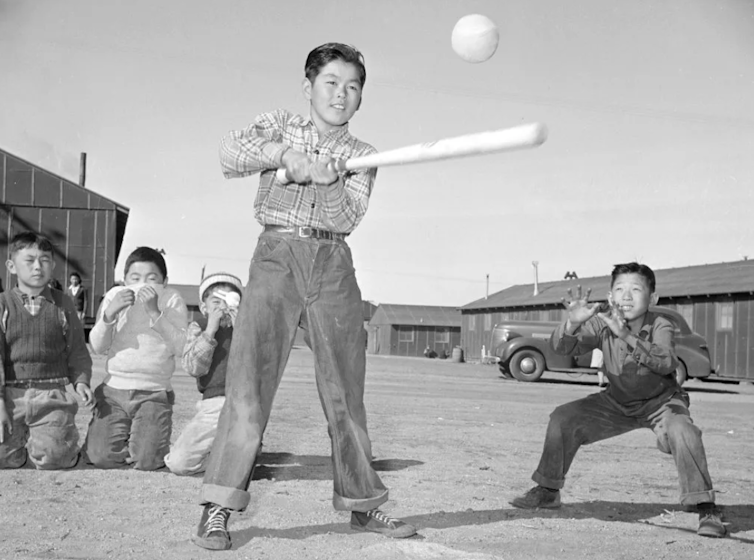
An Asian American boy swings a baseball bat at an approach ball as other boys watch in the background.
Sixth-grade boys play softball during recess at the Manzanar Relocation Center on Feb. 10, 1943.
Francis Leroy Stewart, courtesy of California State University Dominguez Hills Gerth Archives & Special Collections

A love of the game

Adjusting to their new grim reality, the detainees embraced the Japanese spirit of “gaman,” which means to endure hardship with dignity and resilience. They set up an education system and coordinated an array of activities. And they immediately organized baseball and softball games.

Many Japanese American families had already developed a passion for the two sports.

Horace Wilson, an educator from Maine, is credited with introducing baseball to Japan in the early 1870s. In 1872 the Yeddo Royal Japanese Troupe became the first Japanese people to play baseball on U.S. soil. When young Japanese men started immigrating to the U.S. in the late 19th century, they brought with them a love of America’s pastime.

Kerry Yo Nakagawa, the director of the Nisei Baseball Research Project, has written about the vanguards of Japanese American baseball. At a time when players of color were excluded from Major League Baseball, talented Japanese American ballplayers such as Kenichi Zenimura formed teams that barnstormed the country. They even played alongside Babe Ruth and Lou Gehrig in an exhibition game in Fresno, Calif., on Oct. 29, 1927.

A black and white photograph of six baseball players – four Asian Americans and two white Americans – posing on a diamond while wearing baseball uniforms.
Lou Gehrig, second from left, and Babe Ruth, third from right, pose with Japanese American ballplayers at an exhibition game. Kenichi Zenimura is third from left.
Frank Kamiyama, courtesy of the family of Taizo Toshiyuki and the Nisei Baseball Research Project

“Every pre-war Japanese American community had a baseball team and they brought their love of baseball with them to the assembly centers and their camps,” Nakagawa explained to me. Though Zenimura was forced to leave his Fresno home and go to a camp in Gila River, Arizona, he soon had a baseball diamond and a 32-team league up and running.

Patriotism on the diamond

At Manzanar, baseball was easily the most popular sport. According to Dave Goto, the Manzanar National Historic Site arborist, the camp had 10 baseball and softball diamonds on the grounds and more than 120 teams divided into 12 leagues. The camp newspaper, the Manzanar Free Press, provided detailed game recaps, and thousands turned out to watch the games at Manzanar’s “A” Field.

“Watching baseball played at a semi-pro level was entertainment and also gave them a sense of normalcy and community,” Nakagawa said.

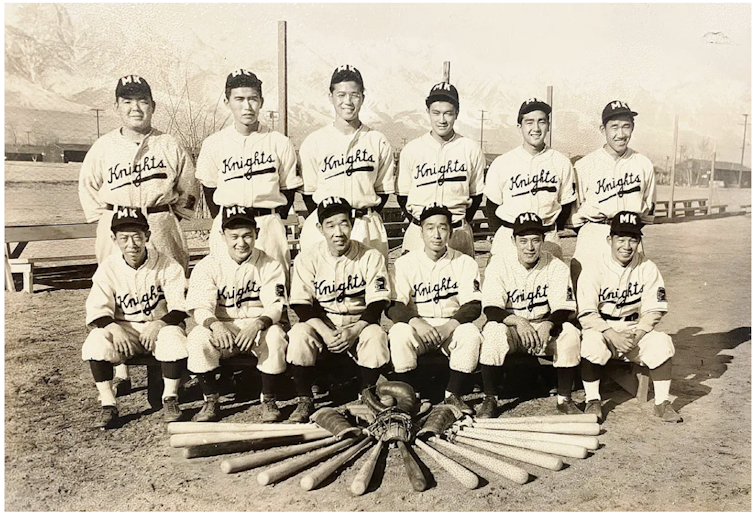
Sepia toned photograph of Japanese Americans wearing baseball uniforms and posing for a team picture.
The ManzaKnights were one of the 100-plus teams formed at the Manzanar camp.
Courtesy of the Maruki Family/Manzanar Historic Site

But for those who felt their loyalty to the U.S. was unfairly questioned, baseball was also a powerful way to express their identity as Americans, especially for the U.S.-born children of Japanese immigrants. Takeo Suo, who was incarcerated at Manazarer, recalled, “Putting on a baseball uniform was like wearing the American flag.” Or, as Nakagawa put it,
“What could be more American than playing the all-American pastime?”

After the war was over and the camps closed, those who’d been imprisoned had to focus on rebuilding their lives. Many were unable to return to their prewar hometowns. For those who ended up back on the West Coast, baseball continued to play an important role.

As Japanese American journalist and sports historian Chris Komai explained in a program at the Japanese American National Museum, “Baseball was a way for them to reestablish their communities while they dealt with antagonism and discrimination. Through the games they stayed connected with their friends and relatives who were now scattered.”

Postwar community baseball gave rise to the Southern California Nisei Athletic Union Baseball Leagues and other leagues that still operate. Kwong began playing for the Nisei Athletic Union in 1971 and does so to this day.

Rebuilding a dusty field of dreams

Nagano instilled in her son a commitment not only to baseball but also to social justice. A performance artist, Kwong stages a one-man play, “Return of the Samurai Centerfielder,” to shed light on this episode in history through the lens of playing baseball at Manzanar. Two years ago, he set out to restore the main Manzanar ball field and to bring baseball back to the site as a tribute to his late mother and other Manzanar detainees.

Working with Goto, the site arborist, volunteer construction supervisor Chris Siddons, Manzanar archaeologist Jeff Burton and other Manzanar site staff, Kwong and his team have restored the field almost exactly as it was. They carefully scrutinized archival photos, some taken by famed landscape photographer Ansel Adams and others snapped by studio photographer Toyo Miyatake, who’d been imprisoned at Manzanar. Miyatake’s photos were provided by his grandson, Alan Miyatake.

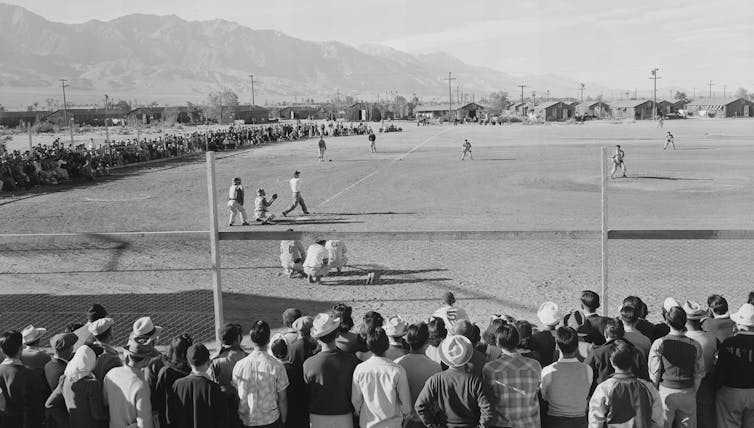
Crowds of onlookers watch a baseball game on a dusty field.
Organizers used archival materials – such as this 1943 Ansel Adams photograph of a baseball game at the Manzanar camp – to restore the field.
Ansel Adams/Library of Congress

From November 2023 to October 2024, volunteers cleared sagebrush, dug post holes and poured concrete, enduring intense heat, strong winds and relentless dust.

On Oct. 26, 2024, baseball returned to Manzanar after more than 80 years before an invitation-only audience. In the inaugural game, Kwong’s Li’l Tokio Giants beat the Lodi JACL Templars. In the game that followed, players donned custom 1940s-style uniforms and used vintage baseball equipment lent by History For Hire prop house. Many of the players were descendants of Japanese Americans who’d been incarcerated at Manzanar and other camps.

That day, Kwong was emotional as he said, “Mom would have gotten such a kick out of this.”

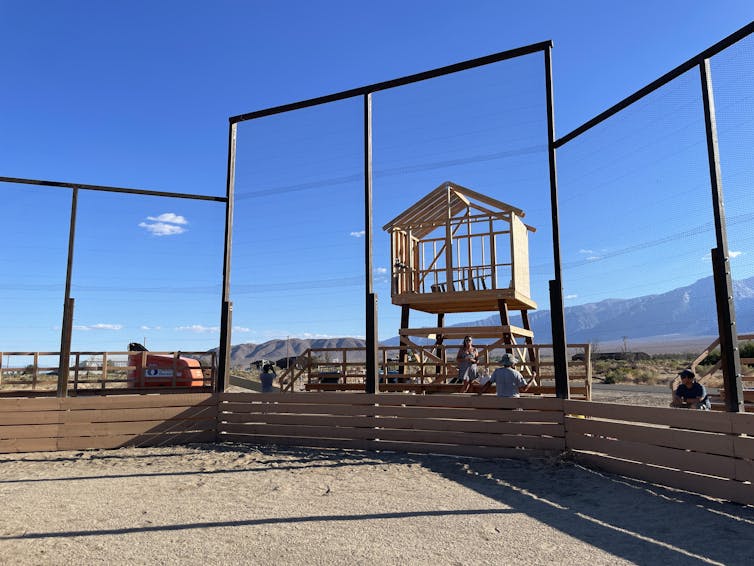
Kwong’s team has completed an announcer’s booth in time for this year’s grand opening, a doubleheader open to the public. The games were originally scheduled for Oct. 18, 2025, but have been postponed due to the U.S. government shutdown.

A wood-framed, enclosed booth on wooden legs behind a baseball field backstop.
The new announcer’s booth under construction at the restored Manzanar ball field.
Dan Kwong, CC BY-SA

For Kwong, staging a historical reenactment of how detainees played ball behind barbed wire pays tribute to their resilience, connects camp survivors and descendants with their past, and allows them to share their story with the American public. He hopes the games can become an annual event, a recurring celebration.

His motto: “In this place of sadness, injustice, and pain, we will do something joyous, righteous, and healing. We will play baseball.”

The Conversation

Susan H. Kamei is a researcher with The Irei Project and is a member of the Japanese American National Museum.

ref. Baseball returns to a Japanese American detention camp after a historic ball field was restored – https://theconversation.com/baseball-returns-to-a-japanese-american-detention-camp-after-a-historic-ball-field-was-restored-265954

AI-generated lesson plans fall short on inspiring students and promoting critical thinking

Source: The Conversation – USA (2) – By Torrey Trust, Professor of Learning Technology, UMass Amherst

When teachers rely on commonly used artificial intelligence chatbots to devise lesson plans, it does not result in more engaging, immersive or effective learning experiences compared with existing techniques, we found in our recent study. The AI-generated civics lesson plans we analyzed also left out opportunities for students to explore the stories and experiences of traditionally marginalized people.

The allure of generative AI as a teaching aid has caught the attention of educators. A Gallup survey from September 2025 found that 60% of K-12 teachers are already using AI in their work, with the most common reported use being teaching preparation and lesson planning.

Without the assistance of AI, teachers might spend hours every week crafting lessons for their students. With AI, time-stretched teachers can generate detailed lesson plans featuring learning objectives, materials, activities, assessments, extension activities and homework tasks in a matter of seconds.

However, generative AI tools such as ChatGPT, Gemini and Copilot were not originally built with educators in mind. Instead, these tools were trained on huge amounts of text and media drawn largely from across the internet and then launched as general-purpose chatbots.

As we started using these tools in our practice as educators, we noticed they often produced instructional materials and lessons that echoed the “recite and recall” model of traditional schooling. This model can be effective for memorizing basic facts, but it often fails to engage students in the active learning required to become informed citizens. We wondered whether teachers should be using these general-purpose chatbots to prepare for class.

For our research, we began collecting and analyzing AI-generated lesson plans to get a sense of what kinds of instructional plans and materials these tools provide to teachers. We decided to focus on AI-generated lesson plans for civics education because it is essential for students to learn productive ways to participate in the U.S. political system and engage with their communities.

To collect data for this study, in August 2024 we prompted three GenAI chatbots – the GPT-4o model of ChatGPT, Google’s Gemini 1.5 Flash model and Microft’s latest Copilot model – to generate two sets of lesson plans for eighth grade civics classes based on Massachusetts state standards. One was a standard lesson plan and the other a highly interactive lesson plan.

We garnered a dataset of 311 AI-generated lesson plans, featuring a total of 2,230 activities for civic education. We analyzed the dataset using two frameworks designed to assess educational material: Bloom’s taxonomy and Banks’ four levels of integration of multicultural content.

Bloom’s taxonomy is a widely used educational framework that distinguishes between “lower-order” thinking skills, including remembering, understanding and applying, and “higher-order” thinking skills – analyzing, evaluating and creating. Using this framework to analyze the data, we found 90% of the activities promoted only a basic level of thinking for students. Students were encouraged to learn civics through memorizing, reciting, summarizing and applying information, rather than through analyzing and evaluating information, investigating civic issues or engaging in civic action projects.

When examining the lesson plans using Banks’ four levels of integration of multicultural content model, which was developed in the 1990s, we found that the AI-generated civics lessons featured a rather narrow view of history – often leaving out the experiences of women, Black Americans, Latinos and Latinas, Asian and Pacific Islanders, disabled individuals and other groups that have long been overlooked. Only 6% of the lessons included multicultural content. These lessons also tended to focus on heroes and holidays rather than deeper explorations of understanding civics through multiple perspectives.

Overall, we found the AI-generated lesson plans to be decidedly boring, traditional and uninspiring. If civics teachers used these AI-generated lesson plans as is, students would miss out on active, engaged learning opportunities to build their understanding of democracy and what it means to be a citizen.

Why it matters

Teachers can try to customize lesson plans to their situation through prompts, but ultimately generative AI tools do not consider any actual students or real classroom settings the way a teacher can.

Although designed to seem as if they understand users and be in dialogue with them, from a technical perspective chatbots such as ChatGPT, Gemini and Copilot are machines that predict the next word in a sequence based on massive amounts of ingested text.

When teachers choose to use these tools while preparing to teach, they risk relying on technology not designed to enhance, aid or improve teaching and learning. Instead, we see these tools producing step-by-step, one-size-fits-all solutions, when what’s needed in education is the opposite – flexibility, personalization and student-centered learning.

What’s next

While our study revealed that AI-generated lesson plans are lacking in many areas, this does not mean that teachers should not use these tools to prepare for class. A teacher could use generative AI technologies to advance their thinking. In the AI-generated lesson plans we analyzed, there were occasional interesting activities and stimulating ideas, especially within the homework suggestions. We would recommend that teachers use these tools to augment their lesson-planning process rather than automate it.

By understanding AI tools cannot think or understand context, teachers can change the way they interact with these tools. Rather than writing simple, short requests – “Design a lesson plan for the Constitutional Convention” – they could write detailed prompts that include contextual information, along with proven frameworks, models and teaching methods. A better prompt would be: “Design a lesson plan for the Constitutional Convention for 8th grade students in Massachusetts that features at least three activities at the evaluate or create level of Bloom’s Taxonomy. Make sure to incorporate hidden histories and untold stories as well as civic engagement activities at the social action level of Banks’ four levels of integration of multicultural content model.”

Our study emphasizes the need for teachers to be critical users, rather than quick adopters, of AI-generated lessons. AI is not an all-in-one solution designed to address the needs of teachers and students. Ultimately, more research and teacher professional development opportunities are needed to explore whether or how AI might improve teaching and learning.

The Conversation

The authors do not work for, consult, own shares in or receive funding from any company or organization that would benefit from this article, and have disclosed no relevant affiliations beyond their academic appointment.

ref. AI-generated lesson plans fall short on inspiring students and promoting critical thinking – https://theconversation.com/ai-generated-lesson-plans-fall-short-on-inspiring-students-and-promoting-critical-thinking-265355

Trump administration’s layoffs would gut department overseeing special education, eliminating parents’ last resort

Source: The Conversation – USA (2) – By Joshua Cowen, Professor of Education Policy, Michigan State University

A sign marks the outside of the Department of Education headquarters in Washington, D.C. J. David Ake/Getty Images

A federal judge on Oct. 16, 2025, paused the Trump administration’s latest round of layoffs, which targeted more than 4,000 federal workers at a range of agencies, including 466 workers at the Department of Education.

U.S. District Judge Susan Illston said that the administration’s layoffs, which it has justified because of a lapse of funding during the government shutdown, are “both illegal and in excess of authority” and called them “arbitrary and capricious.” The Trump administration is expected to appeal the judge’s decision.

The Trump administration first eliminated about half of the Department of Education’s more than 4,200 positions in March 2025. This latest round of cuts would eliminate almost all of the work of the remaining Department of Education offices, including that of the Office of Special Education Programs. OSEP is responsible for ensuring children with disabilities across the U.S. receive a free, appropriate public education, as required by federal law.

Amy Lieberman, the education editor at The Conversation U.S., spoke with Josh Cowen, a scholar of education policy, to understand how these cuts would hinder the educational opportunities for children with special needs.

A large group of people hold yellow signs in front of a building. Some of the signs say
People rally in front of the Department of Education to protest budget cuts on March 13, 2025.
Kayla Bartkowski/Getty Images

What would these cuts mean for parents, children and schools?

With these cuts, we are talking about getting rid of some really important positions. People in these roles serve kids and families across the country. They help them answer questions about how school districts are providing for their children, in the way they are legally required to, if their child has special needs.

Special education is a very broad category. Under the Department of Education, it encompasses everything from dyslexia to a child who is blind. There is no educational need so severe that a child is not entitled to free and adequate education.

When navigating challenges related to your child’s special needs education, you really need an advocate – in the legal sense of the term rather than the political one. You need someone whose job it is to take your call and walk you through options, or just document your call and start an inquiry into your case.

What does the Office of Special Education Programs do?

The Office of Special Education Programs is part of the Department of Education’s Office of Special Education and Rehabilitative Services, which has about 179 employees. The government spent more than US$20 billion on its work from April 2024 through March 2025, making the broader Office of Special Education and Rehabilitation Services the third-largest branch of the Education Department, in terms of spending.

There are very strong federal legal obligations – and often state ones, too – for schools to serve kids with whatever need they have. This office’s main job is to be a resource to parents for their child’s education, particularly if parents feel they are not having these legal obligations met.

Let’s say a child with autism is in school. Their parent does not believe the school district is providing the accommodations that their child is legally entitled to. The school district disagrees and thinks the child is doing well in school. When things get fuzzy about what a child’s needs actually are, or parents feel they are being ignored, OSEP can help parents learn what their options are, and then can even become involved and serve as an arbitrator to figure out the best course of action.

Sometimes, public school districts and state departments of education have very clear, accessible ways for parents to receive information about their rights and obtain instructions for putting together an individualized education plan for their child. If those rights are not met, states may open an investigation into the matter to ensure compliance.

Throughout this process, parents may seek support and guidance from OSEP to make sure state investigations into special education cases are being done and being done well.

What could these investigations result in?

The Department of Education can help hold states and districts accountable and push districts and schools to be more responsive. In the best-case scenario, additional or tailored programming and support – whether it is a teacher’s aide or something else – can come from an OSEP investigation.

An older white woman wears a cream suit and sits at a table, with two men on either side of her.
U.S. Secretary of Education Linda McMahon, center, speaks during a cabinet meeting at the White House on Aug. 26, 2025.
Mandel Ngan/AFP via Getty Images

What does your research show about the impact of cutting services like these?

Well, we don’t really know what happens when you gut OSEP because no one has tried to gut OSEP before.

But it’s safe to say that parents will get really frustrated. I have been contacted by parents who have shared heartbreaking examples of the special education system not working over the past couple of years.

Feeling like the education system is really not serving you can push parents to leave the public school system and consider homeschooling or private options. In the long run, this may actually make parents even worse off because those sectors have have no obligation at all to serve students with special needs. So what’s happening at the U.S. Department of Education right now is not only creating more dissatisfaction and distrust in the system as it stands, but it’s also going to leave parents and kids with fewer options to get the support they need.

The Conversation

Josh Cowen ran for Congress as a Democrat prior to ending his campaign and returning to research and teaching during the fall of 2025.

ref. Trump administration’s layoffs would gut department overseeing special education, eliminating parents’ last resort – https://theconversation.com/trump-administrations-layoffs-would-gut-department-overseeing-special-education-eliminating-parents-last-resort-267684

Baseball returns to a Japanese American detention camp after a historic ball field was restored to honor the resilience of those incarcerated

Source: The Conversation – USA (2) – By Susan H. Kamei, Adjunct Professor of History and Affiliated Faculty, USC Shinso Ito Center for Japanese Religions and Cultures, USC Dornsife College of Letters, Arts and Sciences

In a 2024 exhibition game at Manzanar, players – many of them descendants of internment camp detainees – donned custom 1940s-style uniforms. Aaron Rapoport, CC BY-SA

In the spring of 1942, 15-year-old Momo Nagano needed a way to fill her time.

She was imprisoned at the Manzanar Relocation Center along with approximately 10,000 other people of Japanese ancestry. When she’d arrived with her mother and two brothers, she’d been horrified.

The detention facility was located in the middle of the desert, about 225 miles northeast of Los Angeles. As I describe in my book “When Can We Go Back to America? Voices of Japanese American Incarceration during World War II,” barbed wire surrounded the perimeter and armed soldiers peered down from guard towers. The toilets and showers lacked partitions, and Nagano was forced to stand in long lines for hours in mess halls that served canned food. Her bed was a metal cot. She was directed to stuff straw into a bag for a makeshift mattress. She didn’t know whether she and her family would ever be able to return to their Los Angeles home.

Black and white photo of Asian female teenager smiling and wearing a blouse.
Momo Nagano, in a photograph taken during her time spent at the Manzanar Relocation Center.
Courtesy of Dan Kwong, CC BY-SA

One day, the teenager decided to pick up a glove and play softball. Her son, Dan Kwong, told me in an interview that Nagano ended up playing catcher for The Gremlins, one of the camp’s many women’s softball teams.

“In one game, a batter connected with the ball and then threw the bat, clocking my mom in the nose, breaking it,” he said. “But despite her injury, she still enjoyed playing, even though she didn’t think her team was very good.”

Eighty years later, the descendants of prisoners – such as Nagano’s son, Kwong – are playing baseball again in Manzanar. Thanks to an effort spearheaded by Kwong, a baseball field on the site has been restored as a way to both celebrate the resiliency of so many prisoners and memorialize this dark period in U.S. history.

A massive removal effort

After Japan attacked Pearl Harbor in 1941, the U.S. government wrongly assumed that Japanese-descended West Coast residents would be more loyal to Japan and presented an espionage risk.

So on Feb. 19, 1942, President Franklin D. Roosevelt issued an executive order that gave the U.S. Army the authority to forcibly remove all first-generation immigrants from Japan and their American-born descendants from their West Coast homes.

In March 1942, U.S. soldiers began transporting the detainees to temporary detention sites under Army jurisdiction. The Manzanar site opened on March 21, 1942, and it eventually became one of 10 long-term detention centers, colloquially known as “the camps.”

According to Duncan Ryȗken Williams, the director of The Irei Project, which has compiled the most comprehensive list of those detained, nearly 127,000 people of Japanese ancestry were incarcerated between 1942 and 1947, when the last camp closed. Two-thirds of them were American citizens. Most were imprisoned for the duration of the war, and all were held without hearings or charges leveled against them.

An Asian American boy swings a baseball bat at an approach ball as other boys watch in the background.
Sixth-grade boys play softball during recess at the Manzanar Relocation Center on Feb. 10, 1943.
Francis Leroy Stewart, courtesy of California State University Dominguez Hills Gerth Archives & Special Collections

A love of the game

Adjusting to their new grim reality, the detainees embraced the Japanese spirit of “gaman,” which means to endure hardship with dignity and resilience. They set up an education system and coordinated an array of activities. And they immediately organized baseball and softball games.

Many Japanese American families had already developed a passion for the two sports.

Horace Wilson, an educator from Maine, is credited with introducing baseball to Japan in the early 1870s. In 1872 the Yeddo Royal Japanese Troupe became the first Japanese people to play baseball on U.S. soil. When young Japanese men started immigrating to the U.S. in the late 19th century, they brought with them a love of America’s pastime.

Kerry Yo Nakagawa, the director of the Nisei Baseball Research Project, has written about the vanguards of Japanese American baseball. At a time when players of color were excluded from Major League Baseball, talented Japanese American ballplayers such as Kenichi Zenimura formed teams that barnstormed the country. They even played alongside Babe Ruth and Lou Gehrig in an exhibition game in Fresno, Calif., on Oct. 29, 1927.

A black and white photograph of six baseball players – four Asian Americans and two white Americans – posing on a diamond while wearing baseball uniforms.
Lou Gehrig, second from left, and Babe Ruth, third from right, pose with Japanese American ballplayers at an exhibition game. Kenichi Zenimura is third from left.
Frank Kamiyama, courtesy of the family of Taizo Toshiyuki and the Nisei Baseball Research Project

“Every pre-war Japanese American community had a baseball team and they brought their love of baseball with them to the assembly centers and their camps,” Nakagawa explained to me. Though Zenimura was forced to leave his Fresno home and go to a camp in Gila River, Arizona, he soon had a baseball diamond and a 32-team league up and running.

Patriotism on the diamond

At Manzanar, baseball was easily the most popular sport. According to Dave Goto, the Manzanar National Historic Site arborist, the camp had 10 baseball and softball diamonds on the grounds and more than 120 teams divided into 12 leagues. The camp newspaper, the Manzanar Free Press, provided detailed game recaps, and thousands turned out to watch the games at Manzanar’s “A” Field.

“Watching baseball played at a semi-pro level was entertainment and also gave them a sense of normalcy and community,” Nakagawa said.

Sepia toned photograph of Japanese Americans wearing baseball uniforms and posing for a team picture.
The ManzaKnights were one of the 100-plus teams formed at the Manzanar camp.
Courtesy of the Maruki Family/Manzanar Historic Site

But for those who felt their loyalty to the U.S. was unfairly questioned, baseball was also a powerful way to express their identity as Americans, especially for the U.S.-born children of Japanese immigrants. Takeo Suo, who was incarcerated at Manazarer, recalled, “Putting on a baseball uniform was like wearing the American flag.” Or, as Nakagawa put it,
“What could be more American than playing the all-American pastime?”

After the war was over and the camps closed, those who’d been imprisoned had to focus on rebuilding their lives. Many were unable to return to their prewar hometowns. For those who ended up back on the West Coast, baseball continued to play an important role.

As Japanese American journalist and sports historian Chris Komai explained in a program at the Japanese American National Museum, “Baseball was a way for them to reestablish their communities while they dealt with antagonism and discrimination. Through the games they stayed connected with their friends and relatives who were now scattered.”

Postwar community baseball gave rise to the Southern California Nisei Athletic Union Baseball Leagues and other leagues that still operate. Kwong began playing for the Nisei Athletic Union in 1971 and does so to this day.

Rebuilding a dusty field of dreams

Nagano instilled in her son a commitment not only to baseball but also to social justice. A performance artist, Kwong stages a one-man play, “Return of the Samurai Centerfielder,” to shed light on this episode in history through the lens of playing baseball at Manzanar. Two years ago, he set out to restore the main Manzanar ball field and to bring baseball back to the site as a tribute to his late mother and other Manzanar detainees.

Working with Goto, the site arborist, volunteer construction supervisor Chris Siddons, Manzanar archaeologist Jeff Burton and other Manzanar site staff, Kwong and his team have restored the field almost exactly as it was. They carefully scrutinized archival photos, some taken by famed landscape photographer Ansel Adams and others snapped by studio photographer Toyo Miyatake, who’d been imprisoned at Manzanar. Miyatake’s photos were provided by his grandson, Alan Miyatake.

Crowds of onlookers watch a baseball game on a dusty field.
Organizers used archival materials – such as this 1943 Ansel Adams photograph of a baseball game at the Manzanar camp – to restore the field.
Ansel Adams/Library of Congress

From November 2023 to October 2024, volunteers cleared sagebrush, dug post holes and poured concrete, enduring intense heat, strong winds and relentless dust.

On Oct. 26, 2024, baseball returned to Manzanar after more than 80 years before an invitation-only audience. In the inaugural game, Kwong’s Li’l Tokio Giants beat the Lodi JACL Templars. In the game that followed, players donned custom 1940s-style uniforms and used vintage baseball equipment lent by History For Hire prop house. Many of the players were descendants of Japanese Americans who’d been incarcerated at Manzanar and other camps.

That day, Kwong was emotional as he said, “Mom would have gotten such a kick out of this.”

Kwong’s team has completed an announcer’s booth in time for this year’s grand opening, a doubleheader open to the public. The games were originally scheduled for Oct. 18, 2025, but have been postponed due to the U.S. government shutdown.

A wood-framed, enclosed booth on wooden legs behind a baseball field backstop.
The new announcer’s booth under construction at the restored Manzanar ball field.
Dan Kwong, CC BY-SA

For Kwong, staging a historical reenactment of how detainees played ball behind barbed wire pays tribute to their resilience, connects camp survivors and descendants with their past, and allows them to share their story with the American public. He hopes the games can become an annual event, a recurring celebration.

His motto: “In this place of sadness, injustice, and pain, we will do something joyous, righteous, and healing. We will play baseball.”

The Conversation

Susan H. Kamei is a researcher with The Irei Project and is a member of the Japanese American National Museum.

ref. Baseball returns to a Japanese American detention camp after a historic ball field was restored to honor the resilience of those incarcerated – https://theconversation.com/baseball-returns-to-a-japanese-american-detention-camp-after-a-historic-ball-field-was-restored-to-honor-the-resilience-of-those-incarcerated-265954