Americans have fought back against authoritarianism at home before

Source: The Conversation – UK – By George Lewis, Professor of American History, University of Leicester

The first year of Donald Trump’s second term has been marked by increasing authoritarianism at the heart of the US federal government. He has openly defied court orders, worked beyond the established remit of executive power and is making no secret of his strongman ambitions. History tells us that such an authoritarian presence is not new and offers a blueprint for how it might be overcome.

From the 1930s to the 1970s, a congressional committee called the House Un-American Activities Committee (Huac) operated with near impunity. Granted extraordinary powers to investigate subversion and subversive propaganda, Huac sidelined political opponents, ruined careers and crushed organisations.

In popular memory, Huac remains inexorably tied to the “red scare” politics of the 1950s when cold war tensions led to intense anti-communist paranoia in the US. But in reality, it operated across five decades and its demise only came with the careful plotting of a concerted and organised campaign.

Huac derived much of its power from the vagueness of its mandate, with no objective definition of un-Americanism ever being universally agreed. Earl Warren, the chief justice of the US supreme court at the time, even openly questioned in 1957 whether un-Americanism could be defined and, thus, whether it ought to be investigated.

But the committee was not cowed by that lack of definition. For decades, Huac sought to be seen as the sole arbiter of the meaning of un-Americanism. That way, the committee could target its own enemies at will under the guise of investigating un-Americanism for the public good.

Curbing Huac’s authoritarianism was a delicate business. It had extraordinary powers, ill-defined parameters and vituperative members. The committee had also been a fixture of American life for so long that its existence seemed inevitable. The answer to overcoming its authoritarianism came in two separate stages.

Fighting against authoritarianism

First was the building of a broad coalition. Huac had many opponents both in politics and culture, the issue was uniting them behind a single cause.

Individuals, groups and protest movements that had been operating separately had to be encouraged to put their specific concerns aside and coalesce instead around an overall concern for democratic values. It was here that civil liberties protesters first forged an alliance with their civil rights counterparts at the turn of the 1960s.

Civil liberties organisations were primarily concerned with the free speech provision of the US constitution’s first amendment. Civil rights groups, on the other hand, were most concerned with the 14th and 15th amendments’ equal rights provisions. Huac’s assault on American principles was a reminder that these were amendments to the same document and it was the constitution as a whole that needed protection.

Momentum was key. A Huac memo from around that time recorded American civil rights leader John Lewis stating that “civil rights and liberties are the same”. Lewis worked across generational and geographical divides to unite sit-in students at segregated public spaces in the southern states with students who stormed Huac hearings in the west.

Gender divides also allowed women’s activists to humiliate the masculine conservatism of Huac committeemen. Poems described the committee shivering in its own manure, vinyl records captured anti-Huac protests and singers satirised its proceedings. The supreme court confronted Huac’s overreach, which activists and public intellectuals translated into popular broadsides.

However, this activism alone was insufficient. The second stage in bringing Huac’s authoritarianism to heel saw the carefully planned intervention of national mainstream politicians. Here, Congressman Jimmy Roosevelt provided bold but also tactically astute leadership. He delivered a speech from the floor of the US Capitol in 1960 that changed the movement from one designed to protest Huac’s authoritarianism to one demanding the committee’s outright abolition.

Roosevelt used the committee’s own actions against it. As he recognised, Huac’s meticulous record keeping also detailed its own failings. It spent public money on propaganda and its members, including staff director Richard Arens, were found to have been in the pay of scientific racists even as they investigated the civil rights movement. They also used designated wartime powers in peacetime.

Roosevelt stepped back, though, and concentrated on questions of principle at the heart of American democracy and the nation’s founding ideals. In his speech, Roosevelt told the House that Huac was “at war with our profoundest principles”. The un-American committee had used its powers in un-American ways.

James Roosevelt wearing a suit and glasses.
James Roosevelt was a prominent opponent of Huac in the 1950s and 60s.
Bettmann Archive / Wikimedia Commons

By appealing to matters of principle, Roosevelt was also able to appeal to principled members of the new congressional intake following elections that year which saw Democrat John F. Kennedy enter the White House.

Liberal House members had long given Huac a wide berth on account of its reputation. But riding a wave of liberalism, and encouraged by Roosevelt’s political leadership, some of that new intake now actively sought appointment to Huac so they could oppose its authoritarianism head on.

For the first time, the committee shifted from trying to frame civil rights activists as un-American to investigating the un-Americanism of the Ku Klux Klan. Its reformed membership also began opposing the scale of the congressional appropriations that had underwritten its investigations.

Its remaining conservative members were drawn into making increasingly desperate claims to maintain their national profile, but succeeded only in drawing the committee towards ridicule and irrelevance. Huac limped towards the end of the decade and was finally dissolved in 1975.

History tells those in Washington today that democratic pressures can be brought to bear on an authoritarian presence, however entrenched it may appear. Building a broad coalition is vital, as is labelling authoritarian behaviour appropriately. Denying any one individual ownership of what constitutes un-Americanism is equally important.

The record also shows that disparate groups can apply pressure most effectively when they are bound to a single issue. Here, as in the campaign against Huac, that issue is the principle of American democracy.

Roosevelt left three lessons for US citizens. First, that the momentum generated by a growing popular coalition can be harnessed in national politics. Second, that bold and principled leadership brings reward. And third, that elections can be the harbinger of significant and substantive change.

The Conversation

George Lewis has received funding from the British Academy for his research into un-Americanism.

ref. Americans have fought back against authoritarianism at home before – https://theconversation.com/americans-have-fought-back-against-authoritarianism-at-home-before-273638

The India-UK trade deal is a prime opportunity to protect to some of the world’s most vulnerable workers

Source: The Conversation – UK – By Pankhuri Agarwal, Leverhulme Early Career Research Fellow, University of Bath; King’s College London

AlexAnton/Shutterstock

A new trade agreement between India and the UK is due to come into force this year.
The deal is expected to completely remove tariffs from nearly 99% of Indian goods, including clothing and footwear, that are headed for the UK.

In both countries, this has been widely celebrated as a win for economic growth and competitiveness. And for Indian garment workers in particular, the trade agreement carries real promise.

This is because in recent years, clothing exports from India have declined sharply as well-known fashion brands moved production to places like Morocco and Turkey, which were cheaper.

India’s internal migrant workers (those who move from one region of the country to another looking for work) have been hit hardest, often waiting outside factories for days for the chance of a single shift of insecure work.

Against this backdrop, more opportunities for steadier employment and a more competitive sector under the new trade agreement looks like a positive outcome. But free trade agreements are not merely economic instruments – they shape labour markets and working conditions along global supply chains.

So, the critical question about this trade deal is not whether it will generate employment in India – it almost certainly will – but what kind of employment it will create.

Few sectors illustrate this tension more clearly than the manufacture of clothing. As one of India’s biggest exports, its garments sector is expected to be one of the primary beneficiaries of the trade deal.

But it is also among the country’s most labour-intensive and exploitative industries. From denim mills in Karnataka to knitwear and spinning hubs in Tamil Nadu, millions of Indian workers receive low wages and limited job security.

Research also shows that gender and caste-based exploitation is widespread.

So, if the trade deal goes ahead without addressing these issues, it risks perpetuating a familiar cycle where we see more orders and more jobs, but the same patterns of unfair wages, insecurity and – in some cases – forced labour.

Marginalised

For women workers, who form the backbone of garment production in India, these vulnerabilities are even sharper.

Gender-based violence, harassment and unsafe working conditions have been documented repeatedly across India’s export-oriented factories. Regimes which bound young women to factories under the promise of future benefits that often never materialised show how caste- and gender-based discrimination have long been embedded within the sector.

Even in factories that formally comply with labour laws, wages that meet basic living costs remain rare. Many workers earn wages which are not enough to pay for housing, food, healthcare and education, pushing families into debt as suppliers absorb price pressures imposed by global brands.

On the plus side, the India-UK agreement does not entirely sidestep these issues. There is a chapter which outlines commitments to the elimination of forced labour and discrimination.

But these provisions are mostly framed as guidance rather than enforceable obligation. They rely on cooperation and voluntary commitments, instead of binding standards.

While this approach is common in trade agreements, it limits this deal’s capacity to drive meaningful change. But perhaps even more striking is what has been left out.

Despite the role India’s social stratification system, known as caste, plays in shaping labour markets in India, it is entirely absent from the text of the agreement.

Yet caste determines who enters garment work and who performs the most hazardous and lowest-paid tasks. A significant proportion of India’s garment workforce comes from marginalised caste communities with limited bargaining power and few alternatives.

By addressing labour standards without acknowledging caste, the free trade agreement falls short. It could have required the monitoring of issues concerning caste and gender, and demanded grievance mechanisms and transparency measures that account for social hierarchies.

Instead, a familiar gap remains between commitments to “decent work” on paper and the reality which exists on factory floors.

Missed opportunity

If the India-UK deal is to be more than a tariff-cutting exercise, protections around caste and gender must be central to its implementation.

The deal is rightly being celebrated in both countries as an economic milestone. For the UK, it promises more resilient supply chains and cheaper imports. For India, it offers renewed export growth and the prospect of some more stable employment.

But the agreement’s long-term legitimacy will rest on whether it also delivers social justice.

India can use the deal to strengthen labour protections and ensure growth does not come at the cost of dignity and safety. The UK, as a major consumer market, can use its leverage to insist on enforceable standards for fair wages and decent work.

For trade deals do not simply move goods across borders – they shape the conditions under which those goods are produced.

The Conversation

Pankhuri Agarwal receives funding from the Leverhulme Trust as an Early Career Research Fellow.

ref. The India-UK trade deal is a prime opportunity to protect to some of the world’s most vulnerable workers – https://theconversation.com/the-india-uk-trade-deal-is-a-prime-opportunity-to-protect-to-some-of-the-worlds-most-vulnerable-workers-274055

Moore’s law: the famous rule of computing has reached the end of the road, so what comes next?

Source: The Conversation – UK – By Domenico Vicinanza, Associate Professor of Intelligent Systems and Data Science, Anglia Ruskin University

For half a century, computing advanced in a reassuring, predictable way. Transistors – devices used to switch electrical signals on a computer chip – became smaller. Consequently, computer chips became faster, and society quietly assimilated the gains almost without noticing.

These faster chips enable greater computing power by allowing devices to perform tasks more efficiently. As a result, we saw scientific simulations improving, weather forecasts becoming more accurate, graphics more realistic, and later, machine learning systems being developed and flourishing. It looked as if computing power itself obeyed a natural law.

This phenomenon became known as Moore’s Law, after the businessman and scientist Gordon Moore. Moore’s Law summarised the empirical observation that the number of transistors on a chip approximately doubled every couple of years. This also allows the size of devices to shrink, so it drives miniaturisation.

That sense of certainty and predictability has now gone, and not because innovation has stopped, but because the physical assumptions that once underpinned it no longer hold.

So what replaces the old model of automatic speed increases? The answer is not a single breakthrough, but several overlapping strategies.

One involves new materials and transistor designs. Engineers are refining how transistors are built to reduce wasted energy and unwanted electrical leakage. These changes deliver smaller, more incremental improvements than in the past, but they help keep power use under control.

Another approach is changing how chips are physically organised. Rather than placing all components on a single flat surface, modern chips increasingly stack parts on top of each other or arrange them more closely. This reduces the distance that data has to travel, saving both time and energy.

Perhaps the most important shift is specialisation. Instead of one general-purpose processor trying to do everything, modern systems combine different kinds of processors. Traditional processing units or CPUs handle control and decision-making. Graphics processors, are powerful processing units that were originally designed to handle the demands of graphics for computer games and other tasks. AI accelerators (specialised hardware that speeds up AI tasks) focus on large numbers of simple calculations carried out in parallel. Performance now depends on how well these components work together, rather than on how fast any one of them is.

Alongside these developments, researchers are exploring more experimental technologies, including quantum processors (which harness the power of quantum science) and photonic processors, which use light instead of electricity.

These are not general-purpose computers, and they are unlikely to replace conventional machines. Their potential lies in very specific areas, such as certain optimisation or simulation problems where classical computers can struggle to explore large numbers of possible solutions efficiently. In practice, these technologies are best understood as specialised co-processors, used selectively and in combination with traditional systems.

For most everyday computing tasks, improvements in conventional processors, memory systems and software design will continue to matter far more than these experimental approaches.

For users, life after Moore’s Law does not mean that computers stop improving. It means that improvements arrive in more uneven and task-specific ways. Some applications, such as AI-powered tools, diagnostics, navigation, complex modelling, may see noticeable gains, while general-purpose performance increases more slowly.

New technologies

At the Supercomputing SC25 conference in St Louis, hybrid systems that mix CPUs (processors) and GPUs (graphics processing units) with emerging technologies such as quantum or photonic processors were increasingly presented and discussed as practical extensions of classical computing. For most everyday tasks, improvements in classical processors, memories and software will continue to deliver the biggest gains.

But there is growing interest in using quantum and photonic devices as co-
processors, not replacements. Their appeal lies in tackling specific classes of
problems, such as complex optimisation or routing tasks, where finding low-energy
or near-optimal solutions can be exponentially expensive for classical machines
alone.

In this supporting role, they offer a credible way to combine the reliability of
classical computing with new computational techniques that expand what these
systems can do.

Life after Moore’s Law is not a story of decline, but one that requires constant
transformation and evolution. Computing progress now depends on architectural
specialisation, careful energy management, and software that is deeply aware of
hardware constraints. The danger lies in confusing complexity with inevitability, or marketing narratives with solved problems.

The post-Moore era forces a more honest relationship with computation where performance is not anymore something we inherit automatically from smaller transistors, but it is something we must design, justify, and pay for, in energy, in complexity, and in trade-offs.

The Conversation

Domenico Vicinanza does not work for, consult, own shares in or receive funding from any company or organisation that would benefit from this article, and has disclosed no relevant affiliations beyond their academic appointment.

ref. Moore’s law: the famous rule of computing has reached the end of the road, so what comes next? – https://theconversation.com/moores-law-the-famous-rule-of-computing-has-reached-the-end-of-the-road-so-what-comes-next-273052

Creatine for women: should you add this supplement into your diet?

Source: The Conversation – UK – By Justin Roberts, Professor of Nutritional Physiology, Anglia Ruskin University

Creatine supplements can be particularly beneficial for building strength. Chay_Tee/ Shutterstock

Creatine is one of the most popular sports supplements out there. It’s shown to help build muscle and improve strength, boost speed and power in athletes and benefit sports performance all round.

Research also suggests this superstar nutrient may have other health benefits, including for brain function, memory, bone health and even mood.

While creatine has been a mainstay supplement for gym enthusiasts, most of the research on this supplement’s benefits has been conducted on men. With recent increased advertising specifically promoting creatine for women, there is growing interest in whether this nutrient can also be equally beneficial for them.

It’s already clear from the research that creatine could benefit women by reducing fatigue during exercise. It may also be particularly beneficial for maintaining muscle as women get older.

Creatine is a natural compound produced in the body from several amino acids (the building blocks from protein). We can also get it from protein-rich foods, such as meat and seafood.

Creatine plays a role in short-term energy, particularly during intense exercise, helping us to recover quicker between exercises. This makes it possible to do more work each time we train, leading to around 20% greater performance gains when regularly taking the supplement.

We naturally use around 2g-4g of creatine per day. But as our bodies don’t store much creatine, this is why we need to consume it in our diet or get it from supplements. Think of it like a short-term energy store that needs topping up.

Around 1kg of raw beef or seafood would supply around 3g-5g of creatine. However, cooking can reduce creatine content. This makes it challenging to consistently get enough from the diet alone, which is where supplements can be useful.

Research also shows that vegans, vegetarians and women tend to have diets lower in creatine – meaning lower overall body stores. However, women do appear to store a bit more creatine in their muscles than men, suggesting they may respond to it slower or differently than men.

The most studied form of creatine is creatine monohydrate. This can be taken as a powder, capsule or gummy. If women consume around 3g-5g of creatine a day as a supplement, it will help gradually increase muscle creatine stores over a period of two to four weeks.

But if you’re looking to boost muscle stores faster, research shows taking around 20g of creatine a day for seven days (before dropping down to 3g-5g daily) can safely boost stores.

Creatine benefits for women

There are many factors which influence a women’s health over their lifetime. This includes hormonal changes, the gradual loss of muscle that comes with ageing, loss of bone density and slower metabolism post-menopause – as well as fluctuating energy levels and poor concentration or focus.

Resistance exercise may be beneficial in mitigating some of these changes, particularly in supporting muscle mass and function, bone health and energy levels.

An older woman wearing a pink shirt and standing outdoors drinks out of a shaker bottle used for protein or creatine shakes.
Daily creatine may have many benefits for womens’ health and fitness.
SvetikovaV/ Shutterstock

This is where creatine comes in. Doing resistance training for several weeks while taking around 3g-5g of additional creatine per day can enable you to maintain the quality and consistency of your training. This combination can be particularly beneficial for strength in mid to later life.

Women who take creatine consistently are shown to have improved muscle function, which ultimately can impact quality of life. There’s also some evidence that taking it alongside resistance training may support bone health in postmenopausal women – although not all studies agree on this.

It’s worth noting as well that creatine does not appear to lead to weight gain or cause a bulky, muscular appearance, which are often concerns for women thinking about taking the supplement.

More recently, research has been exploring whether creatine can affect brain health, cognitive function and possibly even mood in older women. Evidence also shows that in younger women, it can improve mood and cognitive function after a bad nights’ sleep.

There’s emerging evidence as well that taking 5g of creatine daily can help younger women sleep longer (particularly on days they’ve done a workout). The same dose may also improve sleep quality in perimenopausal women – possibly by supporting the energy required by the brain.

Another study also reported greater reductions in depressive symptoms in women taking 5g of creatine daily alongside antidepressants, compared to those just taking antidepressants.

Given many women report experiencing symptoms such as “brain fog”, poor concentration, stress, low energy and poor sleep during their menstrual cycle and throughout the menopause, this could make creatine a low-cost solution for many of these symptoms. However, a higher dose of creatine may be needed daily (around 5g-10g) to increase the brain’s creatine stores.

Creatine is by no means a cure-all supplement, and clearly more research on women is needed. But the research so far shows that even just a small amount of creatine daily – when paired with a healthy lifestyle and resistance training – holds promise in supporting many aspects of women’s health.

The Conversation

Professor Justin Roberts is employed by Anglia Ruskin University and Danone Research & Innovation, and has previously received external research funding unrelated to this article.

ref. Creatine for women: should you add this supplement into your diet? – https://theconversation.com/creatine-for-women-should-you-add-this-supplement-into-your-diet-272773

Artificial metacognition: Giving an AI the ability to ‘think’ about its ‘thinking’

Source: The Conversation – USA – By Ricky J. Sethi, Professor of Computer Science, Fitchburg State University; Worcester Polytechnic Institute

AIs could use some self-reflection. davincidig/iStock via Getty Images

Have you ever had the experience of rereading a sentence multiple times only to realize you still don’t understand it? As taught to scores of incoming college freshmen, when you realize you’re spinning your wheels, it’s time to change your approach.

This process, becoming aware of something not working and then changing what you’re doing, is the essence of metacognition, or thinking about thinking.

It’s your brain monitoring its own thinking, recognizing a problem, and controlling or adjusting your approach. In fact, metacognition is fundamental to human intelligence and, until recently, has been understudied in artificial intelligence systems.

My colleagues Charles Courchaine, Hefei Qiu and Joshua Iacoboni and I are working to change that. We’ve developed a mathematical framework designed to allow generative AI systems, specifically large language models like ChatGPT or Claude, to monitor and regulate their own internal “cognitive” processes. In some sense, you can think of it as giving generative AI an inner monologue, a way to assess its own confidence, detect confusion and decide when to think harder about a problem.

Why machines need self-awareness

Today’s generative AI systems are remarkably capable but fundamentally unaware. They generate responses without genuinely knowing how confident or confused their response might be, whether it contains conflicting information, or whether a problem deserves extra attention. This limitation becomes critical when generative AI’s inability to recognize its own uncertainty can have serious consequences, particularly in high-stakes applications such as medical diagnosis, financial advice and autonomous vehicle decision-making.

For example, consider a medical generative AI system analyzing symptoms. It might confidently suggest a diagnosis without any mechanism to recognize situations where it might be more appropriate to pause and reflect, like “These symptoms contradict each other” or “This is unusual, I should think more carefully.”

Developing such a capacity would require metacognition, which involves both the ability to monitor one’s own reasoning through self-awareness and to control the response through self-regulation.

Inspired by neurobiology, our framework aims to give generative AI a semblance of these capabilities by using what we call a metacognitive state vector, which is essentially a quantified measure of the generative AI’s internal “cognitive” state across five dimensions.

5 dimensions of machine self-awareness

One way to think about these five dimensions is to imagine giving a generative AI system five different sensors for its own thinking.

  • Emotional awareness, to help it track emotionally charged content, which might be important for preventing harmful outputs.
  • Correctness evaluation, which measures how confident the large language model is about the validity of its response.
  • Experience matching, where it checks whether the situation resembles something it has previously encountered.
  • Conflict detection, so it can identify contradictory information requiring resolution.
  • Problem importance, to help it assess stakes and urgency to prioritize resources.

We quantify each of these concepts within an overall mathematical framework to create the metacognitive state vector and use it to control ensembles of large language models. In essence, the metacognitive state vector converts a large language model’s qualitative self-assessments into quantitative signals that it can use to control its responses.

For example, when a large language model’s confidence in a response drops below a certain threshold, or the conflicts in the response exceed some acceptable levels, it might shift from fast, intuitive processing to slow, deliberative reasoning. This is analogous to what psychologists call System 1 and System 2 thinking in humans.

A diagram with five rectangles surrounding an oval with arrows connecting them
This conceptual diagram shows the basic idea for giving a set of large language models an awareness of the state of its processing.
Ricky J. Sethi

Conducting an orchestra

Imagine a large language model ensemble as an orchestra where each musician – an individual large language model – comes in at certain times based on the cues received from the conductor. The metacognitive state vector acts as the conductor’s awareness, constantly monitoring whether the orchestra is in harmony, whether someone is out of tune, or whether a particularly difficult passage requires extra attention.

When performing a familiar, well-rehearsed piece, like a simple folk melody, the orchestra easily plays in quick, efficient unison with minimal coordination needed. This is the System 1 mode. Each musician knows their part, the harmonies are straightforward, and the ensemble operates almost automatically.

But when the orchestra encounters a complex jazz composition with conflicting time signatures, dissonant harmonies or sections requiring improvisation, the musicians need greater coordination. The conductor directs the musicians to shift roles: Some become section leaders, others provide rhythmic anchoring, and soloists emerge for specific passages.

This is the kind of system we’re hoping to create in a computational context by implementing our framework, orchestrating ensembles of large language models. The metacognitive state vector informs a control system that acts as the conductor, telling it to switch modes to System 2. It can then tell each large language model to assume different roles – for example, critic or expert – and coordinate their complex interactions based on the metacognitive assessment of the situation.

a woman in a long black dress conducts an orchestra
Metacognition is like an orchestra conductor monitoring and directing an ensemble of musicians.
AP Photo/Vahid Salemi

Impact and transparency

The implications extend far beyond making generative AI slightly smarter. In health care, a metacognitive generative AI system could recognize when symptoms don’t match typical patterns and escalate the problem to human experts rather than risking misdiagnosis. In education, it could adapt teaching strategies when it detects student confusion. In content moderation, it could identify nuanced situations requiring human judgment rather than applying rigid rules.

Perhaps most importantly, our framework makes generative AI decision-making more transparent. Instead of a black box that simply produces answers, we get systems that can explain their confidence levels, identify their uncertainties, and show why they chose particular reasoning strategies.

This interpretability and explainability is crucial for building trust in AI systems, especially in regulated industries or safety-critical applications.

The road ahead

Our framework does not give machines consciousness or true self-awareness in the human sense. Instead, our hope is to provide a computational architecture for allocating resources and improving responses that also serves as a first step toward more sophisticated approaches for full artificial metacognition.

The next phase in our work involves validating the framework with extensive testing, measuring how metacognitive monitoring improves performance across diverse tasks, and extending the framework to start reasoning about reasoning, or metareasoning. We’re particularly interested in scenarios where recognizing uncertainty is crucial, such as in medical diagnoses, legal reasoning and generating scientific hypotheses.

Our ultimate vision is generative AI systems that don’t just process information but understand their cognitive limitations and strengths. This means systems that know when to be confident and when to be cautious, when to think fast and when to slow down, and when they’re qualified to answer and when they should defer to others.

The Conversation

Ricky J. Sethi has received funding from the National Science Foundation, Google and Amazon.

ref. Artificial metacognition: Giving an AI the ability to ‘think’ about its ‘thinking’ – https://theconversation.com/artificial-metacognition-giving-an-ai-the-ability-to-think-about-its-thinking-270026

Where do seashells come from?

Source: The Conversation – USA – By Michal Kowalewski, Thompson Chair of Invertebrate Paleontology, University of Florida

Curious Kids is a series for children of all ages. If you have a question you’d like an expert to answer, send it to CuriousKidsUS@theconversation.com.


Where do seashells come from? – Ivy, age 5, Phoenix, Arizona

Seashells are so plentiful that you may sometimes take them for granted.

Scientists have estimated that just one small stretch of beaches along the Gulf of California contained at least 2 trillion shells. That is 2 followed by 12 zeros.

2,000,000,000,000 shells – in just one small stretch of coast! Imagine if every human alive today went there to collect shells. Each of them would be able to claim nearly 1,000 shells.

But where do all these shells come from, and what tales can they tell us?

We are a paleontologist and marine ecologist, and our scientific research involves looking at shells and discovering where they came from and how old they are.

Skeletons on the beach

Shells are simply skeletons of animals, the remains of dead organisms. But unlike humans and most other animals, these mollusks, such as snails, clams, oysters and mussels, have an exoskeleton, meaning it’s on the outside of their bodies.

When people talk about seashells, they usually mean shells of mollusks. And these are, indeed, the most common types of shells we find on the beach today. Many other marine animals also make skeletons, including, among others, echinoids such as sand dollars that make internal skeletons called tests, and brachiopods, also known as “lampshells.”

These marine animals build their own shells to protect their soft bodies from external threats, such as predators or changes that happen around them in their habitat. Shells can also help these sea creatures stay stable on the seafloor, grow bigger or move around more efficiently.

Just as our bones provide a scaffold to which we attach our muscles, shells provide a rigid frame to which sea creatures attach their muscles. Some mollusks, such as scallops, can even swim by using powerful muscles to vigorously flap the two valves that make their shell. Other sea creatures use muscles attached to their shells to quickly bury themselves in the sediment.

A clam on the beach buries itself in the sand then releases water and waste.

Variety is the spice of marine life

The process of making a shell is known as biomineralization. How marine animals build their shells can vary greatly depending on the species, but all of these animals have special tissues to make their shells, just as humans have special tissues to grow and strengthen our bones.

Most marine animals form their shells from calcium carbonate, which is a tough mineral also found in limestone. Some sponges and microorganisms use another compound silica. There is also a group of brachiopods that build shells using calcium phosphate, which we use to build our bones, too.

More than 50,000 mollusk species live today on our planet, and most of them make shells. But each species makes a different shell. This accounts for the huge variety of shapes and sizes in the seashells you find on the beach.

Seashells of all different colors and shapes in a pile
With over 50,000 species of mollusk, seashells come in all different shapes and sizes.
Amanda Bemis/Invertebrate Zoology Collections, Florida Museum of Natural History

Just as with bones, shells can last for a very long time. The shells of dead animals are moved around by currents and waves. Many eventually wash up on shorelines. Other shells get buried beneath the seafloor. With pressure and time, the buried seafloor sediment becomes a rock, and shells turn into fossils. In fact, seashells are among the most common types of fossils large enough to see with the naked eye.

When an experienced hunter finds a bone in the forest, they know right away whether it came from a deer, rabbit or wild boar. Similarly, when a seashell expert finds a shell, they can tell you what sea creature made it.

What shells can teach us

Besides the sheer number of sea creatures, another reason shells are so prolific is that they last for a very long time. In our research, we use a process called carbon dating to figure out how old a shell is. Mollusks and many other animals use calcium, carbon and oxygen to build their shell. There are three types of carbon – called isotopes – and one of them, known as radiocarbon, is unstable. As a shell ages, its radiocarbon decays at a constant rate. Older shells have less radiocarbon, and we scientists can estimate their age based on that fact.

This process has allowed us and other researchers to date thousands of shells collected from modern beaches and sea bottoms all around the globe. We discovered that many of those shells are hundreds or thousands of years old.

These shells are not just beautiful to look at – they’re also very useful. Like little time machines, these shells carry within them a wealth of information about the past, including details about the habitats in which they lived. Scientists like us can often tell from a shell whether the animal that created it was a predator, a plant eater or even a parasite.

By studying the chemical makeup of the shell, scientists can learn about past climates and environments. We can often even discern how the owner of a shell died and the hazards it faced during its life.

So the next time you admire shells on your favorite beach, inspect them for clues about their past lives. Does the shell contain a round hole? That reveals that the animal was killed by a drilling predator. Does it have a repair scar? It may have survived an attack by a crab. Does the shell belong to an animal that lived in a seagrass meadow that is no longer there?

Each shell is a little diary, and if you know how to read it, it can tell you exciting stories of animals and habitats from the past.


Hello, curious kids! Do you have a question you’d like an expert to answer? Ask an adult to send your question to CuriousKidsUS@theconversation.com. Please tell us your name, age and the city where you live.

And since curiosity has no age limit – adults, let us know what you’re wondering, too. We won’t be able to answer every question, but we will do our best.

The Conversation

Michal Kowalewski receives funding from federal agencies (National Science Foundation) and private organizations such as Felburn Foundation and University of Florida Foundation.

Thomas K. Frazer receives funding from the National Oceanographic and Atmospheric Administration, Florida Fish and Wildlife Conservation Commission, Florida Department of Environmental Protection, Florida Department of Transportation, and South Florida Water Management District and The Ocean Conservancy.

ref. Where do seashells come from? – https://theconversation.com/where-do-seashells-come-from-270153

How the polar vortex and warm ocean intensified a major US winter storm

Source: The Conversation – USA (2) – By Mathew Barlow, Professor of Climate Science, UMass Lowell

Boston and much of the U.S. faced a cold winter blast in January 2026. Craig F. Walker/The Boston Globe via Getty Images

A severe winter storm that brought crippling freezing rain, sleet and snow to a large part of the U.S. in late January 2026 left a mess in states from New Mexico to New England. Hundreds of thousands of people lost power across the South as ice pulled down tree branches and power lines, more than a foot of snow fell in parts of the Midwest and Northeast, and many states faced bitter cold that was expected to linger for days.

The sudden blast may have come as a shock to many Americans after a mostly mild start to winter, but that warmth may have partly contributed to the ferocity of the storm.

As atmospheric and climate scientists, we conduct research that aims to improve understanding of extreme weather, including what makes it more or less likely to occur and how climate change might or might not play a role.

To understand what Americans are experiencing with this winter blast, we need to look more than 20 miles above the surface of Earth, to the stratospheric polar vortex.

A forecast for Jan. 26, 2026, shows the freezing line in white reaching far into Texas. The light band with arrows indicates the jet stream, and the dark band indicates the stratospheric polar vortex. The jet stream is shown at about 3.5 miles above the surface, a typical height for tracking storm systems. The polar vortex is approximately 20 miles above the surface.
Mathew Barlow, CC BY

What creates a severe winter storm like this?

Multiple weather factors have to come together to produce such a large and severe storm.

Winter storms typically develop where there are sharp temperature contrasts near the surface and a southward dip in the jet stream, the narrow band of fast-moving air that steers weather systems. If there is a substantial source of moisture, the storms can produce heavy rain or snow.

In late January, a strong Arctic air mass from the north was creating the temperature contrast with warmer air from the south. Multiple disturbances within the jet stream were acting together to create favorable conditions for precipitation, and the storm system was able to pull moisture from the very warm Gulf of Mexico.

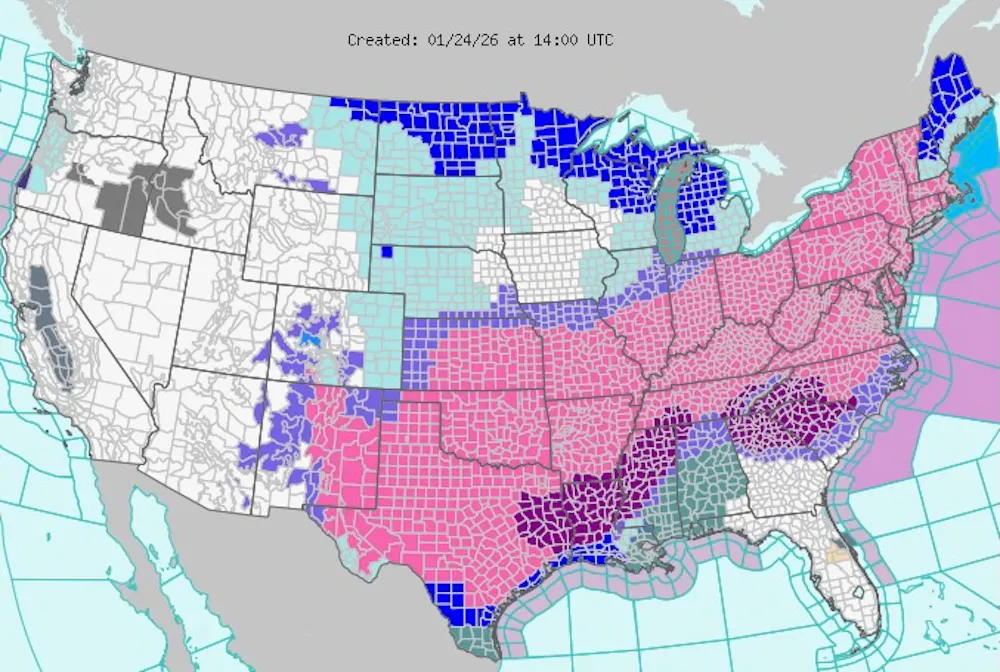
A map of storm warnings on Jan. 24, 2026.
The National Weather Service issued severe storm warnings (pink) on Jan. 24, 2026, for a large swath of the U.S. that could see sleet and heavy snow over the following days, along with ice storm warnings (dark purple) in several states and extreme cold warnings (dark blue).
National Weather Service

Where does the polar vortex come in?

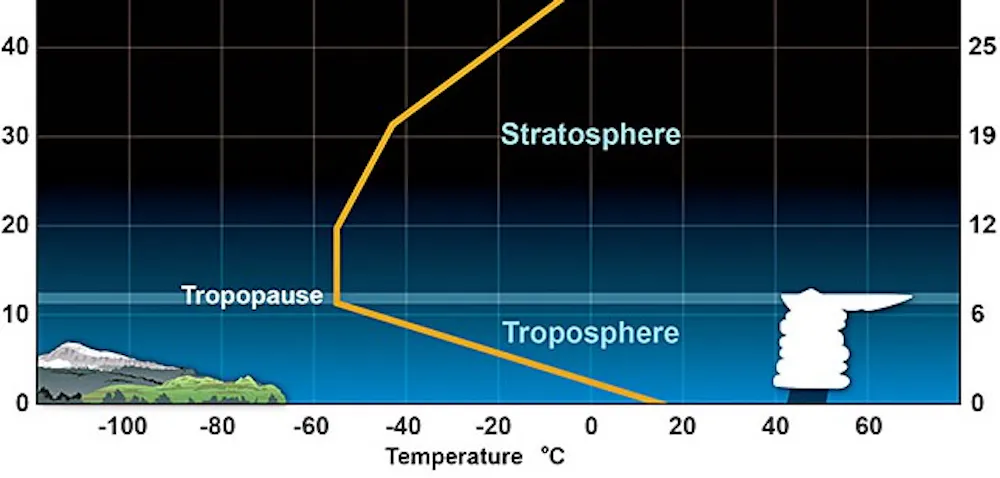
The fastest winds of the jet stream occur just below the top of the troposphere, which is the lowest level of the atmosphere and ends about seven miles above Earth’s surface. Weather systems are capped at the top of the troposphere, because the atmosphere above it becomes very stable.

The stratosphere is the next layer up, from about seven miles to about 30 miles. While the stratosphere extends high above weather systems, it can still interact with them through atmospheric waves that move up and down in the atmosphere. These waves are similar to the waves in the jet stream that cause it to dip southward, but they move vertically instead of horizontally.

A chart shows how temperatures in the lower layers of the atmosphere change between the troposphere and stratosphere. Miles are on the right, kilometers on the left.
NOAA

You’ve probably heard the term “polar vortex” used when an area of cold Arctic air moves far enough southward to influence the United States. That term describes air circulating around the pole, but it can refer to two different circulations, one in the troposphere and one in the stratosphere.

The Northern Hemisphere stratospheric polar vortex is a belt of fast-moving air circulating around the North Pole. It is like a second jet stream, high above the one you may be familiar with from weather graphics, and usually less wavy and closer to the pole.

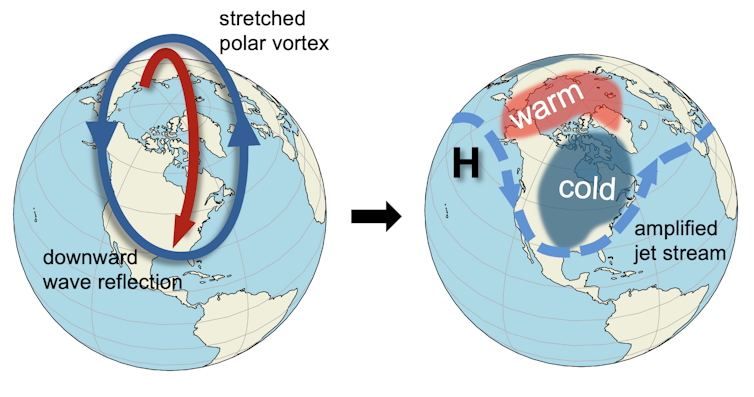
Sometimes the stratospheric polar vortex can stretch southward over the United States. When that happens, it creates ideal conditions for the up-and-down movement of waves that connect the stratosphere with severe winter weather at the surface.

A stretched stratospheric polar vortex reflects upward waves back down, left, which affects the jet stream and surface weather, right.
Mathew Barlow and Judah Cohen, CC BY

The forecast for the January storm showed a close overlap between the southward stretch of the stratospheric polar vortex and the jet stream over the U.S., indicating perfect conditions for cold and snow.

The biggest swings in the jet stream are associated with the most energy. Under the right conditions, that energy can bounce off the polar vortex back down into the troposphere, exaggerating the north-south swings of the jet stream across North America and making severe winter weather more likely.

This is what was happening in late January 2026 in the central and eastern U.S.

If the climate is warming, why are we still getting severe winter storms?

Earth is unequivocally warming as human activities release greenhouse gas emissions that trap heat in the atmosphere, and snow amounts are decreasing overall. But that does not mean severe winter weather will never happen again.

Some research suggests that even in a warming environment, cold events, while occurring less frequently, may still remain relatively severe in some locations.

One factor may be increasing disruptions to the stratospheric polar vortex, which appear to be linked to the rapid warming of the Arctic with climate change.

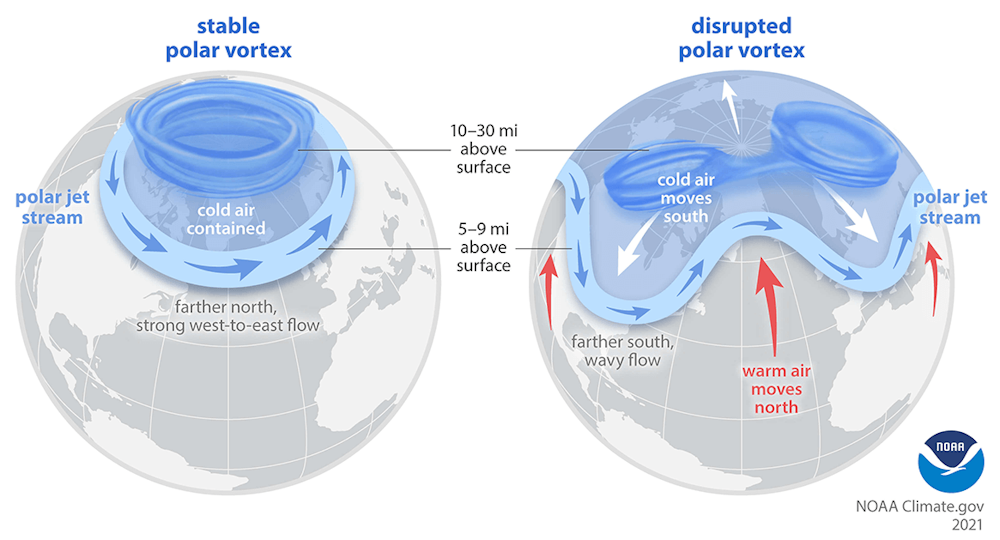
Two globes, one showing a stable polar vortex and the other a disrupted version that brings brutal cold to the South.
The polar vortex is a strong band of winds in the stratosphere, normally ringing the North Pole. When it weakens, it can split. The polar jet stream can mirror this upheaval, becoming weaker or wavy. At the surface, cold air is pushed southward in some locations.
NOAA

Additionally, a warmer ocean leads to more evaporation, and because a warmer atmosphere can hold more moisture, that means more moisture is available for storms. The process of moisture condensing into rain or snow produces energy for storms as well. However, warming can also reduce the strength of storms by reducing temperature contrasts.

The opposing effects make it complicated to assess the potential change to average storm strength. However, intense events do not necessarily change in the same way as average events. On balance, it appears that the most intense winter storms may be becoming more intense.

A warmer environment also increases the likelihood that precipitation that would have fallen as snow in previous winters may now be more likely to fall as sleet and freezing rain.

There are still many questions

Scientists are constantly improving the ability to predict and respond to these severe weather events, but there are many questions still to answer.

Much of the data and research in the field relies on a foundation of work by federal employees, including government labs like the National Center for Atmospheric Research, known as NCAR, which has been targeted by the Trump administration for funding cuts. These scientists help develop the crucial models, measuring instruments and data that scientists and forecasters everywhere depend on.

This article, originally published Jan. 24, 2026, has been updated with details from the weekend storm.

The Conversation

Mathew Barlow has received federal funding for research on extreme events and also conducts legal consulting related to climate change..

Judah Cohen does not work for, consult, own shares in or receive funding from any company or organization that would benefit from this article, and has disclosed no relevant affiliations beyond their academic appointment.

ref. How the polar vortex and warm ocean intensified a major US winter storm – https://theconversation.com/how-the-polar-vortex-and-warm-ocean-intensified-a-major-us-winter-storm-274243

DNA evidence: A double-edged sword that can actually deny justice for some wrongfully accused

Source: The Conversation – Canada – By Kent Roach, Professor of Law, University of Toronto

Jon-Adrian (JJ) Velazquez, a New York man who spent half his life in prison for a crime he didn’t commit, recently sued New York City and its police for US$100 million for his wrongful murder conviction. Velazquez may be known by film buffs for his role in the Oscar-nominated film Sing Sing.

Velazquez may be entitled to millions in compensation if he can prove his factual innocence, typically through DNA evidence at the crime scene. Alas, such evidence is often not available.

The United States has paid almost US$4 billion in damages and settlements to 901 people who have been exonerated of crimes since 1989. This history of wrongful convictions is a warped form of American exceptionalism that I document in my new book Justice for Some: A Comparative Examination of Miscarriages of Justice and Wrongful Convictions .

Proving innocence

Proven factual innocence is a powerful, populist idea. It’s easier to understand and more widely accepted than concepts such as miscarriages of justice, conviction safety or judicial error, which are used to address wrongful convictions in many other countries, including England, Canada and countries in continental Europe.

These more generous approaches used outside the United States better respect the fundamental principle of giving people the benefit of reasonable doubt about their guilt.

It’s very difficult to prove factual innocence. In 2016, a New York court held that Velazquez had failed to prove his innocence despite many weaknesses in the case that led to his 2000 murder conviction.

By 2016, two eyewitness who identifed Velazquez as the person who killed a retired New York police officer had recanted. Some witnesses had initially identified the perpetrator as a Black man with long braided hair; Velazquez is Hispanic and had very short hair. Some said the perpetrator used his right hand to shoot the victim; Velazquez is left-handed.

Consistent with the popular appeal of proven factual innocence, Velazquez was freed in 2021 not by the courts but by New York Gov. Andrew Cuomo, with President Joe Biden apologizing to him the following year. They were responding to investigative reporting and new DNA testing that excluded Velazquez from a betting slip that the killer touched.

The fact that politicians who may have been hoping for re-election were ahead of the American courts in exonerating Velazquez reveals a lot about the decline of the rule of law in the United States.

DNA exonerations

Prominent American lawyers Peter Neufeld and Barry Scheck, the founders of the Innocence Project, argued 26 years ago that DNA exonerations were largely a matter of luck. They predicted in a 2000 book that DNA exonerations would eventually dry up as police only use DNA testing in the small minority of crimes where the perpetrator leaves biological evidence at the crime scene.

Scheck and Neufeld may have been overly optimistic about the competence of American police and prosecutors in their book. Post-conviction, DNA-based exonerations, like Velazquez’s, continue to this day.

DNA is a double-edged sword: it offers compelling evidence of innocence while simultaneously raising the threshold for overturning wrongful convictions. In the U.S., the wrongfully convicted are often expected to prove their innocence through DNA, even though many crimes leave no biological evidence and existing samples are frequently mishandled or unavailable. DNA, in short, serves only a fraction of those wrongfully convicted.

Mass imprisonment in China and the U.S.

The country most closely resembling the U.S. in its insistence on proof of factual innocence is the People’s Republic of China.

Like the U.S., China typically remedies miscarriages of justice only after multiple court proceedings. Intervention by politicians also plays a critical role in obtaining justice for the wrongfully convicted, as it did in the Velazquez case. China has also begun providing more generous compensation to those who can prove their factual innocence.

In both countries, generous compensation for the few who can prove factual innocence risks legitimizing unjust systems that harshly punish the many, including those with wrongful convictions but no meaningful path to justice.

American legal reformers have proposed that a right to claim factual innocence should be added to international law. I argue in Justice for Some, however, that proof of factual innocence would have regressive implications in many other parts of the world that correct miscarriages of justice without such onerous proof. In short, factual innocence would provide justice for fewer people.


Read more:
The use of technology in policing should be regulated to protect people from wrongful convictions


Factual innocence spreads to England

Countries other than the U.S. and China are not immune from the populist appeal of factual innocence.

Since 2014, England has required proven innocence for compensation. This has drastically reduced compensation payments. It’s even resulted in the denial of compensation to people like Velazquez who have been exonerated by DNA.

Victor Nealon spent 17 years in a British prison after being convicted of attempted rape. His lawyers eventually discovered an unknown person’s DNA on clothing that had not been disclosed by investigators, and his conviction was quashed.

Nealon took his compensation claim to the European Court of Human Rights. It ruled in a divided decision that states can require proven innocence without breaching the presumption of innocence. In essence, this allows the wrongfully accused to be denied compensation without regard to the fundamental legal principle that people are presumed innocent until proven guilty. Factual innocence requirements can spread from compensation to appeals from convictions.


Read more:
Eyewitness misidentification is the leading cause of known wrongful convictions


Those who can prove their innocence deserve justice — but justice should not be limited to them alone. Proven innocence rations justice too narrowly.

It may be the best that mass-incarceration societies like the U.S. and China have to offer. But even though factual innocence is popular and easy to grasp, applying this standard broadly across liberal democracies would likely have regressive effects.

The Conversation

Kent Roach is affiliated with the Canadian Registry of Wrongful Conviction. His book received funding to assist in it being published in open access from the Jackman School of Law at the University of Toronto.

ref. DNA evidence: A double-edged sword that can actually deny justice for some wrongfully accused – https://theconversation.com/dna-evidence-a-double-edged-sword-that-can-actually-deny-justice-for-some-wrongfully-accused-273788

How to include fossil fuel communities in Canada’s clean energy transition

Source: The Conversation – Canada – By Ekaterina Rhodes, Associate Professor, School of Public Administration, University of Victoria

Fossil fuel-dependent communities in Western Canada sit at the centre of Canada’s energy decisions. A just and inclusive clean energy transition will depend on how well governments listen to these communities and how fast they deal with the forces working to slow down energy decarbonization.

When it comes to the energy transition, public discussion tends to focus on emissions targets and policies to achieve them. These are important, but they’re just one aspect of the issue. In the oil- and gas-producing regions of Western Canada, conversations and concerns centre on livelihoods, identity and a nagging doubt: does anyone in power grasp rural realities?

Our ongoing research across the region — based on large citizen surveys to focus groups with municipal leaders and analysis of disinformation — highlights that emotions, narratives and perspectives of communities at the heart of Canada’s energy transition politics. As we mark the United Nation’s International Day of Clean Energy today, these voices demand attention before divides deepen further.

Focus groups with municipal staff from 10 oil- and gas-producing communities in British Columbia and Alberta revealed a delicate balancing act. They’re actively pursuing diversification — geothermal projects, hydrogen pilots, tourism expansion, data centres, manufacturing hubs, even rare-earth mineral processing — but most of these efforts build around, rather than beyond, oil and gas.

For many communities, the industry isn’t just jobs. It’s the economic engine funding hospitals, schools, arenas, roads and the very existence of their towns. Abstract talk of an energy transition can feel threatening when it overlooks this.

An Alberta official captured the fear bluntly:

“If you took oil and gas out of our community, I would suggest that there would be no hospital. There would be no schools. There would be no town. The only reason our community exists is to service the oil and gas industry.”

Deep emotional divides

Our 2025 survey of 3,400 residents in non-metropolitan communities across British Columbia, Alberta, Saskatchewan and Manitoba helps explains why climate policy ignites public backlash.

Affective climate polarization, which describes the emotional distance between those who support and oppose climate policy, rivals partisan left-right divides in intensity. These emotional climate identities help explain differences in support for climate policy that ideology alone can’t capture — particularly on the political right, where views on climate action are more diverse.

Policy design nuances are critical but complicated by affective polarization. Clean technology mandates and renewable electricity requirements tend to draw broader backing than carbon taxes, which are generally less popular and spark fierce resistance from right-leaning citizens.

Bundling climate policies with just transition measures, such as government-funded training for new jobs, community-owned energy, low-carbon incentives and public transit, can boost support for carbon pricing among the less polarized. However, for those with stronger emotional commitments, these just transition supports are often ineffective and can even trigger backlash.

Climate policy details matter less to people who score high on affective climate polarization. This helps explain why climate policy debates remain so deeply politicized: when emotional attachments to climate identities are strong, people respond more to elite cues and identity-based judgments than to policy design itself.

Municipalities grapple with limitations

Municipal officials battle structural voids. Officials in northeastern B.C. and Alberta juggle economic ambitions and governance limitations. They craft economic strategies and chase low-carbon investments, while being hamstrung by thin staffing and permitting delays stalling projects for years.

The sharpest barrier to the clean energy transition is the absence of coherent, regionally tailored visions from other levels of government. Federal clean growth plans promote critical minerals and hydrogen. Provincial strategies mix liquefied natural gas with renewables.

Locally, these strategies ring hollow — they seem contradictory and urban-centric. A municipal official in B.C. we spoke to decried a “one-size-fits- all” approach, citing propane-powered electric vehicle chargers in -40 C winters: “How do you gain the support … when even the province isn’t actually addressing” regional realities?

We’ve found that public attitudes differ by age, with youth embracing climate sustainability but veterans of oil-tied lives viewing transition as a “hard sell.” Without a common vision recognizing municipal governance limitations, community leaders hesitate on bold plans, wary of backlash in towns deeply connected to the promise and precarity of oil’s boom–bust cycles.

These tensions are being wilfully intensified by the fossil-fuel industry’s propaganda machine, which uses bad-faith arguments to suggest that climate policies and fossil-fuel communities are at odds.


Read more:
Fossil-fuel propaganda is stalling climate action. Here’s what we can do about it


These arguments often ignore the potential for a well-managed energy transition to improve public health, foster regional development and increase community resilience in these regions.

These are not the only narratives the fossil-fuel industry is using to slow climate action. Our research on Canada’s climate delays shows that fossil-fuel propaganda is being used to falsely portray Canadian oil as low-emissions, to urge Canada to wait for others to act first and to claim that climate policies are more detrimental to workers more than climate change.

Fostering a just energy transition

Governments must engage in genuine listening. Fossil-fuel communities aren’t barriers, but key participants in all energy transition risks and benefits. Co-creating policies with them rather than imposing top-down visions can help grow jobs, revenues and services in Western Canada.

Engagement with communities must also be emotionally attuned. Overcoming climate polarization means restoring trust via local messengers, consistent follow-through and deliberative forums like public assemblies.

At the same time, governments must confront misinformation and propaganda. They can can step in with policies that challenge disinformation legally, regulate ads and fund community energy transformations beyond fossil fuel extraction.

The International Day of Clean Energy spotlights promise. In Western Canada, it also spotlights peril. The energy transition’s success hinges on centring fossil fuel communities as protagonists, not peripherals — turning the transition into a shared opportunity.

The Conversation

Ekaterina Rhodes receives funding from Canada First Research Excellence Fund as part of the University of Victoria-led Accelerating Community Energy Transformation Initiative.

Megan Egler received funding from the Canada First Research Excellence Fund as part of the University of Victoria-led Accelerating Community Energy Transformation Initiative.

Rowan Hargreaves received funding from the Canada First Research Excellence Fund as part of the University of Victoria-led Accelerating Community Energy Transformation Initiative.

Samuel Lloyd receives funding from the Canada First Research Excellence Fund as part of the University of Victoria-led Accelerating Community Energy Transformation Initiative. He also received funding from the Pacific Institute for Climate Solutions for a research project that inspired one of the papers included in this article.

ref. How to include fossil fuel communities in Canada’s clean energy transition – https://theconversation.com/how-to-include-fossil-fuel-communities-in-canadas-clean-energy-transition-273331

With ‘KPop Demon Hunters,’ Korean women hold the sword, the microphone — and possibly an Oscar

Source: The Conversation – Canada – By Hyounjeong Yoo, Instructor, School of Linguistics and Language Studies, Carleton University

When I was a child in South Korea, the New Year often began with a familiar song: “Kkachi Kkachi Seollal.” Seollal refers to the Lunar New Year, one of Korea’s most important family holidays, and kkachi means “magpie,” a bird associated with good fortune and joyful beginnings.

Singing the song, we believed, would invite pleasant guests into the home. For my siblings and me, those guests were usually our grandparents — and their arrival marked warmth, continuity and belonging.

Decades later, I now live in Canada, where distance has made such visits from my home country rare. Yet it feels as though the magpie has arrived again — this time on a global screen.

Netflix’s animated film KPop Demon Hunters, which follows adventures of a fictional Kpop girl group (Huntrix) whose members hunts demons by night, now has an Academy Award nomination for Best Animated Feature and Best Original Song. This follows recent Golden Globe wins.

The film, created by Korean Canadian Maggie Kang, has musical production by Teddy Park and is voiced by Korean American actors such as Arden Cho, Ji-young Yoo and Audrey Nuna.

I’m interested in how KPop Demon Hunters marks a new phase of the Korean Wave. In this phase, folklore and women’s musical labour come together to challenge how Asian stories have long been sidelined in western media.


Read more:
In music and film, a new Korean wave is challenging Asian stereotypes


KPop Demon Hunters, like the success of some other recent popular Korean cultural production in the West, reflects diasporic creativity, notes scholar Michelle Cho, whose research focuses on on Korean film, media and popular culture.

Folklore as cultural authority

One of KPop Demon Hunters’s most striking features is its unapologetic use of Korean symbols. The demon hunters wear gattraditional horsehair hats associated with scholars during Korea’s Joseon dynasty — while battling demons alongside the tiger, long regarded as a guardian spirit of Korea. These elements function as assertions of cultural authority.

Historically, western film and animation have often relegated Asian characters to stereotypes or erased them altogether through whitewashing.

By contrast, KPop Demon Hunters places Korean folklore at its narrative centre. The gat evokes dignity and discipline; the tiger represents protection and resilience. Together, they counter the lingering assumption that mainstream entertainment led by Asian characters is somehow niche or inferior.

By using distinctly Korean imagery — such as the satirical minhwa art style of the film’s Derpy Tiger — the movie firmly anchors itself in a specific Korean context that cannot be generalized or mistaken for a broad, pan-Asian esthetic.

For many in the Korean diaspora — including myself, who grew up rarely seeing people like me centred in mainstream media — this visibility carries emotional weight.

Research in media and cultural studies shows that representation matters not only for how groups are seen by others, but also for how people understand their own place in society. Seeing Korean symbols treated with respect offers a quiet but powerful form of cultural validation.

A matrilineal line of survival

One of the film’s powerful moments is the opening montage. Through a rapid succession of shamanic figures, flappers and disco-era performers, the sequence offers what can be read as matrilineal homage to female Korean musicians across generations.

As writer Iris (Yi Youn) Kim notes, citing a lecture by Asian American studies scholar Elaine Andres, this lineage echoes the real-life story of the Kim Sisters, often described as Korea’s first internationally successful female pop group. After losing their father during the Korean War, the sisters were trained by their mother, the renowned singer Lee Nan-young — best known for the anti-colonial song “Tears of Mokpo” — to perform at U.S. military bases as a means of survival.

The Kim Sisters perform ‘Fever’ on the Ed Sullivan show.

The Kim Sisters later became regular performers on The Ed Sullivan Show, captivating American audiences while navigating racist expectations that framed Asian women as approachable, non-threatening and exotic.

Symbolic labour of representing a nation

The fictional group Huntrix inherits this legacy. Like the Kim Sisters, they are expected to embody discipline, professionalism and national representation.

For example, the film shows the group grappling with perfectionism and the intense discipline demanded of them, often maintaining polished public performances while suppressing personal vulnerability to fulfil their dual roles as idols and protectors. On a meta-narrative level, Huntrix is framed as a cultural representative through the use of Korean folklore imagery, like the gat and the tiger.

As “cultural diplomats” both on and off the screen, Huntrix carry not only entertainment value but also the symbolic labour of representing a nation to a global audience.

By embedding this lineage into a mainstream animated film, KPop Demon Hunters acknowledges that KPop’s global success rests on decades of women’s labour, sacrifice and negotiation with western power structures.

Beyond soft power

The film’s success arrives amid the continued expansion of the Korean Wave across global media.

South Korean cinema and television have already reshaped international perceptions through landmark works such as Parasite and globally streamed series like Squid Game. Netflix has publicly committed hundreds of millions of dollars to Korean content, signalling that this cultural shift is structural rather than fleeting.

KPop Demon Hunters demonstrates how Korean popular culture now moves fluidly across media forms — music, animation, film and streaming — while retaining cultural specificity. Its reception challenges the persistent assumption that stories rooted in Asian experiences lack universal resonance.

Recognition alone does not erase inequality, nor does it dismantle the racialized hierarchies built into global media industries either. But sustained visibility can matter. Studies suggest that repeated exposure to multidimensional, humanized portrayals of marginalized groups helps reduce racial bias by normalizing difference rather than exoticizing it.

Holding the sword and the microphone

While the film grows out of cultural histories shaped by U.S. military presence and Cold War politics, it reshapes those influences through diasporic storytelling that centres Korean voices and perspectives.

The magpie’s promise has finally been kept. Korean characters are no longer merely “pleasant guests” or supporting figures in someone else’s narrative. They are protagonists — holding the sword, the microphone and perhaps, one day, an Oscar.

Recently, I found myself rewatching KPop Demon Hunters while eating kimbap and instant noodles, the same comfort foods the characters share on screen. The moment felt small, but meaningful.

It reminded me of something one of my students once said: seeing this level of representation allows those who have long felt wounded by exclusion to finally feel seen.

The Conversation

Hyounjeong Yoo does not work for, consult, own shares in or receive funding from any company or organisation that would benefit from this article, and has disclosed no relevant affiliations beyond their academic appointment.

ref. With ‘KPop Demon Hunters,’ Korean women hold the sword, the microphone — and possibly an Oscar – https://theconversation.com/with-kpop-demon-hunters-korean-women-hold-the-sword-the-microphone-and-possibly-an-oscar-273443