The cold war maps that can help us rethink today’s Arctic conflict

Source: The Conversation – UK – By James Cheshire, Professor of Geographic Information and Cartography, UCL
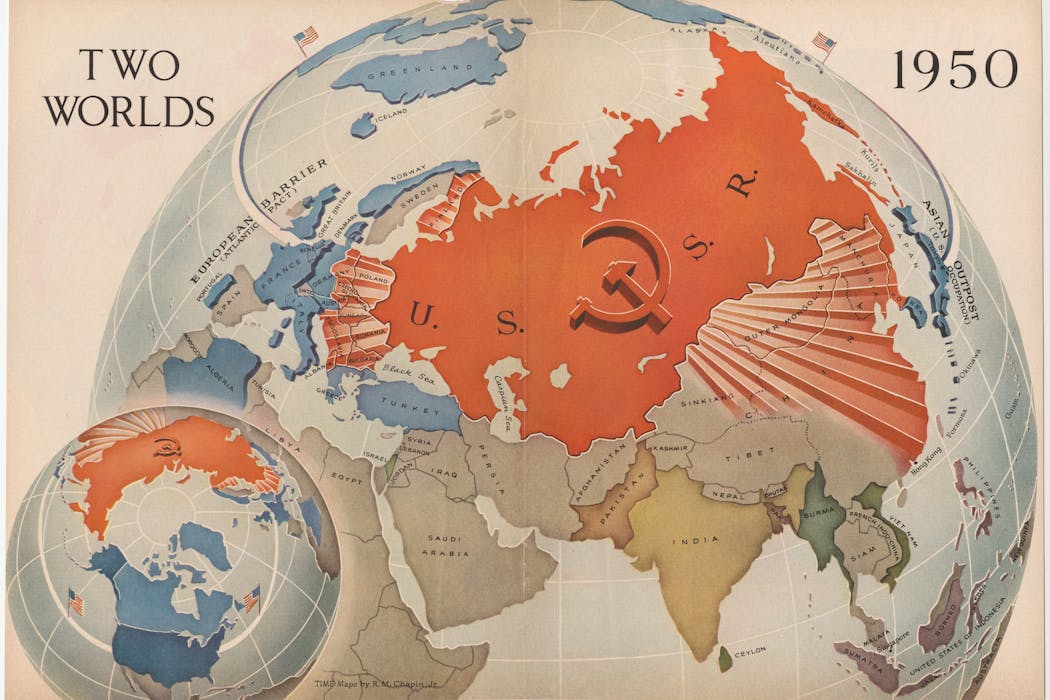
A US view of the cold war world, 1950, showing the fearsome power of the USSR. Cornell University – PJ Mode Collection of Persuasive Cartography.

The late 1940s and early 1950s were a golden age for polar mapmaking in the US. Major magazines such as Time, Life and Fortune commissioned a generation of famous cartographers – who had come of age in the second world war – to explain the new geopolitics to a mass audience that was highly engaged after the catastrophic global conflict they had just lived through.

Their maps were large, dramatic and designed to be spread across kitchen tables and classroom desks. And they also offered a very different perspective to the mainstream maps we have become accustomed to today.

I’ve spent the past four years unearthing maps from the late 1940s and early 1950s to research a book about a largely forgotten map library at my university, and I am always struck by how consequential they feel to the global arguments of their era. Not least because they invited debate from their readers who were asked to become global strategists by discussing the next moves in the game of geopolitics.

These maps didn’t just illustrate the world – they implored people to think about it differently. As the world enters a new period of international relations and global tensions, it’s worth considering the different perspectives maps can offer us.

With each new US foreign policy intervention – such as the US president’s current preoccupation with taking over Greenland – I have often wondered if these maps of global adversaries could have percolated into a young Trump’s mind. The world must have seemed a menacing place and it is shown on these maps as a series of threats and opportunities to be gamed, with the “Arctic arena” as a major venue.
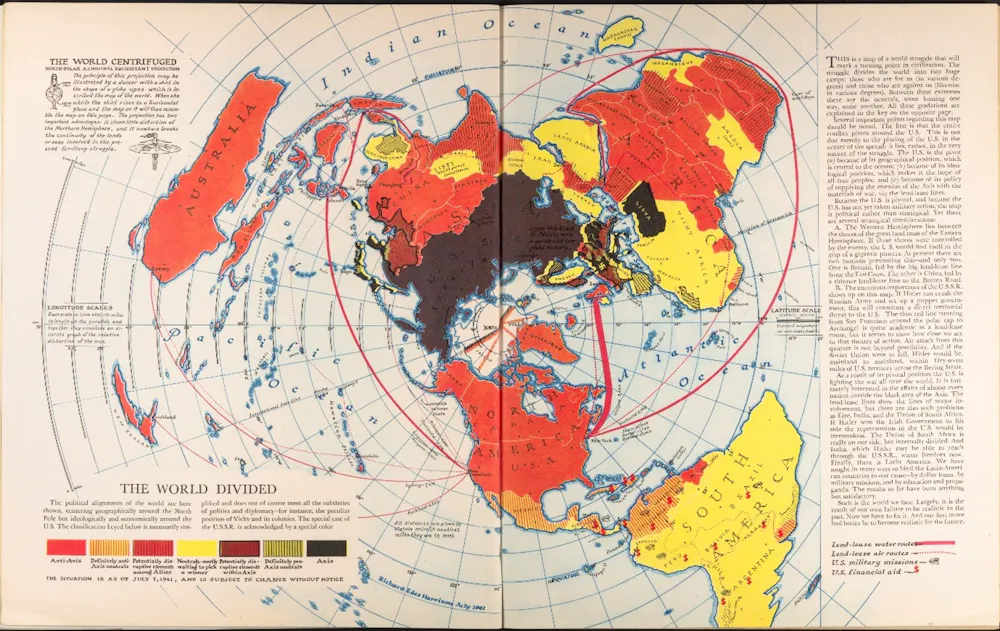
A map showing the political alignments as they were in 1941
The World Divided is an iconic map showing the geoopolitical situation at the height of the second world war. It was created by Richard Edes Harrison and published by Fortune Magazine in August 1941.
Cornell University – PJ Mode Collection of Persuasive Cartography.

The consensus encouraged by the maps was that of alliances, most notably Nato, and US opinion tended to endorse what Henry Luce, the influential owner of Time and Life magazines, called the “American century” in which the US would abandon isolationism and take on a global role.

a map using the North Polar Azimuthal Equidisant Projection
Published in 1950, this map introduces the Azimuthal Equidistant Projection to Time Magazine’s readers.
Time Magazine

Whatever one thinks of that worldview, it was frequently framed in terms of collective responsibility rather than individual dominance. Luce argued that the “work” of shaping the future “cannot come out of the vision of any one man”.

As we can now see with Greenland, Trump has taken the geography of threats and opportunity shown on these influential maps but reached a very different conclusion: an “America first”, resulting from the vision of the US president himself.

Dawning of the ‘air age’

The skilful of the cartographers of the era played with a range of map projections that offered different perspectives of geopolitical arenas. The master of this was Richard Edes Harrison who is described by the historian Susan Schultern as “the person most responsible for sensitizing the public to geography in the 1940s. [The public] tore his maps out of magazines and snatched them off shelves and, in the process, endowed Harrison himself with the status of a minor celebrity.”

Edes Harrison adopted many projections in his work – but for maps of the Arctic, he alighted on the azimuthal equidistant projection. While this creates maps that distort the shapes of countries, it enables the correct distances to be shown from the centre point of the map.

The projection became widely used in the 1940s and 1950s (and was indeed adopted for the UN flag in 1946) because it proved effective at demonstrating the wonder of the burgeoning “air age” as commercial flights followed great circle routes over the Arctic.

World map centered on London 1945
The Air Age Map of The World, 1945 (centered on London).
The Library of Lost Maps

This contrasted with the roundabout routes that needed to be followed by ships and it also mapped the countries that bordered and occupied the Arctic with a much greater sense of proximity and threat.

Missiles and bombers were just as able to travel over the top of Earth as were holidaymakers – and this created a juxtaposition exploited by cartographers. Rand McNally, a renowned map publisher, for example, published a collection of maps entitled Air Age Map of the Global Crisis in 1949.

These set out “the growing line-up of countries and peoples behind the two rival ways of life competing for power in the 20th Century” – that is capitalism as embodied by the US and Soviet and Chinese communism.

Those who bought it were told: “Keep this map folder! It may have great historic significance a generation from now.”

Magazine insert from 1950s with a series of geopolitical maps.
This 1950s map published by Rand McNally was produced as part of a marketing campaign for Airwick air freshener, but also sought to inform the US public about the spread of communism.
Rand McNally

New world order

Donald Trump’s return to office has revived talk of a world moving beyond the assumptions of the postwar order — weakening alliances, acting unilaterally, treating territory as leverage. At the same time, maps remain one of the most trusted forms of evidence in public life.

A Mercator-shaped worldview, widely used by digital maps can distort reality – for example, making Greenland much larger than it is.

Cartographers have long known the strengths and limitations of Mercator, but Trump’s approach to foreign policy is a further reminder of the perspective we lose when we depend on the standardised views of Earth that digital maps encourage (some have also speculated that Mercator’s exaggeration of Greenland’s area heightens its real estate appeal to Trump).

Maps are powerful things and in times of crisis, or rapid change, we turn to them to help explain events and locate ourselves within them. But they can be just as much about arguments as they are facts – and Trump knows this.

The maps of the 1940s and 1950s were about a fresh (American) perspective to create a new world order. They instilled Trump’s generation with a sense of the geopolitical rivalries that tend to get washed out of generic digital maps that are most widely consumed today.

Nearly 80 years on, this order may be creaking – but the maps are still there to remind us of what’s at stake.

The Conversation

James Cheshire receives funding from the Economic and Social Research Council.

ref. The cold war maps that can help us rethink today’s Arctic conflict – https://theconversation.com/the-cold-war-maps-that-can-help-us-rethink-todays-arctic-conflict-274058
The pioneering path of Augustus Tolton, the first Black Catholic priest in the US – born into slavery, he’s now a candidate for sainthood

Source: The Conversation – USA (3) – By Annie Selak, Director, Women’s Center, Georgetown University

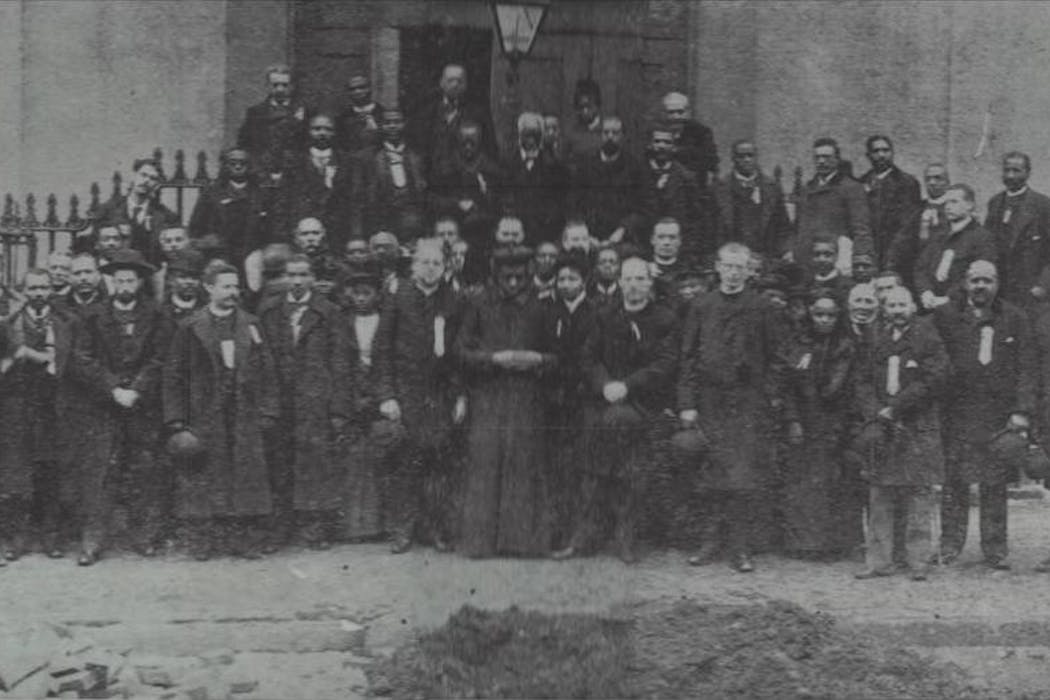
Attendees at the 1892 Colored Catholic Congress included the nation’s first openly Black priest, Augustus Tolton, who stands in the middle of the front row. Wikimedia Commons

The first publicly recognized Black priest in the United States, Augustus Tolton, may not be a household name. Yet I believe his story – from being born enslaved to becoming a college valedictorian – deserves to be a staple of Black History Month. “Good Father Gus” is now a candidate for sainthood.

My forthcoming book, “The Wounded Church,” examines ways that the Catholic Church has excluded people during different chapters of its history, from women to African American people. One chapter of history that many Americans may not know about was how the U.S. church barred Black men from becoming priests – a chapter that ended with Tolton’s ordination in the late 19th century.

Slavery to seminary

Tolton was born on April 1, 1854 in Missouri, where he and his family were enslaved. He was baptized as Catholic as an infant. He escaped slavery in 1863 with his mother and siblings, eventually settling together in Quincy, Illinois.

Life in Quincy was far from a dream come true. He attempted to attend an integrated public school and a Catholic parish school, but was bullied and faced discrimination, causing him to leave. Tolton worked at a tobacco factory – the first of several manual jobs he held as a young man, while also establishing a Sunday school for Black Catholics.

Eventually, he encountered the Rev. Peter McGirr, an Irish immigrant priest who allowed the boy to attend St. Peter’s, a local parish school for white Catholics, when the tobacco factory where Tolton was employed was closed in the winter. McGirr’s decision was controversial, but Tolton pushed on and excelled. He began private tutoring by priests at Saint Francis Solanus College, now Quincy University. In 1880, he graduated as the valedictorian.

A sepia-toned portrait of a Black man wearing a clerical hat, white collar and buttoned-up jacket.
Augustus Tolton became the first Black man to be ordained as a Catholic priest in the U.S.
Quincy University via Wikimedia Commons

By then, it was clear that Tolton was extraordinary – even when working at a soda bottling plant, for example, he had learned German, Latin and Greek. He wanted to become a priest, yet was rejected by U.S. seminaries.

The Vatican allowed Black men to be ordained, but church hierarchy in the U.S. would not admit Black men to seminaries. Their exclusion was driven by white priests “internally beholden to the racist doctrines of the day,” as Nate Tinner-Williams, co-founder and editor of the Black Catholic Messenger, wrote in a 2021 article. Tolton applied to the Mill Hill Missionaries in London, a group that was devoted to serving Black Catholics, and was rejected by them as well.

At the time, the only Black men who were Catholic priests in the U.S. were biracial Americans who passed as white and did not openly identify themselves as Black. The most famous of these was Patrick Healy, who served as president of Georgetown University from 1873-82. Healy and his brothers were ordained in Europe.

With no route to ordination in his home country, Tolton traveled to Rome to complete his seminary education. He was ordained on Easter Saturday in 1886 and celebrated his first Mass in Saint Peter’s Basilica. He planned on going somewhere in Africa as a missionary, but was instead sent to the United States. As Tolton later recalled, “It was said that I would be the only priest of my race in America and would not likely succeed.”

‘Good Father Gus’

After ordination, Tolton returned to his home country and celebrated Masses in New York and New Jersey before settling in in his hometown of Quincy. The Masses were like a triumphant return for Tolton: filled to capacity, and drawing in people from surrounding areas to celebrate the country’s first Mass presided over by a Black priest.

“Good Father Gus” was popular, and known for being a “fluent and graceful talker” with “a singing voice of exceptional sweetness.” Yet his ministry encountered backlash – though not from parishioners. He encountered jealousy from other ministers. Tolton told James Gibbons, archbishop of Baltimore, that Black Protestant ministers were nervous that their members would leave and become Catholic. White Catholic priests “rejoiced at my arrival,” Tolton wrote, but “now they wish I were away because too many white people come down to my church from other parishes.”

A black-and-white illustration of a Black man standing in priest's robes, with a white robe and stole atop a darker one.
An image of Augustus Tolton in William Simmons and Henry McNeal Turner’s 1887 book ‘Men of Mark: Eminent, Progressive and Rising.’
New York Public Library via Wikimedia Commons

Tolton’s most influential chapter began when he moved to Chicago in 1889. He was sent as a “missionary” to the Black community in Chicago, with the hope of establishing a Black Catholic church. He served the parish of St. Monica’s, described at the time as “probably the only Catholic church in the West that has been built by colored members of that faith for their own use.”

This success took a toll. Tolton had periods of sickness and took a temporary leave of absence from St. Monica’s in 1895. It is unclear whether he suffered from mental illness or physical illness. During a heat wave, he collapsed on the street. He died the next day, on July 8, 1897, at age 43.

Road to sainthood

Tolton’s legacy continues beyond his life and early death. As the first Black priest in the U.S., “whom all knew and recognized as Black,” according to Cyprian Davis, a Black Catholic monk and historian of the church, Tolton opened the doors to other Black men being ordained.

A large stone cross stands over a grave in a circular, grass-covered memorial, with a few trees in the background.
Augustus Tolton’s headstone in St. Peter’s Cemetery of Quincy, Ill.
Ched/Wikimedia Commons, CC BY-SA

Ten years after Tolton applied to join the Mill Hill Missionaries, the order accepted a Black man for seminary and priesthood: Charles Randolph Uncles. John Henry Dorsey received the Holy Orders in 1902, becoming the second Black man ordained in the U.S. and the country’s fifth Black priest.

“Good Father Gus” is now on the path toward sainthood. In 2019, Pope Francis advanced Tolton’s cause for sainthood, making his name officially “The Venerable Father Augustus Tolton.” The next steps, beatification and canonization, require evidence of miracles, which the Archdiocese of Chicago and the Vatican are evaluating.

Today, some schools and programs carry Tolton’s name, introducing him to a new generation. But while church law and practice no longer prohibit the ordination of Black men to the priesthood, full equity in church ministry remains elusive.

Black women were long excluded from joining religious orders, and they started their own congregations in the mid-19th century. A Black man did not become a U.S. cardinal until 2020, when Wilton Gregory was named cardinal of Washington, D.C.

During Black History Month, I believe Tolton’s life and legacy offer a vital example of how one man overcame obstacles to pursue priesthood, encountering success and loneliness along the way.

The Conversation

Annie Selak does not work for, consult, own shares in or receive funding from any company or organization that would benefit from this article, and has disclosed no relevant affiliations beyond their academic appointment.

ref. The pioneering path of Augustus Tolton, the first Black Catholic priest in the US – born into slavery, he’s now a candidate for sainthood – https://theconversation.com/the-pioneering-path-of-augustus-tolton-the-first-black-catholic-priest-in-the-us-born-into-slavery-hes-now-a-candidate-for-sainthood-269257

Book Talk: Q&A with a psychologist who argues ‘guilt is a helpful emotion, not a harmful one’

Source: The Conversation – Canada – By The Conversation Canada, The Conversation

Guilt is often treated as a feeling to turn away from, something that is detrimental to our pursuit of happiness. But Chris Moore, psychologist and professor in Dalhousie University’s department of psychology and neuroscience, argues that guilt can be a powerful force for accountability, repair and healing. In his new book, The Power of Guilt: Why We Feel It and Its Surprising Ability to Heal, Moore challenges popular assumptions about guilt and explains why this uncomfortable, even painful, feeling may be one of our most socially useful emotions.


The Conversation Canada: From an evolutionary perspective, why does guilt exist at all? What function does it serve?

Chris Moore: Guilt is a complex set of emotions. One of those emotions is fear for the health of a relationship. Second is empathy. If you do something to hurt somebody else, you feel sadness for them. Then third is remorse — the wish that we hadn’t done it. Those three emotions combined into a cocktail is guilt.

Human beings are arguably the most social of all species, and social networks depend upon healthy relationships between individuals. You have to have mechanisms for keeping social networks healthy because, inevitably, there’s going to be conflict. Guilt is one of those mechanisms. It serves to motivate the individual to repair relationships that are important to them. Psychopathic individuals don’t feel guilt, for example, and the corollary of that is that they tend to have dysfunctional relationships.

TCC: You distinguish between shame and guilt. What is the difference, and why is the distinction important?

CM: Guilt is feeling bad about something that you did (an action), whereas shame is feeling bad about yourself (being a bad person). Shame is more person-focused; guilt is more action-focused. And if you think about what those emotions are for and how they motivate our behaviour, they can have different effects.

If you feel guilt because you performed a bad action, then you can work to heal that by reaching out and apologizing, for example. Shame makes people shy away from relationships because they feel like they’re a bad person. Shame is much more destructive, particularly for relationships.

TCC: You argue that guilt is not a harmful emotion. How so? Why, then, has guilt developed such a bad reputation?

CM: The ultimate point of guilt is to motivate us to try to heal our relationships. That’s why guilt is good for us if we act on it honestly and with genuine motives, although it feels bad. But I do want to emphasize that there are two sides. The antidote to guilt is forgiveness from the other person.

There are a number of reasons for its bad reputation. One is that it feels bad, and so we don’t want to experience it. We may try to ignore it, or we may try to push it away or not act on it. Additionally, it’s often associated with objectively bad things — things that have been deemed to be bad actions by society, whether that’s through religion or through the law. The notion of guilt under the law, for example, is that you’ve done a bad thing and that you need to be punished for it. That is a negative connotation.

TCC: What should we do with guilt when we feel it in the moment? Lean into it? Question it?

CM: Certainly lean into it. I do want to emphasize, however, that guilt is a gut reaction, so we also need to interrogate its accuracy. Do we really have responsibility in the situation for the harm that has come to the relationship that we care about? That’s especially important in situations where other people may be inclined to take advantage of our guilt through guilt-tripping, or what is called guilt induction.

Have you done all that you should do in the context from which the guilt arose? If you have, then you need to be able to let go of the guilt. That is an important part of it because people who are very guilt-prone — people-pleasers or people who score very high on agreeableness — tend to feel guilt a lot. It may not always be justified, but that doesn’t mean that they don’t feel it.

TCC: How do power dynamics in families shape how guilt is experienced?

CM: The origin of guilt, according to Freudian psychoanalytic thought, is that the child first feels guilt in relation to their parents — something that they did which led to anger from their parents. Guilt can arise when there’s an asymmetry in power, but if you’re feeling guilt all the time in the context of a particular relationship, then it may not be you.

That can happen in child-parent relationships, particularly when parents have a very strong sense of filial obligation, which means that the children should be doing what the parents say they should be doing. And if they use guilt to achieve those ends, that can quickly lead to resentment as the child ages into adolescence and adulthood. That is quite a toxic situation for child-parent relationships, and it can lead to estrangement. Estrangement is obviously very unfortunate, but the question becomes: is it for the best?

TCC: How does guilt intersect with collective responsibility such as historical guilt tied to colonialism?

The term “collective guilt” was popularized after the Holocaust in the context of German guilt. Collective guilt has two aspects. “Objective collective guilt” can be thought of as a legal form of guilt. For example, after the Second World War, Germany accepted its collective guilt for the Holocaust and paid reparations to the state of Israel for what was done to the Jewish population. But then there is also the “subjective collective guilt,” which is the guilt that individual people may feel because of their identification with the group that did the damage.

Interestingly, subjective collective guilt can occur in people who have no individual responsibility for those acts. There was a great increase in German guilt in the 1970s in the generation born after the Second World War, for example. There is no clear antidote for subjective collective guilt. There’s nothing you can do, ultimately, that will lead to forgiveness because there’s nobody who can actually act on behalf of the group that was oppressed to offer that forgiveness. There are a number of writers, for example, who have written on white guilt, in relation to racial issues, being dysfunctional.

There’s no point in continuing to harbour collective guilt if you’ve done all that can be done. Now, determining whether you’ve done all that can be done … that is complicated.

This interview has been condensed for length and edited for clarity.

The Conversation

The Conversation Canada does not work for, consult, own shares in or receive funding from any company or organisation that would benefit from this article, and has disclosed no relevant affiliations beyond their academic appointment.

ref. Book Talk: Q&A with a psychologist who argues ‘guilt is a helpful emotion, not a harmful one’ – https://theconversation.com/book-talk-qanda-with-a-psychologist-who-argues-guilt-is-a-helpful-emotion-not-a-harmful-one-274001

Attacks on Nigeria’s energy systems weaken the country – research unpacks costs, risks and ways forward

Source: The Conversation – Africa – By Haruna Inuwa, DPhil Candidate, Energy Systems, University of Oxford

Energy systems are coming under attack globally because disrupting power or fuel supplies offers strategic, economic or political leverage. This can be in local conflicts or large-scale geopolitical confrontations.

Nigeria illustrates this clearly: militants in the Niger Delta sabotage pipelines to assert control and tap into oil revenues, while the extremist group Boko Haram and armed bandits in the north hit power lines to weaken state presence.

These incidents reveal how conflict actors weaponise energy systems.

We recently published a study assessing how militancy, insurgency and armed banditry undermine Nigeria’s energy systems by disrupting oil, gas and power infrastructure. We compiled novel datasets of energy related incidents, mapping their timing, location and cost from 2009 to 2025.

Our findings show that more than 2,300 separate attacks were recorded. We see a widening pattern of energy insecurity that drains national revenue, drives away investment, and worsens environmental injustice.

This explains why Nigeria’s energy insecurity has become one of its most serious development and security challenges.

We recommend investment in decentralised systems, community engagement in oil regions, and policies supporting industrial decarbonisation to strengthen resilience and advance climate goals.

The price

According to our estimates, between 2009 and 2024, approximately US$20 billion was lost as a result of attacks. During the 2013-2016 surge in militancy, losses peaked at roughly US$17 billion.

We found that the South-South (Niger Delta) region remains the epicentre of oil sabotage, with peak revenue losses of US$8.62 trillion (2009-2012) and sustained environmental damage.

Attacks and oil theft along the Trans-Niger Pipeline were particularly devastating. This pipeline moves 450,000 barrels of crude oil daily from oil-producing fields in Niger Delta region to export terminals. Each disruption not only shuts down production but also deprives the government of huge revenues.

Since 2021, tactics have shifted. Over 40 attacks have targeted transmission lines in the North-East and North-Central, largely linked to Boko Haram and armed bandits.

Case studies of the 2016 Shell Forcados terminal bombing and the 2024 Shiroro transmission line attack show reliance on backup generators increased electricity costs by 3.2-6.0 times.

Beyond the financial toll, communities suffer respiratory illnesses, unsafe drinking water and food insecurity.

Disruptions have made Nigeria’s grid more unstable and pose risks to critical infrastructure projects nearing completion, including gas pipelines.

Attacks threaten regional energy trade and integration projects, such as the West African Power Pool, West African Gas Pipeline, Nigeria-Morocco Gas Pipeline, and the proposed Nigeria-Algeria-Gas-Pipeline, which rely on secure cross-border energy infrastructure.

Foreign investors view these risks as prohibitive. Due to attacks on energy infrastructure, in 2020, Nigeria lost around US$40 billion in foreign direct investment.

Oil theft and sabotage have also left a toxic legacy in the Niger Delta. Each pipeline rupture spills crude into rivers and farmland, wiping out livelihoods.

We find that clean-up costs from oil spills on the Trans-Niger Pipeline alone ranged from US$150 million to US$290 million per period (2009-2012, 2013-2016, 2017-2020, 2021-2024), highlighting continuous environmental degradation in the Niger Delta area.

In line with this, the United Nations Environment Programme estimated that a US$1 billion 30-year clean-up is needed in Ogoniland, while Reuters reported that addressing oil pollution in Bayelsa State alone might require US$12 billion over 12 years. When compared to Nigeria’s GDP of US$375 billion in 2024, these figures underscore the substantial financial strain that this attack-induced environmental crisis places on national resources.

Our analysis indicates that insurgents and bandits have shifted tactics since 2021. We see increased disruption and attacks on power infrastructure in the northern part of the country.

More than 40 incidents targeting high-voltage transmission lines have been recorded in just four years, a 20-fold increase from the previous decade. Two major examples show the consequences: the 2016 Forcados terminal bombing cut national power generation by 3,132MW, while the 2024 Shiroro transmission-line attack left the north-western part of the country in darkness for two weeks.

During attack-induced outages, businesses and households switch to diesel or petrol generators. We find that this backup electricity costs three to six times more than grid power, with the North-East and North-West experiencing the highest cost increase.

Each attack also carries an invisible environmental cost. Backup generators release far more carbon dioxide than grid electricity. During the 2016 and 2024 outages, we estimated sharp spikes in CO₂ across the South-West and South-South, Nigeria’s most energy-hungry regions.

This trend undermines Nigeria’s commitments under the National Climate Change Policy 2021-2030, which aims to cut emissions and expand energy access using renewable energy. Insecurity, therefore, is not just an economic or social problem – it is an obstacle to climate progress.

How Nigeria can respond

Our research points to several steps that could make the energy systems more resilient:

  1. Invest in decentralised and modular power systems: Smaller, locally managed plants – such as the 52-megawatt Maiduguri Emergency Power Plant – are harder to sabotage and quicker to repair.

  2. Rebuild trust with host communities: Environmental remediation and transparent benefit-sharing can reduce grievances that drive sabotage. Local participation in energy projects must move beyond tokenism.

  3. Adopt technology for early warning and monitoring: Pressure sensors, drones and predictive analytics can detect tampering and leaks in real-time. Government contracts with former militants to guard pipelines must be coupled with strict accountability.

  4. Accelerate innovative clean-energy deployment: In the light of Nigeria’s commitment to achieve climate goals, it is important to explore emerging decarbonisation pathways, including clean hydrogen.

Nigeria’s energy wealth has long promised prosperity, but persistent insecurity has made it a liability. The financial losses, pollution and emissions caused by repeated attacks erode resilience and deter investment. This challenge is not unique to Nigeria; it reflects a broader global reality in which energy transitions depend on secure infrastructure.

Achieving a stable, decentralised and low-carbon system will require protecting the assets that make it possible.

The Conversation

Haruna Inuwa receives funding from Petroleum Trust Development Fund, Nigeria. However, the views expressed herein do not necessarily reflect the Nigeria government’s official policies.

Stephanie Hirmer receives funding from the Climate Compatible Growth (CCG) Programme which is funded by UK aid from the UK government. The views expressed in this work do not necessarily reflect the UK government’s official policies.

Alycia Leonard does not work for, consult, own shares in or receive funding from any company or organisation that would benefit from this article, and has disclosed no relevant affiliations beyond their academic appointment.

ref. Attacks on Nigeria’s energy systems weaken the country – research unpacks costs, risks and ways forward – https://theconversation.com/attacks-on-nigerias-energy-systems-weaken-the-country-research-unpacks-costs-risks-and-ways-forward-271366

Donkeys are a common sight in northern Namibia – what colonial history has to do with it

Source: The Conversation – Africa – By Giorgio Miescher, Associate Researcher University of Basel and University of Namibia, University of Basel

Donkeys are an unassuming yet ubiquitous presence in northern Namibia. They traverse sandy village roads, pull carts stacked with firewood, and graze freely along the northern edge of the Etosha National Park.

The story of how they came to occupy such a central role in rural life – and in such large numbers – is a fascinating one that’s linked to the country’s colonial history, the management of wildlife versus domestic animals, and the role of migrant workers.

We are historians who specialise in Namibia and Southern Africa. Our research focuses on colonial legacies in nature conservation and land. In a research paper we retraced the routes of the domesticated donkey through a conservation landscape.

We found that donkeys occupy a contradictory status in communities in northern Namibia. They are indispensable, yet undervalued. For example, they remain central to tasks such as ploughing, hauling water and transporting logs. Yet their social status remains curiously low. They are rarely used in ceremonies, have little monetary value, and are strongly associated with those who cannot afford tractors or cars.

We conclude that this ambiguity has arisen from the long histories of colonial rule, labour migration, conservation and veterinary control that shaped northern Namibia.

The great trek north

We traced donkeys’ ability to move across one of the country’s most significant borders: the veterinary cordon fence known as the Red Line. The Red Line is an inner-Namibian border, over 1,000 kilometres long, running from west to east and separating the country into two distinct parts. It originated under German colonial rule (1884-1915) and was fully implemented under South African rule (1915-1990).

It still exists today.

The Red Line separated the more densely populated northern parts of the country from the settler-colonial heartland, the so-called Police Zone in central and southern Namibia. The Etosha Game Reserve served as a buffer zone between the Police Zone and the Owambo region in the central north, conceptualised as a migrant labour reservoir.

Donkeys entered Namibia’s central north relatively late, and only became common in the 1920s and 1930s. Their presence across the region was driven largely by migrant labourers working on contract. As thousands of men travelled between the Police Zone and Owambo, many returned home with equines – especially donkeys – purchased in the south.

Cheap, hardy, and resistant to many diseases, donkeys became essential companions on the workers’ long journeys. Donkeys carried heavy loads of clothes, tools and other goods, including gramophones and radios, earned through contract labour.

Since they were associated with commodities, donkeys also became a symbol of modernity expanding from the thriving settler economy in the south.

Today, people still recount how returning labour migrants used donkeys to haul luggage through predator-rich landscapes within Etosha, or how villagers took their carts to meet these men halfway. Donkeys also served as ambulances during emergencies in the Namibian Liberation War (1966-1989).

Their presence has also been entangled with colonial border regimes and conservation policies.

The tensions

During the rinderpest epidemic of 1896-97, in a failed attempt to stop the disease from entering the colony, German colonial authorities established a cordon of military outposts along the southern edge of the Etosha Pan. Although intended to control the movement of cattle, this cordon would later become the Red Line.

The devastation of rinderpest prompted German forces to import donkeys and mules as disease-resistant alternatives to oxen. These animals gradually filtered into civilian hands in the Police Zone, the heartland of settler colonialism in central and southern Namibia, and became increasingly common by the 1910s.

The establishment of Game Reserve 2, comprising today’s Etosha National Park and the areas north-west of the Etosha Pan, was part of a policy to seal off Owambo from the Police Zone. Hunting and human movement in the reserve became highly regulated.

In 1915 South Africa defeated the German forces and took over Namibia. The new colonial power maintained the inner border and formalised it as the Red Line in the 1920s and 1930s. They banned cattle movement across the Red Line but allowed equines, provided they carried veterinary certificates.

Donkeys thus became one of the few domestic animals permitted to cross the border legally.

As migrant labour expanded, so too did the flow of donkeys northward. By the late 1920s and 1930s, hundreds of donkeys passed through Etosha each year. In Owambo, they were quickly adopted for local agriculture and transport. Even as motorised lorries and buses began to dominate long-distance travel from the 1930s onward, many migrant workers still preferred to buy donkeys as durable companions.

By the 1940s, however, administrators in Owambo began to worry about the donkeys’ impact on grazing. Restrictions were introduced, but donkeys continued to slip into the north through unofficial routes.

From the 1950s onward, the situation changed dramatically as the Etosha National Park was transformed into a fenced conservation area. Residents and livestock were expelled, and by 1961 the southern boundary was fully fenced. Donkey traffic through Etosha came to an end.

Meanwhile, the northern boundary of Etosha became a flashpoint. The government of the pseudo-independent new Ovamboland homeland resisted efforts to fence this border and insisted on continued movement of wildlife out of Etosha – especially zebra, an important local food source. Conservation officials accused communities of using donkeys to disguise poaching tracks and allowing their animals to stray into the park.

New rules

With Namibia’s independence in 1990, new animal-movement regulations emerged, but donkeys retained their special status. Unlike cattle, they were still permitted to cross the Red Line.

Their symbolic and practical importance has changed. Migrant workers no longer return with donkeys from the south, and motorised transport dominates even in rural areas.

But donkeys remain deeply woven into the fabric of northern Namibian life. They continue to support poorer households, endure harsh environments, and live in proximity to wildlife. Their presence evokes conflicting memories – of difficult journeys and colonial border regimes, but also of development and modernity.

The Conversation

The authors do not work for, consult, own shares in or receive funding from any company or organisation that would benefit from this article, and have disclosed no relevant affiliations beyond their academic appointment.

ref. Donkeys are a common sight in northern Namibia – what colonial history has to do with it – https://theconversation.com/donkeys-are-a-common-sight-in-northern-namibia-what-colonial-history-has-to-do-with-it-273058

South Africa’s new immigration policy takes a digital direction – will it succeed?

Source: The Conversation – Africa (2) – By Alan Hirsch, Senior Research Fellow New South Institute, Emeritus Professor at The Nelson Mandela School of Public Governance, University of Cape Town

South Africa has a new draft white paper on immigration, citizenship and refugees. This, the fourth in three decades, represents a step change from the previous efforts. It is a genuine attempt to develop an efficient but humane set of policies.

Based on my work on migration over two decades, I am convinced that the policies in this new paper are far more ambitious than previous reforms. They represent a genuine attempt to address a complex and sensitive set of challenges in a comprehensive way, using state-of-the-art technological tools. The key question is: are the reforms practically and politically feasible?

The first post-apartheid immigration white paper, published in 1997, led to the new Immigration Act of 2002. This was the second significant reform to immigration policy in the post-apartheid era. The first was the Refugee Act of 1998. The Refugee Act represented a bold realignment. In it South Africa acceded to global and African refugee treaties. It also placed human rights at the centre of the policy.

The 2002 Immigration Act was reformist rather than revolutionary. It was rightly criticised for not getting to grips with the legacy of migration patterns in southern Africa.

The white paper represents a far more coherent and systematic rethink than previous South African piecemeal reforms or similar attempts elsewhere in Africa.

The changes are being driven by Home Affairs minister Leon Schreiber. Schreiber is unusual among politicians. He is a real political scientist with real expertise in public policy. He is ambitious and seems determined to accomplish as much as he can in the current term of government. The impression I get is that his senior officials buy into the reforms – indeed, they devised many of them.

The generational change is essentially digitisation. All civil records about citizens, migrants, prospective migrants, visitors, asylum seekers and refugees will be digitised and integrated. If it works, it could result in a watertight management system for immigration, citizenship and refugee protection. This would be a huge step up from the current jumble of paper-based and incomplete datasets.

If completely successful it would eliminate both the massive inefficiency of the Department of Home Affairs, and the fraud and general confusion which still plague the governance of migrants and refugees in South Africa.

Fit for the 21st century

Digitisation and integration of information systems was recommended by the Lubisi enquiry into documentation fraud commissioned by the previous minister.

In my own work on South Africa’s migration policies, I made similar recommendations, with the benefit of the evidence in the Lubisi report and other sources.

At the heart of the system being proposed in the new white paper is an Intelligent Population Register. This is a modern, digitised system to manage and use comprehensive population data. Countries like Estonia and Denmark have pioneered such systems, and India has shown how a digital ID system can be extended to its massive population. Botswana already has an integrated civil registration system similar to the one South Africa is planning.

As the minister of Home Affairs put it, an intelligent population register

uses advanced technologies, such as artificial intelligence, machine learning, biometrics, interoperability and real-time data integration, to improve governance, integrated service delivery, and national planning.

The new system will require mandatory birth and death registration, and biometric data not only for citizens but also for foreigners, regular and irregular, who reside in the country. This would provide data that enables far more effective social and economic policies than the current incomplete population register.

Irregular foreigners, including asylum seekers and others whose status is yet to be determined, will be:

  • counted

  • allowed to use the banking system irrespective of their status

  • expected to pay tax.

Other improvements are that it will be:

  • more difficult for unethical visa applicants to game the system

  • easier to keep track of refugees and asylum seekers

  • more difficult to carry out identity theft.

The other major change is that the new system will introduce a “merit-based path” to naturalisation, in contrast to the existing “mechanical and compliance-based” pathway.

Merit is preferred to years served. After five years of permanent residence, naturalisation will be acquired according to a set of accomplishments that are yet to be detailed. This will be available to immigrants who have come in through a points-based system as well as to current citizens of Zimbabwe, Lesotho and Angola holding exemption permits. The yet to be finalised points system will include assessments of educational qualifications, acquired skills, and some measure of social impact.

The points-based system for skilled immigrants will replace or, for now, complement the critical skills list.

Other immigration reforms include a new start-up visa for tech firms, a subset of an investment visa which replaces the business visa, and new age and income requirements for retiree immigrants. The recently introduced Trusted Employer Scheme, Trusted Tour Operator Scheme and the remote work visa are endorsed in the white paper.

Reforms are proposed to speed up the asylum applications process, including a dedicated immigration court. Even those who obtain refugee status may be returned to the “first safe country” that they passed through when exiting their perilous country.

Countries which are safe for returnees would be designated by government – those which do not have raging civil wars or extreme repression or similar hazards for their citizens. South Africa would have to get agreement from the designated safe countries that they would accept returnees without prejudice.

Caveats and concerns

None of these reforms will be easy. Some, like the various points-based systems for entry, permanent residence and citizenship, and the establishment of dedicated refugee courts, are complex proposals not yet fully explained.

Other concerns include the privacy implications of the intelligent population register and the willingness of other countries to agree to being designated first safe country. Both issues are vulnerable to court challenges. Prospective first safe countries may require some incentive to cooperate, and South Africa might have to offer to accept a considerable share of the refugees.

There are also some issues covered in previous white papers not addressed here. Whether and how to draw on the financial and networking resources of the South African diaspora is not discussed. Nor is the issue of proactive policies to promote the social integration of foreigners.

Also not covered is the issue of lower-skilled migrants. However, migrant labour, mostly low-skilled, is the focus of the White Paper on National Labour Migration Policy republished by the Department of Employment and Labour last year.

The ambition signalled in the new policy paper is impressive. Whether it is doable, and whether the project will be completed, depends on many things, political, technical and judicial.

The Conversation

Alan Hirsch does not work for, consult, own shares in or receive funding from any company or organisation that would benefit from this article, and has disclosed no relevant affiliations beyond their academic appointment.

ref. South Africa’s new immigration policy takes a digital direction – will it succeed? – https://theconversation.com/south-africas-new-immigration-policy-takes-a-digital-direction-will-it-succeed-274038

Afcon drama: what went wrong and what went right at the continent’s biggest football cup in Morocco

Source: The Conversation – Africa – By Chuka Onwumechili, Professor of Communications, Howard University

The 35th edition of the Africa Cup of Nations, hosted by Morocco, produced thrills and several story lines, some good and others not so good. It ended in a victory for Senegal – their second Afcon championship. While the 1-0 victory over Morocco was deserved, the championship game ended on a sour note as fans invaded the field and the winning country abandoned the game for 16 minutes.

I’m a sports communications scholar and an author of multiple books on football as it relates to Africa.

The top four positives of the tournament were:

  • quality matches played on impeccable surfaces

  • expanded media coverage

  • increased global interest

  • higher attendance figures.

On the downside, however, we had the Senegalese team walkout during the final, bad refereeing decisions, especially in games involving Morocco, and ticketing challenges.

This 2026 Afcon provided examples of quality pitches and marketing that future hosts should learn from. However, providing better security around the field and better trained match officials are lessons that CAF (the Confederation of African Football) must learn from this tournament.

What went well

The infrastructure at Afcon showed Morocco’s readiness to host the World Cup later in the year. On six stadiums alone, the country spent US$1.4 billion. As much as US$10 billion was spent on allied public infrastructure for transport. The matches were of high quality on excellent surfaces.

The fans who watched the spectacular football on the field were transported by a high-speed rail system and seamless other transportation means.

The quality of the surfaces may have contributed to the fact that there were fewer surprises or upsets. All four teams that reached the semi-final stage – Egypt, Morocco, Nigeria and Senegal – were top ranked in their groups.

Eventually, the championship game was contested by the two top ranked African teams. The game was outstanding as the well-known names produced memorable football throughout the tournament.


Read more:
African football won the 34th Afcon, with Côte d’Ivoire a close second


Expanded media coverage

The decision to expand to additional markets led to expanded media coverage in China, Brazil and key European markets. With several well-known players from European clubs participating, a global audience was assured. Teams like Real Madrid, PSG, Bayern Munich, Manchester United and Liverpool had players participating.

Beyond those were recent world renowned players such as Sadio Mane, Riyad Mahrez and Pierre-Emerick Aubameyang. Those names were certain to attract media audiences across the world.

Viewership rose overall, with remarkable increases in Europe. France recorded 3.4 million viewers and the UK had 1.7 million viewers.

Increased global interest

CAF announced a 90% increase in revenue. This year’s revenue was US$192.6 million (US$114 million profit) compared to US$105.6 million and US$72 million profit in the previous Afcon. This shows the steady rise from just nine partners in the 2021 tournament to 17 in the 2023 tournament and 23 in this one. Greater media reach resulted in commercial interest.

Attendance figures have also risen remarkably. Figures announced at the end of the competition showed 1.34 million attended the games. The number of attendees in 2023 in Côte d’Ivoire was 1.1 million.

This clearly shows increased interest in the tournament. Morocco’s proximity to Europe was also a critical factor. More attendees travelled from the continent and elsewhere.

The prizes awarded to teams at the tournament also set records, with Senegal taking home US$11.6 million. Teams eliminated at the group stage received US$1.3 million each.


Read more:
Nigeria wins its 10th Wafcon title – but women’s football has never been more competitive


Errors

Angry scenes: The championship game was marred by a Senegalese walkout following protest over a penalty kick awarded to Morocco during the extra time. The game was delayed for 16 minutes. Senegal was angered by the cancellation of its goal late in regulation time. Its protest over the penalty awarded to Morocco lasted until one of its famous faces, Sadio Mane, asked his teammates to continue the game.

By then angry Senegalese fans had torn seats in the stands and multiple fights broke out. In the end, Morocco could not convert the penalty award and Senegal scored a memorable goal to emerge winner.

Umpiring questions: Throughout the tournament, Morocco appeared to be favoured by several refereeing decisions and non-decisions. CAF should consider match official exchange programmes with other confederations as a way of improving officiating. This would not only help Afcon but expose officials to other continental events.

Also of concern, Moroccan ball boys were seen seizing the goalkeepers’ towels for opposing teams in both Nigeria v Morocco and Senegal v Morocco.

Ticketing challenges: There were ticketing challenges also. While tickets were sold out, several stadiums during the group games were deserted. This may be attributed to hiccups where secondary sellers may have bought more tickets than they could re-sell. Nonetheless, an average 21,167 attended each game. Media attendance also rose during the tournament. Reports indicated over 3,800 journalists covered the event from Morocco.

Looking ahead

The competition demonstrated Morocco’s readiness to host World Cup games in 2030. Morocco, along with Spain and Portugal, will host the games, featuring 48 teams. All six cities used for the 2025 Afcon will host the world in 2030. Portugal will have only two host cities and Spain will provide nine venues.

It will be difficult for the host nations for the 2027 Afcon to match Morocco’s accomplishment.

The three hosts for 2027 – Kenya, Tanzania and Uganda – should at least measure up to what Côte d’Ivoire accomplished hosting the 2023 event.

They can look to improve the ticketing system, at the least. Further improving security around stadiums and educating the ball boys would help in protecting visiting teams.

But the on-field disturbances should not take away from this tournament’s numerous accomplishments off the field and the available facilities.

The Conversation

Chuka Onwumechili does not work for, consult, own shares in or receive funding from any company or organisation that would benefit from this article, and has disclosed no relevant affiliations beyond their academic appointment.

ref. Afcon drama: what went wrong and what went right at the continent’s biggest football cup in Morocco – https://theconversation.com/afcon-drama-what-went-wrong-and-what-went-right-at-the-continents-biggest-football-cup-in-morocco-273819

Can shoes alter your mind? What neuroscience says about foot sensation and focus

Source: The Conversation – USA – By Atom Sarkar, Professor of Neurosurgery, Drexel University

Your shoes might not necessarily free your mind. ksana-gribakina/iStock via Getty Images Plus

Athletic footwear has entered a new era of ambition. No longer content to promise just comfort or performance, Nike claims its shoes can activate the brain, heighten sensory awareness and even improve concentration by stimulating the bottom of your feet.

“By studying perception, attention and sensory feedback, we’re tapping into the brain-body connection in new ways,” said Nike’s chief science officer, Matthew Nurse, in the company’s press release for the shoes. “It’s not just about running faster — it’s about feeling more present, focused and resilient.”

Other brands like Naboso sell “neuro-insoles,” socks and other sensory-based footwear to stimulate the nervous system.

It’s a compelling idea: The feet are rich in sensory receptors, so could stimulating them really sharpen the mind?

As a neurosurgeon who studies the brain, I’ve found that neuroscience suggests the reality is more complicated – and far less dramatic – than the marketing implies.

Close links between feet and brain

The soles of the feet contain thousands of mechanoreceptors that detect pressure, vibration, texture and movement.

Signals from these receptors travel through peripheral nerves to the spinal cord and up to an area of the brain called the somatosensory cortex, which maintains a map of the body. The feet occupy a meaningful portion of this map, reflecting their importance in balance, posture and movement.

Footwear also affects proprioception – the brain’s sense of where the body is in space – which relies on input from muscles, joints and tendons. Because posture and movement are tightly linked to attention and arousal, changes in sensory feedback from the feet can influence how stable, alert or grounded a person feels.

This is why neurologists and physical therapists pay close attention to footwear in patients with balance disorders, neuropathy or gait problems. Changing sensory input can alter how people move.

But influencing movement is not the same thing as enhancing cognition.

Proprioception is the sense of where your body is in space.

Minimalist shoes and sensory awareness

Minimalist shoes, with thinner soles and greater flexibility, allow more information about touch and body position to reach the brain compared with heavily cushioned footwear. In laboratory studies, reduced cushioning can increase a wearer’s awareness of where their foot is placed and when it’s touching the ground, sometimes improving their balance or the steadiness of their gait.

However, more sensation is not automatically better. The brain constantly filters sensory input, prioritizing what is useful and suppressing what is distracting. For people unaccustomed to minimalist shoes, the sudden increase in sensory feedback may increase cognitive load – drawing attention toward the feet rather than freeing mental resources for focus or performance.

Sensory stimulation can heighten awareness, but there is a threshold beyond which it becomes noise.

Can shoes improve concentration?

Whether sensory footwear can improve concentration is where neuroscience becomes especially skeptical.

Sensory input from the feet activates somatosensory regions of the brain. But brain activation alone does not equal cognitive enhancement. Focus, attention and executive function depend on distributed networks involving various other areas of the brain, such as the prefrontal cortex, the parietal lobe and the thalamus. They also rely on hormones that modulate the nervous system, such as dopamine and norepinephrine.

There is little evidence that passive underfoot stimulation – textured soles, novel foam geometries or subtle mechanical features – meaningfully improves concentration in healthy adults. Some studies suggest that mild sensory input may increase alertness in specific populations – such as older adults training to improve their balance or people in rehabilitation for sensory loss – but these effects are modest and highly dependent on context.

Put simply, feeling more sensory input does not mean the brain’s attention systems are working better.

Blurred shot of the legs and shoes of three people running
How you move in your shoes might matter more for your cognition than the shoes themselves.
Elena Popova/Moment via Getty Images

Belief, expectation and embodied experience

While shoes may not directly affect your cognition, that does not mean the mental effects people report are imaginary.

Belief and expectation still play a powerful role in medicine. Placebo effects and their influence on perception, motivation and performance are well documented in neuroscience. If someone believes a shoe improves focus or performance, that belief alone can change perception and behavior – sometimes enough to produce measurable effects.

There is also growing interest in embodied cognition, the idea that bodily states influence mental processes. Posture, movement and physical stability can shape mood, confidence and perceived mental clarity. Footwear that alters how someone stands or moves may indirectly influence how focused they feel, even if it does not directly enhance cognition.

In the end, believing a product gives you an advantage may be the most powerful effect it has.

Where science and marketing diverge

The problem is not whether footwear influences the nervous system – it does – but imprecision. When companies claim their shoes are “mind-altering,” they often blur the distinction between sensory modulation and cognitive enhancement.

Neuroscience supports the idea that shoes can change sensory input, posture and movement. It does not support claims that footwear can reliably improve concentration or attention for the general population. If shoes truly produced strong cognitive changes, those effects would be robust, measurable and reproducible. So far, they are not.

Shoes can change how we feel in our bodies, how you move through space and how aware you are of your physical environment. Those changes may influence confidence, comfort and perception – all of which matter to experience.

But the most meaningful “mind-altering” effects a person can experience through physical fitness still come from sustained movement, training, sleep and attention – not from sensation alone. Footwear may shape how the journey feels, but it is unlikely to rewire the destination.

The Conversation

Atom Sarkar does not work for, consult, own shares in or receive funding from any company or organization that would benefit from this article, and has disclosed no relevant affiliations beyond their academic appointment.

ref. Can shoes alter your mind? What neuroscience says about foot sensation and focus – https://theconversation.com/can-shoes-alter-your-mind-what-neuroscience-says-about-foot-sensation-and-focus-273759

NASA’s Artemis II crewed mission to the Moon shows how US space strategy has changed since Apollo – and contrasts with China’s closed program

Source: The Conversation – USA – By Michelle L.D. Hanlon, Professor of Air and Space Law, University of Mississippi

As part of the Artemis II mission, humans will fly around the Moon for the first time in decades. Roberto Moiola/Sysaworld via Getty Images

When Apollo 13 looped around the Moon in April 1970, more than 40 million people around the world watched the United States recover from a potential catastrophe. An oxygen tank explosion turned a planned landing into an urgent exercise in problem-solving, and the three astronauts on board used the Moon’s gravity to sling themselves safely home. It was a moment of extraordinary human drama, and a revealing geopolitical one.

The Cold War space race was a two-player contest. The Soviet Union and the United States operated in parallel, rarely cooperating, but clearly measuring themselves against one another. By 1970, the United States had already landed on the Moon, and competition centered on demonstrating technological capability, political and economic superiority and national prestige. As Apollo 13 showed, even missions that did not go as planned could reinforce a country’s leadership if they were managed effectively.

More than half a century later, NASA’s Artemis II mission will send humans around the Moon again in early 2026, this time deliberately. But the strategy going into Artemis II looks very different from that of 1970. The United States is no longer competing against a single rival in a largely symbolic race.

An artist's impression of a spacecraft flying over the surface of the Moon.
The crew will make a single flyby of the Moon in an Orion capsule, shown in this illustration.
NASA, CC BY-NC

As a professor of air and space law, I research questions of governance and conflict avoidance beyond Earth. From a space law perspective, sustained human activity on the Moon and beyond depends on shared expectations about safety and responsible behavior. In practice, the countries that show up, operate repeatedly and demonstrate how activity on the lunar surface and in outer space can be carried out over time shape these expectations.

Artemis II matters not as nostalgia or merely a technical test flight. It is a strategic signal that the United States intends to compete in a different kind of Moon race, one defined less by singular achievements and more by sustained presence, partnerships and the ability to shape how activity on the Moon is conducted.

From a 2-player race to a crowded field

Today, more countries are competing to land on the Moon than ever before, with China emerging as a pacing competitor. While national prestige remains a factor, the stakes now extend well beyond flags and firsts.

Governments remain central actors in the race to the Moon, but they no longer operate alone. Commercial companies design and operate spacecraft, and international partnerships shape missions from the start.

China, in particular, has developed a lunar program that is deliberate, well-resourced and focused on establishing a long-term presence, including plans for a research station. Its robotic missions have landed on the Moon’s far side and returned samples to Earth, and Beijing has announced plans for a crewed landing by 2030. Together, these steps reflect a program built on incremental capability rather than symbolic milestones.

Why Artemis II matters without landing

Artemis II, scheduled to launch in February 2026, will not land on the Moon. Its four-person crew will loop around the Moon’s far side, test life-support and navigation systems, and return to Earth. This mission may appear modest. Strategically, however, crewed missions carry a different weight than robotic missions.

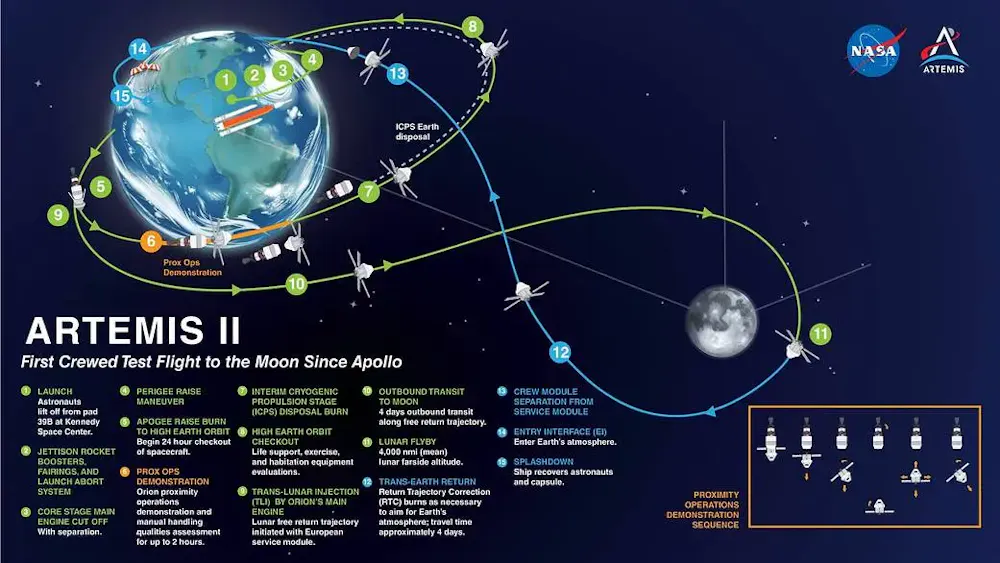
A diagram showing the trajectory of Artemis II and major milestones, from jettisoning its rocket boosters to the crew capsule's separation.
Artemis II’s four-person crew will circle around the Earth and the Moon.
NASA

Sending people beyond low Earth orbit requires sustained political commitment to spaceflight, funding stability and systems reliable enough that sovereign and commercial partners can align their own plans around them.

Artemis II also serves as a bridge to Artemis III, the mission where NASA plans to land astronauts near the Moon’s south pole, currently targeted for 2028. A credible, near-term human return signals that the U.S. is moving beyond experimentation and toward a sustained presence.

The Artemis II mission, detailed from launch to splashdown.

2 different models for going back to the Moon

The contrast between U.S. and Chinese lunar strategies is increasingly clear.

China’s program is centrally directed and tightly controlled by the state. Its partnerships are selective, and it has released few details about how activities on the Moon would be coordinated with other countries or commercial actors.

The U.S. approach, by contrast, is intentionally open. The Artemis program is designed so partners, both other countries and companies, can operate within a shared framework for exploration, resource use and surface activity.

This openness reflects a strategic choice. Coalitions among countries and companies expand their capabilities and shape expectations about how activities such as landing, operating surface equipment and using local resources are conducted.

When vague rules start to matter

International space law already contains a framework relevant to this emerging competition. Article IX of the 1967 outer space treaty requires countries to conduct their activities with “due regard” for the interests of others and to avoid harmful interference. In simple terms, this means countries are expected to avoid actions that would disrupt or impede the activities of others.

For decades, this obligation remained largely theoretical. On Earth, however, similarly open-ended rules, particularly in maritime contexts, created international conflicts as traffic on shipping lanes, resource extraction and military activity increased. Disputes intensified as some states asserted claims that extended beyond what international law recognized.

The Moon is now approaching a comparable phase.

As more actors converge on resource-rich regions, particularly near the lunar south pole, due regard becomes an immediate operational question rather than a theoretical future issue. How it is interpreted – whether it means simply staying out of each other’s way or actively coordinating activities – will shape who can operate where, and under what conditions.

Washington is naming the race − without panic

During his second Senate Commerce Committee confirmation hearing, NASA Administrator Jared Isaacman was asked directly about competition with China in lunar exploration. He emphasized the importance of keeping U.S. space efforts on track over time, linking the success of the Artemis program to long-term American leadership in space.

A similar perspective appears in a recent U.S. government assessment, the U.S.-China Economic and Security Review Commission’s 2025 annual report to Congress. Chapter 7 addresses space as a domain of strategic competition, highlighting China’s growing capabilities. The report frames human spaceflight and deep-space infrastructure – including spacecraft, lunar bases and supporting technologies – as part of broader strategic efforts. It emphasizes growing a human space program over time, rather than changing course in response to individual setbacks or the accomplishments of other countries.

Three people sitting at a panel table and one speaking at a podium with the NASA logo. Projected behind them is a slide reading Artemis Accords, with the flags of several countries.
The U.S. approach to spaceflight is emphasizing international cooperation.
Joel Kowsky/NASA via Getty Images

Recent U.S. policy reflects this emphasis on continuity. A new executive order affirms federal support for sustained lunar operations, as well as commercial participation and coordination across agencies. Rather than treating the Moon as a short-term challenge, the order anticipates long-term activity where clear rules, partnerships and predictability matter.

Artemis II aligns with this posture as one step in the U.S.’s plans for sustained activity on the Moon.

A different kind of test

As Artemis II heads toward the Moon, China will also continue to advance its lunar ambitions, and competition will shape the pace and manner of activity around the Moon. But competition alone does not determine leadership. In my view, leadership emerges when a country demonstrates that its approach reduces uncertainty, supports cooperation and translates ambition into a set of stable operating practices.

Artemis II will not settle the future of the Moon. It does, however, illustrate the American model of space activity built on coalitions, transparency and shared expectations. If sustained, that model could influence how the next era of lunar, and eventually Martian, exploration unfolds.

The Conversation

Michelle L.D. Hanlon is affiliated with For All Moonkind, Inc. a non-profit organization focused on protecting human cultural heritage in outer space.

ref. NASA’s Artemis II crewed mission to the Moon shows how US space strategy has changed since Apollo – and contrasts with China’s closed program – https://theconversation.com/nasas-artemis-ii-crewed-mission-to-the-moon-shows-how-us-space-strategy-has-changed-since-apollo-and-contrasts-with-chinas-closed-program-270245

Repeated government lying, warned Hannah Arendt, makes it impossible for citizens to think and to judge

Source: The Conversation – USA – By Stephanie A. (Sam) Martin, Frank and Bethine Church Endowed Chair of Public Affairs, Boise State University

Despite evidence to the contrary, Homeland Security Secretary Kristi Noem said at a Jan. 24, 2026, news conference that Alex Pretti ‘came with a weapon … and attacked’ officers, who took action to ‘defend their lives.’ AP Photo/Julia Demaree Nikhinson

In Minneapolis, two recent fatal encounters with federal immigration agents have produced not only grief and anger, but an unusually clear fight over what is real.

In the aftermath of Alex Pretti’s killing on Jan. 24, 2026, federal officials claimed the Border Patrol officers who fired weapons at least 10 times acted in self-defense.

But independent media analyses showed the victim holding a phone, not a gun, throughout the confrontation. Conflicting reports about the earlier death of Renée Good have similarly intensified calls for independent review and transparency. Minnesota state and local officials have described clashes with federal agencies over access to evidence and investigative authority.

That pattern matters because in fast-moving crises, early official statements often become the scaffolding on which public judgment is built. Sometimes those statements turn out to be accurate. But sometimes they do not.

When the public repeatedly experiences the same sequence – confident claims, partial disclosures, shifting explanations, delayed evidence, lies – the damage can outlast any single incident.

It teaches people that “the facts” are simply one more instrument of power, distributed strategically. And once that lesson sinks in, even truthful statements arrive under suspicion.

And when government stories keep changing, democracy pays the price.

CNN’s Jake Tapper goes through key excerpts from a judge’s ruling which found that Border Patrol official Greg Bovino lied “multiple times” about events surrounding his deployment of tear gas in a Chicago neighborhood.

Lying in politics

This is not a novel problem. During the U.S. Civil War, for example, President Abraham Lincoln handled hostile press coverage with a blunt mix of repression and restraint. His administration shut down hundreds of newspapers, arrested editors and censored telegraph lines, even as Lincoln himself often absorbed vicious, personal ridicule.

The Iran-Contra scandal in the 1980s brought similar disingenuous attempts by the Reagan administration to manage public perception, as did misleading presidential claims about weapons of mass destruction in the 2003 leadup to the Iraq War.

During the Vietnam era, the gap between what officials said in public and what they knew in private was especially stark.

Both the Johnson and Nixon administrations repeatedly insisted the war was turning a corner and that victory was near. However, internal assessments described a grinding stalemate.

Those contradictions came to light in 1971 when The New York Times and The Washington Post published the Pentagon Papers, a classified Defense Department history of U.S. decision-making in Vietnam. The Nixon administration fiercely opposed the document’s public release.

Several months later, political philosopher Hannah Arendt published an essay in the New York Review of Books called “Lying in Politics”. It was also reprinted in a collection of essays titled “Crises of the Republic.”

Arendt, a Jewish refugee who fled Germany in 1933 to escape Nazi persecution and the very real risk of deportation to a concentration camp, argued that when governments try to control reality rather than report it, the public stops believing and becomes cynical. People “lose their bearings in the world,” she wrote.

‘Nobody believes anything any longer’

Arendt first articulated this argument in 1951 with the publication of “The Origins of Totalitarianism,” in which she examined Nazism and Stalinism. She further refined it in her reporting for The New Yorker on the 1961 trial of Adolf Eichmann, a major coordinator of the Holocaust.

Arendt did not wonder why officials lie. Instead, she worried about what happens to a public when political life trains citizens to stop insisting on a shared, factual world.

Arendt saw the Pentagon Papers as more than a Vietnam story. They were evidence of a broader shift toward what she called “image-making” – a style of governance in which managing the audience becomes at least as important as following the law. When politics becomes performance, the factual record is not a constraint. It is a prop that can be manipulated.

The greatest danger of organized, official lying, Arendt warned, is not that people will believe something that is false. It is that repeated, strategic distortions make it impossible for citizens to orient themselves in reality.

“The result of a consistent and total substitution of lies for factual truth is not that the lie will now be accepted as truth and truth be defamed as a lie,” she wrote, “but that the sense by which we take our bearings in the real world … [gets] destroyed.”

She sharpened the point further in a line that feels especially poignant in today’s fragmented, rapid and adversarial information environment:

“If everybody always lies to you, the consequence is not that you believe the lies, but rather that nobody believes anything any longer,” she wrote. “A lying government has constantly to rewrite its own history … depending on how the political wind blows. And a people that no longer can believe anything cannot make up its mind. It is deprived not only of its capacity to act but also of its capacity to think and to judge.”

When officials lie time and again, the point isn’t that a single lie becomes accepted truth, but that the story keeps shifting until people don’t know what to trust. And when this happens, citizens cannot deliberate, approve or dissent coherently, because a shared world no longer exists.

A gray-haired woman with a cigarette, looking thoughtful.
Political theorist Hannah Arendt in 1963.
Bettman/Getty Images

Maintaining legitimacy

Arendt helps clarify what Minneapolis is showing us, and why the current federal government posture matters beyond one city.

Immigration raids are high-conflict operations by design. They happen quickly, often without public visibility, and they ask targeted communities to accept a heavy federal presence as legitimate. When killings occur in that context, truth and transparency are essential. They protect the government’s legitimacy with the public.

Reporting on the Pretti case shows why. Even as federal government leaders issued definitive claims about the victim’s allegedly threatening behavior – they said Pretti approached agents while pointing a gun – video evidence contradicted that official account.

The point isn’t that every disputed detail in a fast-moving, complicated event causes public harm. It’s that when officials make claims that appear plainly inconsistent with readily available evidence – as in the initial accounts of what happened with Pretti – that mismatch is itself damaging to public trust.

Distorted declarations paired with delayed disclosure, selective evidence or interagency resistance to outside investigations nudge the public toward a conclusion that official accounts are a strategy for controlling the story, and not a description of reality.

Truth is a public good

Politics is not a seminar in absolute clarity, and competing claims are always part of the process. Democracies can survive spin, public relations and even occasional falsehoods.

But Arendt’s observations show that it is the normalization of blatant dishonesty and systematic withholding that threatens democracy. Those practices corrode the factual ground on which democratic consent is built.

The U.S. Constitution assumes a people capable of what Arendt called judgment – citizens who can weigh evidence, assign responsibility and act through law and politics.

If people are taught that “truth” is always contingent and always tactical, the harm goes beyond misinformation. A confused, distrustful public is easier to manage and harder to mobilize into meaningful democratic participation. It becomes less able to act, because action requires a shared world in which decisions can be understood, debated and contested.

The Minneapolis shootings are not only an argument about use of force. They are a test of whether public institutions will treat facts and truth as a public good – something owed to the community precisely when tensions are highest. If democratic life depends on a social contract among the governed and those governing, that contract cannot be sustained on shifting sand. It requires enough shared reality to support disagreement.

When officials reshape the facts, the damage isn’t only to the record. The damage is to the basic belief that a democratic public can know what its government has done.

The Conversation

Stephanie A. (Sam) Martin does not work for, consult, own shares in or receive funding from any company or organization that would benefit from this article, and has disclosed no relevant affiliations beyond their academic appointment.

ref. Repeated government lying, warned Hannah Arendt, makes it impossible for citizens to think and to judge – https://theconversation.com/repeated-government-lying-warned-hannah-arendt-makes-it-impossible-for-citizens-to-think-and-to-judge-274340