The war after the war: How violence is passed down through generations

Source: The Conversation – Canada – By Myriam Denov, Professor and Canada Research Chair in Children, Families and Armed Conflict, McGill University

Editor’s note: This story is the first in a series of articles from Canada’s top social sciences and humanities academics. Click here to register for In Conversation with Myriam Denov, Feb. 25 at 1 p.m. ET. This is a virtual event co-hosted by The Conversation Canada and the Social Sciences and Humanities Research Council of Canada.

From Gaza to Ukraine and from Sudan to Myanmar, war rages across the globe, exacting its gravest toll on those least implicated in the violence: children. Today, an estimated 520 million children worldwide — or one in six — live in conflict zones. Yet even when fighting subsides and peace agreements are signed, violence doesn’t always end. War’s impact endures.

Northern Uganda provides a case in point. During the decades-long conflict from 1987 to 2006, the Lord’s Resistance Army (LRA), led by Joseph Kony, was formed to overthrow the Ugandan government and became well-known for the atrocities and war crimes it committed against civilians. The LRA abducted an estimated 80,000 children into armed conflict — a tactic meant to terrorize communities and swell the LRA’s ranks.

“Rose,” for example, was just 14 years old when the LRA abducted her from school in the mid-1990s. For eight years, she was held captive, forced to fight, coerced into a so-called “marriage” with an LRA commander and subjected to relentless abuse, including sexual violence. Her daughter, Grace, was born of that violence. Grace spent her early childhood in LRA captivity amid brutality, hunger, bombardment and displacement.

When Rose courageously escaped the LRA with Grace after eight years in captivity, they returned not to support but to rejection. Their community viewed them with fear and suspicion. Grace was stigmatized at school, within her extended family and in the wider community, branded “Kony’s child” after the rebel leader. Without stable housing and repeatedly displaced, Grace was forced to leave school and sell goods in the marketplace to support her family.

One day on her long rural walk to the market, the unimaginable happened. Grace was raped, later learning that she was pregnant as the result of the rape. In 2018, and still a teenager, Grace gave birth to Alice, a third-generation child whose life has already been shaped by a war that officially ended years earlier.

War does not end with ceasefires, but is transmitted across generations through stigma, violence, poverty and social exclusion. And despite their inherent connection to conflict, children born of war remain largely invisible in post-conflict discussion and justice efforts.

The war after the war

Sexual violence has long been used as a weapon of war. In recent years, the world has begun to acknowledge its devastating consequences for survivors, including physical injury, psychological trauma, economic marginalization and social exclusion. What remains far less visible are the intergenerational legacies of these crimes, particularly for children born of wartime sexual violence.

My ongoing research with children and youth like Grace shows they often face challenges strikingly similar to those of their mothers.

Many struggle to feel they belong, either within their families or their communities. They are frequently subjected to stigma and rejection. This stigma takes the form of being labelled “violent,” “dangerous” or “rebel children,” who are said to be cursed with “bad spirits” within their families, communities, schools and peer groups. This makes it difficult to develop a secure belonging and identity.

These children are also more likely to experience family and community violence and to encounter barriers to education, health care, land, inheritance, employment and legal rights.

Grace described the hostility she continues to face — and how the violence does not necessarily stop with the second generation — in stark terms:

“Life is hard here because people stigmatize us … they have turned their hate against us. In my family, they hate those of us who were born in captivity. My uncle beats us and said he would kill us. He doesn’t want rebel children, Kony children, at home … I know my child will face stigma. As long as my family is not willing to accept me, I believe they will reject my child as well.”

Rose also fears that Alice will one day inherit the same stigma, echoing Grace’s concerns:

“I feel it is possible my grandchild may be stigmatized because of my daughter’s past. They will say, ‘You see this beautiful child? Her mother was born in the bush.’”

For these families, war has not ended, it has simply changed shape. As one young man in my research who was born of sexual violence during wartime put it: “The war that we are now faced with is stigma.”

How resilience is passed down

And yet violence and devastation are not the whole story. Recognizing intergenerational harm does not mean reducing these families and their lineage to trauma alone.

Across generations and alongside profound loss, there is also resilience, resolve and an unyielding determination to build a different life.

Children born of war in northern Uganda are acutely aware of the sacrifices their mothers made to keep them alive. One young man recalled his mother’s escape from the LRA, carrying him through the bush while evading armed fighters, surviving on stolen cassava and refusing to leave his side even when confronted by death. “She held my hand,” he said. “She never left me.”

These memories of protection and survival are not just recollections of pain, they are sources of strength. Many children draw on them to imagine a future not defined solely by violence. Despite poverty, ostracism and ongoing marginalization, Grace spoke with clarity about what she wants for Alice:

“I want my child to be a doctor. I will support my child in every way possible to achieve this dream.”

This capacity to endure, adapt and hope is not accidental. It reflects what I have described as intergenerational resilience — the ways families transmit strength, meaning and survival strategies across generations, even in the aftermath of extreme violence.

Like a family heirloom, this resilience is forged through collective experience and memory. It equips young people with tools to confront adversity and reframes resilience not as an individual trait, but as a relational and intergenerational process rooted in family bonds and care.

What recognition makes possible

Too often, children born of war are reduced to dehumanizing labels in the countries where the war/genocide has occurred, often referring to them as “children of hate” or “bastards.” Such portrayals obscure both the violence that produced their marginalization and the extraordinary capacities they demonstrate to survive it.

If we continue to treat war as something that ends when peace agreements are signed, we will fail generations of children like Grace and Alice. Post-conflict recovery efforts, transitional justice processes and humanitarian responses must reckon with the fact that war’s harms are cumulative and intergenerational. This requires the meaningful inclusion of children born of war in reconciliation processes, reparations, community sensitization efforts and formal recognition in inheritance and citizenship law.


Read more:
Why Canada must step up to protect children in a period of global turmoil


This also means addressing stigma as a form of ongoing violence, ensuring access to education, employment and legal rights for children born of war and recognizing them not as symbols of past atrocities, but as rights-bearing individuals with futures worth investing in.

As one young participant who is part of my ongoing research in northern Uganda declared, reclaiming a narrative so often denied to them: “We are the light that came out of darkness.”

Intergenerational harms are not unique to northern Uganda, they are unfolding wherever war engulfs children today. And if we are serious about ending war’s toll on children, we must listen — and act accordingly.

The Conversation

Myriam Denov receives funding from the Social Science and Humanities Research Council of Canada, and the Canada Research Chair Program.

ref. The war after the war: How violence is passed down through generations – https://theconversation.com/the-war-after-the-war-how-violence-is-passed-down-through-generations-273669

How anti-ICE organising in Minnesota reactivated mutual aid networks started after George Floyd’s murder

Source: The Conversation – UK – By Gemma Ware, Host, The Conversation Weekly Podcast, The Conversation

Whenever US federal immigration agents pull up to a location in Minneapolis, people take their whistles out, start blowing them and start filming.

In December 2025, the US government sent more than 2,000 Immigration and Customs Enforcement (ICE) agents into Minnesota as part of Operation Metro Surge. They joined more than 700 agents already present in the state – their mission to find and deport people the Trump administration calls “worst of the worst illegal alien criminals.”

The residents of the  metropolitan area known as the Twin Cities – Minneapolis and Saint Paul – quickly came together to try to prevent their neighbours being caught up in ICE raids.  As well as monitoring ICE activities, block by block, people are organising mutual aid for neighbours fearful of going out in case of immigration raids.

Since their arrival, the Trump administration claims ICE agents have arrested more than 4,000 people in Minnesota.  They have also killed two American citizens, Renee Good and Alex Pretti.

In this episode of The Conversation Weekly podcast, we speak to Daniel Cueto-Villalobos, a doctoral candidate at the University of Minnesota, who lives in southern Minneapolis and studies race, religion and social movements. He tracks the neighbourhood groups that have sprung into action in response to the ICE presence back to mutual networks set up during the 2020 COVID pandemic, and in the wake of the murder of George Floyd by a Minneapolis policeman.

“What it did was force us to talk to each other in the most basic sense, and get together as a community to develop these networks that we see really playing out today,” says Cueto-Villalobos.

Listen on The Conversation Weekly podcast.

This episode of The Conversation Weekly was written and produced by Katie Flood, with production assistance from Mend Mariwany. Mixing by Eleanor Brezzi and theme music by Neeta Sarl. Gemma Ware is the executive producer.

Newsclips in this episode from Associated Press, Fox 11 Los Angeles, CBS Evening News, Reuters, CBS News, LiveNow Fox and NBC News.

Listen to The Conversation Weekly via any of the apps listed above, download it directly via our RSS feed or find out how else to listen here. A transcript of this episode is available via the Apple Podcasts or Spotify apps.

The Conversation

Daniel Cueto-Villalobos has received funding for his research from the Lilly Endowment.

ref. How anti-ICE organising in Minnesota reactivated mutual aid networks started after George Floyd’s murder – https://theconversation.com/how-anti-ice-organising-in-minnesota-reactivated-mutual-aid-networks-started-after-george-floyds-murder-275632

What dating apps are really optimizing. Hint: it isn’t love

Source: The Conversation – Canada – By Mathieu Lajante, Associate Professor in Marketing, Toronto Metropolitan University

In the weeks leading up to Valentine’s Day, dating apps typically see a spike in new users and activity. More profiles are created, more messages sent, more swipes logged.

Dating platforms market themselves as modern technological solutions to loneliness, right at your fingertips. And yet, for many people, the day meant to celebrate romantic connection feels lonelier than ever.

This, rather than a personal failure or the reality of modern romance, is the outcome of how dating apps are designed and of the economic logic that governs them.

These digital tools aren’t simply interfaces that facilitate connection. The ease and expansiveness of online dating have commodified social bonds, eroded meaningful interactions and created a type of dating throw-away culture, encouraging a sense of disposability and distorting decision-making.

The business of modern dating

Online dating apps are big business.

Match Group, a technology company that dominates the online dating sector with an extensive portfolio of dating app products — including Tinder, Hinge, Match.com, OkCupid, Plenty of Fish and OurTime — reported fourth-quarter revenue of US$878 million this month.

Its analysis showed fewer people paying for its apps, with paying users down five per cent year over year.

The decline appears to reflect a trend prompting the company to develop new artificial intelligence tools to drive user growth and appeal to younger customers. Part of this means converting free users into paying ones.

Dating apps don’t sell love. They sell the feeling that love is one premium upgrade away. The platforms aren’t primarily designed for users to find love and promptly delete the apps from their phones. They’re designed to keep users swiping.

Why swiping never ends

Prolonged uncertainty is profitable. By creating the sense that a better match is always one swipe away keeps users engaged. Design strategies that gamify choice, offer intermittent variable rewards (like a slot machine) and frequent push notifications produce a fear-of-missing-out mentality and can lead to compulsive and addictive patterns of use.

Maximizing user interaction and time spent on the app and accumulating consumer data turn users into lucrative opportunities for paid features, monthly subscriptions and advertising dollars.

Dating apps market the idea that dating platforms can achieve our social goals more efficiently and more intelligently, meeting a real-world need with a technological solution.

In this system, people are expected to constantly improve and optimize themselves. Paying for added features becomes an investment in oneself, while value is determined by desirability, performance and outcomes.

By creating an interesting profile, crafting witty messages and curating photos and videos of ourselves, we commodify our time and self-worth, reinforcing the idea that we alone are responsible for our success on the apps, even if the playing field is strategically manipulated to keep us on them longer.

So are we being set up to fail? The distinction between failure and success overlooks a key issue: dating apps function as political entities that control access to and distribution of resources.

Changing social reality

Online dating apps sell us hope by exploiting our needs, desires and insecurities. When apps keep hinting that something better is just one more swipe away, they start to reshape our expectations, and even inflate them.

Typically, people employ a decision-making strategy called “satisficer,” which refers to both “satisfy” and “suffice.” This means we generally choose something that’s good enough, rather than searching endlessly for perfection, because of limits on time, information and cognitive energy. In relationship decisions, compatibility used to be enough.

With apps, there’s an endless supply of options — endless potential partners, endless possibilities. The issue is that the options feel infinite and, as a result, we’re being trained not to be satisfied anymore. Rather, we’re encouraged to keep swiping.

This process creates a stream of potential matches that commodifies social interactions by using user engagement to refine algorithms. The platforms serve as central planners of resource access, production and distribution, offering the information technologies and databases that guide decisions in a global market of potential partners. As a result, human actions are treated as market-based transactions.

Users adopt a consumption mindset in which choosing partners is no different from shopping, constantly comparing others and discarding some in search of the highest-value partner.

Rather than being defined by connection or mutual care, interactions become a question of optimizing our choices among endless options. The illusion of oversupply creates the sense that people are replaceable and forces them to compete on superficial standards of beauty or status. Success and desirability on these platforms tend to reinforce existing hierarchies such as class, race and religion.

These tools can also promote a rejection mindset, with users more likely to reject potential partners as the number of options increases, becoming more closed off to romantic opportunities.

Loneliness is a feature, not a flaw

Reducing romantic connection to a commodity weakens social bonds and prioritizes individual success over community, leading to increased isolation and loneliness.

Dating apps are active platforms that prioritize personal preferences and individual strategies rather than addressing structural inequalities or the underlying causes of loneliness.

By fostering a competitive digital environment, these apps encourage disposability and change how people assess and select one another, often resulting in burnout and cynicism.

Users are prompted to view themselves as products to be optimized and others as options to evaluate. Dependence on dating apps to address loneliness ultimately weakens our social bonds and alters how we engage with one another.

The Conversation

Mathieu Lajante is the founder and principal at BomaliQ Inc.

Sameh Al Natour is affiliated with Liberal Party of Canada.

ref. What dating apps are really optimizing. Hint: it isn’t love – https://theconversation.com/what-dating-apps-are-really-optimizing-hint-it-isnt-love-274931

Water in the dams, but South Africa’s taps are dry: essential reads on a history of bad management

Source: The Conversation – Africa – By Caroline Southey, Founding Editor, Africa, The Conversation

It’s become a common refrain in South Africa: there’s no drought, dams and reservoirs are full, but the taps are dry.

The ongoing crisis has been decades in the making. South Africa is a water-scarce country, yet it has failed to take even basic measures to preserve water supplies. These include:

The chronic crisis is underscored by the fact that the challenges – and what needs to be done about them – have been known for some time, as these articles from our archives show.


Johannesburg’s water crisis is getting worse – expert explains why the taps keep running dry in South Africa’s biggest city

Cape Town’s sewage treatment isn’t coping: scientists are worried about what the city is telling the public

The right to water is out of reach for many South Africans: case study offers solutions

South Africans flush toilets with drinkable water: study in Cape Town looked at using seawater instead

South Africa’s sewage crisis: official reports don’t include millions of litres of leaking wastewater

Is my water safe to drink? Expert advice for residents of South African cities

How to make sure water is safe to drink: four practical tips

The Conversation

ref. Water in the dams, but South Africa’s taps are dry: essential reads on a history of bad management – https://theconversation.com/water-in-the-dams-but-south-africas-taps-are-dry-essential-reads-on-a-history-of-bad-management-275832

How to get away with mass murder: 4 tactics Ethiopia used to hide Tigray atrocities from the world

Source: The Conversation – Africa (2) – By Teklehaymanot G. Weldemichel, Lecturer in Environment and Development, University of Manchester

The Tigray region in Ethiopia’s north has endured one of the world’s deadliest armed conflicts of the 21st century. Between 2020 and 2022, as many as 800,000 people were killed (out of a regional population of about 7 million). This rivals estimates from recent major conflicts, including those in Ukraine, Yemen, Sudan and Syria.

The war was fought between Tigray’s security forces and the allied forces of Ethiopia and Eritrea, along with ethnic militias from different regions of Ethiopia.

This period was marked by organised massacres. There was also systematic sexual violence and mass displacement. Ethnic cleansing and prolonged siege conditions devastated civilians.

Despite its unparalleled scale, the Tigray crisis remained largely invisible to the world. Factors such as race and the peripherality of the region made the Tigray conflict a blind spot in global geopolitics. But these explanations are not sufficient.

I have studied Ethiopia’s politics, and closely followed developments in Tigray since the outbreak of the war. In a recent article, I examined the steps taken by the Ethiopian government and its allies to conceal atrocities from global scrutiny.

I analysed government statements, media coverage and reports from local and international human rights organisations shortly before and during the war. I found that the war and its associated human rights and humanitarian crises were not hidden by accident. They were actively rendered invisible.

The Ethiopian government and its allies employed four major tactics to create a “zone of invisibility” – a deliberate effort to obscure what was happening:

These measures allowed atrocities to unfold with limited external scrutiny.

The tactics could easily be replicated by Ethiopia – or by other authoritarian regimes elsewhere – which makes understanding the Tigray case crucial.

The Tigray war demonstrates how modern authoritarian states can combine military force, information control and narrative framing to obscure mass atrocities.

When mass violence is rendered invisible, it is rarely resolved. Instead, it is reproduced. And when accountability is deferred, the conditions that enabled atrocities remain intact.

Manufactured invisibility

The production of a “zone of invisibility” in Tigray was the result of deliberate political and military strategies. The Ethiopian government and its allies systematically limited what could be seen, documented and understood about the war.

1. Communication shutdowns: Immediately after the war began, the Ethiopian government imposed a near-total communications blackout. This lasted over two years. It happened alongside widespread disruptions of telecom, media and power infrastructure. These measures isolated Tigray and prevented information about violence from circulating.

2. Restrictions on journalists and humanitarian organisations: Access to the region was tightly controlled. Journalists and humanitarian organisations were denied entry or restricted in their movements. This removed independent witnesses who could document events and convey civilian suffering to global audiences.

3. Physical blockades: Road closures, territorial occupation and blocked aid routes physically isolated the region. Tigray became a space where violence was difficult to observe or escape, allowing atrocities to unfold largely beyond international scrutiny.

4. Narrative framing: The federal state promoted narratives that made the violence in Tigray appear legitimate and necessary. Official discourse and allied media portrayed Tigrayans as “rebels”, “weeds” and a “cancer in the body politic”. This language dehumanised the population and normalised collective punishment. Such framing dampened calls for intervention and accountability. Additionally, the Tigray war was presented as a “law enforcement operation”. It was often addressed as a domestic conflict. This is despite the full-scale involvement of the Eritrean army. Foreign states also supplied weapons, including the United Arab Emirates, Israel, Turkey and China.

Taken together, these patterns suggest that the violence was structured, targeted and sustained.

Large-scale fighting in Tigray formally ended with the Pretoria Cessation of Hostilities Agreement in November 2022. However, the aftermath has not brought justice or security.

Instead, violence has persisted in Tigray – and spread across Ethiopia.

Accountability mechanisms have been weakened or dismantled. Survivors of the 2020–2022 war continue to live under conditions of profound insecurity, humanitarian deprivation and ongoing human rights violations.

Evading justice and accountability

Following the ceasefire deal in 2022, the Ethiopian regime effectively undermined and ultimately dismantled international investigative mechanisms into crimes committed during the Tigray war.

In 2023, both the UN-mandated International Commission of Human Rights Experts on Ethiopia and an African Union commission of inquiry were terminated. This left no independent international body to pursue accountability.

The dismantling of these mechanisms partly resulted from a sustained campaign by the regime and its allies. However, international actors also allowed themselves to be persuaded by promises made by Ethiopian authorities to establish domestic transitional justice processes.

These commitments amounted to what the UN Commission of Human Rights Experts on Ethiopia has described as “quasi-compliance”: symbolic gestures rather than genuine efforts to ensure accountability.

This is evident in the absence of meaningful attempts to prosecute perpetrators, protect survivors or halt ongoing violence in the post-ceasefire period.

Instead, the Ethiopian state has used the ceasefire agreement to rehabilitate its international image. It has re-established diplomatic and trade relations with regional blocs such as the European Union. These ties had been strained by human rights violations in Tigray.

What happens when atrocities go unnoticed, unpunished, or even tacitly accepted? Impunity does not end violence; it perpetuates it.

After a relative pause over the past three years, active war has flared up again in Tigray in 2026.

This has raised the prospect of a renewed full-scale siege. This is evidenced by recent drone attacks and the suspension of flights to the region.

Further, since late 2025, the federal government has seemed to be moving toward a potential war with Eritrea. This would severely impact Tigray once again. Any confrontation is likely to be fought over Tigrayan territory.

Ethiopia is invoking Eritrea’s occupation of Tigrayan territories – as grounds for confrontation.

In an address to the federal parliament in February 2026, Prime Minister Abiy Ahmed further acknowledged that the Eritrean army killed civilians on a large scale in Tigray, and dismantled and looted civilian infrastructure.

With rhetoric hardening on both sides, war appears increasingly likely.

Diffusion of violence beyond Tigray

The enduring consequences of invisibility and impunity are evident across Ethiopia.

Since the signing of the ceasefire in 2022, the Ethiopian regime and its former allies have fractured and turned their weapons against one another.

In the Amhara region, south of Tigray, is the Fano. This is an ethnic militia accused of ethnic cleansing in western Tigray and other grave crimes alongside the federal army. It’s now been engaged in armed conflict with that same army for nearly three years.

Meanwhile, violence in the Oromia region, which began long before the Tigray war, has continued unabated.

Tactics that were tested and refined during the Tigray war are now being redeployed against civilians in both Amhara and Oromia.

Rather than marking a transition to peace, the post-ceasefire period in Tigray has led to the diffusion and normalisation of violence across Ethiopia’s political and geographic landscape.

The Conversation

Teklehaymanot G. Weldemichel does not work for, consult, own shares in or receive funding from any company or organisation that would benefit from this article, and has disclosed no relevant affiliations beyond their academic appointment.

ref. How to get away with mass murder: 4 tactics Ethiopia used to hide Tigray atrocities from the world – https://theconversation.com/how-to-get-away-with-mass-murder-4-tactics-ethiopia-used-to-hide-tigray-atrocities-from-the-world-275298

Who is the new face of China’s Year of the Fire Horse? Draco Malfoy, of course

Source: The Conversation – Global Perspectives – By Justine Poplin, Teaching Associate, Faculty of Education, Southern Cross University

Warner Bros, Canva, The Conversation, CC BY-NC

The Chinese Year of the Fire Horse has a new, unexpected mascot: Draco Malfoy.

Associating the Harry Potter antagonist with China’s Year of the Fire Horse might seem odd or whimsical. But it has much to teach us about the complexities of Chinese Mandarin wordplay, online participation and meme-making culture.

A search for Malfoy memes manifest his youthful head floating jubilantly, amid a background of red, gold and black calligraphy.

Meaning in images

In China, Lunar New Year decorations are designed to summon luck, prosperity and protection into the home – and visual puns and homophones are a common feature.

Classic New Year prints often include images of names that sound like phrases for good fortune or prosperity. You will commonly see images of the Zodiac, red lanterns, golden carp, fleshy pink peaches and gold ingots – all symbolising abundance.

Prior to the annual festival, the Chinese character fu 福 (good fortune) is often displayed upside-down on doors and walls in Chinese homes.

This is because the word for “upside-down” (倒, dao) is word play on the word “arrive” (到, dao) in Mandarin. Hanging the fu 福 upside down means “Good fortune has arrived”.

There is other word play, too. Yu 魚 (fish) sounds like the word for surplus, so fish imagery suggests abundance.

During last year’s Year of the Snake wordplay used snake (蛇, shé) and earthly beings/humans (巳, sì) to pair snake imagery with phrases about time, events or letting go.

This Year of the Fire Horse is historically linked with energy, momentum and breakthrough.

In Mandarin, Malfoy 马尔福 (Ma er fu) contains phonetic elements that resonate with words associated with horses (马, ma) and good fortune (福, fu). Hanging Malfoy upside-down on a door or wall extends the same pun, suggesting “good horse fortune has arrived” in your home.

In this way, Malfoy sheds his snake skin from villain to a serendipitous linguistic fit for a year defined by fiery horses and potential prosperity: a modern good luck poster.

Visual remixing

Humour, wordplay and visual remixing are a key feature of Chinese internet culture.

Memes thrive on shared visual references, which can be easily remixed. Malfoy’s titanium white hair and sharp features make him iconic, even in small or edited images.

Another example of homophonic wordplay was during the #MeToo movement.

Facing political sensitivity in China, activists embraced phonetic wordplay to visualise the phrase #MeToo, juxtaposing images of a bowl of rice (米饭, mi fan) with a rabbit (兔子, tuzi). The Chinese meme, Mi Tu (literally rice bunny) is visually coded “cute” on the surface, yet functions with the potency and strategic agility of a Trojan Horse.

The memes became a political statement, to visually disrupt and address sexual abuse or harassment.

The Grass Mud Horse (草泥马, cǎonímǎ) is a mythological alpaca co-created in 2009 as a linguistic and visual protest symbol.

Its name is a homophone for a well known insult, enabling users to express defiance while circumventing censorship. It became a playful yet powerful emblem of resistance to information control, widely circulated through music videos, memes and satirical narratives.

The homophonic wordplay of Draco Malfoy performs a similar cultural function – with celebration that evolves tradition, rather than political protest. Users paste Malfoy’s face onto fire horse emojis, Chinese calligraphy or zodiac themed layouts. Others animate him riding red horses or link his image with auspicious greetings.

Culturally specific memes

Visual culture is culturally specific: meaning cannot be transported across contexts without interpretive friction.

Chinese culture has a long history of playful symbolism. The Malfoy memes fit into that tradition using humour and visual puns to express good wishes. It does not replace sacred rituals or religious practices.

Lunar New Year is not only about preserving tradition. Malfoy as a literary villain may be ironic through a Western lens. However, his image becomes a shared entry point into cross-cultural exchange.

It is about renewing hope for the future, and memes are a clever example of how language shapes visual culture and how traditions evolve.

Visual literacy enables us to unlock the cultural keys embedded within symbols and myths, revealing layers of meaning that might otherwise remain obscured.

Online spaces are where a fictional wizard can temporarily join a centuries-old symbolic system built on flexible wordplay and visual humour for the Year of the Fire Horse.

The Conversation

Justine Poplin does not work for, consult, own shares in or receive funding from any company or organisation that would benefit from this article, and has disclosed no relevant affiliations beyond their academic appointment.

ref. Who is the new face of China’s Year of the Fire Horse? Draco Malfoy, of course – https://theconversation.com/who-is-the-new-face-of-chinas-year-of-the-fire-horse-draco-malfoy-of-course-275443

Exiled Iranians and Venezuelans may well support regime change – but diasporas don’t always reflect the politics back home

Source: The Conversation – Global Perspectives – By Michael Paarlberg, Associate Professor, Political Science, Virginia Commonwealth University

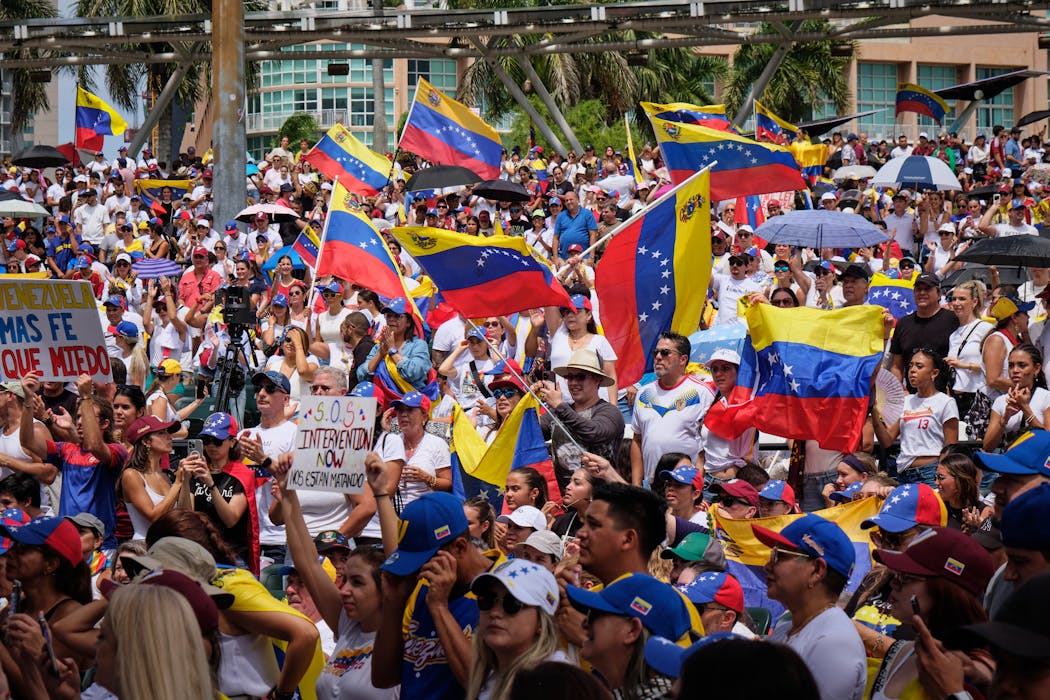
Venezuelans in South Florida protest Nicolás Maduro in August 2024. Carlos Escalona/Anadolu via Getty Images

As protest and military action raised the prospect of regime change in Iran and Venezuela, the voices of both countries’ diasporas were heard loud and clear through the media of their host nations.

Venezuelan exiles in the U.S. were, according to the popular narrative, broadly behind President Donald Trump and his plan to “run Venezuela,” as the nickname “MAGAzuelans” suggests. Meanwhile, the Iranian diaspora rallied behind the Prince Reza Pahlavi as he positioned himself as a leader-in-waiting, projecting an image of unified exile support.

Diasporas are often treated by media and policymakers as monolithic blocs — politically unified, ideologically coherent and ready to be mobilized for regime change. But as a scholar of migration and security in Latin America, I know this assumption fundamentally misunderstands how diaspora communities form, evolve and engage politically.

Iranian and Venezuelan émigrés might broadly oppose their current governments — having left them, this is unsurprising. But they are far from unified on what should replace those governments, who should lead or how change should come about.

Migration waves shape politics

Diasporas are not uniform because their constituent populations did not arrive all at once, from the same places or for the same reasons. Each migration wave carries distinct political orientations shaped by the circumstances of departure.

Consider the Turkish diaspora in Europe. It has a reputation for religious conservatism and nationalism favoring the ruling party of Turkish President Recep Tayyip Erdoğan — seemingly paradoxical given that most live in liberal democracies and support center-left parties in their host countries.

The explanation lies in history, as diaspora scholar Eva Østergaard-Nielsen has detailed. Turkish migration to Europe came in successive waves, each marginalized by Turkey’s longtime secular establishment that dominated the country’s politics until the rise of Erdoğan in the early 2000s. Religious conservatives fled discrimination, Kurds fled persecution, and later came economic migrants. Erdoğan’s ruling AKP has capitalized on this with active outreach to these established diaspora communities.

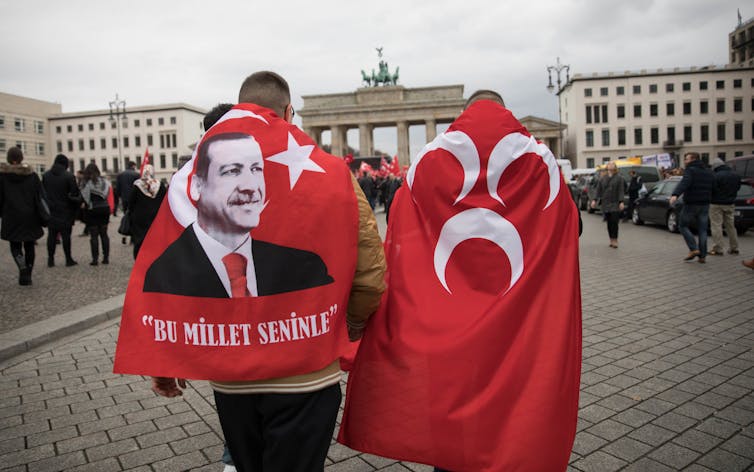
Two men wear red flags with the face of a man on it.
Pro-Recep Tayyip Erdoğan supporters in Berlin in November 2016.
Jörg Carstensen/picture alliance via Getty Images

Only recently have those fleeing the AKP government itself begun to establish a foothold in the diaspora. In a working paper, Gülcan Sağlam and I found that sentiment toward the Turkish ruling party is not predictable by demographic profile, nor is it counteracted by integration or support for liberal European Union parties. Rather, members of the diaspora’s politics are informed by individual personal beliefs and perceptions of discrimination.

The Turkish experience also speaks to the tendency of diasporas to become politically frozen at the moment of departure from their home countries. The same pattern appears across contexts. For example, El Salvador’s diaspora in the United States, which first left during the 1980s civil war, developed a reputation for being “stuck in the ‘80s” — mentally still fighting battles that had long since ended at home.

This temporal displacement has consequences. Iranian-American sociologist Asef Bayat, writing about the Iranian diaspora, argues that exile opposition to the ruling government back home “suffers from a political disease, positioning itself against the movement it claims to support.”

In other words, diaspora activists may advocate positions that resonate with Western audiences, but find little support among those actually living under authoritarian rule. This lack of accountability to political consequences back home can rankle the constituencies on whose behalf they seek to advocate.

Research on the Venezuelan diaspora reflects similar dynamics. A 2022 study found that Venezuelan exiles hold more extreme anti-Venezuelan government views than those who remained.

The myth of diaspora influence

Yet despite the presumed disconnection of diaspora groups, homeland politicians often devote disproportionate attention to those who have left. The logic is simple: Emigrants send money home — accounting for as much as 25% of gross domestic product in some Central American and Caribbean countries. Politicians assume that this financial power translates into political influence over remittance-receiving relatives.

One party official in El Salvador told me: “If we get one Salvadoran in Washington to support us, that gives us five votes in El Salvador — and it doesn’t even matter if the one in Washington votes.”

My own research tested this assumption using polling and voting data across Latin America and found it to be exaggerated. Remittances and family communication mostly reinforce existing, mutual partisan sympathies rather than swing votes.

But the belief in diaspora influence matters politically. And the diaspora voters can be weaponized by authoritarian leaders.

El Salvadoran President Nayib Bukele, in his successful and plainly unconstitutional 2024 reelection bid, expanded external voting through online balloting, increasing diaspora votes by 87-fold over the previous election.

He then directed all diaspora votes to count in San Salvador, despite more emigrants coming from the eastern departments of San Miguel and La Unión. This helped swamp the remaining opposition parties in the capital.

Diasporas in opposition

What happens when diasporas oppose rather than support authoritarian governments? The scholarship offers sobering lessons.

Diasporas can influence home country politics through several channels: direct voting, financial support for opposition movements, lobbying host governments and transmitting democratic values through what sociologist Peggy Levitt calls “social remittances” — the ideas, practices and norms that flow alongside money transfers.

Other research has found that remittances can undermine dictatorships by helping fund opposition activities.

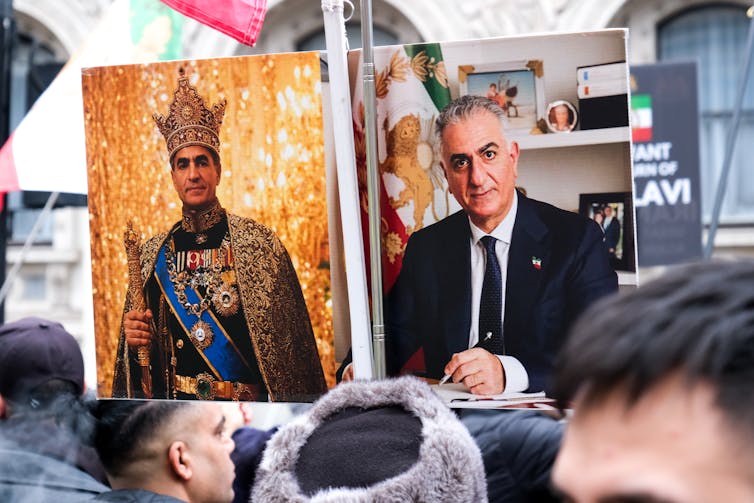
A group holds aloft posters of a man in a royal regalia.
Iranian anti-regime protesters in London show support for the exiled Reza Pahlavi.
Matthew Chattle/Future Publishing via Getty Images

Yet authoritarian governments have developed sophisticated countermeasures. Research on Arab diaspora activism documents shows how governments deter dissent through transnational repression. Freedom House, the democracy and good governance nongovernmental organization, recorded over 1,200 incidents of “physical transnational repression” against dissidents – including assassinations, abductions, assaults and unlawful deportation – between 2014 and 2024 involving 48 governments.

The Cuban example

The Cuban exile community offers, perhaps, the most studied example of diaspora political mobilization. For decades, the Cuban American lobby shaped — some would say dictated — U.S. Cuba policy.

Yet even this influence is easily overstated. The exiles who fled immediately after the 1959 revolution for political reasons constitute a smaller share of the overall Cuban diaspora than commonly assumed.

Subsequent migration waves included far more working-class economic migrants with different political orientations. By 2014, polls showed 52% of Cuban Americans opposed the U.S. embargo that their lobby had championed. The lobby’s influence waned after founder Jorge Mas Canosa’s death in 1997, and the Elián González affair – a messy international custody battle involving a 6-year-old Cuban boy – further fractured the community.

The limits of exile politics

For Venezuela and Iran, these lessons counsel caution. Nearly 8 million Venezuelans have fled their homeland — the largest displacement crisis in the Western Hemisphere. Meanwhile, Iranian emigration accelerated after the 2022 protests.

Both diasporas contain passionate activists, wealthy donors and would-be leaders positioning themselves for future rule. But passion does not equal unity, and visibility does not equal representation.

The loudest voices on social media — or those amplified by U.S. government officials and media — may represent narrow slices of diverse communities. Certain figures project unified support they do not actually command. There may be a rough consensus on opposing the hated government back home, but far less consensus on what should be done — or how to achieve change.

Nor does diaspora opposition necessarily translate into government vulnerability. Authoritarian states have learned to insulate themselves from diaspora pressure while simultaneously using emigration as a safety valve, turning potential dissidents into remittance-senders – as Cuba did by abolishing exit visas in 2013.

Diasporas can contribute to democratic change through funding, advocacy and the slow work of transmitting democratic values. But ultimately, the path to democratic change in Venezuela, Iran and elsewhere will be determined by those who remain, not those who left. Diasporas can support that struggle; they cannot substitute for it.

The Conversation

Michael Paarlberg does not work for, consult, own shares in or receive funding from any company or organization that would benefit from this article, and has disclosed no relevant affiliations beyond their academic appointment.

ref. Exiled Iranians and Venezuelans may well support regime change – but diasporas don’t always reflect the politics back home – https://theconversation.com/exiled-iranians-and-venezuelans-may-well-support-regime-change-but-diasporas-dont-always-reflect-the-politics-back-home-275112

How bird poo fuelled the rise of Peru’s powerful Chincha Kingdom

Source: The Conversation – Global Perspectives – By Jo Osborn, Assistant Professor of Anthropology, Texas A&M University

Islands off the coast of Peru are home to millions of seabirds. Their droppings were an important fertiliser for Indigenous people in the Andes. Jo Osborn

In 1532, in the city of Cajamarca, Peru, Spanish conquistador Francisco Pizarro and a group of Europeans took the Inca ruler Atahualpa hostage, setting the stage for the fall of the Inca Empire.

Before this fateful attack, Pizarro’s brother, Pedro Pizarro, made a curious observation: other than the Inca himself, the Lord of Chincha was the only person at Cajamarca carried on a litter, a carrying platform.

Why did the Lord of Chincha occupy such a high position in Inca society? In our new study published in PLOS One, we find evidence for a surprising potential source of power and influence: bird poo.

A potent and precious resource

Chincha, in southern Peru, is one of several river valleys along the desert coast fed by Andean highland waters, which have long been key to irrigation agriculture. About 25 kilometres out to sea are the Chincha Islands, with the largest guano deposits in the Pacific.

Seabird guano, or excrement, is a highly potent organic fertiliser. Compared to terrestrial manures such as cow dung, guano contains vastly more nitrogen and phosphorus, which are essential for plant growth.

On the Peruvian coast, the Humboldt/Peru ocean current creates rich fisheries. These fisheries support massive seabird colonies that roost on the rocky offshore islands.

Rocky island covered in white bird droppings.
Seabirds use coastal islands to build their nests, and find food nearby in the rich fisheries of the Peruvian current.
Jo Osborn

Thanks to the dry, nearly rainless climate, the seabird guano doesn’t wash away, but continues to pile up until many meters tall. This unique environmental combination makes Peruvian guano particularly prized.

Our research combines iconography, historic written accounts, and the stable isotope analysis of archaeological maize (Zea mays) to show Indigenous communities in the Chincha Valley used seabird guano at least 800 years ago to fertilise crops and boost agricultural production.

We suggest guano likely shaped the rise of the Chincha Kingdom and its eventual relationship with the Inca Empire.

Lords of the desert coast

The Chincha Kingdom (1000–1400 CE) was a large-scale society comprising an estimated 100,000 people. It was organised into specialist communities such as fisherfolk, farmers and merchants. This society controlled the Chincha Valley until it was brought into the Inca Empire in the 15th century.

Given the proximity of historically important guano deposits on the Chincha Islands, Peruvian historian Marco Curatola proposed in 1997 that seabird guano was an important source of Chincha’s wealth. We tested this hypothesis and found strong support.

A biochemical test

Biochemical analysis is a reliable way to identify the use of fertilisers in the past. One experimental 2012 study showed plants fertilised with dung from camelids (alpacas and llamas) and seabirds show higher nitrogen isotope values than unfertilised crops.

Maize cobs on a grey background
Archaeological maize cobs were collected from sites in the Chincha Valley for isotopic analysis.
C. O’Shea

We analysed 35 maize samples recovered from graves in the Chincha Valley, documented as part of an earlier study on burial practices.

Most of the samples produced higher nitrogen isotope values than expected for unfertilised maize, suggesting some form of fertilisation occurred. About half of the samples had extremely high values. These results are so far only consistent with the use of seabird guano.

This chemical analysis confirms the use of guano on pre-Hispanic crops.

Imagery and written sources

Guano – and the birds that produce it – also held broader significance to the Chincha people.

Our analysis of archaeological artefacts suggests the Chincha people had a profound understanding of the connection between the land, sea and sky. Their use of guano and their relationship with the islands was not just a practical choice; it was deeply embedded in their worldview.

Carved wooden paddle decorated with red, green, and yellow paint, featuring a line of small figures at the top and animal carvings down the center.
This decorated wooden object from Chincha, which has been interpreted as either a ceremonial paddle or digging stick, depicts seabirds and fish alongside human figures and geometric designs.
The Met Museum, 1979.206.1025.

This reverence is reflected in Chincha material culture. Across their textiles, ceramics, architectural friezes and metal objects, we see repeated images of seabirds, fish, waves, and sprouting maize.

These images demonstrate the Chincha understood the entire ecological cycle: seabirds ate fish from the ocean and produced guano, guano fed the maize, and the maize fed the people.

This relationship may even be reflected today through local Peruvian place names. Pisco is derived from a Quechua word for bird, and Lunahuaná might translate to “people of the guano”.

Poo power

As an effective and highly valuable fertiliser, guano also enabled Chincha communities to increase crop yields and expand trade networks, contributing to the economic expansion of the Chincha Kingdom.

We suggest fisherfolk sailed to the Chincha Islands to acquire guano and then provided it to farmers, as well as to seafaring merchants to trade along the coast and into the highlands.

Chincha’s agricultural productivity and growing mercantile influence would have enhanced its strategic importance for the Inca Empire. Around 1400 CE, the Inca incorporated the Chincha after a “peaceful” capitulation, creating one of the few calculated alliances of its kind.

Although the “deal” made between Chincha and Inca remains debated, we suggest seabird guano played a role in these negotiations, as the Inca state was interested in maize but lacked access to marine fertilisers. This may be why the Lord of Chincha was held in such high esteem that he was carried aloft on a litter, as Pedro Pizarro noted.

The Inca came to value this fertiliser so much they imposed access restrictions on the guano islands during the breeding season and forbade the killing of guano birds, on or off the islands, under penalty of death.

Our study expands the known geographic extent of guano fertilisation in the pre-Inca world and strongly supports scholarship that predicted its role in the rise of the Chincha Kingdom. However, there is still much to learn about how widespread it was, and when this practice began.

The Conversation

The authors do not work for, consult, own shares in or receive funding from any company or organisation that would benefit from this article, and have disclosed no relevant affiliations beyond their academic appointment.

ref. How bird poo fuelled the rise of Peru’s powerful Chincha Kingdom – https://theconversation.com/how-bird-poo-fuelled-the-rise-of-perus-powerful-chincha-kingdom-275316

Italy hosted the Winter Olympics 70 years ago. What was it like, and what’s changed?

Source: The Conversation – Global Perspectives – By Richard Baka, Honorary Professor, School of Kinesiology, Western University, London, Canada; Adjunct Fellow, Olympic Scholar and Co-Director of the Olympic and Paralympic Research Centre, Institute for Health and Sport, Victoria University

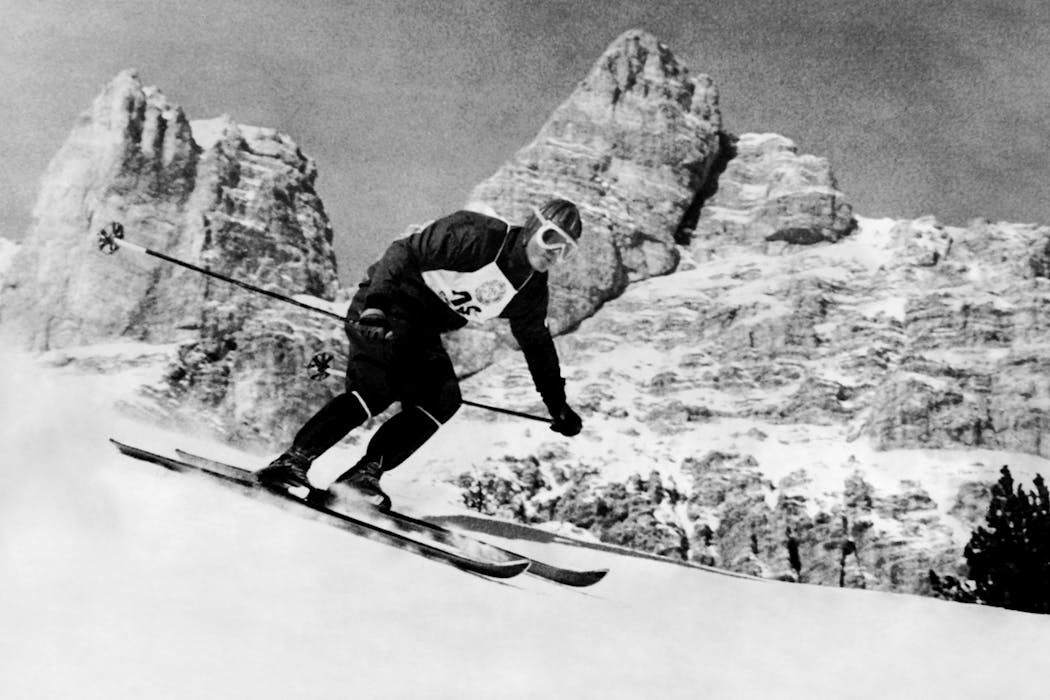
Italian skier Bruno Burrini at the 1956 Winter Olympic Games in Milano Cortina. Getty Images

The 2026 Milan Cortina Winter Olympics are Italy’s fourth as Olympic host and come 70 years after the region first welcomed the world’s best winter athletes.

It is Italy’s third Winter Olympics, second only to the United States (four), reinforcing the nation’s long-standing influence within the Olympic movement.

So, what’s changed since 1956?

Looking back: Cortina d’Ampezzo 1956

The 1956 winter games were originally scheduled for 1944 but were postponed due to the second world war, eventually taking place in Cortina d’Ampezzo.

It was groundbreaking in several ways.

The games ran for 11 days, far shorter than this year’s 17-day program.

Italian skier Giuliana Chenal-Minuzzo became the first woman to recite the Olympic Oath at an opening ceremony.

For the first time, the Winter Olympics were broadcast live on television, albeit in black and white, to nine European nations.

In 1956, winter and summer games were held in the same year, (Melbourne hosted the Summer Olympics that year).

This changed in 1994, when the International Olympic Committee (IOC) moved them to alternating even-numbered years, significantly boosting the profile, commercial appeal and growth of the Winter Olympics.

From centralised to decentralised hosting

Cortina 1956 featured a highly centralised model, with eight venues clustered within the Dolomites mountain range.

In contrast, Milan Cortina in 2026 reflects the IOC’s modern strategy of decentralisation and sustainability.

The spread-out nature of the 2026 event features:

  • four main geographical clusters (Milan, Cortina d’Ampezzo, Valtellina and Val di Fiemme) plus Verona (opening and closing ceremonies)
  • 15 competition venues
  • two host cities – the first time in Olympic history, separated by 413 kilometres
  • six Olympic villages
  • four opening ceremony locations.

With Milan as a major metropolitan hub, the 2026 games are far more urban than their alpine predecessor.

Growth of the winter games

The expansion from 70 years ago is striking:

New, youth-friendly and broadcast-driven sports such as short-track speed skating, snowboarding and freestyle skiing have transformed the program.

The only new sport in 2026 will be ski mountaineering.

Near-gender parity will be achieved through expanded women’s events and mixed-gender competitions.

Leading nations on the medal table

In 1956, the dominant nations were mainly European – the Soviet Union, Austria, Norway, Finland, Sweden and Switzerland as well as the US.

This year, the podium will likely be owned by Norway, the US, Germany, Italy, China and Canada – the latter two making huge improvements in recent times.

Even Australia, a summer games powerhouse, which never made the podium until 1994, has improved dramatically and is expected to have its best result of around six medals, placing it in the top 15.

The Russians will be noticeably absent, forced out by the IOC due to the Ukrainian invasion. They will be allowed to have neutral athletes who can win medals but as a nation they are on the outer.

Paralympics, professionalism and equity

The 2026 Winter Paralympics will follow immediately after the Olympics – something that did not exist in 1956.

The Winter Paralympics first appeared in 1976 and only began sharing host cities with the Olympics in 1992.

Other major shifts since 1956 include:

  • expanded women’s participation, including ice hockey (introduced in 1998)
  • the end of strict amateur-only participation (phased out after 1986)
  • increased financial rewards for medal winners
  • the return of professional National Hockey League male players for the first time since 2014 – a major boost for fans and broadcasters.

Media, technology and the fan experience

Media coverage has exploded since 1956 with the ability to follow every sport, every event on television and radio, digital platforms, newspaper and print media, blogs, podcasts and social media.

Technological changes over the past seven decades have been dramatic. This includes:

  • extensive new types of media coverage
  • use of artificial intelligence
  • equipment design
  • athlete apparel innovation
  • snow-making capabilities
  • venue design and preparation
  • transportation improvements
  • monitoring of athlete performance and training methods.

Fan experience will be greatly enhanced and transformed through:

Costs, sustainability and climate challenges

The 1956 games operated on a modest budget of around US$250,000 (A$350,000).

The 2026 event is projected to cost around US$5.9 billion (A$8.3 billion) for operating and infrastructure expenses.

Cost escalation is driven by inflation, transport and accommodation, security requirements, venue construction and technology.

Balancing this are vastly increased revenues from broadcast rights, sponsorship and ticketing.

Most Olympic hosts end up losing money. The list is long, with Montreal (1976), Nagano (1998), Athens (2004), Sochi (2014), Rio (2016), Tokyo (2020/21) and others all going well over budget.

Sustainability and legacy – barely considered in 1956 – are now central.

The IOC strongly discourages “white elephant” venues, prioritising temporary facilities, venue reuse and carbon reduction.

Climate change remains a long-term concern. While snow was imported for some events in 1956, global warming now threatens the future pool of viable hosts.

Geopolitics, governance and security

The election of Kirsty Coventry as the first woman president of the IOC underscores the organisation’s broader push toward gender equity in leadership.

Under her guidance, the IOC is looking to implement firmer policies on transgender participation.

No major boycotts by nations are expected despite tension caused by the expulsion of Russia and Belarus.

Several international sport federations – supported by some European nations – have even restricted these two banned national Olympic teams from participating as individual neutral athletes.

For the 2026 games, doping controls are stricter than ever, led by the IOC and the World Anti-Doping Agency.

Security planning is at an all-time high. It now includes cyber-threats as well as physical risks.

Watch this space

Seventy years after Cortina d’Ampezzo hosted a modest, alpine-focused winter games, Milan Cortina 2026 represents a vastly expanded, technologically sophisticated and globally connected Olympic festival.

Despite challenges – climate, cost and geopolitics – all indicators suggest the games will deliver a compelling, inclusive and memorable celebration of winter sport.

The Conversation

Richard Baka does not work for, consult, own shares in or receive funding from any company or organisation that would benefit from this article, and has disclosed no relevant affiliations beyond their academic appointment.

ref. Italy hosted the Winter Olympics 70 years ago. What was it like, and what’s changed? – https://theconversation.com/italy-hosted-the-winter-olympics-70-years-ago-what-was-it-like-and-whats-changed-271838

Václav Havel’s 1978 essay The Power of the Powerless is eerily relevant today

Source: The Conversation – Global Perspectives – By Darius von Guttner Sporzynski, Professor of History, Australian Catholic University

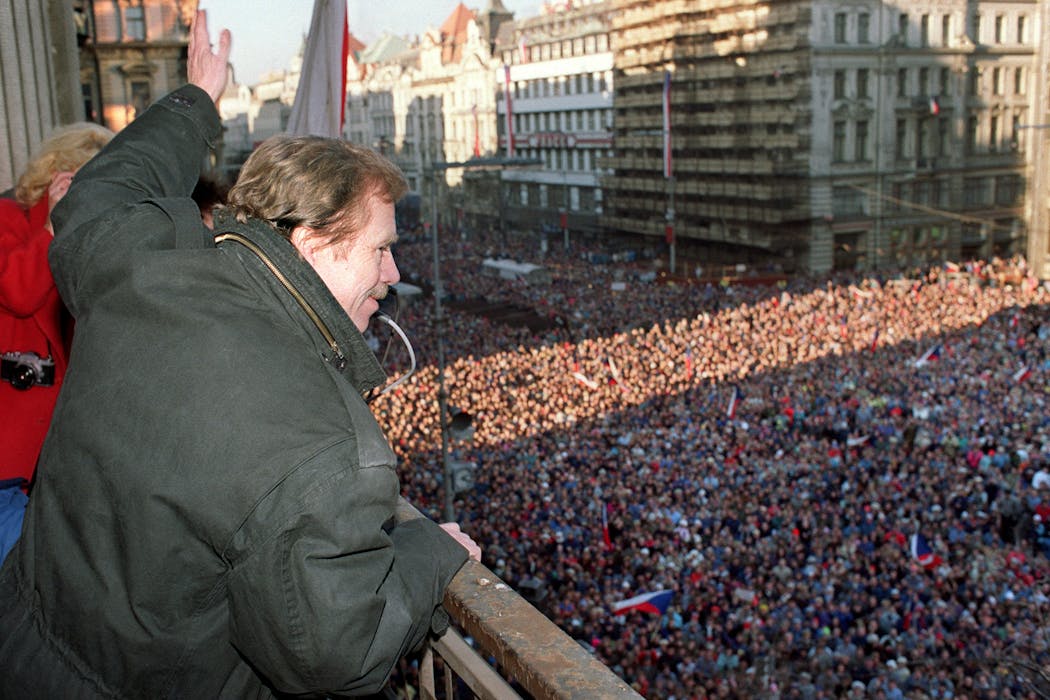
Václav Havel waves to a crowd in Prague celebrating the communist regime’s capitulation in December 1989. Lubomir Kotek/Getty

When Czech political dissident, playwright and poet Václav Havel wrote The Power of the Powerless in October 1978, he was not offering a manifesto in any conventional political sense. Nor was he outlining a program for opposition or regime change.

Instead, he set out to analyse a distinctive form of domination that did not rely primarily on terror, spectacle or charismatic authority, but on routine compliance and the internalisation of untruth.

His central claim was disarmingly simple.

Systems of coercive power endure not only because of police power or elite control, but because ordinary people participate in them by acting as if they believe what they know to be false. They live, as Havel put it, “within a lie”.

His most famous example was of the greengrocer who displays the slogan “Workers of the world, unite!” – not to express revolutionary zeal but to signal conformity. The sign communicates obedience and a willingness to perform the expected ritual – thus helping to sustain a system whose strength lies in habituation. What matters is not belief, but participation. The slogan functions less as political content than as a social password, marking the bearer as safe and nonthreatening.

Havel’s originality lay in shifting attention away from rulers and institutions towards everyday behaviour. Tyranny, in his account, is not only upheld by party elites or security services, but by countless small acts of acquiescence that create what he described as a “post-totalitarian” order.

Such systems normalise untruth.


Goodreads

Havel’s essay, written nearly 50 years ago, speaks with striking force to the present moment. Across a range of democracies, leaders now display increasingly authoritarian reflexes, while public life is sustained by ritualised language masking the erosion of norms and constrains.

Addressing the World Economic Forum last month, Canadian prime minister Mark Carney invoked Havel’s essay, recalling his example of the greengrocer and his sign.

Carney suggested a contemporary “life within a lie” now operates at the level of the international system, where states perform commitment to rules, reciprocity and shared values as those principles are selectively applied or quietly abandoned. The danger lies less in open rule-breaking than in the collective pretence that the system still functions as advertised.

An ethical challenge

The enduring force of Havel’s essay lies in its re-framing of resistance as responsibility rather than victory. Tyranny is challenged not by seizing power, but by depriving falsehood of its audience. Havels’ target is not a particular regime, but a recurring human temptation: the willingness to trade truth for tranquillity.

In an era marked by strategic intimidation, economic pressure and rhetorical cynicism, Havel’s insistence on moral clarity retains its relevance.

To live in truth remains risky, inconvenient and uncertain in its outcomes. Yet Havel’s claim was never that truth guarantees success. It was that systems built on lies are strong only so long as those lies go unchallenged. Once named, their authority begins to weaken.

In this sense, The Power of the Powerless is less a historical document than an ethical challenge. It asks not who governs, but how individuals participate. It insists that even under conditions of asymmetry, the refusal to perform falsehood constitutes a form of power.

‘Living in truth’

According to Havel’s essay, in “post-totalitarian states”, ideology becomes less a doctrine to be argued over than a language to be performed. In this context, the most destabilising act is not armed rebellion or organised protest, but refusal. When an individual ceases to perform the ritual, he exposes it – revealing the emperor is naked.

From this diagnosis follows Havel’s most enduring concept, “living in truth”. This is not a policy platform or a political strategy in the usual sense. It is an existential stance with political consequences. To live in truth is to align one’s public actions with one’s private conscience, even when doing so carries material cost or social risk.

In a system built on universal pretence, even a modest act of honesty acquires disproportionate force. It disrupts the shared fiction on which authority depends, reminding others that alternatives are conceivable.

Havel’s argument was also deliberately unsettling for audiences outside east-central Europe. “Post-totalitarianism” was not a regional anomaly, but an intensified version of tendencies present in modern mass societies.

Comfort could be purchased at the price of indifference and freedom reduced to private consumption detached from public responsibility. In this sense, The Power of the Powerless was a diagnosis of modernity’s susceptibility to moral outsourcing and quiet complicity.

In modern, mass societies, comfort can be purchased at the price of indififference.
Dan Burton/unsplash, CC BY

Sceptical of heroics

Havel saw the fall of communism, ultimately becoming the president of both Czechoslovakia (in 1989–92) and of the Czech Republic (1993–2003). He died in 2011.

His essay is often misread as a celebration of heroic dissent or moral exceptionalism. In fact, it is sceptical of heroics. The power of the powerless, he suggests, does not lie in spectacle, numbers or immediate success. It lies in example.

Truth operates politically not because it commands obedience, but because it awakens recognition. It speaks to what Havel described as the “hidden sphere” of social consciousness, the half-suppressed awareness that life organised around falsehood is corrosive and degrading.

This helps explain why Havel dismissed conventional measures of political effectiveness in societies dominated by totalitarian power. Elections, parties and platforms mean little when the public sphere itself has been hollowed out and emptied of genuine contestation.

What matters instead is the slow reconstruction of moral agency.

Independent cultural activity, unofficial networks and samizdat publishing, for instance, were not substitutes for politics, but its necessary groundwork. They preserved spaces in which truth could be spoken without immediate translation into slogans or coercive power.

A contemporary invocation

Carney’s argument at Davos turned on a familiar contradiction. Political leaders, diplomats and institutions speak the language of rules, reciprocity, and shared norms, while tolerating practices that hollow out those norms.
Trade regimes are described as rules-based even as economic coercion becomes routine. Security arrangements are framed as collective while asymmetries of power grow more explicit.

The problem, in Havel’s terms, is not simply that rules are broken, but that everyone continues to behave as if they still function as advertised. This collective performance sustains an order that no longer delivers what it promises.

In this reading, the international order begins to resemble Havel’s post-totalitarian system. The slogans differ, but the logic is familiar. Language masks fear, dependency and imbalance. The global greengrocer hangs the sign not because he believes it, but because not hanging it appears too risky.

Carney’s proposed response was not withdrawal or isolation, but a call for what he described as “middle powers” to stop pretending. To live in truth at the level of international politics means acknowledging openly where the system fails, refusing convenient fictions and building coalitions grounded in actual shared interests rather than abstract formulae.

The danger of abstraction

Yet there is a risk that “living in truth” becomes an elevated moral injunction detached from the conditions of everyday life.

Havel’s greengrocer is not a philosopher or an essayist. He is a worker responsible for opening a shop, supplying scarce goods and navigating a collectivised economy. For him, refusal carries immediate and concrete consequences: such as loss of employment, harassment or exclusion.

By contrast, intellectuals such as Havel, writing three decades after the communist takeover, occupied a different position. Their capacity to articulate critique in essays, however restricted the audience, rested on forms of cultural capital and social insulation unavailable to most citizens. Havel understood this tension, but it remains a persistent problem in the reception of his ideas.

The same risk attends contemporary invocations such as Carney’s. Those preoccupied with meeting basic needs, managing precarious employment or coping with rising costs are unlikely to be moved by abstract calls for moral clarity in global governance. For them, the performance of ritual may appear not as cowardice, but as survival.

This does not invalidate Havel’s argument, but complicates its application. Revolutions and transformations do not arise from ideas alone. They occur when ideas intersect with lived experience in ways that make existing arrangements untenable. Havel’s insight acquires political force only when “living in truth’” ceases to sound like moral exhortation and begins to articulate shared grievances and recognisable realities.

The question is not whether truth matters, but how it is made audible to those whose compliance sustains the system in the first place.

In that unresolved tension lies the continuing relevance of The Power of the Powerless. It offers no guarantees, refusing consolation. It insists that participation is never neutral and even the smallest refusal carries ethical weight. Whether that refusal can once again ignite broader change depends on whether truth speaks to the conditions of ordinary life.

The Conversation

Darius von Guttner Sporzynski does not work for, consult, own shares in or receive funding from any company or organisation that would benefit from this article, and has disclosed no relevant affiliations beyond their academic appointment.

ref. Václav Havel’s 1978 essay The Power of the Powerless is eerily relevant today – https://theconversation.com/vaclav-havels-1978-essay-the-power-of-the-powerless-is-eerily-relevant-today-275432