Trump’s tariffs have gutted Agoa’s duty‑free promise: our model shows how

Source: The Conversation – Africa – By Tim Vogel, Researcher, German Institute of Development and Sustainability (IDOS)

The African Growth and Opportunity Act (Agoa) was introduced in 2000 as the cornerstone of US development-oriented trade policy towards sub-Saharan Africa. It was designed to grant eligible countries duty-free access to the US market.

In February 2026, President Donald Trump signed a one-year extension after the programme lapsed in September 2025.

Yet the programme’s core benefit has already been effectively eliminated.

Since April 2025, the US has imposed additional bilateral “reciprocal” tariffs ranging lately from 10% to 30% on countries eligible for the Agoa terms. Critically, Agoa only waives the standard tariff rate the US applies to all World Trade Organisation members (called the Most Favoured Nation tariff). This averaged just 3.3% in 2017.

The US Supreme Court struck down the much larger reciprocal surcharges on 20 February 2026. But the White House responded immediately, imposing a 15% surcharge on most imports, effective 24 February 2026 for 150 days.

Agoa technically lives on after a one-year extension. But its main advantage has largely disappeared since the US added tariffs on top of it.

As economists and trade modellers at the German Institute of Development and Sustainablity, we are interested in quantifying the effects of the changing US tariff regime. We ran a model that captures economy-wide adjustments across sectors and countries after a tariff shock via prices, production, consumption and trade diversion.

Our simulations show that new Trump-era tariffs drive large declines in US-bound exports from Africa. The steepest damage is in a few Agoa-dependent countries and sectors such as apparel. Our results remain valid after the latest shift to the 15% tariff surcharge.

African exporters face substantial duties. Agoa offers only a modest advantage over other developing countries still subject to Most Favoured Nation status tariffs.

Thus, the promise of duty-free access has been hollowed out.

When preferences vanish but ‘America First’ stays

Our simulations of the “Liberation Day” tariff package – the April 2025 “America First” tariffs applied on top of Agoa expiry – show that Agoa-eligible countries do lose out, but the aggregate effect on all countries at large is relatively small.

Agoa countries’ exports to the US fall sharply by 34.7%. But in context of their global exports the decline equates only to 1.1%. Real GDP of Agoa-eligible countries remains largely unchanged.

Behind this average, however, some countries and sectors are hit hard. Lesotho’s total exports could drop by about 5.9%, Madagascar’s by 3.3%, and those of both Chad and Botswana by 1.9%.

Wearing apparel is the most affected sector: bilateral Agoa exports to the US fall by nearly half. For Madagascar and Mauritius they are almost wiped out, with losses of roughly US$128.5 million and US$147 million respectively.

According to our latest simulation updates accounting for the lower November 2025 tariff rates, negotiating tariff cuts with Washington or accepting US concessions seem to change little. Agoa-eligible countries still face a 9.2 percentage point rise in their trade-weighted average US tariff (vs 14.8 percentage points in April), leading to a fall of Agoa exports to the US by 9.6%.

Total exports in our simulation decline only by 0.7% as trade diversion to other markets offsets over 40% of US losses.

The limits of preferences

Even before the “Liberation Day” tariffs, Agoa’s effectiveness was limited. Our simulations of a simple shift from Agoa preferences to standard Most Favoured Nation tariffs show only modest impacts on beneficiary countries. Bilateral exports to the US fall by 3.7%, but total exports for Agoa-eligible countries decline by just 0.1%.

This underscores how little Agoa mattered for African trade growth on a larger scale.

This limited effectiveness stems from three main factors.

First, for most sub-Saharan Africa economies, the US is no longer the primary export destination. EU and Chinese markets have become more important.

Second, meeting Agoa’s rules of origin – if a product qualifies for the preferences based on location of value creation – is often costly. In contrast, the tariff advantage has been narrow due to already low US Most Favoured Nation rates.

Third, uncertainty over programme renewals and eligibility reviews has long discouraged firms from investing in Agoa compliance.

To make Agoa work for development again would require substantial reforms. These would need to include:

  • longer timelines and automatic continuation provisions

  • more predictable eligibility through transparent biennial reviews

  • updated rules of origin

  • broader coverage of increasingly important trade issues, such as digital trade, services, as well as non-tariff related trade barriers.

The bipartisan Agoa Renewal and Improvement Act of 2024 proposed some of these improvements, including a 16-year extension to 2041. But it stalled under the “America First” priorities.

Alternatives

In practice, deep reform looks unlikely amid volatile tariffs and short extensions, leaving Agoa increasingly irrelevant.

African policymakers must look elsewhere for new trade opportunities.

China’s new zero-tariff policy for 53 African countries beginning 1 May 2026 offers some relief from US protectionism.

Covering all tariff lines, it extends previous preferences for the continent’s 33 least developed countries to a much wider group of African partners. Middle-income exporters such as Kenya, South Africa, Nigeria, Egypt and Morocco stand to benefit. These countries previously faced Chinese tariffs of up to 25% on processed goods. They will now gain duty-free access on the same terms as the poorest African economies.

Such policies have boosted export diversification modestly for least developed countries in the past. But the benefits will depend on product fit and value-chain dynamics. Until now African exports to China have largely been dominated by low-value, primary products. African countries would need substantial investments to make use of preferential market access to China.

Beyond Chinese offers, the EU offers a stable partnership with substantial market scale. Its own unilateral tariff preferences through Generalised System of Preferences, Everything But Arms and reciprocal Economic Partnership Agreements provide more predictable access than the US tariff rollercoaster.

On top of this, the EU actively tries to pursue strategic alignment around critical raw materials, green energy and sustainable investment. It does this via Clean Trade and Investment Partnerships and Sustainable Investment Facilitation Agreements.

Developing countries, however, often criticise the EU sustainability measures or costly compliance to EU standards which worsen their trade opportunities. Hence, the EU has to find a better balance of its sustainable trade and development playbook to build trust with the global south.

What needs to be done

African policymakers should seize this moment to build a foundation for a trade system that doesn’t depend on uncertain preferences and external policy shocks. Accelerating the African Continental Free Trade Area (AfCFTA) serves as the most credible route to trade resilience, diversification and industrial upgrading.

The free trade area agreement can’t immediately replace US demand (different products, limited value-chain overlap). But it can reduce structural vulnerability to external shocks like US tariff volatility.

The Conversation

Tim Vogel receives funding from the German Federal Ministry for Economic Cooperation and Development (BMZ).

Zoryana Olekseyuk receives funding from the German Federal Ministry for Economic Cooperation and Development (BMZ). .

ref. Trump’s tariffs have gutted Agoa’s duty‑free promise: our model shows how – https://theconversation.com/trumps-tariffs-have-gutted-agoas-duty-free-promise-our-model-shows-how-276641
Despite massive US attack and death of Ayatollah, regime change in Iran is unlikely

Source: The Conversation – USA – By Donald Heflin, Executive Director of the Edward R. Murrow Center and Senior Fellow of Diplomatic Practice, The Fletcher School, Tufts University

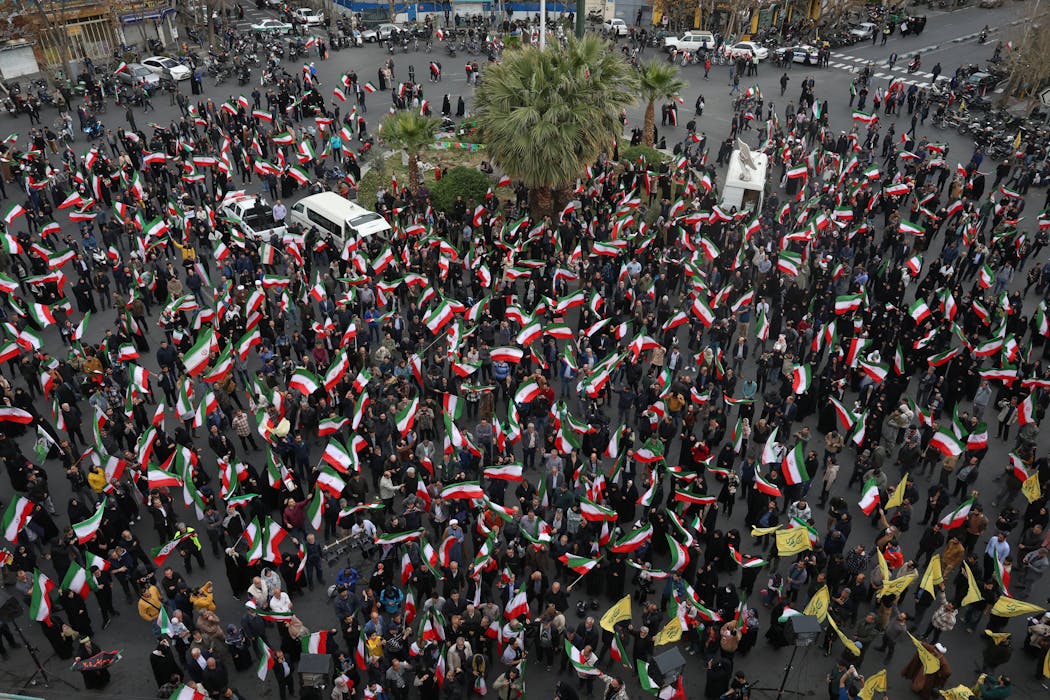
A group of demonstrators in Tehran wave Iranian flags in support of the government on Feb. 28, 2026 AP Photo/Vahid Salemi

After the largest buildup of U.S. warships and aircraft in the Middle East in decades, American and Israeli military forces launched a massive assault on Iran on Feb. 28, 2026.

President Donald Trump has called the attacks “major combat operations” and has urged regime change in Tehran. Iranian media reported Supreme Leader Ayatollah Ali Khamenei was killed in the strikes.

To better understand what this means for the U.S. and Iran, Alfonso Serrano, a U.S. politics editor at The Conversation, interviewed Donald Heflin, a veteran diplomat who now teaches at Tufts University’s Fletcher School.

Widespread attacks have been reported across Iran, following weeks of U.S. military buildup in the region. What does the scale of the attacks tell you?

I think that Trump and his administration are going for regime change with these massive strikes and with all the ships and some troops in the area. I think there will probably be a couple more days’ worth of strikes. They’ll start off with the time-honored strategy of attacking what’s known as command and control, the nerve centers for controlling Iran’s military. From media reporting, we already know that the residence of Khamenei was attacked.

What is the U.S. strategic end game here?

Regime change is going to be difficult. We heard Trump today call for the Iranian people to bring the government down. In the first place, that’s difficult. It’s hard for people with no arms in their hands to bring down a very tightly controlled regime that has a lot of arms.

The second point is that U.S. history in that area of the world is not good with this. You may recall that during the Gulf War of 1990-1991, the U.S. basically encouraged the Iraqi people to rise up, and then made its own decision not to attack Baghdad, to stop short. And that has not been forgotten in Iraq or surrounding countries. I would be surprised if we saw a popular uprising in Iran that really had a chance of bringing the regime down.

Several men wave flags in front of a building.
A group of men wave Iranian flags as they protest U.S. and Israeli strikes in Tehran, Iran, on Feb. 28, 2026.
AP Photo/Vahid Salemi

Do you see the possibility of U.S. troops on the ground to bring about regime change?

I will stick my neck out here and say that’s not going to happen. I mean, there may be some small special forces sent in. That’ll be kept quiet for a while. But as far as large numbers of U.S. troops, no, I don’t think it’s going to happen.

Two reasons. First off, any president would feel that was extremely risky. Iran’s a big country with a big military. The risks you would be taking are large amounts of casualties, and you may not succeed in what you’re trying to do.

But Trump, in particular, despite the military strike against Iran and the one against Venezuela, is not a big fan of big military interventions and war. He’s a guy who will send in fighter planes and small special forces units, but not 10,000 or 20,000 troops.

And the reason for that is, throughout his career, he does well with a little bit of chaos. He doesn’t mind creating a little bit of chaos and figuring out a way to make a profit on the other side of that. War is too much chaos. It’s really hard to predict what the outcome is going to be, what all the ramifications are going to be. Throughout his first term and the first year of his second term, he has shown no inclination to send ground troops anywhere.

Speaking of President Trump, what are the risks he faces?

One risk is going on right now, which is that the Iranians may get lucky or smart and manage to attack a really good target and kill a lot of people, like something in Jerusalem or Tel Aviv or a U.S. military base.

The second risk is that the attacks don’t work, that the supreme leader and whoever else is considered the political leadership of Iran survives, and the U.S. winds up with egg on its face.

The third risk is that it works to a certain extent. You take out the top people, but then who steps into their shoes? I mean, go back and look at Venezuela. Most people would have thought that who was going to wind up winning at the end of that was the head of the opposition. But it wound up being the vice president of the old regime, Delcy Rodríguez.

I can see a similar scenario in Iran. The regime has enough depth to survive the death of several of its leaders. The thing to watch will be who winds up in the top jobs, hardliners or realists. But the only institution in Iran strong enough to succeed them is the army, the Revolutionary Guards in particular. Would that be an improvement for the U.S.? It depends on what their attitude was. The same attitude that the vice president of Venezuela has been taking, which is, “Look, this is a fact of life. We better negotiate with the Americans and figure out some way forward we can both live with.”

But these guys are pretty hardcore revolutionaries. I mean, Iran has been under revolutionary leadership for 47 years. All these guys are true believers. I don’t know if we’ll be able to work with them.

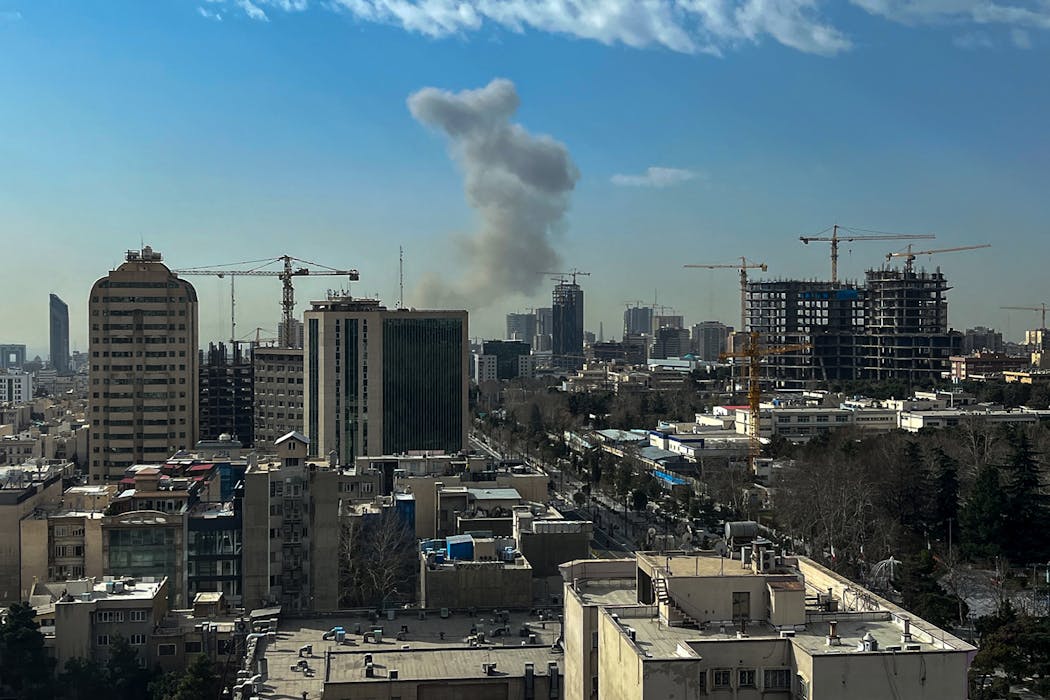
Smoke rises over a city center.
Smoke rises over Tehran on Feb. 28, 2026, after the U.S. and Israel launched airstrikes on Iran.
Fatemeh Bahrami/Anadolu via Getty Images

Any last thoughts?

I think the timing is interesting. If you go back to last year, Trump, after being in office a little and watching the situation between Israel and Gaza, was given an opening, when Israeli Prime Minister Benjamin Netanyahu attacked Qatar.

A lot of conservative Mideast regimes, who didn’t have a huge problem with Israel, essentially said “That’s going too far.” And Trump was able to use that as an excuse. He was able to essentially say, “Okay, you’ve gone too far. You’re really taking risk with world peace. Everybody’s gonna sit at the table.”

I think the same thing’s happening here. I believe many countries would love to see regime change in Iran. But you can’t go into the country and say, “We don’t like the political leadership being elected. We’re going to get rid of them for you.” What often happens in that situation is people begin to rally around the flag. They begin to rally around the government when the bombs start falling.

But in the last few months, we’ve seen a huge human rights crackdown in Iran. We may never know the number of people the Iranian regime killed in the last few months, but 10,000 to 15,000 protesters seems a minimum.

That’s the excuse Trump can use. You can sell it to the Iranian people and say, “Look, they’re killing you in the streets. Forget about your problems with Israel and the U.S. and everything. They’re real, but you’re getting killed in the streets, and that’s why we’re intervening.” It’s a bit of a fig leaf.

Now, as I said earlier, the problem with this is if your next line is, “You know, we’re going to really soften this regime up with bombs; now it’s your time to go out in the streets and bring the regime down.” I may eat these words, but I don’t think that’s going to happen. The regime is just too strong for it to be brought down by bare hands.

This article was updated on Feb 28, 2026, to include confirmation of Ayatollah Ali Khamenei’s death.

The Conversation

Donald Heflin does not work for, consult, own shares in or receive funding from any company or organization that would benefit from this article, and has disclosed no relevant affiliations beyond their academic appointment.

ref. Despite massive US attack and death of Ayatollah, regime change in Iran is unlikely – https://theconversation.com/despite-massive-us-attack-and-death-of-ayatollah-regime-change-in-iran-is-unlikely-277180

Ayatollah Ali Khamenei ruled Iran with defiance and brutality for 36 years. For many Iranians, he will not be revered

Source: The Conversation – Global Perspectives – By Andrew Thomas, Lecturer in Middle East Studies, Deakin University

Ayatollah Ali Khamenei, Iran’s supreme leader for 36 years, has been killed in US and Israeli airstrikes on his country, Iranian state media reported.

As one of Iran’s longest-serving leaders, Khamenei was almost as ubiquitous in Iranian society as his predecessor, Ayatollah Ruhollah Khomeini, who founded the Islamic Republic of Iran in 1979.

And despite the fact Khomeini authored the Iranian Revolution, some say Khamenei was actually the most powerful leader modern Iran has had.

In more than three decades as supreme leader, Khamenei amassed unprecedented power over domestic politics and cracked down ever more harshly on internal dissent. In recent years, he prioritised his survival – and that of his regime – above all else. His government brutally put down a popular uprising in December 2025–January 2026 that killed thousands.

Ultimately, though, Khamenei will not be remembered by most Iranians as a strong leader. Nor will he be revered. Instead, his legacy will be the profound weakness his regime brought the Islamic Republic on all fronts.

Khamenei’s rise through the ranks

Khamenei was born in the city of Marshad in northeastern Iran in 1939. As a boy, he began to form his political and religious world view by studying at Islamic seminaries in Najaf and Qom. At 13, he started to embrace ideas relating to revolutionary Islam. These included the teachings of cleric Navab Safavi, who often called for political violence against the rule of the shah of Iran, Mohammad Reza Pahlavi.

Khamenei met Khomeini in 1958 and immediately embraced his philosophy, often referred to as “Khomeinism”.

This world view was informed by anti-colonial sentiment, Shia Islam and elements of social engineering through state planning, particularly when it came to preserving a “just” Islamic society. Khomeinism stipulates that a system of earthly laws alone cannot create a just society – Iran must draw its legitimacy from “God Almighty”.

The concept of velayat-e faqih, also known as guardianship of the jurist, is central to Khomeinism. It dictates that the supreme leader should be endowed with “all the authorities that the Prophet and infallible Imams were entitled”.

Essentially, this means Iran was to be ruled by a single scholar of Shia Islam. This is where Khomeini, and later Khamenei, would draw their sweeping power and control.

From 1962, Khamenei began almost two decades of revolutionary activity against Pahlavi (the shah) on behalf of Khomeini, who was exiled in 1964. Khamenei was arrested by the shah’s secret police in 1971 and tortured, according to his memoirs.

When the shah was overthrown in the Islamic Revolution in 1979, Khomeini returned from exile to become the new supreme leader.

Khamenei was selected to join the Revolutionary Council, which ruled alongside the provisional government. He then became deputy defence minister and assisted in organising the Islamic Revolutionary Guard Corps (IRGC). This military institution – initially created to protect the revolution and supreme leader – would become one of the most powerful political forces in Iran.

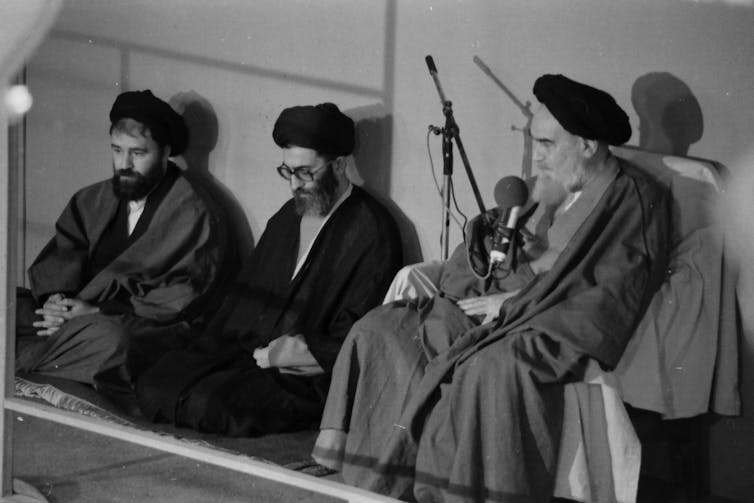
Ayatollah Ruhollah Khomeini (sitting on chair), Ali Khamenei (middle), and Khomeini’s son, Ahmad Khomeini (left), pictured in 1981.
Wikimedia Commons

After surviving an assassination attempt in 1981, Khamenei was elected president of Iran in 1982 and again in 1985. He held the presidency during the majority of the Iran–Iraq war – a conflict that devastated both countries in both human and economic cost.

Although subordinate to the supreme leader, Khamenei wielded significant power compared to later presidents, given the revolution was still very young and the Iraq war posed a great threat to the regime. But he remained in lock-step with Khomeini’s wishes. He also managed to build a close relationship with the IRGC that would go far beyond his presidency.

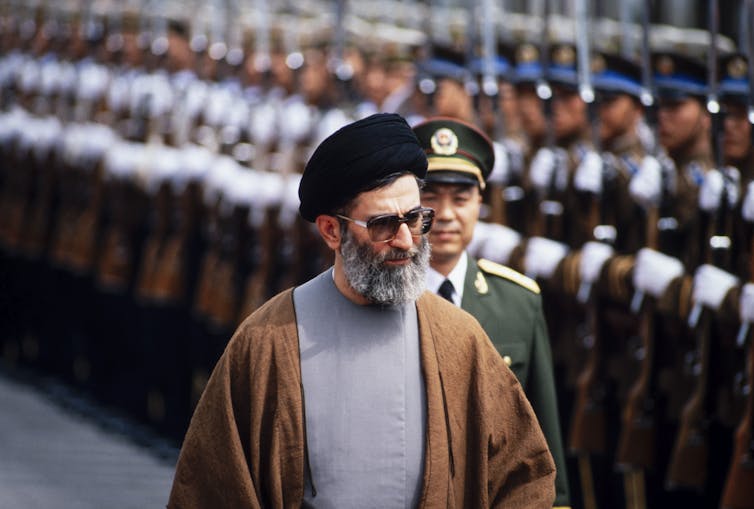
Then-President Ali Khamenei during a state visit to China in May 1989.
Forrest Anderson/Getty Images

A surprising choice for supreme leader

Khomeini died in June 1989 after a period of deteriorating health, with no clear successor.

Khomeini had initially supported Grand Ayatollah Hossein-Ali Montazeri to be his successor. However, Montazeri had become increasingly critical of the supreme leader’s authority and human rights violations in the country. He resigned in 1988 and was put under house arrest until his death in 2009.

Khamenei had the political credentials to lead. He was also a steadfast support of Khomeinism. However, he was seen a surprising choice for supreme leader when he was elected by the Assembly of Experts, a group of Islamic clerics.

In fact, his appointment sparked a significant amount of controversy and criticism. Some Islamic scholars believed he lacked the clerical rank of grand ayatollah, which was required under the constitution to ascend to the position. These critics believed the Iranian people would not respect the word of “a mere human being” without a proper connection to God.

A referendum was held in July 1989 to change the constitution to allow for a supreme leader who has shown “Islamic scholarship”. It passed overwhelmingly and Khamenei became an ayatollah.

Khamenei’s position had been consolidated on paper, but despite being president since 1982, he did not enjoy the same popularity as Khomeini within both the clerical elite and general public.

The constitutional amendments, however, had given Khamenei significantly more power to intervene in political affairs. In fact, he had far more power as supreme leader than Khomeini ever enjoyed.

This included the ability to determine general policies, appoint and dismiss members of the Council of Guardians, and order public referendums. He also had enough power to silence dissent with relative ease.

Consolidating power over the decades

Khamenei worked with his presidents to varying degrees, though he exercised his power to undermine legislation when he disagreed with it.

For example, he largely backed the economic agenda of President Hashemi Rafsanjani (who served from 1989 to 1997), but he often stood in the way of Mohammad Khatami (1997–2005) and Hassan Rouhani (2013–21). Both had attempted to reform Iran’s political system and foster a better relationship with the West.

Khamenei’s most famous intervention in domestic politics occurred after the first term of President Mahmoud Ahmadinejad (2005–13). After Ahmadinejad claimed victory in the disputed 2009 presidential election, thousands of Iranians took to the streets in one of the largest protest movements since the revolution. Khamenei backed the election result and cracked down harshly on the protesters. Dozens were killed (perhaps more), while thousands were arbitrarily arrested.

Khamenei later clashed with Ahmadinejad and warned him against seeking the presidency again in 2017. Ahmadinejad defied him, but was later barred from running.

After the death of hardline President Ebrahim Raisi in a helicopter crash in 2024, Khameini continued his manoeuvring behind the scenes. After the reformist Masoud Pezeshkian won the presidency, Khameini immediately blocked him from negotiating with the United States over sanctions relief and used his influence to thwart his economic reform agenda.

And when protests again broke out at the end of 2025 over the struggling economy, Khamenei again ordered them to be crushed by any means necessary.

A tarnished legacy

Thanks to the powers vested in him in the constitution, Khamenei also had extraordinary control over Iran’s foreign policy.

Like his mentor, Khomeini, he staunchly supported the regime’s resistance to what it considered “Western imperialism”. He was also a key architect of Iran’s regional proxy strategy, funding militant groups like Hezbollah, Hamas, the Houthis and others to carry out Iran’s military objectives.

Khamenei had, at times, been amenable to cooperation with the West – namely negotiating with the US over Iran’s nuclear enrichment program.

During the first Trump administration, however, Khamenei returned to a staunchly anti-Western posture. His government railed against Trump’s scuttling of the 2015 nuclear deal, the reimposed economic sanctions on Iran’s energy sector and the assassination of the head of the IRGC’s Quds force, Qassem Soleimani.

After Trump returned to office in 2025, Iran grew even weaker. And Khamenei’s anti-Western posture began to look increasingly hollow. Iran’s defeat in the 12-day war with Israel in 2025 shredded whatever legitimacy his regime had left.

In the months that followed, Khamenei ruled over a population increasingly resentful of the Iranian political system and its leadership. In the 2025–26 protests, some openly chanted for Khamenei’s death.

When Khomenei died in 1989, his state funeral was attended by millions. Mourners pulled him out of his coffin and scrambled for sacred mementos.

Though Khameini served longer, Iranians will likely not show the same grief for him.

The Conversation

Andrew Thomas does not work for, consult, own shares in or receive funding from any company or organisation that would benefit from this article, and has disclosed no relevant affiliations beyond their academic appointment.

ref. Ayatollah Ali Khamenei ruled Iran with defiance and brutality for 36 years. For many Iranians, he will not be revered – https://theconversation.com/ayatollah-ali-khamenei-ruled-iran-with-defiance-and-brutality-for-36-years-for-many-iranians-he-will-not-be-revered-259268

Ayatollah Ali Khamenei has ruled Iran with defiance and brutality for 36 years. For many Iranians, he will not be revered

Source: The Conversation – Global Perspectives – By Andrew Thomas, Lecturer in Middle East Studies, Deakin University

Ayatollah Ali Khamenei, Iran’s supreme leader for 36 years, has been killed in US and Israeli airstrikes on his country, according to US President Donald Trump. Iran did not immediately confirm his death.

As one of Iran’s longest-serving leaders, Khamenei has been almost as ubiquitous in Iranian society as his predecessor, Ayatollah Ruhollah Khomeini, who founded the Islamic Republic of Iran in 1979.

And despite the fact Khomeini authored the Iranian Revolution, some say Khamenei was actually the most powerful leader modern Iran has had.

In more than three decades as supreme leader, Khamenei amassed unprecedented power over domestic politics and cracked down ever more harshly on internal dissent. In recent years, he prioritised his survival – and that of his regime – above all else. His government brutally put down a popular uprising in December 2025–January 2026 that killed thousands.

Ultimately, though, Khamenei will not be remembered by most Iranians as a strong leader. Nor will he be revered. Instead, his legacy will be the profound weakness his regime brought the Islamic Republic on all fronts.

Khamenei’s rise through the ranks

Khamenei was born in the city of Marshad in northeastern Iran in 1939. As a boy, he began to form his political and religious world view by studying at Islamic seminaries in Najaf and Qom. At 13, he started to embrace ideas relating to revolutionary Islam. These included the teachings of cleric Navab Safavi, who often called for political violence against the rule of the shah of Iran, Mohammad Reza Pahlavi.

Khamenei met Khomeini in 1958 and immediately embraced his philosophy, often referred to as “Khomeinism”.

This world view was informed by anti-colonial sentiment, Shia Islam and elements of social engineering through state planning, particularly when it came to preserving a “just” Islamic society. Khomeinism stipulates that a system of earthly laws alone cannot create a just society – Iran must draw its legitimacy from “God Almighty”.

The concept of velayat-e faqih, also known as guardianship of the jurist, is central to Khomeinism. It dictates that the supreme leader should be endowed with “all the authorities that the Prophet and infallible Imams were entitled”.

Essentially, this means Iran was to be ruled by a single scholar of Shia Islam. This is where Khomeini, and later Khamenei, would draw their sweeping power and control.

From 1962, Khamenei began almost two decades of revolutionary activity against Pahlavi (the shah) on behalf of Khomeini, who was exiled in 1964. Khamenei was arrested by the shah’s secret police in 1971 and tortured, according to his memoirs.

When the shah was overthrown in the Islamic Revolution in 1979, Khomeini returned from exile to become the new supreme leader.

Khamenei was selected to join the Revolutionary Council, which ruled alongside the provisional government. He then became deputy defence minister and assisted in organising the Islamic Revolutionary Guard Corps (IRGC). This military institution – initially created to protect the revolution and supreme leader – would become one of the most powerful political forces in Iran.

Ayatollah Ruhollah Khomeini (sitting on chair), Ali Khamenei (middle), and Khomeini’s son, Ahmad Khomeini (left), pictured in 1981.
Wikimedia Commons

After surviving an assassination attempt in 1981, Khamenei was elected president of Iran in 1982 and again in 1985. He held the presidency during the majority of the Iran–Iraq war – a conflict that devastated both countries in both human and economic cost.

Although subordinate to the supreme leader, Khamenei wielded significant power compared to later presidents, given the revolution was still very young and the Iraq war posed a great threat to the regime. But he remained in lock-step with Khomeini’s wishes. He also managed to build a close relationship with the IRGC that would go far beyond his presidency.

Then-President Ali Khamenei during a state visit to China in May 1989.
Forrest Anderson/Getty Images

A surprising choice for supreme leader

Khomeini died in June 1989 after a period of deteriorating health, with no clear successor.

Khomeini had initially supported Grand Ayatollah Hossein-Ali Montazeri to be his successor. However, Montazeri had become increasingly critical of the supreme leader’s authority and human rights violations in the country. He resigned in 1988 and was put under house arrest until his death in 2009.

Khamenei had the political credentials to lead. He was also a steadfast support of Khomeinism. However, he was seen a surprising choice for supreme leader when he was elected by the Assembly of Experts, a group of Islamic clerics.

In fact, his appointment sparked a significant amount of controversy and criticism. Some Islamic scholars believed he lacked the clerical rank of grand ayatollah, which was required under the constitution to ascend to the position. These critics believed the Iranian people would not respect the word of “a mere human being” without a proper connection to God.

A referendum was held in July 1989 to change the constitution to allow for a supreme leader who has shown “Islamic scholarship”. It passed overwhelmingly and Khamenei became an ayatollah.

Khamenei’s position had been consolidated on paper, but despite being president since 1982, he did not enjoy the same popularity as Khomeini within both the clerical elite and general public.

The constitutional amendments, however, had given Khamenei significantly more power to intervene in political affairs. In fact, he had far more power as supreme leader than Khomeini ever enjoyed.

This included the ability to determine general policies, appoint and dismiss members of the Council of Guardians, and order public referendums. He also had enough power to silence dissent with relative ease.

Consolidating power over the decades

Khamenei worked with his presidents to varying degrees, though he exercised his power to undermine legislation when he disagreed with it.

For example, he largely backed the economic agenda of President Hashemi Rafsanjani (who served from 1989 to 1997), but he often stood in the way of Mohammad Khatami (1997–2005) and Hassan Rouhani (2013–21). Both had attempted to reform Iran’s political system and foster a better relationship with the West.

Khamenei’s most famous intervention in domestic politics occurred after the first term of President Mahmoud Ahmadinejad (2005–13). After Ahmadinejad claimed victory in the disputed 2009 presidential election, thousands of Iranians took to the streets in one of the largest protest movements since the revolution. Khamenei backed the election result and cracked down harshly on the protesters. Dozens were killed (perhaps more), while thousands were arbitrarily arrested.

Khamenei later clashed with Ahmadinejad and warned him against seeking the presidency again in 2017. Ahmadinejad defied him, but was later barred from running.

After the death of hardline President Ebrahim Raisi in a helicopter crash in 2024, Khameini continued his manoeuvring behind the scenes. After the reformist Masoud Pezeshkian won the presidency, Khameini immediately blocked him from negotiating with the United States over sanctions relief and used his influence to thwart his economic reform agenda.

And when protests again broke out at the end of 2025 over the struggling economy, Khamenei again ordered them to be crushed by any means necessary.

A tarnished legacy

Thanks to the powers vested in him in the constitution, Khamenei also had extraordinary control over Iran’s foreign policy.

Like his mentor, Khomeini, he staunchly supported the regime’s resistance to what it considered “Western imperialism”. He was also a key architect of Iran’s regional proxy strategy, funding militant groups like Hezbollah, Hamas, the Houthis and others to carry out Iran’s military objectives.

Khamenei had, at times, been amenable to cooperation with the West – namely negotiating with the US over Iran’s nuclear enrichment program.

During the first Trump administration, however, Khamenei returned to a staunchly anti-Western posture. His government railed against Trump’s scuttling of the 2015 nuclear deal, the reimposed economic sanctions on Iran’s energy sector and the assassination of the head of the IRGC’s Quds force, Qassem Soleimani.

After Trump returned to office in 2025, Iran grew even weaker. And Khamenei’s anti-Western posture began to look increasingly hollow. Iran’s defeat in the 12-day war with Israel in 2025 shredded whatever legitimacy his regime had left.

In the months that followed, Khamenei ruled over a population increasingly resentful of the Iranian political system and its leadership. In the 2025–26 protests, some openly chanted for Khamenei’s death.

When Khomenei died in 1989, his state funeral was attended by millions. Mourners pulled him out of his coffin and scrambled for sacred mementos.

Though Khameini served longer, Iranians will likely not show the same grief for him.

The Conversation

Andrew Thomas does not work for, consult, own shares in or receive funding from any company or organisation that would benefit from this article, and has disclosed no relevant affiliations beyond their academic appointment.

ref. Ayatollah Ali Khamenei has ruled Iran with defiance and brutality for 36 years. For many Iranians, he will not be revered – https://theconversation.com/ayatollah-ali-khamenei-has-ruled-iran-with-defiance-and-brutality-for-36-years-for-many-iranians-he-will-not-be-revered-259268

Massive US attacks on Iran unlikely to produce regime change in Tehran

Source: The Conversation – USA – By Donald Heflin, Executive Director of the Edward R. Murrow Center and Senior Fellow of Diplomatic Practice, The Fletcher School, Tufts University

A group of demonstrators in Tehran wave Iranian flags in support of the government on Feb. 28, 2026 AP Photo/Vahid Salemi

After the largest buildup of U.S. warships and aircraft in the Middle East in decades, American and Israeli military forces launched a massive assault on Iran on Feb. 28, 2026.

President Donald Trump has called the attacks “major combat operations” and has urged regime change in Tehran.

To better understand what this means for the U.S. and Iran, Alfonso Serrano, a U.S. politics editor at The Conversation, interviewed Donald Heflin, a veteran diplomat who now teaches at Tufts University’s Fletcher School.

Widespread attacks have been reported across Iran, following weeks of U.S. military buildup in the region. What does the scale of the attacks tell you?

I think that Trump and his administration are going for regime change with these massive strikes and with all the ships and some troops in the area. I think there will probably be a couple more days’ worth of strikes. They’ll start off with the time-honored strategy of attacking what’s known as command and control, the nerve centers for controlling Iran’s military. From media reporting, we already know that the residence of Supreme Leader Ayatollah Ali Khamenei was attacked.

What is the U.S. strategic end game here?

Regime change is going to be difficult. We heard Trump today call for the Iranian people to bring the government down. In the first place, that’s difficult. It’s hard for people with no arms in their hands to bring down a very tightly controlled regime that has a lot of arms.

The second point is that U.S. history in that area of the world is not good with this. You may recall that during the Gulf War of 1990-1991, the U.S. basically encouraged the Iraqi people to rise up, and then made its own decision not to attack Baghdad, to stop short. And that has not been forgotten in Iraq or surrounding countries. I would be surprised if we saw a popular uprising in Iran that really had a chance of bringing the regime down.

Several men wave flags in front of a building.
A group of men wave Iranian flags as they protest U.S. and Israeli strikes in Tehran, Iran, on Feb. 28, 2026.
AP Photo/Vahid Salemi

Do you see the possibility of U.S. troops on the ground to bring about regime change?

I will stick my neck out here and say that’s not going to happen. I mean, there may be some small special forces sent in. That’ll be kept quiet for a while. But as far as large numbers of U.S. troops, no, I don’t think it’s going to happen.

Two reasons. First off, any president would feel that was extremely risky. Iran’s a big country with a big military. The risks you would be taking are large amounts of casualties, and you may not succeed in what you’re trying to do.

But Trump, in particular, despite the military strike against Iran and the one against Venezuela, is not a big fan of big military interventions and war. He’s a guy who will send in fighter planes and small special forces units, but not 10,000 or 20,000 troops.

And the reason for that is, throughout his career, he does well with a little bit of chaos. He doesn’t mind creating a little bit of chaos and figuring out a way to make a profit on the other side of that. War is too much chaos. It’s really hard to predict what the outcome is going to be, what all the ramifications are going to be. Throughout his first term and the first year of his second term, he has shown no inclination to send ground troops anywhere.

Speaking of President Trump, what are the risks he faces?

One risk is going on right now, which is that the Iranians may get lucky or smart and manage to attack a really good target and kill a lot of people, like something in Jerusalem or Tel Aviv or a U.S. military base.

The second risk is that the attacks don’t work, that the supreme leader and whoever else is considered the political leadership of Iran survives, and the U.S. winds up with egg on its face.

The third risk is that it works to a certain extent. You take out the top people, but then who steps into their shoes? I mean, go back and look at Venezuela. Most people would have thought that who was going to wind up winning at the end of that was the head of the opposition. But it wound up being the vice president of the old regime, Delcy Rodríguez.

I can see a similar scenario in Iran, if Khamenei and a couple of other leaders were taken out. But the only institution in Iran strong enough to succeed them is the army, the Revolutionary Guards in particular. Would that be an improvement for the U.S.? It depends on what their attitude was. The same attitude that the vice president of Venezuela has been taking, which is, “Look, this is a fact of life. We better negotiate with the Americans and figure out some way forward we can both live with.”

But these guys are pretty hardcore revolutionaries. I mean, Iran has been under revolutionary leadership for 47 years. All these guys are true believers. I don’t know if we’ll be able to work with them.

Smoke rises over a city center.
Smoke rises over Tehran on Feb. 28, 2026, after the U.S. and Israel launched airstrikes on Iran.
Fatemeh Bahrami/Anadolu via Getty Images

Any last thoughts?

I think the timing is interesting. If you go back to last year, Trump, after being in office a little and watching the situation between Israel and Gaza, was given an opening, when Israeli Prime Minister Benjamin Netanyahu attacked Qatar.

A lot of conservative Mideast regimes, who didn’t have a huge problem with Israel, essentially said “That’s going too far.” And Trump was able to use that as an excuse. He was able to essentially say, “Okay, you’ve gone too far. You’re really taking risk with world peace. Everybody’s gonna sit at the table.”

I think the same thing’s happening here. I believe many countries would love to see regime change in Iran. But you can’t go into the country and say, “We don’t like the political leadership being elected. We’re going to get rid of them for you.” What often happens in that situation is people begin to rally around the flag. They begin to rally around the government when the bombs start falling.

But in the last few months, we’ve seen a huge human rights crackdown in Iran. We may never know the number of people the Iranian regime killed in the last few months, but 10,000 to 15,000 protesters seems a minimum.

That’s the excuse Trump can use. You can sell it to the Iranian people and say, “Look, they’re killing you in the streets. Forget about your problems with Israel and the U.S. and everything. They’re real, but you’re getting killed in the streets, and that’s why we’re intervening.” It’s a bit of a fig leaf.

Now, as I said earlier, the problem with this is if your next line is, “You know, we’re going to really soften this regime up with bombs; now it’s your time to go out in the streets and bring the regime down.” I may eat these words, but I don’t think that’s going to happen. The regime is just too strong for it to be brought down by bare hands.

The Conversation

Donald Heflin does not work for, consult, own shares in or receive funding from any company or organization that would benefit from this article, and has disclosed no relevant affiliations beyond their academic appointment.

ref. Massive US attacks on Iran unlikely to produce regime change in Tehran – https://theconversation.com/massive-us-attacks-on-iran-unlikely-to-produce-regime-change-in-tehran-277180

Iran will respond to US-Israeli strikes as existential threats to the regime – because they are

Source: The Conversation – Global Perspectives – By Javed Ali, Associate Professor of Practice of Public Policy, University of Michigan

A plume of smoke rises above Tehran on Feb. 28, 2026. AFP via Getty Images

After U.S. and Israeli missiles struck Iran’s nuclear sites in June 2025, Tehran responded with a limited attack on the American airbase in Qatar. Five years before that, a U.S. drone strike against Qasem Soleimani, head of the powerful Islamic Revolutionary Guard Corps Quds Force, was met with followed by an attack on two American bases in Iraq shortly thereafter.

Expect none of that restraint by Iran’s leaders following the latest U.S. and Israeli military operation currently playing out in the Gulf nation.

In the early hours of Feb. 28, 2026, hundreds of missiles struck multiple sites in Iran. Part of “Operation Epic Fury,” as the U.S. Department of Defense has called it, the strikes follow months of U.S. military buildup in the region. But they also come after apparent diplomatic efforts, in the shape of a series of nuclear talks in Oman and Geneva aimed at a peaceful resolution.

Any such deal is surely now completely off the table. In scale and scope, the U.S. and Israel attack goes far beyond any previous strikes on the Gulf nation.

In response, Iran has said it will use “crushing” force. As an expert on Middle East affairs and a former senior official at the National Security Council during the first Trump administration, I believe the calculus both in Washington and more so in Tehran is very different from earlier confrontations: Iran’s leaders almost certainly see this as an existential threat given President Donald Trump’s statement and the military campaign already underway. And there appears to be no obvious off-ramp to avoid further escalation.

What we should expect now is a response from Tehran that utilizes all of its capabilities – even though they have been significantly degraded. And that should be a worry for all nations in the region and beyond.

The apparent aims of the US operation

It is important to note that we are in the early stages of this conflict – much is unknown.

As of Feb. 28, it is unclear who has been killed among Iran’s leadership and to what extent Iran’s ballistic missile capabilities have been degraded. The fact that ballistic missiles have been launched at regional states that host U.S. military bases suggests that, at a minimum, Iran’s military capabilities have not been entirely wiped out.

Iran fired over 600 missiles against Israel last June during their 12-day war, but media reporting and Iranian statements over the past month suggested that Iran managed to replenish some of its missile inventory, which it is now using.

Clearly Washington is intent on crippling Iran’s ballistic program, as it is that capability that allows Iran to threaten the region most directly. A sticking point in the negotiations in Geneva and Oman was U.S. officials’ insistence that both Iran’s ballistic missiles and its funneling of support to proxy groups in the region be on the table, along with the longstanding condition that Tehran ends all uranium enrichment. Tehran has long resisted attempts to have limits on its ballistic missiles as part of any negotiated nuclear deal given their importance in Iran’s national security doctrine.

This explains why some U.S. and Israeli strikes appear to be aimed at taking out Iran’s ballistic and cruise missile launch sites and production facilities and storage locations for such weapons.

With no nuclear weapon, Iran’s ballistic missiles have been the country’s go-to method for responding to any threat. And so far in the current conflict, they have been used on nations including the United Arab Emirates, Qatar, Kuwait and Bahrain.

‘It will be yours to take’

But the Trump administration appears to have expanded its aims beyond removing Iran’s nuclear and non-nuclear military threat. The latest strikes have gone after leadership, too.

Among the locations of the first U.S.-Israeli strikes was a Tehran compound in which the Supreme Leader Ayatollah Ali Khamenei in known to reside, and Israel’s prime minister has confirmed that the 86-year-old leader was a target of the operation.

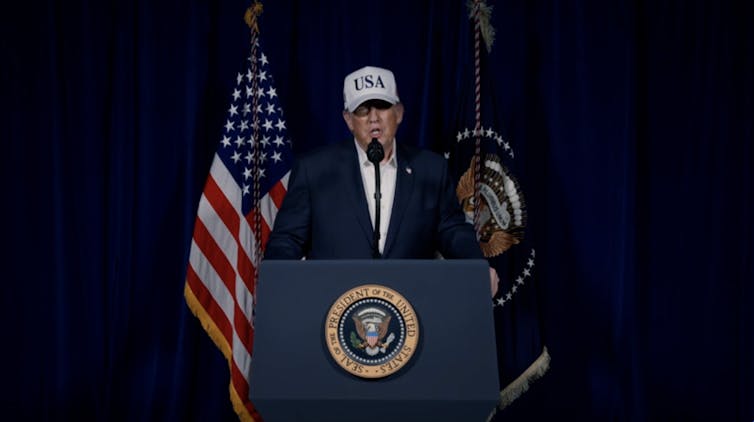
While the status of the supreme leader and other key members of Iran’s leadership remains unknown as of this writing, it is clear that the U.S. administration hopes that regime change will follow Operation Epic Fury. “When we are finished, take over your government. It will be yours to take,” Trump told Iranians via a video message recorded during the early hours of the attack.

A man in a suit and a baseball cap with USA on it stands at a podium.
U.S. President Donald Trump addressed the nation on Iran strikes.
US President Trump Via Truth Social/Anadolu via Getty Images

Regime change carries risks for Trump

Signaling a regime change operation may encourage Iranians unhappy with decades of repressive rule and economic woes to continue where they left off in January – when hundreds of thousands took to the street to protest.

But it carries risks for the U.S. and its interests. Iran’s leaders will no longer feel constrained, as they did after the Soleimani assassination and the June 2025 conflict. On those occasions, Iran responded in a way that was not even proportionate to its losses – limited strikes on American military bases in the region.

Now the gloves are off, and each side will be trying to land a knockout blow. But what does that constitute? The U.S. administration appears to be set on regime change. Iran’s leadership will be looking for something that goes beyond its previous retaliatory strikes – and that likely means American deaths. That eventuality has been anticipated by Trump, who warned that there might be American casualties.

So why is Trump willing to risk that now? It is clear to me that despite talk of progress in the rounds of diplomatic talks, Trump has lost his patience with the process.

On Feb. 26, after the latest round of talks in Geneva, we didn’t hear much from the U.S. side. Trump’s calculus may have been that Iran wasn’t taking the hint – made clear by adding a second carrier strike group to the other warships and hundreds of fighter aircraft sent to the region over the past several weeks – that Tehran had no option other than agreeing to the U.S. demands.

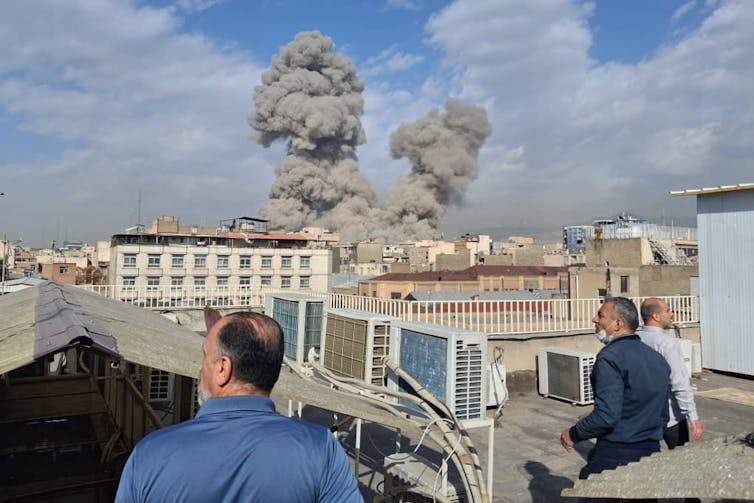
Three iranian men look out from a rooftop as smoke rises from explosions over buildings
Iranians watch as explosions erupt across Tehran.
AP Photo

What happens next

What we don’t know is whether the U.S. strategy is now to pause and see if an initial round of strikes has forced Iran to sue for peace – or whether the initial strikes are just a prelude to more to come.

For now, the diplomatic ship appears to have sailed. Trump seems to have no appetite for a deal now – he just wants Iran’s regime gone.

In order to do that, he has made a number of calculated gambles. First politically and legally: Trump did not go through Congress before ordering Operation Epic Fury. Unlike 23 years ago when President George W. Bush took the U.S. into Iraq, there is no war authorization giving the president cover.

Instead, White House lawyers must have assessed that Trump can carry out this operation under his Article 2 powers to act as commander in chief. Even so, the 1973 War Powers Act will mean the clock is now ticking. If the attacks are not concluded in 60 days, the administration will have to go back to Congress and say the operation is complete, or work with Congress for an authorization to use force or a formal declaration of war.

The second gamble is whether Iranians will heed his call to remove a regime that many have long wanted gone. Given the ferocity of the regime’s response to the protests in January, which resulted in the deaths of thousands of Iranians, are Iranians willing to face down Iran’s internal security forces and drive what remains of the regime from power?

Third, the U.S. administration has made a bet that the Iranian regime – even confronted with an existential threat – does not have the capability to drag the U.S. into a lengthy conflict to inflict massive casualties.

And this last point is crucial. Experts know Tehran has no nuclear bomb and only has a limited stockpile of drones and cruise and ballistic missiles.

But it can lean on unconventional capabilities. Terrorism is a real concern – either through the Islamic Revolutionary Guard Corps’ Quds Force, which coordinates Iran’s unconventional warfare, or through its partnership with Hezbollah in Lebanon. Or actors like the Houthis in Yemen or Shia militias in Iraq may seek to conduct attacks against U.S. interests in solidarity with Iran or directed to do so by the regime.

A mass casualty event may put political pressure on Trump, but I cannot see it leading to U.S. boots on ground in Iran. The American public doesn’t have the appetite for such an eventuality, and that would necessitate Trump gaining Congressional approval, which for now has not yet materialized.

No one has a crystal ball, and it is early in an operation that will likely go on for days, if not longer. But one thing is clear: Iran’s regime is facing an existential threat. Do not expect it to show restraint.

The Conversation

Javed Ali does not work for, consult, own shares in or receive funding from any company or organization that would benefit from this article, and has disclosed no relevant affiliations beyond their academic appointment.

ref. Iran will respond to US-Israeli strikes as existential threats to the regime – because they are – https://theconversation.com/iran-will-respond-to-us-israeli-strikes-as-existential-threats-to-the-regime-because-they-are-277176

Iran has been attacked by US and Israel when peace was within reach

Source: The Conversation – Global Perspectives – By Bamo Nouri, Honorary Research Fellow, Department of International Politics, City St George’s, University of London

US and Iranian negotiators met in Geneva earlier this week in what mediators described as the most serious and constructive talks in years. Oman’s foreign minister, Badr Albusaidi, spoke publicly of “unprecedented openness,” signalling that both sides were exploring creative formulations rather than repeating entrenched positions. Discussions showed flexibility on nuclear limits and sanctions relief, and mediators indicated that a principles agreement could have been reached within days, with detailed verification mechanisms to follow within months.

These were not hollow gestures. Real diplomatic capital was being spent. Iranian officials floated proposals designed to meet US political realities – including potential access to energy sectors and economic cooperation. These were gestures calibrated to allow Donald Trump to present any deal as tougher and more advantageous than the 2015 agreement he withdrew the US from in May 2018. Tehran appeared to understand the optics Washington required, even if contentious issues such as ballistic missiles and regional proxy networks remained outside the immediate framework. Then, in the middle of these talks, the bridge was shattered.

Sensing how close the negotiations were — and how imminent military escalation had become — Oman’s foreign minister, Badr Albusaidi, made an emergency dash to Washington in a last-ditch effort to preserve the diplomatic track.

In an unusually public move for a mediator, he appeared on CBS to outline just how far the talks had progressed. He described a deal that would eliminate Iranian stockpiles of highly enriched uranium, down-blend existing material inside Iran, and allow full verification by the International Atomic Energy Agency (IAEA) — with the possibility of US inspectors participating alongside them. Iran, he suggested, would enrich only for civilian purposes. A principles agreement, he indicated, could be signed within days. It was a remarkable disclosure — effectively revealing the contours of a near-breakthrough in an attempt to prevent imminent war.

But rather than allowing diplomacy to conclude, the US and Israel have launched coordinated strikes across Iran. Explosions were reported in Tehran and other cities. Trump announced “major combat operations,”, framing them as necessary to eliminate nuclear and missile threats while urging Iranians to seize the moment and overthrow their leadership. Iran responded with missile and drone attacks targeting US bases and allied states across the region.

What is most striking is not merely that diplomacy failed, but that it failed amid visible progress. Mediators were openly discussing a viable framework; both sides had demonstrated flexibility – a pathway to constrain nuclear escalation appeared tangible. Choosing military escalation at that moment undermines the premise that negotiation is a genuine alternative to war. It signals that even active diplomacy offers no guarantee of restraint. Peace was not naïve. It was plausible.

Iran’s approach in Geneva was strategic, not submissive. Proposals involving economic incentives – including energy cooperation – were not unilateral concessions but calculated compromises designed to structure a politically survivable agreement in Washington. The core objective was clear: constrain Iran’s nuclear programme through enforceable limits and intrusive verification, thereby addressing the very proliferation risks that sanctions and threats of force were meant to prevent.

Talks had moved beyond rhetorical posturing toward concrete proposals. For the first time in years, there was credible movement toward stabilising the nuclear issue. By attacking during that negotiation window, Washington and its allies have not only derailed a diplomatic opening but have cast doubt on the durability of American commitments to negotiated solutions. The message to Tehran – and to other adversaries weighing diplomacy – is stark: even when talks appear to work, they can be overtaken by force.

Iran is not Iraq or Libya

Advocates of escalation often invoke Iraq in 2003 or Libya in 2011 as precedents for rapid regime collapse under pressure. Those analogies are misleading. Iraq and Libya were highly personalised systems, overly dependent on narrow patronage networks and individual rulers. Remove the centre, and the structure imploded.

Iran is structurally different. It is not a dynastic dictatorship but an ideologically entrenched state with layered institutions, doctrinal legitimacy and a deeply embedded security apparatus, including the Islamic Revolutionary Guard Corps. Its authority is intertwined with religious, political and strategic narratives cultivated over decades. It has endured sanctions, regional isolation and sustained external pressure without fracturing.

Even a previous US-Israeli campaign in 2025 that lasted 12 days failed to eliminate Tehran’s retaliatory capacity. Far from collapsing, the state absorbed pressure and responded. Hitting such a system with maximum force does not guarantee implosion; it may instead consolidate internal cohesion and reinforce narratives of external aggression that the leadership has long leveraged.


Read more:
The US and Israel’s attack may have left Iran stronger


The mirage of regime change

Rhetoric surrounding the strikes has already shifted from tactical objectives to the language of regime change. US and Israeli leaders framed military action not solely as neutralising missile or nuclear capabilities, but as an opportunity for Iranians to overthrow their government. That calculus – regime change by force – is historically fraught with risk.

The Iraq invasion should be a cautionary tale. The US spent more than a decade cultivating multiple Iraqi opposition groups – yet dismantling the centralised state apparatus still produced chaos, insurgency and fragmentation. The vacuum gave rise to extremist organisations such as IS, drawing the US into years of renewed conflict.

Approaching Iran with similar assumptions ignores both its institutional resilience and the complexity of regional geopolitics. Sectarian divisions, entrenched alliances and proxy networks mean that destabilisation in Tehran would not remain contained. It could rapidly spill across borders and harden into prolonged confrontation.

A region wired for escalation

Iran has invested heavily in asymmetric capabilities precisely to deter and complicate external intervention. Its missile, drone and naval systems are embedded along the Strait of Hormuz — a chokepoint for global energy — and linked into a network of regional allies and militias.

In the current escalation, Tehran has already launched retaliatory missile and drone strikes against US military bases and allied territories in the Gulf, hitting locations in Iraq, Bahrain, the United Arab Emirates (including Abu Dhabi), Kuwait and Qatar in direct response to US and Israeli strikes on Iran’s cities, including Tehran, Qom and Isfahan. Explosions have been reported in Bahrain and the UAE, with at least one confirmed fatality in Abu Dhabi, and several bases housing US personnel have been struck or targeted, underscoring how the conflict has already spread beyond Iran’s borders

A full-scale regional war is now more likely than it was a week ago. Miscalculation could draw multiple states into conflict, inflame sectarian fault lines and disrupt global energy markets. What might have remained a contained nuclear dispute now risks expanding into a wider geopolitical confrontation.

What about Trump’s promise of no more forever wars?

Trump built his political brand opposing “endless wars” and criticising the Iraq invasion. “America First” promised strategic restraint, hard bargaining and an aversion to open-ended intervention. Escalating militarily at the very moment diplomacy was advancing sits uneasily with that doctrine and revives questions about the true objectives of US strategy in the Middle East.

If a workable nuclear framework was genuinely emerging, abandoning it in favour of escalation invites a deeper question: does sustained tension serve certain strategic preferences more comfortably than durable peace?

Trump’s Mar-a-Lago address announcing the strikes carried unmistakable echoes of George W. Bush before the 2003 invasion of Iraq. Military action was framed as reluctant yet necessary – a pre-emptive move to eliminate gathering threats and secure peace through strength. The rhetoric of patience exhausted and danger confronted before it fully materialises closely mirrors the language Bush used to justify the march into Baghdad.

The parallel extends beyond tone. Bush cast the Iraq war as liberation as well as disarmament, promising Iraqis freedom from dictatorship. Trump similarly urged Iranians to reclaim their country, implicitly linking force to regime change. In Iraq, that fusion of shock and salvation produced not swift democratic renewal but prolonged instability. The assumption that military force can reorder political systems from the outside has already been tested – and its costs remain visible.

The central challenge now facing the US is not simply Iran’s military capability. It is credibility. Abandoning negotiations mid-course signals that diplomacy can be overridden by force even when progress is visible. That perception will resonate far beyond Tehran.

Peace was never guaranteed. It was limited and imperfect, focused primarily on nuclear constraints rather than human rights or regional proxy networks. But it was plausible – and closer than many assumed. Breaking the bridge while building it does more than halt a single agreement – it risks convincing both sides that negotiation itself is futile.

In that world, trust erodes, deterrence hardens and aggression – not agreement – becomes the default language of international power. What we are witnessing is yet another clear indication that the rules-based order has been consigned to the history books.

The Conversation

Bamo Nouri does not work for, consult, own shares in or receive funding from any company or organisation that would benefit from this article, and has disclosed no relevant affiliations beyond their academic appointment.

ref. Iran has been attacked by US and Israel when peace was within reach – https://theconversation.com/iran-has-been-attacked-by-us-and-israel-when-peace-was-within-reach-277175

US-Israeli attack on Iran risks plunging the world into turmoil

Source: The Conversation – UK – By Arshin Adib-Moghaddam, Professor in Global Thought and Comparative Philosophies, Inaugural Co-Director of Centre for AI Futures, SOAS, University of London

The US and Israel have launched extensive, coordinated attacks on numerous targets across Iran, prompting retaliatory strikes in the region. Donald Trump neither tried to obtain Congressional approval, nor did he pursue a United Nations security council resolution ahead of these actions. And the attack has come in the middle of talks between Tehran and Washington.The facts are clear. This is an illegal war, both in terms of US law and international statutes.

The US president has repeatedly said that Iran can’t be allowed to develop a nuclear weapon. But the IAEA has stated that there is no evidence that Iran is pursuing a nuclear weapon. Iran’s foreign minister, Abbas Araghchi, said after the latest round of talks that “good progress” was being made on a deal to limit Iran’s nuclear programme in return for sanctions relief.

Now, from everything that the US president is saying, the goalposts have shifted from a nuclear deal to an attempt to force regime change.

So bombs are falling on various cities in Iran, family members are hiding, tragedies will inevitably happen and the innocent will suffer. This is the endpoint of a longstanding campaign by the US and Israeli right-wing to reshape the Middle East and the wider Muslim world at the barrel of a gun. This is yet another intervention in a long history of disastrous foreign moves that have destabilised the country since Britain and the Soviet Union deposed Reza Shah Pahlavi in 1941 and the CIA and MI6 orchestrated a coup to depose Iran’s democratically elected prime minister, Mohammad Mossadegh, in 1953.

The consequences of this attack are likely to be dire for the region and the world. Already, Iran has retaliated by targeting US bases in Kuwait, Qatar, the United Arab Emirates and Bahrain and the first reports of casualties are emerging. Iran is unlikely to hold back. It’s clear that the Islamic Republic is viewing this as an existential threat.

Tehran will call on its allies in the region, the Houthis in Yemen, the Popular Mobilisation Forces in Iraq and Hezbollah in Lebanon which – despite being weakened over two years of attacks by Israel aided and abetted by the United States – have the capacity to expand the conflict throughout the region.

Iran has already indicated in recent drills with the Russian Navy that it may be capable of closing off the Strait of Hormuz, through which around one-quarter of the world’s oil and one-third of its liquefied natural gas travel. As a consequence, oil prices will explode and the world economy will suffer.

Clash of civilisations

There is a cultural component to this war, too. Israel and the US are conducting this war during the month of Ramadan. Muslims all over the world are fasting. For billions of them, this is the month of spirituality, peace and solidarity. Images of Iranian Muslims being killed by Israeli and US bombs threaten to further a clash of civilisations narrative which pits the Judeo-Christian world against Islam.

Muslims in European capitals, together with anti-war activists, will see this war as a clear aggression on the part of the US and Israel. Global public opinion will not be easily swayed into the direction Trump and Netanyahu would like.

And it must be asked, what will the leaders in Moscow and Beijing be thinking as they watch this illegal war and what might this mean for Ukraine and Taiwan? Vladimir Putin and Xi Jinping are close to the government of Iran and will condemn this war. At the same time, they must feel emboldened to pursue their own agendas with military might.

So Trump and Netanyahu’s attack on Iran has the potential to plunge the world into deep crisis. Expect more refugees, more economic turmoil, more trauma, death and destruction. The only hope now is that cooler heads among world leaders can prevail to contain this conflict and to limit the actions of Trump and Netanyahu.

Diplomacy has to be prioritised. Attempting to force regime change by launching an illegal war is foolhardy. If Iran is further destabilised, the entire Middle East and beyond will be plunged into utter turmoil. From there the outcome for the whole world is dangerously uncertain.

The Conversation

Arshin Adib-Moghaddam does not work for, consult, own shares in or receive funding from any company or organisation that would benefit from this article, and has disclosed no relevant affiliations beyond their academic appointment.

ref. US-Israeli attack on Iran risks plunging the world into turmoil – https://theconversation.com/us-israeli-attack-on-iran-risks-plunging-the-world-into-turmoil-276818

Cuba’s speedboat shootout recalls long history of exile groups engaged in covert ops aimed at regime change

Source: The Conversation – Global Perspectives – By William M. LeoGrande, Professor of Government, American University School of Public Affairs

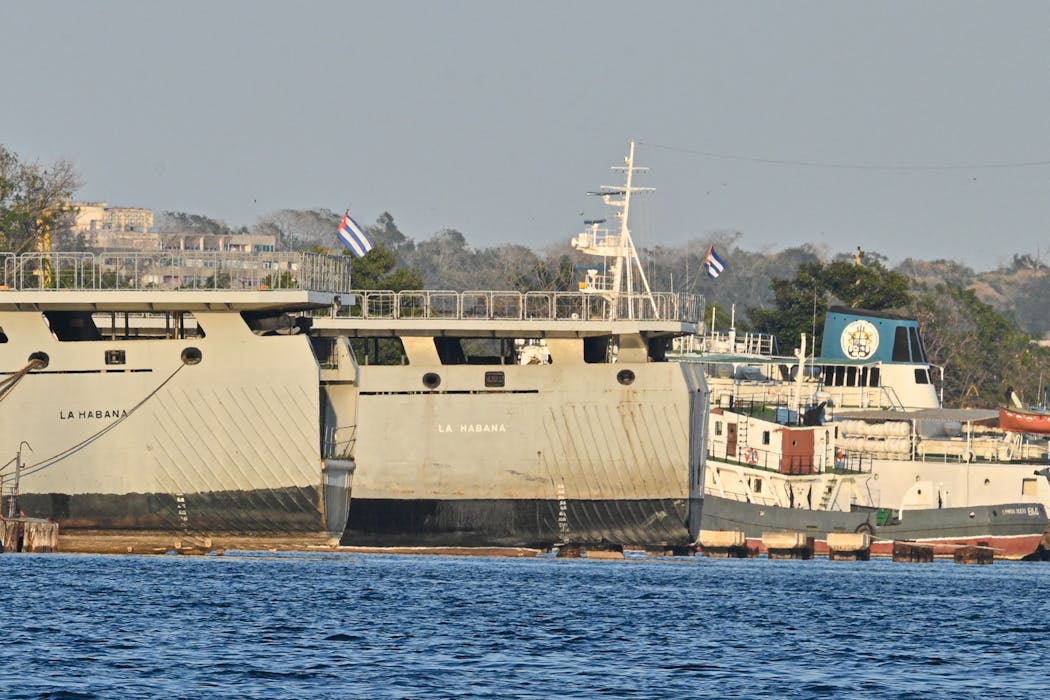
Cuban coast guard ships docked at the port of Havana on Feb. 25, 2026. Adalberto Roque/ AFP via Getty Images

A boat carrying 10 heavily armed men entered Cuban territorial waters on Feb. 25, 2026, intent, according to officials in Havana, on infiltrating the island nation and undermining the communist government through acts of sabotage and terrorism. When the men opened fire on an approaching Cuban Border Guard patrol boat, the border guards returned fire, killing four and wounding the other six. Another Cuban American who had allegedly flown to Cuba from the United States to meet the infiltration team on the beach was later arrested.

While details about the incident continue to come out, the gun battle comes at a time of heightened tensions between Cuba and the United States, which for weeks has been pursuing a de facto total oil blockade of the island. The latest episode is also reminiscent of the early 1960s, when Cuban exiles, trained and armed by the CIA, tried to infiltrate Cuba to conduct acts of sabotage and assassinate the leaders of the Cuban Revolution.

As a longtime expert on U.S. foreign policy toward Latin America and co-author of a history of the bilateral diplomacy between the United States and Cuba, I know that Cuba’s exile community has long contained paramilitary elements. Encouraged by Washington’s intensified sanctions and heated rhetoric, and a weakened government in Havana, these elements seem to sense an opportunity now.

Cuba’s exiled paramilitaries

Following the triumph of the Cuban Revolution and Fidel Castro’s rise to power in 1959, U.S. policy toward the new government was antagonistic almost from the start.

In 1961, the CIA under President John F. Kennedy organized the Bay of Pigs invasion – a military operation by exiled Cubans aimed at overthrowing the young Castro government.

A group of men with guns stand by a boat with a skull and crossbones motif.
Pro-Castro soldiers pose at Playa de Giron, Cuba, after thwarting the ill-fated ‘Bay of Pigs’ invasion.
Graf/Getty Images

The attempted invasion was a “perfect failure,” in the words of author Theodore Draper, after which the agency recruited a number of the invaders to continue to wage irregular war against Cuba. They were part of Operation Mongoose, the Kennedy administration’s multifaceted program of diplomatic, economic, political and paramilitary pressure aimed at overthrowing the Cuban government.

The CIA’s financial support for exile paramilitary groups continued into the late 1960s, until it was phased out because of their ineffectiveness. Although the CIA gave up on overthrowing Castro by force of arms, the paramilitary exile groups did not.

Two of the most prominent groups – Alpha 66 and Omega 7 – continued their war against the Cuban government for years with tacit U.S. support. “We should not inhibit Cuban exile activity against their homeland,” President Richard Nixon wrote in 1971 in response to Coast Guard efforts to arrest members of Alpha 66. Five years later, two of the most prominent paramilitary leaders, Orlando Bosch and Luis Posada Carriles, orchestrated the bombing of a civilian airliner, Cubana Flight 455, killing all 73 people on board.

A change in attitudes

Frustrated by their inability to depose the Cuban government, the paramilitary groups turned their attention inward. In the late 1970s, these groups launched a campaign of terrorist bombings and assassinations mainly targeting Cuban Americans who dared speak out in favor of rapprochement with their homeland. In 1979, two members of the Committee of 75, Cuban Americans who traveled to Cuba to meet with Castro to secure the release of political prisoners, were assassinated by Omega 7.

President Ronald Reagan was certainly no friend of Castro’s Cuba, but his Justice Department launched a major crackdown on the U.S.-based paramilitary groups, winning convictions against a number of their members.

The terrorist attacks subsided, but the martial impulse has remained alive among some Cuban American extremists. Small groups have continued to hold weekend military training exercises in the Everglades in Florida, home to the world’s largest Cuban diaspora. Periodically over the years, some of these weekend warriors have tried to infiltrate Cuba. Almost always, they are quickly captured by Cuban police. The most recent firefight seems to be the latest of these incidents, albeit an unusually violent one.

Ratcheting up US hostility to Cuba

The number of these incursions, along with attempts by Cuban Americans to solicit acts of sabotage over social media, have increased in recent years as relations between Cuba and the U.S. have deteriorated, now at their lowest point in decades.

In his first administration, President Donald Trump reversed President Barack Obama’s 2014 Cuban thaw by imposing the toughest economic sanctions since the 1960s. President Joe Biden left most of those sanctions in place, even as the Cuban economy suffered during the COVID-19 pandemic.

Now in his second term, Trump has turned the screws even tighter by cutting off Cuba’s oil supply from Venezuela and threatening other countries if they send oil to Cuba. The result is a profound, unprecedented economic decline on the island that threatens to precipitate a humanitarian crisis.

Both Trump and Secretary of State Marco Rubio, who built his political career by being the most vocal anti-Cuban government member of Congress, have declared Cuba a failed state and predict its imminent collapse almost daily.

These predictions from the White House, along with the seemingly unsustainable economic crisis on the island, have created an expectation that the Cuban government cannot survive. In this atmosphere, Cuban American militants might well conclude that the long-awaited moment has arrived, and those who fancy themselves soldiers might well decide to take up arms and head south to witness, participate in or even catalyze the demise of the government they have hated so much and for so long.

But Cuba is not a failed state, claims from the White House notwithstanding. The Cuban government is still fully capable of maintaining public order and defending its coastline, as the 10 people that allegedly tried to infiltrate the island found out.

Trump and his hawkish advisers, including Rubio, appear to want to force Cuba into submission, much as they have tried to do in Venezuela.

But there are no visible signs of cracks in the regime and no organized opposition to it. Many Cubans remain fiercely nationalistic and are not likely to accept any deal that requires them to surrender their national sovereignty by remaking their political or economic system to please the United States.

Absent some kind of diplomatic agreement between Washington and Havana, the Cuban economy will continue to deteriorate under the weight of the ongoing oil blockade and all the other elements of the U.S. economic embargo. This will deepen the misery of people living in Cuba and risks prompting other exiles into launching paramilitary adventures in hopes of exploiting Havana’s weakness.

The Conversation

William M. LeoGrande is affiliated with The Quincy Institute as a Non-resident Fellow

ref. Cuba’s speedboat shootout recalls long history of exile groups engaged in covert ops aimed at regime change – https://theconversation.com/cubas-speedboat-shootout-recalls-long-history-of-exile-groups-engaged-in-covert-ops-aimed-at-regime-change-277049

Why isn’t the Greens’ growing success reflected in media coverage?

Source: The Conversation – UK – By Maxwell Modell, Research associate, Cardiff University

wellphoto/Shutterstock

The victory of the Greens in the Gorton and Denton parliamentary byelection is a landmark for the party. But our new research reveals the Greens have received limited airtime over the last year despite almost doubling their support in the polls and in party membership.

While Reform UK has seen a spike in media coverage since it took a commanding lead in the polls, our research shows the Greens have not received more airtime in recognition of their growing popularity.

Broadcasters have to abide by due impartiality rules, but they have the editorial freedom to balance the airtime of political parties. They consider factors such as a party’s vote share at the last UK general election or a party’s electoral performance at the most recent devolved, regional and local election. Other factors to consider include the latest trends in opinion polls tracking voting intention, and whether what a party is saying the news organisation considers significant or, as the BBC says, whether they are “making the political weather” by setting the agenda.

After winning the byelection, this raises the question: should the Greens now be given more airtime?

Limited coverage of Greens

Our Impartiality project team has been tracking coverage of UK opposition parties on BBC News at Ten and ITV News at Ten, the UK’s most-watched nightly TV news bulletins.

In 2025, we found the Greens were the sixth most covered opposition party, being referenced in just 32 items, behind the Conservatives (375), Reform UK (213), the Liberal Democrats (116), the Scottish National Party or SNP (46) and ahead of Plaid Cymru (10).

Number of items led by an opposition party on BBC News at Ten and ITV News at Ten.
Cardiff University, CC BY-NC-ND

We also tracked how often a party was the leading focus of a broadcaster’s report. The Greens led four items – three on BBC and one on ITV. These stories related to the Greens’ May local election campaign, Zack Polanski winning the party leadership in September and the party conference in October. But neither BBC News at Ten and ITV News at Ten covered the announcement or build-up to the leadership contest.

In contrast, Reform UK led 69 items, Conservatives led 45 items, the Liberal Democrats led 14 items and the SNP led 13 items.

vote green sign, outside blue sky
Growing success of the Green party doesn’t mean more press appearances.
Peter_Fleming

The Greens also appeared on only four episodes of BBC Question Time during 2025. That was about a third as often as the Liberal Democrats and Reform UK.
Despite the leadership change, the subsequent surge in membership and the sustained rise in poll ratings (from 11% in August 2025 to 17% in December 2025), broadcast coverage of Greens did not increase at the end of 2025.

This shows a potential inequality in the treatment of the rising left and right parties. The BBC cited improvements in opinion polling as one of the factors behind the increased coverage of Reform UK, but the Green party’s popularity has not received anywhere near the same recognition.


Read more:
What Hannah Spencer’s historic win means for the Green party’s future


In May 2025, news coverage of Reform UK increased substantially following its victories in local and mayoral elections, which broadcasters considered a sign that the party was now a major player in UK electoral politics. Our research even showed in September 2025 Reform UK was referenced on TV news more than the Conservatives, the party that is supposed to be the UK’s parliamentary official opposition.

The question now is whether broadcasters will take the Green party’s victory in Gorton and Denton as a similar sign of its electoral significance and increase media coverage of the party.

While broadcasters have not broken any of the UK’s rules on due impartiality, our new research raises questions about how they have been interpreting impartiality in a new multi-party system.

Traditionally they have relied on allocating airtime according to parties with the largest number of MPs and total vote at the last general election. They have also factored in performances at the latest local, regional or devolved elections. But they now appear to making more subjective judgements about allocating airtime according to the opinion polls or the newsworthiness of parties.

Given the Greens’ growing popularity, their distinctive set of policies, charismatic leader and byelection victory, they might now look set to receive more media attention and scrutiny over the coming months.

The Conversation

Maxwell Modell receives funding from the AHRC for research into broadcasters’ impartiality.

Matt Walsh receives funding from the AHRC for research into broadcasters’ impartiality.

Stephen Cushion has received funding from the BBC Trust, Ofcom, AHRC, BA and ESRC.

ref. Why isn’t the Greens’ growing success reflected in media coverage? – https://theconversation.com/why-isnt-the-greens-growing-success-reflected-in-media-coverage-277137