The two lives of Chuck Norris

Source: The Conversation – USA (2) – By Ben Pettis, Assistant Professor of Rhetoric and Communication Studies, University of Richmond

Actor and martial artist Chuck Norris died on March 19, 2026, at the age of 86. Jean-Jacques Bernier/Gamma-Rapho via Getty Images

“Chuck Norris doesn’t do push-ups. He simply pushes the world down.”

“Chuck Norris counted to infinity – twice.”

“Chuck Norris once strangled someone – with a cordless phone”

In the late 2000s and early 2010s, Chuck Norris, the 1980s action star, became a tongue-in-cheek model of toughness and masculinity in viral internet memes known as “Chuck Norris Facts.”

Although these memes waned in popularity, they never fully fizzled out. One Facebook group has over 400,000 members, many of whom regularly contribute new jokes about the “Walker, Texas Ranger” star.

But when news of Norris’ death broke on March 19, 2026, those memes returned, and memories resurfaced of their glory days.

In fact, they almost overshadowed remembrances of the movie star’s life.

What does it mean that many memories of Norris are more connected to a meme than his actual life and career? What gets left behind when a person becomes a digital object that we send over the internet? And what can memes tell us about how everyday people relate to celebrities – and to one another?

In the case of Norris, the actor and martial artist’s death forced some people to reconcile the memes with the man.

Macho man

Memes aren’t just memes. They might seem like trivial jokes, but my research has shown that they can shape how people understand and debate bigger cultural questions.

For example, Chuck Norris memes gave people a way to critique over-the-top ideas of masculinity and the pressure to live up to them. Whether it was memes crowing about his ability to slam a revolving door or kill two stones with one bird, only Norris, who stood at the apex of manliness, could pull off such impossible feats.

Other times, Norris’ “memeified” macho persona was deployed to advance misogyny: “Chuck Norris told a woman to CALM DOWN, and she did.” (As internet scholar Whitney Phillips explains, memes and humor have always been close relatives of the more toxic parts of online culture.)

Of course, Norris is hardly the only celebrity to have become memeified, and other celebrity memes routinely tap into the cultural zeitgeist.

When pop star Miley Cyrus released the music video for her song “Wrecking Ball” in 2013, it was quickly parodied and become the subject of countless memes. Many parodied her overt sexuality by swapping her out for someone decidedly less sexy on the wrecking ball. Or they spoofed her performance by playing the song over videos of other forms of destruction.

The man, the myth, the legend

Missing from all the meme nostalgia: Who was the real Chuck Norris?

After Norris’ death, social media users pointed to his past homophobic comments, in which he condemned the Boy Scouts of America’s – now Scouting America – inclusion of gay youth and leaders. There were his right-wing politics, including his friendships with Presidents Ronald Reagan and George H. W. Bush and his 2017 endorsement of Alabama U.S. Senate candidate Roy Moore – who, as the state’s chief judge, had ordered Alabama probate judges not to issue marriage licenses to same-sex couples even after same-sex marriage had been legalized nationwide.

If those views and actions conflict with your own values, can you still laugh at Chuck Norris memes?

I certainly think so. Memes are special because there isn’t ever one fixed definition of what they mean, and the humor of a Chuck Norris meme can land even if you know nothing about his real life and career.

At the same time, in life and in death, the meme of Norris will always be connected to the person. The past few weeks have certainly brought these two versions of Norris into contact with one another. It’s up to everyone else to decide which version they remember most.

Democratizing stardom

For me, one of the most interesting aspects of memes is that stardom can happen from the ground up. Regular people decide what a meme is. Fame is no longer largely determined by film studios and mainstream media outlets.

The “Numa Numa Guy” – Gary Brolsma – became a meme after his 2003 video went viral. The “Success Kid” – Sammy Griner – turned into a meme thanks to a photo of him as a toddler clenching his fist in a display of satisfaction.

Why did these people become memes, but countless other YouTubers or kids making funny poses failed to launch? That’s just the unpredictability of the internet and the messiness of online culture.

Memes of existing celebrities also reflect this broader shift in control. No matter how much a studio tries to manage a star’s image, a meme can be created that takes on a life of its own.

Take, for example, Keanu Reeves, who was memeified after a photo of the actor sullenly eating a sandwich went viral. The meme began as a paparazzi photo but took off when everyday people photoshopped Reeves into ridiculous scenarios.

But whether they’re everyday people or famous celebrities, there’s a darker side to reducing people to pixelated, repurposed images: Over time, it can be incredibly difficult to separate the real person from the meme.

Laina Morris, for instance, has tried to move on from the image of her grinning, bug-eyed face that became a popular meme portraying her as an overly protective and clingy girlfriend.

People magazine profiled Morris for an article headlined “Overly Attached Girlfriend Gets Honest About Becoming a Meme,” which explored what it’s like to be constantly recognized as “that girl from that meme.”

Yet the fact that the publication still used “Overly Attached Girlfriend” in its headline shows just how difficult – or even impossible – it is to sever oneself from internet fame.

Chuck Norris, perhaps more than anyone, knew that all too well.

The Conversation

Ben Pettis does not work for, consult, own shares in or receive funding from any company or organization that would benefit from this article, and has disclosed no relevant affiliations beyond their academic appointment.

ref. The two lives of Chuck Norris – https://theconversation.com/the-two-lives-of-chuck-norris-279430
An ancient oracle warned invading Persia would backfire – from Croesus to Trump, rulers have failed to listen

Source: The Conversation – Global Perspectives – By Peter Edwell, Associate Professor in Ancient History, Macquarie University

Photo by Stefano Bianchetti/Corbis via Getty Images

Invasions of ancient Persia were always daunting tasks. They often led to disaster.

In the 6th and 5th centuries BCE, the Persian empire came to dominate a vast and varied geography with Iran at its heart.

Comprising modern Iran, Iraq, Turkey, the Persian Gulf and parts of other neighbouring countries, the Persian Empire was established and ruled by the Achaemenids. This powerful dynasty lasted all the way to about 330 BCE when Alexander the Great defeated its last ruler, Darius III.

But in the early days of this Achaemenid Persian expansion (546 BCE), the legendary King Croesus (from Lydia, in western Turkey) decided to challenge it.

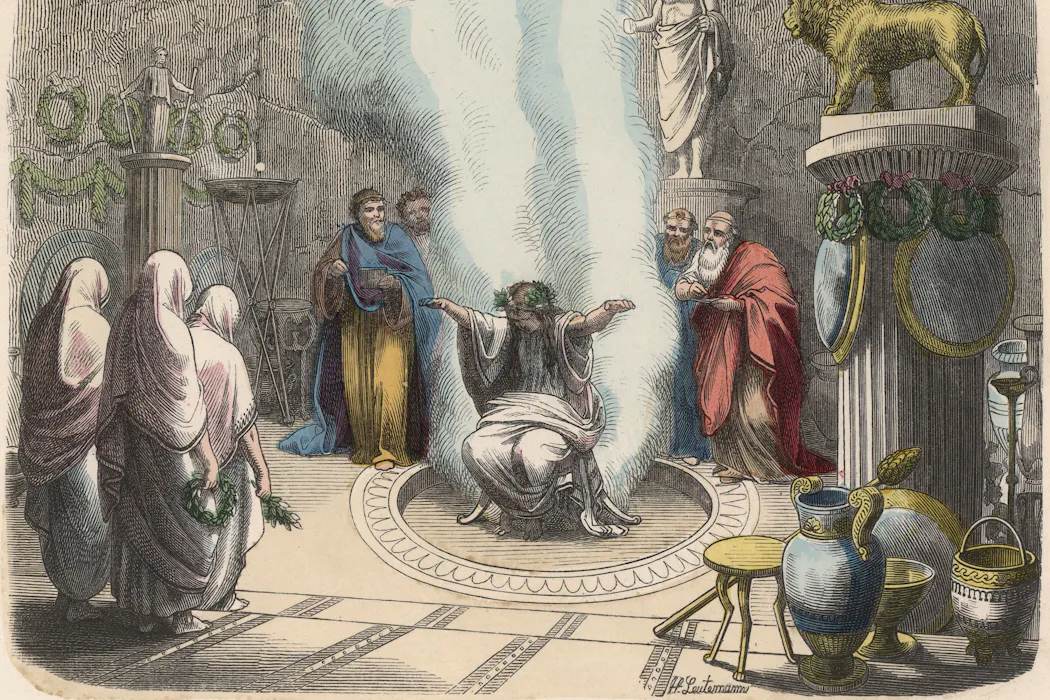
Reputedly the richest man in the world, Croesus consulted the famed Oracle of Apollo at Delphi (in Greece). The oracle, according to ancient writer Herodotus, told Croesus:

that if he should send an army against the Persians he would destroy a great empire.

Croesus’ subsequent invasion and defeat by the Persian king, Cyrus, saw the destruction of his own empire. The oracle accurately foretold the outcome but not as Croesus had hoped.

Croesus wasn’t the last ruler to invade Persia and realise he’d bitten off more than he could chew.

From the 6th century BCE to the 4th century CE, Greeks and Romans invaded Persia multiple times. The risks were high, the logistics complicated.

In fact – as US President Donald Trump is now discovering – wars like these, in this part of the world, are a lot easier to start than they are to end.

Complex and high-risk

The vast resources and manpower of the Achaemenid empire, together with its varied geography, made any invasion of Persia complex and high-risk.

When Alexander the Great (also known as Alexander III of Macedon) invaded in 334 BCE, he led stunning military successes against the Persians over the next few years.

But by the time of his premature death in Babylon in 323 BCE, organisation of the vast territory he had conquered was a hodge-podge of short-term arrangements.

Over time, the memory of Alexander in the Iranian territories he conquered was one of contempt. The Persian territory he conquered couldn’t be held by his successors.

Around 70 years after Alexander’s death, a new dynasty emerged in Iran.

Known as the Arsacid Parthians, they would dominate much of the former Achaemenid territory for centuries.

The Arsacid Parthians became the key rivals of the Romans as they (the Romans) expanded further east from the 1st century BCE onwards.

The first invasion of the Parthian empire by the Romans ended in total disaster – for the Romans.

The Roman general Crassus invaded Parthian imperial territory in southern Turkey in 53 BCE. The Parthian army annihilated Crassus’ forces near the city of Carrhae. Around 20,000 Roman soldiers died (including Crassus and his son) and 10,000 were captured.

This disaster would live in the Roman memory for centuries.

‘A source of constant wars and great expense’

Even when Roman invasions of the Parthian empire in the 2nd century CE were successful, there was often a sting in the tail. The emperor Trajan invaded all the way to the Persian Gulf in 116/117 CE but couldn’t hold any of his gains.

Later in the 2nd century CE, Roman invasions of the Parthian empire did see territorial gains in Mesopotamia (southern Turkey).

But one contemporary Roman writer, Cassius Dio, thought these gains were more trouble than they were worth:

He [emperor Septimius Severus] used to declare that he had added a vast territory to the empire and had made it a bulwark of Syria. On the contrary, it is shown by the facts themselves that this conquest has been a source of constant wars and great expense to us.

From loss to ultimate humiliation

In the 3rd century CE, the Sasanian dynasty took control of Iran and Mesopotamia from the Parthians. The Sasanian Persians inflicted serious defeats on invading Roman armies in the centuries ahead.

The Roman emperor Gordian III died in battle against the Sasanians in 244 CE. He led a large-scale invasion of the Persian empire but died trying to attack the capital, Seleucia-Ctesiphon. His successor (Philip I) signed a humiliating peace treaty to ransom what was left of the army.

But the ultimate humiliations for Roman emperors were yet to come.

In 260 CE, the emperor Valerian was captured by the Persian king, Shapur I.

Legendary accounts claimed Valerian served as a footstool for Shapur when he mounted his horse.

Rock reliefs from the 3rd century depicting Valerian and Philip I in subjection to Shapur survive in Iran to this day.

Around a century later, the emperor Julian died while invading the Persian empire. Leading an army of 60,000 men, Julian suffered a heavy defeat and was killed north of the Persian capital, Seleucia-Ctesiphon.

The ensuing peace treaty saw Rome lose key territory and fortresses in northern Mesopotamia.

It would take more than a century for Rome to recover from this defeat.

Most ancient invasions of the Persian empire caused serious problems for those who prosecuted them.

The varied and sometimes harsh nature of the geography was an important factor. The national resolve and military preparedness were others.

While the current US-Israel war against Iran is different in many ways to ancient wars directed at Persia, the 3rd-century Sasanian rock reliefs are reminders of what can go wrong.

The Conversation

Peter Edwell receives funding from the Australian Research Council.

ref. An ancient oracle warned invading Persia would backfire – from Croesus to Trump, rulers have failed to listen – https://theconversation.com/an-ancient-oracle-warned-invading-persia-would-backfire-from-croesus-to-trump-rulers-have-failed-to-listen-279750

Iran’s president appeals to Americans − but does his office still hold any real power?

Source: The Conversation – Global Perspectives – By Roxane Razavi, Visiting scholar in contemporary Middle Eastern history, Princeton University

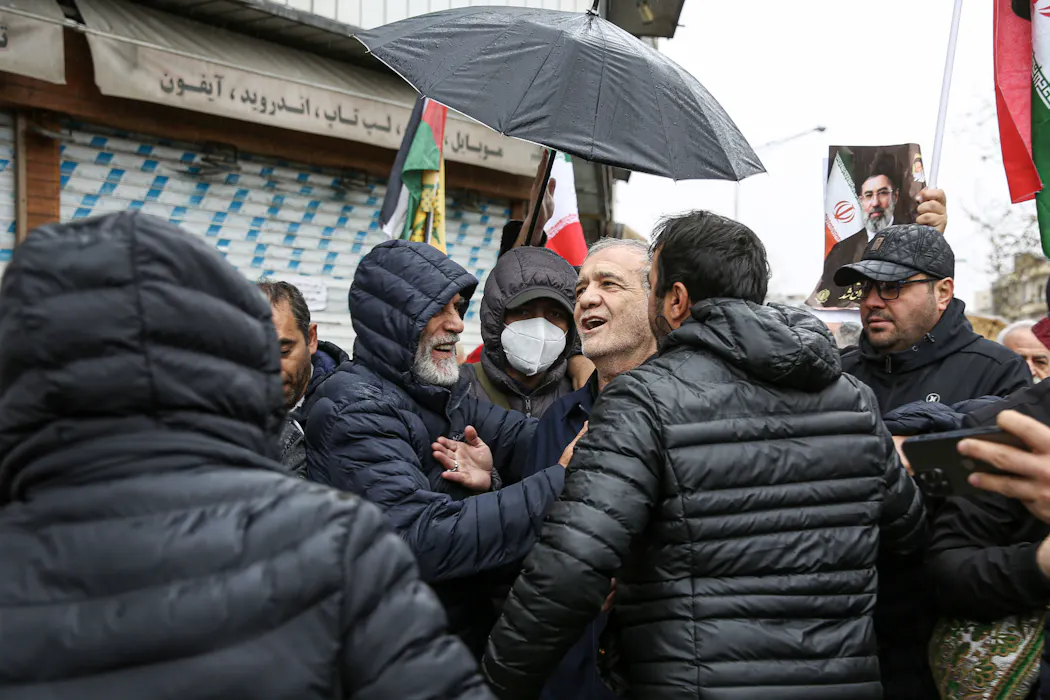
Iranian President Masoud Pezeshkian attends the Quds Day march in Tehran on March 13, 2026. Hassan Ghaedi/Anadolu via Getty Images

Iranian President Masoud Pezeshkian penned an open letter to “the people of the United States” on April 1, 2026, in which he implored Americans to “look beyond” misinformation that portrayed Iran as a threat to the world.

It was, perhaps, his most prominent intervention during the current conflict. Despite being the president of a country in the midst of crisis, Pezeshkian hasn’t had the highest of war profiles.

Criticized by conservatives at home for his conciliatory tone, the reformist politician has also been sidelined by Iran’s adversaries. Western media initially appeared more interested in the musings of Pezeshkian’s son, Yousef. President Donald Trump has barely mentioned Pezeshkian, other than in an oblique social media post on April 1 in which he claimed “Iran’s new regime president” had asked the U.S. for a ceasefire – something denied by Iran.

International attention has instead largely centered on the role of Iran’s supreme leader. First, it was about who would succeed Ali Khamenei after his killing in the first strikes of the war, and then what was known about his successor and son, Mojtaba Khamenei.

As a researcher of contemporary Iranian politics, I think this focus on the supreme leader over the president inadvertently confirms a trend in Iran that has been happening for years: the cementing of a political structure that increasingly resembles a centralized dictatorship.

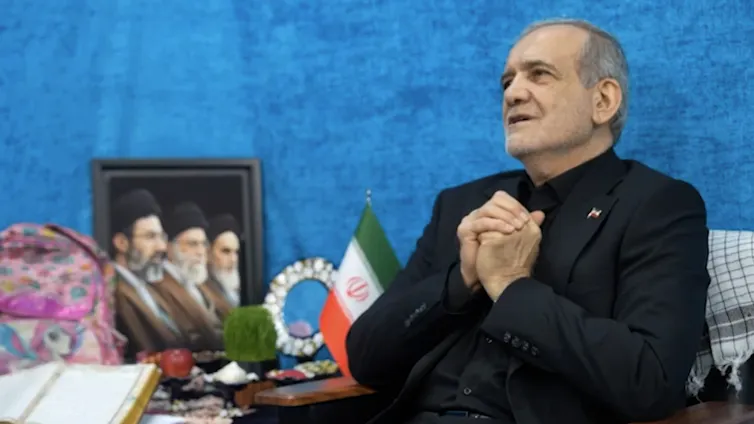
A man clasps his hands while sat in front of a photo of three men.
Iranian President Masoud Pezeshkian records a video message on March 20, 2026.
AA Video/Anadolu via Getty Images

An uneasy balance

The concentration of power around one figure sits uneasily with one of the founding impulses of the 1979 revolution that ushered in the Islamic Republic. A wide spectrum of revolutionary actors – Islamists, leftists and secular nationalists – were involved in the ousting of the shah. But they shared at least one principle: the rejection of monarchy.

The idea that one generation could not determine the political future of the next was precisely what many revolutionaries, despite their internal differences, had fought against.

As such, the system that initially emerged in 1979 was neither a pure theocracy nor a conventional republic. The supreme leader would exercise ultimate religious and political authority, and an elected president was to embody the republican dimension of the state. This second part gave institutional form to the revolutionary promise that people, through elections, would periodically renew political authority.

In the first decade after the revolution, this balance functioned, albeit in a fragile and conflictual manner.

The authority of Ruhollah Khomeini, the Islamic Republic’s first supreme leader, coexisted with the presidency – most notably during the brief presidency of Abolhassan Bani Sadr. Elected in 1980, Bani Sadr quickly came into conflict with clerical factions over the direction of the revolution and the conduct of the Iran-Iraq war.

Accused of political incompetence, Bani Sadr was impeached by parliament in 1981 and subsequently fled into exile.

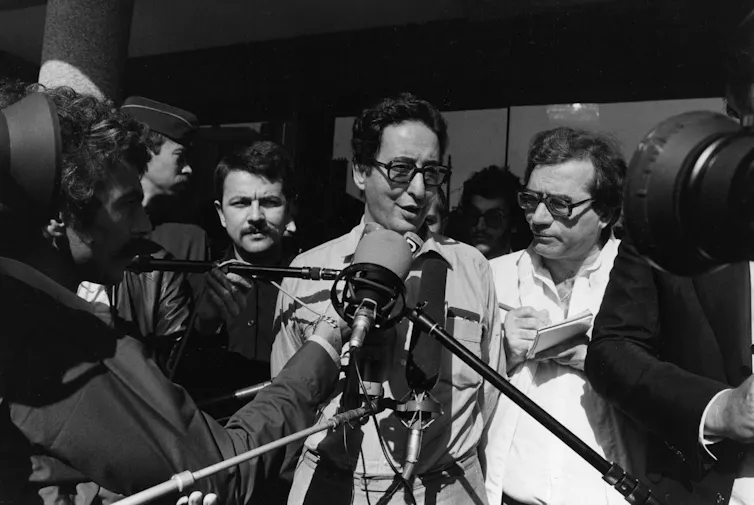
A man in glasses stands behind microphones
Iran’s first post-revolution president, Abolhassan Bani Sadr, in exile in France in 1981.
Marc Bulka/Gamma-Rapho via Getty Images

The presidency of his successor, Ali Khamenei, marked a period of relative alignment with the supreme leader. Operating under Khomeini’s authority, Khamenei operated less as an autonomous political force than as an instrument embedded within a broader clerical and revolutionary consensus.

The dynamic between president and supreme leader was further redefined by the 1989 constitutional revision following Khomeini’s death and the elevation of Khamenei from president to supreme leader. The post of prime minister was abolished, consolidating executive authority in the presidency. At the same time, the institutional and political supremacy of the supreme leader was strengthened.

The weakening presidency

The presidency of Mohammad Khatami, who was elected in 1997, demonstrated that the office could still function as a significant locus of power. As Khatami’s tenure showed, presidents were still able to shape public discourse and policy agendas, particularly in areas such as cultural policy, foreign relations and economic management.

But a major turning point in the power of the office occurred in 2009 with the contested reelection of the hard-liner president, Mahmoud Ahmadinejad, amid widespread allegations of electoral fraud.

It led to mass demonstrations that became known as the “Green Movement.” The state responded with the repression of protesters, followed by a consolidation of the security apparatus – particularly the expanding influence of the Islamic Revolutionary Guard Corps around the supreme leader.

At the same time, it marked the beginning of Ahmadinejad’s falling out of favor. His populist rhetoric and attempts to build an independent political base led to confrontations with clerical authorities in the early 2010s. It also exposed the regime’s intolerance for even a relatively autonomous presidency.

It contributed to a power struggle between Ahmadinejad and Supreme Leader Ali Khamenei that became public in 2011 when the then-president sought to dismiss Intelligence Minister Heydar Moslehi – only to be overruled by Khamanei.

Ahmadinejad was subsequently excluded from the 2017 presidential race by the Guardian Council, a body handpicked by the supreme leader. In so doing, Khamenei made it clear that while the office of the presidency could remain, it would cease to function as an independent center of decision-making and power.

Since then, presidents have continued to be elected, but their capacity to reshape the political order has been diminished sharply.

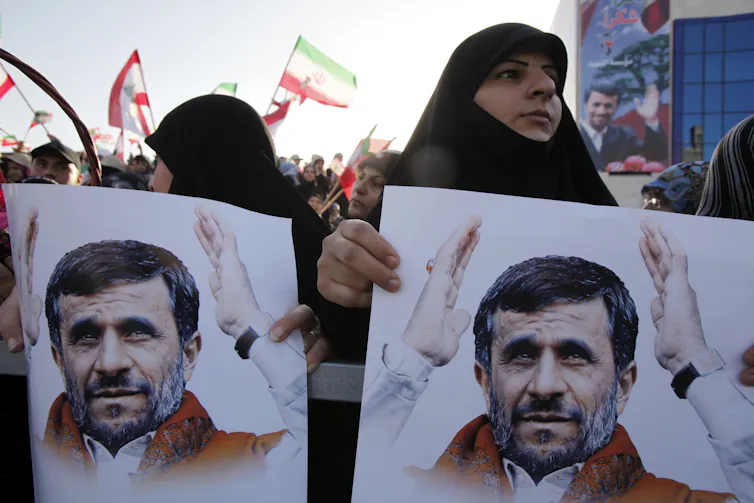
Two women hold posters with a man's face on it.
Supporters of hard-line Iranian President Mahmoud Ahmadinejad.
Salah Malkawi/Getty Images

The presidency of Hassan Rouhani briefly appeared to be an exception. His election in 2013, and the subsequent negotiation of the Joint Comprehensive Plan of Action, generated both domestic expectations and significant international attention.

Yet the durability of the agreement remained contingent on decisions taken beyond the presidency, both internationally and domestically. Its eventual unraveling during the first Trump administration confirmed suspicions among Iranian hard-liners around the supreme leader that reform, an independent power center in the presidency and diplomacy with the U.S. had been a mistake.

With even the limited form of democratic expression as embodied through an elected president suppressed, political disengagement has followed. Although voter turnout remained significant in the years immediately following 2009, a longer-term trend has seen people give up faith in elective politics in Iran. In the last election, held in 2024, just 39.9% of Iranians turned out to vote.

Consolidation of power

This diminishing of the role of the presidency and political legitimacy forms the background to any questions of succession now. But by reducing the political future of the country to the identity of future supreme leaders, observers risk normalizing the transformation of what was historically a contested and hybrid political system into one defined by a single office.

The bloody suppression of the January 2026 protests, the constraints imposed by wartime conditions and the increasing marginalization of elective institutions have all contributed to weakening the presidency.

The fallout of the current war may, of course, see a reorganization of political institutions in Iran. But for now, when Pezeshkian seeks diplomacy with Americans, the pertinent question is: Does his office still matter?

The Conversation

Roxane Razavi receives funding from the EHESS (PhD funding).

ref. Iran’s president appeals to Americans − but does his office still hold any real power? – https://theconversation.com/irans-president-appeals-to-americans-but-does-his-office-still-hold-any-real-power-278705

Where is transatlantic intelligence-sharing headed under the Trump administration?

Source: The Conversation – Global Perspectives – By Hager Ben Jaffel, Docteure en relations internationales spécialisée dans la sociologie du renseignement et de la sécurité, Institut catholique de Lille (ICL)

Repeated threats to annex Greenland, controversial diplomatic statements, and, more broadly, the antagonistic stance of the American executive toward Europeans point to an unprecedented climate of distrust among transatlantic allies, of which the latest Davos forum provided a revealing example. But what about alliances between intelligence services?

Often perceived as domestic instruments of political power, intelligence services are, in fact, highly internationalised and enjoy significant autonomy in their dealings with foreign counterparts, though this can occasionally be disrupted by political interference.

A history of long-standing collaborations

Cooperation between intelligence services is not new. Some partnerships date back at least to the First World War and are often the result of agreements between services themselves rather than formal decisions by governments. Whether bilateral or multilateral, these alliances underpin a wide range of activities: liaison officers posted abroad, listening stations, participation in international conferences, and routine exchanges of information.

International cooperation built on common ground and trust

Research in the social sciences has shown how, over time, a dense network of relationships has developed around shared interests. Counterterrorism, nuclear non-proliferation and other perceived imminent threats have provided strong justification for cooperation, including the exchange of data on individuals, organizations or states considered “dangerous.” The widely held belief that sharing information helps prevent attacks has also encouraged the expansion of surveillance mechanisms – often at the expense of robust democratic oversight.

One example is the many partnerships between the National Security Agency (NSA) and several European counterparts. These collaborations have enabled the pooling of advanced technologies – such as artificial intelligence and algorithmic analysis – to collect and process large volumes of private communications. This work also depends on explicit alliances between intelligence agencies and major tech companies, which have become key intermediaries that, willingly or not, make their users’ data available to intelligence services.

The solidarity and trust on display should not obscure the fact that international cooperation remains a space marked by strong rivalries. Services compete to access information, shape priorities and secure an advantageous position in relationships where resources – financial, human, or technical – are unevenly distributed. In this context, espionage between services and other disloyal practices are also part of the game.

These dynamics suggest that intelligence alliances follow a logic of their own rather than unwavering loyalty to political authority. It is in this context that the Danish military intelligence service monitored the communications of several European political leaders on behalf of the NSA. Above all, because they possess in-depth knowledge of the threats facing the world, intelligence services are able to position themselves at the heart of security decision-making, making political leaders dependent on their expertise.

Continuity despite political interference

That said, these alliances are not immune to political pressures. Disputes between intelligence services and political leaders have always existed, but the openly hostile attitude of the “reactionary internationale” embodied by the Trump administration and its MAGA supporters has raised concerns about a possible breakdown – or at least a significant weakening of cooperation.

Faced with an unfavourable political context, they are often able to adjust and even turn the situation to their advantage.

Several European intelligence services have thus strengthened their cooperation, even raising the possibility of creating a European Five Eyes – in reference to the Anglosphere intelligence alliance linking Australia, Canada, New Zealand, the United Kingdom and the United States to countries in Europe and Asia.

Others have specifically developed units to better anticipate the unpredictability of the American executive, with tangible effects: staffing in the unit dealing with the United States within France’s DGSE has increased, and the budgets of several European intelligence services are set to rise, benefiting from broader increases in defence spending.

More broadly, history shows that ties between services remain strong even when governments hold divergent positions. In the early 2000s, exchanges between the DGSE and the CIA continued despite disagreements over the war in Iraq.

A more recent example is Brexit, which did not lead to any major rupture in relations between the British police and their European counterparts, who continue to facilitate the flow of intelligence.

As in any relationship, signs of caution, distrust, or even ambivalence can emerge. For example, the British and Danish intelligence services have indicated that they are limiting – but not completely halting – their exchanges with their American counterparts, concerned about the legal implications and, more broadly, the politicisation of US intelligence. Irritated by repeated provocations over Greenland, the Danish military intelligence service went so far as to designate the United States as a national security threat, alongside China and Russia.

Nonetheless, it would be incorrect to assume that, under more normal circumstances, intelligence sharing would happen without any restrictions. Services do not share all their secrets, all the time, with everyone. On the contrary, the restraint shown by some reflects a routine asymmetry in exchanges that persists and can even be heightened during periods of turbulence.

Signs of continuity are evident, underscoring a key reality: intelligence primarily falls under the purview of career professionals, not politicians. Earlier this year, the Davos forum hosted European and Anglo-American intelligence chiefs, including the CIA, in a key meeting to preserve ties with the “Old Continent”.

Trump and the ‘deep state:‘ a love-hate relationship

Concerns among European services are partly linked to Donald Trump’s stated desire to dismantle the “deep state.” While he did follow through on some threats by dismissing personnel within intelligence agencies, these institutions have neither disappeared nor ceased to function. In practice, the executive branch remains dependent on them.

The appointment of controversial figures to lead several agencies, instead of career officials, reflects an effort to align leadership more closely with political and ideological priorities. Current international developments show that intelligence services remain essential to the implementation of foreign policy. Long criticised, the CIA now appears to have returned to favour with the White House, taking advantage of the opportunities offered by the fight against drug trafficking and the conflict in Iran to reaffirm its relevance and legitimacy to political power.

Taken together, these developments highlight the complexity of the relationship between intelligence services and political power – one shaped by both distance and proximity.


A weekly e-mail in English featuring expertise from scholars and researchers. It provides an introduction to the diversity of research coming out of the continent and considers some of the key issues facing European countries. Get the newsletter!


The Conversation

Hager Ben Jaffel ne travaille pas, ne conseille pas, ne possède pas de parts, ne reçoit pas de fonds d’une organisation qui pourrait tirer profit de cet article, et n’a déclaré aucune autre affiliation que son organisme de recherche.

ref. Where is transatlantic intelligence-sharing headed under the Trump administration? – https://theconversation.com/where-is-transatlantic-intelligence-sharing-headed-under-the-trump-administration-279135

Pam Bondi’s extreme political loyalty to Trump wasn’t enough to save her job

Source: The Conversation – USA – By Austin Sarat, William Nelson Cromwell Professor of Jurisprudence and Political Science, Amherst College

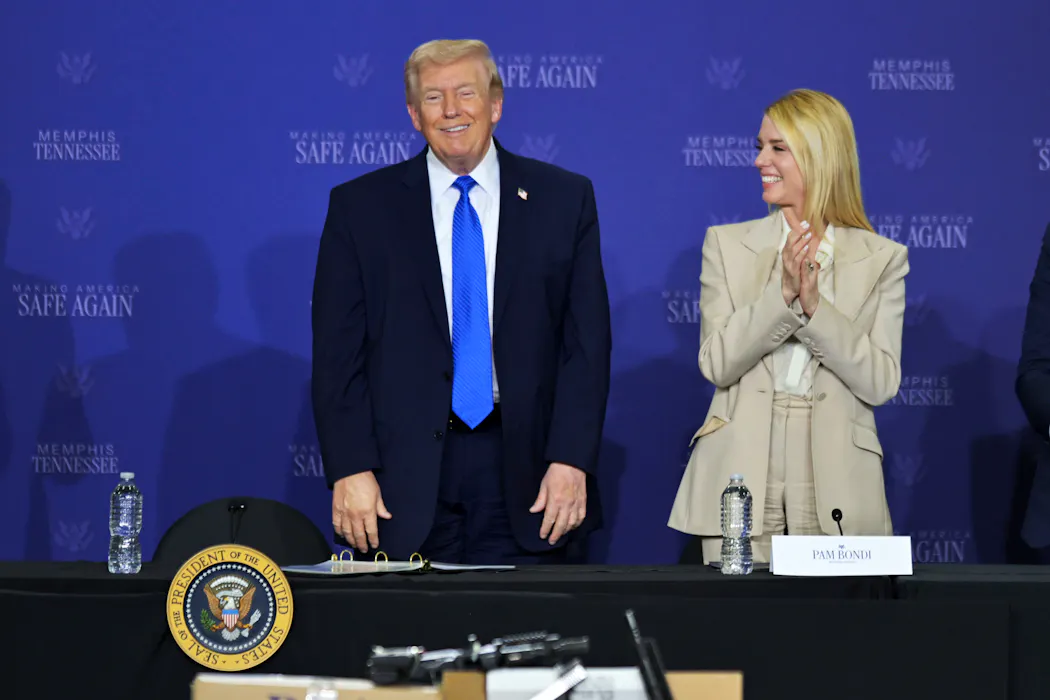
President Donald Trump participates in a roundtable discussion in Memphis, Tenn., with Attorney General Pam Bondi on March 23, 2026. AP Photo/Bruce Newman

After President Donald Trump fired Attorney General Pam Bondi on April 2, 2026, news reports suggested that she fell from grace, not for being too independent, but for not being effective enough at defending him and prosecuting his political enemies.

As The New York Times reported the previous day, Trump was disappointed with “Ms. Bondi’s handling of the Jeffrey Epstein files, which has become a political liability for Mr. Trump among his supporters. He has also complained about her shortcomings as a communicator and vented about what he sees as the Department of Justice’s lack of aggressiveness in going after his foes.”

The president has long indicated that whoever served as attorney general in his administration should see themselves as his lawyer rather than as someone representing the U.S. government.

During his first presidential term, Trump was gravely disappointed with Jeff Sessions, his first attorney general, who recused himself from the investigation into alleged political interference in the 2016 election. He replaced Sessions with William Barr, who abandoned Trump when the president did not accept the results of the 2020 election.

Having learned from those mistakes, Trump set out to find a political ally and loyalist to take the helm at the Justice Department in his second administration.

As a scholar of law and politics, and someone who has written about the role of the attorney general, I think Trump’s desire has a familiar ring to it. It is not unusual for presidents to put people who share their views and policy preferences into the role. But Trump has gone far beyond what is usually done.

A man dressed in a suit and tie lifts his right hand in front of a panel of lawmakers.
Jeff Sessions is sworn in as attorney general before the House Judiciary Committee on Capitol Hill on Nov. 14, 2017.
AP Photo/Alex Brandon

Bondi’s ascent

Florida Congressman Matt Gaetz was Trump’s first choice for attorney general during the president’s second term. Many commentators viewed Gaetz as a firebrand who was temperamentally unsuited for that position. Some criticized him for calling the president an “inspirational leader of a loving and patriotic movement” in the aftermath of the Jan. 6, 2021, attack on the Capitol. In the face of growing opposition generated in part by allegations of his misconduct, Gaetz withdrew.

Trump turned to Bondi a few hours later. She had served as Florida’s attorney general and drawn praise from across the political spectrum for her professionalism.

A bipartisan group of former state attorneys general wrote a letter attesting to their “firsthand knowledge of her fitness for the office” and her “wealth of prosecutorial experience and commitment to public service.”

In addition, as PBS noted at the time of her appointment, Bondi was “a longtime Trump ally and was one of his lawyers during his first impeachment trial, when he was accused — but not convicted — of abusing his power as he tried to condition U.S. military assistance to Ukraine on that country investigating then-former Vice President Joe Biden.”

She also showed her loyalty by attending Trump’s New York trial for paying hush money to porn actor Stormy Daniels, with whom he allegedly had an affair.

At the time of her nomination, Bondi seemed to have the attributes of an attorney general. She had the credentials to take on the job of running the DOJ and the confidence of the president who appointed her.

From confirmation to downfall

During her confirmation hearings, Bondi promised to safeguard the Justice Department’s independence and bolster its transparency. She also vowed to not serve as the president’s personal attorney.

And in response to a question from Rhode Island Senator Sheldon Whitehouse, she pledged in January 2025 that “there will never be an enemies list within the Department of Justice.”

But she also showed her willingness to joust with Democrats on the Senate Judiciary Committee. She hewed to the MAGA script by refusing to say that the president had lost the 2020 election. And she mounted a spirited attack on the Biden Justice Department, which she claimed had been “weaponized for years and years and years.”

A woman speaks in front of a microphone as a man stands behind her.
Attorney General Pam Bondi and Deputy Attorney General Todd Blanche speak to reporters in Washington on March 18, 2026.
Nathan Posner/Anadolu via Getty Images

Once in office, Bondi took on the difficult task of leading the Justice Department while also pleasing the president. She stood by when Trump used an appearance at the department to give, according to The New York Times, a “grievance-filled attack on the very people who have worked in the building and others like them.” The Times added: “He appeared to offer his own vision of justice in America, one defined by personal vengeance rather than by institutional principles.”

Bondi apparently did not do enough to deliver on that version of justice.

Last year, Trump had to urge Bondi to take action against his political enemies, including former FBI Director James Comey, California Senator Adam Schiff and New York Attorney General Leticia James.

“They’re all guilty as hell,” Trump posted on his social media platform, Truth Social, “but nothing is going to be done. “We can’t delay any longer, it’s killing our reputation and credibility,” he added. “They impeached me twice, and indicted me (5 times!), OVER NOTHING. JUSTICE MUST BE SERVED, NOW!!!”

Bondi took her marching orders and launched investigations of those the president named. However, she was not able to secure any convictions. NBC News quoted a former official in the Trump White House who said that failing to secure indictments “is a problem for job security with the president.”

If that wasn’t enough, Trump was also reportedly frustrated with the way Bondi had handled the release of the Epstein files, first promising full disclosure and then botching the rollout of the files.

Contending visions of the attorney general’s job

Bondi’s tenure illustrates the conflicting visions of what an attorney general should do that animate today’s American politics.

The questions Democrats asked her during her confirmation were designed to get her to commit to their view of what the attorney general should do. Those questions signaled their belief that anyone occupying that office should maintain their distance from the president and uphold the Justice Department’s independence.

But right from the start of the republic, presidents have chosen close political allies to serve as attorney general.

It’s common for presidents to appoint their friends and supporters to be attorneys general. Since Franklin D. Roosevelt, many presidents have chosen their campaign manager or their party’s national chairperson to be attorney general of the United States.

But even compared with this history, Trump and his allies have a radically different vision, seeing the attorney general as just another Cabinet member whose responsibility is to carry out the president’s policies and implement his directions. As Trump put it in a 2017 interview with The New York Times, he has the “absolute right to do what I want to do with the Justice Department.”

In the end, it seems that Bondi was fired for her failure to be effective in the political role assigned to her. It is likely that the president will want to replace her with someone even more political than she was, who promises to deliver more of the results he wants.

The Conversation

Austin Sarat does not work for, consult, own shares in or receive funding from any company or organization that would benefit from this article, and has disclosed no relevant affiliations beyond their academic appointment.

ref. Pam Bondi’s extreme political loyalty to Trump wasn’t enough to save her job – https://theconversation.com/pam-bondis-extreme-political-loyalty-to-trump-wasnt-enough-to-save-her-job-279926

Will row over Iran conflict spell the end of Nato?

Source: The Conversation – UK – By Jonathan Este, Senior International Affairs Editor, Associate Editor, The Conversation

This is the text from The Conversation UK’s World Affairs Briefing email. Sign up here to receive weekly analysis of the latest developments in international relations, direct to your inbox.


Anybody who tuned in to Donald Trump’s prime-time speech to the American people last night hoping to hear that he plans an end to the US attacks on Iran and will focus instead on reaching an agreement over opening up the Strait of Hormuz would have been bitterly disappointed. I know I was.

Instead of a strategy to restore the vital flow of oil and gas through the strait – something which would have immediately calmed the markets and started to bring down energy prices – the US president opted for a familiar mix of revisionism, self-aggrandisement and bloodcurdling threats.

So we heard that it was never his intention to force regime change in Iran (despite having said exactly that on day one of the special military operation). We had the miraculous achievements of his administration over the past year which had restored “a dead and crippled country after the last administration” to what is now “the hottest country anywhere in the world by far”.

And instead of seeking a deal with Iran over the Strait of Hormuz, Trump promised to “hit them extremely hard over the next two to three weeks. We’re going to bring them back to the Stone Ages, where they belong.”

Along the way, the US president took a potshot at America’s Nato allies who have been reluctant to get involved in this war, exhorting them to “build up some delayed courage. Should have done it before. Should have done it with us as we asked.”

Donald Trump addresses the American people, April 1 2026.

In the event, Nato secretary-general Mark Rutte and many of Nato’s European leaders will probably feel as if they have got off lightly. Trump and his secretary of state, Marco Rubio, have been outspoken in their criticism of Nato in recent days. Rubio told Fox News host Sean Hannity that the US would “reexamine the value of Nato”, while the president, when asked if the US was reconsidering its Nato membership, said the question was “beyond reconsideration”, adding that the alliance is a “paper tiger, and Putin knows that too, by the way.”

Trump is not the first US president to question the operation of Nato and worry about the outsized burden borne by the US. But none before has done so much to publicly undermine the alliance. But then, as Andrew Gawthorpe explains, Nato’s focus on European security has been a huge benefit to the US over the decades. Gawthorpe, an expert in American foreign policy at Leiden University, presents us with a cost-benefit analysis of US leadership of Nato, spelling out the many advantages which he says “generations of American strategists, military officers and diplomats have viewed as worthwhile”.

It’s not as if the US-Israeli military operation in Iran is a matter for Nato in any case, writes David Galbreath. Nato is a defensive alliance. Article 5 of its founding treaty holds “an armed attack against one NATO member shall be considered an attack against all members, and triggers an obligation for each member to come to its assistance”. This is clearly not the case in Iran.

To be sure, as Galbreath notes, Nato’s focus has shifted at times over the years. From aiming purely at collective defence – defined as coming to the aid of a fellow member whose territory is threatened by a third party – at times Nato has intervened in issues of regional security, most notably in the 1990s wars in the former Yugoslavia.

But an individual member’s foreign policy adventures have never mandated nato’s involvement: indeed the US actively opposed the UK and France during the Suez crisis in 1956 and in turn UK minister, Harold Wilson, resisted pressure from US president Lyndon Baines Johnson to get involved in the US war in Vietnam. It would, Galbreath concludes, be tragic if – having weathered these storms – Nato falls apart over this war of questionable legality.


Read more:
Nato has survived some serious rifts but the Iran war shows how the US has soured on the transatlantic alliance


Israel’s forever war?

Not just questionable legality, either. After the US president’s speech last night the world is no wiser as to how long this might continue. But Trump’s enthusiasm for Operation Epic Fury will, to an extent, be calibrated by how he and his close advisers judge it might affect his party’s chances in the midterm elections in November. High gasoline prices and inflation (as well as continuing entanglement in a war – something he pledged not to do on the campaign trail in 2024) are likely to lose him votes.

For Israeli prime minister, Benjamin Netanyahu, the calculation will be different. He also faces an election in the autumn. But when Israelis cast their ballots on October 27, they’ll be voting on different issues. Netanyhu’s appeal to voters on security grounds is a potent one. There’s a clock in Tehran which counts down to 2040 by which time the late supreme leader Ayatollah Ali Khamenei swore Israel would no longer exist.

A leader who could neutralise that threat for good could use that accomplishment to good purposes on the campaign trail, whether or not his methods are deemed legal in international law.

Leonie Fleischmann, a scholar of Israeli politics at City St George’s, University of London, has researched Israeli security policy over decades, particularly when it comes to the way it has been enacted by Netanyahu. The current prime minister, she writes, is a disciple of the founder of Revisionist Zionism, Ze’ev Jabotinsky. For Jabotinsky, the watchword was “strength first, diplomacy second”.

But, Fleischmann notes, there is an important secondary concern for Netanyahu beyond the security of his people. That is that at present the polls suggest that while his party might be the most popular with voters, the support is not enough to enable him to form a coalition government. And if he loses, Netanyahu could face trial for bribery and corruption and a possible jail term. So arguably, his security is at stake, too.


Read more:
Why Benjamin Netanyahu needs the Iran conflict to continue


On the Russian front

There’s a bizarre twist to the US-Israeli operation in Iran. In the initial years of Russia’s invasion of Ukraine, Moscow was relying heavily on Shahed drones supplied by Iran. Now Russia is returning the favour, supplying its drones to Iran and – as a bonus – providing data to help Iran identify and hit its targets.

Meanwhile Kyiv is understandably increasingly concerned that US involvement in the Middle East has inevitably meant that US munitions previously available for purchase by Ukraine’s allies are instead being used against Iran. If so – and it seems a reasonable assumption – it will seriously undermine Ukraine’s ability to defend itself.

ISW map showing the state of the war in Ukraine, April 1 2026
State of the war in Ukraine, April 1 2026.
Institute for the Study of War

Meanwhile, in an attempt to control rising oil prices, the US has removed some sanctions preventing Russia from selling its oil. So the war in Iran has the potential to be an utter disaster for Ukraine.

The one silver lining towards the end of last year was that Russia was losing far more men on the battlefield than Ukraine. But Charlie Walker and Bettina Renz have been following Russia’s recruitment and write that good salaries and lavish signing on bonuses continue to attract plenty of new soldiers.

Walker and Renz believe that Vladimir Putin has worked hard in recent years to repair and enhance conditions in the Russian military, prompting the in-house newspaper of the defence ministry to trumpet that “contract soldiers are becoming the country’s middle class”. Needless to say, the in-house defence ministry newspaper is bound to take a rosy view of conditions in the military, but the confidence with which this has been asserted suggests that anyone hoping for a collapse in Russian military morale in 2026 might be disappointed.


Read more:
Despite massive casualties in Ukraine, Russia is unlikely to run out of soldiers anytime soon – here’s why


Sign up to receive our weekly World Affairs Briefing newsletter from The Conversation UK. Every Thursday we’ll bring you expert analysis of the big stories in international relations.


The Conversation

ref. Will row over Iran conflict spell the end of Nato? – https://theconversation.com/will-row-over-iran-conflict-spell-the-end-of-nato-279898

The nonprofit status of NCAA athletic departments is starting to raise questions

Source: The Conversation – USA (2) – By Andrew Urbaczewski, Professor of Business Information and Analytics, University of Denver

University of Michigan star forward Yaxel Lendeborg revealed that he’d been offered millions of dollars to transfer to another school. Gregory Shamus/Getty Images

With all the talk of busted brackets, game-winning shots, point spreads and Cinderellas, it was easy to miss the eye-popping offer University of Michigan star forward Yaxel Lendeborg claimed to have received during the first weekend of March Madness.

Lendeborg told The Associated Press that the University of Kentucky had dangled between US$7 million and $9 million to entice him to transfer there in 2025.

Though University of Kentucky head coach Mark Pope called it “100% false” in a subsequent interview, the numbers being thrown around show just how big a business college sports have become. CBS and Turner are paying the NCAA about $1.1 billion annually through 2032 to air March Madness games. Recent court decisions, settlements and NCAA policy changes have opened the door for top college athletes like Lendeborg to earn millions of dollars.

Yet athletic departments are still operating as tax-exempt nonprofits, even as a growing chorus of voices, from academia to politics, is wondering whether this designation should be reevaluated.

The nonprofit mission

Most private universities operate as 501(c)(3) organizations under the tax code. This IRS designation means it is a nonprofit that serves a public or charitable mission. These nonprofits don’t have to pay federal taxes and can receive tax-deductible donations.

Because public universities are already government entities, they don’t need to apply for 501(c)(3) status. However, their affiliated fundraising arms – including those supporting athletics – are set up as separate nonprofit foundations and typically need to apply for and receive that designation.

According to the IRS, nonprofits can receive this tax-exempt status if they advance the following missions: “religious, educational, charitable, scientific, literary, testing for public safety, fostering national or international amateur sports competition (as long as it doesn’t provide athletic facilities or equipment), or the prevention of cruelty to children or animals.”

This designation means that universities will reinvest any leftover funds after expenses – they don’t use the word “profit” – into programs that advance the university’s mission. These include facilities, research, academic departments and scholarships.

Donors to a university are able to receive tax deductions for their support. They can usually direct their donations toward funding a specific mission – perhaps in memory of a favorite professor, supporting cancer research or to support extracurricular activities such as sports.

In March 2025, for example, philanthropists Maurice and Carolyn Cunniffe gave $100 million to Fordham University to support STEM education, and in December 2025, Acrisure CEO Greg Williams and his wife, Dawn, gave $401 million to Michigan State University, designating over 70% of their historic donation to Michigan State athletics.

A windfall for some college athletes

I want to return to one phrase from the IRS’ requirements for being designated as a tax-exempt nonprofit: “fostering national or international amateur sports competition.”

In 2026, there’s very little about college basketball and football – and, increasingly, sports such as golf and ice hockey – that could be considered “amateur,” which technically means that athletes are not paid salaries or wages for playing and do not compete as their primary profession.

In recent years, the NCAA has allowed athletes to earn money through endorsements and sponsorships. Meanwhile, the recently approved settlement in House v. NCAA allows schools to share roughly 20% to 22% of its revenue from licensing, media rights and ticket sales directly with athletes, further complicating the traditional definition of amateurism.

The compensation college athletes can receive happens on top of a five-year scholarship that covers the full cost of attendance for some athletes. At the University of Denver, where I teach, five years of attendance is valued at over $435,000.

Greg and Dawn Williams made a historic $401 million donation to Michigan State University, $290 million of which was earmarked for athletics.

Schools argue that athletics are part of their educational mission, with revenue from football and basketball funding sports that make far less money, such as swimming and gymnastics.

But it’s gotten to the point where playing certain college sports can be as lucrative – if not more so – than being a professional athlete.

Chicago Bears quarterback Caleb Williams reportedly had to take a pay cut as a rookie after leaving the University of Southern California.

Former Notre Dame women’s basketball standout Olivia Miles passed up likely being the second pick in the WNBA draft and instead transferred to Texas Christian University, where, according to a recent ESPN E60 report, she is earning over 10 times what she would have been paid in the WNBA, through a mix of sponsorships and direct payments.

Eligibility extensions

Some college athletes, such as quarterback Diego Pavia, who most recently played for Vanderbilt University, have sued the NCAA to extend their eligibility beyond the current limit of four seasons and five calendar years. It isn’t unheard of for a player to get seventh, eighth and ninth years of eligibility.

Meanwhile, student athletes are routinely playing for two, three or four different schools during their collegiate years. The so-called “transfer portal” – a period when college athletes make it known that they are willing to switch schools – operates like a free agent market in pro sports leagues.

This is a far cry from college sports in the 1970s and ’80s, when student athletes were expected to earn their degrees in four years. Until 1968 – and 1972 for football and basketball – freshmen weren’t even allowed to play at the varsity level. The thinking went that they needed a year of adjustment to get a handle on their coursework.

For some of today’s college athletes, school isn’t in the picture. Before the 2026 College Football Playoff national championship, a reporter asked University of Miami quarterback Carson Beck, a transfer from Georgia, whether he had to worry about class that week.

His response?

“No class. I graduated two years ago.”

A business separate from the university?

This isn’t to say college athletes definitely don’t deserve to be compensated beyond the value of their scholarships. Perhaps they do. But the idea that athletic departments and their associated fundraising arms should be classified as tax-exempt nonprofits promoting education and amateur sports strains credulity.

In November 2025, U.S. Sen. Maria Cantwell submitted a letter to the chief of staff for the U.S. Congress Joint Committee on Taxation.

“Given the evolving market dynamics of college sports,” she wrote, “legitimate questions have been raised about whether it is time to rethink the tax-exempt regime under which college sports currently operates.”

At this point, college sports strike me as a business only loosely tied to the university. Education scholar John R. Thelin has pointed out how athletics can function like a separate corporation, tied to the university only through scholarships, logo licensing and marketing.

So what might happen if athletic departments lost their tax-exempt, charitable status?

For one, the government would treat them as businesses, and businesses pay taxes. And their donors and boosters would no longer be eligible to receive tax deductions for gifting money to a program, just like a regular customer at a restaurant doesn’t receive a tax break for regularly dining there.

This isn’t unheard of: Some universities already have taxable, for-profit arms, whether it’s in real estate development, hospitality or startup incubators.

To some donors, their love for their alma mater may outweigh any tax benefit. But others may find themselves more willing to fund other causes – in or outside a university – that more closely align with the nonprofit mission.

The Conversation

Andrew Urbaczewski does not work for, consult, own shares in or receive funding from any company or organization that would benefit from this article, and has disclosed no relevant affiliations beyond his academic appointment.

ref. The nonprofit status of NCAA athletic departments is starting to raise questions – https://theconversation.com/the-nonprofit-status-of-ncaa-athletic-departments-is-starting-to-raise-questions-278184

Kratom poisonings surged 1,200% over the past decade, and regulators are struggling to keep up with the dangers

Source: The Conversation – USA (3) – By Andrew Kolodny, Medical Director of Opioid Policy Research, Brandeis University

Kratom powder is produced by the plant Mitragyna speciosa. iStock via Getty Images Plus

Proposals to ban or regulate kratom, a plant-based substance sold in gas stations, convenience stores and vape shops, are making headlines in local newspapers across the United States. But as lawmakers debate whether to regulate or ban kratom, public health problems associated with the drug continue to rise.

In late March 2026, the Centers for Disease Control and Prevention reported that hospitalizations and poisonings involving kratom have increased by more than 1,200% over the past decade.

At legislative hearings, families share tragic stories of lives cut short by kratom overdoses and addiction.

On the opposing side, lawmakers are also hearing from lobbyists representing the kratom industry and kratom users who insist that it is a safe, natural substance that boosts mood and energy, relieves pain and even helps people overcome opioid addiction.

As a physician who treats opioid addiction and studies the opioid crisis, I have followed this debate closely.

Scientific evidence shows that kratom carries real risks that are often downplayed or misunderstood. Kratom’s rising use over the past decade coincided with the opioid crisis, as people searched for alternatives to prescription opioids. Because kratom comes from a plant and is marketed as “natural,” many people wrongly assumed it was safe. That belief helped fuel its use. Today, about 1.7 million Americans report using kratom each year.

Alabama is one of six states that have banned kratom as of early 2026. But it still makes its way onto store shelves in the state.

How kratom works

The U.S. Food and Drug Administration has warned consumers for more than a decade that kratom can cause serious problems, including liver disease, seizures, addiction and death.

According to the FDA, research and adverse event reports make clear that “compounds in kratom make it so it isn’t just a plant – it’s an opioid.”

Kratom comes from the plant Mitragyna speciosa, a tropical evergreen tree native to Southeast Asia.

People use kratom to experience the opioid effects, including pain relief and improved mood. But with daily use, tolerance to these effects results in a need for higher doses, and users experience withdrawal symptoms when they try to stop.

Kratom’s effects come from compounds in its leaves, including mitragynine and 7-hydroxymitragynine, often called 7OH. After kratom is consumed, some of the mitragynine is changed in the body into 7OH. This matters because mitragynine is a weak opioid, while 7OH is a much stronger opioid, which can increase the intensity of the opioid effects and lead to overdose. Both compounds bind to opioid receptors in the brain, which triggers chemical changes that, with regular use, can lead to dependence and withdrawal symptoms similar to those caused by oxycodone or heroin.

Some in the kratom industry argue that only newer products with boosted levels of 7OH are dangerous. But the evidence does not support that claim. Deaths linked to kratom were already rising before the newer 7OH products appeared on the market in late 2023.

Kratom is not a treatment for opioid addiction

Another claim often made in legislative hearings is that kratom can treat opioid addiction. The American Kratom Association, a lobby group that represents the kratom industry and its consumers has even promoted kratom as a solution to the opioid crisis. One of the group’s videos claims that kratom can eliminate opioid addiction altogether.

That incorrect claim is based on a partial truth. If someone in opioid withdrawal uses kratom, their withdrawal symptoms may temporarily improve. But the same effect occurs with any opioid. A person dependent on heroin can relieve withdrawal by taking oxycodone, and a person dependent on oxycodone can relieve withdrawal by taking heroin.

But relief of withdrawal symptoms does not make a drug a treatment for opioid use disorder; it simply shows that the drug is an opioid. Effective, evidence-based treatments already exist, including medications such as buprenorphine and methadone, which have been shown to reduce cravings, prevent withdrawal and lower the risk of overdose. These medications also allow patients to feel and function normally.

When it comes to kratom, the FDA has been clear: It is not approved for any medical use and should not be used to treat opioid addiction.

Using kratom exposes people to risks that are not well understood. Some research suggests its primary compound may cause dangerous heart problems, including sudden death. Kratom has also been found to contain high levels of lead, which can damage the brain and other organs. For women of childbearing age, kratom may pose a risk to the fetus if pregnancy occurs. And using kratom during pregnancy may lead to infants experiencing opioid withdrawal at birth.

Newborn baby lying face down with monitors attached in a hospital bed.
Kratom poses particular threats to pregnant women and has the potential to cause opioid withdrawal in newborns.
Salwan Georges/The Washington Post via Getty Images

Bold claims, limited evidence

Some advocates argue that keeping kratom available could help states reduce deaths from fentanyl and other opioids. But the available evidence does not support this idea.

If kratom were helping reduce fentanyl overdose deaths, states that banned kratom might be expected to have a higher rate of fentanyl deaths. That has not been the case. For example, Vermont, one of the first states to ban kratom, has not fared worse than other states. In fact, Vermont has seen one of the largest declines in opioid overdose deaths in the country.

Kratom supporters often point to personal stories from users who say it helps them. These experiences should not be dismissed, but personal stories are not the same as scientific evidence.

With opioids, cycles of withdrawal followed by relief when a dose is taken can make a drug seem helpful, even when it is causing harm. That is why controlled studies, which can reliably distinguish true benefits from the relief of withdrawal symptoms, would be needed to prove that kratom’s benefits outweigh its risks. But those studies have not been done.

For now, the evidence shows that kratom is an opioid with real risks – not a harmless supplement.

The Conversation

Andrew Kolodny is president of Physicians for Responsible Opioid Prescribing, a nonprofit organization that advocates for more cautious use of prescription opioids and served as an expert witness on behalf of state and local governments in the national opioid litigation.

ref. Kratom poisonings surged 1,200% over the past decade, and regulators are struggling to keep up with the dangers – https://theconversation.com/kratom-poisonings-surged-1-200-over-the-past-decade-and-regulators-are-struggling-to-keep-up-with-the-dangers-277161

Humans’ closest invertebrate ancestors date back much further than thought – how we discovered the fossils that show this

Source: The Conversation – UK – By Luke Parry, Associate Professor of Palaeobiology, Department of Earth Sciences, University of Oxford

Artist’s impression of Earth’s earliest complex animals during the late Ediacaran period – before the ‘Cambrian explosion’. Xiaodong Wang, CC BY-SA

Animal life is extraordinarily diverse and complex, having colonised almost all environments on Earth – from hostile hydrothermal vents in the deep sea to the skies across our continents.

But the planet was not always teeming with complex animal life. For the first 3.7 billion years after it originated, life was small, simple and largely confined to the oceans. This microbe-dominated world was a tumultuous place, with several major swings in its climate.

But all this appears to have changed about 538 million years ago (mya) during the Cambrian period. This critical juncture in the history of life saw animals bursting on to the scene in an event known as the “Cambrian explosion”.

All sorts of animals easily recognisable as groups alive today appeared in the fossil record, from echinoderms (starfish, sea cucumbers, urchins) and arthropods (spiders, crustaceans, insects) to various types of worm. This seemingly abrupt appearance of animals in a geological “blink of an eye” has puzzled scientists from Charles Darwin onwards.

Many of these new lifeforms belonged to a group of animals called Bilateria, so-named for their symmetrical left and right sides. This group now contains all animals with brains and complex musculature.

However, a longstanding question for palaeontologists has been whether this astonishing diversification event happened all at once during the Cambrian explosion – or if ancestors of Cambrian and modern animal groups can be traced further back in time. Our new study, published in the journal Science, could help to resolve this question.

Strange bodies

The preceding Ediacaran period (635-538 mya) was much more enigmatic than the Cambrian. Many organisms from that period have defied efforts to classify them. Their strange bodies – often resembling shapeless sacs or thin, quilted pillows – have no obvious counterparts among living species, let alone modern animals.

As a result, interpretations of Ediacaran creatures have encompassed almost all multicellular forms of life – from fungi and lichens to an extinct kingdom unrelated to anything multicellular alive today. These Ediacaran organisms lived in close association with mats of microbes that smothered the seafloor – a type of ecosystem that did not survive the advent of grazing bilaterians.

More recent evidence relating to their reproductive strategy and how they grew and developed has suggested they were, in fact, animals – albeit very simple ones without any direct, living descendents.

A fossil (plus artist's reconstruction) found in the Jiangchuan biota (~554-539mya).
This fossil (plus artist’s reconstruction), found in the Jiangchuan biota (~554-539mya), is an early cnidarian: the phylum that includes jellyfish, sea anemones and corals. Scale bar: 2mm.
Gaorong Li and Xiaodong Wang., CC BY-SA

It isn’t until the very end of the Ediacaran period that the fossil record gives hints that more complex – and recognisable – animals were around. And most of the evidence for these bilaterian animals has come from fossilised burrows and trails, suggestive of complex animal life but telling us little about the animals that made them.

This has led to much debate about the nature of the transition from the Ediacaran to the Cambrian period – the start of which geologists have defined by the action of complex animals churning up ocean sediment for the first time.

A discovery to fill the fuzzy gap

In spring 2023, one of us, Gaorong Li – then a PhD student at Yunnan Key Laboratory for Palaeobiology (YKLP) – made a discovery that helps to clarify this fuzzy gap between the weird Ediacaran world and the recognisable, complex animal-dominated Cambrian period.

Along with my PhD supervisors Wei Fan and Peiyun Cong, we explored Ediacaran rocks in the Chinese region of Eastern Yunnan. We were principally looking for fossil algae (seaweeds), the focus of my PhD thesis, in rocks known for well-preserved fossils called the Jiangchuan biota.

What we found in addition was a bizarre worm that lived tethered to the seafloor by an anchoring disc, and which could turn its strange proboscis inside out to collect food. These specimens were clearly complex animals, but not as they are known today.

We nicknamed it the “bugle worm”, and our team are still figuring out exactly where this strange beast fits into the classification of animals. Previously, it had been described based only on the disc anchoring it to the seafloor and named Cycliomedusa – but we found the whole organism, revealing it as something unexpected and strange.

As we continued splitting more and more rocks, it became clear there were more animals hiding in the Jiangchuan biota. In 2024 – now joined by a team from the University of Oxford including the co-authors of this article, Luke and Frankie – we went back into the field and pieced together this new fossil community.

We found some fossilised organisms characteristic of both the Ediacaran and Cambrian periods. But surprisingly, we also found some that had previously only been known from the time of the Cambrian explosion. These included a primitive animal similar to the Cambrian organism Mackenzia, as well as various worms and swimming predators called ctenophores.

Most striking of all, we found the oldest evidence for the group to which we humans belong: the deuterostomes.

A deuterostome cambroernid fossil from the Jiangchuan biota and artist’s reconstruction.
A deuterostome cambroernid fossil from the Jiangchuan Biota (~554-539mya), plus artist’s reconstruction (scale bar: 2mm).
Gaorong Li and Xiaodong Wang, CC BY-SA

Several of these specimens have a stalk and tentacles, and closely resemble a group of Cambrian fossils called cambroernids. These now-extinct animals are related to living starfish and acorn worms – the closest invertebrate relatives to humans. This shows our own evolutionary story has its roots in the Ediacaran period.

The discovery of diverse, complex animals in the Jingchuan biota suggests several animal groups shared the world with the weird and wonderful Ediacarans for millions of years. Diverse complex animal life has a more ancient heritage than the Cambrian explosion.

The Conversation

Luke Parry receives funding from the Natural Environment Research Council (NERC) and the Leverhulme Trust.

Frankie Dunn receives funding through an NERC Independent Research Fellowship.

Gaorong Li does not work for, consult, own shares in or receive funding from any company or organisation that would benefit from this article, and has disclosed no relevant affiliations beyond their academic appointment.

ref. Humans’ closest invertebrate ancestors date back much further than thought – how we discovered the fossils that show this – https://theconversation.com/humans-closest-invertebrate-ancestors-date-back-much-further-than-thought-how-we-discovered-the-fossils-that-show-this-279793

As oil shortages deepen, wartime rationing offers a guide for today’s governments

Source: The Conversation – Canada – By Henri Chevalier, PhD student at School of Environment, Resources and Sustainability, University of Waterloo

With global oil supply under pressure from the U.S.-Iran war, governments may need to bring back tools many assume belong to the past: rationing and price controls.

Some countries are already moving in that direction. The Philippines has declared a national emergency in response to energy supply risks, while South Sudan has begun rationing electricity in its capital, Juba, and Mauritius has imposed restrictions aimed at reducing consumption and limiting waste.

These developments echo historical precedents. My research, recently published in Sustainability: Science, Practice and Policy, draws on the case of British clothing rationing during the Second World War to show that when essential goods become scarce, governments cannot rely on price alone to manage the crisis.

When left to market forces, access to basic goods becomes dependent on those who can pay most, meaning lower-income households are often hit hardest.

A global supply shock

Since U.S. and Israeli strikes on Iran triggered a wider conflict and effectively shut down shipping through the Strait of Hormuz, global oil supply has fallen by about eight million barrels per day — roughly eight per cent of world demand.


Read more:
What is the Strait of Hormuz, and why does its closure matter so much to the global economy?


The disruption of a route carrying about 20 per cent of the world’s oil supply is pushing prices up and availability down, creating conditions similar to those Britain faced before rationing.

In the face of such an oil shock, governments around the world should learn from the British clothing rationing system by implementing rationing and price controls.

That was the case during the oil shocks of the 1970s in Canada. Governments kept domestic oil prices under control and helped cover the cost of more expensive imports.

Canada also designed a national gasoline rationing plan in 1979, using printed stamps to limit private motorists’ fuel use while giving priority access to ambulances, freight carriers and farmers.

What history can teach us

The United Kingdom faced major supply disruptions during the Second World War, prompting the introduction of rationing to mitigate the effects of material shortages, inflation and mounting pressure on civilian supply.

To achieve this, the British rationing system relied on three main policy tools.

The first was a coupon system. Introduced in 1941, coupons were tied to material use rather than price. Each person received a fixed number of clothing coupons per year, starting at 66 per person (about two-thirds of pre-war levels) and fell to 36 by 1946.

Each type of garment required a set number of coupons depending on how much material it used. For example, a wool dress might cost around 11 coupons, while a shirt might cost five and a pair of stockings two. Cutting just two coupons per person saved about 27 million metres of fabric.

The second was the Utility Clothing Scheme. Launched in 1942, it provided affordable, durable clothing through strict standards and fabric-saving rules. Shortening men’s shirts by five centimetres and removing double cuffs saved 3.3 million square metres of cotton. By 1943, the scheme covered 80 per cent of British clothing production.

The final was price controls. The Board of Trade was granted the power to fix prices and margins across production and distribution, helping keep “Utility” clothing stable or cheaper while non-Utility prices rose, with Utility items costing about half as much as non-Utility clothing.

Managing scarcity and fairness

These policies led to three major consequences. First, they reduced overall consumption. Under clothing rationing, wool spinning fell by 44 per cent and hosiery industry yarn by 37 per cent, while civilian textile supply and clothing consumption per person dropped by 67 per cent.

Clothing and footwear purchases per capita declined by 34 per cent. Despite six years of war, civilians had access to less than four years’ worth of normal clothing supplies.

Second, they ensured fair access to essentials. Price-controlled rationing helped ensure people still had decent clothing, reducing poverty and preventing severe shortages.

Third, they reinforced a culture of repair and reuse. Building on the repair culture already present in the 1930s, campaigns such as “Make Do and Mend” promoted repair, remaking, modular design and the reuse of materials such as blankets, blackout fabric, food bags, parachute silk, wooden clogs and even dog fur yarn.

A video about clothes rationing in Britain from the Imperial War Museum.

The rationing system not only cut consumption and aligned demand with supply, but also prevented scarcity from becoming a windfall for producers and a punishment for low-income households. It also reduced waste and discouraged overconsumption — all valuable lessons in today’s global oil supply disruption.

That said, the system was not without drawbacks. Britain’s rationing system was also technocratic, bureaucratic and not very democratic.

What governments can do now

Today, the real issue is not whether governments intervene, but whether they do so fairly and effectively.

On March 20, to address the current oil supply squeeze, the International Energy Agency proposed a series of demand-reduction measures, including expanding remote work, lowering speed limits, stengthening public transit use and increased car-sharing use.

While useful, these measures remain short-term fixes. If shortages deepen, governments — including Canada’s — may need to consider the following structural responses:

1. Prepare fair fuel-allocation systems if shortages deepen.

Some governments are already moving in that direction. Sri Lanka introduced a QR code-based fuel authorization system to regulate petrol and diesel distribution, with weekly quotas.

2. Cap excessive prices and margins on essentials.

In Canada’s concentrated fuel and grocery markets, refiners and downstream food firms can widen margins at the expense of consumers. Refining profits surged as pump prices rose faster than crude costs, while processors, distributors and retailers captured 83 cents of every food dollar spent in Canada.

Canada could learn from Austria, Greece and Spain, which have respectively capped fuel retailer margins, grocery margins and rents recently.

3. Use the crisis to build structural economic transformation.

Recurring resource, geopolitical and ecological crises point to the need to reduce dependence on fragile global supply chains, accelerate decarbonization and reorganize the economy around scarce resources through reduced advertising and democratically decided material caps.

This would protect essential needs first, reduce unnecessary production and consumption, and prioritize durable, repairable and sustainable goods.

For those interested in exploring this research further, a more engaging and accessible version of the study is available online.

The Conversation

This research was supported by the Social Sciences and Humanities Research Council of Canada, Coboom, and the HEC Montréal Foundation

ref. As oil shortages deepen, wartime rationing offers a guide for today’s governments – https://theconversation.com/as-oil-shortages-deepen-wartime-rationing-offers-a-guide-for-todays-governments-279193