Racial profiling by ICE agents mirrors the targeting of Japanese Americans during World War II

Source: The Conversation – USA – By Anna Storti, Assistant Professor of Gender, Sexuality, and Feminist Studies and Asian American Studies, Duke University
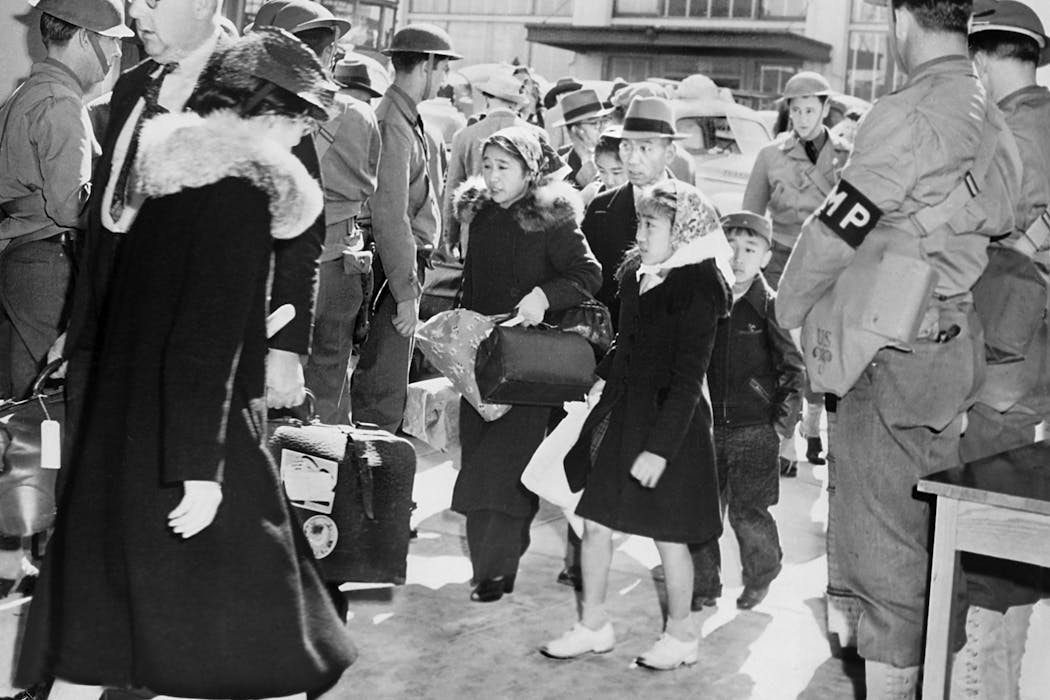
A Japanese American family is taken to a relocation center in San Francisco in May 1942. Circa Images/GHI/Universal History Archive/Universal Images Group via Getty Images

The Department of Homeland Security in September 2025 said that 2 million undocumented immigrants had been forced out of the United States since the start of Donald Trump’s second presidency.

Through its use of the Alien Enemies Act, a wartime law from 1798, the Trump administration has bypassed immigration courts and the right to due process to more easily detain and deport immigrants.

The Trump administration has, in part, reached these numbers by arresting immigrants in courthouses and at their workplaces. It has also conducted raids in schools, hospitals and places of worship.

And the Supreme Court in September, in its Noem v. Vasquez Perdomo decision, lifted a federal court order that barred agents with Immigration and Customs Enforcement from racially profiling suspected undocumented immigrants. For now, ICE agents can use race, ethnicity, language and occupation as grounds for stopping and questioning people.

This form of targeting has disproportionately affected Latino communities, which represent 9 in 10 ICE arrests, according to a UCLA study published in October.

Targeting immigrants is a centuries-old American practice. In particular, Asian Americans have drawn parallels between the attacks on Latinos today and the forced relocation and incarceration of Japanese Americans during World War II.

Notably, the passage of the War Brides Act, passed just three months after the end of WWII, in December 1945, broke with the nation’s centuries-long practice of exclusionary immigration policy. The act allowed American servicemen to bring their non-American spouses and children to the United States. The measure seemed to inaugurate a new era of inclusive immigration policy.

As a feminist studies scholar and author, I know the War Brides Act forever altered the nation’s racial demographics, increasing both Asian migration to the U.S. and the birth of biracial children.

On the 80th anniversary of the War Brides Act, I’ve also noticed an alarming contradiction: Although America may be more multiracial than ever before, the U.S. immigration system remains as exclusive as it has ever been.

Exclusionary immigration policy

The racial profiling of Latino people by ICE agents today is not unlike what took place during World War II in the U.S.

Following Japan’s attack on Pearl Harbor in 1941, President Franklin D. Roosevelt issued an executive order authorizing the forced removal of anyone deemed to be a national security threat. Anyone, that is, who was Japanese. From 1942 to 1945, the U.S. government incarcerated approximately 120,000 Japanese Americans in internment camps.

To determine who was a national security threat, the government used overt racial profiling. Similar to today, when the U.S. government often misidentifies Latino Americans as noncitizens, a majority of the Japanese people incarcerated in WWII were U.S. citizens.

Amid the Trump administration’s treatment of immigrants, it’s worth recalling the exclusionary origins of U.S. immigration policy.

The first restrictive immigration law in the U.S., the Page Act of 1875, barred Chinese women from entering the country. The assumption the law was based on was that all Chinese women were immoral and worked in the sex trade.

A soldier holds a rifle on a city street.
Immigration and Customs Enforcement agents conduct operations in a predominantly Mexican American community in Chicago on Nov. 8, 2025.
Jacek Boczarski/Anadolu via Getty Images

The Page Act laid the groundwork for the Chinese Exclusion Act of 1882, which banned all Chinese immigration into the U.S. for 10 years. This was the first federal law to ban an entire ethnic group, launching an era of legalized and targeted exclusion.

With the passage of the Immigration Act of 1924, the U.S. created its first border control service, which enforced new immigration restrictions. It also implemented a quota system, which banned or limited the number of immigrants from specific regions, including Asia and Southern and Eastern Europe.

The act stemmed from nativism – the policy that protects the interests of native-born residents against those of immigrants – and a desire to preserve American homogeneity.

The 1945 War Brides Act largely diverged from these previous measures, helping to dismantle the Asian exclusion made commonplace in the 19th and early 20th centuries. From 1945 until 1948, when the War Brides Act expired, more than 300,000 people entered the country as nonquota immigrants, people from countries not subject to federal immigration restrictions.

Exclusionary tendencies

Decades later, in 1965, the U.S. formally abolished the quota system. America opened its doors to those who President Lyndon B. Johnson deemed most able to contribute to the nation’s growth, particularly skilled professionals.

The Immigration and Nationality Act of 1965 eliminated racial exclusion. As a result, the U.S. population diversified. Immigrants deepened the multiracialism initiated by the War Brides Act.

This trend increased later in the 1960s when the Supreme Court, in Loving v. Virginia, overturned anti-miscegenation laws, which criminalized marriage between people of different races. The justices ruled that laws banning interracial marriage violated the 14th Amendment.

Multiracialism further increased after the Vietnam War. Subsequent legislation such as the 1987 Amerasian Homecoming Act facilitated the entry of biracial children born in Vietnam and fathered by a U.S. citizen.

Japanese-Americans arrive at a train station.
People of Japanese ancestry arrive at the Santa Anita Assembly Center in California before being moved inland to relocation centers, April 5, 1942.
© CORBIS/Corbis via Getty Images

By the 1960s, however, exclusion was taking on a different shape.

After 1965, immigration policy initiated a preference system that prioritized skilled workers and relatives of U.S. citizens. Quotas related to race and national origin were abolished. Nonetheless, preferences for families and professionals excluded people from Latin America.

For the first time, immigration from the Western Hemisphere was limited. This directly affected migrant workers in the farming and agricultural industries, many of whom were Latino.

Recalling the War Brides Act allows Americans to better comprehend the fiction that undergirds the U.S. immigration system: that immigration policy’s preference for certain immigrants is enough to justify the discriminatory policies which deem some families more valuable than others.

The Conversation

Anna Storti has received funding from the Institute for Citizens and Scholars, the Andrew W. Mellon Foundation, and the McNair Scholars Program.

ref. Racial profiling by ICE agents mirrors the targeting of Japanese Americans during World War II – https://theconversation.com/racial-profiling-by-ice-agents-mirrors-the-targeting-of-japanese-americans-during-world-war-ii-271612
The western US is in a snow drought – here’s how a storm made it worse

Source: The Conversation – USA (2) – By Alejandro N. Flores, Associate Professor of Geoscience, Boise State University

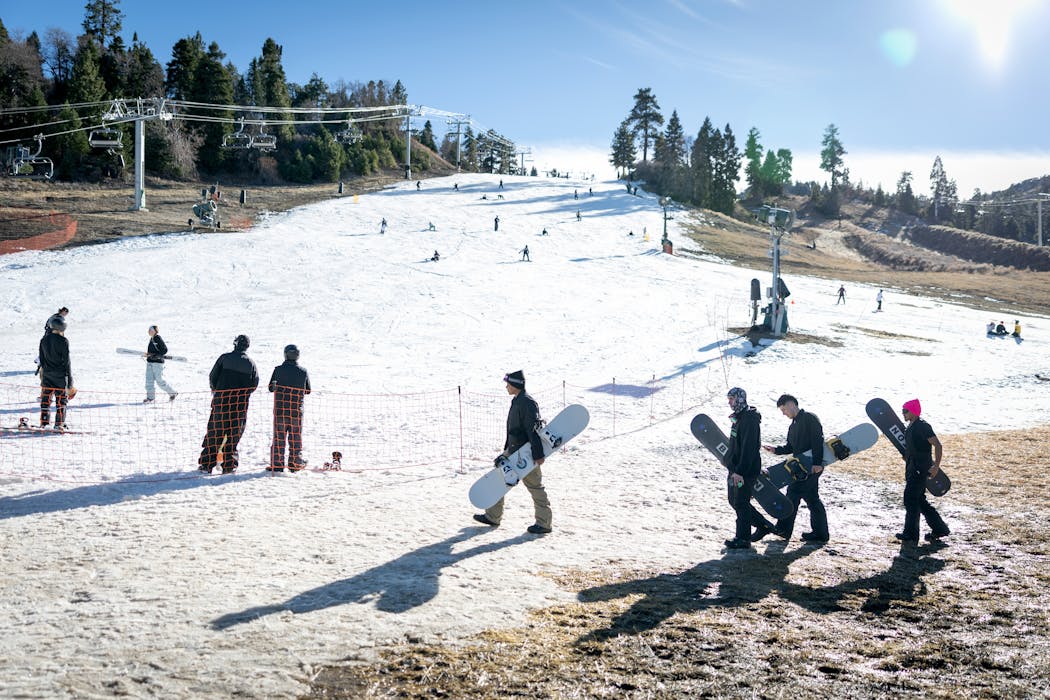
Skiers and snowboarders walk across dry ground to reach a slope at Bear Mountain ski resort on Dec. 21, 2025, in California. Eric Thayer/Los Angeles Times via Getty Images

Much of the western U.S. has started 2026 in the midst of a snow drought. That might sound surprising, given the record precipitation from atmospheric rivers hitting the region in recent weeks, but those storms were actually part of the problem.

To understand this year’s snow drought – and why conditions like this are a growing concern for western water supplies – let’s look at what a snow drought is and what happened when atmospheric river storms arrived in December.

A chart shows very low snowpack in 2025 compared to average.

Chart source: Rittiger, K., et al., 2026, National Snow and Ice Data Center, CC BY

What is a snow drought?

Typically, hydrologists like me measure the snowpack by the amount of water it contains. When the snowpack’s water content is low compared with historical conditions, you’re looking at a snow drought.

A snow drought can delayed ski slope opening dates and cause poor early winter recreation conditions.

It can also create water supply problems the following summer. The West’s mountain snowpack has historically been a dependable natural reservoir of water, providing fresh water to downstream farms, orchards and cities as it slowly melts. The U.S. Geological Survey estimates that up to 75% of the region’s annual water supply depends on snowmelt.

A map shows much of the West, with the exceptions of the Sierra Nevada and northern Rockies, with snowpack less than 50% of normal.
Snowpack is typically measured by the amount of water it contains, or snow water equivalent. The numbers show each location’s snowpack compared to its average for the date. While still early, much of the West was in snow drought as 2026 began.
Natural Resources Conservation Service

Snow drought is different from other types of drought because its defining characteristic is lack of water in a specific form – snow – but not necessarily the lack of water, per se. A region can be in a snow drought during times of normal or even above-normal precipitation if temperatures are warm enough that precipitation falls as rain when snow would normally be expected.

This form of snow drought – known as a warm snow drought – is becoming more prevalent as the climate warms, and it’s what parts of the West have been seeing so far this winter.

How an atmospheric river worsened the snow drought

Washington state saw the risks in early December 2025 when a major atmospheric river storm dumped record precipitation in parts of the Pacific Northwest. Up to 24 inches fell in the Cascade Mountains between Dec. 1 and Dec. 15. The Center for Western Weather and Water Extremes at Scripps Oceanographic Institute documented reports of flooding, landslides and damage to several highways that could take months to repair. Five stream gauges in the region reached record flood levels, and 16 others exceeded “major flood” status.

Yet, the storm paradoxically left the region’s water supplies worse off in its wake.

The reason was the double-whammy nature of the event: a large, mostly rainstorm occurring against the backdrop of an uncharacteristically warm autumn across the western U.S.

Water fills a street over the wheels of cars next to a river.
Vehicles were stranded as floodwater in a swollen river broke a levee in Pacific, Wash., in December 2025.
Brandon Bell/Getty Images

Atmospheric rivers act like a conveyor belt, carrying water from warm, tropical regions. The December storm and the region’s warm temperatures conspired to produce a large rainfall event, with snow mostly limited to areas above 9,000 feet in elevation, according to data from the Center for Western Weather and Water Extremes.

The rainfall melted a significant amount of snow in mountain watersheds, which contributed to the flooding in Washington state. The melting also decreased the amount of water stored in the snowpack by about 50% in the Yakima River Basin over the course of that event.

As global temperatures rise, forecasters expect to see more precipitation falling as rain in the late fall and early spring rather than snow compared with the past. This rain can melt existing snow, contributing to snow drought as well as flooding and landslides.

What’s ahead

Fortunately, it’s still early in the 2026 winter season. The West’s major snow accumulation months are generally from now until March, and the western snowpack could recover.

More snow has since fallen in the Yakima River Basin, which has made up the snow water storage it lost during the December storm, although it was still well below historical norms in early January 2026.

Scientists and water resource managers are working on ways to better predict snow drought and its effects several weeks to months ahead. Researchers are also seeking to better understand how individual storms produce rain and snow so that we can improve snowpack forecasting – a theme of recent work by my research group.

As temperatures warm and snow droughts become more common, this research will be essential to help water resources managers, winter sports industries and everyone else who relies on snow to prepare for the future.

The Conversation

Alejandro N. Flores receives funding from the National Science Foundation, US Department of Energy, NASA, USDA Agricultural Research Service, and Henry’s Fork Foundation.

ref. The western US is in a snow drought – here’s how a storm made it worse – https://theconversation.com/the-western-us-is-in-a-snow-drought-heres-how-a-storm-made-it-worse-272549

Taming the moral menace at capitalism’s core

Source: The Conversation – USA (2) – By Valerie L. Myers, Organizational Psychologist and Lecturer in Management and Organizations, University of Michigan

Digital disruption and the climate crisis are often framed as economic or social challenges. But they force crucial moral questions. Who will be held accountable for the human cost? What will it take to transform business culture so that those costs are not treated as inevitable and acceptable?

In my view, the answers will shape not only technology’s impact on humanity and the planet but the moral foundations of democracy itself.

As a management professor who studies the calling ethic – the idea that work can be guided by principles and moral duty – I think this moment is best understood as a contest between two recurring leadership patterns.

One pattern rationalizes exploitation and disguises harm as the price of progress. Drawing on Yale law professor James Whitman’s use of the phrase “moral menace,” I use it here to name this recurring force.

In contrast, some leaders show how it’s possible to pursue principles and profits together. I call such people “moral muses”: leaders whose care and fairness promote flourishing.

The contrast is stark: Menaces dominate. Muses cultivate.

I contend the menace often wins not because it’s right, but because its practices have hardened into management orthodoxy about how to treat people. Yet its dominance can be disrupted by tracing the menace’s ancient roots and, like muses throughout history, learning how to tame it.

The menace: Normalized callousness

The menace isn’t just about greed. It’s a system of cruelty rooted in ancient Roman property law, in which wives, children, enslaved people and animals were treated as possessions and subject to abuses, including violence at the owner’s will. Whitman traces how this legal foundation evolved into a broader moral menace that became a durable template in Western capitalism that was repeatedly reproduced.

Building on that concept, I would argue that the menace adapted and became normalized in business management – from institutional alliances to empire, to everyday practices.

A pivotal development in institutionalized commercial cruelty began in the 15th century, when papal decrees gave religious sanction to menacing conquests – campaigns of land seizure, enslavement and labor theft. Contemporary accounts speak to the cruelty and exploitation that were pillars of economies of the time.

By the 17th century, Dutch traders outpaced their Spanish rivals in turning menace into efficiency. The richest 1% sent sailors on deadly voyages to amass fortunes, while leaving their fellow citizens among the poorest in Europe. Researchers studying this period, sometimes known as the Dutch Golden Age, wrote, “We did not expect to find the ‘pioneers of capitalism’ in the cradle of civil society to have been so stingy.”

Abroad, traders pioneered accounting, logistics and labor-control methods that maximized profit by brutalizing enslaved workers. Historian Caitlin Rosenthal shows how plantation owners refined these methods, the British perfected them, and Americans institutionalized them.

Once normalized, inhumanity – recast as efficiency – arguably became the defining logic of modern management: extracting ever more output to enrich owners, regardless of the human toll. Financial journalists have called this the “dark side of efficiency.” Yet the menace has a cultural halo: Popular TV series like “Billions” and “Yellowstone” valorize exploitation, dominance and dark tetrad tendencies like Machiavellianism.

Studies show that this celebrated style produces lackluster results. Is it any wonder that only 31% of employees report feeling engaged at work?

Even so, the menace has never gone unchallenged. At every stage of its advance, muses have resisted – insisting that fairness and care prevail.

The muse: Transforming institutions of menace

Throughout history, muses have done more than resist the menace; they’ve sought to transform the very institutions that sustained it. Driven by principle, their disruptive actions bent institutions toward more humane and ethical practices – even as the menace adapted to survive.

One early muse-like figure is Martin Luther, who in 1524 sparked a revolution by challenging the church’s influence on commerce. In “Trade and Usury” he condemned “unneighborly” and deceptive business practices, insisting that trade must be guided by law and conscience rather than greed. (In time, of course, Protestants themselves used religion to justify slavery and domination – a reminder that the menace reinvents itself when challenged.)

In the 18th century, American founder and businessman Gouverneur Morris advanced the muse struggle by reimagining power in the new nation. At the Constitutional Convention, he warned that “the rich will strive to establish their dominion and enslave the rest” unless restrained by law. He enshrined limits on elite domination and elevated civic principles in the preamble to the Constitution: justice, union, tranquility and general welfare. Over the centuries, other business and policy leaders advanced the ethic.

More recently, Marriott International illustrates how profitable firms operate by muse principles without sacrificing profits. Since its 1927 founding, Marriott valued “putting people first.” In 2010, Chief Global Human Resources Officer David Rodriguez institutionalized this value with the Take Care initiative. In response to the 2020 global pandemic response, under the stewardship of the late Arne Sorenson, it expanded to “Project We Care.” Due in part to its commitments, Marriott had less than half the losses of U.S. peers Hilton and Hyatt.

Empirical studies confirm what Marriott’s leaders modeled: Servant leaders generate stronger employee commitment and performance than charismatic or transformational leaders.

Notably, muse leaders typically aim at intermediate targets – reforming institutions and governance to constrain the menace. But since management itself is built on menace foundations, transformation at scale will require a critical mass of moral muses in business.

Mobilizing moral muses

One-off reforms like family-friendly policies, ESG targets and civility pledges are useful, but they cannot uproot centuries of menace. What’s required is a critical mass of moral muses who refuse to rationalize harm as progress and who lead a culture reset in guiding business logic.

That means uprooting institutionalized callousness and redefining what counts as efficiency, innovation and value. It also means enacting civic principles of care and common good, as Morris envisioned, and amplifying leaders who prove that compassion and profitability can reinforce each other.

History shows that muses are not anomalies, and their stories are instructive for us now. Across eras, they have demonstrated that prioritizing human dignity fosters trust, prosperity and social vitality. But their stories are too often buried or ignored – not by accident, but because they threaten those who profit from menace. Without sustained institutional redesign, the menace reliably reasserts itself under new moral guises.

Reclaiming and amplifying muse stories is essential for transformation. They aren’t just anecdotes of resistance; they are blueprints for a more humane and sustainable capitalism.

The Conversation

Valerie L. Myers does not work for, consult, own shares in or receive funding from any company or organization that would benefit from this article, and has disclosed no relevant affiliations beyond their academic appointment.

ref. Taming the moral menace at capitalism’s core – https://theconversation.com/taming-the-moral-menace-at-capitalisms-core-266744

Illness is more than just biological – medical sociology shows how social factors get under the skin and cause disease

Source: The Conversation – USA (3) – By Jennifer Singh, Associate Professor of Sociology, Georgia Institute of Technology

Lack of access to safe and affordable housing is harmful to health. Robert Gauthier/Los Angeles Times via Getty Images

Health and medicine is more than just biological – societal forces can get under your skin and cause illness. Medical sociologists like me study these forces by treating society itself as our laboratory. Health and illness are our experiments in uncovering meaning, power and inequality, and how it affects all parts of a person’s life.

For example, why do low-income communities continue to have higher death rates, despite improved social and environmental conditions across society? Foundational research in medical sociology reveals that access to resources like money, knowledge, power and social networks strongly affects a person’s health. Medical sociologists have shown that social class is linked to numerous diseases and mortality, including risk factors that influence health and longevity. These include smoking, overweight and obesity, stress, social isolation, access to health care and living in disadvantaged neighborhoods.

Moreover, social class alone cannot explain such health inequalities. My own research examines how inequalities related to social class, race and gender affect access to autism services, particularly among single Black mothers who rely on public insurance. This work helps explain delays in autism diagnosis among Black children, who often wait three years after initial parent concerns before they are formally diagnosed. White children with private insurance typically wait from 9 to 22 months depending on age of diagnosis. This is just one of numerous examples of inequalities that are entrenched in and deepened by medical and educational systems.

Medical sociologists like me investigate how all of these factors interact to affect a person’s health. This social model of illness sees sickness as shaped by social, cultural, political and economic factors. We examine both individual experiences and societal influences to help address the health issues affecting vulnerable populations through large-scale reforms.

By studying the way social forces shape health inequalities, medical sociology helps address how health and illness extend beyond the body and into every aspect of people’s lives.

Protesters standing in front of a federal building, holding signs in the shape of graves reading '16 MILLION LIVES' and 'R.I.P. DEATH BY A THOUSAND CUTS,' wearing shirts that read 'MEDICAID SAVES LIVES'
Access to health insurance is a political issue that directly affects patients. Here, care workers gathered in June 2025 to protest Medicaid cuts.
Tasos Katopodis/Getty Images for SEIU

Origins of medical sociology in the US

Medical sociology formally began in the U.S after World War II, when the National Institutes of Health started investing in joint medical and sociological research projects. Hospitals began hiring sociologists to address questions like how to improve patient compliance, doctor-patient interactions and medical treatments.

However, the focus of this early work was on issues specific to medicine, such as quality improvement or barriers to medication adherence. The goal was to study problems that could be directly applied in medical settings rather than challenging medical authority or existing inequalities. During that period, sociologists viewed illness mostly as a deviation from normal functioning leading to impairments that require treatment.

For example, the concept of the sick role – developed by medical sociologist Talcott Parsons in the 1950s – saw illness as a form of deviance from social roles and expectations. Under this idea, patients were solely responsible for seeking out medical care in order to return to normal functioning in society.

In the 1960s, sociologists began critiquing medical diagnoses and institutions. Researchers criticized the idea of the sick role because it assumed illnesses were temporary and did not account for chronic conditions or disability, which can last for long periods of time and do not necessarily allow people to deviate from their life obligations. The sick role assumed that all people have access to medical care, and it did not take into account how social characteristics like race, class, gender and age can influence a person’s experience of illness.

Patient wearing surgical mask sitting in chair of exam room, talking to a doctor
Early models of illness in medical sociology discounted the experience of the patient.
Paul Bersebach/MediaNews Group/Orange County Register via Getty Images

Parsons’ sick role concept also emphasized the expertise of the physician rather than the patient’s experience of illness. For example, sociologist Erving Goffman showed that the way care is structured in asylums shaped how patients are treated. He also examined how the experience of stigma is an interactive process that develops in response to social norms. This work influenced how researchers understood chronic illness and disability and laid the groundwork for later debates on what counts as pathological or normal.

In the 1970s, some researchers began to question the model of medicine as an institution of social control. They critiqued how medicine’s jurisdiction expanded over many societal problems – such as old age and death – which were defined and treated as medical problems. Researchers were critical of the tendency to medicalize and apply labels like “healthy” and “ill” to increasing parts of human existence. This shift emphasized how a medical diagnosis can carry political weight and how medical authority can affect social inclusion or exclusion.

The critical perspective aligns with critiques from disability studies. Unlike medical sociology, which emerged through the medical model of disease, disability studies emerged from disability rights activism and scholarship. Rather than viewing disability as pathological, this field sees disability as a variation of the human condition rooted in social barriers and exclusionary environments. Instead of seeking cures, researchers focus on increasing accessibility, human rights and autonomy for disabled people.

A contemporary figure in this field was Alice Wong, a disability rights activist and medical sociologist who died in November 2025. Her work amplified disabled voices and helped shaped how the public understood disability justice and access to technology.

Structural forces shape health and illness

By focusing on social and structural influences on health, medical sociology has contributed significantly to programs addressing issues like segregation, discrimination, poverty, unemployment and underfunded schools.

For example, sociological research on racial health disparities invite neighborhood interventions that can help improve overall quality of life by increasing the availability of affordable nutritious foods in underserved neighborhoods or initiatives that prioritize equal access to education. At the societal level, large-scale social policies such as guaranteed minimum incomes or universal health care can dramatically reduce health inequalities.

People carrying boxes of food under a tent
Access to nutritious food is critical to health.
K.C. Alfred / The San Diego Union-Tribune via Getty Images

Medical sociology has also expanded the understanding of how health care policies affect health, helping ensure that policy changes take into account the broader social context. For example, a key area of medical sociological research is the rising cost of and limited access to health care. This body of work focuses on the complex social and organizational factors of delivering health services. It highlights the need for more state and federal regulatory control as well as investment in groups and communities that need care the most.

Modern medical sociology ultimately considers all societal issues to be health issues. Improving people’s health and well-being requires improving education, employment, housing, transportation and other social, economic and political policies.

The Conversation

Jennifer Singh does not work for, consult, own shares in or receive funding from any company or organization that would benefit from this article, and has disclosed no relevant affiliations beyond their academic appointment.

ref. Illness is more than just biological – medical sociology shows how social factors get under the skin and cause disease – https://theconversation.com/illness-is-more-than-just-biological-medical-sociology-shows-how-social-factors-get-under-the-skin-and-cause-disease-270258

Seeking honor is a double-edged sword – from ancient Greece to samurai Japan, thinkers have wrestled with whether it’s the way to virtue

Source: The Conversation – USA (3) – By Kenneth Andrew Andres Leonardo, Postdoctoral Fellow and Visiting Assistant Professor of Government, Hamilton College

Desire for validation from other people can lead people toward virtue – or in the other direction. Jacob Wackerhausen/iStock via Getty Images Plus

Pete Hegseth, the current defense secretary, has stressed what he calls the “warrior ethos,” while other Americans seem to have embraced a renewed interest in “warrior culture.”

Debate about these concepts actually traces back for thousands of years. Thinkers have long wrestled with what it means to be a true “warrior,” and the proper place of honor and virtue on the road to becoming one. I study the history of political thought, where these debates sometimes play out, but have engaged them in my own martial arts training, too. Beyond aimless brutality or victory, serious practitioners eventually look toward higher principles – even when the desire for glory is powerful.

Many times, “honor” and “virtue” are almost synonyms. If you acted righteously, you behaved “honorably.” If you’re moral, you’re “honorable.” In practice, chasing after honor can prompt not only the best behavior, but the worst. We all long for validation. At its best, that longing can motivate us toward virtue – but it can also lead in the opposite direction.

I am fascinated by the way two famous thinkers grapple with this paradox. They are teachers who lived centuries apart, on opposite sides of the world: Aristotle, the Greek philosopher; and Yamamoto Tsunetomo, a Japanese samurai and Buddhist priest.

The ‘prize of virtue’

In the age of Homer, the Greek poet who is thought to have composed “The Iliad” and “The Odyssey” around the 8th century B.C.E., being “good” meant attaining excellence in combat and military affairs, along with wealth and social standing.

According to classics scholar Arthur W.H. Adkins, the “quiet virtues” like justice, prudence and wisdom were seen as honorable, but were not needed for a person to be considered good during this time.

Several centuries later, though, those virtues became central to Socrates, Plato and Aristotle – Greek thinkers whose ideas about character continue to influence how many people, both inside and outside academia, view ethics today.

Aristotle’s understanding of virtue is reflected not only in his works, but in the deeds of his reputed student, Alexander the Great. The Macedonian king is commonly held as the best military commander in antiquity, with an empire that extended from Greece to India. The Greek author Plutarch believed that philosophy provided Alexander with the “equipment” for his campaign: virtues including courage, moderation, greatness of soul and comprehension.

In Aristotle’s view, honor and virtue seem to be “goods” that people pursue in the search for happiness. He refers to external goods, like honor and wealth; goods related to the body, like health; and goods of the soul, like virtue.

A white stone statue of a bearded man's head, with his shoulders wrapped in fabric folds.
A Roman copy of a bust of Aristotle, modeled after a bronze by the Greek sculptor Lysippos, who lived in the 4th century BCE.
National Roman Museum of the Altemps Palace/Jastrow via Wikimedia Commons

Each moral virtue, such as courage and moderation, forms one’s character by maintaining good habits, Aristotle proposed.

Overall, the virtuous human being is one who consistently makes the correct choices in life – generally, avoiding too much or too little of something.

A courageous warrior, for example, acts with just the right amount of fear. True courage, Aristotle wrote, results from doing what is noble, like defending one’s city, even if it leads to a painful death. Cowards habitually flee what is painful, while someone who acts bravely because of excessive confidence is simply reckless. Someone who is angry or vengeful fights due to passion, not courage, according to Aristotle.

The problem is that people tend to neglect virtue in favor of other “goods,” Aristotle observed: things like riches, property, reputation and power. Yet virtue itself provides the way to acquire them. Honor, properly bestowed, is the “prize of virtue.”

Still, the impulse for honor can be overwhelming. Indeed, Aristotle called it the “greatest of the external goods.” But we should only care, he cautioned, when honor comes from people who are virtuous themselves. He even recognized two virtues – greatness of soul and ambition – that involve seeking the correct amount of honor from the right place.

Loyalty, even in the face of death

A painting with a large yellow backdrop, showing a man in black robes seated on a green carpet.
Nabeshima Mitsushige, the 17th-century lord whom Yamamoto Tsunetomo served.
Kodenji Temple Collections via Wikimedia Commons

Two thousand years later, and half a world away, the samurai warriors of Japan also famously focused on honor.

One of them was Yamamoto Tsunetomo – a servant of Nabeshima Mitsushige, a feudal lord in southern Japan. After his lord’s death in 1700, Tsunetomo became a Buddhist priest.

Tsunetomo’s counsel can be found in the “Hagakure-kikigaki,” a collection of his teachings about how a samurai ought to live. Today, this text is considered one of the most notable discourses on “bushidō,” or the way of the warrior.

Tsunetomo’s samurai oath involved the following:

I will never fall behind others in pursuing the way of the warrior.

I will always be ready to serve my lord.

I will honor my parents.
I will serve compassionately for the benefit of others.

The road to becoming a samurai required developing habits that would enable the warrior to fulfill these oaths. Over time, those consistent habits would develop into virtues, like compassion and courage.

To merit honor, the samurai were expected to demonstrate those virtues until their end. Tsunetomo infamously stated that “the way of the warrior is to be found in dying.” Freedom and being able to fulfill one’s duties require living as a “corpse,” he taught. A warrior who cannot detach from life and death is useless, whereas “with this mind-set, any meritorious feat is achievable.”

A courageous death was integral to meriting honor. If one’s lord died, ritual suicide was considered an honorable expression of loyalty – an extension of the general rule that samurai should follow their lord. Indeed, it was considered shameful to become a “rōnin,” a samurai dismissed without a master. Nonetheless, it was possible to make amends and return. Lord Katsushige, the previous head of the Nabeshima domain, even encouraged the experience to truly understand how to be of service.

Large Black characters in Asian script on a gray-yellow piece of paper.
The Japanese characters for ‘bushidō,’ the ‘way of the warrior.’
Norbert Weber-Karatelehrer via Wikimedia Commons, CC BY-SA

The path to virtue, then, might involve a period of dishonor. The “Hagakure” suggests that fear of dishonor should not lead a samurai to mindlessly follow his lord’s instructions. In some cases, a servant could correct their master as a sign of “magnificent loyalty.” Tsunetomo referred to the example of Nakano Shōgen, who brought peace after persuading his lord, Mitsushige, to apologize for not paying proper respect to certain families within the clan.

The “Hagakure” presents honor as something essential to the way of the warrior. But fame and power should only be pursued along a path aligned with virtue – a life in accord with the samurai’s core oath.

“A [samurai] who seeks only fame and power is not a true retainer,” according to the “Hagakure.” “Then again, he who doesn’t [seek them] is not a true retainer either.”

Honor matters in the pursuit of virtue, both Aristotle and Tsunetomo conclude, especially as a first source of motivation.

But both thinkers agree that honor is not the final end. Nor is moral virtue. Ultimately, they acknowledge something even higher: divine truth.

For Aristotle and Tsunetomo, it seems, the way of the warrior turns toward philosophy rather than unrestrained power and endless war.

The Conversation

Kenneth Andrew Andres Leonardo worked on some of the research presented here under the direction of Dr. Alexander Bennett at Kansai University (Osaka, Japan) through their “Scholars from Overseas” program. Professor Leonardo is an Instructor in Kali Method under Guro Jason Cruz. He also currently trains in Gracie Jiu Jitsu under Sensei Erik Soderbergh and in Judo at Brown’s School of Judo, Jujutsu, and Grappling. Previously, he studied Pangamot under Grandmaster Felix Pascua.

ref. Seeking honor is a double-edged sword – from ancient Greece to samurai Japan, thinkers have wrestled with whether it’s the way to virtue – https://theconversation.com/seeking-honor-is-a-double-edged-sword-from-ancient-greece-to-samurai-japan-thinkers-have-wrestled-with-whether-its-the-way-to-virtue-262005

Grok produces sexualized photos of women and minors for users on X – a legal scholar explains why it’s happening and what can be done

Source: The Conversation – USA – By Wayne Unger, Associate Professor of Law, Quinnipiac University

Grok is making it easy for users to flood X with nonconsensual sexualized images. Anna Barclay/Getty Images

Since the end of December, 2025, X’s artificial intelligence chatbot, Grok, has responded to many users’ requests to undress real people by turning photos of the people into sexually explicit material. After people began using the feature, the social platform company faced global scrutiny for enabling users to generate nonconsensual sexually explicit depictions of real people.

The Grok account has posted thousands of “nudified” and sexually suggestive images per hour. Even more disturbing, Grok has generated sexualized images and sexually explicit material of minors.

X’s response: Blame the platform’s users, not us. The company issued a statement on Jan. 3, 2026, saying that “Anyone using or prompting Grok to make illegal content will suffer the same consequences as if they upload illegal content.” It’s not clear what action, if any, X has taken against any users.

As a legal scholar who studies the intersection of law and emerging technologies, I see this flurry of nonconsensual imagery as a predictable outcome of the combination of X’s lax content moderation policies and the accessibility of powerful generative AI tools.

Targeting users

The rapid rise in generative AI has led to countless websites, apps and chatbots that allow users to produce sexually explicit material, including “nudification” of real children’s images. But these apps and websites are not as widely known or used as any of the major social media platforms, like X.

State legislatures and Congress were somewhat quick to respond. In May 2025, Congress enacted the Take It Down Act, which makes it a criminal offense to publish nonconsensual sexually explicit material of real people. The Take It Down Act criminalizes both the nonconsensual publication of “intimate visual depictions” of identifiable people and AI- or otherwise computer-generated depictions of identifiable people.

Those criminal provisions apply only to any individuals who post the sexually explicit content, not to the platforms that distribute the content, such as social media websites.

Other provisions of the Take It Down Act, however, require platforms to establish a process for the people depicted to request the removal of the imagery. Once a “Take It Down Request” is submitted, a platform must remove the sexually explicit depiction within 48 hours. But these requirements do not take effect until May 19, 2026.

Problems with platforms

Meanwhile, user requests to take down the sexually explicit imagery produced by Grok have apparently gone unanswered. Even the mother of one of Elon Musk’s children, Ashley St. Clair, has not been able to get X to remove the fake sexualized images of her that Musk’s fans produced using Grok. The Guardian reports that St. Clair said her “complaints to X staff went nowhere.”

This does not surprise me because Musk gutted then-Twitter’s Trust and Safety advisory group shortly after he acquired the platform and fired 80% of the company’s engineers dedicated to trust and safety. Trust and safety teams are typically responsible for content moderation and initiatives to prevent abuse at tech companies.

Grok is letting users flood X with nonconsensual images.

Publicly, it appears that Musk has dismissed the seriousness of the situation. Musk has reportedly posted laugh-cry emojis in response to some of the images, and X responded to a Reuters reporter’s inquiry with the auto-reply “Legacy Media Lies.”

Limits of lawsuits

Civil lawsuits like the one filed by the parents of Adam Raine, a teenager who committed suicide in April 2025 after interacting with OpenAI’s ChatGPT, are one way to hold platforms accountable. But lawsuits face an uphill battle in the United States given Section 230 of the Communications Decency Act, which generally immunizes social media platforms from legal liability for the content that users post on their platforms.

Supreme Court Justice Clarence Thomas and many legal scholars, however, have argued that Section 230 has been applied too broadly by courts. I generally agree that Section 230 immunity needs to be narrowed because immunizing tech companies and their platforms for their deliberate design choices – how their software is built, how the software operates and what the software produces – falls outside the scope of Section 230’s protections.

In this case, X has either knowingly or negligently failed to deploy safeguards and controls in Grok to prevent users from generating sexually explicit imagery of identifiable people. Even if Musk and X believe that users should have the ability to generate sexually explicit images of adults using Grok, I believe that in no world should X escape accountability for building a product that generates sexually explicit material of real-life children.

Regulatory guardrails

If people cannot hold platforms like X accountable via civil lawsuits, then it falls to the federal government to investigate and regulate them. The Federal Trade Commission, the Department of Justice or Congress, for example, could investigate X for Grok’s generation of nonconsensual sexually explicit material. But with Musk’s renewed political ties to President Donald Trump, I do not expect any serious investigations and accountability anytime soon.

For now, international regulators have launched investigations against X and Grok. French authorities have commenced investigations into “the proliferation of sexually explicit deepfakes” from Grok, and the Irish Council for Civil Liberties and Digital Rights Ireland have strongly urged Ireland’s national police to investigate the “mass undressing spree.” The U.K. regulatory agency Office of Communications said it is investigating the matter, and regulators in the European Commission, India and Malaysia are reportedly investigating X as well.

In the United States, perhaps the best course of action until the Take It Down Act goes into effect in May is for people to demand action from elected officials.

The Conversation

Wayne Unger does not work for, consult, own shares in or receive funding from any company or organization that would benefit from this article, and has disclosed no relevant affiliations beyond their academic appointment.

ref. Grok produces sexualized photos of women and minors for users on X – a legal scholar explains why it’s happening and what can be done – https://theconversation.com/grok-produces-sexualized-photos-of-women-and-minors-for-users-on-x-a-legal-scholar-explains-why-its-happening-and-what-can-be-done-272861

Arrow tips found in South Africa are the oldest evidence of poison use in hunting

Source: The Conversation – Africa (2) – By Marlize Lombard, Professor with Research Focus in Stone Age Archaeology, Palaeo-Research Institute, University of Johannesburg

Boophone disticha. Ton Rulkens from Mozambique, CC BY-SA 2.0, via Wikimedia Commons, CC BY

The oldest evidence for the use of arrow poison globally was long thought to come from Egypt, dating to 4,000 years ago. It was a black, toxic residue on bone arrowheads from a tomb at the Naga ed Der archaeological site.

New evidence from southern Africa is challenging this.

New research has found poison on stone arrow tips from South Africa dating to 60,000 years ago. It is the oldest direct evidence for hunting with poisoned arrows.

This adds to what is already known about the know-how of ancient African bowhunters. These abilities may have contributed to our species’ long and flourishing evolution in the region, and ultimately the successful spread of Homo sapiens out of Africa.

Hunter-gatherers in southern Africa

The evidence comes from Umhlatuzana Rock Shelter, in South Africa’s KwaZulu-Natal province. The site was partly excavated in the 1980s to preserve archaeological material that could be damaged during the construction of the N3 highway between the cities of Durban and Pietermaritzburg.

Umhlatuzana is recognised as an important Stone Age site where hunter-gatherers lived at least 70,000 years ago. It is one of only a few sites in southern Africa where people continued to live until just a few thousand years ago.

In southern Africa, people have a long history of hunting with poisoned arrows. For example, a team of South African and Swedish archaeologists found residues on arrow tips dating to between a few centuries and 1,000 years ago, that revealed how different arrow poison recipes were used.

Recently, three bone arrowheads stored in a poison-filled bone container were reported from Kruger Cave in South Africa dating to almost 7,000 years ago. This pushed back direct molecular evidence of arrow poison use to about 3,000 years before the Egyptian poisoned arrows.

Traces of poison have previously been found on a stick and in a lump of beeswax dating to between 35,000 and 25,000 years ago at Border Cave in KwaZulu-Natal. These were seen as indirect suggestions of early hunting poisons.

As a researcher in cognitive and Stone Age archaeology, I studied some of the artefacts from Umhlatuzana almost 20 years ago, finding use traces and adhesive residues on some of the quartz backed microliths (small, shaped stone tools) from 60,000 years ago. This showed that they were probably used as arrow tips.

Now, Sven Isaksson in the archaeology laboratory at Stockholm University has been able to identify molecular traces of toxic plant alkaloids (chemical substances), known to be an arrow poison, on a handful of these artefacts.

Poison from indigenous plants

This latest research revealed the presence of buphandrine and epibuphanisine toxic alkaloids on five out of ten analysed arrow tips from Umhlatuzana. The same alkaloids were also found on bone arrowheads collected by Swedish travellers in the region 250 years ago. This tells us that the same arrow poison was used for many millennia in southern Africa.

Both alkaloids can be found in several southern African species of Amaryllidaceae, a family of flowering plants growing from bulbs. But only what is colloquially known as gifbol (poison bulb, Boophone disticha) is well-recorded as the source of an arrow poison. The plant’s bulb contains a toxic juice (exudate).

Finding these specific alkaloids on five out of the ten quartz arrow tips studied cannot be coincidental. Ancient hunter-gatherers would have been familiar with the toxic properties of the gifbol exudates. For example, by about 77,000 years ago, people of the same region also understood the insecticidal and larvicidal properties of some aromatic leaves that were used for bedding. So they probably would not have kept the gifbol substance in their living space.

Substances with buphandrine and epibuphanisine molecules are not used commercially or in archaeological conservation, ruling out accidental modern contamination of the arrow tips.

Gifbol bulbs can survive for a century or more, despite drought cycles and fire regimes. The plant is indigenous to South Africa, thriving in grassland, savanna and Karoo vegetation. It is widespread throughout the southern, eastern and northern regions of South Africa, growing within a day’s walk from Umhlatuzana Rock Shelter today. For various reasons, it’s likely that it was also available to the inhabitants of the site thousands of years ago.

The toxic chemicals in the bulb last a long time. They don’t decompose easily, even in wet environments, and they interact well with mineral surfaces like stone arrow tips. That’s probably why they survived for 60,000 years at Umhlatuzana.

Implications of the world’s oldest known poisoned arrow tips

The quartz arrow tips with gifbol poison now represent the first direct evidence for hunting with poisoned arrows in southern Africa, and globally – at 60,000 years ago.

It demonstrates that these ancient bowhunters possessed a knowledge system enabling them to identify, extract and apply toxic plant exudates effectively. They must have also understood prey ecology and behaviour to know that the delayed effect of poison shot into an animal would weaken it after some time. That would make it easier to run down, a technique known as persistence hunting.

Such out-of-sight, long-distance action is a convincing indicator of complex cognition that requires response inhibition (being able to delay an action for a reason). Because poison is not a physical force, but functions chemically, the hunters must also have relied on advanced planning, abstraction and causal reasoning.

Thus, apart from providing the first direct evidence of hunting with poisoned arrows, the findings contribute to the understanding of human adaptation, techno-behavioural complexity and modern human behaviour in southern Africa.

The Conversation

Marlize Lombard works for the University of Johannesburg

ref. Arrow tips found in South Africa are the oldest evidence of poison use in hunting – https://theconversation.com/arrow-tips-found-in-south-africa-are-the-oldest-evidence-of-poison-use-in-hunting-271444

Les coupures d’Internet se multiplient de façon spectaculaire en Afrique : un nouveau livre explique pourquoi

Source: The Conversation – in French – By Tony Roberts, Digital Research Fellow, Institute of Development Studies

Entre 2016 et 2024, 193 coupures d’Internet ont été imposées dans 41 pays africains. Cette forme de contrôle social est une tendance croissante sur le continent, selon un nouvel ouvrage en libre accès. Il s’agit de la toute première analyse comparative rédigée par des chercheurs africains sur la manière dont les États africains recourent aux coupures d’Internet et les raisons qui les poussent à le faire.

Le livre, coédité par Felicia Anthonio, militante des droits numériques et spécialiste des coupures d’Internet, et Tony Roberts, chercheur sur le numérique, propose 11 études de cas approfondies sur les coupures d’Internet imposées par les États. Nous leur avons posé cinq questions à ce sujet.


Qu’est-ce qu’une coupure d’Internet et pourquoi se produit-elle ?

En termes simples, une coupure d’Internet est une interruption intentionnelle des communications en ligne ou mobiles. Elle est généralement ordonnée par l’État et mise en œuvre par des entreprises privées, des fournisseurs d’accès à Internet ou des opérateurs de téléphonie mobile, ou parfois les deux.

Le livre soutient que les coupures d’Internet ne sont ni légales, ni nécessaires, ni proportionnées au regard du cadre juridique international des droits humains. Les coupures empêchent délibérément la libre circulation de l’information et de la communication. Elles perturbent la vie sociale, économique et politique en ligne. Ainsi, chaque coupure d’Internet viole généralement les droits fondamentaux de millions de citoyens. Cela inclut leurs droits à la liberté d’expression, au commerce, au débat démocratique et à la participation civique en ligne.

Notre recherche a examiné des études de cas provenant de 11 pays entre 2016 et 2024. Elle révèle que ces coupures sont programmées au moment d’élections ou de manifestations pacifiques afin de réprimer l’opposition politique et d’empêcher la diffusion d’informations en ligne.

Au Sénégal, cinq coupures motivées par des raisons politiques en seulement trois ans ont transformé le paysage numérique du pays. Elles ont privé les citoyens de l’accès au travail en ligne à l’éducation et aux informations liées à la santé.

Le chapitre consacré à l’Ouganda montre comment le gouvernement a imposé des coupures des réseaux sociaux pendant les élections. Il craignait les voix dissidentes en ligne, notamment celle du musicien et homme politique Bobi Wine.

En Éthiopie, les coupures d’Internet sont calées sur les manifestations de l’opposition pour empêcher la couverture en direct de la répression violente de l’État.

Au Zimbabwe, le gouvernement a coupé l’Internet en 2019 pour réprimer les manifestations antigouvernementales.

Il est préoccupant que les régimes imposent ces pratiques autoritaires numériques avec une fréquence croissante et en toute impunité.

Quelles sont les grandes tendances ?

Le rapport alerte sur l’utilisation des coupures d’Internet pour conserver le pouvoir grâce à des contrôles autoritaires. Dans toute l’Afrique, les gouvernements normalisent leur utilisation pour réprimer la dissidence, étouffer les manifestations et manipuler les résultats électoraux.

Ces coupures sont de plus en plus fréquentes et de plus en plus importantes, passant de 14 coupures en 2016 à 28 en 2024. Les conséquences sont dévastatrices dans un monde de plus en plus connecté numériquement.

Les coupures d’Internet sont également de plus en plus sophistiquées. Les coupures partielles peuvent cibler des provinces ou des sites web spécifiques, afin de couper l’accès aux zones d’opposition. Ces dernières années, des États étrangers, des régimes militaires et des parties belligérantes ont également recouru à la coupure d’Internet comme arme de guerre. Cela a été fait en ciblant et en détruisant les infrastructures de télécommunications.

L’Éthiopie a connu le plus grand nombre de coupures d’Internet en Afrique, avec 30 coupures au cours des 10 dernières années. Ces coupures sont devenues une tactique courante de l’État pour tenter de faire taire la dissidence dans les régions Oromo et Amhara.

Les coupures sont synchronisées avec les répressions des manifestations ou les opérations militaires pour empêcher toute couverture en direct des violations des droits humains. L’Éthiopie est un exemple clair de la manière dont les coupures d’Internet reflètent et amplifient les intérêts politiques et ethniques existants.

Le Zimbabwe est l’un des nombreux exemples cités dans le livre pour illustrer les racines coloniales des coupures. Les premières coupures des médias au Zimbabwe ont été imposées par les Britanniques, qui ont fermé les journaux pour faire taire les appels à l’indépendance politique. Après la libération, le nouveau gouvernement a utilisé son propre contrôle autoritaire sur les médias pour diffuser de la désinformation et restreindre les appels de l’opposition en faveur de la justice et d’une démocratie pleine et entière.

Vers la fin du règne de l’ancien président Robert Mugabe, le gouvernement a imposé plusieurs coupures d’Internet à l’échelle nationale. Il a également réduit la vitesse de l’Internet mobile, dégradant suffisamment le service pour perturber considérablement l’expression et l’organisation de l’opposition.

Le Soudan a connu 21 coupures d’Internet au cours de la dernière décennie. Celles-ci se sont multipliées ces dernières années à mesure que les actions politiques et militaires s’intensifiaient. L’État a systématiquement recouru à des perturbations intentionnelles de l’accès à Internet lors de manifestations et de périodes de troubles politiques, en particulier en réponse aux mouvements de résistance et aux soulèvements civils pendant le conflit en cours.

Y a-t-il eu une résistance efficace aux coupures ?

Les militants résistent en utilisant des logiciels de réseau privé virtuel (VPN) pour dissimuler leur emplacement. Ou en utilisant des connexions satellites non contrôlées par le gouvernement et des cartes SIM étrangères. Ils mobilisent également des manifestations hors ligne malgré une répression violente.

Le Nigeria n’a pas subi le même nombre de coupures d’Internet que le Soudan ou l’Éthiopie. Cela s’explique en partie par le fait que la société civile est plus forte et capable d’opposer une résistance plus vigoureuse face à la violation par l’État du droit à la liberté d’expression. Lorsque des coupures d’Internet ont été imposées au Nigeria, l’État n’a pas bénéficié de la même impunité que le gouvernement du Zimbabwe ou d’autres pays.

Lorsque les Nigérians se sont trouvés dans l’impossibilité de travailler en ligne ou de participer à la vie sociale et politique en ligne de la communauté, ils ont pris des mesures décisives en agissant collectivement. Ils ont intenté des poursuites judiciaires ciblées contre le gouvernement. Cela a conduit les tribunaux à statuer que la coupure d’Internet n’était ni légale, ni nécessaire, ni proportionnée. Le gouvernement a été contraint de lever l’interdiction.

Comment s’est déroulée l’année 2025 en matière de coupures d’Internet ?

Nous avons observé des tendances à la fois positives et négatives en 2025. Le nombre total de coupures d’Internet sur le continent continue d’augmenter. La capacité croissante des régimes à cibler de manière précise des zones spécifiques est très préoccupante, car elle permet à l’État de punir les bastions de l’opposition tout en privilégiant les autres.

Du côté positif, nous avons constaté une montée de la résistance, tant en termes d’utilisation de technologies de contournement que de capacité émergente des organisations de la société civile à tenir tête aux gouvernements répressifs.

Que faut-il faire pour empêcher les coupures ?

Le droit au travail, la liberté d’expression et d’association, ainsi que le droit à l’éducation sont des droits humains fondamentaux, hors ligne comme en ligne. Les gouvernements africains sont signataires de la Convention universelle des droits de l’homme et de la Charte africaine des droits de l’homme et des peuples. Pourtant, les politiciens ignorent trop souvent ces engagements afin de préserver leur emprise personnelle sur le pouvoir.

Dans certains pays africains, les citoyens exercent désormais leur propre pouvoir pour demander des comptes à leurs gouvernements, mais cela est plus facile dans les pays qui disposent d’une société civile forte, d’une justice indépendante et de médias relativement libres. Même lorsque ce n’est pas le cas, la cour constitutionnelle est une option pour soulever des objections lorsque l’État restreint les libertés fondamentales.

Et si ce sont les États qui ordonnent les coupures d’Internet, ce sont les entreprises privées de téléphonie mobile et d’Internet qui les mettent en œuvre. Les entreprises privées ont l’obligation de promouvoir et de protéger les droits humains. Si les entreprises s’engageaient collectivement à ne pas contribuer aux violations des droits et refusaient d’imposer des coupures d’Internet, cela constituerait un grand pas en avant pour mettre fin à cette pratique autoritaire.

The Conversation

Tony Roberts reçoit un financement de l’Open Society Fund.

ref. Les coupures d’Internet se multiplient de façon spectaculaire en Afrique : un nouveau livre explique pourquoi – https://theconversation.com/les-coupures-dinternet-se-multiplient-de-facon-spectaculaire-en-afrique-un-nouveau-livre-explique-pourquoi-272840

La marche, premier mode de déplacement en France : ce que disent vraiment les statistiques de mobilité

Source: The Conversation – France (in French) – By Frédéric Héran, Économiste des transports et urbaniste émérite, Université de Lille

Les statistiques de mobilité orientent les politiques publiques. Or en France, la manière de les présenter, héritée des années du tout automobile, minore la part de la marche, ce qui pénalise le développement des mobilités actives. Et si on s’inspirait des approches statistiques déjà déployées ailleurs, par exemple en Suisse, pour mieux comptabiliser le temps passé à marcher ?


Les statistiques ne sont jamais neutres : elles sont le reflet de choix politiques répondant à un contexte historique spécifique. La manière de présenter les résultats des enquêtes statistiques sur la mobilité des personnes en France, qui a déjà 50 ans, n’échappe pas à cette règle. Elle conduit à sous-estimer fortement les déplacements à pied, au risque de continuer à favoriser des politiques en faveur des modes de déplacement motorisés.

Il est grand temps de réformer cet usage, comme l’a fait la Suisse il y a déjà 30 ans, si l’on souhaite redonner aujourd’hui davantage de place aux mobilités actives, tant pour des raisons sociales, économiques qu’environnementales.

Pour rappel, la marche est le mode de déplacement le plus inclusif, le plus démocratique et le moins nuisible à l’environnement, et pas seulement dans le cœur des grandes villes.


À lire aussi :
Atteindre les objectifs climatiques améliorera aussi la santé publique


Ce que disent les statistiques sur la mobilité

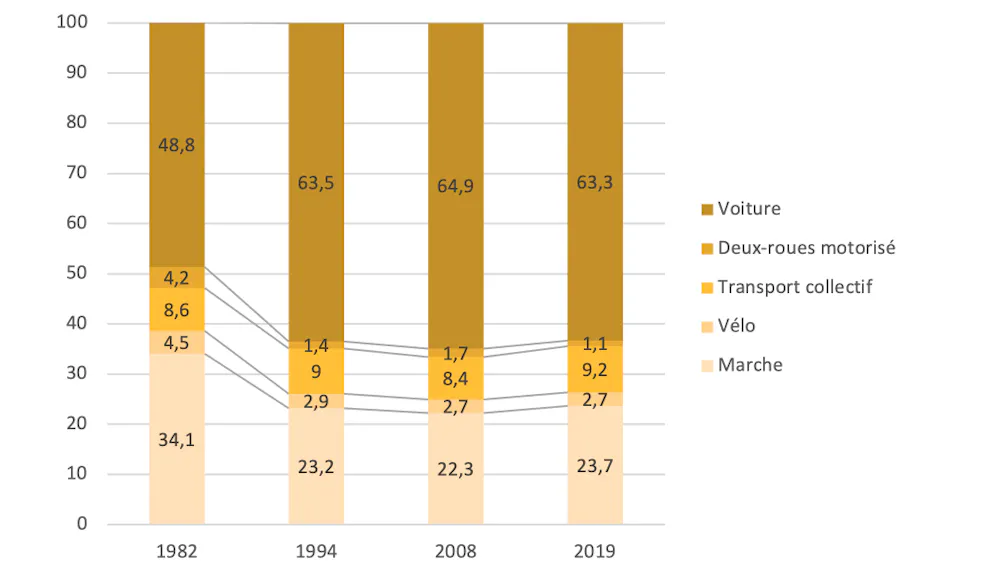
En France, depuis la standardisation des enquêtes sur la mobilité des personnes en 1976, les déplacements sont généralement présentés sous forme de « parts modales ». Il s’agit des parts, sur l’ensemble des déplacements comptabilisés, réalisées avec chaque mode de déplacement : voiture, deux-roues motorisé, transports collectifs, vélo, marche…

Évolution des parts modales en France, entre 1982 et 2019, pour les déplacements en semaine.
Dernières enquêtes nationales sur la mobilité des personnes

Dans les présentations classiques des données recueillies, la part modale de la marche apparaît très inférieure à celle de la voiture. Pourtant, quand on regarde l’autre grande source statistique que représentent les enquêtes sur la mobilité réalisées dans les grandes villes, les déplacements à pied dominent dans les centres-villes, et parfois également dans les banlieues denses de la proche périphérie. Mais partout ailleurs, c’est largement le contraire et le triomphe de la voiture apparaît ainsi incontestable.

Voitures stationnées directement sur le trottoir, ce qui empêche de l’utiliser.
Fourni par l’auteur

En conséquence, pour qui découvre ces statistiques ainsi présentées , dans la plupart des territoires, il paraît nécessaire de s’occuper en priorité des voitures, de leur accorder davantage de place pour circuler et stationner, même si cela doit se faire au détriment des espaces publics, des trottoirs, des places publiques et autres terre-pleins.

Ce qu’oublient de préciser ces représentations

Examinons ces chiffres de plus près. En réalité, ce qu’on nomme habituellement la « part modale de la marche » ne concerne que la « marche exclusive », c’est-à-dire les déplacements entièrement faits à pied, par les résidents, sur l’espace public et hors du temps de travail.

Par convention, on oublie ainsi :

  • la marche intermodale, c’est-à-dire les déplacements à pied pour rejoindre ou quitter un transport public ou une place de stationnement pour voiture, vélo ou deux-roues motorisé,

  • la marche effectuée dans des espaces privés ouverts au public, comme les centres commerciaux ou les gares,

  • la promenade ou la randonnée,

  • la marche pendant le travail, y compris quand elle est effectuée sur l’espace public, qui est pourtant très importante dans certaines professions,

  • la marche au domicile pour effectuer toutes sortes d’activités : du ménage au jardinage, en passant par le bricolage, etc.,

  • enfin, la marche réalisée par les visiteurs (touristes et autres non-résidents) du territoire.


À lire aussi :
Mobilité : et si on remettait le piéton au milieu du village ?


Comment expliquer une approche si restrictive ?

Les conventions statistiques sur la mobilité ont été élaborées dans les années 1960-1970 à l’époque du « tout automobile », puis des premiers efforts réalisés pour relancer les transports publics. Dans ce contexte, il fallait avant tout prévoir et dimensionner la voirie pour absorber un trafic motorisé fortement croissant, les piétons étant très peu considérés et les cyclistes censés disparaître.

Par convention dans les enquêtes sur la mobilité, un déplacement, c’est une personne qui va d’un lieu d’origine à un lieu de destination, avec un ou plusieurs modes et pour un motif particulier. Les modes sont hiérarchisés avec priorité aux plus lourds : d’abord les transports publics, puis la voiture, puis les deux-roues et enfin la marche.

Autrement dit, si une personne se rend à pied à un arrêt de bus, prend le bus, puis termine son trajet à pied, le déplacement est considéré comme ayant été fait en transport public et la part de marche est tout simplement ignorée. Dans cette approche, la marche devient un « résidu » statistique, c’est-à-dire ce qui reste une fois qu’on a pris en compte tous les autres modes de déplacement. Pourtant, les usagers des transports publics passent environ la moitié de leur temps à pied à marcher ou à attendre.


À lire aussi :
Réduire l’empreinte carbone des transports : Quand les progrès techniques ne suffisent pas


Ces pays qui comptabilisent les déplacements différemment

Or, cette représentation des statistiques de déplacement en France est loin d’être la seule possible.

En Suisse par exemple, depuis une réforme des statistiques de la mobilité introduite en 1994, les résultats des enquêtes de mobilité sont présentés sous trois angles différents : les distances parcourues, le temps de trajet et le nombre d’étapes.

Par étape, on entend ici les segments d’un déplacement effectués à l’aide d’un seul mode de transport. Un déplacement en transport public, par exemple, compte le plus souvent une première étape à pied, puis une deuxième en transport public et une troisième à nouveau à pied : on parle de marche intermodale.

Ainsi, en 2021, en ne tenant compte que de la marche exclusive et de la marche intermodale, les Suisses ont passé chaque jour plus de temps à pied qu’en voiture.

Parts modales des moyens de transport utilisés en Suisse en 2021.
Office fédéral de la statistique suisse

Ailleurs, on réfléchit aussi à d’autres manières de présenter les résultats des enquêtes sur la mobilité, comme en Belgique ou au Royaume-Uni.

En réalité, 100 % de nos déplacements intègrent au moins une part de marche, même minimale lorsqu’il s’agit par exemple de simplement sortir de sa voiture sur le parking de son lieu de travail. La marche est à l’origine de toutes les autres formes de mobilité et les autres modes ne sont que des « relais du piéton ». Parce que nous sommes des bipèdes, la marche est évidemment notre premier mode de déplacement.

Vers une nouvelle approche en France ?

La France peut-elle changer sa façon de présenter les statistiques de mobilité, dans le sillage de ce que propose la Suisse ?

Pour prendre conscience de l’importance journalière de la marche, il convient de l’aborder en temps de déplacement total à pied. Une récente étude de l’Ademe révèle que nous passons chaque jour une heure et douze minutes à pied, soit beaucoup plus que la durée moyenne passée en voiture chaque jour, qui est de 37 minutes.

Ces résultats montrent aussi que la prise en compte de la marche intermodale augmente de 75 % la durée de la seule marche exclusive (dite « déplacements locaux intégralement à pied » dans le graphique ci-après). En tenant compte de tous les temps consacrés à se déplacer, la marche est sans conteste le premier mode de déplacement, loin devant la voiture.

Cette étude repose sur l’utilisation de deux enquêtes existantes mais sous-exploitées (l’enquête mobilité des personnes et l’enquête emploi du temps des Français) et en adoptant plusieurs hypothèses prudentes.

En quelques centaines de milliers d’années d’évolution humaine, la bipédie s’est hautement perfectionnée. Elle a permis de libérer nos mains, nous a rendus très endurants à la course et a contribué à développer notre cerveau. Puis, en 150 ans seulement avec l’avènement du transport motorisé, la marche utilitaire quotidienne s’est effondrée.

Pourtant, de par notre constitution, marcher régulièrement est essentiel pour rester en bonne santé, pour bien grandir, vivre mieux et bien vieillir. C’est un enjeu de santé publique. C’est pourquoi, il convient de réaliser des espaces publics confortables, de libérer les trottoirs du stationnement sauvage et autres obstacles, de ménager des traversées piétonnes sécurisées et de calmer la circulation automobile, sa vitesse et son volume. Pour appuyer de telles politiques, encore faudrait-il revoir notre manière de représenter la marche dans les résultats des enquêtes de mobilité.

The Conversation

Frédéric Héran est membre du conseil d’administration de l’association et groupe de réflexion Rue de l’Avenir

ref. La marche, premier mode de déplacement en France : ce que disent vraiment les statistiques de mobilité – https://theconversation.com/la-marche-premier-mode-de-deplacement-en-france-ce-que-disent-vraiment-les-statistiques-de-mobilite-272718

Peut-on encourager le covoiturage avec des subventions locales ?

Source: The Conversation – France (in French) – By Guillaume Monchambert, Maître de conférences en économie, Université Lumière Lyon 2

Les personnes qui bénéficient des subventions locales pour le covoiturage ne sont pas toujours d’anciens automobilistes solos. Cette réalité limite donc les bénéfices de ces aides. Rawpixel.com/Freepik, CC BY

Le covoiturage est souvent perçu comme une des façons les plus simples de baisser les émissions de gaz à effet de serre des transports. Si le premier bilan des subventions locales visant à généraliser cette pratique est encourageant, il masque en vérité plusieurs aspects.


Face à l’urgence climatique et aux embouteillages chroniques des métropoles françaises, les pouvoirs publics cherchent des solutions pour réduire l’usage de la voiture individuelle. Les automobiles des particuliers sont la principale source des émissions de gaz à effet de serre du transport en France. Elles sont également émettrices de particules fines qui dégradent la qualité de l’air et augmentent les risques de maladies respiratoires et cardiovasculaires.

Face à cette réalité, le covoiturage est une piste qui suscite beaucoup d’espoir, car elle ne nécessite pas d’infrastructures lourdes supplémentaires, s’appuyant sur des ressources existantes de véhicules et de conducteurs. Parmi les solutions incitatives, les aides financières locales au covoiturage, notamment via des plateformes numériques, se développent depuis 2019. Mais ces subventions encouragent-elles vraiment plus de covoiturage ? Et quels sont les gains environnementaux dus à ces subventions ?

Des résultats probants, mais variables selon les territoires

La loi d’orientation des mobilités (LOM), promulguée en 2019, autorise les autorités organisatrices de mobilité à verser une incitation financière aux conducteurs et passagers d’un trajet en covoiturage. Le versement de cette subvention s’effectue principalement via des plateformes numériques qui organisent le covoiturage. La subvention moyenne pour un déplacement en covoiturage de 22 kilomètres s’élève à 1,60 euros.

Pour voir si ce levier est efficace, un jeu de données est précieux : celui du registre de preuve de covoiturage. Il centralise les données de trajets transmises par les plateformes partenaires. Notre étude récente utilise ces données pour mesurer la pratique du covoiturage organisé via plateforme dans 1 123 collectivités locales françaises entre 2019 et 2024.

Elle révèle que ce levier est effectivement puissant. En moyenne, l’introduction d’une subvention locale attribuée pour chaque déplacement augmente d’environ 5 trajets mensuels le nombre de trajets de covoiturage à courte distance (inférieurs à 80 kilomètres) sur plateforme pour 1 000 habitants concernés. Chaque euro de subvention supplémentaire par déplacement génère près de 4 trajets mensuels additionnels par 1 000 habitants. Autrement dit, les finances publiques locales, investies dans ce type d’incitation, produisent un effet tangible et mesurable sur le terrain.

Ce résultat masque cependant une forte diversité. L’effet des subventions est nettement plus marqué dans les zones urbaines denses et peuplées. À l’inverse, dans les territoires peu denses et ruraux, la subvention n’a quasiment aucun effet, traduisant les difficultés du covoiturage à s’implanter sans une masse critique d’usagers. Cette disparité met en lumière le rôle central des effets de réseau propres aux plateformes numériques : plus il y a d’utilisateurs, plus elles deviennent utiles, ce qui amplifie l’impact des subventions.

D’autres réalités doivent également être soulevées pour comprendre l’efficacité ou non de ces subventions, notamment du point de vue environnemental.

L’effet d’aubaine : inciter ceux qui viendraient de toute façon

L’effet d’aubaine se produit lorsque des utilisateurs auraient covoituré via la plateforme même en l’absence de toute subvention. Par exemple, un salarié habitué à organiser son covoiturage quotidien sur une application continue simplement à le faire, mais touche désormais une prime financière.

Ici, la dépense publique n’a donc pas changé son choix ni augmenté le nombre total de trajets partagés, ce qui dilue l’efficacité de la politique.

L’effet d’opportunité : attirer les covoitureurs informels sans créer de nouveaux trajets

L’effet d’opportunité correspond lui aux covoitureurs qui, sans subvention, auraient continué à partager leurs trajets en dehors des plateformes numériques (par exemple via le bouche-à-oreille ou des groupes privés). Lorsque la subvention est instaurée, ils transfèrent leur pratique sur la plateforme pour bénéficier des aides. Ainsi, le volume de trajets enregistrés croit artificiellement, sans que la part réelle du covoiturage dans la mobilité globale n’augmente. Par exemple, deux voisins qui organisaient ensemble leur trajet en voiture hors plateforme rejoignent l’application pour percevoir la prime, sans modification de leur habitude de déplacement. Une enquête du Centre d’études et d’expertise sur les risques, l’environnement, la mobilité et l’aménagement (Cerema) montre qu’un tiers des nouveaux covoitureurs attirés par les dispositifs d’incitation financière covoituraient déjà avant la mise en place de l’incitation.

Le report modal : comprendre d’où viennent les nouveaux passagers

Le facteur le plus décisif concerne cependant les sources du report modal : il s’agit d’identifier le mode de transport qu’un passager du covoiturage aurait utilisé si la subvention n’existait pas. Contrairement à l’idée reçue, une grande partie des nouveaux passagers du covoiturage issu de la subvention ne sont pas d’anciens automobilistes solo, mais d’anciens usagers du transport collectif (bus, train) ou parfois des modes actifs (comme le vélo ou la marche).

Prenons l’exemple d’une passagère qui renonce au TER pour un trajet covoituré subventionné : cela ne retire pas une voiture de la circulation, et les bénéfices pour la réduction des émissions sont nettement moindres que si elle avait quitté la voiture solo.

D’après l’enquête nationale sur le covoiturage pilotée par l’Agence de l’environnement et de la maîtrise de l’énergie (Ademe), 35 % des passagers du covoiturage courte distance via plateforme faisaient le déplacement en transports en commun avant de pratiquer le covoiturage, 11 % utilisaient un mode actif et 10 % ne faisaient pas ce trajet. Ce constat est valable tant pour le covoiturage court que longue distance, freinant fortement l’effet net de la politique sur les émissions de gaz à effet de serre.

Combien coûte réellement la tonne de CO₂ évitée ?

Pour obtenir une mesure de l’impact net des subventions, il est donc indispensable de corriger les chiffres bruts du nombre de trajets en tenant compte de ces trois effets. Selon notre étude, ces phénomènes expliquent qu’entre un tiers et la moitié de l’augmentation observée n’est pas associée à une réelle réduction de l’autosolisme ou des émissions.

Une manière de mesurer l’efficacité d’une politique de réduction des émissions de gaz à effet de serre, et de la comparer à d’autres politiques, est de calculer le montant nécessaire pour éviter l’émission d’une tonne de CO2. Dans le cas du covoiturage, chaque tonne de CO2 évitée coûte à la collectivité entre 1 000 et 1 300 euros en subventions.

Ce chiffre se situe dans la fourchette haute des instruments de politique climatique en Europe, ce qui dénote une efficacité très relative. À titre de comparaison, le dispositif d’encouragement de l’adoption de la motorisation électrique a un coût pour les finances publiques de l’ordre de 600 euros par tonne de CO₂ évitée.

Vers une stratégie de long terme, ciblée et combinée

Ces résultats montrent bien la nécessité de concevoir des politiques qui ciblent précisément les changements de comportement les plus à même de réduire les émissions de CO2. Ces politiques seront d’autant plus efficaces qu’elles convainquent des autosolistes d’abandonner leur voiture pour covoiturer en tant que passager. Pour cela, des stratégies combinées seront nécessaires : incitations financières, infrastructures adaptées comme les voies réservées, développement de l’intermodalité…

Enfin, l’effet des subventions croissant dans le temps et le développement de la pratique du covoiturage invitent à une vision de long terme, loin des mesures ponctuelles d’effet d’annonce.

The Conversation

Guillaume Monchambert est membre du conseil scientifique de la Société des Grands Projets (SGP). Il a reçu des financements de la Région Auvergne-Rhône-Alpes (Projet Covoit’AURA) et de la BPI (projet Mobipart). Il a effectué des activités de conseil pour SNCF Réseau et SNCF Voyageurs.

ref. Peut-on encourager le covoiturage avec des subventions locales ? – https://theconversation.com/peut-on-encourager-le-covoiturage-avec-des-subventions-locales-271261