Swimming in the Seine in Paris: an old pastime resurfaces in the age of global warming

Source: The Conversation – France – By Julia Moutiez, Doctorante en Architecture et Enseignante à l’École d’architecture de Paris Val-de-Seine, Université Paris Nanterre – Université Paris Lumières

Bathing on a hot day in Paris, 1932. Agence Rol / Gallica / BNF

As the 2024 Olympic Games drew near, the promise of being able to swim in the Seine turned into a media countdown: first as part of the official sporting events and then for the general public. As bids for the Olympic and Paralympic Games have become less and less popular due to the staggering costs involved and the difficulty of justifying them in terms of benefits for local communities, allowing Parisians to swim in the river flowing through Paris was heavily promoted ahead of last summer’s Games.

This kind of media framing, however, has overlooked current and historical realities. River bathing was widely practised over the last few centuries, and in the Seine, it has survived to the present day despite bans on swimming. Additionally, the practice does not only include recreational or sporting dimensions – it is also climate-related, at a time when rising temperatures suggest that compliance with the Paris Agreement will be a difficult, if not impossible task.

A centuries-old bathing tradition

While bathing in the Seine in 2024 was sometimes presented as a novel project, it is key to remember that swimming in Paris is a centuries-old practice. Traces of bathing facilities have been found in the capital dating back to the 13th century. However, the practice is difficult to document in detail as such traces are few, except in cases of major pieces of infrastructure. Over the centuries, swimming continued for hygiene, refreshment and leisure purposes, gradually spreading beyond the city limits.

It was not until the 17th century that the first documented boom in bathing practices in the Seine took place, as evidenced by the introduction of the first prohibitions on bathing and the emergence of the first facilities specifically designed for river bathers. Whether for washing, relaxing or socialising, these facilities were primarily set up to keep bathers safe from the current, and to conceal their nudity on the riverbanks. From the end of the 18th century onwards, these facilities became more complex: additional services were added to improve the comfort of swimmers and the first swimming schools appeared on the Seine.

At the end of the 19th century, floating baths became increasingly popular on the Seine and the Marne outside Paris, while the first-heated swimming pools were built in the capital.

A long-standing practice despite bans

Bans on swimming in the Seine have been numerous over the centuries, though they never completely eradicated the practice.

Historians Isabelle Duhau and Laurence Lestel trace the first restrictions back to the 17th century, when the provosts of merchants and aldermen expressed concern about public nudity on the banks of the river. Until the end of the 19th century, restrictions on swimming in the capital were always based on concerns about nudity. A second reason, that of hindering navigation, appeared in an ordinance of 1840. This was regularly amended until the prefectural decree of 1923, which is still in force today and prohibits bathing in rivers and canals throughout the former département (administrative unit) of the Seine.

However, these bans did not put an end to swimming. After 1923, bathing establishments continued to operate. They even experienced a boom in the interwar period, especially in the suburbs. Photos show that swimming was quite popular during heatwaves.

It was not until the second half of the 20th century that swimming in the Seine became less common, mainly due to the spread of public swimming pools, which offered a more artificial and controlled environment for this form of leisure.

And it was not until 1970, with the ban on swimming in the Marne, that the issue of water quality was raised, even though water quality was already being measured and questioned before then.

Indefatigable bathers

Even today, however, there are still occasional, activist, or even regular swimmers taking to Paris’s waterways. Sporting competitions have brought athletes to the Seine, for example in 2012 for the Paris triathlon, and in a more gradual way in recent years.

In amateur sports, cold-water swimmers also began training in the canals a few years ago, despite the ban. To deal with the risks posed by water temperatures, and possibly police surveillance, these swimmers set their own safety rules: they watch out for each other from the bank and wear life jackets and caps so they are always clearly visible. To date, none of these swimmers has ever been fined by the police.

In recent years, others have also taken a dip for more political reasons. In 2005, members of the Green Party (including its future leader Cécile Duflot) swam in the Seine on World Water Day to raise awareness about how polluted it was.

Diving in the Seine to raise awareness about river pollution also isn’t a new idea. It’s actually the trademark of the NGO European River Network, founded in 1994 and known for its Big Jump events, annual group swims calling for better water quality. Around the same period in the Paris region, the Marne Vive union was created to make the river swimmable again and protect its flora and fauna. In association with local elected officials, it has also been organising Big Jumps since the early 2000s.

In recent times, members of the Bassines Non Merci collective also took dips in Paris to protest against the appropriation of water resources, ahead of planned demonstrations against schemes for large agricultural water reservoirs in the Poitou region.

Other activists have also taken action to make Parisian waterways more suitable for swimming again. The Laboratoire des baignades urbaines expérimentales (Laboratory for Experimental Urban Swimming) organized collective “pirate” swims and shared them on social media and in the press to get local authorities to take up the issue.

Finally, despite the general ban on swimming throughout Paris, it should be noted that swimming is, once again, permitted under certain conditions in the Bassin de la Villette and the Canal Saint-Martin in the summer. For several years, the city has been organising its own collective swimming events, which are supervised and limited in terms of space and time. This is one of the paradoxes of urban swimming in Paris: on the one hand, public authorities are making efforts to improve water quality, in particular by opening sites where people can swim; on the other, they are reinforcing the general ban on swimming in the Seine, for example through more prominent signposting.

The many European versions of urban bathing

Looking at urban swimming practices in Europe, there are many cities where residents already bathe within city limits. These include Basel, Zurich, Bern, Copenhagen, Vienna, Amsterdam, Bruges, Munich and others. That said, putting together a comprehensive list remains tricky because of differences in how urban regulations are applied across Europe, where swimming might be allowed, tolerated, banned, or just accepted.


A weekly e-mail in English featuring expertise from scholars and researchers. It provides an introduction to the diversity of research coming out of the continent and considers some of the key issues facing European countries. Get the newsletter!


In these different cities, the widespread practice of swimming may have been a goal, or it may be a byproduct of water sanitation policies. Copenhagen, for example, isn’t crossed by a river but by an inlet. In the 1990s, the city renovated its aging sanitation system and restored the port, in particular to prevent overflowing. It is also building on national policies, implemented since the 1970s, aimed at preserving water quality and aquatic biodiversity.

These developments, carried out by separate departments and for sometimes different purposes, gradually improved the water quality in the Danish capital, which then sought to highlight the new environmental standards it had achieved. The initial focus was on developing water-based leisure activities. Ideas included areas for fishing and wildlife observation, and plans for an aquarium and the development of canoeing. Ultimately, the focus shifted to a swimming area inaugurated in the early 2000s called Harbour Bath. The site was initially intended as temporary but was made permanent due to its success. Some 20 years later, urban swimming has become an asset that Copenhagen is keen to promote, for example by distributing maps of swimming areas to tourists.

The links between open water swimming and improved water quality are varied. The practice may be used to raise awareness of the need to improve water quality, or to gain support from the general public and elected officials for sanitation projects.

In Europe, numerous directives aimed at preserving biodiversity and water quality have prompted municipalities to clean up the waterways running through areas under their jurisdiction. In this context, then Paris Mayor Jacques Chirac pledged in 1988 to swim in the Seine following reports of the return of numerous fish species, indicating an improvement in the river’s condition. In this video, however, Chirac was not claiming to make the Seine swimmable again for all Parisians. Rather, he was just trying to demonstrate that its water quality had improved.

River bathing in the age of global warming

Another motivation is becoming increasingly important in the creation of urban waterways: providing people with access to cool places in the face of increasingly frequent heatwaves.

Another motivation for allowing swimming in urban waterways is becoming increasingly important: providing people with access to cool places during frequent heatwaves. Paris is particularly vulnerable to climate change due to its dense landscape. A recent scientific study ranks it as one of Europe’s most dangerous cities in the event of a heatwave.

The urban heat-island effect is particularly strong in Paris, and the city’s housing is not well suited to cope with heatwaves. Waterways are seen as a potential solution to the problem of cooling off outside the home. But riverbanks are often very exposed to the sun, which means that only direct contact with water can effectively cool the body – at least to a certain extent. Paris has therefore set up temporary swimming areas, initially in the form of removable pools, before allowing direct access to canals. The Bassin de la Villette, for example, is part of the city council’s Parcours Fraîcheur (Cooling Route) plan, and is also included in its heatwave plan.

Swimming in the Seine was also mentioned in 2015 in the city’s adaptation strategy, in the context of a general overhaul of municipal water policies that was initiated with the decision to take over Eau de Paris, the company responsible for the city’s water supply and wastewater collection.

A decade later, and after the success of the Paris Olympics where swimmers competed in the Seine, the future of swimming in Paris is still uncertain. But one thing is clear: rarely has the subject of urban bathing generated so much discussion, interest, and media coverage.

The Conversation

Julia Moutiez ne travaille pas, ne conseille pas, ne possède pas de parts, ne reçoit pas de fonds d’une organisation qui pourrait tirer profit de cet article, et n’a déclaré aucune autre affiliation que son organisme de recherche.

ref. Swimming in the Seine in Paris: an old pastime resurfaces in the age of global warming – https://theconversation.com/swimming-in-the-seine-in-paris-an-old-pastime-resurfaces-in-the-age-of-global-warming-263386
Squash has been played in Philly for 125 years − a sports psychologist explains why it’s one of the city’s best-kept secrets

Source: The Conversation – USA (2) – By Eric Zillmer, Professor of Neuropsychology, Drexel University

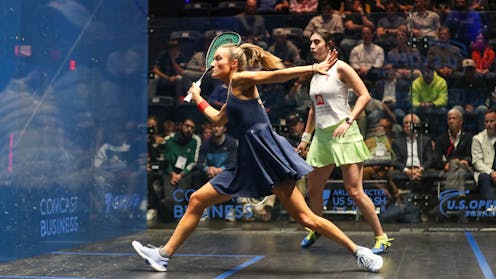
Olivia Weaver, in foreground, is an American professional squash player from Philadelphia who is ranked No. 4 in the world. Courtesy US Squash

What sport combines the intensity of a high-wire circus act with the strategic thinking of a grand master chess match?

I’d say the sport of squash, for the first time an Olympic sport at the 2028 Los Angeles Games. Squash has its U.S. epicenter in Philadelphia, which is also considered the birthplace of squash in America. The sport was introduced to the U.S. at the Racquet Club of Philadelphia in 1900, where the first squash doubles court was later established.

James Zug, the preeminent historian of the game, writes about how, in the winter of 1901, 32 men competed at the club in the first squash tournament on American soil. Many other Philadelphia clubs followed, leading to a local squash culture that spread to high schools and colleges.

The United States Squash Racquets Association, now US Squash, was founded in Philadelphia in 1904, later moved to New York City, and in 2021 relocated its offices back to Philly.

I’m a sports psychologist who works with elite professional squash athletes and also writes about the game. As the former athletic director at Drexel University, I helped introduce varsity squash to the school and also assisted in starting a nonprofit community program called SquashSmarts for Philly public school students.

I believe squash is one of Philly’s best-kept secrets, as many Philadelphians do not know our city is host to an Olympic training high-performance center, the U.S. Squash Hall of Fame and youth development programs known as urban squash.

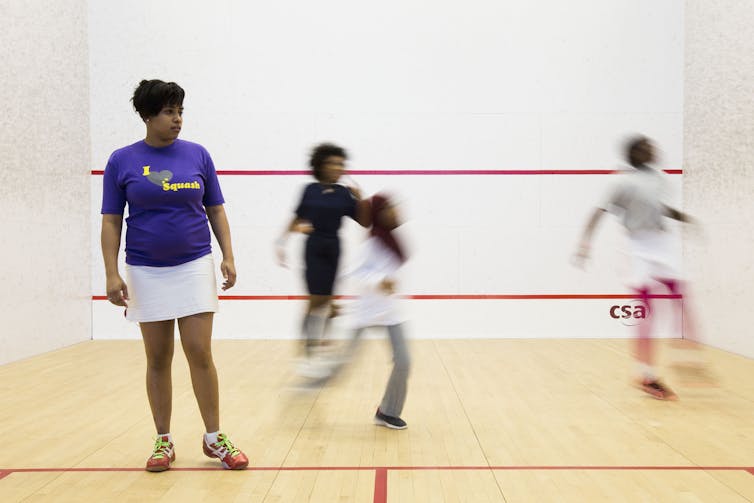
Woman in purple T-shirt and short white skirt stands on squash court as kids play
In this Feb. 11, 2014, photo, squash coach Sakora Miller directs kids at SquashSmarts, a nonprofit dedicated to teaching the sport to Philly kids.
AP Photo/Matt Rourke

A feast for the brain

Squash originated from the older game of racquets, which was played in London’s prisons during the 19th century.

The vulcanization of rubber by Charles Goodyear in 1839 enabled the creation of a squeezable rubber ball that maintained its original shape after being “squashed” against the wall. The British Commonwealth, through its worldwide military, social and political influence, promoted and grew the game internationally and set standardized rules and courts.

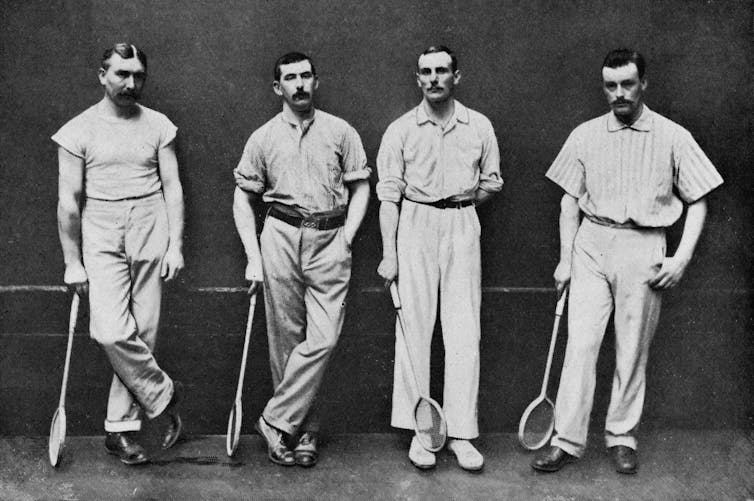
Black and white photo of four men in shirts, slacks and shoes holding squash rackets
Racquets doubles players in Philadelphia in January 1900. Squash was introduced to Philadelphia the same year.
The Print Collector/Hulton Archive via Getty Images

Watching professional squash today feels like being in gym class and science class at the same time: The sport showcases incredible athleticism and celebrates the laws of mathematics.

Squash is best understood in terms of its form and its essence.

The form of squash includes the ancient proportions of the cella of the Parthenon, which held the sacred statue of Athena holding Nike, the goddess of victory. An international squash court is 32 feet by 21 feet, and this ratio of approximately 1 to 1.5 establishes a sense of geometric order. With all walls and angles in play, and emphasizing elements such as time, velocity and space, squash allows for an amazing spectacle of creativity, elegance and speed. It is a feast for the brain.

Mental aspects of the game

But the essence of squash is mental, and the three aspects I find especially intriguing are mindfulness, playfulness and fairness.

Mindfulness: Mindfulness involves not dwelling on the past or worrying about the future. This is easier said than done, especially when a player is exhausted and struggling. The competitive squash player must focus on the moment and anticipate the next. This requires processing information in real time and practicing mindfulness to avoid distractions.

Playfulness: When I was a young athlete, I gave a B effort in practice and an A effort during competition. I had it all wrong.

I now understand that intense, disciplined practices are the foundation for tomorrow’s world-class athlete. There are no shortcuts. Psychologist Angela Duckworth advocates that excellence is 66% grit – which she decribes as a combination of passion, effort and perseverance – with the other 34% being innate talent.

For high-performance athletes, it is beneficial to be a neurotic perfectionist in practice, but not during competition, when they need to be situationally aware. Performance coach Brian Levenson writes about the pro athlete being the opposite of a perfectionist when competing, shifting to being playful, intuitive, confident and adaptable instead.

In other words, practice like a pro, play like a kid.

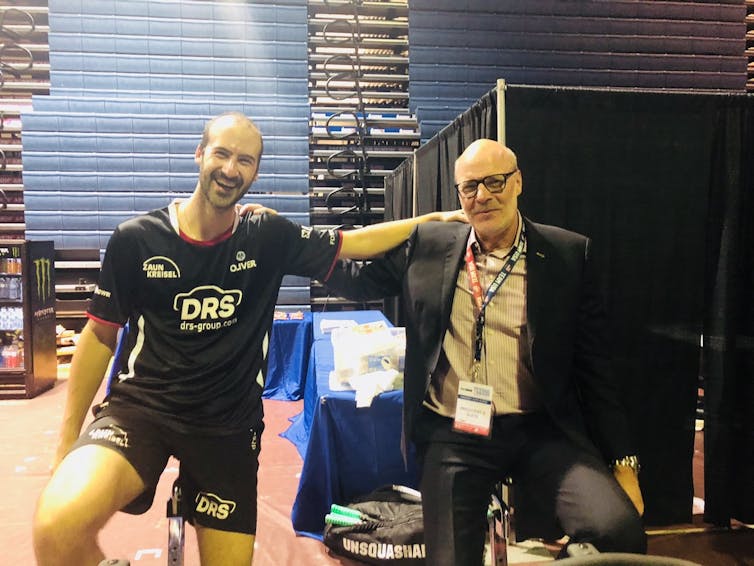
Two men, one in athletic uniform and one in suit, pose together for photograph
The author, right, with Simon Rösner, Germany’s highest-ever-ranked player at No. 3, in a postmatch cooldown at the U.S. Open Squash Championships in Philadelphia.
Courtesy Eric Zillmer

Fairness: One intriguing aspect of squash is the two competitors share the same space. This requires respect for your opponent as well as the game.

At its best, squash resembles a dance between two foes, with the winner graciously allowing their opponent to leave the court first.

US Squash has made sportsmanship and character a key initiative as the sport grows in popularity at all levels of play. While the art of deception, such as head fakes or varying your swing timing, is a valued tactical skill, blocking the opponent, whether subtle or overt, is not.

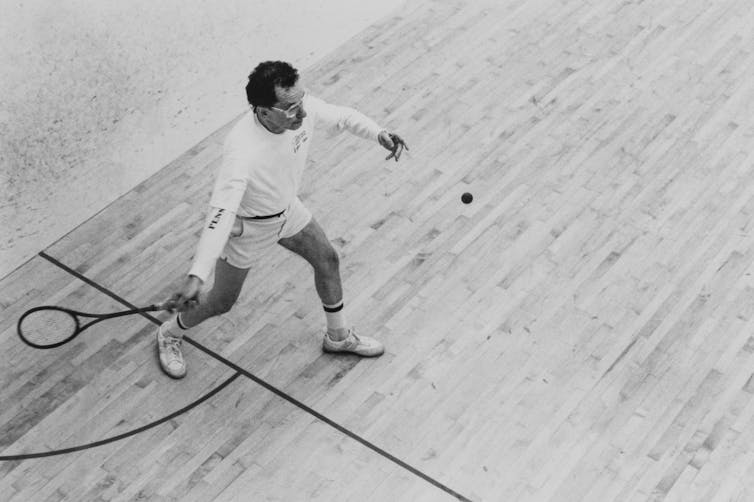
Black and white photo of man on court hitting ball with a racket
U.S. Sen. Arlen Specter of Pennsylvania playing squash in 1985.
Laura Patterson/CQ Roll Call via Getty Images

Philly’s Olympic center

One of Philadelphia’s most passionate amateur players was the longtime U.S. Sen. Arlen Specter. In 2021, the Arlen Specter US Squash Center, located on the campus of Drexel University, opened and was named in his honor.

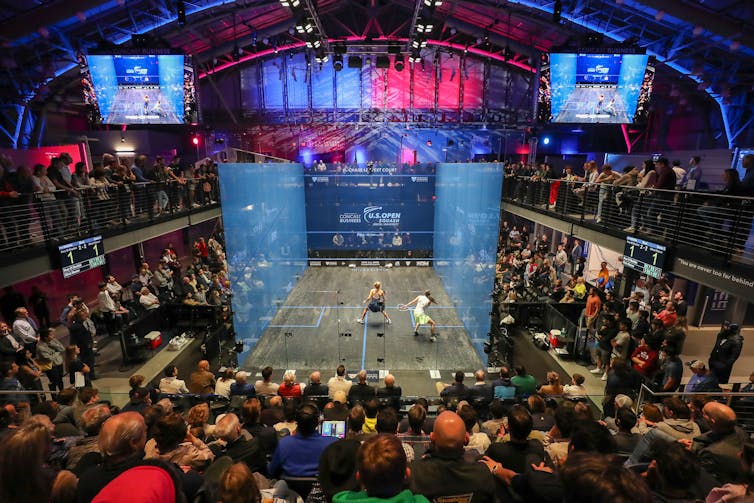
The Specter Center is a state-of-the-art training facility and home to Team USA, the administrative center for US Squash, the home for the U.S. Open, and a hub for the U.S. junior and senior national teams, as well as urban squash.

The inclusion of squash in the 2028 Olympics is a milestone for the increasingly international sport. Currently, eight nationalities are represented among the top 10 male and female pro players, although in recent years Egypt has dominated both the men’s and women’s game.

Two U.S. women who are ranked in the world Top 10 are Team USA’s best chances to win gold: Amanda Sobhy, who went undefeated at Harvard, and Philly’s own Olivia Weaver.

If you want to catch them in action before the 2028 games, both will compete at the U.S. Open Squash Championship at the Arlen Specter US Squash Center from Oct. 19 to Oct. 25, 2025.

Two women athletes compete on squash court with four transparent walls surrounded by onlookers
US Squash has a major national facility in Philadelphia, the Arlen Specter US Squash Center.
Courtesy US Squash

Read more of our stories about Philadelphia.

The Conversation

Eric Zillmer serves as an unpaid advisor to the following non-profit boards. 2010-present Advisory Board, Philadelphia SquashSmarts; 2019-present PHL Sports Congress, Vice Chair Advisory Board; 2020-present Philadelphia Convention & Visitors Bureau (PHLCVB) Board of Directors; and 2025-present US Squash Board of Directors.

ref. Squash has been played in Philly for 125 years − a sports psychologist explains why it’s one of the city’s best-kept secrets – https://theconversation.com/squash-has-been-played-in-philly-for-125-years-a-sports-psychologist-explains-why-its-one-of-the-citys-best-kept-secrets-260898

College students are bombarded by misinformation, so this professor taught them fact-checking 101 − here’s what happened

Source: The Conversation – USA – By Sam Wineburg, Emeritus Professor of Education, Stanford University

Smartphones are a window into a world of misinformation. Jacob Wackerhausen/iStock via Getty Images

Mike Evans knew something had to change.

As the lead instructor for American Government 1101 at Georgia State University in 2021, Evans had watched his students over the years show up with fewer facts and more conspiracy theories. Gone were the days when students arrived on campus with dim memories of high school civics. Now they came armed with bold, often misleading beliefs shaped by hours spent each day on TikTok, YouTube and Instagram.

One example of misinformation making the rounds back then was an anonymously posted video that more than half of teens in a national survey said provided “strong evidence” of U.S. voter fraud. The video was actually shot in Russia, crucial context that could be gleaned by entering a few choice keywords into a browser.

Ignoring the problem of online gullibility felt irresponsible – even negligent. How could the course deliver on its aim of helping students become “effective and responsible participants in American democracy” if it turned a blind eye to digital misinformation? At the same time, a major overhaul of a course that enrolls more than 4,000 students each year – with 15 instructors teaching 42 sections in person, online and in a hybrid format – would create a logistical nightmare.

That’s when Evans, a political scientist, came across the Civic Online Reasoning curriculum, developed by the research group I used to lead at Stanford University. The curriculum, which is freely available to anyone, teaches a set of strategies based on how professional fact-checkers evaluate online information.

In fall 2021, he reached out with a question: Could aspects of the curriculum be incorporated into American Government 1101 without turning the whole course on its head?

My team and I thought so.

Teaching informed citizenship

Evans’ challenge was hardly unique to his campus.

For Generation Z, born between 1997 and 2012, social media – especially YouTube, TikTok, Instagram and Snapchat – has become their source of information about the world, eclipsing traditional news outlets. In a survey of more than 1,000 young people ages 13 to 18, 8 in 10 said they encounter conspiracy theories in their social media feeds each week, yet only 39% reported receiving instruction in evaluating the claims they saw there.

We built our Civic Online Reasoning program to address this gap.

When we launched the program in 2018, digital literacy was a catchall that included everything from editing and uploading videos to cyberbullying and sexting. “Checking the credibility of sources” was just one criterion among many buried in a list of desired outcomes.

We narrowed the focus of our program to skills essential to being an informed citizen, such as “lateral reading” − that is, using the full context of the internet to judge the quality of a claim, identify the people or organizations behind it and assess their credibility. Rather than fixate solely on the message, we taught students to vet the messenger: What organizations stand behind the claim? Does the source of the claim have a conflict of interest? What are the source’s credentials or expertise?

We tested our approach in an experiment in 12th grade classrooms teaching government in Lincoln, Nebraska, public schools.

Across six hours of instruction – two hours less than the average teen spends online each day – students nearly doubled in their ability to locate quality information compared to a control group. We thought it wouldn’t be a huge leap to extend our approach to college classrooms.

In a version of this program modified for Evans’ course, we designed six short modules that could be used asynchronously, meaning that students could complete them on their own time, regardless of course format. Unlike information literacy lessons that soar above the particulars of any one discipline, our modules were closely tied to course content.

In a unit on the executive branch, for instance, students examined an Instagram video that falsely claimed President Joe Biden wanted Americans to pay more at the gas pump. In a module on the judiciary, they watched a video on TikTok about Ketanji Brown Jackson’s Supreme Court confirmation, posted by a partisan, left-leaning organization.

A look at the program in action.

We created videos that pulled back the curtain by deconstructing tactics common in political campaigns – quotes ripped from context, videos spliced and selectively edited, and corporate-funded websites that masquerade as grassroots efforts.

We also taught students how to check facts like the pros. The main strategy was lateral reading – searching across the internet to see what other, more credible sources say about an organization or influencer. We challenged common assumptions too, such as that Wikipedia is always unreliable. Not true, especially for “protected pages,” indicated by a padlock icon at the top of an article, which prevent editorial changes except those made by established Wikipedians. Another is the belief that a dot-org website has passed rigorous tests that qualify it as a charity, which is never true. Dot-org has always been an “open” domain that anyone can register, no questions asked.

These lessons took just 150 minutes in total over the semester, and instructors didn’t need to change a thing; they just listed the lessons on the course schedule.

Positive outcomes, modest effort

Did this approach work for Evans and his American Government 1101 students?

Across two semesters in one academic year, 3,488 students took a test at the beginning of the course and again at the end. It included items such as one in which students evaluated a website that claimed it “does not represent any industry or political group” but is actually backed by fossil fuel interests.

In June, Evans, two co-authors and I uploaded a preprint of a journal article, which hasn’t yet been peer reviewed, that documents the experiment and its results. We found that from the beginning to the end of the semester, students became a lot smarter at identifying shady sources and more confident in evaluating where information comes from. Students’ scores showing how well they were able to do this improved by 18%. Even better, 80% said they “learned important things” from the modules.

Not bad for an easily adopted addition to the course.

These results add to other studies we’ve conducted, such as one in a college nutrition class and one in a rhetoric and writing intro course, that similarly showed how educators can improve students’ digital literacy – and their awareness of misinformation – without causing a major disruption to the curriculum.

And I believe it’s needed. A chasm separates the approved content that appears on students’ reading lists and the massive amount of unregulated, unverified and unreliable content they consume online.

The good news? This intervention could work in any subject where misinformation runs wild: history, nutrition, economics, biology and politics. Findings similar to ours from other college campuses buoy our confidence in the approach.

These changes don’t require waiting for a big revolution. Small steps can go a long way. And in a world flooded with misinformation, helping students learn to sort fact from fiction might be the most civic thing we can do.

The Conversation

Sam Wineburg received funding from the William & Flora Hewlett Foundation for this research. He is a board member of the not-for-profit Digital Inquiry Group (inquirygroup.org), which now operates the Civic Online Reasoning curriculum.

ref. College students are bombarded by misinformation, so this professor taught them fact-checking 101 − here’s what happened – https://theconversation.com/college-students-are-bombarded-by-misinformation-so-this-professor-taught-them-fact-checking-101-heres-what-happened-262409

Active Clubs are white supremacy’s new, dangerous frontier

Source: The Conversation – USA – By Art Jipson, Associate Professor of Sociology, University of Dayton

What looks like a fitness group could actually be a white supremacist training cell. starush/iStock via Getty Images

Small local organizations called Active Clubs have spread widely across the U.S. and internationally, using fitness as a cover for a much more alarming mission. These groups are a new and harder-to-detect form of white supremacist organizing that merges extremist ideology with fitness and combat sports culture.

Active Clubs frame themselves as innocuous workout groups on digital platforms and decentralized networks to recruit, radicalize and prepare members for racist violence. The clubs commonly use encrypted messaging apps such as Telegram, Wire and Matrix to coordinate internally.

For broader propaganda and outreach they rely on alternative social media platforms such as Gab, Odysee, VK and sometimes BitChute. They also selectively use mainstream sites such as Instagram, Facebook, X and TikTok, until those sites ban the clubs.

Active Club members have been implicated in orchestrating and distributing neo-Nazi recruitment videos and manifestos. In late 2023, for instance, two Ontario men, Kristoffer Nippak and Matthew Althorpe, were arrested and charged with distributing materials for the neo-Nazi group Atomwaffen Division and the transnational terrorist group Terrorgram.

Following their arrests, Active Club Canada’s public network went dark, Telegram pages were deleted or rebranded, and the club went virtually silent. Nippak was granted bail under strict conditions, while Althorpe remains in custody.

As a sociologist studying extremism and white supremacy since 1993, I have watched the movement shift from formal organizations to small, decentralized cells – a change embodied most clearly by Active Clubs.

An investigation by the Canadian Broadcasting Corporation tracks down two Ontario-based Active Clubs that recruit and train young men to fight.

White nationalism 3.0

According to private analysts who track far-right extremist activities, the Active Club network has a core membership of 400 to 1,200 white men globally, plus sympathizers, online supporters and passive members. The clubs mainly target young white men in their late teens and twenties.

Since 2020, Active Clubs have expanded rapidly across the United States, Canada and Europe, including the U.K., France, Sweden and Finland. Precise numbers are hard to verify, but the clubs appear to be spreading, according to The Counter Extremism Project, the Anti-Defamation League, the Southern Poverty Law Center and my own research.

The clubs reportedly operate in at least 25 U.S. states, and potentially as many as 34. Active U.S. chapters reportedly increased from 49 in 2023 to 78 in 2025.

The clubs’ rise reflects a broader shift in white supremacist strategy, away from formal organizations and social movements. In 2020, American neo-Nazi Robert Rundo introduced the concept of “White Nationalism 3.0” – a decentralized, branded and fitness-based approach to extremist organizing.

Rundo previously founded the Rise Above Movement, which was a violent, far-right extremist group in the U.S. known for promoting white nationalist ideology, organizing street fights and coordinating through social media. The organization carried out attacks at protests and rallies from 2016 through 2018.

Active Clubs embed their ideology within apolitical activities such as martial arts and weightlifting. This model allows them to blend in with mainstream fitness communities. However, their deeper purpose is to prepare members for racial conflict.

An actor reconstructs how British broadcaster ITV News infiltrated and secretly filmed inside Active Club England, documenting its recruiting process, activities and goals.

‘You need to learn how to fight’

Active Club messaging glorifies discipline, masculinity and strength – a “warrior identity” designed to attract young men.

“The active club is not so much a structural organization as it is a lifestyle for those willing to work, risk and sweat to embody our ideals for themselves and to promote them to others,” Rundo explained via his Telegram channel.

“They never were like, ‘You need to learn how to fight so you can beat up people of color.’ It was like, ‘You need to learn how to fight because people want to kill you in the future,’” a former Active Club member told Vice News in 2023.

These cells are deliberately small – often under a dozen members – and self-contained, which gives them greater operational security and flexibility. Each club operates semi-autonomously while remaining connected to the broader ideology and digital network.

Expanding globally and deepening ties

Active Clubs maintain strategic and ideological connections with formal white supremacist groups, including Patriot Front, a white nationalist and neofascist group founded in 2017 by Thomas Rousseau after the Unite the Right rally in Charlottesville, Virginia.

Active Clubs share extremist beliefs with these organizations, including racial hierarchy and the “Great Replacement” theory, which claims white populations are being deliberately replaced by nonwhite immigrants. While publicly presenting as fitness groups, they may collaborate with white supremacist groups on recruitment, training, propaganda or public events.

Figures connected to accelerationist groups – organizations that seek to create social chaos and societal collapse that they believe will lead to a race war and the destruction of liberal democracy – played a role in founding the Active Club network. Along with the Rise Above Movement, they include Atomwaffen Division and another neo-Nazi group, The Base – organizations that repackage violent fascism to appeal to disaffected young white men in the U.S.

Brotherhood as a cover

By downplaying explicit hate symbols and emphasizing strength and preparedness, Active Clubs appeal to a new generation of recruits who may not initially identify with overt racism but are drawn to a culture of hypermasculinity and self-improvement.

Anyone can start a local Active Club chapter with minimal oversight. This autonomy makes it hard for law enforcement agencies to monitor the groups and helps the network grow rapidly.

Shared branding and digital propaganda maintain ideological consistency. Through this approach, Active Clubs have built a transnational network of echo chambers, recruitment pipelines and paramilitary-style training in parks and gyms.

Club members engage in activities such as combat sports training, propaganda dissemination and ideological conditioning. Fight sessions are often recorded and shared online as recruitment tools.

Members distribute flyers, stickers and online content to spread white supremacist messages. Active Clubs embed themselves in local communities by hosting events, promoting physical fitness, staging public actions and sharing propaganda.

Potential members first see propaganda on encrypted apps such as Telegram or on social media. The clubs recruit in person at gyms, protests and local events, vetting new members to ensure they share the group’s beliefs and can be trusted to maintain secrecy.

From fringe to functioning network

Based on current information from the Global Project Against Hate and Extremism, there are 187 active chapters within the Active Club Network across 27 countries – a 25% increase from late 2023. The Crowd Counting Consortium documented 27 protest events involving Active Clubs in 2022-2023.

However, precise membership numbers remain difficult to ascertain. Some groups call themselves “youth clubs” but share similar ideas and aesthetics and engage in similar activities.

Active Club members view themselves as defenders of Western civilization and masculine virtue. From their perspective, their activities represent noble resistance rather than hate. Members are encouraged to stay secretive, prepare for societal collapse and build a network of committed, fit men ready to act through infiltration, activism or violence.

Hiding in plain sight

Law enforcement agencies, researchers and civil society now face a new kind of domestic threat that wears workout clothes instead of uniforms.

Active Clubs work across international borders, bound by shared ideas and tactics and a common purpose. This is the new white nationalism: decentralized, modernized, more agile and disguised as self-improvement. What appears to be a harmless workout group may be a gateway to violent extremism, one pushup at a time.

The Conversation

Art Jipson does not work for, consult, own shares in or receive funding from any company or organization that would benefit from this article, and has disclosed no relevant affiliations beyond their academic appointment.

ref. Active Clubs are white supremacy’s new, dangerous frontier – https://theconversation.com/active-clubs-are-white-supremacys-new-dangerous-frontier-262786

Like Reagan, Trump is slashing US environment regulations, but his strategy may have a far deeper impact

Source: The Conversation – USA (2) – By Barbara Kates-Garnick, Professor of Practice in Energy Policy, The Fletcher School, Tufts University

When the Trump administration announced it was moving to eliminate dozens of U.S. climate policies, Environmental Protection Agency Administrator Lee Zeldin said he was sending “a dagger straight into the heart of the climate change religion.”

That drive – to both repeal environmental regulations and cast doubt on science – reflects the Trump administration’s approach to environment policy.

Deregulation has long been a key theme in Republican environmental policy. The conflict between the obligation to protect public health and the desire to boost markets traces back to Ronald Reagan’s presidential administration. Reagan’s perspective that government is not a solution to problems, but is the problem instead, set the stage for Republican administrations that followed.

Reagan, standing in a reception line, shakes Trump's hand. Trump is wearing a tuxedo. Reagan a suit.
President Ronald Reagan shakes Donald Trump’s hand during a reception that Trump, then a real estate developer, attended at the White House in 1987.
White House Photographic Collection via Wikimedia Commons

Reagan argued that the growth of government spending and business regulation had stymied economic prosperity. Environmental regulations were a prime target.

Forty years later, America is seeing many of the same concepts in the Trump administration. However, its strategy could have a greater effect than Reagan ever envisioned.

Slashing budgets and staffing

There are many ways to kneecap government agencies: Instituting massive budget cuts, cutting staff with critical functions and appointing leadership whose goal is limiting the reach and effectiveness of the very agencies they direct are just a few.

In these efforts, Reagan and Trump had similar approaches to the EPA, although with different levels of intensity.

Trump’s EPA budget plan for 2026 includes a draconian 50% cut from the previous year and the lowest budget proposal, when adjusted for inflation, since Reagan. Staff cuts in just the first six months of the second Trump administration put the agency’s total employment at 12,448, down from 16,155 in January.

Reagan dissolved the EPA Office of Enforcement to limit “unnecessary regulation,” which resulted in a 80% decline in actions to enforce environmental regulations. Trump is also stopping enforcement actions, dismantling the EPA’s Science and Research Office and politicizing the agency’s science by putting political appointees in charge, moves that undermine EPA’s independence and expertise.

Both cut EPA’s budget, but that alone does not reduce an agency’s effectiveness.

Politicizing EPA leadership

When the EPA was founded in 1970 during the Nixon administration, it represented a bipartisan consensus: After decades of auto exhaust, polluted waterways and smog-filled air, environmental protection had become a national policy priority.

But industries that EPA regulated argued that the costs of implementing the agency’s mandates were too high. That created tension between economics and science and enforcement.

As part of his “government is not the solution” approach, Reagan issued an executive order shortly after taking office in 1981 requiring federal agencies to submit all proposed rules to the White House Office of Management and Budget before making them public. In Reagan’s eyes, this approach centralized power in the White House and was a way to eliminate burdensome regulations before the agencies announced them to the public.

He also appointed an EPA administrator who shared his anti-government perspective. Anne Gorsuch Burford was a lawyer and state legislator from Colorado, where she routinely voted against toxic waste cleanup and auto pollution controls.

A woman sits in a chair next to the president's desk. Reagan is smiling as he talks with her.
President Ronald Reagan meets with EPA Administrator Anne Gorsuch in the Oval Office in May 1982.
HUM Images/Universal Images Group via Getty Images

Once in Washington, she appointed several people to the EPA’s leadership team with direct ties to industries the EPA regulated. An example was Rita Lavelle, head of the EPA’s toxic waste programs, who was later convicted of perjury for lying to Congress about when she knew her former employer, a defense contractor, was disposing of toxic waste at a now notorious dump site.

These appointments were an example of regulatory capture by the industries EPA was in charge of overseeing. Anne Gorsuch Burford was held in contempt of Congress for not turning over records related to the Superfund cleanup of the same hazardous waste site, which led to her resignation. The Superfund program to clean up toxic waste dumps was new and one of EPA’s largest programs at the time.

The scandals, broken staff morale, stripped budgets and fights over policy discredited the agency.

Going after government scientists

Anne Gorsuch Burford’s deregulation efforts weren’t fully successful, in part because EPA staff experts rallied to preserve science and regulatory functions. They leaked materials about delays in the Superfund site cleanup to sympathetic congressional staff, who in turn found support from Republican and Democratic senators.

That history may have influenced the Trump administration’s strategy toward the federal bureaucracy’s staff experts, who Trump calls “the Deep State.”

The Department of Government Efficiency, an unofficial group Trump set up in early 2025 headed by Elon Musk, directed the firing of tens of thousands of government scientists and other staff with expertise that government agencies rely on. Thousands more have resigned amid intimidation tactics such as surveillance.

A group of people hold science reading 'EPA protects you, protect EPA' and 'Science saves'
EPA employees and supporters held a rally in Philadelphia on March 25, 2025, to call attention to the impact of the Trump administration’s job cuts.
AP Photo/Matt Rourke

Trump’s head of the Office of Management and Budget, Russell Vought, has been clear about targeting bureaucrats. He said in 2023: “We want their funding to be shut down so that the EPA can’t do all of the rules against our energy industry because they have no bandwidth financially to do so. We want to put them in trauma.”

There is a clear focus today on EPA programs that don’t align with the administration’s views. Programs related to environmental justice for low-income communities are in the line of fire. The appointment of people from the chemical, fossil fuel and corporate industries to high-level regulatory and legal positions raises questions about regulatory capture – whether their focus will be more on the health of the industries they oversee than on the health of the public.

The first Trump administration had a focus on reforming permitting and bureaucracy. While appearing radical at the time, the revamping of scientific boards to include more industry representatives, the undoing of power plant rules and the lessening of enforcement hobbled but did not completely undo the agency.

The second Trump administration, in actively supporting fossil fuel “energy dominance,” is taking steps to not just eliminate regulations but to ensure future administrations can’t bring the regulations back, by using a complex set of legal arguments related to the regulation of greenhouse gases.

At the same time, the administration is trying to discredit scientific research to downplay the risks of a warming planet.

EPA Administrator Lee Zeldin announces plans in March 2025 to reconsider dozens of regulations that affect the fossil fuel industry and human health.

The Reagan administration, while it also pushed for deregulation and expanded permitting of oil, gas and coal leases, embraced some elements of environmental protection. Reagan designated more than 10 million acres as protected wilderness and signed the Coastal Barriers Resources Act, which helped protect 3.5 million acres of shoreline from development. When Reagan signed the Montreal Protocol in 1988 to help protect the ozone layer, he cited scientific data showing the growing risks of ozone-depleting substances.

When Congress doesn’t push back

There is another critical difference between the first and second Trump administrations: The current Republican-controlled Congress is consenting to almost every request the president makes.

Congress has a constitutional responsibility to be a check on the executive branch, and a bipartisan Congress has long taken an active role in oversight and investigation involving environmental issues.

In 2025, however, Congress has approved most of Trump’s demands, including voting to repeal much of the Inflation Reduction Act, a package of pro-environment spending it had just passed two years earlier and that included many projects in Republican districts.

The administration’s effort to eliminate U.S. climate policies will take time and face lawsuits.

In an irony of history, Anne Gorsuch Burford’s son Neil Gorsuch now sits on the Supreme Court. His vote when those cases come before the court may be the ultimate Reagan legacy on the Trump EPA.

The Conversation

Barbara Kates-Garnick does not work for, consult, own shares in or receive funding from any company or organization that would benefit from this article, and has disclosed no relevant affiliations beyond their academic appointment.

ref. Like Reagan, Trump is slashing US environment regulations, but his strategy may have a far deeper impact – https://theconversation.com/like-reagan-trump-is-slashing-us-environment-regulations-but-his-strategy-may-have-a-far-deeper-impact-262929

Des microbes intestinaux qui enivrent et abîment le foie : comment le microbiote peut se transformer en microbrasserie

Source: The Conversation – France in French (3) – By Bill Sullivan, Professor of Microbiology and Immunology, Indiana University

Il peut exceptionnellement arriver qu’un taux d’alcoolémie élevé ne soit pas dû à une consommation d’alcool… Nikamo/Shutterstock.com

Le « syndrome d’auto-brasserie » est une affection très rare et très peu documentée, impliquant la production d’alcool par des bactéries intestinales, qui entraîne l’intoxication des individus concernés. Au-delà des quelques cas cliniques décrits, des scientifiques se demandent si un phénomène similaire ne pourrait pas être impliqué dans certains cas de stéatose hépatique non alcoolique, une maladie aux causes multiples, beaucoup plus courante.


Imaginez : vous êtes agent de police, et vous remarquez une voiture qui zigzague dangereusement sur la chaussée. Vous arrêtez le conducteur : il est manifestement ivre. D’une voix pâteuse, il jure pourtant n’avoir pas touché une goutte d’alcool de la journée. Le croiriez-vous ? Probablement pas.

Pourtant, en 2024, un citoyen belge a été acquitté après avoir été verbalisé pour conduite en état d’ivresse à trois reprises en quatre ans. Son emploi dans une brasserie pouvait nourrir les soupçons, mais il affirmait n’avoir rien bu. Selon les trois médecins qui l’ont ausculté, il aurait souffert d’un syndrome d’auto-brasserie dont il ignorait l’existence.

Les personnes atteintes de ce syndrome très rare (une revue de la littérature scientifique de langue anglaise publiée en 2020 a révélé que seuls 20 cas avaient été identifiés depuis 1974, ndlr) hébergeraient dans leurs intestins des microbes produisant des quantités anormalement élevées d’alcool lorsqu’ils décomposent les sucres. En 2016, à New York, une femme avait, elle aussi, été acquittée après un diagnostic identique. Son taux d’alcoolémie atteignait quatre fois la limite légale.

Bien que le syndrome d’auto-brasserie soit exceptionnel, certaines des espèces bactériennes qui y sont associées pourraient être impliquées dans une autre maladie beaucoup moins rare, la stéatose hépatique.

En tant que microbiologiste, je suis passionné par l’étude des divers effets du microbiote intestinal sur la santé humaine, ainsi que sur l’humeur et le comportement, que j’ai aussi vulgarisés dans l’ouvrage Pleased to Meet Me: Genes, Germs, and the Curious Forces That Make Us Who We Are. Voici ce qu’il faut savoir sur ces bactéries productrices d’alcool et les soupçons qui pèsent sur elles.

Un foie malade sans abus alcool

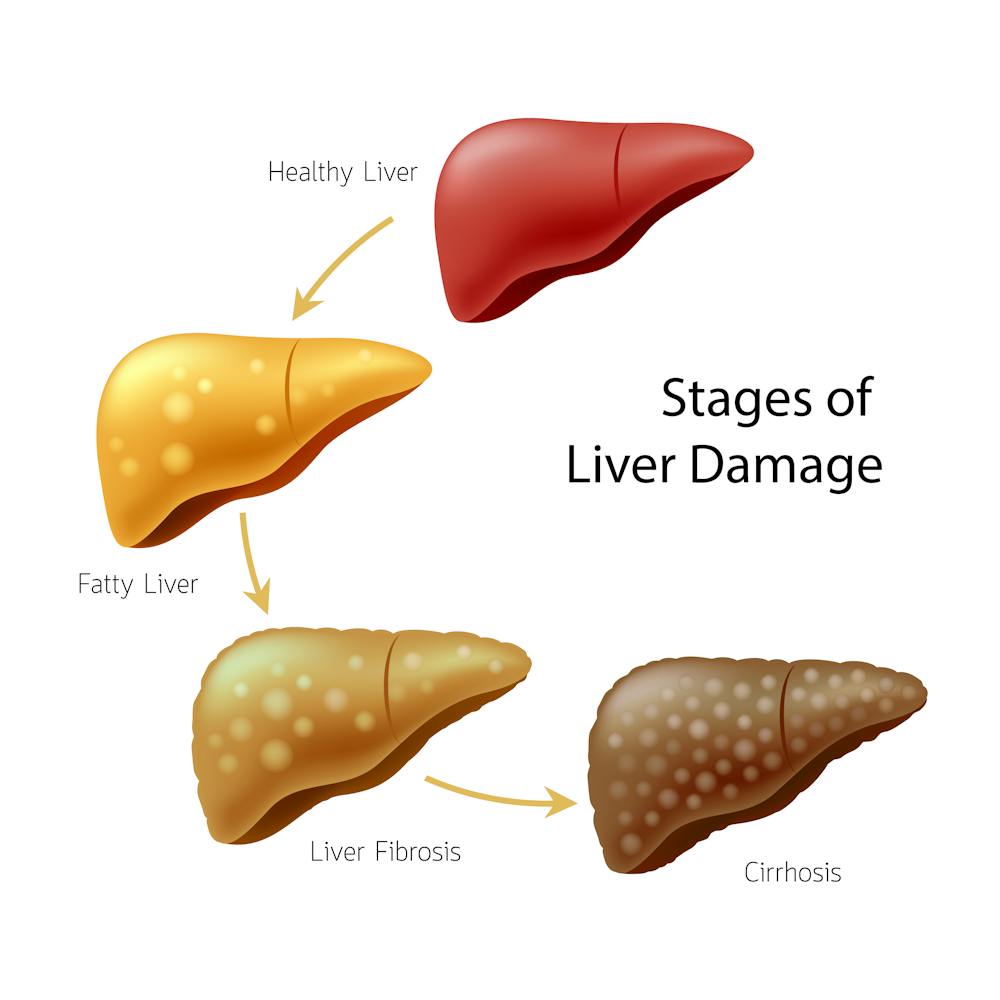
L’accumulation de graisses dans le foie peut entraîner de graves problèmes de santé. L’inflammation chronique qui en résulte peut notamment favoriser la survenue d’une fibrose hépatique qui peut mener à une cirrhose, laquelle peut sur le long terme, évoluer en cancer du foie.


À lire aussi :
Maladie du foie gras : décoder nos gènes pour mieux la prévenir


On associe souvent la stéatose hépatique à l’alcoolisme. Pourtant, la stéatose hépatique métabolique associée à une dysfonction, ou MASLD, survient sans consommation excessive d’alcool. Anciennement appelée « stéatose hépatique non alcoolique » (SHNA, ou NASH en anglais pour Non-Alcoholic Steatohepatitis), et aussi désignée en français par l’expression « maladie du foie gras », cette affection est un continuum d’anomalies hépatiques qui touche de 80 millions à 100 millions d’Américains (en France, les données de la cohorte CONSTANCE de 2020 indiquent que la stéatose hépatique non alcoolique toucherait 18,2 % de la population, ndlr).

Les causes de la MASLD semblent multiples : obésité, résistance à l’insuline, excès de cholestérol ou encore infection par l’hépatite C. Des travaux semblent aussi suggérer que certains microbes pourraient aussi jouer un rôle.

Diagramme représentant la dégradation du foie, du foie sain à la stéatose, puis à la fibrose et enfin à la cirrhose
Les quatre stades de la stéatose hépatique non alcoolique.
wowow/Shutterstock

En 2019, notamment, des médecins ont identifié un patient souffrant à la fois du syndrome d’auto-brasserie et d’une MASLD sévère. L’analyse de ses selles a révélé la présence de la bactérie Klebsiella pneumoniae. Il s’est avéré que la souche isolée produisait quatre à six fois plus d’alcool que celles habituellement rencontrées chez des individus sains.

Sur 43 autres patients atteints de MASLD, 61 % hébergeaient une souche de K. pneumoniae produisant des quantités inhabituellement élevées d’alcool. En revanche, parmi les 48 personnes en bonne santé servant de témoins, seuls 6 % étaient concernées.

Les chercheurs ont également constaté que K. pneumoniae n’était que légèrement plus abondante dans l’intestin des malades que chez les témoins. C’était la quantité d’alcool produite qui différait. Ils se sont alors demandé si cet excès pouvait réellement engendrer la stéatose.

Une microbrasserie dans l’intestin ?

Pour vérifier si ces bactéries étaient bel et bien responsables de la situation des malades, les scientifiques ont mené des tests sur des animaux de laboratoire. Ils ont nourri des souris saines avec la souche hyper-alcoologène de K. pneumoniae. En un mois, les rongeurs ont développé une stéatose mesurable, qui a évolué en cirrhose au bout de deux mois. La progression de la maladie reproduisait fidèlement celle observée lorsque les souris étaient gavées d’alcool pur.

En outre, le transfert de microbiote provenant de souris ou d’humains atteints de MASLD dans des souris saines a également déclenché des lésions hépatiques.

Enfin, les chercheurs ont traité le microbiote de souris atteintes de MASLD avec un virus ciblant uniquement Klebsiella, pour détruire ces bactéries. Le transfert du microbiote ainsi débarrassé de Klebsiella dans des souris saines n’a provoqué chez ces dernières aucune maladie.

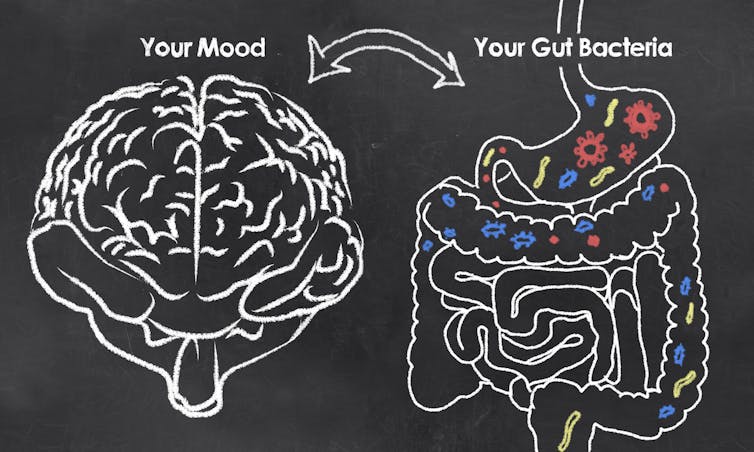
Illustration à la craie montrant des flèches doubles entre cerveau et intestin, peuplés de microbes
Les microbes présents dans l’intestin produisent des substances pouvant influencer l’humeur et la santé – pour le meilleur comme pour le pire.
T. L. Furrer/Shutterstock

Ces résultats suggèrent que certaines souches de K. pneumoniae fabriquent des quantités excessives d’alcool, capables d’induire une stéatose hépatique. Ils laissent aussi espérer que certaines formes de stéatose liées à Klebsiella puissent être traitées par antibiotiques. En effet, l’administration à des souris atteintes d’imipénem, un antibiotique de la famille des bêtalactamines, de la classe des carbapénèmes, a inversé l’évolution de la maladie.

Puisque K. pneumoniae transforme le sucre en alcool, un simple test sanguin mesurant l’alcoolémie après ingestion de sucre pourrait permettre de diagnostiquer cette forme particulière de stéatose. Les chercheurs ont montré que des souris hébergeant ces bactéries devenaient ivres et voyaient leur taux d’alcool sanguin grimper après avoir consommé du sucre.

Il faut souligner que l’on ignore encore l’ampleur de ce phénomène. Si Klebsiella est fréquemment présente dans l’intestin humain, on ne sait pas pourquoi certaines personnes hébergent des souches productrices de grandes quantités d’alcool.

Plus largement, ces travaux illustrent une fois encore le rôle du microbiote dans la régulation de l’humeur et du comportement. Comme pour la conductrice new-yorkaise acquittée, le simple fait de consommer un dessert très sucré pourrait, dans de rares cas, entraîner chez certaines personnes une ébriété sans qu’elles n’aient consommé d’alcool. Le salarié belge, quant à lui, tente de réduire sa production intestinale d’alcool en suivant à la fois un régime alimentaire spécifique et un traitement médicamenteux, selon les déclarations de son avocate. Reste à savoir si ces individus développent une tolérance accrue à l’alcool, de par leur exposition continue.


Cet article, initialement publié le 30 septembre 2019, a été actualisé en 2024 pour inclure les éléments sur la décision de justice belge.

The Conversation

Bill Sullivan ne travaille pas, ne conseille pas, ne possède pas de parts, ne reçoit pas de fonds d’une organisation qui pourrait tirer profit de cet article, et n’a déclaré aucune autre affiliation que son organisme de recherche.

ref. Des microbes intestinaux qui enivrent et abîment le foie : comment le microbiote peut se transformer en microbrasserie – https://theconversation.com/des-microbes-intestinaux-qui-enivrent-et-abiment-le-foie-comment-le-microbiote-peut-se-transformer-en-microbrasserie-263737

Quête de minceur et d’ivresse express : comment la « drunkorexie » menace la santé des jeunes

Source: The Conversation – France in French (3) – By Ludivine Ritz, Maitre de Conférences en Psychologie spécialité Neuropsychologie des addictions, Université de Caen Normandie

Sauter des repas pour pouvoir consommer davantage d’alcool sans craindre d’augmenter ses apports caloriques… Cette très mauvaise idée est en train de prendre de l’ampleur, au point d’inquiéter le corps médical, et d’avoir donné naissance à un néologisme : la « drunkorexie », ou « alcoolorexie ».


La « drunkorexie » (ou « alcoolorexie ») est un néologisme formé à partir des mots drunk (de l’anglais, être ivre) et anorexie. Il est apparu pour la première fois, il y a une quinzaine d’années, dans un article du New York Times, « Se priver de nourriture, un cocktail à la main ». Tout en précisant que ce terme n’avait rien de médical, la journaliste Sarah Kershaw l’employait pour décrire comment certaines personnes adoptaient des comportements de jeûne volontaire afin de limiter la prise de poids liée à leur consommation d’alcool.

Depuis, le phénomène a fait l’objet de recherches plus approfondies. Il soulève des enjeux majeurs de santé mentale et interroge sur le rôle des normes esthétiques et de la pression sociale. Explications.

Quels sont les risques associés à la drunkorexie ?

La drunkorexie est définie comme un ensemble de comportements alimentaires à risque, incluant des formes de restriction (jeûner, sauter des repas), des conduites de purge (comme des vomissements provoqués) ou une activité physique excessive.

Ces comportements poursuivent deux objectifs principaux : éviter la prise de poids liée à la consommation d’alcool ou atteindre un état d’ivresse plus rapide. Ils peuvent être adoptés à différents moments, que ce soit en amont de la consommation (par anticipation), pendant celle-ci (notamment lors de soirées festives) ou après, dans une logique de compensation a posteriori.

Si la drunkorexie peut être perçue comme un comportement ponctuel ou stratégique, ses conséquences sont loin d’être anodines. Elle est tout d’abord associée à une consommation d’alcool plus fréquente et plus intense, ainsi qu’à des épisodes d’ivresse plus sévères, exposant les jeunes à des prises de risques accrues, tant sur le plan physique que social.

Par ailleurs, les effets de la drunkorexie ne se limitent pas à l’alcool. Plusieurs études montrent qu’elle s’inscrit souvent dans un tableau plus large de troubles alimentaires, présents y compris en dehors des contextes festifs. À terme, ces comportements pourraient favoriser l’installation durable de troubles du comportement alimentaire chez certains jeunes adultes.

Sur le plan psychologique, ce type de comportement semble également refléter une fragilité émotionnelle plus profonde. Dépression, anxiété, détresse psychologique, difficultés de régulation des émotions, antécédents de maltraitance ou insécurité dans les relations proches, sont fréquemment rapportés chez les jeunes concernés.

Enfin, les conséquences cognitives de la drunkorexie restent encore peu documentées, mais certaines hypothèses méritent d’être explorées : quel impact ce comportement peut-il avoir sur la mémoire, sur les capacités de raisonnement ou sur la réussite académique, lorsque l’alcool est consommé de manière répétée dans un contexte de restriction alimentaire ?

Une tendance inquiétante chez les jeunes

Si récent soit-il, ce phénomène n’en est pas moins fréquent. Plusieurs études indiquent qu’entre 6 % à 39 % des adolescents et jeunes adultes déclarent réduire leur alimentation avant de consommer de l’alcool. Plus de la moitié déclarent également adopter des comportements caractéristiques de la drunkorexie.

À ce jour, il n’existe pas de données épidémiologiques nationales permettant d’estimer précisément combien de personnes sont concernées par la drunkorexie. Les études disponibles portent généralement sur des populations ciblées (lycéens, étudiants, jeunes adultes) et indiquent des prévalences comparables, avoisinant la moitié des personnes consommatrices d’alcool.

Il n’existe pas encore de données permettant de décrire précisément l’évolution de la drunkorexie sur le long terme. Les études longitudinales sont difficiles à mettre en œuvre : elles demandent du temps, sont coûteuses et exposées à une perte importante de participants au fil du temps. En France, une étude de cohorte sur cinq ans, suivant des étudiants recrutés en première année à l’Université puis réévalués après deux et quatre ans, est actuellement en cours et devrait apporter des éléments nouveaux sur la dynamique de la drunkorexie chez les jeunes adultes.

Les réseaux sociaux jouent probablement un rôle clé dans la diffusion et la banalisation de la drunkorexie. Les plateformes comme Instagram, TikTok ou Snapchat exposent les jeunes à un flux constant d’images valorisant la minceur, la musculation ou certaines pratiques festives, créant ainsi un double impératif : afficher un corps conforme aux normes esthétiques tout en participant aux codes sociaux de la fête et de l’alcoolisation.

Dans cet environnement, la drunkorexie peut apparaître comme un compromis pour concilier ces deux injonctions, renforcée par le partage d’expériences, de conseils ou de défis en ligne.

Des comportements associés à la fête

Si ce phénomène est surtout observé chez les lycéens et les étudiants, il n’est pas exclusif à cette population. On le retrouve également chez les adultes, bien que sa prévalence tende à diminuer avec l’âge.

Ces comportements apparaissent le plus souvent dans des contextes festifs, où la consommation d’alcool est normalisée, voire encouragée. Chez les jeunes, ils sont rarement perçus comme problématiques. Au contraire, ils sont souvent intégrés à une routine associée aux soirées, renforcés par le sentiment de « faire comme tout le monde », ce qui participe à leur banalisation.

La drunkorexie est ainsi décrite comme une pratique courante, parfois automatique, dans les situations de forte consommation d’alcool. Elle peut aussi répondre à une volonté de se conformer aux normes du groupe, d’obtenir une forme d’approbation sociale ou de renforcer le sentiment d’appartenance.

Plusieurs études suggèrent par ailleurs que les jeunes femmes seraient plus exposées à la drunkorexie, en lien avec une perturbation de l’image de soi et une plus grande insatisfaction corporelle. D’autres travaux montrent, cependant, que les jeunes hommes peuvent également adopter ces pratiques, notamment dans le but d’intensifier les effets recherchés de l’alcool.

Pourquoi les jeunes sont-ils plus vulnérables ?

Les adolescents et les jeunes adultes évoluent dans des contextes où les normes sociales autour du corps et de la consommation d’alcool sont particulièrement marquées. L’idée qu’il faut être mince ou musclé pour être valorisé socialement coexiste souvent avec une pression à participer aux soirées et à consommer de l’alcool de manière excessive.

Dans ce cadre, la drunkorexie peut apparaître comme une stratégie d’ajustement à ces deux pressions contradictoires : rester conforme aux attentes liées à l’apparence tout en participant aux normes sociales de consommation.

Des travaux ont également mis en évidence l’importance des motivations de conformité : certains jeunes pratiquent la drunkorexie non seulement pour s’intégrer à un groupe ou se sentir acceptés, mais aussi pour éviter d’être stigmatisés ou se sentir exclus s’ils ne se conforment pas aux attentes en matière de consommation d’alcool et de contrôle du poids.

Que faire face à la drunkorexie ?

Si un proche semble adopter des troubles alimentaires avant ou après avoir bu de l’alcool et des signes de drunkorexie, il existe différents dispositifs d’aide.

En France, Alcool Info Service (0 980 980 930, 7 jours sur 7, de 8 heures à 2 heures du matin, appel anonyme et non surtaxé), Fil Santé Jeunes pour les 12-25 ans, ou les services de santé étudiants proposent écoute, conseils et orientation vers des professionnels de santé ou des structures spécialisées.

Il est également possible d’autoévaluer sa consommation d’alcool et de dépister un risque de trouble alimentaire. En cas de suspicion, le médecin traitant et les consultations Jeunes Consommateurs, peuvent assurer un suivi et orienter vers une prise en charge adaptée.


À lire aussi :
Alcool : c’est quoi le binge drinking ? comment savoir si on est concerné ?


Au-delà de la prise en charge individuelle, limiter la progression de la drunkorexie suppose des actions collectives et de santé publique, visant notamment à renforcer la prévention chez les plus jeunes, dès le collège et le lycée, en intégrant à la fois l’éducation sur les risques liés à l’alcool et la sensibilisation aux troubles alimentaires. Le repérage précoce de la drunkorexie passe par la formation des professionnels de santé et des acteurs du milieu éducatif à mieux identifier ces comportements.

Des campagnes de prévention ciblées, conçues pour répondre aux réalités des publics concernés, en tenant compte de l’âge, du sexe et des contextes psychosociaux, pourraient contribuer à réduire l’adoption de ces pratiques. Enfin, une réponse politique plus stricte, visant à une meilleure régulation des messages véhiculés sur les réseaux sociaux, en particulier ceux associant minceur et ivresse, pourrait réduire l’attractivité de la drunkorexie auprès des jeunes.

The Conversation

RITZ Ludivine a reçu des financements de l’IRESP et la Société Française d’Alcoologie et d’Addictologie.

ref. Quête de minceur et d’ivresse express : comment la « drunkorexie » menace la santé des jeunes – https://theconversation.com/quete-de-minceur-et-divresse-express-comment-la-drunkorexie-menace-la-sante-des-jeunes-261241

La musique ne vous fait ni chaud ni froid ? Cela pourrait être dû au fonctionnement de votre cerveau

Source: The Conversation – in French – By Catherine Loveday, Professor, Neuropsychology, University of Westminster

Certaines personnes ne ressentent absolument rien quand elles écoutent de la musique. Les chercheurs ont en découvert la cause, logée dans le cerveau. Krakenimages/Shutterstock

Et si la musique vous laissait de marbre ? Alors qu’elle fait vibrer la plupart d’entre nous, 5 à 10 % de la population reste totalement indifférente aux mélodies. Ce trouble, appelé « anhédonie musicale », intrigue les chercheurs, qui en dévoilent aujourd’hui l’origine : un défaut de communication entre le cerveau auditif et le système de récompense.


Lorsque je demande à une salle remplie d’étudiants comment ils se sentiraient s’ils ne pouvaient plus jamais écouter de musique, la plupart sont horrifiés. Un bon nombre était encore en train d’écouter de la musique juste avant le début du cours. Mais il y en a toujours un ou deux qui avouent timidement que cela ne changerait rien à leur vie si la musique n’existait pas.

Les psychologues appellent cela « l’anhédonie musicale », c’est-à-dire l’absence de plaisir à écouter de la musique. Et un nouvel article publié par des neuroscientifiques espagnols et canadiens suggère qu’elle serait causée par un problème de communication entre différentes zones du cerveau.

Pour beaucoup d’entre nous, ne rien ressentirquand on écoute de la musique semble incompréhensible. Pourtant, pour 5 à 10 % de la population, c’est la norme.

Dans le cadre de mes recherches et de ma pratique auprès de personnes souffrant de pertes de mémoire, je leur demande souvent de choisir leurs chansons préférées dans le but de raviver chez elles des souvenirs marquants.

J’ai toujours été fascinée par le fait que certaines personnes me regardent d’un air perplexe et me disent : « La musique ne m’a jamais vraiment intéressé•e. » Cela contraste tellement avec la majorité des gens qui adorent parler de leur premier disque ou de la chanson qui a été jouée à leur mariage.

Des études récentes montrent des variations considérables dans l’intensité des émotions ressenties quand on écoute de la musique. Environ 25 % de la population est hyperhédonique, c’est-à-dire qu’elle éprouve un besoin presque obsessionnel de musique.

Les recherches dans ce domaine utilisent généralement le Barcelona Music Reward Questionnaire (BMRQ) (questionnaire de récompense musicale de Barcelone), qui interroge les personnes sur l’importance de la musique dans leur vie quotidienne : À quelle fréquence en écoutent-elles ? Leur arrive-t-il de fredonner des airs ? Y a-t-il des chansons qui leur donnent des frissons ?

Si le score obtenu est faible, alors on parle d’anhédonie musicale. Pour confirmer ce diagnostic, des chercheurs mesurent, en laboratoire, le rythme cardiaque, la température ou la sudation des personnes sondées, pendant qu’elles écoutent de la musique. Chez la plupart d’entre nous, ces marqueurs physiologiques varient en fonction de la musique écoutée, selon qu’elle nous touche beaucoup ou peu. Mais chez les personnes souffrant d’anhédonie musicale, l’effet physiologique est nul.

Une théorie a consisté à dire que le fait de moins apprécier la musique pourrait refléter une anhédonie plus générale, c’est-à-dire une absence de plaisir pour quoi que ce soit. Ces pathologies sont souvent liées à des perturbations au niveau des zones du système de récompense, telles que le noyau accumbens, le noyau caudé et le système limbique.

Il s’agit d’une caractéristique courante de la dépression qui, comme d’autres troubles de l’humeur, peut être corrélée à une absence de réponse à la musique. Cependant, cela n’explique pas l’anhédonie musicale « spécifique », qui touche des personnes qui prennent du plaisir avec d’autres récompenses, comme la nourriture, les relations sociales ou le cinéma par exemple, mais restent indifférentes à la musique.

Homme renfrogné devant un violon
Tous les enfants obligés de prendre des cours de musique ne remercient pas leurs parents une fois adultes.
foto-lite/Shuttersock

Une autre explication qui a été avancée consiste à dire que les personnes qui s’intéressent peu à la musique ne la comprennent tout simplement pas, peut-être en raison de difficultés à percevoir les mélodies et les harmonies.

Pour vérifier cette hypothèse, nous pouvons nous intéresser aux personnes atteintes d’amusie, un trouble de la perception musicale qui affecte la capacité à reconnaître des mélodies familières ou à détecter des notes fausses. Ce trouble survient lorsque l’activité est réduite dans des régions clés du cortex fronto-temporal du cerveau, qui gère le traitement complexe de la hauteur des notes et de la mélodie. Or, on connaît au moins un cas d’une personne atteinte d’amusie qui n’en aime pas moins la musique.

Quoi qu’il en soit, d’autres recherches montrent que les personnes souffrant d’anhédonie musicale ont souvent une perception musicale normale, ils reconnaissent les chansons ou distinguent sans problème les accords majeurs des accords mineurs.

Alors, que se passe-t-il ? Un article recense toutes les recherches menées à ce jour dans ce domaine. La récompense musicale semble être traitée par la connectivité existant entre les zones corticales auditives, situées au niveau du gyrus temporal supérieur, et les zones du système de récompense. Il arrive que ces zones soient intactes chez des sujets souffrant d’anhédonie musicale. C’est donc la communication entre les zones qui est gravement perturbée : les parties du cerveau chargées du traitement auditif et le centre de la récompense ne communiquent pas.

Les personnes qui réagissent normalement à la musique présentent une activité importante au niveau de cette connexion dans le cerveau, qui est plus élevée pour une musique agréable que pour des sons neutres. Une étude réalisée en 2018 a montré qu’il est possible d’augmenter le plaisir procuré par la musique en stimulant artificiellement ces voies de communication à l’aide d’impulsions magnétiques.

Cette nouvelle analyse pourrait permettre aux scientifiques de mieux comprendre les troubles cliniques dans lesquels les récompenses quotidiennes semblent réduites ou amplifiées, ce qui est le cas par exemple lors de troubles alimentaires, d’addictions au sexe ou aux jeux.

Ces résultats remettent également en question l’idée répandue selon laquelle tout le monde aime la musique. La plupart des gens l’aiment, mais pas toutes les personnes, et cette variation s’explique par des différences dans le câblage du cerveau. Parfois, cela résulte des suites d’une lésion cérébrale, mais le plus souvent, les individus naissent ainsi, et une étude réalisée en mars 2025 a mis en évidence l’existence d’un lien génétique.

The Conversation

Catherine Loveday ne travaille pas, ne conseille pas, ne possède pas de parts, ne reçoit pas de fonds d’une organisation qui pourrait tirer profit de cet article, et n’a déclaré aucune autre affiliation que son organisme de recherche.

ref. La musique ne vous fait ni chaud ni froid ? Cela pourrait être dû au fonctionnement de votre cerveau – https://theconversation.com/la-musique-ne-vous-fait-ni-chaud-ni-froid-cela-pourrait-etre-du-au-fonctionnement-de-votre-cerveau-263588

Un pulmón de cerdo trasplantado a un humano se suma a corazones, riñones e hígados en el avance de los xenotrasplantes

Source: The Conversation – (in Spanish) – By Lluís Montoliu, Investigador científico del CSIC, Centro Nacional de Biotecnología (CNB – CSIC)

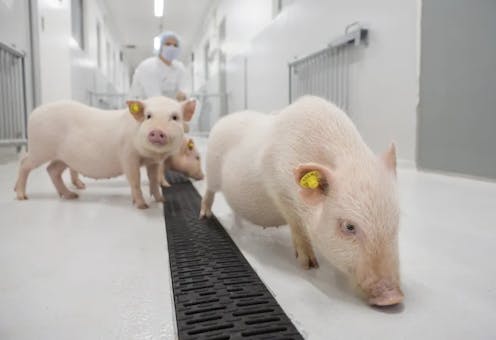
Minicerdos (_minipigs_) de Göttingen modificados genéticamente. Ellegaard, CC BY-SA

Los xenotrasplantes de órganos de cerdo a seres humanos siguen avanzando. Tras validarse esta estrategia con riñones, hígados y corazones ahora un equipo de investigadores chinos lo ha logrado con pulmones de cerdo xenotrasplantados a un hombre cadáver, en muerte clínica. El pulmón ha sobrevivido nueve días funcionando.

Por qué son necesarios

El trasplante de órganos es uno de los avances médicos más espectaculares: permite seguir viviendo a centenares de miles de personas cuyos órganos fallaban o habían dejado de funcionar.

Solo en el año 2024 se realizaron 173 286 trasplantes de órganos en todo el mundo. La mayoría de ellos (110 021) fueron de riñón, seguidos de los trasplantes de hígado (42 494), corazón (10 286) y pulmón (8 236), los cuatro órganos que se trasplantan con más frecuencia.

España sigue siendo el país del mundo donde se realizan más donaciones y más trasplantes por millón de personas. Desgraciadamente, no todos los pacientes que necesitan alguno de estos órganos logra encontrar una persona compatible que acepte o pueda donárselos (como donante vivo, un procedimiento habitual en trasplante de riñón), o pueda aprovecharlos tras un accidente mortal o tras la muerte clínica de una persona. Se estima que en EE. UU. aproximadamente 17 personas fallecen cada día en las listas de espera, sin recibir el órgano que necesitaban.

Las donaciones de órganos, a pesar de haber aumentado, no logran compensar el incremento de solicitudes de trasplantes. Esta es la razón principal de la búsqueda de estrategias alternativas para suplir la carencia de órganos humanos, y este es el origen de la investigación en xenotrasplantes. Estos están pensados esencialmente para ganar tiempo en las listas de espera, hasta que los pacientes puedan ser trasplantados con un órgano humano.

Cerdos editados genéticamente

Los trasplantes de órganos de animales a seres humanos (xenotrasplantes), son esencialmente de cerdo. Pero no de un cerdo cualquiera. Son cerdos transgénicos, editados genéticamente. En laboratorio se realizan múltiples modificaciones genéticas para que sus órganos no sean reconocidos como extraños por nuestro sistema inmunitario.

De este modo, la edición genética busca ‘camuflar’ el órgano del cerdo para evitar el rechazo fulminante, a medio y a largo plazo que se produciría inevitablemente.

Son cerdos de la raza minipig, de pequeño tamaño, que llegan a pesar entre 70-80 Kg, compatibles con el tamaño de cuerpo y órganos humanos.

Los xenotrasplantes surgieron, como idea, hace más de 30 años. Se produjeron diversos cerdos transgénicos con varios genes porcinos anulados y varios genes humanos añadidos, para que sus órganos pudieran subsistir dentro del cuerpo humano. Durante muchos años los experimentos solamente se realizaron en primates no humanos, principalmente monos babuinos. Hasta que se dio el paso a probarlo en humanos.

Primeros experimentos: riñones en humanos

En septiembre de 2021 un equipo de cirujanos e investigadores de un hospital de Nueva York decidió conectar un riñón de uno de estos cerdos transgénicos a la circulación sanguínea en una pierna de una mujer cadáver, en muerte clínica cerebral, pero con latido cardíaco y respiración asistida. El riñón sobrevivió 54 horas sin mostrar signos de rechazo y produjo orina con normalidad.

Poco después conocimos otro caso similar, realizado en Birmingham (Alabama, EE. UU.) cuando a un hombre, también en muerte clínica, le trasplantaron los dos riñones de estos cerdos transgénicos. En este caso solo uno de los riñones funcionó las 74 horas que duró el experimento.

El primer riñón de cerdo transgénico trasplantado a una persona viva se realizó en 2024, y el hombre sobrevivió dos meses.

Tras estos primeros intentos se sucedieron otros xenotrasplantes de riñones con distintos tipos de cerdos editados genéticamente, con mayor o menor éxito. Hasta que recientemente se ha anunciado un ensayo clínico en el que se evaluarán 50 pacientes xenotrasplantados de riñón.

Los ejemplos del corazón

En corazones se ha seguido un camino similar al de los riñones. Primero se empezó con corazones de cerdos modificados genéticamente xenotrasplantados a cadáveres de personas en muerte cerebral. El primer avance significativo se produjo en enero de 2022 en Baltimore (Maryland, EE. UU.) al trasplantar un corazón de cerdo transgénico a un hombre, con una cardiomiopatía avanzada y otras comorbilidades por las que no era un candidato adecuado en las listas de espera. Nunca habría recibido un corazón humano.

El hombre proporcionó su consentimiento informado para el xenotrasplante y sobrevivió dos meses con el corazón de un cerdo latiendo en el interior de su tórax. En 2023, también en el hospital de Baltimore, otro paciente vivo recibió un corazón de cerdo transgénico. En este caso sobrevivió seis semanas.

En hígados también se han realizado algunos xenotrasplantes, primero sobre cadáveres y luego sobre personas vivas, y en algún caso el resultado ha sido exitoso.

Vencer el rechazo

Los síntomas de rechazo son la razón principal del fracaso de los xenotrasplantes, a pesar de que todos los pacientes reciben medicamentos para mantener la respuesta inmunitaria controlada y reducida. En otros casos pueden aparecer infecciones difíciles de tratar debido a la inmunosupresión a la que están sometidos.

Tras validar la estrategia de xenotrasplantes en riñones, hígados y corazones, los tres órganos que se trasplantan con mayor frecuencia, el siguiente reto era probarlo en pulmones, el cuarto órgano en relevancia para trasplantes. Y esto es lo que acaba de realizar un equipo de cirujanos e investigadores en Guangzhou (China).

Los resultados de este primer experimento de xenotrasplante de pulmón de cerdo transgénico sobre una persona cadáver, en muerte clínica cerebral, han aparecido publicados en la revista Nature Medicine.

Un cerdo con seis genes editados

En este caso, los investigadores han usado el corazón de un tipo de cerdo con seis genes editados, que xenotrasplantaron a un hombre de 39 años, en muerte clínica cerebral.

Solamente le introdujeron uno de los dos pulmones, el izquierdo. Dejaron el derecho intacto, para poder comparar el comportamiento y funcionalidad de ambos.

El pulmón xenotrasplantado funcionó durante nueve días, sin síntomas de rechazo agudo o infección, lo cual ya es un gran éxito médico. El tratamiento posoperatorio incluyó también diversas drogas inmunosupresoras. Sin embargo, los doctores detectaron un edema importante a las 24 horas en el pulmón xenotrasplantado, probablemente relacionado con el procedimiento quirúrgico del xenotrasplante.

Este es un primer caso, un primer paciente, al que seguramente seguirán muchos más hasta poder optimizar la técnica y permitir la realización de futuros xenotrasplantes de pulmón, de forma segura y eficaz. Una prueba más de que los xenotrasplantes de órganos de cerdo a personas ya están aquí, empiezan a ser viables, y han venido para quedarse.

The Conversation

Los contenidos de esta publicación y las opiniones expresadas son exclusivamente las del autor y este documento no debe considerar que representa una posición oficial del CSIC ni compromete al CSIC en ninguna responsabilidad de cualquier tipo.

ref. Un pulmón de cerdo trasplantado a un humano se suma a corazones, riñones e hígados en el avance de los xenotrasplantes – https://theconversation.com/un-pulmon-de-cerdo-trasplantado-a-un-humano-se-suma-a-corazones-rinones-e-higados-en-el-avance-de-los-xenotrasplantes-263888

Les femmes dans la finance : déconstruire les stéréotypes pour faire progresser l’égalité

Source: The Conversation – France (in French) – By Gunther Capelle-Blancard, Professeur d’économie (Centre d’Economie de la Sorbonne et Paris School of Business), Université Paris 1 Panthéon-Sorbonne

Le secteur de la finance s’est largement féminisé. Mais, à mesure que l’on monte dans la hiérarchie, les hommes continuent d’être majoritaires. Ces inégalités prennent naissance dans des préjugés – parfois dès le foyer. Est-il possible de les combattre efficacement ? Comment ?


Longtemps, la finance a été considérée comme un bastion masculin. Et si les temps changent, les représentations peinent à évoluer. Golden boys, traders arrogants, dirigeants technocrates : les figures dominantes de l’imaginaire financier restent quasi exclusivement masculines. Or, dans la réalité, la majorité des salariés du secteur bancaire sont… des femmes ! Mais cette majorité est trompeuse. À mesure que l’on grimpe dans la hiérarchie ou que les postes deviennent plus rémunérateurs et stratégiques, leur part décroît nettement. Aucune femme, à ce jour, n’a dirigé de grande banque française.

Dans un contexte où des voix conservatrices s’élèvent, notamment aux États-Unis, contre les politiques de diversité sur fond de croisade antiwokisme, il importe de continuer à documenter, interroger et à comprendre les mécanismes comportementaux, culturels et institutionnels complexes qui façonnent les trajectoires socioéconomiques et, partant, les inégalités de genre.

Des différences souvent mal comprises

Les différences d’attitudes, de préférences et de valeurs entre les femmes et les hommes sont largement exagérées. Il serait temps d’en finir avec cette fable selon laquelle les hommes viendraient de Mars et les femmes de Vénus. Qu’il s’agisse de leur rapport à l’argent, de leur goût pour le risque et la compétition ou de leur volonté de pouvoir, les différences entre hommes et femmes sont souvent faibles, variables et fortement contextuelles. Et surtout, elles sont socialement construites.

Ces différences sont amplifiées par la prégnance de stéréotypes qui finissent par être intégrés, tant par les femmes que par les hommes. Il en résulte des inégalités persistantes au détriment des femmes en matière d’épargne, d’accès aux crédits et de participation sur les marchés boursiers. Les femmes pâtissent aussi lourdement des préjugés dans leur carrière et sont peu nombreuses à occuper les postes les plus prestigieux et les plus rémunérateurs. Et lorsque les femmes finissent par briser ce « plafond de verre », c’est souvent en adoptant des « codes réputés masculins » (en matière de prise de risque, par exemple) – ce qui remet d’ailleurs en cause certains récits sans doute trop simplistes autour des effets vertueux d’une féminisation des instances financières.


À lire aussi :
Financement participatif : les créatrices d’entreprise mieux traitées par le grand public que par les professionnels ?


Des stéréotypes qui viennent du foyer

Ces différences se nourrissent des préjugés qui prennent naissance dans les foyers. Ainsi, pendant longtemps, c’est le mari qui s’occupait de gérer le budget du ménage. Ce n’est plus le cas aujourd’hui : les enquêtes montrent au contraire que ce rôle est désormais dévolu majoritairement aux épouses. On en sait toutefois peu sur la gestion de l’argent au sein des couples.

À partir d’une base de données issue d’une banque française regroupant plus de 7 000 couples, on peut analyser la manière dont chacun des partenaires s’auto-évalue en matière de connaissances financières. Fait marquant, un biais de genre est observé dans la perception de ses propres compétences financières puisque la recherche montre que les femmes se sous-estiment plus souvent que les hommes. Pourtant, lorsque les conjoints sont présents ensemble au moment de l’évaluation, l’écart tend à se réduire de 18,7 %.

Ce phénomène suggère que la dynamique du couple peut atténuer ou renforcer les biais de genre. Et plus les couples sont engagés financièrement (épargne, investissement), plus l’écart de confiance tend à s’accentuer au détriment des femmes. Ces écarts ne sont pas anodins : ils conditionnent les prises de décision et les arbitrages patrimoniaux, et il peuvent renforcer les déséquilibres au sein du couple.

Une loi pour quels résultats ?

La finance, ce n’est pas que la gestion des comptes et du budget au sein des ménages. C’est aussi (et surtout) un secteur économique structurant, où les postes les plus stratégiques sont encore largement occupés par des hommes.

En France, la loi Copé-Zimmermann (2011) a imposé un quota de femmes dans les conseils d’administration, dans et hors du secteur financier, suivie plus récemment par la loi Rixain (2021) sur les comités exécutifs. Ces dispositifs ont eu des effets réels. Les conseils d’administration sont, à l’heure actuelle, à quasi-parité en matière de genre et la France est le leader en la matière. Il apparaît, en outre, aujourd’hui, que la loi de 2011 a eu un effet sur la performance extrafinancière des entreprises, qui s’expliquerait par la montée en puissance de femmes ayant eu des parcours professionnels souvent en prise avec les enjeux environnementaux et sociaux.

Si les quotas garantissent donc en général une quasi-parité dans les conseils d’administration (en termes de sièges), ils n’épuisent cependant pas la question des inégalités de genre à la tête des grandes entreprises. En particulier, la hiérarchie au sein même des conseils (présidences, comités stratégiques, etc.) reste très genrée et reproduit les stéréotypes conventionnels, les femmes accédant moins souvent aux fonctions les plus influentes.

Interroger les règles du jeu

Finalement, les inégalités observées ne traduisent pas des différences innées de compétences ou d’appétence pour la finance, mais bien des différences de socialisation, d’éducation et, consécutivement, de trajectoires. Les travaux issus de la recherche expérimentale et des enquêtes institutionnelles convergent : les écarts existent, mais ils sont amplifiés par les structures et les normes sociales. En d’autres termes, il ne suffit pas d’ouvrir les portes de la finance aux femmes. Il faut aussi interroger les règles du jeu, les modèles dominants, et les représentations qui pèsent sur les parcours.

Ainsi, et par exemple, il apparaît clairement aujourd’hui que les quotas à la tête des entreprises, pour importants qu’ils soient, ne suffiront pas à résorber les inégalités de genre aux niveaux inférieurs, à tous niveaux de qualification : le rôle et la prégnance des stéréotypes indiquent que la clé est dans une dynamique bottom up (plus que top down), conduisant les femmes à se projeter pleinement dans l’univers de la finance et des postes à responsabilités, et les hommes à se départir de leurs croyances en la matière. Bref, c’est à la base qu’il faut maintenant agir : dans les écoles, dans les familles, dans les institutions.


Les auteurs de cet article ont supervisé le numéro de la Revue d’économie financière d’avril 2025, « Femmes et finance ».

The Conversation

Antoine Rebérioux a reçu des financements de l’Agence Nationale de la Recherche (ANR).

Gunther Capelle-Blancard et Marie-Hélène Broihanne ne travaillent pas, ne conseillent pas, ne possèdent pas de parts, ne reçoivent pas de fonds d’une organisation qui pourrait tirer profit de cet article, et n’ont déclaré aucune autre affiliation que leur poste universitaire.

ref. Les femmes dans la finance : déconstruire les stéréotypes pour faire progresser l’égalité – https://theconversation.com/les-femmes-dans-la-finance-deconstruire-les-stereotypes-pour-faire-progresser-legalite-257589