Arts participatifs : des œuvres en quête de reconnaissance

Source: The Conversation – in French – By Nathalie Poisson-Cogez, Professeure d’Enseignement Artistique, ESA / École Supérieure d’Art / Dunkerque – Tourcoing

À la croisée de l’expérience esthétique et de l’engagement citoyen, les œuvres participatives, pour lesquelles des artistes professionnels et des personnes « non-artistes » créent ensemble au cœur des territoires, bousculent les codes. Porteuses d’ambitions fortes, reliant l’art et la vie quotidienne, ces démarches sont pourtant toujours en quête de reconnaissance, tant de la part des institutions que des mondes de l’art.


Il arrive que des personnes non professionnelles de l’art soient invitées à prendre part à la conception et/ou à la réalisation d’œuvres. Cet art dit participatif couvre un large éventail de pratiques. Nous avons par exemple étudié des projets d’art citoyen portant sur des expérimentations inscrites dans un temps long (deux à quatre ans), investissant des lieux a priori non dédiés à l’art, générant – au fil de processus ouverts et évolutifs – des réalisations singulières qui bousculent la notion d’œuvre : un Fol Inventaire de toutes les plantes de la Terre, la carte sensible d’un quartier populaire, des impromptus de poésie à 2 mi-mots, un café-œuvre ou encore une immense robe avec soixante poches garnies d’objets insolites…

La notion d’œuvre artistique en question

L’artiste Pablo Helguera distingue les créations prétendument participatives se bornant en réalité à un apport limité, dans le cadre d’un projet prédéterminé, et celles où les personnes associées dès la genèse d’une œuvre sont susceptibles de la (re)modeler. Dans cette lignée, deux concepts ont été récemment élaborés : celui d’art en commun par l’historienne de l’art Estelle Zhong Mengual et celui de co-création par l’artiste chercheuse Marie Preston. Désacralisant la posture d’auteur (l’auctorialité), ces notions invitent à reconnaître le potentiel créatif de chaque personne et même à envisager qu’une œuvre puisse être cosignée par les différentes parties prenantes. Cette approche peut donner lieu, dans certains cas, assez rares, à une répartition des éventuels bénéfices financiers, au-delà de la seule rétribution symbolique (reconnaissance, sentiment de fierté, etc.).

Très souvent, les initiateurs d’actions participatives insistent sur la primauté du mode de faire sur le « résultat » final, ce qui tend à laisser dans l’ombre l’étendue et la valeur artistique des formes créées, lesquelles sont tantôt tangibles ou immatérielles, uniques ou reproductibles, pérennes ou éphémères, spectaculaires ou furtives. Par ailleurs, la documentation recueillie au fil du processus (un blog, une édition, un film, etc.) constitue parfois, outre sa fonction d’archive, un objet-trace doté d’un statut d’œuvre à part entière.

Ces réflexions concernent les pratiques artistiques contemporaines dans leur ensemble (participatives ou non) où, en réaction aux logiques productivistes, la notion d’œuvre, sa matérialité sont interrogées, et même son bien-fondé, certains artistes revendiquant sa disparition. Le critique d’art Stephen Wright évoque même « un art sans œuvre, sans auteur et sans spectateur ».

Tisser ambition artistique et droits culturels

Nées d’une immersion à l’occasion de temps de résidence, certaines propositions participatives découlent d’un travail dit situé qui fait possiblement de l’artiste un « passeur de territoire ». S’affranchissant des logiques classiques de diffusion, elles s’inscrivent davantage dans une démarche d’infusion. Pour « tenter de réduire, à défaut de pouvoir les abolir, les distances métriques, mais aussi culturelles, linguistiques et cognitives », les artistes déploient différents moyens : marches sensibles ; déplacements en triporteur ou avec un âne ; bureau mobile installé sur la place du marché ; moments de convivialité autour d’un banquet…

Au-delà du seul déplacement physique, l’enjeu est de renouveler les liens entre art et société. Remontant aux années 1970, identifiées dans un rapport emblématique paru en 2001 : Les Nouveaux territoires de l’art du sociologue Fabrice Lextrait, de telles initiatives font écho aux concepts d’esthétique relationnelle et de créations en contexte forgés respectivement par les historiens de l’art Nicolas Bourriaud et Paul Ardenne. Un certain nombre d’entres-elles se sont fédérées au sein de l’association Autre(s) pARTs. Fondées idéalement sur la réciprocité et l’horizontalité, ces démarches participatives résonnent également avec les théories de « l’aller-vers » du champ social.

Outre le fait qu’elles associent souvent plusieurs disciplines artistiques (arts visuels, spectacle vivant…), ces propositions composent également avec d’autres pratiques (cuisine, jardinage, bricolage…) et d’autres champs (travail social, santé, écologie…) que celui de l’art. Élargissant ainsi sa définition même, elles rejoignent les analyses de l’historien de l’art Maurice Fréchuret autour du rapprochement entre l’art et la vie et incarnent la notion d’art comme expérience élaborée par le philosophe John Dewey. Brouillant les frontières, elles donnent naissance à des formes hybrides, parfois déroutantes.

Comme le note le sociologue Pascal Nicolas-Le Strat :

« L’art apparaît désormais comme une pratique diffuse, articulée aux autres activités sociales, en prise avec de nombreuses dimensions de l’existence. »

Signes des tensions persistantes entre exigence artistique et dimension sociale, dans leur immense majorité, les financements (publics ou privés) des pratiques participatives relèvent davantage d’enveloppes consacrées à l’action culturelle et non à la création. Généralement centrées sur des critères quantitatifs, les subventions peuvent générer des situations d’instrumentalisation des démarches de création et/ou des personnes sollicitées ou encore des risques d’injonction à la participation, comme le pointe le sociologue Loïc Blondiaux.

En l’absence de dispositifs adaptés, les créations partagées émergent grâce à l’inventivité le plus souvent d’associations, mais également des quelques institutions qui leur accordent de la considération. Plutôt que de les corseter par des modes de soutien trop contraignants, il s’agirait d’accepter la part d’indétermination inhérente à ces projets en leur accordant « une avance de confiance », et en corollaire, comme pour toute autre création artistique, un droit à l’erreur.

Vers une reconnaissance des mondes de l’art et des politiques publiques ?

La visibilité des œuvres participatives, censées être « vécues de l’intérieur », devrait-elle rester cantonnée, comme c’est souvent le cas, aux contextes singuliers dont elles sont issues ? Pourquoi ne pourraient-elles pas, sous réserve de l’accord des principaux intéressés, rencontrer une plus large audience ? En effet, au-delà des enjeux d’émancipation et de « vivre ensemble » classiquement invoqués, les créations partagées avec une réelle diversité de personnes recèlent un potentiel pour déranger les écritures contemporaines et contribuer ainsi au renouvellement des formes et pratiques artistiques. Face aux limites de la démocratisation culturelle, elles représentent une piste pour faire vivre une véritable démocratie culturelle.

À Sevran (Seine-Saint-Denis), depuis 2018, le Théâtre de la Poudrerie, scène conventionnée « art et territoire » les met en lumière à travers sa Biennale de la création participative. La toute récente Fédération des arts participatifs invite à les considérer « comme une composante essentielle et légitime de la création contemporaine ». Pour sa part, le chercheur Philippe Henry appelle à un soutien public renforcé à des initiatives en mesure de « construire une démocratie artistique et culturelle vraiment digne de ce nom ». Cette reconnaissance garantirait à ces projets complexes de meilleures conditions matérielles et humaines de réalisation, tout en actant une interdépendance entre éthique et esthétique.


Cet article est publié dans le cadre de la série « Regards croisés : culture, recherche et société », publiée avec le soutien de la Délégation générale à la transmission, aux territoires et à la démocratie culturelle du ministère de la culture.

The Conversation

Nathalie Poisson-Cogez a reçu des financements de la fondation Daniel et Nina Carasso pour effectuer un travail d’évaluation des projets d’art citoyen évoqués au début de l’article.

Réjane Sourisseau a reçu des financements de la fondation Daniel et Nina Carasso pour effectuer un travail d’évaluation des projets d’art citoyen évoqués au début de l’article.

ref. Arts participatifs : des œuvres en quête de reconnaissance – https://theconversation.com/arts-participatifs-des-oeuvres-en-quete-de-reconnaissance-262169

La Californie, un colosse économique, mais un creuset d’inégalités (en dix graphiques)

Source: The Conversation – in French – By Julien Pillot, Enseignant-Chercheur en Economie, INSEEC Grande École

De la ruée vers l’or à la génération hippie, sans oublier la révolution informatique, la Californie ne semble pas avoir volé son surnom d’État en or ou Golden State, en VO. Mais qu’en est-il réellement, alors que les anicroches entre le président Trump et le gouverneur démocrate de Californie Gavin Newsom se multiplient. Quel est le poids réel de cet État au plan fédéral ? Décryptage de la puissance économique californienne et… de ses faiblesses.


Avec un PIB de 4 103 milliards de dollars, la Californie s’est hissée, en 2024, au 4e rang des économies les plus prospères et même au 3e rang si on exclut les États-Unis dont elle fait partie intégrante. Seules la Chine, la « manufacture de la planète », forte de ses 1,4 milliard d’habitants, et l’Allemagne, qui compte 2,12 fois plus d’habitants, présentent un PIB supérieur au Golden State qui, décidément, n’a jamais aussi bien porté son nom (Graphique 1).

Petite radiographie de l’économie californienne à partir de dix graphiques et indicateurs clés qui mettent l’accent à la fois sur l’excellence productive de cet État, mais aussi sur certaines inégalités sociales et territoriales qui se creusent rapidement.

Graphique 1 : PIB annuel des principales économies mondiales (en dollars USD courants, 2024)


Fourni par l’auteur

Une économie prospère…

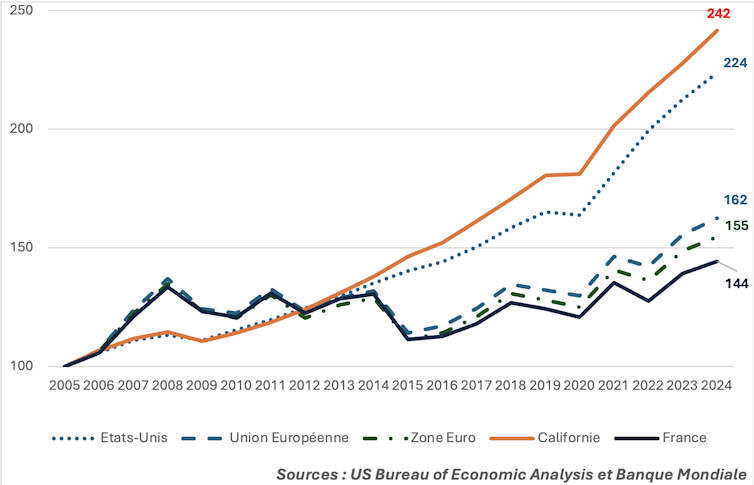
Entre 2005 et 2024, l’économie californienne a connu un taux de croissance sensiblement supérieur à la moyenne nationale. Quant aux économies européennes, elles ne soutiennent pas la comparaison (Graphique 2). Parmi les dix économies les plus développées de la planète, seules la Chine et l’Inde ont fait mieux sur la même période, tandis que le Brésil faisait jeu égal.

Graphique 2 : Évolution du PIB 2005-2024 (base 100 en 2005 / en dollars USD courants)


Fourni par l’auteur

C’est bien simple : depuis 2005, le taux de croissance de la Californie n’a été inférieur à la moyenne nationale qu’en 2009 et 2010 – en plein cœur de la crise financière des subprimes – et, en 2022 et en 2023 (en raison d’une inflation de près de 9 % qui a frappé plus durement la Californie que le reste du territoire américain). À ce rythme, il n’y a rien d’anormal à voir le 31e État des États-unis prendre toujours plus de poids dans l’économie fédérale, jusqu’à peser désormais plus de 14 % de son PIB (Graphique 3). Loin devant le Texas et l’État de New York qui, avec 9,3 % et 7,9 % respectivement, complètent le podium.

Graphique 3 : Évolution de la part de la Californie dans le PIB des États-Unis (en dollars USD courants)

Échelle de gauche (en dollars USD courants) : PIB des États-Unis. Échelle de droite (en %) : part de la Californie dans le PIB états-unien.
Fourni par l’auteur

Un secteur privé particulièrement productif

Si la croissance de l’économie californienne a été si soutenue au long de ce dernier quart de siècle, c’est qu’elle repose sur quelques secteurs d’activité qui ont le vent en poupe : la finance, l’immobilier, la tech et les services aux entreprises, l’industrie (notamment défense, aéronautique, automobile, biotech…) et la santé (Graphique 4). Le secteur privé lucratif compte ainsi pour 90 % du PIB californien.

Graphique 4 : Contribution au PIB californien par secteur d’activité en 2023 (en %)


Fourni par l’auteur

L’autre moteur de l’économie californienne repose sur le dynamisme des investissements en recherche et développement. En 2022, l’Unesco estimait que la Californie représentait plus de 28 % des dépenses de recherche et développement (R&D) réalisées par les entreprises états-uniennes. Il faut bien admettre que tout concourt à attirer de tels investissements tant la Californie dispose d’un écosystème favorable à l’innovation : finance dynamique, pôles universitaires de renom, travailleurs qualifiés, industries de pointe, et politiques incitatives.


À lire aussi :
Trump face à la Californie : affrontement à haute tension


Là encore, il n’y a guère de mystère à ce que cet État figure parmi les économies les plus pourvoyeuses d’emplois très qualifiés dans la recherche, dans l’ingénierie et dans l’innovation. En 2021, la Californie concentrait à elle seule plus de 21 % des emplois en R&D de l’ensemble de l’économie fédérale, dont près d’un quart des emplois du secteur privé lucratif (Graphique 5).

Graphique 5 : Part des emplois en recherche et développement (R&D) en Californie, par secteurs d’activité en 2021


Fourni par l’auteur

De bons niveaux de vie

La prospérité de l’économie californienne se traduit par un PIB par tête sans commune mesure avec les autres économies développées (Graphique 6). Exprimé en dollars courants, un Californien est ainsi en moyenne 1,8 fois plus riche qu’un Allemand, 2,2 fois plus qu’un Français, et même 7,6 fois plus qu’un Chinois.

Graphique 6 : PIB par tête (2023, dollars USD courants)


Fourni par l’auteur

Le coût de la vie en Californie est cependant très élevé, et réaliser une comparaison internationale des niveaux de vie nécessite un traitement en termes réels, c’est-à-dire exprimé en parité de pouvoir d’achat (Graphique 7).

Les écarts, s’ils restent conséquents, s’en trouvent significativement réduits. Par exemple, l’écart avec la France n’est plus que de 1,42 et avec l’Allemagne, de seulement 1,2. Plus intéressant encore, la Californie présente un niveau de vie similaire à la moyenne américaine.

Graphique 7 : PIB par tête, PPA (2023, dollar international courant)


Fourni par l’auteur

Des inégalités qui croissent

Car, à y regarder de plus près, la croissance économique du Golden State est loin de profiter de façon homogène aux quelque 39,2 millions de Californiens.

En effet, il existe en Californie de très importantes disparités territoriales et si la Bay Area – la région de San Francisco, qui abrite la fameuse Silicon Valley – a effectivement connu une explosion de ses revenus, elle fait figure d’exception et tire, à elle seule, une grande part de la croissance californienne.

Avec un PIB par tête de 131 000 dollars en 2023, la Bay Area pèse plus du double de certains comtés moins dynamiques, tels que la Central Valley (hors Sacramento), l’Inland Empire (Riverside, San Bernardino…), et le Northern California (Shasta, Gold Country…). A titre de comparaison, l’écart de PIB/tête intracalifornien n’était jamais supérieur à 32 000 dollars en 1998 (Graphique 8).

Graphique 8 : PIB par tête par région (en dollars USD courants de 2023)


Fourni par l’auteur

Bien évidemment, cette explosion des inégalités territoriales s’explique essentiellement par la croissance dans la tech et dans les services aux entreprises, qui a particulièrement profité aux 7,8 millions de résidents de la Bay Area et, à un degré moindre, aux comtés de San Diego, Orange et Los Angeles.

De telles disparités se ressentent naturellement sur les salaires. Pour bien s’en rendre compte, il suffit de comparer le salaire médian de la Bay Area (34 dollars USD de l’heure) avec celui d’autres comtés tels que celui de San Diego (28 dollars de l’heure), Inland Empire (22 dollars de l’heure) ou encore la Sierra et la Central Valley (21 dollars de l’heure).

Graphique 9 : Taux de chômage par État en 2024 (en %)


Fourni par l’auteur

Recrudescence des travailleurs pauvres

Deux autres indicateurs montrent les fragilités internes à l’économie californienne : le taux de chômage et le taux de travailleurs pauvres. Le taux de chômage en Californie est, en effet, structurellement supérieur à la moyenne nationale (Graphique  9).

L’État paie ainsi ses grandes disparités régionales, mais aussi une dépendance à des secteurs volatils, ainsi qu’un déclin démographique (une perte de 600 000 habitants entre 2020 et 2022), essentiellement imputable à un coût de la vie devenu rédhibitoire, qui entame la demande intérieure et l’ajustement du marché du travail.

Plus inquiétante encore est la recrudescence de « travailleurs pauvres », c’est-à-dire de personnes en emploi, mais dont les revenus ne permettent pas de franchir le seuil de pauvreté (fixé, en 2023, à 43 990 dollars (USD) pour un foyer de deux adultes en âge de travailler et de deux enfants à charge. Ce seuil est une moyenne nationale, avec des ajustements régionaux selon le coût de la vie. Il est, par exemple, de 50 380 dollars (USD) dans le secteur de Bay Area et de 36 280 dollars (USD) dans celui de Central Valley.

Arte, 2024.

Un coût de la vie préoccupant

Le coût de la vie, et notamment du logement, explique cette situation préoccupante où, en 2023, 9,8 % des travailleurs californiens âgés de 25 ans à 64 ans vivaient dans la pauvreté. Soit un contingent de près de 1,5 million de personnes auquel il faut ajouter 2,3 millions de travailleurs (14,7 %) en situation précaire (foyer dont le revenu est compris entre 1 et 1,5 fois le seuil de pauvreté).

Sans grande surprise, ce sont les régions où le coût de la vie est le plus élevé et où la main-d’œuvre moins qualifiée peine à s’insérer et à trouver des salaires permettant de vivre décemment de son travail qui sont concernées au premier chef (Graphique 10). Le taux de travailleurs pauvres atteint des sommets dans l’agriculture (24,6 %), dans le BTP (24,2 %), dans la restauration (22,4 %) et dans les services à la personne (20,8 %).

Graphique 10 : Part des travailleurs californiens sous le seuil de pauvreté en 2023 (en %)


Fourni par l’auteur

Si le Golden State n’a jamais aussi bien porté son nom, force est de constater que la ruée vers l’or est loin d’avoir profité à l’ensemble de la population et des territoires.

La Bay Area en général et, en particulier, la Silicon Valley sont des poches de richesse dans un État en proie à de véritables préoccupations socio-économiques : trop grande dépendance à certains secteurs d’activité, difficultés d’insertion des travailleurs non qualifiés, explosion du coût de la vie et du nombre de travailleurs pauvres, déclin démographique…

« Il n’y a pas de classes sociales en Californie, il y a des échelles de salaire et des barreaux qui manquent »,

écrit, en 1986, le Québécois Jacques Godbout dans son roman Une histoire américaine. Pouvait-il imaginer à quel point l’histoire lui donnerait raison ?

The Conversation

Julien Pillot ne travaille pas, ne conseille pas, ne possède pas de parts, ne reçoit pas de fonds d’une organisation qui pourrait tirer profit de cet article, et n’a déclaré aucune autre affiliation que son organisme de recherche.

ref. La Californie, un colosse économique, mais un creuset d’inégalités (en dix graphiques) – https://theconversation.com/la-californie-un-colosse-economique-mais-un-creuset-dinegalites-en-dix-graphiques-263544

Netflix’s ‘Mo’ delivers humour and heartache as it explores Israel-Gaza war, Palestinian and Mexican migrant life in the U.S.

Source: The Conversation – Canada – By Faiza Hirji, Associate Professor, Department of Communication Studies and Media Arts, McMaster University

I recently watched both seasons of the Netflix drama-comedy Mo (2022-25), expecting a good laugh, since the show is headlined and written by funny and smart comedian Mohammed Amer.

Mo does provoke a lot of laughter, but it also stirs deep emotions, including despair, loneliness and helplessness, as the episodes explore life in America for people on the margins.

Mo is a semi-autobiographical depiction of Amer’s life. He’s a Palestinian who grew up in Houston, Texas, immigrating to that city when he was nine years old by way of Kuwait.

In the series, Amer plays Mo Najjar as he navigates a complex balancing act between the different cultures that have shaped his life. Mo undergoes struggles to obtain asylum status in the United States as a “stateless person” with no passport.

Amer uses elements of a situation comedy to introduce increasingly troubling sociopolitical themes, leavening an existential darkness with the love and laughter of the main character’s friends and family.

The comedy-drama format allows Mo to address difficult and divisive issues, such as immigration in America and the Israel-Gaza war, in non-threatening ways.

Amer’s comedic writing also serves to humanize his characters. This is particularly important accomplishment in the case of Palestinians, both at home and in the diaspora — and more broadly for Muslims globally — given the long history of misrepresentation of Islam in western discourse.

Comedy tackles erasure of Palestine

In his writing on the first Gulf War, Canadian researcher Karim H. Karim explains how western war propaganda attempted to dehumanize their enemy. He cites comments from the U.S. army members during the Gulf War as examples. They described Iraqis as non-human and animals: “fish in a barrel,” “cockroaches” and part of a “turkey shoot,” alongside the use of longstanding stereotypes about Arabs and Muslims

Dehumanizing techniques can also be seen in today’s conflicts in the Middle East.

For example, Israeli Finance Minister Bezalel Smotrich delivered a speech in October 2024 in which he said: “There is no such thing as a Palestinian nation. There is no Palestinian history. There is no Palestinian language.” Israeli Defense Minister Yoav Gallant also said: “We are fighting human animals and we act accordingly.”


Read more:
How colonialist depictions of Palestinians feed western ideas of eastern ‘barbarism’


Mo counters these types of messages repeatedly as features representations of strong women, respectful men and loving families, instead of the angry terrorists or oppressed women depicted in western imaginings.

Several researchers have previously documented such stereotypes, including Edward Said, Leila Ahmed, Yasmin Jiwani, Karim Karim and Ross Perigoe and Mahmoud Eid.

Comedy is non-threatening

Viewers get to know Mo’s family, the Najjars, and their quirks and idiosyncracies, as well as the complicated path they tread.

During the family’s asylum hearing, an opposing lawyer raises an objection to their claim, saying the U.S. does not recognize Palestine as a state. The statement is brief and the moment passes quickly, but the viewer is now aware of this kind of daily erasure of Palestinian people.

Over the course of the show, viewers see the many ways Mo protests the general erasure of Palestinian culture, including a recurring argument over the origin of hummus (made with chickpeas, garlic, tahini and olive oil).

Building that statement into a comedy is less likely to attract negative attention than a high-profile drama or documentary. For example, Hamdan Ballal, one of the directors of the Oscar-winning Israel-Palestine documentary, No Other Land, was injured in an attack by masked settlers and then arrested by the Israel Defence Forces in the West Bank. Israel’s culture minister said changes had been made to public funding rules to help prevent similar films from being made in future..

Comedy as simultaneous defusion and resistance is also practised by the Palestinian-Canadian comedian Eman el Husseini, whose stand-up routine touches on the idea that Arabs are perceived to be dangerous while painting a picture of her own family as affectionate, overbearing and harmless.

The strategic use of comedy to make characters relatable is a technique that has proven successful with racialized comedians tackling difficult issues, both for stand-ups like Russell Peters and situation comedy formats like Black-ish.

Crushing challenges

Humour may seem like an odd response to the characters’ crushing challenges. At one point, while in negotiation with a criminal who is threatening to amputate the foot of his friend, Mo suggests cutting off just a pinkie instead, hissing to his outraged friend, “Hey, you don’t wear pinkie rings, anyway!”

But in this series, humour becomes the coping mechanism for Mo‘s characters, however fraught or fragile the issue, from a lighthearted chuckle to the darkness of gallows humour.

At times, Mo’s mother, Yusra (Farah Bsaiso), seems utterly consumed by stories of dispossession taking place back in Palestine, while Mo becomes increasingly angry about examples of appropriation and erasure.

His sister, Nadia (Cherien Dabis), trying to forge a way forward, urges her mother to pull herself away from stories of tragedy back home and resist oppression finding moments of happiness. She insists:

“We’re more than our pain and suffering.”

Ultimately, it is Yusra who summarizes what it means to smile through one’s pain, telling Mo:

“The world will always try to tear us down. And when they do…we smile. Because we know who we are.”

Resilience

In Season 2, Mo, still undocumented in Texas, gets accidentally trapped in Mexico after unwittingly crossing the border. His Mexican fiancée leaves him in frustration and loneliness.

Throughout this season, Mo’s anger at the American immigration system grows as he repeatedly tries — and fails — to get home. He seems to be engaging in constant self-sabotage, in which he simply cannot accept the process that his lawyer and the bureaucracy have outlined for him.

Yet, as the depth of the dehumanization experienced by Mo and his family becomes more and more apparent, Mo’s simmering, ever-present anger starts to seem less dysfunctional. Instead, the world’s indifference becomes spotlighted.

During these episodes, Mo begins to learn how to live with — but never accept — injustice.

However, this is still a sitcom, and some things do work out for Mo. At the end of Season 2, Mo and his family get their U.S. passports and so can finally visit their family in Palestine.

As Mo is getting ready to return to Texas, after a joyful and also heartbreaking visit with his relatives, he is harassed by an Israeli border guard. At this moment, Mo realizes he must develop the same inner strength and resolve embodied by his mother, earned after years of having to bear such harassment.

Although Mo is consumed by anger and sadness at the unjust actions towards him by the guard, against all his instincts, he thanks the border guard, smiles and walks on.

The Conversation

Faiza Hirji receives funding from the Social Sciences and Humanities Research Council of Canada.

ref. Netflix’s ‘Mo’ delivers humour and heartache as it explores Israel-Gaza war, Palestinian and Mexican migrant life in the U.S. – https://theconversation.com/netflixs-mo-delivers-humour-and-heartache-as-it-explores-israel-gaza-war-palestinian-and-mexican-migrant-life-in-the-u-s-249684

Earth-size stars and alien oceans – an astronomer explains the case for life around white dwarfs

Source: The Conversation – USA – By Juliette Becker, Assistant Professor of Astronomy, University of Wisconsin-Madison

White dwarf stars, like this one shown shrouded by a planetary nebula, are much smaller than stars like our Sun. NASA/R. Ciardullo (PSU)/H. Bond (STScI)

The Sun will someday die. This will happen when it runs out of hydrogen fuel in its core and can no longer produce energy through nuclear fusion as it does now. The death of the Sun is often thought of as the end of the solar system. But in reality, it may be the beginning of a new phase of life for all the objects living in the solar system.

When stars like the Sun die, they go through a phase of rapid expansion called the Red Giant phase: The radius of the star gets bigger, and its color gets redder. Once the gravity on the star’s surface is no longer strong enough for it to hold on to its outer layers, a large fraction – up to about half – of its mass escapes into space, leaving behind a remnant called a white dwarf.

I am a professor of astronomy at the University of Wisconsin-Madison. In 2020, my colleagues and I discovered the first intact planet orbiting around a white dwarf. Since then, I’ve been fascinated by the prospect of life on planets around these, tiny, dense white dwarfs.

Researchers search for signs of life in the universe by waiting until a planet passes between a star and their telescope’s line of sight. With light from the star illuminating the planet from behind, they can use some simple physics principles to determine the types of molecules present in the planet’s atmosphere.

In 2020, researchers realized they could use this technique for planets orbiting white dwarfs. If such a planet had molecules created by living organisms in its atmosphere, the James Webb Space Telescope would probably be able to spot them when the planet passed in front of its star.

In June 2025, I published a paper answering a question that first started bothering me in 2021: Could an ocean – likely needed to sustain life – even survive on a planet orbiting close to a dead star?

An illustration showing a large bright circle, with a very small white dot nearby.
Despite its relatively small size, a white dwarf – shown here as a bright dot to the right of our Sun – is quite dense.
Kevin Gill/Flickr, CC BY

A universe full of white dwarfs

A white dwarf has about half the mass of the Sun, but that mass is compressed into a volume roughly the size of Earth, with its electrons pressed as close together as the laws of physics will allow. The Sun has a radius 109 times the size of Earth’s – this size difference means that an Earth-like planet orbiting a white dwarf could be about the same size as the star itself.

White dwarfs are extremely common: An estimated 10 billion of them exist in our galaxy. And since every low-mass star is destined to eventually become a white dwarf, countless more have yet to form. If it turns out that life can exist on planets orbiting white dwarfs, these stellar remnants could become promising and plentiful targets in the search for life beyond Earth.

But can life even exist on a planet orbiting a white dwarf? Astronomers have known since 2011 that the habitable zone is extremely close to the white dwarf. This zone is the location in a planetary system where liquid water could exist on a planet’s surface. It can’t be too close to the star that the water would boil, nor so far away that it would freeze.

A diagram showing a sun, with three planets at varying distances away. The closest one is labeled 'too hot' the next 'just right' and the farthest 'too cold'
Planets in the habitable zone aren’t so close that their surface water would boil, but also not so far that it would freeze.
NASA

The habitable zone around a white dwarf would be 10 to 100 times closer to the white dwarf than our own habitable zone is to our Sun, since white dwarfs are so much fainter.

The challenge of tidal heating

Being so close to the surface of the white dwarf would bring new challenges to emerging life that more distant planets, like Earth, do not face. One of these is tidal heating.

Tidal forces – the differences in gravitational forces that objects in space exert on different parts of a nearby second object – deform a planet, and the friction causes the material being deformed to heat up. An example of this can be seen on Jupiter’s moon Io.

The forces of gravity exerted by Jupiter’s other moons tug on Io’s orbit, deforming its interior and heating it up, resulting in hundreds of volcanoes erupting constantly across its surface. As a result, no surface water can exist on Io because its surface is too hot.

A diagram showing Jupiter, with four Moons orbiting around it. Io is the Moon closest to Jupiter, and it has four arrows pointing to the planet and other moons, representing the forces exerted on it.
Of the four major moons of Jupiter, Io is the innermost one. Gravity from Jupiter and the other three moons pulls Io in varying directions, which heats it up.
Lsuanli/Wikimedia Commons, CC BY-SA

In contrast, the adjacent moon Europa is also subject to tidal heating, but to a lesser degree, since it’s farther from Jupiter. The heat generated from tidal forces has caused Europa’s ice shell to partially melt, resulting in a subsurface ocean.

Planets in the habitable zone of a white dwarf would have orbits close enough to the star to experience tidal heating, similar to how Io and Europa are heated from their proximity to Jupiter.

This proximity itself can pose a challenge to habitability. If a system has more than one planet, tidal forces from nearby planets could cause the planet’s atmosphere to trap heat until it becomes hotter and hotter, making the planet too hot to have liquid water.

Enduring the red giant phase

Even if there is only one planet in the system, it may not retain its water.

In the process of becoming a white dwarf, a star will expand to 10 to 100 times its original radius during the red giant phase. During that time, anything within that expanded radius will be engulfed and destroyed. In our own solar system, Mercury, Venus and Earth will be destroyed when the Sun eventually becomes a red giant before transitioning into a white dwarf.

For a planet to survive this process, it would have to start out much farther from the star — perhaps at the distance of Jupiter or even beyond.

If a planet starts out that far away, it would need to migrate inward after the white dwarf has formed in order to become habitable. Computer simulations show that this kind of migration is possible, but the process could cause extreme tidal heating that may boil off surface water – similar to how tidal heating causes Io’s volcanism. If the migration generates enough heat, then the planet could lose all its surface water by the time it finally reaches a habitable orbit.

However, if the migration occurs late enough in the white dwarf’s lifetime – after it has cooled and is no longer a hot, bright, newly formed white dwarf – then surface water may not evaporate away.

Under the right conditions, planets orbiting white dwarfs could sustain liquid water and potentially support life.

Search for life on planets orbiting white dwarfs

Astronomers haven’t yet found any Earth-like, habitable exoplanets around white dwarfs. But these planets are difficult to detect.

Traditional detection methods like the transit technique are less effective because white dwarfs are much smaller than typical planet-hosting stars. In the transit technique, astronomers watch for the dips in light that occur when a planet passes in front of its host star from our line of sight. Because white dwarfs are so small, you would have to be very lucky to see a planet passing in front of one.

The transit technique for detecting exoplanets requires watching for the dip in brightness when a planet passes in front of its host star.

Nevertheless, researchers are exploring new strategies to detect and characterize these elusive worlds using advanced telescopes such as the Webb telescope.

If habitable planets are found to exist around white dwarfs, it would significantly broaden the range of environments where life might persist, demonstrating that planetary systems may remain viable hosts for life even long after the death of their host star.

The Conversation

Juliette Becker does not work for, consult, own shares in or receive funding from any company or organization that would benefit from this article, and has disclosed no relevant affiliations beyond their academic appointment.

ref. Earth-size stars and alien oceans – an astronomer explains the case for life around white dwarfs – https://theconversation.com/earth-size-stars-and-alien-oceans-an-astronomer-explains-the-case-for-life-around-white-dwarfs-262301

How the conservative Federalist Society will affect the Supreme Court for decades to come

Source: The Conversation – USA – By Paul M. Collins Jr., Professor of Legal Studies and Political Science, UMass Amherst

Supreme Court Justices Samuel Alito and Clarence Thomas look on during the 60th presidential inauguration on Jan. 20, 2025, in the U.S. Capitol in Washington. Chip Somodevilla/Pool Photo via AP

During the 2016 presidential election campaign, candidate Donald Trump took the unprecedented move of releasing a list of his potential Supreme Court nominees.

But Trump didn’t assemble this list himself. Instead, he outsourced the selection of his judicial appointments to leaders of the Federalist Society, an organization in the conservative legal movement.

As Trump explained in a 2016 interview, “We’re going to have great judges, conservative, all picked by the Federalist Society.”

This was a strategic decision by Trump. By turning to the Federalist Society, he was able to court conservative and evangelical voters who may have been otherwise uneasy with supporting the former New York City real estate mogul.

In his first presidential term, Trump appointed three justices affiliated with the Federalist Society – Neil Gorsuch, Brett Kavanaugh, and Amy Coney Barrett – in addition to hundreds of lower federal court judges. Federalist Society affiliates are current or former members of the organization, as well as individuals who interact with the group, such as by attending Federalist Society events, but who may not claim membership.

We are political science scholars who recently published research in a peer-reviewed journal showing that Supreme Court justices affiliated with the Federalist Society are more conservative and more consistently conservative than other justices, meaning they seldom deviate from their conservative voting behavior.

Our research suggests that, despite Trump’s recent criticism of the organization and its leadership, justices affiliated with the Federalist Society will advance the conservative legal agenda decades into the future. But this won’t always involve supporting Trump’s agenda.

Here’s what you should know, and why it matters.

The Federalist Society

The Federalist Society for Law and Public Policy Studies was founded in 1982 with the goal of providing intellectual spaces for conservative law students who felt their views were dismissed by the legal field. It has grown tremendously over the past 40 years. Today, it boasts more than 200 chapters and over 70,000 members.

Unlike other conservative public interest groups, it does not advocate for specific issue positions. Instead, it promotes its goals primarily through education and networking.

The Federalist Society’s educational mission is pursued chiefly in law schools. That’s where it trains the next generation of lawyers in the approaches and goals of the conservative legal movement. This includes promoting the judicial philosophy of originalism – the idea that the best way to interpret the U.S. Constitution is according to how it was understood at the time of its adoption.

Originalism is often used to justify conservative outcomes.

For example, Justice Clarence Thomas, a prominent member of the Federalist Society, has called for using originalism to reconsider Supreme Court precedents involving the right to contraception, same-sex marriage and same-sex consensual relations.

A woman, her image projected on a big screen, speaks to an audience.
Supreme Court Justice Amy Coney Barrett speaks at the 2023 Antonin Scalia Memorial Dinner, part of the Federalist Society’s National Lawyers Convention, on Nov. 9, 2023, in Washington, D.C.
Jahi Chikwendiu/The Washington Post via Getty Images

The Federalist Society network also connects junior members with more senior members, helping young lawyers obtain prestigious clerkships and positions in government and the legal profession. These lawyers tend to associate with the Federalist Society throughout their careers.

Federalist Society affiliates learn that promoting the group’s interest is also a way of promoting their self-interests as they move up in the legal world.

For Supreme Court justices, this networking has tangible benefits. For instance, Justice Samuel Alito accepted a luxury fishing vacation in 2008 organized by Leonard Leo, the former executive vice president and current co-chair of the Federalist Society. The estimated cost of the fishing trip was more than $100,000.

And Thomas was treated to decades of high-end vacations and private school tuition for his grandnephew – whom he raised as a son – by billionaire businessman Harlan Crow, a Federalist Society donor.

In short, the Federalist Society is a network of lawyers and judges who share a conservative outlook on the world and aspire to etch the conservative agenda into law through judicial decisions.

Our research

Our research sought to answer two interrelated questions. Are justices affiliated with the Federalist Society more conservative than nonaffiliated justices, and are they more consistently conservative?

To illustrate this, consider former Justice David Souter, whom President George H.W. Bush appointed in 1990 and who had no connections to the Federalist Society. Despite being a Republican appointee, Souter often voted with the court’s liberal members, such as upholding abortion rights in 1992. In 2005, he wrote the majority opinion in a ruling that prevented the Ten Commandments from being displayed in courthouses and public schools.

A man in a suit and tie places his left hand on a bible and raises his right hand as he receives an oath.
President George H.W. Bush appointed David Souter to the Supreme Court in 1990.
Mark Reinstein/Corbis via Getty Images

To determine whether justices affiliated with the Federalist Society are different from even other judges appointed by Republican presidents, we examined almost 25,000 votes cast by Supreme Court justices between 1986 and 2023. We started with 1986 because that’s when the first justice affiliated with the Federalist Society – Antonin Scalia – joined the high court.

We classified votes as conservative or liberal according to a well-established methodology. For example, conservative votes support the restriction of reproductive freedom, are anti-business regulation and generally disfavor policies that promote the rights of vulnerable populations, such as the LGBTQ+ community. Liberal votes do the opposite.

We found that justices connected to the Federalist Society are about 10 percentage points more likely to cast a conservative vote than other justices, even other justices appointed by Republican presidents. And they are more consistent in their voting behavior, seldom casting votes that go against their conservative values.

The Federalist Society’s lasting impact

These findings have important implications. Justices on the modern Supreme Court serve for about a quarter century on average. And every current Republican-appointed member of the court is affiliated with the Federalist Society.

This means that Americans are likely to see justices affiliated with the Federalist Society advance the agenda of the conservative legal movement for decades to come. This has already happened in recent decisions that curtailed reproductive freedom, eliminated affirmative action in college admissions and expanded the powers of the president, including immunizing the president from criminal prosecution.

President Trump has recently had a high-profile breakup with the Federalist Society, calling Leo a “sleazebag” and expressing his disappointment with the organization.

Trump’s outburst followed a ruling by the U.S. Court of International Trade that blocked his sweeping tariff program against China and other nations. This happened despite one of Trump’s first-term judicial appointees sitting on the panel.

Notwithstanding this acrimony, this term will give justices affiliated with the Federalist Society the opportunity to further solidify the conservative agenda. Cases involving LGBTQ+ rights and federal elections are on the docket. And the court will be adding other important issue areas as it fills out its caseload for the 2025-26 term, which starts on the first Monday in October.

The Conversation

The authors do not work for, consult, own shares in or receive funding from any company or organization that would benefit from this article, and have disclosed no relevant affiliations beyond their academic appointment.

ref. How the conservative Federalist Society will affect the Supreme Court for decades to come – https://theconversation.com/how-the-conservative-federalist-society-will-affect-the-supreme-court-for-decades-to-come-263397

As National Park System visitor numbers hit record highs, here’s how visitors can adapt for a better experience

Source: The Conversation – USA (2) – By Allie McCreary, Assistant Professor of Parks and Recreation, Auburn University

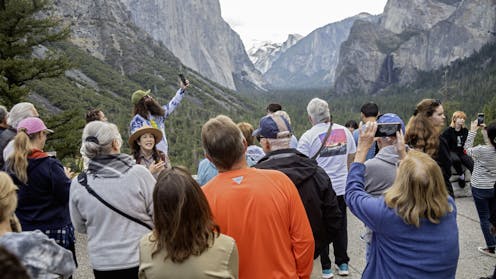
Crowds often form at popular places in U.S. national parks, like the entrance to Yosemite Valley in California. Jim West/UCG/Universal Images Group via Getty Images)

Visiting America’s national parks is a treasured public pastime. The wetlands of Congaree in South Carolina, the depths of the Grand Canyon in Arizona and the vistas provided by peaks in Yosemite in California are iconic American experiences for residents and for people who travel from other countries to vacation.

There are lots of benefits of visiting national parks, or parks in general. Spending time in nature is good for people’s mental health. Moving in the outdoors – walking, biking, running, paddling – benefits people’s physical health. Sharing experiences with others helps build social connections with old friends or newfound ones. Visitors also learn about ecosystems and cultural history, developing their own relationship to the landscape.

National park visitation is growing, with record-high visitor numbers in 2024 across the entire 398-property system, as well as at the 63 formally designated national parks. And there has been a general trend of people gravitating to Instagram-popular parks, and even specific spots within popular parks.

Reductions in federal funding and staffing at national parks means visitors may see longer lines to enter parks or popular locations within them, fewer visitor services and educational programs, and fewer rangers to ask for advice or assistance.

As scholars of parks and recreation, we know crowded conditions make it harder to enjoy national parks. But we also know that if you plan carefully, you can create a great experience.

What gets in the way of fun?

In general, research identifies three main barriers to recreational fun.

One is how confident people are in their own physical abilities and how safe they feel in the park. For example, someone may want to go kayaking in Florida’s Everglades or Minnesota’s Voyageurs National Park but doesn’t know where to rent a boat, where to put it in the water, or which stretches of water are best for a beginner.

Another is the presence – or absence – of people to enjoy the space with, or family obligations or relationships that might preclude them from an activity. Culture can also play a role in where people visit and what they do there. For instance, a national park may be a source of escape where individuals seek autonomy and independence. For others, a national park visit can be a focal point for social gatherings and a time to reconnect with family and friends.

A large group of people stand in a line looking at an area where steam is rising from the ground.
For many years, Old Faithful in Yellowstone National Park in Wyoming has drawn massive crowds to witness the natural phenomenon of an erupting geyser.
Joe Sohm/Visions of America/Universal Images Group via Getty Images

There are also external factors, like how much free time a person has for recreation and how easy it is to get to a national park from their home. Someone may live a short drive from a national park but not visit simply because they do not know what they can do there, or how to have a positive experience.

More recently, research has also identified environmental barriers outside visitors’ control. Thin ice or lack of snow prevents many winter activities in Colorado’s Rocky Mountain National Park and Maine’s Acadia National Park, just as excessive heat can decrease the attractiveness of summer recreation in parks like the Everglades or California’s Death Valley. Extreme weather events such as inland flooding and coastal hurricanes can block roads and damage parks, posing both physical and logistical barriers in parks such as Cape Lookout National Seashore in North Carolina.

Wildlife habits also affect visitors, who may flock to an area where they can see wildlife. Or they may avoid – or may be restricted from – areas with dangerous wildlife.

Adapting to find enjoyment anyway

If the national park places you want to visit seem too busy, think about your options. You could change your travel dates to a less busy time. People who want to visit Yellowstone in Wyoming, Idaho and Montana could find campground reservations unavailable for some weeks but plentiful for other weeks – or they could choose to stay in a local hotel instead of camping.

You could try a different park or activity. For example, an angler who typically visits Great Smoky Mountains National Park in North Carolina and Tennessee to fish for trout may find that some streams are warming and no longer support this activity. They might go fishing elsewhere or stay in the Smokies and bird-watch, hike or read by a stream.

If you really want to visit during a busy time, you can also simply change your expectations, like not expecting Old Faithful to be a quiet place with only a few visitors.

Park personnel often seek to manage visitor numbers to protect the park from too much traffic, but also so everyone who visits can enjoy the experience. For example, implementing reservations for Acadia’s Cadillac Mountain at sunrise means at least some people get a relatively serene experience, as opposed to lots of people having an overcrowded experience.

Park staff also design park amenities so roads, boat ramps, trailheads and parking are in useful locations that work well for the number of visitors expected. And park workers provide advance information for visitors, in brochures and on websites, charge fees for entry, conduct tours or other programs at the location – and ticket or arrest people who are in places or doing activities they’re not supposed to – to reduce the effects of overcrowding.

A group of people stand on a mountaintop looking at a bay with islands as the sun rises over the horizon.
The National Park Service requires advance reservations to see the sunrise atop Cadillac Mountain in Acadia National Park in Maine.
AP Photo/Robert F. Bukaty

Planning is key

We have found that the most effective way for people to have the park experiences they want, and enjoy them as much as they hope, is to plan ahead.

Planning can include looking at parks’ websites for ideas and considering the best time to visit – both for your own schedule and what you want to do.

Understanding the weather and climate of the region will help you determine what to bring, but also what conditions will be like if you’re hiking, paddling or driving.

Advance preparation definitely includes finding lodging – and making reservations whenever possible. If reservations aren’t possible, see whether you can increase your chances of finding a place to sleep when you arrive by choosing lesser-visited parts of the park or identifying nearby backup options, such as state parks and private campgrounds, that might provide a break from the crowds.

And you can make sure you’re prepared for whatever you’re going to do, whether it’s getting used to walking long distances before a big hike or learning about local flora and fauna before you arrive.

Thinking ahead also means you can share your itinerary with friends and family – either as invitations to join you or for periodic safety check-ins.

It is also helpful to talk to park personnel. Park staff will have great insights into hidden gems that might be slightly off the beaten path but away from the crowds and able to provide a unique visitor experience. Rangers or other staff can help you determine the best choices for settings and activities that match your abilities, interests, time and needs.

And finally, don’t forget to be considerate of other visitors. Have patience in the parking lots, visitor centers, trailheads and lookout points. Others in the park seek the same awe-inspiring views and heart-pumping recreation activities as you. In many cases, it’s not the number of people but the attitudes and behaviors of those people that can make a place either feel crowded or like a community of like-minded outdoor enthusiasts.

The Conversation

Allie McCreary receives funding from the Public Lands Service Coalition and New Frontiers in Research Fund (Government of Canada).

Michael Brunson is affiliated with The Appalachian Trail Conservancy and the National Association for Interpretation .

ref. As National Park System visitor numbers hit record highs, here’s how visitors can adapt for a better experience – https://theconversation.com/as-national-park-system-visitor-numbers-hit-record-highs-heres-how-visitors-can-adapt-for-a-better-experience-262407

American capitalism is being remade by state power

Source: The Conversation – USA (2) – By H. Sami Karaca, Professor of Business Analytics, Questrom School of Business, Boston University

Is the Trump administration trying to reshape American capitalism? Recent moves by Washington, such as taking a 10% share of semiconductor maker Intel, point to a shift in that direction. For decades, Washington has supported free-market capitalism. Today, the government appears to be supporting a new direction – state-directed capitalism.

As a professor at the Questrom School of Business who studies different economic systems, I find this reversal striking. My research is supported by the Ravi K. Mehrotra Institute, which is trying to understand how business, markets and society interact. My previous research – finding, for example, that U.S. news coverage of capitalism was far more negative in the 1940s than it is now – suggests capitalism isn’t in retreat but is rather evolving.

In what direction is the Trump administration pushing it?

Types of capitalism

While many people bandy around the term “capitalism,” it actually comes in many different forms. The most basic definition of capitalism is when the means of production – such as factories, farms and offices – are owned by private individuals.

Capitalism is driven by profit. Some of the earliest descriptions of the profit motive that drives the whole system come from Adam Smith. As he wrote in 1776, “It is not from the benevolence of the butcher, the brewer or the baker that we expect our dinner, but from their regard to their own interest.”

Who gets the profits and who controls the means of production determine the specific forms of capitalism. While there are many types, I want to focus on three of the most important.

Free-market capitalism, also called laissez-faire capitalism, is when the government takes a hands-off approach to the economy. The U.S. after the Civil War is a good example of free-market capitalism. During the late 1800s, the federal government imposed few regulations on businesses.

State-guided capitalism is when the government chooses industries or companies to support. Favored sectors are given money and face looser regulations than nonfavored sectors. China today is an example of state-guided capitalism, where the state provides support for industries such as shipbuilding, steel and AI.

Oligarchic capitalism is when a very small part of the population owns key industries and controls the economy. Russia today is an example of this type of capitalism.

Each form of capitalism has its strengths and weaknesses. For example, free-market capitalism provides the most incentives to grow the economy, but the lack of rules often leads businesses to run roughshod over consumers. U.S. historians describe the late 1800s as the era of robber barons.

State-guided capitalism can dramatically boost the output of favored industries. However, if the government invests in the wrong industries, huge amounts of money can be wasted propping up dying firms.

Oligarchic capitalism can rapidly invest in new areas and shift resources, but the profits enrich only a tiny elite.

Recent changes

The U.S. currently appears to be operating under a hybrid model of capitalism, blending free-market principles with elements of state capitalism.

One of the most recent changes is the Trump administration’s decision to take a 10% stake in Intel. Congress passed the multibillion-dollar CHIPS and Science Act in 2022 to bolster U.S. computer chipmakers. Intel is slated to receive US$11.1 billion in grants from the program and other government funding. The current administration has converted that public support into a 10% ownership of the semiconductor maker.

Intel isn’t alone. The government has recently become a shareholder in other companies it views as strategically important – a trend that seems likely to continue and possibly result in the creation of a “sovereign wealth fund.” In July 2025, the Department of Defense agreed to buy $400 million of convertible preferred stock in MP Materials. MP Materials is the only U.S. rare-earth minerals mine with integrated production capacity. The company said the Department of Defense would be positioned to become its largest shareholder.

The government is also requiring a share of revenue from large computer chip manufacturers. Nvidia and AMD will have to remit 15% of revenue from certain chip sales to China as a condition for export licenses.

Why the US change is important

The CHIPS and Science Act has already funneled billions into U.S. semiconductor manufacturing via grants, tax credits and R&D support. MP Materials and Intel could serve as pilot models for further strategic intervention. However, the U.S. government spends trillions each year, and the amounts invested in American industries and companies represent only a small percentage of total spending.

While the CHIPS and Science Act was passed in 2022 under the Biden administration, the implementation relied on traditional tools of industrial policy such as grants, tax credits and milestone-based funding. In contrast, the Trump administration has converted these grants into equity arrangements, with officials stating the government should get a return on its investment.

This shift from an incentive-based approach to a direct ownership model represents one of the most fascinating experiments in modern American capitalism. The real question is what happens if – or when – this strategy expands. The government could become more involved in energy, biotech and AI, or any place where markets show signs of lagging or supply chains are geopolitically fragile.

The U.S. isn’t rejecting capitalism but recalibrating its boundaries. The next few years will show exactly how Washington’s interventions will reshape U.S. capitalism.

The Conversation

H. Sami Karaca receives funding from the Ravi K. Mehrotra Institute.

ref. American capitalism is being remade by state power – https://theconversation.com/american-capitalism-is-being-remade-by-state-power-263881

We’ve been tracking the number of Americans who identify as transgender – soon, there will be no reliable way to measure them

Source: The Conversation – USA (2) – By Jody L. Herman, Senior Scholar of Public Policy at the Williams Institute, University of California, Los Angeles

Researchers have traditionally had a difficult time tracking the number of Americans who identify as transgender.

But over the past decade, our work has become easier, largely thanks to federal data. In 2014, for the first time, the federal government included a question on transgender identity in the Centers for Disease Control and Prevention’s Behavior Risk Factor Surveillance System. It subsequently added gender identity questions to other surveys, like the National Crime Victimization Survey. Since 2016, we’ve been able to use federal datasets to estimate the number of people who identify as transgender at the national and state levels.

Our recently published analysis suggests that 2.1 million U.S. adults identify as transgender. In our prior study, published in 2022, we found that 1.3 million U.S. adults identified this way. In our new report, we also found that 724,000 youth age 13 to 17 identified as transgender.

To arrive at these estimates, we drew from the CDC’s Youth Risk Behavior Survey and Behavior Risk Factor Surveillance System, which provide the most comprehensive data on the gender identity of Americans. Though these datasets are the best available to make these estimates, we lack state-level data in certain cases. So we used a statistical technique called multilevel regression and poststratification to fill in those gaps.

This information is important. It allows policymakers, educators, judges, the media and others to understand the size and characteristics of this population, as well as who will be affected by public policies, such as nondiscrimination laws that aim to protect transgender people or bans on transgender people’s use of public bathrooms. The U.S. Supreme Court has even cited our estimates in decisions that impact transgender people.

But our work is about to become a lot harder, if not impossible.

At the directive of the Trump administration, federal surveys will no longer collect data about gender identity. Questions that aim to identify transgender respondents will be removed, while binary sex questions with only “male” or “female” response options will remain.

Though data sources are being erased, the transgender population will not be. And yet it will likely be at least a decade before we can publish updated figures on the estimated number of people living in the U.S. who identify as transgender.

Age group differences persist

But first, let’s highlight what the new report reveals.

One consistent pattern across our reports from 2017, 2022 and 2025 is that younger people are more likely to identify as transgender than older adults.

In our new report, however, we were able to see significant differences among different age groups of adults for the first time.

Those 18 to 34 are now significantly more likely to identify as transgender than those 65 and older, and those 18 to 24 are significantly more likely to identify as transgender than those 35 to 64.

When considering population changes over time, our estimates for the youngest age group – those 13 to 17 – have utilized different data sources and methodologies. Therefore, we can’t make direct comparisons across years. Among adults overall, we haven’t seen any significant changes over the past decade or so.

However, our estimate for the youngest adult age group – those 18 to 24 – is now significantly higher. Using 2014-15 data, we estimated that 0.7% of U.S. adults aged 18 to 24, or 205,850 people, identified as transgender. The data we analyzed from 2021-23 puts that figure at 2.7%, or 827,200 Americans.

This uptick doesn’t support the idea that there is a sudden, rapid growth in the transgender youth population, however. In fact, our findings are consistent with the idea that acceptance of gender and sexuality is generational and shaped by your social surroundings.

These generational differences likely impact whether someone will disclose their transgender identity on a survey. Our own analysis of CDC data found that young people are more likely than older adults to answer questions about their gender identity. This also means the real percentage of older adults who identify as transgender may be higher.

As younger transgender people grow older, we expect observed differences between age groups to diminish over time.

Disappearing data sources

More research is required to determine the reasons for this growth among young adults identifying as transgender. Yet future efforts to better identify and understand transgender population trends will likely be delayed for the foreseeable future.

Should gender identity data collection be reinstituted under a new presidential administration in 2029, federal surveys will need to be updated and administered. Once data collection resumes, three years of new data are required before we can update our estimates.

While we and other researchers will look to other data sources in the interim, there’s nothing that can fully replace federal data sources.

In the end, no amount of data suppression can erase the reality on the ground. Millions of transgender youth and adults will continue to live in communities across the U.S. – in cities and small towns, in red states and blue states. They’ll continue to enroll in schools, get hired for jobs and navigate health care systems.

This population will not vanish simply because some of those in power wish it would. But in order for us to continue to shed light on the characteristics and needs of the transgender population – whether it’s assessing impacts of gender-affirming care bans to changes in U.S. passport gender marker policies – we’ll need these questions to be added back on federal surveys.

The Conversation

Andrew Ryan Flores receives funding from The Williams Institute at the UCLA School of Law to conduct research that fulfills the Institute’s mission of independent research. He is affiliated with American University, the Public Religion Research Institute, and the World Bank.

Jody L. Herman does not work for, consult, own shares in or receive funding from any company or organization that would benefit from this article, and has disclosed no relevant affiliations beyond their academic appointment.

ref. We’ve been tracking the number of Americans who identify as transgender – soon, there will be no reliable way to measure them – https://theconversation.com/weve-been-tracking-the-number-of-americans-who-identify-as-transgender-soon-there-will-be-no-reliable-way-to-measure-them-263599

Pregnant women face tough choices about medication use due to lack of safety data − here’s why medical research cuts will make it worse

Source: The Conversation – USA (3) – By Almut Winterstein, Distinguished Professor of Pharmaceutical Outcomes & Policy, University of Florida

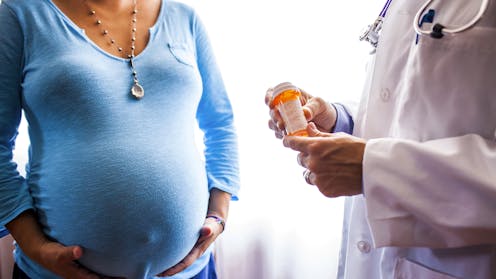
More than 9 in 10 women take at least one medication during pregnancy, yet data on prescription drugs’ effects on the fetus are sparse. Adam Hester/Tetra images via Getty Images

A panel convened in July 2025 by the Food and Drug Administration sparked controversy by casting doubt about the safety of commonly used antidepressants during pregnancy. But it also raised the broader issue of how little is known about the safety of many medications used in pregnancy, considering the implications for both mother and child – and how understudied this topic is.

In the U.S., the average pregnant patient takes four prescription medications, and more than 9 in 10 patients take at least one. But most drugs lack conclusive evidence about their safety during pregnancy. About 1 in 5 women uses a medication during pregnancy that has some preliminary evidence that it could cause harm but for which conclusive studies are missing.

We are researchers in maternal and child health who evaluate the safety of medications during pregnancy. In our work, we identify medications that might raise the risk for birth defects or pregnancy loss and compare the safety of different treatments.

While progress has been slow, researchers and federal agencies have built monitoring systems, databases and tools to accelerate our understanding of medication safety. However, these efforts are now at risk due to ongoing cuts to medical research funding – and with them, so is the knowledge base for determining whether sticking with a therapy or discontinuing it offers the safest choice for both mother and child.

How pregnant women got sidelined

One big reason why so little is known about the effects of medications during pregnancy stretches back more than half a century. In the 1960s, a drug called thalidomide that was widely prescribed to treat morning sickness in pregnant women caused severe birth defects in over 10,000 children around the world. In response, in 1977 the FDA recommended excluding women of childbearing age from participating in early stage clinical trials testing new medications.

A pill bottle with a label carrying the drug's brand name, Kevadon, and its generic name, thalidomide.
Thalidomide, sold under several brand names including Kevadon, was used in many countries to treat morning sickness, though the Food and Drug Administration never approved it for that purpose in the United States.
U.S. Food and Drug Administration

Ethically, there is long-standing tension between concerns about fetal harm and maternal needs. Legal liability and added complexities when conducting studies in pregnant women serve as additional barriers for drug manufacturers.

When drugs are approved, studies about whether they might cause birth defects are typically done only in animals, and they often don’t translate well to humans. So when a new medication comes on the market, nothing is known about how it affects people during pregnancy. Even if animal studies or the medication’s mode of action raised concerns, the drug can still be approved, though companies may be required to conduct studies observing its effects when taken during pregnancy.

Cause and effect

Of 290 drugs approved by the FDA between 2010 and 2019, 90% contain no human data on the risks or benefits for pregnant patients. About 80% of some 1,800 medications in a national database called TERIS, which summarizes evidence on medications’ risks during pregnancy, lack or have limited evidence about the risks for birth defects. Researchers have estimated that it takes 27 years to pin down whether a medication is safe to use in pregnancy.

As a result, many pregnant women stop treating their chronic diseases. In a U.S. study published in 2023, over one-third of women stopped taking a medication during pregnancy, and 36.5% of those did so without advice from a health care provider. More than half cited concerns about birth or developmental defects as the reason.

Yet uncontrolled chronic disease comes with its own toll on both the mother’s and the baby’s health. For example, some medications used to treat seizures are known to cause birth defects, but stopping them may increase seizures, which themselves raise the risk of fetal death.

Women with severe or recurrent depression who abruptly stop their antidepressants risk their depression returning, which is in turn associated with increased risk of substance use, inadequate prenatal care and other negative effects on fetal development. Stopping the use of medications
for treating high blood pressure also causes adverse effects – specifically, a greater risk of pregnancy-related high blood pressure that can cause organ damage, called preeclampsia; a condition called placental abruption, when the placenta detaches from the wall of the uterus too early; preterm birth; and fetal growth restriction. An online resource called Mother to Baby, created by a network of experts on birth defects, provides an excellent summary of the available data on medication safety during pregnancy.

The FDA in some cases requires drug companies to establish registries to track the outcomes of pregnancies exposed to certain medications. These registries can be useful, but they have shortcomings. For example, recruiting pregnant patients into them takes time and considerable effort, resulting in small sample sizes that may not capture rare birth defects. Also, registries typically follow a single medication and rarely include comparisons to alternative treatment approaches – or to no treatment.

What’s more, following the 2022 Dobbs v. Jackson Supreme Court decision overturning the constitutional right to abortion, women might be reluctant to add their names to a pregnancy registry or to provide data on prenatal detection of birth defects due to concerns about privacy and legal risks.

Decades of underfunding

In 2019, a task force established by the 21st Century Cures Act identified a major gap in knowledge about drug safety and effectiveness in pregnant and lactating women and recommended a boost in funding to fill it.

However, little has changed. A 2025 review by the National Academies of Sciences, Engineering and Medicine pointed out that research funding for women’s health topics has remained flat over the past decade, while the overall budget of the National Institutes of Health has steadily increased. The review recommended doubling the NIH funding allocated for such research, but this seems unlikely in light of the recent proposals to cut the overall NIH budget by 40%.

The National Institute of Child Health and Human Development funds the bulk of research on the safety of medications during pregnancy across federal agencies, although the institute has an appreciably smaller budget than most of its sister institutes such as the National Cancer Institute. Grants awarded are typically broad and take four to five years to complete, but they allow the more comprehensive assessments that are needed to support informed decisions considering outcomes for mother and child. For example, NIH-funded researchers have established a clear link between autism and prenatal use of valproate, a potent teratogen used to treat epilepsy and several mental health disorders.

The Centers for Disease Control and Prevention as well as the FDA have also funded specific pregnancy-related research. For example, following the COVID-19 epidemic, the CDC renewed its funding for studies that help expedite pregnancy safety studies for treatments that might be used for newly emerging infections. In response to emerging concerns about a substance called gadolinium, which is often used during MRI procedures, the FDA funded our own work on a study of almost 6,000 pregnant women, which found no elevated risk.

For healthy pregnancies, more research is critical

These efforts have laid a crucial foundation for evaluating medication safety and effectiveness during pregnancy. But keeping pace with the release of new medications and new ways they are used, as well as addressing the backlog of missing evidence for medications that were approved in the past millennium, remain a challenge.

Recent terminations of NIH-funded studies have focused on topics presumably relating to diversity, equity and inclusion. But research on safe and healthy pregnancies and on maternal health – for example, on the safety of COVID-19 vaccines during breastfeeding – has been affected as well.

The NIH has scaled back new grant awards by nearly US$5 billion since the beginning of 2025, and the odds for receiving NIH funding have plummeted. Proposed sweeping budget cuts for the CDC and FDA leave their role in supporting research on healthy pregnancies similarly uncertain.

In our view, removing or reducing ongoing investments in healthy pregnancies poses a danger to much-needed efforts to reduce excessive rates of stillbirths as well as infant and maternal deaths.

The Conversation

Almut Winterstein consults on medication safety issues to Merck, Syneos, Lykos and Novo Nordisk. She receives funding for pregnancy-related research from NIH, CDC, FDA, and the Gates Foundation.

Sonja Rasmussen receives funding from Harmony Biosciences, Axsome Therapeutics, Biohaven (acquired by Pfizer), Lundbeck, Novo Nordisk, and Myovant Sciences to serve on pregnancy registry scientific advisory committees. She also receives or has received funding from NIH, CDC, and FDA.

ref. Pregnant women face tough choices about medication use due to lack of safety data − here’s why medical research cuts will make it worse – https://theconversation.com/pregnant-women-face-tough-choices-about-medication-use-due-to-lack-of-safety-data-heres-why-medical-research-cuts-will-make-it-worse-260783

Être grand-parent à distance : ce qui se perd lorsque les familles sont séparées et comment combler le fossé

Source: The Conversation – in French – By Sulette Ferreira, Transnational Family Specialist and Researcher, University of Johannesburg

Devenir grand-parent est souvent perçu comme une expérience profondément intime et concrète : tenir un nouveau-né dans ses bras, partager ses premiers sourires, assister à ses premiers pas hésitants. Cette expérience repose traditionnellement sur la présence physique et sur des visites spontanées.

Pour de nombreux grands-parents dont les enfants ont émigré, ces moments précieux ne se vivent plus avec le contact physique. Ils se déroulent désormais à travers des écrans et sont soumis aux contraintes des décalages horaires. Ils sont aussi marqués par un sentiment d’éloignement.

C’est le cas en Afrique du Sud, un pays où l’émigration est en hausse, en particulier parmi les jeunes familles. Plus d’un million de Sud-Africains vivent aujourd’hui à l’étranger. Cela a des effets profonds et durables et touche plusieurs générations.

Dans une étude récente, j’ai exploré l’impact de l’émigration mondiale sur les relations entre les grands-parents sud-africains et leurs petits-enfants nés à l’étranger. J’ai examiné ce que signifie endosser le rôle de grand-parent à distance, souvent pour la première fois, et comment l’absence de proximité physique remodèle les relations entre générations.

J’ai publié divers articles sur la migration et les relations entre générations dans les familles qui vivent entre deux pays. Je dirige également un cabinet privé qui se concentre sur les défis émotionnels liés à l’émigration.

Dans le cadre de ma thèse de doctorat, j’ai mené des entretiens approfondis avec 24 parents sud-africains dont les enfants adultes avaient émigré. Ce projet a jeté les bases de mon programme de recherche plus large sur les effets émotionnels de la migration. Cet article de recherche est basé sur les expériences de 44 participants.

Pour ces grands-parents, l’émigration représente plus qu’une simple séparation géographique. Le rythme familier de la vie avec leurs petits-enfants, des visites spontanées aux fêtes communes, est bouleversé. Il en résulte un sentiment de perte profond et permanent, non seulement lié à l’absence des interactions quotidiennes avec leurs petits-enfants, mais aussi à la disparition progressive d’un rôle cher à leur cœur, autrefois ancré dans la présence physique et les liens quotidiens.

Les résultats montrent que l’absence de proximité physique engendre de profondes barrières émotionnelles, particulièrement durant les premières années de la vie d’un petit-enfant, qui sont déterminantes. Pourtant, malgré la distance, les grands-parents parviennent à trouver des moyens créatifs et significatifs de rester émotionnellement présents.

Dans les familles transnationales, les grands-parents jouent un rôle de gardiens de la continuité culturelle et de soutien émotionnel, mais aussi d’acteurs actifs qui redéfinissent ce que signifie être grand-parent dans le contexte de la migration mondiale.

Témoignages des grands-parents

La question centrale de ma recherche était de savoir comment la distance avait redéfini le rôle de certains grands-parents dans les familles sud-africaines. Elle a également examiné comment les grands-parents s’adaptent et négocient leurs rôles à différentes étapes de la vie de leurs petits-enfants.

Les critères de sélection étaient les suivants : être citoyen sud-africain, parler couramment l’anglais, vivre en Afrique du Sud, être parent d’un ou plusieurs enfants adultes ayant émigré et vécu à l’étranger pendant au moins un an, et être de toute origine ethnique, culture, sexe, statut socio-économique et âgé de 50 à 80 ans.

J’ai complété les entretiens par des enquêtes qualitatives distribuées via mon groupe de soutien en ligne.

Les grands-parents ont fait état de diverses difficultés, telles que la perte de leur implication quotidienne, la charge émotionnelle liée à la séparation et les difficultés de communication numérique qui nécessitaient des stratégies d’adaptation continues pour maintenir le lien.

L’étude montre que la distance n’affaiblit pas nécessairement les liens intergénérationnels, mais oblige les grands-parents à redéfinir leur présence.

Mes recherches ont clairement montré que le lieu de naissance est un facteur déterminant dans la formation du lien entre grands-parents et
petits-enfants.

Les grands-parents d’enfants nés en Afrique du Sud et qui déménagent ensuite dans un autre pays sont souvent impliqués dès le début. Ils aident à prendre soin des enfants au quotidien, célèbrent les étapes importantes et profitent de visites spontanées. Ces interactions quotidiennes nourrissent des liens émotionnels forts.
Comme l’a confié Annelise, une participante :

Quand votre petit-enfant naît ici, vous le connaissez depuis sa naissance, vous le voyez tous les jours, vous partagez tout.

Lorsque ces petits-enfants émigrent, la rupture peut être profonde. Les grands-parents perdent non seulement un contact régulier, mais aussi leur rôle de soutiens actifs.

Lorsque les petits-enfants naissent à l’étranger, un parcours émotionnel différent se dessine. La joie et l’excitation sont souvent tempérées par la nostalgie et la tristesse.

La réalité des relations transfrontalières oblige les grands-parents à redéfinir leur rôle. Pour de nombreuses familles, la grossesse renforce les liens entre les générations, en particulier entre les mères et les filles. Cette phase est généralement marquée par des rituels communs, qui façonnent l’identité de mère et de grand-parent. Ces rituels favorisent les liens affectifs et le sentiment d’appartenance.

Mais pour les grands-parents qui sont séparés, ces moments peuvent être remplacés par des captures d’écran et des messages vocaux, rendant les étapes importantes lointaines et intangibles.

Cette absence précoce peut être ressentie comme une exclusion de la grand-parentalité elle-même, comme si ce rôle était refusé avant même d’avoir commencé. Ce phénomène correspond étroitement au concept de « perte ambiguë » développé par la psychologue américaine Pauline Boss, qui désigne un deuil sans fin.

Malgré cela, de nombreux grands-parents restent activement impliqués. Certains deviennent ce que les sociologues américaines Judith Treas et Shampa Mazumdar appellent des « seniors en mouvement » : ils se déplacent plus, et organisent leur vie autour de billets d’avion, des renouvellements de visa et des séjours temporaires consacrés aux petits-enfants.

Mais les défis sont de taille.

Rester proche malgré la distance

Il est difficile de maintenir une relation au-delà des frontières.

Deux stratégies clés sont ressorties de mes recherches : la communication virtuelle et les visites transnationales.

Toutes les personnes que j’ai interrogées utilisaient largement la technologie : lecture hebdomadaire d’histoires sur Zoom, enregistrements de lectures ou « colis » remplis de lettres, de recettes ou d’objets artisanaux.

Les visites physiques étaient limitées par un ensemble d’obstacles financiers, logistiques, émotionnels et relationnels.

Les vols sont tout simplement trop chers, et avec ma santé, je ne pense pas pouvoir supporter le voyage. Cela me brise le cœur, mais ce n’est tout simplement pas possible. Je ne pense pas que je le reverrai un jour.

J’ai également constaté que le rôle des parents était essentiel. En partageant des photos, en prenant l’initiative d’appeler et en faisant en sorte que les grands-parents soient présents dans les conversations quotidiennes, certains parents ont contribué à renforcer les liens affectifs.

Ma fille et mon gendre sont tous deux très doués pour m’envoyer régulièrement des photos et des vidéos… Ils savent tous les deux à quel point mes deux petits-enfants me manquent, alors ils me tiennent au courant… Ils m’appellent également chaque semaine et encouragent les enfants à se concentrer sur nos appels.

Conclusions

Le rôle des grands-parents transnationaux remet en question le modèle traditionnel d’implication active. Il nécessite de repenser la notion de présence.

Mes recherches montrent que les grands-parents y parviennent grâce à leur créativité, leur souplesse émotionnelle et leur amour indéfectible. Ils sont en train de forger un nouveau type de grands-parents à travers les continents, où les liens transcendent la distance.

The Conversation

Sulette Ferreira est chercheuse à l’université de Johannesburg.

ref. Être grand-parent à distance : ce qui se perd lorsque les familles sont séparées et comment combler le fossé – https://theconversation.com/etre-grand-parent-a-distance-ce-qui-se-perd-lorsque-les-familles-sont-separees-et-comment-combler-le-fosse-263875