Los neandertales también iban a la playa… y dejaban sus huellas en la arena

Source: The Conversation – (in Spanish) – By Fernando Muñiz Guinea, Geólogo, Paleontólogo (Icnológía, tafonomía, paleoecología). Actualmente, Profesor Titular de la Universidad de Sevilla.., Universidad de Sevilla
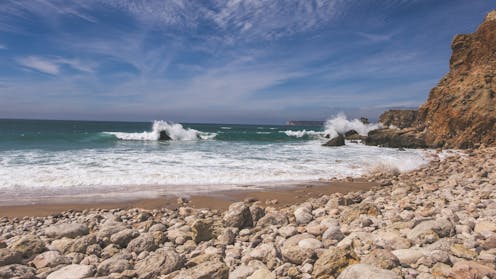
Praia do Telheiro, en Portugal, donde se han encontrado huellas fosilizadas de neandertales de unos 80 000 años de antigüedad. David_Pastyka/Shutterstock

Cuando imaginamos a los neandertales, la mayoría de nosotros pensamos en cazadores cubiertos de pieles, acurrucados en cuevas y soportando el frío de la Europa glacial. Sin embargo, un descubrimiento sorprendente en la costa atlántica de Portugal está ayudando a reescribir esa imagen. Nuevas investigaciones muestran que los neandertales no solo habitaban cuevas o cazaban en el interior, sino que también iban a la playa.

En monte Clérigo y en praia do Telheiro, en la región del Algarve, se ha conservado un registro extraordinario: huellas fosilizadas de neandertales que caminaron por estas playas hace unos 80 000 años. Son huellas profundas, algunas de niños y adolescentes, congeladas en el tiempo en dunas antiguas. Juntas, ofrecen una ventana a un día en la vida de nuestros parientes más cercanos y sugieren una relación con la costa mucho más rica de lo que antes se creía.

Praia do Telheiro, en Portal, un sitio de interés geológico donde se han hallado muestras de vida neandertal.
GeoPortal. Energía y Geología de Portugal., CC BY

Huellas en la arena… durante 80 000 años

Las huellas, ahora endurecidas en roca, se conservaron gracias a una afortunada combinación de arena, humedad y tiempo. En monte Clérigo, los investigadores documentaron 26 huellas de neandertales, mientras que praia do Telheiro reveló otra huella más. Algunas impresiones son tan nítidas que se puede ver el talón, el arco y algunos dedos, especialmente el dedo gordo, como si la persona acabara de salir a caminar.

Al estudiar su forma y tamaño, los científicos pudieron incluso estimar la edad y tamaño de los individuos. Muchas pertenecían a adultos, junto a algunos niños. Esto sugiere salidas en grupo más que individuos solitarios. De hecho, un niño pequeño dejó un par de huellas: un recordatorio poderoso de que los días en la playa no eran solo para sobrevivir, sino también para jugar y explorar.

¿Por qué ir a la costa?

Entonces, ¿qué hacían estos neandertales junto al mar? Las huellas no lo dicen exactamente, pero las posibilidades son fascinantes. Las zonas costeras eran ricas en recursos: animales, mariscos, crustáceos, aves marinas e, incluso, peces o mamíferos varados. Para los cazadores-recolectores, la playa era un bufé natural.

Las huellas también sugieren movilidad y curiosidad. Los neandertales no estaban confinados a cuevas o bosques; como era de esperar, exploraban dunas, estuarios y orillas. Al aventurarse a la costa, demostraban la misma adaptabilidad que les permitió prosperar durante cientos de miles de años en paisajes muy distintos, desde la península ibérica hasta Bélgica, el norte de Francia, el sur de Inglaterra y el Cáucaso, llegando hasta los montes Altái en el sur de Siberia.

Una imagen diferente de la vida prehistórica

Durante décadas, los neandertales fueron caricaturizados como brutos, primitivos y centrados únicamente en la supervivencia. Pero descubrimientos como este desafían esa visión anticuada. Aquí los vemos no solo como cazadores de elefantes y ciervos, sino como comunidades dinámicas basadas en la familia que usaban diversos entornos.

La presencia de huellas de niños es especialmente reveladora. Pinta una escena de jóvenes neandertales corriendo por las dunas mientras los adultos caminaban cerca. Es fácil imaginar familias explorando juntas, como hacen los humanos modernos. Los valiosos fósiles encontrados congelan un momento cotidiano y fugaz, del tipo de momentos que la arqueología rara vez captura.

¿Cómo sabemos que eran neandertales?

La datación de los sitios los sitúa firmemente en la era neandertal, hace unos 80 000 años, antes de la llegada del Homo sapiens a Europa. Otros sitios con restos de neandertales e industrias líticas se encuentran en entornos costeros como Figueira Brava (Portugal), la costa andaluza en Matalascañas (Huelva), Gibraltar y algunos otros lugares de la costa mediterránea de España. En conjunto, la evidencia es sólida: estas son huellas de neandertales y muestran la presencia de grupos familiares a lo largo de la costa ibérica.

Ocupaciones neandertales en el litoral central catalán. Museo Arqueológico Nacional de España.

Por qué esto importa

El descubrimiento tiene grandes implicaciones. Por un lado, se suma a la creciente evidencia de que los neandertales aprovechaban entornos y recursos costeros. Los concheros en sitios como Figueira Brava (cerca de Lisboa), las cuevas de Vanguard y Gorham (Gibraltar) o la cueva Bajondillo (Málaga) ya sugerían mariscos en su dieta, pero las huellas proporcionan una evidencia mucho más directa: ellos realmente caminaron allí.

También desafía estereotipos sobre el comportamiento neandertal. Lejos de estar atrapados en el interior, interactuaban activamente con los paisajes marinos. Esta versatilidad pudo haberles ayudado a soportar los cambios climáticos durante los interglaciares y glaciares, hasta la la Edad de Hielo, el último periodo glacial que ha acontecido en la historia geológica de la Tierra.

Finalmente, hay un impacto emocional. Las huellas son poderosas porque nos conectan directamente con individuos. A diferencia de herramientas de piedra o huesos, muestran comportamiento en movimiento: alguien caminando, parado o corriendo, en un lugar y tiempo específicos. Salvan el abismo de milenios de una forma que pocos otros fósiles pueden.

Praia do Telheiro, en Portugal.
Puyol/Wikiloc., CC BY

Caminando en sus huellas

Nuestra especie, Homo sapiens, eventualmente se extendió por Europa y coexistió con los neandertales durante miles de años antes de que desaparecieran hace menos de 40 000 años. Hoy, muchos de nosotros todavía llevamos rastros de ADN neandertal. Descubrimientos como los de monte Clérigo y praia do Telheiro nos recuerdan cuánto compartimos con ellos: no solo genes, sino también comportamientos, paisajes y, quizá, la simple alegría de un día en la playa.


Leer más:
Los neandertales se extinguieron hace 40.000 años, pero nunca ha habido más ADN suyo que hoy


La próxima vez que pasee por una orilla arenosa durante las vacaciones, considere esto: mucho antes del turismo de playa, mucho antes de los pueblos pesqueros, hasta antes de que nuestra especie llegara a Europa, las familias neandertales ya estaban allí. Los adultos caminaban delante, quizás para cazar, sus pasos más pesados hundiéndose en la arena mientras subían la duna. Los niños seguían, dejando pequeñas huellas juguetonas. La marea subía y bajaba, el nivel del mar cambiaba, las dunas se desplazaban, pero de alguna manera, con casi ninguna probabilidad, esas huellas perduraron.

Ochenta milenios después, resurgen para contarnos una historia: los neandertales eran tan exploradores, sobrevivientes y amantes de la playa como nosotros.

The Conversation

Las personas firmantes no son asalariadas, ni consultoras, ni poseen acciones, ni reciben financiación de ninguna compañía u organización que pueda obtener beneficio de este artículo, y han declarado carecer de vínculos relevantes más allá del cargo académico citado anteriormente.

ref. Los neandertales también iban a la playa… y dejaban sus huellas en la arena – https://theconversation.com/los-neandertales-tambien-iban-a-la-playa-y-dejaban-sus-huellas-en-la-arena-263686

‘Algún día todo el mundo habrá querido estar siempre en contra’: el libro que retrata la destrucción de Gaza y el consentimiento de Occidente

Source: The Conversation – (in Spanish) – By Clare Corbould, Associate Professor of History and Associate Head (Research) of the School of Humanities and Social Sciences, Deakin University

Omar El Akkad no quiere que usted aparte la mirada. Reputado periodista y novelista, El Akkad nació en Egipto, vivió durante su adolescencia en Catar y Canadá, y emigró de adulto a los Estados Unidos, donde ahora vive con su familia en la costa noroeste del Pacífico.

Su colección de ensayos, Algún día todo el mundo habrá querido estar siempre en contra, se inspira en su vida, desde la infancia hasta su reciente paternidad. Combina estas reflexiones con un agudo conocimiento de la historia moderna para examinar las respuestas de Occidente al “primer genocidio retransmitido en directo del mundo” en Gaza. Al considerar esa respuesta insuficiente, insta a los lectores a observar, escuchar, reflexionar y actuar.

Como hijo de padres que emigraron a Occidente en busca de la libertad y las oportunidades que este ofrecería a sus hijos, El Akkad tiene un agudo sentido de los acontecimientos, las ideas y las estructuras del pasado que han dado forma al presente. Presta especial atención al legado del dominio colonial.

Testigo de la historia

Portada del libro de Omar El Akkad que se titula 'Algún día -cuando no entrañe riesgo alguno, cuando podamos llamar a las cosas por su nombre, cuando sea demasiado tarde para exigir responsabilidades- todo el mundo habrá querido estar siempre en contra'.

Libros del Kultrum

Las descripciones que hace El Akkad de las atrocidades no son fáciles de leer. Tampoco lo es su contundente exigencia a hacer algo. Sin embargo, la fuerza de sus observaciones y la mordacidad de su prosa hacen que sea difícil apartar la mirada.

Su propósito es similar al de muchos testigos famosos de la historia. Las declaraciones contemporáneas sobre la violencia suelen servir más tarde como testimonio para determinar qué ocurrió, quién fue el responsable y qué compensación se debe pagar.

Pensemos en George Orwell reflexionando sobre la propaganda en España. O en los periodistas británicos Gareth Jones y Malcolm Muggeridge, que denunciaron la hambruna en la URSS de los años 30, mientras muchos comunistas occidentales miraban para otro lado. O los diarios de Victor Klemperer, publicados después de la guerra, que relataban cómo los nazis tergiversaban el lenguaje cotidiano.

Por encima de todo, este tipo de testimonios protegen contra futuras afirmaciones de inocencia, contra la tranquilizadora afirmación de que “no sabían lo que estaba pasando” o “eran producto de su época”.

El fuego y la furia de El Akkad también me trajeron a la memoria a la periodista estadounidense Ida B. Wells. En la década de 1890, Wells atacó ferozmente los linchamientos en su propio periódico, el Memphis Free Speech. Investigó casos concretos de violencia ritualizada por parte de las masas.

Wells también catalogó la forma en que los medios de comunicación contaban esas historias. Medían sus palabras para proteger a los autores, mientras mancillaban la reputación de los fallecidos, a quienes siempre nombraban.

El Akkad también presta mucha atención a la forma en que se enmarca y se describe la violencia en Gaza. Observa cómo los periodistas utilizan la voz pasiva, lo que no solo oculta los nombres de los asesinos, sino que da a entender que la muerte masiva se produjo por accidente o por arte de magia: “Periodista palestino herido en la cabeza por una bala durante una redada en la casa de un sospechoso de terrorismo”, rezaba un titular de The Guardian.

Tanto Wells como El Akkad muestran cómo las víctimas de la violencia racista y colonial son presentadas como culpables de antemano. En el caso de los linchamientos, el pretexto solía ser una acusación de violación, aunque rara vez ese era el verdadero motivo. Mucho más comunes eran las disputas entre hombres por la tierra, los salarios, la organización laboral, la competencia empresarial o las campañas de votación.

En el caso de Gaza, muchos medios de comunicación imitan las afirmaciones de los políticos israelíes, su ejército y los aliados de ambos. Así tachan a los civiles de terroristas o terroristas en potencia, incluso a los niños. Las palabras limpian la conciencia de los espectadores. Blanquean el daño como si fuera dinero en efectivo.

Formas de resistencia

Como reza el título del libro, que comenzó su andadura como un tuit viral, “algún día, todo el mundo habrá estado siempre en contra de esto”.

Al ser testigo de las atrocidades y las respuestas cobardes, El Akkad recuerda a los lectores liberales que, si lo ocurrido en Gaza hubiera sucedido en el pasado, condenarían la violencia. Es más, imaginarían que, si hubieran estado vivos en ese momento, se habrían resistido firmemente al mal o incluso habrían adoptado una postura heroica en su contra.

Además de diagnosticar el problema, El Akkad examina y evalúa las formas de resistir lo que está sucediendo en Gaza. Descarta como ineficaz el antiguo llamamiento al interés propio de los occidentales. Señalar que los horrores que permiten en otros lugares acabarán llegando a ellos simplemente no funciona.

Sus ensayos fueron escritos entre el ataque de Hamás a Israel el 7 de octubre de 2023 y agosto de 2024, cuando la campaña presidencial estadounidense estaba en pleno apogeo. Gran parte de su energía se dedica a abordar el debate sobre “el menor de dos males” en relación con el voto en una democracia en la que las opciones son la extrema derecha y, como mucho, el centro ligeramente a la izquierda. Solo desde una posición relativamente protegida, observa, se podría votar al Partido Demócrata con el argumento de que el otro bando “sería mucho peor”.

Según El Akkad, defender esta postura equivale a aceptar tácitamente la muerte masiva. Lo denomina “aceptación reticente del genocidio” y pide a los liberales de Estados Unidos (y, por extensión, de otras democracias occidentales) que examinen sus conciencias.

La medida correctiva que propone El Akkad es la negación generalizada, o “alejarse”. La gente, en masa, debe negarse a aceptar que las escasas promesas de los partidos políticos menos conservadores son las mejores opciones disponibles.

Esto requerirá sacrificios. El Akkad ofrece ejemplos de personas a las que admira: el escritor que rechazó un premio de una organización que había guardado silencio sobre Gaza; el profesor lo suficientemente valiente como para hablar con sus alumnos adolescentes sobre la intolerable tasa de mortalidad de niños y civiles (no “no combatientes”). De forma más cruda, escribe sobre Aaron Bushnell, el veterano de la Fuerza Aérea de los Estados Unidos, cuyas últimas palabras antes de prenderse fuego frente a la embajada israelí en Washington D. C. fueron “Palestina libre”.

Violencia sistemática

Al igual que Wells, El Akkad vincula la violencia sistemática con las estructuras que sustentan el mundo moderno. La principal de ellas es el capitalismo. Sugiere que el cambio real llegará cuando un número suficiente de nosotros, por usar la vieja jerga de los años sesenta, “abandonemos”, aunque él prefiere la palabra “negación”, un término que implica que hay algo a lo que oponerse.

Omar El Akkad.
Text Publishing

Es hora, argumenta, de que los ciudadanos occidentales bien educados digan “basta”. Nuestros teléfonos son lo suficientemente inteligentes; somos (colectivamente) lo suficientemente ricos y estamos lo suficientemente saciados.

Puede que al principio resulte difícil, pero aprenderemos que “quizás no sea tan complicado evitar pedir café, descargar aplicaciones y comprar hummus con sabor a chocolate de empresas que toleran la matanza”.

Hacerlo podría detener un genocidio. Con el tiempo, este tipo de acción colectiva también podría detener otras calamidades inminentes, entre ellas el colapso climático. El enfoque constante de El Akkad a lo largo del libro en la muerte, las mutilaciones y los daños psíquicos inconmensurables que sufren los niños de Gaza hace que este caso parezca urgente.

Si esa urgencia suena exagerada, El Akkad podría preguntarle qué niños tenía en mente cuando se estremeció ante su diagnóstico. Es probable que su reacción dependa de la ubicación, el color y la riqueza de los niños que tiene en la cabeza.

En una de las frases más impactantes del libro, El Akkad pregunta: “¿Cómo se completa la frase: ‘Es lamentable que hayan muerto decenas de miles de niños, pero…’?”. Tras eso, sugiere que es mejor que todos nos comportemos según la afirmación: “No existen los hijos ajenos”.

The Conversation

Clare Corbould no recibe salario, ni ejerce labores de consultoría, ni posee acciones, ni recibe financiación de ninguna compañía u organización que pueda obtener beneficio de este artículo, y ha declarado carecer de vínculos relevantes más allá del cargo académico citado.

ref. ‘Algún día todo el mundo habrá querido estar siempre en contra’: el libro que retrata la destrucción de Gaza y el consentimiento de Occidente – https://theconversation.com/algun-dia-todo-el-mundo-habra-querido-estar-siempre-en-contra-el-libro-que-retrata-la-destruccion-de-gaza-y-el-consentimiento-de-occidente-263973

Europa frente al desafío del agua: hacia una estrategia común de resiliencia hídrica

Source: The Conversation – (in Spanish) – By María Molinos Senante, Investigadora postdoctoral Instituto de Procesos Sostenibles, Universidad de Valladolid

Quintanilla/Shutterstock

Desde la Roma antigua, el agua ha sido sinónimo de civilización. Los acueductos, termas y sistemas de distribución romanos no solo garantizaron la supervivencia de una sociedad floreciente, sino que también demostraron el papel central de este recurso en el desarrollo económico y cultural.

Hoy, dos milenios después, nuestra realidad no es tan diferente: medio ambiente, economía, seguridad alimentaria, energía y calidad de vida siguen dependiendo de un suministro de agua estable y de calidad. Sin embargo, el crecimiento demográfico, los cambios socioeconómicos y el cambio climático están poniendo en riesgo la seguridad hídrica de millones de europeos.

Las proyecciones son especialmente preocupantes para el sur del continente. En España se estima que la disponibilidad de agua podría reducirse hasta un 40 % en algunas cuencas hidrográficas. Si la temperatura global aumenta 1,5 °C, la población europea que vive en condiciones de escasez pasaría de los 51,9 millones actuales a 64,6 millones. En el caso español, el número crecería de 22,4 a 32,7 millones de personas.

El otro gran desafío son las inundaciones, el desastre natural más frecuente en Europa. Los episodios recientes, como la dana en Valencia, evidencian la magnitud del problema. Hoy, una décima parte de la población urbana europea vive en zonas con riesgo potencial de inundación.


Leer más:
¿Hay ahora un mayor riesgo frente a catástrofes naturales?


Tres principios para afrontar la crisis hídrica

Ante este panorama, la Comisión Europea aprobó en junio de 2025 la Estrategia Europea de Resiliencia Hídrica, cuyo objetivo es construir una Europa más preparada frente a la crisis hídrica. Y se articula en tres ejes:

  1. Restaurar y proteger el ciclo hidrológico.

  2. Impulsar una economía hidrointeligente que combine competitividad y sostenibilidad.

  3. Garantizar el acceso universal a agua limpia y asequible. En definitiva, Europa reconoce que el agua ya no puede darse por sentada: requiere planificación, inversión y, sobre todo, una respuesta conjunta y solidaria.

La Estrategia Europea de Resiliencia Hídrica propone un ambicioso programa de acción que combina nuevas regulaciones, planificación a largo plazo y desarrollo tecnológico. Sin embargo, su verdadero valor reside en la capacidad de articular políticas y acciones multisectoriales, trasladando la gestión hídrica más allá del ámbito medioambiental.

Agricultura, industria, energía, transporte y urbanismo deben trabajar de forma coordinada para reducir la presión sobre los recursos, fomentar el uso eficiente, acelerar la innovación tecnológica y promover la circularidad.

Esta iniciativa supone un avance significativo en la gobernanza del agua al reconocerla como un bien común indispensable para la salud pública, la seguridad alimentaria, la energía, la cohesión social y la competitividad económica. Sin embargo, su éxito dependerá en gran medida de cómo se afronten una serie de obstáculos estratégicos, institucionales y técnicos.


Leer más:
Sin agua no hay desarrollo sostenible


Los desafíos en la resiliencia hídrica

Entre los principales retos destaca la naturaleza no vinculante de algunos objetivos, como la meta de reducir el consumo de agua en un 10 % para 2030. Asimismo, la fragmentación institucional y legislativa de la Unión Europea complica la coherencia en su aplicación.

Las directrices europeas deben traducirse eficazmente en políticas nacionales coordinadas. Sin embargo, la capacidad administrativa es divergente en los países europeos. El desafío financiero es otro reto importante. La Comisión Europea estima una necesidad de 23 000 millones de euros al año para modernizar infraestructuras y fomentar la reutilización del agua. Sin embargo, garantizar inversiones privadas y públicas sostenidas requerirá mecanismos financieros robustos y confianza regulatoria.

En este contexto, para que la estrategia cumpla su propósito, es indispensable fortalecer la gobernanza multinivel, asegurar financiación sostenible, fomentar colaboraciones público-privadas y adaptar las acciones a la diversidad regional.

Ante un clima cada vez más extremo y sistemas hídricos frágiles, solo un enfoque coherente, participativo y financiero sólido puede consolidar la resiliencia hídrica en toda Europa.

The Conversation

María Molinos Senante no recibe salario, ni ejerce labores de consultoría, ni posee acciones, ni recibe financiación de ninguna compañía u organización que pueda obtener beneficio de este artículo, y ha declarado carecer de vínculos relevantes más allá del cargo académico citado.

ref. Europa frente al desafío del agua: hacia una estrategia común de resiliencia hídrica – https://theconversation.com/europa-frente-al-desafio-del-agua-hacia-una-estrategia-comun-de-resiliencia-hidrica-261246

Like Reagan, Trump is slashing environment regulations, but his strategy may have a far deeper impact

Source: The Conversation – USA (2) – By Barbara Kates-Garnick, Professor of Practice in Energy Policy, The Fletcher School, Tufts University

When the Trump administration announced it was moving to eliminate dozens of U.S. climate policies, Environmental Protection Agency Administrator Lee Zeldin said he was sending “a dagger straight into the heart of the climate change religion.”

That drive – to both repeal environmental regulations and cast doubt on science – reflects the Trump administration’s approach to environment policy.

Deregulation has long been a key theme in Republican environmental policy. The conflict between the obligation to protect public health and the desire to boost markets traces back to Ronald Reagan’s presidential administration. Reagan’s perspective that government is not a solution to problems, but is the problem instead, set the stage for Republican administrations that followed.

Reagan, standing in a reception line, shakes Trump's hand. Trump is wearing a tuxedo. Reagan a suit.
President Ronald Reagan shakes Donald Trump’s hand during a reception that Trump, then a real estate developer, attended at the White House in 1987.
White House Photographic Collection via Wikimedia Commons

Reagan argued that the growth of government spending and business regulation had stymied economic prosperity. Environmental regulations were a prime target.

Forty years later, America is seeing many of the same concepts in the Trump administration. However, its strategy could have a greater effect than Reagan ever envisioned.

Slashing budgets and staffing

There are many ways to kneecap government agencies: Instituting massive budget cuts, cutting staff with critical functions and appointing leadership whose goal is limiting the reach and effectiveness of the very agencies they direct are just a few.

In these efforts, Reagan and Trump had similar approaches to the EPA, although with different levels of intensity.

Trump’s EPA budget plan for 2026 includes a draconian 50% cut from the previous year and the lowest budget proposal, when adjusted for inflation, since Reagan. Staff cuts in just the first six months of the second Trump administration put the agency’s total employment at 12,448, down from 16,155 in January.

Reagan dissolved the EPA Office of Enforcement to limit “unnecessary regulation,” which resulted in a 80% decline in actions to enforce environmental regulations. Trump is also stopping enforcement actions, dismantling the EPA’s Science and Research Office and politicizing the agency’s science by putting political appointees in charge, moves that undermine EPA’s independence and expertise.

Both cut EPA’s budget, but that alone does not reduce an agency’s effectiveness.

Politicizing EPA leadership

When the EPA was founded in 1970 during the Nixon administration, it represented a bipartisan consensus: After decades of auto exhaust, polluted waterways and smog-filled air, environmental protection had become a national policy priority.

But industries that EPA regulated argued that the costs of implementing the agency’s mandates were too high. That created tension between economics and science and enforcement.

As part of his “government is not the solution” approach, Reagan issued an executive order shortly after taking office in 1981 requiring federal agencies to submit all proposed rules to the White House Office of Management and Budget before making them public. In Reagan’s eyes, this approach centralized power in the White House and was a way to eliminate burdensome regulations before the agencies announced them to the public.

He also appointed an EPA administrator who shared his anti-government perspective. Anne Gorsuch Burford was a lawyer and state legislator from Colorado, where she routinely voted against toxic waste cleanup and auto pollution controls.

A woman sits in a chair next to the president's desk. Reagan is smiling as he talks with her.
President Ronald Reagan meets with EPA Administrator Anne Gorsuch in the Oval Office in May 1982.
HUM Images/Universal Images Group via Getty Images

Once in Washington, she appointed several people to the EPA’s leadership team with direct ties to industries the EPA regulated. An example was Rita Lavelle, head of the EPA’s toxic waste programs, who was later convicted of perjury for lying to Congress about when she knew her former employer, a defense contractor, was disposing of toxic waste at a now notorious dump site.

These appointments were an example of regulatory capture by the industries EPA was in charge of overseeing. Anne Gorsuch Burford was held in contempt of Congress for not turning over records related to the Superfund cleanup of the same hazardous waste site, which led to her resignation. The Superfund program to clean up toxic waste dumps was new and one of EPA’s largest programs at the time.

The scandals, broken staff morale, stripped budgets and fights over policy discredited the agency.

Going after government scientists

Anne Gorsuch Burford’s deregulation efforts weren’t fully successful, in part because EPA staff experts rallied to preserve science and regulatory functions. They leaked materials about delays in the Superfund site cleanup to sympathetic congressional staff, who in turn found support from Republican and Democratic senators.

That history may have influenced the Trump administration’s strategy toward the federal bureaucracy’s staff experts, who Trump calls “the Deep State.”

The Department of Government Efficiency, an unofficial group Trump set up in early 2025 headed by Elon Musk, directed the firing of tens of thousands of government scientists and other staff with expertise that government agencies rely on. Thousands more have resigned amid intimidation tactics such as surveillance.

A group of people hold science reading 'EPA protects you, protect EPA' and 'Science saves'
EPA employees and supporters held a rally in Philadelphia on March 25, 2025, to call attention to the impact of the Trump administration’s job cuts.
AP Photo/Matt Rourke

Trump’s head of the Office of Management and Budget, Russell Vought, has been clear about targeting bureaucrats. He said in 2023: “We want their funding to be shut down so that the EPA can’t do all of the rules against our energy industry because they have no bandwidth financially to do so. We want to put them in trauma.”

There is a clear focus today on EPA programs that don’t align with the administration’s views. Programs related to environmental justice for low-income communities are in the line of fire. The appointment of people from the chemical, fossil fuel and corporate industries to high-level regulatory and legal positions raises questions about regulatory capture – whether their focus will be more on the health of the industries they oversee than on the health of the public.

An example is decision-making related to who bears the costs of cleaning up pollution from PFAS “forever chemicals” − persistent, harmful chemicals that are now found in drinking water and in people’s bloodstreams. Steven Cook, a Trump appointee who once represented chemical companies that are fighting the rule, has proposed shifting what are expected to be billions of dollars in costs from the companies to taxpayers, The New York Times reports. That would be a significant shift away from the 45-year Superfund mantra that “the polluter pays.” Such actions blur the lines between ethics, policymaking and consumer and company interests.

The first Trump administration had a focus on reforming permitting and bureaucracy. While appearing radical at the time, the revamping of scientific boards to include more industry representatives, the undoing of power plant rules and the lessening of enforcement hobbled but did not completely undo the agency.

The second Trump administration, in actively supporting fossil fuel “energy dominance,” is taking steps to not just eliminate regulations but to ensure future administrations can’t bring the regulations back, by using a complex set of legal arguments related to the regulation of greenhouse gases.

At the same time, the administration is trying to discredit scientific research to downplay the risks of a warming planet.

EPA Administrator Lee Zeldin announces plans in March 2025 to reconsider dozens of regulations that affect the fossil fuel industry and human health.

The Reagan administration, while it also pushed for deregulation and expanded permitting of oil, gas and coal leases, embraced some elements of environmental protection. Reagan designated more than 10 million acres as protected wilderness and signed the Coastal Barriers Resources Act, which helped protect 3.5 million acres of shoreline from development. When Reagan signed the Montreal Protocol in 1988 to help protect the ozone layer, he cited scientific data showing the growing risks of ozone-depleting substances.

When Congress doesn’t push back

There is another critical difference between the first and second Trump administrations: The current Republican-controlled Congress is consenting to almost every request the president makes.

Congress has a constitutional responsibility to be a check on the executive branch, and a bipartisan Congress has long taken an active role in oversight and investigation involving environmental issues.

In 2025, however, Congress has approved most of Trump’s demands, including voting to repeal much of the Inflation Reduction Act, a package of pro-environment spending it had just passed two years earlier and that included many projects in Republican districts.

The administration’s effort to eliminate U.S. climate policies will take time and face lawsuits.

In an irony of history, Anne Gorsuch Burford’s son Neil Gorsuch now sits on the Supreme Court. His vote when those cases come before the court may be the ultimate Reagan legacy on the Trump EPA.

This article, originally published Aug. 26, 2025, has been updated with a recommendation within EPA to shift PFAS cleanup costs from companies to taxpayers.

The Conversation

Barbara Kates-Garnick does not work for, consult, own shares in or receive funding from any company or organization that would benefit from this article, and has disclosed no relevant affiliations beyond their academic appointment.

ref. Like Reagan, Trump is slashing environment regulations, but his strategy may have a far deeper impact – https://theconversation.com/like-reagan-trump-is-slashing-environment-regulations-but-his-strategy-may-have-a-far-deeper-impact-262929

Medidas que debería incluir un pacto de Estado para hacer frente a los incendios forestales

Source: The Conversation – (in Spanish) – By Víctor Resco de Dios, Catedrático de Ingeniería Forestal y Cambio Global, Universitat de Lleida

Actuación de la Unidad Militar de Emergencias en el incendio de Tres Cantos (Madrid) el 12 de agosto de 2025. UME

Hace un par de semanas, cuando el azote de los incendios forestales empezaba a golpear el oeste de la península ibérica, propusimos un pacto de Estado para hacer frente al problema de los incendios forestales en España, junto con Paco Castañares, del sector forestal.

El Gobierno ha prometido un Pacto de Estado para la mitigación y adaptación a la Emergencia Climática, y el principal partido de la oposición presentó un plan de Ayuda, Recuperación y Prevención para el Medio Rural y Forestal.

Pero ¿en qué consistiría exactamente un pacto de Estado para hacer frente al problema de los incendios forestales? A continuación, trataré de esbozar algunos de los siete principales aspectos que, bajo nuestro parecer, debería contener.

1. Cultura de riesgo y autoprotección

Debemos establecer una cultura de riesgo, de manera que la ciudadanía sea consciente de los riesgos a los que está expuesta, que sepa cómo autoprotegerse y cómo reaccionar frente a la emergencia a través de:

  • Desarrollo y publicación de una cartografía de riesgo, con mapas de zonas “inflamables” (equivalente a mapas de zonas inundables) y que concrete puntos de reunión, vías de escape y evacuación dado que muchas personas viven, o veranean, en ratoneras sin escapatoria en caso de incendio y sin ser conscientes de ello.

  • Facilitación a la ciudadanía de herramientas que permitan visualizar en tiempo casi real el incendio e información sobre cómo autoprotegerse.

  • Desarrollo y ejecución de los planes de prevención municipal por técnicos cualificados, que incluyan franjas cortafuegos de cientos de metros, coordinados a través de las diputaciones en el caso de ayuntamientos pequeños y con medios escasos.

Cuando la cultura de riesgo ya esté instaurada, junto con las debidas medidas de autoprotección, podemos revisar la legislación para permitir que cada persona elija si prefiere evacuar su casa o quedarse a defenderla, asumiendo el riesgo que eso conlleva, como se hace en Australia y otros países.

2. Prevención y actividad forestal

La literatura científica actual nos indica que para reducir sustantivamente el área quemada en incendios, necesitamos tratar preventivamente el equivalente a 3-5 veces el área quemada, lo que implica un mínimo de un millón de hectáreas al año, a través de un diseño estratégico. Estamos hablando de:

  • Planificar y ejecutar obras de prevención a escala de macizo montañoso, a parte de la necesaria protección municipal y a escalas más locales.

  • Promover mosaicos de vegetación, o “cortafuegos productivos”, que son zonas que combinan distintos tipos de vegetación y permiten casar la rentabilidad de la explotación (castañas, cultivos, olivos…) con la preservación de la biodiversidad y las zonas de escasa inflamabilidad, de baja carga de combustible, sobre todo en puntos críticos.

  • Implementar un ambicioso programa de quemas prescritas, la versión ingenieril de las quemas tradicionales de los pastores, nuevamente para disminuir la carga de combustible en nuestros montes y crear oportunidades para la extinción.


Leer más:
Prevención de incendios forestales: ¿algún país lo está haciendo bien?


3. Sistema de alertas

Necesitamos desarrollar un sistema de alerta temprana que avise idealmente 72 horas antes del advenimiento de condiciones adversas para poder preparar tanto a los dispositivos de extinción como a la población sobre posibles evacuaciones o confinamientos.

Este sistema de alerta debe ser desarrollado por expertos en incendios forestales, a partir de los datos que puedan aportar distintas agencias como las meteorológicas o estadísticas.

4. Gestión de la emergencia

El pacto de Estado que necesitamos debe velar por:

  • La incorporación a la cadena de mando de unidades de análisis y planificación de la extinción, ya que los incendios actuales requieren de unidades de inteligencia avanzada. Hasta que eso no se haya logrado, necesitamos hacer frente a las condiciones de emergencia nacional de estos días con, por lo menos, un sistema de soporte en el análisis. Resulta paradójico que a nivel internacional se haya implementado el mecanismo FAST, que permite ese apoyo en inteligencia a países terceros, pero que una estructura parecida aún no se haya aplicado a nivel nacional.

  • A largo plazo, el pacto de Estado debe velar por la homogeneización de los elementos comunes en los dispositivos de extinción, para dar una respuesta efectiva cuando se produzca la próxima emergencia nacional.

  • Mejorar la formación de los bomberos a todos los niveles. En algunas comunidades autónomas, las condiciones laborales es otra de las tareas pendientes.

Paisaje de tierra quemada
Paisaje tras el incendio de Yeres, en León.
UME

5. Restauración

Los megaincendios son la respuesta de los ecosistemas al cambio global que estamos viviendo. La nueva realidad climática impone cambios drásticos sobre algunos paradigmas para adaptar nuestros ecosistemas a un clima cambiante. Esto implica que:

  • Deberemos favorecer el establecimiento de vegetación adaptada al clima futuro que se espera para cada zona, aun cuando eso implique una pérdida de la superficie de bosques cerrados o la incorporación de vegetación no autóctona.

  • Necesitamos unidades de inteligencia que permitan tomar decisiones rápidas sobre cómo abordar la restauración tras múltiples incendios que queman centenares de miles de hectáreas, y agilizar los procedimientos para poder contratar con urgencia las obras de restauración necesarias para evitar las pérdidas de suelo.


Leer más:
¿Puede la vegetación recuperarse por sí sola después de un gran incendio?


6. Legislación y fiscalidad

Y por último, el pacto de Estado debe disminuir la carga burocrática con la que se encuentra el sector primario y, en particular, las actividades relacionadas con la prevención de incendios y fomentar, a través de incentivos fiscales, la actividad rural y su rentabilidad. Esto conlleva acciones como:

  • Incorporar la singularidad forestal en la Política Agraria Común (PAC), de manera que se puedan dejar sin labrar zonas en riesgo importante de incendios forestales.

  • Reducir (o eliminar) el IVA de las actuaciones de prevención.

  • Priorizar la protección frente a incendios forestales en la implementación española del Pacto Verde, considerando los cambios que sobre el régimen de incendios pueden ejercer, por ejemplo, la transición energética o la legislación sobre restauración .


Leer más:
Hemos identificado las verdaderas causas de la última ola de megaincendios en Europa


  • Revisar a fondo de la legislación actual en materia forestal y rural de manera que se eliminen las trabas a la recuperación de antiguos cultivos y otras medidas que favorezcan la prevención de incendios.

7. Ciencia e innovación

  • Incentivar la mejora e innovación facilitando el acceso en abierto a datos y previsiones meteorológicas y otros datos financiados con dinero público.

  • Dotar a los medios de extinción de capacidad para mapear el avance de los incendios a tiempo real, y poder reconstruir su comportamiento para su posterior estudio.

En una primera aproximación se estima que el coste de poner en marcha estas medidas debería estar cerca de los 3 000 millones de euros, lo que podría suponer menos de la mitad de lo que llevamos este año gastado en extinción (extinguir cuesta unos 19 000 euros por hectárea). El pacto nos hubiera evitado en gran parte la pérdida de vidas humanas e infraestructuras y de las subvenciones asociadas a la declaración de zona catastrófica.

Además, un porcentaje elevado se podría cubrir por capital privado si logramos mejorar la rentabilidad de las explotaciones. Aparte de las medidas aquí propuestas, otras actividades que fomenten los usos energéticos de la biomasa y constructivo de la madera, por poner dos ejemplos, podrían favorecer esta actividad privada.

Los incendios forestales de este año nos recuerdan cómo se están convirtiendo en un problema de protección civil y de salud pública, con importantes consecuencias para la red ferroviaria y el turismo, y que está afectando también a la calidad de las aguas, aparte de su impacto creciente sobre las sociedades y economías rurales. El margen de error es cada vez más estrecho.

The Conversation

Víctor Resco de Dios recibe fondos del MICINN.

ref. Medidas que debería incluir un pacto de Estado para hacer frente a los incendios forestales – https://theconversation.com/medidas-que-deberia-incluir-un-pacto-de-estado-para-hacer-frente-a-los-incendios-forestales-263979

Netflix’s ‘Mo’ delivers humour, heartache as it explores Israel-Gaza war and Palestinian and Mexican migrant life in the U.S.

Source: The Conversation – Canada – By Faiza Hirji, Associate Professor, Department of Communication Studies and Media Arts, McMaster University

I recently watched both seasons of the Netflix drama-comedy Mo (2022-25), expecting a good laugh, since the show is headlined and written by funny and smart comedian Mohammed Amer.

Mo does provoke a lot of laughter, but it also stirs deep emotions, including despair, loneliness and helplessness, as the episodes explore life in America for people on the margins.

Mo is a semi-autobiographical depiction of Amer’s life. He’s a Palestinian who grew up in Houston, Texas, immigrating to that city when he was nine years old by way of Kuwait.

In the series, Amer plays Mo Najjar as he navigates a complex balancing act between the different cultures that have shaped his life. Mo undergoes struggles to obtain asylum status in the United States as a “stateless person” with no passport.

Amer uses elements of a situation comedy to introduce increasingly troubling sociopolitical themes, leavening an existential darkness with the love and laughter of the main character’s friends and family.

The comedy-drama format allows Mo to address difficult and divisive issues, such as immigration in America and the Israel-Gaza war, in non-threatening ways.

Amer’s comedic writing also serves to humanize his characters. This is particularly important accomplishment in the case of Palestinians, both at home and in the diaspora — and more broadly for Muslims globally — given the long history of misrepresentation of Islam in western discourse.

Comedy tackles erasure of Palestine

In his writing on the first Gulf War, Canadian researcher Karim H. Karim explains how western war propaganda attempted to dehumanize their enemy. He cites comments from the U.S. army members during the Gulf War as examples. They described Iraqis as non-human and animals: “fish in a barrel,” “cockroaches” and part of a “turkey shoot,” alongside the use of longstanding stereotypes about Arabs and Muslims

Dehumanizing techniques can also be seen in today’s conflicts in the Middle East.

For example, Israeli Finance Minister Bezalel Smotrich delivered a speech in October 2024 in which he said: “There is no such thing as a Palestinian nation. There is no Palestinian history. There is no Palestinian language.” Israeli Defense Minister Yoav Gallant also said: “We are fighting human animals and we act accordingly.”


Read more:
How colonialist depictions of Palestinians feed western ideas of eastern ‘barbarism’


Mo counters these types of messages repeatedly as features representations of strong women, respectful men and loving families, instead of the angry terrorists or oppressed women depicted in western imaginings.

Several researchers have previously documented such stereotypes, including Edward Said, Leila Ahmed, Yasmin Jiwani, Karim Karim and Ross Perigoe and Mahmoud Eid.

Comedy is non-threatening

Viewers get to know Mo’s family, the Najjars, and their quirks and idiosyncracies, as well as the complicated path they tread.

During the family’s asylum hearing, an opposing lawyer raises an objection to their claim, saying the U.S. does not recognize Palestine as a state. The statement is brief and the moment passes quickly, but the viewer is now aware of this kind of daily erasure of Palestinian people.

Over the course of the show, viewers see the many ways Mo protests the general erasure of Palestinian culture, including a recurring argument over the origin of hummus (made with chickpeas, garlic, tahini and olive oil).

Building that statement into a comedy is less likely to attract negative attention than a high-profile drama or documentary. For example, Hamdan Ballal, one of the directors of the Oscar-winning Israel-Palestine documentary, No Other Land, was injured in an attack by masked settlers and then arrested by the Israel Defence Forces in the West Bank. Israel’s culture minister said changes had been made to public funding rules to help prevent similar films from being made in future..

Comedy as simultaneous defusion and resistance is also practised by the Palestinian-Canadian comedian Eman el Husseini, whose stand-up routine touches on the idea that Arabs are perceived to be dangerous while painting a picture of her own family as affectionate, overbearing and harmless.

The strategic use of comedy to make characters relatable is a technique that has proven successful with racialized comedians tackling difficult issues, both for stand-ups like Russell Peters and situation comedy formats like Black-ish.

Crushing challenges

Humour may seem like an odd response to the characters’ crushing challenges. At one point, while in negotiation with a criminal who is threatening to amputate the foot of his friend, Mo suggests cutting off just a pinkie instead, hissing to his outraged friend, “Hey, you don’t wear pinkie rings, anyway!”

But in this series, humour becomes the coping mechanism for Mo‘s characters, however fraught or fragile the issue, from a lighthearted chuckle to the darkness of gallows humour.

At times, Mo’s mother, Yusra (Farah Bsaiso), seems utterly consumed by stories of dispossession taking place back in Palestine, while Mo becomes increasingly angry about examples of appropriation and erasure.

His sister, Nadia (Cherien Dabis), trying to forge a way forward, urges her mother to pull herself away from stories of tragedy back home and resist oppression finding moments of happiness. She insists:

“We’re more than our pain and suffering.”

Ultimately, it is Yusra who summarizes what it means to smile through one’s pain, telling Mo:

“The world will always try to tear us down. And when they do…we smile. Because we know who we are.”

Resilience

In Season 2, Mo, still undocumented in Texas, gets accidentally trapped in Mexico after unwittingly crossing the border. His Mexican fiancée leaves him in frustration and loneliness.

Throughout this season, Mo’s anger at the American immigration system grows as he repeatedly tries — and fails — to get home. He seems to be engaging in constant self-sabotage, in which he simply cannot accept the process that his lawyer and the bureaucracy have outlined for him.

Yet, as the depth of the dehumanization experienced by Mo and his family becomes more and more apparent, Mo’s simmering, ever-present anger starts to seem less dysfunctional. Instead, the world’s indifference becomes spotlighted.

During these episodes, Mo begins to learn how to live with — but never accept — injustice.

However, this is still a sitcom, and some things do work out for Mo. At the end of Season 2, Mo and his family get their U.S. passports and so can finally visit their family in Palestine.

As Mo is getting ready to return to Texas, after a joyful and also heartbreaking visit with his relatives, he is harassed by an Israeli border guard. At this moment, Mo realizes he must develop the same inner strength and resolve embodied by his mother, earned after years of having to bear such harassment.

Although Mo is consumed by anger and sadness at the unjust actions towards him by the guard, against all his instincts, he thanks the border guard, smiles and walks on.

The Conversation

Faiza Hirji receives funding from the Social Sciences and Humanities Research Council of Canada.

ref. Netflix’s ‘Mo’ delivers humour, heartache as it explores Israel-Gaza war and Palestinian and Mexican migrant life in the U.S. – https://theconversation.com/netflixs-mo-delivers-humour-heartache-as-it-explores-israel-gaza-war-and-palestinian-and-mexican-migrant-life-in-the-u-s-249684

What’s in a name? How the sound of names can bias hiring decisions

Source: The Conversation – Canada – By David Sidhu, Assistant Professor, Department of Psychology, Carleton University

Imagine you’re hiring someone for a job that requires a very kind, agreeable and co-operative person. You have two candidates and all you know about them are their names: Renee and Greta. Who do you think would be a better fit?

If you are like the people in our recent study on hiring judgments, you probably chose Renee. We found that smoother-sounding names like Renee were preferred to harsher-sounding names like Greta for certain kinds of jobs.

The idea that the sound of a word can make it a better fit for particular meanings or qualities is known as sound symbolism. And it suggests that even something as small as the phonemes in a name can carry surprising weight in how people are judged.

The power of sound symbolism

The best known example of sound symbolism is the bouba/kiki effect. Across languages and cultures, people tend to match the made-up word “bouba” with round shapes and “kiki” with spiky ones.

Why this happens is still debated. Various explanations exist, including the physical sensation of pronouncing the words or the way the sounds of the words imitate the features of round versus spiky objects.

Two shapes seen side-by-side: A spiky shape and a flower shape with rounded edges
In experiments, people tend to associate the word kiki with the shape on the left, and bouba with the one on the right.
(Wikimedia Commons), CC BY-SA

Several years ago, we tested whether the bouba/kiki effect extended beyond invented words to real first names. In one part of that study, we showed participants silhouettes that were either round or spiky and asked them to match them with names.

Not only do people associate names like Bob with round silhouettes and Kirk with spiky silhouettes, but people also associate these names with different personality traits.


Read more:
Why people hate or love the sound of certain words


Smoother-sounding names like Liam or Noelle were judged as more agreeable and emotional, while spikier-sounding names like Tate or Krista were judged as more extroverted.

Importantly, this didn’t mean that Liams actually were more agreeable than Tates. In fact, when our study looked at the personalities of more than 1,000 people, we didn’t find any sign these patterns existed in the real world. Nevertheless, people still make associations based on the sounds of names.

Names and hiring decisions

In our latest study, we were curious to see how these associations might affect judgments in a real-world context: hiring. Of course, employers usually have much more to go on than a name, but there are many instances in which candidates are screened based on only limited information.

There is also a great deal of evidence that socio-demographic cues in a name — such as race and age — can affect who gets a callback. The sound of a name itself could be another potential source of bias.

We designed job ads that looked for a candidate high in one of six personality factors: honesty-humility, emotionality, extroversion, agreeableness, conscientiousness (how organized or hard-working someone is) and openness to experience. For example, one ad looking for an agreeable candidate read:

An organization is looking to hire a new employee. The ideal applicant for this job should be:

  • Co-operative
  • Peaceful
  • Not aggressive

A sample of adults recruited online were then given a pair of names and asked to decide who sounded like a better fit for the job. One name in the pair contained what are called “sonorant” consonants (l, m, n) that sound especially smooth and continuous.

The other contained what are called “voiceless stops” (p, t, k) that sound especially abrupt. For example, they might have to choose between Liam and Tate.

The people in our study made decisions for many different pairs of names, and the overall finding across three experiments was that smoother sounding names, like Liam and Noelle, were judged as better fits for jobs looking for someone high in honesty-humility, emotionality, agreeableness and openness.

When more information is available

We also tested what happens when additional information was introduced. For example, what if participants saw Liam in a picture or watched a video of him answering questions about himself?

We found that when people saw pictures of candidates (randomly paired with names), the influence of name sound decreased. When people saw a videotaped interview of the job candidates, the sound of a name no longer had an effect on their judgments of personality.

We also asked participants how well a given name fit the job candidate in the video. When people felt a name suited a candidate — regardless of sound — that candidate was judged more positively on almost every measure, including warmth and competence.

In other words, there seems to be a benefit of having a name that fits, even though it’s not yet known why some people’s names seem to suit them better than others.

Taken together, these results show the sound of a name might be one additional source of bias in hiring decisions. When people don’t have a lot of details about a candidate, it seems that there is much in a name.

The Conversation

David Sidhu receives funding from the Social Sciences and Humanities Research Council of Canada (SSHRC) and the Natural Sciences and Engineering Research Council of Canada (NSERC)

Penny Pexman receives funding from the Social Sciences and Humanities Research Council of Canada (SSHRC) and the Natural Sciences and Engineering Research Council of Canada (NSERC).

ref. What’s in a name? How the sound of names can bias hiring decisions – https://theconversation.com/whats-in-a-name-how-the-sound-of-names-can-bias-hiring-decisions-263607

Universities could bolster democracy by fostering students’ AI literacy

Source: The Conversation – Canada – By Larry Till, PhD student, Werklund School of Education, University of Calgary

The fears are familiar: Artificial intelligence is going to eat our jobs, make our students weak and lazy and possibly destroy democracy for good measure.

As AI has become more accessible to the public, it’s become closely (and probably not unreasonably) associated with academic misconduct, especially plagiarism and other forms of cheating.

For some time now, research has been suggesting that the future of AI and post-secondary education would be deeply intertwined.

What if, though, teaching students to use AI properly — ethically, responsibly and critically — could help make them better, more engaged citizens?

Fuelling debate

Since its public release in late 2022, ChatGPT, one of the most commonly used generative AI (GenAI) models in the world, has sparked furious academic debate. But the either/or argument that it will kill us or make us stronger is a false dichotomy.

As a long-time post-secondary educator, public servant and current doctoral student examining education and civic literacy, I am interested in the potential for AI to help us build a healthier, more inclusive and more robust democracy by creating new ways to engage our critical thinking skills across disciplines.

I researched this article, in part, by using Scite.ai, a research tool to which I was introduced by Sarah Eaton, a member of my doctoral supervisory committee whose research focuses on academic ethics in higher education. Eaton has examined issues around student misconduct, and has also argued that the connection between civic and digital literacy, including the use of AI in post-secondary education, is strong and growing.

Universities and civic literacy

Civic literacy is about fostering students’ potential to become active, engaged students in the pursuit of peaceful social change.

Somewhere along the way, it seems, universities shied away from that part of their institutional role.

Through western modernity, universities came to occupy roles as endowers of knowledge while building on more ancient expectations that education carried social obligations, often construed as a form of noblesse oblige.”

Decolonial, democratic and educational criticism rightly underscores the importance of recognizing varied forms of knowledge existing throughout society and in learners’ own lives, and how students and diverse disciplines collaborate to construct knowledge.

Through this lens, as some scholars have argued, universities have become spaces to foster forms of civic literacy.

Educating for democracy

The role of colleges and universities in fostering civic literacy, sometimes known as educating for democracy, feeds their contribution to fostering democratic societies. Universities frequently point to this role proudly, speaking of it in broad, glowing terms without offering a lot of specifics.

While universities and colleges often talk broadly about creating learning spaces conducive to democratic engagement and good citizenship, principles associated with democracy have tended to be concentrated in a relatively small number of academic disciplines, such as humanities, social and political sciences. The STEM disciplines don’t always give them the same attention.

The need for digital and AI literacy, across disciplines, raises rich possibilities around fostering the teaching and learning of democratic or civic dispositions. This refers to creating students who become voting citizens, who have the capacity to make informed political decisions about the leaders who represent them or to assess the validity of what those leaders present.


Read more:
AI is making elections weird: Lessons from a simulated war-game exercise


The path to using AI to foster civic literacy requires the reinforcement of critical thinking, which encourages learners to challenge assumptions and cultivate independent thought.

Becoming critical, informed citizens

Many of us are familiar with concerns that AI doesn’t probe deeply; it can’t assess credibility as a human might; it’s typically working from dated information, having been trained on older, static data sets; it demonstrates bias and discrimination; and sometimes, it can outright hallucinate, making up facts that have no basis in reality.

There’s a bit of a void at the moment in terms of institutional AI policies on the use or misuse of AI and how everyone understands them, which is understandable, given how new the technology is.

This is where the connection between AI and civic literacy is especially strong: the same critical thinking skills we teach our students in literature, science or any other discipline can be applied to when explaining AI policy or transparently examining AI outputs in classes related to curricula and assignments.

By teaching students to question outputs and assess their validity, accuracy and trustworthiness, we can help them enhance the very skills they’ll ultimately need to become active, informed citizens.

They might then stand a better chance of becoming more critical citizens, employing their skills to resolve disputes and assess everything from the news they consume to promises made by political leaders. It can also help develop the skills to combat political polarization and misinformation.

True digital literacy includes not only determining in what contexts it could be appropriate to use AI but also how to effectively use AI-powered tools.

Need for prudence

University educators have to be prudent in our approach, though. So-called “cognitive offloading” — trusting machines to do our reasoning, thinking and memory work for us — is a genuine risk.

This risk makes the argument for using AI to teach critical thinking even more compelling. Human analysis of the output and its credibility is essential.

In a presentation at the University of Calgary in March 2025, Eaton noted:

“If anything, problems facing students, educators and citizens of the world may be even more complex in the future than they are today … These next-generation citizens will be navigating and leading changes we have not yet even imagined.”

What I am seeing in my research is that a broadening of the discussion to look at AI’s potential to foster civic literacy — as Eaton suggests — may be crucial to the future of democracy.

The Conversation

Larry Till does not work for, consult, own shares in or receive funding from any company or organisation that would benefit from this article, and has disclosed no relevant affiliations beyond their academic appointment.

ref. Universities could bolster democracy by fostering students’ AI literacy – https://theconversation.com/universities-could-bolster-democracy-by-fostering-students-ai-literacy-261905

Les fossiles de dinosaures offrent des données scientifiques uniques et ne devraient pas être vendus aux enchères

Source: The Conversation – in French – By Jessica M. Theodor, Professor of Biological Sciences, University of Calgary

L’an passé, un Stegosaurus surnommé Apex a été vendu aux enchères pour 40,5 millions de dollars américains. Le mois dernier, un Ceratosaurus juvénile l’a été pour 30,5 millions de dollars.

Les partisans de ces ventes considèrent qu’elles sont sans conséquences, voire bénéfiques pour la science. D’autres comparent les fossiles à des objets d’art, louant leur beauté ou leur charme historique.

En tant que paléontologues, nous tenons à affirmer que ces personnes ont tort.

Les fossiles ne sont ni des objets d’art ni des trophées. Ils contiennent des données scientifiques qui fournissent des traces tangibles de l’histoire lointaine de la Terre. Ce sont des outils essentiels pour comprendre l’évolution, l’extinction, les changements climatiques, ainsi que l’origine et la disparition des écosystèmes.

Leur véritable valeur réside dans ce qu’ils nous enseignent, et non dans leur prix. Bien sûr, certains fossiles sont magnifiques. Tout comme le sont les rhinocéros blancs, une espèce menacée, et personne ne suggère pour autant que ces animaux soient vendus aux enchères au plus offrant. La valeur d’un fossile ne se définit pas par sa beauté, mais par son accessibilité scientifique permanente.

Science VS propriété

Les paléontologues sont des historiens du temps profond qui étudient la vie sur des millions d’années. Notre science repose sur les mêmes principes fondamentaux que toutes les autres disciplines scientifiques. Les données doivent être transparentes, accessibles, reproductibles et vérifiables. Pour que cela soit possible en paléontologie, les spécimens fossiles doivent être conservés dans des institutions publiques disposant de collections permanentes.

Pour que la recherche paléontologique soit scientifique, il faut que les spécimens étudiés soient répertoriés dans des lieux qui en garantissent l’accès à perpétuité, afin que d’autres chercheurs puissent régulièrement examiner, évaluer et réévaluer les données qu’ils contiennent.

Ainsi, la vente aux enchères du spécimen de Tyrannosaurus rex surnommé Sue, qui a eu lieu en 1997, se distingue des ventes actuelles. Bien que Sue ait été cédée dans le cadre d’une vente privée, c’est un consortium public-privé, comprenant le Musée d’histoire naturelle de Chicago (FMNH), Walt Disney, McDonald’s et des donateurs privés, qui l’a acquise. Le squelette de Sue a immédiatement été placé dans le domaine public au FMNH, un musée accrédité, et a été dûment catalogué.

Sue n’a pas disparu dans la collection privée d’un acheteur anonyme. Au contraire, le T. rex est devenu une ressource scientifique accessible aux chercheurs et au grand public. C’est précisément ce qui devrait arriver à tous les fossiles d’importance scientifique.

De plus en plus de fossiles remarquables finissent entre les mains de collectionneurs privés. Même lorsque les propriétaires les prêtent temporairement à des musées, comme dans le cas du Stegosaurus Apex, ces fossiles ne peuvent être utilisés pour des études scientifiques sérieuses.

Un accès permanent

Les principales revues scientifiques ne publient pas les recherches qui étudient de tels spécimens pour une raison bien simple : la science exige un accès permanent.

La paléontologie repose sur la transparence, la reproductibilité et la celle des données. Un fossile appartenant à un particulier, aussi spectaculaire soit-il, peut devenir inaccessible à tout moment selon le bon vouloir de son propriétaire. Cette incertitude rend impossible toute garantie quant à la possibilité de vérifier les découvertes, de répéter les analyses ou d’utiliser de nouvelles technologies ou méthodes sur le matériel original à l’avenir.

Comparez cela aux fossiles conservés dans le domaine public, comme le T. rex Sue. Le squelette de Sue est exposé depuis près de 20 ans et a fait l’objet de nombreuses études. À mesure que la technologie évolue, de nouvelles questions scientifiques sont abordées concernant les vestiges anciens, et notre compréhension du passé lointain s’approfondit d’une recherche à l’autre.

L’importance des normes

Il peut être tentant de justifier le commerce des fossiles en citant l’exemple des films et des jouets sur le thème des dinosaures, comme si la culture populaire était l’équivalent de la science. C’est comme affirmer que les tableaux exécutés par la peinture à numéros peuvent remplacer des œuvres d’art au Louvre. Les ventes très médiatisées induisent le public en erreur en lui faisant croire que l’importance d’un fossile ne dépend que de sa taille ou de son intégralité.

La Société de paléontologie des vertébrés, la plus grande organisation mondiale de paléontologues professionnels, a élaboré des directives éthiques reflétant les normes professionnelles en matière de recherche. Toutefois, ces règles sont jugées trop strictes par certains, qui estiment qu’elles devraient être « assouplies ». Mais les assouplir reviendrait à abandonner le principe même de la méthode scientifique pour favoriser la convenance et le profit.

Il est contraire à l’éthique de vendre des fossiles humains ou des artefacts culturels à des collectionneurs privés. La même règle devrait s’appliquer aux dinosaures et autres fossiles de vertébrés. Qu’ils soient communs ou spectaculaires et rares, les fossiles constituent un témoignage précieux de l’histoire de notre planète.

La science en héritage

La science ne devrait pas être mise en vente. Nous suggérons aux millionnaires et milliardaires passionnés de fossiles d’investir leur argent là où il pourra contribuer à changer les choses. Au lieu d’acheter un squelette, nous les encourageons à soutenir la recherche, les musées, les étudiants et les sociétés scientifiques qui redonnent vie aux ossements anciens.

Le prix d’un seul fossile pourrait financer des années de découvertes révolutionnaires, d’éducation et d’expositions. C’est un héritage qui mérite d’être légué, surtout à une époque où le financement de la science est en déclin.

La Conversation Canada

Jessica M. Theodor reçoit des fonds du Conseil de recherches en sciences naturelles et en génie du Canada. Elle est l’ancienne présidente de la Society of Vertebrate Paleontology.

Kenshu Shimada est président du comité des affaires gouvernementales de la Society of Vertebrate Paleontology.

Kristi Curry Rogers est vice-présidente de la Society of Vertebrate Paleontology.

Stuart Sumida est président de la Society of Vertebrate Paleontology.

ref. Les fossiles de dinosaures offrent des données scientifiques uniques et ne devraient pas être vendus aux enchères – https://theconversation.com/les-fossiles-de-dinosaures-offrent-des-donnees-scientifiques-uniques-et-ne-devraient-pas-etre-vendus-aux-encheres-264102

White mold fungi split their genome across several nuclei, with implications for future gene editing

Source: The Conversation – Canada – By Xin Li, Professor, Botany, University of British Columbia

A view of the mold _Sclerotinia sclerotiorum_ seen under a microscope. (Mushroom Observer/Wikimedia Commons), CC BY-SA

Genomes contain the complete library of information required to build and maintain a living organism — the figurative blueprints of life. In eukaryotes, genomes are stored in the nuclei, where they are organized into chromosomes. A eukaryote is an organism whose cells have a nucleus surrounded by a membrane: plants, animals, fungi and many microbes are eukaryotes.

The human genome, for example, is organized in 23 chromosomes, each containing a portion of the complete genetic code. Until recently, it has always been assumed that each nucleus contains at least a complete set of chromosomes, and thus the “one nucleus, one full genome” rule.

However, our research has revealed that in two species of fungi, their genomes can be split across multiple nuclei, with each nucleus receiving only part of the total chromosomes.

A surprising discovery

white mold growing on a plant
Sclerotinia sclerotiorum causes stem rot in plants.
(Rasbak/Wikimedia Commons), CC BY-SA

Our laboratory at the University of British Columbia studies the fungus Sclerotinia sclerotiorum, which is a soil-borne pathogen causing stem rot or white mold in various crop plants, including canola, soybean and sunflower.

Despite its impact on cash crops, S. sclerotiorum‘s genetics and cell biology are not well understood.

While trying to better understand the biology of this fungus, our laboratory made a startling discovery about the organization of S. sclerotiorum’s 16 chromosomes during cell division and reproduction.

Most eukaryotic cells are diploid, meaning the nucleus contains two copies of each different chromosome. In many fungi, such as baker’s yeast, reproduction begins with a parent diploid cell dividing to form haploid spore cells with one nucleus housing one copy of each chromosome.

However, S. sclerotiorum spores, known as ascospores, each contain two separate nuclei. Previously, it was assumed that each nucleus was haploid, containing the full suite of 16 chromosomes. This would mean that each ascospore contains a total of 32 chromosomes, similar to a diploid cell.

Using fluorescent microscopy, we were able to directly count the number of chromosomes present in a single ascospore. Remarkably, we consistently observed only 16 chromosomes per ascospore, in conflict with the 32 predicted by the current “one nucleus, one full genome” theory.

Additionally, we used fluorescent probes to label specific chromosomes, and found that the two nuclei in an ascospore contain distinct chromosomes. Ascospores contain one set of 16 chromosomes divided across two nuclei, rather than each nucleus containing a complete set of chromosomes.

An irregular manner

The next question we asked was whether the 16 chromosomes are randomly assorted between the two nuclei, or whether this genomic division follows a regular pattern.

To answer this, we separated individual nuclei and determined which chromosomes were present through polymerase chain reaction (PCR) analysis. We found that chromosome composition varies among nuclei, suggesting the division of chromosomes between nuclei is in an irregular manner.

Intrigued, we sought to investigate whether similar phenomenon occurs in other fungi. Botrytis cinerea is another species of plant pathogenic fungi in the same family as S. sclerotiorum.

B. cinerea produces conidial spores typically with four to six nuclei, rather than the two regularly observed in ascospores of S. sclerotiorum. Using similar methods, we found that the 18 chromosomes in the B. cinerea genome are similarly split across nuclei, with each nucleus generally carrying three to eight chromosomes.

This observation showed that haploid genome “splitting” across nuclei occurs in multiple plant pathogenic fungi. However, whether this phenomenon is wider spread across fungal families, or even other eukaryotes, requires further study.

An unknown mechanism

The observation that the S. sclerotiorum and B. cinerea haploid genomes are divided across nuclei raises questions about how this separation plays a role in the rest of the fungal life cycle.

In order to produce the next generation, these fungi need to reform a diploid cell with the full suite of chromosomes, from which new ascospores can be produced. Presumably, this requires the fusion of nuclei with complementary chromosomes to reunite the genome. So how do these fungi ensure that the correct nuclei fuse?

Perhaps the simplest explanation would be one of viability selection: nuclei may fuse randomly, but only those with a complete genome would produce viable ascospores. This seems inefficient, and a more attractive scenario would involve some structure or mechanism to keep complementary nuclei together after the initial division, allowing them to easily reassemble later in the fungal life cycle.

We hope our future work will provide answers to these fascinating questions, and help broaden our understanding of the fundamental dynamics of nuclei and their genomes. This improved understanding will enable dramatic revolutions in gene editing, allowing researchers to manipulate chromosomes and nuclei at will.

The Conversation

Xin Li receives funding from the Natural Sciences and Engineering Research Council of Canada.

Edan Jackson receives funding from Natural Sciences and Engineering Research Council of Canada.

Josh Li receives funding from Natural Sciences and Engineering Research Council of Canada.

ref. White mold fungi split their genome across several nuclei, with implications for future gene editing – https://theconversation.com/white-mold-fungi-split-their-genome-across-several-nuclei-with-implications-for-future-gene-editing-260699