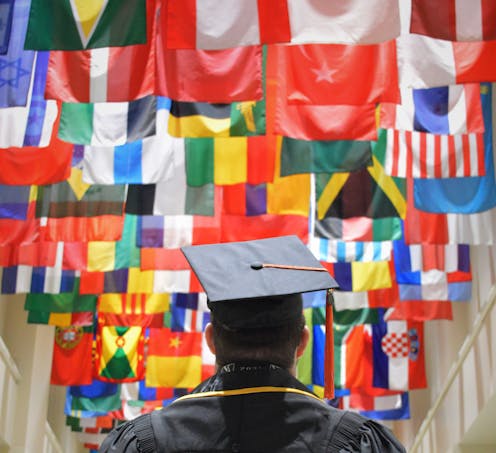
How to avoid seeing disturbing content on social media and protect your peace of mind

Source: The Conversation – USA – By Annie Margaret, Teaching Assistant Professor of Creative Technology & Design, ATLAS Institute, University of Colorado Boulder
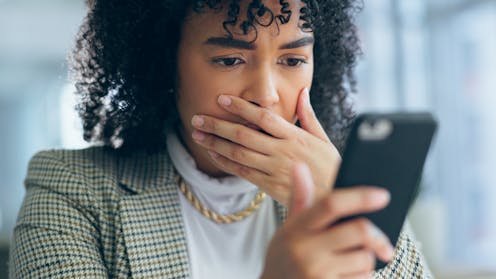
Social media often serves up disturbing images but you can minimize your exposure. Jacob Wackerhausen/iStock via Getty Images

When graphic videos go viral, like the recent fatal shooting of Charlie Kirk, it can feel impossible to protect yourself from seeing things you did not consent to see. But there are steps you can take.

Social media platforms are designed to maximize engagement, not protect your peace of mind. The major platforms have also reduced their content moderation efforts over the past year or so. That means upsetting content can reach you even when you never chose to watch it.

You do not have to watch every piece of content that crosses your screen, however. Protecting your own mental state is not avoidance or denial. As a researcher who studies ways to counteract the negative effects of social media on mental health and well-being, I believe it’s a way of safeguarding the bandwidth you need to stay engaged, compassionate and effective.

Why this matters

Research shows that repeated exposure to violent or disturbing media can increase stress, heighten anxiety and contribute to feelings of helplessness. These effects are not just short-term. Over time, they erode the emotional resources you rely on to care for yourself and others.

Protecting your attention is a form of care. Liberating your attention from harmful content is not withdrawal. It is reclaiming your most powerful creative force: your consciousness.

Just as with food, not everything on the table is meant to be eaten. You wouldn’t eat something spoiled or toxic simply because it was served to you. In the same way, not every piece of media laid out in your feed deserves your attention. Choosing what to consume is a matter of health.

And while you can choose what you keep in your own kitchen cabinets, you often have less control over what shows up in your feeds. That is why it helps to take intentional steps to filter, block and set boundaries.

Practical steps you can take

Fortunately, there are straightforward ways to reduce your chances of being confronted with violent or disturbing videos. Here are four that I recommend:

  1. Turn off autoplay or limit sensitive content. Note that these settings can vary depending on device, operating system and app version, and can change.
  1. Use keyword filters. Most platforms allow you to mute or block specific words, phrases or hashtags. This reduces the chance that graphic or violent content slips into your feed.

  2. Curate your feed. Unfollow accounts that regularly share disturbing images. Follow accounts that bring you knowledge, connection or joy instead.

  3. Set boundaries. Reserve phone-free time during meals or before bed. Research shows that intentional breaks reduce stress and improve well-being.

a settings screen with a red rectangle around one option
Where to turn off autoplay in your account on Facebook’s website.
Screen capture by The Conversation, CC BY-ND

Reclaim your agency

Social media is not neutral. Its algorithms are engineered to hold your attention, even when that means amplifying harmful or sensational material. Watching passively only serves the interests of the social media companies. Choosing to protect your attention is a way to reclaim your agency.

The urge to follow along in real time can be strong, especially during crises. But choosing not to watch every disturbing image is not neglect; it is self-preservation. Looking away protects your ability to act with purpose. When your attention is hijacked, your energy goes into shock and outrage. When your attention is steady, you can choose where to invest it.

You are not powerless. Every boundary you set – whether it is turning off autoplay, filtering content or curating your feed – is a way of taking control over what enters your mind. These actions are the foundation for being able to connect with others, help people and work for meaningful change.

More resources

I’m the executive director of the Post-Internet Project, a nonprofit dedicated to helping people navigate the psychological and social challenges of life online. With my team, I designed the evidence-backed PRISM intervention to help people manage their social media use.

Our research-based program emphasizes agency, intention and values alignment as the keys to developing healthier patterns of media consumption. You can try the PRISM process for yourself with an online class I am launching through Coursera in October 2025. You can find the course, Values Aligned Media Consumption, by searching for Annie Margaret at the University of Colorado Boulder on Coursera. The course is aimed at anyone 18 and over, and the videos are free to watch.

The Conversation

Annie Margaret works for/consults to Post Internet Project. She receives funding from University of Colorado Boulder PACES grant.

ref. How to avoid seeing disturbing content on social media and protect your peace of mind – https://theconversation.com/how-to-avoid-seeing-disturbing-content-on-social-media-and-protect-your-peace-of-mind-265178

Yes, this is who we are: America’s 250-year history of political violence

Source: The Conversation – USA – By Maurizio Valsania, Professor of American History, Università di Torino

Punishment by tar and feather of Thomas Ditson, who purchased a gun from a British soldier in Boston in March 1775. Interim Archives/Getty Images

The day after conservative activist Charlie Kirk was shot and killed while speaking at Utah Valley University, commentators repeated a familiar refrain: “This isn’t who we are as Americans.”

Others similarly weighed in. Whoopi Goldberg on “The View” declared that Americans solve political disagreements peacefully: “This is not the way we do it.”

Yet other awful episodes come immediately to mind: President John F. Kennedy was shot and killed on Nov. 22, 1963. More recently, on June 14, 2025, Melissa Hortman, speaker emerita of the Minnesota House of Representatives, was shot and killed at her home, along with her husband and their golden retriever.

As a historian of the early republic, I believe that seeing this violence in America as distinct “episodes” is wrong.

Instead, they reflect a recurrent pattern.

American politics has long personalized its violence. Time and again, history’s advance has been imagined to depend on silencing or destroying a single figure – the rival who becomes the ultimate, despicable foe.

Hence, to claim that such shootings betray “who we are” is to forget that the U.S. was founded upon – and has long been sustained by – this very form of political violence.

A fuzzy photo of a large car with a woman leaning over in the back seat to help a slumped man next to her.
First lady Jacqueline Kennedy leans over to assist her husband, John F. Kennedy, just after he is shot in Dallas, Texas, on Nov. 22, 1963.
Bettman/Getty Images

Revolutionary violence as political theater

The years of the American Revolution were incubated in violence. One abominable practice used on political adversaries was tarring and feathering. It was a punishment imported from Europe and popularized by the Sons of Liberty in the late 1760s, Colonial activists who resisted British rule.

In seaport towns such as Boston and New York, mobs stripped political enemies, usually suspected loyalists – supporters of British rule – or officials representing the king, smeared them with hot tar, rolled them in feathers, and paraded them through the streets.

The effects on bodies were devastating. As the tar was peeled away, flesh came off in strips. People would survive the punishment, but they would carry the scars for the rest of their life.

By the late 1770s, the Revolution in what is known as the Middle Colonies had become a brutal civil war. In New York and New Jersey, patriot militias, loyalist partisans and British regulars raided across county lines, targeting farms and neighbors. When patriot forces captured loyalist irregulars – often called “Tories” or “refugees” – they frequently treated them not as prisoners of war but as traitors, executing them swiftly, usually by hanging.

In September 1779, six loyalists were caught near Hackensack, New Jersey. They were hanged without trial by patriot militia. Similarly, in October 1779, two suspected Tory spies captured in the Hudson Highlands were shot on the spot, their execution justified as punishment for treason.

To patriots, these killings were deterrence; to loyalists, they were murder. Either way, they were unmistakably political, eliminating enemies whose “crime” was allegiance to the wrong side.

An old portrait of an older man in a black robe.
In 1798, Henry Brockholst Livingston – later a U.S. Supreme Court justice – killed James Jones in a duel. It did not affect his career.
US Supreme Court

Pistols at dawn: Dueling as politics

Even after independence, the workings of American politics remained grounded in a logic of violence toward adversaries.

For national leaders, the pistol duel was not just about honor. It normalized a political culture where gunfire itself was treated as part of the debate.

The most famous duel, of course, was Aaron Burr’s killing of Alexander Hamilton in 1804. But scores of lesser-known confrontations dotted the decade before it.

In 1798, Henry Brockholst Livingston – later a U.S. Supreme Court justice – killed James Jones in a duel. Far from discredited, he was deemed to have acted honorably. In the early republic, even homicide could be absorbed into politics when cloaked in ritual. Ironically, Livingston had survived an assassination attempt in 1785.

In 1802, another shameful spectacle unfolded: New York Democratic-Republicans DeWitt Clinton and John Swartwout faced off in Weehawken, New Jersey. They fired at least five rounds before their seconds intervened, leaving both men wounded. In this case, the clash had nothing to do with political principle; Clinton and Swartwout were Republicans. It was a patronage squabble that still erupted into gunfire, showing how normalized armed violence was in settling disputes.

Gun culture and its expansion

A small, antique pistol.
One of the matching pair of derringer pistols used by John Wilkes Booth in the assassination of President Abraham Lincoln in 1865.
Bob Grieser/Los Angeles Times via Getty Images

It is tempting to dismiss political violence as a leftover from some “primitive” or “frontier” stage of American history, when politicians and their supporters supposedly lacked restraint or higher moral standards. But that is not the case.

From before the Revolution onward, physical punishment or even killing were ways to enforce belonging, to mark the boundary between insiders and outsiders, and to decide who had the right to govern.

Violence has never been a distortion in American politics. It has been one of its recurring features, not an aberration but a persistent force, destructive and yet oddly creative, producing new boundaries and new regimes.

The dynamic only deepened as gun ownership expanded. In the 19th century, industrial arms production and aggressive federal contracts put more weapons into circulation. The rituals of punishing those with the wrong allegiance now found expression in the mass-produced revolver and later in the automatic rifle.

These more modern firearms became not only practical tools of war, crime or self-defense but symbolic objects in their own right. They embodied authority, carried cultural meaning and gave their holders the sense that legitimacy itself could be claimed at the barrel of a gun.

That’s why the phrase “This isn’t who we are” rings false. Political violence has always been part of America’s story, not a passing anomaly, and not an episode.

To deny it is to leave Americans defenseless against it. Only by facing this history head-on can Americans begin to imagine a politics not defined by the gun.

The Conversation

Maurizio Valsania does not work for, consult, own shares in or receive funding from any company or organization that would benefit from this article, and has disclosed no relevant affiliations beyond their academic appointment.

ref. Yes, this is who we are: America’s 250-year history of political violence – https://theconversation.com/yes-this-is-who-we-are-americas-250-year-history-of-political-violence-265171

Scientists detected a potential biosignature on Mars – an astrobiologist explains what these traces of life are, and how researchers figure out their source

Source: The Conversation – USA – By Amy J. Williams, Assistant Professor of Geology, University of Florida

NASA’s Perseverance rover explores Mars’ Jezero Crater. NASA/JPL-Caltech/MSSS, CC BY-NC

As the Perseverance rover traversed an ancient river valley in Mars’ Jezero Crater back in July 2024, it drilled into the surface and extracted a sample from of a unique, striped rock called Chevaya Falls. The rover’s instruments then analyzed the sample, which is called Sapphire Canyon, and surveyed the surrounding rock.

When scientists started looking into the data, they found two types of iron-rich minerals arranged on the rock in a distinctive, spotted pattern. Both these minerals are associated with life on Earth. One is found around decomposing organic matter on Earth, while the other is produced by certain microbes.

A team of researchers determined in a study published Sept. 10, 2025, that the sample contains a potential biosignature – which could suggest the red planet once hosted microbial life.

These minerals may have formed on the rock when ancient microbes used chemical reactions to produce energy. But chemical reactions not related to life can also produce these minerals under certain conditions.

To learn more, The Conversation U.S. asked Amy J. Williams, an astrobiologist at the University of Florida, about biosignature hunting on Mars and what’s so special about this Sapphire Canyon sample.

What are biosignatures?

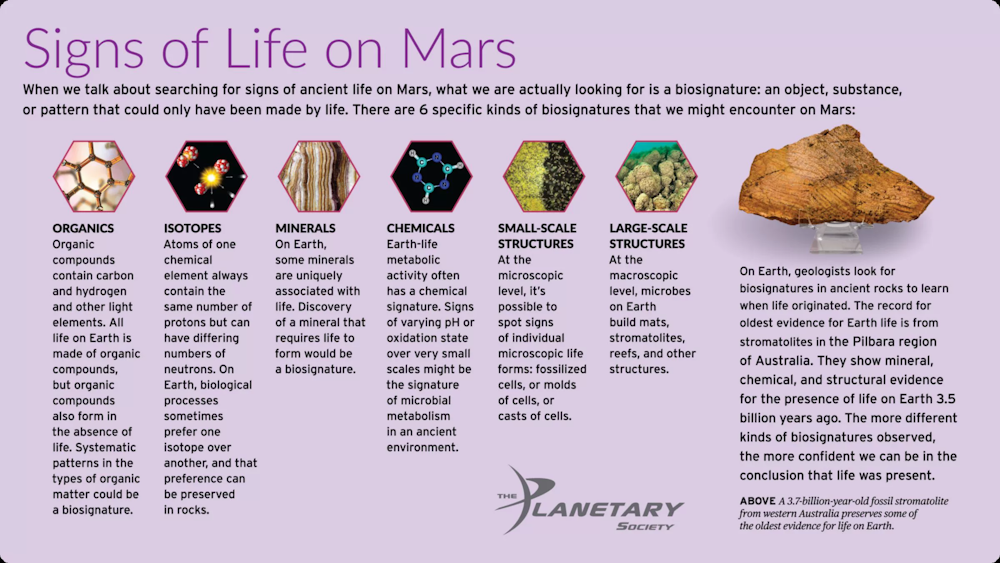
A biosignature is any characteristic, element, molecule, substance or feature that serves as evidence for past or present life. It must be something that cannot be produced without life. Some examples include fossils, organic molecules derived from a biological process, or mineral patterns that form only through microbial activity.

An infographic showing six types of biosignatures, including organics, isotopes, minerals, chemicals, small-scale and large-scale structures
There are six types of biosignatures that scientists may find on Mars.
The Planetary Society, CC BY

A potential biosignature, which is how the Sapphire Canyon finding is described, is a substance or structure that might have a biological origin but requires more data or further study before scientists can make a conclusion about the absence or presence of life.

How do scientists determine whether something could be a biosignature on Mars?

Biosignatures come in many different flavors – chemical, physical or structural. Some are rather obvious, like a dinosaur fossil on Earth, but most are far more nuanced.

The search for ancient life on Earth partially informs the search for biosignatures on Mars. Researchers rely on subtle clues preserved in the rock record to address questions such as how long ago microbial life arose on Earth. We search for that evidence in environments such as craters and lake beds with high preservation potential, meaning those that are likely to preserve the biosignatures.

Scientists can apply these techniques to the search for life on Mars. That is why Perseverance was sent to Jezero Crater. In the ancient past, the crater hosted a river-fed lake, which on Earth would represent a habitable environment: one where life would want to live if it ever arose.

This crater was an ideal location to search for ancient life preserved in the rock record on Mars. Astrobiologists then search for chemical, textural and mineral patterns that resemble processes influenced by life back on Earth.

What makes this sample unique and interesting?

The Sapphire Canyon sample is unique because Perseverance’s PIXL and SHERLOC instruments revealed distinctive textures that were dubbed “leopard spots.” These spots are concentric reaction fronts – places where chemical and physical reactions occur – enriched in the minerals vivianite, which contains iron phosphate, and greigite, which is made of iron sulfide.

Dusty rocks on the surface of Mars, speckled with dark spots.
Chevaya Falls, a rock in the Martian Jezero Crater, is speckled with ‘leopard spots,’ which could indicate chemical reactions that may have once supported ancient life.
NASA/JPL-Caltech/MSSS

On Earth, vivianite often forms in environments with lots of decaying organic matter, while certain microbes that use sulfate for energy can produce greigite. Compounds in both these minerals are part of a chemical process called redox gradients, which refers to a series of gradual changes over physical space where chemicals can oxidize (lose electrons) or reduce (gain electrons).

One example is leaving your metal bike out in the rain. Over time, the reduced iron (Fe2+) will lose an electron and oxidize to rust (Fe3+). This process can happen nonbiologically, as exposure to water and oxygen drive the chemical changes that take your new bike to a rusty bike – I suggest not leaving it in the rain.

But some oxidation and reduction processes are so slow on their own that the only way they can occur is with living organisms that push the reactions forward. This process is how many microbes, such as bacteria, get the energy to live. Because these two minerals in the Sapphire Canyon sample both occur in redox gradients, scientists predict that microbial life, if it was ever present, could have played a role in the reactions that created these mineral signatures.

Now, scientists are looking into the explanations that wouldn’t require life to form these features on the sample.

Did scientists expect to find a sample like this?

This was a finding that we had hoped for. However, it was somewhat unexpected in this particular location. This sample came from some of the youngest sedimentary rocks the mission has investigated to date. An earlier prediction had assumed signs of ancient life would come from older Martian rock formations.

Finding these features in younger rocks widens the window of time that Mars was potentially habitable and suggests that Mars could have been habitable later in the planet’s history than scientists previously thought, and older rocks might also hold signs of life that are simply harder to detect.

NASA hosted a press conference on Sept. 10, 2025, about the mysterious sample.

What are the next steps to tell whether the sample indicates signs of past life, or whether the signature is from a nonbiological process?

The mineral associations are a potential fingerprint for those redox reactions that can occur when microbes drive the reaction forward – but abiotic processes, such as sustained high temperatures, acidic conditions and binding by organic compounds, could also explain them.

However, the Cheyava Falls rock shows no signs that it’s been exposed to the high heat or acidity usually required for greigite and vivianite to form nonbiologically. Still, the only definitive way to answer this question is to return the sample to Earth, where scientists can use advanced laboratory techniques to distinguish biological from nonbiological origins.

The Conversation

Amy J. Williams receives funding from NASA and is a scientist on the NASA Mars 2020 Perseverance rover mission.

ref. Scientists detected a potential biosignature on Mars – an astrobiologist explains what these traces of life are, and how researchers figure out their source – https://theconversation.com/scientists-detected-a-potential-biosignature-on-mars-an-astrobiologist-explains-what-these-traces-of-life-are-and-how-researchers-figure-out-their-source-265157

¿Qué implica para España el ataque ruso con drones en Polonia?

Source: The Conversation – (in Spanish) – By Armando Alvares Garcia Júnior, Professor de Direito Internacional, Relações Internacionais e Geopolítica/Geoeconomia, UNIR – Universidad Internacional de La Rioja

Soldados polacos en la zona donde impactó uno de los drones rusos. RTVE

Durante la madrugada del 10 de septiembre, Europa experimentó uno de los incidentes de seguridad más graves de su historia reciente: una formación de drones rusos atravesó el espacio aéreo polaco en el marco de una ofensiva sobre Ucrania y fue abatida por cazas de la OTAN.

Uno de estos aparatos impactó en la localidad de Wyryki-Wola, lo que activó alertas en toda la estructura de defensa euroatlántica y evidenció la vulnerabilidad de la frontera oriental de la Alianza.

La penetración de 19 drones en territorio polaco, en paralelo a un ataque masivo sobre Ucrania, puede o no entenderse como un accidente. Las autoridades polacas, por ejemplo, interpretaron el episodio como un gesto de fuerza diseñado para poner a prueba tanto la unidad política como la capacidad operativa de la OTAN ante amenazas híbridas y directas por parte de Rusia.

Este tipo de incursiones obliga a repensar los límites físicos y jurídicos de la disuasión colectiva y pone en jaque los mecanismos tradicionales de control de escalada.

La activación inmediata del artículo 4 del Tratado del Atlántico Norte respondió a la percepción de un peligro directo a la integridad y soberanía polacas. Aunque esa disposición legal no implica un compromiso automático de defensa militar conjunta (como el artículo 5), sí obliga a consultas diplomáticas urgentes para coordinar la posición aliada y calibrar la naturaleza jurídica e internacional de la amenaza.

Esta herramienta ha sido empleada solo en contadas ocasiones, reflejando la gravedad de la situación y la importancia del consenso intergubernamental en la respuesta.

¿Cuál es el compromiso de España con la OTAN?

España ha reforzado este año su compromiso con la defensa colectiva de la OTAN, liderando desde julio la Brigada Multinacional en Eslovaquia, con base en Lešť, donde mantiene desplegados alrededor de 828 efectivos en el que es su contingente exterior más numeroso.

También participa en la Presencia Avanzada Reforzada (Enhanced Forward Presence) mediante despliegues rotatorios y ejercicios periódicos en el flanco oriental, como el reciente NATO’s Forge 2025 en Letonia, en el que contribuyó con tanques Leopard 2E, vehículos Pizarro y sistemas antiaéreos NASAMS, además de rotaciones temporales en Polonia y Lituania.

Igualmente, España aporta cazas Eurofighter y otros medios a misiones de policía aérea y vigilancia, como el Baltic Air Policing y operaciones en Islandia y Rumanía, reforzando su perfil como aliado clave tanto en la OTAN como en la Brújula Estratégica de la Unión Europea, que integra esfuerzos en inteligencia, ciberseguridad y protección de infraestructuras críticas.

Esta proyección exterior no exime a las autoridades españolas de sus responsabilidades jurídicas en plan doméstico. Cualquier aumento significativo del despliegue militar o modificación sustancial de las reglas de enfrentamiento debe someterse a un proceso de debate y aprobación en el Parlamento, asegurando un control democrático efectivo sobre las misiones internacionales y el cumplimiento de los compromisos asumidos por España en el marco del derecho internacional.

Este procedimiento resulta esencial en contextos donde la línea que separa la disuasión de un conflicto abierto se vuelve especialmente difusa.

Diferentes países, estrategias distintas

El incidente de los drones evidencia la existencia de estrategias divergentes dentro de la Alianza y la Unión Europea. Polonia y los Estados bálticos exigen medidas inmediatas de refuerzo y nuevas rondas de sanciones, mientras Alemania y Francia apuestan por una respuesta gradual y diplomática para evitar su escalada.

La administración estadounidense mantiene, bajo la presidencia de Trump, un discurso ambiguo que limita la cohesión estratégica, introduciendo un factor de incertidumbre en las capitales europeas.

En el seno de la Unión Europea, el debate sobre autonomía estratégica se acelera. Kaja Kallas, como Alta Representante para la Política Exterior, abogó por ampliar sanciones contra intermediarios energéticos y acelerar la implantación de la Brújula Estratégica. Esto no tiene otro objetivo que dotar a la UE de mayor capacidad militar autónoma que complemente y refuerce al sistema OTAN sin superponer competencias.

Más allá del plano militar, la reciente invasión del espacio aéreo polaco –siempre considerando la necesidad de datos contrastados y evitando conclusiones precipitadas ante la proliferación de relatos poco verificados– genera efectos económicos y energéticos inmediatos. Las turbulencias en los mercados tienden a incrementar los precios de la electricidad y el transporte en toda la Unión Europea, con un impacto directo sobre los consumidores españoles y de otros Estados miembros.

El riesgo de que este tipo de agresiones evolucione hacia escenarios híbridos –combinando operaciones cinéticas con campañas de desinformación y ataques cibernéticos– obliga a reforzar la estrategia española, especialmente en la protección de infraestructuras críticas, inteligencia y ciberseguridad, tanto a escala nacional como comunitaria.

A esto se añade que, según recientes estudios y análisis europeos, España y el sur de Europa han sido identificados como objetivos de campañas de desinformación y sabotaje de origen externo, requiriendo una cooperación aún mayor en resiliencia y defensa digital.

El respeto a la integridad territorial, consagrada en la Carta de las Naciones Unidas, sirve de base para las consultas en la OTAN y la posible elevación del caso ante instituciones multilaterales. Del mismo modo, la legitimidad de cualquier uso de la fuerza defensiva debe quedar inscrita tanto en las resoluciones de la Alianza como en la normativa constitucional de cada Estado miembro, especialmente España, cuya práctica constitucional refuerza el carácter parlamentario de las grandes decisiones estratégicas.

¿A qué se enfrenta ahora la Alianza Atlántica?

La Alianza Atlántica se enfrenta a una encrucijada, en la que la unidad y la rapidez de respuesta serán vitales para evitar fracturas que puedan debilitar su capacidad de disuasión y defensa. El despliegue español, su participación en ejercicios multinacionales y las lecciones aprendidas en operaciones preventivas reflejan tanto el compromiso europeo como la necesidad de dotar a las decisiones de legitimidad democrática y multilateral.

En este escenario, España asume tanto una responsabilidad militar como también diplomática, institucional y social, contribuyendo a la estabilidad colectiva sin descuidar los principios del derecho internacional y la garantía del control parlamentario.

El desafío de la frontera oriental evidencia que la defensa europea requiere respuestas integrales, cooperación avanzada y una interpretación dinámica del derecho internacional en tiempos de crisis.

The Conversation

Armando Alvares Garcia Júnior no recibe salario, ni ejerce labores de consultoría, ni posee acciones, ni recibe financiación de ninguna compañía u organización que pueda obtener beneficio de este artículo, y ha declarado carecer de vínculos relevantes más allá del cargo académico citado.

ref. ¿Qué implica para España el ataque ruso con drones en Polonia? – https://theconversation.com/que-implica-para-espana-el-ataque-ruso-con-drones-en-polonia-265155

Les animaux de compagnie sont-ils des gages de bonheur ? Des recherches apportent des bémols

Source: The Conversation – in French – By Christophe Gagné, PhD candidate, Psychology, Université du Québec à Montréal (UQAM)

Les gens se tournent souvent vers les animaux de compagnie pour améliorer leur humeur et trouver de la compagnie. Améliorer le bien-être et réduire la solitude font partie des raisons les plus souvent citées pour adopter un animal.

La croyance selon laquelle les animaux de compagnie apportent de nombreux bienfaits à leurs propriétaires est très répandue, mais des recherches montrent qu’avoir un animal n’est pas une panacée pour la santé psychologique.

Malgré cela, les animaux de compagnie sont souvent présentés dans les médias et sur les réseaux sociaux comme des solutions efficaces pour réduire le stress et la solitude, entretenant l’idée répandue de leurs bienfaits pour la santé. Cela peut inciter les gens à adopter des animaux de compagnie sans tenir pleinement compte des responsabilités et des exigences que cela implique, ce qui peut avoir des conséquences négatives tant pour eux-mêmes que pour leurs animaux.

En tant que psychologues sociaux étudiant les relations entre les humains et les animaux de compagnie, nous adoptons une approche plus nuancée, en examinant quand, comment et pour qui les animaux de compagnie peuvent — ou non — améliorer le bien-être.

Ce que dit la recherche

De nombreuses études ont montré que les propriétaires d’animaux de compagnie sont moins anxieux, se sentent moins seuls et moins stressés que les personnes qui n’en ont pas. Les propriétaires d’animaux domestiques se déclarent également plus satisfaits de leur vie.

Ces études retiennent souvent notre attention, car elles font écho à une croyance largement répandue : nos animaux domestiques sont bons pour nous. Ce type de recherche rassure et valide le lien profond que nous pouvons ressentir avec nos compagnons. Mais elles ne montrent qu’un seul côté de la médaille.

D’autres études n’ont trouvé aucun lien significatif entre le fait d’avoir un animal de compagnie et le bien-être humain. En fait, les personnes qui ont des animaux de compagnie ne déclarent pas nécessairement un bien-être plus élevé ni une meilleure santé mentale que celles qui n’en ont pas.

Notre étude sur le rôle des animaux de compagnie dans le bien-être humain, menée au Canada pendant la pandémie de Covid-19, a donné des résultats surprenants : elle a révélé qu’avoir un animal de compagnie était généralement associé à un bien-être et une santé mentale moindres.

L’étude portait à la fois sur des propriétaires d’animaux de compagnie et des personnes sans animaux, dans le but de comparer les deux groupes au niveau de différents indicateurs de bien-être pendant la pandémie. Les propriétaires d’animaux ont déclaré un bien-être inférieur à celui des non-propriétaires pendant cette période, notamment des niveaux de solitude plus élevés.

Ces incohérences entre les différentes études montrent que le lien entre le fait d’avoir un animal de compagnie et le bien-être n’est pas si simple. Notre étude a révélé certaines de ces nuances. Par exemple, par rapport aux propriétaires d’autres animaux de compagnie, les propriétaires de chiens ont déclaré un bien-être plus élevé.

Pour comprendre ces résultats mitigés, les chercheurs ont commencé à examiner de plus près la nature de la relation entre les propriétaires et leurs animaux de compagnie. Cette approche pourrait nous aider à mieux comprendre les facteurs qui font en sorte que la présence d’un animal de compagnie soit bénéfique au bien-être.

La qualité du lien

Tout comme nos relations avec les autres êtres humains, le lien qui nous unit à nos animaux de compagnie est complexe. De nombreux aspects de cette relation peuvent influencer les bienfaits que nous en tirons. Ce n’est pas seulement le fait d’avoir un animal de compagnie qui compte, mais aussi la façon dont nous tissons des liens avec eux et interagissons avec eux.

Par exemple, les propriétaires qui ressentent plus d’anxiété à l’idée d’être séparés de leur animal, ou qui remettent davantage en question l’affection de celui-ci, ce qui reflète un attachement inquiet à l’animal, disent également se sentir plus déprimés. Le fait de percevoir nos animaux de compagnie comme moins compréhensifs ou plus insensibles à nos besoins est également associé à des niveaux plus élevés de dépression, d’anxiété et de solitude.


À lire aussi :
Les bienfaits des animaux de compagnie sont connus. Il faut s’attaquer aux obstacles qui empêchent certains d’en profiter


À l’inverse, plus les gens ont le sentiment de partager des caractéristiques avec leurs animaux de compagnie (par exemple, la loyauté, la paresse), plus ils sont susceptibles de rapporter un bien-être plus élevé. Les animaux de compagnie sont également perçus comme vivant dans le présent, sans s’attarder sur le passé ni s’inquiéter pour l’avenir. Interagir en faisant preuve de présence attentive avec nos animaux peut nous aider à nous concentrer sur le moment présent, ce qui favorise également un plus grand bien-être.

En cultivant les aspects positifs de nos relations avec nos animaux de compagnie et en travaillant sur les aspects plus difficiles, nous pouvons atténuer le stress lié à certains des défis que représente leur prise en charge, notamment les ressources financières nécessaires ou l’anxiété que nous ressentons lorsqu’ils tombent malades.

Avoir un animal de compagnie : les défis

En réalité, avoir un animal de compagnie s’accompagne de responsabilités et de défis qui ne semblent pas être abordés aussi souvent que les avantages. Ces aspects plus difficiles de la prise en charge d’un animal de compagnie peuvent parfois être éprouvants sur le plan émotionnel et nuire au bien-être psychologique du propriétaire.

Avoir des animaux de compagnie, même si on les aime beaucoup, demande du temps, de l’énergie et des ressources financières. Pour certains, cette responsabilité peut représenter une source supplémentaire de stress. Dans notre étude, le fait d’avoir un animal de compagnie était associé, durant la pandémie de Covid-19, à un bien-être moindre chez les femmes et chez les personnes ayant deux enfants ou plus à la maison, des groupes déjà confrontés à des exigences accrues liées aux enfants et aux tâches ménagères.


Déjà des milliers d’abonnés à l’infolettre de La Conversation. Et vous ? Abonnez-vous gratuitement à notre infolettre pour mieux comprendre les grands enjeux contemporains.


De même, avoir un animal de compagnie était associée à un bien-être moindre chez les personnes sans emploi ou ayant un emploi moins stable (par exemple, les étudiants, les personnes au foyer). Des ressources financières limitées pouvaient rendre plus difficile la prise en charge de l’animal.

De même, devoir s’occuper d’un animal malade peut être éprouvant sur le plan émotionnel pour les propriétaires. Les personnes qui s’occupent de chiens atteints d’une maladie chronique déclarent se sentir désespérées et impuissantes, en particulier lorsqu’elles ne peuvent pas soulager la souffrance de leur animal.

D’autres facteurs, tels que les problèmes de comportement d’un animal et le deuil vécu après la perte d’un animal de compagnie, peuvent également être difficiles à vivre pour les propriétaires. Pour ceux qui envisagent d’adopter un animal, il est important de tenir compte de ces réalités afin de prendre une décision éclairée.

Répondre aux besoins de notre animal

Il y a de nombreux facteurs importants à prendre en compte avant d’accueillir un nouvel animal de compagnie dans notre maison. Avant tout, nous devons nous assurer que nous avons le temps, l’énergie et les ressources nécessaires pour répondre à ses besoins.

Choisir un animal de compagnie avec soin, en fonction de ce que nous pouvons réellement lui offrir et sur la base d’informations fiables concernant ses caractéristiques et ses besoins, nous donne les meilleures chances d’avoir une relation positive et épanouie.

Répondre aux besoins de nos animaux de compagnie peut également améliorer notre propre bien-être en tant que propriétaires, démontrant ainsi le potentiel des relations interespèces mutuellement bénéfiques. Mais lorsque ces besoins ne sont pas satisfaits, les animaux de compagnie et leurs propriétaires peuvent finir par se sentir stressés et anxieux.

Lorsque l’on envisage d’adopter un animal de compagnie, il est important de se poser la question suivante : pourquoi voulons-nous un animal de compagnie ? Si l’idée est d’améliorer notre bien-être psychologique, nos recherches suggèrent qu’il faudrait peut-être y réfléchir à deux fois.

La Conversation Canada

Catherine Amiot fait partie du conseil d’administration émergent de la PHAIR Society, une société savante qui vise à promouvoir la recherche sur les relations intergroupes entre les humains et les animaux. Elle a reçu du financement du Conseil de recherches en sciences humaines du Canada (CRSH) et du Fonds de recherche du Québec – Santé (FRQS) pour les recherches menées dans son laboratoire et présentées dans cet article.

Christophe Gagné ne travaille pas, ne conseille pas, ne possède pas de parts, ne reçoit pas de fonds d’une organisation qui pourrait tirer profit de cet article, et n’a déclaré aucune autre affiliation que son organisme de recherche.

ref. Les animaux de compagnie sont-ils des gages de bonheur ? Des recherches apportent des bémols – https://theconversation.com/les-animaux-de-compagnie-sont-ils-des-gages-de-bonheur-des-recherches-apportent-des-bemols-263144

Millennial pink, Gen-Z Yellow, Brat Green… Décris-moi tes couleurs préférées, je devinerai ta génération

Source: The Conversation – France (in French) – By Sabine Ruaud, Professeur de marketing, EDHEC Business School

Chaque époque a ses couleurs emblématiques : les pastels rassurants des boomers, le rose poudré des milléniaux, le jaune éclatant et le vert tape-à-l’œil de la Gen Z. Reflets d’émotions collectives et de tendances sociétales, ces teintes en disent souvent plus long que de simples effets de mode.


Chaque génération semble s’approprier certaines teintes, mais il serait réducteur d’y voir une donnée biologique ou universelle. Si la couleur est l’effet visuel résultant de la composition spectrale de la lumière qui est envoyée, transmise ou réfléchie par des objets, la façon dont on l’envisage est avant tout une construction sociale et culturelle qui reflète les mœurs, les évolutions idéologiques et les influences médiatiques d’une époque.

En effet, comme l’a commenté Michel Pastoureau, ce n’est pas la nature qui fait les couleurs ni même l’œil ou le cerveau, mais la société qui leur attribue des significations variables selon les époques. Elles deviennent ainsi des témoins privilégiés des mutations de chaque décennie.

Dans un chapitre récemment publié, « La couleur, marqueur créatif générationnel ? », nous nous sommes intéressés à la façon dont les générations successives se caractérisent par un ensemble de valeurs, de croyances et de comportements qui se manifestent visuellement, notamment à travers des couleurs qui leur sont propres.

Ainsi, la segmentation par générations – boomers, générations X, Y, Z, Alpha – permet d’observer des affinités chromatiques qui ne relèvent pas seulement du goût individuel, mais d’un rapport collectif au temps, aux aspirations et aux codes esthétiques dominants.

À chaque génération, son code couleur

Les boomers (nés entre la fin de la Seconde Guerre mondiale et le milieu des années 1960, ndlr– et la génération X (née entre 1965 et 1980) se caractérisent par une préférence pour des palettes dites traditionnelles, dominées par des tons neutres et pastels auxquels s’ajoutent, à partir des années 1970, des couleurs inspirées de la nature comme les verts, les bruns et les rouges terreux.

La génération Y, ou les millennials (en français, les milléniaux ; nés entre 1980 et le milieu des années 1990, ndlr), a quant à elle été marquée par l’émergence d’un rose emblématique, le « millennial Pink ». Plus qu’une simple teinte, ce rose pâle s’est imposé dans les années 2010 comme un symbole de légèreté, d’optimisme et surtout de remise en question des codes de genre.

Pour la génération Z (née entre 1995 et 2010), c’est d’abord un jaune vif, le « Gen-Z Yellow », qui s’est imposé, au tournant de 2018, en contraste avec le rose singulier de ses aînés. Rapidement, le violet est venu compléter cette palette, couleur historiquement liée au pouvoir, à la créativité et aux luttes féministes et, désormais, associée à l’expression de soi et à l’inclusivité. Plus récemment, le vert a gagné en importance : d’un côté, comme couleur associée aux enjeux écologiques, fréquemment mobilisée et récupérée dans le champ politique ; de l’autre, comme tendance numérique et provocante, le « Brat Green », popularisé, en 2024, par la chanteuse britannique Charli XCX.

La génération Alpha, encore en formation, oscille pour sa part entre un attrait pour les tons naturels et réconfortants et une exposition précoce aux couleurs franches et artificielles de l’univers digital.

S’ancrer dans son époque

Si ces repères générationnels sont séduisants, il est essentiel de ne pas les figer. Les couleurs ne se laissent pas réduire à des étiquettes fixes : elles vivent, elles circulent, elles se réinventent. Elles reviennent parfois de manière cyclique, à l’image de la mode, et se rechargent de nouvelles significations. C’est ce qui rend la couleur si puissante dans la communication. Elle permet d’ancrer une marque dans son époque tout en laissant place à la réinterprétation.

L’actualité chromatique de 2024–2025 en témoigne. À côté du vert néon insolent de l’album à succès Brat, de Charli XCX, l’entreprise Pantone a choisi « Mocha Mousse » comme couleur de l’année 2025, un brun cosy, gourmand et enveloppant qui traduit le besoin collectif de réassurance et d’ancrage. Le contraste entre ces deux signaux, l’un pop et ironique, l’autre discret et rassurant, illustre parfaitement la tension contemporaine entre exubérance et quête de stabilité.

Les recherches en marketing montrent, par ailleurs, que l’impact des couleurs ne réside pas seulement dans la teinte elle-même, mais aussi dans la manière dont elle est nommée.

Le « color naming » des marques

Le « color naming » a un effet direct sur la préférence et l’intention d’achat : un nom de produit évocateur, poétique ou humoristique génère davantage d’engagement qu’un terme générique. Ce phénomène, encore peu documenté, rappelle aux marques que les mots façonnent autant que les couleurs la perception des produits. L’excès d’humour peut toutefois brouiller la mémorisation de la marque, d’où la nécessité d’un dosage subtil

Pour les entreprises, l’enjeu est donc double. Il s’agit, d’une part, de comprendre les codes chromatiques ponctuels qui circulent dans une génération donnée, afin de parler un langage immédiatement perceptible, et, d’autre part, de créer un système de couleurs qui reste cohérent et durable dans le temps.

Parler de « couleurs de génération » reste un outil utile de décryptage, mais uniquement si l’on accepte sa plasticité. Pour chaque génération, la couleur est une passeuse de messages, un support de signes tacites ou exprimés de toutes sortes, un témoin clé dont les nuances suscitent des émotions, véhiculent des significations et procurent des expériences variées.

The Conversation

Les auteurs ne travaillent pas, ne conseillent pas, ne possèdent pas de parts, ne reçoivent pas de fonds d’une organisation qui pourrait tirer profit de cet article, et n’ont déclaré aucune autre affiliation que leur organisme de recherche.

ref. Millennial pink, Gen-Z Yellow, Brat Green… Décris-moi tes couleurs préférées, je devinerai ta génération – https://theconversation.com/millennial-pink-gen-z-yellow-brat-green-decris-moi-tes-couleurs-preferees-je-devinerai-ta-generation-260366

Fewer international students are coming to the US, costing universities and communities that benefit from these visitors

Source: The Conversation – USA (2) – By Tara Sonenshine, Edward R. Murrow Professor of Practice in Public Diplomacy, Tufts University

The international student population is expected to experience a dive in the fall of 2025. iStock/Getty Images Plus

American college campuses from Tucson to Tallahassee are buzzing with the familiar routine of students getting settled in classes and dorms.

One new trend, though, is emerging.

An estimated 30% to 40% fewer international students are expected on American college campuses in the fall of 2025, compared with trends in the 2024-2025 academic year, according to according to NAFSA: Association of International Educators – a nonprofit that focuses on international education – and JB International, a for-profit educational technology firm.

In total, an estimated 150,000 fewer international students were expected to arrive this fall, due to new visa restrictions and visa appointments being canceled at U.S. embassies and consulates in many countries, such as India, China, Nigeria and Japan. NAFSA and JB International are expected to release updated data on international student enrollment in November 2025.

There were over 1.1 million international students – more than half of whom were from China or India – on American college campuses in the 2023-2024 academic year, according to the Institute for International Education, which monitors foreign student programs and shares the most comprehensive available recent data.

This sharp drop in international students could cost the U.S. economy US$7 billion in the 2025-26 school year, according to estimates from NAFSA.

For every three international students in the U.S., one new American job is created or supported by the average $35,000 these students spend in their local communities on housing, food and transportation, and other costs.

As a senior fellow at the Fletcher School of Law and Diplomacy at Tufts University and a former undersecretary of state for public diplomacy in the Obama administration, I oversaw many of the student exchange programs involving multiple countries around the globe. I foresee a major economic crisis over international students that could last for years.

Two young Chinese women with dark hair hold red flags with yellow stars on them. One of the women wears a light blue graduation robe and smiles.
A Chinese Columbia University student and a friend attend graduation in May 2019.
Mark Lennihan/Associated Press

A growing trend, quickly reversed

International students began coming to the U.S. in the early 20th century, when philanthropists like the Carnegie, Rockefeller and Mott families sought out scholars from the U.S. to go overseas. These philanthropists helped create international fellowships and grants that later on would often be funded by the U.S. government – like the Fulbright program, which gives money to American students to spend time and research abroad.

By 1919, nonprofits like the Institute for International Education
were serving as mediators between foreign students and American universities.

International student enrollment in the U.S. has steadily risen since the end of World War II, coinciding with an emerging world that became easier and cheaper to travel across. While 26,000 foreign students came to the U.S. in the 1949–1950 school year, that number had ballooned to 286,343 three decades later.

In the 1990s, there were more than 400,000 international students attending school in the U.S. each year. That number continued to climb and surpassed 500,000 in the early 2000s.

International student enrollment in the U.S. first topped more than 1 million in the 2015-2016 school year.

While international students made up just 1% of the 2.4 million university and college students in the U.S. in 1949-50, they were about 6% of the total 18.9 million students in the U.S. in 2023-24, according to the Migration Institute, a nonpartisan research organization.

This percentage is relatively small, however, compared with the international student representation in other countries.

International students represented 38% of overall Canadian university enrollment, made up 31% of all university students in Australia and 27% of all students in the United Kingdom during the 2024-2025 school year.

Trump’s warnings to international students

Within the first 90 days of his return to office, President Donald Trump invoked the 1952 Immigration and Nationality Act, which gives the secretary of state the authority to expel foreign students whose behavior could pose a threat to U.S. foreign policy interests.

The administration has since revoked the visas of 6,000 foreign students, the State Department reported in August 2025.

There have also been several high-profile arrests of international students, including Rumeysa Ozturk, a Turkish student at Tufts University. Immigration and Customs Enforcement officials arrested Ozturk in March 2025 shortly after the administration revoked her visa. Her arrest came one year after she co-wrote an opinion piece calling for Tufts to recognize a genocide in the Gaza Strip and to divest from all companies with ties to Israel.

Secretary of State Marco Rubio defended Ozturk’s arrest, saying in March that the government will not give visas to people who come to the U.S. intending to do “things like vandalizing universities, harassing students, taking over buildings, creating a ruckus.”

A federal judge ruled in May that there was no evidence showing Ozturk posed a credible threat to the U.S. She was then released from an immigration detention facility.

But her arrest coincided with the arrest of other international students in high-profile cases, like Mahmoud Khalil, a Columbia graduate student and U.S. permanent resident who was arrested after he participated in Palestinian rights protests on campus. These arrests all sent a message to foreign students: It is not as safe as it once was to come to the U.S.

The administration has announced other changes that will make it more difficult for foreign students to spend time in the U.S. – like a 2025 travel ban that prohibits or restricts the entry of people from 19 countries, mostly in the Middle East and Africa.

The administration also announced in August that it plans to cap the length of time foreign students can stay in the U.S. to four years. Currently, foreign students have a 60-day grace period to stay in the U.S. following graduation, before they must secure a work visa or another kind of authorization to legally stay in the country.

A group of young people wear black robes and black graduation hats and walk together. Some of the people hold globes.
Harvard graduates exit the university’s commencement ceremony holding globes in May 2025.
Sydney Roth/Anadolu via Getty Images

A simple math equation

New York University, Northeastern University in Boston and Columbia University hosted the largest number of international students in 2023-2024. But international students are not concentrated in just major, liberal cities.

Arizona State University hosted the fourth-highest number of international students that school year, and Purdue University in Indiana and the University of North Texas also are among the 10 schools that host the total most international students.

All of these schools – and others, like Kansas City colleges and universities, which are now welcoming far fewer international students than they planned to in the spring because some of the students could not get visas – will feel the financial effects of turning international students away from the U.S.

Doing the math, I believe that a solid argument can be made for increasing the numbers of foreign students coming to the U.S., not cutting back.

The Conversation

Tara Sonenshine does not work for, consult, own shares in or receive funding from any company or organization that would benefit from this article, and has disclosed no relevant affiliations beyond their academic appointment.

ref. Fewer international students are coming to the US, costing universities and communities that benefit from these visitors – https://theconversation.com/fewer-international-students-are-coming-to-the-us-costing-universities-and-communities-that-benefit-from-these-visitors-264012

Beauty sleep isn’t a myth – a sleep medicine expert explains how rest keeps your skin healthy and youthful

Source: The Conversation – USA (3) – By Joanna Fong-Isariyawongse, Associate Professor of Neurology, University of Pittsburgh

Getting enough sleep is one of the most accessible and powerful ways to maintain healthy skin. TatyanaGl/iStock via Getty Images

Have you ever woken up after a night of poor sleep, glanced in the mirror and thought, “I look tired?”

You’re not imagining it.

I am a neurologist who specializes in sleep medicine. And though “beauty sleep” may sound like a fairy tale, a growing body of research confirms that sleep directly shapes how our skin looks, how youthful it appears and even how attractive others perceive us to be.

What happens during sleep

Sleep is not just down time. Your body moves through distinct stages that serve different restorative functions. Deep, slow-wave sleep is the primary stage during which the body prioritizes tissue repair, muscle recovery and collagen production.

Growth hormone is released during this sleep stage, with most daily secretion occurring in the early part of the night. This hormone drives the body’s repair and rebuilding processes, helping to heal tissues, restore muscles and boost the production of collagen, the protein that keeps skin firm and elastic.

Slow-wave sleep also creates a unique hormonal environment that benefits the skin. Cortisol, the body’s main stress hormone, falls to its lowest point during this stage. Lower cortisol protects collagen, reduces inflammation and supports the skin barrier. At the same time, higher levels of growth hormone and prolactin, a hormone that helps regulate the immune system and cell growth, enhance immune function and tissue repair, helping skin recover from daily stressors.

The skin–sleep connection

The skin is your body’s largest organ, and it works hard while you sleep. Adequate sleep promotes hydration and barrier function, helping your skin maintain moisture and resist irritation. In contrast, sleep deprivation increases water loss through the skin, leaving it drier and more vulnerable to damage and visible signs of aging.

Sleep also plays a role in acne, a common skin condition that affects people of all ages. Poor sleep can raise inflammation and stress hormones such as cortisol, both of which may worsen breakouts. Consistent, restorative sleep, on the other hand, supports your skin’s ability to regulate oil production and recover from irritation.

Collagen repair and elasticity also depend heavily on adequate rest. In one study, short-term sleep restriction, defined as just three hours of sleep per night for two nights in a row, reduced skin elasticity and made wrinkles more noticeable.

Chronic sleep deficiency, also known in sleep medicine as insufficient sleep syndrome, refers to getting fewer than seven hours of sleep per night for at least three months, accompanied by daytime fatigue or impaired functioning. This state disrupts collagen production, weakens the skin barrier and fuels low-grade inflammation that undermines healing.

Studies show that the hormonal disruptions that occur with sleep loss elevate cortisol and accelerate oxidative stress, an imbalance between cell-damaging molecules and the body’s defenses, while impairing the very processes that keep skin resilient. Over time, these changes accelerate biological aging and leave the body less resilient to daily stressors.

Serums, sunscreens and moisturizers may be good for your skin, but they can’t make up for poor sleep habits.

Your face tells the story

Sleep loss does not only affect how skin functions. It also changes how the face appears to others. Controlled studies show that even after a few nights of reduced sleep, others consistently rated them as less attractive, less healthy and more fatigued. Common cues include paler skin, darker under-eye circles, red or swollen eyes, drooping eyelids and downturned mouth corners.

These signals are subtle but socially significant. Observers are less inclined to interact with or approach someone who looks sleep-deprived. Sleep also affects empathy and aesthetic perception, meaning that people who are well rested not only view others more positively but are also, in turn, viewed more positively by others. This reciprocal effect may help explain why job interviewers, dates, or even friends tend to respond more favorably to a well-rested face.

Sleep even influences how we perceive ourselves. People with poor sleep often report lower satisfaction with their own appearance.

Supporting your health

Prioritizing sleep is a powerful and accessible way to support appearance and overall health. So the next time you consider trading sleep for a few extra hours of work or entertainment, remember that your skin, your health and even your social presence will benefit from those hours of rest.

The Conversation

Joanna Fong-Isariyawongse does not work for, consult, own shares in or receive funding from any company or organization that would benefit from this article, and has disclosed no relevant affiliations beyond their academic appointment.

ref. Beauty sleep isn’t a myth – a sleep medicine expert explains how rest keeps your skin healthy and youthful – https://theconversation.com/beauty-sleep-isnt-a-myth-a-sleep-medicine-expert-explains-how-rest-keeps-your-skin-healthy-and-youthful-259363

Proposed cuts to NIH funding would have ripple effects on research that could hamper the US for decades

Source: The Conversation – USA (3) – By Mohammad S. Jalali, Associate Professor, Systems Science and Policy, Harvard University

The NIH is a node in an interconnected system producing health and medical advances. Anchalee Phanmaha/Moment via Getty Images

In May 2025, the White House proposed reducing the budget of the National Institutes of Health by roughly 40% – from about US$48 billion to $27 billion. Such a move would return NIH funding to levels last seen in 2007. Since NIH budget records began in 1938, NIH has seen only one previous double-digit cut: a 12% reduction in 1952.

Congress is now tasked with finalizing the budget ahead of the new fiscal year, which begins Oct. 1. In July, the Senate rejected the White House’s proposed cuts and instead advanced a modest increase. And in early September, the House of Representatives also supported a budget that maintains the agency’s current funding levels.

However, talk of cutting NIH funding is not a new development. Such proposals tend to resurface from time to time, and the ongoing discussion has created uncertainty about the stability of research overall and prompted concern among scientists about the future of their work.

As researchers studying complex health policy systems – and specifically, science funding policy – we see the NIH as one node in an interconnected system that supports the discovery of new knowledge, trains the biomedical workforce and makes possible medical and public health advances across the U.S.

Our research shows that while cutting NIH funding may appear to save money in the short term, it can trigger a chain of effects that increase long-term health care costs and slow the development of new treatments and public health solutions over time.

Seeing the bigger picture of NIH funding

NIH funding does not just support the work of individual researchers and laboratories. It shapes the foundation of American science and health care by training scientists, supporting preventive health research and creating the knowledge that biomedical companies can later build into new products.

To understand how funding cuts may affect scientific progress, the training of new researchers and the availability of new treatments, we took a broad look at existing evidence. We reviewed studies and data that connect NIH funding, or biomedical research more generally, to outcomes such as innovation, workforce development and public health.

In a study published in July 2025, we built a simple framework to show how changes in one part of the system – research grants, for example – can lead to changes in others, like fewer training opportunities or slower development of new therapies.

Eroding the basic research foundation

The NIH funds early-stage research that lacks immediate commercial value but provides the building blocks for future innovations. This includes projects that map disease pathways, develop new laboratory methods or collect large datasets that researchers use for decades.

For example, NIH-supported research in the 1950s identified cholesterol and its role in disease pathways for heart disease, helping to lay the groundwork for the later discovery of statins used by millions of people to lower cholesterol levels. Cancer biology research in the 1960s led to the discovery of cisplatin, a chemotherapy prescribed to 10% to 20% of cancer patients. Basic research in the 1980s on how the kidneys handle sugar helped pave the way for a new class of drugs for Type 2 diabetes, some of which are also used for weight management. Diabetes affects about 38 million Americans, and obesity affects more than 40% of the adults in the U.S.

A cancer patient receives chemotherapy in a clinic
Cisplatin, a chemotherapy widely used today, was developed through NIH-supported cancer biology research.
FatCamera/E+ via Getty Images

Without this kind of public, taxpayer-funded investment, many foundational projects would never begin, because private firms rarely take on work with long timelines or unclear profits. Our study did not estimate dollar amounts, but the evidence we reviewed shows that when public research slows, downstream innovation and economic benefits are also delayed. That can mean fewer new treatments, slower adoption of cost-saving technologies and reduced growth in industries that depend on scientific advances.

Reducing the scientific workforce

By providing grants that support students, postdoctoral researchers and early-career investigators, along with the labs and facilities where they train, the NIH also plays a central role in preparing up-and-coming scientists.

When funding is cut, fewer positions are available and some labs face closure. This can discourage young researchers from entering or staying in the field. The effect extends beyond academic research. Some NIH-trained scientists later move into biotechnology, medical device companies and data science roles. A weaker training system today means fewer skilled professionals across the broader economy tomorrow.

For example, NIH programs have produced not only academic researchers but also engineers and analysts who now work on immune therapies, brain-computer interfaces, diagnostics and AI-driven tools, as well as other technologies in startups and in more established biotech and pharmaceutical companies.

If those training opportunities shrink, biotech and pharmaceutical industries may have less access to talent. A weakened NIH-supported workforce may also risk eroding U.S. global competitiveness, even in the private sector.

Innovation shifts toward narrow markets

Public and private investment serve different purposes. NIH funding often reduces scientific risk by advancing projects to a stage where companies can invest with greater confidence. Past examples include support for imaging physics that led to MRI and PET scans and early materials science research that enabled modern prosthetics.

Our research highlights the fact that when public investment recedes, companies tend to focus on products with clearer near-term returns. That may tilt innovation toward specialty drugs or technologies with high launch prices and away from improvements that serve broader needs, such as more effective use of existing therapies or widely accessible diagnostics.

Surgeon examines an MRI of the brain
Imaging technologies such as MRI were developed through NIH funding for basic research.
Tunvarat Pruksachat/Moment via Getty Images

Some cancer drugs, for instance, relied heavily on NIH-supported basic science discoveries in cell biology and clinical trial design. Independent studies have documented that without this early publicly supported work, development timelines lengthen and costs increase, which can translate into higher prices for patients and health systems. When public funding shrinks and companies shift toward expensive products instead of lower-cost improvements, overall health spending can rise.

What looks like a budget saving in the near term can therefore have the opposite effect, with government programs such as Medicare and Medicaid ultimately shouldering higher costs.

Prevention and public health are sidelined

NIH is also a major funder of research aimed at promoting health and preventing disease. This includes studies on nutrition, chronic diseases, maternal health and environmental exposures such as lead or air pollution.

These projects often improve health long before disease becomes severe, but they rarely attract private investment because their benefits unfold gradually and do not translate into direct profits.

Delaying or canceling prevention research can result in higher costs later, as more people require intensive treatment for conditions that could have been avoided or managed earlier. For example, decades of observation in the Framingham Heart Study shaped treatment guidelines for risk factors such as high blood pressure and heart rhythm disorders. Now this cornerstone of prevention helps to avert heart attacks and strokes, which are far more risky and costly to treat.

A broader shift in direction?

Beyond these specific areas, the larger issue is how the U.S. will choose to support science and medical research going forward. For decades, public investment has enabled researchers to take on difficult questions and conduct decades-long studies. This support has contributed to advances ranging from psychosocial therapies for depression to surgical methods for liver transplants that do not fit neatly into market priorities, unlike drugs or devices.

If government support weakens, medical and health research may become more dependent on commercial markets and philanthropic donors. That can narrow the kinds of problems studied and limit flexibility to respond to urgent needs such as emerging infections or climate-related health risks.

Countries that sustain public investment may also gain an edge by attracting top researchers and setting global standards for new technologies.

On the other hand, once opportunities are lost and talent is dispersed, rebuilding takes far more time and resources.

The Conversation

The authors do not work for, consult, own shares in or receive funding from any company or organization that would benefit from this article, and have disclosed no relevant affiliations beyond their academic appointment.

ref. Proposed cuts to NIH funding would have ripple effects on research that could hamper the US for decades – https://theconversation.com/proposed-cuts-to-nih-funding-would-have-ripple-effects-on-research-that-could-hamper-the-us-for-decades-262419

Social scientists have long found women tend to be more religious than men – but Gen Z may show a shift

Source: The Conversation – USA (3) – By Ryan Burge, Professor of Practice, Danforth Center on Religion and Politics, Washington University in St. Louis

Students leave after attending a Catholic Mass at Benedictine College on Dec. 3, 2023, in Atchison, Kan. AP Photo/Charlie Riedel

For decades, one of the most consistent findings in religion research has been that women tend to be more religious than men. This holds true across dozens of countries and on nearly every measure of religiosity, from how often someone prays to how important faith is in their lives.

Social scientists have struggled to pinpoint a universal cause for this pattern. Theories run the gamut – from the claim that it has something to do with women being more risk averse to the argument that religion offers women support for social responsibilities around birth, death and raising children.

In the past few years, however, survey data in the U.S. has started to tell a different story. Today, there is less empirical evidence that women are more religious than men – a debate I’ve tracked closely as a quantitative scholar of American religion. Looking at Generation Z, in particular, a number of results have raised some eyebrows, pointing toward other divides throughout the country.

Shrinking gap

In 2023, the American Enterprise Institute’s Survey Center on American Life found that 39% of Gen Z women say they do not have a religious affiliation, compared to 34% of men from the same generation. The past several waves of data from the Cooperative Election Study, a national survey, have found that men born after 1990 – a mix of younger millennials and Gen Z – are slightly more likely to attend religious services weekly than women of the same age.

When I give a lecture or presentation, often the first question I’m asked is about this surprising result.

I warn people to take it with a grain of salt. According to data from the 2022 General Social Survey, one of the most well-respected national polls, the opposite is true: among Americans ages 18-45, women are still more likely to attend a house of worship nearly every week. And the Pew Religious Landscape Study, which was released in February 2025, concludes, “While the gender gap in American religion appears to be narrowing, there are still no birth cohorts in which men are significantly more religious than women.”

All together, a growing body of survey evidence suggests that the overall religiosity of young American adults does not vary significantly by gender.

A man wearing a long-sleeved t-shirt raises his arms in prayer inside a dark room.
The Cove, a pop-up Christian nightclub in Nashville, Tenn., was started in 2023 by Black Christian men in their 20s.
AP Photo/Jessie Wardarski

Anecdotal reports about scores of young men flocking to church or joining religious communities like Eastern Orthodoxy seem to grab headlines. However, the idea of a reversal in the gender gap is not supported by evidence – only that it is narrowing.

Drifting apart

If America’s gender gap around religion is changing, perhaps politics can help explain why.

A growing body of survey data suggests that overall, young men are moving further to the right on political matters, while young women are becoming increasingly progressive.

An NBC News poll in April 2025 found that among people ages 30-44, men were about 9 percentage points more likely to approve of Donald Trump’s job performance than women of the same age. Among those ages 18-29, the gap widened to a staggering 21 points.

A few months later, NBC polled nearly 3,000 young Americans about how they define success, asking them to select the top three factors from a list of 13. Overall, men between 18-29 rated “being married” and “having children” slightly higher than women their age. Among Gen Z men who voted for Trump, having children was the most important. Women who voted for Kamala Harris, meanwhile, ranked children near the bottom.

The largest religious traditions in America today are evangelical Protestant Christianity and the Catholic Church. Both groups’ teachings emphasize “traditional” gender roles, marriage and having children. For a growing wave of young progressive women, such teachings are at odds with their desire to make advances in the workplace and society. Some analysts argue that those tensions, as well as views on LGBTQ+ rights, are driving women away from institutional religion.

Three young women stand in church pews in a lofty sanctuary as they pray or sing.
Students from Loyola University Maryland participate in a prayer service in remembrance of Pope Francis at St. Ignatius Catholic Church on April 22, 2025, in Baltimore.
AP Photo/Stephanie Scarbrough

Opposite directions

As a result, Generation Z may be the most visible manifestation of the growing “God gap” in American politics.

In short, the religious compositions of the two major political parties have gone in opposite directions. In the 1990s, 67% of Republicans said they believed in God without a doubt, and 63% of Democrats said the same, according to my analysis of General Social Survey data. By 2022, certain belief in God had dropped to 39% among Democrats, while holding fairly steady among Republicans, at 63%. Twenty-eight percent of Democrats regularly attend a house of worship, compared to 42% of Republicans; in the 1970s, the gap was only 4 percentage points.

This all points to a broader, potentially more polarized future for the American public. Already, there is evidence that a growing number of people choose their house of worship based on political tribe, not just theological beliefs, making congregations less diverse. Women’s and men’s competing interests and preferences may make it harder to find a suitable partner. Common ground may be harder to find when there are fewer chances for interaction and conversation.

Ultimately, these trends suggest a future where polarization extends beyond politics and into the very fabric of American life – shaping where people worship, who they marry, and how communities form.

The Conversation

Ryan Burge receives funding from the John Templeton Foundation.

Ryan Burge is the Research Director for Faith Counts.

ref. Social scientists have long found women tend to be more religious than men – but Gen Z may show a shift – https://theconversation.com/social-scientists-have-long-found-women-tend-to-be-more-religious-than-men-but-gen-z-may-show-a-shift-263693