Businesses have a moral responsibility to stand up to autocrats

Source: The Conversation – Canada – By David Silver, Chair in Business and Professional Ethics, University of British Columbia

Aspiring autocrats are increasingly pressuring businesses to co-operate with their quest for wealth and power, such as by demanding they direct corporate funds towards their personal enrichment or fire personnel who are critical of them.

Autocrats undermine democratic societies by rejecting the rule of law, the separation of powers, free and fair elections and the rights of vulnerable groups. They also threaten free markets by tying business success to political co-operation and obedience rather than to skill in the marketplace.

On this International Day of Democracy, these threats remind us that the business community is a critical part of democratic society and it shares responsibility for protecting it.

Public reaction often splits when companies are regarded as having capitulated to autocratic demands, as when Paramount settled a lawsuit with U.S. President Donald Trump over editorial decisions in the production of a CBS interview.


Read more:
ABC’s and CBS’s settlements with Trump are a dangerous step toward the commander in chief becoming the editor-in-chief


In such cases, some direct their anger towards the companies, arguing they have an obligation to resist. Others argue that such moral anger is misplaced because these businesses are simply acting in a rational manner to protect their interests.

These two reactions mirror a longstanding division over the moral agency of businesses and the responsibilities they hold in society.

Finances versus morals

While business ethicists see corporations as governed by a range of moral duties, many others see them as pure profit-maximizers who cannot be held to any moral standard. Legal scholar Joel Bakan, for instance, argued in his 2004 book that if a corporation were a real person, it would be a psychopath.

According to this “psychopathic” view, society can positively shape the behaviour of corporations through regulation and enforcement. Businesses can also claim that it’s good for their bottom line to align their actions with the interests of their stakeholders and the rest of society.

Book cover of Corporations and Persons: A Theory of the Firm in Democratic Society by David Silver
‘Corporations and Persons: A Theory of the Firm in Democratic Society’ by David Silver.
(Oxford Academic)

However, whether it’s in a company’s best financial interest to adhere to any moral standard is ultimately an empirical question. Doing the “right” thing does not necessarily guarantee the highest profit.

The moral case for businesses to resist autocratic demands is more straightforward. As a scholar in business ethics, I recently wrote about this in Corporations and Persons: A Theory of the Firm in Democratic Society.

The book uses philosophical methods to argue that, despite metaphysical, economic and legal arguments to the contrary, corporations are fully morally accountable for their actions and they have a number of moral duties relating to the democratic governance of society.

Defending liberal democracy

Liberal democratic states like Canada share a fundamental commitment to the freedom and equality of all their citizens, and it’s the shared responsibility of everyone in society to help uphold these commitments when they’re threatened.

The idea that even businesses have a duty to help protect liberal democracy is not new. Consider American economist Milton Friedman, a conservative icon who famously argued that the primary social duty of firms is to make profits for shareholders.

Writing against the backdrop of the Cold War, he decried how the business leaders of his time were channelling society into an oppressive form of socialism through a misguided sense of “social responsibility,” and urged them to resist participating in this march towards “unfreedom.”

A similar call is appropriate as business leaders respond to the demands of today’s autocrats. When these leaders capitulate, it further consolidates autocratic power and makes it harder for other institutions — such as law firms and universities — to resist. Each act of capitulation is thereby another step away from a free society.

The moral responsibility of businesses

When acts of resistance are completely futile, we may excuse businesses that capitulate to authoritarian demands. But these excuses don’t hold up for powerful companies whose public resistance can help stem the rising tide of authoritarianism.

Those who believe that companies bear no moral responsibility will argue that their responses to autocratic demands are driven solely by self-interest.

From this view, business leaders must weigh the risk of retaliation for acts of resistance against the dangers of ceding power to authoritarians — who may, in turn, make increasingly costly demands or personal threats. They must also weigh the long-term reputational damage their firms might incur for capitulating.
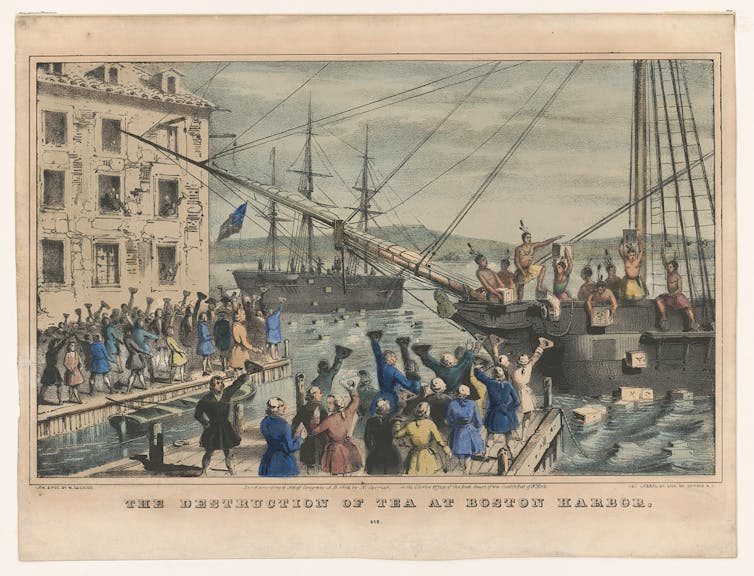
An illustration of colonists boarding ships in a harbour and dumping chests of tea into the water
The Destruction of Tea at Boston Harbor lithographed and published by Nathaniel Currier, 1846. Depicting American colonists dumping chests of East India Company tea into Boston Harbor to protest a tax placed upon tea, it’s one of the earliest acts of protest against corporate and imperial power.
(The Library of Congress)

However, as I argue in my book, this amoral view of the firm doesn’t stand up to scrutiny. One common argument is that businesses cannot be expected to act morally because market competition will discipline those that voluntarily forgo profits.

But this line of thinking is flawed, and ignores the fact that we demand competitors in all sorts of arenas — including in sports and war — to adhere to moral standards.

While corporations face several kinds of pressures that can make it difficult for them to live up to their moral obligations, they are nonetheless still morally accountable for what they do. Similarly, the moral agency of businesses is not erased by their being threatened by autocrats with the abusive use of state power.

What can companies do?

Businesses have tools that can help them manage their risks while honouring their duty to resist autocratic demands. These include standing together in solidarity, and relying on courts and other parts of society still committed to liberal democratic values to help protect their interests.

It’s therefore not up to the business community alone to defend liberal democratic society against autocracy.

However, as I argue in the book, the successful defence of liberal democracy against authoritarianism calls for an all-of-society effort that critically includes morally responsible leadership from within the business community.

The Conversation

David Silver does not work for, consult, own shares in or receive funding from any company or organisation that would benefit from this article, and has disclosed no relevant affiliations beyond their academic appointment.

ref. Businesses have a moral responsibility to stand up to autocrats – https://theconversation.com/businesses-have-a-moral-responsibility-to-stand-up-to-autocrats-263170

Information collected by the world’s largest radio telescope will be stored and processed by global data centres

Source: The Conversation – Canada – By Simon Blouin, Postdoctoral Fellow, Astronomy, University of Victoria

An artist’s impression of the Square Kilometre Array telescope in South Africa.
(SKAO)

When the Square Kilometre Array (SKA) Observatory goes online later this decade, it will create one of science’s biggest data challenges. The SKA Observatory is a global radio telescope project built in the Southern Hemisphere. There, views of our Milky Way are clearest and the SKA’s remote sites limit human-made radio interference.

The project spans two sites: approximately 131,000 Christmas-tree-shaped antennas in western Australia and 200 large dish antennas in the Karoo region of South Africa. As part of this international collaboration, Canada has established a data-processing centre at the University of Victoria.


Read more:
Canada’s participation in the world’s largest radio telescope means new opportunities in research and innovation


The SKA Observatory will produce around 600 petabytes of data each year. That amount would take 200 years to download using an at-home internet connection of 100 megabytes per second.

This data volume exceeds by a significant margin even what is produced by the Large Hadron Collider, often considered to be the world’s premier big data science project.

Research aims

Among its many science goals, the SKA detects faint radio signals emitted during the Cosmic Dawn, roughly 50 million to one billion years after the Big Bang, when the very first stars and galaxies lit up the universe.

The SKA will also test Albert Einstein’s theory of general relativity by timing signals from pulsars (rapidly spinning neutron stars) with high accuracy.

Another goal is understanding fast radio bursts – brief, intense radio pulses from distant sources. The SKA is expected to detect fast radio bursts far more frequently than current instruments, providing a large dataset to help determine their cause, building on work done by facilities like Canada’s CHIME telescope.

Initial data from the SKA is expected in 2027, with the start of major science operations in 2029 as the array is built and commissioned in phases.

an image of outer space showing the moon in the top right and dots of light throughout
The first image from an early working version of the SKA Observatory’s SKA-Low telescope, which is currently under construction in western Australia.
(SKAO), CC BY

Canada’s role

Handling the large volume and complexity of SKA data requires a global network of specialized computing facilities, collectively known as SKA Regional Centres (SRCs).

Canada became a member of the SKA Observatory research project in 2024. Shortly after joining, Canada committed to establishing one such centre.

The Canadian SRC (CanSRC) will be the sole SRC in the Americas, serving as an important node for processing, storing and providing streamlined access to SKA data. It will allow researchers to focus on scientific analysis rather than data management hurdles.

Big Astronomy

The SKA is part of astronomy’s ongoing evolution toward “Big Science,” where international collaboration becomes essential for scientific breakthroughs. This large-scale approach not only changes how science is funded, but also how it is conducted.

While the SKA will still accommodate traditional investigator-led proposals — where individual scientists or small teams request specific telescope time and computational resources for more focused projects — most of its observing power will target ambitious, multi-year projects designed by large international teams.

Canadian researchers participate in all of the SKA Science Working Groups and have co-chaired four of them in recent years. Canada is recognized as a world leader in studies of pulsars, cosmic magnetism and transients, as well as in low-frequency cosmology, areas where the SKA will make some of its most transformative discoveries.

a red blotch against a grey background
The centre of our Milky Way galaxy as seen by MeerKAT, a South African radio telescope that will become part of the SKA.
(South African Radio Astronomy Observatory), CC BY

Astronomical data management

Building, developing and managing CanSRC requires collaboration among the National Research Council’s Canadian Astronomy Data Centre, with four decades of experience in astronomical data management; the Digital Research Alliance of Canada, offering high-performance computing resources; CANARIE, operating the high-speed research network for data transfer; and the University of Victoria’s Arbutus cloud platform, supplying the scalable infrastructure.

The project leverages expertise concentrated within the University of Victoria’s Astronomy Research Centre, which brings together researchers from the University of Victoria, the National Research Council Herzberg Astronomy and Astrophysics Research Centre and TRIUMF, Canada’s national particle accelerator centre.

Importantly, CanSRC ensures that researchers have access to SKA data. The capabilities developed through CanSRC will strengthen Canada’s digital ecosystem for the future.

Digital discovery

CanSRC will serve as a gateway for developing and expanding the use of advanced data methods and algorithms, helping scientists from research and industry sectors harness massive datasets.

Applications of these techniques extend far beyond astronomy, with potential uses in medical imaging, remote sensing and artificial intelligence.

The Conversation

Falk Herwig receives funding from the National Research Council of Canada and the Natural Science and Engineering Research Council of Canada.

JJ Kavelaars receives funding from the National Research Council of Canada and the Natural Science and Engineering Research Council of Canada.

Sébastien Fabbro receives funding from the National Research Council of Canada and the Natural Science and Engineering Research Council of Canada.

Simon Blouin does not work for, consult, own shares in or receive funding from any company or organisation that would benefit from this article, and has disclosed no relevant affiliations beyond their academic appointment.

ref. Information collected by the world’s largest radio telescope will be stored and processed by global data centres – https://theconversation.com/information-collected-by-the-worlds-largest-radio-telescope-will-be-stored-and-processed-by-global-data-centres-255268

Inequality in Africa: what drives it, how to end it and what some countries are getting right

Source: The Conversation – Africa – By Imraan Valodia, Pro Vice-Chancellor, Climate, Sustainability and Inequality and Director, Southern Centre for Inequality Studies, University of the Witwatersrand

The relationship between inequality and economic growth is a complex one, especially in Africa. Inequality is the result of a host of factors, including policy choices, institutional legacies and power structures that favour elites. Professor Imraan Valodia, director of the Southern Centre for Inequality Studies spoke to Ernest Aryeetey, emeritus professor of Development Economics at the Institute of Statistical, Social and Economic Research, University of Ghana about the issues.


What policy choices have African governments made that have worsened inequality?

Firstly, structural adjustment policies. Many African countries undertook these during the late 20th century, often encouraged by international financial institutions. These policies included public sector retrenchments, the removal of subsidies, and reduced social services. They disproportionately affected the poor by weakening the state’s role in redistributing public goods, and limiting access to essential services.

The programmes also increased income inequality by choosing free markets over social protection. Later efforts to address the consequences were often “too little, too late.”

Secondly, taxation and fiscal policies. Most tax systems in Africa have relied on indirect taxes (such as VAT or consumption taxes) rather than progressive, direct taxes on income and wealth. As a result, poorer households often bear a heavier relative tax burden while the wealthiest benefit from exemptions or evasion.

Early post-independence taxation rarely did much to redistribute wealth, and efforts to tax the informal sector have been minimal or poorly designed. They have failed to capture significant resources for social spending.

Thirdly, education and healthcare investment. Policy choices have often perpetuated access gaps between urban and rural populations and among socioeconomic classes. Investments tended to favour cities and privileged groups, so that not everyone had the same opportunities. This “urban bias” in public spending reinforced existing inequalities. Rural people’s needs remained unmet.

Fourthly, weak social protection. Until the expansion of more comprehensive schemes in the 2000s, many Africans were left poor and vulnerable, without adequate safety nets.

Fifth, economic structures favour elites. African governments have often maintained or even reinforced economic structures that concentrate wealth and opportunity for just a few. Examples include policies favouring extractive industries or resource sectors controlled by politically connected groups. Land tenure, trade policies and access to state contracts and licences have frequently favoured the powerful.

Sixth, limited regional and gender inclusion. Early public policies rarely met the needs of women, youth, rural areas, or marginalised regions. Exclusion from land ownership or financial services, and limited emphasis on affirmative action, reinforced systemic inequalities. Only in recent decades have some governments begun to address these gaps, but progress remains uneven.

Are these choices linked to the capture of public policy by elites?

Yes. Privileged groups have often shaped or manipulated state policies in ways that protect their interests and reinforce inequality.

Colonial and postcolonial legacy. Policies and institutions established during and after colonialism often allocated resources and power to a narrow elite, either colonial settlers, expatriates or local collaborators. Today’s elites inherited and sustained many of these structures. They still control wealth, land, and market opportunities.

Economic structure and resource control. Many African economies remain oriented around extractive industries and primary commodities such as oil and minerals. Policies around resource extraction, trade and land tenure have often favoured elites through preferential access, tax exemptions and regulatory loopholes.

Policy design and fiscal choices. The design of tax systems has typically favoured indirect taxes (like VAT). These do not affect elite wealth. Efforts to tax high incomes, property or capital gains are underdeveloped or easily evaded.


Read more:
Tax season in South Africa: the system is designed to tackle inequality – how it falls short


Social protection and service delivery. Safety nets and public goods (like quality education, healthcare, or infrastructure) often target formal sector workers or urban residents (where elites reside). They neglect the informal sector, rural poor and marginalised groups.

Political patronage and governance. State resources, positions and contracts go to loyalists, family members, or ethnic/regional networks.

What have been the 3 biggest inequality drivers?

Firstly, regressive fiscal policies. These include broad based taxes such as transaction levies and VAT. They take a larger share of low income earners’ cash flows. Wealthier groups benefit from exemptions or low tax rates.

Secondly, rapid, elite led privatisation and market liberalisation. Selling state assets or opening key sectors (energy, telecoms and transport) to politically connected investors concentrates profits and market power. Informal workers and small firms are left with reduced earnings.

Patronage, corruption and political capture keep things that way.

Thirdly, under-investment in universal social services. Cuts to health, education and social safety nets limit upward mobility for the poor and maintain regional and gender gaps.

Lastly, resource dependence and economic structure. Many African economies focus on industries like oil, minerals and cash crops. These benefit political and business elites but don’t diversify industries or create jobs. The benefits of growth go mostly to the already privileged. Most citizens and entire regions are excluded.

Which countries have managed best to change this?

Rwanda has a progressive income tax structure. Low value mobile money transactions are exempt from tax. Key utilities such as electricity and water remain largely public, which has reduced the impact of taxes on the poor.

Rwanda has also made efforts towards inclusive governance. Examples include quotas for women, investments in health and education, and a focus on rural inclusion.

Botswana has pursued a cautious privatisation agenda. The state retains majority ownership in diamonds, telecoms and banking. Revenues were channelled into universal primary education and health.

Despite its dependence on diamonds, it does well at channelling resource wealth into national savings, infrastructure and public services. This while maintaining relatively high institutional quality and political stability.

Ethiopia, pre 2020 reforms which saw the role of the private sector being broadened.

Before then, the country had focused on massive public investment in primary education, health extension services and rural road networks. At the same time it avoided large scale privatisation of basic utilities. This limited the social service gap.

In addition, it has invested in manufacturing and export-led growth. This has generated jobs and gradually shifted the economy away from depending on primary commodities. Inequality has reduced compared to resource-dependent peers.

Have technology advances affected inequality differently on the continent?

Yes.

Technology has the potential to reduce inequality by expanding access to markets, services, information and financial inclusion. But gaps in digital infrastructure, affordability and skills have caused technology to sometimes reinforce, rather than alleviate, disparities in African countries.

  • Digital divide and urban-rural gaps. Access to digital technologies is highly uneven. Rural areas, the poor, women and less-educated groups are less likely to use the internet or benefit from digital services. This divide is much starker in Africa than in advanced economies, where technology adoption is nearly universal. As a result, new technologies can benefit urban, educated and higher-income groups the most. This widens inequalities if not accompanied by robust, inclusive policies.

  • Mobile leapfrogging, but patchy inclusion. Africa’s rapid leap to mobile phone use has often skipped fixed-line infrastructure. This has brought financial inclusion and new markets to millions, such as M-Pesa in Kenya. Still, large parts of the continent remain excluded due to affordability, lack of electricity, limited digital skills and language barriers.

  • Economic structure and global value chains. Limited integration into global value chains and a small high-tech sector mean most jobs on the continent remain in low-productivity informal work.

Why do the effects differ?

Firstly, late, unequal adoption. The industrial revolution and subsequent technological advances arrived late and unevenly. Colonial and postcolonial legacies left Africa behind in both education and infrastructure. This made it harder for broad segments of the population to benefit from new technologies.

Infrastructure scarcity forces societies to adopt mobile solutions directly, bypassing legacy banking but also making them vulnerable to policy shocks.

Secondly, policy and market failures. Inadequate regulation, weak competition and high costs of devices and data are brakes on digital transformation. Digital public goods, such as e-government and online education, reach only connected groups. And digital skills gaps further entrench the social digital divide.

The Conversation

Imraan Valodia receives funding from a number of foundations and institutions that support independent academic research.

ref. Inequality in Africa: what drives it, how to end it and what some countries are getting right – https://theconversation.com/inequality-in-africa-what-drives-it-how-to-end-it-and-what-some-countries-are-getting-right-265265

Ansaru terror leaders’ arrest is a strategic change for Nigeria: what could happen next

Source: The Conversation – Africa (2) – By Saheed Babajide Owonikoko, Researcher, Centre for Peace and Security Studies, Modibbo Adama University of Technology

Attacks by non-state armed groups are a security challenge in the Sahel, including Nigeria.

In northern Nigeria, the activities of Jama’at Ahl al-Sunna li al-Da’wa wa al-Jihad (also known as Boko Haram), Islamic State West Africa Province (ISWAP) and Jama’atu Ansarul Muslimina fi Biladis Sudan (Ansaru) contribute to the instability of the Nigerian state.

On 16 August 2025, Nuhu Ribadu, Nigeria’s national security adviser, announced the arrest of two leaders of Ansaru: Mahmud Muhammad Usman and Mahmud al-Nigeri.

They appeared before the Federal High Court in Abuja on 11 September. Usman pleaded guilty to the charge of illegal mining activities and was sentenced to 15 years’ imprisonment. They are currently facing a 32-count charge including engagement in acts of terrorism, and other violent crimes.

As a scholar of security studies, I can offer some thoughts about the importance of the arrest, possible responses from Ansaru and how Nigeria should respond.

Who are the two men arrested?

Mahmud Muhammed Usman and Mahmud al-Nigeri are two key leaders of Ansaru, a terrorist organisation that formed as a breakaway faction of Boko Haram in 2012 in Kano state. Boko Haram is a Salafi Jihadist militant group operating in north-east Nigeria and the Lake Chad region. It’s known for its efforts since 2010 to establish an Islamic state governed by Islamic law.

Ansaru functioned until 2013 before it appeared to fizzle out. Its operations included a prison break in November 2012, an attack on a Nigerian military convoy heading to Mali in January 2013 and the kidnapping of seven expatriates working with Setraco Construction Company in Bauchi in February 2013.

Since 2013, not much has been heard about the group. Some linked its silence to the death of its leader Abubakar Adam Kambar in 2012. Others said it had been forced back into mainstream Boko Haram by that group’s then leader Abubakar Shekau.

But Ansaru revived between 2018 and 2020 and has been recruiting and involved in rising banditry and kidnapping in North West and North Central.

The arrested leaders are prominent figures in Ansaru. An official statement revealed that Mahmud Muhammad Usman is the amir (leader) and Mahmud al-Nigeri serves as the deputy and chief of staff.

Both have undergone extensive training from al-Qaeda in the Maghreb region. Al-Qaeda is a pan-Islamic militant group leading a global Islamist revolution aimed at uniting the Muslim world. It was established by Osama Bin Laden in 1988 and he remained its leader until 2011, when he was killed.

Strategic significance of the arrest

Arresting leaders is known in counterterrorism as “leadership decapitation” or “snakehead strategy”. This involves capturing or killing the leaders or high-ranking commanders of terrorist organisations.

Not all policymakers and academics agree about the effectiveness of that tactic. States facing terrorism challenges, such as Israel, the United States and Russia, often use it, but most research shows it is not that effective.

It may temporarily incapacitate the group, but the group may bounce back even more brutally.

The targeted killing of Osama Bin Laden decimated al-Qaeda but paved the way for the rise of the Islamic State as a global caliphate. Islamic State has been lethal in its operations, particularly in the Sahel.

And the 2009 killing of Muhammed Yusuf, the former leader of Boko Haram, led to the emergence of Abubakar Shekau. Under him, Boko Haram became more formidable until he died in 2021.

The case of the Ansaru leaders is different, however. It is target arrest and incarceration.

This strategy has advantages for Nigeria and the broader Sahel region.

Incarceration of the two leaders means Ansaru won’t be able to take key decisions for some time. And it will deny the group some key technical know-how. Terrorist organisations seldom get new leaders while others are still alive.

Al-Nigeri is not only deputy and chief of staff, he is an expert in planning and implementing attacks and kidnapping in Nigeria and Niger. He underwent training in the Maghreb in handling weapons and making explosive devices.

It’s possible that lack of access to their expertise and authority will drastically reduce the activities of Ansaru.

Shortly after their arrest, Abduraham Yusuf, son of the Boko Haram founder, who is also a leader of one of ISWAP cells in the region, was arrested in Chad. Similarly, Boko Haram leader Ibrahim Mahamadu, also known as Bakura, was reportedly killed in Niger Republic on 20 August.

I believe these two incidents may be related to intelligence obtained following the arrest of the two Ansaru leaders.

Likely responses from the group

Considering the importance of the two leaders to Ansaru, there are two likely responses from the group.

  • breaking them out of prison – the group carried out prison breaks in 2012 and 2022

  • high-profile kidnapping and hostage taking, a trademark of Ansaru.

The March 28 2022 Abuja-Kaduna train bombing incident was believed to have been carried out by Ansaru with the support of some bandits as a retaliation for the Nigerian Police raid of Ansaru Camp in Kaduna State in which two commanders of the group were killed.

Even the parent group, Boko Haram, possibly executed the Chibok kidnapping in 2014 in retaliation for some of its commanders under incarceration of Nigerian government. Given these antecedents, the arrest of their prize leaders may trigger retaliation from the group.

Although the group’s ability to retaliate largely depends on whether it can still function effectively without the inputs of its two leaders in incarceration, the current cordial relationship between Ansaru and some bandits operating in the North West may make this possible.

Responses from the state

The Nigerian government and security forces must brace for likely retaliation from Ansaru. I expect that these two leaders should not be kept together in the same prison facility, and there is a need to adequately fortify prison facilities where they are kept to fend off any possible attack.

Furthermore, security needs to be provided for key places, especially schools, communities, and other vulnerable people that Ansaru may attack in the North West and North Central regions.

The Conversation

Saheed Babajide Owonikoko does not work for, consult, own shares in or receive funding from any company or organisation that would benefit from this article, and has disclosed no relevant affiliations beyond their academic appointment.

ref. Ansaru terror leaders’ arrest is a strategic change for Nigeria: what could happen next – https://theconversation.com/ansaru-terror-leaders-arrest-is-a-strategic-change-for-nigeria-what-could-happen-next-264921

Suplemento cultural: en un lugar de la pantalla

Source: The Conversation – (in Spanish) – By Claudia Lorenzo Rubiera, Editora de Cultura, The Conversation

Fotografía del rodaje de ‘El cautivo’ de Alejandro Amenábar. Disney

Este texto se publicó por primera vez en nuestro boletín Suplemento cultural, un resumen quincenal de la actualidad cultural y una selección de los mejores artículos de historia, literatura, cine, arte o música. Si quiere recibirlo, puede suscribirse aquí.


A veces tengo la sensación de que, como hispanoparlantes, no somos conscientes de la relevancia e importancia que tiene la figura de Cervantes –alguien que forma parte de nuestro patrimonio– en todo el planeta. Recuerdo entonces ese capítulo de El Ministerio del Tiempo en el que don Miguel visualizaba, en un “sueño premonitorio”, la trascendencia que iba a tener su obra en todo el mundo. Menos mal que no era realmente consciente de ello, que eso solo pasó en esta ficción televisiva, porque… ¿cómo habría podido llevar en vida el peso de saberse el autor de la obra más importante de la literatura universal?

Por eso, en su última película, Alejandro Amenábar decidió despojar al escritor de su aura divina y tratarlo como la persona que fue. Es decir, un ser humano más. En este caso, incluso, un cautivo más. La película homónima del director español imagina cómo Cervantes pasó los cinco años que estuvo retenido en Argel y cómo desarrolló ahí su talento para contar historias. Para situar la acción consultó con uno de los mayores expertos de Cervantes, José Manuel Lucía Megías, que sirvió de asesor aunque, como dijo el propio cineasta, el filme plantea hipótesis que chocan con los argumentos del estudioso porque, después de todo, una ficción es una ficción.

Pero nosotros nos hemos asegurado de que Lucía Megías haga una panorámica de cómo era la Argel del cautiverio de Cervantes que derribe mitos y fábulas. Porque la vida del escritor está ahora mismo rodeada de fake news. No hay más que leer a Pablo Úrbez Fernández y su repaso por la imagen de Cervantes que se ha recreado en la pantalla para confirmarlo. De espadachín a ejemplo moral, hay de todo en su representación menos la realidad de un hombre de carne y hueso.

Por cierto, no me cansaré de recomendar, ahora que hablamos de Alejandro Amenábar, el pódcast Delirios de España y su última temporada, en la que se repasa el loco rodaje de Los otros. Ahí queda dicho.

El arte agota

No sé si alguna vez han ido al Museo del Prado intentando descifrar las caras de los asistentes, pero muchas veces, sobre todo entre los turistas, se alternan rostros de agotamiento con otros de desesperación. Los locales estamos más acostumbrados a abordar la colección de la pinacoteca de poco en poco, pero los visitantes ocasionales sienten que tienen que verlo todo en un día y acaban con la cabeza del revés.

Esto no es una percepción nuestra. Alberto Pérez-López e Irene Pérez López explican qué es la fatiga museal y cómo debemos prepararnos, mental pero también físicamente, para un maratón artístico. ¿La máxima principal? Quien mucho abarca poco aprieta.

Yo quiero bailar…

Recuerdo que, en un artículo escrito durante la pandemia en el que se hablaba de cómo habíamos perdido la oportunidad de socializar en masa durante aquellos meses –o años–, un chico comentaba: “Es que yo no me puedo creer que no hayamos podido bailar todavía el ‘Physical’ de Dua Lipa”. Para quien no conozca la música de la cantante, el pop que propone es, sobre cualquier otra cosa, bailongo y divertido. Cuando leí eso recordé que, efectivamente, yo solo había podido dar saltos con sus canciones a solas en el salón de mi casa.

Por eso me quedé fascinada –y algo preocupada– cuando asistí al concierto de Dua Lipa este año y toda la pista estaba quieta, grabando, sin moverse ante algunos de los temas más discotequeros de nuestro tiempo. ¿Por qué ha pasado esto? Se lo pregunté a Cristina Pérez Ordoñez, que ha investigado sobre este tema, y escribió un artículo en el que explica las posibles causas de este cambio de hábitos. Es certero y objetivo, pero también algo triste.

Gaza

Mucho antes de leer la reseña sobre este libro en The Conversation Australia, su título, que ya lo decía todo, había captado mi atención en las librerías: “Algún día –cuando no entrañe riesgo alguno, cuando podamos llamar a las cosas por su nombre, cuando sea demasiado tarde para exigir responsabilidades– todo el mundo habrá querido estar siempre en contra”.

En él, Omar El Akkad lanza un reflexivo grito de socorro por el pueblo palestino que confronta a Occidente con la realidad de su inmovilidad. En el futuro se dirán otras cosas, pero él defiende que lo que cuenta es lo que hacemos ahora, en el presente.

Más cine por favor

Vuelve el cole y vuelve también la agenda cargada de estrenos de cine (ver el inicio de este boletín). Pero antes de tener nada más en cuenta, repasemos lo que ha sucedido en las salas en los últimos meses.

Uno de los grandes éxitos veraniegos ha sido la cinta de terror Weapons que ha cosechado alabanzas de crítica y público –y a la que yo no pienso acercarme–. Pero ¿de verdad deberíamos tenerle miedo a lo paranormal cuando los seres humanos son capaces de provocarnos verdadero pavor?

Para hablar de eso, precisamente, conviene analizar uno de los últimos géneros en auge: el true crime. Y plantearse a quién se le da voz a la hora de divulgar los casos. Porque si bien convertirse en portavoz de personas injustamente acusadas puede ayudar a su defensa, ponerle un micrófono a quienes han cometido actos terribles provoca más dolor del ya infligido.

Y, para cerrar, hablemos de Elvis. O de Lilo & Stitch, el gran taquillazo de 2025 (con permiso de Ne Zha 2). A los niños que acudieron en masa a su visionado les acompañaban padres que, en muchos casos, disfrutaron de los guiños que la cinta hacía a la música del roquero. No es un caso aislado. Las películas cada vez buscan más referencias sonoras para contentar a los adultos que acuden a ver cine infantil.

Y aprovecho para despedirme con una serie de películas sobre las aulas en Francia (el país que mejor trata la educación en el cine).

The Conversation

ref. Suplemento cultural: en un lugar de la pantalla – https://theconversation.com/suplemento-cultural-en-un-lugar-de-la-pantalla-265150

La conversación docente: la salud mental de los universitarios

Source: The Conversation – (in Spanish) – By Eva Catalán, Editora de Educación, The Conversation

¿Recuerda cuando era estudiante universitario? ¿Son recuerdos borrosos de cañas en la cafetería y fiestas en el colegio mayor, debates encendidos hasta altas horas de la noche “arreglando el mundo”? ¿O más bien de horas de estudio en la biblioteca, madrugones o noches sin dormir para preparar exámenes? Quizá pertenece al grupo afortunado que combina ambas opciones.

Empezamos la universidad siendo adolescentes, y terminamos, o al menos ese es el objetivo, como jóvenes preparados para la vida adulta. Es un salto importante en el desarrollo mental. Y mientras muchos jóvenes disfrutan y prosperan durante este proceso de maduración, algunos sufren. Mucho. En ocasiones, se sienten tan angustiados o perdidos que recurren a las autolesiones: es decir, se hacen daño físico deliberadamente.

Lorena Gutiérrez, de la Universidad Rey Juan Carlos nos ha explicado esta semana qué factores influyen en la aparición de este tipo de conductas, denominadas “autolíticas”, que están aumentando entre la población universitaria. Entre un 15 % y un 25 % de universitarios españoles recurren a las autolesiones, según datos recientes que cita esta experta, que ofrece algunas claves sobre cómo podemos intervenir ante estos comportamientos y prevenirlos.

No es ninguna sorpresa que la hiperconexión digital sea uno de los factores que influye en el malestar mental de los universitarios. El impacto de las redes sociales nos afecta a todos, pero especialmente a las nuevas generaciones, como hemos analizado y documentado exhaustivamente en nuestra campaña de Bienestar digital y menores.

Y una de sus consecuencias es el estar sometido a una “violencia insidiosa” o “violencia de baja intensidad”: un goteo continuo de imágenes y agresiones en el que viven inmersos no ya los jóvenes, sino los adolescentes y preadolescentes en cuanto comienzan a interactuar en línea. Así lo describen los expertos de la Universidad del País Vasco que han publicado recientemente el artículo “Los adolescentes viven inmersos en violencia digital: ¿cómo les afecta?”.

Pero en The Conversation no estamos solo para alertar y documentar con evidencias estas tendencias. Muchos expertos trabajan en proyectos y métodos para encontrar soluciones. Aquí he recopilado varios de ellos, porque también es responsabilidad de la comunidad educativa conocer los retos a los que se enfrentan los estudiantes, que a menudo comienzan mucho antes de que se manifiesten los síntomas, y ayudarles en ese camino de superación.

Incluyo también los mejores artículos de esta semana para docentes: ideas para la clase de música y posibilidades con realidad virtual en Educación Física.

Feliz semana.

The Conversation

ref. La conversación docente: la salud mental de los universitarios – https://theconversation.com/la-conversacion-docente-la-salud-mental-de-los-universitarios-265336

Autism is not a scare story: What parents need to know about medications in pregnancy, genetic risk and misleading headlines

Source: The Conversation – Canada – By Sura Alwan, Clinical Instructor in Medical Genetics (Teratology & Birth Defects Epidemiology); Co-Director, TERIS (The Teratogen Information System), University of British Columbia

Over the past couple of months, headlines have warned expectant parents that something as ordinary as a pain reliever or an antidepressant taken during pregnancy could “cause autism.”

The stories have focused on acetaminophen (also known as paracetamol or the brand name Tylenol) and selective serotonin reuptake inhibitors (SSRIs), such as Prozac (fluoxetine) and Zoloft (sertraline).

But here is what the headlines leave out: acetaminophen is commonly used during pregnancy to manage fever, pain or stress, all of which can themselves affect fetal development. Similarly, SSRIs are prescribed for depression or anxiety, conditions that also influence pregnancy outcomes. In many cases, it may well be the illness, not the treatment, that shapes child development.

Both classes of medications have been studied extensively for decades. Yet despite what the headlines suggest, the evidence that acetaminophen or SSRIs cause autism is weak, inconsistent and easily misinterpreted.

With a background in genetics and clinical teratology — the scientific study of birth defects — my research examines how maternal exposures in pregnancy interact with genetic and environmental factors to influence child development. From this perspective, I want to explain why the research on acetaminophen and SSRIs is often misunderstood, and why reducing complex science to alarming headlines does more harm than good.

With the recent U.S. Food and Drug Administration (FDA) panel on SSRIs in pregnancy, and the public claims made by United States Secretary of Health and Human Services Robert F. Kennedy Jr. regarding acetaminophen and autism, there is a need for evidence-based information. While my focus will be on autism, the same issues apply to media coverage linking pregnancy exposures to attention deficit/hyperactivity disorder (ADHD).

Association is not causation

Much of the research behind these headlines is observational. Such studies can spot associations but cannot prove cause and effect. The associations they identify are usually small to modest, and other factors are often responsible.

Confounding is a good example. Pregnant women may take acetaminophen because they have a fever, but fever itself has been linked to higher risks of neurodevelopmental outcomes such as neural tube defects. Similarly, someone prescribed SSRIs may be experiencing depression or anxiety, which on their own are associated with differences in pregnancy outcomes and child development. Here, the medication may appear to be the cause, when in reality it is the condition being treated.

Another problem is misclassification. Most studies rely on mothers recalling how often they used acetaminophen during pregnancy. Memory is imperfect: some under-report, others over-report, and details about dose or timing are often missing.

With SSRIs, misclassification can arise when prescriptions are used as a proxy for exposure. A woman may fill a prescription in early pregnancy but stop taking the medication later, while records still count her as continuously exposed. Both scenarios distort results.

Even the outcomes themselves are not always measured consistently. Diagnoses like autism spectrum disorder vary across countries and over time. Some studies use parental questionnaires instead of medical diagnoses, which can be subjective. Two children with the same traits might be classified differently depending on who reports them.

When researchers adjust for these kinds of factors, the apparent risks often shrink or even disappear.

Research shortcomings and media spin

Beyond these challenges, research in this area has other limitations: timing and dose are often recorded crudely; use of other medications taken at the same time is not systematically assessed; results are inconsistently replicated; and while biobank and biomarker studies — which analyze measurable biological signals, such as blood levels of a substance, to indicate exposure — hold promise, they are uncommon and usually capture exposure only once.

Furthermore, studies that report positive associations are more likely to be published, and once they are, news outlets are far more likely to amplify findings that sound alarming than ones that reassure. “Everyday painkiller linked to autism” makes a clickable headline; while a more balanced one that might read something like “Evidence inconsistent, no strong effect found” does not.

This cycle amplifies fear, leaving parents confused and anxious.

The real dangers of untreated conditions

It also matters what happens when pain, fever, depression or anxiety go untreated.

High fever in pregnancy is known to increase the risk of neural tube defects and other complications. Untreated maternal depression and anxiety can lead to poor prenatal care, substance use, preeclampsia, premature birth, impaired bonding and even suicide — one of the leading causes of maternal death.

In these cases, acetaminophen and SSRIs are not just helpful. They can be lifesaving.

Understanding autism

Autism is not caused by a single medication or choice. It is a complex neurodevelopmental difference with a strong genetic basis. Heritability estimates are around 70–80 per cent, meaning much of the variation in risk is tied to parental traits and shared family environments.

Autism also clearly runs in families: siblings of autistic individuals are 10 to 20 times more likely to be diagnosed, and many parents or relatives show autistic traits even without formal diagnoses. This familial pattern reinforces that genetics and shared environment play a major role.

Sibling studies add weight by comparing siblings where one was exposed to a medication in pregnancy, and the other was not.

If the medication were truly causing autism, clear differences would appear. But often they shrink or disappear, pointing instead to shared genetics and environment.

Of course, environmental factors can still play a role. But to suggest that a common medication like acetaminophen “causes” autism oversimplifies the picture and risks stigmatizing families, while fuelling guilt among mothers who already face intense scrutiny during pregnancy.

Communicating risk responsibly

One of the greatest challenges is not the research itself, but how its results are communicated. Studies often report risks using relative measures. For example, a study might report that acetaminophen use is associated with a 30 per cent increase in autism risk. That sounds alarming. But in absolute terms, the difference is much smaller.

Autism affects about three in every 100 children. Even taking the highest reported increase in studies — a 30 per cent relative rise — that number only goes up to about four in 100. In other words, instead of 97 children without autism, you’d have 96. So while the increase is real, the absolute change in risk remains small.

Therefore, balanced communication matters. When parents hear only the alarming side, some may stop taking needed medications abruptly, which can be dangerous. Others may endure untreated illness out of fear. Clinicians and researchers should emphasize absolute risks, acknowledge limits, and aim to inform, not frighten.

Informed, not alarmed

The lesson isn’t that acetaminophen or SSRIs are risk-free. No medication is. But decades of research show that, when clinically indicated, they are generally safe in pregnancy. The risks of untreated illness are often greater.

Autism is a condition caused by many factors, including genetics, not something to blame on common medications — or mothers.

Expectant parents deserve clear, compassionate, evidence-based information, not fear-driven headlines. Association is not causation, absolute risks are small, and informed choice should never be replaced by alarm.

The Conversation

Sura Alwan is the founder and executive director of PEAR-Net Society, a Canadian nonprofit that advocates for maternal fetal health and safety of medications and other environmental exposures during pregnancy.

ref. Autism is not a scare story: What parents need to know about medications in pregnancy, genetic risk and misleading headlines – https://theconversation.com/autism-is-not-a-scare-story-what-parents-need-to-know-about-medications-in-pregnancy-genetic-risk-and-misleading-headlines-264964

Prisons de haute sécurité : efficaces contre le crime organisé ?

Source: The Conversation – in French – By Marion Vannier, Chercheuse en criminologie, Université Grenoble Alpes (UGA)

Un nombre important de détenus de la prison de haute sécurité de Vendin-le-Vieil (Pas-de-Calais) sont en grève de la faim depuis cet été, dénonçant leurs conditions d’incarcération. Ce nouveau dispositif, visant en particulier les narcotrafiquants, interroge les défenseurs des droits humains et les spécialistes des politiques carcérales. Que nous enseigne l’histoire des quartiers de haute sécurité, voulus par l’État dans les années 1970, puis abandonnés en 1982 ? Les dispositifs similaires – aux États-Unis, au Royaume-Uni ou en Italie – ont-ils fait leurs preuves dans la lutte contre la criminalité organisée opérant depuis la prison ?


Le ministre de la justice Gérald Darmanin déclarait, fin 2024, vouloir « couper du monde les 100 narcotrafiquants les plus dangereux » en les enfermant dans des « prisons de haute sécurité ». Cet été, il annonçait ainsi un « changement pénitentiaire radical » depuis la prison de Vendin-le-Vieil dans le Pas-de-Calais.

Le 1er septembre, un nombre important des détenus transférés dans les nouveaux dispositifs de haute sécurité à Vendin-le-Vieil ont entamé une grève de la faim. Mouvement solidaire, la manifestation a été décrite comme une « manifestation de désespoir » par l’avocate Delphine Boesel. Une seconde centaine de détenus doit être incarcérée, d’ici mi-octobre 2025, au sein du nouveau quartier de lutte contre la criminalité organisée (QLCO) de Condé-sur-Sarthe (Orne), dont le régime sécuritaire hors norme est déjà largement documenté]. Ces évènements relancent le débat sur la justification et sur l’efficacité de la prison de haute sécurité face au crime organisé.

« Vingt-et-une heures par jour dans une cellule, seul »

Les quartiers de haute sécurité (QHS), également appelés quartiers de sécurité renforcée (QSR), ont été [créés en 1975] par décret le 23 mai 1975 sous la présidence de Valéry Giscard d’Estaing, dans un contexte d’inquiétude sécuritaire marqué par une série d’évasions spectaculaires et par la montée des violences en détention].

Le garde des sceaux Alain Peyrefitte adopte une ligne résolument sécuritaire et consolide l’usage des QHS comme dispositifs de répression accrue. Ces unités visent notamment à contenir les détenus insubordonnés, réaffirmant la position d’un gouvernement fort pour lequel la sécurité est une priorité absolue. Sont éligibles au placement en QHS les détenus « caractériellement dangereux » et ceux qui, par leur comportement, visent à troubler gravement le bon fonctionnement des établissements.

Ces espaces opèrent alors sur un régime punitif extrême. Le recours a l’isolement est fréquent, notamment contre les détenus ayant tenté de s’évader. Lors du procès de Lisieux (Calvados) de 1978, quatre accusés, qui avaient tenté de s’évader, décrivent la violence des QHS. Georges Ségard témoigne qu’il est enfermé depuis trente-cinq mois consécutifs en QHS, dont onze mois complètement isolé. Daniel Debrielle ajoute :

« Le quartier de sécurité renforcée, c’est vingt-et-une heures par jour dans une cellule, seul. C’est une heure de promenade par jour dans une cour en béton avec deux grillages au-dessus de la tête. La nuit, un projecteur donne sur les barreaux et les renvoie partout. Vous ouvrez l’œil et vous ne voyez que des barreaux. »

Le célèbre Jacques Mesrine, assimilera les QHS à une lente peine de mort :

« Les QHS sont la forme futuriste de la peine capitale. On y assassine le mental en mettant en place le système de l’oppression carcérale à outrance, conduisant à la mort par misère psychologique. »

Au même moment, des intellectuels, comme Michel Foucault, des associations de défense des droits humains ainsi que certains magistrats et agents pénitentiaires dénoncent également les QHS.

Rapidement, ces quartiers deviennent donc le symbole d’une violence institutionnelle injustifiée. Les QHS sont officiellement abandonnés en 1982 après l’arrivée de la gauche au pouvoir.

Le recours aux prisons de haute sécurité pour narcotrafiquants

Quarante ans plus tard, Gérald Darmanin réouvre donc des prisons de haute sécurité pour narcotrafiquants, désormais appelés « quartier de longue peine et de contrôle opérationnel » (QLCO). Certes, il ne s’agit plus de quartiers isolés dans l’espace carcéral existant, mais de la création de prisons de haute sécurité en tant que telles. La logique reste la même : séparer et neutraliser certains profils de criminels. Surtout, il s’agit de signaler, comme cela avait été le cas en 1975, la fermeté du gouvernement face au crime organisé dans le cadre du trafic de drogues.

Cela évoque la « war on drugs », déclenchée par le président Nixon, dans les années 1970, récemment relancée par le président Trump.

Cette approche ne vise pas la réhabilitation et la réinsertion des détenus. Il s’agit d’exclure fermement et totalement, ce que certains chercheurs en criminologie aux États-Unis appellent « the total incarceration ». Ce terme désigne un modèle pénal dans lequel l’enfermement devient une fin en soi, un outil de neutralisation permanente, qui repose sur la rupture de tout lien social, familial, professionnel et culturel, plutôt qu’un passage temporaire avant une éventuelle réinsertion. Le chercheur Jonathan Simon, en analysant la montée de l’incarcération de masse aux États-Unis, décrit ce paradigme comme l’étirement de la prison à des fonctions qui dépassent la logique de la peine d’emprisonnement elle-même : l’expression d’une force étatique priorisant la sécurité avant tout.

La création de prisons de haute sécurité, et non plus de simple quartiers, rappelle également le modèle du Royaume-Uni qui a institutionnalisé depuis longtemps des établissements de type « high security ». Si, à l’origine, elles étaient aussi destinées aux détenus dont l’évasion était jugée dangereuse pour le public, la police ou la sécurité de l’État, elles sont devenues le lieu de détention des personnes jugées potentiellement dangereuses pour l’institution carcérale, ses agents et l’État de manière plus vaste. Typiquement, les prisonniers condamnés aux peines les plus lourdes, comme la prison à perpétuité, et ceux ayant commis des crimes sexuels y sont détenus et y vieillissent, soulevant de nombreux problèmes de gestion.

Cependant, le modèle de haute sécurité britannique est, du moins en théorie, censé n’être que temporaire. Il est prévu que la personne détenue, au fur et à fur que son niveau de dangerosité décroît, progresse vers des prisons de niveau sécuritaire moins élevé. Il ne semble pas qu’un mécanisme de progression similaire en France soit envisagé.

Contrairement aux quartiers d’isolement classiques, souvent critiqués pour la vétusté des bâtiments, le manque de moyens humains et l’absence de formation spécialisée, les deux prisons de haute sécurité annoncées par Gérald Darmanin sont censées répondre à ces faiblesses. Les infrastructures sont neuves ou entièrement réaménagées afin d’être hermétiques aux communications illicites et adaptées au régime d’isolement renforcé.

Conçues sur le modèle italien du « carcere duro » luttant contre la mafia, elles sont dotées d’installations ultramodernes (détection antidrones, brouilleurs, miradors, hygiaphones, visioconférences généralisées). Chaque détenu sera encadré par trois ou quatre surveillants, une proportion inédite dans le système pénitentiaire français, et les agents suivront une formation spécifique de deux mois, centrée sur la gestion de la criminalité organisée et sur la prévention des risques de corruption. De plus, un dispositif d’anonymisation des surveillants et un recrutement ciblé visent à limiter le turnover et à renforcer la stabilité du personnel.

Bien que la loi de 2025 cible spécifiquement les narcotrafiquants, la critique de Michel Foucault, en 1978, quant au flou de la notion de dangerosité reste actuelle. En pratique, les critères prévus par la loi ont un spectre si large qu’ils autorisent de vastes classifications indifférenciées, potentiellement applicables à des détenus non liés au narcotrafic, comme le dénonce l’Observatoire international des prisons (OIP)). En effet, le décret confère au garde des sceaux le pouvoir de placer une personne en isolement administratif à titre préventif afin de « prévenir la poursuite ou l’établissement de liens avec les réseaux de la criminalité et de la délinquance organisées, quelles que soient les finalités et les formes de ces derniers », ce qui reste extrêmement vague. Le rôle du juge n’est que consultatif (en cas de condamnation) ou informatif (en cas de prévention), avec possibilité d’opposition sous huit jours seulement, ce qui limite fortement la force du contrôle judiciaire sur une décision à portée potentiellement arbitraire.

Comment lutter contre le narcotrafic en prison ?

Le problème du narcotrafic depuis l’enceinte de la prison est un réel phénomène global que gouvernements et institutions carcérales peinent à maîtriser et ce, dans un contexte de surpopulation carcérale), de manque d’effectifs, et d’absence d’accompagnement suivi à la réintégration.

Concernant le recours à l’isolement, la recherche sociologique et les rapports officiels convergent pour souligner leur inefficacité. Les études sur les prisons de type « supermax » (de l’anglais, super maximum security) confirment que les unités ultrasécurisées n’ont jamais fait leurs preuves pour réduire les violences ou la récidive, et tendent au contraire à radicaliser la défiance et à aggraver les troubles psychiques des détenus.

Il existe pourtant des alternatives à l’isolement et à la haute sécurité pour traiter les problèmes soulevés par le narcotrafic en prison. D’abord, couper les communications illicites sans forcément couper le détenu du monde est possible. Cela inclut un brouillage ciblé et une téléphonie légale et surveillée. Le lien social reste, en effet, central pour la réinsertion). Ensuite, des unités de renseignement en prison permettent de surveiller flux financiers et communications suspectes sans passer par l’isolement systématique. Des plans individualisés (suivi psychologique, accompagnement à la sortie, encadrement par binôme éducateur–surveillant) ont montré qu’ils réduisaient la récidive, y compris dans la criminalité organisée.

S’attaquer au problème de la surpopulation carcérale est évidemment clé dès lors qu’il nourrit le turnover du personnel et renforce les pouvoirs informels et l’augmentation de la violence (Baggio et al. 2020). L’ONU (2016) insiste ainsi sur la nécessité de réduire la densité carcérale et de fidéliser les équipes. Enfin, privilégier l’usage de sanctions alternatives (par ex., par des amendes ciblées, des saisies d’avoirs ou des peines substitutives pour les exécutants des trafics) pourrait désengorger les établissements et recentrer les moyens sur les véritables têtes de réseaux.

À peine lancée, la réouverture de prisons de haute sécurité en France soulève déjà des contestations, notamment autour des risques liés à l’isolement prolongé, à la santé mentale et au respect des droits fondamentaux. Les recherches menées sur des dispositifs comparables montrent des résultats incertains en matière de sécurité et de prévention de la récidive, laissant ouverte la question de l’efficacité réelle de ce choix politique face au narcotrafic.

The Conversation

Marion Vannier ne travaille pas, ne conseille pas, ne possède pas de parts, ne reçoit pas de fonds d’une organisation qui pourrait tirer profit de cet article, et n’a déclaré aucune autre affiliation que son organisme de recherche.

ref. Prisons de haute sécurité : efficaces contre le crime organisé ? – https://theconversation.com/prisons-de-haute-securite-efficaces-contre-le-crime-organise-264931

Lutter contre les micro-violences à l’école : ces attentions qui changent la donne

Source: The Conversation – in French – By Laurent Muller, Maitre de Conférences en Sciences de l’éducation et de la formation, Université de Lorraine

Les micro-violences sont ces actes ou remarques du quotidien qui, sans être perçus comme des violences, portent atteinte à la dignité d’un élève et peuvent durablement le blesser. Pour les enrayer, il faut d’abord apprendre à les reconnaître.


La circulaire de rentrée 2025 réaffirme la volonté de « refuser toute forme violence » à l’école, avec comme ambition d’« engager et responsabiliser tous les acteurs de la communauté éducative ». Mais il ne suffit pas de vouloir pour pouvoir : encore faut-il comprendre les raisons du symptôme, pour pouvoir vraiment les traiter.

Pour redonner vie à la responsabilité collective, celle des enseignants, éducateurs, parents… et élèves, il faut en passer par la conscientisation des discours qui autorisent les micro-violences dans les relations interpersonnelles. Il s’agit aussi de savoir reconnaître et mettre en pratique les micro-attentions qui contribuent à l’épanouissement des élèves.

Micro-violences et déni de responsabilité

Dans ses expériences sur la soumission à l’autorité, le psychologue Stanley Milgram se réfère au concept de « banalité du mal » cher à Hannah Arendt et note que l’essentiel du mal susceptible d’être fait dans le monde ne vient pas d’une volonté perverse ou diabolique, mais du simple déni de responsabilité. Devenir étranger à son « moi profond » pour devenir « un simple instrument destiné à exécuter les volontés d’autrui » : c’est ce genre de petite démission de la volonté qui constitue le premier pas, anodin, vers le mal qu’on peut faire à l’autre.

À cet égard, l’intention affichée ne saurait constituer une garantie d’innocuité. Il faut ici prêter l’oreille et identifier les poncifs, ces phrases toutes faites qui servent de prêt-à-penser, dont on peut s’autoriser pour se montrer (micro) violent :

  • « C’est pour ton bien » ou l’anticipation des conséquences favorables ;

  • « C’est à moi que ça fait mal » ou l’inversion accusatoire ;

  • « C’est pas la mer à boire » ou la minimisation ;

  • « C’est pour tout le monde la même chose » ou la banalisation ;

  • « Pauvre chou » ou l’ironie ; toutes les manières de renoncer à l’empathie, et même à l’auto-empathie en se disant à soi-même : « Je n’ai pas le choix. »

Le spectre des mécanismes de défense est large, et il faut engager un travail de clarification intérieur pour se (re)saisir de sa responsabilité. La réforme des automatismes de langage visant à se donner bonne conscience à peu de frais est indispensable pour sortir du statut quo. Mais si la conscientisation n’a rien à voir ici avec une quelconque « bonne conscience » qu’on se donne, elle n’a rien à voir non plus avec une quelconque « mauvaise conscience » qu’on devrait s’attribuer, cet ulcère de l’âme qui nourrit la culpabilité.

Bienveillance bien ordonnée commence par soi-même : oui, nous nous sommes (très) probablement montrés micro-violents, et il n’y a rien d’étonnant à être dans la « reproduction ». Mais l’essentiel n’est pas ce qui a été fait : c’est ce qui sera fait désormais. Il ne saurait être question d’être « parfait » (exigence étouffante et impossible à satisfaire) mais, plus modestement, d’accepter que l’être humain, certes imparfait, est « perfectible ». Il a besoin de progresser, conduisant à pouvoir autant s’améliorer que se dégrader.

Les micro-attentions nourrissent les missions éducatives

Ce travail à la responsabilisation ouvre un champ de possibles, déjà exploré par de nombreux éducateurs, à travers le développement de micro-attentions. Ces marques de reconnaissance contribuent à tisser des liens et soutiennent la confiance et l’estime de soi : elles valorisent non seulement l’élève, mais aussi (et surtout) la personne de l’élève.

À l’occasion d’une sortie scolaire, d’un temps de pause (la récréation), d’un projet ou dans le cours ordinaire d’une séance, une remarque, un sourire, un regard, une attention informelle vient nourrir un besoin de reconnaissance et introduit une forme de « jeu » dans le fonctionnement rigide de l’institution.

Au contraire des micro-violences, les micro-attentions sont ces gestes ou mots qui font la différence, et qui, dans la chaleur d’un regard ou d’un sourire, écoutent, soutiennent sans chercher à normaliser. Un étudiant de master témoigne :

« Au lycée, j’ai eu une enseignante de SVT qui a créé un lien formidable avec notre classe, elle s’intéressait à notre parcours, nos projets, elle nous a d’ailleurs beaucoup aidés pour notre choix d’étude. Encore aujourd’hui elle demande des nouvelles de ses élèves sur un groupe Discord. Cette enseignante a été un point d’attache et un repère pour beaucoup. Lorsqu’on avait une difficulté dans la vie lycéenne ou dans les cours nous pouvions lui parler librement, elle était à l’écoute et nous proposait des solutions ou des conseils. C’est une des personnes qui m’a donné envie d’enseigner et de créer une vraie relation avec sa classe. »

Sommes-nous dans l’anecdotique ? Peut-être… Mais l’essentiel surgit parfois à la marge, à la dérobée, de manière imprévisible. Ce sont les grands et heureux effets des petites causes, générées par une attitude qui permet (qui ose) la rencontre.

Chacun a fait l’expérience de ces éducateurs solaires, faisant d’eux des « tuteurs de résilience » qui permettent aux plus fragilisés de « tenir ». Leur agentivité se transfère, et fait de l’école davantage qu’un lieu de (sur) vie : un lieu où il est permis de s’épanouir.

Le paradoxe est que cette agentivité n’est guère soutenue dans cette institution hautement normalisatrice qu’est l’école française. Ne serait-il pas temps, pour autant qu’on souhaite donner corps à la prévention de toutes les formes de violence à l’école (et ailleurs), d’institutionnaliser autant qu’il est possible, les micro-attentions, afin d’en faire non plus l’exception, mais la règle ? De faire de la qualité des relations interpersonnelles un enjeu central de la formation des enseignants, jusqu’à présent centrée sur les contenus à enseigner ?

Sans doute s’agit-il là d’un changement de paradigme, celui-là même qui est censé faire vivre les valeurs inclusives, en en faisant tout autre chose que des normes quantitatives à respecter. Pour l’initier, il faut libérer la parole, non à des fins d’accusation, mais pour engager le dialogue, remettre au centre l’intelligence collective et la responsabilité partagée.


Une enquête sur les micro-violences à l’école et à l’université est en cours, et le questionnaire sur les souvenirs scolaires est toujours accessible ici.

The Conversation

Laurent Muller est fondateur de l’association à but non lucratif Stop Micro-Violences (http://www.stopmv.fr/)

ref. Lutter contre les micro-violences à l’école : ces attentions qui changent la donne – https://theconversation.com/lutter-contre-les-micro-violences-a-lecole-ces-attentions-qui-changent-la-donne-260757

Juifs ultra-orthodoxes en Israël : l’exemption de service militaire face à l’épreuve de la guerre

Source: The Conversation – in French – By Elizabeth Sheppard Sellam, Responsable du programme « Politiques et relations internationales » à la faculté de langues étrangères, Université de Tours

Depuis la fondation de l’État d’Israël en 1948, les personnes qui consacrent leur vie à l’étude des textes religieux sont exemptées de l’obligation de servir sous les drapeaux. Mais la non-participation à l’effort de guerre de cette communauté, de plus en plus nombreuse (près de 13 % de la population aujourd’hui), suscite de plus en plus de tensions.


La non-conscription des Juifs ultra-orthodoxes (haredim, littéralement « ceux qui craignent Dieu ») constitue aujourd’hui l’une des fractures sociales et politiques les plus profondes d’Israël.

Alors que la majorité des familles – y compris les femmes et les réservistes, dont la mobilisation ne cesse de s’intensifier – participent directement à l’effort de guerre dans lequel le pays est engagé, une minorité en pleine croissance démographique continue de bénéficier d’une exemption qui fait de plus en plus polémique. Le défi est à la fois social, politique et économique.

Un défi social : la cohésion nationale mise à l’épreuve

Depuis le massacre perpétré par le Hamas, le 7 octobre 2023, Israël est plongé dans la guerre la plus longue et la plus coûteuse de son histoire récente. Vingt-trois mois plus tard, les dépenses cumulées atteignent environ 253 milliards de shekels (67 milliards de dollars). Pour 2024 seulement, les dépenses militaires représentaient déjà 8,4 % du PIB, contre 5,2 % en 2023.

Des centaines de milliers de réservistes ont été rappelés, certains plusieurs fois, imposant un poids inédit aux familles et à l’économie. Cet effort repose sur le modèle israélien de conscription universelle : hommes et femmes sont appelés à servir. La mobilisation est telle que sur certaines lignes de front, près de 25 % des effectifs sont désormais des femmes.

Dans ce contexte, l’exemption dont bénéficient les haredim apparaît comme une fracture majeure. Rappelons que les haredim sont des Juifs ultra-orthodoxes, centrés sur l’étude de la Torah et une vie religieuse séparée du monde séculier. Seule une minorité d’entre eux est antisioniste ; la majorité reconnaît l’État d’Israël et participe à sa vie politique, tout en refusant le service militaire pour préserver l’étude religieuse.

Alors que plus de 80 % des jeunes Israéliens juifs effectuent leur service, seuls 1 212 hommes haredim ont été incorporés sur 24 000 convoqués en 2024, soit environ 5 %.

Cette disparité nourrit un ressentiment profond : l’immense majorité des familles du pays envoient leurs fils et leurs pères au front, tandis qu’une minorité croissante échappe à l’effort commun. Chaque tentative de conscription déclenche des manifestations violentes dans les quartiers haredim.

Le contraste est frappant avec le cas des minorités non juives : les hommes druzes sont soumis à la conscription depuis 1956 et servent massivement ; les Bédouins et certains Arabes israéliens, bien que non obligés, choisissent volontairement de s’engager, notamment dans les patrouilles de pisteurs. Autrement dit, des groupes minoritaires, parfois marginalisés, participent activement à cet acte fondateur de cohésion et de défense collective, tandis qu’une minorité juive croissante, pour des raisons religieuses, s’en abstient.

À cette dimension morale s’ajoute une dynamique démographique préoccupante. Avec une croissance annuelle de 4 %, les haredim représentaient 13,6 % de la population en 2023 et devraient atteindre 16 % en 2030. Cette évolution rend l’exemption toujours plus insoutenable, au point de menacer le pacte social israélien.

Un nœud politique : entre impératif sécuritaire et survie gouvernementale

Ce décalage entre l’effort de guerre de la majorité et l’exemption persistante des haredim ne se limite pas à une fracture sociale : il alimente aussi une dynamique politique.

La croissance démographique de la communauté ultra-orthodoxe s’est traduite par la consolidation de partis religieux puissants comme Shas (séfarade) et Judaïsme unifié de la Torah (UTJ, ashkénaze), devenus des acteurs incontournables de la Knesset (respectivement 11 et 7 sièges sur 120 à l’issue des dernières législatives, en 2022). Leur poids politique permet de bloquer toute réforme, plaçant la conscription haredie au cœur d’un affrontement où se mêlent impératifs sécuritaires, équité sociale et survie gouvernementale.

La fracture sociale autour de la question de la conscription des haredim s’est ainsi transformée en crise politique et institutionnelle. En juin 2024, la Cour suprême israélienne a rendu un arrêt historique, mettant fin à l’exemption de facto et obligeant le gouvernement à appliquer la conscription, sous peine de couper les financements publics aux yeshivot (écoles d’enseignement religieux supérieur) accueillant des étudiants en âge de servir.

Cette décision s’est aussitôt heurtée à un blocage parlementaire. La coalition de Benyamin Nétanyahou dépend du soutien de Shas et de l’UTJ, et perdre ces alliés reviendrait à perdre sa majorité, au moment même où la guerre devient de plus en plus impopulaire parmi les familles d’otages et une large partie de l’opinion. Shas et l’UTJ ont soutenu la guerre à Gaza, en insistant tout particulièrement sur l’obligation religieuse de tout faire pour obtenir la libération des otages. Ils ont affirmé qu’aucune mitsva (prescription) n’était plus importante que le « rachat des captifs » et ont appuyé les propositions de trêve ou d’accord allant dans ce sens.

En juillet 2025, l’UTJ a annoncé son retrait du gouvernement pour protester contre l’absence de législation garantissant une exemption claire pour les étudiants en yeshivot. Quelques jours plus tard, le Shas a à son tour retiré ses ministres, tout en restant formellement dans la coalition. Ces départs ont réduit la majorité de Nétanyahou à la Knesset à une seule voix, fragilisant encore la position du premier ministre.

La contestation s’est aussi déplacée sur le terrain religieux. Fin juillet 2025, le rabbin Dov Lando, figure du courant lituanien (une branche haredi non hassidique centrée sur l’étude intensive de la Torah et du Talmud dans les yeshivot), a dénoncé « une guerre de l’État contre les étudiants de yeshivot », promettant « une lutte mondiale sans précédent ». Certains de ses proches ont même évoqué une désobéissance civile silencieuse – boycotts économiques, retraits bancaires massifs…

Cette impasse illustre une crispation institutionnelle sans précédent : exécutif paralysé, pouvoir judiciaire exigeant l’égalité et opinion publique de plus en plus hostile au statu quo. Les sondages montrent un soutien massif, dans toutes les composantes du public non-haredi, à l’imposition de sanctions économiques sévères à l’encontre des réfractaires.

Le prix économique de l’exemption

L’exemption haredie représente aussi un coût économique majeur pour l’État. Le taux d’emploi des hommes haredim stagne à 54 %, contre plus de 85 % chez les non-haredim. Les femmes haredies sont plus actives (environ 80 %), mais souvent dans des secteurs peu productifs. Cette disparité réduit l’assiette fiscale, accroît la dépendance aux transferts sociaux et freine la croissance.


À lire aussi :
Comment évaluer l’économie israélienne au prisme de son insertion internationale


L’absence de service militaire aggrave encore la situation. L’armée est, pour la majorité des Israéliens, un sas d’intégration vers le marché du travail, en offrant des compétences et des réseaux professionnels dont les haredim restent exclus, ce qui pèse sur la compétitivité nationale

Le coût macroéconomique est estimé à 8,5 milliards de shekels par an, soit environ 1,7 % du PIB. Le ministère des finances a mis en garde contre le prix « très élevé » du maintien de l’exemption, tandis que la Banque d’Israël souligne l’incertitude budgétaire que celle-ci engendre.

À cela s’ajoutent les subventions directes aux yeshivot, qui se chiffrent en milliards chaque année et renforcent un modèle de dépendance : une partie significative des hommes haredim passent leur vie à étudier la Torah au lieu de rejoindre le marché du travail. Dans un contexte de guerre prolongée, ce double coût – budgétaire et économique – devient de plus en plus intenable.

Une réforme inévitable

En temps de guerre, l’exception haredie n’est plus seulement un compromis politique : elle fragilise la cohésion nationale, creuse l’injustice sociale et pèse lourdement sur l’économie. Israël se trouve face à l’obligation de prendre une décision inévitable : réformer la conscription, conformément à l’arrêt rendu par la Cour suprême en 2024, pour réintégrer une communauté en pleine expansion dans l’effort collectif.

Plusieurs pistes existent. L’extension de brigades adaptées comme Netzah Yehuda est une possibilité, même si ce modèle a vocation à rester relativement marginal. Cette unité d’infanterie de l’armée, créée pour permettre aux jeunes haredim de servir tout en observant strictement les prescriptions religieuses, est impliquée dans plusieurs controverses. Des enquêtes ont souligné des violations des droits humains au sein du bataillon. Mais en août 2024, le département d’État américain a conclu que ces abus avaient été « efficacement réglés » et a rétabli l’éligibilité du bataillon à l’aide militaire des États-Unis, qui lui avait, un temps, suspendue.

Le service civil obligatoire – dans la santé, l’éducation ou l’aide sociale – constituerait une option alternative crédible.

Enfin, le levier économique – conditionner le financement des yeshivot à la participation au service – apparaît comme l’outil le plus puissant, car il touche directement le cœur du modèle de vie des haredim.

Le statu quo est de moins en moins viable alors que les mobilisations de réservistes se multiplient et que la société exige un partage équitable de la responsabilité. L’avenir dépendra de la capacité d’Israël à concilier sécurité nationale, justice sociale et stabilité politique. Faute de réforme, l’exception haredie risque de miner durablement le contrat civique sur lequel repose l’État.

The Conversation

Elizabeth Sheppard Sellam ne travaille pas, ne conseille pas, ne possède pas de parts, ne reçoit pas de fonds d’une organisation qui pourrait tirer profit de cet article, et n’a déclaré aucune autre affiliation que son organisme de recherche.

ref. Juifs ultra-orthodoxes en Israël : l’exemption de service militaire face à l’épreuve de la guerre – https://theconversation.com/juifs-ultra-orthodoxes-en-israel-lexemption-de-service-militaire-face-a-lepreuve-de-la-guerre-264833