Bad rural roads in South Africa aren’t just a technical problem – they block people’s rights: report

Source: The Conversation – Africa (2) – By Siyabulela Christopher Fobosi, Senior Researcher, UNESCO ‘Oliver Tambo’ Chair of Human Rights, University of Fort Hare, University of Fort Hare

In many rural parts of South Africa, getting to a hospital, school or workplace depends on the condition of a gravel road. When that road collapses during rain or potholes make it impassable, the consequences are immediate: ambulances cannot reach patients, children miss school, workers lose income.

This is the reality for many communities in the Eastern Cape, one of South Africa’s poorest provinces. Here, four out of every five children live in households whose monthly income isn’t enough to meet their basic needs. In 2024, nearly 50% of children in the Eastern Cape lived in households without a single employed adult – the highest rate in the country.

A recent study in one Eastern Cape community documents that the roads are so degraded – from poorly maintained gravel to crumbling asphalt – that they actively cut residents off from healthcare, education and markets.

The problem is often described simply as a failure of service delivery. But this explanation is incomplete. My research as a sociologist with a particular interest in the transport sector suggests that the decay of rural roads reflects something deeper. It is not a breakdown, but a continuation. A regime of inequality continues to shape infrastructure development long after the end of apartheid.

The poor infrastructure is a direct legacy of apartheid’s spatial planning, which from 1948 to 1994 systematically underdeveloped rural “homelands” like the former Transkei (now in the Eastern Cape) to confine and control the Black majority.

Today’s neglected roads still physically isolate communities, restrict their access to markets and services, and demonstrate how the state, through inaction and underfunding, maintains the barriers established by its predecessor.

In my study, I drew on the 2023 inquiry conducted by the South African Human Rights Commission into the state of rural roads in the province. The inquiry was convened in response to a pattern of complaints received by the Commission from rural communities over several years. I served on the panel for this inquiry, which heard oral testimonies from affected community members and farmers, and received detailed written submissions from key stakeholders.

A key finding was that only 9% of the province’s roads are paved, compared to a national average of 25%. The inquiry found that poor road infrastructure limits people’s ability to access essential services enshrined as constitutional rights, such as healthcare, education and social support.

Roads as a system of power

Infrastructure is often seen as neutral – roads, bridges and railways that simply allow people and goods to move. But infrastructure also reflects political choices about who receives investment and who is left behind.

A snapshot of this is evident in the provincial budget for roads in the Eastern Cape. The human rights inquiry report reveals that the Eastern Cape Department of Transport receives an annual allocation of about R2.5 billion (almost US$150 million) for its road network. But the department itself estimates a capital backlog of R30.5 billion just to bring roads up to an acceptable standard.

While the annual budget allows for upgrading only about 42km of road per year (at an average cost per kilometre of R18 million, or over US$1 million), the province has over 36,000km of unpaved roads – a legacy of apartheid-era neglect.

This is not a technical failure. It is a political choice to perpetuate a system where the most vulnerable communities remain isolated.

Three decades after democracy, many of these patterns remain visible. And the effects continue to ripple through everyday life.

The everyday harm of infrastructure decay

For rural residents, road deterioration is not just an inconvenience. It produces what scholars call slow, everyday harm.

Ambulances struggle to reach remote villages, delaying medical care. School transport is disrupted when buses cannot travel on damaged roads. Farmers face difficulties transporting goods to markets. Public transport services often avoid areas where roads are impassable.

These impacts accumulate over time, affecting livelihoods, health and dignity.

In some cases, residents must walk long distances because vehicles cannot reach their communities. During heavy rains, entire villages can become temporarily isolated.

This situation highlights how infrastructure shapes social inequality. When roads deteriorate, the burden falls disproportionately on people who already face economic and geographic marginalisation.

Why the problem persists

Several factors contribute to the continued deterioration of rural roads.

The first is the massive historical backlog.

Second, the funding model is fundamentally inadequate. The inquiry report details that the Eastern Cape relies almost entirely on the Provincial Roads Maintenance Grant. Provincial Treasury itself argued that the national funding formula, based on population, fails to account for the province’s vast geography and historical infrastructure deficit.

Third, governance and capacity issues are rife. Submissions from the Auditor General highlighted repeated financial mismanagement within the Department of Transport, including fruitless and wasteful expenditure on contracts. Municipalities, tasked with maintaining local roads, often lack the resources and the technical capacity to effectively use management systems.

Fourth, the impact of climate change is accelerating decay. The inquiry heard from multiple municipalities about how increasingly severe weather events overwhelm their ability to respond.

Finally, a lack of coordination and accountability. The report notes that despite clear legal mandates, there is often poor planning between the provincial department, the national roads agency and municipalities, leading to misaligned priorities and slow project implementation.

Urban areas and major highways receive priority funding because they are economically strategic. This is not a uniquely South African phenomenon – it is a global pattern. The World Bank estimates that 80% of the world’s poorest people reside in rural areas.


Read more:
Land reform in South Africa is failing. Ignoring the realities of rural life plays a part


Rural roads tend to receive less consistent maintenance. When maintenance is consistently deferred, costs climb.

Meanwhile, funds that could be used for this upkeep are often tied up elsewhere. A recent Auditor-General’s report found that municipal infrastructure projects nationally face average delays of 17 to 26 months, and all South African municipalities combined spend only 4% of the total value of their assets on maintenance.

These numbers show that the deterioration of rural roads is not an accident, but the predictable outcome of political choices not to invest in marginalised communities.

Communities stepping in

Despite these challenges, rural residents are not passive victims of infrastructure neglect.

Across parts of the Eastern Cape, communities have organised to repair roads themselves. Residents fill potholes, clear drainage channels and use local materials to stabilise damaged sections of road.

These efforts are often informal and rely on collective labour rather than state support. They reflect what scholars sometimes call “insurgent infrastructure” – grassroots initiatives that emerge when the state fails to maintain essential services.

While such actions demonstrate community resilience, they also highlight the scale of the problem. Road infrastructure is expensive and technically complex to maintain. Community efforts cannot substitute for sustained public investment.

Rethinking infrastructure policy

Addressing rural road deterioration requires more than occasional repairs. It demands a broader rethinking of infrastructure governance.

First, rural infrastructure should be treated as a development priority, not a secondary concern. Reliable roads are essential for economic participation, access to services and social inclusion.

Second, government agencies need stronger coordination to ensure that road maintenance responsibilities are clearly defined and effectively implemented.

Finally, policymakers should recognise the knowledge and experience of rural communities themselves. Residents often understand the local terrain and infrastructure challenges better than distant administrators.

Beyond service delivery

If rural roads continue to deteriorate, the consequences will extend far beyond transport. They will reinforce social and economic exclusion for already marginalised communities.

Recognising infrastructure as part of a broader regime of inequality is an important step towards addressing these challenges.

The Conversation

Siyabulela Christopher Fobosi does not work for, consult, own shares in or receive funding from any company or organisation that would benefit from this article, and has disclosed no relevant affiliations beyond their academic appointment.

– ref. Bad rural roads in South Africa aren’t just a technical problem – they block people’s rights: report – https://theconversation.com/bad-rural-roads-in-south-africa-arent-just-a-technical-problem-they-block-peoples-rights-report-278337

African cities are diverse and thriving, but face many challenges. How to make them healthier

Source: The Conversation – Africa (2) – By Elaine Nsoesie, Assistant Professor, Department of Global Health, Boston University School of Public Health, Boston University

A new book called Urban Health in Africa explores how rapid urbanisation across the continent shapes public health and wellbeing. Drawing on diverse research and case studies, the book reframes African cities not just as sites of challenge, but as places of innovation, resilience and opportunity.

We spoke to global health researcher Elaine Nsoesie and urbanisation and wellbeing sociologist Blessing Mberu, co-editors of the book, to explore why the stories of African cities matter, and what it will take to build inclusive, healthy urban futures.

What’s one thing about urban life in Africa that you think more people should appreciate?

African cities work, but not always like cities in other regions. In the book, we quote the following text by AbdouMaliq Simone, who works on issues of spatial composition in urban regions:

In city after city, one can witness an incessant throbbing produced by the intense proximity of hundreds of activities: cooking, reciting, selling, loading and unloading, fighting, praying, relaxing, pounding, and buying, all side by side on stages too cramped, too deteriorated, too clogged with waste, history, and disparate energy, and sweat to sustain all of them. And yet they persist.

That persistence matters. Too often, discussions about African cities focus only on their problems. These include inadequate infrastructure, rapid urbanisation and informal settlements. What gets lost is their remarkable functionality and their diversity. No single city can represent the entire continent. Lagos is not Nairobi; Accra is not Dakar. Each has its own history, governance structures and contemporary challenges. Treating them all the same flattens this complexity.

Yes, these cities face serious challenges. But they’re also home to innovative urban experts, effective policy solutions and technological breakthroughs designed for their specific contexts. The question isn’t whether African cities work. It is whether we’re paying attention to how they work, documenting how they are addressing challenges related to health and learning from their solutions.

Was there a story or example that really stayed with you?

When we set out to write this book, we knew we had to start with history. You can’t understand health in African cities today without understanding how colonialism shaped the built environment and urban citizenship. We wanted readers to see how historical forces combined with rural-urban migration, population growth and policies created the urban landscapes affecting millions of lives today.


Read more:
Harare’s street traders create their own system to survive in the city


Our second goal was to map the social determinants of health – the conditions of the environments in which people are born, live, play, work and learn – shaping African cities. We focused on informal settlements and slums because they’ve become defining features of urban Africa. We examined how residents navigate daily struggles: inadequate housing, water and sanitation; air pollution; transportation; food insecurity. We didn’t want to present these as isolated problems. We wanted to show how they’re interconnected challenges that affect many communities.

One of our favourite chapters is in this section. The chapter explores how transport affects health in African cities – both the risks and the benefits. For example, the availability of transportation increases access to hospitals and schools, while vehicles also cause traffic injuries and air pollution. The authors also discuss distinctive forms of public transport that African cities share that you won’t find in most other parts of the world.

Motorcycle taxis, for example, have different names. They are called boda bodas in Kampala, okadas in Lagos. Commuter minibuses are referred to as poda-poda in Freetown, trotro in Accra, daladala in Dar es Salaam, matatu in Kenya, car rapides in Dakar, kamuny in Kampala, gbaka in Abidjan, esprit de mort in Kinshasa, candongueiros in Luanda, sotrama in Bamako, songa kidogo in Kigali.

The chapter captures a major theme in the book; while these cities are different, policies that have been effective in one city can be adopted to address the needs of residents in another city.


Read more:
South Africa’s minibus taxi industry runs on social bonds – reform must accept this


In addition to the social determinants of health, we had another section that addressed Africa’s unique demographic reality: these cities are young. We dedicated sections to how urban environments shape young lives, particularly around sexual and reproductive health. We also highlighted the growing epidemic of chronic diseases like obesity, diabetes and hypertension. Studies have shown an association between the rate of urbanisation in Africa and an increase in chronic diseases because of issues such as adoption of unhealthy western diets, lack of spaces to exercise, and sedentary behaviours.

To showcase how some cities are addressing the challenges related to the social determinants of health, we included case studies on air quality in Kampala, new mental health initiatives in Yaoundé, an approach to reducing school dropouts in Arusha, integrated planning transforming informal settlements in Nairobi, and digital health innovations. The case studies demonstrate that effective solutions incorporate community voices and the local context.

Your book outlines a future for urban health in Africa. What do you see?

Our final chapters make explicit what we believe must happen next. We need public health professionals, urban planners, physicians, nurses, community health workers, policy advocates and water and waste managers working together. We need educational programmes focused specifically on urban health. Most critically, we need strong local, national and regional governance to turn plans into reality.


Read more:
Youth workers are spreading health messages on social media: how to support what they do in South Africa


But we also need to elevate youth voices, ideas and innovations across the continent. According to United Nations estimates, about 40% of Africans were under 15 in 2020, and nearly 60% were under 25 – the largest proportion of young people of any region worldwide.

Young people are shaping African cities and they will live with the consequences of whatever decisions are made today.

What motivated the publication of this book, and why now?

When we started this project there weren’t any books on urban health in Africa written by Africans working to address the various challenges faced by urban residents. An estimated 46% of Africa’s 1.3 billion people live in urban areas. Africa is also the continent with the fastest urbanisation rate, with 50% to 65% of the population projected to live in urban areas by 2050. Despite having urban challenges similar to those in other regions, some of the issues that cities in Africa face are unique.

We wanted to bring together researchers and practitioners with diverse expertise and deep knowledge of the challenges people face in cities. We wanted to look at these challenges, the policies that have been effective and recommendations about what must be done to improve the health of residents.

The Conversation

Elaine Nsoesie receives funding from the Gates Foundation to support a fellowship program for early career researchers in Africa.

Blessing Mberu works for the APHRC, an organization that previously received funding for urbanization research, but not for the specific book on urban health in Africa, nor this submission to The Conversation Africa.

– ref. African cities are diverse and thriving, but face many challenges. How to make them healthier – https://theconversation.com/african-cities-are-diverse-and-thriving-but-face-many-challenges-how-to-make-them-healthier-274647

Voici pourquoi il faut valoriser les vendeurs ambulants et les récupérateurs de déchets dans les villes

Source: The Conversation – in French – By Gisèle Yasmeen, JW McConnell Professor of Practice, Max Bell School of Public Policy, McGill University

Les villes abritent aujourd’hui près de la moitié (45 %) des 8,2 milliards d’habitants de la planète, et ce chiffre devrait atteindre 68 % d’ici 2050. Avec leur croissance, les villes deviennent des acteurs clés pour bâtir un avenir durable. Partout dans le monde, l’urbanisation influence la production, la distribution et la consommation alimentaires, et les villes sont des moteurs essentiels de l’évolution des systèmes alimentaires.

Le Pacte de Milan pour une politique alimentaire urbaine a récemment renouvelé les engagements mondiaux en faveur de systèmes alimentaires urbains durables et équitables. Signé par 330 villes à travers le monde, le plan d’action de ce pacte vise à améliorer la production et la distribution alimentaires et à réduire le gaspillage.


Cet article fait partie de notre série Nos villes d’hier à demain. Le tissu urbain connait de multiples mutations, avec chacune ses implications culturelles, économiques, sociales et politiques. Pour éclairer ces divers enjeux, La Conversation invite les chercheuses et chercheurs à aborder l’actualité de nos villes.

Comme le Comité de la sécurité alimentaire mondiale a affirmé en octobre 2025, sans politique intentionnelle, cette croissance ne permettra pas d’alimenter la transformation nécessaire pour assurer la durabilité des systèmes alimentaires.

La restauration de rue et ses vendeurs sont un élément essentiel du paysage alimentaire urbain, offrant une alimentation abordable et un revenu vital à de nombreux citadins. Cependant, ces vendeurs se heurtent fréquemment à l’hostilité des autorités municipales qui invoquent des problèmes de circulation et de santé publique.

De plus, au moins un tiers des aliments produits dans le monde se perdent, finissant dans les décharges et entraînant un gaspillage de ressources précieuses, d’énergie et de main-d’œuvre. Les récupérateurs de déchets urbains peuvent jouer un rôle essentiel dans la réduction de ces déchets.

Pour remédier à ces problèmes, il faut une volonté politique et des investissements afin d’améliorer nos systèmes alimentaires et de les rendre plus durables à l’avenir.

Vendeurs ambulants et les kiosques de nourriture

De nombreuses villes à travers le monde proposent une scène culinaire de rue dynamique qui assure des moyens de subsistance aux vendeurs et offre à leurs clients une cuisine variée, savoureuse et de grande qualité. Des chercheurs et des défenseurs de la cuisine de rue affirment qu’elle constitue un élément essentiel du système alimentaire urbain et souvent une alternative plus saine aux aliments ultra-transformés de type fast-food.

Cependant, les tensions avec les autorités municipales peuvent perturber ce paysage alimentaire. Par exemple, à Bangkok, des dizaines de milliers de vendeurs ont été déplacés en raison d’une campagne municipale décongestionner des trottoirs.

De plus, il y a une récente initiative controversée visant à créer des centres de restauration ambulante à la manière de Singapour afin de créer une apparence d’ordre et d’améliorer l’hygiène.

À New York, une organisation appelée le Street Vendor Project vise à équilibrer la sécurité de la circulation et des piétons avec la nécessité de maintenir ces services urbains et moyens de subsistance essentiels. Le groupe a joué un rôle déterminant dans la campagne menée par le Conseil municipal de New York pour l’abrogation des sanctions pénales pour délits mineurs en faveur des vendeurs ambulants de nourriture en septembre 2025. Une politique et une planification équitables impliquent de soutenir les vendeurs de nourriture plutôt que de les marginaliser davantage.

Récupérateurs de déchets urbains

Dans de nombreuses villes, des récupérateurs de déchets collectent, trient et vendent des matériaux mis au rebut comme le plastique, le métal et le papier en vue de leur recyclage ou de leur réutilisation. Si les récupérateurs de déchets sont plus fréquents dans les villes des pays à revenu faible ou intermédiaire, on les retrouve également dans les zones urbaines des pays riches.

Les pertes et le gaspillage alimentaires sont responsables de 8 à 10 % des émissions de gaz à effet de serre. Ce gaspillage est largement dû à de mauvaises pratiques de stockage, à des chaînes d’approvisionnement défaillantes, à la logistique du dernier kilomètre, à des réglementations trop restrictives et aux pratiques de consommation excessives des ménages aisés. Une étude de 2020 a estimé que près de 60 % du plastique collecté pour le recyclage l’était par des récupérateurs de déchets informels.

Une grande partie de ce plastique provient d’emballages alimentaires et de boissons jetés dans les zones urbaines. Le Programme des Nations unies pour l’environnement recommande que les quelque 20 millions de récupérateurs de déchets dans le monde soient pleinement intégrés à la gestion des déchets municipaux.

L’amélioration de la gestion des déchets, notamment dans les villes des pays du Sud, exige des investissements importants dans les infrastructures. Toutefois, les systèmes de gestion des déchets ne doivent pas se contenter de copier les modèles des pays du Nord.

Une analyse des approches et des résultats menée à travers le monde en vue de l’intégration des récupérateurs de déchets dans les systèmes municipaux de gestion des déchets a formulé plusieurs recommandations. Toutefois, la stigmatisation de ces moyens de subsistance demeure un obstacle.


Déjà des milliers d’abonnés à l’infolettre de La Conversation. Et vous ? Abonnez-vous gratuitement à notre infolettre pour mieux comprendre les grands enjeux contemporains.


Néanmoins, un nombre croissant d’organisations de récupérateurs de déchets — ainsi qu’une coalition mondiale — offre une lueur d’espoir quant à la reconnaissance de ces héros méconnus du recyclage urbain. Parmi ces initiatives, on peut citer les partenariats entre les récupérateurs de déchets et les collectivités locales brésiliennes, le Binners Project à Vancouver, qui s’appuie sur le dépôt United We Can, Les Valoristes à Montréal, la National Street Vendor Association of India et l’initiative Linis-Ganda à Manille, qui collabore avec des établissements d’enseignement et des entreprises. Ces exemples illustrent comment l’intégration des recycleurs informels peut contribuer à la gestion des déchets et à la création d’une économie alimentaire plus circulaire.

Face à l’urbanisation croissante, nous serons de plus en plus nombreux à dépendre du rôle essentiel des vendeurs ambulants et des récupérateurs de déchets. Des politiques et une planification inclusives, reconnaissant la contribution de ces deux moyens de subsistance, sont indispensables pour garantir un avenir alimentaire urbain durable pour tous.

La Conversation Canada

Cet article est basé en partie sur des documents de breffage que Gisèle Yasmeen a préparé pour une étude par la Banque Mondiale.

Julian Tayarah et Umme Salma ne travaillent pas, ne conseillent pas, ne possèdent pas de parts, ne reçoivent pas de fonds d’une organisation qui pourrait tirer profit de cet article, et n’ont déclaré aucune autre affiliation que leur poste universitaire.

– ref. Voici pourquoi il faut valoriser les vendeurs ambulants et les récupérateurs de déchets dans les villes – https://theconversation.com/voici-pourquoi-il-faut-valoriser-les-vendeurs-ambulants-et-les-recuperateurs-de-dechets-dans-les-villes-274942

How dolphins communicate – new discoveries from a long-term study in Sarasota, Florida

Source: The Conversation – USA – By Laela Sayigh, Senior Research Specialist, Cetacean Communication, Woods Hole Oceanographic Institution

Bottlenose dolphins are social creatures that use whistles and clicks to communicate with each other. Brookfield Zoo Chicago’s Sarasota Dolphin Research Program, taken under NMFS MMPA Scientific Research Permit

Human fascination with bottlenose dolphins goes back thousands of years, at least as early as Greek mythology.

But it wasn’t until the 1960s that methodical research into dolphin communication began. Scientists like John Lilly and the husband-and-wife team of Melba and David Caldwell tried various experiments to decipher the sounds dolphins can make.

The Caldwells figured out a way to record isolated animals in human care. They discovered that each individual dolphin communicated mostly with one unique whistle, which they called the “signature whistle.” Researchers now know that these whistles convey identities much like human names do. Dolphins use them to stay in touch with each other in their murky habitat, where vision is limited. It’s like announcing “I’m over here!” when someone can’t see you.

This discovery is foundational to my own research. I’ve been studying communication in wild dolphins since the mid-1980s, when I joined my mentor Peter Tyack in documenting signature whistles in wild dolphins for the first time. Our team’s research focused on a resident community of free-ranging bottlenose dolphins in waters near Sarasota, Florida, where I continue to work today.

This collaborative study, led by Randall Wells of Brookfield Zoo Chicago’s Sarasota Dolphin Research Program, involves numerous researchers from a variety of institutions, who study different aspects of dolphin biology, health, ecology and behavior. Begun in 1970, this is the longest-running research project on a population of wild cetaceans – whales, dolphins and porpoises – in the world.

one dolphin surfaces next to another's dorsal fin, which has a jagged edge at the top
Each dolphin has distinctive markings on its dorsal fin. Experienced researchers can sometimes identify them by sight in the field, and they photograph them to confirm their identity in the lab.
Photo by Brookfield Zoo Chicago’s Sarasota Dolphin Research Program, taken under NMFS MMPA Scientific Research Permit

Recording and observing

Researchers know the age, sex and maternal relatedness of almost all of the approximately 170 dolphins in the Sarasota community. This depth of knowledge provides an unprecedented opportunity to study communication in a wild cetacean species.

The dolphins in the Sarasota project are periodically subject to brief catch-and-release health assessments, during which researchers, including me, briefly handle individual dolphins.

Our team attaches suction-cup hydrophones directly onto each dolphin’s melon – that is, its forehead. We then record the dolphins continuously throughout the health assessments, taking notes on who is being recorded when, and what is happening at the time.

This is how my colleagues and I were able to confirm that wild dolphins, like captive animals, produced large numbers of individually distinctive signature whistles when briefly isolated from other dolphins. Through observations and recordings of known free-swimming dolphins, we were further able to confirm that they produced these same signature whistles in undisturbed contexts.

We have organized these recordings into the Sarasota Dolphin Whistle Database, which now contains nearly 1,000 recording sessions of 324 individual dolphins. More than half of the dolphins in the database have been recorded more than once.

We identify each dolphin’s signature whistle based on its prevalence: In the catch-and-release context, about 85% of the whistles that dolphins produced are signature whistles. We can identify these visually, by viewing plots of frequency vs. time called spectrograms.

Spectrograms of signature whistles of 269 individual bottlenose dolphins recorded in Sarasota.
Figure created by Frants Jensen, with sound files from Laela Sayigh

Signature whistles and ‘motherese’

The Sarasota Dolphin Whistle Database has proved to be a rich resource for understanding dolphin communication. For instance, we have discovered that some calves develop signature whistles similar to those of their mothers, but many do not, raising questions about what factors influence signature whistle development.

We have also found that once developed, signature whistles are highly stable over an animal’s lifetime, especially for females. Males often form strong pair bonds with another adult male, and in some instances, their whistles become more similar to one another over time. We are still trying to understand when and why this occurs.

Dolphin mothers modify their signature whistles when communicating with their calves by increasing the maximum frequency, or pitch. This is similar to human caregivers using a higher-pitched voice when communicating with young children – a phenomenon known as “motherese.”

Slowed recording of a bottle-nosed dolphin without her calf, then with her calf.
Courtesy of Laela Sayigh of Woods Hole Oceanographic Institution, and Brookfield Zoo Chicago’s Sarasota Dolphin Research Program. These sounds were obtained under a federal scientific research permit issued to R. Wells of SDRP.72 KB (download)

Also similar to humans is how dolphins will initiate contact with another dolphin by imitating their signature whistle – what we call a signature whistle copy. This is similar to how you would use someone’s name to call out to them.

Our team is interested in finding out if dolphins also copy whistles of others who aren’t present, potentially talking about them. We have seen evidence of this in our recordings of dolphins during health assessments, which provide a rare context to document this phenomenon convincingly. But we still have more work to do to confirm that these are more than chance similarities in whistles.

Shared whistle types

Another exciting development has been our recent discovery of shared whistle types — ones that are used by multiple animals and that are not signature whistles. We call these non-signature whistles.

I could hardly believe my ears when I first discovered a repeated, shared non-signature whistle type being produced by multiple dolphins in response to sounds we play back to them through an underwater speaker. We had previously believed that these non-signature whistles were somewhat random, but now I was hearing many different dolphins making a similar whistle type.

Our team originally had been using the playbacks to try to determine whether dolphins use “voice cues” to recognize each other – similar to how you can recognize the voice of someone you know. Although we found that dolphins did not use voice cues, our discovery of shared non-signature whistle types has led to an entirely new research direction.

A woman on a boat wearing headphones and looking at a laptop
The author listens to dolphin whistles on a boat in Sarasota.
Jonathan Bird from the film ‘Call of the Dolphins’/Oceanic Research Group, Inc.

So far, I’ve identified at least 20 different shared non-signature whistle types, and I am continuing to build our catalog. We are hoping that artificial intelligence methods may help us categorize these whistle types in the future.

To understand how these shared non-signature whistle types function, we are carrying out more playback experiments, filming the dolphins’ responses with drones. We’ve found that one such whistle often leads to avoidance of the drones, suggesting a possible alarm-type function. We have also found that another type might be an expression of surprise, as we have seen animals produce it when they hear unexpected stimuli.

More difficult, more interesting

So far, the main takeaway from our experiments has been that dolphin communication is complex and that there are not going to be one-size-fits-all responses to any non-signature whistle type. This isn’t surprising, given that, like us, these animals have complicated social relationships that could affect how they respond to different sound types.

For instance, when you hear someone call your name, you may respond differently if you are with a group of people or alone, or if you recently had an argument with someone, or if you’re hungry and on your way to eat.

Our team has a lot more work ahead to sample as many dolphins in as many contexts as possible, such as different ages, sexes, group compositions and activities.

This makes my job more difficult – and far more interesting. I feel lucky every day I am able to spend working on the seemingly infinite number of fascinating research questions about dolphin communication that await answers.

Read more stories from The Conversation about Florida.

The Conversation

Laela Sayigh works for the Woods Hole Oceanographic Institution. She receives funding from various government and philanthropic organizations. She is on the board of the non-profit Cetacean Communication Research, Inc. She closely collaborates with the Brookfield Zoo Chicago’s Sarasota Dolphin Research program.

– ref. How dolphins communicate – new discoveries from a long-term study in Sarasota, Florida – https://theconversation.com/how-dolphins-communicate-new-discoveries-from-a-long-term-study-in-sarasota-florida-271276

50 years ago, Karen Quinlan’s coma sparked the movement for patients’ rights near the end of life

Source: The Conversation – USA (3) – By Robert S. Olick, Associate Professor Emeritus of Bioethics and Humanities, SUNY Upstate Medical University

Karen Ann Quinlan’s case has remained a touchstone for other debates about end-of-life care. ljubaphoto/E+ via Getty Images

March 31, 2026, marks 50 years since a landmark decision
that shapes American patients’ rights every day: the New Jersey Supreme Court ruling in the case of Karen Ann Quinlan, who had suffered an irreversible coma.

Quinlan’s case established for the first time that decisions near the end of life should be made by patients and families, not by doctors and hospitals alone. As a bioethicist, I have taught and written extensively about the profound impact the Quinlan case has had on law, bioethics and the pursuit of death with dignity.

The Quinlan story

In April 1975, at the age of 21, Karen Ann Quinlan suffered a cardiac arrest and loss of oxygen to the brain while at a friend’s party. After she had gone to bed, friends discovered that she had stopped breathing, and she was rushed to the hospital.

After a while, doctors determined that Quinlan was in a persistent vegetative state: a condition in which all cognitive functions of the brain have been lost and the patient has no awareness of themselves or their environment. People in a persistent vegetative state retain some brain stem functions that regulate involuntary bodily activities, such as heart rate, blood pressure and digestion, but cannot live without continuous care and treatment. Some patients breathe independently with a feeding tube and other care. Quinlan needed both a respirator and a feeding tube.

When a persistent vegetative state is properly diagnosed, recovering cognitive ability is extremely rare.

After months of agonizing over their daughter’s plight, the Quinlans decided she would not want her biological life prolonged indefinitely in this condition and that it was not in her best interests. The family knew Karen as a very active, athletic and energetic young woman, who, when terminally ill people she knew had received aggressive treatments, had said she would not want similar measures.

A black and white portrait of a young woman with long, straight brown hair.
Karen Ann Quinlan went into a coma in 1975.
Bettmann/Getty Images

Joseph and Julia Quinlan were devout Catholics who met often with their parish priest. He explained that Catholic teachings permitted removal of extraordinary treatments, like the respirator, that impose pain, suffering and excessive burdens without possibility of recovery. Many Catholic theologians believe that ordinary care and treatment such as feeding tubes, on the other hand, should be continued.

The parents requested the respirator be removed and that their daughter be allowed to die. But the doctor and hospital refused, prompting her family to go to court.

At trial

The Quinlans were represented by Paul Armstrong. He became their champion both in a court of law and in the court of public opinion amid the onslaught of press coverage.

At the heart of the case was the argument that patients have a constitutional right of privacy to refuse treatment, including life-sustaining treatment.

The Quinlans argued that Joseph should be appointed Karen’s guardian to exercise this right on her behalf, with authority to decide to remove the respirator. They contended that this should be understood as allowing a natural dying process to take its course, not as an act of suicide or homicide. No case had ever presented these principles to a court of law.

The doctors and hospital, along with local and state prosecutors, argued that there was no such right to die and that preservation of life was paramount. Two of the medical professionals’ claims stand out. First, that to continue the respirator was for medical experts to decide, not the patient or family. Second, that accepted norms of the profession required aggressive interventions to sustain life. Extending the patient’s life mattered more than its quality.

On Nov. 10, 1975, the trial court ruled against the family and held that the doctors and hospital had no obligation to comply with the family’s request. They could continue the respirator and decide whether and when it should be removed.

The Quinlans appealed to the state Supreme Court.

Landmark decision

On March 31, 1976, the New Jersey Supreme Court issued a unanimous opinion in favor of the Quinlans. The justices held that patients have a constitutional right of privacy to refuse unwanted life-sustaining treatments and that this right should not be lost when illness, disease or disability take away our ability to choose for ourselves. Family members may decide on behalf of incompetent loved ones, basing decisions on what the patient would want and acting in their best interests.

A black and white photograph shows a middle-aged woman in a white dress and a middle-aged man in a suit jacket, speaking with a man in a black clerical uniform.
The Rev. Thomas Trepasso speaks with Joseph and Julia Quinlan, whose Catholic faith guided their decisions about their daughter’s care.
Bettmann/Getty Images

Stating the broader principles of the case, Chief Justice Richard Hughes wrote that the patient’s wishes are “predominant” even when doctors disagree, and these decisions must “be responsive not only to the concepts of medicine but also to the common moral judgment of the community at large.” With these words, the decision rejected centuries of physician paternalism – of “doctor knows best.” It ushered in the era of patient autonomy that puts patients and families first at the bedside.

The case would transform how decisions near the end of life are made and by whom. It also planted the seeds for hospital ethics committees and consultants who today serve to ensure sound decision-making and to help resolve disagreements privately without going to court.

The decision did not bring an end to the family’s painful journey, nor to public interest in the case. After the decision, the physicians removed and reattached the respirator, taking it away for progressively longer periods of time. Eventually, Quinlan was able to breathe on her own, while still in a vegetative state.

True to their Catholic faith, the Quinlans believed the feeding tube sustaining Karen’s life to be ordinary care that should be continued and that it was not causing her pain. They never asked that it be removed. Their daughter died from pneumonia nine years later on June 11, 1985.

End-of-life consensus

In the 15 years or so after the New Jersey ruling, courts across the nation saw their own end-of-life controversies and followed the core principles of the Quinlan decision to resolve them.

Meanwhile, state legislatures had another answer for the essential question: What would the patient want?

A decade after the Quinlan case, New Jersey created a Bioethics Commission to study advancing health care technology in light of the decision’s principles. The commission’s proposed legislation establishing advance directives was enacted on July 11, 1991. I was privileged to lead this project, as staff to the commission.

Today, all 50 states have advance directive laws that allow competent adults to plan ahead and put their wishes for end-of-life care in writing.

The rapid emergence of a national judicial and legislative consensus added several principles to the Quinlan framework: Treatment refusal rests on the inherent right of self-determination and does not depend on how the Constitution is interpreted. These same rights belong to those suffering from advanced cancer, heart disease or other terminal conditions. And patients may refuse any and all medical interventions, including feeding tubes.

These are all pillars of today’s legal, ethical, medical and social consensus around end-of-life care.

Put it in writing

Today, many Americans take the fundamental right to refuse unwanted treatments for granted and put off planning for life’s end. These are not easy conversations to have. According to a 2020 University of Michigan study, only 59% of adults ages 50-80 have discussed their treatment preferences with family members or another trusted person, and less than 50% have completed an advance care planning document.

I believe this anniversary is an occasion to appreciate these important rights and to consider putting wishes for end-of-life care in writing.

The Conversation

Robert S. Olick does not work for, consult, own shares in or receive funding from any company or organization that would benefit from this article, and has disclosed no relevant affiliations beyond their academic appointment.

– ref. 50 years ago, Karen Quinlan’s coma sparked the movement for patients’ rights near the end of life – https://theconversation.com/50-years-ago-karen-quinlans-coma-sparked-the-movement-for-patients-rights-near-the-end-of-life-277318

What Betsy Ross’ real story tells us about women’s work in the Revolution − and why it still matters 250 years later

Source: The Conversation – USA – By Marla Miller, Distinguished Professor of History, UMass Amherst

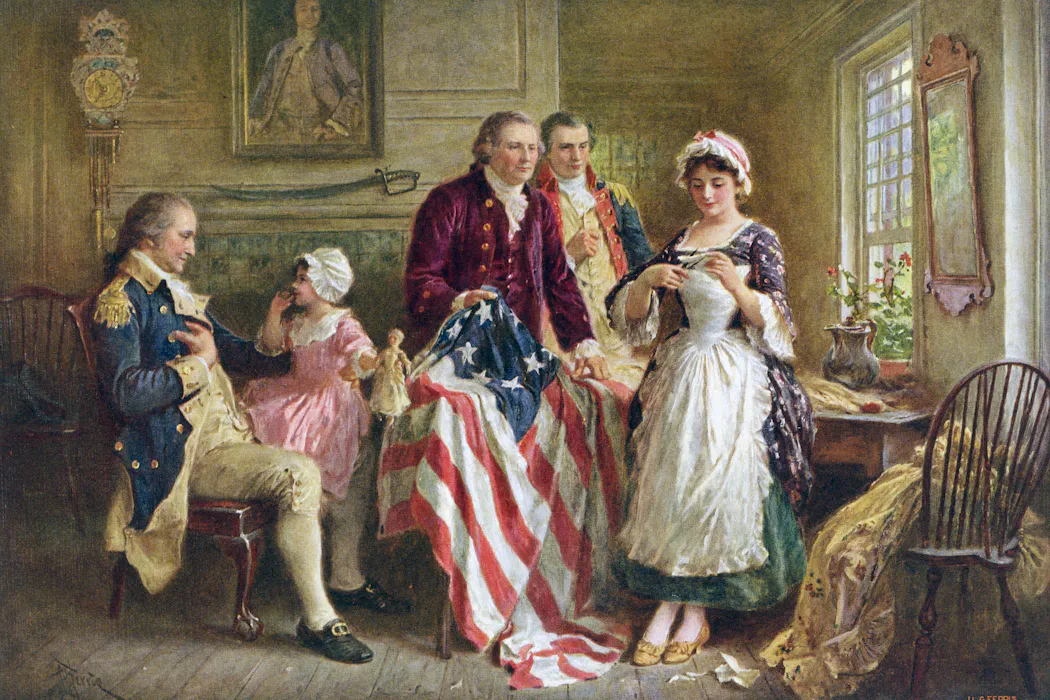
According to the legend, Betsy Ross showed George Washington how a five-pointed star instead of a six-pointed star would speed up production. GraphicaArtis/Archive Photos Collection via Getty Images

For generations, most Americans knew – and maybe believed – a story about upholstery seamstress Betsy Ross and the making of the nation’s first flag.

In the account passed down through her family, Ross was a young Philadelphia widow when George Washington and a congressional committee asked her to make a flag for the Colonies uniting in rebellion against England.

A sketch showed what they envisioned: red and white stripes and a constellation of six-pointed stars across a blue field.

But, the story continues, Ross folded a piece of paper “just so,” made a single cut, and voila! She produced a perfect five-pointed star. The men approved, she stitched a flag, Congress cheered and history was made.

As a historian of early American craftswomen, including Ross, I have often seen how mythologies – history’s sound bites – can bury richer and deeper understandings of the past. That’s the case with Betsy Ross, whose story was never about designing one flag but about producing many – and being one of thousands of women whose labor was essential to the nation’s origins.

Making of a legend

In 1870, Ross’ grandson William J. Canby recounted the family’s story about Betsy Ross and the making of the first flag in a speech to the Pennsylvania Historical Society. Historians and members of the public greeted the tale with skepticism.

Canby’s best efforts notwithstanding, no archival evidence then – or since – has confirmed that Ross fabricated the first U.S. flag.

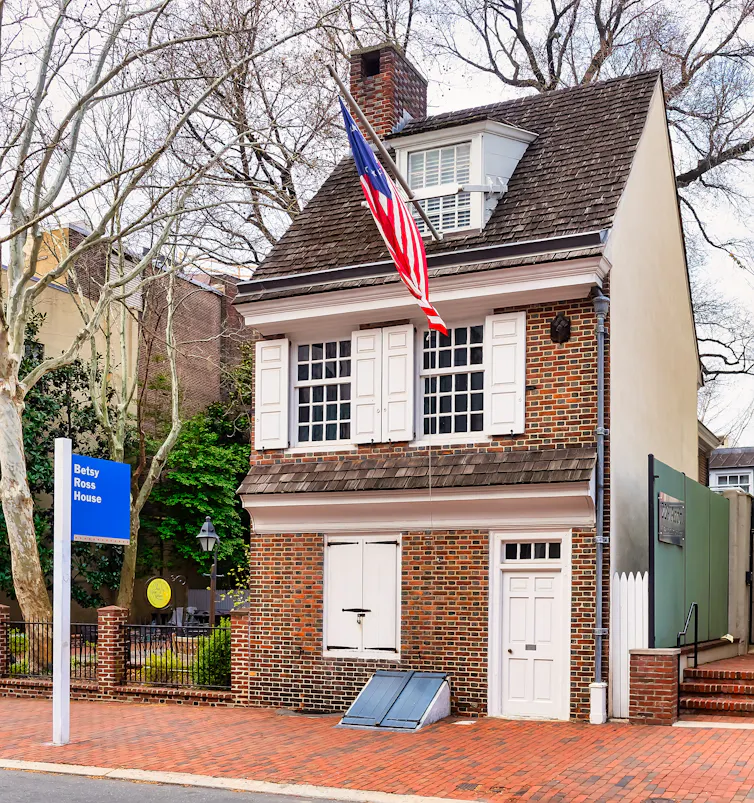
Still, the story gained traction. For a long while, Ross was a popular historical figure in U.S. culture, up there with the likes of Martha Washington and Abigail Adams. One of the earliest biopics imagined her life story, and her name graced everything from dolls to decanters. Over time, thousands of people began visiting her supposed home at 239 Arch St. in the Old City neighborhood of Philadelphia. The landmark is preserved as a house museum.

As late as the 1980s, history professor Michael Frisch reported that “college students asked to name any person from pre–Civil War America who is not a politician or military figure” included Ross “year after year.”

But in the years following the 1976 U.S. bicentennial, Ross’ fame was already cresting. Today many Americans aren’t entirely sure whether she was real or fictional.

A brick rowhome with a white door and a US flag
The Betsy Ross House museum in Philadelphia.
Gilbert Carrasquillo via Getty Images

Widow turned aspiring government contractor

Elizabeth Griscom Ross was indeed real. She was an upholstery worker who lived in Philadelphia from the 1750s to the 1830s. While no written record confirms the flag story, ample evidence survives to document the successful multigenerational flagmaking enterprise that she launched and then sustained with her daughter and granddaughters.

According to an oral history recorded with Ross’ youngest daughter, sometime in the 1760s a young Elizabeth Griscom, who was born in 1752, joined a sister employed by Philadelphia upholsterer John Webster. Ross learned the craft of upholstery as well as the making of tassels and fringe from Ann King, who oversaw women’s work there.

Ross married upholstery apprentice John Ross in 1773, and the pair launched a small shop. John died in January 1776. Ross’ second husband, mariner Joseph Ashburn, served the Revolution as a privateer and died in an English prison. In 1783, another privateer, John Claypoole, became Ross’ third husband, and the couple raised a large family and lived full lives in the city.

My take on the legend’s veracity is that it is partly accurate, partly not, and there isn’t really any “first” flag.

What is certainly true is this: Ross found herself widowed in 1776 just as Philadelphia braced for British forces, an effort that required the building of a navy and new flags representing the Americans. Women all around the seaport were getting contracts to stitch flags, and Ross surely wanted in.

The “Did she or didn’t she sew the ‘first flag’?” question is usually framed as a story of design, but it’s not: It’s a story of production.

Ross, drawing on years of experience, was saying to these potential clients, “If you want a lot of these flags, and fast, five-pointed stars work better.”

Women’s massive wartime effort

When Betsy Ross told this story later to her children and grandchildren, at the heart of the story is a young craftswoman who met the “Father of Our Country” – and believed she taught him something.

Understanding Ross’ real life is important because her story offers a view of women’s massive wartime production of flags, uniforms, tents, knapsacks and more – and because of the deep pride she and women like her felt in their contributions to the independence movement.

Hundreds of Philadelphia women – including, briefly, Ross – manufactured ordnance for the Schuylkill arsenal. White, Black, Indigenous, enslaved and free women provided labor in the form of nursing, cooking, and making and maintaining clothes that was essential to military encampments. Women shaped diplomacy directly, especially among Indigenous peoples, and indirectly as they shared their perspectives with husbands, fathers and sons. They also managed affairs for absent family and stretched scarce resources to sustain wartime households.

Whatever she did or did not offer to the making of the first U.S. flag, Elizabeth Griscom Ross Ashburn Claypoole certainly enjoyed a long career in flagmaking.

The best documentation for this came just before the War of 1812. When Purveyor of public supplies Tench Coxe needed flags, he steered contracts to the onetime Elizabeth Ross, now known as Elizabeth Claypoole. In 1808, for instance, Coxe recorded that yards of blue fabric were en route to her; weeks later, the craftswoman submitted a bill for two garrison flags, two silk flags and seven regimental colors.

In 1810, she was contracted for six 18-by-24-foot garrison flags for a military installation at New Orleans. These flags unfolded to 432 square feet and required more than 100,000 stitches. They must have been well received because another order followed, for 46 garrison flags, which she was to deliver “with all dispatch” to the arsenal. Orders also came in from the Indian Department to produce dozens of flags used in diplomatic exchanges with Native nations.

By the time the U.S. went to war with England a second time in 1812, flags by Elizabeth Claypoole, aka “Betsy Ross,” flew all around the United States.

Over her long career, Betsy Ross produced an unknown number of flags – the hundred or so recorded in archival sources represent a fraction of her total output. As the U.S. observes the 250th anniversary of its independence, Ross’ real life – today fully interpreted by the dedicated staff of the Betsy Ross House – offers a view into the lives of working women across America whose wartime labor helped build a nation.

Read more of our stories about Philadelphia, or sign up for our Philadelphia newsletter on Substack.

The Conversation

Marla Miller receives funding from the National Park Service as a consultant providing expertise on women and the the American Revolution.

– ref. What Betsy Ross’ real story tells us about women’s work in the Revolution − and why it still matters 250 years later – https://theconversation.com/what-betsy-ross-real-story-tells-us-about-womens-work-in-the-revolution-and-why-it-still-matters-250-years-later-276582

The ever-evolving Latino vote is rapidly shifting away from Trump and Republicans

Source: The Conversation – USA – By Matt A. Barreto, Professor of Political Science, UCLA Luskin School of Public Affairs

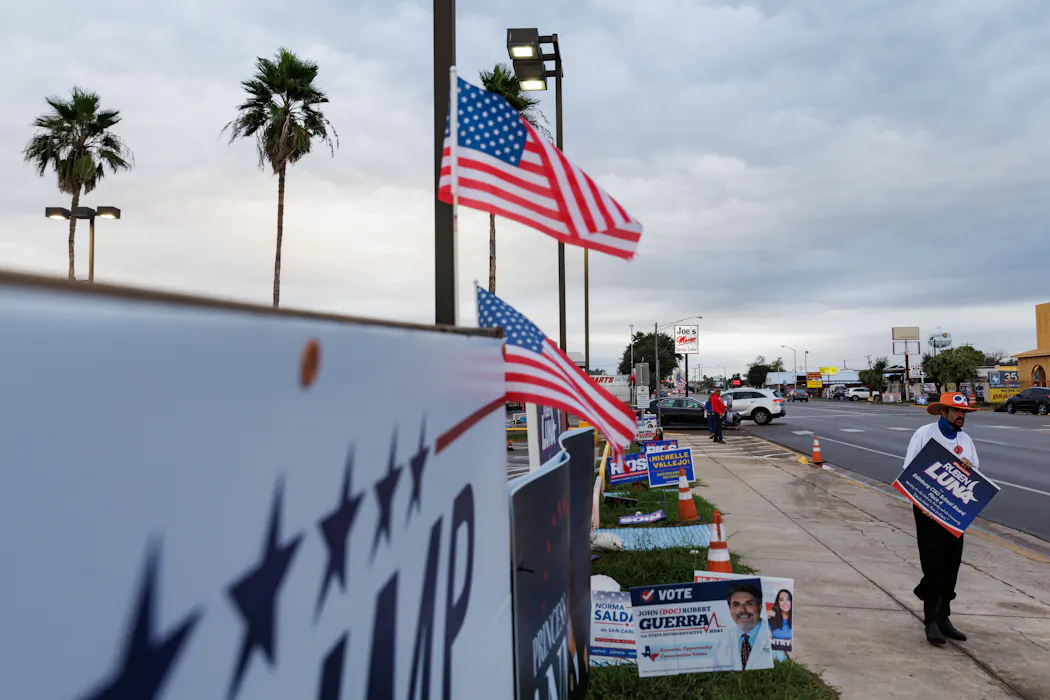
In 2024, Trump and other Republicans scored notable gains in the Rio Grande Valley of Texas, along with other heavily Hispanic areas. Getty Images/Michael Gonzalez

In 2024, Donald Trump dramatically improved his performance among nearly all groups of voters from four years earlier. Trump’s growth among Hispanic voters was especially notable, increasing by more than 10 points from 2020 to 2024, at least according to exit polls.

This led to a considerable amount of commentary speculating that Hispanic voters, historically more supportive of Democrats, might continue shifting toward the GOP.

News reports suggesting Latinos were critical to Trump’s 2024 victory were, in our view, overblown. Even if Latinos had not shifted, Trump still would have won in 2024.

Yet there is no question that over the past three election cycles, Latino voters – Latino men under 40, in particular – have shifted right. That change has benefited GOP candidates, even as the majority of Latinos still voted for Democrats.

However, evidence from general elections in 2025 in places such as New Jersey, New York and Virginia, as well as special elections in 2026, suggest an abrupt correction is underway, with some of the Latino voters who backed Trump now swinging back to the Democrats.

As political scientists and pollsters who study Hispanic voting trends, we are concerned with the question of whether these latest movements are real or simply a function of fluctuating Latino Democratic turnout rates. In other words, are Latinos broadly changing their votes back to Democrats, or are Latinos who remained loyal to the Democrats now more angry and fired up?

Survey and election data suggest it’s a bit of both. So what does this portend for the future of American politics?

Latino voting trends

The history of the Latino vote nationwide had for decades been one of long-term stability. Historically, Democrats enjoyed an approximate 65% to 35% advantage over Republicans.

That advantage shrank marginally after Republican President Ronald Reagan signed the Immigration Reform and Control Act in 1986, providing a path to citizenship for millions. But the more familiar two-thirds advantage for the Democratic Party returned following passage of Proposition 187, a 1994 anti-immigrant initiative in California that ultimately mobilized Latinos against Republicans.

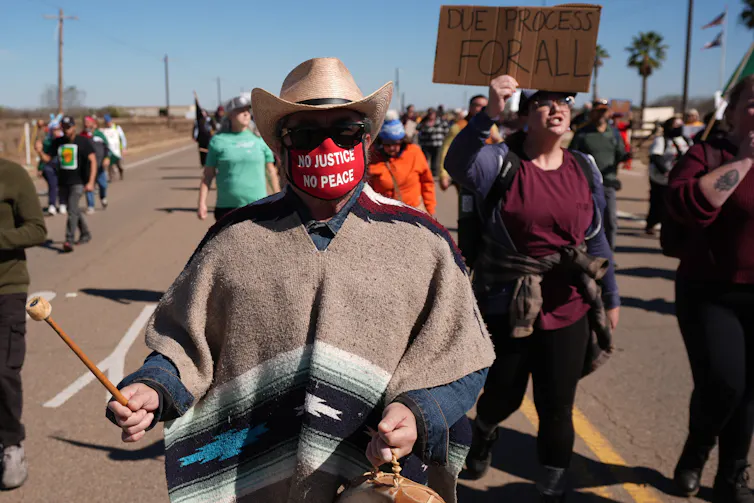
A man wearing a poncho and a mask that says 'no justice, no peace' bangs on a drum during a protest.
Trump’s immigration policies have triggered widespread protests, including among Latinos.
AP Photo/Eric Gay

Another effort at GOP outreach to Hispanic voters culminated in President George W. Bush taking approximately 40% of the Latino vote in 2004. That growth, however, soon eroded in the wake of anti-immigrant legislation passed by the Republican-controlled House in 2005 and 2006.

The successful campaigns of Democrat Barack Obama in 2008 and 2012, as well as Hillary Clinton’s unsuccessful 2016 campaign against Trump, saw Democrats reaping a relatively high level of Latino support, peaking at a 3-to-1 advantage in 2012.

That made Trump’s improvements among Latinos in 2020 and 2024 feel, for some, particularly unexpected. He lodged notable breakthroughs in parts of Florida, where he carried Miami-Dade County, and Texas, where he flipped the historically Democratic Rio Grande Valley.

Some Latinos question whether Democrats have delivered

It should not have been such a surprise. There has been a history of sizable shares of Latinos supporting Republican candidates. For instance, both former President George W. Bush and his brother, former Florida Gov. Jeb Bush, performed well with Latinos in Texas and Florida.

For two decades, Democrats have campaigned among Latinos on the promise of comprehensive immigration reform and an economic policy that would level the playing field, including raising the federal minimum wage, providing universal pre-K education and promoting affordable housing.

Many Latinos feel they are still waiting for these Democratic policies to be enacted, let alone improve their lives.

Democratic trifectas in 2009-10 and 2021-22 – when the party held both chambers of Congress, along with the presidency – failed to produce meaningful movement on immigration policy. Many Latinos felt their daily lives had not improved, as they faced high costs of living, expensive housing markets and rising health care costs. While House Democrats did pass numerous bills to address these topics, Senate moderates proved difficult to persuade.

A female member of Congress in a black-and-white polka dotted jackets stands at a lectern and speaks during a news conference.
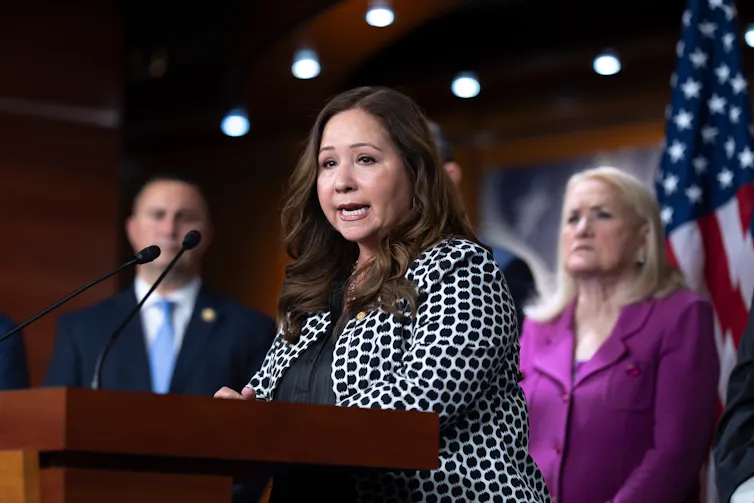
Members of the Congressional Hispanic Caucus, including Arizona Democrat Adelita Grijalva, have criticized Trump’s immigration stance.
AP Photo/J. Scott Applewhite

Given these shortcomings, running on the message that “the GOP are bad guys” only gets Democrats so far. In 2024, surveys and focus groups of Hispanic voters made it clear that not everyone was convinced by this characterization. The frustrations of working-class families during the Biden administration were real, whereas fears of mass deportations and other social chaos that a second Trump term might portend were, at that point, conjecture.

The Trump campaign specifically promised widespread action against immigrants, but many of our Latino focus group participants felt this was bluster. They believed that Trump’s actions would be targeted against blatant criminals and that his policies would not affect their families and friends.

They did not believe the worst-case scenarios presented by Vice President Kamala Harris and other Democrats during the campaign. Despite often not liking Trump, his economic promises felt good during the 2024 affordability crisis.

Latinos shifting back left?

Many Latinos are now quite upset with Trump. The 2025 gubernatorial elections in New Jersey and Virginia point to dramatic 25-point changes in the Latino vote in the Democrats’ direction, compared with Trump’s 2024 performance.

In December 2025, the first Democrat was elected mayor of Miami since 1997, with Latino support. A Democrat won a heavily Republican state legislative district in Texas in February 2026 with an estimated 79% of the Latino vote. Most recently, Latino voter turnout surged to record levels in the March Democratic primary in Texas.

Majorities of Latino voters believe that their economic fortunes have declined since Trump returned to the White House. Moreover, they expect the situation to worsen over the next year. In March 2026, The Economist reported that Trump’s support among Latinos had fallen to 22%.

In a bipartisan poll by UnidosUS released in November 2025, only 14% of Latino voters said their lives were better after one year under Trump, while 39% said they had gotten worse. Looking ahead, 50% expected things to get worse still in 2026, while only 20% were optimistic about their economic future. Two-thirds of Latino voters felt that Trump and the Republicans were not focusing enough on improving the economy for people like them.

What’s more, mass deportations have happened under the second Trump administration. The vast majority of those detained for deportation, including those who have died, had no criminal record.

Latinos are overwhelmingly opposed to federal troops in U.S. cities, according to our polling; 41% fear legal residents and U.S. citizens getting caught up in enforcement actions. The No. 1 immigration concern for Latino voters remains a path to citizenship for Dreamers – the undocumented immigrants brought to the U.S. as children – and for immigrants who have worked and paid taxes in the country for more than 20 years but lack formal status.

Among Latinos who actually voted for Trump, many would not do so again. Our poll suggests that 22% of Latinos who voted for Trump in 2024 would not vote for him again. By contrast, Democrats retain support from 93% of their 2024 Latino voters.

The long-term effects of the Trump presidency on the Latino electorate are difficult to predict, but for now party preferences have shifted firmly back toward the Democrats. Among voters in the UnidosUS poll, 55% said they felt the Democrats “care a great deal” about Latinos, compared with 29% saying they felt that way about the GOP. At the same time, 33% of Latino voters see the GOP as “hostile,” compared with just 7% who believe this about the Democrats.

If the recent leftward shift is sustained, or the earlier shift to the right was illusory, the effects on the politics of 2026 could be large, potentially putting control of Congress in the hands of Latino voters. There are 46 House districts where the number of registered voters who are Latino exceeds the total margin of victory for those seats in 2024, with 23 currently held by Republicans and 23 currently held by Democrats.

Latino voters need to believe that politicians truly care about their concerns and will work to implement a plan to create equal opportunities for the nation’s largest minority group to achieve the American dream. We believe the candidates able to make that pitch convincingly will be the most successful.

The Conversation

Matt A. Barreto is principal and co-founder of the polling firm BSP Research. BSP Research has conducted polling for non-profit and advocacy organizations, businesses, and candidates. Barreto has, in the past, directly consulted with Democratic candidates for House, Senate and the presidency.

Gary M. Segura is principal and co-founder of the polling firm BSP Research. BSP Research has conducted polling for non-profit and advocacy organizations, businesses, and candidates. Segura has, in the past, directly consulted with Democratic candidates for House, Senate and the presidency.

– ref. The ever-evolving Latino vote is rapidly shifting away from Trump and Republicans – https://theconversation.com/the-ever-evolving-latino-vote-is-rapidly-shifting-away-from-trump-and-republicans-277335

Can you survive inside a tornado? This scientist did by accident – he’s lucky to be alive

Source: The Conversation – USA (2) – By Perry Samson, Professor Emeritus of Atmospheric Science, University of Michigan

Tornadoes can be erratic and extremely dangerous. Brent Koops/NOAA Weather in Focus Photo Contest 2015, CC BY

Curious Kids is a series for children of all ages. If you have a question you’d like an expert to answer, send it to CuriousKidsUS@theconversation.com.


Can a person survive inside a tornado? – Sophia, age 14, Greencastle, Indiana


I have seen the center of a monster. Most people describe the sound of a tornado as like a freight train, but up close, it’s more like a thousand screaming jet engines. I am one of the few people on Earth who has driven into a tornado and lived to tell the tale.

While it might sound like a scene from a Hollywood blockbuster involving a high-tech armored truck, my experience was much more dangerous and terrifying.

I am an atmospheric scientist who studies tornadoes, but I am only alive today because of split-second decisions and a massive amount of dumb luck. Believe me, I do not want to ever be in that situation again.

A vehicle drives down a rural road, away from a large tornado.
Tornadoes vary in size and intensity.
Hank Schyma, used with permission

The day the sky broke

It started in northwest Kansas, where I was studying supercell thunderstorms – the kind that produce tornadoes – with a team of students from the University of Michigan.

We were positioned under a thunderstorm that was so dark, we had to turn on our vehicles’ headlights in the middle of the day. Suddenly, a tornado formed and began charging directly toward us.

The storm the author survived, filmed by students who were in nearby vehicles at the time.

The students were in other vehicles and got away, but my car was quickly swallowed by a cloud of flying debris so thick that I couldn’t even see my own hood.

With my options disappearing, I made a desperate move: I turned the car directly into the wind, hoping the vehicle’s aerodynamics would keep us pinned to the ground rather than being flipped like a toy.

The physics of fear

When you’re inside a tornado’s vortex, your body experiences things the news cameras can’t capture:

  • The pressure change: A tornado is a localized area of rapidly changing pressure. Your ears don’t just “pop” – they ache, as if your head is being squeezed by giant hands.

  • The solid wind: We measured wind speeds of almost 150 mph (241 kph) nearby, but inside the vortex, they were likely much higher. At those speeds, air hits you with the force of a solid object.

  • The soup of darkness: In movies, the “eye” is a clear space. In reality, it’s a debris ball – a brownish-black soup of pulverized soil, trees and buildings. It was so dark that my camera couldn’t even register a picture.

A tornado tears apart a building, sending a cloud of fast-moving debris into the air.
A tornado’s winds can reach 300 mph (482 kph). Part of the danger is all the debris blowing around at fast speeds.
Hank Schyma, used with permission

As debris slammed into my windshield, I was terrified I’d be crushed by flying materials – tornadoes can pick up fences, wood and metal from buildings, tree branches, even cows. Textbook advice says to get into a ditch so you’re lying flat and might be more protected from flying debris. But the wind was so violent, I couldn’t even open the car door. I just stayed low and prayed.

The making of a monster

How does this severe of a storm even happen? It takes a perfect, violent recipe of atmospheric ingredients:

  • Fuel: A tornado needs warm, muggy air (water vapor) near the ground with dry air above it. This creates the potential for rising air, but only if the atmosphere is unstable enough to overcome “the cap.”

  • The cap: A thin “inversion” layer of stable air acts like a lid on that warm moist air, bottling it up until the moist air punches through.

  • The dry line: The dry line is where warm, moist air from the Gulf of Mexico and dry air from the west meet. The advancing hot, dry air is actually heavier than muggy air, and this dry air pushes the moist air upward, disrupting the cap.

  • Wind shear: Surface winds from the south and upper winds from the west create a horizontal rolling motion in the atmosphere. When the air is pushed upward, that rotation becomes vertical, creating what’s known as a mesocyclone.

  • The jet stream: About 5 to 7 miles (8 to 11 kilometers) up, the jet stream is a fast-moving river of air. Disturbances within it can create areas that pull air upward from below and lower surface pressure.

How wind shear makes the winds roll and form tornadoes. NOAA.

Together, these ingredients can create the powerful, rotating vortex that you know as a tornado.

These storms can have winds up to 300 mph (482 kph) and leave a long path of destruction, sometimes more than a mile (1.6 kilometers) wide. They can stay on the ground for seconds or many minutes, tearing apart buildings and trees in their path. Where they will travel is hard to predict, so getting to safety should be a priority.

The monster’s lesson

When the storm passed, the silence was jarring. My rental car was mired in mud, the antenna was bent in half, and bits of straw were embedded in every single seam of the car’s body.

Tornadoes are extremely dangerous. Sixty-one people were killed by tornadoes in the U.S. in 2025, and many more were injured by flying debris. Make sure you know what to do when a tornado alert sounds – follow the alert’s advice and get to safety immediately.

Four people stand beside a truck with the NOAA logo.
Scientists working with the National Severe Storms Lab watch a thunderstorm’s evolution in Kansas.
Mike Coniglio, NOAA NSSL/VORTEX II, CC BY

When scientists chase storms, they are not trying to experience tornadoes – they are trying to measure the small-scale processes inside storms that cannot be observed in other ways. Many of the key processes that produce tornadoes occur within a few hundred meters of the ground and evolve over minutes, which means radars, satellites and weather stations often miss them.

Seeing a tornado and the damage it causes is a powerful reminder that people are not in control of everything. It serves as a warning to be wise and ready for anything. Sophisticated research using drones and radar is the smart way to study these monsters – seeing them from the inside is definitely not.

Willa Connolly, a student at Tappan Middle School in Ann Arbor, Michigan, contributed to this article.

The Conversation

Perry Samson does not work for, consult, own shares in or receive funding from any company or organization that would benefit from this article, and has disclosed no relevant affiliations beyond their academic appointment.

– ref. Can you survive inside a tornado? This scientist did by accident – he’s lucky to be alive – https://theconversation.com/can-you-survive-inside-a-tornado-this-scientist-did-by-accident-hes-lucky-to-be-alive-278648

Immigrant kids can attend school regardless of citizenship – some states are challenging this standard

Source: The Conversation – USA (2) – By William McCorkle, Associate Professor of Education, College of Charleston

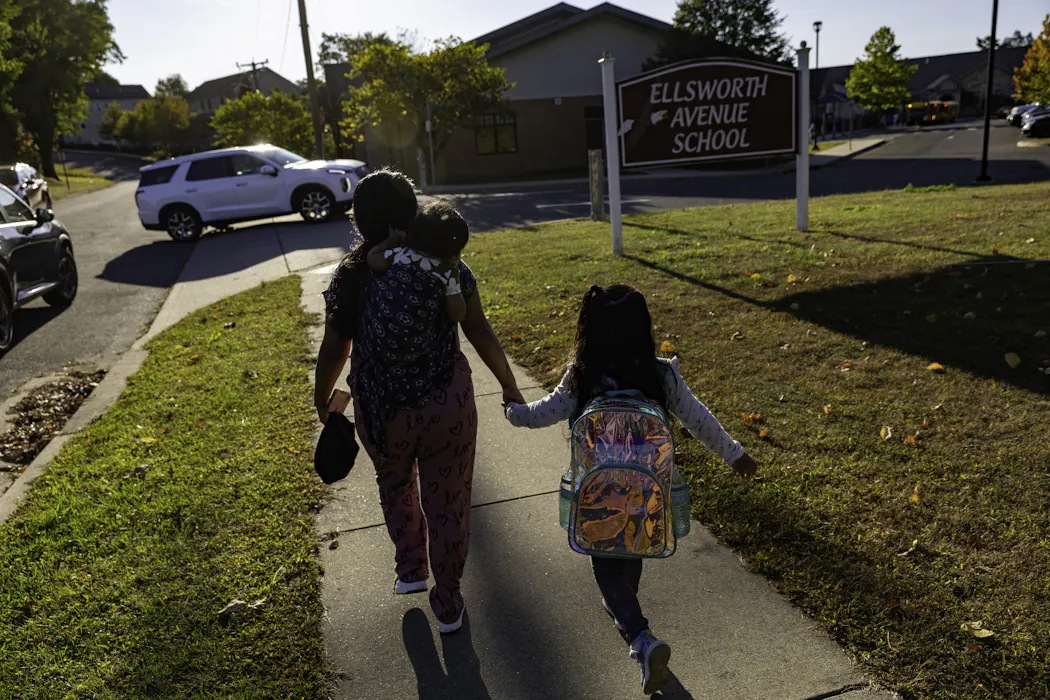
An undocumented mother walks her 6-year-old daughter to school in Danbury, Conn., in October 2025, shortly before the family self-deported. John Moore/Getty Images

All immigrants, regardless of their citizenship status, have the right to attend a public K-12 school in the United States. Schools cannot collect students’ immigration status when they enroll. This has been the case since 1982, when the Supreme Court ruled against Texas in the case of Plyler v. Doe.

Republican legislators in several states, including Tennessee, Oklahoma and Ohio, are trying to pass legislation that challenges the Plyler decision. These bills would make it harder, if not impossible, for immigrant children to attend public school.

In the U.S., there are approximately 1.5 million children under the age of 18 who are undocumented immigrants, meaning that they live in the country without legal authorization.

There are likely 600,000 to 850,000 undocumented students enrolled in K-12 schools.

Two young girls stand near a fence outside of a brick building. They're wearing jackets and hoods and hats that cover their faces as they look away from the camera and toward the building.
Two undocumented children pause outside a school in Lynn, Mass., in February 2025.
Pat Greenhouse/The Boston Globe via Getty Images

Opposition to Plyler

In 1975, Texas passed legislation that allowed school districts to either charge undocumented students to attend public school or not let them enroll at all.

Seven years later, the Supreme Court ruled that Texas’ law violated the 14th Amendment’s equal protection clause. The court determined that someone’s immigration status “does not establish a sufficient rational basis for denying them benefits that the State affords other residents.”

For the past 44 years, this ruling has ensured that no state can ban undocumented students from attending a public K-12 school, charge them extra fees or discriminate against them in any other way because of their immigration status.

A few times over the past few decades, some states have unsuccessfully tried to make it harder for immigrant children to attend school.

In 1994, California voters passed Proposition 187, a ballot initiative that denied undocumented people the right to receive public services, including a public education. The proposition also required schools to document students’ immigration status.

A federal judge ruled in 1998 that the controversial proposition was unconstitutional.

In 2011, Alabama passed legislation that required K-12 public schools to collect students’ immigration status.

The Supreme Court ruled in 2012 that Alabama’s legislation was illegal. Alabama schools, like all other schools, are not allowed to ask students about their immigration status, as it could be a means of discrimination or intimidation.

A new wave of legislation

The conservative think tank The Heritage Foundation issued a policy document in February 2026 that encouraged all states to challenge the Plyler v. Doe ruling.

Heritage argued that “illegal aliens should not be eligible for federal, state, or local government benefits, including through their children.” It wrote that giving undocumented immigrants these benefits “takes resources from American citizens and lawful immigrants.”

Heritage also published sample legislation that challenges the Plyler ruling and which state legislators could follow when drafting a new bill.

In 2025, at least five states considered legislation that would make it harder for undocumented students to attend K-12 school. None of those measures have become official policy, though some are still being debated in legislatures.

The Tennessee Senate passed a bill in 2025 that allowed school districts to ban undocumented students. In March 2026, the state’s House of Representatives passed a similar, watered-down version of the legislation. This bill would require schools to check students’ immigration status. The two government chambers are now working to determine next steps on the measure.

In 2025, Ohio legislators introduced a bill that wouldn’t ban immigrants from attending school, but it would require schools to report students’ immigration status to the state. The state’s House Government Oversight Committee is considering the measure.

In January 2025, the Oklahoma Board of Education passed a resolution that would require parents to show their child’s citizenship status before enrolling in school. Oklahoma’s House of Representatives blocked the resolution four months later.

Similarly, Republican legislators in Idaho introduced a bill in February 2026 that would require public K-12 schools to check students’ immigration status. The state’s House Education Committee is currently considering the bill.

A bill was also introduced in New Jersey in January 2025 that would charge undocumented students to study at a K-12 school, but the bill did not gain traction.

In Texas, Gov. Greg Abbott has talked about challenging the Plyler ruling, as far back as 2022. The state is not currently considering any specific legislation on the issue.

But in March 2026, Mandy Drogin, a campaign director with the conservative think tank Texas Public Policy Foundation, spoke out against Plyler in a U.S. Congressional hearing.

“If states are required to educate illegal immigrant students, they must be allowed to identify the student population’s status to fully understand and address the adverse effects of Plyler v. Doe,” Drogin said.

A patchwork higher education landscape

The Plyler decision focused on K-12 schools, not colleges and universities. Undocumented students in some states already face college enrollment and tuition restrictions, particularly when it comes to state schools.

Twenty-five states, including Florida and Texas, require undocumented students to pay higher out-of-state tuition fees for state schools, even if they are Florida residents.

Alabama and South Carolina ban undocumented students from attending state colleges and universities. Undocumented students in Georgia cannot attend certain top public universities, including the University of Georgia and Georgia Tech.

These policies all make it harder for undocumented students to receive a college degree. But the stakes of state legislation that would create new hurdles for immigrant children to attend elementary and secondary school would arguably be much higher.

A red sign on a metal pole says, 'This classroom is a safe space for immigrants.'
A teachers union sign in support of immigrant students is posted at Sepulveda Middle School in Los Angeles in August 2025.
Sarah Reingewirtz/MediaNews Group/Los Angeles Daily News via Getty Images

A fragile right

If undocumented students are not offered a free public education, then students who are applying for asylum, or students whose parents are undocumented, could find that this standard is no longer a guarantee for them as well.

This issue has not received a great deal of media attention, perhaps because states have not yet succeeded in passing any of this legislation.

As an education professor, I believe that any of these state measures, if turned into law, would have significant effects on immigrant families – and on American education more broadly.

It would mean that many young people, including the many who are rapidly losing their legal immigration status under the Trump administration, would no longer be able to receive an education in this country and try to reach their full potential. They also would have less opportunities to contribute to our society.

The universal right to public education in the U.S. has long been taken for granted – but this right, like others, might be more fragile than it seems.

The Conversation

William McCorkle does not work for, consult, own shares in or receive funding from any company or organization that would benefit from this article, and has disclosed no relevant affiliations beyond their academic appointment.

– ref. Immigrant kids can attend school regardless of citizenship – some states are challenging this standard – https://theconversation.com/immigrant-kids-can-attend-school-regardless-of-citizenship-some-states-are-challenging-this-standard-278766

For the nearly 1 in 4 US adults with chronic pain, employers’ expectations of a healthy body can lead to shame

Source: The Conversation – USA (2) – By Beth Schinoff, Assistant Professor of Management, University of Delaware

Chronic pain afflicts white-collar and blue-collar workers alike. ilkercelik/E+ via Getty Images

Your back pain gets worse as you sit through a long meeting. Your wrist pain flares when you’re typing furiously to meet a tight deadline. During a busy shift at the grocery store, you feel a migraine coming on.

If that sounds familiar, you’ve got plenty of company. About 1 in 4 U.S. adults suffer from chronic pain. The share who say they are in chronic pain either on most days or every day in the past three months is growing: It jumped by nearly 4 percentage points to 23% of U.S. adults in 2023, up from 19% in 2019.

Chronic pain is not only hard on workers trying to do their jobs, but it also takes a toll on employers and the economy as a whole by costing an estimated US$722 billion in lost productivity each year.

As management scholars who study how people feel at work, we wanted to understand why chronic pain so often makes it impossible for employees to do their work – and even to keep their jobs.

Bad for your health

With this in mind, we teamed up with two other management researchers, Kimberly Rocheville of Creighton University and Njoke Thomas of Boston College, to conduct a study that Academy of Management Journal published online in January 2026 and will include in an upcoming print edition.

We interviewed 66 people between 2019 and 2021. All of them said that they were in chronic pain – meaning pain that lasts for at least three months. They were all U.S. workers and at least 18 years old. They lived all over the country, in relatively more urban than rural areas. Our sample was 78% women because women tend to experience more chronic pain than men and tend to be more open to talking about their pain.

This professionally diverse group included lawyers, grocery store workers, teachers, police officers and health care professionals. They experienced many different kinds of pain, such as back pain, migraines, arthritis and fibromyalgia.

We found that this wide array of workers and white-collar professionals pushed through their pain because they felt pressure to have what we call an “ideal worker body”: a body that is healthy and strong enough to do anything their job requires.

Regardless of what job they had, people described a surprisingly similar pressure to perform despite their pain. From warehouse workers to lawyers, people felt they had no choice but to walk without a limp, lift heavy things and sit still during meetings.

Many of these people felt compelled to be ideal workers who put work before everything else in their lives. Previous research has found that these expectations can harm their mental health. We found that it can harm your physical health too.

Trapped in a cycle of pain and shame

Because they were in chronic pain, all of the participants in our study said their body wasn’t healthy and strong enough to do everything their job required when it required them to do it.

Even though they were more than intellectually capable of doing their work, they felt ashamed that their bodies fell short. This led them to hide their pain. They took the stairs, instead of the elevator, to seem more like their co-workers who felt fine. They avoided managing their pain in ways their colleagues could see, such as by applying ice to areas of their body that were in pain.

Ironically, trying to make it seem like their bodies were ideal worsened pain for all 66 of the people we interviewed. Most of them eventually reached a point where their pain became so intolerable that they could not function at or outside of work.

Some of them ultimately had to leave their jobs and found other ones that were more compatible with their chronic pain symptoms. In a few cases, they exited the workforce entirely.

This is not unusual. Chronic pain is the leading reason for workers becoming eligible for long-term disability benefits.

Breaking free of the cycle of shame and pain

A few of the people we interviewed told us that they managed to escape the damaging cycle of shame and pain.

Why were they able to break free?

First, they found doctors who told them their pain was real. Getting a clear diagnosis and having a medical professional recognize their physical limitations helped them understand that they could never look healthy and strong as expected, no matter how hard they tried.

This released them from the pressure of trying to do so.

Second, most of these people had employers who cared more about what they did – the work itself – and less about how their body looked and moved, even if this meant finding a new job or even changing their profession. As a result, they felt free to ask colleagues for help, stretch during meetings, use dictation software instead of typing, or keep the camera off during Zoom calls so they could lie down when their backs were aching.

They also came up with creative ways of working that were more efficient and better for their bodies. For example, an ultrasound technician told us that she learned to scan patients using both her arms instead of constantly using the same arm. A deli worker said she started using a cart to move heavy meats around the store.

Although we focused on how pressure to be strong and healthy can hurt workers with chronic pain, we believe our findings could matter to everyone – no matter their size, strength, age or employment status.

After all, it’s possible to feel social pressure to conceal aches and pain when you’re in public settings of any kind. And failing to move around when needed or take care of your body in other ways can make you vulnerable to more pain.

The Conversation

The authors do not work for, consult, own shares in or receive funding from any company or organization that would benefit from this article, and have disclosed no relevant affiliations beyond their academic appointment.

– ref. For the nearly 1 in 4 US adults with chronic pain, employers’ expectations of a healthy body can lead to shame – https://theconversation.com/for-the-nearly-1-in-4-us-adults-with-chronic-pain-employers-expectations-of-a-healthy-body-can-lead-to-shame-278140