Building a stable ‘abode of thought’: Kant’s rules for virtuous thinking

Source: The Conversation – USA (3) – By Alexander T. Englert, Assistant Professor of Philosophy, University of Richmond

Virtuous thinking, Kant wrote, is like good carpentry: It builds strong ideas in harmony with one another. Jackyenjoyphotography/Moment via Getty Images

What makes a life virtuous? The answer might seem simple: virtuous actions – actions that align with morality.

But life is more than doing. Frequently, we just think. We observe and spectate; meditate and contemplate. Life often unfolds in our heads.

As a philosopher, I specialize in the Enlightenment thinker Immanuel Kant, who had volumes – literally – to say about virtuous actions. What I find fascinating, however, is that Kant also believed people can think virtuously, and should.

To do so, he identified three simple rules, listed and explained in his 1790 book, “Critique of the Power of Judgment,” namely: Think for yourself. Think in the position of everyone else. And, finally, think in harmony with yourself.

If followed, he thought a “sensus communis,” or “communal sense,” could result, improving mutual understanding by helping people appreciate how their ideas relate to others’ ideas.

Given our current world, with its “post-truth” culture and isolated echo chambers, I believe Kant’s lessons in virtuous thinking offer important tools today.

Rule 1: Think for yourself

Thinking can be both active and passive. We can choose where to direct our attention and use reason to solve problems or consider why things happen. Still, we cannot completely control our stream of thought; feelings and ideas bubble up from influences outside our control.

One kind of passive thinking is letting others think for us. Such passive thinking, Kant thought, was not good for anybody. When we accept someone else’s argument without a second thought, it is like handing them the wheel to think for us. But thoughts lie at the foundation of who we are and what we do, thus we should beware of abdicating control.

A formal painting of a man with a gray powdered wig, looking down and wearing a dark suit jacket.
A late 18th-century portrait of Immanuel Kant, possibly by Elisabeth von Stägemann.
Norwegian Digital Learning Arena via Wikimedia Commons

Kant had a word for handing over the wheel: “heteronomy,” or surrendering freedom to another authority.

For him, virtue depended on the opposite: “autonomy,” or the ability to determine our own principles of action.

The same principle holds true for thinking, Kant wrote. We have an obligation to take responsibility for our own thinking and to check its overarching validity and soundness.

In Kant’s day, he was especially concerned about superstition, since it provides consoling, oversimplified answers to life’s problems.

Today, superstition is still widespread. But many new, pernicious forms of trying to control thought now proliferate, thanks to generative artificial intelligence and the amount of time we spend online. The rise of deepfakes, the use of ChatGPT for creative tasks, and information ecosystems that block out opposing views are but a few examples.

Kant’s Rule 1 tells us to approach content and opinions cautiously. Healthy skepticism provides a buffer and leaves room for reflection. In short, active or autonomous thinking protects people from those who seek to think for them.

Rule 2: Think in the position of everyone else

Pride often tempts us to believe that we have everything figured out.

Rule 2 checks this pride. Kant recommends what philosophers call “epistemic humility,” or humility about our own knowledge.

Stepping outside our own beliefs isn’t just about opening up new perspectives. It’s also the bedrock of science, which seeks shared agreement about what is and is not true.

Suppose you’re in a meeting and a consensus is taking shape. Strong personalities and a quorum support it, but you remain unsure.

At this point, Rule 2 does not recommend that you adopt the view of the others. Quite the opposite, in fact. If you simply accept the group’s conclusion without further thought, you’d be breaking Rule 1: Think for yourself.

Instead, Rule 2 prescribes temporarily detaching yourself from even your own way of thinking, especially your own biases. It’s an opportunity to “think in the position of everyone else.” What would a fair and discerning thinker make of this situation?

Kant believed that, while difficult, a standpoint can be achieved in which biases all but vanish. We might notice things that we missed before. But this requires appreciating our own limitations and seeking a wider, more universal view.

Again, Kant’s idea of virtue depends on autonomy, so Rule 2 isn’t about letting others think for us. To be responsible for how we shape the world, we must take responsibility for our own thinking, since everything flows from that point outward.

But it emphasizes the “communal” part of the “sensus communis,” reminding us that it must be possible to share what is true.

Rule 3: Think in harmony with yourself

The final rule, Kant maintained, is both the most difficult and profound. He said that it was the task of becoming “einstimmig,” literally “of one voice” with ourselves. He also uses a related term, “konsequent” – coherent – to express the same idea.

Blue neon lights illuminate a courtyard outside a large stone building, seen at night.
Immanuel Kant’s tomb at the Konigsberg Cathedral in Kaliningrad, Russia.
Denis Gavrilov/iStock via Getty Images Plus

To clarify, a metaphor that Kant employed can help – namely, carpentry.

Constructing a building is complex. The blueprint must be sound, the building materials must be high quality, and craftsmanship matters. If the nails are hammered sloppily or steps performed out of order, then the edifice might collapse.

Rule 3 tells us to construct our abode of thought with the same care as when constructing a house, such that stability between the parts results. Each thought, belief and intention is a building block. To be “einstimmig” or “bündig” – to be in “harmony” – these building blocks should fit well together and support each other.

Imagine a colleague who you believe has impeccable taste. You trust his opinions. But one day, he shares his secret obsession with death metal music – a genre you dislike.

A disharmony in thought might result. Your reaction to his love of death metal reveals a further belief: Your belief that only people with disturbed taste could love something you perceive to be so grating to the spirit. But he seems, otherwise, like such a thoughtful and pleasant person!

Rather than immediately change your belief about him, Kant’s third rule commands you to investigate the world and your own thoughts further. Perhaps you have never listened to death metal with a discerning spirit. Maybe your original beliefs about your colleague were inaccurate. Or could it be that having good taste is more complex than you originally thought?

Rule 3 leads us to do a system check of our mental architecture, whether we’re considering music, politics, morality or religion. And if that architecture is stable, Kant thinks that rewards will follow.

Sure, harmony is satisfying; but that’s not all. A sturdy system of thought might equip us better for integrated, creative thinking. When I understand how things connect, my own control over them can improve. For example, insight about human psychology will open up new ways to think about morality, and vice versa.

But ultimately, Kant found harmony important because it supports the construction of a coherent “worldview.” The English language gained that term through the translation of a German word, “Weltanschauung,” which Kant coined and which has been a focus of my own work. At its most basic, a harmonious worldview allows us to feel more at home in the world: We gain a sense of how it hangs together, and see it as imbued with meaning.

How we think ultimately determines how we live. If we have a stable abode of thought, we take that stability into everything we do and have some shelter from life’s storms.

The Conversation

Alexander T. Englert does not work for, consult, own shares in or receive funding from any company or organization that would benefit from this article, and has disclosed no relevant affiliations beyond their academic appointment.

ref. Building a stable ‘abode of thought’: Kant’s rules for virtuous thinking – https://theconversation.com/building-a-stable-abode-of-thought-kants-rules-for-virtuous-thinking-263597

James Comey’s lawyers face an uphill battle to prove selective or vindictive prosecution in his high-profile case

Source: The Conversation – USA – By Peter A. Joy, Professor of law, Washington University in St. Louis

Patrice Failor, wife of former FBI Director James Comey, departs the courthouse following Comey’s arraignment hearing in Alexandria, Va., on Oct. 8, 2025. Andrew Caballero-Reynold/AFP via Getty Images

Soon after President Donald Trump demanded in a social media post that the Department of Justice prosecute his perceived enemy, former FBI director James Comey, Comey was indicted on Sept. 25, 2025, for lying to a Congressional committee in 2020.

Comey’s lawyers have responded, filing a motion on Oct. 20, 2025, to dismiss the charges against him with prejudice – the “prejudice” being legal jargon for barring a refiling of the charges. Comey’s lawyers allege that the Justice Department’s prosecution is both selective and vindictive.

Despite the existence of a long string of Trump attacks specifically urging that Comey be prosecuted, getting the case dismissed as a prosecution that is selective, vindictive or both will require Comey to overcome a very strong presumption that the charging decision was lawful.

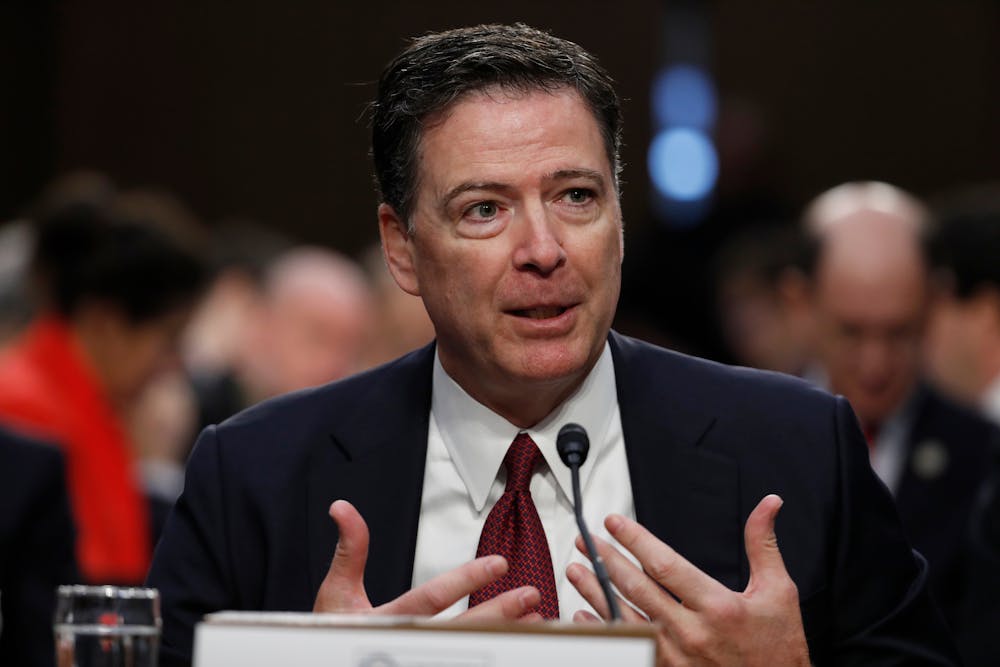
A man in a dark blue blazer, white shirt and red ties speaks in front of a microphone while moving his hands.
Former FBI Director James Comey speaks during a Senate Intelligence Committee hearing on Capitol Hill in Washington on June 8, 2017.
AP Photo/Andrew Harnik

Selective prosecution

For a court to find that there is a selective prosecution, Comey has two hurdles.

First, he has to demonstrate that he was singled out for prosecution for something others have done without being prosecuted.

Second, Comey will have to prove that the government discriminated against him for his constitutionally protected speech of criticizing Trump.

Clearing both of these hurdles seems unlikely. Others, including former Trump fixer Michael Cohen and former Reagan administration Defense Secretary Caspar Weinberger, have been prosecuted for the same type of crimes – allegedly making false statements to Congress or unlawfully seeking to influence or obstruct a Senate investigation.

Vindictive prosecution

Due to Trump’s repeated statements and social media posts that Comey should be charged, proving a vindictive prosecution may be easier.

Indeed, the motion to dismiss starts by laying out the argument for a vindictive prosecution, signaling that Comey’s lawyers think this is the stronger argument by leading with it.

Still, if Comey’s lawyers are to convince the judge, they will have to overcome a heavy burden that the prosecution has exceeded the broad discretion of the prosecutor.

The legal standard requires a court to first find that the prosecutor had animus, hostility, toward Comey, and second, that the charges would not have been brought if there was no animus.

The motion to dismiss based on vindictive prosecution makes a very strong showing of animus, relying on Trump’s several statements and social media posts that Comey should be prosecuted and that Comey was a “Dirty Cop” and “a total SLIMEBALL!

Further evidence involves the fact that no other prosecutor other than Trump’s former personal lawyer, Lindsey Halligan, would seek charges against Comey.

Still, the grand jury found probable cause for the two charges against Comey and issued the indictment. The government will likely argue that demonstrates that the charges could have been brought even if there was animus.

A social media post in which the president urges prosecution of James Comey and others.
A social media post by President Donald Trump urging Attorney General Pam Bondi to prosecute his perceived enemies, including James Comey.
Truth Social Donald Trump account

Fallback position

Comey’s lawyers are leaning heavily on arguments for a dismissal of the charges with prejudice, but they also have a fallback position.

If the judge determines that they have not proved a selective or vindictive prosecution, they are asking for the opportunity to obtain discovery – the record – of the government’s decision to seek charges from the grand jury, and a hearing on their motion to dismiss the indictment.

Given Trump’s public statements and social media posts, and the legal authority on this issue, as a longtime practitioner and teacher of criminal law, I believe the judge is very likely to choose this course of action.

No matter how the trial judge rules on the motion to dismiss, the losing side is certain to appeal. No matter how the federal appeals court rules, the losing side is likely to seek Supreme Court review. Whether the court would take such a case is impossible to predict with any certainty.

The Conversation

Peter A. Joy does not work for, consult, own shares in or receive funding from any company or organization that would benefit from this article, and has disclosed no relevant affiliations beyond their academic appointment.

ref. James Comey’s lawyers face an uphill battle to prove selective or vindictive prosecution in his high-profile case – https://theconversation.com/james-comeys-lawyers-face-an-uphill-battle-to-prove-selective-or-vindictive-prosecution-in-his-high-profile-case-267956

Coal plants emitted more pollution during the last government shutdown, while regulators were furloughed

Source: The Conversation – USA (2) – By Ruohao Zhang, Assistant Professor of Agricultural Economics, Penn State

Coal-fired power plants emit both smoke and steam. Paul Souders/Stone via Getty Images

When the U.S. government shut down in late 2018, it furloughed nearly 600 Environmental Protection Agency pollution inspectors for more than a month. Those workers had to stop their work of monitoring and inspecting industrial sites for pollution, and stopped enforcing environmental-protection laws, including the Clean Air Act.

My colleagues and I analyzed six years’ worth of air quality levels, emissions measurements, power production data and weather reports for more than 200 coal-fired power plants around the country. We found that the coal plants’ operators appeared to take advantage of the lapse in enforcement of environmental regulations.

As soon as the shutdown began, coal-fired power plants started producing about 15% to 20% more particle pollution. And as soon as the government reopened and inspections resumed, pollution levels dropped.

Particulate matter is dangerous

The longest federal government shutdown in U.S. history up until that time began on Dec. 22, 2018, and lasted until Jan. 25, 2019. During that period, about 95% of EPA employees were furloughed, including nearly all the agency’s pollution inspectors, who keep track of whether industrial sites like coal-fired power plants follow rules meant to limit air pollution.

Among those rules are strict limits on a type of pollution called particulate matter, which is sometimes called PM2.5 and PM10. These microscopic particles are smaller than the width of a human hair. When inhaled, they can travel deep into the lungs and even get into the bloodstream. Even short-term exposure to particulates increases the risk of asthma, heart disease and premature death.

An illustration shows a human hair and a grain of beach sand to compare with the size of particulate matter.
Particulate matter pollution is much smaller than a human hair or even a fine grain of sand.
U.S. Environmental Protection Agency

To determine whether coal-fired power plants continued to obey the rules even when environmental inspectors were furloughed and not watching, we examined data on emissions of more than 200 coal-fired power plants across the country. We looked at satellite data from NASA that provides a reliable indicator of particulate pollution in the atmosphere. We also looked at the amounts of several types of chemicals recorded directly from smokestacks and sent to the EPA.

We looked at each plant’s daily emissions before, during and after the 2018-2019 shutdown, and compared them with the plants’ emissions on the same calendar days in the five previous years, when EPA inspectors were not furloughed.

Pollution rose and fell with the shutdown

We found that as soon as the EPA furlough began in 2018, particulate emissions within 1.8 miles (3 kilometers) around the coal-fired power plants rose, according to the NASA data.

The data indicated that, on average, particulate matter during the 2018 and 2019 shutdown was 15% to 20% higher than it had been during the same period in the preceding five years.

And once the EPA inspectors returned to work, the plants’ average particulate pollution dropped back to its pre-shutdown level.

We also found that two other common air pollutants from coal-fired power plants, sulfur dioxide and nitrogen oxides, did not increase during the furlough period. Those gases, unlike particulate matter, are continuously monitored by sensors inside coal plants’ smokestacks, even when the federal government is not operating. Particulate emissions, however, are not continuously monitored: Enforcement of those emissions standards relies on the manual collection of samples from monitors and on-site inspections, both of which halted during the shutdown.

The pattern was clear: When the EPA stopped watching, coal plants increased pollution. And once inspections resumed, emissions dropped back to normal.

Considering various explanations

To confirm that the increase in particulate pollution during the shutdown was due to the lack of inspections and not because of some other factors such as weather fluctuations, we tested a range of alternative explanations and found that they did not fit the data we had collected.

For example, weather records showed that wind, humidity and temperature at and around the coal plants during the shutdown were all within the same ranges as they had been over the previous five years. So the increased particulate pollution during the shutdown was not due to different weather conditions.

Electricity demand – how much power the plants were generating – was also typical, and did not increase significantly during the shutdown. That means the coal plants weren’t polluting more just because they were being asked to produce more electricity.

Our analysis also revealed that the coal plants didn’t shift which particular boilers were operating to less efficient ones that would have produced more particulates. So the increase in pollution during the shutdown wasn’t due to just using different equipment to generate electricity.

The emissions data we collected also included carbon dioxide emissions, which gave us insight into what the coal plants were burning. With similar weather conditions and amounts of electricity generated, different types of coal emit different amounts of carbon dioxide. So if we had found carbon dioxide emissions changed, it could have signaled that the plants had changed to burning another type of coal, which could emit more particulate matter – but we did not. This showed us that the increase in particulate emissions was not from changing the specific types of coal being burned to generate electricity.

All of these tests helped us determine that the spike in particulate matter pollution was unique to the 2018–2019 EPA furlough.

Spewing particulate matter

All of this analysis led us to one final question: Was it, in fact, possible for coal-fired power plants to quickly increase – and then decrease – the amount of particulate matter they emit? The answer is yes. Emissions-control technology does indeed allow that to happen.

Power plants control their particulate emissions with a device called an electrostatic precipitator, which uses static electricity to collect particles from smoke and exhaust before it exits the smokestack. Those devices use electricity to run, which costs money, even for a power plant. Turning them off when the plants are being monitored risks incurring heavy fines. But when oversight disappeared, the power plants could save money by turning those devices off or reducing their operation, with less risk of being caught and fined.

Our findings indicate that air pollution regulations are only as effective as their enforcement, which had already been decreasing before the 2018 shutdown. Between 2007 and 2018, EPA’s enforcement staff declined by more than 20%, and the number of inspections dropped by one-third.

Since the new administration took office in January 2025, EPA staffing has been reduced significantly. We found that without strong and continuous monitoring and enforcement, environmental laws risk becoming hollow promises.

The Conversation

The authors do not work for, consult, own shares in or receive funding from any company or organization that would benefit from this article, and have disclosed no relevant affiliations beyond their academic appointment.

ref. Coal plants emitted more pollution during the last government shutdown, while regulators were furloughed – https://theconversation.com/coal-plants-emitted-more-pollution-during-the-last-government-shutdown-while-regulators-were-furloughed-267696

1 in 3 US nonprofits that serve communities lost government funding in early 2025

Source: The Conversation – USA (2) – By Lewis Faulk, Associate Professor of Public Administration and Policy, American University

The Trump administration’s spending cuts have hit many nonprofits hard. michaelquirk/iStock via Getty Images Plus

About one-third of U.S. nonprofit service providers experienced a disruption in their government funding in the first half of 2025.

That’s what we found when we teamed up with Urban Institute researchers to collect nationally representative survey data from 2,737 nonprofits across the country.

These organizations run food pantries, deliver job training and offer mental health services. They provide independent living assistance, disaster relief and emergency shelter, among other services.

Our team found that 21% lost a grant or contract, 27% faced delays or funding freezes and 6% were hit with stop-work orders. Some of the nonprofits had experienced more than one of these funding problems, which affected nonprofits of all kinds. But they were especially disruptive to larger ones that employ more people and provide key services, such as large social service agencies, food banks and organizations serving people enrolled in Medicaid.

These findings came from the most recent Nonprofit Trends and Impacts survey, which we conducted from April to June 2025 with colleagues at the Urban Institute, including Laura Tomasko, Hannah Martin, Katie Fallon and Elizabeth T. Boris. They follow findings from a prior survey that the project fielded between October 2024 and January 2025.

When funding dries up, nonprofits tend to shrink and scale back their services. About 21% of those hit by funding cuts in the first half of 2025 were already serving fewer people by the time they completed the survey in April, May and June 2025, and 29% had reduced their staff. Many of these nonprofit leaders also told us they expect to have to lay off more of their employees by the end of 2025.

Nonprofits had already been facing financial pressure.

In the prior round of the survey that our team conducted in the fall of 2024, more than half of nonprofit leaders said they were worried about their organization’s finances. Many of them said they had received less money through donations and were facing tougher competition when they applied for grants, largely due to a tougher economic climate and the end of federal funding that had been disbursed during the COVID-19 pandemic.

Why it matters

Nonprofits often partner with the government to deliver essential services. This government support is vital – it makes up about 20% of the revenue that most nonprofits rely on. What’s more, government funding provided more than half of total revenue for about 1 in 5 service-oriented nonprofits in 2023, which is the most recent data available.

That same year, about 2 in 3 nonprofits received at least one federal, state or local government grant or contract.

Government funding made up 42% of total revenue for service-providing nonprofits that experienced government funding disruptions in our 2025 survey. The rest of their funding came from donations, foundation grants and service fees.

Nonprofits get less than half of their total revenue from foundations and individual donations, and total government funding for nonprofits amounts to around three times total foundation funding. That makes it unlikely that philanthropy will replace the government funding that’s being lost.

What still isn’t known

Nonprofits from California to Florida are seeing their funding withheld, and the government shutdown that began Oct. 1, 2025, is compounding the effects of the Trump administration’s longer-term spending cuts. The full extent of the impacts of these federal disruptions on nonprofits’ budgets won’t be known until 2026 or later.

In addition, our survey doesn’t include the leaders of very small nonprofits, or several kinds of nonprofits – including hospitals, colleges, universities, churches and foundations.

What’s next

Our upcoming Nonprofit Trends and Impacts surveys in early 2026 will convey more of the effects of government funding cuts on nonprofits’ budgets and programs.

A more complete picture will not be possible until the Internal Revenue Service publishes data that it collects from the 990 form that most charitable nonprofits must file on an annual basis. Historically, The IRS has taken years to release comprehensive nonprofit financial data, requiring additional research beyond the 990 form.

The Conversation

Lewis Faulk is a Non-Resident Fellow of the Urban Institute. He received funding from the Fidelity Charitable Catalyst Fund and the Barr Foundation to support the research discussed in this article.

Mirae Kim is a Non-Resident Fellow of the Urban Institute. She received funding from the Fidelity Charitable Catalyst Fund and the Barr Foundation to support the research discussed in this article. She is affiliated with the Association for Research on Nonprofit Organizations and Voluntary Action (ARNOVA) as a non-paid, at-large board member.

ref. 1 in 3 US nonprofits that serve communities lost government funding in early 2025 – https://theconversation.com/1-in-3-us-nonprofits-that-serve-communities-lost-government-funding-in-early-2025-267795

Surrealism is better known for its strangeness than the radical politics and revolutionary ambitions of its creators

Source: The Conversation – USA (2) – By Tom McDonough, Professor of Art History, Binghamton University, State University of New York

A visitor looks at ‘Magnetic Mountain’ by Kurt Seligmann at the Centre Pompidou in Paris. Sandrine Marty/Hans Lucas/AFP via Getty Images

A large-scale exhibition of surrealism that first opened in Paris in 2024 will have its sole American iteration, “Dreamworld: Surrealism at 100,” at the Philadelphia Art Museum from Nov. 8, 2025, through Feb. 16, 2026.

In everyday speech, people use “surreal” to refer to anything unbelievable, fantastic, bizarre.

“I found myself in the surreal position of explaining who I am …”

“In the middle of the story, things turned surreal.”

“It was a completely surreal situation!”

As an art historian and critic who has closely studied 20th-century avant-garde movements, I find it remarkable that a word that originated in the arcane jargon of Paris’ modern art circles a century ago has become so familiar. From the cafes and studios of the 1920s, the term has traveled into common parlance – touching a shared nerve for the strangeness and absurdity of modern life.

But surrealism, the movement that coined the term and took it up as its moniker, was about more than ostentatious strangeness. If you think only of Salvador Dalí’s limp watches swarming with ants, or his extravagant moustaches and even more extravagant (mis)behavior, you are missing the better part of what continues to make surrealism one of the most compelling art movements of the 20th century – and the lessons it still holds today.

Black and white photo of man in suit sitting in chair in front of paintings on canvases
Surrealist artist Salvador Dalí poses with his oil paintings at his New York City studio in 1943.
Michael Ochs Archives via Getty Images

Melding dream and reality

Surrealism was founded by a group of young Parisian artists, mostly writers, who gathered around the charismatic figure of poet André Breton.

During World War I, Breton had treated front-line soldiers suffering from what was then termed “shell shock” and today we understand as PTSD. This experience opened him to altered mental states and introduced him to new ideas from the Viennese psychoanalyst Sigmund Freud about the structure of the human mind.

In states of psychosis, but also in daily occurrences such as dreams and slips of the tongue, Freud saw glimpses of an uncharted region of the psyche, the unconscious. Why, Breton asked, shouldn’t life, and art, take these aspects of human experience into account? Shouldn’t the portion of existence spent dreaming also be recognized as having value?

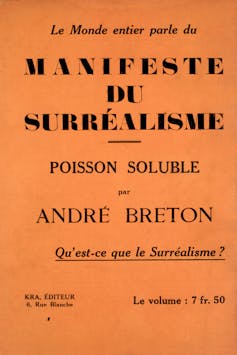
Orange paper with text printed in French and titled 'Manifeste du Surréalisme'
The publication of André Breton’s ‘Manifesto of Surrealism’ in 1924 is considered the birth of the surrealist movement.
Photo12/Universal Images Group via Getty Images

In a manifesto published in 1924, Breton called for “the future resolution of these two states, dream and reality, which are seemingly so contradictory, into a kind of absolute reality, a surreality, if one may so speak.”

Politics of revolution

Freud had coined the term “dreamwork” to describe the activity that transformed residues of the day’s memories into vehicles for the expression of our unconscious desires.

For the surrealists, too, dreaming was no simple realm of idle fantasy. They understood the synthesis of sleeping and waking life as promising a liberation no less sweeping than that of the revolutionary workers’ movement of their time.

Overcoming the contradiction between dream and reality, they believed, would complement the class struggle between the global proletariat and its bourgeois oppressors. Surrealism was much more than a merely artistic project – it was also a means toward a larger political end.

From a century’s distance, these may appear grandiose, even delusional claims. But 1924, the year of surrealism’s founding, was only seven years after the Russian Revolution. The surrealists wagered on the power of both the revolution of modern art and poetry and the political transformation of society.

“‘Transform the world,’ Marx said; ‘change life,’ [French poet Arthur] Rimbaud said. These two watchwords are one for us,” Breton said, speaking to a group of writers in Paris. In other words, the uncompromising project of remaking social existence would not be complete without the artistic reimagining of the human psyche, and vice versa.

But by 1935, when Breton pronounced this succinct formulation, the surrealists’ gamble on revolution had already effectively been lost. With Joseph Stalin’s purges underway in Moscow and Adolf Hitler consolidating power in Germany, the window for radical change that had seemed to open in the years after World War I was definitively closing.

Soon, the surrealists would find themselves dispersed into exile by a new global conflict. All that remained was for the museums and libraries to collect the relics of that heady ideal and to preserve the artworks and ephemera that registered surrealism’s brief quest to unleash the forces of the unconscious in the name of a new, freer world.

Surrealism’s unfinished business

The surrealists aimed to seduce their audiences. That seduction was not undertaken to sell their paintings, or even to provide their audiences a moment’s respite from harried lives. It was done in the name of subversion. They wished – through artworks, films and books – to shatter people’s complacency and move them to change their lives, and the world.

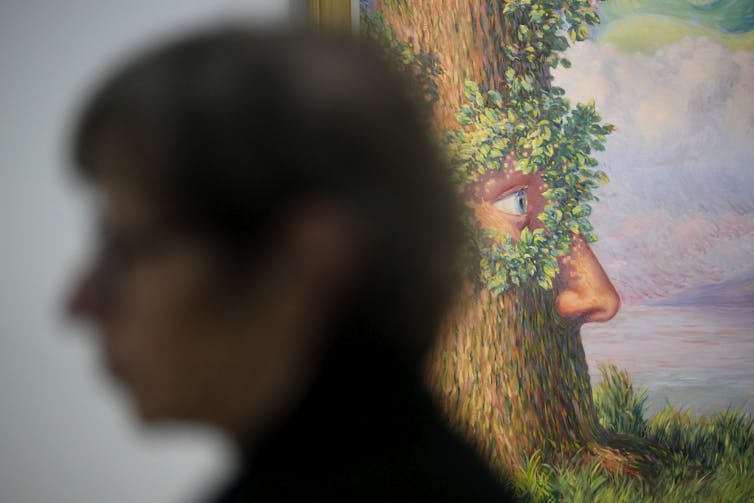
Woman in foreground, blurred, shown passing a colorful painting of tree with human face
A visitor to the Paris exhibition walks past René Magritte’s surrealist ‘Alice in Wonderland,’ painted in 1946.
AP Photo/Christophe Ena

The artwork wasn’t a mere window through which to look onto a distant “dreamworld.” It was more like a revolving door one was invited to walk through. Breton and his colleagues desired a world in which individuals could live poetry, not just read it.

Surrealist works of art, even as they hang peaceably on the museum’s walls or sit quietly on library shelves, retain at least residues of that power.

In my view, the best recent writing on the movement manages to recapture that urgency, that allure, for our own time. These include translator and author Mark Polizzotti’s 2024 book “Why Surrealism Matters” and art historian Abigail Susik’s 2021 volume “Surrealist Sabotage.”

The centenary of surrealism is a reminder of the movement’s unfinished business of revolutionary seduction. After all, as Breton reminded his readers at the close of his 1924 manifesto, life is not bound to the realities of the world as currently given.

“Existence,” he insisted, “is elsewhere.”

Read more of our stories about Philadelphia and Pennsylvania, or sign up for our Philadelphia newsletter on Substack.

The Conversation

Tom McDonough does not work for, consult, own shares in or receive funding from any company or organization that would benefit from this article, and has disclosed no relevant affiliations beyond their academic appointment.

ref. Surrealism is better known for its strangeness than the radical politics and revolutionary ambitions of its creators – https://theconversation.com/surrealism-is-better-known-for-its-strangeness-than-the-radical-politics-and-revolutionary-ambitions-of-its-creators-264961

Why your late teens and early 20s are crucial times for lifelong heart health

Source: The Conversation – USA (3) – By Jewel Scott, Assistant Professor of Nursing Science, University of South Carolina

Many young adults don’t realize that high cholesterol, obesity, high blood pressure and lack of physical activity are early heart disease risk factors. Kmatta/Moment via Getty Images

Emerging adulthood – the life stage that unfolds around ages 18-25 – is full of major transitions, such as starting college or learning a trade, making new friends and romantic connections, and generally becoming more independent.

It’s also a stage where behaviors that diminish heart health, such as spending more time sitting, consuming more fast food and using more tobacco and alcohol, become more common. In fact, only about 1 in 4 youths maintain positive health behavior patterns during the transition to adulthood.

More Americans die of heart disease than of any other condition. People often think of heart disease as an illness that mostly affects older people, but data from electronic health records show that the rate of heart disease in people under 40 has more than doubled since 2010 and tripled among people who use tobacco. Researchers like me are learning a great deal more about how heart health later in life heavily depends on the habits built during late adolescence and early adulthood.

I am a primary care nurse practitioner and researcher studying how early life shapes long-term heart health. In my clinical practice, I frequently care for people in their early 20s who are entering adulthood and are already facing serious cardiovascular risk factors such as elevated blood pressure, high blood sugar or a body mass index in the obesity range.

Just as young people on the cusp of adulthood make important decisions about their education, career and relationships, the health habits they build during this critical time also lay the foundation for lifelong heart health and better quality of life.

Early roots of heart disease

The most common form of heart disease is atherosclerotic cardiovascular disease, which develops when sticky, fatty plaque builds up in the blood vessels and makes it harder for blood to flow.

Heart health doesn’t suddenly decline in middle age. It starts to slip much earlier, often without people realizing it. In fact, research shows that a key turning point is around age 17. That’s when overall heart health scores based on behaviors such as diet, movement and sleep, along with clinical measures such as blood pressure, begin to worsen.

Age 17 is a key turning point when heart health scores can begin to decline in young people.

That means by the time many young people are finishing high school, heart disease risk factors are already emerging. The good news is that most of the risk factors that drive this buildup are modifiable – meaning you can do something about them.

In a report I co-authored in March 2025, my colleagues and I explored the key risk factors for heart disease in emerging adults. One of the most important is nicotine exposure. Use of cigarettes, vapes and other nicotine products has surged among young adults in recent years, from 21% of 18- to 23-year-olds in 2002 to 43% in 2018. Nicotine damages blood vessels and speeds up the plaque formation process, increasing the risk of serious heart problems later in life. While signs such as chest discomfort or shortness of breath tend to show up much later, the groundwork for those symptoms is laid much earlier.

Obesity is another early risk factor. In fact, 1 in 5 young people under age 25 have a BMI of 30 or higher, and projections suggest nearly 3 in 5 will meet that threshold by age 35.

Meanwhile, fewer than half of adults ages 18-34 recognize high cholesterol, obesity, high blood pressure and lack of physical activity as heart disease risk factors. These early warning signs, often uncovered during routine checkups, can set the stage for future heart disease.

Societal factors shape heart health, too

Heart health isn’t shaped by individual choices alone. Broader policies and systems also play a major role.

For example, the Affordable Care Act allows young adults to stay on their parents’ insurance plans until age 26, which can help ensure access to preventive services. These services, such as routine checkups, blood pressure screenings and conversations about family history, are key opportunities for your primary care provider to catch early signs of cardiovascular risk.

While preventive care use among young adults increased after the ACA was passed, overall rates of preventive care visits still remain low. Policies that expand access to health care and that make it easy for young people to take advantage of these services, such as telehealth, can make a real difference. And if a provider doesn’t bring up heart health during a well-check visit, patients can ask questions or start the conversation themselves.

An instructor leads an outdoor exercise class.
Living in a neighborhood with access to outdoor spaces can make it easier to engage in activities that support heart health.
kali9/E+ via Getty Images

Beyond health care access, the conditions of people’s daily lives, such as where they live, their education level and their economic stability, also play important roles in heart health. Neighborhoods can include resources such as parks and green spaces, which make healthy choices more feasible. Education and stable employment are tied to health care access, lower stress and food security, all of which support a healthier heart.

Healthy social connections matter, too. Strong, supportive relationships are linked to better overall well-being, including heart health. Recently, several major health organizations have spotlighted loneliness as a public health issue. However, there is still a lot to learn about exactly how social connections translate to healthier lives, and not enough of this research focuses on young adults.

Pew research shows that 1 in 3 teens report near-constant use of social media, but those connections do not yield the same health benefits as interacting in real life. In my own research, I am investigating how social connection affects heart health in young adults in particular.

Building a foundation for heart health

There is a lot you can do today to make a difference in your heart health. In our recent report, written with the American Heart Association, my colleagues and I highlighted a group of eight risk factors that people can modify to reduce their heart disease risk, called the Essential 8.

Embracing the Essential 8, a set of evidence-based measures developed by the American Heart Association, can help young people establish lifelong habits for a healthy heart.

Four are health behaviors. In addition to avoiding nicotine, young people should prioritize getting 150 minutes of moderate to vigorous activity a week, or around 20 minutes a day, as recommended by the American Heart Association. They should also aim to get seven to nine hours of sleep nightly and to eat a diet rich in fish, berries and vegetables. Even small changes in these four behaviors can have positive effects.

Of these four behaviors, U.S. children score worst on diet – an important area for improvement in the transition to adulthood. Young adults with stronger cooking skills tend to have healthier eating habits in middle age, suggesting that learning how to cook could be a valuable step toward better heart health.

The other four factors are clinical measures: blood pressure, blood sugar, cholesterol and BMI. Since the early 2000s, three of the four – blood pressure, blood sugar and BMI – have all worsened among young adults.

These changes can go unnoticed until much later, but checking in on them early creates an opportunity to take action. The next time you are at a checkup, ask your provider about your heart health – even if you think you’re too young to be worrying about heart disease. A simple conversation today could shape the way you feel years from now, and your future heart will thank you.

The Conversation

Jewel Scott receives funding from the National Institutes of Health. She is a volunteer with the American Heart Association.

ref. Why your late teens and early 20s are crucial times for lifelong heart health – https://theconversation.com/why-your-late-teens-and-early-20s-are-crucial-times-for-lifelong-heart-health-254276

La Bretagne, un futur refuge climatique ?

Source: The Conversation – in French – By Louis Amiot, Docteur en géographie, Université Rennes 2

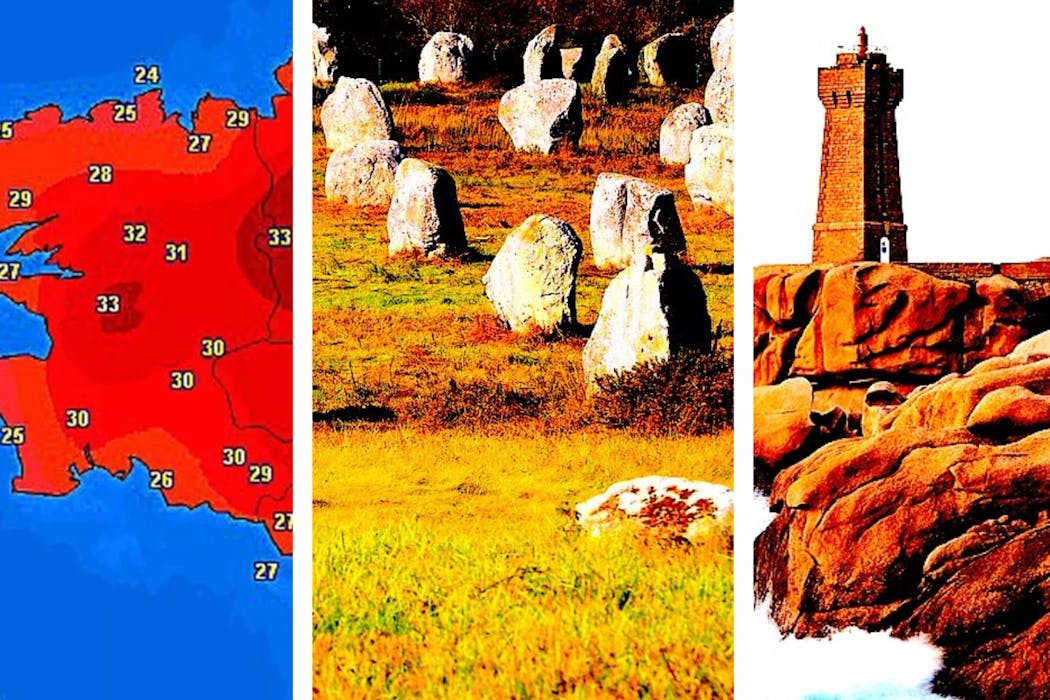
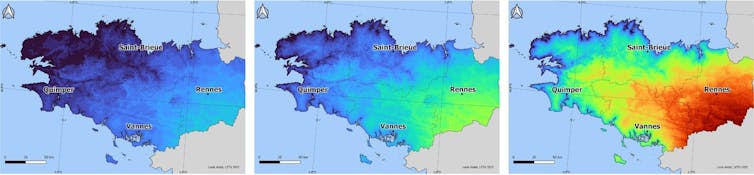
La Bretagne n’est pas épargnée par le changement climatique, qui y provoque des problèmes de sécheresses de plus en plus inquiétants. Capture d’écran de Météo France/Martin Cígler/Maëlick, CC BY

Déménager pour éviter de trop subir les aléas du changement climatique, nous sommes nombreux à y avoir songé un jour. La région de prédilection à laquelle nous pensons alors est souvent la Bretagne. Mais est-ce vraiment une bonne idée ?

Allons-nous tous finir en Bretagne ? Cette question, sans doute assez improbable il y a encore dix ans, est désormais une interrogation sérieuse que posent divers médias nationaux et qui s’immisce dans les esprits. Car à l’heure du changement climatique, la Bretagne, souvent considérée comme une région où « il pleut tout le temps » et où l’on a « des étés pourris » se transforme en un refuge possible face au mercure qui n’en finit pas de grimper.

En effet, d’après un récent sondage, environ un Français sur trois est prêt à déménager face au changement climatique. La Bretagne est la région de migration privilégiée pour cela en plus d’être déjà la plus attractive pour les retraités. Mais s’installer en Bretagne pour échapper au changement climatique, est-ce vraiment une bonne idée ?

La réalité n’est pas si simple, d’abord parce que la région n’a pas un climat uniforme, notamment lorsque l’on compare Rennes (Ille-et-Vilaine) et Brest (Finistère), par exemple. La Bretagne est aussi loin d’être préservée du changement climatique. Elle est particulièrement vulnérable au risque de sécheresse, ce qui peut poser des problèmes dans la gestion de l’eau. Ses habitants sont d’ailleurs les Français les plus pessimistes face au changement climatique, selon le même sondage. Seule différence, eux n’ont pas tellement de perspective de déménagement pour apaiser leurs inquiétudes.

Des climats bretons

La Bretagne est généralement classée comme un climat océanique (été frais, hiver doux et pluies régulières toute l’année). Mais en détail, il existe de grandes différences entre l’est et l’ouest de la région. Il n’y a par exemple qu’un degré d’écart en moyenne entre Rennes et Brest à l’année, mais à Brest les hivers sont plus doux et les étés plus frais qu’à Rennes. La pluviométrie est, elle, presque deux fois plus importante à Brest (1220 mm) qu’à Rennes (690 mm). Cette différence est plus marquante à l’échelle saisonnière : en hiver, il y a trois fois plus de pluie à Brest qu’à Rennes, tandis qu’en été, l’écart est moins conséquent.

Cumul de précipitations et de températures moyennes mensuelles à Rennes (Ille-et-Vilaine) et à Brest (Finistère), sur la période 1991-2020.
Fourni par l’auteur

Il existe ainsi plusieurs climats bretons qui ont été cartographiés afin de différencier le littoral nord et sud de la Bretagne, l’est et l’ouest et l’intérieur de la région. De manière générale, les côtes bretonnes sont moins exposées aux risques climatiques tels que les extrêmes thermiques (chaleur et gel) et pluviométriques (sécheresses et fortes pluies). Le sud de la Bretagne est aussi plus chaud et sec que le nord.

Une région qui subit le changement climatique

Mais, partout en Bretagne, le changement climatique se fait sentir, avec une hausse de la température moyenne annuelle de l’ordre de 0,9 °C à 1,1 °C entre la période 1951-1980 et la période 1991-2020. Cela est certes moins prononcé qu’à échelle de la France (+1,5 °C), mais reste supérieur au réchauffement mondial (+0,7 °C entre ces mêmes périodes).

À l’horizon 2050, la température devrait encore augmenter d’au moins 1 °C et de 1,5 °C à 3 °C en fin de siècle. Dans le scénario pessimiste, en fin de siècle, la température moyenne de Brest pourrait être équivalente à l’actuelle température de Bordeaux et celle de Rennes à la température de Marseille. Dans le même temps, les quantités de pluie devraient rester similaires sur l’année avec des pluies davantage concentrées en hiver et moins importantes en été. Les risques et aléas climatiques liés au réchauffement sont eux aussi déjà notables et devraient s’intensifier.

Prenons l’exemple du risque de forte chaleur en regardant les journées à plus de 30 °C, qui sont un des marqueurs du changement climatique. Il existe une forte différence est/ouest concernant le risque actuel avec en moyenne 8 jours en Ille-et-Vilaine contre seulement 1 à 2 jours dans le Finistère. D’ici 2050, le nombre moyen de jours très chauds devrait plus que doubler. En fin de siècle, les fortes chaleurs sont encore plus présentes et concernent en moyenne 20 jours par an sur la région. Ce chiffre varie de moins de 10 sur le littoral nord à plus de 30 jours au sud de Rennes (soit autant qu’à Toulouse en moyenne).

Dans l’ensemble, seul le littoral nord se retrouve relativement préservé de ce risque de fortes chaleurs même si celui-ci augmente.

Cartographie du nombre de jours très chaud par an (température maximale supérieure à 30 °C) avec la situation actuelle observée et la situation future projetée dans le scénario pessimiste
Cartographie du nombre de jours très chaud par an (température maximale supérieure à 30 °C) avec la situation actuelle observée et la situation future projetée dans le scénario pessimiste.
Fourni par l’auteur

La Bretagne face au défi de l’eau

Le changement climatique affecte aussi l’intensité et la fréquence des sécheresses. Or, cela peut paraître paradoxal, mais la Bretagne est très vulnérable face à ce risque. En effet, plus de 75 % de l’eau potable dépend des réserves superficielles (rivières, lacs, étangs) contre seulement 36 % pour l’échelle du territoire.

La Bretagne se retrouve ainsi extrêmement dépendante des conditions météorologiques. Si d’ordinaire, celles-ci sont plutôt humides avec une bonne répartition des pluies au cours de l’année, certaines années sont marquées par des longues périodes sans pluies menant à des sécheresses.

Par exemple, en 2022, la région a subi une sécheresse historique : au cours du mois d’août, toute la région était pour la première fois en état de crise sécheresse du fait de pluviométrie très faible et de fortes chaleurs. Cela a engendré de fortes pressions sur l’île de Groix (Morbihan), il y a eu des menaces de coupure d’eau à Saint-Malo (Ille-et-Vilaine) comme dans le département des Côtes-d’Armor où la préfecture a indiqué un « risque sérieux de rupture de l’alimentation en eau potable se dessine pour les dernières semaines d’octobre ». La région a finalement été sauvée de la pénurie par des pluies bienvenues au cours du mois de septembre. Mais cette situation a révélé la fragilité de la Bretagne dans ces périodes climatiques exceptionnelles.

De plus, une récente étude a démontré que ces sécheresses extrêmes sont amenées à être de plus en plus présentes. D’ici 2050, environ un été sur cinq serait au moins aussi chaud et sec que celui de 2022, en fin de siècle cela représente un été sur deux. Dans ce contexte, la région risque d’être confrontée à des problèmes grandissants d’accès à l’eau alors que le nombre d’habitants devrait augmenter d’au moins 250 000 d’ici 2050.

Cette tendance démographique risque ainsi d’aggraver le partage d’une ressource qui se fait de plus en plus précieuse. L’enjeu est donc de garantir un accès à l’eau dans un futur climatique plus sec et chaud, particulièrement autour de Rennes et dans le littoral sud-breton.

Le risque d’une maladaptation

Dès lors, si s’installer en Bretagne peut sembler de prime abord une bonne idée face au changement climatique, il s’agit plutôt d’une forme de maladaptation. En effet, un accroissement massif de la population bretonne peut amplifier les impacts négatifs du changement climatique, principalement lié au risque de sécheresse et mener à une crise de l’eau. La région n’est donc pas un refuge climatique optimal à terme. Au-delà des enjeux liés au manque d’eau, la Bretagne doit aussi faire face à la hausse du niveau de la mer dont les 1 700 kilomètres de littoraux sont directement concernés.

Enfin, le changement climatique n’est qu’une problématique au milieu d’une crise environnementale globale (pollutions, extinction de la biodiversité, acidification de l’océan…). Par exemple, la Bretagne est en première ligne face à la pollution aux nitrates qui peut affecter la qualité de l’eau et les plages avec les algues vertes.

La crise climatique doit donc être traitée collectivement d’une part pour réduire l’intensité de celui-ci en diminuant les émissions de gaz à effet de serre et d’autre part en préparant les territoires à faire face aux changements climatiques. Il faut adapter les territoires au climat de demain pour qu’ils restent des lieux de vie agréables plutôt que de miser sur des migrations vers d’autres régions à priori moins exposés au changement climatique.

The Conversation

Louis Amiot a reçu des financements dans le cadre des programmes CLIMATVEG (financé par l’ADEME et les régions Bretagne et Pays de la Loire et piloté par Vegepolys Valley) et FERMADAPT (financé par l’ADEME et les régions Bretagne et Pays de la Loire et piloté par Valorial).

ref. La Bretagne, un futur refuge climatique ? – https://theconversation.com/la-bretagne-un-futur-refuge-climatique-267482

Nuestros ojos saben lo que hicimos el último verano

Source: The Conversation – (in Spanish) – By Sergio Recalde Maestre, Director científico del laboratorio de oftalmología experimental, Universidad de Navarra

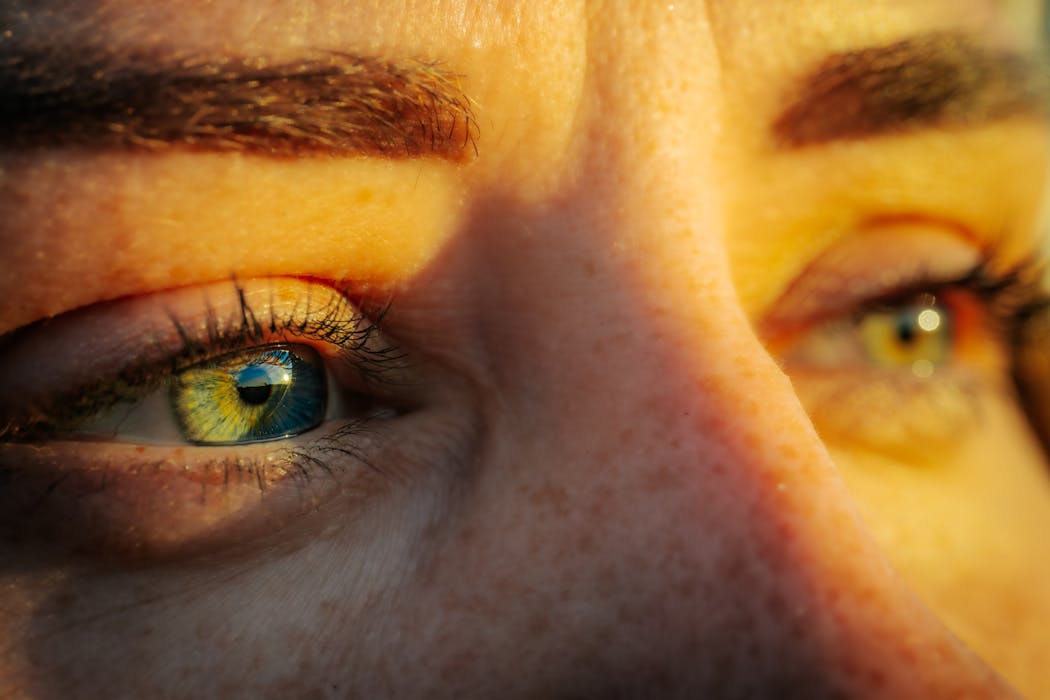
Emvat Mosakovskis/Shutterstock

La miopía avanza de forma imparable en todo el mundo. Según la Organización Mundial de la Salud, para 2050 la mitad de la población mundial será miope. No se trata solo de llevar gafas: cuando esa afección visual progresa mucho, aumenta el riesgo de desprendimiento de retina, glaucoma o ceguera irreversible.

En España, por ejemplo, la ceguera miópica es la primera causa de afiliación a la ONCE. La pregunta es inevitable: ¿qué podemos hacer para frenar la epidemia?

Una “caja negra” de la exposición al sol

La respuesta podría estar, literalmente, en nuestros ojos. Más en concreto, en un curioso fenómeno llamado autofluorescencia ultravioleta conjuntival (CUVAF por su denominación en inglés), que funciona como una especie de “caja negra” de la exposición solar que ha recibido cada persona.

(A) Demostración ‘in vivo’ del enfoque corneal de la luz periférica proveniente del lado temporal del ojo hacia el limbo y la conjuntiva nasal, con una intensidad luminosa mayor en comparación con el lado temporal. (B) Representación óptica del efecto de enfoque de la luz periférica que provoca la concentración de los rayos incidentes, al atravesar la cámara anterior, sobre la superficie límbico-conjuntival contralateral del ojo. (C) Representación de un caso CUVAF negativo (sin área de hiperautofluorescencia conjuntival). (D–E) Fotografías CUVAF negativas tomadas bajo luz ultravioleta (D) (longitud de onda máxima de 365 nm) y (E) una fotografía tomada con el modo BAF del Heidelberg Spectralis HRA+OCT (longitud de onda máxima de 488 nm). (F) Representación de un caso CUVAF positivo (muestra un área de hiperautofluorescencia que absorbe a 360 nm y emite en el espectro visible). (G–H) Fotografías CUVAF positivas en una imagen a color tomada bajo luz ultravioleta (G) y (H) con el Heidelberg Spectralis HRA+OCT.

El CUVAF es un área de autofluorescencia en la conjuntiva (la parte blanca del ojo) que aparece cuando se ilumina con luz ultravioleta. Entonces, el ojo muestra manchas brillantes que delatan cuánto tiempo hemos pasado bajo la luz del sol.

Aunque esas manchas no son visibles a simple vista, quedan registradas de forma objetiva. Así, el CUVAF se ha convertido en un biomarcador fiable para saber cuántas horas al aire libre ha acumulado una persona a lo largo de su vida reciente.

Los científicos llevan años sospechando que la falta de luz natural es una de las grandes culpables del aumento de la miopía. Los niños que pasan más tiempo en interiores –ya sea frente al móvil, la tableta o los libros– tienen más riesgo de desarrollarla.

¿Por qué? La hipótesis más aceptada es que la luz solar estimula la liberación del neurotransmisor dopamina en la retina, y esa dopamina actúa como freno natural para que el ojo no crezca en exceso (además de controlar ciclos circadianos, hormonas, etc).

Otra posible causa es que cuando estamos en la calle miramos principalmente de lejos, de forma relajada y sin forzar los músculos de la acomodación (necesarios para ver de cerca), lo cual evita el crecimiento excesivo del ojo. Porque cuando esto último ocurre, la imagen no se enfoca nítidamente en la retina y aparece la miopía.

De los cuestionarios a la “memoria ocular”

Hasta hace poco, los investigadores solo podían medir el tiempo que pasan los niños al aire libre preguntando a los padres o a los propios menores. Pero esos cuestionarios tienen muchas limitaciones: ¿quién recuerda con exactitud cuántas horas estuvo en el parque hace un mes?


Leer más:
Las lentillas para Halloween pueden dar un susto a nuestros ojos


El CUVAF resuelve este problema. Funciona como un registro objetivo de la exposición solar, independiente de la memoria o la percepción. Si un niño presenta poco CUVAF, significa que pasa poco tiempo en exteriores y, por tanto, que tiene más riesgo de ser miope.

Lo que dicen los estudios

Varios trabajos internacionales confirman su utilidad. Así, un metaanálisis con más de 3 600 personas de distintos países encontró que los miopes pasaban menos tiempo al aire libre y tenían áreas de CUVAF significativamente más pequeñas que los no miopes. Y en la Universidad de Navarra, un estudio con estudiantes de Medicina y de Ciencias Ambientales mostró que los segundos, que pasan más horas en el exterior por su carrera, tenían más CUVAF y la mitad de riesgo de desarrollar miopía.

Para conocer las repercusiones de este biomarcador en la edad infantil –la etapa más sensible para el crecimiento excesivo del ojo–, se llevó a cabo una investigación en más de 260 niños de entre 6 y 17 años. Los autores comprobaron que los miopes, efectivamente, pasaban menos tiempo al aire libre y presentaban menos CUVAF. Además, si el área de autofluorescencia de la conjuntiva era grande en relación a la edad, los menores estaban protegidos hasta 2,5 veces frente a la miopía y hasta 5 veces frente a la miopía alta.

Este hallazgo podría confirmarse en un estudio, actualmente en revisión, con más de 2 600 niños de la Comunidad de Madrid.

Imaginemos cómo podría usarse dicha información en la práctica clínica. En una revisión ocular, el oftalmólogo toma una imagen del CUVAF. Si el resultado muestra un área reducida, podría dar el siguiente consejo:
“Su hijo necesita al menos una o dos horas de juego al aire libre cada día. El mejor tratamiento ahora mismo es la luz natural, gratuita y sin efectos secundarios”.

En el futuro, las consultas de oftalmología podrían incorporar esa prueba rutinaria igual que hoy se mide la tensión ocular o el fondo de ojo.

No es solo cosa de niños

Aunque la prevención en la infancia es clave, el CUVAF también puede ser útil en adultos jóvenes. Durante la universidad o los primeros años laborales, la miopía puede seguir progresando. Medir el CUVAF en esta etapa permite detectar a quienes mantienen un estilo de vida demasiado “de puertas adentro” y orientar cambios sencillos: salir a pasear, practicar deporte al aire libre, exponerse a la luz natural cada día.

Hay una metáfora muy bonita que usan algunos investigadores: el verano se borra de nuestra piel, pero permanece en nuestros ojos. Aunque la piel pierda el bronceado, el ojo conserva la huella del sol a través del CUVAF. Y esa huella no es un simple recuerdo: es una pista directa sobre nuestra futura salud visual.

Porque la miopía no es inevitable: aunque los genes juegan un papel, el ambiente es decisivo. Y entre los factores ambientales, el tiempo al aire libre es el más importante y modificable.

The Conversation

Sergio Recalde Maestre recibe fondos del instituto de Salud Carlos III (PI20/0251 y PI24/01236) para la investigación en Miopía y de la Fundación Multiópticas. Esta investigando en colaboración con la asociación de altos miopes AMIRES y se encuentra desarrollando un sistema de medición y análisis del CUVAF (sin patentar ni crear ninguna empresa hasta el momento).

ref. Nuestros ojos saben lo que hicimos el último verano – https://theconversation.com/nuestros-ojos-saben-lo-que-hicimos-el-ultimo-verano-265789

¿A qué se debe la oleada de incidentes alimentarios en Estados Unidos?

Source: The Conversation – (in Spanish) – By José Miguel Soriano del Castillo, Catedrático de Nutrición y Bromatología del Departamento de Medicina Preventiva y Salud Pública, Universitat de València

En las últimas semanas, Estados Unidos ha experimentado una oleada de incidentes que han encendido las alarmas sobre el estado de la seguridad alimentaria en el país. Desde el retiro masivo de productos contaminados hasta brotes mortales de Listeria, los casos registrados en septiembre y octubre de 2025 revelan no solo fallos puntuales, sino también tensiones más profundas en las instituciones encargadas de proteger la salud pública.

Brotes y retiradas: un otoño de alertas

A continuación enumeramos algunos ejemplos recientes. La compañía Hillshire Brands retiró alrededor de 26 000 toneladas de corn dogs o perritos de maíz (una especie salchichas empanadas) tras descubrir fragmentos de madera en la masa de maíz, con al menos cinco personas lesionadas a nivel gástrico. El Servicio de Inspección y Seguridad Alimentaria (FSIS) emitió una alerta nacional por comidas congeladas que incluían pasta contaminada con Listeria monocytogenes, vinculadas, como mínimo, a cuatro muertes. La empresa Black Sheep Egg Company tuvo que sacar del mercado varios lotes de huevos tras detectar Salmonella.

A esto se suman las advertencias sobre snacks contaminados con fragmentos de metal o el retiro de melones procesados y de salmón y lubina ahumados por riesgo de contaminación con la citada especie de Listeria.

Cada uno de estos casos podría entenderse por separado como parte de la rutina de vigilancia. Sin embargo, su acumulación en un corto periodo de tiempo dibuja un escenario más inquietante: el sistema estadounidense de control alimentario muestra grietas crecientes.

Entrada a un recinto donde está indicado el nombre de la la Administración de Alimentos y Medicamentos de Estados Unidos (FDA).
Sede de la Administración de Alimentos y Medicamentos de Estados Unidos (FDA) en Silver Spring, Maryland.
Tada Images/Shutterstock

La política detrás de la crisis

La administración Trump ha defendido una agenda de desregulación y recortes presupuestarios bajo la premisa de simplificar la burocracia. En la práctica, esto ha supuesto recortes de personal en la Administración de Alimentos y Medicamentos, (FDA por sus siglas en inglés) que llevaron, por ejemplo, a suspender pruebas de calidad de la leche. Además, el Departamento de Agricultura decidió disolver comités asesores científicos que guiaban la política de inocuidad, eliminando un contrapeso técnico clave.

La FDA inició además un proceso para revocar regulaciones que definen los estándares de identidad de más de 50 alimentos, flexibilizando las reglas de etiquetado. A ello hay que añadir la eliminación de la División de Protección al Consumidor del Departamento de Justicia, lo que limita la capacidad de sancionar penalmente a empresas infractoras, así como un proceso de descentralización que transfiere responsabilidades a estados y gobiernos locales, con capacidades muy desiguales.

Los defensores de estas políticas argumentan que reducen costos y fomentan la competitividad. Los críticos, en cambio, advierten que constituyen un debilitamiento estructural del sistema.

Voces críticas y dimisiones

La tensión también se ha manifestado en renuncias de alto perfil. Jim Jones, subcomisionado de alimentos humanos de la FDA, dimitió el pasado mes de febrero tras denunciar que los recortes habían dejado a su área sin capacidad para cumplir con sus funciones esenciales. Poco después, Michael Rogers, jefe de inspecciones de la agencia, se retiró tras 34 años de carrera, en medio de la frustración de inspectores que veían debilitadas sus funciones.

Además, organizaciones de consumidores, médicas y de salud pública han llegado a pedir la renuncia de Robert F. Kennedy Jr., secretario de Salud y Servicios Humanos, al que acusan de priorizar la desregulación por encima de la seguridad. Estas salidas no son meros cambios de personal: simbolizan la fractura interna de las instituciones encargadas de velar por la seguridad alimentaria.

Conviene subrayar que las retiradas de productos y brotes siempre han existido en Estados Unidos y en buena medida son prueba de que la vigilancia funciona. Lo que cambia ahora es la frecuencia y la magnitud. Muchos de los productos afectados en las últimas semanas son de consumo masivo, lo que multiplica el impacto potencial en la salud. Además, con menos inspecciones y menos recursos, la probabilidad de que los riesgos pasen desapercibidos aumenta.

Las estadísticas definitivas de 2025 tardarán en publicarse, pero los patrones recientes sugieren que los riesgos se están volviendo más visibles y peligrosos.

Las justificaciones oficiales

El Gobierno y algunos sectores de la industria se defienden con varios argumentos. Afirman que la eliminación de comités y estándares excesivos busca desburocratizar y acelerar la innovación. Aducen que descentralizar hacia los estados permite respuestas más adaptadas a cada realidad local. Y sostienen que los recursos deben centrarse en los riesgos más graves, en lugar de dispersarse en controles rutinarios.

Sin embargo, estas justificaciones pierden sentido cuando los incidentes se acumulan y los titulares hablan de intoxicaciones y muertes. La seguridad alimentaria es un bien público y, como recuerdan especialistas en salud pública, no puede depender solo de la autorregulación del mercado.

Los acontecimientos de este otoño no pueden atribuirse únicamente a la mala fortuna. Son la consecuencia visible de un sistema sometido a recortes, desregulación y pérdida de talento técnico. Todo esto lleva a pensar que la seguridad alimentaria en Estados Unidos atraviesa un momento crítico. Los brotes recientes no son meros accidentes aislados, sino el síntoma de un sistema debilitado.

La pregunta para los próximos meses será si la presión social y política logrará revertir la tendencia antes de que los costos humanos y económicos se multipliquen.

The Conversation

José Miguel Soriano del Castillo no recibe salario, ni ejerce labores de consultoría, ni posee acciones, ni recibe financiación de ninguna compañía u organización que pueda obtener beneficio de este artículo, y ha declarado carecer de vínculos relevantes más allá del cargo académico citado.

ref. ¿A qué se debe la oleada de incidentes alimentarios en Estados Unidos? – https://theconversation.com/a-que-se-debe-la-oleada-de-incidentes-alimentarios-en-estados-unidos-267338

Diez años de ‘First Dates’: el ritual televisivo que nos recuerda cómo mirarnos a los ojos

Source: The Conversation – (in Spanish) – By Joan Tahull Fort, Profesor e investigador en sociología, especializado en dinámicas sociales y educativas contemporáneas, Universitat de Lleida

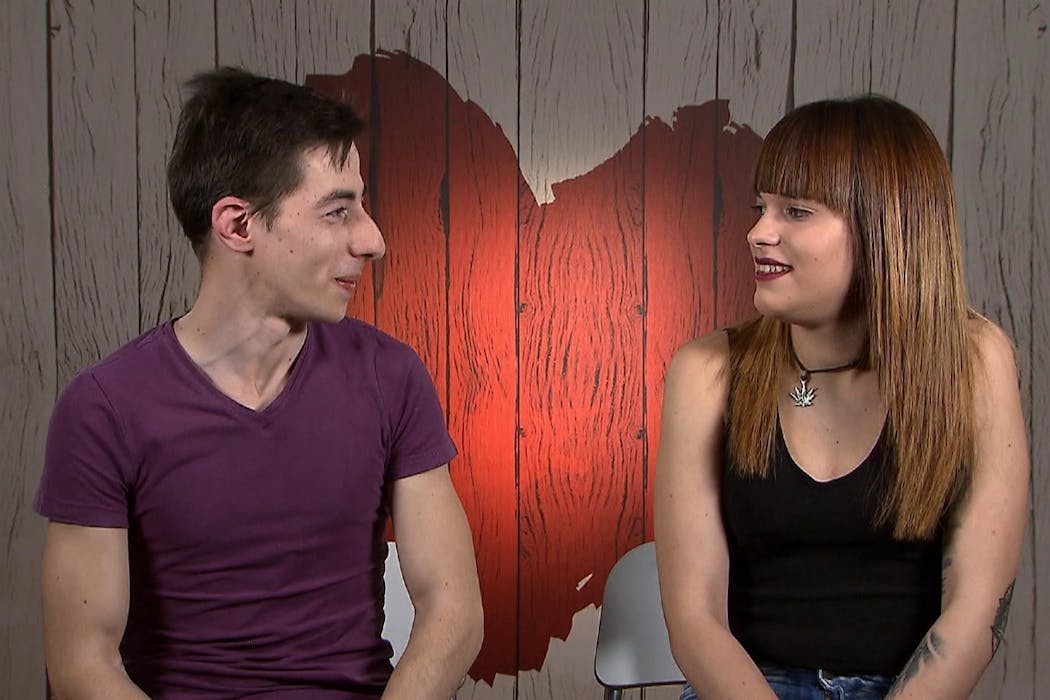
Pareja de participantes en _First Dates_. Mediaset

En abril de 2026 se cumplirán diez años del estreno del programa de televisión First Dates, el restaurante televisivo donde dos desconocidos se sientan a charlar y compartir una cena frente a las cámaras. Una década después, el formato mantiene una rara estabilidad en la televisión actual: continuidad, éxito sostenido y un público diverso que lo sigue a diario.

Desde su debut, el 17 de abril de 2016, el programa ha tenido una audiencia media de entre 1,2 y 1,3 millones de espectadores, con cuotas de pantalla que rondan el 7-8 %.

Más allá de los índices de audiencia, esa fidelidad refleja el clima social del momento. First Dates no es solo un programa de entretenimiento: se ha consolidado como una ventana a la diversidad de biografías, deseos y formas de entender el amor, la sexualidad, la convivencia, la familia… En un contexto saturado de estímulos y pantallas, el programa va a lo esencial: la socialización, el encuentro, el reconocimiento del otro y la autenticidad.

Cuatro razones del interés de la audiencia

El programa logra conectar con los espectadores a través de cuatro dimensiones fundamentales:

  1. Identificación emocional. Muchos espectadores se reconocen en los participantes porque comparten sus miedos, sus ilusiones y esas segundas oportunidades que alguna vez vivieron o imaginaron. El vínculo que se genera va más allá de la mera observación: no se trata solo de contemplar una historia ajena, sino de reconocerse en los gestos, las dudas y los deseos que todos, de algún modo, tenemos.

  2. Entretenimiento sin estridencias. La brevedad de los encuentros, el tono ligero y la ausencia de dramatismo permiten desconectar al final del día, sin la carga emocional de las noticias o los programas más agresivos. Hay espacio para la risa y para alguna que otra sorpresa, pero sin recurrir a la humillación ni a la exageración.

  3. Curiosidad por lo nuevo. Las citas funcionan como un observatorio de los códigos afectivos contemporáneos: la negociación del compromiso, los pactos de convivencia, las expectativas sobre el sexo o la familia y la visibilidad de identidades y orientaciones diversas. Para quienes crecieron en otras tradiciones, presenciar esas conversaciones resulta informativo, incluso liberador; en algunos casos permite comprender mejor a determinadas personas cercanas. Y para los más jóvenes, supone la oportunidad de descubrir otros modelos y formas de entender la vida, la pareja y la familia.

  4. Ritual cotidiano y conversación social. Convertido en una cita diaria, se ha integrado en la rutina de muchos espectadores: acompaña la cena, marca el final del día y ofrece un espacio de desconexión. Para muchos, el programa se ha convertido también en tema de conversación: las citas de la noche anterior, las reacciones de los participantes, sus gestos o maneras de relacionarse crean temas de conversación entre familiares y amigos.

Estas motivaciones no son exclusivas de las personas mayores, sino que actúan como un puente entre generaciones. Mientras los mayores descubren cómo piensan y sienten los jóvenes y adultos –e incluso otros mayores distintos de sí mismos–, los adultos confrontan sus modelos y los jóvenes encuentran nuevas formas de interpretar la vida y proyectarse hacia el futuro. Unos actualizan sus referentes y otros comprueban que sus dudas no son tan originales y que, en el fondo, son compartidas.

El presentador Carlos Sobera (en el centro) y el equipo que le acompaña delante de las cámaras celebran el programa número 2000 en noviembre de 2024.
Mediaset

En cada mesa se ensaya, sin pretensiones, una pedagogía del encuentro: mirarse, preguntar, responder con cierta honestidad, gestionar la atracción o el desacuerdo, expresar los límites y ofrecer –o negar– una segunda cita con respeto.

La forma importa tanto como el fondo. Esa cultura del cuidado y la cortesía emocional –poco habitual en los tiempos actuales y en las redes sociales– está en el programa.

First Dates ofrece una mirada serena, sin estridencias ni gritos, con personas muy distintas. En sus mesas cabe casi todo: edades, cuerpos, creencias, trayectorias, orientaciones y procedencias. La diversidad se vive como una experiencia cotidiana: cada comensal habla de sí mismo. En tiempos de polarización, ese gesto sencillo adquiere un evidente valor cívico y humano.

Individualismo, soledad no deseada y encaje social

Vivimos la paradoja de estar hiperconectados y, al mismo tiempo, sentirnos solos. La soledad no deseada se extiende entre jóvenes y mayores; el individualismo transforma los vínculos en conexiones fugaces y destaca más lo llamativo frente a lo cuidadoso y delicado.

En ese contexto, First Dates actúa como un refugio emocional: observar una conversación normal, a un ritmo humano y con unas reglas claras de cortesía.

Para quienes viven en los márgenes de la vida social –por viudedad, separación, jubilación, migración…–, el programa cumple una función simbólica y práctica: recordar que el encuentro sigue siendo posible y que el aprendizaje social no termina a los 30.

Observar las citas de otros alimenta la esperanza, legitima la búsqueda de compañía y refuerza el sentido de pertenencia a una comunidad diversa, compleja y compuesta por personas diferentes.

Por qué funciona

El programa tiene unas características que lo hacen único:

  • Formato claro: una fórmula sencilla y reconocible –dos personas en una mesa que tienen que tomar una decisión– que facilita una comprensión inmediata y mantiene la atención sin exigir continuidad.

  • Tono cuidado: humor sin burla, ternura sin cursilería y curiosidad sin morbo.

  • Ritmo breve: historias cortas cerradas en sí mismas que evitan el desgaste de los formatos más largos.

  • Valor público: normaliza la diversidad y muestra nuevas formas de entender la vida, la familia, la pareja, el amor, el sexo…

Algunos programas televisivos funcionan como agentes de socialización y generadores de relatos compartidos. En España, el caso de First Dates resulta paradigmático: una propuesta sencilla produce aprendizajes sutiles y fomenta vínculos más allá de la pantalla. Por ello se ha consolidado como un espacio con una clara función socializadora y prosocial.

Diez años, una invitación

Que First Dates vaya a cumplir una década no es solo motivo de celebración televisiva. Es también una invitación a repensar nuestros espacios y tiempos de encuentro: ¿dónde practicamos hoy la escucha, la empatía o la negociación cotidiana del desacuerdo? Quizá el éxito del programa se explique, en parte, porque en casa y fuera no encontramos estos momentos.

En un tiempo en que las relaciones tienden a medirse en clics y notificaciones, First Dates recuerda que somos seres sociales, que necesitamos la presencia del otro para reconocernos.

Volver a valorar la conversación, la mirada compartida o el placer de la compañía contribuye al bienestar y a un vida más feliz: aprender de la presencialidad, abrirse al encuentro y redescubrir la satisfacción de estar –de verdad– con alguien.

The Conversation

Joan Tahull Fort no recibe salario, ni ejerce labores de consultoría, ni posee acciones, ni recibe financiación de ninguna compañía u organización que pueda obtener beneficio de este artículo, y ha declarado carecer de vínculos relevantes más allá del cargo académico citado.

ref. Diez años de ‘First Dates’: el ritual televisivo que nos recuerda cómo mirarnos a los ojos – https://theconversation.com/diez-anos-de-first-dates-el-ritual-televisivo-que-nos-recuerda-como-mirarnos-a-los-ojos-267083