Le crypto-mercantilisme américain ou comment prolonger l’hégémonie du dollar par les stablecoins

Source: The Conversation – in French – By Jean-Marc Figuet, Professeur d’économie, Université de Bordeaux

Pour les mercantilistes, la puissance d’un État se mesurait à sa capacité à contrôler la monnaie et les flux qu’elle génère. Avec le Genius Act, Donald Trump a semble-t-il trouvé l’occasion d’étendre l’« exorbitant privilège » du dollar à la crypto-économie.


En juillet 2025, le Congrès américain a adopté le Genius Act, première loi fédérale encadrant l’usage des stablecoins, ces crypto-actifs indexés sur le dollar. Contrairement au bitcoin, dont le cours est très volatil, ces « jetons stables » sont conçus pour maintenir en permanence une parité de 1 pour 1 avec le dollar. Le plus important d’entre eux, Tether (USDT), représente aujourd’hui plus de 160 milliards de jetons en circulation, et son principal concurrent, USD Coin (USDC), environ 60 milliards, soit un encours total de stablecoins en dollar de l’ordre de 250 milliards à 260 milliards de dollars (entre 215 milliards et 224,5 milliards d’euros).

Donald Trump a qualifié ce texte de « formidable », car loin d’être un simple ajustement technique, il marque un tournant dans la stratégie monétaire américaine. Après avoir utilisé massivement les droits de douane comme arme économique, Trump lance désormais une nouvelle étape que l’économiste français Éric Monnet qualifie de crypto-mercantilisme : la diffusion de stablecoins adossés au dollar pour renforcer la puissance monétaire américaine.

Du mercantilisme au crypto-mercantilisme

Historiquement, le mercantilisme désigne un ensemble de pratiques économiques visant à enrichir l’État par l’accumulation de métaux précieux et la maîtrise du commerce extérieur. En France, la controverse Bodin–Malestroit au XVIe siècle, illustre ce lien entre monnaie et pouvoir. Malestroit attribuait la hausse des prix à l’altération monétaire, issue de la réduction du poids en métal des pièces. Jean Bodin y voyait surtout la conséquence de l’afflux d’or et d’argent en provenance des Amériques. Pour Bodin, père du mercantilisme et précurseur de la théorie quantitative de la monnaie, l’abondance de liquidités accroît le pouvoir des États qui les contrôlent mais engendre l’inflation.

Aux XVIe et XVIIe siècles, l’Angleterre, la France ou l’Espagne créèrent des compagnies de commerce monopolistiques, imposèrent des barrières douanières et cherchèrent à maximiser leurs exportations pour accumuler métaux et devises. Si le mercantilisme permit le financement des armées, la construction de flottes marchandes, il généra aussi l’expansion coloniale, des tensions commerciales et des guerres…

Le crypto-mercantilisme transpose ce raisonnement dans l’univers numérique par l’émission d’instruments financiers et monétaires digitaux.

Le Genius Act

Le Genius Act définit le stablecoin de paiement comme un jeton numérique adossé au dollar (par exemple, 1 stablecoin pour 1 dollar), intégralement garanti par des actifs liquides (dépôts bancaires, bons du Trésor). Seules des institutions agréées (banques, coopératives de crédit ou entreprises supervisées) peuvent en émettre. Ce cadre légal ouvre la voie à une diffusion massive des stablecoins. Les banques américaines se préparent à lancer leurs propres jetons. Les GAFAM, comme Meta, sont également en première ligne pour intégrer ces instruments sur leurs plates-formes. Mastercard collabore, depuis 2021, avec Circle, l’émetteur de l’USDC. Un premier accord a permis d’utiliser ce stablecoin pour régler certaines transactions sur le réseau Mastercard, coopération qui a depuis été progressivement étendue et continue de monter en puissance.

La stratégie repose sur l’effet réseau. Les flux de stablecoins internationaux se concentrent fortement hors des États-Unis, en particulier en Asie et en Amérique du sud, reflétant une demande globale pour le dollar numérique dans les paiements transfrontaliers. Ces transactions sont souvent plus rapides et moins coûteuses que les circuits bancaires classiques. En encourageant leur expansion, Washington étend la zone d’influence du dollar bien au-delà de son système bancaire national. Cette dynamique pourrait contraindre les grandes plates-formes étrangères à s’aligner sur ce modèle si elles veulent rester compétitives sur les marchés mondiaux des paiements. Lors de l’émission, les émetteurs de stablecoins achètent massivement des bons du Trésor pour garantir leurs réserves. Ainsi, un nouveau canal privé de financement de la dette publique américaine apparaît.

Le crypto-mercantilisme américain s’analyse donc comme un double mouvement. D’une part, la consolidation de la suprématie du dollar dans les échanges mondiaux. D’autre part, la captation de nouveaux flux financiers privés pour soutenir le marché des bons du Trésor.

Les risques internes et externes

Sur le plan interne, l’essor des stablecoins peut affaiblir la transmission de la politique monétaire. Si les agents privilégient les jetons numériques pour leurs paiements et leur épargne, la demande de dépôts bancaires diminue, réduisant ainsi la capacité des banques à financer l’économie réelle. Le risque d’un digital bank run, c’est-à-dire une ruée numérique vers un remboursement en dollar est bien réel. En effet, au moindre doute sur la solvabilité d’un émetteur, des millions d’utilisateurs peuvent, en quelques clics, demander le rachat de leurs stablecoins contre des dollars. L’émetteur doit alors liquider les bons du Trésor en réserve pour faire face aux demandes, ce qui peut transformer une inquiétude ponctuelle en crise de liquidité. Or, la confiance, est au cœur de la stabilité financière. Tirole alerte sur le fait que des renflouements massifs pourraient reposer sur les contribuables. Gorton et Zhang dressent un parallèle avec le free banking du XIXe siècle, où des banques privées émettaient leurs propres billets, souvent au prix d’une instabilité chronique. La Réserve Fédérale américaine, créée en 1913, fut la réponse gouvernementale à cette instabilité.

Sur le plan externe, le risque est la perte de souveraineté monétaire des États, déjà fortement dépendants des infrastructures de paiement américaines (Apple Pay, Google Pay, Mastercard, Visa…). La BCE a exprimé ses inquiétudes. Si les Européens utilisent massivement des stablecoins en dollar, elle perd la totale maîtrise de sa politique monétaire car leur usage rompt le lien de convertibilité directe entre la monnaie scripturale et la monnaie centrale. À ce stade, les tentatives de créer des stablecoins en euro restent marginales. L’EURC, stablecoin en euro émis par Circle, représente aujourd’hui un encours de l’ordre de 170 millions à 200 millions d’euros, quand l’USDC pèse près de 60 milliards de dollars (51,8 milliards d’euros) et l’USDT plus de 160 milliards de dollars (plus de 138 milliards d’euros). L’écart de taille est donc spectaculaire et illustre le risque de « dollarisation numérique » de fait si aucune alternative crédible libellée en euro n’est proposée.

L’euro numérique est présenté comme une réponse pour limiter cette dépendance. La BCE insiste sur la nécessité d’un instrument public capable d’offrir une alternative sûre, liquide et universellement accessible. L’euro numérique contribue à la stabilité monétaire, lutte contre les monopoles privés de paiement et incarne un symbole de l’unité européenne. À la différence d’un stablecoin, l’euro numérique sera une nouvelle forme de monnaie de banque centrale, c’est-à-dire une créance directe sur la puissance publique, au même titre que les billets, et non un jeton géré par des acteurs privés.

Un ordre monétaire international en recomposition

Le mercantilisme classique s’appuie sur les métaux précieux et le commerce maritime. Son avatar numérique combine la réglementation publique et l’innovation privée pour prolonger l’hégémonie du dollar. Mais ce renforcement s’accompagne d’une fragmentation accrue car l’émergence de stablecoins, de monnaies numériques de banque centrale ou d’initiatives concurrentes, ici et ailleurs, dessine un ordre monétaire international plus instable et conflictuel. La révolution monétaire est en marche.

Pour les États-Unis, la stratégie est claire : maintenir l’« exorbitant privilège » du dollar, même au prix d’une désintermédiation du rôle de la Réserve Fédérale. La domination du dollar repose sur un équilibre fragile entre confiance internationale et capacité d’innovation financière. Le crypto-mercantilisme peut prolonger cet avantage, mais en l’exposant à de nouvelles vulnérabilités.

Pour l’Europe, et le reste du monde, le défi est désormais de ne pas subir cette dollarisation numérique, mais d’y répondre. L’euro numérique illustre cette volonté de bâtir un contrepoids crédible, à la fois pour protéger la souveraineté monétaire et pour offrir une alternative de confiance dans les paiements du futur.

The Conversation

Jean-Marc Figuet a reçu des financements publics.

ref. Le crypto-mercantilisme américain ou comment prolonger l’hégémonie du dollar par les stablecoins – https://theconversation.com/le-crypto-mercantilisme-americain-ou-comment-prolonger-lhegemonie-du-dollar-par-les-stablecoins-266690

As US hunger rises, Trump administration’s ‘efficiency’ goals cause massive food waste

Source: The Conversation – USA (2) – By Tevis Garrett Graddy-Lovelace, Provost Associate Professor of Environment, Development and Health, American University School of International Service

A person sits in a field of crops after a raid by U.S. immigration agents. Blake Fagan/AFP via Getty Images

The U.S. government has caused massive food waste during President Donald Trump’s second term. Policies such as immigration raids, tariff changes and temporary and permanent cuts to food assistance programs have left farmers short of workers and money, food rotting in fields and warehouses, and millions of Americans hungry. And that doesn’t even include the administration’s actual destruction of edible food.

The U.S. government estimates that more than 47 million people in America don’t have enough food to eat – even with federal and state governments spending hundreds of billions of dollars a year on programs to help them.

Yet, huge amounts of food – on average in the U.S., as much as 40% of it – rots before being eaten. That amount is equivalent to 120 billion meals a year: more than twice as many meals as would be needed to feed those 47 million hungry Americans three times a day for an entire year.

This colossal waste has enormous economic costs and renders useless all the water and resources used to grow the food. In addition, as it rots, the wasted food emits in the U.S. alone over 4 million metric tons of methane – a heat-trapping greenhouse gas.

As a scholar of wasted food, I have watched this problem worsen since Trump began his second term in January 2025. Despite this administration’s claim of streamlining the government to make its operations more efficient, a range of recent federal policies have, in fact, exacerbated food wastage.

A person standing in a field raises her hands as a line of people dressed as soldiers approaches.
A farmworker raises her hands as armed immigration agents approach during a raid on a California farm in July 2025.
Blake Fagan/AFP via Getty Images

Immigration policy

Supplying fresh foods, such as fruits, vegetables and dairy, requires skilled workers on tight timelines to ensure ripeness, freshness and high quality.

The Trump administration’s widespread efforts to arrest and deport immigrants have sent Immigration and Customs Enforcement, the Border Patrol and other agencies into hundreds of agricultural fields, meat processing plants and food production and distribution sites. Supported by billions of taxpayer dollars, they have arrested thousands of food workers and farmworkers – with lethal consequences at times.

Dozens of raids have not only violated immigrants’ human rights and torn families apart: They have jeopardized the national food supply. Farmworkers already work physically hard jobs for low wages. In legitimate fear for their lives and liberty, reports indicate that in some places 70% of people harvesting, processing and distributing food stopped showing up to work by mid-2025.

News reports have identified many instances where crops have been left to rot in abandoned fields. Even the U.S. Department of Labor declared in October 2025 that aggressive farm raids drive farmworkers into hiding, leave substantial amounts of food unharvested and thus pose a “risk of supply shock-induced food shortages.”

Stacks of boxes sit with a bright yellow label saying 'Hold, do not use, dispose.'
Food specially formulated to feed starving children is marked for disposal in a U.S. government warehouse in July 2025.
Stephen B. Morton for The Washington Post via Getty Images

Foreign aid cuts

When the Trump administration all but shut down the U.S. Agency for International Development in early 2025, the agency had 500 tons of ready-to-eat, high-energy biscuits worth US$800,000, stored to distribute to starving people around the world who had been displaced by violence or natural disasters. With no staff to distribute the biscuits, they expired while sitting in a warehouse in Dubai.

Incinerating the out-of-date biscuits reportedly cost an additional $125,000.

An additional 70,000 tons of USAID food aid may also have been destroyed.

Tariffs

In the late 20th century, as globalized trade patterns grew, U.S. farmers struggled with agricultural prices below their production costs. Yet tariffs in the first Trump administration did not protect small farms.

And the tariffs imposed in early 2025, after Trump regained the White House, severed U.S. soybean trade with China for months. Meanwhile, there’s nowhere to store the mountains of soybeans. An October 2025 agreement may resume some activity, but at lower price levels and a slower pace than before, as China looks to Brazil and Argentina to meet its vast demand.

Though the soybeans were intended to feed the Chinese pig industry, not humans, the specter of waste looms both in terms of the potential spoilage of soybeans and the actual human food that could have been grown in their place.

Bean pods hang off a stalk in the middle of a field.
Mature soybeans sit unharvested in an Indiana field in October 2025.
Jeremy Hogan/Getty Images

Other efforts lead to more waste

Since taking office, the second Trump administration has taken many steps aimed at efficiency that actually boosted food waste. Mass firings of food safety personnel risks even more outbreaks of foodborne diseases, tainted imports, and agricultural pathogens – which can erupt into crises requiring mass destruction, for instance, of nearly 35,000 turkeys with bird flu in Utah.

In addition, the administration canceled a popular program that helped schools and food banks buy food from local farmers, though many of the crops had already been planted when the cancellation announcement was made. That food had to find new buyers or risk being wasted, too. And the farmers were unable to count on a key revenue source to keep their farms afloat.

Also, the administration slashed funding for the Federal Emergency Management Agency that helped food producers, restaurants and households recover from disasters – including restoring power to food-storage refrigeration.

The fall 2025 government shutdown left the government’s major food aid program, SNAP, in limbo for weeks, derailing communities’ ability to meet their basic needs. Grocers, who benefit substantially from SNAP funds, announced discounts for SNAP recipients – to help them afford food and to keep food supplies moving before they rotted. The Department of Agriculture ordered them not to, saying SNAP customers must pay the same prices as other customers.

Food waste did not start with the Trump administration. But the administration’s policies – though they claim to be seeking efficiency – have compounded voluminous waste at a time of growing need. This Thanksgiving, think about wasted food – as a problem, and as a symptom of larger problems.

American University School of International Service master’s student Laurel Levin contributed to the writing of this article.

The Conversation

Garrett Graddy-Lovelace received funding from the NSF Multiscale RECIPES for Sustainable Food Systems project.

ref. As US hunger rises, Trump administration’s ‘efficiency’ goals cause massive food waste – https://theconversation.com/as-us-hunger-rises-trump-administrations-efficiency-goals-cause-massive-food-waste-270027

George Plimpton’s 1966 nonfiction classic ‘Paper Lion’ revealed the bruising truths of Detroit Lions training camp

Source: The Conversation – USA (2) – By Stephen Siff, Associate Professor of Journalism, Miami University

Green Bay Packers wide receiver Romeo Doubs (87) and Detroit Lions cornerback Terrion Arnold (6) show off their athleticism on Sept. 7, 2025. AP Photo/Matt Ludtke

As the Detroit Lions barrel toward a Thanksgiving Day game with the Green Bay Packers, some die-hard fans may be fantasizing about what it would be like to be on the field themselves: calling plays from the Lions huddle, accepting the snap from between a crouching center’s thighs, and spinning to hand off the football before the defensive linemen come crashing down.

In 1963, Lions head coach George Wilson allowed writer and Paris Review editor George Plimpton to enact that fantasy.

With a Sports Illustrated contract in hand, Plimpton convinced Lions management to allow him to enter preseason training camp at Cranbrook, the private boys school in Bloomfield Hills, Michigan. His plan was to go undercover as a rookie quarterback for a magazine article that would reach dramatic culmination when he called a series of plays in a game of professional football.

No one expected the amateur athlete to survive for long on a field with real-life Lions. But in writing about the experience, Plimpton turned off-field fandom and on-field bumbling into literary gold.

A colorful book jacket reads 'Paper Lion: Confessions of a Last-String Quarterback'
Little, Brown reissued Paper Lion in 2016.
Little, Brown

His resulting 1966 book, “Paper Lion: Confessions of a Last-String Quarterback,” became a bestseller that was praised by The New York Times as “one of the greatest books written on sports, and the most thoroughly engaging book on any subject in recent memory.”

A 1968 movie based on the book starred Alan Alda as Plimpton and members of the 1967 Lions team as themselves.

Decades before I became a journalism professor at Miami University of Ohio, I discovered Plimpton’s sportswriting from reading the paperback versions I found on my parents’ bookshelves. Plimpton was a leading member of a mid-20th-century class of literary journalists, including Tom Wolfe, Truman Capote, Gay Talese and Norman Mailer, who were becoming known for applying novelistic techniques and sometimes personal, subjective perspectives to nonfiction.

While the other literati tackled heavy topics, Plimpton’s engaging, conversational prose goofed around on the fringes of pro sports. Many of his books followed the same “participatory journalism” formula. He wrote about pitching against MLB all-stars, traveling with the PGA tour, boxing a bout against Archie Moore and playing with the Boston Bruins.

Those were just the full-length books. Other television and magazine projects had Plimpton competing in tennis and bridge; performing stand-up comedy; acting in a Western; playing with the New York Philharmonic; and attempting to be an aerialist with the circus.

However, he is best known for trying his hand quarterbacking for the Lions.

Posh writer meets the gridiron

In some ways, Plimpton seemed exactly the wrong person for this job. The possessor of a distinctively old money accent and patrician wealth and manners, he was founding editor of The Paris Review and in 1967 a mainstay of literary salons in Paris and New York. “Author, critic, interviewer, party-giver … friend of everybody, gifted, personable, energetic, bright, with-it, rich, a legend in his own time,” The New York Times gushed.

Just the kind of person whom your average football fan might enjoy seeing knocked flat.

American writer George Plimpton sits and poses for a portrait photo
American journalist and literary critic George Plimpton was no fan of pain, and that limited his ability on the football field.
Evening Standard/Hulton Archive/Getty Images

Plimpton joined a team he described as recovering from scandal. After ending the 1962 season with an 11-3 record and a Playoff Bowl victory for third place in the NFL, the NFL commissioner’s office fined six Lions for gambling on the championship game between Green Bay and New York. More significant on field, the commissioner suspended Lions great defensive tackle and future Pro Football Hall of Famer Alex Karras for one year. Without him, the Lions would end the 1963 season 5-8-1.

Plimpton wrote his way onto the team by promising to “just hang around on the periphery of things and not bother anyone, just try to participate enough to get the feel of things.”

Wilson agreed, and Plimpton arrived at training camp a few months later with his own football, purchased from an army-navy store in Times Square, and a “mild fiction” about having played quarterback at Harvard and for the nonexistent Newfoundland Newfs.

Plimpton’s attempt at deception might raise ethical questions; however, the joke is always on him. The coaching staff seemed to have thought it would be hilarious if anyone on the team actually took the gangly 36-year-old with the nasal accent as a professional football player. It seems unlikely that anyone did.

“I never had the temerity to pretend I was something that I wasn’t,” Plimpton wrote. “The team caught on quickly enough.”

At camp, Plimpton hung around the dining hall and sat in the back of team meetings. A master of small talk, he lets the reader eavesdrop on conversations with Hall of Famers Karras, Dick “Night Train” Lane and Joe Schmidt.

Plimpton takes us with him one night to a bar frequented by coaches, where we listen in rounds of liars’ poker with Wilson, Scooter McLean and Les Bingaman. We tag along as he chats with Karras at Lindell’s A.C., the bar the player owned in downtown Detroit at the time.

Lessons in grit

At training camp, Plimpton faced the teasing of players but earned respect by facing the brutality of sport and by persisting despite the inevitability of pain. He never played football in school, beyond a beery game between Harvard Crimson and Harvard Lampoon, and did not know the basics of playing quarterback.

Several days into camp, he was allowed to participate in a play where, as quarterback, he was supposed to quickly hand off the ball to another player.

“At ‘two’ the snap back came,” Plimpton wrote. “I began to turn without the proper grip on the ball, moving too nervously, and I fumbled the ball, gaping at it, mouth ajar, as it fell and bounced twice, once away from me, then back, and rocked back and forth gaily at my feet. I flung myself on it (…) and I heard the sharp strange whack of gear, the grunts, and then a quick sudden weight whooshed the air out of me.”

The same thing happened when Plimpton was allowed to take the field in an annual intra-squad game played in Pontiac. Over his first three plays he lost 20 yards by falling down, getting knocked over by his own teammates and being literally picked from the ground by a zealous defender. On the bus ride home, Plimpton admitted to Wilson that he didn’t like being hit.

The coach gently explained that “love of physical contact” was necessary to make it in pro football.

“When kids, out in a park, chose of sides for tackle rather than touch, the guys that want to be ends and go out for the passes, or even quarterback, because they think subconsciously they can get rid of the ball before being hit, those guys don’t end up as football players,” Wilson mused. “They become great tennis players, or skiers, or high jumpers. It doesn’t mean they lack courage or competitiveness.”

“But the guys who put up their hands to be tackles or guards, or fullbacks who run not for daylight but for trouble – those are the ones who will make it as football players.”

This quality of great football players – an irrational enthusiasm for bruising physical contact – is celebrated by Plimpton in the veteran Lions who take him into their orbit. He becomes friends with Karras and offensive lineman John Gordy, in particular, and shoots the breeze on topics ranging from the NFL commissioner to Adolf Hitler.

In a subsequent book, Plimpton goes with the pair to a madcap golf tournament and starts a ridiculous business venture, suggesting the on-field madness necessary to succeed in football bleeds into off-field life as well.

But it is not Plimpton’s way to delve into the psychology of his idols. Rather, he listens as they spin tales that show how reckless the grown men who run toward trouble really are.

The Conversation

Stephen Siff does not work for, consult, own shares in or receive funding from any company or organization that would benefit from this article, and has disclosed no relevant affiliations beyond their academic appointment.

ref. George Plimpton’s 1966 nonfiction classic ‘Paper Lion’ revealed the bruising truths of Detroit Lions training camp – https://theconversation.com/george-plimptons-1966-nonfiction-classic-paper-lion-revealed-the-bruising-truths-of-detroit-lions-training-camp-267946

Thousands of criminals reoffend in South Africa – better data would show where the justice system is failing

Source: The Conversation – Africa (2) – By Marelize Isabel Schoeman, Professor, University of South Africa

In a recent statement, South Africa’s minister of correctional services said more than 18,000 parolees had reoffended in the past three years. They included 209 committing murder and 330 rape during 2024-25. This is one of the country’s most pressing justice problems, yet it remains poorly understood. It’s called recidivism: a situation where an individual who has already served a sentence commits another crime and is arrested, convicted or sentenced again.

Academic and media reports suggest that many released prisoners commit another crime and are sentenced. However, South Africa lacks a standard definition for recidivism or a consistent way to measure it. This means that no one knows the true rate. Researcher Marelize Schoeman explains why tracking recidivism matters.

Why is the definition of recidivism so important?

Recidivism is not simply reoffending. The word comes from Latin. It means “to fall back”. It describes when an individual who has already served a sentence commits another crime and is arrested, convicted or sentenced again.

A high recidivism rate, therefore, reflects not only reoffending, but the criminal justice system’s failure to rehabilitate offenders and prevent further crime.

According to academic research, South Africa’s recidivism rate ranges from 55% to 95%. Media reports claim it to be as high as 80% to 97%.

These figures, however, can only be regarded as estimates. South Africa lacks a standard definition of recidivism. This has led to researchers and criminal justice institutions – including the Department of Correctional Services, the South African Police Service and the National Prosecuting Authority – using different definitions and measurement methods. This produces inconsistent data and inaccurate recidivism statistics.

The lack of a shared definition and common understanding has resulted in recidivism being used as a buzzword. This is done to create public sensation, score political points or claim programme success without any credible or generalisable evidence.

As a result, policymakers and service providers in the criminal justice sector don’t know whether:

  • policing, sentencing and rehabilitation programmes are effective

  • correctional centres are overcrowded due to repeat offenders

  • parole and reintegration efforts are successful.

This absence of reliable information hampers the criminal justice system’s ability to deliver effective prevention services, support parolees after release, reduce reoffending and build safer communities.

How can South Africa better define and address the problem?

The first step is to have a uniform definition of recidivism across the criminal justice sector. Then the rate can be measured accurately. Without accurate data, resources can be wasted on crime prevention and rehabilitation programmes that do not work. Effective initiatives will remain unnoticed or underfunded. You can’t manage what you can’t measure.

The second step is to improve record-keeping and create a central digitised databank for sentenced offenders. This databank would hold key information, such as personal details, previous convictions, the nature of each offence, and other risk-related factors that could influence an offender’s rehabilitation prospects.

This information should be accessible to the prisons, police and prosecutors. The courts, parole boards and accredited rehabilitation service providers should also have access.

Currently, there is no central record system. The police service maintains all criminal record information. To obtain a person’s criminal record, a form and the individual’s fingerprints must be submitted. An official then checks the database for any previous convictions, offence details and sentencing information. This largely paper-based system is prone to delays, human error and inaccuracies.

Many offenders use aliases or do not have identity documents.

A uniform identification system, using digitally captured fingerprints or iris scans, would be a more effective way of identifying and keeping records of individuals with a criminal record.

Digitising this process has been planned since 1996, but hasn’t happened. Fragmented systems, weak accountability, outdated infrastructure, governance bottlenecks and late deliveries have delayed it.

What difference will the database make?

Making these improvements would change how South Africa measures, understands and manages recidivism. A uniform definition would replace guesswork and political rhetoric with a clear, evidence-based standard.

Policymakers, researchers and practitioners could use a common language to make comparisons and coordinate strategies.

The focus could shift from viewing recidivism merely as individuals reoffending, to the criminal justice system’s effectiveness in breaking the cycle of crime.

A centralised, digitised offender database would reduce human error and improve data reliability, making it possible to identify and do what works.

Public trust in the criminal justice sector might improve, enhancing rehabilitation outcomes and building safer communities.

What countries have cracked this?

Countries like the United Kingdom, Norway, Finland and Sweden, Canada, New Zealand and Singapore have adopted a uniform definition of recidivism. They use it to measure the performance of their criminal justice systems.

The effectiveness of these steps is clear in Norway and Singapore. The two countries have some of the lowest recidivism rates in the world at 20% and 21%, respectively. The UK’s recidivism rates have declined from 31.6% in 2010 to 26.5% in 2023. In New Zealand, performance data is used to target high-risk groups and strengthen rehabilitation efforts.

These countries use biometric databases in law enforcement and correctional facilities. The databases help to identify offenders, track parolees and manage prisons. Authorities can identify ex-offenders who commit new crimes.

Recidivism statistics are also used as key performance indicators across the criminal justice system. They guide funding and programme development.

In South Africa, a review of the parole board system which began in September 2025 offers the Department of Correctional Services an opportunity to define what recidivism means.

This step could create the basis for developing a central record system for both incarcerated offenders and those under community corrections. The system could later be expanded across the entire criminal justice network.

The Conversation

Marelize Isabel Schoeman does not work for, consult, own shares in or receive funding from any company or organisation that would benefit from this article, and has disclosed no relevant affiliations beyond their academic appointment.

ref. Thousands of criminals reoffend in South Africa – better data would show where the justice system is failing – https://theconversation.com/thousands-of-criminals-reoffend-in-south-africa-better-data-would-show-where-the-justice-system-is-failing-268413

Global power shifts are playing out in the Red Sea region: why this is where the rules are changing

Source: The Conversation – Africa (2) – By Federico Donelli, Associate Professor of International Relations, University of Trieste

The competition for global influence and control is shifting. One of the places where this dynamic is playing out is the Red Sea region, which encompasses Egypt, Eritrea, Djibouti, Sudan, Saudi Arabia and Yemen. Here, international rivalries, regional ambitions and local politics collide. Federico Donelli, who has studied these political dynamics and recently published Power Competition in the Red Sea, explains what’s driving the region’s geopolitical significance.

What defines the Red Sea as a region?

The region stretches from the Suez Canal to the Bab el-Mandeb Strait, covering approximately 438,000km². The Red Sea borders some of the world’s most volatile regions: the Horn of Africa, the Arabian Peninsula and the western shore of the Indo-Pacific area.

The Red Sea region

The Red Sea is rapidly becoming a highly contested zone, where traditional and emerging global powers are vying for influence and control. The decline of western geopolitical centrality, the rise of alternative powers and the increasing assertiveness of regional actors converge in the Red Sea.

This has created a complex and dynamic arena in which to test future global power hierarchies. The Red Sea region is challenging the liberal international order that emerged at the end of the cold war in 1989. That order is based on:

  • multilateralism – cooperation among multiple states

  • a free market – limited state intervention in the economy

  • liberal democracy – political pluralism and individual rights.

These tenets have been eroded by a combination of internal weaknesses and external challenges over the past 20 years.

While competition for global power between the United States and China tends to dominate the headlines, the true laboratories of the post-liberal world order are found in regions where international, regional and local dynamics collide.

The broader Red Sea region is one of them. Others are the Arctic, the South Indo-Pacific and the Balkans.

Why is the Red Sea region a stage for global power competition?

The region lacks a clear dominant power that is capable of imposing order. This makes it an open arena of competition among states with overlapping interests.

The Red Sea has great strategic value. It connects the Mediterranean and the Indo-Pacific, and is a maritime route for global trade and energy. It also borders several fragile states like Sudan, Eritrea and Yemen.

This combination – on the one hand, limited or contested authority that leaves the area exposed to external penetration, and on the other, its significant strategic value – has turned the region into a magnet for external involvement.

The United States and China both have military facilities in Djibouti. Russia has sought access to Port Sudan. Gulf powers, notably Saudi Arabia, the United Arab Emirates and Qatar, have expanded their presence across the Horn of Africa. They’ve done this by investing in ports, infrastructure and military cooperation especially in Sudan, Somalia and Ethiopia.

Turkey, Iran and Israel have also established political, economic and security ties. This links the Red Sea to the eastern Mediterranean and the Persian Gulf.

However, external powers are not the only drivers of change in the region.

Local actors, from Ethiopia to Sudan, Eritrea, Egypt and Somalia, are exploiting global rivalries to advance their strategic objectives. They are courting competing external powers by trading military access for security guarantees, or seeking investment in strategic infrastructure. They are also using diplomatic alignment with the US, China, Gulf states or Turkey to strengthen domestic and regional positions.

These actions create a complex web of overlapping interests. These blur the line between regional and global politics. Governments and non-state actors now have multiple external patrons to choose from. They can play one power against another.

This “multi-alignment” gives regional players leverage. It also increases volatility and uncertainty. For example, rival factions in the ongoing Sudanese civil war have sought support from external players, ranging from Saudi Arabia to the UAE. This has transformed an internal conflict into a proxy battlefield.

In Somalia, local and clan authorities negotiate security and economic deals directly with foreign powers like Turkey and Gulf states, often bypassing weak local institutions.

Meanwhile, landlocked Ethiopia’s search for sea access has drawn it into new diplomatic and security entanglements with Somaliland, Somalia, Eritrea, Egypt and Gulf countries.

These examples reveal how the Red Sea arena has become a microcosm of the post-liberal order: fragmented, transactional and deeply interconnected.

What are the main outcomes and lessons from this alignment?

The Red Sea region reflects the broader transformation of global politics.

Rather than producing a new balance, the decline of western influence has created a decentralised and competitive system.

In this environment, regional areas serve as testing grounds for new patterns of interaction between global and local powers, state and non-state actors, and formal alliances and informal partnerships.

While western-centric “universal” rules and institutions defined the liberal international order, the post-liberal order is characterised by selective engagement, bilateral bargains and flexible alignments.

The result is a world where order emerges from competition rather than consensus.

Competition among great powers now occurs less through international institutions and more through regional arenas. Military presence, infrastructure investment and political alliances now serve as instruments of influence.

What conclusions do you draw?

The Red Sea region is a reminder to scholars and policymakers that the future of international politics will not be defined solely in Washington, Beijing, Brussels or Moscow. It will also be defined in places like Port Sudan, Aden and Djibouti, where the new global order is being shaped.

Regions have become true laboratories of international change. They are places where global competition interacts with local conflicts, and new models of governance and influence emerge.

Local actors, state and non-state, are no longer passive recipients of external interference. They are active participants in shaping their own security environments.

The Conversation

Federico Donelli is affiliated with the Italian Institute for International Political Studies (ISPI), the Nordic Africa Institute (NAI), and the Orion Policy Institute (OPI)

ref. Global power shifts are playing out in the Red Sea region: why this is where the rules are changing – https://theconversation.com/global-power-shifts-are-playing-out-in-the-red-sea-region-why-this-is-where-the-rules-are-changing-268895

Encouraging young people to vote requires understanding why they don’t

Source: The Conversation – Canada – By Christopher Alcantara, Professor of Political Science, Western University

Around the world, political institutions are under threat and democracy hangs in the balance. Deepening political divisions, political apathy and the rise of opportunistic populist leaders have all contributed to widespread democratic backsliding and a rise in authoritarianism.

Meeting this challenge requires active and engaged citizens. In Canada, there’s a strong sense that civic engagement is on the decline, especially among young people. Recent research commissioned by the Max Bell Foundation — a charity that works to improve educational, health and environmental outcomes for Canadians — suggests that the real story may be more complex.

Our research on political engagement has found that while today’s young Canadians are participating less in conventional political activities, they are increasingly active in other less traditional ways. How do we encourage youth to engage in all forms of civic life?

Ballots versus boycotts

Our analyses of Elections Canada voting data and survey data, collected through the Canada Election Study and Democracy Checkup projects, clearly illustrate that young people differ from older Canadians in how they participate in civic and political life.

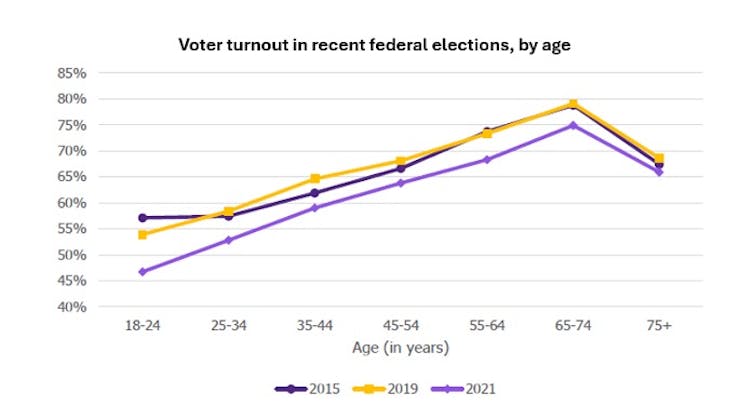
Canadians between the ages of 18 and 34 are less likely to vote than those in other age cohorts and had the steepest decline in turnout from 2015 to 2021, when fewer than half of eligible young Canadians voted.

Young people are generally less knowledgeable and politically informed than older adults.

A graph shows voter turnout numbers in recent Canadian federal elections by age
Voter turnout numbers in recent Canadian federal elections by age.
(Elections Canada)

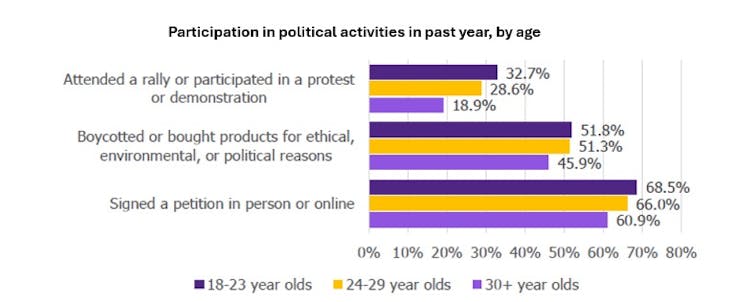
At the same time, young Canadians are at the forefront of discussing politics online, following politicians on social media and mobilizing their peers through digital platforms. They are more likely to take part in protests, petitions and political consumerism — from boycotts to buycotts — and to volunteer with community organizations and political campaigns at higher rates than other age groups.

a graph shows levels of political participation by age
Data on levels of political participation by age.
(Democracy Checkup surveys)

The real story isn’t that youth don’t care or aren’t political. It’s that they are turning away from conventional, formal participation in favour of alternative ways of sharing and expressing their views.

Explaining changing participation norms

Our analysis suggests that younger Canadians differ from their older counterparts across key factors that shape whether and how they participate.

Many young Canadians cite a lack of time as a barrier to engagement, have lower levels of political knowledge, report slightly lower levels of interest in politics and struggle to make the connection between politics and the issues they care about.

Our work also suggests that youth are noticeably less likely to see civic participation like voting as a duty, and they’re much more likely to be influenced by whether they believe their participation will make a difference.

This presents a particular challenge, because youth also tend to express higher levels of skepticism that their participation matters.

One final surprising finding is that more attention may need to be paid to understanding how political polarization affects youth. Young people may be increasingly put off from politics by hostility and conflict that they want to avoid.

Civic engagement beyond election day

Youth don’t seem to be tuning out but are instead finding different ways to engage. Nonetheless, declining interest in political engagement through formal institutions represents a real concern for democracy in Canada.

So how to build upon the areas where youth are already engaging, and bring young people back into conventional forms of civic engagement like voting?

Our conversations with civil society organizations suggest that civic engagement starts with effective civic education programs in schools, while highlighting the challenges these programs face — from educator training to curriculum design and sustainability over time.

They also highlight the challenge of reaching older youth, especially those referred to as NEET by statisticians — not in employment, education or training. Our interviewees shared their own successful strategies and emphasized the importance of reaching out to youth where they are and through the media and platforms that they prefer.

What comes next?

Democracies around the world are under pressure, and Canada is no exception. In this moment, it’s more critical than ever to pay attention to youth civic engagement.

Investing in civic education and encouraging civic participation early in life helps ensure young people have a voice in politics. But perhaps more importantly, it can also demonstrate how civic engagement can lead to change and challenge the feelings of powerlessness that drive disengagement. Youth participation helps build habits that last a lifetime and is essential to sustaining democracy for generations to come.

The future of Canadian democracy is in the hands of our youth. They must be equipped with the knowledge and the skills to shape it for the better.

The Conversation

Christopher Alcantara receives funding from Max Bell Foundation for this research report.

Craig Mutter receives funding from Max Bell Foundation for this research.

Laura Stephenson receives funding from Max Bell Foundation for this research.

ref. Encouraging young people to vote requires understanding why they don’t – https://theconversation.com/encouraging-young-people-to-vote-requires-understanding-why-they-dont-270015

Online harassment is silencing Canada’s health experts — institutions need to do more to protect them

Source: The Conversation – Canada – By Heidi J. S. Tworek, Professor of History and Public Policy, University of British Columbia

Canada has lost the measles elimination status it has held since 1998. To regain that status, one crucial factor is hearing from researchers who speak about vaccine safety in public.

Canada can’t afford to lose expert voices at a moment when the threat of vaccine-preventable diseases is rising. Yet our work suggests that online harassment is a growing deterrent that is driving researchers and scientists out of the conversations needed at this time.

Harassment is a long-standing problem in academia. While it occurs within different institutions and disciplines, it has increasingly taken the form of online attacks from people outside of academia. It’s a phenomenon that accelerated during the COVID-19 pandemic, and one where health experts are left to cope alone.

Canadian institutions and research organizations need to create broad support for these individuals.

The harms of online harassment

Our recent study on prominent Canadian health communicators — including university researchers and public health officials — found that 94 per cent, or 33 of 35 interviewees, had faced online abuse during the COVID-19 pandemic.

Online harassment goes beyond vaccines and COVID-19; climate change, gender diversity, immigration and other topics have all triggered a backlash. But we found that vaccination was one of the topics most likely to trigger abuse, and it’s an issue that has become increasingly politicized in Canada.

As with many issues in Canada, developments in the United States have played a major role. For instance, a 2021 study on vaccine hesitancy in Canada showed how social media conversations on vaccinations were heavily influenced by discussions in the U.S. It turned out that Canadians followed a median of 32 Canadian accounts and 87 American accounts.

With such interconnected information ecosystems, anti-science harassment directed at American researchers routinely spills into Canadian online spaces. This is worsened when senior officials in the U.S. administration publicly express a lack of support for immunization and evidence-based health recommendations.

Canadian universities and academic institutions need to develop mitigation and support strategies to deal with online harassment fuelled by these realities.

We can learn from action plans by U.S.-based universities and coalitions. Canada can also learn from models in countries like the Netherlands that have created national initiatives to support researchers experiencing harassment.

Hostility that threatens public health

While academics should be comfortable having their ideas challenged, technology-facilitated harassment is very different. Online harassment is often linked with other forms of targeted abuse and includes acts of doxxing, reputation attacks or threatening and sexualized messaging, among others.

Though this hostility often targets individuals working on politically contested issues, researchers from equity-deserving groups face online abuse that builds on systemic inequities related to race, gender, sexuality and other identity factors.

Online abuse can harm mental health, provoke fears about employment or grants and undermine academic freedom, as the Canadian Association of University Teachers observes. Our research found that health communicators faced the “psychological toll” of reading hostile emails day after day, with several reporting fear, sadness or anxiety in response to threats of violence.

A racialized expert recounted how personal attacks on her appearance and background “take a toll,” while a health journalist said that messages like one wishing her “blood clots” sometimes kept her awake at night. Several interviewees described exhaustion, worry and depressive symptoms, highlighting the hidden burden of online harassment.

Besides having serious personal, institutional and societal consequences, this reality risks creating information gaps that could be quickly filled by conspiracy theories. Some health researchers decided to stop media interviews or social media posts on controversial issues. So should they simply avoid public engagement on contentious topics?

While this approach might lessen the risks, it would also dramatically reduce the impact of their expertise. Public engagement is not only a key part of research grants but it also ensures that Canadians benefit directly from research.

Currently, scholars and public health communicators targeted with online abuse mainly use individual coping strategies such as deleting social media accounts, withdrawing from public communication or accepting abuse as inevitable.

These strategies, however, leave individuals to address attacks in isolation. While such measures provide temporary relief, they reinforce self-censorship and hamper public access to expert knowledge.

The need for ‘wraparound’ support

Institutions need to adopt “wraparound” support. This approach acknowledges researcher agency and institutional responsibility through a rights-based framework. It also shifts responsibility from individuals to institutions.

Unlike many universities’ current siloed and inflexible approach, a wraparound approach co-ordinates and integrates multiple domains of support.

For instance, some targeted individuals may not face legal or safety risks but can benefit from psychological support. Others may need assistance with cybersecurity risks or removing online mentions of personal information like their home address or children’s school.

Our institution, the University of British Columbia, for example, offers cybersecurity assistance, mental health support and other key elements of a response.

However, when we consulted faculty and staff, we learned that people found it daunting to figure out all the supports available and how to access them. We created an online resource to help. York University solved that problem by creating a map.

Canadian universities can also turn to international models for inspiration. Fourteen universities in the Netherlands, for instance, participate in a joint SafeScience initiative, which offers guidance and a national helpline to report incidents. Germany’s SciComm-Support provides resources, training and free counselling to researchers.

If we expect scientists and health experts to speak out about issues like measles vaccination for the good of society, they must know that their employers and institutions will stand with them, that they will have their backs.

Canada cannot prepare for future public health emergencies, like another pandemic, without protecting the safety of researchers and their freedom to pursue their lines of inquiry without fear.

Immunity and Society is a new series from The Conversation Canada that presents new vaccine discoveries and immune-based innovations that are changing how we understand and protect human health. Through a partnership with the Bridge Research Consortium, these articles — written by academics in Canada at the forefront of immunology and biomanufacturing — explore the latest developments and their social impacts.

The Conversation

Heidi J. S. Tworek receives funding from the Bridge Research Consortium (BRC), part of Canada’s Immuno-Engineering and Biomanufacturing Hub, which in turn is funded by the Canada Biomedical Research Fund, Canada Foundation for Innovation and the BC Knowledge Development Fund. She also receives funding from the Canada Research Chair Programme and the Social Sciences and Humanities Research Council.

Chris Tenove receives funding from the Bridge Research Consortium (BRC), part of Canada’s Immuno-Engineering and
Biomanufacturing Hub, which in turn is funded by the Canada Biomedical Research Fund, Canada Foundation for Innovation and the BC Knowledge Development Fund.

Netheena Neena Mathews receives funding from the Bridge Research Consortium (BRC), part of Canada’s Immuno-Engineering and Biomanufacturing Hub, which in turn is funded by the Canada Biomedical Research Fund, Canada Foundation for Innovation and the BC Knowledge Development Fund.

ref. Online harassment is silencing Canada’s health experts — institutions need to do more to protect them – https://theconversation.com/online-harassment-is-silencing-canadas-health-experts-institutions-need-to-do-more-to-protect-them-267532

An important wetland in Ghana is under siege. Researchers investigate the real issues

Source: The Conversation – Africa – By Stephen Leonard Mensah, PhD Candidate, University of Memphis

Wetlands are vital ecological resources that provide several benefits in urban and peri-urban areas. They slow down flood waters, and act as a source of fishing and farming livelihoods. They also provide socio-cultural benefits for local communities. But some of these valuable ecosystems, due to their presence in prime locations, are at the centre of competing cultural, ecological and economic interests. Property development, especially, is a threat to wetlands.

The 2025 Global Wetland Outlook emphasises that the protection of wetlands is key to sustainable development. However, since 1970, about 411 million hectares of wetlands have been lost. In Africa, degradation is widespread and many are in poor condition.

We are a multidisciplinary team of researchers working in the area of resilience, sustainability and justice in urban transitions.

Our research highlights some of the local-level issues and conflicting interests that are shaping the rapid destruction of the Sakumono Ramsar Site in Tema, Ghana. Under the Ramsar Convention, a Ramsar site is a designated wetland with special natural significance.

We found institutional complicity and the lack of engagement with communities to be key drivers shaping current wetland conditions. Our study proposes a model for enforcing regulations and asserting the community’s right to nature for socio-cultural purposes.


Read more:
A root cause of flooding in Accra: developers clogging up the city’s wetlands


Tema: wetlands in an industrial city

Tema was developed from a small fishing community into an industrialised port city by independent Ghana’s first president, Kwame Nkrumah. Its purpose was to facilitate international trade and vibrant economic development. It is one of Ghana’s most important cities and has been experiencing urban expansion and land use changes. This has led to encroachment in environmentally sensitive areas, including the Ramsar site.

The Sakumono wetland was officially designated a Ramsar site in 1992 to protect its rich biodiversity. It covers about 1,400 hectares and is protected by several regulations, including the Wetland Management Regulations Act, 1999.

But the site has, over the years, witnessed rapid depletion and intense encroachment from property development. Approximately 80% of the Sakumono Ramsar Site has been encroached on, leaving only about 20% of the wetland intact.

Population in the wetland’s catchment area had grown from about 114,600 in 1984 to over 500,000 by 2000, indicating that large numbers of people live around and rely on the wetland. Although the exact number of people currently affected by the wetlands encroachment is unknown, the dense surrounding population suggests that many households, especially those engaged in farming and fishing, have likely experienced reduced access and livelihood displacement. Like other wetlands in Ghana, the Sakumomo Ramsar site risks eventual destruction if nothing is done to reverse current trends.

The president of Ghana has called for heavy punishment for individuals who encroach on Ramsar sites. Both community and institutional respondents in our research claimed, however, that it was the political elites who were behind unbridled property development in the first place.


Read more:
Flooding incidents in Ghana’s capital are on the rise. Researchers chase the cause


Multiple and conflicting interests in wetlands management

The main objective of our study was to analyse stakeholders’ perspectives on the use, value and management of wetlands. We evaluated the impact of these views on the sustainable management of ecologically sensitive areas. We conducted in-depth interviews with community residents, community leaders and opinion leaders. We also interviewed officials from metropolitan and municipal assemblies. The research was conducted in the Sakumono community, where the Sakumono Ramsar site is located.

Conflicting views on wetlands value: while the value of the site lies in its economic and ecological benefits, community residents were more interested in its economic value. That is, how it provides livelihood opportunities through farming and fishing activities.

Residents wondered why developers were allowed to exploit portions of the wetlands for building purposes, while they were prevented from fishing and farming. One of the residents said:

See rich and influential people buying land in the wetland area and using it for building properties. But we are not permitted to fish there.

For state institutions, protecting the wetland meant restricting access for community members. They encouraged activities such as tree planting and periodic desilting.

Conflicting views on wetlands use: the views of stakeholders also showed the changing understanding of the use of wetlands. An official from the forestry commission revealed that the wetland was acquired by the state during the 1980s for conservation. But other institutional officials, such as those of the lands commission, revealed that it had become a prime area for property development. Powerful developers bypass the land registration process and build without a permit.

The size of the Ramsar site has reduced because people are acquiring the wetland, including the buffer area, for residential development. Even though the wetland area is demarcated as a protected area, many of the politically connected developers go behind us and build without a permit.

Conflicting views on wetlands management: our research revealed contradictions between state institutions and community stakeholders. For instance, traditional authorities were of the view that:

Since the management of the wetland is not under our control, we are not responsible for the current developments taking place in and around the demarcated area.

The traditional authorities said they were not consulted and did not benefit from the wetland. This perhaps explains why they watched on as destruction continued. A member of the traditional council said:

As leaders of the community, we are not consulted about how the wetland is managed. You always hear the forestry commission accusing community leaders that we are selling the land. We can’t sell land that does not belong to us.

Towards a community-based stewardship model

Communities should be at the centre of wetlands management. We propose a stewardship-based co-management model that enforces environmental and conservation regulations. It emphasises working with a range of stakeholders. This includes government agencies, traditional authorities and environmentally conscious community members. We call for an updated wetlands management plan that reflects recent changes, but that is also fair, responsible and protective for present and future generations. This is essential for building sustainable communities in Ghana and beyond.

The Conversation

Louis Kusi Frimpong receives funding from African Peacebuilding and Developmental Dynamics (APDD) through the Individual Research Fellowship (IRF).

Seth Asare Okyere and Stephen Leonard Mensah do not work for, consult, own shares in or receive funding from any company or organisation that would benefit from this article, and have disclosed no relevant affiliations beyond their academic appointment.

ref. An important wetland in Ghana is under siege. Researchers investigate the real issues – https://theconversation.com/an-important-wetland-in-ghana-is-under-siege-researchers-investigate-the-real-issues-269016

How does Narcan work? Mapping how it reverses opioid overdose can provide a molecular blueprint for more effective drugs

Source: The Conversation – USA – By Saif Khan, Ph.D. Candidate in Biology, University of Southern California

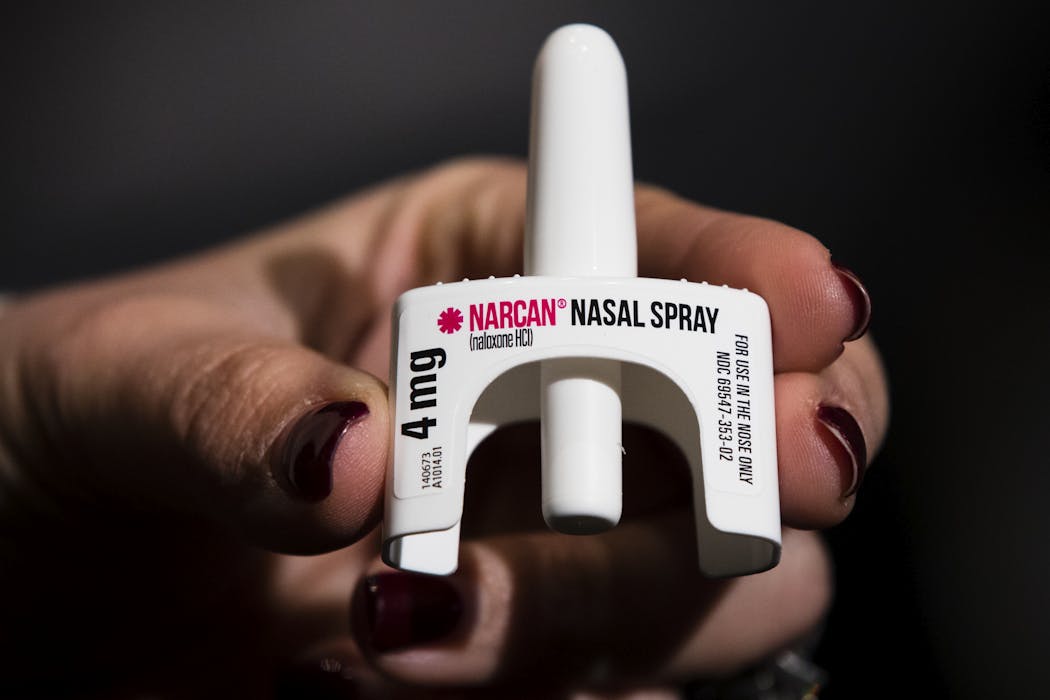
Naloxone competes with opioids for the same receptor on the surface of neurons. Matt Rourke/AP Photo

Naloxone, also known by the brand name Narcan, is one of the most important drugs in the United States’ fight against the opioid crisis. It reverses an opioid overdose nearly instantly, restarting breathing in a person who was unresponsive moments before and on the brink of death. To bystanders witnessing it being administered, naloxone can appear almost supernatural.

Although the Food and Drug Administration approved naloxone for medical use in 1971 and for over-the-counter purchase in 2023, exactly how it works is still unclear. Researchers know naloxone acts on opioid receptors, a family of proteins responsible for the body’s response to pain. When opioids such as morphine and fentanyl bind to these receptors, they produce not only pain relief and euphoria but also dangerous side effects. Naloxone competes with opioids for access to these receptors, preventing the drugs from triggering effects in the body. How it does this at the molecular level, however, has been an ongoing question.

In our recently published research in the journal Nature, my team and I were able to provide some definitive evidence of how naloxone works by capturing images of it in action for the first time.

Knowing how to use naloxone can save lives.

Biology of opioids

To better grasp how naloxone works, it’s helpful to first zoom in on the biology behind opioids.

One member of the family of opioid receptors, MOR – short for µ-opioid receptor – is a central player in regulating the body’s response to pain. It sits on the surface of neurons, mostly in the brain and spinal cord, and acts as a communication hub.

When an opioid – such as an endorphin, the body’s natural painkillers – interacts with MOR, it changes the structure of the receptor. This change in shape allows what’s called a G protein to bind to the receptor and trigger a signal to the rest of the body to reduce pain, induce pleasure, or – in the case of overdose – dangerously slow breathing and heart rate.

Diagram of different configurations of MOR
When a molecule binds to the µ-opioid receptor, it changes its structure and elicits an effect. Antagonists like naloxone inactivate the µ-opioid receptor, while agonists like fentanyl activate it.
Bensaccount/Wikimedia Commons

In everyday terms, MOR is like a lock on the outside of the cell. The G protein is the mechanism inside the lock that turns when the correct key – in this case, an endorphin or a drug like fentanyl – goes in. For decades, scientists believed that an opioid’s ability to enable this signaling cascade was linked to how effectively it reshaped the structure of the receptor – essentially, whether the lock could open wide enough for the internal mechanism of the G-protein to engage.

Yet, recent research – including our work – has revealed that the critical step to how opioids work is not how wide they open the lock but how well the mechanism works. G proteins act like a switch, releasing one molecule in exchange for another molecule that triggers the protein to send the signal that sets off opioid effects.

In essence, drugs like fentanyl, by acting on the receptor, transmit physical changes to G proteins that result in the switch flipping more rapidly. What we now see is that naloxone jams the mechanism, preventing the switch from flipping and sending the signal.

Capturing the switch

Researchers know that the effects of opioids are triggered when the G protein switch is flipped. But what does this process look like?

For years, attempts to visualize this mechanism were largely limited to two states – before the G protein binds to the µ-opioid receptor, and after the molecule was released from the G protein. The states in between were considered too unstable to isolate. My team and I wanted to capture these unseen states moment by moment as the switch flips and the molecule is released.

To do this, we used a technique called cryo-electron microscopy, which freezes molecules in motion to visualize them at near-atomic resolution. For both naloxone and the opioid drug loperamide (Imodium), we trapped the G protein bound to the opioid receptor right before it released the molecule.

We captured four distinct structural states leading up to the release of the molecule from the G protein.

The first of these, which we call the latent state, is the earliest form of the opioid receptor and G protein after they make contact. We found that both the opioid receptor and the G protein are inactive at this point. Moreover, naloxone stabilizes this latent state. What this means is that naloxone effectively jams the mechanism right at the start, preventing all subsequent steps required for activation.

Diagram of MOR and G protein in six different states of activation
How the µ-opioid receptor (top half of the structure) and G protein (bottom half of the structure) are configured is key to the effects of naloxone and opioids.
Saif Khan et al/Nature, CC BY-NC-ND

In the absence of naloxone, an opioid drug promotes a transition to the remaining three states: The G-protein rotates and aligns itself with the receptor (engaged), swings open the door blocking the molecule that would trigger the switch from flipping (unlatched), and holds that door open so the molecule can be released (primed) and send the signal to carry out the drug’s effects.

To confirm that our snapshots reflect what’s really happening, we performed extensive computational simulations to watch these four states change over time. Together, these findings point to the molecular root of naloxone’s therapeutic effects: By stalling the opioid receptor and G protein at a latent state, it shuts down opioid signaling, reversing an opioid overdose within minutes.

Visualizing new drugs

Designing a new key for a lock is most successfully done when you know exactly what that lock looks like. By mapping the exact sequence of how opioids interact with opioid receptors and pinpointing where different drugs can intervene in this process, our findings provide a blueprint for engineering the next generation of opioid medicines and overdose antidotes.

For example, one of the persistent challenges with naloxone is that it must often be administered repeatedly during an overdose. This is especially the case for fentanyl overdoses, where the opioid can outcompete or outlast the effects of the treatment.

Knowing that naloxone works by stalling the µ-opioid receptor in an early, latent state suggests that molecules that can bind more tightly or more selectively to this form of the receptor could be more effective at stabilizing this inactive state and thus preventing an opioid’s effects.

By uncovering the structure of molecules involved in opioid signaling, researchers may be able to develop drugs that provide longer-lasting protection against overdose.

The Conversation

This research was supported by the National Institutes of Health.

ref. How does Narcan work? Mapping how it reverses opioid overdose can provide a molecular blueprint for more effective drugs – https://theconversation.com/how-does-narcan-work-mapping-how-it-reverses-opioid-overdose-can-provide-a-molecular-blueprint-for-more-effective-drugs-269706

Absence of evidence is not evidence of absence – and that affects what scientific journals choose to publish

Source: The Conversation – USA – By Mark Louie Ramos, Assistant Research Professor of Health Policy and Administration, Penn State

Careful planning and analysis are part of trying to reduce the chance of a false-positive finding. Arnon Mungyodklang/iStock via Getty Images Plus

Should you believe the findings of scientific studies? Amid current concerns about the public’s trust in science, old arguments are resurfacing that can sow confusion.

As a statistician involved in research for many years, I know the care that goes into designing a good study capable of coming up with meaningful results. Understanding what the results of a particular study are and are not saying can help you sift through what you see in the news or on social media.

Let me walk you through the scientific process, from investigation to publication. The research results you hear about crucially depend on the way scientists formulate the questions they’re investigating.

The scientific method and the null hypothesis

Researchers in all kinds of fields use the scientific method to investigate the questions they’re interested in.

First, a scientist formulates a new claim – what’s called a hypothesis. For example, is having some genetic mutations in BRCA genes related to a higher risk of breast cancer? Then they gather data relevant to the hypothesis and decide, based on the data, whether that initial claim was correct or not.

It’s intuitive to think that this decision is cleanly dichotomous – that the researcher decides the hypothesis is either true or false. But of course, just because you decide something doesn’t mean you’re right.

If the claim is really false but the researcher decides, based on the evidence, it’s true – a false positive – they commit what’s called a Type 1 error. If the claim is really true but the researcher fails to see that – a false-negative conclusion – then they commit a Type 2 error.

Moreover, in the real world, it gets a little messier. It’s really hard to decide about the truth or falsity of a claim just based on what’s observed.

For that reason, most scientists employ what is called the null hypothesis significance testing framework. Here’s how it works: A researcher first states a “null hypothesis,” something that’s contrary to what they want to prove. For instance, in our example the null hypothesis is that BRCA genetic mutations are not associated with increased breast cancer occurrence.

The scientist still gathers data and makes a decision, but the decision is not about whether the null is true. Instead, a researcher decides whether there’s enough evidence to reject the null hypothesis or not.

man in white coat in lab looking at tablet
Careful statistical analysis along with a well-formulated null hypothesis lend confidence to a study finding.
Jackyenjoyphotography/Moment via Getty Images

What rejecting the null does and doesn’t mean

Understanding this distinction is crucial. Rejecting the null is equivalent in practice to acting as though it is false – in the example, rejecting the null means claiming that those with some BRCA gene mutations do have a higher risk of breast cancer. Along with other evidence, such as the size of the increased risk, this outcome can justify recommending early breast cancer screening for people with the identified BRCA mutations.

But failing to reject the null hypothesis doesn’t imply that it’s true – in this case, it doesn’t mean there is no association between the BRCA mutations and breast cancer. Rather, such a result is inconclusive; there’s not enough evidence to claim there is an association. A negative result – inadequate evidence to say the null is false – does not necessarily invite the researcher to believe the null is true.

This is because null hypothesis significance testing is set up to control for Type 1 error (false positive) at a level defined in advance by the researcher but at the cost of having less control over Type 2 error (false negative).

A researcher’s chances of correctly rejecting the null if there is increased risk can depend on how much data they have, how complex the design of the study is and, most importantly, how large the effect actually is. It’s much easier to reject the null if BRCA mutations truly increase cancer risk many times than it is if the risk is only slightly elevated. A researcher can end up with a result that is not statistically significant but cannot rule out the possibility of an increased risk that is too small for the study to detect.

Which results are more often publicized

Once they have their result and the researchers want to disseminate their work, they typically do so through peer-reviewed publication. Journal publishers consider a researcher’s write-up of their study, send it out for other scientists to review, and then decide whether to publish it.

In this process, the publishers tend to favor studies that rejected their null hypothesis over those that failed to reject it. This is called positive publication bias.

It is natural for publishers to prefer studies that support new claims since they objectively carry more information than studies that failed to reject their null hypothesis. Journals want to publish something new and noteworthy.

Many sources flag this phenomenon as “bad science,” but is it really? Remember, the framework used to make decisions about scientific claims is intentionally only capable of either rejecting the null hypothesis – in other words, supporting the claim – or alternatively declaring inconclusive results.

The framework isn’t designed to be able to prove the null hypothesis. That said, researchers can reverse the design of a scientific investigation so that a previous claim becomes the null hypothesis in a new study with fresh data.

For instance, rather than a null hypothesis that there is no association between BRCA mutations and breast cancer, the null hypothesis becomes that the increased breast cancer risk from BRCA mutations is equal to or greater than some value the researcher settles on before gathering fresh data.

Rejecting the null this time would mean the increased risk is smaller than that set value, thus supporting the claim consistent with what had previously been the null hypothesis on prior data. In the example, rejecting the null means the effect of BRCA genes is small enough to be practically negligible in terms of developing breast cancer.

It’s critical for a researcher to structure their study so that what they’re interested in proving is aligned with the rejection of the null. Publishers are naturally less inclined to consider studies that failed to reject their null hypothesis, not because they do not want to publish studies that support negative statements but because null hypothesis significance testing does not actually support negative statements. Failure to reject the null just means your results are inconclusive – and may perhaps seem less newsworthy.

library shelves with research journals
Research journals want to publish results that will have an impact.
luoman/iStock via Getty Images Plus

What positive publication bias does

So what does the practice of preferring to publish studies that reject their null hypothesis do?

While we can’t know for certain, we can see how this plays out under different circumstances. You can explore the scenarios in this app I made.

If scientists are acting in good faith, using null hypothesis significance testing appropriately, it turns out that positive publication bias on the part of scientific journal publishers will increase the proportion of true discoveries in their pages much more than it will increase the proportion of false positives.

If editors did not exercise any positive publication bias, journals would be almost entirely full of studies with inconclusive results.

Of course, if scientists are not acting in good faith and are just interested in getting published while ignoring proper use of statistical tests, that can lead to false-positive rates being as high or higher than the rate of true discoveries. But this possibility is true even without positive publication bias.

The Conversation

Mark Louie Ramos does not work for, consult, own shares in or receive funding from any company or organization that would benefit from this article, and has disclosed no relevant affiliations beyond their academic appointment.

ref. Absence of evidence is not evidence of absence – and that affects what scientific journals choose to publish – https://theconversation.com/absence-of-evidence-is-not-evidence-of-absence-and-that-affects-what-scientific-journals-choose-to-publish-264854