Africa’s drylands need the right kind of support – listening to the pastoralists who live there

Source: The Conversation – Africa – By Claire Bedelian, Senior Researcher, SPARC Consortium, ODI Global

Africa’s drylands are often imagined as vast, empty spaces. Romantic wilderness on the one hand. Zones of hunger, conflict and poverty on the other. Media stories tend to emphasise crises and scarcity, portraying these regions as peripheral and fragile.

But this narrative obscures a more complex and hopeful reality. Across these landscapes, millions of pastoralists and dryland farmers are constantly adapting, innovating, and building livelihoods in some of the continent’s most variable environments.

Drylands are areas of low rainfall and high temperature that cover 60% of Africa. They support the livelihoods and food security of half a billion people who depend on pastoralism and crop farming. These regions are integral to biodiversity, culture and economies. Pastoralists alone supply over half the continent’s meat and milk, sustaining millions of households and enterprises. They underpin food systems and trade networks that reach far beyond the drylands.

Yet drylands people face mounting pressures. These include political marginalisation, insecure land tenure, persistent conflict and climate change. These challenges are often worsened by misguided investments and inappropriate policies. Among them are land grabs and mining concessions to rangeland conversion.

In addition, many initiatives in the drylands have failed to deliver lasting change despite decades of investments. Too often, they are shaped by outdated, crisis-driven narratives. These misrepresent drylands as “empty”, “unproductive”, or in need of “saving”.

Such interventions disrupt livelihoods and distort the underlying logic of dryland societies, while being used to justify yet more external investment.

For more than a decade we have been researching dryland livelihood systems in Africa and the Arab Region. We are part of the six-year SPARC programme (Supporting Pastoralism and Agriculture
in Recurrent and Protracted Crises), which informs more feasible and cost-effective policies and investments in the drylands of Africa and the Middle East. We recently produced a documentary that followed five stories of pastoralists driving positive change in Africa’s drylands.

We found that the most effective support for drylands builds on the local systems and expertise that people already rely on. Yet many external initiatives still attempt to replace these rather than work with them. This matters because efforts that overlook local systems often weaken resilience and increases vulnerability.

Why past efforts often fall short

Misconceptions about drylands define them by what they lack rather than by their strengths. They oversimplify complex, dynamic systems to rationalise interventions aimed at taming dryland variability. The result has been projects that often undermine resilience instead of strengthening it.

For example, many investments in large-scale irrigation schemes have diverted water from traditional livelihoods while failing to boost agricultural productivity.

Similarly, fixed water infrastructure such as boreholes or dams can disrupt pastoral mobility. In Turkana, northern Kenya, permanent water points contributed to resource conflicts and rangeland degradation, and many have since fallen into disuse.

These “imported” solutions rarely account for local priorities or ecological realities. That’s why dozens of boreholes lie abandoned even in areas still facing water shortages.

Limited long-term learning compounds this problem. Few organisations return to assess how previous resilience projects fared. Millions are spent on building resilience, yet there is little follow-up to understand the outcomes of past efforts.

In contrast, locally-led approaches have proven far more effective. Along the shores of Lake Turkana, joint planning between local communities and county government has produced investments people value and maintain. These include shared water systems, fishing equipment and community gardens.

These examples underline a key lesson: initiatives designed around community priorities and local governance structures are more likely to have lasting impact.

Dynamic, adaptive and innovative

While external projects often struggle, dryland people continue to adapt in creative and diverse ways. Their resilience is rooted in mobility, cooperation and environmental knowledge passed down through generations.

Pastoralists and farmers have developed finely tuned strategies for living with this variability such as unpredictable rainfall, recurrent droughts and occasional floods. They move herds, manage grazing and water resources, diversify incomes, and draw on social networks that spread risk.

Mobility and flexibility are central. Herders move strategically across rangelands to access water and pasture, balancing environmental and social factors in real time. In flood-prone Bor, South Sudan, many Dinka women shift seasonally from livestock to fish preservation and trade.

Pastoralists also embrace digital technology, dispelling myths of technological illiteracy. Herders use mobile phones, social media, and digital tools such as Kaznet and Afriscout to locate water and monitor pasture.

Initiatives like Livestock247 – a livestock traceability and marketing platform – show how tech can open markets and improve herd management when aligned with pastoralist social values and practices.

Informal networks are another cornerstone of resilience. Motorbike riders scout for pasture during droughts, local traders offer credit to women, lorry drivers deliver goods to remote areas, and mobile money agents keep remittances flowing. In times of crisis these social and economic linkages often provide more reliable safety nets than formal aid systems.

Rethinking support: building on what works

If governments, donors and development partners are serious about helping Africa’s drylands become more peaceful, prosperous and resilient, they must start by recognising the expertise, agency and innovation that already exist.

Effective support means investing in – and strengthening – the systems that already work rather than replacing them with rigid, top-down solutions. These include mobility, local governance, informal trade, and indigenous knowledge

Empowering women and youth is key. When given opportunities and resources, they are often the first to innovate, diversify livelihoods and rebuild communities after crises.

Iterative, context-specific efforts strengthen resilience in the drylands, not rapid, transformational change. Small-scale, locally-grounded efforts can have a lasting impact. In many post-conflict recovery examples, smallholders steadily rebuilt agriculture through gradual improvements in seeds, fertilisers and tools. They do this with minimal government support.

Building resilience in drylands is not a technical fix. It requires flexibility, listening, and partnership over control and prescription.

2026 is the International Year of Rangelands and Pastoralists (IYRP). It is a year for highlighting the importance of drylands for food security, biodiversity and sustainable livelihoods, and for elevating pastoralist’s contribution and influence over policy and investment priorities. It offers an opportunity to shift the narratives from outdated myths of scarcity and crises to those that champion the agency, knowledge and resilience of dryland people.

This requires sustained commitment – placing dryland communities at the centre of decisions, nurturing their innovations, and resisting attempts to impose incompatible models.

A new story of Africa’s drylands is emerging, one grounded in respect, recognition and partnership. One worth amplifying for a more peaceful, resilient and prosperous future.

The Conversation

Guy Jobbins and the SPARC Consortium receive funding from the UK Foreign, Commonwealth and Development Office. However the views expressed do not necessarily reflect the UK government’s official policies.

Claire Bedelian does not work for, consult, own shares in or receive funding from any company or organisation that would benefit from this article, and has disclosed no relevant affiliations beyond their academic appointment.

ref. Africa’s drylands need the right kind of support – listening to the pastoralists who live there – https://theconversation.com/africas-drylands-need-the-right-kind-of-support-listening-to-the-pastoralists-who-live-there-269975

Why one 16th-century theologian’s advice for a bitterly divided nation holds true today

Source: The Conversation – USA (3) – By Michael Bruening, Professor of History, Missouri University of Science and Technology

A monument to Sebastian Castellio in Geneva – using a French spelling of his name – reads, ‘Killing a man is not defending a doctrine; it is killing a man.’ MHM55/Wikimedia Commons, CC BY-SA

Ideological division was tearing the country apart. Factions denounced each other as unpatriotic and evil. There were attempted kidnappings and assassinations of political figures. Public monuments and art were desecrated all over the country.

This was France in the middle of the 16th century. The divisions were rooted in religion.

The Protestant minority denounced Catholics as “superstitious idolaters,” while the Catholics condemned Protestants as “seditious heretics.” In 1560, Protestant conspirators attempted to kidnap the young King Francis II, hoping to replace his zealous Catholic regents with ones more sympathetic to the Protestant cause.

Two years later, the country collapsed into civil war. The French Wars of Religion had begun – and would convulse the country for the next 36 years.

I am a historian of the Reformation who writes about the opponents of John Calvin, a leading Protestant theologian who influenced Reformed Christians, Presbyterians, Puritans and other denominations for centuries. One of the most significant of Calvin’s rivals was the humanist Sebastian Castellio, whom he had worked with in Geneva before a bitter falling out over theology.

Soon after the first war in France broke out, Castellio penned a treatise that was far ahead of its time. Rather than join in the bitter denunciations raging between Protestants and Catholics, Castellio condemned intolerance itself.

He identified the main problem as both sides’ efforts to “force consciences” – to compel people to believe things they did not believe. In my view, that advice from nearly five centuries ago has much to say to the world today.

Foreseeing the carnage

Castellio rose to prominence in 1554 when he condemned the execution of Michael Servetus, a medical doctor and theologian convicted of heresy. Servetus had rejected the standard Christian belief in the Trinity, which holds that the Father, Son and Holy Spirit are three persons in one God.

A dark-colored statue of a downcast, seated man, positioned in front of trees and bushes.
A monument to Michael Servetus, who was condemned for heresy and executed, in Geneva.
Iantomferry/Wikimedia Commons, CC BY-SA

Already condemned by the Catholic Inquisition in France, Servetus was passing through Geneva when Calvin urged his arrest and advocated for his execution. Servetus was burned alive at the stake.

Castellio condemned the execution in a remarkable book titled “Concerning Heretics: Whether They are to be Persecuted and How They are to be Treated.” In it, Castellio questioned the very notion of heresy: “After a careful investigation into the meaning of the term heretic, I can discover no more than this, that we regard those as heretics with whom we disagree.”

In the process, he laid the intellectual foundations for religious toleration that would come to dominate Western political philosophy during the Enlightenment.

But it took centuries for religious toleration to take hold.

In the meantime, Europe became embroiled in a series of religious wars. Most were civil wars between Protestants and Catholics, including the French Wars of Religion, a series of conflicts from 1562 to 1598. These included one of the most horrific events of the 16th century: the St. Bartholomew’s Day Massacre of 1572, when thousands of Protestants were slain in a nationwide bloodbath.

Castellio had seen the carnage coming: “So much blood will flow,” he had warned in a treatise 10 years earlier, “that its loss will be irremediable.”

A painting in faded colors shows a plaza in a medieval city, with scenes of people slaughtering each other and throwing bodies in a river.
‘The St. Bartholomew’s Day Massacre,’ by 16th-century artist François Dubois.
Cantonal Museum of Fine Arts/Wikimedia Commons

Remembering the Golden Rule

Castellio’s 1562 book, “Advice to a Desolate France,” was a rarity in the 16th century, for it sought compromise and the middle ground rather than the religious extremes.

With an extraordinarily modern sensibility, he decided to use the terms each side preferred for themselves, rather than the negative epithets used by their opponents.

“I shall call them what they call themselves,” he explained, “in order not to offend them.” Hence, he used “Catholics” rather than “Papists” and “evangelicals” rather than “Huguenots.”

Castellio pulled no punches. To the Catholics, referring to decades of Protestant persecution in France, he said: “Recall how you have treated the evangelicals. You have pursued and imprisoned them … and then you have roasted them alive at a slow fire to prolong their torture. And for what crime? Because they did not believe in the pope, the Mass, and purgatory. … Is that a good and just cause for burning men alive?”

To the Protestants, he complained, “You are forcing them against their consciences to attend your sermons, and what is worse, you are forcing some to take up arms against their own brothers.” He noted that they were using three “remedies” for healing the church, “namely bloodshed, the forcing of consciences, and the condemning and regarding as unfaithful of those who are not entirely in agreement with your doctrine.”

A sepia-colored illustration of a man with a long goatee, wearing a black jacket with buttons.
A portrait of Sebastian Castellio, made by 18th-century printmaker Heinrich Pfenninger.
Sepia Times/Universal Images Group via Getty Images

In short, Castellio accused both sides of ignoring the Golden Rule: “Do not do unto others what you would not want them to do unto you,” he wrote. “This is a rule so true, so just, so natural, and so written by the finger of God in the hearts of all,” he asserted, that none can deny it.

Both sides were trying to promote their vision of true religion, Castellio said, but both were going about it the wrong way. In particular, he warned against trying to justify evil behavior by appealing to its possible effects: “One should not do wrong in order that good may result from it.”

In another essay, he made the same point to argue against torture, writing that “Evil must not be done in order to pursue the good.” Castellio was the anti-Machiavelli; for him, the ends did not justify the means.

Force doesn’t work

Finally, “Advice to a Desolate France” argued that forcing people to your own way of thinking never works: “We manifestly see that those who are forced to accept the Christian religion, whether they are a people or individuals, never make good Christians.”

Americans, I believe, would do well to bear Castellio’s words in mind today. The country’s two dominant political parties have become increasingly polarized. Students are reluctant to speak out on controversial topics for fear of “saying the wrong thing.” Americans increasingly think in binary terms of good and evil, friends and enemies.

In the 16th century, Christians failed to heed Castellio’s advice and continued to kill each other over differences of belief for another hundred years. It would be wise to apply his ideas to today’s bitter divisions.

The Conversation

Michael Bruening does not work for, consult, own shares in or receive funding from any company or organization that would benefit from this article, and has disclosed no relevant affiliations beyond their academic appointment.

ref. Why one 16th-century theologian’s advice for a bitterly divided nation holds true today – https://theconversation.com/why-one-16th-century-theologians-advice-for-a-bitterly-divided-nation-holds-true-today-266457

Disability rights and services are shaped by the narratives embedded in policies like the Accessible Canada Act and MAID

Source: The Conversation – Canada – By Alfiya Battalova, Assistant Professor in Justice Studies, Royal Roads University

This year’s International Day of Persons with Disabilities centres on “fostering disability inclusive societies for advancing social progress.”

The theme recognizes persistent barriers faced by disabled people: disproportionate poverty, employment discrimination, inadequate social protection and the denial of dignity and autonomy in care systems.

Accessibility gains and losses

In 2022, the disability rate for people aged 15 years and over in Canada was 27 per cent. Nearly eight million people identified as having one or more disabilities, an increase of 1.7 million people over 2017, when the disability rate was 22 per cent.

The United Nations’ latest review of Canada’s implementation of the UN Convention on the Rights of Persons with Disabilities praised Canada’s progress in adopting the Accessible Canada Act and accessibility legislation at the provincial/territorial levels.

At the same time, the committee identified several areas of deep concern, such as the expansion of Medical Assistance in Dying (MAID) for disabled people whose death is not foreseeable. The report warns that inadequate supports risk normalizing death as a “solution” to poverty, lack of services and discrimination, and that the concept of choice can create a false dichotomy, enabling death without guaranteeing support.

All policies tell stories

All policies convey narratives and stories that carry values. They deal with questions of “why” as well as “how.”

Narratives distil and reflect a particular understanding of social and political relations. A story about disability as a phenomenon can be told from different perspectives. A medical model of disability views disability as a personal problem, a social model focuses on removing the barriers, and a human rights model introduces a language of rights and their protection. We often hear deficit-based stories rooted in the medical model about disability.

The Accessible Canada Act (ACA) and Medical Assistance in Dying (MAID) Track 2 in Canada tell contradictory stories about disability rights and state responsibility.

A young person using crutches shakes hands with a person holding open a door
The Accessible Canada Act is framed as a landmark piece of human rights legislation, emphasizing inclusion, accessibility and the removal of barriers.
(Pixabay)

The ACA is framed as a landmark piece of human rights legislation, emphasizing inclusion, accessibility and the removal of barriers to ensure full participation for people with disabilities, with a vision of a barrier-free Canada by 2040. Disability activists played a central role in its development, and the law is celebrated for its systemic, proactive approach to tackling exclusion and discrimination, offering rights to consultation, representation and accessible information.

In contrast, the MAID regime, especially after the expansion through Bill C-7, has been criticized for normalizing assisted death as a response to suffering caused by lack of access to medical, disability and social support, rather than addressing the underlying barriers and systemic failures that the ACA promises to remove.


Read more:
A dangerous path: Why expanding access to medical assistance in dying keeps us up at night


Research shows that the odds for having unmet needs for health-care services, medications, assistive aids or devices, or help with everyday activities increases with disability severity. A coalition of disability rights organizations and two personally affected individuals have filed a Charter challenge with the Ontario Superior Court of Justice opposing Track 2 of the MAID law, which extends eligibility to people whose death is not reasonably foreseeable.

Narrative accounts like the ones below, and research in bioethics, highlights that many people seek MAID not because they are terminally ill, but because they face poverty, inadequate housing and lack of care. This reveals a troubling contradiction: while the ACA proclaims a commitment to inclusion and support, MAID often functions as a default solution for those failed by the very systems the ACA aims to fix.


Read more:
Ontario Chief Coroner reports raise concerns that MAID policy and practice focus on access rather than protection


The stories told by these two policies — on one hand, the promise of full inclusion and on the other, the normalization of state-facilitated death for those marginalized by inadequate support — reveal a profound tension in Canada’s approach to disability rights and social responsibility.

Troubling cases

Cases are emerging where people access MAID due to intolerable suffering caused by systemic failures. There is a story of 66-year-old Normand Meunier who requested medical assistance in dying following a hospital stay last year that left him with a severe bedsore. He died a few weeks later.

The coroner’s report on Meunier’s case highlights the need for guaranteed and prompt access to therapeutic mattresses for patients with spinal cord injuries. Québec coroner Dave Kimpton also calls on the province to create an advisory committee aimed at preventing and treating bedsores with new tools and training. Kimpton observes:

“It is now undeniable to me, after this research, that the body of someone with a spinal cord injury speaks a different language, and that health-care professionals must learn to decode it if they are to anticipate and effectively manage medical complications.”

The stories of disabled people advocating for life-saving treatment is an example of continuing devaluation of disabled lives. Jeremy Bray of Manitoba pleaded for continued coverage of medication for his Type 2 spinal muscular atrophy. In British Columbia, Charleigh Pollock’s family fought for continued coverage of the medication for her neurological disorder. These stories individualize disability and promote a medical model approach.

Disability justice, as championed by the late activist Alice Wong and her Disability Visibility project, insists that storytelling is not “add-on” advocacy — it is evidence that exposes how policies like MAID, income-testing and institutionalization feel on the ground. Wong’s work demonstrates that disabled people’s stories are a powerful form of resistance, providing evidence that disabled people exist in societies that often erase them.

In her book Dispatches from Disabled Country, activist, educator and researcher Catherine Frazee provides an alternative vision of living with a disability. She uses a metaphor of Disabled Country to describe a “place of refuge for outlaws from the rules of fitting in a place where the value of human life is intrinsic, not contingent on a place that yields itself to our being and our capacity to flourish.”

Re-examining Canada’s disability policy story

From a policy-research perspective, understanding these narrative dynamics is essential for evaluating the effects of laws such as the ACA and for anticipating the implications of MAID expansion.

Scholars argue that policy narratives influence everything from budget priorities to program eligibility criteria and institutional cultures. They also shape how disabled people imagine their futures — an increasingly important dimension of well-being research.

As Canada reflects on the International Day of Persons with Disabilities, emerging evidence underscores the importance of aligning disability policy with the lived realities documented through research, monitoring processes and personal accounts.

Examining the narratives embedded in policy frameworks can help clarify how laws and institutions either support or hinder long-term flourishing for disabled people, and can offer insights into how stories told in policies ultimately align with societal values.

The Conversation

Alfiya Battalova does not work for, consult, own shares in or receive funding from any company or organisation that would benefit from this article, and has disclosed no relevant affiliations beyond their academic appointment.

ref. Disability rights and services are shaped by the narratives embedded in policies like the Accessible Canada Act and MAID – https://theconversation.com/disability-rights-and-services-are-shaped-by-the-narratives-embedded-in-policies-like-the-accessible-canada-act-and-maid-271094

Zero waste in schools? Why factoring in labour is essential

Source: The Conversation – Canada – By Mitchell McLarnon, Assistant Professor, Adult Education, Concordia University

Over the last decade, I’ve worked closely with Montréal educators and students to better understand how climate change education occurs in schools — and how climate change curricula and policies shape everyday experiences there.

In 2019, as part of a wider climate action plan, Montréal ambitiously committed to transitioning to zero waste by 2030.

With hopes of further reducing landfill waste, 22 schools across four school boards in Montréal were promised compost collection as part of the city’s zero-waste plan.

I interviewed three teachers from three different schools, one principal from another school and a school board employee to hear their analyses of how this program unfolded. The research suggests that to effectively expand composting and zero-waste climate action through schools, the labour of educators and other school workers must be factored into a “just transition.”

As a conceptual framework and practice, a “just transition” is an approach for connecting mechanisms of climate action with social fairness.

Importance of ‘just transition’

Montréal has goals to use a zero-waste model to reduce its emissions because food waste accounts for 15 to 20 per cent of emissions in the city. The aim is to ensure food waste is either being composted or that still-edible food finds its way to people experiencing food insecurity.

As communities grapple with climate change mitigation and adaption, efforts to realize global and local climate policy ambitions like zero waste are often premised upon the concept of a just transition.

Just transitions typically seek to reconcile environmental and social issues with a low-carbon and fossil-fuel-free future. Much of the research on just transitions encircles worker and labour rights from the energy, manufacturing, transport and related sectors as they move toward zero-emission outcomes.

My research points to teachers and other educational workers as key contributors for policy development toward a just transition. Because ecological and social crises are constructed and reproduced through power imbalances, a just transition away from fossil fuels and ecologically destructive practices also needs to be a departure from unequal and extractive ways of relating.

Zero waste by 2030?

During the pilot phase of the zero-waste plan’s implementation in schools, educational workers I partnered with stated they experienced a top-down policy implementation that created additional labour and misunderstandings while undercutting existing school composting programs and other established processes.

School board and city policymakers did not initially consider who would actually take on different compost-related tasks like sorting and transporting waste, and how this might intersect with labour relations and collective bargaining agreements.

As such, teachers and other school staff were compelled to take on additional and onerous tasks, such as organizing waste across the school, raising awareness and communicating with city workers.

For example, one participant said the only support and resources offered to their school by the city came in the form of two large composting bins and a short workshop on what goes into the city’s compost bins. They also felt there was an assumption that the compost would simply sort itself when someone needed to be present to ensure that organic matter ended up in the right place.

When the implementation of city-mediated school composting didn’t work well, some teachers intervened. In different schools, each having its own set of patterns, behaviours and peculiarities, varied responses emerged to the composting program.

One educator opted to work with the city on structuring the kind of compost support that would be pertinent for their school, while another motivated their students to participate during instructional time.

Teachers as key players

Increasingly, climate change education is included in provincial curricula. Along with this are mounting pressures on teachers to add climate change content into existing courses. In this way, teachers are being positioned as key players in addressing the global climate crisis.

Unfortunately, decades of austerity reforms to public education are now coupled with a growing list of unmet social, environmental and health needs (for example, pertaining to child and youth mental health, food insecurity and nutrition) that schools are tasked with addressing. Yet teachers are not structurally supported to take on this important new work.

It’s important that teachers and other educational workers be included in any large-scale policy implementation addressing students or educational spaces. For example, beyond the zero-waste project, the Canadian government announced a National School Food Policy in 2024 to address hunger and health inequities among Canadian youth, boost their mental and physical wellness and promote environmentally sustainable practices. Teacher expertise is crucial for equitable outcomes.


Read more:
School lunches, the French way: It’s not just about nutrition, but togetherness and _bon appetit_


Recognizing people’s labour

Montréal’s 2024 zero-waste report (Montréal objectif
zéro déchet
)
notes that the city now has 418 educational institutions with organic waste pickup. However, how much school waste is being diverted through the program and how it fits into the larger city’s zero-waste plans are unclear.

Policymakers mean well, but municipal policies need stronger social and structural supports to help stakeholders meet climate-action goals.

If our governments are indeed committed to connecting social justice and climate action, then they should also provide additional funding and labour to local schools to acknowledge the immense efforts required to develop and sustain these kinds of climate policies.

To sketch out where we might begin, I encourage governments to:

  1. Realize that climate policy like composting and notions of zero waste in schools are dependent on the labour and care of students and multiple education workers, including custodians, teachers, day-care workers, principals and others who fell outside of the scope of my research;

  2. Engage, recognize and compensate teachers and other school staff for their time, feedback and expertise on issues that impact them;

  3. Incorporate teacher, student and school-based reactions to proposed projects’ overall goals. Use their input to make the proposed budget realistic and relevant;

  4. Commit to transparency that allows local schools, teachers, education workers and organizers to receive meaningful and detailed updates on climate change mitigation data, benchmarks and budgetary allocations; and

  5. Rather than contracting or using “experts” from outside of a school and its community, work with people in the education sector to hire local climate-engaged teachers and school staff to manage the initiatives.

All climate change mitigation efforts from cities, schools and individuals ought to be applauded and encouraged for attempting to better improve and adapt to the current climate crisis.

But as a society, we shouldn’t pretend that ineffective responses are good enough — instead, climate-engaged educators and policymakers must resolve to learn from experience and insight to improve responsive policy and practice.

The Conversation

Mitchell McLarnon receives funding from the Fonds de Recherche du Québec, le Ministère de l’Éducation du Québec and the Social Sciences Research Council of Canada

ref. Zero waste in schools? Why factoring in labour is essential – https://theconversation.com/zero-waste-in-schools-why-factoring-in-labour-is-essential-263689

Sudan’s protesters built networks to fight a tyrant – today they save lives in a war

Source: The Conversation – Africa (2) – By Lovise Aalen, Research Professor, Political Science, Chr. Michelsen Institute

Sudan has a long history of civilian-led resistance, with young people playing a key role. For example, informal neighbourhood networks established in 2013 to survive repression under three decades of authoritarian rule have since transformed into vibrant support systems.

These groups helped mobilise mass protests in 2018. They have provided a lifeline for communities in the ongoing civil war, which started in 2023.

During the mass protests, youth-led networks organised political sit-ins and demonstrations against the Islamist regime of Omar al-Bashir. They were ultimately successful in overthrowing a 30-year dictatorship.

We are researchers in the fields of anthropology and political science, studying youth mobilisation in authoritarian states. In a recent paper, we studied the emergence and role of Sudan’s neighbourhood committees and informal networks. These became the backbone of protests.

We found that young people built grassroots networks through engagement in different forms of voluntarism and charity. They built resistance structures under the repressive environment of the Islamist regime. Later (around 2013 or so), these developed into neighbourhood committees organising resistance underground.

And since the outbreak of war in April 2023, Emergency Response Rooms, which are community-led networks, have been providing crucial humanitarian relief.

African youth mobilisation is often seen as an outcome of tension between an urban underclass and a repressive state. We argue that in Sudan, a collaboration between different classes, including the middle class, has been key in the fight against autocratic governance.

We found that the committees enabled protests. They played a vital role in organising emergency responses during times of crises.

Building the resistance

Under the repressive policies of the al-Bashir regime, political activities were not allowed in public spaces. Opposition was heavily suppressed.

Despite this, young people found innovative ways to create political spaces. Neighbourhood committees became sites of resistance, emerging as a critical infrastructure for grassroots mobilisation.

The committees represent a unique blend of political and practical action. They serve a dual functionality – mobilising for change while addressing immediate community needs. This underscores the potential of informal, decentralised networks to drive both political and social transformation.


Read more:
Sudan’s people toppled a dictator – despite the war they’re still working to bring about democratic change


They were initially formed during the 2013 anti-austerity protests as neighbourhoods’ underground cells. These committees were informal, hyper-local networks of politically engaged youth.

Over time, they evolved into organised structures. They facilitated protests, provided essential services and emergency responses during crises. In the 2018 uprising, they coordinated logistics. They also provided real-time updates through social media.

The committees also supported a sit-in at the military headquarters in April 2019. This became a focal point of the uprising. This sit-in presented a vibrant community space where youth experienced a sense of political togetherness. It featured art exhibitions, public debates and cultural performances, creating a shared vision of a better Sudan.

The civil war

The war between the army and a paramilitary group, the Rapid Support Forces, has put more than 30 million people – about two-thirds of the population – in need of humanitarian aid. This has created one of the world’s worst humanitarian crises. Conflict and blockades have meant international efforts to send aid hasn’t always been possible.

During the transitional period after al-Bashir’s exit and the 2023 war, the committees transformed into emergency response rooms. These provided critical services, such as healthcare, food and water. These rooms were run by the same youth networks that had led the protests. They drew on their pre-war experiences of grassroots mobilisation and humanitarian aid.

Amid a devastating civil war, they carry on the idea of political togetherness. Bonds of trust, necessity and solidarity established years ago have transcended ethnic or class divisions. They have created civilian resilience against state repression.

Lessons in resilience

The committees’ ability to adapt to new challenges underscores the importance of grassroots networks in both political and humanitarian contexts.

The concept of political togetherness, as seen in Sudan, reveals how temporary alliances across class, gender and ethnic divides can create a cohesive force for change.


Read more:
How a Sudanese university kept learning alive during war


This has implications for understanding youth movements globally, particularly where formal political spaces are inaccessible or untrustworthy.

The adaptability of Sudan’s neighbourhood committees illustrates the resilience of grassroots networks. By stepping into the void left by state failure, these committees provide essential services and also reinforce their legitimacy within their communities.

This suggests that such networks can serve as a foundation for future governance models, especially in post-conflict reconstruction efforts.


Read more:
Sudan’s civilians urgently need protection: the options for international peacekeeping


However, our study also reveals risks associated with informal and flexible structures.

The lack of formal governance mechanisms within these committees leaves them vulnerable to co-optation, fragmentation and the erosion of trust over time.

Without proper institutional support, the cohesion and effectiveness of these networks may wane. This is especially when the crises or transitions are prolonged.

What next?

In a post-war Sudan, both the Sudanese government and the international community should aim to preserve the emergency response rooms’ autonomy and grassroots nature. This should happen while providing resources and institutional support to enhance their capacity for community service and crisis response.

Activists within Sudan and similar contexts should continue to build on the model of political togetherness. This means fostering inclusive alliances that transcend traditional divides.

By prioritising both political mobilisation and community service, these grassroots networks can maintain the momentum for change while addressing immediate needs.


Read more:
Omar al-Bashir brutalised Sudan – how his 30-year legacy is playing out today


The humanitarian efforts that the Sudanese people invented are based on previous experience in civil engagement. The current call for a civilian government, which was also a demand by the protesters during the 2018 uprisings, is rooted in political togetherness. It is also linked to the long history of civilian governance practices at the grassroots level.

The Conversation

Lovise Aalen receives funding from the Research Council of Norway (grant no. ES620468) and the Sudan-Norway Academic Collaboration (SNAC). She is a member of the board of the Rafto Foundation for Human Rights.

Mai Azzam receives funding from the Bayreuth International Graduate School for African Studies (BIGSAS) and from the Gender and Diversity Office (GDO) of the Africa Multiple Cluster of Excellence, University of Bayreuth, Germany.

ref. Sudan’s protesters built networks to fight a tyrant – today they save lives in a war – https://theconversation.com/sudans-protesters-built-networks-to-fight-a-tyrant-today-they-save-lives-in-a-war-270176

Les ports du Havre, de Marseille et de Dunkerque face à la concurrence européenne

Source: The Conversation – in French – By Arnaud Serry, Maitre de conférences HDR en géographie, Université Le Havre Normandie

En 2024, le port du Havre (Seine-Maritime), géré par l’établissement public Haropa Port, est le septième plus grand port européen en termes de trafic total annuel en tonnes. Alexandre Prevot/Shutterstock

Une étude menée de 2018 à 2022 sur les ports du Havre, de Marseille et de Dunkerque met en lumière leur performance face aux 49 principaux ports européens. S’ils affichent des indicateurs en deçà de leurs concurrents – taux de navires obligés de passer au mouillage, durée moyenne des escales ou taux moyen de manutention –, leur progression est bien réelle.


La performance des ports est au cœur de la compétitivité économique et logistique d’un pays. Dans un contexte de chaînes d’approvisionnement mondialisées, la fluidité du passage portuaire est un facteur déterminant pour attirer les armateurs, dont une poignée contrôle la quasi-totalité des capacités de transport et les trafics conteneurisés.

Malgré des investissements et des atouts géographiques indéniables, les ports français présentent des performances en retrait par rapport à leurs grands concurrents européens.

C’est ce que montre notre étude menée de 2018 à 2022. À partir des données Automatic Identification System (AIS) et de la plateforme Port Performance de S&P Global, nous avons comparé les performances des trois principaux ports à conteneurs français – Haropa-Le Havre (Seine-Maritime), Marseille-Fos (Bouches-du-Rhône) et Dunkerque (Nord) – à celles des 49 ports européens ayant traité plus de 500 000 équivalents vingt pieds, l’unité de mesure du transport maritime, en 2022.

Croissance du Havre, de Marseille et de Dunkerque

Les trois ports français étudiés présentent des profils contrastés.

Haropa-Le Havre, premier port à conteneurs national, affiche un trafic de 3,01 millions d’équivalents vingt pieds (EVP) en 2022. Soit une croissance de 5 % par rapport à 2018. Marseille-Fos, deuxième, atteint 1,5 million d’EVP avec une croissance de 8 %. Dunkerque, longtemps tourné vers le vrac, connaît une véritable percée avec 745 000 EVP, soit une hausse de 76 % sur la période.


À lire aussi :
Contrôler les données des ports, un enjeu de guerre économique avec la Chine ?


Cette progression s’explique par le renforcement des liaisons opérées par CMA CGM, acteur majeur du pavillon français. À Dunkerque, la compagnie représente près des trois quarts des escales de porte-conteneurs. Le port nordiste accueille désormais des unités de très grande capacité de plus de 18 000 EVP, illustrant sa montée en gamme sur les lignes maritimes principales.

Peu d’engorgement pour l’accès maritime des navires

Les ports français se distinguent positivement par leur accessibilité maritime.

En 2022, en moyenne en Europe, un tiers des navires étaient obligés de passer au mouillage avant d’accoster. À Marseille, ce chiffre n’était que de 4 %. Au Havre, 24 % des navires ont attendu en rade, un chiffre en hausse mais encore proche de la moyenne régionale, et à Dunkerque ils étaient 16 %. Ce dernier se distingue également sur le temps d’attente moyen qui n’est que de 8,2 heures contre 25 heures en moyenne en Europe.

Ces chiffres traduisent une fluidité maritime et une faible congestion. C’est une force dans un contexte où de nombreux ports européens subissent régulièrement des engorgements et où l’attente signifie une perte d’argent pour les armateurs de lignes régulières conteneurisées.

Taux de navires passant au mouillage (passant au moins quinze minutes en zone d’ancrage) en 2022.
S&P Global Market Intelligence, Fourni par l’auteur

Un rythme de 35 conteneurs par heure

Le revers de la médaille apparaît à quai. La durée moyenne des escales reste plus élevée en France que dans le reste de l’Europe.

Au Havre, elle dépasse de six heures la moyenne de ses concurrents de la Manche et de mer du Nord. À Marseille et à Dunkerque, les durées se rapprochent davantage de celles observées dans leurs bassins géographiques respectifs, mais sans les dépasser.

L’un des principaux facteurs de ce retard est la productivité des opérations de manutention. En moyenne, les ports français déplacent moins de conteneurs par heure et par grue. À Marseille-Fos, la productivité atteint seulement 35 conteneurs par heure, contre plus de 55 en moyenne européenne. Cette faiblesse tient au nombre réduit d’engins de levage disponibles : 1,5 grue en moyenne par escale, contre 2,2 en Europe.

Nombre moyen de conteneurs manutentionnés par navire et par heure en 2022.
S&P Global Market Intelligence, Fourni par l’auteur

Nous pouvons noter également que les ports français occupent un rôle encore limité dans le transbordement, l’acheminement de conteneurs vers une destination intermédiaire. Au Havre (50,8 conteneurs par heure) et à Dunkerque (45,6), la situation est meilleure mais reste en deçà des ports de la Manche et de la mer du Nord, où la moyenne s’établit à 61,8.

Des taux de manutention faibles

Au-delà de la vitesse, le rapport entre le nombre de conteneurs effectivement manutentionnés et la capacité théorique des navires met en évidence une autre faiblesse structurelle. Le taux moyen de manutention s’élève à 44,4 % en Europe, mais seulement à 28 % au Havre, 30 % à Dunkerque et 33 % à Marseille. Les trois ports français possèdent des taux moyens parmi les plus bas des ports étudiés.

Autrement dit, pour le même porte-conteneurs d’une capacité de transport théorique de 20 000 EVP, au Havre, 5 600 EVP seront chargés et déchargés contre 11 000 EVP à Anvers. Cette différence illustre la place intermédiaire occupée par les ports français dans les itinéraires des grandes compagnies maritimes : leurs escales y sont plus courtes et moins chargées.

Dans le contexte actuel et dans les stratégies des grands armateurs, certaines escales sont moins importantes. En cas de réorganisation des lignes maritimes, les armateurs peuvent choisir de supprimer certains ports de leurs services et de se concentrer sur un nombre plus restreint de ports, le blank sailing.

Les services maritimes se recentrant sur un nombre d’escales plus réduit, les ports avec des taux de manutention faibles sont les plus susceptibles d’être une escale sautée. Il faut tout de même souligner que, pour les ports de Marseille et de Dunkerque, les taux de manutention sont en progression constante depuis 2018 de 7 et de 13 points de pourcentage respectivement.

Haropa en établissement unique

La compétitivité portuaire ne se réduit pas à la performance technique. Elle dépend aussi de la qualité des connexions terrestres, du fonctionnement des terminaux, du dialogue social et de la capacité à offrir des services logistiques intégrés.

Les ports français souffrent encore d’une fragmentation institutionnelle et d’une gouvernance parfois complexe, là où leurs concurrents du Nord ont su rationaliser et industrialiser leurs processus. La transformation de Haropa en établissement unique en 2021 constitue un pas dans la bonne direction, mais les effets se feront sentir sur le long terme.

Vers une stratégie nationale de reconquête ?

Malgré leurs connexions sur les lignes majeures mondiales, les ports français présentent des performances plus faibles que leurs principaux concurrents européens. Face à la domination d’Anvers, de Rotterdam ou de Hambourg, les marges de manœuvre existent. L’enjeu n’est pas de rivaliser sur la taille, mais sur l’efficacité et la fiabilité. Réduire la durée des escales, améliorer la productivité des terminaux et fluidifier les dessertes ferroviaires et fluviales sont des priorités.

Les ports français disposent d’atouts : des réserves foncières importantes, une position géographique stratégique entre Méditerranée et Manche, une accessibilité maritime globalement performante, etc. Dans le même temps, plusieurs ports européens connaissent des épisodes de congestion et la présence d’un armateur mondial, CMA CGM, ou encore l’investissement important de MSC au Havre.

Pour transformer ces atouts en avantage compétitif durable, il faudra poursuivre les efforts de modernisation et de coordination logistique. Car dans un monde où chaque heure de transit compte, la compétitivité portuaire devient un indicateur clé de la souveraineté économique.

The Conversation

Ronan Kerbiriou a reçu des financements de la fondation SEFACIL.

Arnaud Serry ne travaille pas, ne conseille pas, ne possède pas de parts, ne reçoit pas de fonds d’une organisation qui pourrait tirer profit de cet article, et n’a déclaré aucune autre affiliation que son organisme de recherche.

ref. Les ports du Havre, de Marseille et de Dunkerque face à la concurrence européenne – https://theconversation.com/les-ports-du-havre-de-marseille-et-de-dunkerque-face-a-la-concurrence-europeenne-269646

Google’s proposed data center in orbit will face issues with space debris in an already crowded orbit

Source: The Conversation – USA – By Mojtaba Akhavan-Tafti, Associate Research Scientist, University of Michigan

This rendering shows satellites orbiting Earth. yucelyilmaz/iStock via Getty Images

The rapid expansion of artificial intelligence and cloud services has led to a massive demand for computing power. The surge has strained data infrastructure, which requires lots of electricity to operate. A single, medium-sized data center here on Earth can consume enough electricity to power about 16,500 homes, with even larger facilities using as much as a small city.

Over the past few years, tech leaders have increasingly advocated for space-based AI infrastructure as a way to address the power requirements of data centers.

In space, sunshine – which solar panels can convert into electricity – is abundant and reliable. On Nov. 4, 2025, Google unveiled Project Suncatcher, a bold proposal to launch an 81-satellite constellation into low Earth orbit. It plans to use the constellation to harvest sunlight to power the next generation of AI data centers in space. So, instead of beaming power back to Earth, the constellation would beam data back to Earth.

For example, if you asked a chatbot how to bake sourdough bread, instead of firing up a data center in Virginia to craft a response, your query would be beamed up to the constellation in space, processed by chips running purely on solar energy, and the recipe sent back down to your device. Doing so would mean leaving the substantial heat generated behind in the cold vacuum of space.

As a technology entrepreneur, I applaud Google’s ambitious plan. But as a space scientist, I predict that the company will soon have to reckon with a growing problem: space debris.

The mathematics of disaster

Space debris – the collection of defunct human-made objects in Earth’s orbit – is already affecting space agencies, companies and astronauts. This debris includes large pieces, such as spent rocket stages and dead satellites, as well as tiny flecks of paint and other fragments from discontinued satellites.

Space debris travels at hypersonic speeds of approximately 17,500 miles per hour (28,000 km/h) in low Earth orbit. At this speed, colliding with a piece of debris the size of a blueberry would feel like being hit by a falling anvil.

Satellite breakups and anti-satellite tests have created an alarming amount of debris, a crisis now exacerbated by the rapid expansion of commercial constellations such as SpaceX’s Starlink. The Starlink network has more than 7,500 satellites, which provide global high-speed internet.

The U.S. Space Force actively tracks over 40,000 objects larger than a softball using ground-based radar and optical telescopes. However, this number represents less than 1% of the lethal objects in orbit. The majority are too small for these telescopes to reliably identify and track.

In November 2025, three Chinese astronauts aboard the Tiangong space station were forced to delay their return to Earth because their capsule had been struck by a piece of space debris. Back in 2018, a similar incident on the International Space Station challenged relations between the United States and Russia, as Russian media speculated that a NASA astronaut may have deliberately sabotaged the station.

The orbital shell Google’s project targets – a Sun-synchronous orbit approximately 400 miles (650 kilometers) above Earth – is a prime location for uninterrupted solar energy. At this orbit, the spacecraft’s solar arrays will always be in direct sunshine, where they can generate electricity to power the onboard AI payload. But for this reason, Sun-synchronous orbit is also the single most congested highway in low Earth orbit, and objects in this orbit are the most likely to collide with other satellites or debris.

As new objects arrive and existing objects break apart, low Earth orbit could approach Kessler syndrome. In this theory, once the number of objects in low Earth orbit exceeds a critical threshold, collisions between objects generate a cascade of new debris. Eventually, this cascade of collisions could render certain orbits entirely unusable.

Implications for Project Suncatcher

Project Suncatcher proposes a cluster of satellites carrying large solar panels. They would fly with a radius of just one kilometer, each node spaced less than 200 meters apart. To put that in perspective, imagine a racetrack roughly the size of the Daytona International Speedway, where 81 cars race at 17,500 miles per hour – while separated by gaps about the distance you need to safely brake on the highway.

This ultradense formation is necessary for the satellites to transmit data to each other. The constellation splits complex AI workloads across all its 81 units, enabling them to “think” and process data simultaneously as a single, massive, distributed brain. Google is partnering with a space company to launch two prototype satellites by early 2027 to validate the hardware.

But in the vacuum of space, flying in formation is a constant battle against physics. While the atmosphere in low Earth orbit is incredibly thin, it is not empty. Sparse air particles create orbital drag on satellites – this force pushes against the spacecraft, slowing it down and forcing it to drop in altitude. Satellites with large surface areas have more issues with drag, as they can act like a sail catching the wind.

To add to this complexity, streams of particles and magnetic fields from the Sun – known as space weather – can cause the density of air particles in low Earth orbit to fluctuate in unpredictable ways. These fluctuations directly affect orbital drag.

When satellites are spaced less than 200 meters apart, the margin for error evaporates. A single impact could not only destroy one satellite but send it blasting into its neighbors, triggering a cascade that could wipe out the entire cluster and randomly scatter millions of new pieces of debris into an orbit that is already a minefield.

The importance of active avoidance

To prevent crashes and cascades, satellite companies could adopt a leave no trace standard, which means designing satellites that do not fragment, release debris or endanger their neighbors, and that can be safely removed from orbit. For a constellation as dense and intricate as Suncatcher, meeting this standard might require equipping the satellites with “reflexes” that autonomously detect and dance through a debris field. Suncatcher’s current design doesn’t include these active avoidance capabilities.

In the first six months of 2025 alone, SpaceX’s Starlink constellation performed a staggering 144,404 collision-avoidance maneuvers to dodge debris and other spacecraft. Similarly, Suncatcher would likely encounter debris larger than a grain of sand every five seconds.

Today’s object-tracking infrastructure is generally limited to debris larger than a softball, leaving millions of smaller debris pieces effectively invisible to satellite operators. Future constellations will need an onboard detection system that can actively spot these smaller threats and maneuver the satellite autonomously in real time.

Equipping Suncatcher with active collision avoidance capabilities would be an engineering feat. Because of the tight spacing, the constellation would need to respond as a single entity. Satellites would need to reposition in concert, similar to a synchronized flock of birds. Each satellite would need to react to the slightest shift of its neighbor.

Detecting space debris in orbit can help prevent collisions.

Paying rent for the orbit

Technological solutions, however, can go only so far. In September 2022, the Federal Communications Commission created a rule requiring satellite operators to remove their spacecraft from orbit within five years of the mission’s completion. This typically involves a controlled de-orbit maneuver. Operators must now reserve enough fuel to fire the thrusters at the end of the mission to lower the satellite’s altitude, until atmospheric drag takes over and the spacecraft burns up in the atmosphere.

However, the rule does not address the debris already in space, nor any future debris, from accidents or mishaps. To tackle these issues, some policymakers have proposed a use-tax for space debris removal.

A use-tax or orbital-use fee would charge satellite operators a levy based on the orbital stress their constellation imposes, much like larger or heavier vehicles paying greater fees to use public roads. These funds would finance active debris removal missions, which capture and remove the most dangerous pieces of junk.

Avoiding collisions is a temporary technical fix, not a long-term solution to the space debris problem. As some companies look to space as a new home for data centers, and others continue to send satellite constellations into orbit, new policies and active debris removal programs can help keep low Earth orbit open for business.

The Conversation

Mojtaba Akhavan-Tafti receives funding from NASA and Intelligence Advanced Research Projects Activity (IARPA). He teaches space systems engineering and mission design and management at the University of Michigan’s College of Engineering.

ref. Google’s proposed data center in orbit will face issues with space debris in an already crowded orbit – https://theconversation.com/googles-proposed-data-center-in-orbit-will-face-issues-with-space-debris-in-an-already-crowded-orbit-270410

Labeling dissent as terrorism: New US domestic terrorism priorities raise constitutional alarms

Source: The Conversation – USA – By Melinda Haas, Assistant Professor of International Affairs, University of Pittsburgh

A new Trump administration policy threatens to undermine foundational American commitments to free speech and association. D-Keine, Getty Images

A largely overlooked directive issued by the Trump administration marks a major shift in U.S. counterterrorism policy, one that threatens bedrock free speech rights enshrined in the Bill of Rights.

National Security Presidential Memorandum/NSPM-7, issued on Sept. 25, 2025, is a presidential directive that for the first time appears to authorize preemptive law enforcement measures against Americans based not on whether they are planning to commit violence but for their political or ideological beliefs.

You’ve probably heard a lot about President Donald Trump’s many executive orders. But as an international relations scholar who has studied U.S. foreign policy decision-making and national security legislation, I recognize that presidents can take several types of executive actions without legislative involvement: executive orders, memoranda and proclamations.

This structure allows the president to direct law enforcement and national security agencies, with little opportunity for congressional oversight.

This seventh national security memorandum from the Trump White House pushes the limits of presidential authority by targeting individuals and groups as potential domestic terrorists based on their beliefs rather than their actions.

The memorandum represents a profound shift in U.S. counterterrorism policy, one that risks undermining foundational American commitments to free speech and association.

A man in a dark suit and blue tie sits at a desk.
The presidential memorandum signed by Donald Trump identifies ‘anti-Christian,’ ‘anti-capitalism’ or ‘anti-American’ views as potential indicators that a group or person will commit domestic terrorism.
Andrew Harnik/Getty Images

Presidential national security powers

Executive memoranda instruct government officials and agencies by delegating tasks and directing agency actions.

They can, for example, order a department to prepare reports, implement new policies, coordinate interagency efforts or review existing programs to align with the administration’s priorities.

Unlike executive orders, they are not required to be published. When these memoranda, like NSPM-7, relate to national security and military and foreign policy, they are called national security directives, although the specific name of these directives changes with each administration.

Many of these directives are classified. They may not be declassified, if at all, until years or decades after the end of the administration that issued them.

The stated purpose of NSPM-7 is to counter domestic terrorism and organized political violence, focusing mainly on perceived threats from the political left. The memorandum identifies “anti-Christian,” “anti-capitalism” or “anti-American” views as potential indicators that a group or person will commit domestic terrorism.

The memorandum claims that political violence originates with “anti-fascist” groups that hold the following views: “support for the overthrow of the United States Government; extremism on migration, race, and gender; and hostility towards those who hold traditional American views on family, religion, and morality.”

The strategy laid out in NSPM-7 includes preemptive measures to disrupt groups before they engage in violent political acts. For example, multiagency task forces are empowered to investigate potential federal crimes related to radicalization, as well as the funders of those potential crimes.

‘Domestic terrorist organizations’

The memorandum directs the Department of Justice to focus the resources of the FBI’s approximately 200 Joint Terrorism Task Forces on investigating “acts of recruiting or radicalizing persons” for the purpose of “political violence, terrorism, or conspiracy against rights; and the violent deprivation of any citizen’s rights.”

NSPM-7 also allows the attorney general to propose groups for designation as “domestic terrorist organizations.” That includes groups that engage in the following behaviors: “organized doxing campaigns, swatting, rioting, looting, trespass, assault, destruction of property, threats of violence, and civil disorder.”

Existing laws allow the secretary of state to designate groups as “foreign terrorist organizations” that are then subject to financial sanctions.

But these laws do not permit the president to label domestic groups this way.

A protest with a person in an orange outfit carrying a sign saying 'It's my First Amendment right to be HERE.'
Would protesters like these at a Washington, D.C., ‘No Kings’ demonstration be seen as potential domestic terrorists by the Trump administration?
Jose Luis Magana/AP

Defining terrorism

NSPM-7 marks a major conceptual shift in U.S. counterterrorism policy. Its focus on domestic terrorism significantly departs from historical approaches that primarily targeted foreign threats.

Earlier presidential directives largely defined terrorism as a foreign threat to be countered through military power, diplomacy and international cooperation.

Since Ronald Reagan’s presidency, the U.S. government had treated terrorism as a global menace to democratic institutions, emphasizing protection of citizens and allies abroad. By moving away from a traditional law enforcement framework and recasting terrorism as an act of war, the Reagan administration situated the issue within the broader realm of Cold War geopolitics and military advantage.

In the 1990s, the Clinton administration reframed terrorism as both a foreign policy and domestic security challenge, particularly after high-profile attacks such as the 1993 World Trade Center bombing and the 1995 Oklahoma City bombing. Clinton’s policy highlighted the dangers of transnational networks and the need to defend critical infrastructure.

After the 9/11 attacks, the Bush administration fused counterterrorism with national defense. The Bush-initiated global war on terrorism expanded the concept of who constituted a threat to include countries that harbored or aided terrorist organizations.

The Obama administration tried to narrow and regulate those powers by embedding counterterrorism within a system of legal rules and procedures. The key question, according to the declassified guidance, was whether the targeted individuals “pose a continuing, imminent threat to U.S. persons.”

This standard was not focused on ideology but rather on tactical considerations, such as the feasibility of capture and continued threat to U.S. interests.

For example, the lethal drone strike on al-Qaida propagandist Anwar al-Awlaki in 2011 was justified on the basis that he was actively involved in plotting attacks and remained unreachable for capture.

During the first Trump presidency, executive orders were used to change counterterrorism policy, most notably through several iterations of a “travel ban” that attempted to restrict immigration from terror-prone countries such as Iraq, Iran, Somalia, Syria and Yemen.

The Biden administration redirected attention toward preventing catastrophic threats, especially from weapons of mass destruction in the hands of groups or individuals outside of governments, such as terrorist organizations.

First Amendment rights at risk

There is no single official definition of terrorism in U.S. law.

Instead, laws use different definitions based on their purpose, whether criminal law or laws relating to intelligence collection or civil liability.

Definitions in all those areas typically focus on identifying violent or dangerous acts done with the intent to intimidate or coerce civilians or influence government policy.

But more than redefining terrorism, NSPM-7 reorients the machinery of national security toward the policing of belief.

The First Amendment generally prevents the government from punishing people for unpopular opinions. It also protects the ability for people to associate to advance public and private ideas in pursuit of political, economic, religious or cultural goals.

The directive’s emphasis on ideological orientations – “anti-Christianity,” “anti-capitalism” and “anti-American” views – as indicators of domestic terrorism potentially jeopardizes First Amendment rights.

Thirty-one members of Congress sent a letter to Trump expressing “serious concerns” about NSPM-7, warning that it poses “serious constitutional, statutory and civil liberties risks, especially if used to target political dissent, protest or ideological speech.”

As the ACLU warns, any definition of terrorism that includes ideological components risks criminalizing people or groups based on belief rather than based on violence or other criminal conduct.

Congress has declined to create a domestic complement to the foreign terrorist designation in large part because of the potential for impinging on First Amendment–protected association and speech.

But I fear that chilling speech may be the point.

Silencing dissent

NSPM-7 does not authorize new actions in the legal and institutional framework for counterterrorism. It does not criminalize previously legal conduct.

Rather, it states that the Trump administration’s investigative focus will be around the identity and ideology of supposed perpetrators. Prioritizing investigations into this broad swath of ideologies serves to instill fear, silencing anti-fascist and other messages in opposition to the Trump administration.

Law professor Steve Vladeck frames this chill as “obeying in advance,” in which organizations self-censor rather than risk investigation, prosecution or defending against the “domestic terrorist” label.

Although left-wing violence has risen in the past decade, empirical evidence proves that this violence remains at very low absolute levels, well below historical levels of right-wing or jihadist violence.

In fact, most domestic terrorists in the U.S. are politically on the right, and right-wing attacks account for the vast majority of fatalities from domestic terrorism.

Yet NSPM-7 focuses disproportionately on left-wing ideologies. NSPM-7 departs from prior U.S. counterterrorism frameworks by prioritizing the suppression of ideologically motivated dissent, even in the absence of concrete evidence of violent intent.

The Conversation

Melinda Haas does not work for, consult, own shares in or receive funding from any company or organization that would benefit from this article, and has disclosed no relevant affiliations beyond their academic appointment.

ref. Labeling dissent as terrorism: New US domestic terrorism priorities raise constitutional alarms – https://theconversation.com/labeling-dissent-as-terrorism-new-us-domestic-terrorism-priorities-raise-constitutional-alarms-269161

Yes, the government can track your location – but usually not by spying on you directly

Source: The Conversation – USA – By Emilee Rader, Professor of Information, University of Wisconsin-Madison

Where your smartphone has been is available for sale. cofotoisme/iStock via Getty Images

If you use a mobile phone with location services turned on, it is likely that data about where you live and work, where you shop for groceries, where you go to church and see your doctor, and where you traveled to over the holidays is up for sale. And U.S. Immigration and Customs Enforcement is one of the customers.

The U.S. government doesn’t need to collect data about people’s locations itself, because your mobile phone is already doing it. While location data is sometimes collected as part of a mobile phone app’s intended use, like for navigation or to get a weather forecast, more often locations are collected invisibly in the background.

I am a privacy researcher who studies how people understand and make decisions about data that is collected about them, and I research new ways to help consumers get back some control over their privacy. Unfortunately, once you give an app or webpage permission to collect location data, you no longer have control over how the data is used and shared, including who the data is shared with or sold to.

Why mobile phones collect location data

Mobile phones collect location data for two reasons: as a by-product of their normal operation, and because they are required to by law.

Mobile phones are constantly scanning for nearby cell towers so that when someone wants to place a call or send a text, their phone is already connected to the closest tower. This makes it faster to place a call or send a text.

To maintain quality of service, mobile phones often connect with multiple cell towers at the same time. The range of the radio signal from a cell tower can be thought of as a big bubble with the cell tower in the center. The location of a mobile phone can be calculated via triangulation based on the intersection of the bubbles surrounding each of the cell towers the phone is connected to.

In addition to cell tower triangulation, since 2001 mobile phone carriers have been required by law to provide latitude and longitude information for phones that have been used to call 911. This supports faster response times from emergency responders.

The ‘Today’ show gives an overview of how your phone reveals where you go and what you do.

How location data ends up being shared

When people allow webpages and apps to access location data generated by their mobile phones, the software maker can share that data widely without asking for further permission. Sometimes the apps themselves do this directly through partnerships between the maker and data brokers.

More often, apps and webpages that contain advertisements share location data via a process called “real-time bidding,” which determines which ads are shown. This process involves third parties hired by advertisers, which place automated bids on the ad space to ensure that ads are shown to people who match the profile of interests the advertisers are looking for.

To identify the target audience for the ads, software embedded in the app or webpage shares information collected about the user, including their location, with the third parties placing the bids. These third parties are middlemen that can keep the data and do whatever they want with it, including selling the data to location data brokers, whether or not their bid wins the auction for the ad space.

What happens to the data once it is shared

The data acquired by location data brokers is sold widely, including to companies called location-based service providers that repackage it and sell access to tools that monitor people’s locations. Some of these tools do things like provide roadside assistance. Others are used by police, government agencies and others to track down individuals.

In October 2025, news outlets reported that U.S. Immigration and Customs Enforcement had purchased a location surveillance tool from a company called Penlink that can track movements of specific mobile devices over time in a given location. Tools like this allow users to access location data from “hundreds of millions of mobile phones” without a warrant.

Why it matters

The invisible collection, sale and repackaging of location data is a problem because location data is extremely sensitive and cannot be made anonymous. The two most common locations a person visits are their home and where they work. From this information alone, it is trivially easy to determine a person’s identity and match it with the other location data about them that these companies have acquired.

Also, most people don’t realize that the location data they allowed apps and services to collect for one purpose, like navigation or weather, can reveal sensitive personal information about them that they may not want to be sold to a location data broker. For example, a research study I published about fitness tracker data found that even though people use location data to track their route while exercising, they didn’t think about how that data could be used to infer their home address.

This lack of awareness means that people can’t be expected to anticipate that data collected through the normal use of their mobile phones might be available to, for example, U.S. Immigration and Customs Enforcement.

More restrictions on how mobile phone carriers and apps are allowed to collect and share location data – and on how the government is allowed to obtain and use location information about people – could help protect your privacy. To date, Federal Trade Commission efforts to curb carriers’ data sales have had mixed results in federal court, and only a few states are attempting to pass legislation to tackle the problem.

The Conversation

Emilee Rader receives funding from the National Science Foundation.

ref. Yes, the government can track your location – but usually not by spying on you directly – https://theconversation.com/yes-the-government-can-track-your-location-but-usually-not-by-spying-on-you-directly-267808

What are small modular reactors, a new type of nuclear power plant sought to feed AI’s energy demand?

Source: The Conversation – USA (2) – By Leonel Lagos, Associate Professor of Construction Management; Director of Research, Applied Research Center, Florida International University

Workers examine an experimental small modular reactor at a research institute in China. Liu Kun/Xinhua via Getty Images)

As U.S. electricity demand rises and technology companies seek to build more and larger data centers to drive artificial intelligence systems, the main question arising is how to generate all that power.

According to the International Energy Agency, large-scale data centers around the world used about 460 terawatt-hours of electricity in 2022, a figure that analysts expect to continue rising years into the future.

One potential solution being proposed is nuclear energy – produced by existing large-scale nuclear power plants, reactivated old ones, new ones that might be constructed with government subsidies, and other, smaller types of nuclear plants that are in development and not yet available.

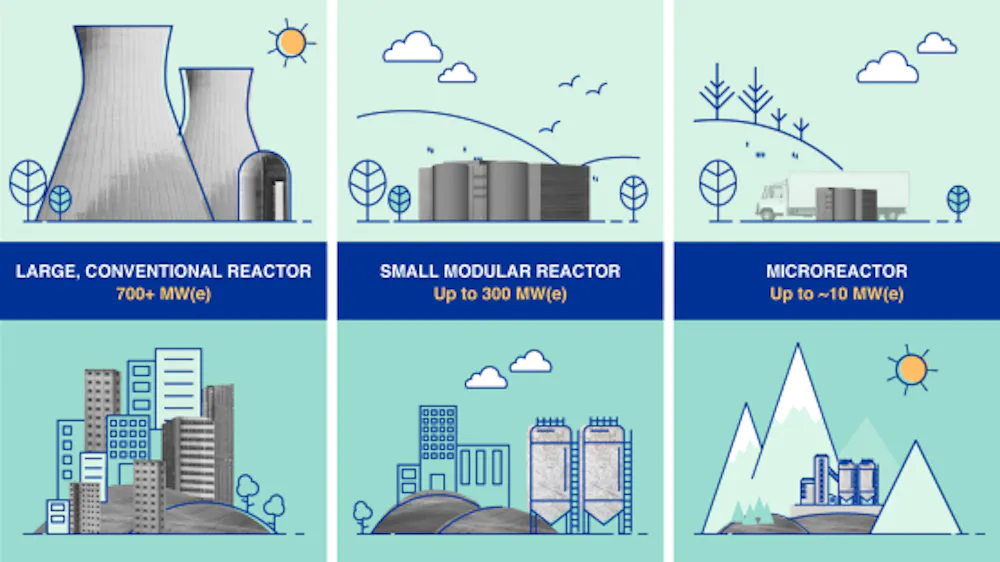
The discussion around powering AI data centers, in particular, has involved a type of nuclear power plant called a small modular reactor. According to the International Atomic Energy Agency, there are about 70 different designs being researched and developed around the world, including reactors that could one day serve small or remote communities, military applications and even ships at sea or spacecraft.

Proponents say these reactor designs provide consistent power without climate-changing carbon emissions. They can also be located close to places that need their energy, reducing dependence on the electricity grid. They are still years from being commercially available: Demonstration projects may begin construction before 2030, with commercial ones reaching operation perhaps by the mid-2030s. And there is not yet a plan from the U.S. Department of Energy to handle the radioactive waste they would generate.

I am an engineer whose work focuses on the nuclear industry, including waste handling and decommissioning of nuclear reactors. Here’s what this type of reactor is, how it works and what it can do:

A diagram showing three types of reactors – large, conventional reactors, labeled '700+MW(e)', small modular reactors, labeled 300+MW(e), and microreactors, labeled 'up to 10 MW(e)'
Small modular reactors, at the top, are in between the other two sizes of reactor, and serve different sizes of communities, at the bottom.
A. Vargas/IAEA

The basics

There are three general sizes of nuclear reactors – only one of which, conventional nuclear plants, has been built commercially. Conventional plants are built in permanent locations on large plots of land around reactor cores as tall as 30 feet (10 meters). They usually generate more than 1,000 megawatts of power, enough to supply 700,000 to 1 million homes.

The other types are still being researched and are considerably smaller. Microreactors have cores that are small enough to fit into the trailer of a semitruck. They can be installed on land about as big as a football field and generate less than 20 megawatts.

Small modular reactors are in between. Their cores are roughly 9 feet (3 meters) across and 18 feet (6 meters) tall. The entire operation occupies an area of about 50 acres and can generate up to 300 megawatts of electricity.

Because of the reactors’ size, they can be built in factories from various components and then be shipped by truck, rail or water to the location where they are assembled.

All the different types of small modular reactors generate heat the same way: by splitting heavy atoms and capturing the heat into a variety of materials – like water, liquid metal or molten salt – that circulate through water to generate steam that drives a turbine.

They are also designed with safety features to reduce the risk and severity of accidents that might release radiation or radioactive material into the surroundings. For instance, passive systems and those based on fundamental principles like gravity can terminate nuclear reactions before they reach levels where explosions or leaks might occur. These reactors also produce less heat and have far smaller amounts of nuclear material than traditional large reactors, which can reduce the radioactivity risk as well.

A large green item is on a pier next to a ship and a crane.
The green-wrapped core module of a small nuclear reactor is readied for transfer to a ship.
Liu Xuan/VCG via Getty Images

Construction and deployment

Small modular reactors are well-suited to provide electricity in remote places or regions without a large power grid – places where large nuclear power plants are impractical.

Their compact design and flexible placements make them ideal for small geographical regions or industrial installations, like desalination plants, or in countries just starting to develop nuclear power.

They can be built and put into operation within two or three years – more quickly than the decade or longer it can take to secure permits and construction of standard nuclear power plants and complete construction of a large nuclear plant.

There remains a range of technical challenges before small modular reactors can actually be built and put into use. These include relatively straightforward questions like how many people are needed to operate each reactor, and more complex decisions about refinements to safety regulations, both in the U.S. and internationally. It’s also not yet clear what the best way is to manage the transport of radioactive materials, especially for reactors that use coolants other than water, which could produce new forms of radioactive waste.

Understanding the fuel

Larger nuclear power plants use fuel that is about 5% uranium-235, the element that splits in a nuclear reaction, releasing heat. But many small modular reactor designs use a different fuel, with between 5% and 20% uranium-235.

This different fuel, called “high-assay low-enriched uranium,” lets the reactors generate more electricity from a smaller volume of fuel material. And though it contains significantly more uranium than standard nuclear fuel, it remains far below the concentration of 90% uranium-235 that is used in nuclear weapons.

The more concentrated fuel also allows reactors to run longer between refueling and reduces the amount of radioactive waste that remains after the fuel is spent.

A person stands in front of a complicated piece of machinery.
An engineer at a French research center works on equipment as part of efforts to develop a small modular reactor.
Nicolas Tucat/AFP via Getty Images

US efforts

The U.S. Department of Energy is working to develop domestic manufacturing of this type of uranium for small modular reactors, to avoid being dependent on foreign sources.

Under a government contract, a Maryland-headquartered nuclear fuel company called Centrus Energy has produced nearly 1 ton (920 kilograms) of that fuel since 2023 under a contract estimated to cost taxpayers US$120 million. In mid-2025, Centrus received a $110 million contract extension to produce that amount again by the middle of 2026.

The Department of Energy is distributing the fuel Centrus has made to five companies for demonstrations and development projects.

Managing waste

All nuclear plants require safe handling of the fuel and the resulting waste. There is no permanent place to store nuclear waste in the U.S. Most nuclear waste is stored on the land around the reactors where it was generated.

The Department of Energy says it is trying to find a place to temporarily store waste from small modular reactors, but that process has been tied up in the courts for years and may not be resolved anytime soon.

Other industrial uses

In addition to delivering electricity, small modular reactors can also directly generate large amounts of heat.

That can be useful for desalination plants, which use both electricity and heat to convert seawater into fresh water for drinking and irrigation. Remote mining operations also often need both heat and power to operate equipment, ensure living quarters are habitable and process minerals.

Small modular reactors may also be useful on university campuses. A microreactor planned for the University of Illinois will provide power and steam to campus buildings, while also teaching students how to operate nuclear plants, and offer research and demonstration opportunities for more reactor improvements in the future.

The Conversation

Leonel Lagos does not work for, consult, own shares in or receive funding from any company or organization that would benefit from this article, and has disclosed no relevant affiliations beyond their academic appointment.

ref. What are small modular reactors, a new type of nuclear power plant sought to feed AI’s energy demand? – https://theconversation.com/what-are-small-modular-reactors-a-new-type-of-nuclear-power-plant-sought-to-feed-ais-energy-demand-268628