A veces me dan envidia los padres y madres de la generación Z (nacidos entre 1997 y 2012). La mayoría todavía ni siquiera lo son. Pero pienso que cuando lo sean, tendrán algunas ideas mucho más claras que las generaciones anteriores en cuanto al papel de la tecnología en la vida de sus hijos. No serán los conejillos de Indias a quienes determinadas innovaciones tecnológicas como el teléfono móvil inteligente y las redes sociales pillaron desprevenidos cuando sus hijos eran adolescente o preadolescentes.
Otras veces, paseando por un parque, veo a una bebé en su carrito con el móvil en las manos, mirando unos dibujos en lugar de los árboles, las nubes y la gente; o en el autobús, un niño de apenas dos años pide más y más vídeos de la tablet a sus padres… y dudo.
Mucho antes de ser yo madre, en el año 1995, se estrenó una película de animación como ninguna otra: Toy Story. Como su título indica, es una historia de juguetes. Juguetes que cobran vida y se enfrentan a desafíos existenciales, en otras palabras, a la muerte. La muerte para un juguete, claro: que ningún niño juegue con él. Con cada nueva entrega (van cuatro), el enemigo ha cambiado de forma. La amenaza de ser relegados al olvido llega en forma de un juguete más moderno, con luces y voces; un vecino malévolo que disfruta destruyéndolos o, sencillamente, el paso del tiempo: el terror de pasar a una caja en el desván cuando su dueño se va a la universidad.
La semana que viene se estrena su quinta entrega y ya sabemos dos cosas importantes sobre ella: que la canción original es de Taylor Swift y que esta vez el enemigo de los juguetes es… una pantalla. Más allá de la ironía (al final, Toy Story no deja de ser una película, es decir, algo a lo que también nos referimos cuando hablamos de niños y pantallas), tiene todo el sentido en el contexto de la historia que los juguetes estén aterrados con la llegada de una tablet. Ningún “enemigo” tiene el mismo poder de persuasión; cuando las pantallas interactivas entran en el cuarto infantil, el juego se transforma, a veces para siempre.
El cerebro humano se desarrolla en íntima interacción, a través de todos los sentidos, con el mundo que lo rodea. Por supuesto, con los demás humanos, con el resto de seres vivos y, muy especialmente, con los objetos. Su textura, su temperatura, su peso, su sonido, su sabor, su forma… toda esta información ayuda a crear conexiones neuronales, a crecer y aprender. Por eso en los primeros meses de vida podemos considerar “juguete” casi cualquier objeto de tamaño mediano y sin aristas o pinchos. Algo que manipular con seguridad, y con lo que explorar y desarrollar la mente. La pedagoga Elinor Goldschmied hablaba, con propiedad, de “cesta de los tesoros”, y es muy fácil de preparar en cualquier hogar.
Y es que entretener a los niños es un ejercicio minimalista más que acumulativo: unos minutos de atención completa, una tarea doméstica compartida, nutren más que grandes planes y actividades excesivamente estructuradas. Esto no quiere decir que no sea un plan excelente ir a ver Toy Story 5. Y ojalá su mensaje “cale” entre niños y adultos. Quizá, que una pantalla interactiva sea el malo de la película tenga un impacto positivo mucho más allá del cine.
La FIFA, l’instance dirigeante du football mondial, présente la Coupe du monde 2026 – et le football mondial en général – comme une célébration de l’inclusion et de la diversité. Elle est présentée comme un symbole de paix et d’espoir, voire comme une forme de salut pour les migrants africains qui périssent en tentant de traverser la Méditerranée.
Cette posture humanitaire ne doit pas nous faire oublier l’existence d’une classe mondiale de migrants en situation précaire. Beaucoup viennent d’Afrique de l’Ouest et rejoignent l’Europe (et d’autres régions du monde) par divers moyens, avec le rêve de gagner leur vie en jouant au football. Comme l’ont montré de nombreuses études, beaucoup se retrouvent bloqués en tant que migrants en situation irrégulière, manipulés par des agents malhonnêtes ou exploités par des clubs de football.
Malgré des recherches nuancées menées sur ce sujet depuis longtemps, les migrants ouest-africains du football font encore régulièrement la une des journaux pour des raisons plus sensationnelles. Ils sont présentés soit comme des victimes de la traite des êtres humains, soit comme des joueurs exceptionnels dans le football de haut niveau.
Le trafic des êtres humains lié au football existe bel et bien. Ce phénomène a été expliqué en détail par des chercheurs et par des journalistes d’investigation. Mais réduire les migrants à des victimes ou à des stars ne reflète pas leur réalité, leurs ambitions et les défis auxquels ils sont confrontés. Ils contribuent à transformer l’Europe et son football.
J’ai passé plus d’une décennie à mener des recherches anthropologiques sur les migrations liées au football de l’Afrique de l’Ouest vers l’Europe. Plus récemment, j’ai interviewé des migrants en Belgique et en Europe de l’Est, en m’appuyant sur mes travaux antérieurs auprès de joueurs en herbe dans l’Ouest du Cameroun.
J’ai constaté qu’entre les gros titres alarmistes et les récits héroïques se cache une autre réalité : celle de migrants ambitieux et résilients qui évoluent dans la précarité et dans une industrie guidée par le profit, dans un contexte de politiques violentes de fermeture des frontières.
Rêves de football
Une récente enquête menée par des chercheurs en migration en Afrique de l’Ouest a demandé à des jeunes (18-39 ans) quel était leur rêve le plus important dans la vie. Au Ghana, 13 % des jeunes hommes ont répondu que c’était de devenir footballeur professionnel. En Gambie, ce chiffre était de 10 %.
Ces pourcentages sont très élevés, et seraient probablement bien plus élevés si l’enquête avait été menée auprès d’une population plus jeune (par exemple les 15-30 ans). Ils sont particulièrement frappants quand on considère que très peu d’aspirants ont une chance réaliste de « percer » en tant que professionnels.
Les opportunités dans les ligues nationales d’Afrique de l’Ouest sont limitées, incertaines et souvent peu rémunérées. Rêver d’une carrière dans le football, c’est presque rêver de partir à l’étranger.
Jouer et s’entraîner au football est devenu l’un des moyens les plus prisés par les jeunes hommes pour tenter d’émigrer, de gagner leur vie et de subvenir aux besoins de leur famille. L’Europe reste la destination privilégiée des aspirants footballeurs, même s’ils tentent parfois leur chance ailleurs.
Migrer par tous les moyens
Des jeunes hommes originaires de pays comme le Ghana, la Gambie, la Côte d’Ivoire et le Nigeria se rendent en Europe par tous les moyens possibles. Bon nombre de ces itinéraires n’ont pas grand-chose à voir avec les transferts officiels de joueurs entre clubs.
Un jeune footballeur ghanéen en herbe que j’ai rencontré en 2024 en Belgique, par exemple, est arrivé en Europe par bateau. Il s’agissait d’un itinéraire clandestin, via la Libye et l’Italie, que certains de ses amis gambiens appelaient « la voie détournée ».
Ce n’est qu’après son arrivée en Europe qu’il a commencé à chercher des opportunités dans des clubs de divisions inférieures. Il vivait avec son père et son frère en Belgique tout en faisant une demande de permis de séjour au titre du regroupement familial.
Tous ne prennent pas une route dangereuse. Mais une grande partie de la migration liée au football se déroule de manière informelle, par l’intermédiaire de personnes informelles et de membres de la famille vivant déjà à l’étranger. Les transferts officiellement reconnus sont réservés aux plus talentueux – et aux plus chanceux.
Les footballeurs avec lesquels j’ai travaillé appellent parfois cela un “système D”. Ce terme est également utilisé de manière plus générale en Afrique de l’Ouest pour désigner l’art de se débrouiller pour gagner sa vie dans une économie informelle souple mais aléatoire.
Pour les migrants en devenir, cela signifie trouver des moyens de se déplacer et de naviguer dans un contexte transnational où les demandes de visa sont systématiquement rejetées et où les voies de migration régulières sont difficiles à trouver.
Une prison dorée
Ce système D peut être excitant et gratifiant, mais aussi incroyablement dur et épuisant. L’un des participants à mes recherches était un Ivoirien qui s’est retrouvé bloqué en Belgique en tant que migrant en situation irrégulière après avoir été mal géré par un agent cupide. Il décrivait sa situation comme une « prison dorée ». Dorée en raison de la perspective d’une brillante carrière en Europe, et prison en raison de son statut irrégulier qui le laissait dans la peur et confiné dans une petite chambre.
Quand je demandais à des jeunes hommes comme lui pourquoi ils restaient en Europe après avoir échoué à signer un contrat professionnel, ils répondaient qu’ils devaient continuer à se battre. Qu’ils étaient conscients qu’ils n’auraient peut-être plus jamais une autre occasion de quitter l’Afrique, que ce soit pour le football ou pour autre chose. En d’autres termes, des politiques migratoires restrictives limitaient leur liberté de mouvement. Elles les poussaient vers des itinéraires irréguliers et les marges de la société.
Les autorités ciblent souvent les agents véreux et les trafiquants pour lutter contre ce problème. Mais ces individus ne sont qu’une partie d’un ensemble de problèmes plus vastes.
J’ai également suivi et interviewé des intermédiaires du football : agents, entraîneurs et propriétaires de clubs qui cherchent à organiser et à contrôler la mobilité des footballeurs. J’ai découvert qu’ils étaient motivés à la fois par le profit et par un désir sincère d’aider ces jeunes hommes à réaliser leurs rêves.
Lorsque je leur ai demandé pourquoi ils se lançaient dans des transactions incertaines (et parfois louches) et changeaient fréquemment leurs plans, ils m’ont expliqué qu’ils devaient répondre aux exigences en constante évolution du marché mondial. Les courtiers étaient des entrepreneurs pris dans leur propre système D : le business mondial spéculatif et imprévisible des transferts dans le football mondial.
Enfin, lorsque j’ai interrogé les footballeurs sur les raisons de leur voyage initial, ils répondaient que les opportunités économiques pour les jeunes en Afrique de l’Ouest ne pouvaient se comparer à celles que l’on trouve à l’étranger, dans le football comme dans d’autres domaines. L’une des principales raisons qui poussent ces jeunes hommes vers des horizons plus prometteurs réside dans les inégalités entre le Nord et le Sud.
Inégalités systémiques
Des problèmes tels que le capitalisme spéculatif, les politiques migratoires violentes, les inégalités mondiales et un racisme à la fois manifeste et dissimulé – sont structurels et profondément enracinés. Ils ne se limitent pas aux migrations liées au football.
Ces problèmes ne seront pas résolus simplement en traquant les agents malhonnêtes. Les étiquettes utilisées sans nuance de «trafic d’êtres humains» et de «commerce d’esclaves» peuvent en effet masquer les problèmes courants rencontrés par la majorité des migrants. Elles occultent les inégalités sous-jacentes qui rendent leur parcours précaire.
Les récits des migrants du football présentés dans mon étude ne reflètent pas tant les cas de traite moderne qui font la une des journaux, ni les récits triomphants sur la diversité et l’inclusion. Ils révèlent une réalité bien plus courante : celle de l’ambition et de la résilience dans un monde inégalitaire et injuste.
Uroš Kovač bénéficie d’un financement de l’Agence exécutive européenne pour la recherche dans le cadre de la convention de subvention n° 101106831 pour un projet intitulé « Two-Faced Hopes : Football, Migration, and Religion Between West Africa and Europe (JANUSHOPE) ».
Le 26 avril 2026, le Kényan Sabastian Sawe est passé sous la barre symbolique des deux heures lors du marathon de Londres : 1 heure, 59 minutes et 30 secondes. Sawe s’inscrit dans la lignée des coureurs qui, à quelques kilomètres de la frontière avec l’Ouganda, foulent chaque jour les pistes d’Iten, dans la vallée du Grand Rift. Si cette terre est aujourd’hui kényane, elle ne l’a pas toujours été et reste marquée par une histoire difficile, où il est notamment question des sources du Nil, d’un train lunatique, d’attaques léonines et de crimes coloniaux.
Ils proviennent des hauts plateaux de la vallée du Grand Rift, dans l’ouest du Kenya, plus précisément des comtés de Nandi, Kericho, Kisumu, Uasin Gishu ou Elgeyo-Marakwet. Pour la plupart d’entre eux, ils sont kalendjins, issus des groupes Nandi, Keiyo ou Kipsigi.
Tous ont en commun d’avoir assidûment fréquenté les fameuses pistes rouges de latérite (un minerai volcanique, riche en oxyde de fer) d’Iten, Eldoret, Kaptagat ou Kapsabet, à près de 2500 m d’altitude. On dit qu’en ces lieux « l’air se raréfie ».
En réalité, la pression atmosphérique y étant diminuée, l’apport en oxygène à l’effort se trouve lui aussi réduit. Physiologiquement, l’entraînement bi (voire tri) quotidien – alternant fractionnés courts ou longs, récupération et sorties longues – vise à optimiser ces apports en améliorant la production de globules rouges, le transport d’oxygène vers les muscles et, plus globalement, l’endurance aérobie (décisive sur longue distance). Cela explique que les marathoniens d’élite s’y entraînent et que fleurissent autour d’Iten, « capitale mondiale du marathon », nombre de training camps offrant des prestations hôtelières à des coureurs venus du monde entier.
Cette terre fertile, bénie des dieux de l’athlétisme, fait aujourd’hui la fierté et la richesse du Kenya. Le thé, le café, les légumes et les roses y poussent aussi volontiers que germent les graines de champions. Mais beaucoup ignorent qu’elle aurait pu être placée sous souveraineté ougandaise au moment des indépendances de 1962 et 1963. Pour le comprendre, une brève mise en perspective historico-juridique s’impose.
Le contrôle du Nil par le colon britannique
La conférence de Berlin s’est ouverte le 15 novembre 1884, à l’initiative du chancelier Otto von Bismarck, avant de se clore le 26 février 1885. Cet accord politique entre États européens constitue la base d’un vaste processus de colonisation, de peuplement et de spoliation des ressources.
À cette époque, les Britanniques contrôlent le delta du Nil, depuis la mise en place d’un protectorat de facto sur l’Égypte, sous la responsabilité du consul général Evelyn Baring, Comte de Cromer.
Mais leur expansion sur le Haut-Nil est stoppée lors de la guerre des mahdistes (1881-1899) (du nom de Muhammad Ahmad, le mahdi ou « sauveur », qui dirige la révolte soudanaise contre les forces anglo-égyptiennes). Le 26 janvier 1885, les mahdistes prennent Khartoum, épisode durant lequel le général britannique Charles George Gordon trouve la mort. Dix ans plus tard, en 1896, le général Horatio Herbert Kitchener revient, l’esprit revanchard, reprend Khartoum au successeur du mahdi (Abdullah al-Taashi) et met fin à son règne lors de la fameuse bataille d’Omdourman, le 2 septembre 1898, sous les yeux du jeune Winston Churchill alors officier de cavalerie. C’est grâce à la construction de la ligne ferroviaire entre Wadi Halfa et Abu Hamed («Kitchener’s Railway», 1896-1897) que la victoire britannique fut acquise.
Ce tableau peint par William Barnes Wollen en 1899 représente la charge du 21ᵉ régiment des lanciers britanniques lors de la bataille d’Omdourman (2 septembre 1898). Wikimédia
La crise de Fachoda, dans le sud du Soudan – déclenchée par la présence des troupes françaises du commandant Jean-Baptiste Marchand – n’y fera rien : les Britanniques contrôleront durablement le Nil unique, entre Khartoum et le delta.
Mais qu’en était-il de ses sources, les lacs Tana et Victoria, qui donnent respectivement naissance au Nil bleu et au Nil blanc ?
Pour ce qui concerne la source du Nil blanc, en revanche, la logique fut celle de la colonisation via l’instauration des protectorats d’Ouganda et d’Afrique orientale britannique (qui deviendra le Kenya).
Les protectorats britanniques et le « Lunatic Express »
Au XIXe siècle, le sultanat de Zanzibar contrôlait le Zanguebar, bande côtière entre la Somalie et le Mozambique actuels. Des missionnaires européens s’étaient implantés entre le fleuve Tana et Mombasa (sur la future côte kényane).
Au lendemain de la conférence de Berlin, les Britanniques ont obtenu un prolongement de leur sphère d’influence dans les terres, jusqu’aux lacs Rodolphe (actuel lac Turkana) au nord, Albert/Kivu à l’est et Victoria au sud-est. Au sud-ouest, l’Allemagne avait pris possession, quant à elle, de l’Afrique orientale (actuels Burundi, Rwanda et Tanzanie).
Dans ce contexte, la Compagnie britannique impériale d’Afrique de l’Est (Imperial British East Africa Company), chargée de développer le commerce (de l’ivoire, notamment) dans les zones sous contrôle de la Couronne, étendait son activité sur près de 640 000 kilomètres carrés, soit plus des trois quarts des territoires actuels de l’Ouganda et du Kenya.
Mais la Compagnie affrontait une difficulté de taille : l’acheminement. L’ivoire, acheté aux chefs locaux du royaume de Buganda (sur la rive ougandaise du lac Victoria), était alors préférablement dirigé – dans les conditions inhumaines du système esclavagiste du portage – vers le port de Bagamoyo (« Ici, mon cœur défaille », en swahili). La capitale de l’Afrique orientale allemande disposait, en effet, d’infrastructures portuaires légères et d’un accès privilégié à Zanzibar.
Face à cette concurrence, les Britanniques entendirent reprendre la main en liquidant la Compagnie et en instaurant les protectorats d’Ouganda (en 1894) et d’Afrique orientale britannique (l’actuel Kenya, en 1895).
Ces territoires dépendaient du Colonial Office et étaient soumis à deux régimes différents d’administration : l’Indirect Rule (gouvernement indirect) et le Direct Rule (gouvernement direct).
Le protectorat d’Ouganda englobait des royaumes précoloniaux structurés (principalement le Buganda, du peuple baganda) et était administré selon l’Indirect Rule. Un commissaire représentait la Couronne britannique et intervenait peu dans les affaires foncières. Celles-ci relevaient, en vertu de l’accord du 10 mars 1900, du kabaka (le roi), assisté par le lukiko (l’assemblée du Buganda). Le contrôle colonial se cantonnait à la collecte des impôts de capitation (Hut Tax) et à l’administration de la justice, assurées par un colon britannique à la tête d’un saza (un comté) ou d’un gombola (un sous-comté). En somme, il s’agissait certes d’un régime colonial, mais une (relative) autonomie était garantie localement.
Le protectorat d’Afrique orientale britannique était, lui, une colonie de peuplement, administrée directement – selon le Direct Rule – par la Couronne. Le commissaire concentrait l’essentiel des pouvoirs et était assisté par un conseil exécutif exclusivement européen. Le conseil législatif, à la composition similaire, votait les lois et le budget. Contrairement à l’Ouganda, les colons de l’Afrique orientale ne s’appuyaient pas sur des royaumes préexistants. Ils nommaient des District Commissioners sans légitimité, enclins à réserver les meilleures terres aux européens et à pérenniser le travail forcé.
Lors de l’instauration de ces deux protectorats, l’Ouganda oriental (correspondant à la région des hauts plateaux du Grand Rift entre les lacs Victoria et Rodolphe, où se trouvent Kisumu, Eldoret ou Iten) faisait partie intégrante du protectorat d’Ouganda et était donc placé sous la responsabilité des autorités locales, sous administration coloniale indirecte. C’est dans ce contexte que fut inauguré, en 1896, le nouveau port de Kilindini à Mombasa (sur l’actuelle côte kényane), dont la structure en eaux profondes permettait d’accueillir de grands navires à vapeur. L’activité du port de Bagamoyo (qui avait perdu son statut de capitale de l’Afrique orientale allemande en 1891 au profit de Dar es-Salaam) n’a alors cessé de péricliter.
Mais c’est surtout la mise en place du chemin de fer ougandais, reliant Mombasa à Kampala (capitale actuelle de l’Ouganda) via Kisumu et le lac Victoria, qui a imposé durablement la suprématie commerciale britannique dans la zone.
La construction de cette ligne de 930 kilomètres, débutée en mai 1896, s’est achevée en 1901. Ce projet – dramatique d’un point de vue humain (l’épisode des attaques de lions à Tsavo, en 1898, a coûté la vie à des dizaines d’ouvriers) – a mobilisé une main-d’œuvre locale ainsi que 32 000 travailleurs migrants indiens, tous travaillant dans des conditions sanitaires déplorables. Il a nécessité l’édification de viaducs et d’un dépôt ferroviaire dans le marais d’Enkare Nyrobi (« Lieu de l’eau fraîche », en langue maa), site qui deviendra Nairobi. Le député de Northampton Henry Du Pré Labouchère baptisa alors ironiquement cet ouvrage titanesque, qui coûta environ 5 millions de livres sterling, « Lunatic Express ».
Le chemin de fer ougandais (Lunatic Express) reliait le port de Mombasa à Kisumu (anciennement Port Florence) en quelques dizaines d’heures contre plusieurs semaines à pieds. Wikimedia
Les mutations territoriales et l’« uti possidetis juris »
Le chantier du Lunatic Express terminé, le colon britannique entendit prendre le contrôle total du territoire. Pour ce faire, un Uganda Order in Council – signé par le roi Édouard VII, le 11 août 1902 – a transféré l’Ouganda oriental (avec Kisumu, Eldoret ou Iten) du protectorat d’Ouganda à celui d’Afrique orientale britannique.
La frontière entre les deux, qui embrassait l’escarpement de Naivasha, était déplacée vers l’ouest, entre la rive orientale du lac Victoria et le mont Elgon. La région échappait ainsi au contrôle foncier des royaumes locaux pour relever directement des autorités coloniales britanniques.
Les hauts plateaux du Grand Rift étaient situés dans l’Ouganda oriental, passé en 1902 de l’administration indirecte (Indirect Rule) à l’administration directe (Direct Rule) de la Couronne britannique. (Cliquer pour zoomer.) Wikimedia
Charles Eliot, alors commissaire du protectorat d’Afrique orientale britannique, avait été un farouche opposant au Lunatic Express et voyait dans la colonisation de peuplement une possibilité d’en amortir les frais. Défenseur d’une doctrine raciste et suprématiste, Eliot s’est inspiré des recommandations de Harry Johnston (son homologue du protectorat d’Ouganda) et a appuyé les politiques d’accaparement des terres et de peuplement des plateaux fertiles en octroyant aux colons européens (parfois des Boers du Transvaal sud-africain) des concessions terrestres à loyers modiques.
Côté ougandais, le protectorat britannique ne reposait pas sur le peuplement. Aussi, l’indépendance acquise le 9 octobre 1962 a surtout été marquée par des tensions internes entre le Congrès du peuple ougandais de Milton Obote et le kabaka de Buganda, Muteesa II (ce dernier sera déposé en 1966 par Obote avec la complicité de son chef d’état-major Idi Amin Dada, futur despote qui massacrera sa population et expulsera par milliers les descendants d’ouvriers indiens venus participer au chantier du Lunatic Express).
Côté kényan, le protectorat d’Afrique orientale britannique sera remplacé par celui du Kenya en 1920, avant qu’un soulèvement populaire contre l’accaparement des terres (la fameuse révolte des Mau-Mau, lancée en 1952 et menée par le peuple kikuyu) ne précipite les conférences de Lancaster House qui aboutiront à l’indépendance, le 12 décembre 1963.
Si cette prétendue fonction pacificatrice est loin d’avoir fait son œuvre partout, la frontière ougando-kényane s’est effectivement imposée sur la base de textes coloniaux : l’Uganda Order in Council (précité) de 1902 (qui transfère les hauts plateaux de la vallée du Grand Rift du protectorat d’Ouganda à celui d’Afrique orientale britannique), le Kenya Colony and Protectorate (Boundaries) Order in Council de 1921 (qui délimite plus précisément les frontières du protectorat du Kenya) et celui de 1926 (qui rattache le pays Turkana, jusqu’alors partie nord du protectorat d’Ouganda, au protectorat du Kenya).
Les indépendances de 1962 et 1963 ont, ce faisant, définitivement consolidé l’appartenance des hauts plateaux de la vallée du Grand Rift – et d’Iten, « capitale mondiale du marathon » – au Kenya.
Iten, « Home of Champions », attire chaque année des marathoniens professionnels ou amateurs du monde entier. R. Colavitti, Fourni par l’auteur
Le rayonnement planétaire des coureurs de la région est une bien futile satisfaction face aux tragiques décennies de la colonisation. L’ironie de l’histoire veut qu’un coureur kényan soit le premier à avoir officiellement franchi la barre fatidique des deux heures au marathon de Londres, capitale de l’ancienne puissance coloniale. Mais le règne de Sawe et de ses compatriotes reste précaire : n’oublions pas que le champion ougandais, Jacob Kiplimo (originaire du district de Kween, à la frontière, et entraîné sur les pentes ougandaises du mont Elgon) est à l’affût ; que l’éthiopien Yomif Kejelcha est le deuxième marathonien de l’histoire à être passé sous la barre des deux heures (record homologué), également à Londres (en 1 heure 59 minutes et 41 secondes) ; et que sa compatriote Tigst Assefa est, depuis le même jour, nouvelle détentrice du record du monde pour une épreuve féminine sur cette distance (en 2 heures 15 minutes et 41 secondes). La course au record n’est pas près de s’arrêter ; avec elle, grandit l’exigence d’un marathon éthique également libéré de toute suspicion de dopage.
Romélien Colavitti est assesseur à la Cour nationale du droit d’asile. Les propos tenus dans cet article sont personnels et n’engagent pas l’institution
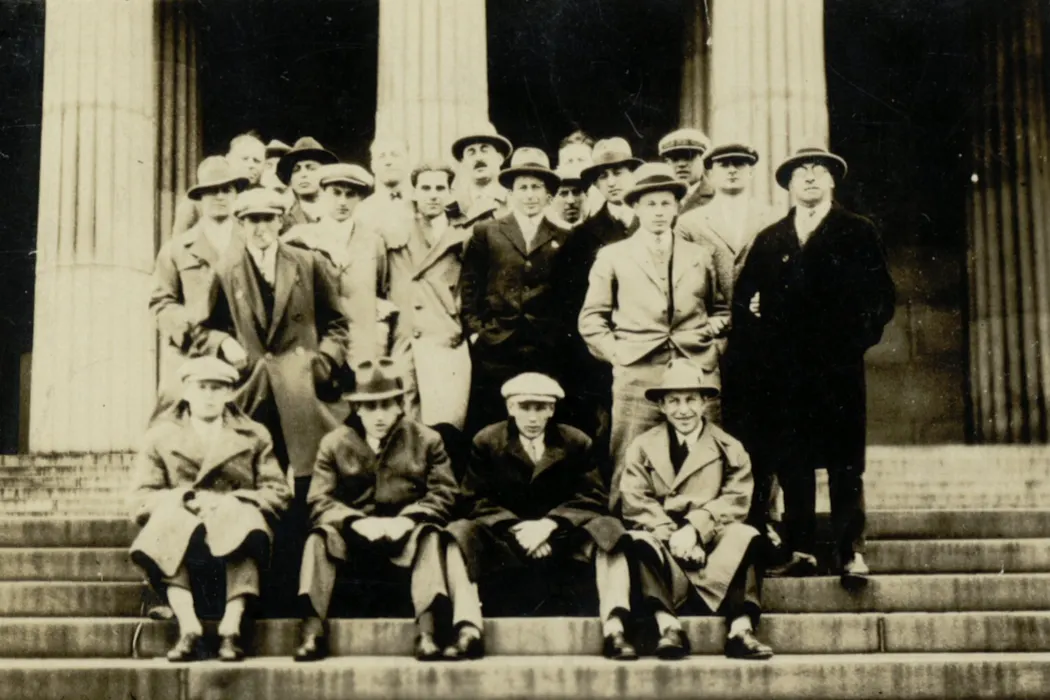
L’équipe de l’Hakoah de Vienne en 1927 lors de sa tournée aux États-Unis à la suite de quoi une Hakoah américaine sera créée à New York, obligeant les exilés à appeler leur club Hakoah Amateur Club pour s’en différencier. https://sammlung.jmw.at/
Après l’Anschluss de 1938, des Viennois réfugiés à New York recréent l’Hakoah, célèbre club sportif juif et sioniste dissous par les nazis, afin de préserver leurs réseaux de solidarité et leur identité collective en exil. Le club prolonge l’idéal du Muskeljudentum (« judaïsme du muscle »), qui entend répondre à l’antisémitisme par la valorisation d’un corps juif fort et fier, tout en maintenant un engagement culturel et politique hérité de l’Europe centrale. Dans le même temps, la pratique du football et la participation à la vie associative locale favorisent l’intégration de ces exilés au melting-pot états-unien, jusqu’à ce que leurs descendants s’éloignent progressivement de cet héritage.
En 1940, des exilés juifs de Vienne recréent à New York leur club de sport, l’Hakoah (« force » en hébreu). Son équipe de football est entrée dans la légende en 1925 : l’équipe, juive et sioniste, est sacrée championne d’Autriche, pays marqué par un fort antisémitisme. En 1938, l’Hakoah est dissoute par les nazis. Recréer ce club de l’autre côté de l’Atlantique, c’est à la fois retrouver ses marques dans un environnement étranger et perpétuer un mouvement qui porte un combat politique juif sur les terrains de sport alors que l’extermination des Juifs d’Europe est en cours. Dans le même temps, jouer au soccer à New York permet de s’intégrer au melting-pot états-unien.
Personne n’a encore écrit l’histoire de l’Hakoah de New York, qui n’a pas de fonds d’archive propre. Je m’appuie donc dans mes recherches sur la presse des exilés germanophones à New York, et sur deux livres publiés à l’occasion des 35ᵉ et 50ᵉ anniversaires du club historique. Le premier est publié par le club de New York en 1945, et le second à Tel-Aviv en 1959 et accompagné en 1961 d’un supplément et d’un carnet avec les adresses de tous les Hakoahner encore en vie.
Un club en exil
On estime que l’annexion de l’Autriche par l’Allemagne nazie en mars 1938 a poussé à l’exil 130 000 juifs autrichiens, dont 30 000 arrivent aux États-Unis. Il leur faut dès lors s’adapter à un environnement social, culturel et linguistique étranger, faire face à la perte de leur statut social, de leurs amis, voire de leur famille. Dans ce contexte naissent des associations et des clubs de sport, qui leur permettent de s’entraider et de recréer du lien avec des gens qui partagent leur vécu et leur langue.
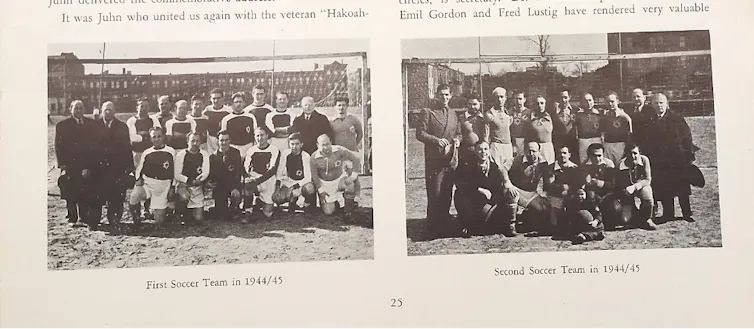
Deux équipes de l’Haokah de New York en 1944/1945. « 35 years of the Hakoah », New York, 1945, p. 25.
L’Hakoah propose à ses membres, dont on peut imaginer que ce sont essentiellement d’anciens membres du club viennois, des cours de tennis, de natation, et des cours de gymnastique réservés aux femmes. Les horaires et lieux d’entraînement sont publiés dans le journal Aufbau (« Reconstruction »). Évidemment, la section football est représentée. Elle joue en amateur dans l’Eastern District League avec trois équipes masculines et compte 65 membres, dont 22 ont moins de 18 ans en 1945.
Un tableau de résultats de l’Eastern District Soccer League (EDSL). « Aufbau », 30 avril 1943, p. 23.
Mais l’Hakoah, comme les autres clubs de sport d’exilés juifs germanophones, le Prospect Unity Club ou le New World Club, joue un rôle beaucoup plus structurant dans leur vie sociale. Il organise des bals, héberge des cabarets, comme Die Arche, le cabaret sioniste que j’étudie dans ma thèse.
Par-delà les activités qu’il propose, le club semble être un réel repère dans la reconstruction de la vie sociale des exilés. La publicité pour le café de Joschy Gruenfeld (parfois orthograpgié Grünfeld), elle aussi publiée dans Aufbau, met ainsi en avant le fait que ce dernier est un ancien joueur de l’Hakoah de Vienne.
Publicité pour le café de Joschy Gruenfeld. « Aubau », 7 janvier 1944, p. 12.
L’Hakoah de New York est donc une affaire de liens, célébrés en 1960 dans un poème de Pourim, dépeignant une réunion des membres à l’occasion de cette fête religieuse au restaurant de Joschy Gruenfeld.
« Chez Joschy Grünfeld, aujourd’hui il y a un meeting ;
De près et de loin, ils sont tous venus,
De ce bastion du sport la vieille garde,
Les combattants et les amis de l’« Hakoah »…
Regardez-les, ces vieux garçons,
Avec leurs jeunes épouses ;
Ils ont perdu leurs cheveux noirs et touffus,
Aujourd’hui, ils sont plutôt « rabou-gris ».
Les voici réunis – toutes les sections sont représentées
Ils ont fui Hitler jusqu’aux États-Unis
Pourtant, ne les comptez pas, ces têtes aimées ;
Les meilleurs manquent – ils ne sont plus là.
Mais aujourd’hui, nous voulons célébrer Pourim,
Et chasser au loin ces sombres pensées ;
Les Hakoahner ont toujours été prompts à rire,
Alors, cette tradition, laissez-nous la perpétuer. »
L’Hakoah et le sionisme
À Vienne, l’Hakoah, au maillot bleu et blanc arborant l’étoile de David, est un club sioniste, dans un contexte où les clubs sportifs ont des identités politiques très marquées. Sport et politique font en effet bon ménage dans la première moitié du XXᵉ siècle. Mais le sionisme l’investit d’une manière qui lui est propre à travers le concept de Muskeljudentum, « judaïsme du muscle », théorisé par le penseur Max Nordau en 1898.
Il s’agit de prendre le contre-pied des discours antisémites (et sexistes) sur les hommes juifs, qui seraient faibles et efféminés. Cultiver un corps fort et fier, celui d’un « nouvel homme juif », et se confronter aux corps « aryens », c’est donc prouver la vacuité des discours antisémites. On comprend là une caractéristique importante du sionisme en Europe centrale avant la Seconde Guerre mondiale : c’est un mouvement nationaliste tourné vers la Palestine, mais dans la pratique, ce sont des organisations locales qui répondent à des enjeux locaux, dont le premier est de faire face à l’antisémitisme.
Le sionisme, en tant que pratique du Muskeljudentum et en tant que projet de création d’un État juif en Palestine, est très présent dans la brochure publiée par l’Hakoah de New York en 1945. Elle est éditée par Heinrich Heinz Glanz, éditeur viennois en exil, proche du sionisme révisionniste de Vladimir Jabotinsky.
En 1945, les révisionnistes prônent l’immigration illégale en Palestine, voire le terrorisme. C’est Glanz qui écrit le premier article de la brochure, qui est de loin l’article le plus politique. Il y prône la légitimité totale de l’établissement d’un État juif à l’aune de l’engagement de brigades juives dans les forces alliées. Sous sa plume, la Seconde Guerre mondiale devient la « German-Jewish war », et la rhétorique états-unienne du combat pour la liberté et la démocratie, le « Jewish fight for liberty ».
Ce qu’il met en avant, ce sont les corps fiers des soldats, qui incarnent le Muskeljudentum, plutôt que les corps morts de la Shoah. Cette manière de contrebalancer la honte que représente le massacre de six millions de juifs par l’image de combattants juifs victorieux sera caractéristique du traitement mémoriel de la Shoah en Israël jusque dans les années 1960.
Toutefois, ce texte a ceci de paradoxal qu’il reste bien loin du terrain. Les membres du club se sont battus en Europe, mais ils ne sont pas appelés à se battre en Palestine. Et si l’on regarde les adresses des membres de l’Hakoah en 1959, on constate que, parmi les membres de l’Hakoah de New York que l’on peut identifier avec la brochure de 1945, seul Paul Fulton, alors vice-président, a émigré des États-Unis vers Israël après 1948.
Une histoire d’intégration états-unienne
Même si les auteurs de la brochure répètent que leur engagement est tendu vers la création d’un État juif, ce document donne plutôt des gages de l’intégration du club et de ses membres à la société états-unienne. Il est rédigé en anglais, patronné par le gouverneur de l’État de New York et s’ouvre sur un Honor Roll des membres du club engagés dans l’armée états-unienne. Malgré la lecture qu’en fait Glanz, cet engagement dans les forces armées est un phénomène très large parmi les exilés, et qui n’est pas forcément politiquement motivé : ils peuvent ainsi accélérer leur naturalisation, et donc parachever leur intégration.
Le club semble donc s’être solidement installé aux États-Unis, et Otto I. Herbst, son président, insiste ainsi sur sa volonté d’y développer le « Jewish sports movment », c’est-à-dire la pratique militante du Muskeljudentum – en somme, de perpétuer la pratique diasporique du sionisme. Pour comprendre les différentes approches de Glanz et de Herbst, il faut toutefois souligner que le premier se place dans la construction d’un argumentaire en vue de la création imminente de l’Organisation des Nations unies (ONU), là où le deuxième exprime son pessimisme quant à la création prochaine d’un État juif. Il part donc du principe que les États-Unis sont le nouveau centre de la vie juive.
Pratiquer le football européen à New York a donc permis à ces exilés de devenir des émigrés dans le melting-pot (dans la limite de la diversité autorisée, bien sûr). En jouant dans l’Eastern District League, ils expriment et mettent en scène une identité nationale parmi d’autres groupes nationaux, également issus de l’immigration. J’entends ici identité nationale au sens central-européen de groupe ethno-culturel.
Le terrain de football devient un lieu de partage d’une double expérience : celle du transfert culturel d’une pratique proprement européenne, que ces émigrés conservent aux États-Unis, et celle d’une nouvelle organisation sociale où l’on appartient à une community et à la nation civique états-unienne. Ils y font aussi l’expérience de la diversité de la communauté juive new-yorkaise, qui, loin de se ranger derrière un seul club, dispose de plusieurs équipes.
Signe de cette intégration réussie : le club ne trouve pas vraiment de relève. En 1959, il prend les allures d’un café où se retrouvent ses membres vieillissants. Pendant ce temps, leurs enfants et petits-enfants jouent au baseball et au football… américain.
Charlotte Carayol ne travaille pas, ne conseille pas, ne possède pas de parts, ne reçoit pas de fonds d’une organisation qui pourrait tirer profit de cet article, et n’a déclaré aucune autre affiliation que son organisme de recherche.
Pendant et après la Première Guerre mondiale, des milliers d’Américaines ont joué le rôle de mères auprès d’orphelins français. Éclairage de cette facette méconnue de l’histoire transatlantique.
Entre août 1914 et avril 1917, malgré la neutralité affichée de leur pays, près de 25 000 Américaines, selon les estimations, traversent l’Atlantique pour soutenir la France dans sa guerre contre l’Allemagne. Ces citoyennes, bien souvent issues de la haute société américaine, pansent les plaies des soldats, réconfortent les civils, appuient les médecins ; une manière, selon elles, de s’opposer à la neutralité officielle de leur pays. À en croire ces femmes, il est du devoir des États-Unis de porter secours à la France, en mémoire de La Fayette, le héros français de la révolution américaine.
Leur participation à l’effort de guerre ainsi que leur implication sur le front occidental leur permettent de revendiquer une citoyenneté pleine et entière. Beaucoup espéraient que leur participation à l’effort de guerre leur permettrait d’obtenir enfin le droit de vote.
Pourquoi s’intéresser à l’histoire des marraines de guerre américaines
En règle générale, les historiens militaires traitent des batailles, des erreurs stratégiques commises par les états-majors et des pertes tandis que les spécialistes d’histoire culturelle analysent les répercussions du conflit sur les communautés civiles. Quant aux spécialistes d’histoire diplomatique, leur travail vise à comprendre la responsabilité des belligérants dans cette catastrophe européenne.
Plutôt que de chercher à comprendre ce qui pousse le président Woodrow Wilson à adopter une stricte neutralité en août 1914, il serait intéressant de dégager une histoire transatlantique des trajectoires individuelles de ces femmes qui ont choisi de participer à l’effort de guerre de la France.
Le Centenaire de la Première Guerre mondiale a permis à une nouvelle génération de chercheurs américains et européens de renouveler considérablement l’historiographie européenne à ce sujet. Cependant, ces études s’intéressent généralement à un pays en particulier et peinent à dégager un angle transnational. Par ailleurs, même lorsque certains chercheurs tentent une approche comparative de différentes sociétés européennes en guerre, la dimension transatlantique manque cruellement.
Entre 1914 et 1921, malgré la neutralité affichée de leur pays, plusieurs centaines d’Américaines choisissent de s’engager dans des missions humanitaires et de secourir des orphelins de guerre français.
En 1915, un groupe de philanthropes américains décide de créer plusieurs « colonies » franco-américaines pour mettre à l’abri des orphelins de guerre belges et français. Au total, le Comité franco-américain pour les enfants de la frontière (CFAPCF) établit 28 colonies sur tout le territoire français. Les congrégations religieuses, comme les sœurs de Notre-Dame-de-Sion, mettent leurs domaines à disposition des philanthropes américains. Elles accueillent les jeunes rescapés, les instruisent et les nourrissent pendant toute la durée du conflit.
Cependant, ce sont des Américaines qui lèvent suffisamment de fonds pour approvisionner ces « colonies » et faire en sorte que les orphelins ne manquent de rien. Certaines, comme Alma A. Clarke, ancienne élève du prestigieux Bryn Mawr College (Pennsylvanie), et Erica Thorp de Berry (1890-1943), petite-fille du célèbre professeur de l’Université d’Harvard Henry Wadsworth Longfellow, lèvent des fortunes colossales aux États-Unis pour subvenir aux besoins des orphelins français. La France, elle, n’intervient nullement dans cette initiative.
Plus important encore, ces Américaines traversent l’Atlantique pour rencontrer les enfants. Au-delà même de leur contribution humanitaire, les Américaines mettent un point d’honneur à apprendre l’histoire des États-Unis aux petits orphelins. Alma A. Clarke organise même la très célèbre fête du 4-Juillet (Independence Day) dans la « colonie » du château de la Cour-au-Berruyer (Indre-et-Loire). Au total, plus de 800 enfants qui sont secourus.
Cette même année, en 1915, Émile Deutsch de la Meurthe (1847-1924) fonde une œuvre transatlantique humanitaire. La Société des enfants sans père de France (FCFS) mène une campagne intense aux États-Unis pour inciter les Américains à « adopter » des orphelins de père français. À raison de 36,50 dollars par an (ce qui reviendrait à environ 900 dollars aujourd’hui, soit 775,8 euros), un citoyen américain peut nourrir, blanchir, et contribuer à l’éducation d’un orphelin de père.
Même si l’organisation naît de l’initiative d’un industriel français et que l’œuvre se situe à Paris, ce sont des femmes américaines qui donnent une visibilité certaine à cette société philanthropique. Lors de la fête nationale des États-Unis, le 4 juillet, par exemple, les Américaines s’habillent en Marianne, n’hésitent pas à scander le nom de La Fayette et font circuler des récits d’orphelins affamés pour attendrir leurs compatriotes. Entre 1915 et 1921, les Américains adoptent quelque 300 000 orphelins de père français.
Le rôle des Américaines dans la reconstruction de la France
Son initiative inspire d’autres Américaines. Certaines pilotent des programmes pour aider de jeunes mères incapables d’allaiter leurs nourrissons. En 1920, à Verdun (Meuse), Miss Butler, du Vassar College (État de New York), fonde la Ligue des enfants franco-américains. L’objectif : collecter suffisamment de fonds pour acheter des vaches et organiser quotidiennement la distribution de lait. À Reims (Marne), une « Goutte de lait » ouvre grâce à la détermination de femmes américaines, permettant à des centaines de veuves de nourrir leurs nourrissons.
S’intéresser aux œuvres humanitaires pilotées par des Américaines pendant et après la Première Guerre mondiale, c’est écrire une nouvelle histoire, une histoire « connectée », des relations franco-américaines en temps de guerre. Ces recherches ne renouvellent pas seulement l’historiographie de 1914–1918 ; elles représentent un point d’entrée important pour les enseignants d’histoire soucieux de partir d’une perspective transnationale pour traiter du Premier Conflit mondial avec leurs élèves.
À partir de l’exemple d’un orphelin adopté pendant le conflit, il serait possible à des établissements français d’envisager des projets pédagogiques avec leurs homologues américains. Imaginons, par exemple, un lycée de Paris travailler en étroite collaboration avec le célèbre Vassar College. À l’heure où les associations américaines d’histoire, telles que l’American Historical Association (AHA) et l’Organization for American Historians (OAH), réfléchissent à la manière d’inclure les établissements secondaires dans les recherches universitaires et militent pour que les jeunes générations s’intéressent à cette discipline, une telle démarche serait précieuse.
Emmanuel Destenay ne travaille pas, ne conseille pas, ne possède pas de parts, ne reçoit pas de fonds d’une organisation qui pourrait tirer profit de cet article, et n’a déclaré aucune autre affiliation que son organisme de recherche.
Source: The Conversation – in French – By François Robinet, Maître de conférences en histoire contemporaine, Université de Versailles Saint-Quentin-en-Yvelines (UVSQ) – Université Paris-Saclay
Le 6 avril 1994, la destruction en vol par un tir de missile de l’avion transportant le président rwandais Juvénal Habyarimana, ainsi que le chef de l’État burundais Cyprien Ntaryamira, marque le début du génocide des Tutsi du Rwanda, au cours duquel plus d’un million de personnes furent massacrées en quelque trois mois. L’entourage de la veuve d’Habyarimana, Agathe, est accusé d’avoir joué un rôle majeur dans l’instigation de ce carnage à grande échelle. Réfugiée depuis des années en France, Mme Habyarimana, qui a bénéficié en 2025 d’un non-lieu qui vient d’être infirmé par la chambre de l’instruction de la Cour d’appel de Paris, pourrait être jugée pour ces faits. Un tel procès, s’il avait lieu, aurait une importance cruciale pour l’histoire du génocide des Tutsi.
Alors qu’un non-lieu semblait se profiler, la chambre de l’instruction de la Cour d’appel de Paris a ordonné, le 6 mai dernier, la reprise de l’instruction des plaintes visant Agathe Habyarimana pour complicité de génocide et complicité de crimes contre l’humanité.
Pour quelles raisons cette décision, qui rouvre un dossier ancien de près de vingt ans, est-elle si importante pour les rescapés comme pour les associations engagées à leurs côtés ? Comment expliquer la durée de l’instruction ? Que pourrait-on attendre d’un procès si l’information judiciaire devait aboutir à un renvoi en cour d’assises ?
Une procédure au long cours
L’affaire semblait entendue. En août 2025, après dix-sept ans d’enquête judiciaire en France – la justice française a été saisie à la suite d’une plainte déposée en février 2007 par le Collectif des parties civiles pour le Rwanda (CPCR), la présence d’Agathe Habyarimana sur le sol français permettant l’ouverture d’une enquête pour des faits présumés de génocide – deux juges d’instruction considéraient les charges insuffisantes pour renvoyer l’ancienne première dame rwandaise, veuve du président Juvénal Habyarimana, devant une cour d’assises.
L’ordonnance de non-lieu des juges Stéphanie Tacheau et Carole Vujasinovic semblait définitivement éloigner la perspective d’un procès d’Agathe Habyarimana pour ses responsabilités présumées dans le génocide contre les Tutsi.
Cette ordonnance de non-lieu a suscité de vives réactions et a été contestée aussi bien par les parties civiles et plusieurs associations de rescapés que par le parquet national antiterroriste lui-même.
Ainsi, dans une tribune publiée par le Monde, le 30 mars dernier, plusieurs personnalités et historiens spécialistes du Rwanda – parmi lesquels l’auteur de ces lignes – rappelaient que les travaux historiques ainsi que les procédures judiciaires conduites devant le Tribunal pénal international avaient mis en lumière le rôle joué par le réseau informel parfois appelé « Akazu » (un réseau parfois surnommé le « clan de Madame ») dans la radicalisation du régime, puis dans la mise en œuvre des massacres.
Les réactions furent d’autant plus vives que l’ordonnance de non-lieu décrivait Agathe Habyarimana comme une « victime » des événements et de l’exil qui suivit, une formulation qui a suscité l’incompréhension de plusieurs associations de rescapés et parties civiles.
Encore récemment, plus de 600 Rwandaises publiaient une lettre ouverte dénonçant la possible clôture de l’instruction dans un texte exprimant leur inquiétude – et leur indignation – face au risque de voir disparaître la possibilité même d’un débat public sur le rôle d’Agathe Habyarimana dans le génocide.
La décision de la chambre d’instruction de la Cour d’appel du 6 mai dernier, contestée en cassation par madame Habyarimana, marque donc un nouveau retournement de situation, un retournement qui ne préjuge en rien de l’organisation d’un futur procès et encore moins d’une éventuelle condamnation.
Plus de trente ans après le génocide, cette décision rappelle surtout à quel point le cas Agathe Habyarimana (aujourd’hui âgée de 83 ans) occupe une place singulière au cœur des débats historiques, judiciaires et mémoriels consacrés au génocide des Tutsi.
Le pouvoir informel de l’« Akazu »
Comprendre cette singularité exige de revenir sur le travail d’enquête et de documentation exceptionnel qui a été mené depuis 1994 et dont la justice dispose aujourd’hui pour se prononcer.
Dès les années 1990, les recherches consacrées au génocide des Tutsi ont permis de mieux comprendre le rôle joué par ce que les contemporains appelaient alors publiquement l’« Akazu » (la « Petite Maison »). Derrière ces termes se dessinait un premier cercle du pouvoir rwandais structuré autour de la famille présidentielle – de proches alliés politiques, militaires et économiques, majoritairement originaires du nord-ouest du Rwanda.
De nombreux travaux – notamment ceux d’Andrew Wallis et d’autres historiens, journalistes, acteurs judiciaires et associations de défense des droits humains – ont souligné à quel point ce réseau informel joua un rôle majeur dans la diffusion de l’idéologie du Hutu Power (idéologie extrémiste qui présente les Tutsi comme une menace à éliminer), dans le soutien aux médias extrémistes comme la Radio télévision libre des Mille Collines (RTLM) ou le journal Kangura, dans la préparation puis dans l’exécution même du génocide.
Au cœur de ce réseau, Agathe Habyarimana apparaît comme une figure centrale. Elle n’a certes occupé aucune fonction officielle dans l’appareil d’État, mais sa position au sein des réseaux familiaux et politiques du régime – ainsi que sa renommée et le prestige de son clan – lui donnait une influence singulière.
Le défi de la preuve
Si les logiques de pouvoir à l’œuvre sont désormais bien connues, comment expliquer les difficultés de la justice à établir les responsabilités individuelles d’Agathe Habyarimana ?
D’abord, comme souvent dans les affaires liées aux crimes imprescriptibles, le temps finit par devenir lui-même un acteur du dossier judiciaire : des témoins disparaissent, les mémoires se fragmentent et les archives écrites – parfois difficilement accessibles – prennent une place croissante dans la compréhension des événements.
Il reste par ailleurs difficile de qualifier précisément les responsabilités pénales individuelles alors même que les mécanismes de décision au sein de l’« Akazu » passaient principalement par des relations de proximité, d’influence et de patronage, un tel système de pouvoir reposant moins sur des décisions administratives classiques laissant des traces écrites que sur des échanges informels.
Il faut enfin comprendre qu’Agathe Habyarimana – et son fils Jean-Luc Habyarimana (qui n’a jamais fait l’objet de poursuites judiciaires pour une participation présumée au génocide des Tutsi) – restent après le génocide des figures symboliquement importantes dans les controverses mémorielles et politiques liées au génocide des Tutsi, nombreux étant les anciens dignitaires du régime engagés dans des stratégies de renversement des responsabilités voire de négation du génocide.
Les journées des 6, 7 et 8 avril 1994 se trouvent au cœur des investigations et, là encore, les responsabilités individuelles ne sont pas si simples à documenter précisément.
Plusieurs témoignages recueillis après le génocide décrivent la résidence présidentielle de Kanombe, à Kigali, comme un lieu de regroupement et de coordination du premier cercle du régime dans les heures qui suivent l’attentat contre l’avion présidentiel. Certains témoignages évoquent la présence d’Agathe Habyarimana lors de discussions concernant la traque des opposants politiques et des Tutsi. D’autres témoignages demeurent indirects, contradictoires ou fragiles tandis que les sources écrites disponibles restent souvent lacunaires. L’informalité même du fonctionnement de l’« Akazu » complique considérablement le travail de la justice comme celui des historiens.
Ces difficultés ne doivent pourtant pas conduire à invisibiliser ce que les travaux historiques ont progressivement mis en lumière : le génocide des Tutsi a été porté par un appareil politico-militaire dont le premier cercle présidentiel constitua l’un des principaux centres de gravité.
Ce que juger signifie
C’est sans doute là que réside, à mon sens, l’enjeu si particulier d’un éventuel procès d’Agathe Habyarimana. Non dans la révélation spectaculaire de faits inconnus. Non dans l’illusion qu’une procédure judiciaire pourrait à elle seule enrichir l’histoire du génocide des Tutsi. Mais dans la création d’un temps de confrontation publique entre archives, témoignages et savoirs historiques autour du rôle joué par l’entourage présidentiel.
L’important me semble ici que les procès pour génocide ne produisent pas seulement des verdicts. Ils constituent aussi des moments de mise en visibilité, de discussion publique, d’intelligibilité partagée, comme l’ont montré les procès du Tribunal pénal international pour le Rwanda (TPIR) à Arusha ou ceux en compétence universelle en Europe. Si l’on peut regretter que ces derniers n’aient pas bénéficié de la même attention que les grands procès historiques des années 1980-1990 (Barbie, Touvier, Papon), leurs audiences ont tout de même contribué à révéler des témoignages, à exhumer certains documents, à inscrire plus profondément le génocide des Tutsi dans notre mémoire collective.
La tenue d’un procès d’Agathe Habyarimana aurait, c’est vrai, une portée bien particulière. Parce qu’il se déroulerait vraisemblablement à Paris. Parce qu’il concernerait une personnalité présente en France depuis 1994. Parce qu’il rouvrirait nécessairement, dans l’espace public français, des questions longtemps demeurées sensibles sur les relations entre Paris et le régime Habyarimana, sur l’opération Amaryllis (8-14 avril 1994) ou encore sur les réseaux politiques, militaires et médiatiques qui entourèrent l’ancien pouvoir rwandais avant, pendant et à la suite du génocide.
L’absence de procès aurait aussi une signification historique et mémorielle. Pour de nombreux rescapés du génocide, pour plusieurs associations et pour une partie des chercheurs travaillant depuis des années sur le génocide des Tutsi, elle laisserait ouverte une question devenue centrale : celle de la possibilité même d’examiner publiquement en France les responsabilités des réseaux politico-familiaux qui gravitaient autour du pouvoir présidentiel rwandais en 1994, privant du même coup les rescapés comme les citoyens français d’un moment important de clarification publique.
Les recherches de François Robinet ont bénéficié de financements accordés par différentes organisations publiques de soutien à la recherche scientifique.
Depuis plus d’une décennie, l’Union européenne (UE) s’appuie sur des partenariats extérieurs pour renforcer le renvoi des migrants qui n’ont pas le droit de séjourner en Europe. Elle a progressivement mis en place un réseau étendu d’instruments de financement, de projets et d’accords bilatéraux afin d’inciter les pays d’Afrique et du Moyen-Orient à coopérer dans le cadre de ses efforts de retour des migrants vers leur pays d’origine.
Des milliards d’euros ont été consacrés à des projets liés à la migration.
Les incitations ont été accompagnées de mesures coercitives. L’UE utilise le code des visas révisé (article 25 bis) comme levier, permettant à la Commission européenne d’imposer des restrictions en matière de visas aux pays qui ne coopèrent pas.
Parallèlement à ce levier financier et diplomatique, l’UE a investi massivement dans des infrastructures de contrôle afin d’augmenter le nombre de renvois. Ces investissements comprennent notamment des équipements frontaliers, des bases de données biométriques, des centres de détention et un soutien opérationnel par l’intermédiaire de Frontex, l’agence européenne de garde-frontières et de garde-côtes.
Cette approche a été qualifiée de stratégie d’externalisation des politiques migratoires de l’UE. Elle part du principe que des incitations financières peuvent acheter la coopération et que les infrastructures de contrôle peuvent transformer les accords politiques en retours effectifs.
En Afrique, l’UE a principalement utilisé le financement comme un instrument de confinement des migrations, tandis qu’au Moyen-Orient, il a servi à partager le fardeau de la crise syrienne. Aucun de ces modèles n’a produit le niveau de coopération escompté.
Nous sommes chercheurs en politiques publiques à la Florence School of Transnational Governance de l’Institut universitaire européen. En nous appuyant sur des recherches antérieures sur la gouvernance de l’UE en matière de retour et de réadmission, notre dernière note d’orientation examine si les politiques de l’UE ont conduit à une coopération durable en matière de retours depuis l’Afrique et le Moyen-Orient. Nous nous sommes appuyés sur les données d’Eurostat relatives aux retours, les registres des dépenses de l’UE et le Réseau européen des migrations.
La réponse courte est non. Les taux de retour restent inférieurs à 10 % dans la majeure partie de l’Afrique. Au Moyen-Orient, seul un nombre limité d’États coopèrent de manière significative. Nos recherches confirment que les taux de retour sont davantage influencés par les dynamiques structurelles régionales que par les accords de réadmission ou aux niveaux de financement.
Nous avons constaté que le levier financier et les infrastructures de contrôle ont contribué à une approche plus transactionnelle et à court terme. La coopération est souvent négociée au cas par cas et dépend de marchandages politiques à court terme.
Sur la base de nos recherches, nous soutenons qu’un financement accru des retours et des réadmissions n’aura qu’un effet limité sur les retours effectifs vers les pays d’origine. Nous concluons par trois recommandations visant à mieux aligner les objectifs de l’UE en matière de retour sur ses investissements financiers et diplomatiques.
Premièrement, mesurer la qualité des retours plutôt que leur seul volume, en tenant compte de la durabilité et de la sécurité de la réintégration.
Deuxièmement, privilégier une diplomatie migratoire ciblée plutôt que de vastes programmes de financement, en plaçant les droits des migrants au cœur des partenariats de l’Union européenne (UE).
Troisièmement, accroître les investissements dans les voies légales de migration de travail, qui représentent actuellement moins de 10 % des dépenses totales de l’UE en matière de migration.
Impact
Le taux de retour des migrants africains est, en moyenne, de 9,9 %. Ce chiffre masque des variations sous-régionales spectaculaires. Le taux de retour de 11,2 % en Afrique du Nord s’explique en partie par la coopération avec le Maroc et la Tunisie. En revanche, les taux de retour sont plus faibles en Afrique de l’Ouest (7,5 %) et en Afrique de l’Est (7,9 %), régions qui génèrent de nombreuses arrivées irrégulières en Europe et bénéficient d’un financement substantiel de l’UE en matière de migration.
Au Moyen-Orient, le taux de retour global de la région est de 16,8 %. La coopération est forte avec la Jordanie (57,0 %) et l’Irak (35,4 %). Le Yémen reste à 2,1 %, ce qui souligne qu’un financement élevé et une volonté politique ne peuvent se substituer aux conditions fondamentales de sécurité et de bon fonctionnement de l’État dans les pays d’origine.
Les programmes de retour volontaire, souvent soutenus par des fonds de réintégration, sont largement présentés comme une alternative plus humaine aux expulsions forcées. Pourtant, la frontière entre les deux est souvent floue : les migrants peuvent opter pour un retour « volontaire » après avoir reçu une décision de retour, afin d’éviter la détention ou la perte de leur droit de séjour. Le retour assisté est rarement un choix mûrement réfléchi pour les migrants ; il constitue le plus souvent un dernier recours.
Les réponses
Nous formulons trois recommandations. Premièrement, évaluer la qualité des retours, y compris la durabilité et la sécurité de la réintégration. Comprendre les expériences des personnes renvoyées peut contribuer à garantir que les politiques de retour n’entraînent pas de nouveaux déplacements ou une migration vers d’autres destinations.
À cette fin, les programmes de réintégration devraient adopter des indicateurs standardisés couvrant des domaines tels que le logement, les revenus, l’accès aux soins de santé, l’éducation, le statut juridique et le bien-être général. Les résultats devraient faire l’objet d’un suivi à long terme. En outre, la migration vers d’autres destinations et les nouveaux déplacements devraient être considérés comme des indicateurs de l’échec des politiques de retour.
Deuxièmement, privilégier une diplomatie migratoire ciblée plutôt que de vastes programmes d’aide financière. Un engagement soutenu auprès de partenaires spécifiques peut produire des résultats plus durables que de vastes programmes d’aide financière. Parallèlement, les droits des migrants et les normes internationales en matière de protection doivent être respectés.
Troisièmement, il convient d’accroître les investissements dans les voies légales de migration de main-d’œuvre, telles que les programmes qui mettent en adéquation la formation dans les pays d’origine avec les pénuries de main-d’œuvre dans l’UE.
L’UE devrait augmenter les financements dédiés, rationaliser les procédures de reconnaissance et de délivrance de visas et mettre en place des mesures incitatives pour renforcer l’engagement du secteur privé.
Les migrants qualifiés pourraient alors travailler légalement et soutenir le développement économique tant dans les pays d’origine que dans les pays de destination.
La coopération en matière de migration est, en fin de compte, une question politique. Les outils de contrôle ne sont pas efficaces s’il n’y a pas de coopération politique.
The authors do not work for, consult, own shares in or receive funding from any company or organisation that would benefit from this article, and have disclosed no relevant affiliations beyond their academic appointment.
Source: The Conversation – (in Spanish) – By Alfredo Rodríguez Muñoz, Catedrático de Psicología Social y de las Organizaciones, Universidad Complutense de Madrid
Son las doce y media de la noche y un adolescente está tumbado en la cama. La luz de la habitación está apagada, pero el día todavía no ha terminado. El grupo de WhatsApp sigue activo. Llegan vídeos de TikTok, alguien comenta una foto en Instagram y otro propone una partida online. Técnicamente está solo en su habitación. Socialmente, sigue rodeado de gente.
Durante siglos acostarse significaba desaparecer unas horas del mundo. La noche imponía una desconexión natural. Los amigos dejaban de estar disponibles, las conversaciones terminaban y el descanso encontraba un espacio protegido. Hoy esa frontera ha desaparecido.
Cuando hablamos del deterioro del sueño adolescente solemos señalar a las pantallas y, especialmente, a la luz azul que emiten los dispositivos electrónicos. No es una preocupación infundada. Sabemos que la exposición nocturna a este tipo de luz puede alterar la producción de melatonina y dificultar el inicio del sueño.
Sin embargo, la luz azul es solo una parte de la historia. La estimulación cognitiva, la interacción social permanente y la dificultad para desconectar parecen desempeñar también un papel fundamental en la forma en que la tecnología está transformando el descanso de los adolescentes.
El problema no está solo en las pantallas
La gran transformación no es solo tecnológica, sino social. Por primera vez en la historia, los adolescentes pueden permanecer conectados a su grupo de iguales prácticamente las veinticuatro horas del día. La tecnología ha eliminado los límites temporales de la vida social. Antes existía una separación relativamente clara entre el día y la noche; hoy el grupo “entra en la cama”.
Lo hace con una intensidad difícil de ignorar. Un estudio reciente que monitorizó objetivamente el uso del smartphone en más de seiscientos adolescentes estadounidenses encontró que los jóvenes pasaban, de media, más de 50 minutos utilizando el teléfono entre las diez de la noche y las seis de la mañana durante los días lectivos. Más llamativo aún: el 52 % utilizaba el móvil entre medianoche y las cuatro de la madrugada, una franja horaria que debería estar dedicada casi exclusivamente al sueño.
La evidencia científica reciente sugiere precisamente que el principal problema no es el uso general del móvil, sino su utilización durante la noche. En un estudio con seguimiento diario de adolescentes estadounidenses, los días en los que los jóvenes utilizaban más de lo habitual el teléfono durante la noche, se asociaban con una peor calidad de sueño y con una hora de conciliación más tardía.
No estamos simplemente ante un problema de pantallas, sino de noches invadidas. La luz de las pantallas forma parte de esa transformación, pero también las notificaciones, los mensajes, las redes sociales y la sensación de que siempre ocurre algo de lo que no conviene perderse.
Miedo a perderse cosas
A ello se suma el miedo a quedarse fuera; la sensación de que, mientras uno duerme, los demás siguen participando en conversaciones, experiencias y acontecimientos importantes. Este fenómeno es conocido en la literatura científica como FOMO (del inglés fear of missing out, “temor a perderse algo”). Y resulta especialmente relevante en una etapa de la vida en la que pertenecer al grupo ocupa un lugar central.
Las investigaciones sugieren, además, que muchos adolescentes utilizan el móvil en la cama no solo para entretenerse, sino también para gestionar emociones, combatir el aburrimiento y mantener el contacto con los demás. Aquellos que presentan patrones de uso más emocionales o compulsivos suelen mostrar también peores indicadores de sueño y bienestar psicológico.
Las consecuencias van mucho más allá del cansancio. El sueño desempeña un papel fundamental en el aprendizaje, la memoria, la regulación emocional y la salud mental. Además de afectar al rendimiento académico, dormir poco incrementa la irritabilidad, dificulta la gestión emocional y aumenta el riesgo de ansiedad y otros problemas psicológicos.
La punta del iceberg de una situación que se normaliza
Lo preocupante es que esta situación se está normalizando. Cada vez resulta más habitual encontrar adolescentes que duermen menos de lo recomendable y consideran ese agotamiento como una parte inevitable de la vida cotidiana.
Pero los adolescentes son, en realidad, la punta del iceberg. Vivimos en una cultura que ha convertido la disponibilidad permanente en una norma. Contestamos correos por la noche, revisamos mensajes al despertar y llevamos el trabajo y las redes sociales en el bolsillo a todas horas. Los jóvenes, simplemente, representan la versión más visible de un problema que afecta al conjunto de la sociedad.
Por eso, quizá ,la pregunta ya no sea solo cómo reducir el tiempo de pantalla antes de dormir. La cuestión de fondo es cómo proteger espacios reales de desconexión en un mundo diseñado para captar nuestra atención de forma permanente. Tal vez el desafío no consista únicamente en aprender a convivir con la tecnología, sino en recuperar la capacidad de desaparecer durante unas horas del mundo.
En otras palabras, descolonizar la noche y devolver al descanso un espacio propio. Porque dormir no es desconectarse de la vida, sino una condición para vivirla mejor.
Alfredo Rodríguez Muñoz no recibe salario, ni ejerce labores de consultoría, ni posee acciones, ni recibe financiación de ninguna compañía u organización que pueda obtener beneficio de este artículo, y ha declarado carecer de vínculos relevantes más allá del cargo académico citado.
Source: The Conversation – (in Spanish) – By Julio Díaz, Codirector de la Unidad de Referencia de Cambio Climático, Salud y Medio Ambiente Urbano. Profesor de Investigación. ISCIII, Instituto de Salud Carlos III
Estamos a las puertas del verano en España y ya hemos experimentado los primeros coletazos de calor intenso. No sabemos qué nos depararán los meses próximos, pero el año pasado desde el punto de vista meteorológico se registraron tres olas de calor estivales, con un total de 33 días.
Las altas temperaturas afectan negativamente a nuestra salud. En general, incrementan la mortalidad al producir un empeoramiento de patologías previas: personas con enfermedades respiratorias, cardiovasculares, renales, neurológicas y endocrinas crónicas ven agravados sus síntomas y esto hace que ingresen en un hospital o que fallezcan. Sin embargo, el impacto en la salud de las olas de calor no se debe únicamente a la temperatura. También tiene que ver con la contaminación.
Cómo se generan las olas de calor
Las situaciones meteorológicas que producen las olas de calor en la península ibérica suelen ser de dos tipos:
Un anticiclón que se sitúa sobre la Península que dificulta tanto los movimientos verticales del aire (convección) como los movimientos horizontales (advección). Esta ausencia de viento, junto con la fuerte insolación, hace que las temperaturas vayan aumentando día a día hasta que el anticiclón se desplace o se debilite.
La otra situación meteorológica que se relaciona con la ocurrencia de olas de calor es la existencia de patrones atmosféricos que impulsan hacia la Península aire muy cálido y seco procedente de África.
Altas temperaturas y contaminación
Las situaciones anticiclónicas impiden la dispersión de contaminantes, con lo que se produce un incremento en las concentraciones de los contaminantes primarios –aquellos emitidos directamente a la atmósfera–, como el dióxido de nitrógeno (NO₂). La existencia de dióxido de nitrógeno y las condiciones de estabilidad atmosférica, alta insolación y temperaturas elevadas son además propicias para la formación de un contaminante secundario como es el ozono troposférico (O₃).
En las olas de calor por entrada de aire sahariano lo que se favorece es un mayor transporte de material particulado (PM) de origen desértico a la atmósfera local. Las condiciones atmosféricas en estas situaciones también propician el incremento de concentraciones de dióxido de nitrógeno y ozono en el aire.
Todo esto significa que los días de ola de calor en la Península también suelen estar acompañados de altos niveles de contaminación atmosférica que afectan a la calidad del aire que respiramos.
Tanto la contaminación atmosférica como la temperatura durante las olas de calor actúan sobre la salud de grupos de vulnerabilidad similar, agravando el mismo tipo de enfermedades de carácter respiratorio y cardiovascular fundamentalmente. Por lo tanto, durante una ola de calor habrá un exceso de mortalidad atribuible a la temperatura, pero también a las mayores concentraciones de contaminación atmosférica.
En relación con la activación de los planes de prevención en salud pública ante olas de calor en Europa, la Organización Mundial de la Salud establece que la temperatura de definición de ola de calor debe basarse en criterios epidemiológicos y no exclusivamente meteorológicos. Es decir, se debe determinar la temperatura a partir de la cual aumenta la mortalidad de forma estadísticamente significativa. Este nivel debe ser la temperatura umbral de definición de ola de calor que se debe utilizar para prevenir los efectos de las altas temperaturas sobre la salud.
Actualmente las temperaturas umbrales que utiliza el Ministerio de Sanidad en su “Plan Nacional de actuaciones preventivas de los efectos del exceso de temperaturas sobre la salud” no tiene en cuenta el posible efecto de la contaminación atribuyendo todo el exceso de mortalidad a la temperatura. Sin embargo, existen métodos estadísticos que permiten identificar separadamente qué mortalidad es atribuible a la temperatura y cuál a la contaminación.
En un estudio pendiente de publicación hemos comprobado que al aplicar este enfoque a todas las provincias españolas, las temperaturas de definición de ola de calor resultantes, una vez considerado el efecto de la contaminación, aumentan en promedio de 0,5 °C para el conjunto de España, con variaciones geográficas a nivel provincial que oscilan entre 0,1 °C y 2,9 °C.
Diferencias en ºC entre las temperaturas de definición de ola de calor (OC) teniendo en cuenta el efecto de la contaminación y sin considerarlo para las provincias españolas. Las zonas en blanco sin número indican que una de las dos temperaturas de definición de ola de calor no se ha podido calcular. Los autores
Implicaciones en salud pública
Aunque 0,5 °C pueda parecer un incremento marginal, en términos epidemiológicos puede desplazar de forma relevante los umbrales de riesgo poblacional. Esto implica modificar la temperatura a partir de la cual se activan las alertas sanitarias, se movilizan recursos preventivos y se considera que la exposición al calor supone un riesgo significativo para la salud. Supondría también emitir menos alertas por calor y que estas fuesen más precisas y efectivas.
Por otro lado, hay un exceso de mortalidad durante las olas de calor que se está atribuyendo a la temperatura, pero que en realidad se debe a la contaminación. Según nuestras estimaciones, de media para toda España esta mortalidad atribuida inadecuadamente a la temperatura en olas de calor es del 18,7 %, pero sube hasta un 22,5 % en los días de ola de calor que se originan por la entrada de polvo del Sahara.
Pero quizá lo más relevante es que en la actualidad solo se estarían generando medidas preventivas para evitar ese exceso de mortalidad basadas en los efectos de la temperatura en la salud: mayor hidratación, no exponerse al sol, utilizar aire acondicionado. Pero no actuaciones dirigidas a la protección de la ciudadanía frente a la contaminación (utilización de mascarillas, no realizar ejercicio al aire libre) ni medidas por parte de las Administraciones encaminadas a disminuir esta contaminación atmosférica. Estas últimas incluirían, por ejemplo, la limitación del tráfico y de las actividades industriales y de producción de energía que supongan un incremento aún mayor de las concentraciones de los contaminantes atmosféricos, sobre todo en las zonas urbanas.
En la elaboración de este artículo ha colaborado Gerardo Sánchez Martínez, experto en Salud y Medio Ambiente de la Agencia Europea de Medio Ambiente (AEMA).
Julio Díaz recibe fondos de Instituto de Salud Carlos III.
Cristina Linares Gil recibe fondos de Instituto de Salud Carlos III y FECYT (FC-24-20138)
Pedro Salvador Martínez recibe fondos de MITECO.
José Antonio López Bueno y Miguel Ángel Navas Martín no reciben salarios, ni ejercen labores de consultoría, ni poseen acciones, ni reciben financiación de ninguna compañía u organización que pueda obtener beneficio de este artículo, y han declarado carecer de vínculos relevantes más allá del puesto académico citado.
Source: The Conversation – (in Spanish) – By Concepción Foronda Robles, Catedrática de Geografía Humana. Instituto Andaluz de Investigación e Innovación en Turismo (IATUR), Universidad de Sevilla
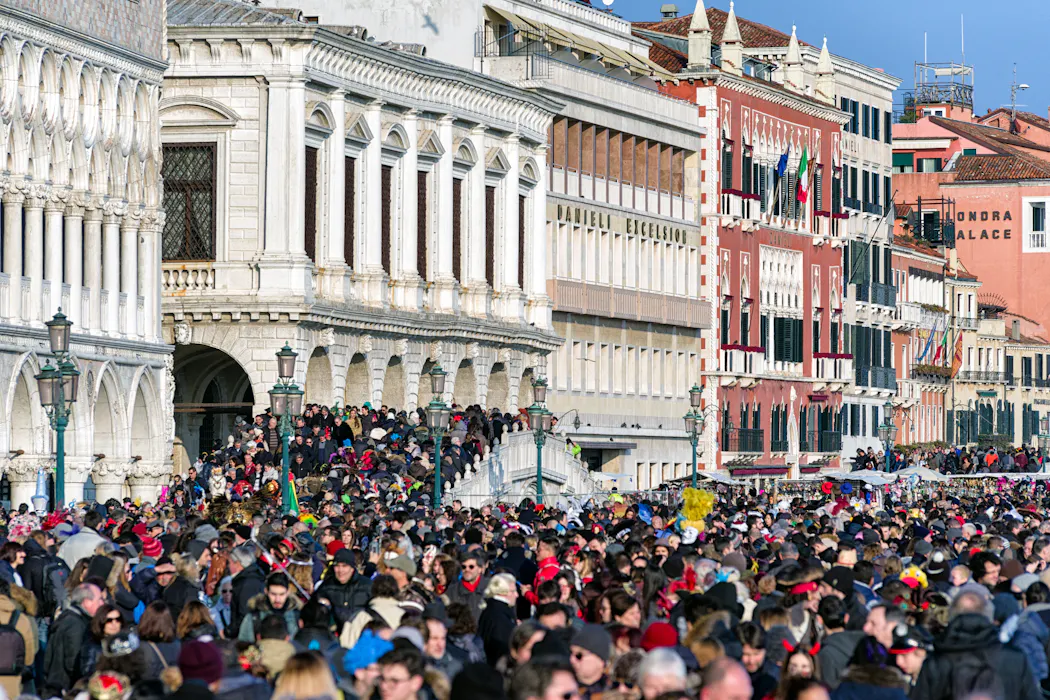
Los turistas inundan la Riva degli Schiavoni, en Venecia, incluido el famoso Puente de la Paja.Jaroslav Moravcik
En los últimos tiempos, diversos destinos turísticos han ido aplicando nuevas tarifas de entrada ante el aumento del número de visitantes. La más reciente fue Roma, que cobra por el acceso a las escalinatas de la Fontana di Trevi desde febrero de este año.
Dolce Vita (1960): en una Roma desierta, Anita Ekberg baila, maravillada, en la Fontana di Trevi. Fuente: FlixOlé, YouTube.
Turismo y precios tributarios
El sector turístico engloba el transporte, el alojamiento, el ocio y la restauración, que pagan los mismos impuestos que el resto de la economía: impuesto de sociedades, IRPF e IVA. Estos son impuestos generales del sistema tributario.
Pero también existen otros tributos creados para el turismo como la tasa de ocupación en alojamientos, la tasa de pasajeros de transporte o las cuotas de acceso en algunas actividades. Cada uno adopta una forma jurídica distinta, como impuesto, tarifa o precio público, según lo defina la ley.
Para regular el acceso a determinados espacios públicos (plazas, calles o parques) en momentos de saturación, algunas ciudades han empezado a cobrar por la entrada a lugares específicos. Este modelo recaudatorio, que surge para controlar la presión de los visitantes, genera polémica. Algunas personas temen que favorezca la privatización del espacio público, mientras que otras critican que pueda limitar la libertad de movimiento o generar discriminación económica.
Sin datos suficientes para valorarla con rigor, algunos expertos dudan de la capacidad de esta medida para reducir la presión turística sobre la ciudad. El gobierno local no busca frenar las llegadas sino redistribuirlas, evitar decisiones improvisadas y mejorar la habitabilidad de esta frágil ciudad. A ello se suma la campaña “Enjoy Respect Venice”, que retoma normas del reglamento de policía y seguridad urbana y las dirige a los visitantes.
Esta política se desarrolla dentro de espacios de prueba, llamados entornos regulatorios controlados (sandbox), que se inspiran en la legislación europea de inteligencia artificial (Reglamento 2024/1689). Permiten ensayar nuevas herramientas de gestión urbana antes de convertirlas en reglas permanente.
Roma, acceso simbólico a la Fontana de Trevi
En febrero de 2026 se implantó un pago de dos euros para acceder al área inmediata de la Fontana de Trevi, donde los visitantes suelen fotografiarse y lanzar monedas. Ese mes se registraron 229 896 visitantes y la recaudación ascendió a 435 194 euros. Los fondos se destinarán a financiar la entrada gratuita a los museos de Roma para sus residentes.
La plaza continúa siendo de acceso libre; únicamente el entorno más cercano a la fuente exige este pago simbólico. Su objetivo es ordenar las visitas y reducir la masificación, ya que, en temporada alta, la Fontana recibe 70 000 visitantes diarios y supera los 10 millones al año.
Las autoridades aplican medidas excepcionales cuando la presión pone en riesgo la conservación del espacio y la calidad de vida de los vecinos.
Microdesconcentración en el parque Güell
El Park Güell es un parque público barcelonés, obra del arquitecto Antonio Gaudí. Desde 2013, su zona monumental (famosa por su mirador con trencadís, la sala de columnas y la salamandra) tiene entrada y control de visitas. En 2024, el Ayuntamiento de Barcelona adoptó medidas para reducir la presión turística sobre los barrios colindantes (como La Salut, Carmel, Can Baró y Vallcarca). La más llamativa fue retirar la línea de autobús 116 de Google Maps y Apple Maps. Esta decisión redujo su uso por los turistas y permitió a los residentes recuperar este servicio público.
A esta acción se sumaron controles de tráfico, con cambios en las paradas de taxis. Además, la compra de entradas pasó a ser online. Las paradas de transporte mostraron avisos de “Todo vendido”. Acciones como éstas crean un modelo que actúa sobre el monumento, la movilidad y la experiencia del visitante.
Kioto, protegiendo sus barrios históricos
Otro caso es el barrio de Gion, en Kioto. Desde 2023 aplica medidas para proteger sus calles tradicionales, donde trabajan y viven las geishas y maikos. Algunas de estas medidas fueron restringir el acceso a los callejones residenciales y multar a los turistas por conductas inapropiadas.
Además, se limitaron algunas líneas de autobuses urbanos. En horas punta, varias de ellas se señalan como “sólo para residentes”. Con esta decisión se asegura la movilidad del vecindario y se reduce la presión del turismo sobre el transporte local.
La famosa tasa turística de pernoctación
La tasa turística suele referirse al impuesto que se aplica a las estancias. Este impuesto se cobra en hoteles, apartamentos, campings y casas rurales, y suele calcularse como una cantidad fija por persona y noche o como un porcentaje del precio del alojamiento. Su valor cambia según la categoría del hospedaje, su ubicación o la temporada.
A pesar de su popularidad, su implementación genera debate, pues puede afectar a la competitividad del destino al aumentar el coste del viaje. También plantea dudas sobre la equidad, porque suele aplicarse al alojamiento regulado. El no reglado o ilegal queda al margen.
En España, Cataluña fue la primera región en aplicarla, en 2012. Barcelona, además, destaca por su recargo municipal, el más alto del país. Baleares la aplica desde 2016 y Galicia desde 2025. La Coruña y Santiago también se han sumado. El País Vasco la activará en el transcurso de 2026 y el debate continúa en otras comunidades.
El impuesto invisible del transporte
Por último, la tasa de transporte o impuesto de salida afecta a quienes llegan o salen por un aeropuerto o puerto. Esta es prácticamente invisible para el turista porque está integrada en el precio del billete. Por este motivo, el viajero asume el coste antes de llegar al destino.
En algunos países, esta tasa se destina a fines sociales o de solidaridad. Su efecto es reducido porque factores como rutas, conectividad o atractivo pesan más en la decisión del viajero. Las aerolíneas, además, ajustan sus precios para mantener sus aviones llenos.
Respecto a América Latina, en su reunión anual de 2026, la Asociación Internacional de Transporte Aéreo (IATA por sus siglas en inglés) ha señalado que, aunque la región tiene potencial de crecimiento, también aplica una importante carga de tasas e impuestos: su peso sobre los precios de los billetes puede llegar a alcanzar el 29 % del total de su coste.
Medidas de choque
Estamos ante un amplio repertorio de medidas para afrontar la saturación urbana. Estas actuaciones abarcan desde códigos de conducta, campañas de sensibilización y reordenación de flujos, hasta reservas obligatorias, límites de aforo o pagos por acceso.
Las tarifas deben ser el último recurso y reservarse para situaciones excepcionales y de alta presión. El objetivo es evitar medidas duras cuando el problema aún admite soluciones suaves.
Para valorar estas políticas, es esencial entender la finalidad de cada modalidad fiscal, sea recaudatoria, reguladora o de prestacional. También es esencial reforzar la transparencia en la comunicación con residentes, visitantes y empresas turísticas.
Concepción Foronda Robles recibe fondos del proyecto de investigación e innovación aplicada “Turismo para los ciudadanos: Inteligencia para un turismo sostenible y participativo” (PPIT – FEDER- SOL2024-31731), cofinanciado por UE – Ministerio de Hacienda y Función Pública – Fondos Europeos – Junta de Andalucía – Consejería de Universidad, Investigación e Innovación.